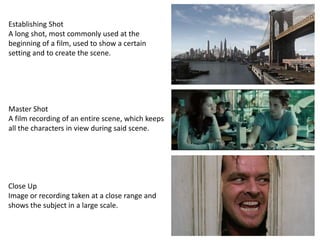
Establishing Shot
A long shot, most commonly used at the
beginning of a film, used to show a certain
setting and to create the scene.
Master Shot
A film recording of an entire scene, which keeps
all the characters in view during said scene.
Close Up
Image or recording taken at a close range and
shows the subject in a large scale.
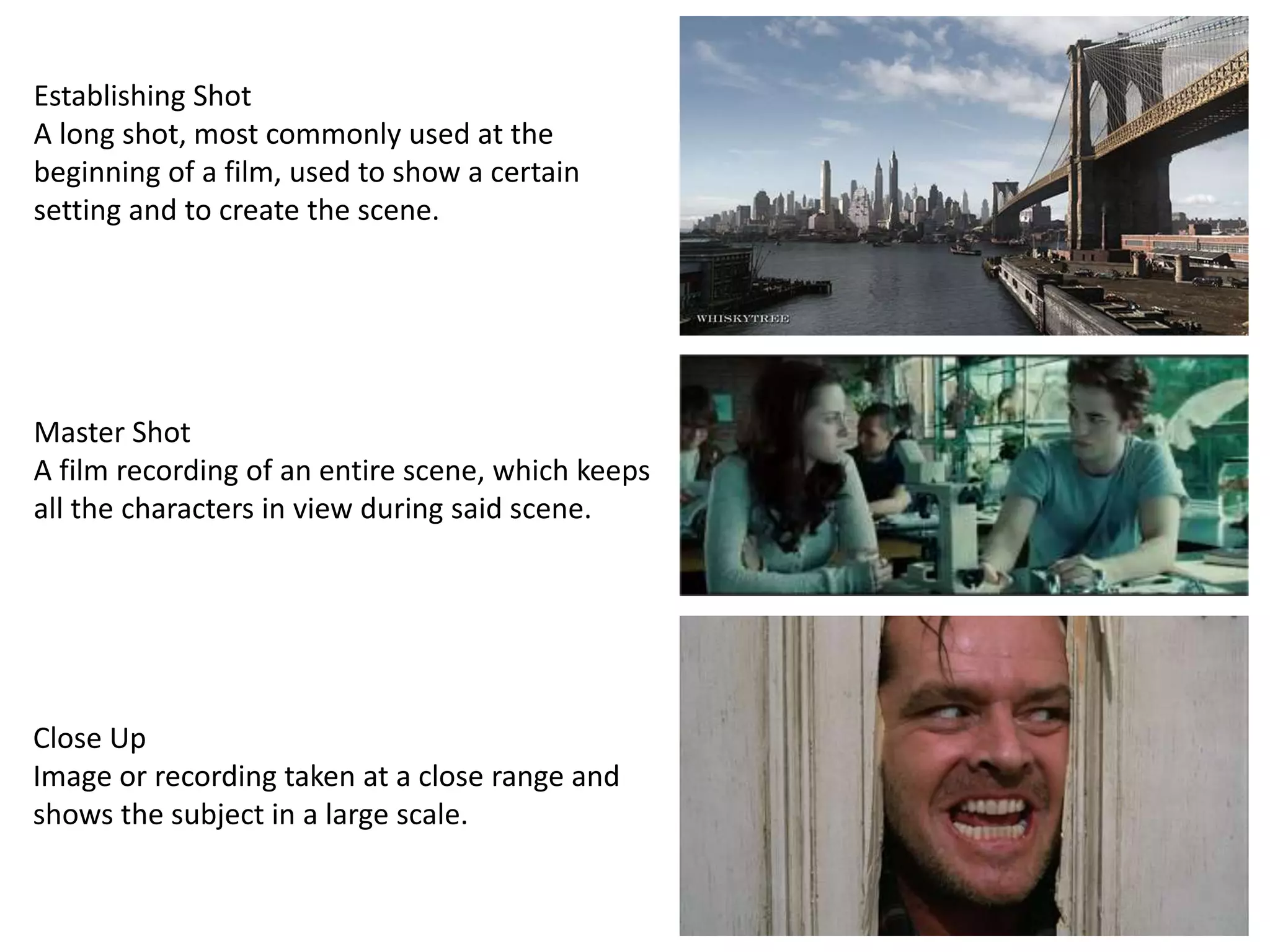
Extreme Close Up
A photograph or film recording shot
where the subject is shown in a
very large scale and is tightly
framed.
Mid Shot
A shot showing some
part of a subject in
more detail, whilst still
showing enough for
the audience to feel as
if they were looking at
the whole subject. It is
an approximation of
how you would see
someone in the flesh
if you were having a
conversation with
them.
Long shot
Often referred to as a ‘wide
shot’, shows a character who
is taking up almost the full
height of the frame. If it is
not a scene with a person in
then a long shot can also be
a wide shot of the whole
scene, putting the subjects in
their environment.
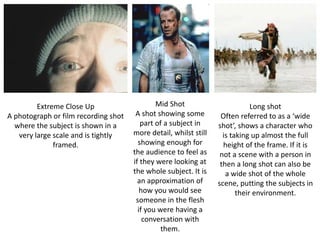
Wide Shot
Virtually the same as a long shot where the
character will take up almost the full height of
the frame. The should be a small amount of
room between each side of the frame and the
subjects body, this is known as safety room.
Two Shot
Simply a shot with two people in, often used to
portray their relationship.
Aerial Shot
An extremely high angle shot, usually taken
from a crane or high stationary point but is also
commonly taken from a plane or helicopter.
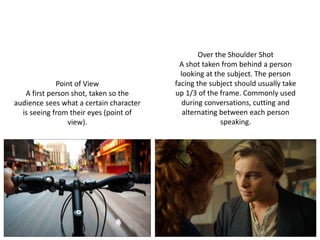
Point of View
A first person shot, taken so the
audience sees what a certain character
is seeing from their eyes (point of
view).
Over the Shoulder Shot
A shot taken from behind a person
looking at the subject. The person
facing the subject should usually take
up 1/3 of the frame. Commonly used
during conversations, cutting and
alternating between each person
speaking.

Camera angles

  • 1.
    Establishing Shot A longshot, most commonly used at the beginning of a film, used to show a certain setting and to create the scene. Master Shot A film recording of an entire scene, which keeps all the characters in view during said scene. Close Up Image or recording taken at a close range and shows the subject in a large scale.
  • 2.
    Extreme Close Up Aphotograph or film recording shot where the subject is shown in a very large scale and is tightly framed. Mid Shot A shot showing some part of a subject in more detail, whilst still showing enough for the audience to feel as if they were looking at the whole subject. It is an approximation of how you would see someone in the flesh if you were having a conversation with them. Long shot Often referred to as a ‘wide shot’, shows a character who is taking up almost the full height of the frame. If it is not a scene with a person in then a long shot can also be a wide shot of the whole scene, putting the subjects in their environment.
  • 3.
    Wide Shot Virtually thesame as a long shot where the character will take up almost the full height of the frame. The should be a small amount of room between each side of the frame and the subjects body, this is known as safety room. Two Shot Simply a shot with two people in, often used to portray their relationship. Aerial Shot An extremely high angle shot, usually taken from a crane or high stationary point but is also commonly taken from a plane or helicopter.
  • 4.
    Point of View Afirst person shot, taken so the audience sees what a certain character is seeing from their eyes (point of view). Over the Shoulder Shot A shot taken from behind a person looking at the subject. The person facing the subject should usually take up 1/3 of the frame. Commonly used during conversations, cutting and alternating between each person speaking.