11 Film Shots 
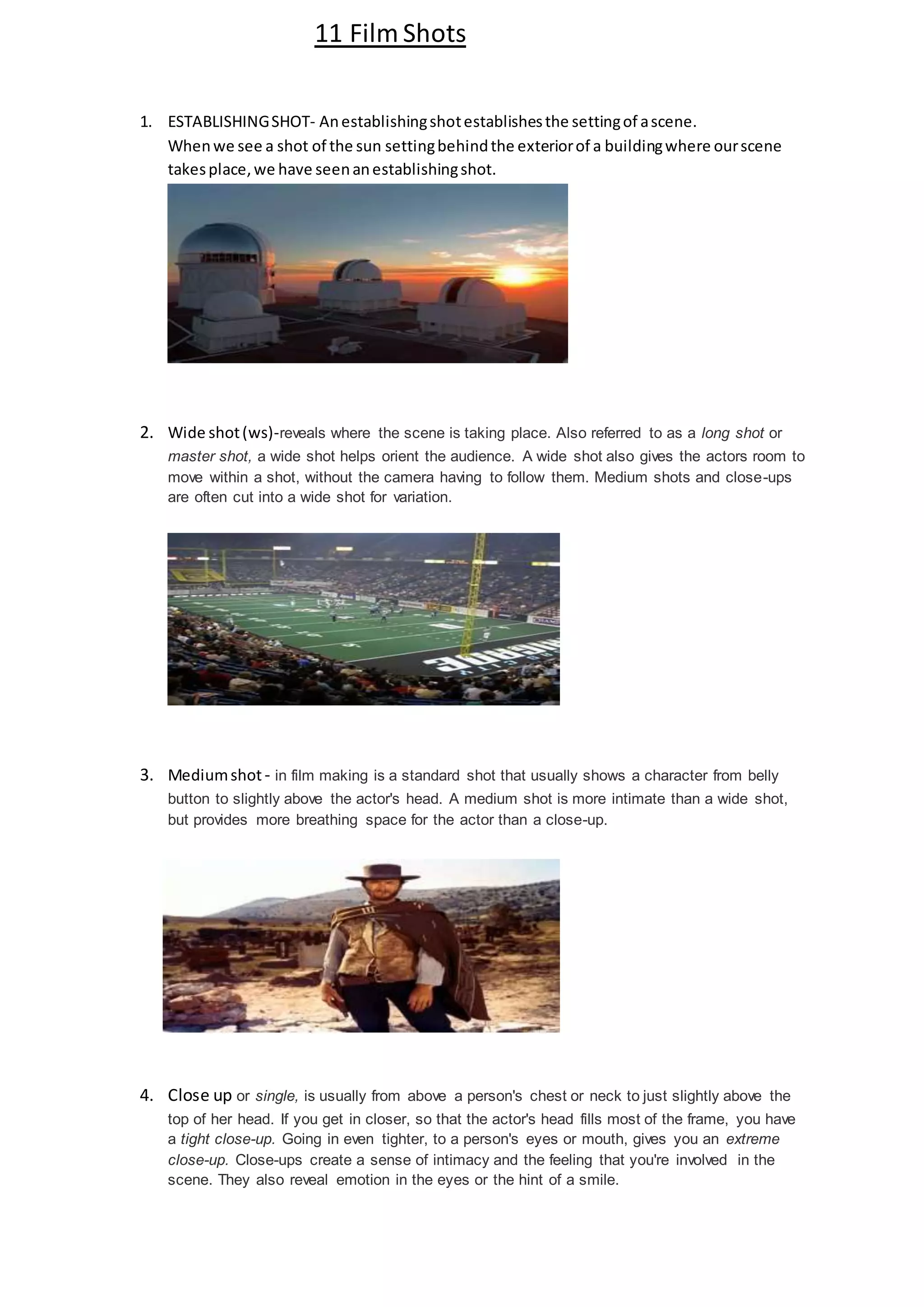
1. ESTABLISHING SHOT- An establishing shot establishes the setting of a scene. 
When we see a shot of the sun setting behind the exterior of a building where our scene 
takes place, we have seen an establishing shot. 
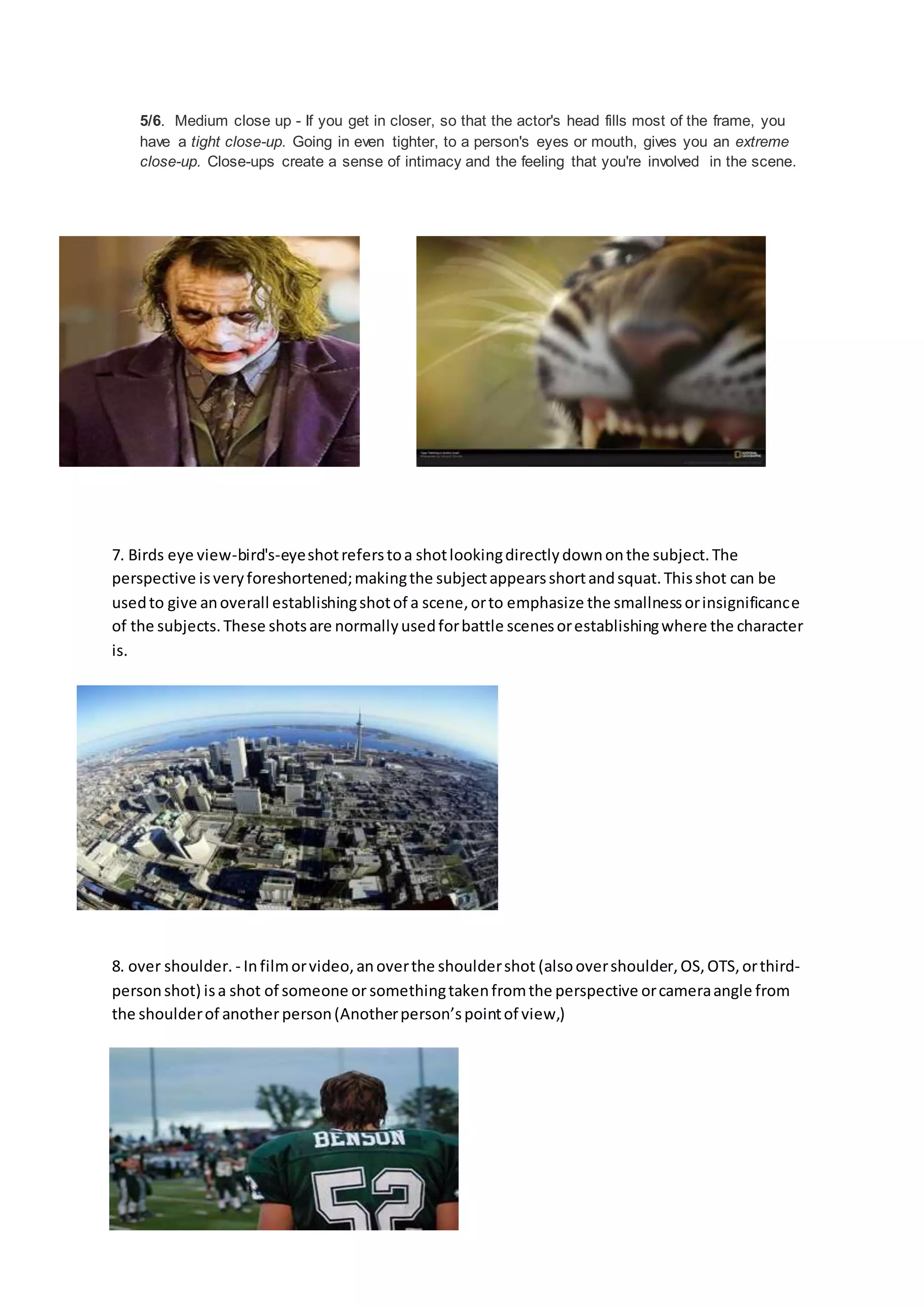
2. Wide shot (ws)-reveals where the scene is taking place. Also referred to as a long shot or 
master shot, a wide shot helps orient the audience. A wide shot also gives the actors room to 
move within a shot, without the camera having to follow them. Medium shots and close-ups 
are often cut into a wide shot for variation. 
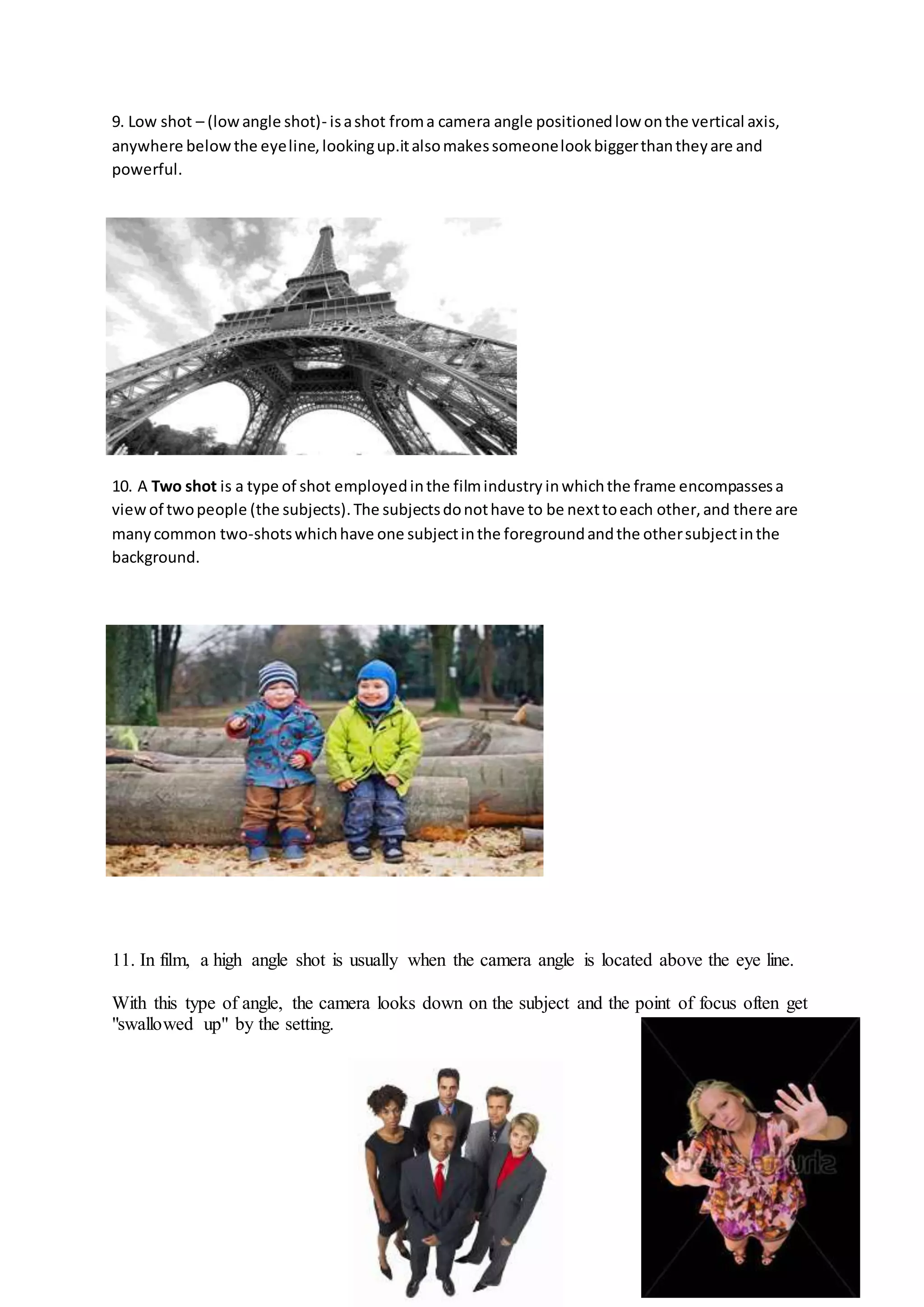
3. Medium shot - in film making is a standard shot that usually shows a character from belly 
button to slightly above the actor's head. A medium shot is more intimate than a wide shot, 
but provides more breathing space for the actor than a close-up. 
4. Close up or single, is usually from above a person's chest or neck to just slightly above the 
top of her head. If you get in closer, so that the actor's head fills most of the frame, you have 
a tight close-up. Going in even tighter, to a person's eyes or mouth, gives you an extreme 
close-up. Close-ups create a sense of intimacy and the feeling that you're involved in the 
scene. They also reveal emotion in the eyes or the hint of a smile.
5/6. Medium close up - If you get in closer, so that the actor's head fills most of the frame, you 
have a tight close-up. Going in even tighter, to a person's eyes or mouth, gives you an extreme 
close-up. Close-ups create a sense of intimacy and the feeling that you're involved in the scene. 
7. Birds eye view-bird's-eye shot refers to a shot looking directly down on the subject. The 
perspective is very foreshortened; making the subject appears short and squat. This shot can be 
used to give an overall establishing shot of a scene, or to emphasize the smallness or insignificance 
of the subjects. These shots are normally used for battle scenes or establishing where the character 
is. 
8. over shoulder. - In film or video, an over the shoulder shot (also over shoulder, OS, OTS, or third-person 
shot) is a shot of someone or something taken from the perspective or camera angle from 
the shoulder of another person (Another person’s point of view,)
9. Low shot – (low angle shot)- is a shot from a camera angle positioned low on the vertical axis, 
anywhere below the eye line, looking up.it also makes someone look bigger than they are and 
powerful. 
10. A Two shot is a type of shot employed in the film industry in which the frame encompasses a 
view of two people (the subjects). The subjects do not have to be next to each other, and there are 
many common two-shots which have one subject in the foreground and the other subject in the 
background. 
11. In film, a high angle shot is usually when the camera angle is located above the eye line. 
With this type of angle, the camera looks down on the subject and the point of focus often get 
"swallowed up" by the setting.

11 camera angles

  • 1.
    11 Film Shots 1. ESTABLISHING SHOT- An establishing shot establishes the setting of a scene. When we see a shot of the sun setting behind the exterior of a building where our scene takes place, we have seen an establishing shot. 2. Wide shot (ws)-reveals where the scene is taking place. Also referred to as a long shot or master shot, a wide shot helps orient the audience. A wide shot also gives the actors room to move within a shot, without the camera having to follow them. Medium shots and close-ups are often cut into a wide shot for variation. 3. Medium shot - in film making is a standard shot that usually shows a character from belly button to slightly above the actor's head. A medium shot is more intimate than a wide shot, but provides more breathing space for the actor than a close-up. 4. Close up or single, is usually from above a person's chest or neck to just slightly above the top of her head. If you get in closer, so that the actor's head fills most of the frame, you have a tight close-up. Going in even tighter, to a person's eyes or mouth, gives you an extreme close-up. Close-ups create a sense of intimacy and the feeling that you're involved in the scene. They also reveal emotion in the eyes or the hint of a smile.
  • 2.
    5/6. Medium closeup - If you get in closer, so that the actor's head fills most of the frame, you have a tight close-up. Going in even tighter, to a person's eyes or mouth, gives you an extreme close-up. Close-ups create a sense of intimacy and the feeling that you're involved in the scene. 7. Birds eye view-bird's-eye shot refers to a shot looking directly down on the subject. The perspective is very foreshortened; making the subject appears short and squat. This shot can be used to give an overall establishing shot of a scene, or to emphasize the smallness or insignificance of the subjects. These shots are normally used for battle scenes or establishing where the character is. 8. over shoulder. - In film or video, an over the shoulder shot (also over shoulder, OS, OTS, or third-person shot) is a shot of someone or something taken from the perspective or camera angle from the shoulder of another person (Another person’s point of view,)
  • 3.
    9. Low shot– (low angle shot)- is a shot from a camera angle positioned low on the vertical axis, anywhere below the eye line, looking up.it also makes someone look bigger than they are and powerful. 10. A Two shot is a type of shot employed in the film industry in which the frame encompasses a view of two people (the subjects). The subjects do not have to be next to each other, and there are many common two-shots which have one subject in the foreground and the other subject in the background. 11. In film, a high angle shot is usually when the camera angle is located above the eye line. With this type of angle, the camera looks down on the subject and the point of focus often get "swallowed up" by the setting.