Types of Shot
Research
1

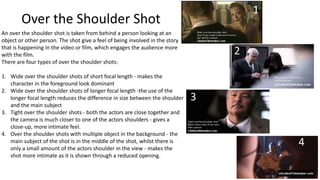
Over the Shoulder Shot
An over the shoulder shot is taken from behind a person looking at an
object or other person. The shot give a feel of being involved in the story
that is happening in the video or film, which engages the audience more
with the film.
There are four types of over the shoulder shots:
1. Wide over the shoulder shots of short focal length - makes the
character in the foreground look dominant
2. Wide over the shoulder shots of longer focal length -the use of the
longer focal length reduces the difference in size between the shoulder
and the main subject
3. Tight over the shoulder shots - both the actors are close together and
the camera is much closer to one of the actors shoulders - gives a
close-up, more intimate feel.
4. Over the shoulder shots with multiple object in the background - the
main subject of the shot is in the middle of the shot, whilst there is
only a small amount of the actors shoulder in the view - makes the
shot more intimate as it is shown through a reduced opening.

2

3

4
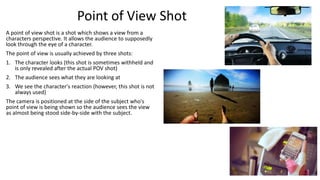
Point of View Shot
A point of view shot is a shot which shows a view from a
characters perspective. It allows the audience to supposedly
look through the eye of a character.
The point of view is usually achieved by three shots:
1. The character looks (this shot is sometimes withheld and
is only revealed after the actual POV shot)

2. The audience sees what they are looking at
3. We see the character's reaction (however, this shot is not
always used)
The camera is positioned at the side of the subject who's
point of view is being shown so the audience sees the view
as almost being stood side-by-side with the subject.
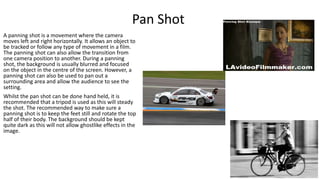
Pan Shot
A panning shot is a movement where the camera
moves left and right horizontally. It allows an object to
be tracked or follow any type of movement in a film.
The panning shot can also allow the transition from
one camera position to another. During a panning
shot, the background is usually blurred and focused
on the object in the centre of the screen. However, a
panning shot can also be used to pan out a
surrounding area and allow the audience to see the
setting.
Whilst the pan shot can be done hand held, it is
recommended that a tripod is used as this will steady
the shot. The recommended way to make sure a
panning shot is to keep the feet still and rotate the top
half of their body. The background should be kept
quite dark as this will not allow ghostlike effects in the
image.
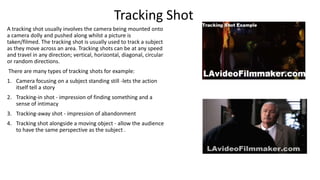
Tracking Shot
A tracking shot usually involves the camera being mounted onto
a camera dolly and pushed along whilst a picture is
taken/filmed. The tracking shot is usually used to track a subject
as they move across an area. Tracking shots can be at any speed
and travel in any direction; vertical, horizontal, diagonal, circular
or random directions.
There are many types of tracking shots for example:
1. Camera focusing on a subject standing still -lets the action
itself tell a story
2. Tracking-in shot - impression of finding something and a
sense of intimacy
3. Tracking-away shot - impression of abandonment
4. Tracking shot alongside a moving object - allow the audience
to have the same perspective as the subject .
1

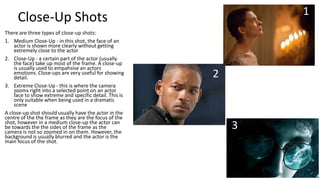
Close-Up Shots
There are three types of close-up shots:
1. Medium Close-Up - in this shot, the face of an
actor is shown more clearly without getting
extremely close to the actor
2. Close-Up - a certain part of the actor (usually
the face) take up most of the frame. A close-up
is usually used to empahsise an actors
emotions. Close-ups are very useful for showing
detail.
3. Extreme Close-Up - this is where the camera
zooms right into a selected point on an actor
face to show extreme and specific detail. This is
only suitable when being used in a dramatic
scene
A close-up shot should usually have the actor in the
centre of the the frame as they are the focus of the
shot, however in a medium close-up the actor can
be towards the the sides of the frame as the
camera is not so zoomed in on them. However, the
background is usually blurred and the actor is the
main focus of the shot.

2

3

Types of Shots Research

  • 1.
  • 2.
    1 Over the ShoulderShot An over the shoulder shot is taken from behind a person looking at an object or other person. The shot give a feel of being involved in the story that is happening in the video or film, which engages the audience more with the film. There are four types of over the shoulder shots: 1. Wide over the shoulder shots of short focal length - makes the character in the foreground look dominant 2. Wide over the shoulder shots of longer focal length -the use of the longer focal length reduces the difference in size between the shoulder and the main subject 3. Tight over the shoulder shots - both the actors are close together and the camera is much closer to one of the actors shoulders - gives a close-up, more intimate feel. 4. Over the shoulder shots with multiple object in the background - the main subject of the shot is in the middle of the shot, whilst there is only a small amount of the actors shoulder in the view - makes the shot more intimate as it is shown through a reduced opening. 2 3 4
  • 3.
    Point of ViewShot A point of view shot is a shot which shows a view from a characters perspective. It allows the audience to supposedly look through the eye of a character. The point of view is usually achieved by three shots: 1. The character looks (this shot is sometimes withheld and is only revealed after the actual POV shot) 2. The audience sees what they are looking at 3. We see the character's reaction (however, this shot is not always used) The camera is positioned at the side of the subject who's point of view is being shown so the audience sees the view as almost being stood side-by-side with the subject.
  • 4.
    Pan Shot A panningshot is a movement where the camera moves left and right horizontally. It allows an object to be tracked or follow any type of movement in a film. The panning shot can also allow the transition from one camera position to another. During a panning shot, the background is usually blurred and focused on the object in the centre of the screen. However, a panning shot can also be used to pan out a surrounding area and allow the audience to see the setting. Whilst the pan shot can be done hand held, it is recommended that a tripod is used as this will steady the shot. The recommended way to make sure a panning shot is to keep the feet still and rotate the top half of their body. The background should be kept quite dark as this will not allow ghostlike effects in the image.
  • 5.
    Tracking Shot A trackingshot usually involves the camera being mounted onto a camera dolly and pushed along whilst a picture is taken/filmed. The tracking shot is usually used to track a subject as they move across an area. Tracking shots can be at any speed and travel in any direction; vertical, horizontal, diagonal, circular or random directions. There are many types of tracking shots for example: 1. Camera focusing on a subject standing still -lets the action itself tell a story 2. Tracking-in shot - impression of finding something and a sense of intimacy 3. Tracking-away shot - impression of abandonment 4. Tracking shot alongside a moving object - allow the audience to have the same perspective as the subject .
  • 6.
    1 Close-Up Shots There arethree types of close-up shots: 1. Medium Close-Up - in this shot, the face of an actor is shown more clearly without getting extremely close to the actor 2. Close-Up - a certain part of the actor (usually the face) take up most of the frame. A close-up is usually used to empahsise an actors emotions. Close-ups are very useful for showing detail. 3. Extreme Close-Up - this is where the camera zooms right into a selected point on an actor face to show extreme and specific detail. This is only suitable when being used in a dramatic scene A close-up shot should usually have the actor in the centre of the the frame as they are the focus of the shot, however in a medium close-up the actor can be towards the the sides of the frame as the camera is not so zoomed in on them. However, the background is usually blurred and the actor is the main focus of the shot. 2 3