SHORT STATURE IN CHILDREN
DR.M.SUCINDAR
Definition
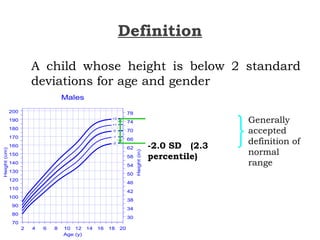
A child whose height is below 2 standard
deviations for age and gender
Males
Age (y)
30
34
38
42
46
50
54
58
62
66
70
74
78
Height(in)
Height(cm)
2 4 6 8 10 12 14 16 18 20
70
80
90
100
110
120
130
140
150
160
170
180
190
200
0
+2
+1
-1
-2
-2.0 SD (2.3
percentile)
Generally
accepted
definition of
normal
range
Definition
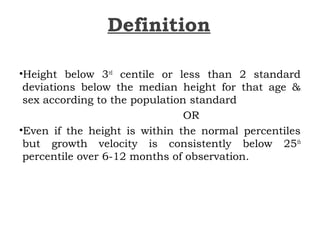
•Height below 3rd
centile or less than 2 standard
deviations below the median height for that age &
sex according to the population standard
OR
•Even if the height is within the normal percentiles
but growth velocity is consistently below 25th
percentile over 6-12 months of observation.
•The term ‘Dwarfism’ is no longer used for short
stature
•It should not be confused with FTT as it is
associated with greater impairment in wt.gain than
linear growth resulting in decresd W/H.& THE
LINEAR GROWTH affected is almost always
SECONDARY.
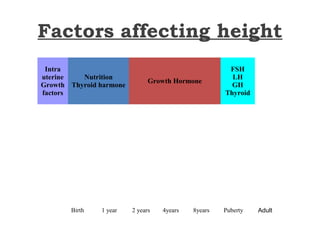
Factors affecting height
Intra
uterine
Growth
factors
Nutrition
Thyroid harmone
Growth Hormone
FSH
LH
GH
Thyroid
Birth 1 year 2 years 4years 8years Puberty Adult
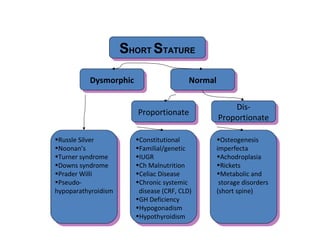
SHORT STATURESHORT STATURE
DysmorphicDysmorphic NormalNormal
•Russle Silver
•Noonan’s
•Turner syndrome
•Downs syndrome
•Prader Willi
•Pseudo-
hypoparathyroidism
•Russle Silver
•Noonan’s
•Turner syndrome
•Downs syndrome
•Prader Willi
•Pseudo-
hypoparathyroidism
ProportionateProportionate Dis-
Proportionate
Dis-
Proportionate
•Constitutional
•Familial/genetic
•IUGR
•Ch Malnutrition
•Celiac Disease
•Chronic systemic
disease (CRF, CLD)
•GH Deficiency
•Hypogonadism
•Hypothyroidism
•Constitutional
•Familial/genetic
•IUGR
•Ch Malnutrition
•Celiac Disease
•Chronic systemic
disease (CRF, CLD)
•GH Deficiency
•Hypogonadism
•Hypothyroidism
•Osteogenesis
imperfecta
•Achodroplasia
•Rickets
•Metabolic and
storage disorders
(short spine)
•Osteogenesis
imperfecta
•Achodroplasia
•Rickets
•Metabolic and
storage disorders
(short spine)
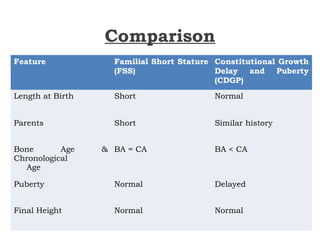
Comparison
Feature Familial Short Stature
(FSS)
Constitutional Growth
Delay and Puberty
(CDGP)
Length at Birth Short Normal
Parents Short Similar history
Bone Age &
Chronological
Age
BA = CA BA < CA
Puberty Normal Delayed
Final Height Normal Normal
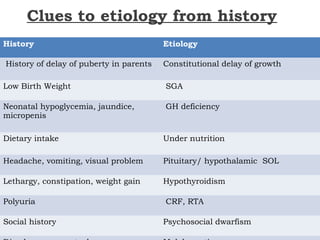
Clues to etiology from history
History Etiology
History of delay of puberty in parents Constitutional delay of growth
Low Birth Weight SGA
Neonatal hypoglycemia, jaundice,
micropenis
GH deficiency
Dietary intake Under nutrition
Headache, vomiting, visual problem Pituitary/ hypothalamic SOL
Lethargy, constipation, weight gain Hypothyroidism
Polyuria CRF, RTA
Social history Psychosocial dwarfism
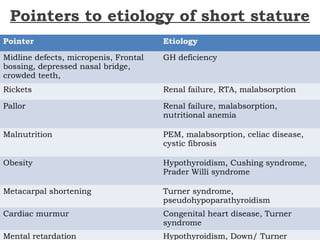
Pointers to etiology of short stature
Pointer Etiology
Midline defects, micropenis, Frontal
bossing, depressed nasal bridge,
crowded teeth,
GH deficiency
Rickets Renal failure, RTA, malabsorption
Pallor Renal failure, malabsorption,
nutritional anemia
Malnutrition PEM, malabsorption, celiac disease,
cystic fibrosis
Obesity Hypothyroidism, Cushing syndrome,
Prader Willi syndrome
Metacarpal shortening Turner syndrome,
pseudohypoparathyroidism
Cardiac murmur Congenital heart disease, Turner
syndrome
Mental retardation Hypothyroidism, Down/ Turner
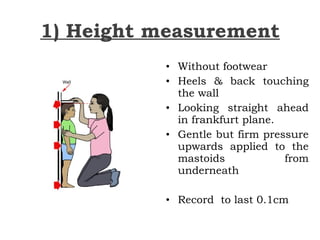
1) Height measurement
• Without footwear
• Heels & back touching
the wall
• Looking straight ahead
in frankfurt plane.
• Gentle but firm pressure
upwards applied to the
mastoids from
underneath
• Record to last 0.1cm
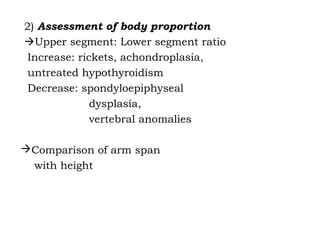
2) Assessment of body proportion
Upper segment: Lower segment ratio
Increase: rickets, achondroplasia,
untreated hypothyroidism
Decrease: spondyloepiphyseal
dysplasia,
vertebral anomalies
Comparison of arm span
with height
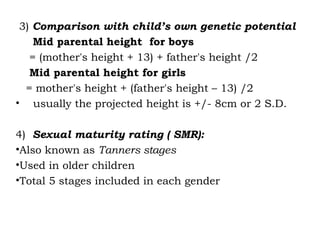
3) Comparison with child’s own genetic potential
Mid parental height for boys
= (mother's height + 13) + father's height /2
Mid parental height for girls
= mother's height + (father's height – 13) /2
• usually the projected height is +/- 8cm or 2 S.D.
4) Sexual maturity rating ( SMR):
•Also known as Tanners stages
•Used in older children
•Total 5 stages included in each gender
Investigation
Level 1 ( essential investigations):
• Complete hemogram with ESR, hepatic& renal profile- to
r/o chronic disease.
• BONE AGE (x ray of left wrist)
• Urinalysis ( Microscopy, pH, Osmolality)
• Stool ( parasites, steatorrhea, occult blood)
• Blood ( Calcium, Phosphate, alkaline phosphatase,
venous gas, fasting sugar, albumin, transaminases)
• karyotyping & pelvic u/s .
• Karyotype to rule out Turner syndrome in girls
If above investigations are normal and height
between -2 to -3 SD Observe height velocity for 6-
12 months
If height < 3SD level 2 investigations
BONE AGE (BA)
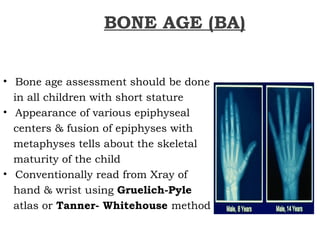
• Bone age assessment should be done
in all children with short stature
• Appearance of various epiphyseal
centers & fusion of epiphyses with
metaphyses tells about the skeletal
maturity of the child
• Conventionally read from Xray of
hand & wrist using Gruelich-Pyle
atlas or Tanner- Whitehouse method
What does bone age tell you?
• Skeletal maturity
• Correlates closely with SMR
• Speaks for remaining growth potential
• Helps in adult height prediction
• Bone age delay of more than 2 SD i.e. about 2
years is significant
Investigations Level II
• IGF-I
• IGF Binding protein 3
• Growth hormone and other dynamic stimulation
tests
• Neuroimaging
• These tests are best left for the specialised units
•Celiac serology ( anti- endomysial or anti- tissue
transglutaminase antibodies)
•Duodenal biopsy
•GH stimulation test with Clonidine or insulin & serum
insulin like GF-1 levels
Investigations Level III
Management
• Counselling of parents
( for physiological causes)
• Dietary advice
( Undernutrition, Celiac disease, RTA )
• Limb lengthening procedures
( skeletal dysplasias )
• Levothyroxine ( In Hypothyroidism)
• GH s/c injections ( GH deficiency, Turner
syndrome, SGA, CRF prior to transplant)
THANK YOU

Short stature Dr.M.Sucindar

  • 1.
    SHORT STATURE INCHILDREN DR.M.SUCINDAR
  • 2.
    Definition A child whoseheight is below 2 standard deviations for age and gender Males Age (y) 30 34 38 42 46 50 54 58 62 66 70 74 78 Height(in) Height(cm) 2 4 6 8 10 12 14 16 18 20 70 80 90 100 110 120 130 140 150 160 170 180 190 200 0 +2 +1 -1 -2 -2.0 SD (2.3 percentile) Generally accepted definition of normal range
  • 3.
    Definition •Height below 3rd centileor less than 2 standard deviations below the median height for that age & sex according to the population standard OR •Even if the height is within the normal percentiles but growth velocity is consistently below 25th percentile over 6-12 months of observation.
  • 4.
    •The term ‘Dwarfism’is no longer used for short stature •It should not be confused with FTT as it is associated with greater impairment in wt.gain than linear growth resulting in decresd W/H.& THE LINEAR GROWTH affected is almost always SECONDARY.
  • 5.
    Factors affecting height Intra uterine Growth factors Nutrition Thyroidharmone Growth Hormone FSH LH GH Thyroid Birth 1 year 2 years 4years 8years Puberty Adult
  • 6.
    SHORT STATURESHORT STATURE DysmorphicDysmorphicNormalNormal •Russle Silver •Noonan’s •Turner syndrome •Downs syndrome •Prader Willi •Pseudo- hypoparathyroidism •Russle Silver •Noonan’s •Turner syndrome •Downs syndrome •Prader Willi •Pseudo- hypoparathyroidism ProportionateProportionate Dis- Proportionate Dis- Proportionate •Constitutional •Familial/genetic •IUGR •Ch Malnutrition •Celiac Disease •Chronic systemic disease (CRF, CLD) •GH Deficiency •Hypogonadism •Hypothyroidism •Constitutional •Familial/genetic •IUGR •Ch Malnutrition •Celiac Disease •Chronic systemic disease (CRF, CLD) •GH Deficiency •Hypogonadism •Hypothyroidism •Osteogenesis imperfecta •Achodroplasia •Rickets •Metabolic and storage disorders (short spine) •Osteogenesis imperfecta •Achodroplasia •Rickets •Metabolic and storage disorders (short spine)
  • 7.
    Comparison Feature Familial ShortStature (FSS) Constitutional Growth Delay and Puberty (CDGP) Length at Birth Short Normal Parents Short Similar history Bone Age & Chronological Age BA = CA BA < CA Puberty Normal Delayed Final Height Normal Normal
  • 8.
    Clues to etiologyfrom history History Etiology History of delay of puberty in parents Constitutional delay of growth Low Birth Weight SGA Neonatal hypoglycemia, jaundice, micropenis GH deficiency Dietary intake Under nutrition Headache, vomiting, visual problem Pituitary/ hypothalamic SOL Lethargy, constipation, weight gain Hypothyroidism Polyuria CRF, RTA Social history Psychosocial dwarfism
  • 9.
    Pointers to etiologyof short stature Pointer Etiology Midline defects, micropenis, Frontal bossing, depressed nasal bridge, crowded teeth, GH deficiency Rickets Renal failure, RTA, malabsorption Pallor Renal failure, malabsorption, nutritional anemia Malnutrition PEM, malabsorption, celiac disease, cystic fibrosis Obesity Hypothyroidism, Cushing syndrome, Prader Willi syndrome Metacarpal shortening Turner syndrome, pseudohypoparathyroidism Cardiac murmur Congenital heart disease, Turner syndrome Mental retardation Hypothyroidism, Down/ Turner
  • 10.
    1) Height measurement •Without footwear • Heels & back touching the wall • Looking straight ahead in frankfurt plane. • Gentle but firm pressure upwards applied to the mastoids from underneath • Record to last 0.1cm
  • 11.
    2) Assessment ofbody proportion Upper segment: Lower segment ratio Increase: rickets, achondroplasia, untreated hypothyroidism Decrease: spondyloepiphyseal dysplasia, vertebral anomalies Comparison of arm span with height
  • 12.
    3) Comparison withchild’s own genetic potential Mid parental height for boys = (mother's height + 13) + father's height /2 Mid parental height for girls = mother's height + (father's height – 13) /2 • usually the projected height is +/- 8cm or 2 S.D. 4) Sexual maturity rating ( SMR): •Also known as Tanners stages •Used in older children •Total 5 stages included in each gender
  • 13.
    Investigation Level 1 (essential investigations): • Complete hemogram with ESR, hepatic& renal profile- to r/o chronic disease. • BONE AGE (x ray of left wrist) • Urinalysis ( Microscopy, pH, Osmolality) • Stool ( parasites, steatorrhea, occult blood) • Blood ( Calcium, Phosphate, alkaline phosphatase, venous gas, fasting sugar, albumin, transaminases) • karyotyping & pelvic u/s .
  • 14.
    • Karyotype torule out Turner syndrome in girls If above investigations are normal and height between -2 to -3 SD Observe height velocity for 6- 12 months If height < 3SD level 2 investigations
  • 15.
    BONE AGE (BA) •Bone age assessment should be done in all children with short stature • Appearance of various epiphyseal centers & fusion of epiphyses with metaphyses tells about the skeletal maturity of the child • Conventionally read from Xray of hand & wrist using Gruelich-Pyle atlas or Tanner- Whitehouse method
  • 16.
    What does boneage tell you? • Skeletal maturity • Correlates closely with SMR • Speaks for remaining growth potential • Helps in adult height prediction • Bone age delay of more than 2 SD i.e. about 2 years is significant
  • 17.
    Investigations Level II •IGF-I • IGF Binding protein 3 • Growth hormone and other dynamic stimulation tests • Neuroimaging • These tests are best left for the specialised units
  • 18.
    •Celiac serology (anti- endomysial or anti- tissue transglutaminase antibodies) •Duodenal biopsy •GH stimulation test with Clonidine or insulin & serum insulin like GF-1 levels Investigations Level III
  • 19.
    Management • Counselling ofparents ( for physiological causes) • Dietary advice ( Undernutrition, Celiac disease, RTA ) • Limb lengthening procedures ( skeletal dysplasias ) • Levothyroxine ( In Hypothyroidism) • GH s/c injections ( GH deficiency, Turner syndrome, SGA, CRF prior to transplant)
  • 20.