SHORT STATURE
NUR IZZATUL NAJWA -36
NUR FARRA NAJWA -35
LEARNING OBJECTIVES
• DEFINE SHORT STATURE
• KNOW THE ASSESSMENT OF SHORT STATURE
• CLASSIFY SHORT STATURE BASED ON ETIOLOGY
• DESCRIBE EACH TYPES OF SHORT STATURE
• UNDERSTAND THE DIFFERENTIAL DIAGNOSIS OF
SHORT STATURE
• ENUMERATE THE MANAGEMENT OF SHORT
STATURE
• APPROACH TO THE CASE SCENARIO
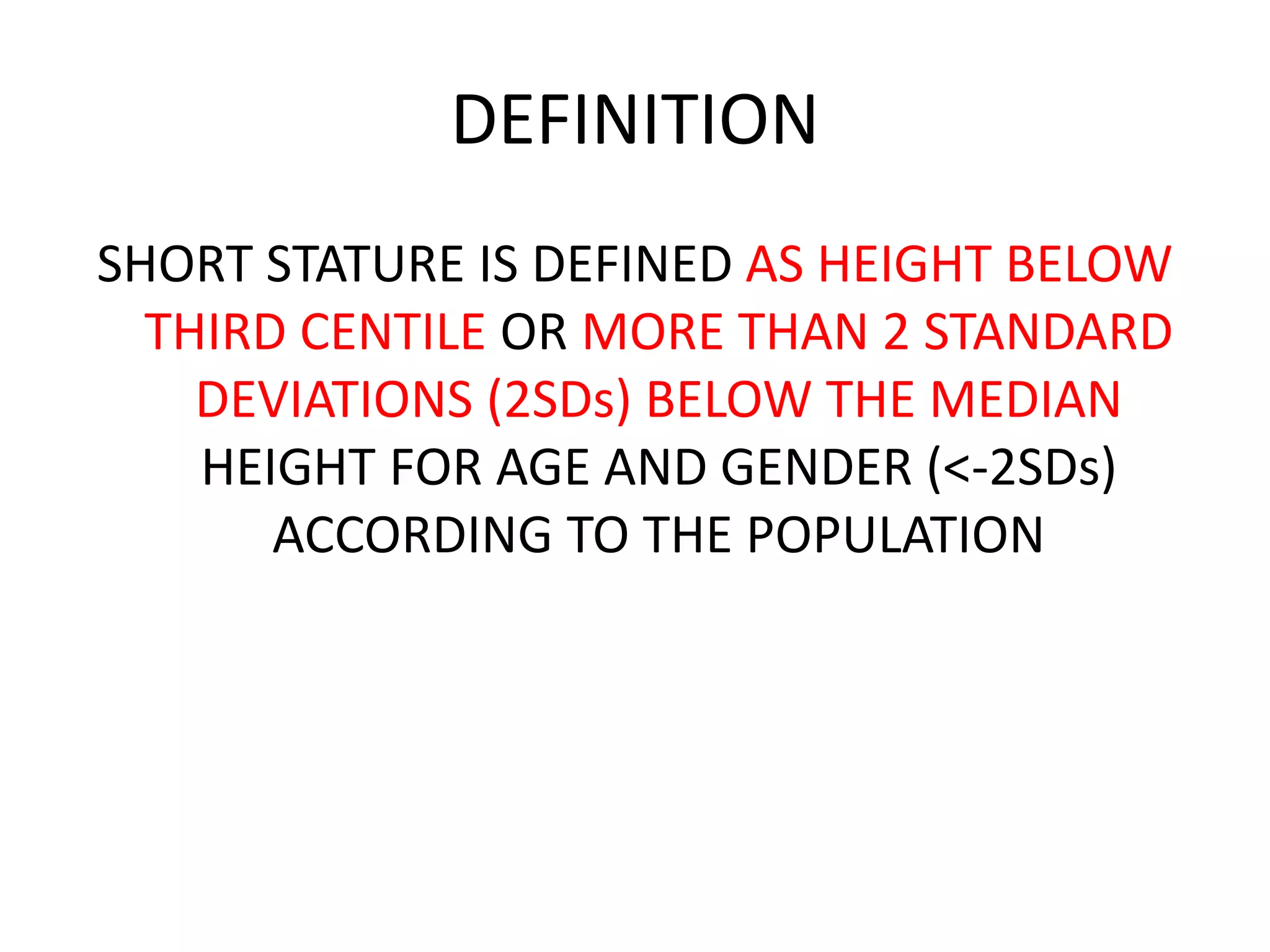
DEFINITION
SHORT STATURE IS DEFINED AS HEIGHT BELOW
THIRD CENTILE OR MORE THAN 2 STANDARD
DEVIATIONS (2SDs) BELOW THE MEDIAN
HEIGHT FOR AGE AND GENDER (<-2SDs)
ACCORDING TO THE POPULATION
CHART
TABLE
ASSESMENT TO SHORT STATURE
1. ACCURATE HEIGHT MEASUREMENT
2. ASSESSMENT OF HEIGHT VELOCITY
3. COMPARISON WITH POPULATION NORMS
4. COMPARISON WITH CHILD’S OWN GENETIC POTENTIAL
5. ASSESSMENT OF BODY PROPORTION
6. SEXUAL MATURITY RATING (SMR)
1. ACCURATE HEIGHT MEASUREMENT
ABOVE 2 YEARS
• Using stadiometer
• Standing upright which
heels, buttocks,
shoulder blades and
back of heads are in
contact with vertical
surface
• Head piece is kept
firmly over the head to
compress
BELOW 2 YEARS
• Using infantometer or
measuring table
• Holding the infant
straight on horizontal
board in supine position
• Knees and legs keep
straight
• Bulky diapers, harpin,
braids, are removed!
2. ASSESSMENT OF HEIGHT VELOCITY
• Rate of increase in height over a period of
time expressed as cm/year
AGE AVERAGE OF HEIGHT
VELOCITY
1ST YEAR 25cm/yr
4-9 year ( prepubertal children) 4-6cm/yr
During puberty 10-12cm/yr
• If the velocity is lower than expected age,
child is suffering from pathological stature
3. COMPARISON WITH POPULATION
NORMS
• Height must be plotted on
growth chart and
expressed in centiles or
standard deviation score
4. COMPARISON WITH CHILD’S OW
GENETIC POTENTIAL
• Parents height affects child’s height
• Estimation of child’s genetic potential is by mid parental
height (MPH)
• Value is plotted on chart to observe whether the target will
be reached or not
MPH BOYS = MOTHER’S + FATHER’S HEIGHT (CM) + 6.5CM
2
MPH GIRLS = MOTHER’S + FATHER’S HEIGHT (CM) - 6.5CM
2
5. ASSESSMENT OF BODY
PROPORTION
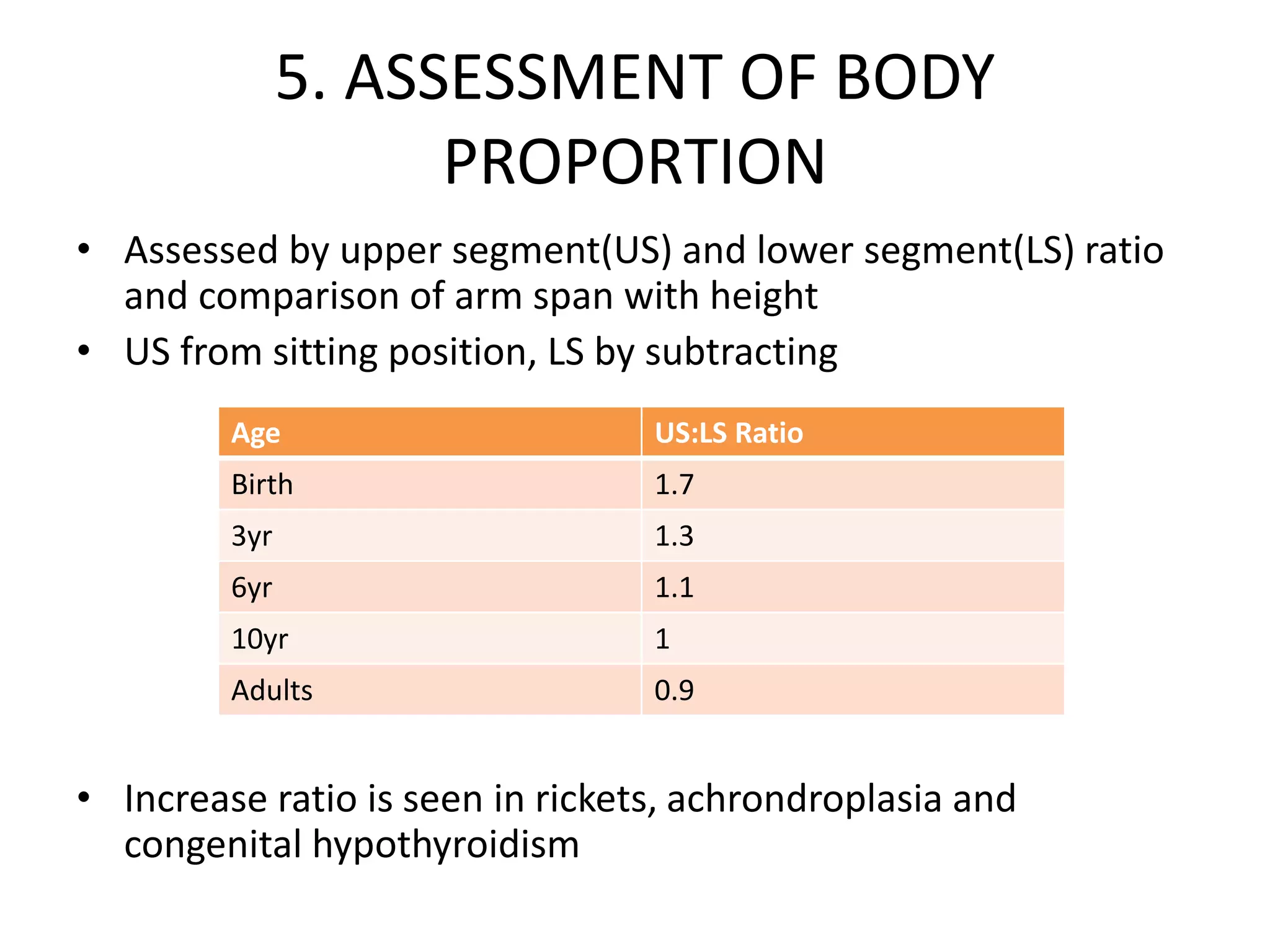
• Assessed by upper segment(US) and lower segment(LS) ratio
and comparison of arm span with height
• US from sitting position, LS by subtracting
• Increase ratio is seen in rickets, achrondroplasia and
congenital hypothyroidism
Age US:LS Ratio
Birth 1.7
3yr 1.3
6yr 1.1
10yr 1
Adults 0.9
6. SEXUAL MATURITY RATE (SMR)
• Assessed in older age children
• Also known as Tanner stage with 5 stages according to gender
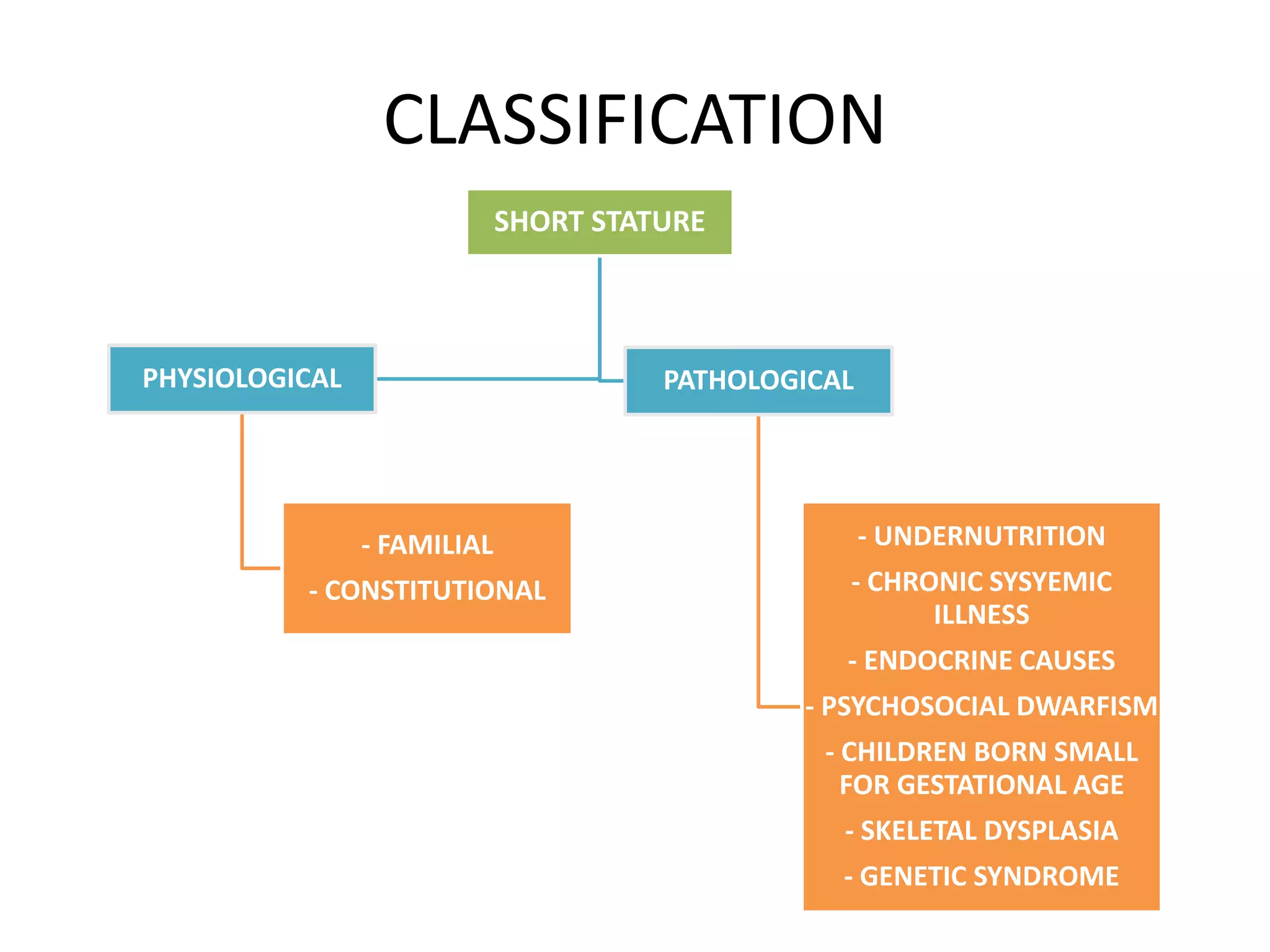
CLASSIFICATION
SHORT STATURE
PHYSIOLOGICAL
- FAMILIAL
- CONSTITUTIONAL
PATHOLOGICAL
- UNDERNUTRITION
- CHRONIC SYSYEMIC
ILLNESS
- ENDOCRINE CAUSES
- PSYCHOSOCIAL DWARFISM
- CHILDREN BORN SMALL
FOR GESTATIONAL AGE
- SKELETAL DYSPLASIA
- GENETIC SYNDROME
PHYSIOLOGICAL SHORT
STATURE
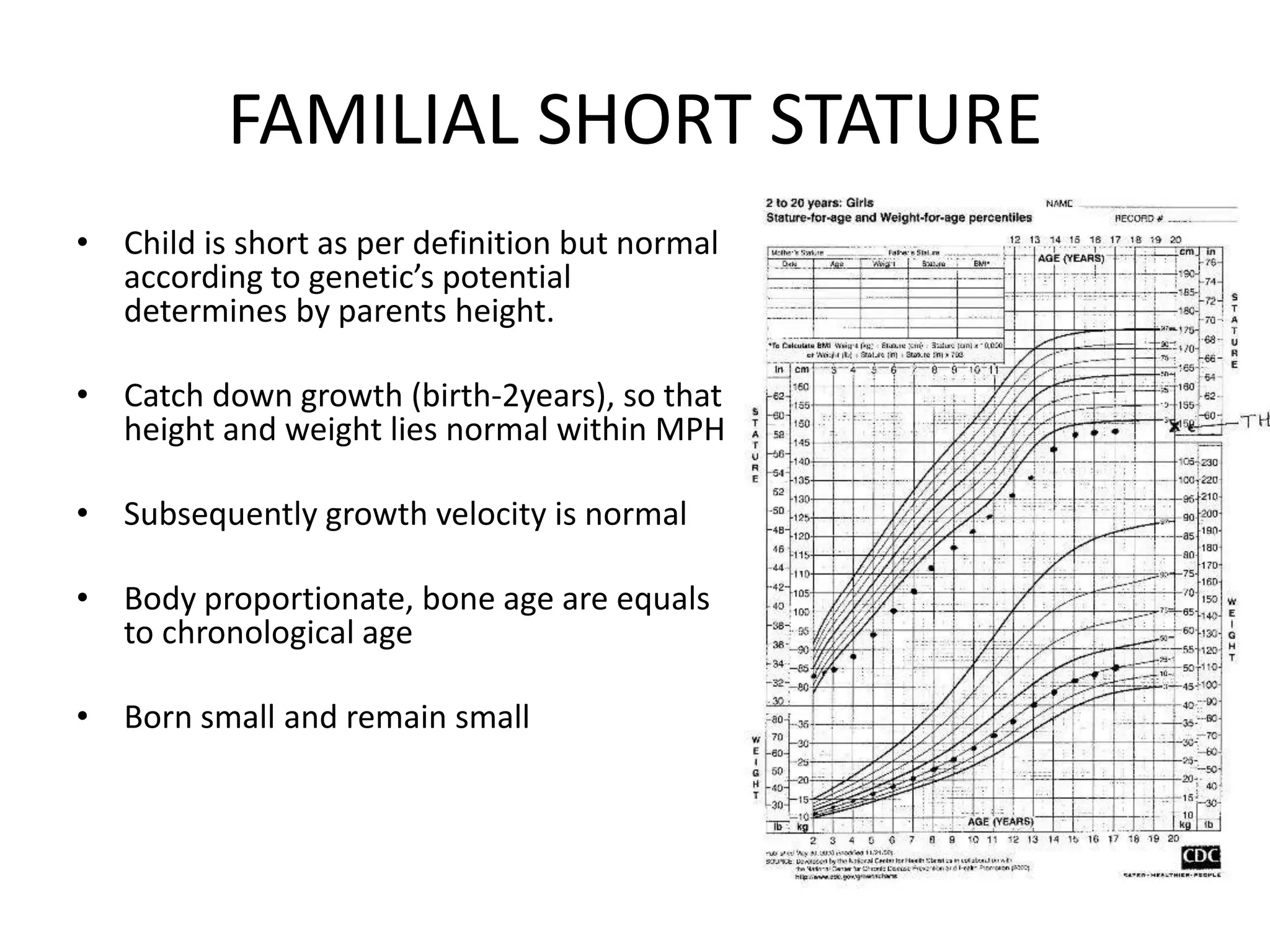
FAMILIAL SHORT STATURE
• Child is short as per definition but normal
according to genetic’s potential
determines by parents height.
• Catch down growth (birth-2years), so that
height and weight lies normal within MPH
• Subsequently growth velocity is normal
• Body proportionate, bone age are equals
to chronological age
• Born small and remain small
CONSTITUTIONAL SHORT STATURE
(IDIOPATHIC)
• Born with normal height and weight
for first 6-12 months of life
• Then shows deceleration
• By 3yr of age, normal height velocity
is resumed and continue to grow
just below or parallel to 3rd centile
• Onset of puberty and adolescent
growth is delayed, but final height is
normal
• Bone age is lower than chronological
age
• History of delayed puberty from one
or both parents
DISTINCTION BETWEEN FAMILIAL AND CONSTITUTIONAL SHORT STATURE
FEATURE FAMILIAL CONSTITUTIONAL
GROWTH DELAY
HEIGHT SHORT SHORT
HEIGHT VELOCITY NORMAL NORMAL
FAMILY HISTORY SHORT STATURE DELAYED PUBERTY
BONE AGE NORMAL LESS THAN
CHRONOLOGICAL AGE
PUBERTY NORMAL DELAYED
FINAL HEIGHT LOW BUT NORMAL FOR
TARGET HEIGHT
NORMAL
PATHOLOGICAL SHORT
STATURE
UNDERNUTRITION
• Stunted growth due to chronic undernutrition
• Detailed diet history and US:LS can suggest
the diagnosis
• Eg : Kwashiorkor
ENDOCRINE
• Growth hormone deficiency, insensitivity
• Hypothyroidism
• Cushing syndrome
• Pseudohypothyroidism
• Precocious or delayed puberty
SKELETAL DYSPLASIA
• Inborn error in the formation
of bone and cartilage
• Can be sporadic or inherited
• Associated with abnormal
skeletal proportion ans severe
short stature (except
hypchondroplasia)
Warwick
Davis
GENETIC SYNDROMES
• Turner syndrome ( 1:2000 live birth)
• Down syndrome
• Prader- Willi syndrome
• Russell-Silver syndrome
PSYCHOSOCIAL DWARFISM
• Also known as emotional deprivation
dwarfism, maternal deprivation dwarfism or
hyperphagic short stature
• Seen in children with unhappy homes
• Characterized by functional hypopituitarism
indicated by low IGF-1 and inadequate
response of GH stimulation
• Need to be nurtured with love and affection
CHILDREN BORN SMALL FOR
GESTATIONAL AGE ( SGA)
• Birthweight below the 10th centile for gestational age
can be caused by maternal, placetal or fetal factor
• Most of them shows catch up at age of 2yrs
• 20-30% of babies born SGA fail to show improvement
and remain short
• Subtle defect in growth hormone and insulin like
growth hormone ( GH-IGF) axis are considered
responsible
DIFFERENTIAL
DIAGNOSIS
CLUES TO ETIOLOGY OF SHORT STATURE FROM HISTORY
HISTORY ETIOLOGY
LOW BIRTHWEIGHT SMALL FOR GESTATIONAL AGE
POLYURIA CHRONIC RENAL FAILURE, RENAL
TUBULAR ACIDOSIS
CHRONIC DIARRHEA, GREASY STOOLS MALABSORPTION
NEONATAL HYPOGLYCEMIA,
JAUNDICE
HYPOPITUITARISM
HEADACHE, VOMITING, VISUAL
PROBLEM
PITUITARY
LETHARGY, CONSTIPATION, WEIGHT
GAIN
HYPOTHYROIDISM
INADEQUATE DIETARY INTAKE UNDERNUTRITION
SOCIAL HISTORY PSYCHOSOCIAL DWARFISM
DELAYED PUBERTY IN PARENTS CONSTITUTIONAL DELAY OF GROWTH
AND PUBERTY
CLUES TO ETIOLOGY OF SHORT STATURE FROM EXAMINATION
EXAMINATION FINDING ETIOLOGY
DISPROPORTION SKELETAL DYSPLASIA, RICKETS,
HYPOTHYROIDISM
DYSMORPHISM CONGENITAL SYNDROMES
PALLOR CHRONIC ANAEMIA, CHRONIC RENAL
FAILURE
HYPERTENSION CHRONIC RENAL FAILURE
FRONTAL BOSSING, DEPRESSED NASAL
BRIDGE, CROWDED TEETH, SMALL PENIS
HYPOPIUITARISM
CENTRAL OBESITY, STRIAE CUSHING SYNDROME
MANAGEMENT
• GENERAL
– Counseling of parents
– Dietary advice
• SPECIFIC
– Physiological : reassurance, annual monitoring of
height and weight, dietary rehabilition
– Pathological : limb lengthening procedure for
skeltal dysplasia, levothyroxine replacement, daily
subcutaneous injection of growth hormone
CASE SCENARIO
CASE APPROACHES
• A 8 year old boy, parents complains that he is the
shortest boy in his class.
• He has a normal past medical history and although
always a bit small for his current age, he noticed that
he has fallen behind his peer in the last 2 years.
• He is at the 3rd percentile for height.
• His father began puberty at age of the 16 and complete
his growth at the age of 19, he is now 6 feet.
• His mother began pubertal development at the age of
13, her height is 5 feet.
HISTORY TAKING
Presenting a case of, an eight year old boy, named
Shankar, sex- male, religion- hindu, born on
22/4/2009
• Shankar
• 8 year old
• Male
• Hindu
• Weight : 30kg
• Height : 110cm
CHIEF COMPLAIN
• Fallen behind his peer in the last 2 years.
HISTORY OF PRESENTING ILLNESS
• Shankar a 8 year old boy is lagging behind compared to his
peers of same ages for 2 year, he also had difficulty to play
together with them.
• His clothes also still the same for past 2 years and not
outwear.
• He also the shortest child in his classroom.
• Friend also make fun of him of his height.
• His academic performances and appetite is normal .
• Recently during fitness checkup at school, his height is
110cm and referred to nearest hospital.
PAST HISTORY
• Before 2015, he was having normal growth, as
mother say there is a change is clothing size in
average 3 to 4 times since birth and can catch up
with friends with his age.
• Last time his shoe size change when he was 6
• No history of congenital heart diseases,
gastrointestinal disease such as celiac diseases,
inflammatory bowel diseases and no history of
renal diseases
• No history of any surgical procedure
FAMILY HISTORY
• He is the only son of a non consanginuine marriage
between a 40 year old father and
34 old mother.
• Father’s family had history of down syndrome,
which is father’s sister
• No family history of congenital anomalies
Cont.
• Fathers was diagnosed with constitutional short
stature during his childhood, as on examination
his bone age is lower than his chronological age
and had attained puberty by age 16 ( delayed
puberty)
• Currently father height is normal that is 160 cm
for typical Asian man
• Mother was normal in height for typical Asian
women that is 145 cm, and shes been diagnosed
with diabetes mellitus at age of 30
BIRTH HISTORY
Antenatal
• She was a booked case
• Pregnancy was normal
• She is having pregnancy induce hypertension
during last trimester but resolve after delivery
• All routine check up was done and also
ultrasonography
• She taking Iron Folic Acid supplement
• She received TT injection
Cont.
Natal
• Mode of delivery is normal
• Baby is born on term (37-41 weeks)
• Baby cries soon after birth
• Length and weight is normal
(length = 52 cm, weight = 3 kg)
• normal head circumference
(32 cm)
• No history of asphyxia recorded
Postnatal
• There is history of admission to NICU for jaundice
for 2 days
• But no history of neonatal hypoglycemia or
prolonged jaundice or cyanosis or fever
convulsion
• Baby was breast feed after 3 hours for 15-30
minutes with gap of 3 hours after discharge from
NICU
• During NICU stay there is mixed breast milk with
formula milk for 2 days.
Immunization history
• The immunization schedule is up to date
DEVELOPMENTAL HISTORY
• Boy start to stand when he is 1 year old
• He start to walk when he 2 and a half year
• He start to speak at age of 4 year
• All milestone was up to date to his age
Diet history
Breakfast Idly (1)
Milk (100ml)
50kcal
67kcal
2g
3.3g
Lunch Rice (100 gram)
Paneer
Vegetables
Banana
Egg
111kcal
64kcal
35kcal
105kcal
70kcal
2.2g
4g
3g
1.29g
6g
Dinner Rice (100g)
Curd
Vegetables
Egg
111kcal
67kcal
105kcal
70kcal
2.2g
3.3g
1.2g
6g
Snack Biscuit 132kcal 1g
Total calorie:
987kcal
Total protein:
35.49g
Weight of child is 20kg
Calorie requirement
• 10kg = 1000kcal
• 10kg = 500kcal
• Total needed = 1500kcal
• Calorie deficit =
513 kcal
Protein requirement
• 20kg x 1.5g/kg/day
= 30 g/ day
• Protein deficit =
5.49g/day
SOCIOECONOMIC HISTORY
Mothers
• Name : Sumitha
• Age : 34
• Occupation : teacher
• Education : degree
Father
• Name : Sharhul
• Age : 40
• Occupation : businessman
• Education : diploma
Income = 15000 / month
Income per capita = 5000/ person
Kuppuswamy score : education : graduate (6)
businessmen : (6)
income : (10)
Total score : 22 from upper middle
Cont.
• They live in a pukka house, embassy height apartment
with 1 hall, 3 bedroom, kitchen(gas) and attached
bathroom
• 3 person in a home with good ventilation and lighting
• Waste product are manage properly, sources of water
is from filter
• No pets no smoker in family
• Living environment is far from main city and housing
area is well equip with facilities such as playground for
child and small lake for elderly activities.
SUMMARY
This is a case of an 8 year old boy, whose brought by mother
with complain of growth lagging 2 year behind his peer. He
was born with normal weight, length, head measurement and
non other congenital anomalies seen.
At 8 year, his height is below normal compared to other child
but has no difficulty in learning. The child was healthy and
active.
Family history was normal except there is history for delayed
puberty in fathers.
Cont.
• Development is up to date and the socioeconomic is
upper middle according to kuppuswamy scale.
• Immunization is up todate based on IAP schedule
however he has calorie deficit by 513kcal and protein
execess by 5.49g.
PROVISIONAL DIAGNOSIS
• Constitutional short stature
• Pathological short stature probably due to
genetics
PHYSICAL EXAMINATION
• Weight measurement : 20 kg
• Height measurement : 110 cm
• Ratio of US:LS = 1:1
• Normal systemic examination
• Normal facial features
• H/A > W/A, but both below chronological ages
( thin/short )
GENERAL EXAMINATION
Anthropometry
• Height : 110 cm (between 3rd – 15th percentile)
• Weight : 20 kg
• MPH : mother’s height + father’s height + 6.5 cm
= 152 + 182 + 6.5
= 173.5 cm
SMR : tanner stage ( not done, will be assessed next
checkup – older child)
2
2
COUNSELLING
• GENERAL
- Parent should be explain about the situation of the child,
that everything about their child is normal for his
condition.
- Emphasizes to parent more on the child diet so it is
planned to meet with his age requirement to support his
growth and development by suggesting what
combination of diet is good.
- Advised the parent on the personality building of child
despite of worrying about his stature, this can help him
to catch up with his peers.
Cont.
• SPECIFIC
- Reassure the parents that the child height will be
normal when he reached for puberty. They can
be advised to always monitor the child height and
weight, if he reached the target height , with the
help of physician.
- Suggest the best treatment needed which is
affordable for parents, explain all the pros and
cons and explain also the complication that may
arise from the treatment.
Q & A
• How short stature is define?
• How to assess short stature?
• Under short stature classification of pathological,
children born small for gestational age (SGA) is ?
• Explain the general management of short stature
and perform it?
• For the cases scenario, which is the most
significant issue that point to constitutional short
stature?
REFERENCES
• Ghai, Essential Pediatric, Eight Edition
• Clinical Pediatrics,Aruchamy
Lakshmanaswamy
• https://www.ncbi.nlm.nih.gov/pmc/articles/P
MC4028640/
• http://emedicine.medscape.com/article/9244
11-clinical
Short stature
Short stature

Short stature

  • 1.
    SHORT STATURE NUR IZZATULNAJWA -36 NUR FARRA NAJWA -35
  • 2.
    LEARNING OBJECTIVES • DEFINESHORT STATURE • KNOW THE ASSESSMENT OF SHORT STATURE • CLASSIFY SHORT STATURE BASED ON ETIOLOGY • DESCRIBE EACH TYPES OF SHORT STATURE • UNDERSTAND THE DIFFERENTIAL DIAGNOSIS OF SHORT STATURE • ENUMERATE THE MANAGEMENT OF SHORT STATURE • APPROACH TO THE CASE SCENARIO
  • 3.
    DEFINITION SHORT STATURE ISDEFINED AS HEIGHT BELOW THIRD CENTILE OR MORE THAN 2 STANDARD DEVIATIONS (2SDs) BELOW THE MEDIAN HEIGHT FOR AGE AND GENDER (<-2SDs) ACCORDING TO THE POPULATION
  • 4.
  • 5.
  • 6.
    ASSESMENT TO SHORTSTATURE 1. ACCURATE HEIGHT MEASUREMENT 2. ASSESSMENT OF HEIGHT VELOCITY 3. COMPARISON WITH POPULATION NORMS 4. COMPARISON WITH CHILD’S OWN GENETIC POTENTIAL 5. ASSESSMENT OF BODY PROPORTION 6. SEXUAL MATURITY RATING (SMR)
  • 7.
    1. ACCURATE HEIGHTMEASUREMENT ABOVE 2 YEARS • Using stadiometer • Standing upright which heels, buttocks, shoulder blades and back of heads are in contact with vertical surface • Head piece is kept firmly over the head to compress BELOW 2 YEARS • Using infantometer or measuring table • Holding the infant straight on horizontal board in supine position • Knees and legs keep straight • Bulky diapers, harpin, braids, are removed!
  • 8.
    2. ASSESSMENT OFHEIGHT VELOCITY • Rate of increase in height over a period of time expressed as cm/year AGE AVERAGE OF HEIGHT VELOCITY 1ST YEAR 25cm/yr 4-9 year ( prepubertal children) 4-6cm/yr During puberty 10-12cm/yr • If the velocity is lower than expected age, child is suffering from pathological stature
  • 9.
    3. COMPARISON WITHPOPULATION NORMS • Height must be plotted on growth chart and expressed in centiles or standard deviation score
  • 10.
    4. COMPARISON WITHCHILD’S OW GENETIC POTENTIAL • Parents height affects child’s height • Estimation of child’s genetic potential is by mid parental height (MPH) • Value is plotted on chart to observe whether the target will be reached or not MPH BOYS = MOTHER’S + FATHER’S HEIGHT (CM) + 6.5CM 2 MPH GIRLS = MOTHER’S + FATHER’S HEIGHT (CM) - 6.5CM 2
  • 11.
    5. ASSESSMENT OFBODY PROPORTION • Assessed by upper segment(US) and lower segment(LS) ratio and comparison of arm span with height • US from sitting position, LS by subtracting • Increase ratio is seen in rickets, achrondroplasia and congenital hypothyroidism Age US:LS Ratio Birth 1.7 3yr 1.3 6yr 1.1 10yr 1 Adults 0.9
  • 12.
    6. SEXUAL MATURITYRATE (SMR) • Assessed in older age children • Also known as Tanner stage with 5 stages according to gender
  • 14.
    CLASSIFICATION SHORT STATURE PHYSIOLOGICAL - FAMILIAL -CONSTITUTIONAL PATHOLOGICAL - UNDERNUTRITION - CHRONIC SYSYEMIC ILLNESS - ENDOCRINE CAUSES - PSYCHOSOCIAL DWARFISM - CHILDREN BORN SMALL FOR GESTATIONAL AGE - SKELETAL DYSPLASIA - GENETIC SYNDROME
  • 15.
  • 16.
    FAMILIAL SHORT STATURE •Child is short as per definition but normal according to genetic’s potential determines by parents height. • Catch down growth (birth-2years), so that height and weight lies normal within MPH • Subsequently growth velocity is normal • Body proportionate, bone age are equals to chronological age • Born small and remain small
  • 17.
    CONSTITUTIONAL SHORT STATURE (IDIOPATHIC) •Born with normal height and weight for first 6-12 months of life • Then shows deceleration • By 3yr of age, normal height velocity is resumed and continue to grow just below or parallel to 3rd centile • Onset of puberty and adolescent growth is delayed, but final height is normal • Bone age is lower than chronological age • History of delayed puberty from one or both parents
  • 18.
    DISTINCTION BETWEEN FAMILIALAND CONSTITUTIONAL SHORT STATURE FEATURE FAMILIAL CONSTITUTIONAL GROWTH DELAY HEIGHT SHORT SHORT HEIGHT VELOCITY NORMAL NORMAL FAMILY HISTORY SHORT STATURE DELAYED PUBERTY BONE AGE NORMAL LESS THAN CHRONOLOGICAL AGE PUBERTY NORMAL DELAYED FINAL HEIGHT LOW BUT NORMAL FOR TARGET HEIGHT NORMAL
  • 19.
  • 20.
    UNDERNUTRITION • Stunted growthdue to chronic undernutrition • Detailed diet history and US:LS can suggest the diagnosis • Eg : Kwashiorkor
  • 21.
    ENDOCRINE • Growth hormonedeficiency, insensitivity • Hypothyroidism • Cushing syndrome • Pseudohypothyroidism • Precocious or delayed puberty
  • 22.
    SKELETAL DYSPLASIA • Inbornerror in the formation of bone and cartilage • Can be sporadic or inherited • Associated with abnormal skeletal proportion ans severe short stature (except hypchondroplasia) Warwick Davis
  • 23.
    GENETIC SYNDROMES • Turnersyndrome ( 1:2000 live birth) • Down syndrome • Prader- Willi syndrome • Russell-Silver syndrome
  • 24.
    PSYCHOSOCIAL DWARFISM • Alsoknown as emotional deprivation dwarfism, maternal deprivation dwarfism or hyperphagic short stature • Seen in children with unhappy homes • Characterized by functional hypopituitarism indicated by low IGF-1 and inadequate response of GH stimulation • Need to be nurtured with love and affection
  • 25.
    CHILDREN BORN SMALLFOR GESTATIONAL AGE ( SGA) • Birthweight below the 10th centile for gestational age can be caused by maternal, placetal or fetal factor • Most of them shows catch up at age of 2yrs • 20-30% of babies born SGA fail to show improvement and remain short • Subtle defect in growth hormone and insulin like growth hormone ( GH-IGF) axis are considered responsible
  • 26.
  • 27.
    CLUES TO ETIOLOGYOF SHORT STATURE FROM HISTORY HISTORY ETIOLOGY LOW BIRTHWEIGHT SMALL FOR GESTATIONAL AGE POLYURIA CHRONIC RENAL FAILURE, RENAL TUBULAR ACIDOSIS CHRONIC DIARRHEA, GREASY STOOLS MALABSORPTION NEONATAL HYPOGLYCEMIA, JAUNDICE HYPOPITUITARISM HEADACHE, VOMITING, VISUAL PROBLEM PITUITARY LETHARGY, CONSTIPATION, WEIGHT GAIN HYPOTHYROIDISM INADEQUATE DIETARY INTAKE UNDERNUTRITION SOCIAL HISTORY PSYCHOSOCIAL DWARFISM DELAYED PUBERTY IN PARENTS CONSTITUTIONAL DELAY OF GROWTH AND PUBERTY
  • 28.
    CLUES TO ETIOLOGYOF SHORT STATURE FROM EXAMINATION EXAMINATION FINDING ETIOLOGY DISPROPORTION SKELETAL DYSPLASIA, RICKETS, HYPOTHYROIDISM DYSMORPHISM CONGENITAL SYNDROMES PALLOR CHRONIC ANAEMIA, CHRONIC RENAL FAILURE HYPERTENSION CHRONIC RENAL FAILURE FRONTAL BOSSING, DEPRESSED NASAL BRIDGE, CROWDED TEETH, SMALL PENIS HYPOPIUITARISM CENTRAL OBESITY, STRIAE CUSHING SYNDROME
  • 29.
  • 30.
    • GENERAL – Counselingof parents – Dietary advice • SPECIFIC – Physiological : reassurance, annual monitoring of height and weight, dietary rehabilition – Pathological : limb lengthening procedure for skeltal dysplasia, levothyroxine replacement, daily subcutaneous injection of growth hormone
  • 31.
  • 32.
    CASE APPROACHES • A8 year old boy, parents complains that he is the shortest boy in his class. • He has a normal past medical history and although always a bit small for his current age, he noticed that he has fallen behind his peer in the last 2 years. • He is at the 3rd percentile for height. • His father began puberty at age of the 16 and complete his growth at the age of 19, he is now 6 feet. • His mother began pubertal development at the age of 13, her height is 5 feet.
  • 34.
    HISTORY TAKING Presenting acase of, an eight year old boy, named Shankar, sex- male, religion- hindu, born on 22/4/2009 • Shankar • 8 year old • Male • Hindu • Weight : 30kg • Height : 110cm
  • 35.
    CHIEF COMPLAIN • Fallenbehind his peer in the last 2 years. HISTORY OF PRESENTING ILLNESS • Shankar a 8 year old boy is lagging behind compared to his peers of same ages for 2 year, he also had difficulty to play together with them. • His clothes also still the same for past 2 years and not outwear. • He also the shortest child in his classroom. • Friend also make fun of him of his height. • His academic performances and appetite is normal . • Recently during fitness checkup at school, his height is 110cm and referred to nearest hospital.
  • 37.
    PAST HISTORY • Before2015, he was having normal growth, as mother say there is a change is clothing size in average 3 to 4 times since birth and can catch up with friends with his age. • Last time his shoe size change when he was 6 • No history of congenital heart diseases, gastrointestinal disease such as celiac diseases, inflammatory bowel diseases and no history of renal diseases • No history of any surgical procedure
  • 38.
    FAMILY HISTORY • Heis the only son of a non consanginuine marriage between a 40 year old father and 34 old mother. • Father’s family had history of down syndrome, which is father’s sister • No family history of congenital anomalies
  • 39.
    Cont. • Fathers wasdiagnosed with constitutional short stature during his childhood, as on examination his bone age is lower than his chronological age and had attained puberty by age 16 ( delayed puberty) • Currently father height is normal that is 160 cm for typical Asian man • Mother was normal in height for typical Asian women that is 145 cm, and shes been diagnosed with diabetes mellitus at age of 30
  • 40.
    BIRTH HISTORY Antenatal • Shewas a booked case • Pregnancy was normal • She is having pregnancy induce hypertension during last trimester but resolve after delivery • All routine check up was done and also ultrasonography • She taking Iron Folic Acid supplement • She received TT injection
  • 41.
    Cont. Natal • Mode ofdelivery is normal • Baby is born on term (37-41 weeks) • Baby cries soon after birth • Length and weight is normal (length = 52 cm, weight = 3 kg) • normal head circumference (32 cm) • No history of asphyxia recorded
  • 42.
    Postnatal • There ishistory of admission to NICU for jaundice for 2 days • But no history of neonatal hypoglycemia or prolonged jaundice or cyanosis or fever convulsion • Baby was breast feed after 3 hours for 15-30 minutes with gap of 3 hours after discharge from NICU • During NICU stay there is mixed breast milk with formula milk for 2 days.
  • 43.
    Immunization history • Theimmunization schedule is up to date
  • 44.
    DEVELOPMENTAL HISTORY • Boystart to stand when he is 1 year old • He start to walk when he 2 and a half year • He start to speak at age of 4 year • All milestone was up to date to his age
  • 45.
    Diet history Breakfast Idly(1) Milk (100ml) 50kcal 67kcal 2g 3.3g Lunch Rice (100 gram) Paneer Vegetables Banana Egg 111kcal 64kcal 35kcal 105kcal 70kcal 2.2g 4g 3g 1.29g 6g Dinner Rice (100g) Curd Vegetables Egg 111kcal 67kcal 105kcal 70kcal 2.2g 3.3g 1.2g 6g Snack Biscuit 132kcal 1g Total calorie: 987kcal Total protein: 35.49g
  • 46.
    Weight of childis 20kg Calorie requirement • 10kg = 1000kcal • 10kg = 500kcal • Total needed = 1500kcal • Calorie deficit = 513 kcal Protein requirement • 20kg x 1.5g/kg/day = 30 g/ day • Protein deficit = 5.49g/day
  • 47.
    SOCIOECONOMIC HISTORY Mothers • Name: Sumitha • Age : 34 • Occupation : teacher • Education : degree Father • Name : Sharhul • Age : 40 • Occupation : businessman • Education : diploma Income = 15000 / month Income per capita = 5000/ person Kuppuswamy score : education : graduate (6) businessmen : (6) income : (10) Total score : 22 from upper middle
  • 48.
    Cont. • They livein a pukka house, embassy height apartment with 1 hall, 3 bedroom, kitchen(gas) and attached bathroom • 3 person in a home with good ventilation and lighting • Waste product are manage properly, sources of water is from filter • No pets no smoker in family • Living environment is far from main city and housing area is well equip with facilities such as playground for child and small lake for elderly activities.
  • 49.
    SUMMARY This is acase of an 8 year old boy, whose brought by mother with complain of growth lagging 2 year behind his peer. He was born with normal weight, length, head measurement and non other congenital anomalies seen. At 8 year, his height is below normal compared to other child but has no difficulty in learning. The child was healthy and active. Family history was normal except there is history for delayed puberty in fathers.
  • 50.
    Cont. • Development isup to date and the socioeconomic is upper middle according to kuppuswamy scale. • Immunization is up todate based on IAP schedule however he has calorie deficit by 513kcal and protein execess by 5.49g.
  • 51.
    PROVISIONAL DIAGNOSIS • Constitutionalshort stature • Pathological short stature probably due to genetics
  • 52.
    PHYSICAL EXAMINATION • Weightmeasurement : 20 kg • Height measurement : 110 cm • Ratio of US:LS = 1:1 • Normal systemic examination • Normal facial features • H/A > W/A, but both below chronological ages ( thin/short )
  • 54.
    GENERAL EXAMINATION Anthropometry • Height: 110 cm (between 3rd – 15th percentile) • Weight : 20 kg • MPH : mother’s height + father’s height + 6.5 cm = 152 + 182 + 6.5 = 173.5 cm SMR : tanner stage ( not done, will be assessed next checkup – older child) 2 2
  • 55.
    COUNSELLING • GENERAL - Parentshould be explain about the situation of the child, that everything about their child is normal for his condition. - Emphasizes to parent more on the child diet so it is planned to meet with his age requirement to support his growth and development by suggesting what combination of diet is good. - Advised the parent on the personality building of child despite of worrying about his stature, this can help him to catch up with his peers.
  • 56.
    Cont. • SPECIFIC - Reassurethe parents that the child height will be normal when he reached for puberty. They can be advised to always monitor the child height and weight, if he reached the target height , with the help of physician. - Suggest the best treatment needed which is affordable for parents, explain all the pros and cons and explain also the complication that may arise from the treatment.
  • 57.
    Q & A •How short stature is define? • How to assess short stature? • Under short stature classification of pathological, children born small for gestational age (SGA) is ? • Explain the general management of short stature and perform it? • For the cases scenario, which is the most significant issue that point to constitutional short stature?
  • 58.
    REFERENCES • Ghai, EssentialPediatric, Eight Edition • Clinical Pediatrics,Aruchamy Lakshmanaswamy • https://www.ncbi.nlm.nih.gov/pmc/articles/P MC4028640/ • http://emedicine.medscape.com/article/9244 11-clinical