




Short & Tall Stature
Dr Kaushik Barot
Assistant Professor ,Pediatrics
SHORT STATURE: DEFINITION
• Height less than 3rd percentile or 2 SDs of the normal
for age, sex and reference population.
• Height velocity less than 25th percentile for age, sex
and reference population.
• Height < 1.5 SD of MPH/outside MPH range.
2
PHYSIOLOGICAL SHORT STATURE
• Familial short stature (FSS)
• Constitutional delay in growth and puberty (CDGP)
• Mixed
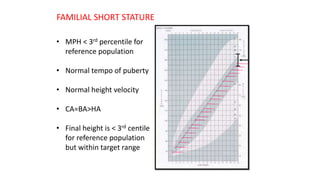
FAMILIAL SHORT STATURE
• MPH < 3rd percentile for
reference population
• Normal tempo of puberty
• Normal height velocity
• CA=BA>HA
• Final height is < 3rd centile
for reference population
but within target range
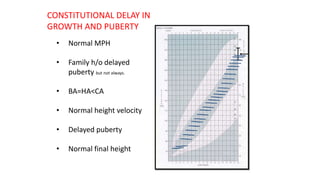
CONSTITUTIONAL DELAY IN
GROWTH AND PUBERTY
• Normal MPH
• Family h/o delayed
puberty but not always.
• BA=HA<CA
• Normal height velocity
• Delayed puberty
• Normal final height
CLUES FOR PATHOLOGICAL SHORT STATURE
• Height less then -3 SD
• Disproportionate SS
• Dysmorphism
• Height velocity less then 25 centile
• BMI increased or decreased
• Marked delay in bone age
• Major systemic manifestations
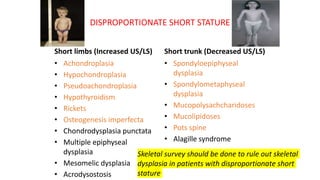
DISPROPORTIONATE SHORT STATURE
Short limbs (Increased US/LS)
• Achondroplasia
• Hypochondroplasia
• Pseudoachondroplasia
• Hypothyroidism
• Rickets
• Osteogenesis imperfecta
• Chondrodysplasia punctata
• Multiple epiphyseal
dysplasia
• Mesomelic dysplasia
• Acrodysostosis
Short trunk (Decreased US/LS)
• Spondyloepiphyseal
dysplasia
• Spondylometaphyseal
dysplasia
• Mucopolysachcharidoses
• Mucolipidoses
• Pots spine
• Alagille syndrome
Skeletal survey should be done to rule out skeletal
dysplasia in patients with disproportionate short
stature
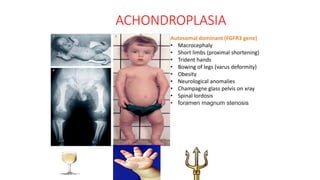
ACHONDROPLASIA
Autosomal dominant (FGFR3 gene)
• Macrocephaly
• Short limbs (proximal shortening)
• Trident hands
• Bowing of legs (varus deformity)
• Obesity
• Neurological anomalies
• Champagne glass pelvis on xray
• Spinal lordosis
• foramen magnum stenosis
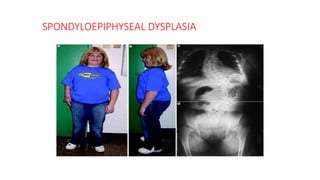
SPONDYLOEPIPHYSEAL DYSPLASIA
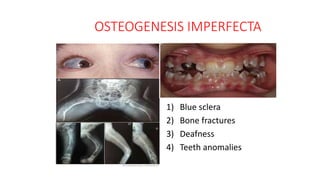
OSTEOGENESIS IMPERFECTA
1) Blue sclera
2) Bone fractures
3) Deafness
4) Teeth anomalies
PROPORTIONATE SHORT STATURE
MALNUTRITION
• Chronic malnutrition can give rise to stunting. W/H reduced more.
• Most common cause of pathological short stature in developing
countries.
• Delayed puberty.
• Iron, Calcium, Vitamin D & Zinc deficiency can cause short stature.
• IGF – 1 is diminished in under nutrition. GH levels may be low, normal
or high. The biochemical picture is suggestive of a form of GH
resistance.
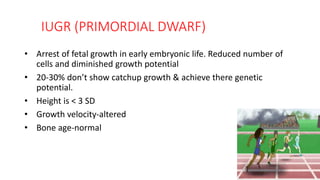
IUGR (PRIMORDIAL DWARF)
• Arrest of fetal growth in early embryonic life. Reduced number of
cells and diminished growth potential
• 20-30% don’t show catchup growth & achieve there genetic
potential.
• Height is < 3 SD
• Growth velocity-altered
• Bone age-normal
GENETIC CAUSES
• Downs syndrome
• Turners syndrome
• Noonans syndrome
• Seckel syndrome
• Rubinstein-Taybi syndrome
• Prader Willi syndrome
• Russel Silver syndrome
• Di-George syndrome
• Williams syndrome
• Edward syndrome. (Trisomy 18)
• Patau syndrome.(Trisomy 13)
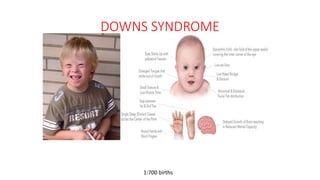
DOWNS SYNDROME
1:700 births
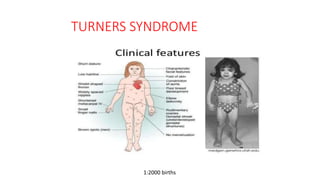
TURNERS SYNDROME
1:2000 births
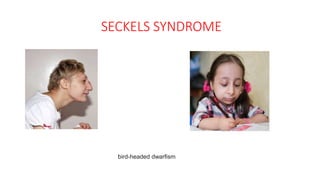
SECKELS SYNDROME
bird-headed dwarfism
SYSTEMIC CAUSES
• Malabsorption syndromes- ex.Celiac disease and others.
• Chronic infections/ inflammatory conditions
• Chronic renal disease
• Chronic liver disease
• Rickets
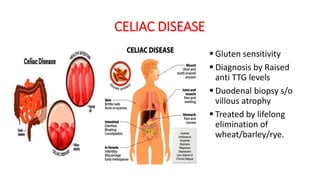
CELIAC DISEASE
 Gluten sensitivity
 Diagnosis by Raised
anti TTG levels
 Duodenal biopsy s/o
villous atrophy
 Treated by lifelong
elimination of
wheat/barley/rye.
ENDOCRINE CAUSES
•BA< CA
•Hypothyroidism
•Growth hormone deficiency
•Growth hormone insensitivity
•Hypoparathyroidism
•Cushing’s syndrome
•Psychosocial dwarfism
•Type-1 Diabetes Mellitus
•BA > CA
•Precocious puberty
•Hyperthyroidism
•CAH
•obesity
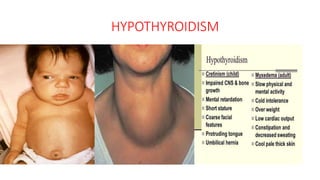
HYPOTHYROIDISM
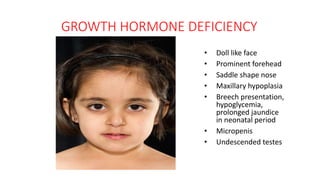
GROWTH HORMONE DEFICIENCY
• Doll like face
• Prominent forehead
• Saddle shape nose
• Maxillary hypoplasia
• Breech presentation,
hypoglycemia,
prolonged jaundice
in neonatal period
• Micropenis
• Undescended testes
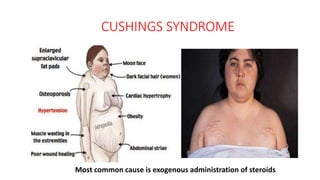
CUSHINGS SYNDROME
Most common cause is exogenous administration of steroids
SYSTEMIC ILLNESS (non endocrine)
• INFECTIONS:- HIV,TB,Malaria,Leishmaniasis
• GIT:- Chronic diarrhea due to any cause
(Celiac disease/IBD/Food allergy)
Chronic liver disease, chronic pancreatitis
• R/S:- Recurrent RTI, Cystic fibrosis, Asthma
• CNS:- Cerebral palsy
• Renal:- Renal tubular acidosis, Chronic renal failure
• CVS:- Congenital heart disease, Cardiomyopathy
DRUGS CAUSING SHORT STATURE
• Glucocorticoids
• Sex steroids
• Dextroamphetamines
• Metheylphenidate
POINTERS FROM HISTORY ASSOCIATED DISEASES
• Birth size (length, weight,
head circumference) and
gestational age
• Birth history (breech
delivery, asphyxia, jaundice,
hypoglycaemia)
• Parental height
• Tempo of puberty in parents
• Family history
• Previous growth
information
• Social environment
• To identify small for gestational
age (symmetric vs asymmetric)
• Associated with pituitary
dysfunction
• To assess genetic potential to
grow
• To look for family h/o delayed
puberty
• To look for a genetic cause
• May provide clues about the
aetiology
• To look for emotional
deprivation
HISTORY AND EXAMINATION
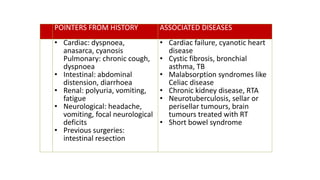
POINTERS FROM HISTORY ASSOCIATED DISEASES
• Cardiac: dyspnoea,
anasarca, cyanosis
Pulmonary: chronic cough,
dyspnoea
• Intestinal: abdominal
distension, diarrhoea
• Renal: polyuria, vomiting,
fatigue
• Neurological: headache,
vomiting, focal neurological
deficits
• Previous surgeries:
intestinal resection
• Cardiac failure, cyanotic heart
disease
• Cystic fibrosis, bronchial
asthma, TB
• Malabsorption syndromes like
Celiac disease
• Chronic kidney disease, RTA
• Neurotuberculosis, sellar or
perisellar tumours, brain
tumours treated with RT
• Short bowel syndrome
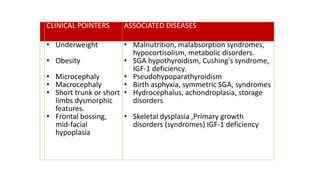
CLINICAL POINTERS ASSOCIATED DISEASES
• Underweight
• Obesity
• Microcephaly
• Macrocephaly
• Short trunk or short
limbs dysmorphic
features.
• Frontal bossing,
mid-facial
hypoplasia
• Malnutrition, malabsorption syndromes,
hypocortisolism, metabolic disorders.
• SGA hypothyroidism, Cushing's syndrome,
IGF-1 deficiency.
• Pseudohypoparathyroidism
• Birth asphyxia, symmetric SGA, syndromes
• Hydrocephalus, achondroplasia, storage
disorders
• Skeletal dysplasia ,Primary growth
disorders (syndromes) IGF-1 deficiency
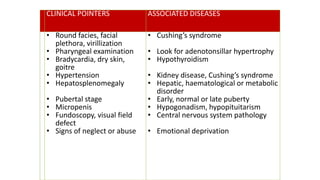
CLINICAL POINTERS ASSOCIATED DISEASES
• Round facies, facial
plethora, virillization
• Pharyngeal examination
• Bradycardia, dry skin,
goitre
• Hypertension
• Hepatosplenomegaly
• Pubertal stage
• Micropenis
• Fundoscopy, visual field
defect
• Signs of neglect or abuse
• Cushing’s syndrome
• Look for adenotonsillar hypertrophy
• Hypothyroidism
• Kidney disease, Cushing’s syndrome
• Hepatic, haematological or metabolic
disorder
• Early, normal or late puberty
• Hypogonadism, hypopituitarism
• Central nervous system pathology
• Emotional deprivation
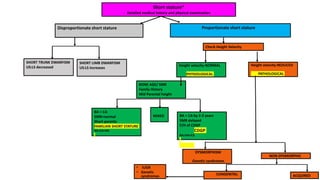
Short stature*
Detailed medical history and physical examination
SHORT LIMB DWARFISM
US:LS increases
Proportionate short stature
Height velocity-NORMAL
PHYSIOLOGICAL
Disproportionate short stature
SHORT TRUNK DWARFISM
US:LS decreased
Height velocity-REDUCED
PATHOLOGICAL
BONE AGE/ SMR
Family History
Mid Parental height
MIXED
BA = CA
SMR=normal
Short parents
FAMILIAN SHORT STATURE
BA=CA<HA
BA < CA by 2-3 years
SMR delayed
F/H of CDGP
CDGP
BA=HA<CA
DYSMORPHISM
Genetic syndromes
NON-DYSMORPHIC
CONGENITAL ACQUIRED
• IUGR
• Genetic
syndromes
Check Height Velocity
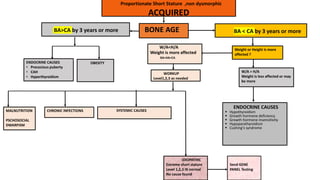
Proportionate Short Stature ,non dysmorphic
ACQUIRED
OBESITY
BA < CA by 3 years or more
W/A<H/A
Weight is more affected
BA=HA<CA
BA>CA by 3 years or more
ENDOCRINE CAUSES
• Precocious puberty
• CAH
• Hyperthyroidism
W/A > H/A
Weight is less affected or may
be more
WORKUP
Level1,2,3 as needed
IDIOPATHIC
Extreme short stature
Level 1,2,3 IX normal
No cause found
MALNUTRITION
PSCHOSOCIAL
DWARFISM
CHRONIC INFECTIONS
ENDOCRINE CAUSES
 Hypothyroidism
 Growth hormone deficiency
 Growth hormone insensitivity
 Hypoparathyroidism
 Cushing’s syndrome
SYSTEMIC CAUSES
BONE AGE
Weight or Height is more
affected ?
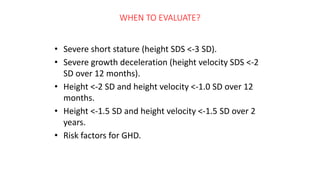
WHEN TO EVALUATE?
• Severe short stature (height SDS <-3 SD).
• Severe growth deceleration (height velocity SDS <-2
SD over 12 months).
• Height <-2 SD and height velocity <-1.0 SD over 12
months.
• Height <-1.5 SD and height velocity <-1.5 SD over 2
years.
• Risk factors for GHD.
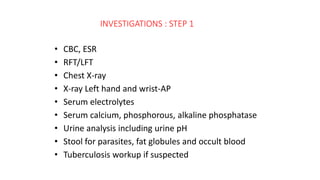
INVESTIGATIONS : STEP 1
• CBC, ESR
• RFT/LFT
• Chest X-ray
• X-ray Left hand and wrist-AP
• Serum electrolytes
• Serum calcium, phosphorous, alkaline phosphatase
• Urine analysis including urine pH
• Stool for parasites, fat globules and occult blood
• Tuberculosis workup if suspected
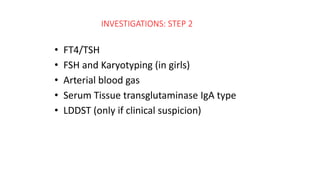
INVESTIGATIONS: STEP 2
• FT4/TSH
• FSH and Karyotyping (in girls)
• Arterial blood gas
• Serum Tissue transglutaminase IgA type
• LDDST (only if clinical suspicion)
INVESTIGATIONS: STEP 3
TO RULE OUT GROWTH HORMONE RELATED
DISORDERS
• IGF-1 and IGFBP3
• Growth hormone stimulation tests
• MRI pituitary
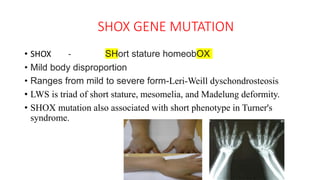
SHOX GENE MUTATION
• SHOX - SHort stature homeobOX
• Mild body disproportion
• Ranges from mild to severe form-Leri-Weill dyschondrosteosis
• LWS is triad of short stature, mesomelia, and Madelung deformity.
• SHOX mutation also associated with short phenotype in Turner's
syndrome.
CLINICAL EVALUATION OF SHORT STATURE
• Anthropometrics: Ht, Wt., HC, Arm span, U/L
segment ratio
• Dysmorphic features
• Nutritional status
• Thyroid gland
• Tanner staging for puberty development
• Neurological exam
- visual acuity and visual fields, nystagmus
- signs of hydrocephalus, focal signs
40
MANAGEMENT
Systemic diseases: Disease directed therapy
• Malnutrition: Nutrional rehabilitation
• Psychosocial dwarfism: Good social environment.
• Nutritional rickets: Vitamin D
• Distal RTA: Shohl’s solution
• Celiac disease: Gluten free diet
• Hypothyroidism: Thyroxine
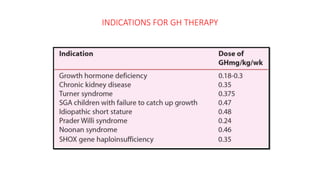
GH 5,10,15,30 mg
Rs 18500
INDICATIONS FOR GH THERAPY
TALL STATURE
• Height more than 97th percentile of the normal for
age, or more than 2 SDs above the mean height for
that age, sex and reference population
• Most often constitutional
44
CAUSES OF TALL STATURE IN CHILDHOOD
•Postnatal overgrowth
• Familial (constitutional)
tall stature
• Exogenous obesity
• Hypogonadism
• Excess GH secretion
• Marfan syndrome
• Fragile X syndrome
• Homocystinuria
• Klinefelter syndrome
• XYY
•Foetal overgrowth
Maternal diabetes mellitus
Cerebral gigantism
Beckwith-Wiedemann
syndrome
Childhood tall stature with
adult short stature
Hyperthyroidism
Precocious puberty
45
46
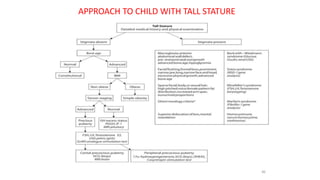
APPROACH TO CHILD WITH TALL STATURE
MANAGEMENT OF TALL STATURE
• Reassurance of the family and the patient in constitutional tall
stature. May be oestrogen if expected final height > 3SD
• Hypogonadism: Sex steroid
• Gigantism: excision of pituitary adenoma, somatostatin
analogues, pegvisomant or radiotherapy
• CAH: glucocorticoids and mineralocorticoid replacement
• Central precocious puberty: GnRH analogues
47
THANK YOU
48

Short stature

  • 1.
    Short & TallStature Dr Kaushik Barot Assistant Professor ,Pediatrics
  • 2.
    SHORT STATURE: DEFINITION •Height less than 3rd percentile or 2 SDs of the normal for age, sex and reference population. • Height velocity less than 25th percentile for age, sex and reference population. • Height < 1.5 SD of MPH/outside MPH range. 2
  • 3.
    PHYSIOLOGICAL SHORT STATURE •Familial short stature (FSS) • Constitutional delay in growth and puberty (CDGP) • Mixed
  • 4.
    FAMILIAL SHORT STATURE •MPH < 3rd percentile for reference population • Normal tempo of puberty • Normal height velocity • CA=BA>HA • Final height is < 3rd centile for reference population but within target range
  • 5.
    CONSTITUTIONAL DELAY IN GROWTHAND PUBERTY • Normal MPH • Family h/o delayed puberty but not always. • BA=HA<CA • Normal height velocity • Delayed puberty • Normal final height
  • 6.
    CLUES FOR PATHOLOGICALSHORT STATURE • Height less then -3 SD • Disproportionate SS • Dysmorphism • Height velocity less then 25 centile • BMI increased or decreased • Marked delay in bone age • Major systemic manifestations
  • 7.
    DISPROPORTIONATE SHORT STATURE Shortlimbs (Increased US/LS) • Achondroplasia • Hypochondroplasia • Pseudoachondroplasia • Hypothyroidism • Rickets • Osteogenesis imperfecta • Chondrodysplasia punctata • Multiple epiphyseal dysplasia • Mesomelic dysplasia • Acrodysostosis Short trunk (Decreased US/LS) • Spondyloepiphyseal dysplasia • Spondylometaphyseal dysplasia • Mucopolysachcharidoses • Mucolipidoses • Pots spine • Alagille syndrome Skeletal survey should be done to rule out skeletal dysplasia in patients with disproportionate short stature
  • 9.
    ACHONDROPLASIA Autosomal dominant (FGFR3gene) • Macrocephaly • Short limbs (proximal shortening) • Trident hands • Bowing of legs (varus deformity) • Obesity • Neurological anomalies • Champagne glass pelvis on xray • Spinal lordosis • foramen magnum stenosis
  • 10.
  • 11.
    OSTEOGENESIS IMPERFECTA 1) Bluesclera 2) Bone fractures 3) Deafness 4) Teeth anomalies
  • 12.
  • 13.
    MALNUTRITION • Chronic malnutritioncan give rise to stunting. W/H reduced more. • Most common cause of pathological short stature in developing countries. • Delayed puberty. • Iron, Calcium, Vitamin D & Zinc deficiency can cause short stature. • IGF – 1 is diminished in under nutrition. GH levels may be low, normal or high. The biochemical picture is suggestive of a form of GH resistance.
  • 14.
    IUGR (PRIMORDIAL DWARF) •Arrest of fetal growth in early embryonic life. Reduced number of cells and diminished growth potential • 20-30% don’t show catchup growth & achieve there genetic potential. • Height is < 3 SD • Growth velocity-altered • Bone age-normal
  • 15.
    GENETIC CAUSES • Downssyndrome • Turners syndrome • Noonans syndrome • Seckel syndrome • Rubinstein-Taybi syndrome • Prader Willi syndrome • Russel Silver syndrome • Di-George syndrome • Williams syndrome • Edward syndrome. (Trisomy 18) • Patau syndrome.(Trisomy 13)
  • 16.
  • 17.
  • 18.
  • 19.
    SYSTEMIC CAUSES • Malabsorptionsyndromes- ex.Celiac disease and others. • Chronic infections/ inflammatory conditions • Chronic renal disease • Chronic liver disease • Rickets
  • 20.
    CELIAC DISEASE  Glutensensitivity  Diagnosis by Raised anti TTG levels  Duodenal biopsy s/o villous atrophy  Treated by lifelong elimination of wheat/barley/rye.
  • 21.
    ENDOCRINE CAUSES •BA< CA •Hypothyroidism •Growthhormone deficiency •Growth hormone insensitivity •Hypoparathyroidism •Cushing’s syndrome •Psychosocial dwarfism •Type-1 Diabetes Mellitus •BA > CA •Precocious puberty •Hyperthyroidism •CAH •obesity
  • 22.
  • 23.
    GROWTH HORMONE DEFICIENCY •Doll like face • Prominent forehead • Saddle shape nose • Maxillary hypoplasia • Breech presentation, hypoglycemia, prolonged jaundice in neonatal period • Micropenis • Undescended testes
  • 24.
    CUSHINGS SYNDROME Most commoncause is exogenous administration of steroids
  • 25.
    SYSTEMIC ILLNESS (nonendocrine) • INFECTIONS:- HIV,TB,Malaria,Leishmaniasis • GIT:- Chronic diarrhea due to any cause (Celiac disease/IBD/Food allergy) Chronic liver disease, chronic pancreatitis • R/S:- Recurrent RTI, Cystic fibrosis, Asthma • CNS:- Cerebral palsy • Renal:- Renal tubular acidosis, Chronic renal failure • CVS:- Congenital heart disease, Cardiomyopathy
  • 26.
    DRUGS CAUSING SHORTSTATURE • Glucocorticoids • Sex steroids • Dextroamphetamines • Metheylphenidate
  • 27.
    POINTERS FROM HISTORYASSOCIATED DISEASES • Birth size (length, weight, head circumference) and gestational age • Birth history (breech delivery, asphyxia, jaundice, hypoglycaemia) • Parental height • Tempo of puberty in parents • Family history • Previous growth information • Social environment • To identify small for gestational age (symmetric vs asymmetric) • Associated with pituitary dysfunction • To assess genetic potential to grow • To look for family h/o delayed puberty • To look for a genetic cause • May provide clues about the aetiology • To look for emotional deprivation HISTORY AND EXAMINATION
  • 28.
    POINTERS FROM HISTORYASSOCIATED DISEASES • Cardiac: dyspnoea, anasarca, cyanosis Pulmonary: chronic cough, dyspnoea • Intestinal: abdominal distension, diarrhoea • Renal: polyuria, vomiting, fatigue • Neurological: headache, vomiting, focal neurological deficits • Previous surgeries: intestinal resection • Cardiac failure, cyanotic heart disease • Cystic fibrosis, bronchial asthma, TB • Malabsorption syndromes like Celiac disease • Chronic kidney disease, RTA • Neurotuberculosis, sellar or perisellar tumours, brain tumours treated with RT • Short bowel syndrome
  • 29.
    CLINICAL POINTERS ASSOCIATEDDISEASES • Underweight • Obesity • Microcephaly • Macrocephaly • Short trunk or short limbs dysmorphic features. • Frontal bossing, mid-facial hypoplasia • Malnutrition, malabsorption syndromes, hypocortisolism, metabolic disorders. • SGA hypothyroidism, Cushing's syndrome, IGF-1 deficiency. • Pseudohypoparathyroidism • Birth asphyxia, symmetric SGA, syndromes • Hydrocephalus, achondroplasia, storage disorders • Skeletal dysplasia ,Primary growth disorders (syndromes) IGF-1 deficiency
  • 30.
    CLINICAL POINTERS ASSOCIATEDDISEASES • Round facies, facial plethora, virillization • Pharyngeal examination • Bradycardia, dry skin, goitre • Hypertension • Hepatosplenomegaly • Pubertal stage • Micropenis • Fundoscopy, visual field defect • Signs of neglect or abuse • Cushing’s syndrome • Look for adenotonsillar hypertrophy • Hypothyroidism • Kidney disease, Cushing’s syndrome • Hepatic, haematological or metabolic disorder • Early, normal or late puberty • Hypogonadism, hypopituitarism • Central nervous system pathology • Emotional deprivation
  • 31.
    Short stature* Detailed medicalhistory and physical examination SHORT LIMB DWARFISM US:LS increases Proportionate short stature Height velocity-NORMAL PHYSIOLOGICAL Disproportionate short stature SHORT TRUNK DWARFISM US:LS decreased Height velocity-REDUCED PATHOLOGICAL BONE AGE/ SMR Family History Mid Parental height MIXED BA = CA SMR=normal Short parents FAMILIAN SHORT STATURE BA=CA<HA BA < CA by 2-3 years SMR delayed F/H of CDGP CDGP BA=HA<CA DYSMORPHISM Genetic syndromes NON-DYSMORPHIC CONGENITAL ACQUIRED • IUGR • Genetic syndromes Check Height Velocity
  • 32.
    Proportionate Short Stature,non dysmorphic ACQUIRED OBESITY BA < CA by 3 years or more W/A<H/A Weight is more affected BA=HA<CA BA>CA by 3 years or more ENDOCRINE CAUSES • Precocious puberty • CAH • Hyperthyroidism W/A > H/A Weight is less affected or may be more WORKUP Level1,2,3 as needed IDIOPATHIC Extreme short stature Level 1,2,3 IX normal No cause found MALNUTRITION PSCHOSOCIAL DWARFISM CHRONIC INFECTIONS ENDOCRINE CAUSES  Hypothyroidism  Growth hormone deficiency  Growth hormone insensitivity  Hypoparathyroidism  Cushing’s syndrome SYSTEMIC CAUSES BONE AGE Weight or Height is more affected ?
  • 33.
    WHEN TO EVALUATE? •Severe short stature (height SDS <-3 SD). • Severe growth deceleration (height velocity SDS <-2 SD over 12 months). • Height <-2 SD and height velocity <-1.0 SD over 12 months. • Height <-1.5 SD and height velocity <-1.5 SD over 2 years. • Risk factors for GHD.
  • 34.
    INVESTIGATIONS : STEP1 • CBC, ESR • RFT/LFT • Chest X-ray • X-ray Left hand and wrist-AP • Serum electrolytes • Serum calcium, phosphorous, alkaline phosphatase • Urine analysis including urine pH • Stool for parasites, fat globules and occult blood • Tuberculosis workup if suspected
  • 35.
    INVESTIGATIONS: STEP 2 •FT4/TSH • FSH and Karyotyping (in girls) • Arterial blood gas • Serum Tissue transglutaminase IgA type • LDDST (only if clinical suspicion)
  • 36.
    INVESTIGATIONS: STEP 3 TORULE OUT GROWTH HORMONE RELATED DISORDERS • IGF-1 and IGFBP3 • Growth hormone stimulation tests • MRI pituitary
  • 38.
    SHOX GENE MUTATION •SHOX - SHort stature homeobOX • Mild body disproportion • Ranges from mild to severe form-Leri-Weill dyschondrosteosis • LWS is triad of short stature, mesomelia, and Madelung deformity. • SHOX mutation also associated with short phenotype in Turner's syndrome.
  • 39.
    CLINICAL EVALUATION OFSHORT STATURE • Anthropometrics: Ht, Wt., HC, Arm span, U/L segment ratio • Dysmorphic features • Nutritional status • Thyroid gland • Tanner staging for puberty development • Neurological exam - visual acuity and visual fields, nystagmus - signs of hydrocephalus, focal signs 40
  • 40.
    MANAGEMENT Systemic diseases: Diseasedirected therapy • Malnutrition: Nutrional rehabilitation • Psychosocial dwarfism: Good social environment. • Nutritional rickets: Vitamin D • Distal RTA: Shohl’s solution • Celiac disease: Gluten free diet • Hypothyroidism: Thyroxine
  • 41.
  • 42.
  • 43.
    TALL STATURE • Heightmore than 97th percentile of the normal for age, or more than 2 SDs above the mean height for that age, sex and reference population • Most often constitutional 44
  • 44.
    CAUSES OF TALLSTATURE IN CHILDHOOD •Postnatal overgrowth • Familial (constitutional) tall stature • Exogenous obesity • Hypogonadism • Excess GH secretion • Marfan syndrome • Fragile X syndrome • Homocystinuria • Klinefelter syndrome • XYY •Foetal overgrowth Maternal diabetes mellitus Cerebral gigantism Beckwith-Wiedemann syndrome Childhood tall stature with adult short stature Hyperthyroidism Precocious puberty 45
  • 45.
    46 APPROACH TO CHILDWITH TALL STATURE
  • 46.
    MANAGEMENT OF TALLSTATURE • Reassurance of the family and the patient in constitutional tall stature. May be oestrogen if expected final height > 3SD • Hypogonadism: Sex steroid • Gigantism: excision of pituitary adenoma, somatostatin analogues, pegvisomant or radiotherapy • CAH: glucocorticoids and mineralocorticoid replacement • Central precocious puberty: GnRH analogues 47
  • 47.