Recalibrating
Language Assessment
in the New Normal
Rachel Luna Peralta
Macao Institute for Tourism Studies
International Research and Development Congress on
Teaching English to Speakers of Other Languages
23-25 October 2020
 English teacher since 1999
 TESOL International Member
since 2016
 Asia TEFL (since 2018), HAAL
(since 2018), MAAL Board
Member (since 2019)
 Asian Association for Language
Assessment (AALA) member
since 2018
 Macao Joint Admission Exam
(JAE) – Examiner since 2018
 JEAP Elsevier Recognized
Reviewer (since 2016), Asian
EFL Journal & EILJ (since 2016)
How can EFL/ESL teachers make Language
Assessment authentic, valid, and reliable in
this new normal?
Introduction
Why is Language Assessment
important?
Outline
Covid-19
Largest disruption of education systems in history
1.6 billion
learners in almost 190 countries are
affected by the school closures and
disruptions
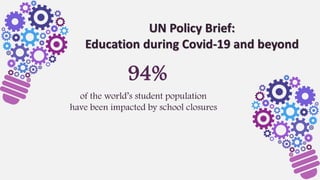
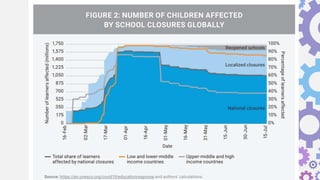
94%
of the world’s student population
have been impacted by school closures
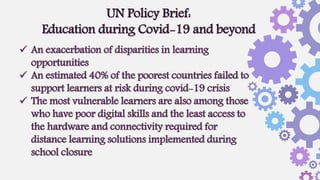
 An exacerbation of disparities in learning
opportunities
 An estimated 40% of the poorest countries failed to
support learners at risk during covid-19 crisis
 The most vulnerable learners are also among those
who have poor digital skills and the least access to
the hardware and connectivity required for
distance learning solutions implemented during
school closure
UN Policy Brief:
Education during Covid-19 and beyond
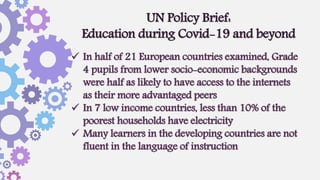
 In half of 21 European countries examined, Grade
4 pupils from lower socio-economic backgrounds
were half as likely to have access to the internets
as their more advantaged peers
 In 7 low income countries, less than 10% of the
poorest households have electricity
 Many learners in the developing countries are not
fluent in the language of instruction
UN Policy Brief:
Education during Covid-19 and beyond
 Even when they could access content they could
understand, living conditions, economic stress, and
low education levels of parents, including digital
skills are low
 In most European countries, children from lower
socio-economic backgrounds are more likely to
lack reading opportunities, a quiet room, and
parental support during school closure
UN Policy Brief:
Education during Covid-19 and beyond
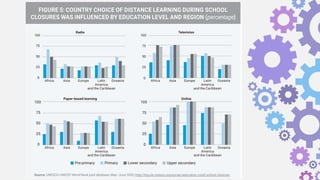
 Different modalities of teaching and learning have
been used, more than others, depending on the
education level, with variability across regions
 Areas with less connectivity – traditional distance
learning – a mix of TV and radio program, and the
distribution of print materials
 Digital divide – distance learning in high income
countries covers 80-85%; low-income countries
less than 50%
UN Policy Brief:
Education during Covid-19 and beyond
 The disadvantaged have limited access to basic
household services such as electricity, a lack of
technology infrastructure, and low levels of digital
literacy among students, parents, and teachers
 Serious disruptions on how students are evaluated –
exams are postponed, in a few they have been
cancelled, and in others, they have been replaced by
continuous assessment or alternative modalities, e.g.
online testing for final exam.
UN Policy Brief:
Education during Covid-19 and beyond
 Student progress can be monitored with mobile
phone surveys, tracking usage and performance
statistics from learning platforms and apps, and
implementing rapid learning assessments to
identify learning gaps
 But the question now is – are these assessments
authentic and valid/reliable? (with emphasis on
language education/assessment)
UN Policy Brief:
Education during Covid-19 and beyond
1. What is
Language
Assessment?
 Assessment is an integral part of instruction.
 It determines whether or not the goals of
education are being met.
 It affects decisions about grades, placement,
advancement, instructional needs, curriculum,
and even funding.
“Are we teaching what we think we are
teaching?”
“Are students learning what they are
supposed to be learning?”
“Is there a way to teach the subject
better, thereby promoting better
learning?”
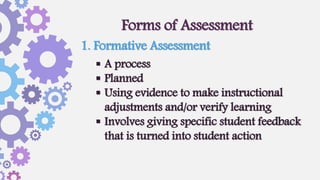
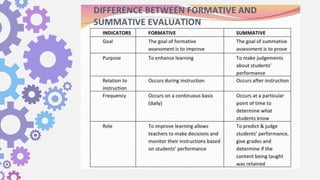
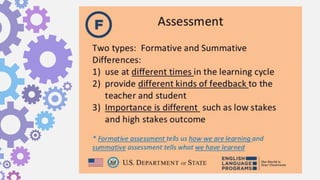
Forms of Assessment
 A process
 Planned
 Using evidence to make instructional
adjustments and/or verify learning
 Involves giving specific student feedback
that is turned into student action
1. Formative Assessment
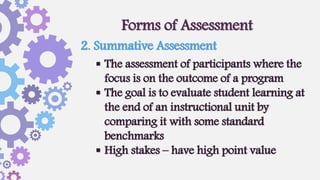
Forms of Assessment
 The assessment of participants where the
focus is on the outcome of a program
 The goal is to evaluate student learning at
the end of an instructional unit by
comparing it with some standard
benchmarks
 High stakes – have high point value
2. Summative Assessment
2. Why is Language
Assessment
important?
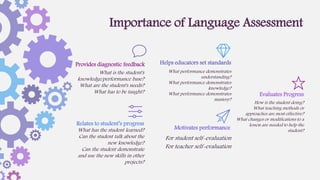
What has the student learned?
Can the student talk about the
new knowledge?
Can the student demonstrate
and use the new skills in other
projects?
Relates to student’s progress
How is the student doing?
What teaching methods or
approaches are most effective?
What changes or modifications to a
lesson are needed to help the
student?
Evaluates Progress
What is the student's
knowledge/performance base?
What are the student's needs?
What has to be taught?
Provides diagnostic feedback
For student self-evaluation
For teacher self-evaluation
Motivates performance
What performance demonstrates
understanding?
What performance demonstrates
knowledge?
What performance demonstrates
mastery?
Helps educators set standards
Importance of Language Assessment
3. How can EFL/ESL
teachers make Language
Assessment authentic,
reliable, and valid in this
new normal?
Reliability of Assessment
 Reliability refers to how well a score represents an
individual’s ability, and within education, ensures
that assessments accurately measure student
knowledge.
 The reliability of an assessment tool is the extent to
which it consistently and accurately measures
learning.
 When the results of an assessment are reliable, we
can be confident that repeated or equivalent
assessments will provide consistent result.
Reliability of Assessment
Factors which can affect reliability:
 The length of the assessment
 The suitability of the questions or tasks for the
students being assessed
 The phrasing and terminology of the questions
 The consistency in test administration
 The design of the marking schedule and moderation
of marking procedures
 The readiness of the students for the assessment
Validity of Assessment
 Validity is the most important single
attribute of a good test.
 The validity of an assessment tool is the
extent to which it measures what it was
designed to measure, without contamination
from other characteristics.
Validity of Assessment
Types of validity:
 Face Validity: Do the assessment items appear to be
appropriate?
 Content Validity: Does the assessment content cover
what you want to assess?
 Criterion-related Validity: How well does the test
measure what they want to?
 Construct Validity: Are you measuring what you think
you’re measuring?
 A valid assessment should have a good coverage of the criteria (concepts,
skills, and knowledge) relevant to the purpose of the examination.
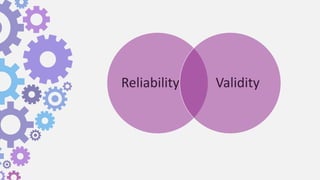
Reliability Validity
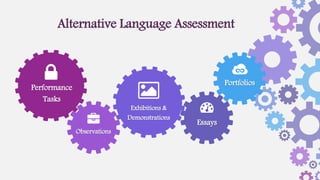
Alternative assessment, often called authentic,
comprehensive, or performance assessment, is
usually designed by the teacher to gauge students'
understanding of material.
Alternative Language Assessment
Performance
Tasks
Observations
Exhibitions &
Demonstrations
Essays
Portfolios
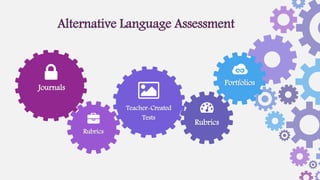
Alternative Language Assessment
Journals
Rubrics
Teacher-Created
Tests
Rubrics
Portfolios
Synchronous vs Asynchronous vs Modular
 Formative assessments might feel harder
now in virtual classrooms
 Challenges exist in all forms – S, A, M
Make learners CREATORS of CONTENT
 User-generated content (UGCs)
 Do away with traditional assessment to minimize
cheating/plagiarism
 Focus on HOTS
 UDL – action and expression
 Give students options for showing what they know
 Adaptability
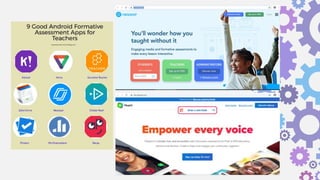
Nearpod - short quizzes, polls, surveys, and games can be embedded
into a lesson so that teachers can check for understanding before
moving on to the next concept.
Flipgrid
Writing:
• Students record their writing ideas
• Use the recording to talk through their ideas
• Refer back to the video to help them remember their original
thoughts
• Other students can record responses & give peer-evaluation
Stand-alone video for speaking tests/listening
Foreign Language – collaborate with a class in Spain or France – use
the grid to help teach each other accents and language rules
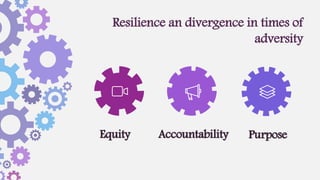
PurposeEquity Accountability
Resilience an divergence in times of
adversity
 Go slow
 Minimum pressure
 Be as flexible as possible
 Grades are not really
what matter now,
although it is important
 Build communication
with your students
Research Ideas
Use Action Research to carry out a research; Use data analytics; Be ethical
(consent)
https://www.menti.com/bkq1d4trf6
rachel@iftm.edu.mo
Q & A
Thank you!
The Ministry of Education- New Zealand. (n.d.). Reliability and validity.
https://www.assessment.tki.org.nz/Using-evidence-for-learning
United Nations. (2020, August). Policy Paper: Education during Covid-19 and beyond.
https://www.sg_policy_brief_covid-19_and_education_august_2020.pdf
References
Thank you!
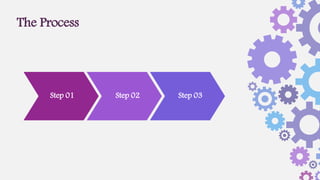
Step 03
The Process
Step 01 Step 02

Recalibrating language assessment in the new normal

  • 1.
    Recalibrating Language Assessment in theNew Normal Rachel Luna Peralta Macao Institute for Tourism Studies International Research and Development Congress on Teaching English to Speakers of Other Languages 23-25 October 2020
  • 2.
     English teachersince 1999  TESOL International Member since 2016  Asia TEFL (since 2018), HAAL (since 2018), MAAL Board Member (since 2019)  Asian Association for Language Assessment (AALA) member since 2018  Macao Joint Admission Exam (JAE) – Examiner since 2018  JEAP Elsevier Recognized Reviewer (since 2016), Asian EFL Journal & EILJ (since 2016)
  • 3.
    How can EFL/ESLteachers make Language Assessment authentic, valid, and reliable in this new normal? Introduction Why is Language Assessment important? Outline
  • 5.
    Covid-19 Largest disruption ofeducation systems in history
  • 6.
    1.6 billion learners inalmost 190 countries are affected by the school closures and disruptions
  • 7.
    94% of the world’sstudent population have been impacted by school closures
  • 9.
     An exacerbationof disparities in learning opportunities  An estimated 40% of the poorest countries failed to support learners at risk during covid-19 crisis  The most vulnerable learners are also among those who have poor digital skills and the least access to the hardware and connectivity required for distance learning solutions implemented during school closure UN Policy Brief: Education during Covid-19 and beyond
  • 10.
     In halfof 21 European countries examined, Grade 4 pupils from lower socio-economic backgrounds were half as likely to have access to the internets as their more advantaged peers  In 7 low income countries, less than 10% of the poorest households have electricity  Many learners in the developing countries are not fluent in the language of instruction UN Policy Brief: Education during Covid-19 and beyond
  • 11.
     Even whenthey could access content they could understand, living conditions, economic stress, and low education levels of parents, including digital skills are low  In most European countries, children from lower socio-economic backgrounds are more likely to lack reading opportunities, a quiet room, and parental support during school closure UN Policy Brief: Education during Covid-19 and beyond
  • 12.
     Different modalitiesof teaching and learning have been used, more than others, depending on the education level, with variability across regions  Areas with less connectivity – traditional distance learning – a mix of TV and radio program, and the distribution of print materials  Digital divide – distance learning in high income countries covers 80-85%; low-income countries less than 50% UN Policy Brief: Education during Covid-19 and beyond
  • 14.
     The disadvantagedhave limited access to basic household services such as electricity, a lack of technology infrastructure, and low levels of digital literacy among students, parents, and teachers  Serious disruptions on how students are evaluated – exams are postponed, in a few they have been cancelled, and in others, they have been replaced by continuous assessment or alternative modalities, e.g. online testing for final exam. UN Policy Brief: Education during Covid-19 and beyond
  • 15.
     Student progresscan be monitored with mobile phone surveys, tracking usage and performance statistics from learning platforms and apps, and implementing rapid learning assessments to identify learning gaps  But the question now is – are these assessments authentic and valid/reliable? (with emphasis on language education/assessment) UN Policy Brief: Education during Covid-19 and beyond
  • 16.
  • 17.
     Assessment isan integral part of instruction.  It determines whether or not the goals of education are being met.  It affects decisions about grades, placement, advancement, instructional needs, curriculum, and even funding.
  • 18.
    “Are we teachingwhat we think we are teaching?” “Are students learning what they are supposed to be learning?” “Is there a way to teach the subject better, thereby promoting better learning?”
  • 19.
    Forms of Assessment A process  Planned  Using evidence to make instructional adjustments and/or verify learning  Involves giving specific student feedback that is turned into student action 1. Formative Assessment
  • 21.
    Forms of Assessment The assessment of participants where the focus is on the outcome of a program  The goal is to evaluate student learning at the end of an instructional unit by comparing it with some standard benchmarks  High stakes – have high point value 2. Summative Assessment
  • 25.
    2. Why isLanguage Assessment important?
  • 26.
    What has thestudent learned? Can the student talk about the new knowledge? Can the student demonstrate and use the new skills in other projects? Relates to student’s progress How is the student doing? What teaching methods or approaches are most effective? What changes or modifications to a lesson are needed to help the student? Evaluates Progress What is the student's knowledge/performance base? What are the student's needs? What has to be taught? Provides diagnostic feedback For student self-evaluation For teacher self-evaluation Motivates performance What performance demonstrates understanding? What performance demonstrates knowledge? What performance demonstrates mastery? Helps educators set standards Importance of Language Assessment
  • 27.
    3. How canEFL/ESL teachers make Language Assessment authentic, reliable, and valid in this new normal?
  • 30.
    Reliability of Assessment Reliability refers to how well a score represents an individual’s ability, and within education, ensures that assessments accurately measure student knowledge.  The reliability of an assessment tool is the extent to which it consistently and accurately measures learning.  When the results of an assessment are reliable, we can be confident that repeated or equivalent assessments will provide consistent result.
  • 31.
    Reliability of Assessment Factorswhich can affect reliability:  The length of the assessment  The suitability of the questions or tasks for the students being assessed  The phrasing and terminology of the questions  The consistency in test administration  The design of the marking schedule and moderation of marking procedures  The readiness of the students for the assessment
  • 32.
    Validity of Assessment Validity is the most important single attribute of a good test.  The validity of an assessment tool is the extent to which it measures what it was designed to measure, without contamination from other characteristics.
  • 33.
    Validity of Assessment Typesof validity:  Face Validity: Do the assessment items appear to be appropriate?  Content Validity: Does the assessment content cover what you want to assess?  Criterion-related Validity: How well does the test measure what they want to?  Construct Validity: Are you measuring what you think you’re measuring?  A valid assessment should have a good coverage of the criteria (concepts, skills, and knowledge) relevant to the purpose of the examination.
  • 34.
  • 35.
    Alternative assessment, oftencalled authentic, comprehensive, or performance assessment, is usually designed by the teacher to gauge students' understanding of material. Alternative Language Assessment
  • 36.
  • 37.
  • 38.
    Synchronous vs Asynchronousvs Modular  Formative assessments might feel harder now in virtual classrooms  Challenges exist in all forms – S, A, M
  • 39.
    Make learners CREATORSof CONTENT  User-generated content (UGCs)  Do away with traditional assessment to minimize cheating/plagiarism  Focus on HOTS  UDL – action and expression  Give students options for showing what they know  Adaptability
  • 41.
    Nearpod - shortquizzes, polls, surveys, and games can be embedded into a lesson so that teachers can check for understanding before moving on to the next concept. Flipgrid Writing: • Students record their writing ideas • Use the recording to talk through their ideas • Refer back to the video to help them remember their original thoughts • Other students can record responses & give peer-evaluation Stand-alone video for speaking tests/listening Foreign Language – collaborate with a class in Spain or France – use the grid to help teach each other accents and language rules
  • 43.
    PurposeEquity Accountability Resilience andivergence in times of adversity
  • 44.
     Go slow Minimum pressure  Be as flexible as possible  Grades are not really what matter now, although it is important  Build communication with your students
  • 45.
    Research Ideas Use ActionResearch to carry out a research; Use data analytics; Be ethical (consent)
  • 46.
  • 47.
  • 48.
    The Ministry ofEducation- New Zealand. (n.d.). Reliability and validity. https://www.assessment.tki.org.nz/Using-evidence-for-learning United Nations. (2020, August). Policy Paper: Education during Covid-19 and beyond. https://www.sg_policy_brief_covid-19_and_education_august_2020.pdf References
  • 49.
  • 50.