NON FERROUS METAL AND ALLOY
Prepared By:
Nikunj Patel
(ID No: 2017PMT5480)
What is sheet metal ?
 Sheet metal is metal formed by an industrial
process into thin, flat pieces.
 It is one of the fundamental forms used in
metalworking and it can be cut and bent into a
variety of shapes.
 Countless everyday objects are fabricated from
sheet metal.
 Thicknesses can vary significantly; extremely
thin sheets are considered foil or leaf, and
pieces thicker than 6 mm (0.25 in) are
considered plate.
Foil
 A foil is a very thin sheet of metal, usually made by
hammering or rolling.
 Foils are most easily made with malleable metals,
such as aluminium, copper, tin, and gold.
 Foils usually bend under their own weight and can
be torn easily.
 For example, aluminium foil is usually about
1/1000 inch (0.03 mm), whereas gold can be made
into foil only a few atoms thick, called gold leaf.
Plate
When sheet metal pieces thicker than
6 mm (0.25 in) are considered plate.
It is thicker than foil. So you can have
more strength then foil and used for
industrial purpose, where strength are
needed.
Application of Sheet metal
 Aluminum is also a popular metal used in sheet metal
due to its flexibility, wide range of options, cost
effectiveness, and other properties.
 The four most common aluminium grades available as
sheet metal are 1100-H14, 3003-H14, 5052-H32, and
6061-T6.
 Grade 1100-H14 is commercially pure aluminium,
highly chemical and weather resistant. It is ductile
enough for deep drawing and weldable, but has low
strength. It is commonly used in chemical processing
equipment, light reflectors, and jewelry.
List of process of sheet metal working for
non-ferrous metal and alloy
Bending
Curling
Decambering
Deep drawing
Expanding
Hydro-forming
Perforating
Punching
Roll forming
Rolling
Spinning
Stamping
Water jet cutting
Wheeling
Bending
Bending is a manufacturing process that
produces a V-shape, U-shape, or
channel shape along a straight axis in
ductile materials, most commonly sheet
metal.
Typical products that are made like this
are boxes such as electrical enclosures
and rectangular ductwork.
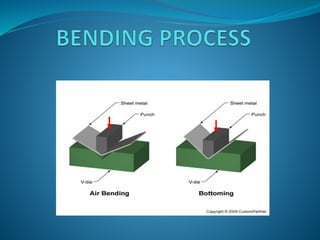
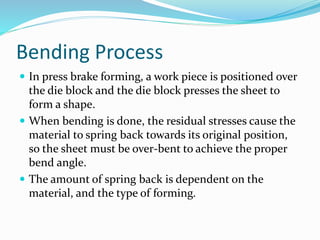
Bending Process
 In press brake forming, a work piece is positioned over
the die block and the die block presses the sheet to
form a shape.
 When bending is done, the residual stresses cause the
material to spring back towards its original position,
so the sheet must be over-bent to achieve the proper
bend angle.
 The amount of spring back is dependent on the
material, and the type of forming.
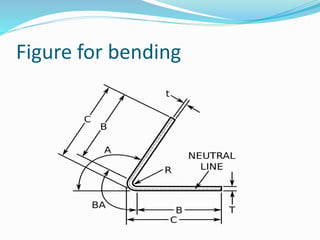
Figure for bending
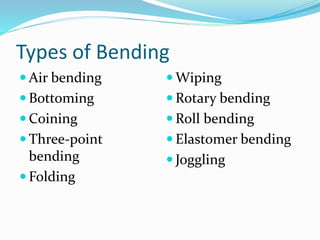
Types of Bending
 Air bending
 Bottoming
 Coining
 Three-point
bending
 Folding
 Wiping
 Rotary bending
 Roll bending
 Elastomer bending
 Joggling
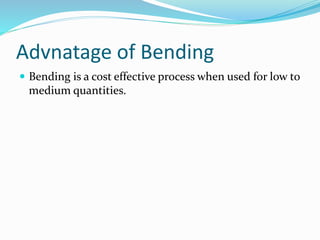
Advnatage of Bending
 Bending is a cost effective process when used for low to
medium quantities.
Curling
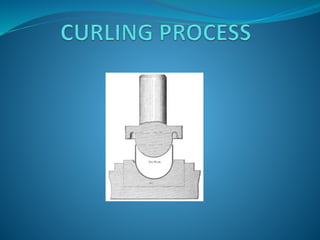
Curling is a sheet metal forming process
used to form the edges into a hollow
ring.
Curling can be performed to eliminate
sharp edges and increase the moment of
inertia near the curled end.
Other parts are curled to perform their
primary function, such as door hinges.
Curling Operations
 In the curling operation, the flare, or burr, should
always be turned away from the die.
 This will help prolong the life of the die by avoiding
unnecessary damage due to scratching.
 The stroke of the die must be as long as the curl.
 Curling is often performed as part of a high
production, multiple operation progressive forming.
Deep drawing
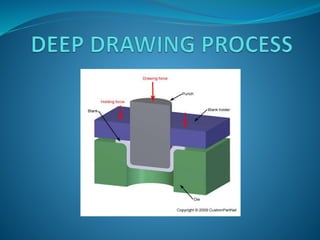
 Deep drawing is a sheet metal forming process in
which a sheet metal blank is radially drawn into a
forming die by the mechanical action of a punch.
 It is thus a shape transformation process with material
retention.
 The process is considered "deep" drawing when the
depth of the drawn part exceeds its diameter. This is
achieved by redrawing the part through a series of
dies.
Deep drawing process
 The total drawing load consists of the ideal forming load
and an additional component to compensate for friction in
the contacting areas of the flange region and bending
forces as well as unbending forces at the die radius.
 The forming load is transferred from the punch radius
through the drawn part wall into the deformation region
(sheet metal flange). In the drawn part wall, which is in
contact with the punch, the hoop strain is zero whereby the
plane strain condition is reached.


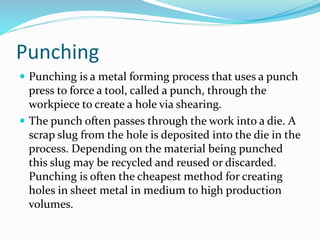
Punching
 Punching is a metal forming process that uses a punch
press to force a tool, called a punch, through the
workpiece to create a hole via shearing.
 The punch often passes through the work into a die. A
scrap slug from the hole is deposited into the die in the
process. Depending on the material being punched
this slug may be recycled and reused or discarded.
Punching is often the cheapest method for creating
holes in sheet metal in medium to high production
volumes.
Punching
 When a specially shaped punch is used to create
multiple usable parts from a sheet of material the
process is known as blanking. In forging applications
the work is often punched while hot, and this is called
hot punching.
 Slugging- It is the operation of punching in which
punch is stopped as soon as the metal fracture is
complete and metal is not removed but held in hole.
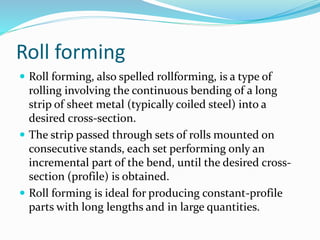
Roll forming
 Roll forming, also spelled rollforming, is a type of
rolling involving the continuous bending of a long
strip of sheet metal (typically coiled steel) into a
desired cross-section.
 The strip passed through sets of rolls mounted on
consecutive stands, each set performing only an
incremental part of the bend, until the desired cross-
section (profile) is obtained.
 Roll forming is ideal for producing constant-profile
parts with long lengths and in large quantities.
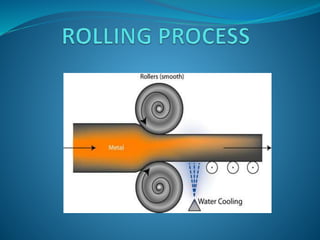
Rolling Process
 In metalworking, rolling is a metal forming process in
which metal stock is passed through one or more pairs of
rolls to reduce the thickness and to make the thickness
uniform.
 The concept is similar to the rolling of dough. Rolling is
classified according to the temperature of the metal
rolled.
 If the temperature of the metal is above its
recrystallization temperature, then the process is known
as hot rolling. If the temperature of the metal is below its
recrystallization temperature, the process is known as
cold rolling.
Types of Rolling
 Roll bending
 Roll forming
 Flat rolling
 Ring rolling
 Structural shape rolling
 Controlled rolling
 Forge rolling
THANK YOU

Sheet metal working for non ferrous metal and alloys

  • 1.
  • 2.
  • 3.
    What is sheetmetal ?  Sheet metal is metal formed by an industrial process into thin, flat pieces.  It is one of the fundamental forms used in metalworking and it can be cut and bent into a variety of shapes.  Countless everyday objects are fabricated from sheet metal.  Thicknesses can vary significantly; extremely thin sheets are considered foil or leaf, and pieces thicker than 6 mm (0.25 in) are considered plate.
  • 4.
    Foil  A foilis a very thin sheet of metal, usually made by hammering or rolling.  Foils are most easily made with malleable metals, such as aluminium, copper, tin, and gold.  Foils usually bend under their own weight and can be torn easily.  For example, aluminium foil is usually about 1/1000 inch (0.03 mm), whereas gold can be made into foil only a few atoms thick, called gold leaf.
  • 5.
    Plate When sheet metalpieces thicker than 6 mm (0.25 in) are considered plate. It is thicker than foil. So you can have more strength then foil and used for industrial purpose, where strength are needed.
  • 6.
    Application of Sheetmetal  Aluminum is also a popular metal used in sheet metal due to its flexibility, wide range of options, cost effectiveness, and other properties.  The four most common aluminium grades available as sheet metal are 1100-H14, 3003-H14, 5052-H32, and 6061-T6.  Grade 1100-H14 is commercially pure aluminium, highly chemical and weather resistant. It is ductile enough for deep drawing and weldable, but has low strength. It is commonly used in chemical processing equipment, light reflectors, and jewelry.
  • 7.
    List of processof sheet metal working for non-ferrous metal and alloy Bending Curling Decambering Deep drawing Expanding Hydro-forming Perforating Punching Roll forming Rolling Spinning Stamping Water jet cutting Wheeling
  • 9.
    Bending Bending is amanufacturing process that produces a V-shape, U-shape, or channel shape along a straight axis in ductile materials, most commonly sheet metal. Typical products that are made like this are boxes such as electrical enclosures and rectangular ductwork.
  • 10.
    Bending Process  Inpress brake forming, a work piece is positioned over the die block and the die block presses the sheet to form a shape.  When bending is done, the residual stresses cause the material to spring back towards its original position, so the sheet must be over-bent to achieve the proper bend angle.  The amount of spring back is dependent on the material, and the type of forming.
  • 11.
  • 12.
    Types of Bending Air bending  Bottoming  Coining  Three-point bending  Folding  Wiping  Rotary bending  Roll bending  Elastomer bending  Joggling
  • 13.
    Advnatage of Bending Bending is a cost effective process when used for low to medium quantities.
  • 15.
    Curling Curling is asheet metal forming process used to form the edges into a hollow ring. Curling can be performed to eliminate sharp edges and increase the moment of inertia near the curled end. Other parts are curled to perform their primary function, such as door hinges.
  • 16.
    Curling Operations  Inthe curling operation, the flare, or burr, should always be turned away from the die.  This will help prolong the life of the die by avoiding unnecessary damage due to scratching.  The stroke of the die must be as long as the curl.  Curling is often performed as part of a high production, multiple operation progressive forming.
  • 18.
    Deep drawing  Deepdrawing is a sheet metal forming process in which a sheet metal blank is radially drawn into a forming die by the mechanical action of a punch.  It is thus a shape transformation process with material retention.  The process is considered "deep" drawing when the depth of the drawn part exceeds its diameter. This is achieved by redrawing the part through a series of dies.
  • 19.
    Deep drawing process The total drawing load consists of the ideal forming load and an additional component to compensate for friction in the contacting areas of the flange region and bending forces as well as unbending forces at the die radius.  The forming load is transferred from the punch radius through the drawn part wall into the deformation region (sheet metal flange). In the drawn part wall, which is in contact with the punch, the hoop strain is zero whereby the plane strain condition is reached.  
  • 21.
    Punching  Punching isa metal forming process that uses a punch press to force a tool, called a punch, through the workpiece to create a hole via shearing.  The punch often passes through the work into a die. A scrap slug from the hole is deposited into the die in the process. Depending on the material being punched this slug may be recycled and reused or discarded. Punching is often the cheapest method for creating holes in sheet metal in medium to high production volumes.
  • 22.
    Punching  When aspecially shaped punch is used to create multiple usable parts from a sheet of material the process is known as blanking. In forging applications the work is often punched while hot, and this is called hot punching.  Slugging- It is the operation of punching in which punch is stopped as soon as the metal fracture is complete and metal is not removed but held in hole.
  • 24.
    Roll forming  Rollforming, also spelled rollforming, is a type of rolling involving the continuous bending of a long strip of sheet metal (typically coiled steel) into a desired cross-section.  The strip passed through sets of rolls mounted on consecutive stands, each set performing only an incremental part of the bend, until the desired cross- section (profile) is obtained.  Roll forming is ideal for producing constant-profile parts with long lengths and in large quantities.
  • 26.
    Rolling Process  Inmetalworking, rolling is a metal forming process in which metal stock is passed through one or more pairs of rolls to reduce the thickness and to make the thickness uniform.  The concept is similar to the rolling of dough. Rolling is classified according to the temperature of the metal rolled.  If the temperature of the metal is above its recrystallization temperature, then the process is known as hot rolling. If the temperature of the metal is below its recrystallization temperature, the process is known as cold rolling.
  • 27.
    Types of Rolling Roll bending  Roll forming  Flat rolling  Ring rolling  Structural shape rolling  Controlled rolling  Forge rolling
  • 28.