Umair Raza Study of Sheet Metal Forming 19013386-002
44
Objective:
Methods of sheet metal processes such as stretching, shearing, blanking, bending, deep drawing, redrawing
are introduced.
Variables in sheet forming process will be discussed together with formability and test methods.
Defects occurring during the forming process will be emphasized.
Introduction:
Sheet metal forming is a process where pieces of sheet
metal are modified to its geometry rather than removing
any materials. The applied process generates a force that
stresses the material to deform. This in turn gives the
possibility to bend ouch stretch the sheet to a variety of
complex shapes. SHEET METAL FORMING is the
process of converting a flat sheet of metal into apart of
desired shape without fracture or excessive localized
thinning. The process may be simple, such as a bending
operation, or a sequence of very complex operations such
as those performed in high-volume stamping plants.
SheetMetal Forming How to differentiate a
sheetand a plate?
If thickness is less than 6 mm (1/ 4 inches) then it is regarded as sheet.
If thickness is greater than 6 mm (1/ 4 inches) then it is regarded as plate.
Applications of sheet metals:
 Aircraft Bodies
 Automobiles bodies
 Utensils used for domestic purposes
 Beverage cans
ClassificationofSheetMetalParts:
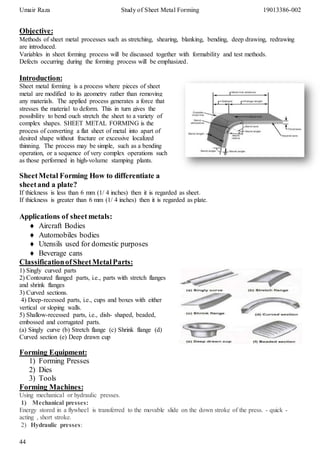
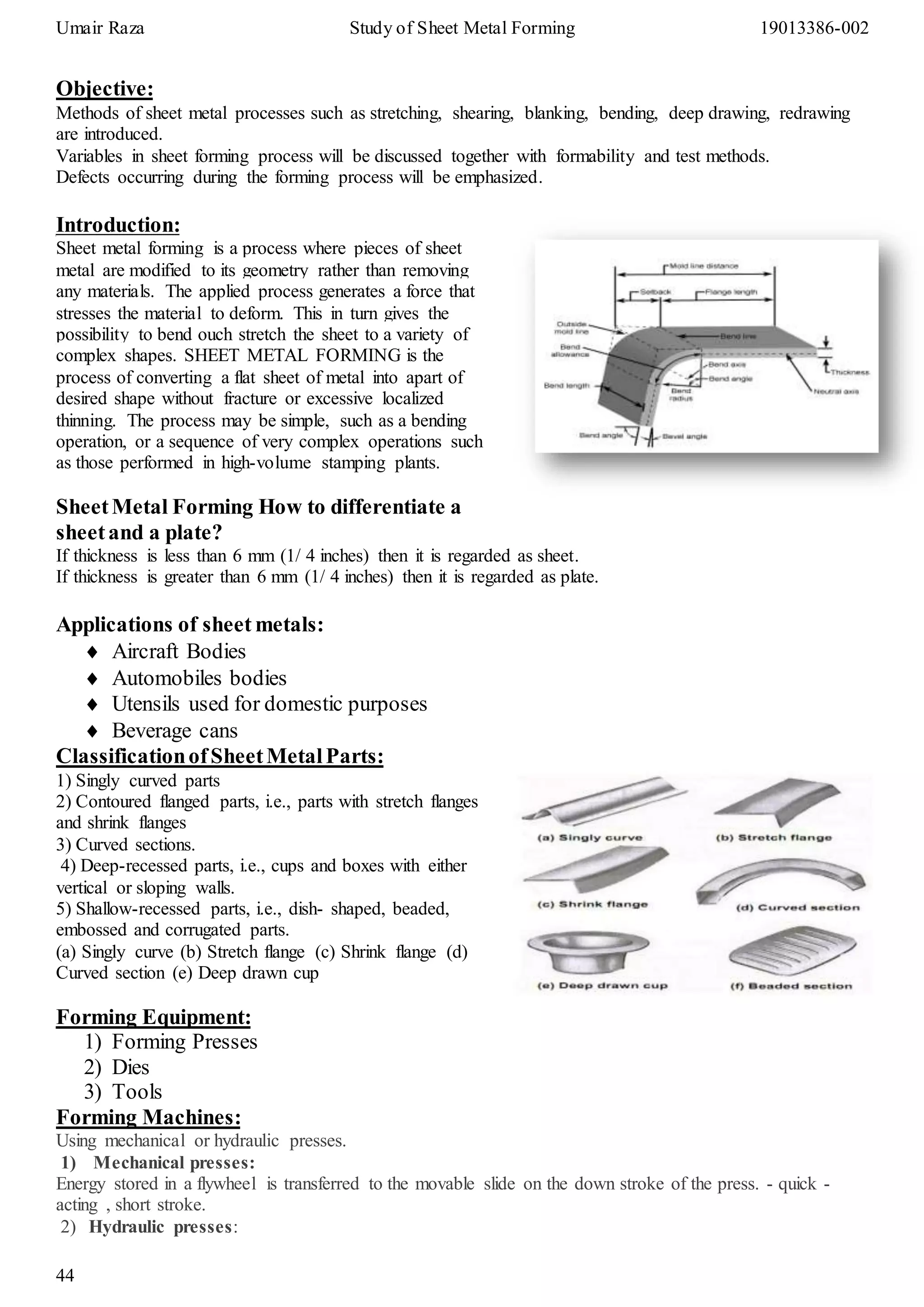
1) Singly curved parts
2) Contoured flanged parts, i.e., parts with stretch flanges
and shrink flanges
3) Curved sections.
4) Deep-recessed parts, i.e., cups and boxes with either
vertical or sloping walls.
5) Shallow-recessed parts, i.e., dish- shaped, beaded,
embossed and corrugated parts.
(a) Singly curve (b) Stretch flange (c) Shrink flange (d)
Curved section (e) Deep drawn cup
Forming Equipment:
1) Forming Presses
2) Dies
3) Tools
Forming Machines:
Using mechanical or hydraulic presses.
1) Mechanical presses:
Energy stored in a flywheel is transferred to the movable slide on the down stroke of the press. - quick -
acting , short stroke.
2) Hydraulic presses:
Umair Raza Study of Sheet Metal Forming 19013386-002
45
Slower - acting, longer stroke.
Action Of Presses:
1) Single - action press
One slide - vertical direction
2) Double - action press
Two slides - the second action is used to operated the hold-down, which prevents wrinkling in deep
drawing.
3) Triple - action press
Two actions above the die, one action below the die.
Types of sheetmetal forming:
1) Curling
Curling is a sheet metal forming process
that’s used to smooth out the otherwise
sharp and rugged edges of sheet metal.
Sheet metal often contains sharp edges with
“burrs” after it’s initially produced. Curling
is a forming process that involves de-
burring sheet metal to produce smooth
edges.
2) Bending
Another common sheet metal forming
process is bending. Companies typically
perform bending on sheet metal using either
a brake press or similar machine press. The
sheet metal is placed over a die block, at
which point a punch presses down onto the
sheet metal. Bending doesn’t actually create
holes in sheet metal. Rather, it lives up to its
namesake by “bending” sheet metal in the
shape of the die.
3) Ironing
Sheet metal may also be ironed to achieve a
uniform thickness. Most aluminum cans, for
instance, are made of ironed aluminum. In
its raw state, the aluminum sheet metal is
too thick for beverage cans, so it’s ironed to
achieve a thinner, more uniform
composition. Ironing involves the use of a
punch to force sheet metal between two
dies.
Umair Raza Study of Sheet Metal Forming 19013386-002
46
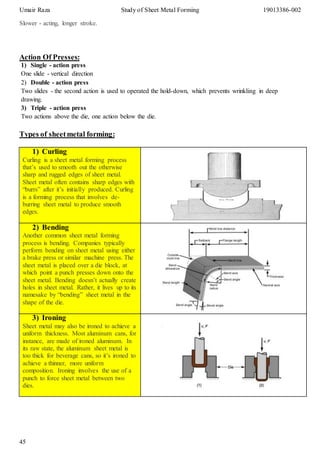
4) LaserCutting
Laser cutting has become an increasingly
common sheet metal forming process in
recent years. With laser cutting, sheet metal
is exposed to a high-powered laser that
burns holes in the metal. It’s a faster and
more precise cutting method that can even
be performed automatically using a
computer numerically controlled (CNC)
laser cutting machine.
5) Hydroforming
A lesser-known sheet metal forming process
is hydroforming. Like deep drawing,
hydroforming involves stretching the blank
over a die. So, what’s the difference
between hydroforming and deep drawing?
The key difference between these two
processes is that deep drawing requires
multiple draw reductions, whereas
hydroforming is performed in just one step.
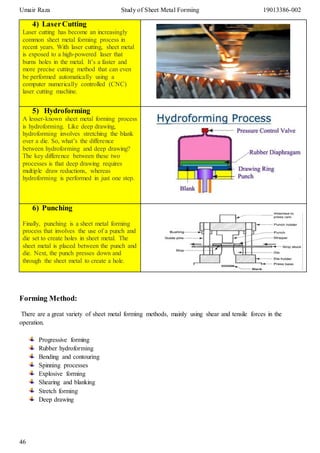
6) Punching
Finally, punching is a sheet metal forming
process that involves the use of a punch and
die set to create holes in sheet metal. The
sheet metal is placed between the punch and
die. Next, the punch presses down and
through the sheet metal to create a hole.
Forming Method:
There are a great variety of sheet metal forming methods, mainly using shear and tensile forces in the
operation.
Progressive forming
Rubber hydroforming
Bending and contouring
Spinning processes
Explosive forming
Shearing and blanking
Stretch forming
Deep drawing
Umair Raza Study of Sheet Metal Forming 19013386-002
47
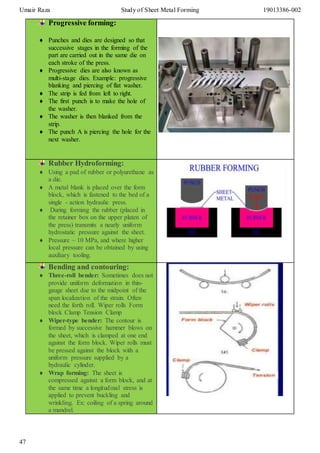
Progressive forming:
 Punches and dies are designed so that
successive stages in the forming of the
part are carried out in the same die on
each stroke of the press.
 Progressive dies are also known as
multi-stage dies. Example: progressive
blanking and piercing of flat washer.
 The strip is fed from left to right.
 The first punch is to make the hole of
the washer.
 The washer is then blanked from the
strip.
 The punch A is piercing the hole for the
next washer.
Rubber Hydroforming:
 Using a pad of rubber or polyurethane as
a die.
 A metal blank is placed over the form
block, which is fastened to the bed of a
single - action hydraulic press.
 During forming the rubber (placed in
the retainer box on the upper platen of
the press) transmits a nearly uniform
hydrostatic pressure against the sheet.
 Pressure ~ 10 MPa, and where higher
local pressure can be obtained by using
auxiliary tooling.
Bending and contouring:
 Three-roll bender: Sometimes does not
provide uniform deformation in thin-
gauge sheet due to the midpoint of the
span localization of the strain. Often
need the forth roll. Wiper rolls Form
block Clamp Tension Clamp
 Wiper-type bender: The contour is
formed by successive hammer blows on
the sheet, which is clamped at one end
against the form block. Wiper rolls must
be pressed against the block with a
uniform pressure supplied by a
hydraulic cylinder.
 Wrap forming: The sheet is
compressed against a form block, and at
the same time a longitudinal stress is
applied to prevent buckling and
wrinkling. Ex: coiling of a spring around
a mandrel.
Umair Raza Study of Sheet Metal Forming 19013386-002
48
Conclusion:
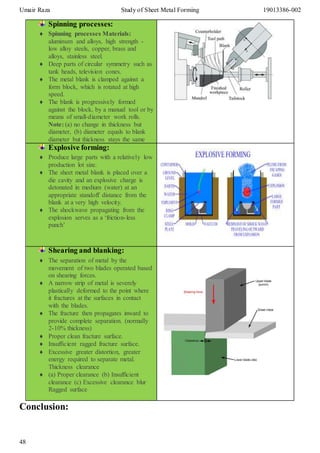
Spinning processes:
 Spinning processes Materials:
aluminum and alloys, high strength -
low alloy steels, copper, brass and
alloys, stainless steel.
 Deep parts of circular symmetry such as
tank heads, television cones.
 The metal blank is clamped against a
form block, which is rotated at high
speed.
 The blank is progressively formed
against the block, by a manual tool or by
means of small-diameter work rolls.
Note: (a) no change in thickness but
diameter, (b) diameter equals to blank
diameter but thickness stays the same
Explosive forming:
 Produce large parts with a relatively low
production lot size.
 The sheet metal blank is placed over a
die cavity and an explosive charge is
detonated in medium (water) at an
appropriate standoff distance from the
blank at a very high velocity.
 The shockwave propagating from the
explosion serves as a ‘friction-less
punch’
Shearing and blanking:
 The separation of metal by the
movement of two blades operated based
on shearing forces.
 A narrow strip of metal is severely
plastically deformed to the point where
it fractures at the surfaces in contact
with the blades.
 The fracture then propagates inward to
provide complete separation. (normally
2-10% thickness)
 Proper clean fracture surface.
 Insufficient ragged fracture surface.
 Excessive greater distortion, greater
energy required to separate metal.
Thickness clearance
 (a) Proper clearance (b) Insufficient
clearance (c) Excessive clearance blur
Ragged surface
Umair Raza Study of Sheet Metal Forming 19013386-002
49
Sheet forming is a good for applications where large numbers of parts can be made from sheet metal. Sheet
metal pressing becomes cheaper than other manufacturing processes ~700 units. Parts & manufacturing
processes must be designed so part are formed correctly quickly. Sheet metal forming is a process where
pieces of sheet metal are modified to its geometry rather than removing any materials. The applied process
generates a force that stresses the material to deform. This in turn gives the possibility to bend ouch stretch
the sheet to a variety of complex shapes. Rolling is the most common metal forming process & generally
used when change cross-sectional area is required.
References:
https://www.custompartnet.com/wu/sheet-metal-forming
https://www.sciencedirect.com/topics/materials-science/sheet-metal-forming
https://en.wikipedia.org/wiki/Sheet_metal
http://www.engineeringarticles.org/sheet-metal-forming-process/
http://web.mit.edu/2.810/www/files/lectures/2015_lectures/lec6-sheet-metal-forming-2015.pdf
https://monroeengineering.com/blog/6-common-sheet-metal-forming-process/
https://www.slideshare.net/vins049/sheet-metal-forming-presentation
https://www.metafab.com/common-types-of-sheet-metal/
https://www.machinemfg.com/what-is-sheet-metal-and-types-of-sheet-metal/
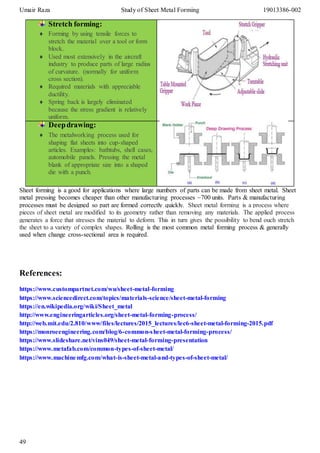
Stretch forming:
 Forming by using tensile forces to
stretch the material over a tool or form
block.
 Used most extensively in the aircraft
industry to produce parts of large radius
of curvature. (normally for uniform
cross section).
 Required materials with appreciable
ductility.
 Spring back is largely eliminated
because the stress gradient is relatively
uniform.
Deepdrawing:
 The metalworking process used for
shaping flat sheets into cup-shaped
articles. Examples: bathtubs, shell cases,
automobile panels. Pressing the metal
blank of appropriate size into a shaped
die with a punch.

Metal sheet forming, its types & operations

  • 1.
    Umair Raza Studyof Sheet Metal Forming 19013386-002 44 Objective: Methods of sheet metal processes such as stretching, shearing, blanking, bending, deep drawing, redrawing are introduced. Variables in sheet forming process will be discussed together with formability and test methods. Defects occurring during the forming process will be emphasized. Introduction: Sheet metal forming is a process where pieces of sheet metal are modified to its geometry rather than removing any materials. The applied process generates a force that stresses the material to deform. This in turn gives the possibility to bend ouch stretch the sheet to a variety of complex shapes. SHEET METAL FORMING is the process of converting a flat sheet of metal into apart of desired shape without fracture or excessive localized thinning. The process may be simple, such as a bending operation, or a sequence of very complex operations such as those performed in high-volume stamping plants. SheetMetal Forming How to differentiate a sheetand a plate? If thickness is less than 6 mm (1/ 4 inches) then it is regarded as sheet. If thickness is greater than 6 mm (1/ 4 inches) then it is regarded as plate. Applications of sheet metals:  Aircraft Bodies  Automobiles bodies  Utensils used for domestic purposes  Beverage cans ClassificationofSheetMetalParts: 1) Singly curved parts 2) Contoured flanged parts, i.e., parts with stretch flanges and shrink flanges 3) Curved sections. 4) Deep-recessed parts, i.e., cups and boxes with either vertical or sloping walls. 5) Shallow-recessed parts, i.e., dish- shaped, beaded, embossed and corrugated parts. (a) Singly curve (b) Stretch flange (c) Shrink flange (d) Curved section (e) Deep drawn cup Forming Equipment: 1) Forming Presses 2) Dies 3) Tools Forming Machines: Using mechanical or hydraulic presses. 1) Mechanical presses: Energy stored in a flywheel is transferred to the movable slide on the down stroke of the press. - quick - acting , short stroke. 2) Hydraulic presses:
  • 2.
    Umair Raza Studyof Sheet Metal Forming 19013386-002 45 Slower - acting, longer stroke. Action Of Presses: 1) Single - action press One slide - vertical direction 2) Double - action press Two slides - the second action is used to operated the hold-down, which prevents wrinkling in deep drawing. 3) Triple - action press Two actions above the die, one action below the die. Types of sheetmetal forming: 1) Curling Curling is a sheet metal forming process that’s used to smooth out the otherwise sharp and rugged edges of sheet metal. Sheet metal often contains sharp edges with “burrs” after it’s initially produced. Curling is a forming process that involves de- burring sheet metal to produce smooth edges. 2) Bending Another common sheet metal forming process is bending. Companies typically perform bending on sheet metal using either a brake press or similar machine press. The sheet metal is placed over a die block, at which point a punch presses down onto the sheet metal. Bending doesn’t actually create holes in sheet metal. Rather, it lives up to its namesake by “bending” sheet metal in the shape of the die. 3) Ironing Sheet metal may also be ironed to achieve a uniform thickness. Most aluminum cans, for instance, are made of ironed aluminum. In its raw state, the aluminum sheet metal is too thick for beverage cans, so it’s ironed to achieve a thinner, more uniform composition. Ironing involves the use of a punch to force sheet metal between two dies.
  • 3.
    Umair Raza Studyof Sheet Metal Forming 19013386-002 46 4) LaserCutting Laser cutting has become an increasingly common sheet metal forming process in recent years. With laser cutting, sheet metal is exposed to a high-powered laser that burns holes in the metal. It’s a faster and more precise cutting method that can even be performed automatically using a computer numerically controlled (CNC) laser cutting machine. 5) Hydroforming A lesser-known sheet metal forming process is hydroforming. Like deep drawing, hydroforming involves stretching the blank over a die. So, what’s the difference between hydroforming and deep drawing? The key difference between these two processes is that deep drawing requires multiple draw reductions, whereas hydroforming is performed in just one step. 6) Punching Finally, punching is a sheet metal forming process that involves the use of a punch and die set to create holes in sheet metal. The sheet metal is placed between the punch and die. Next, the punch presses down and through the sheet metal to create a hole. Forming Method: There are a great variety of sheet metal forming methods, mainly using shear and tensile forces in the operation. Progressive forming Rubber hydroforming Bending and contouring Spinning processes Explosive forming Shearing and blanking Stretch forming Deep drawing
  • 4.
    Umair Raza Studyof Sheet Metal Forming 19013386-002 47 Progressive forming:  Punches and dies are designed so that successive stages in the forming of the part are carried out in the same die on each stroke of the press.  Progressive dies are also known as multi-stage dies. Example: progressive blanking and piercing of flat washer.  The strip is fed from left to right.  The first punch is to make the hole of the washer.  The washer is then blanked from the strip.  The punch A is piercing the hole for the next washer. Rubber Hydroforming:  Using a pad of rubber or polyurethane as a die.  A metal blank is placed over the form block, which is fastened to the bed of a single - action hydraulic press.  During forming the rubber (placed in the retainer box on the upper platen of the press) transmits a nearly uniform hydrostatic pressure against the sheet.  Pressure ~ 10 MPa, and where higher local pressure can be obtained by using auxiliary tooling. Bending and contouring:  Three-roll bender: Sometimes does not provide uniform deformation in thin- gauge sheet due to the midpoint of the span localization of the strain. Often need the forth roll. Wiper rolls Form block Clamp Tension Clamp  Wiper-type bender: The contour is formed by successive hammer blows on the sheet, which is clamped at one end against the form block. Wiper rolls must be pressed against the block with a uniform pressure supplied by a hydraulic cylinder.  Wrap forming: The sheet is compressed against a form block, and at the same time a longitudinal stress is applied to prevent buckling and wrinkling. Ex: coiling of a spring around a mandrel.
  • 5.
    Umair Raza Studyof Sheet Metal Forming 19013386-002 48 Conclusion: Spinning processes:  Spinning processes Materials: aluminum and alloys, high strength - low alloy steels, copper, brass and alloys, stainless steel.  Deep parts of circular symmetry such as tank heads, television cones.  The metal blank is clamped against a form block, which is rotated at high speed.  The blank is progressively formed against the block, by a manual tool or by means of small-diameter work rolls. Note: (a) no change in thickness but diameter, (b) diameter equals to blank diameter but thickness stays the same Explosive forming:  Produce large parts with a relatively low production lot size.  The sheet metal blank is placed over a die cavity and an explosive charge is detonated in medium (water) at an appropriate standoff distance from the blank at a very high velocity.  The shockwave propagating from the explosion serves as a ‘friction-less punch’ Shearing and blanking:  The separation of metal by the movement of two blades operated based on shearing forces.  A narrow strip of metal is severely plastically deformed to the point where it fractures at the surfaces in contact with the blades.  The fracture then propagates inward to provide complete separation. (normally 2-10% thickness)  Proper clean fracture surface.  Insufficient ragged fracture surface.  Excessive greater distortion, greater energy required to separate metal. Thickness clearance  (a) Proper clearance (b) Insufficient clearance (c) Excessive clearance blur Ragged surface
  • 6.
    Umair Raza Studyof Sheet Metal Forming 19013386-002 49 Sheet forming is a good for applications where large numbers of parts can be made from sheet metal. Sheet metal pressing becomes cheaper than other manufacturing processes ~700 units. Parts & manufacturing processes must be designed so part are formed correctly quickly. Sheet metal forming is a process where pieces of sheet metal are modified to its geometry rather than removing any materials. The applied process generates a force that stresses the material to deform. This in turn gives the possibility to bend ouch stretch the sheet to a variety of complex shapes. Rolling is the most common metal forming process & generally used when change cross-sectional area is required. References: https://www.custompartnet.com/wu/sheet-metal-forming https://www.sciencedirect.com/topics/materials-science/sheet-metal-forming https://en.wikipedia.org/wiki/Sheet_metal http://www.engineeringarticles.org/sheet-metal-forming-process/ http://web.mit.edu/2.810/www/files/lectures/2015_lectures/lec6-sheet-metal-forming-2015.pdf https://monroeengineering.com/blog/6-common-sheet-metal-forming-process/ https://www.slideshare.net/vins049/sheet-metal-forming-presentation https://www.metafab.com/common-types-of-sheet-metal/ https://www.machinemfg.com/what-is-sheet-metal-and-types-of-sheet-metal/ Stretch forming:  Forming by using tensile forces to stretch the material over a tool or form block.  Used most extensively in the aircraft industry to produce parts of large radius of curvature. (normally for uniform cross section).  Required materials with appreciable ductility.  Spring back is largely eliminated because the stress gradient is relatively uniform. Deepdrawing:  The metalworking process used for shaping flat sheets into cup-shaped articles. Examples: bathtubs, shell cases, automobile panels. Pressing the metal blank of appropriate size into a shaped die with a punch.