

Sheet Metal Forming
Subject: Manufacturing Processes-I
Subject Teacher: Intizar Ali Tunio
Presented by: Mudeer Ahmed (F16ME33)
INTRODUCTION
Sheet Metal Forming 25/01/2020
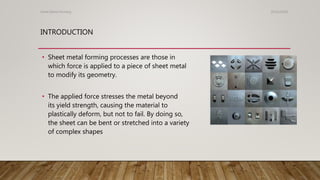
• Sheet metal forming processes are those in
which force is applied to a piece of sheet metal
to modify its geometry.
• The applied force stresses the metal beyond
its yield strength, causing the material to
plastically deform, but not to fail. By doing so,
the sheet can be bent or stretched into a variety
of complex shapes
TYPES OF SHEET METAL FORMING
25/01/2020Sheet Metal Forming
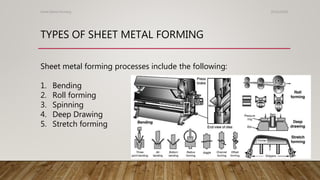
Sheet metal forming processes include the following:
1. Bending
2. Roll forming
3. Spinning
4. Deep Drawing
5. Stretch forming
1. BENDING
25/01/2020Sheet Metal Forming
 Bending is a metal forming process in which a force is applied to a piece of sheet
metal, causing it to bend at an angle and form the desired shape
 A bending operation causes deformation along one axis, but a sequence of several
different operations can be performed to create a complex part
 Bent parts can be quite small, such as a bracket, or up to 20 feet in length, such as a
large enclosure or chassis
Sheet Metal Forming 25/01/2020
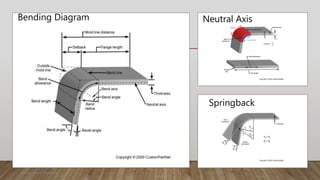
Bending Diagram Neutral Axis
Springback
BENDING TYPE
Sheet Metal Forming 25/01/2020
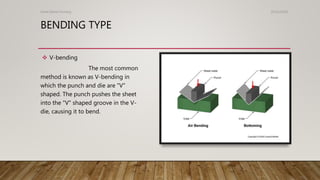
 V-bending
The most common
method is known as V-bending in
which the punch and die are "V"
shaped. The punch pushes the sheet
into the "V" shaped groove in the V-
die, causing it to bend.
BENDING TYPE
CONTI…….
Sheet Metal Forming 25/01/2020
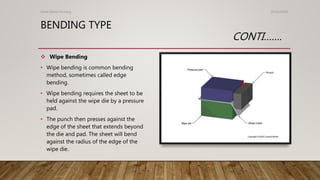
 Wipe Bending
• Wipe bending is common bending
method, sometimes called edge
bending.
• Wipe bending requires the sheet to be
held against the wipe die by a pressure
pad.
• The punch then presses against the
edge of the sheet that extends beyond
the die and pad. The sheet will bend
against the radius of the edge of the
wipe die.
2. ROLLING BENDING
Sheet Metal Forming 25/01/2020
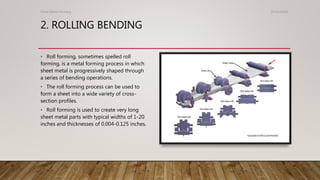
• Roll forming, sometimes spelled roll
forming, is a metal forming process in which
sheet metal is progressively shaped through
a series of bending operations.
• The roll forming process can be used to
form a sheet into a wide variety of cross-
section profiles.
• Roll forming is used to create very long
sheet metal parts with typical widths of 1-20
inches and thicknesses of 0.004-0.125 inches.
ROLLING BENDING
Sheet Metal Forming 25/01/2020
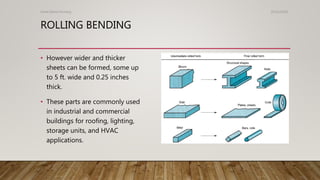
• However wider and thicker
sheets can be formed, some up
to 5 ft. wide and 0.25 inches
thick.
• These parts are commonly used
in industrial and commercial
buildings for roofing, lighting,
storage units, and HVAC
applications.
3. SPINNING
Sheet Metal Forming 25/01/2020
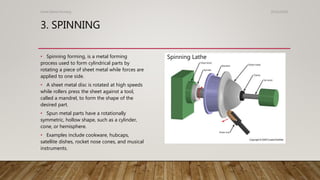
• Spinning forming, is a metal forming
process used to form cylindrical parts by
rotating a piece of sheet metal while forces are
applied to one side.
• A sheet metal disc is rotated at high speeds
while rollers press the sheet against a tool,
called a mandrel, to form the shape of the
desired part.
• Spun metal parts have a rotationally
symmetric, hollow shape, such as a cylinder,
cone, or hemisphere.
• Examples include cookware, hubcaps,
satellite dishes, rocket nose cones, and musical
instruments.
Spinning Lathe
SPINNING
CONTI……
Sheet Metal Forming 25/01/2020
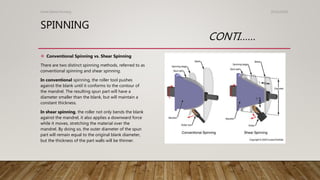
 Conventional Spinning vs. Shear Spinning
There are two distinct spinning methods, referred to as
conventional spinning and shear spinning.
In conventional spinning, the roller tool pushes
against the blank until it conforms to the contour of
the mandrel. The resulting spun part will have a
diameter smaller than the blank, but will maintain a
constant thickness.
In shear spinning, the roller not only bends the blank
against the mandrel, it also applies a downward force
while it moves, stretching the material over the
mandrel. By doing so, the outer diameter of the spun
part will remain equal to the original blank diameter,
but the thickness of the part walls will be thinner.
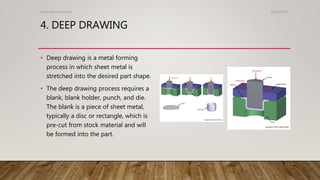
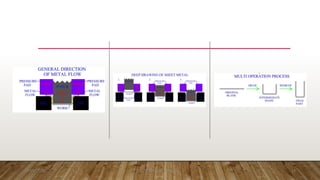
4. DEEP DRAWING
Sheet Metal Forming 25/01/2020
• Deep drawing is a metal forming
process in which sheet metal is
stretched into the desired part shape.
• The deep drawing process requires a
blank, blank holder, punch, and die.
The blank is a piece of sheet metal,
typically a disc or rectangle, which is
pre-cut from stock material and will
be formed into the part.
25/01/2020 Sheet Metal Forming 13
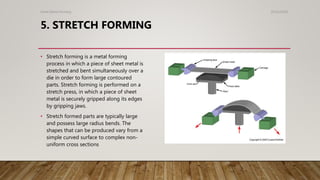
5. STRETCH FORMING
Sheet Metal Forming 25/01/2020
• Stretch forming is a metal forming
process in which a piece of sheet metal is
stretched and bent simultaneously over a
die in order to form large contoured
parts. Stretch forming is performed on a
stretch press, in which a piece of sheet
metal is securely gripped along its edges
by gripping jaws.
• Stretch formed parts are typically large
and possess large radius bends. The
shapes that can be produced vary from a
simple curved surface to complex non-
uniform cross sections
ADVANTAGES AND DISADVANTAGES
OF SHEET METAL FORMING
Sheet metal enclosure manufacturing involves many different sheet metal forming processes such as roll
forming, bending, spinning, deep drawing, stretch forming and more. This list compares the good and bad
of each process.
• Roll Forming
This process is for long parts with constant complex cross-sections. It produces good surface finish and has
high production rates. However, this process has high tool costs.
• Spinning
Spinning process is used to produce small or large axisymmetric parts. This process produces good surface
finish and has low tooling costs. However, labor costs can be high unless operations are automated.
• Drawing
Drawing process is for production of shallow or deep parts with relatively simple shapes. The pros are its
high production rates. The cons are its high tooling and equipment costs.
• Stretch Forming
Stretch forming can be used to produce large parts with shallow contours but it is only suitable for low-
quantity production. The cons are high labor costs, although tooling and equipment costs vary depending
on part size.
Sheet Metal Forming 25/01/2020
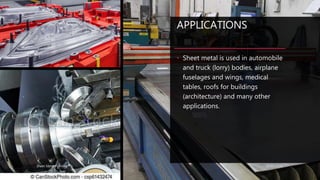
APPLICATIONS
• Sheet metal is used in automobile
and truck (lorry) bodies, airplane
fuselages and wings, medical
tables, roofs for buildings
(architecture) and many other
applications.
Sheet Metal Forming 25/01/2020

Sheet metal forming

  • 1.
    Sheet Metal Forming Subject:Manufacturing Processes-I Subject Teacher: Intizar Ali Tunio Presented by: Mudeer Ahmed (F16ME33)
  • 2.
    INTRODUCTION Sheet Metal Forming25/01/2020 • Sheet metal forming processes are those in which force is applied to a piece of sheet metal to modify its geometry. • The applied force stresses the metal beyond its yield strength, causing the material to plastically deform, but not to fail. By doing so, the sheet can be bent or stretched into a variety of complex shapes
  • 3.
    TYPES OF SHEETMETAL FORMING 25/01/2020Sheet Metal Forming Sheet metal forming processes include the following: 1. Bending 2. Roll forming 3. Spinning 4. Deep Drawing 5. Stretch forming
  • 4.
    1. BENDING 25/01/2020Sheet MetalForming  Bending is a metal forming process in which a force is applied to a piece of sheet metal, causing it to bend at an angle and form the desired shape  A bending operation causes deformation along one axis, but a sequence of several different operations can be performed to create a complex part  Bent parts can be quite small, such as a bracket, or up to 20 feet in length, such as a large enclosure or chassis
  • 5.
    Sheet Metal Forming25/01/2020 Bending Diagram Neutral Axis Springback
  • 6.
    BENDING TYPE Sheet MetalForming 25/01/2020  V-bending The most common method is known as V-bending in which the punch and die are "V" shaped. The punch pushes the sheet into the "V" shaped groove in the V- die, causing it to bend.
  • 7.
    BENDING TYPE CONTI……. Sheet MetalForming 25/01/2020  Wipe Bending • Wipe bending is common bending method, sometimes called edge bending. • Wipe bending requires the sheet to be held against the wipe die by a pressure pad. • The punch then presses against the edge of the sheet that extends beyond the die and pad. The sheet will bend against the radius of the edge of the wipe die.
  • 8.
    2. ROLLING BENDING SheetMetal Forming 25/01/2020 • Roll forming, sometimes spelled roll forming, is a metal forming process in which sheet metal is progressively shaped through a series of bending operations. • The roll forming process can be used to form a sheet into a wide variety of cross- section profiles. • Roll forming is used to create very long sheet metal parts with typical widths of 1-20 inches and thicknesses of 0.004-0.125 inches.
  • 9.
    ROLLING BENDING Sheet MetalForming 25/01/2020 • However wider and thicker sheets can be formed, some up to 5 ft. wide and 0.25 inches thick. • These parts are commonly used in industrial and commercial buildings for roofing, lighting, storage units, and HVAC applications.
  • 10.
    3. SPINNING Sheet MetalForming 25/01/2020 • Spinning forming, is a metal forming process used to form cylindrical parts by rotating a piece of sheet metal while forces are applied to one side. • A sheet metal disc is rotated at high speeds while rollers press the sheet against a tool, called a mandrel, to form the shape of the desired part. • Spun metal parts have a rotationally symmetric, hollow shape, such as a cylinder, cone, or hemisphere. • Examples include cookware, hubcaps, satellite dishes, rocket nose cones, and musical instruments. Spinning Lathe
  • 11.
    SPINNING CONTI…… Sheet Metal Forming25/01/2020  Conventional Spinning vs. Shear Spinning There are two distinct spinning methods, referred to as conventional spinning and shear spinning. In conventional spinning, the roller tool pushes against the blank until it conforms to the contour of the mandrel. The resulting spun part will have a diameter smaller than the blank, but will maintain a constant thickness. In shear spinning, the roller not only bends the blank against the mandrel, it also applies a downward force while it moves, stretching the material over the mandrel. By doing so, the outer diameter of the spun part will remain equal to the original blank diameter, but the thickness of the part walls will be thinner.
  • 12.
    4. DEEP DRAWING SheetMetal Forming 25/01/2020 • Deep drawing is a metal forming process in which sheet metal is stretched into the desired part shape. • The deep drawing process requires a blank, blank holder, punch, and die. The blank is a piece of sheet metal, typically a disc or rectangle, which is pre-cut from stock material and will be formed into the part.
  • 13.
  • 14.
    5. STRETCH FORMING SheetMetal Forming 25/01/2020 • Stretch forming is a metal forming process in which a piece of sheet metal is stretched and bent simultaneously over a die in order to form large contoured parts. Stretch forming is performed on a stretch press, in which a piece of sheet metal is securely gripped along its edges by gripping jaws. • Stretch formed parts are typically large and possess large radius bends. The shapes that can be produced vary from a simple curved surface to complex non- uniform cross sections
  • 15.
    ADVANTAGES AND DISADVANTAGES OFSHEET METAL FORMING Sheet metal enclosure manufacturing involves many different sheet metal forming processes such as roll forming, bending, spinning, deep drawing, stretch forming and more. This list compares the good and bad of each process. • Roll Forming This process is for long parts with constant complex cross-sections. It produces good surface finish and has high production rates. However, this process has high tool costs. • Spinning Spinning process is used to produce small or large axisymmetric parts. This process produces good surface finish and has low tooling costs. However, labor costs can be high unless operations are automated. • Drawing Drawing process is for production of shallow or deep parts with relatively simple shapes. The pros are its high production rates. The cons are its high tooling and equipment costs. • Stretch Forming Stretch forming can be used to produce large parts with shallow contours but it is only suitable for low- quantity production. The cons are high labor costs, although tooling and equipment costs vary depending on part size. Sheet Metal Forming 25/01/2020
  • 16.
    APPLICATIONS • Sheet metalis used in automobile and truck (lorry) bodies, airplane fuselages and wings, medical tables, roofs for buildings (architecture) and many other applications. Sheet Metal Forming 25/01/2020
  • 17.
  • 18.