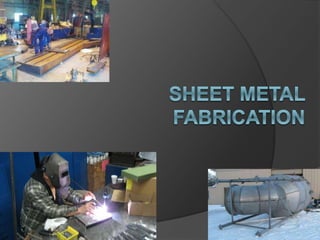
what is Sheet Metal Fabrication?
 Sheet metal fabrication is a classification of
manufacturing processes that shape a piece
of sheet metal into the desired part through
material removal and/or material
deformation.
 Sheet metal, which acts as the workpiece in these
processes, is one of the most common forms of raw
material stock.
 The material thickness that classifies a workpiece as
sheet metal is not clearly defined. However, sheet metal
is generally considered to be a piece of stock between
0.006 and 0.25 inches thick.
 A piece of metal much thinner is considered to be "foil"
and any thicker is referred to as a "plate".
 The thickness of a piece of sheet metal is often referred
to as its gauge,
Gauge
 The sheet metal gauge (sometimes
spelled gage) indicates the standard
thickness of sheet metal for a specific
material.
 For most materials, as the gauge
number increases, the material
thickness decreases.
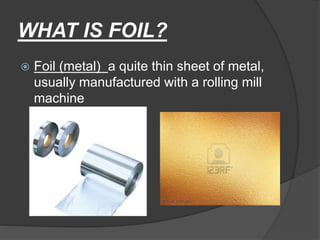
WHAT IS FOIL?
 Foil (metal) a quite thin sheet of metal,
usually manufactured with a rolling mill
machine
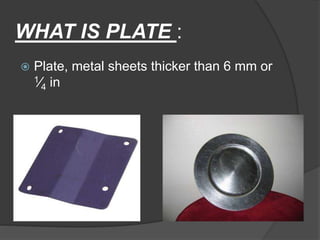
WHAT IS PLATE :
 Plate, metal sheets thicker than 6 mm or
1⁄4 in
Sheet metal stock is available in a wide variety of materials,
which include the following:
 Aluminum
 Brass
 Bronze
 Copper
 Magnesium
 Nickel
 Stainless steel
 Steel
 Tin
 Titanium
 Zinc
 Sheet metal can be cut, bent, and stretched into
a nearly any shape. Material removal processes
can create holes and cutouts in any 2D
geometric shape.
 Deformation processes can bend the sheet
numerous times to different angles or stretch
the sheet to create complex contours.
 These parts are found in a variety of industries,
such as aircraft, automotive, construction,
consumer products, HVAC, and furniture.
Sheet metal fabrication
processes
Sheet metal fabrication processes can mostly be placed into two
categories –
 Forming
 cutting.
 Forming processes are those in which the applied force
causes the material to plastically deform, but not to fail. Such
processes are able to bend or stretch the sheet into the
desired shape
 Cutting processes are those in which the applied force
causes the material to fail and separate, allowing the material
to be cut or removed
Forming
 Bending
 Roll forming
 Spinning
 Deep Drawing
 Stretch forming
Cutting with shear
 Shearing
 Blanking
 Punching
Cutting without shear
 Laser beam cutting
 Plasma cutting
 Water jet cutting
Sheet Metal Forming
 Sheet metal forming processes are those in which force is applied to a
piece of sheet metal to modify its geometry rather than remove any
material
 The applied force stresses the metal beyond its yield strength, causing
the material to plastically deform, but not to fail. By doing so, the sheet
can be bent or stretced into a variety of complex shapes.
Sheet metal forming processes include the following:
 Bending
 Roll forming
 Spinning
 Deep Drawing
 Stretch forming
Bending Bending is a metal forming process in which a force is
applied to a piece of sheet metal, causing it to bend at
an angle and form the desired shape.
 A bending operation causes deformation along one axis,
but a sequence of several different operations can be
performed to create a complex part.
 While using a press brake and standard die sets, there
are still a variety of techniques that can be used to bend
the sheet. The most common method is known as V-
bending, in which the punch and die are "V" shaped.
 The punch pushes the sheet into the "V" shaped groove
in the V-die, causing it to bend.
 If the punch does not force the sheet to the bottom of
the die cavity, leaving space or air underneath, it is
called "air bending".
 If the punch forces the sheet to the bottom of the die
cavity, it is called "bottoming"
 The act of bending results in both tension and compression in
the sheet metal. The outside portion of the sheet will undergo
tension and stretch to a greater length, while the inside
portion experiences compression and shortens. The neutral
axis is the boundary line inside the sheet metal, along which
no tension or compression forces are present. As a result, the
length of this axis remains constant. The changes in length to
the outside and inside surfaces can be related to the original
flat length by two parameters, the bend allowance and bend
deduction, which are defined below
 Bending is typically performed on a machine called a press
brake, which can be manually or automatically operated. For
this reason, the bending process is sometimes referred to as
press brake forming.
 A press brake contains an upper tool called the punch and a
lower tool called the die, between which the sheet metal is
located. The sheet is carefully positioned over the die and
held in place by the back gauge while the punch lowers and
forces the sheet to bend.
 In an automatic machine, the punch is forced into the sheet
under the power of a hydraulic ram. The bend angle achieved
is determined by the depth to which the punch forces the
sheet into the die. This depth is precisely controlled to
achieve the desired bend.
ROLL FORMING
Roll forming, sometimes, is a metal forming process in
which sheet metal is progressively shaped through a
series of bending operations
 The process is performed on a roll forming line in which
the sheet metal stock is fed through a series of roll
stations
 . Each station has a roller, referred to as a roller die,
positioned on both sides of the sheet.
DEEP DRAWING
 Deep drawing is a metal forming
process in which sheet metal is
stretched into the desired part shape.
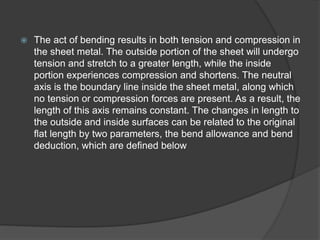
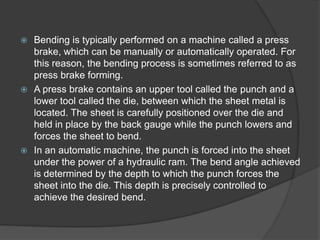
 Sheet metal has applications in car bodies,
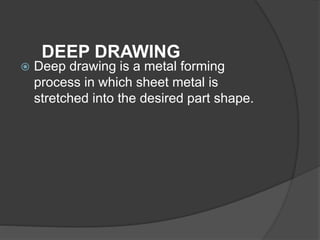
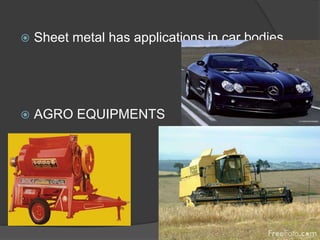
 AGRO EQUIPMENTS
Contact Us
Structural Design Detailing ( India )
Website- www.structuraldesigndetailing.com
Email- con@structuraldesigndetailing.com
structuraldesigndetailing.com@gmail.com
Contact No - + 91 9222086563 , + 91 8097027355
Mumbai|Sangli |Navi Mumbai|Vadodara|

Sheetmetalfabrication 140305095610-phpapp01

  • 2.
    what is SheetMetal Fabrication?  Sheet metal fabrication is a classification of manufacturing processes that shape a piece of sheet metal into the desired part through material removal and/or material deformation.
  • 3.
     Sheet metal,which acts as the workpiece in these processes, is one of the most common forms of raw material stock.  The material thickness that classifies a workpiece as sheet metal is not clearly defined. However, sheet metal is generally considered to be a piece of stock between 0.006 and 0.25 inches thick.  A piece of metal much thinner is considered to be "foil" and any thicker is referred to as a "plate".  The thickness of a piece of sheet metal is often referred to as its gauge,
  • 4.
    Gauge  The sheetmetal gauge (sometimes spelled gage) indicates the standard thickness of sheet metal for a specific material.  For most materials, as the gauge number increases, the material thickness decreases.
  • 5.
    WHAT IS FOIL? Foil (metal) a quite thin sheet of metal, usually manufactured with a rolling mill machine
  • 6.
    WHAT IS PLATE:  Plate, metal sheets thicker than 6 mm or 1⁄4 in
  • 7.
    Sheet metal stockis available in a wide variety of materials, which include the following:  Aluminum  Brass  Bronze  Copper  Magnesium  Nickel  Stainless steel  Steel  Tin  Titanium  Zinc
  • 8.
     Sheet metalcan be cut, bent, and stretched into a nearly any shape. Material removal processes can create holes and cutouts in any 2D geometric shape.  Deformation processes can bend the sheet numerous times to different angles or stretch the sheet to create complex contours.  These parts are found in a variety of industries, such as aircraft, automotive, construction, consumer products, HVAC, and furniture.
  • 9.
    Sheet metal fabrication processes Sheetmetal fabrication processes can mostly be placed into two categories –  Forming  cutting.  Forming processes are those in which the applied force causes the material to plastically deform, but not to fail. Such processes are able to bend or stretch the sheet into the desired shape  Cutting processes are those in which the applied force causes the material to fail and separate, allowing the material to be cut or removed
  • 10.
    Forming  Bending  Rollforming  Spinning  Deep Drawing  Stretch forming Cutting with shear  Shearing  Blanking  Punching Cutting without shear  Laser beam cutting  Plasma cutting  Water jet cutting
  • 11.
    Sheet Metal Forming Sheet metal forming processes are those in which force is applied to a piece of sheet metal to modify its geometry rather than remove any material  The applied force stresses the metal beyond its yield strength, causing the material to plastically deform, but not to fail. By doing so, the sheet can be bent or stretced into a variety of complex shapes. Sheet metal forming processes include the following:  Bending  Roll forming  Spinning  Deep Drawing  Stretch forming
  • 12.
    Bending Bending isa metal forming process in which a force is applied to a piece of sheet metal, causing it to bend at an angle and form the desired shape.  A bending operation causes deformation along one axis, but a sequence of several different operations can be performed to create a complex part.
  • 13.
     While usinga press brake and standard die sets, there are still a variety of techniques that can be used to bend the sheet. The most common method is known as V- bending, in which the punch and die are "V" shaped.  The punch pushes the sheet into the "V" shaped groove in the V-die, causing it to bend.  If the punch does not force the sheet to the bottom of the die cavity, leaving space or air underneath, it is called "air bending".  If the punch forces the sheet to the bottom of the die cavity, it is called "bottoming"
  • 14.
     The actof bending results in both tension and compression in the sheet metal. The outside portion of the sheet will undergo tension and stretch to a greater length, while the inside portion experiences compression and shortens. The neutral axis is the boundary line inside the sheet metal, along which no tension or compression forces are present. As a result, the length of this axis remains constant. The changes in length to the outside and inside surfaces can be related to the original flat length by two parameters, the bend allowance and bend deduction, which are defined below
  • 15.
     Bending istypically performed on a machine called a press brake, which can be manually or automatically operated. For this reason, the bending process is sometimes referred to as press brake forming.  A press brake contains an upper tool called the punch and a lower tool called the die, between which the sheet metal is located. The sheet is carefully positioned over the die and held in place by the back gauge while the punch lowers and forces the sheet to bend.  In an automatic machine, the punch is forced into the sheet under the power of a hydraulic ram. The bend angle achieved is determined by the depth to which the punch forces the sheet into the die. This depth is precisely controlled to achieve the desired bend.
  • 16.
    ROLL FORMING Roll forming,sometimes, is a metal forming process in which sheet metal is progressively shaped through a series of bending operations  The process is performed on a roll forming line in which the sheet metal stock is fed through a series of roll stations  . Each station has a roller, referred to as a roller die, positioned on both sides of the sheet.
  • 17.
    DEEP DRAWING  Deepdrawing is a metal forming process in which sheet metal is stretched into the desired part shape.
  • 18.
     Sheet metalhas applications in car bodies,  AGRO EQUIPMENTS
  • 19.
    Contact Us Structural DesignDetailing ( India ) Website- www.structuraldesigndetailing.com Email- con@structuraldesigndetailing.com structuraldesigndetailing.com@gmail.com Contact No - + 91 9222086563 , + 91 8097027355 Mumbai|Sangli |Navi Mumbai|Vadodara|