ARTIFICIAL INSEMINATION
AND PREGNANCY
DIAGNOSIS IN BITCHES
uploaded by Rauful Hassan
OVERVIEW
 Artificial Insemination (AI) is the process
of collecting semen and depositing it
through artificial means into the vagina of
the receptive bitch.
 For some dogs, natural breeding is
unsuccessful and artificial methods are
required.
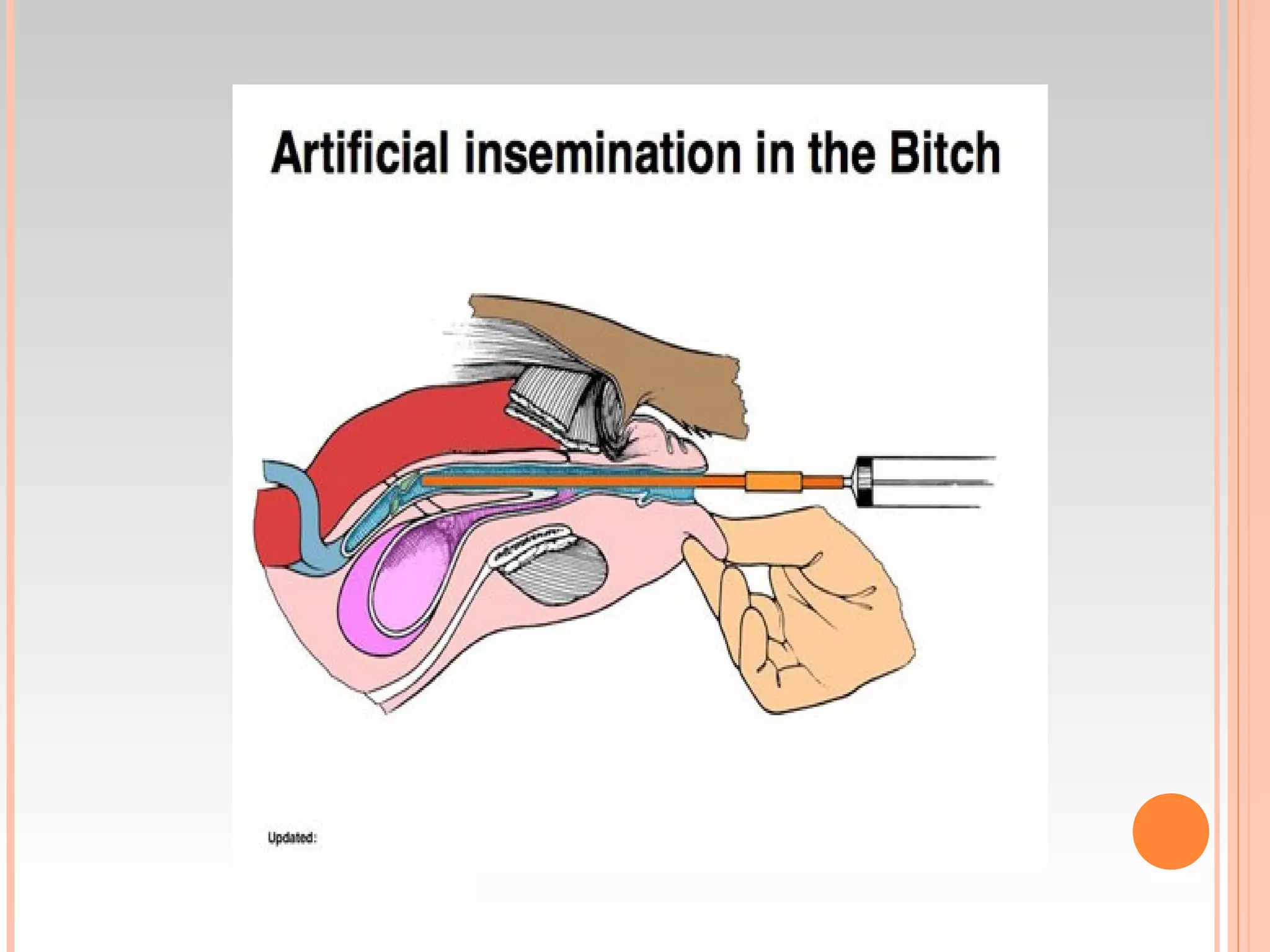
GENITAL TRACT OF BITCH
PRECLUSIONS
 AI is generally reserved for valuable
purebred dogs that are unable to conceive
through natural means due to various
problems.
Abnormal vulvar or vaginal conformation
Aggression
Male has poor sex drive or weakness or pain
when mounting due to arthritis or prostatic
disease
Geographic constraints
AI PROCESS
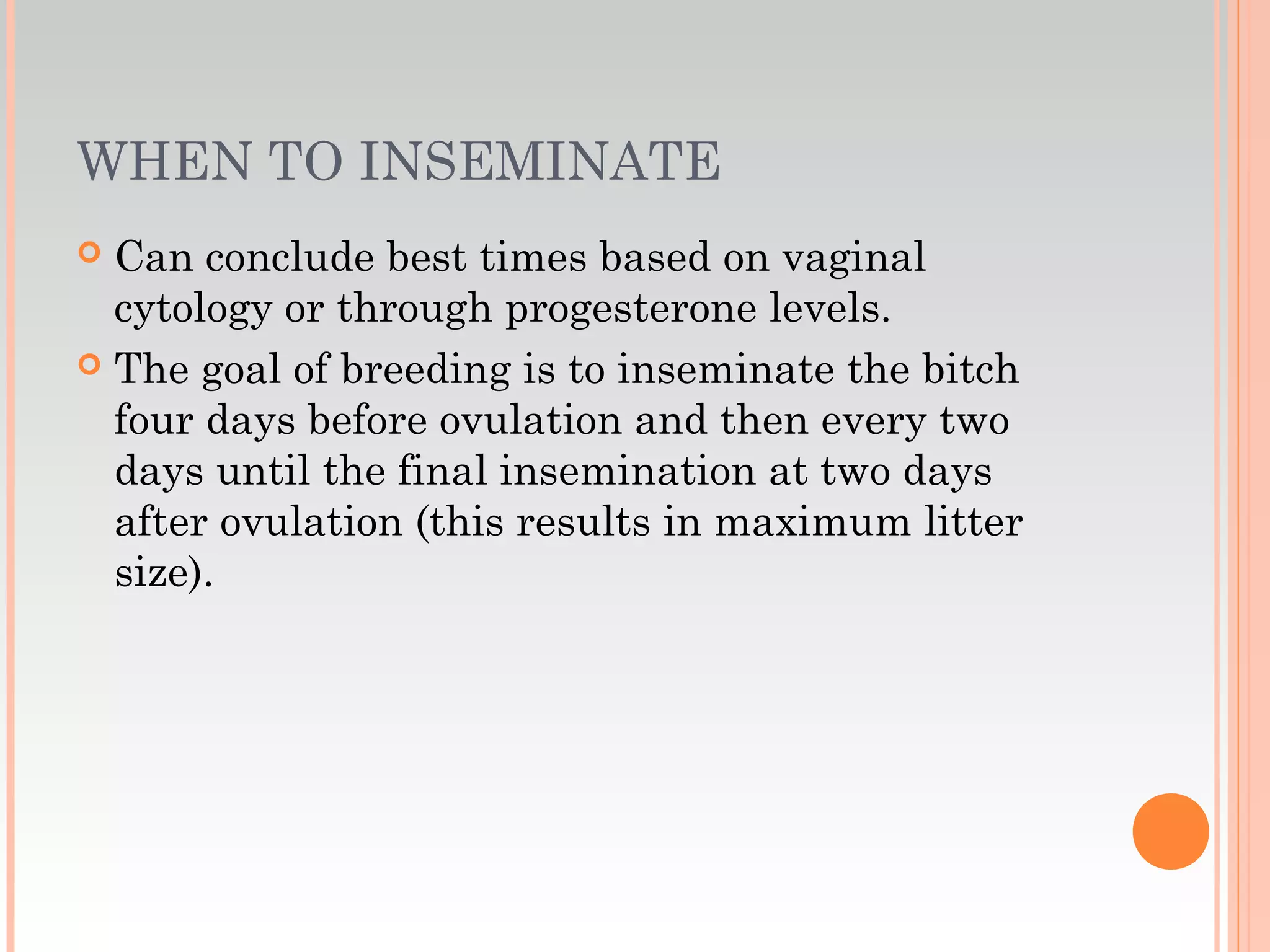
 Begins with collection of semen from male.
 Semen can be used fresh (chilled and used within
24 hours) or frozen.
 More processing of semen, less likely it will result in
fertilization.
 A semen extender fluid can be added to nourish
semen (different extenders for fresh or frozen semen)
 Extenders used for liquid semen are :- Skimmed milk
and Tris-Glucose-Egg-Yolk
and that for frozen semen are :- Tris-
Fructose-Citric-Acid extender with 8% Glycerol.
SEMEN ANALYSIS
After the collection of the semen, it should be analysed for the
following :-
 Concentration
 Motility
 Morphology
Normal
Sperm
AMOUNT OF SEMEN NEEDED
 Depends on the size of the female:
 Bitches less than 10 lbs need 1.5-3 mls of semen per
insemination.
 Bitches 10-50 lbs need 3-5 mls of semen
 Bitches over 50 lbs need 5-8 mls of semen
 Fresh
 Intravaginal
 Intrauterine
 Insemination Dose
 200 million sperms
 No. of Inseminations
 Depends on method used
for timing inseminations
 Frozen
 Intrauterine
 Insemination Dose
 200 million sperms
 No. of Inseminations
 Depends on Technique
 Surgical
 Only one insemination
during peak fertile period
 Transcervical
 One or Two inseminations at
intervals of 48 hrs during
fertile period
WHEN TO INSEMINATE
 Can conclude best times based on vaginal
cytology or through progesterone levels.
 The goal of breeding is to inseminate the bitch
four days before ovulation and then every two
days until the final insemination at two days
after ovulation (this results in maximum litter
size).
INSEMINATION
Differences due to life span of type of semen
utilized :-
 Frozen semen only lives for a few hours after
thawing and insemination.
 Chilled semen lives for about 5 days in the bitch.
 Fresh semen lives for about 6 days in the bitch.
INSEMINATION CONTINUED
 Once prepared, the semen can be deposited
either in front of the cervix or just inside the
uterus.
 Samples deposited just in front of the cervix
result in the best success.
 Placement of the semen into the proper area of
the reproductive tract requires some specialized
equipment.
Long pipettes are commercially
available.
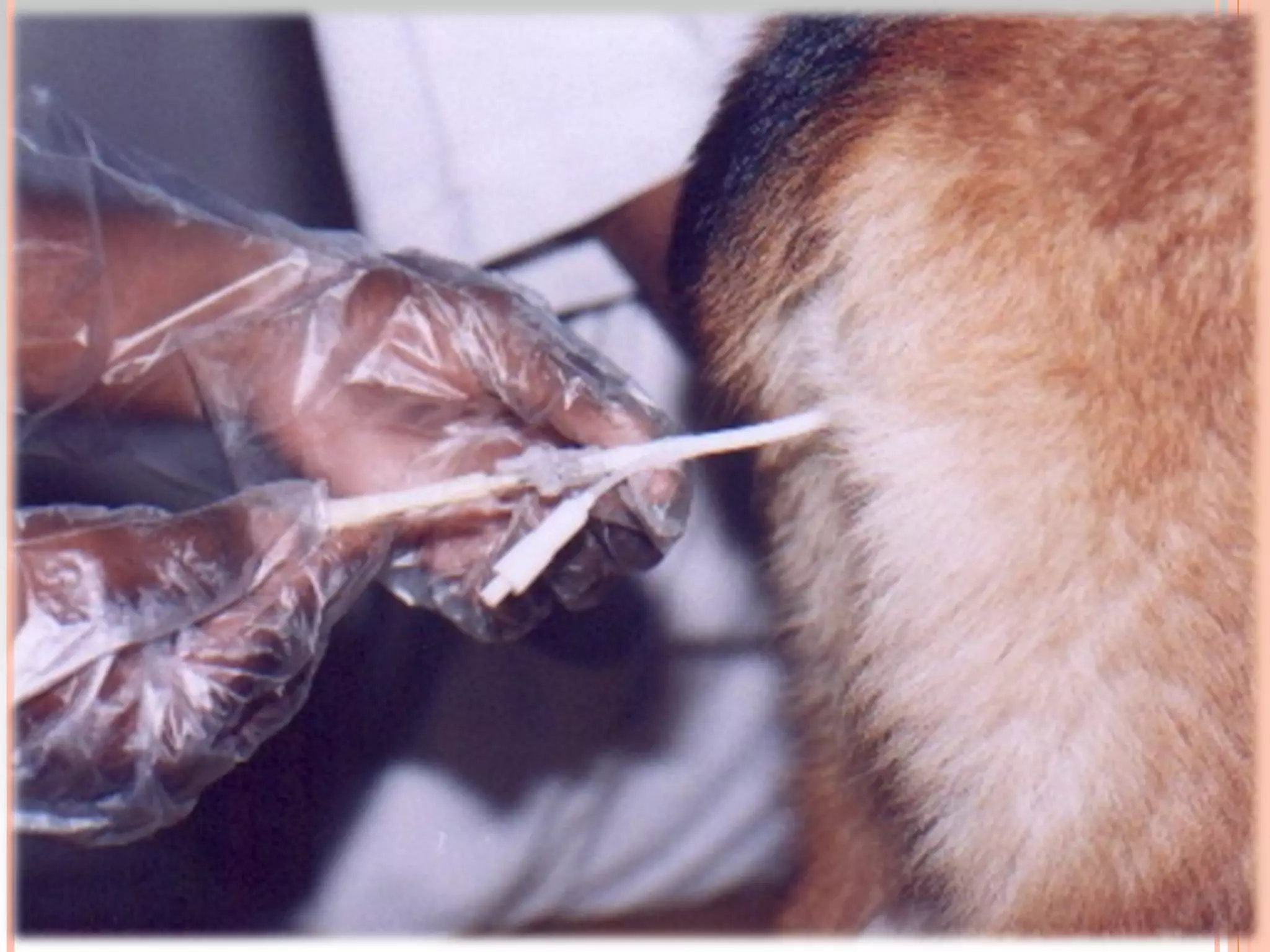
INSEMINATION DIRECTIONS
 Male should not be around the female.
 Hold the female in a standing position.
 Draw the appropriate amount of semen
into a sterile syringe and attach this to
the appropriate pipette.
 Pipette is then guided into the upper
vagina by a gloved, lubricated finger
inserted into the vaginal canal.
 Semen is deposited.
INSEMINATION DIRECTIONS
CONTINUED
 Syringe is filled with air, and remaining semen
is injected after initial push of the syringe.
 Pipette is removed, but finger is not.
 Vaginal wall is stimulated with inserted finger
for several minutes
 Finger is removed.
 Rear of dog is elevated for 5-10 minutes.
 DO NOT PUSH ABDOMEN!!
 DO NOT ALLOW DOG TO SQUAT!!
 Do not allow to urinate or jump for 30-60
minutes.
 Female can return to normal activity after one
hour.
SURGICAL INSEMINATION
 Uterus is exposed, the semen sample is introduced into
the uterus by a needle and syringe.
 Not the most effective method but may be required.
RESULTS
 Natural breeding there is 80-95% success rate of
pregnancy
 With AI using fresh semen, 62-100% success rate
 With AI using chilled semen, 59-80% success rate.
 With AI using frozen semen deposited into the vagina,
52-60% success rate.
 With AI using frozen semen deposited into the uterus,
0-80% success rate.
Why we go for pregnancy diagnosis in dogs ?
 Valuable to clients.
 Allows appropriate changes in schedule of working of show
dogs.
 Valuable to veterinarians if owner wants early termination
of pregnancy in case of mismating.
 Allows better management of bitch during pregnancy.
 Rules out pseudopregnancy at early stage.
METHODS OF PD IN BITCHES
Reliable methods of PD
 Abdominal palpation
 Radiography
 Ultrasonography
 Relaxin assay
 Acute phase proteins
Non reliable methods of PD
 Evaluation of teats
 Weight gain and abdominal enlargement
 Hormonal assays (P4,E2,PRL,FSH,C-Peptides)
 Metabolic changes (creatnine and IgG)
ABDOMINAL PALPATION (AP) Traditional method of PD in bitches.
 AP is accurate between 24- to 35-day post breeding.
 At about 30-35 days the accuracy is high 87%.
 AP in the flank and also in the lower abdomen.
 Gestational sacs are palpated as tense conceptual
swellings (6 to 30 mm in diameter) within uterine cornua.
 These swellings double in size every week until days 35 to
38.
DISADVANTAGES OF AP
 Difficult without experience to determine the exact number
of fetuses.
 Fetal viability cannot be verified with palpation.
 Position of fetuses is difficult to determine.
 Difficult to palpate, especially in obese or tense dogs.
 Bitches often tense their abdominal wall and respire too fast
making abdominal palpation often too difficult to perform.
 Fetal no. cannot be verified.
NON-TRADITIONAL METHOD
Ultrasonography
 Safe and accurate modality for pregnancy diagnosis
 3 types of diagnostic ultrasound for canine
pregnancy diagnosis. A-mode , Doppler and B-mode
 B-mode , or real time ultrasound is mostly used for
PD
 It allows assessment of ; pregnancy status
fetal no. and viability
 Trans abdominal USG is done in dogs
 Frequency of transducer is set between 3.5-5
MHz(most of the dogs)
 Toy breeds , 7.5 MHz transducer is used
 For early PD , 7.5-10 MHz transducer is used.
ULTRASONOGRAPHY
 24-25 Days 94-95% accurate
 28 Days 99% accurate
 Best time 25-30 days after mating
 Amniotic vesicle – 18-21 days
 fetal heart beat 24days
 fetal bones 42-45 days
ADVANTAGES
 Safe and accurate method for pregnancy diagnosis.
 Method of early pregnancy diagnosis in bitches.
 Method of choice for assessment of liveability of foetuses.
Disadvantages
 High cost of machine.
 Not the method of choice for assessment of litter size.
 Fetal position is difficult to determine.
 Trained person is required to perform USG.
RADIOGRAPHY
 Radiography is done after 45 days of mating.
 100% accurate in last 15 days of pregnancy.
 Mineralization of bones starts 44 day onwards.
 Lateral sides are mineralized earlier than ventro dorsal
projections.
 Radiography in lateral recumbency is preferred than dorsal
or dorso ventral.
 Voltage should be 50 Kvp.
 Current should be 0.5-1 mA.
SIGNS OF FETAL DEATH
 Spalding sign,(which is the overlapping of cranial bones).
 Collapse of skeleton.
 Gas shadows in the fetal heart, stomach, around the fetus.
 Tightly flexed spine(seen in fetuses died for long time) .
Jackson,2004
ADVANTAGES
 Good in evaluating fetal numbers in the bitches.
 Fetus can be differentiated easily from abdominal
contents due to mineralization of bones after 45
days.
 Position of fetuses can be easily determined.
 Number of fetuses can be easily counted.
 Whelping date can be predicted.
Disadvantages
 Poor in evaluating fetal viability.
 High cost of machine.
 Hazards of exposure to X-Rays to growing fetuses and
operator.
HORMONAL ASSAY
 Relaxin
 Pregnancy-specific hormone in dogs.
 Secreted by placenta only.
 Differential hormone between pregnancy and pseudo
pregnancy.
 Peak conc. Between 20-30 days of gestation.
 Relaxin assay cannot be used to estimate litter size.

Progesterone Assay
 Not used for routine diagnosis.
 Conc. remains elevated during diestrus in both pregnant
and non-pregnant bitch.

Prolactin
 Drastic increase in conc. during 30-45 days of gestation.
 FSH
 Declines below 150ng/ml after 17 days of pregnancy.
 ESTROGEN
 In urine increases 21 days post mating.

Acute phase proteins
 Increased after day 20 of gestation.
 Released during pregnancy & inflammatory diseases.
 Include heptoglobulin, ceruloplasmin, alpha-globulin, C-
reactive protein and fibrinogen.
 Serum fibrinogen as a pregnancy confirmatory test;
 98% accurate, with a value > 280 mg/dL
 Nearly 100% accurate with a value of > 300 mg/dL
 Metabolic changes
 Decreased serum creatinine and IgG in pregnant dogs 21-
day post-breeding
 Serum creatinine decreased 25-33% ,
and serum IgG decreased 40-45%
 Decrease in antithrombin III activity
 Normocytic normochromic anemia that begins on
Days 25-30 of gestation & max at term
 General changes in pregnant
bitch
 Bodyweight gain is 36% (range 20-55%).
 Change in body shape after days 56.
 Presence of fetal movements day 55 onwards.
 Nipples enlargement after 40-45 days.
Ai and pd in bitches

Ai and pd in bitches

  • 1.
    ARTIFICIAL INSEMINATION AND PREGNANCY DIAGNOSISIN BITCHES uploaded by Rauful Hassan
  • 2.
    OVERVIEW  Artificial Insemination(AI) is the process of collecting semen and depositing it through artificial means into the vagina of the receptive bitch.  For some dogs, natural breeding is unsuccessful and artificial methods are required.
  • 3.
  • 4.
    PRECLUSIONS  AI isgenerally reserved for valuable purebred dogs that are unable to conceive through natural means due to various problems. Abnormal vulvar or vaginal conformation Aggression Male has poor sex drive or weakness or pain when mounting due to arthritis or prostatic disease Geographic constraints
  • 5.
    AI PROCESS  Beginswith collection of semen from male.  Semen can be used fresh (chilled and used within 24 hours) or frozen.  More processing of semen, less likely it will result in fertilization.  A semen extender fluid can be added to nourish semen (different extenders for fresh or frozen semen)  Extenders used for liquid semen are :- Skimmed milk and Tris-Glucose-Egg-Yolk and that for frozen semen are :- Tris- Fructose-Citric-Acid extender with 8% Glycerol.
  • 7.
    SEMEN ANALYSIS After thecollection of the semen, it should be analysed for the following :-  Concentration  Motility  Morphology Normal Sperm
  • 8.
    AMOUNT OF SEMENNEEDED  Depends on the size of the female:  Bitches less than 10 lbs need 1.5-3 mls of semen per insemination.  Bitches 10-50 lbs need 3-5 mls of semen  Bitches over 50 lbs need 5-8 mls of semen
  • 9.
     Fresh  Intravaginal Intrauterine  Insemination Dose  200 million sperms  No. of Inseminations  Depends on method used for timing inseminations  Frozen  Intrauterine  Insemination Dose  200 million sperms  No. of Inseminations  Depends on Technique  Surgical  Only one insemination during peak fertile period  Transcervical  One or Two inseminations at intervals of 48 hrs during fertile period
  • 10.
    WHEN TO INSEMINATE Can conclude best times based on vaginal cytology or through progesterone levels.  The goal of breeding is to inseminate the bitch four days before ovulation and then every two days until the final insemination at two days after ovulation (this results in maximum litter size).
  • 11.
    INSEMINATION Differences due tolife span of type of semen utilized :-  Frozen semen only lives for a few hours after thawing and insemination.  Chilled semen lives for about 5 days in the bitch.  Fresh semen lives for about 6 days in the bitch.
  • 12.
    INSEMINATION CONTINUED  Onceprepared, the semen can be deposited either in front of the cervix or just inside the uterus.  Samples deposited just in front of the cervix result in the best success.  Placement of the semen into the proper area of the reproductive tract requires some specialized equipment. Long pipettes are commercially available.
  • 16.
    INSEMINATION DIRECTIONS  Maleshould not be around the female.  Hold the female in a standing position.  Draw the appropriate amount of semen into a sterile syringe and attach this to the appropriate pipette.  Pipette is then guided into the upper vagina by a gloved, lubricated finger inserted into the vaginal canal.  Semen is deposited.
  • 18.
    INSEMINATION DIRECTIONS CONTINUED  Syringeis filled with air, and remaining semen is injected after initial push of the syringe.  Pipette is removed, but finger is not.  Vaginal wall is stimulated with inserted finger for several minutes  Finger is removed.  Rear of dog is elevated for 5-10 minutes.  DO NOT PUSH ABDOMEN!!  DO NOT ALLOW DOG TO SQUAT!!  Do not allow to urinate or jump for 30-60 minutes.  Female can return to normal activity after one hour.
  • 19.
    SURGICAL INSEMINATION  Uterusis exposed, the semen sample is introduced into the uterus by a needle and syringe.  Not the most effective method but may be required.
  • 20.
    RESULTS  Natural breedingthere is 80-95% success rate of pregnancy  With AI using fresh semen, 62-100% success rate  With AI using chilled semen, 59-80% success rate.  With AI using frozen semen deposited into the vagina, 52-60% success rate.  With AI using frozen semen deposited into the uterus, 0-80% success rate.
  • 22.
    Why we gofor pregnancy diagnosis in dogs ?  Valuable to clients.  Allows appropriate changes in schedule of working of show dogs.  Valuable to veterinarians if owner wants early termination of pregnancy in case of mismating.  Allows better management of bitch during pregnancy.  Rules out pseudopregnancy at early stage.
  • 23.
    METHODS OF PDIN BITCHES Reliable methods of PD  Abdominal palpation  Radiography  Ultrasonography  Relaxin assay  Acute phase proteins Non reliable methods of PD  Evaluation of teats  Weight gain and abdominal enlargement  Hormonal assays (P4,E2,PRL,FSH,C-Peptides)  Metabolic changes (creatnine and IgG)
  • 24.
    ABDOMINAL PALPATION (AP)Traditional method of PD in bitches.  AP is accurate between 24- to 35-day post breeding.  At about 30-35 days the accuracy is high 87%.  AP in the flank and also in the lower abdomen.  Gestational sacs are palpated as tense conceptual swellings (6 to 30 mm in diameter) within uterine cornua.  These swellings double in size every week until days 35 to 38.
  • 26.
    DISADVANTAGES OF AP Difficult without experience to determine the exact number of fetuses.  Fetal viability cannot be verified with palpation.  Position of fetuses is difficult to determine.  Difficult to palpate, especially in obese or tense dogs.  Bitches often tense their abdominal wall and respire too fast making abdominal palpation often too difficult to perform.  Fetal no. cannot be verified.
  • 27.
    NON-TRADITIONAL METHOD Ultrasonography  Safeand accurate modality for pregnancy diagnosis  3 types of diagnostic ultrasound for canine pregnancy diagnosis. A-mode , Doppler and B-mode  B-mode , or real time ultrasound is mostly used for PD  It allows assessment of ; pregnancy status fetal no. and viability  Trans abdominal USG is done in dogs  Frequency of transducer is set between 3.5-5 MHz(most of the dogs)  Toy breeds , 7.5 MHz transducer is used  For early PD , 7.5-10 MHz transducer is used.
  • 28.
    ULTRASONOGRAPHY  24-25 Days94-95% accurate  28 Days 99% accurate  Best time 25-30 days after mating  Amniotic vesicle – 18-21 days  fetal heart beat 24days  fetal bones 42-45 days
  • 29.
    ADVANTAGES  Safe andaccurate method for pregnancy diagnosis.  Method of early pregnancy diagnosis in bitches.  Method of choice for assessment of liveability of foetuses. Disadvantages  High cost of machine.  Not the method of choice for assessment of litter size.  Fetal position is difficult to determine.  Trained person is required to perform USG.
  • 30.
    RADIOGRAPHY  Radiography isdone after 45 days of mating.  100% accurate in last 15 days of pregnancy.  Mineralization of bones starts 44 day onwards.  Lateral sides are mineralized earlier than ventro dorsal projections.  Radiography in lateral recumbency is preferred than dorsal or dorso ventral.  Voltage should be 50 Kvp.  Current should be 0.5-1 mA.
  • 31.
    SIGNS OF FETALDEATH  Spalding sign,(which is the overlapping of cranial bones).  Collapse of skeleton.  Gas shadows in the fetal heart, stomach, around the fetus.  Tightly flexed spine(seen in fetuses died for long time) . Jackson,2004
  • 32.
    ADVANTAGES  Good inevaluating fetal numbers in the bitches.  Fetus can be differentiated easily from abdominal contents due to mineralization of bones after 45 days.  Position of fetuses can be easily determined.  Number of fetuses can be easily counted.  Whelping date can be predicted. Disadvantages  Poor in evaluating fetal viability.  High cost of machine.  Hazards of exposure to X-Rays to growing fetuses and operator.
  • 33.
    HORMONAL ASSAY  Relaxin Pregnancy-specific hormone in dogs.  Secreted by placenta only.  Differential hormone between pregnancy and pseudo pregnancy.  Peak conc. Between 20-30 days of gestation.  Relaxin assay cannot be used to estimate litter size.
  • 35.
     Progesterone Assay  Notused for routine diagnosis.  Conc. remains elevated during diestrus in both pregnant and non-pregnant bitch.  Prolactin  Drastic increase in conc. during 30-45 days of gestation.  FSH  Declines below 150ng/ml after 17 days of pregnancy.  ESTROGEN  In urine increases 21 days post mating.
  • 36.
     Acute phase proteins Increased after day 20 of gestation.  Released during pregnancy & inflammatory diseases.  Include heptoglobulin, ceruloplasmin, alpha-globulin, C- reactive protein and fibrinogen.  Serum fibrinogen as a pregnancy confirmatory test;  98% accurate, with a value > 280 mg/dL  Nearly 100% accurate with a value of > 300 mg/dL
  • 37.
     Metabolic changes Decreased serum creatinine and IgG in pregnant dogs 21- day post-breeding  Serum creatinine decreased 25-33% , and serum IgG decreased 40-45%  Decrease in antithrombin III activity  Normocytic normochromic anemia that begins on Days 25-30 of gestation & max at term
  • 38.
     General changesin pregnant bitch  Bodyweight gain is 36% (range 20-55%).  Change in body shape after days 56.  Presence of fetal movements day 55 onwards.  Nipples enlargement after 40-45 days.