Introduction to Animal Science
                 POULTRY
                    Lecture 1


          Adapted by Tony Seykora
from a Power Point by Dr. Jacquie Jacob, Poultry
          Specialist at the U of MN
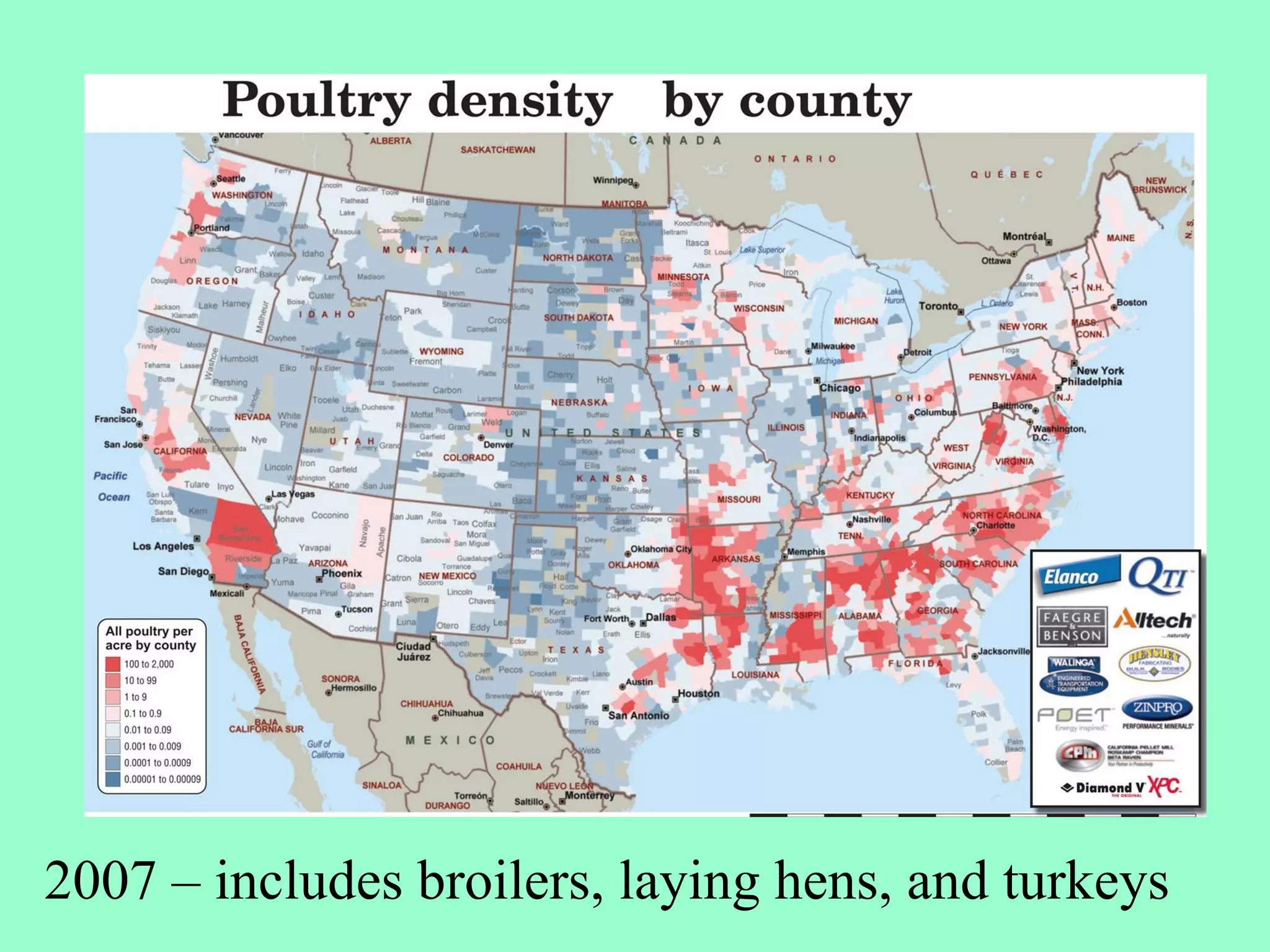
2007 – includes broilers, laying hens, and turkeys
POULTRY
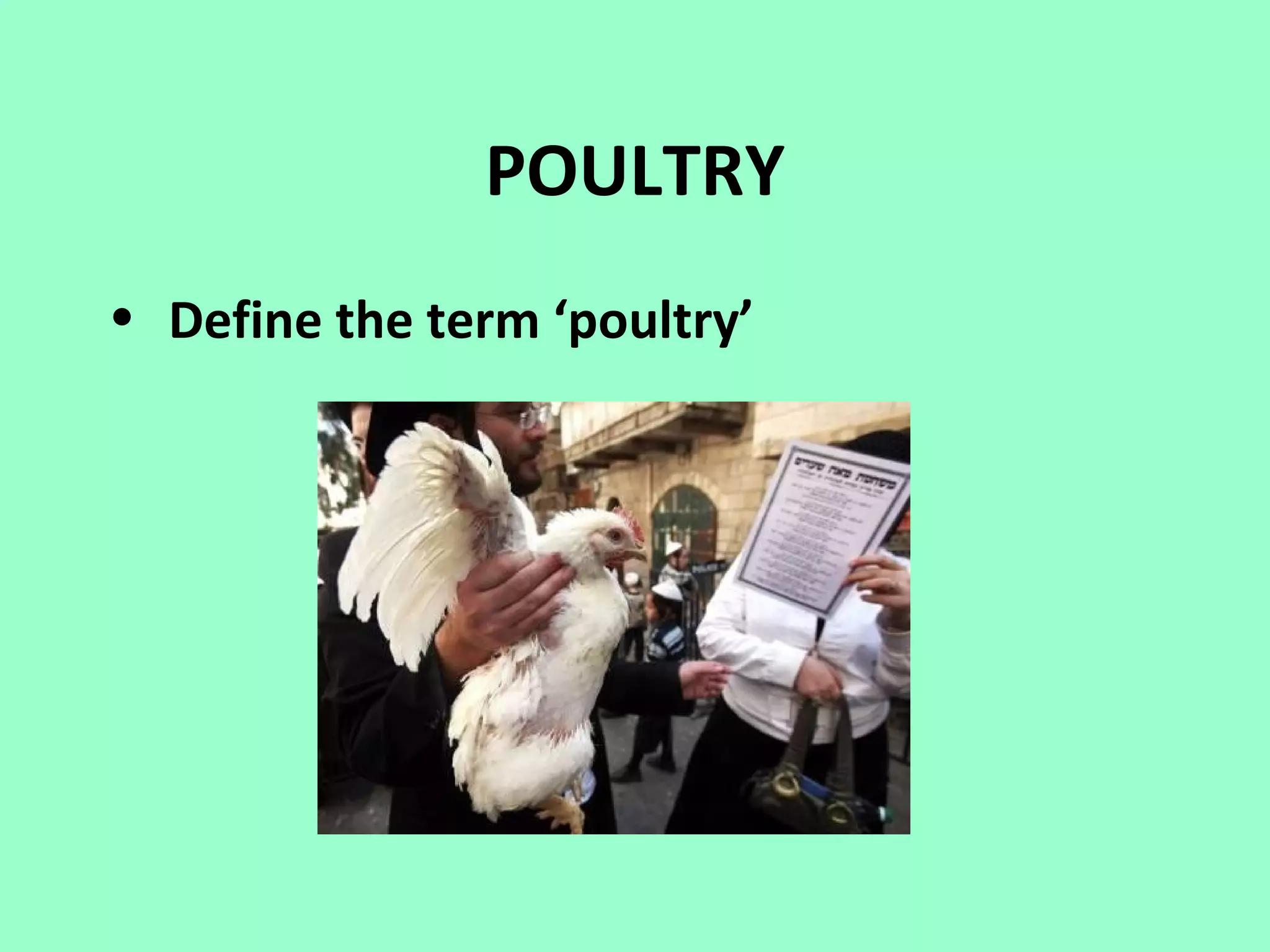
• Define the term ‘poultry’
POULTRY
• Define the term ‘poultry’
  – Singular or plural?
POULTRY
• Define the term ‘poultry’
  – Singular or plural?
POULTRY
• Define the term ‘poultry’
  – Singular or plural?
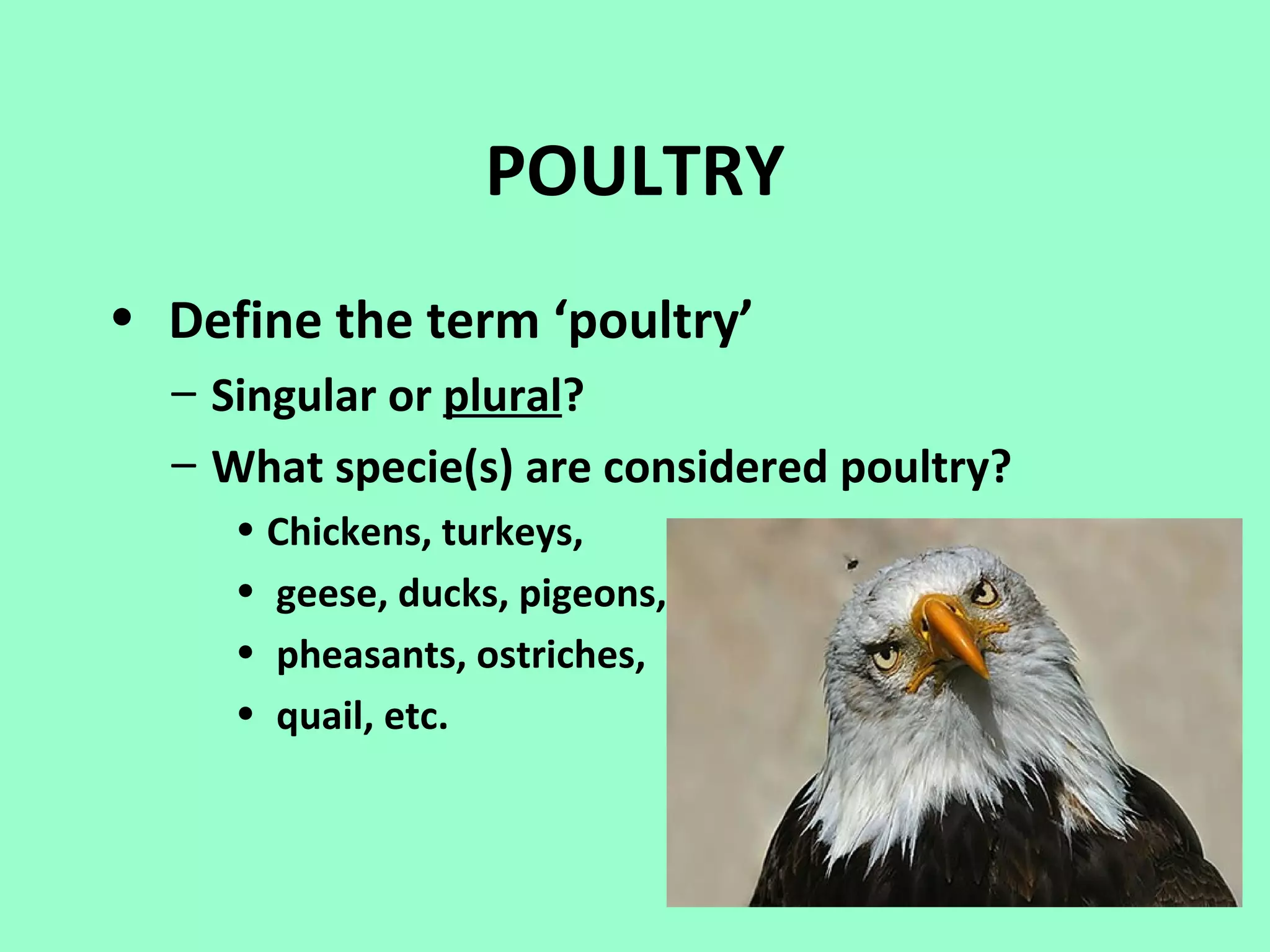
  – What specie(s) are considered poultry?
POULTRY
• Define the term ‘poultry’
  – Singular or plural?
  – What specie(s) are considered poultry?
     • Chickens, turkeys,
     • geese, ducks, pigeons,
     • pheasants, ostriches,
     • quail, etc.
POULTRY
• Define the term ‘poultry’
  – Singular or plural?
  – What specie(s) are considered poultry?
     • Chickens, turkeys, geese, ducks, pigeons,
       pheasants, ostriches, quail, etc.
  – What are poultry raised for?
POULTRY
• Define the term ‘poultry’
  – Singular or plural?
  – What specie(s) are considered poultry?
     • Chickens, turkeys, geese, ducks, pigeons,
       pheasants, ostriches, quail, etc.
  – What are poultry raised for?
     • Meat, eggs, feathers/down, livers, entertainment,
       work (e.g., pigeons that carry messages)
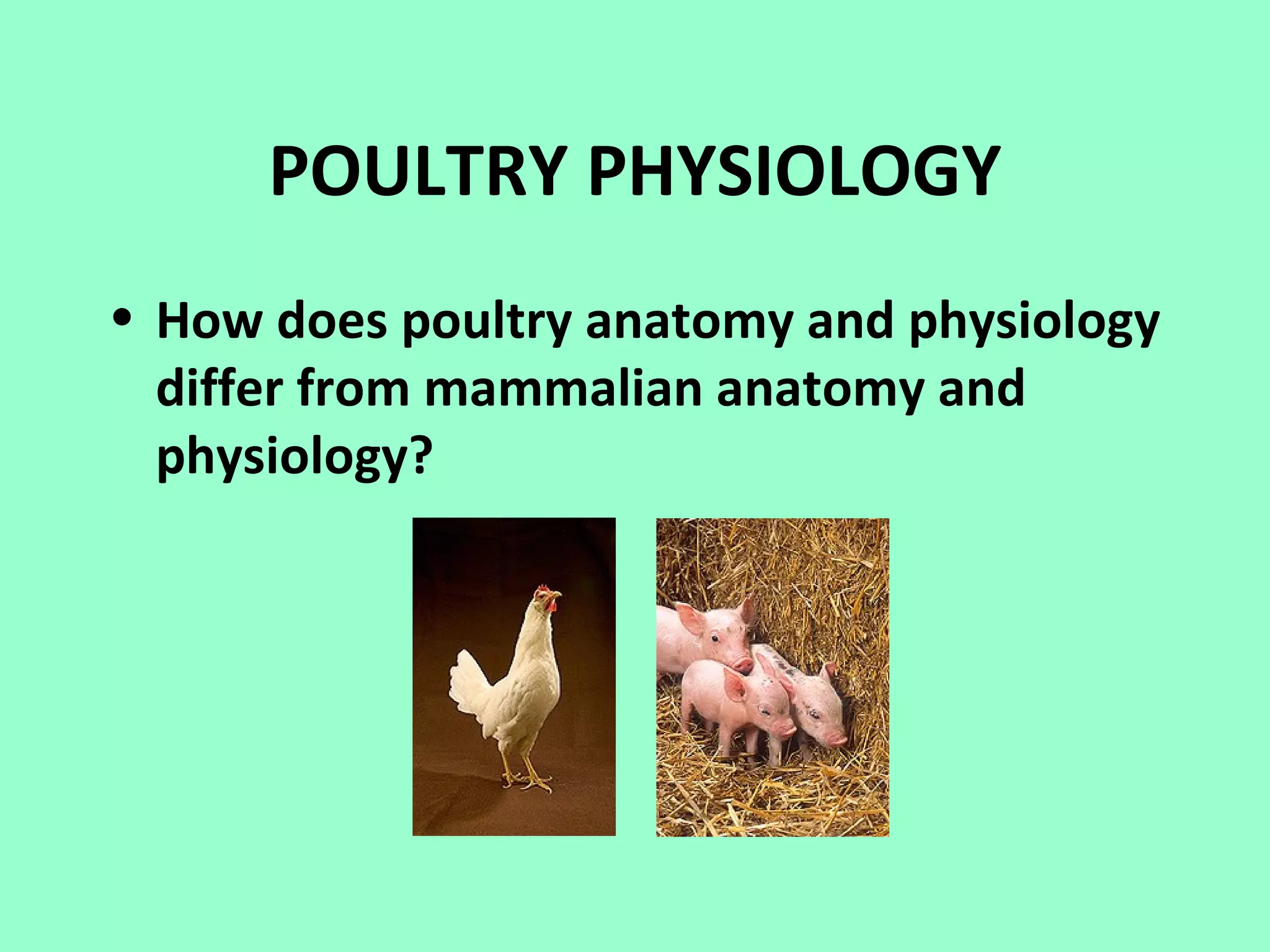
POULTRY PHYSIOLOGY
• How does poultry anatomy and physiology
  differ from mammalian anatomy and
  physiology?
POULTRY VS MAMMALIAN ANATOMY AND
             PHYSIOLOGY

• Integument - “The covering of the body”
   – Feathers - All birds have feathers and no other
     animals do
• Function of feathers:
   – Provide protection from the elements
   – Help regulate body temperature
   – Help streamline the body for flight
• Integument - “The covering of the body”
Different types of feathers
   – Each with a specific function
   – Each with specific structural feathers
     enhancing its functional purpose
• Integument - “The covering of the body”
• Skin is thin and pliable
   – Doesn’t need to be thick since the feathers provide a
     protective cover
   – Possess feather tracts that arrange feathers in a
     definite pattern
   – Does not contain sweat glands
   – Contains one major oil gland
   – Located at the base of the tail
       • Oil is removed from the gland when squeezed by
         the birds beak and the oil is spread over the body
         feathers during preening
SKIN
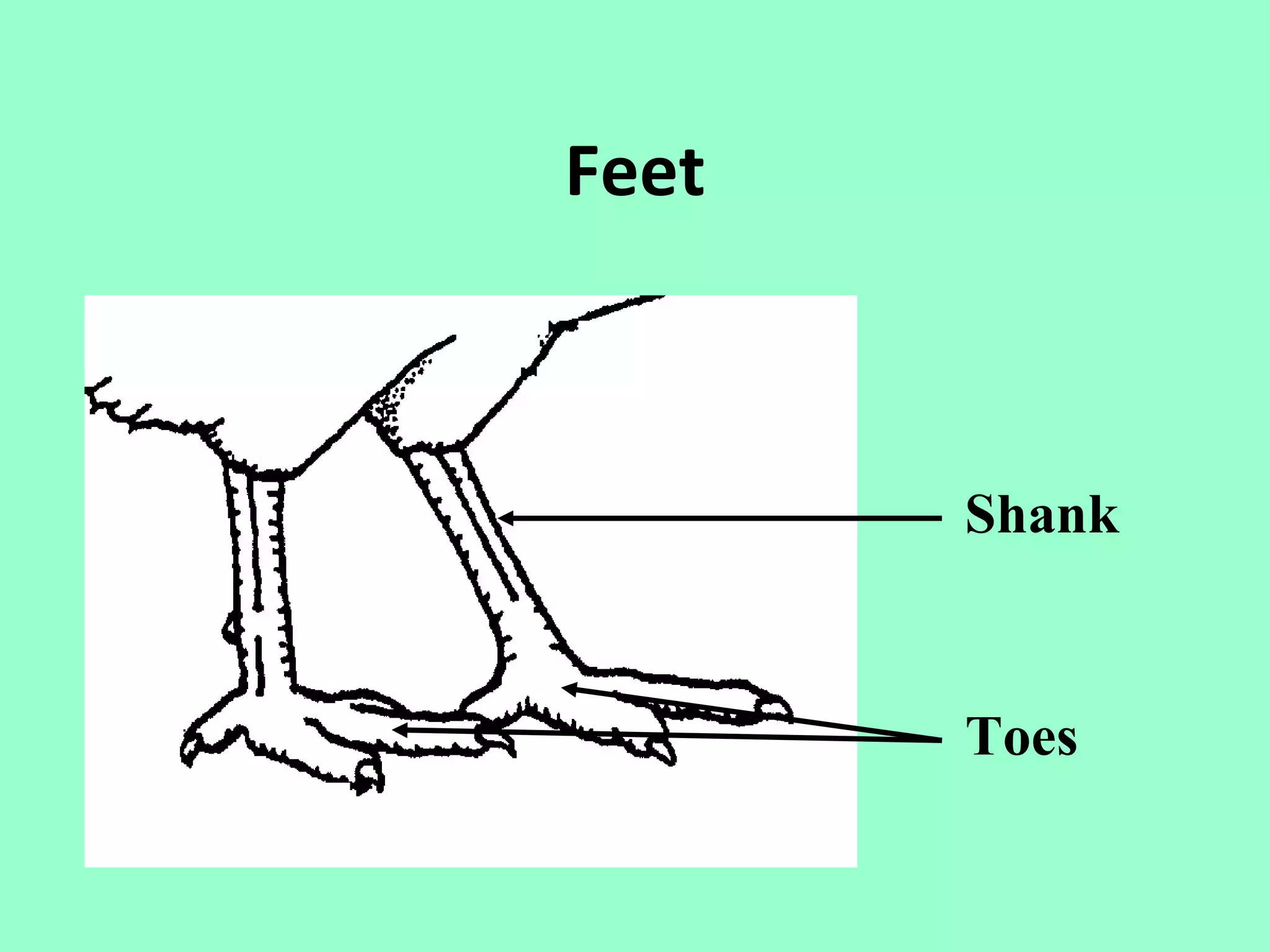
• Specialized types of skin:
  – Scales of the shanks and toes
Feet


       Shank


       Toes
SKIN
• Specialized types of skin:
  –   Scales of the shanks and toes
  –   Comb and wattles
  –   The beak is covered by a thin layer of skin
  –   Ear lobes
Comb
Beak
Ear lobe
Wattle
POULTRY VS MAMMALIAN ANATOMY AND
            PHYSIOLOGY

• Digestive system
  – Differences ?
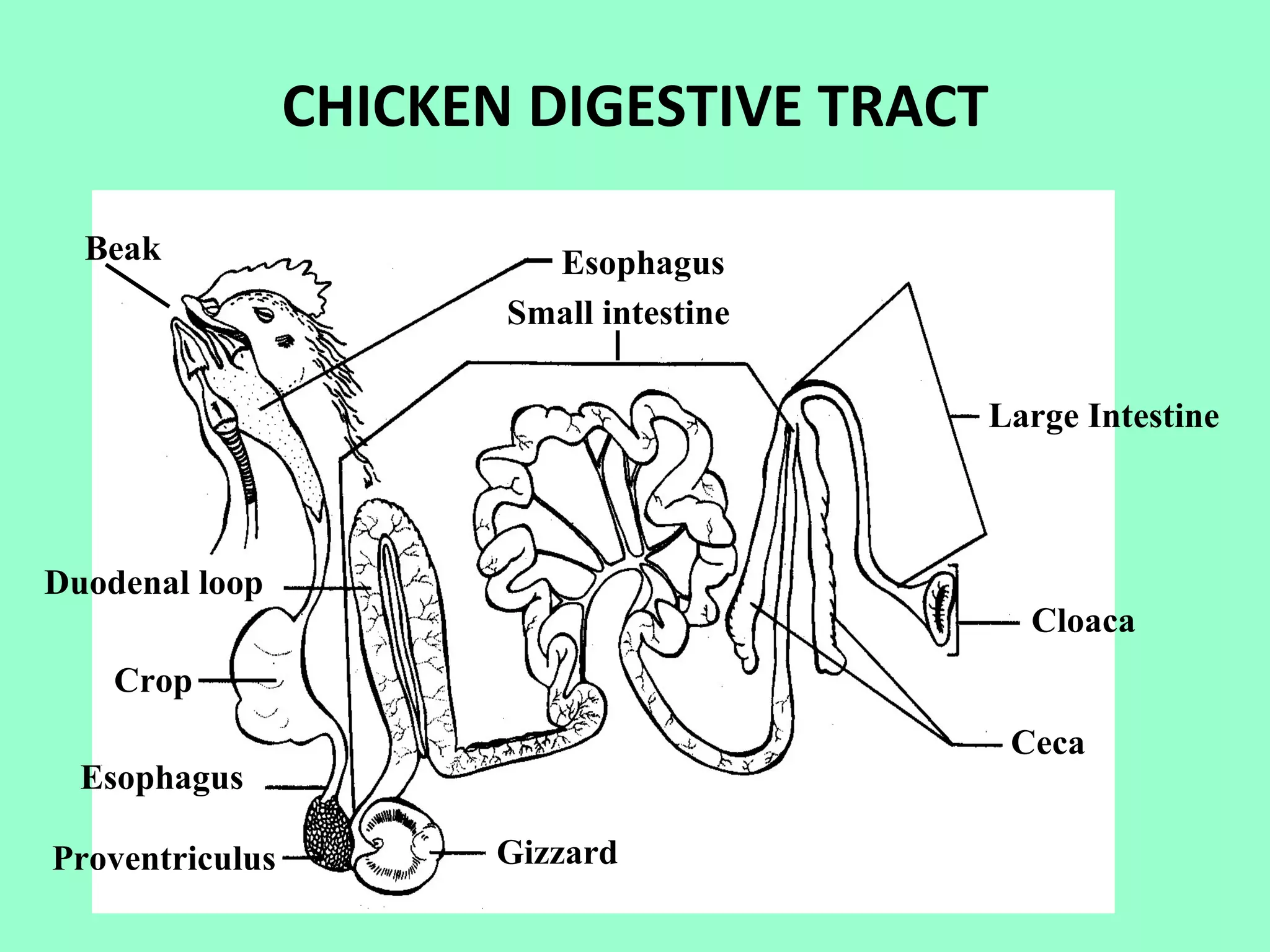
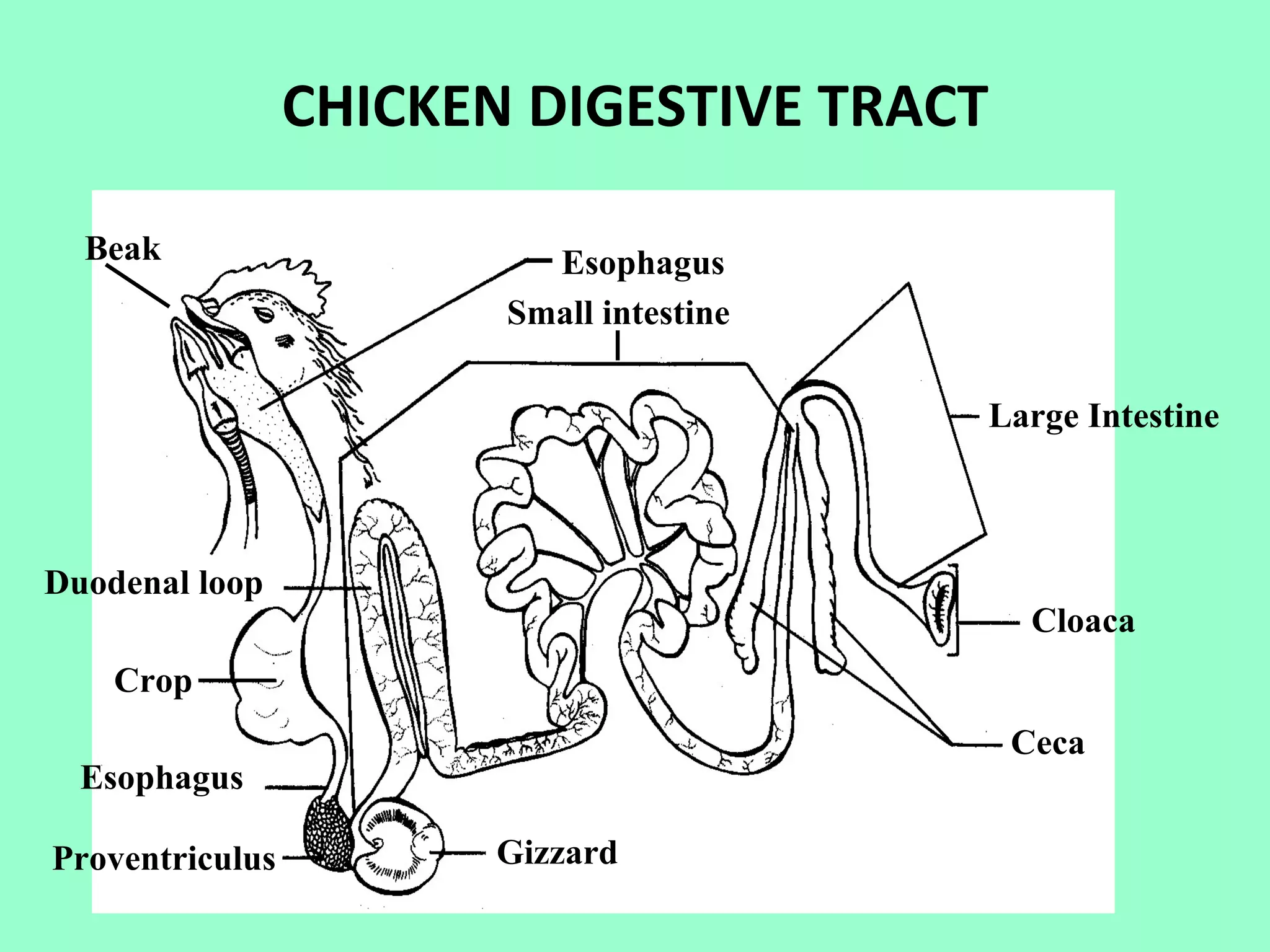
CHICKEN DIGESTIVE TRACT

  Beak                    Esophagus
                        Small intestine

                                          Large Intestine


Duodenal loop
                                            Cloaca
    Crop
                                           Ceca
  Esophagus

Proventriculus         Gizzard
Avian digestive system
•Classified as: Non-ruminant / Monogastric
•How does it differ from other non-ruminants?
•Birds don’t have teeth or lips
•Food swallowed in gulps with no chewing
Grasping and particle-size reduction
 functions assumed by the beak,
 tongue and gizzard


 Permits the weight associated with
 heavy jaws, teeth and muscles to be
 moved more centrally to
 accommodate flight
Crop - Temporary storage

 Permits a bird to forage for
 large amounts of food
 rapidly and then fly off to
 digest the meal in safety
Permits binging in the evening so that food can be
  slowly released to supply nutrients during the
  night time

  In chickens, food stored during an evening
  feeding supplies 75% of the nocturnal energy
  needs
  In some species, supplies a moist environment
  where food begins to soften

  But, in chickens mucous glands only present
  near the entrance of the crop so dependent on
  consumed water

  No enzymes secreted into the crop
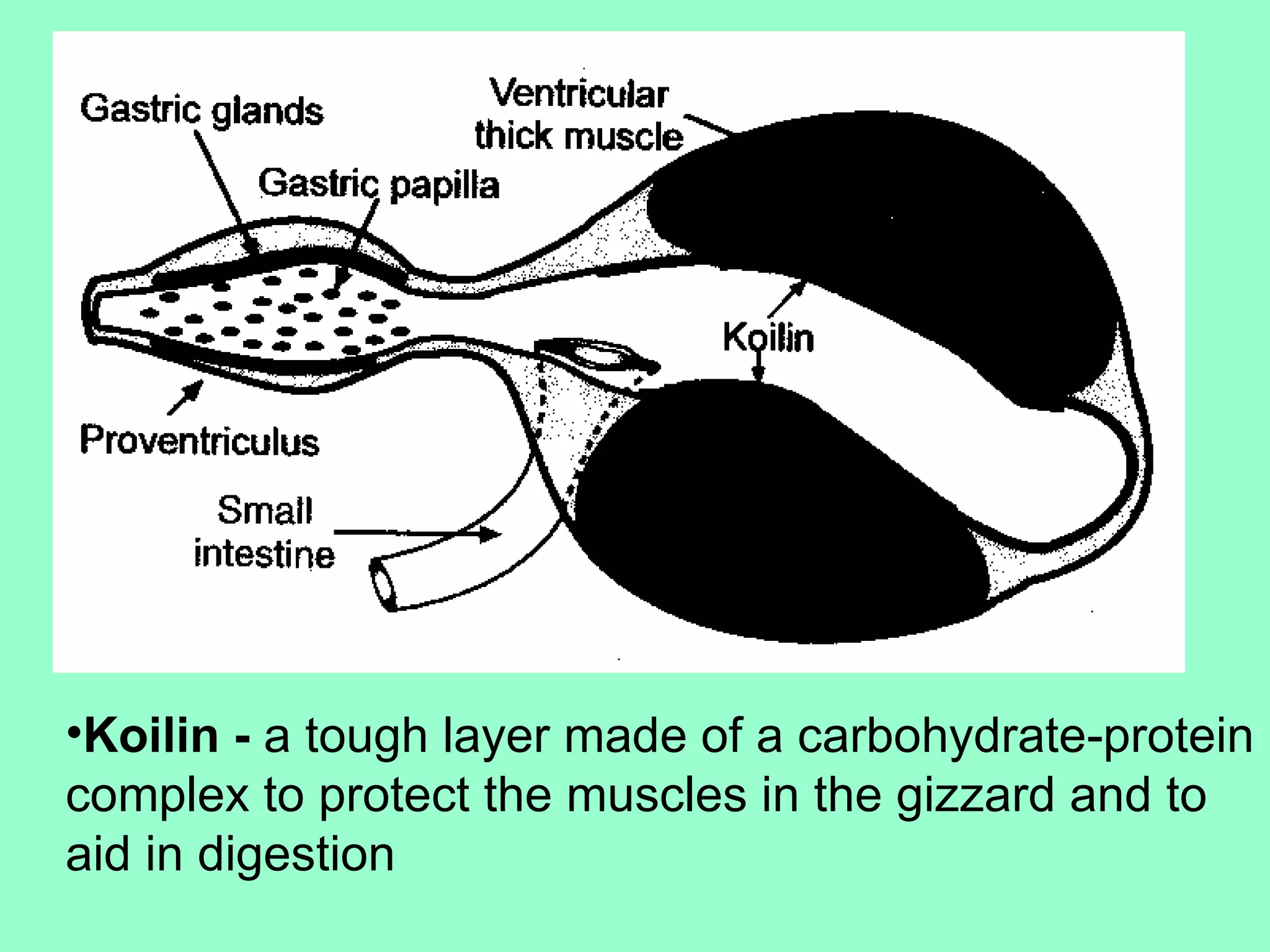
•Koilin - a tough layer made of a carbohydrate-protein
complex to protect the muscles in the gizzard and to
aid in digestion
CHICKEN DIGESTIVE TRACT

  Beak                    Esophagus
                        Small intestine

                                          Large Intestine


Duodenal loop
                                            Cloaca
    Crop
                                           Ceca
  Esophagus

Proventriculus         Gizzard
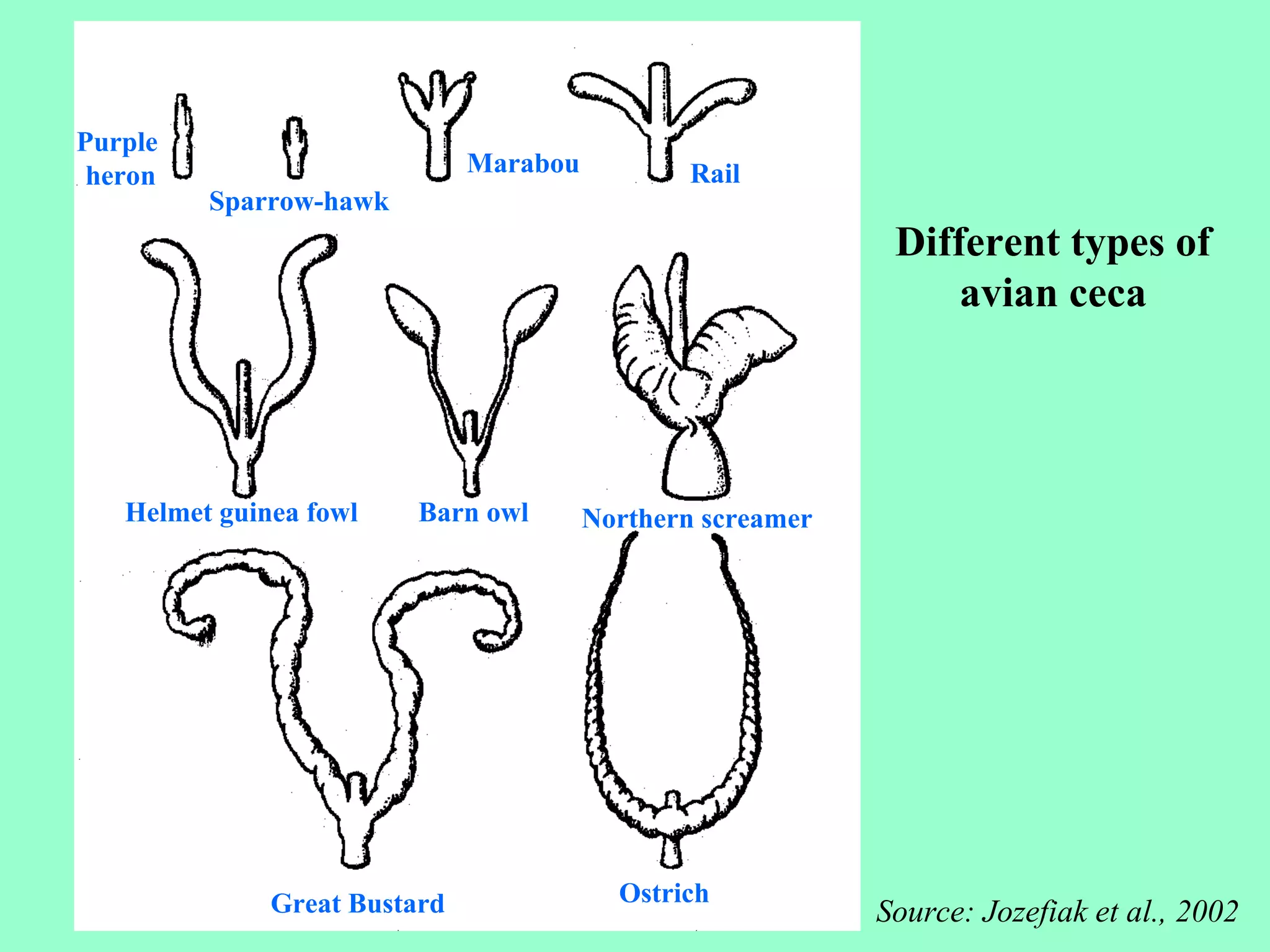
Purple
 heron                        Marabou          Rail
         Sparrow-hawk
                                                             Different types of
                                                                 avian ceca


   Helmet guinea fowl    Barn owl       Northern screamer


              Great Bustard               Ostrich
                                                            Source: Jozefiak et al., 2002
Considerable variation in size

 Ranges from voluminous pairs, to a
 single cecum to complete absence

 Highly developed in herbivores and
 omnivores

 Site for microbial fermentation of
 complex carbohydrates
Large intestine
  More accurately referred to as the rectum
  or colon


  Typically very short and small in diameter

  Exception is the ostrich where it is >50%
  of total intestinal length and is sacculated
  - divided into a series of pouches.
CLOACA
• Serves as a storage area for urine and
  feces
• Receives the exit ducts of the digestive,
  reproductive, and urinary systems
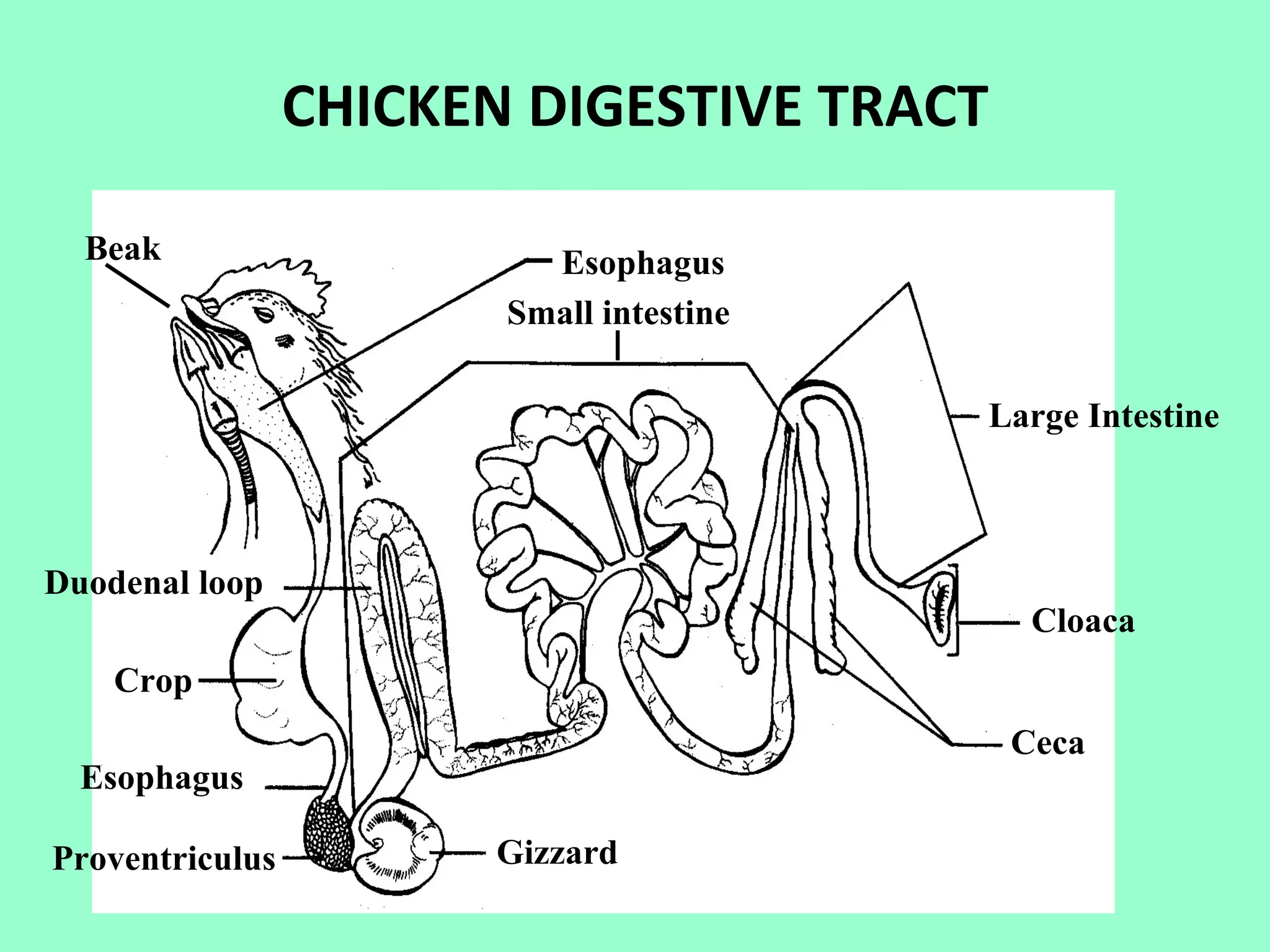
CHICKEN DIGESTIVE TRACT

  Beak                    Esophagus
                        Small intestine

                                          Large Intestine


Duodenal loop
                                            Cloaca
    Crop
                                           Ceca
  Esophagus

Proventriculus         Gizzard
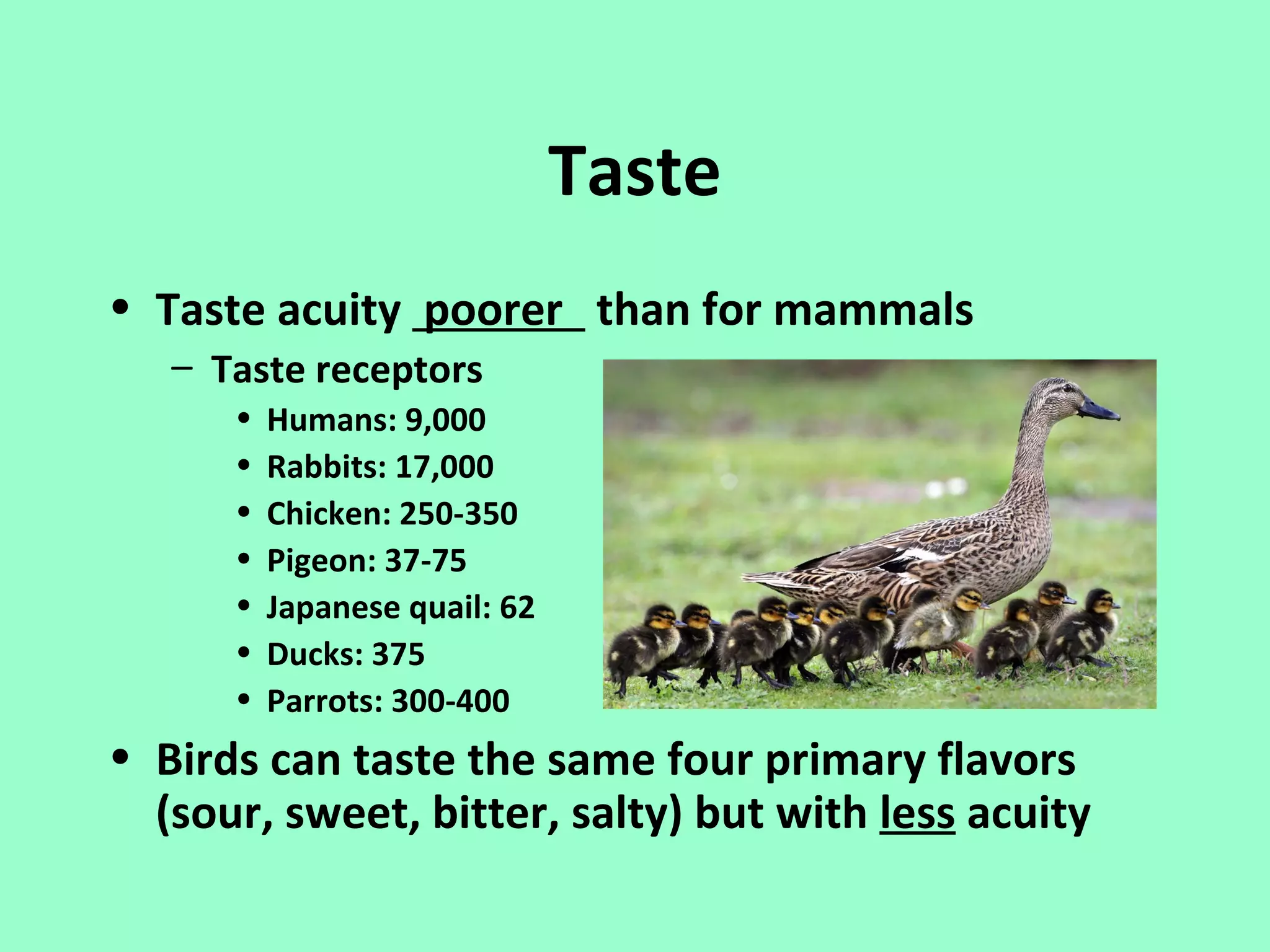
• Liver
   – Predominant bile salt produced varies
     among species
• Gall bladder
   – Absent in some avian species: ostrich,
     hummingbirds, doves, pigeons, parrots
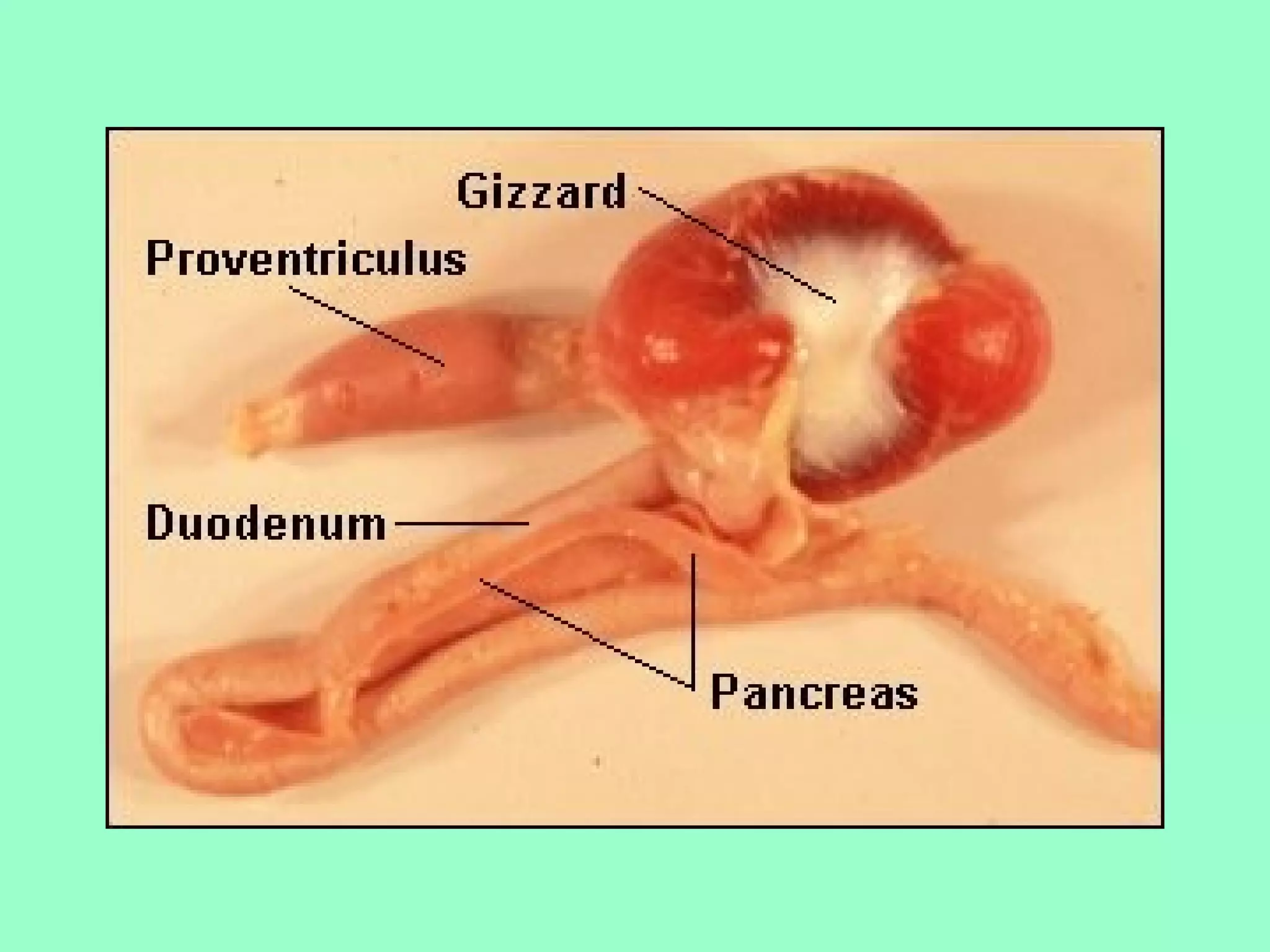
• Pancreas
   – Supplies digestive enzymes
   – Also produces insulin (hormone that
     regulates carbohydrate metabolism)
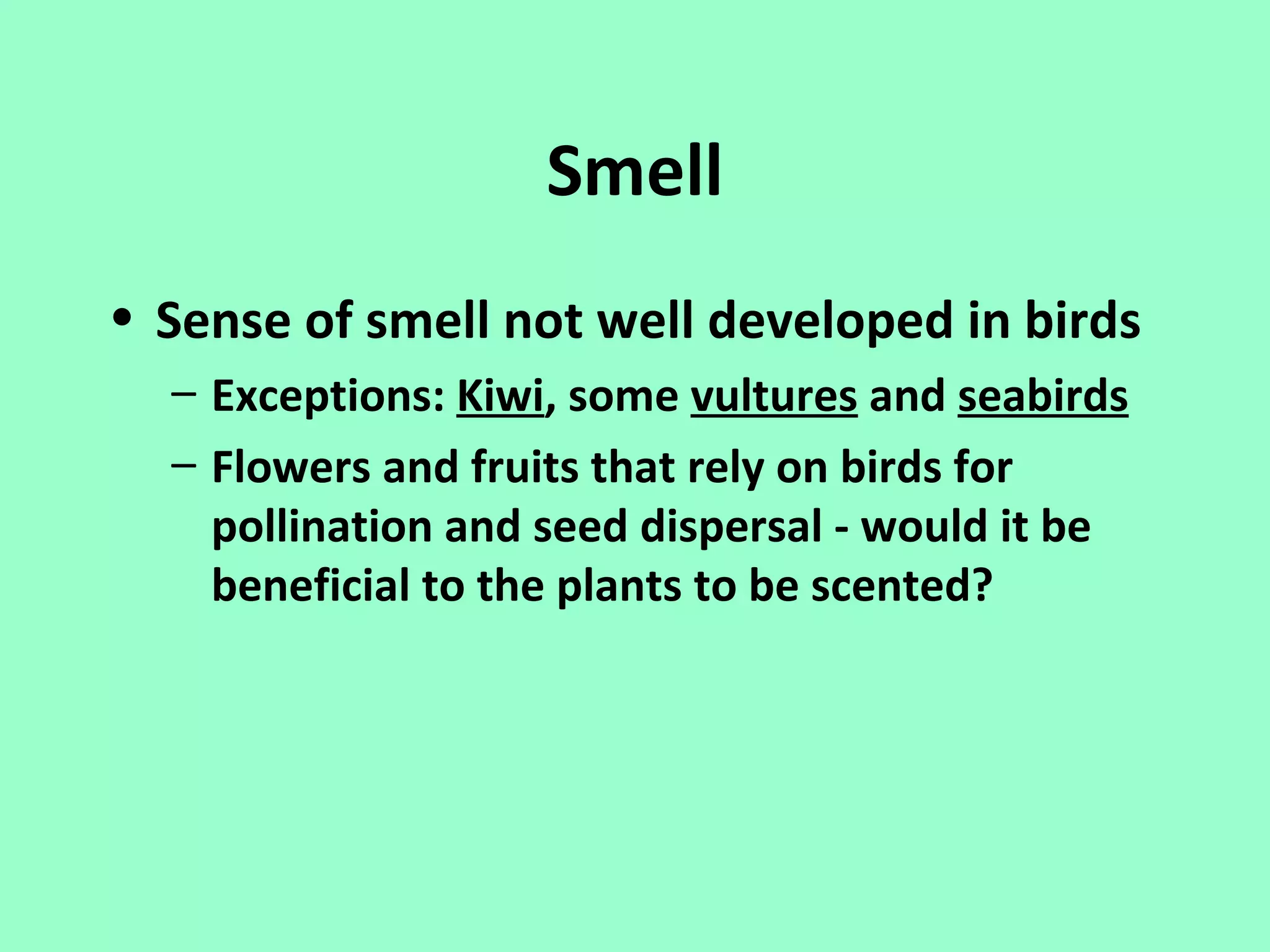
Taste
• Taste acuity poorer than for mammals
   – Taste receptors
      •   Humans: 9,000
      •   Rabbits: 17,000
      •   Chicken: 250-350
      •   Pigeon: 37-75
      •   Japanese quail: 62
      •   Ducks: 375
      •   Parrots: 300-400
• Birds can taste the same four primary flavors
  (sour, sweet, bitter, salty) but with less acuity
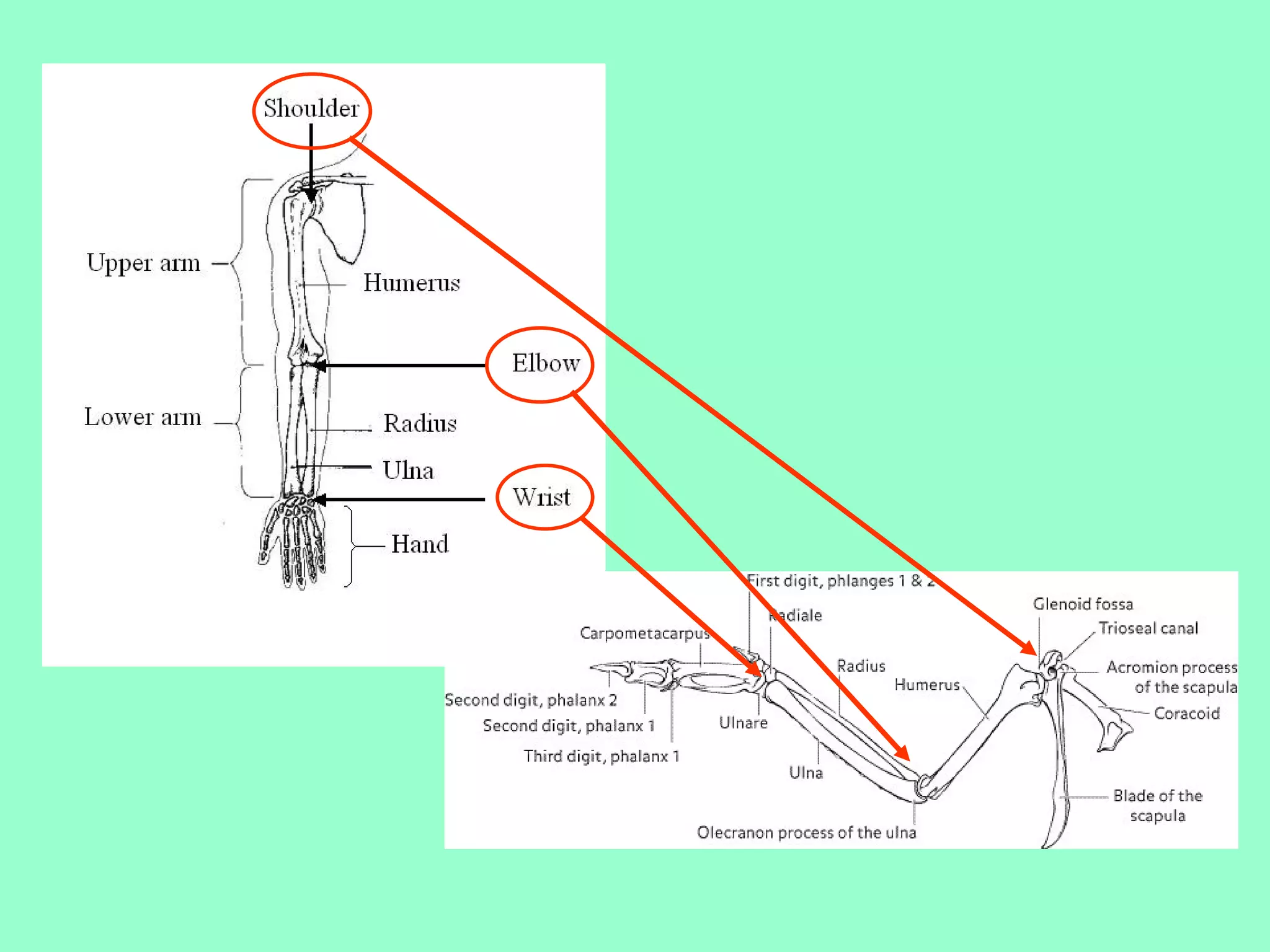
Smell
• Sense of smell not well developed in birds
  – Exceptions: Kiwi, some vultures and seabirds
  – Flowers and fruits that rely on birds for
    pollination and seed dispersal - would it be
    beneficial to the plants to be scented?
SKELETAL SYSTEMS


Keel
POULTRY VS MAMMALIAN ANATOMY AND
            PHYSIOLOGY

• Skeletal system
  – Differences ?
SKELETAL SYSTEMS


Keel
SKELETAL SYSTEM


KEEL
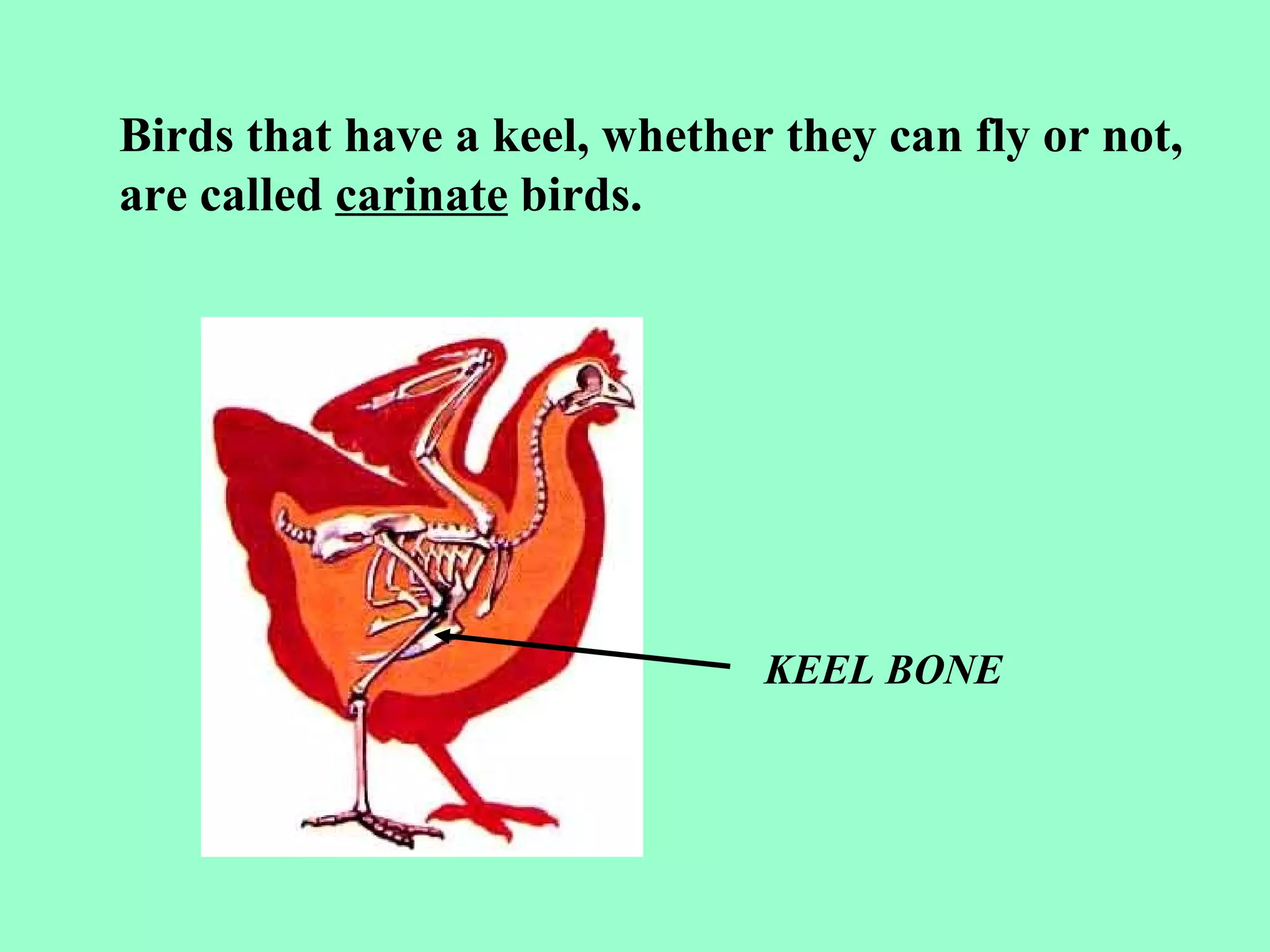
Birds that have a keel, whether they can fly or not,
are called carinate birds.
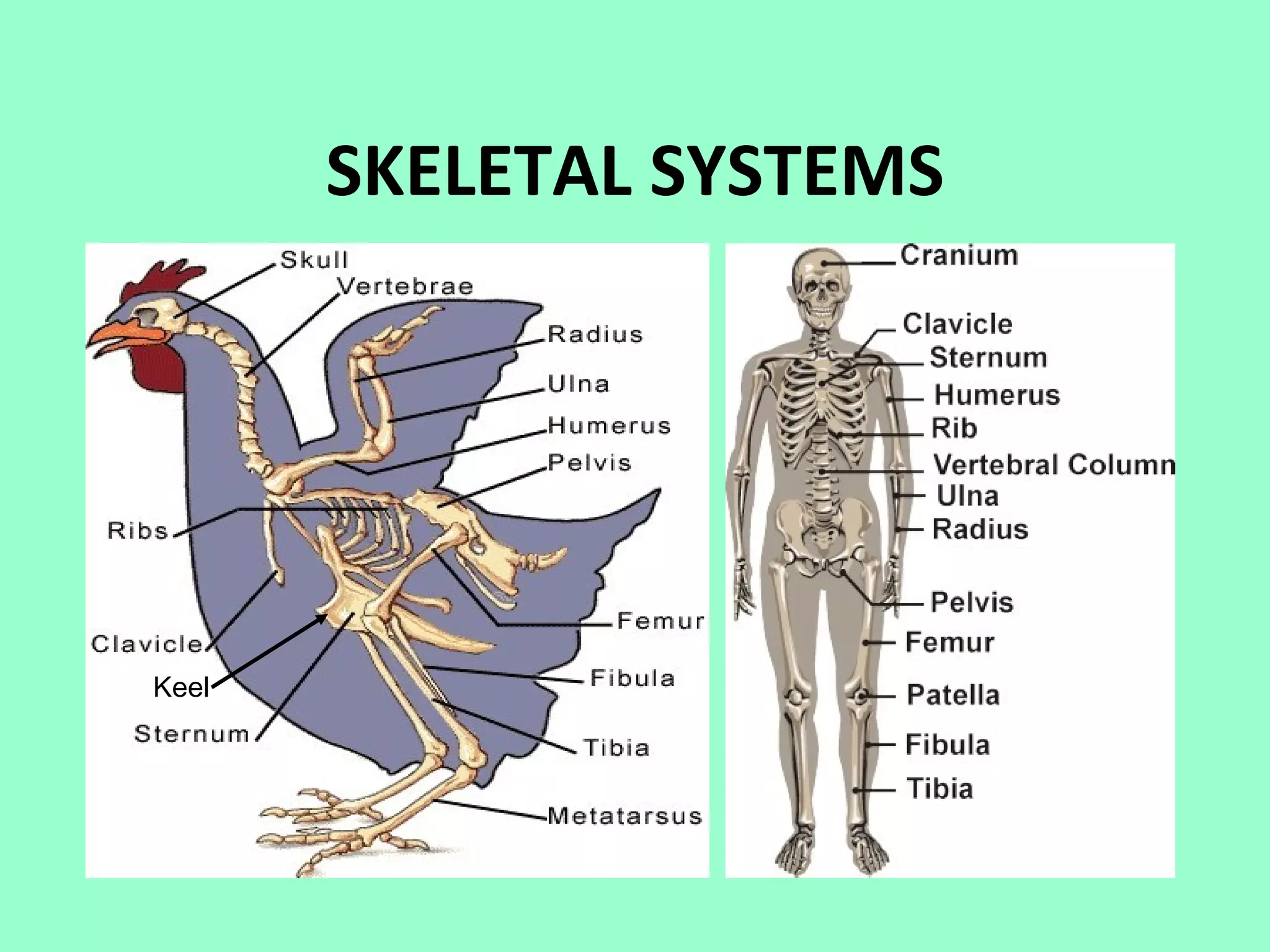


                               KEEL BONE
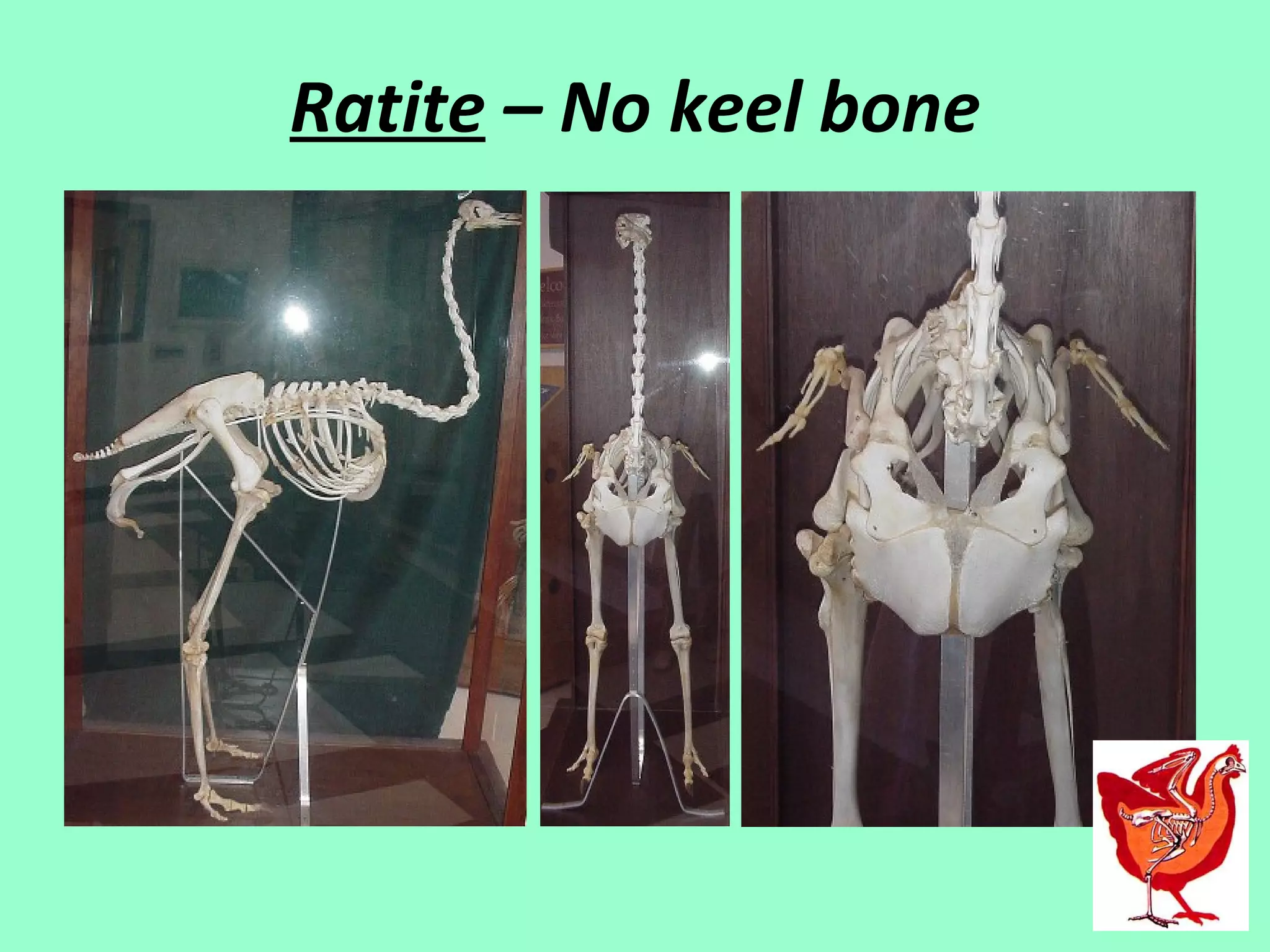
Ratite – No keel bone
POULTRY VS MAMMALIAN ANATOMY AND
            PHYSIOLOGY

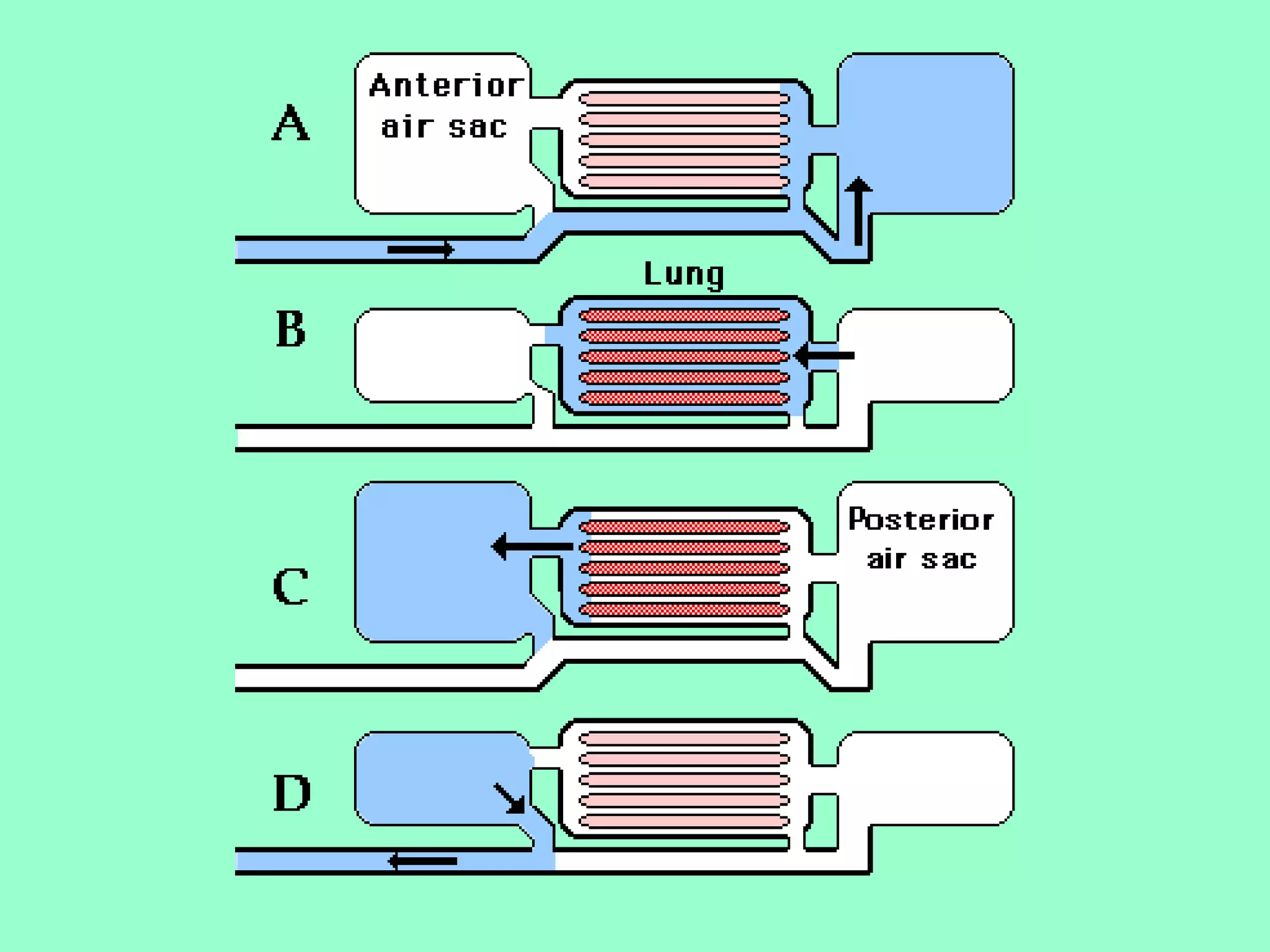
• Respiratory system
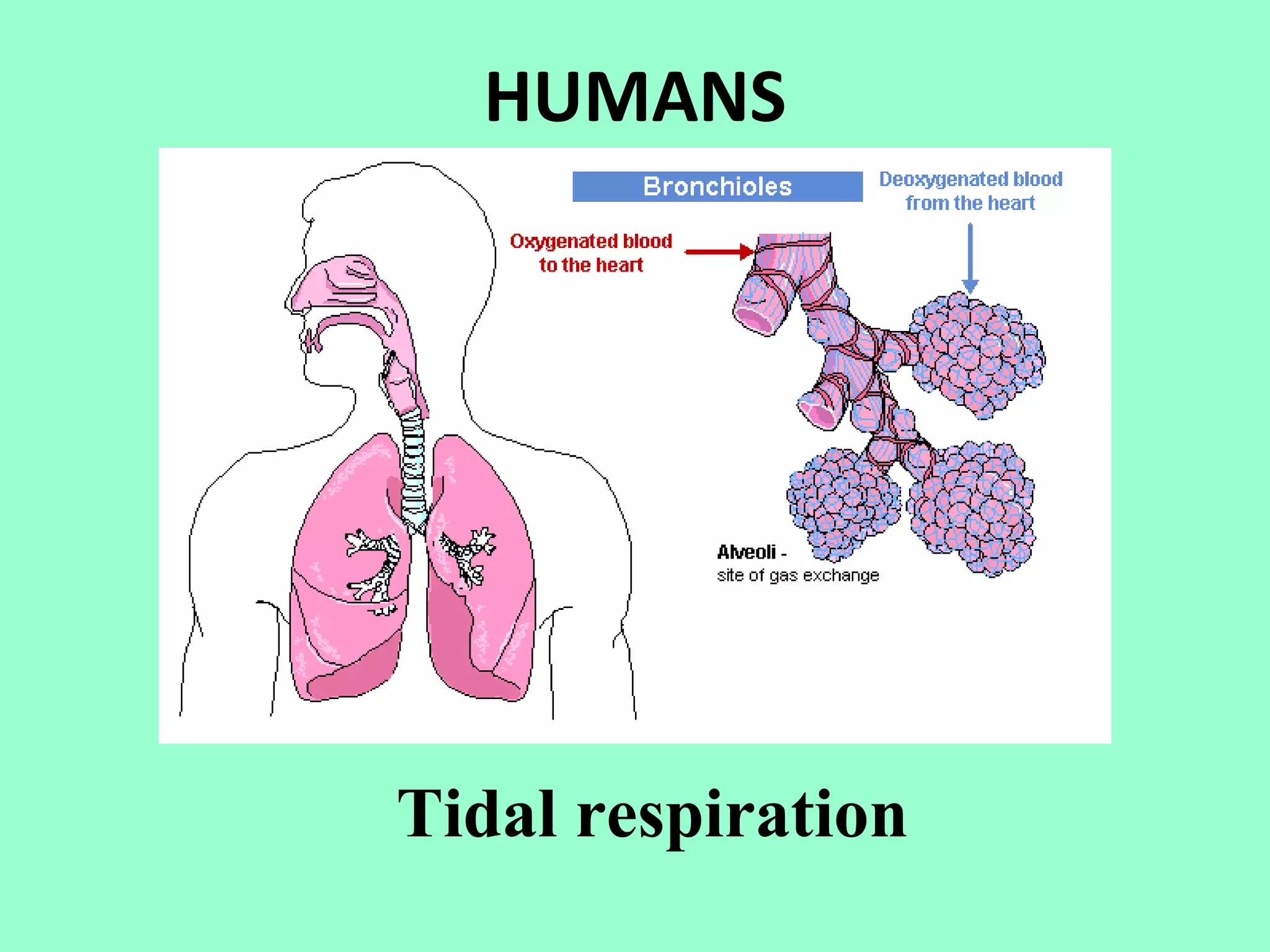
HUMANS


Tidal respiration
CHICKENS
Inspiration   Expiration
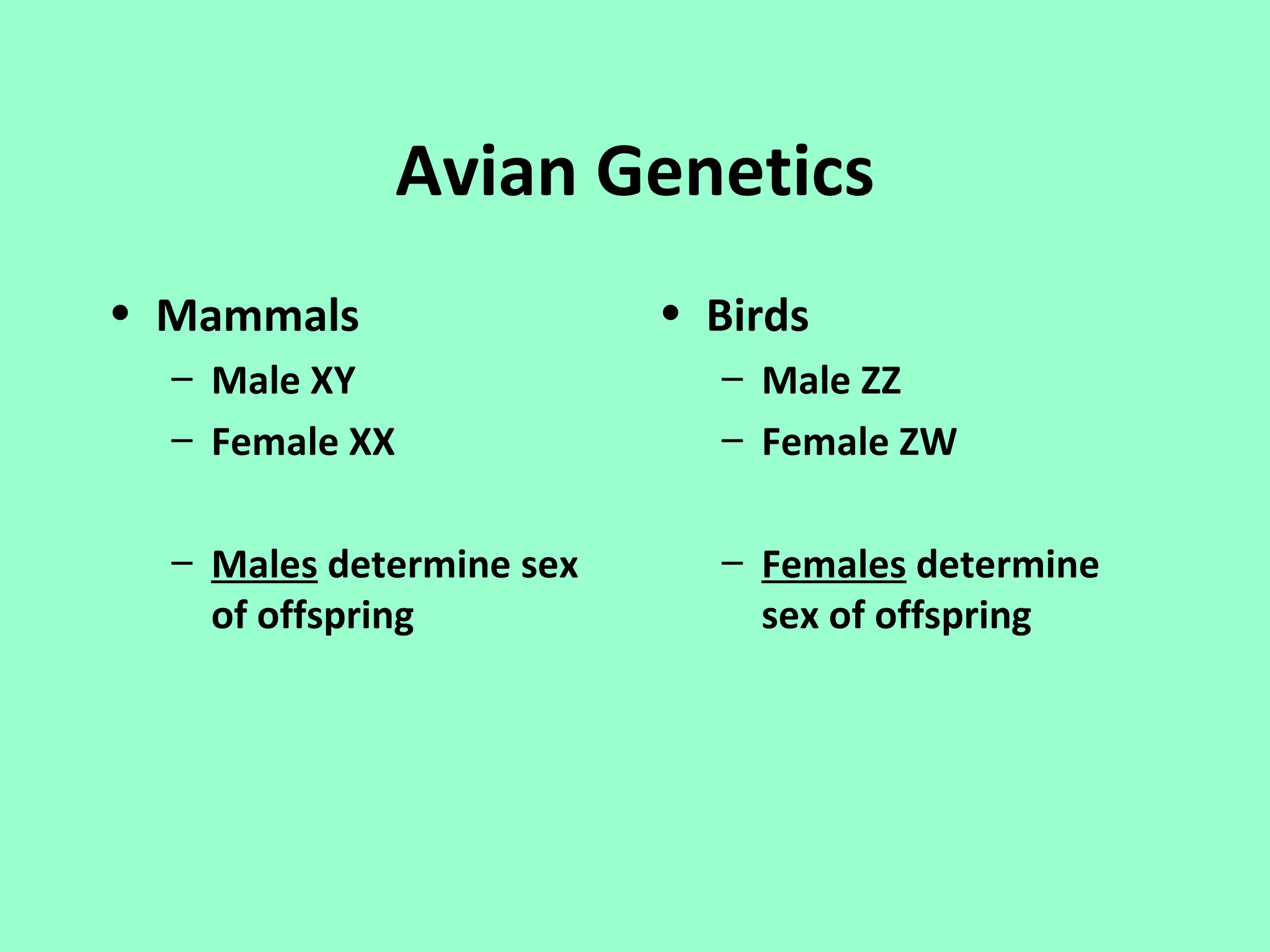
Avian Genetics
• Mammals                 • Birds
  – Male XY                 – Male ZZ
  – Female XX               – Female ZW

  – Males determine sex     – Females determine
    of offspring              sex of offspring
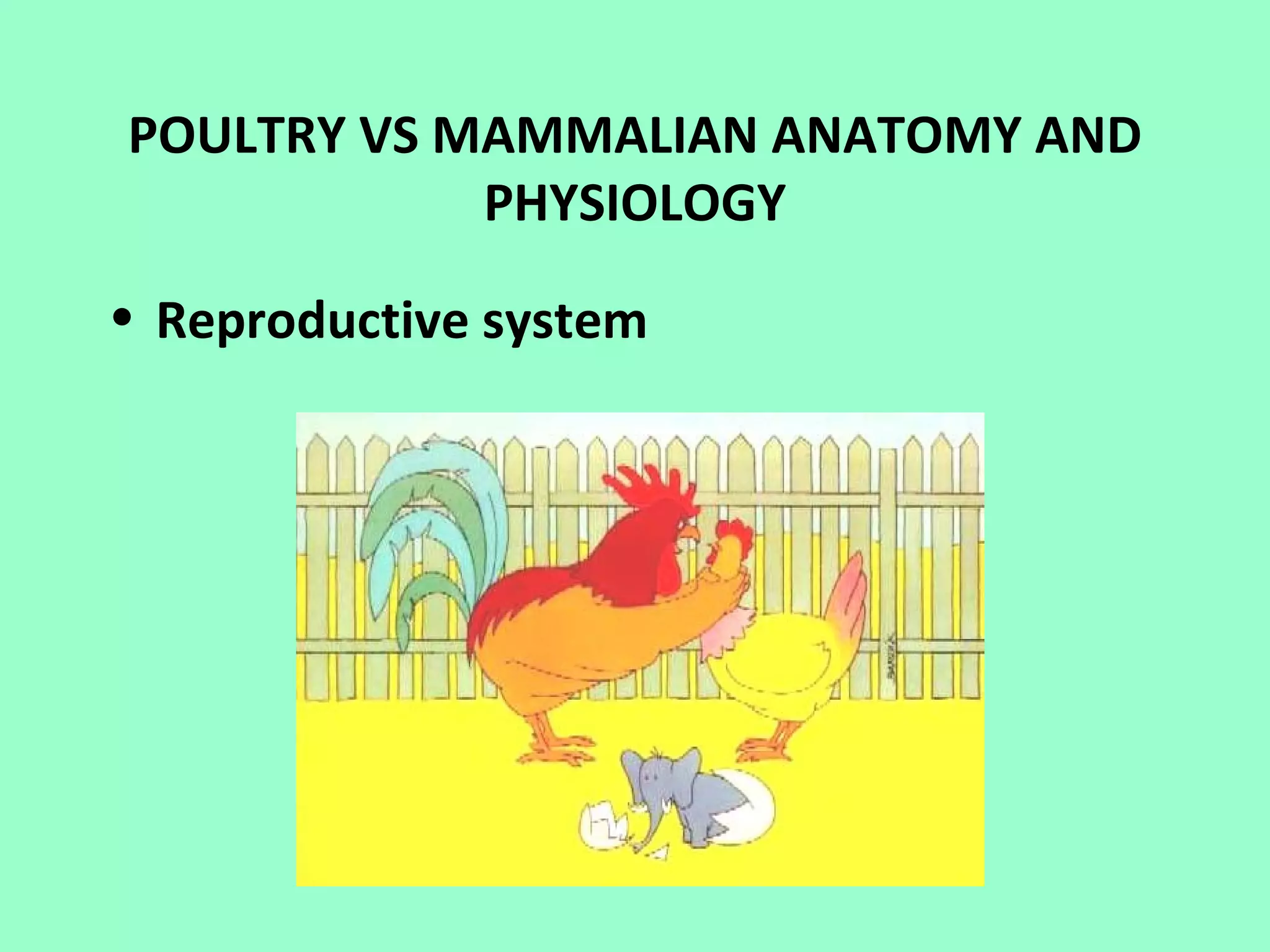
POULTRY VS MAMMALIAN ANATOMY AND
            PHYSIOLOGY

• Reproductive system
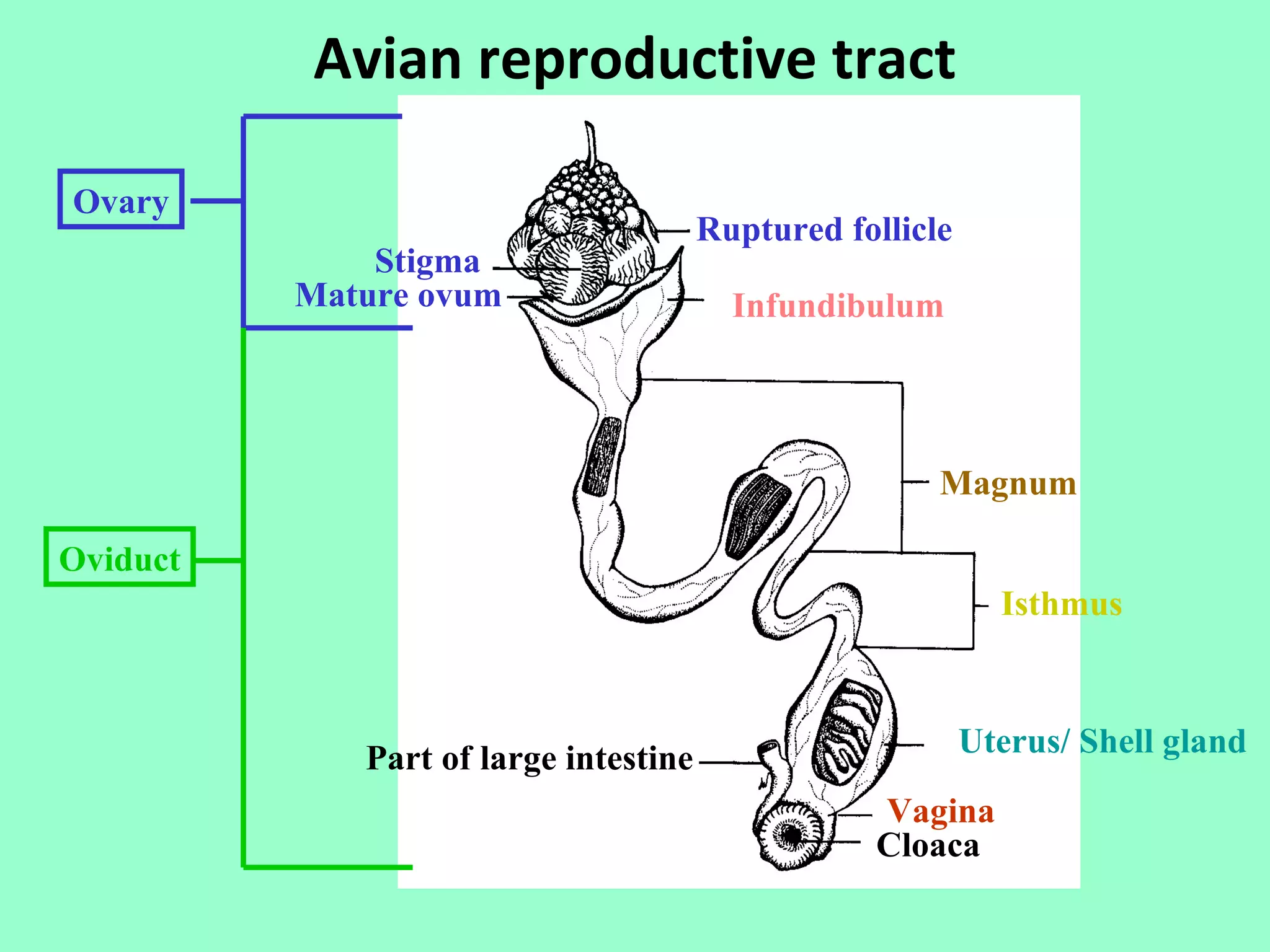
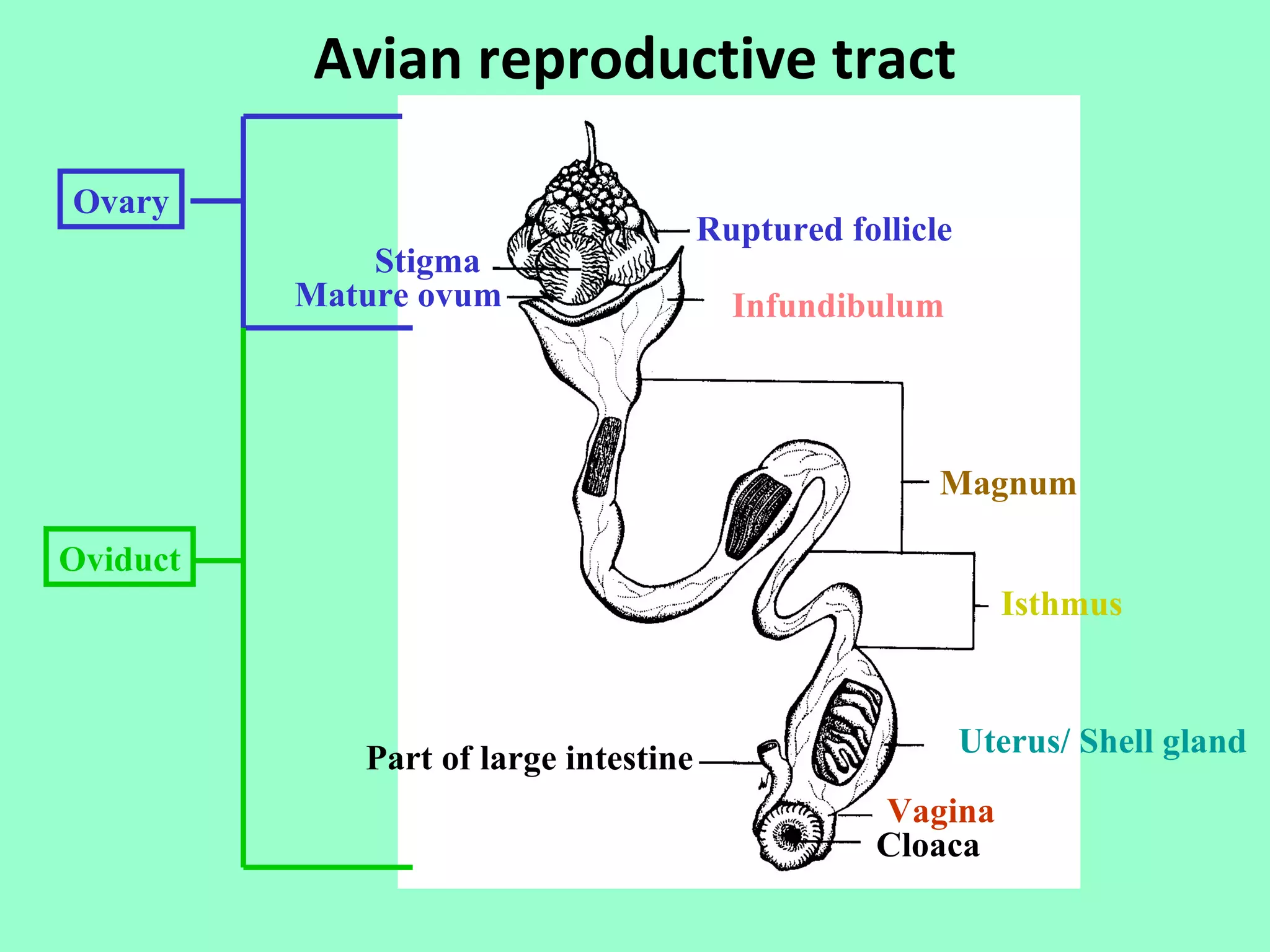
Avian reproductive tract

Ovary
                                       Ruptured follicle
              Stigma
          Mature ovum                    Infundibulum


                                                       Magnum

Oviduct
                                                             Isthmus


             Part of large intestine                       Uterus/ Shell gland
                                                  Vagina
                                                  Cloaca
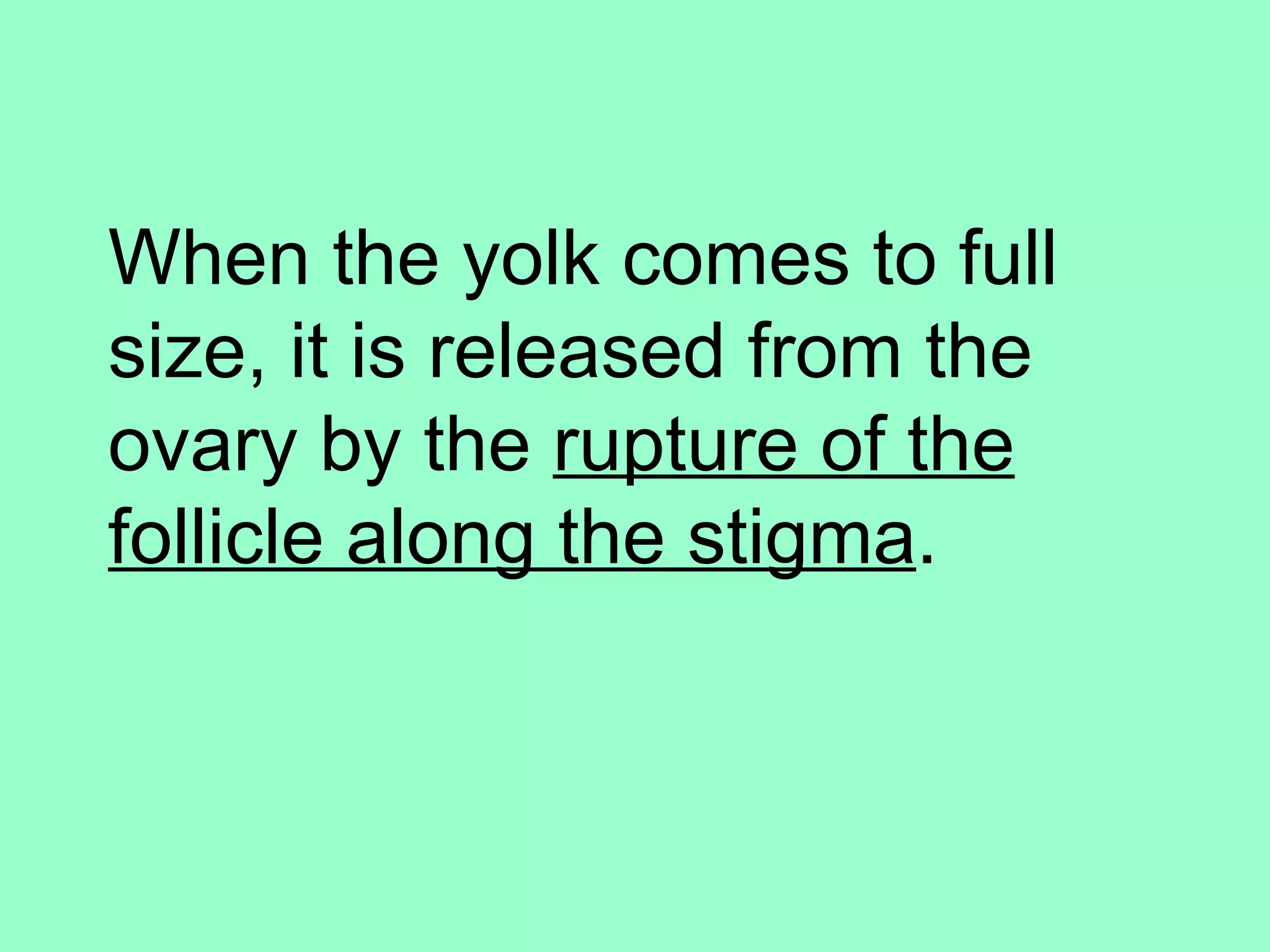
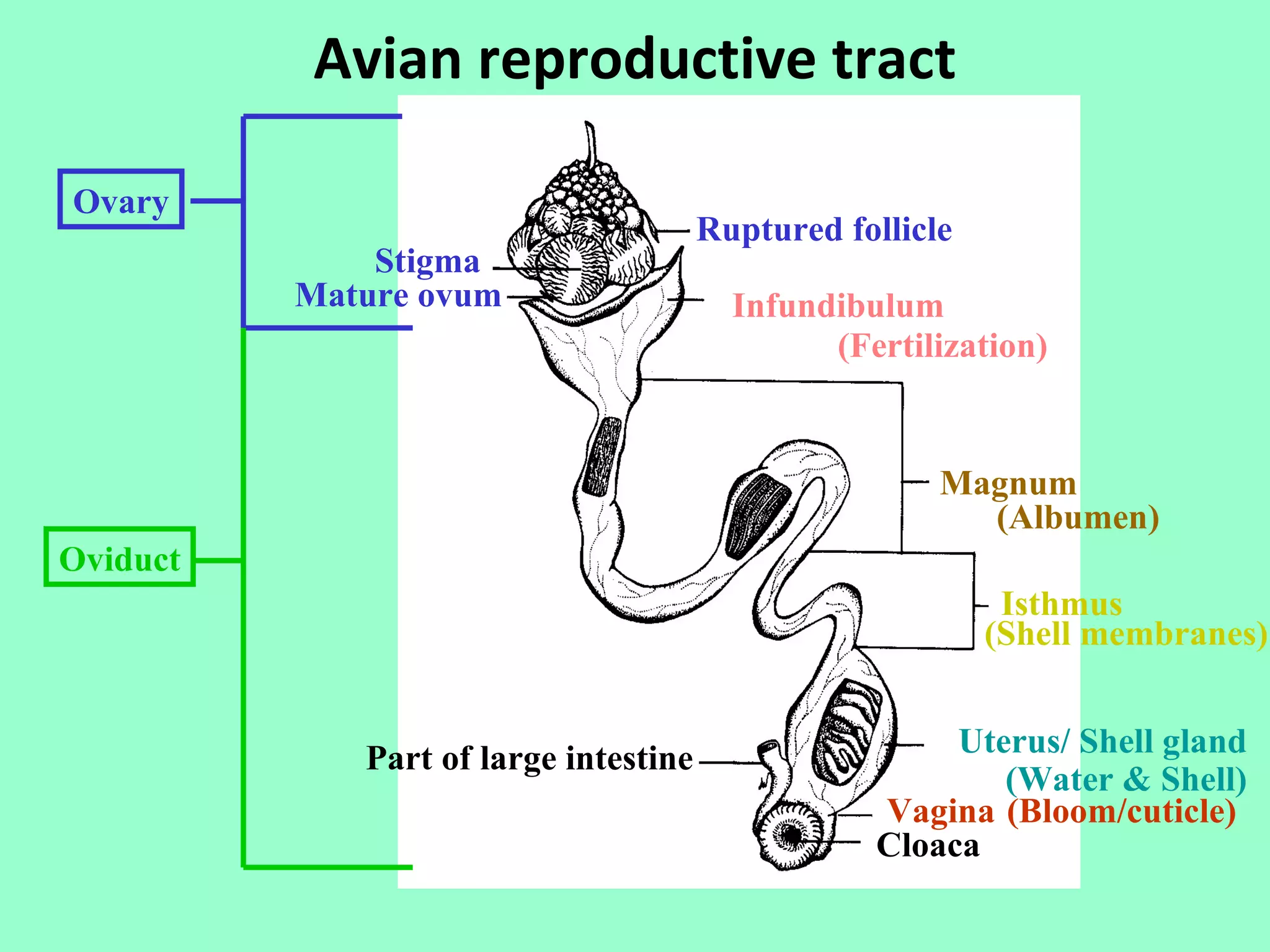
When the yolk comes to full
size, it is released from the
ovary by the rupture of the
follicle along the stigma.
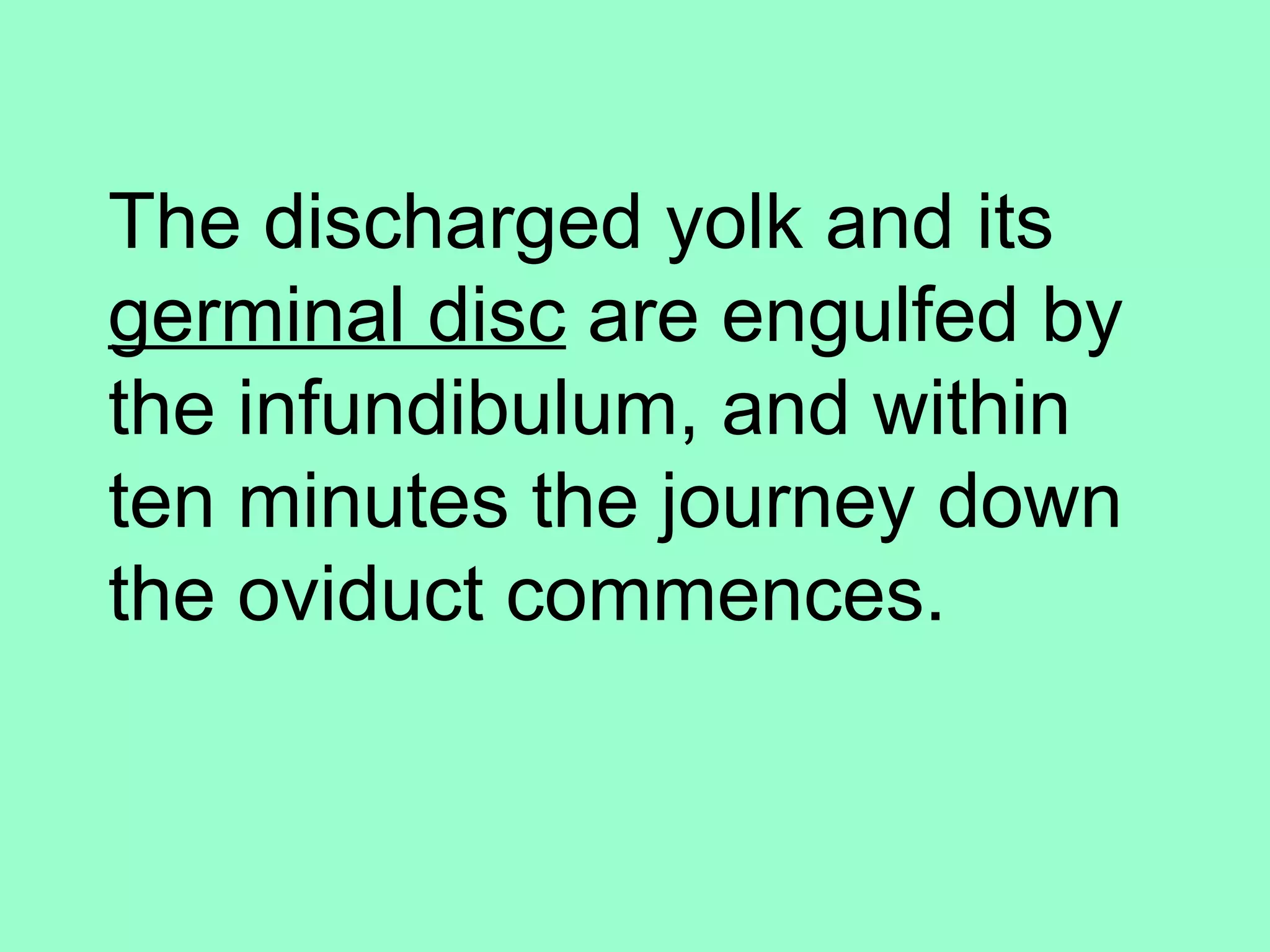
The discharged yolk and its
germinal disc are engulfed by
the infundibulum, and within
ten minutes the journey down
the oviduct commences.
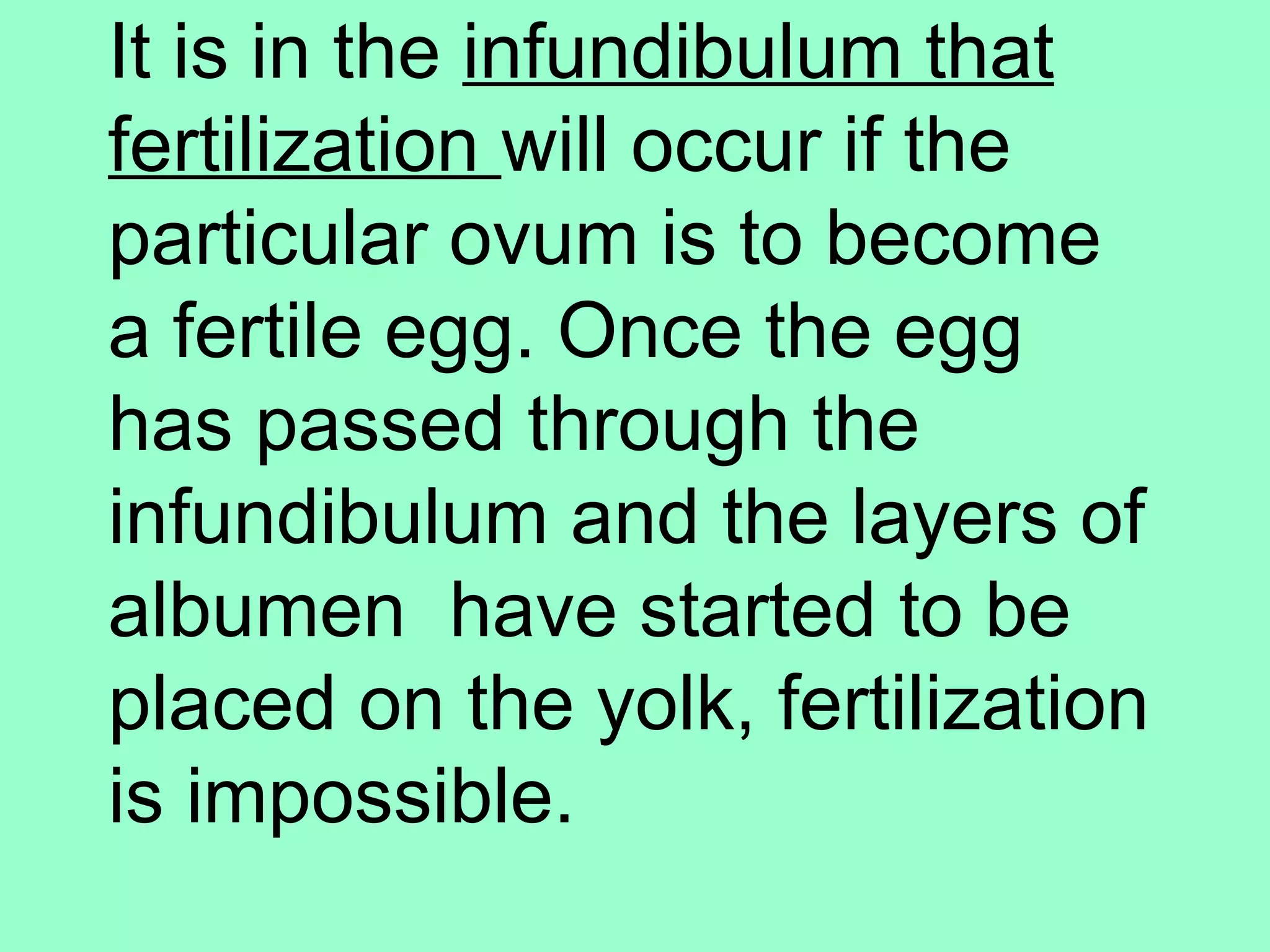
It is in the infundibulum that
fertilization will occur if the
particular ovum is to become
a fertile egg. Once the egg
has passed through the
infundibulum and the layers of
albumen have started to be
placed on the yolk, fertilization
is impossible.
The yolk spends approximately 3
hours in the magnum where the
thick albumen is added. This is
about half of the total egg white.
The remainder of the egg white is
added after the shell membranes
have been formed and the egg
has entered the uterus.
The two shell membranes are formed in the
isthmus during a period of 1.25 hours.

However, the yolk and the thick albumen do
not have the appearance of an egg until water
secreted in the uterus, passes through the
shell membranes and the egg assumes its
characteristic shape.
The egg spends over 20 hours
in the uterus, where calcium
carbonate is deposited on the
outer shell membrane.
When the shell structure is
complete, the egg passes into the
vagina where it may be retained for
a few minutes while a very thin coat
of albumen-like material is
deposited over the shell.

This material is referred to as the
bloom or cuticle and functions to fill
the pores of the shell.
The egg passes through the
oviduct small end first, but just
prior to laying the egg turns
horizontally 180° so that the large
end of the egg comes out first.
This allows for more shell surface
area on which uterine muscles
may apply pressure prior to the
egg-laying process.
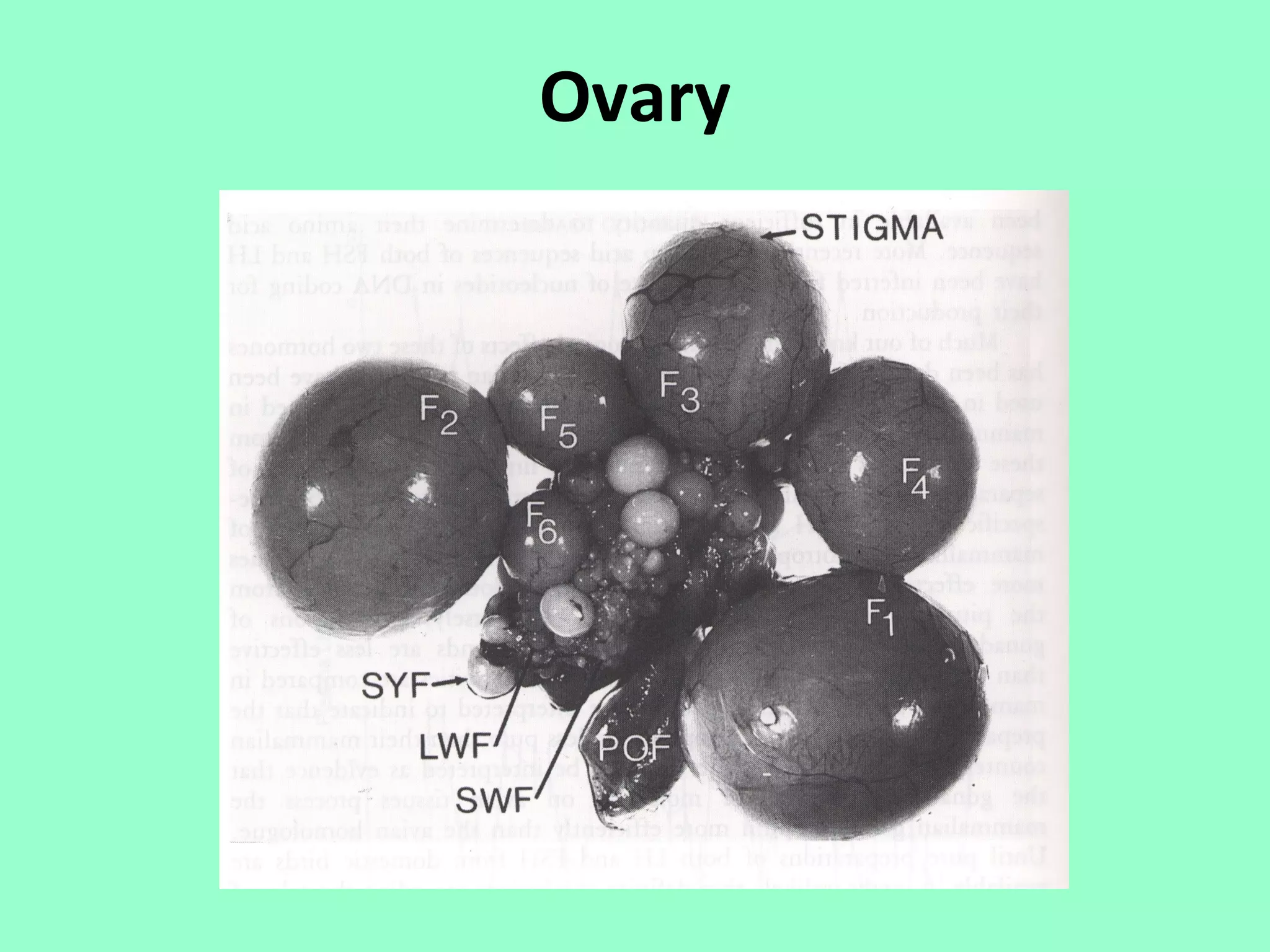
Ovary
Ovulation


 Video
Avian reproductive tract

Ovary
                                       Ruptured follicle
              Stigma
          Mature ovum                    Infundibulum


                                                       Magnum

Oviduct
                                                             Isthmus


             Part of large intestine                       Uterus/ Shell gland
                                                  Vagina
                                                  Cloaca
Infundibulum


   Video
Avian reproductive tract

Ovary
                                       Ruptured follicle
              Stigma
          Mature ovum                    Infundibulum
                                               (Fertilization)


                                                       Magnum
                                                         (Albumen)
Oviduct
                                                            Isthmus
                                                           (Shell membranes)


             Part of large intestine                   Uterus/ Shell gland
                                                          (Water & Shell)
                                                  Vagina (Bloom/cuticle)
                                                  Cloaca
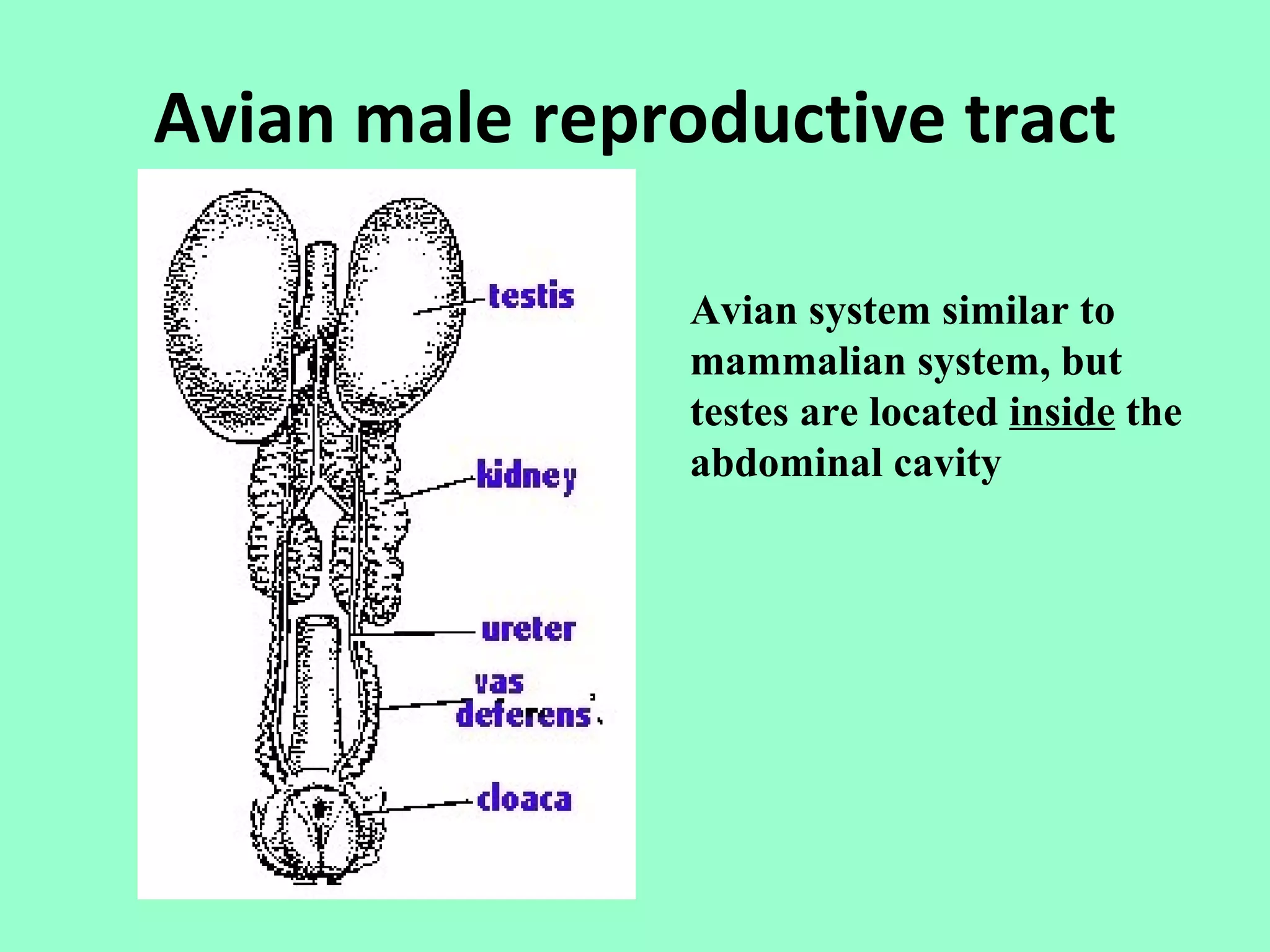
Avian male reproductive tract

                Avian system similar to
                mammalian system, but
                testes are located inside the
                abdominal cavity
Questions?

Poultry1 2010

  • 1.
    Introduction to AnimalScience POULTRY Lecture 1 Adapted by Tony Seykora from a Power Point by Dr. Jacquie Jacob, Poultry Specialist at the U of MN
  • 2.
    2007 – includesbroilers, laying hens, and turkeys
  • 3.
    POULTRY • Define theterm ‘poultry’
  • 4.
    POULTRY • Define theterm ‘poultry’ – Singular or plural?
  • 5.
    POULTRY • Define theterm ‘poultry’ – Singular or plural?
  • 6.
    POULTRY • Define theterm ‘poultry’ – Singular or plural? – What specie(s) are considered poultry?
  • 7.
    POULTRY • Define theterm ‘poultry’ – Singular or plural? – What specie(s) are considered poultry? • Chickens, turkeys, • geese, ducks, pigeons, • pheasants, ostriches, • quail, etc.
  • 8.
    POULTRY • Define theterm ‘poultry’ – Singular or plural? – What specie(s) are considered poultry? • Chickens, turkeys, geese, ducks, pigeons, pheasants, ostriches, quail, etc. – What are poultry raised for?
  • 9.
    POULTRY • Define theterm ‘poultry’ – Singular or plural? – What specie(s) are considered poultry? • Chickens, turkeys, geese, ducks, pigeons, pheasants, ostriches, quail, etc. – What are poultry raised for? • Meat, eggs, feathers/down, livers, entertainment, work (e.g., pigeons that carry messages)
  • 10.
    POULTRY PHYSIOLOGY • Howdoes poultry anatomy and physiology differ from mammalian anatomy and physiology?
  • 11.
    POULTRY VS MAMMALIANANATOMY AND PHYSIOLOGY • Integument - “The covering of the body” – Feathers - All birds have feathers and no other animals do • Function of feathers: – Provide protection from the elements – Help regulate body temperature – Help streamline the body for flight
  • 12.
    • Integument -“The covering of the body” Different types of feathers – Each with a specific function – Each with specific structural feathers enhancing its functional purpose
  • 13.
    • Integument -“The covering of the body” • Skin is thin and pliable – Doesn’t need to be thick since the feathers provide a protective cover – Possess feather tracts that arrange feathers in a definite pattern – Does not contain sweat glands – Contains one major oil gland – Located at the base of the tail • Oil is removed from the gland when squeezed by the birds beak and the oil is spread over the body feathers during preening
  • 14.
    SKIN • Specialized typesof skin: – Scales of the shanks and toes
  • 15.
    Feet Shank Toes
  • 16.
    SKIN • Specialized typesof skin: – Scales of the shanks and toes – Comb and wattles – The beak is covered by a thin layer of skin – Ear lobes
  • 17.
  • 18.
    POULTRY VS MAMMALIANANATOMY AND PHYSIOLOGY • Digestive system – Differences ?
  • 19.
    CHICKEN DIGESTIVE TRACT Beak Esophagus Small intestine Large Intestine Duodenal loop Cloaca Crop Ceca Esophagus Proventriculus Gizzard
  • 20.
    Avian digestive system •Classifiedas: Non-ruminant / Monogastric •How does it differ from other non-ruminants? •Birds don’t have teeth or lips •Food swallowed in gulps with no chewing
  • 21.
    Grasping and particle-sizereduction functions assumed by the beak, tongue and gizzard Permits the weight associated with heavy jaws, teeth and muscles to be moved more centrally to accommodate flight
  • 22.
    Crop - Temporarystorage Permits a bird to forage for large amounts of food rapidly and then fly off to digest the meal in safety
  • 23.
    Permits binging inthe evening so that food can be slowly released to supply nutrients during the night time In chickens, food stored during an evening feeding supplies 75% of the nocturnal energy needs In some species, supplies a moist environment where food begins to soften But, in chickens mucous glands only present near the entrance of the crop so dependent on consumed water No enzymes secreted into the crop
  • 24.
    •Koilin - atough layer made of a carbohydrate-protein complex to protect the muscles in the gizzard and to aid in digestion
  • 26.
    CHICKEN DIGESTIVE TRACT Beak Esophagus Small intestine Large Intestine Duodenal loop Cloaca Crop Ceca Esophagus Proventriculus Gizzard
  • 27.
    Purple heron Marabou Rail Sparrow-hawk Different types of avian ceca Helmet guinea fowl Barn owl Northern screamer Great Bustard Ostrich Source: Jozefiak et al., 2002
  • 28.
    Considerable variation insize Ranges from voluminous pairs, to a single cecum to complete absence Highly developed in herbivores and omnivores Site for microbial fermentation of complex carbohydrates
  • 29.
    Large intestine More accurately referred to as the rectum or colon Typically very short and small in diameter Exception is the ostrich where it is >50% of total intestinal length and is sacculated - divided into a series of pouches.
  • 30.
    CLOACA • Serves asa storage area for urine and feces • Receives the exit ducts of the digestive, reproductive, and urinary systems
  • 31.
    CHICKEN DIGESTIVE TRACT Beak Esophagus Small intestine Large Intestine Duodenal loop Cloaca Crop Ceca Esophagus Proventriculus Gizzard
  • 32.
    • Liver – Predominant bile salt produced varies among species • Gall bladder – Absent in some avian species: ostrich, hummingbirds, doves, pigeons, parrots • Pancreas – Supplies digestive enzymes – Also produces insulin (hormone that regulates carbohydrate metabolism)
  • 33.
    Taste • Taste acuitypoorer than for mammals – Taste receptors • Humans: 9,000 • Rabbits: 17,000 • Chicken: 250-350 • Pigeon: 37-75 • Japanese quail: 62 • Ducks: 375 • Parrots: 300-400 • Birds can taste the same four primary flavors (sour, sweet, bitter, salty) but with less acuity
  • 34.
    Smell • Sense ofsmell not well developed in birds – Exceptions: Kiwi, some vultures and seabirds – Flowers and fruits that rely on birds for pollination and seed dispersal - would it be beneficial to the plants to be scented?
  • 35.
  • 37.
    POULTRY VS MAMMALIANANATOMY AND PHYSIOLOGY • Skeletal system – Differences ?
  • 38.
  • 39.
  • 40.
    Birds that havea keel, whether they can fly or not, are called carinate birds. KEEL BONE
  • 41.
    Ratite – Nokeel bone
  • 42.
    POULTRY VS MAMMALIANANATOMY AND PHYSIOLOGY • Respiratory system
  • 43.
  • 44.
  • 46.
    Inspiration Expiration
  • 47.
    Avian Genetics • Mammals • Birds – Male XY – Male ZZ – Female XX – Female ZW – Males determine sex – Females determine of offspring sex of offspring
  • 48.
    POULTRY VS MAMMALIANANATOMY AND PHYSIOLOGY • Reproductive system
  • 50.
    Avian reproductive tract Ovary Ruptured follicle Stigma Mature ovum Infundibulum Magnum Oviduct Isthmus Part of large intestine Uterus/ Shell gland Vagina Cloaca
  • 51.
    When the yolkcomes to full size, it is released from the ovary by the rupture of the follicle along the stigma.
  • 52.
    The discharged yolkand its germinal disc are engulfed by the infundibulum, and within ten minutes the journey down the oviduct commences.
  • 53.
    It is inthe infundibulum that fertilization will occur if the particular ovum is to become a fertile egg. Once the egg has passed through the infundibulum and the layers of albumen have started to be placed on the yolk, fertilization is impossible.
  • 54.
    The yolk spendsapproximately 3 hours in the magnum where the thick albumen is added. This is about half of the total egg white. The remainder of the egg white is added after the shell membranes have been formed and the egg has entered the uterus.
  • 55.
    The two shellmembranes are formed in the isthmus during a period of 1.25 hours. However, the yolk and the thick albumen do not have the appearance of an egg until water secreted in the uterus, passes through the shell membranes and the egg assumes its characteristic shape.
  • 56.
    The egg spendsover 20 hours in the uterus, where calcium carbonate is deposited on the outer shell membrane.
  • 57.
    When the shellstructure is complete, the egg passes into the vagina where it may be retained for a few minutes while a very thin coat of albumen-like material is deposited over the shell. This material is referred to as the bloom or cuticle and functions to fill the pores of the shell.
  • 58.
    The egg passesthrough the oviduct small end first, but just prior to laying the egg turns horizontally 180° so that the large end of the egg comes out first. This allows for more shell surface area on which uterine muscles may apply pressure prior to the egg-laying process.
  • 59.
  • 60.
  • 61.
    Avian reproductive tract Ovary Ruptured follicle Stigma Mature ovum Infundibulum Magnum Oviduct Isthmus Part of large intestine Uterus/ Shell gland Vagina Cloaca
  • 62.
  • 63.
    Avian reproductive tract Ovary Ruptured follicle Stigma Mature ovum Infundibulum (Fertilization) Magnum (Albumen) Oviduct Isthmus (Shell membranes) Part of large intestine Uterus/ Shell gland (Water & Shell) Vagina (Bloom/cuticle) Cloaca
  • 65.
    Avian male reproductivetract Avian system similar to mammalian system, but testes are located inside the abdominal cavity
  • 66.

Editor's Notes

  • #6 A plural term
  • #8 Includes a wide variety of different avian species Chickens, turkeys, ducks, geese, guinea fowl, pigeons, pheasants, quail, ostrich, etc.
  • #10 Domesticated birds raised primarily for: Food (meat, eggs, liver, etc.) Clothing (feathers, leather) Work/entertainment (carrier pigeons, rollers, fighting birds)
  • #12 “ The covering of the body” Feathers - All birds have feathers and no other animals do Function of feathers: Provide protection from the elements Help regulate body temperature Help streamline the body for flight Different types of feathers Each with a specific function Each with specific structural feathers enhancing its functional purpose Skin is thin and pliable Doesn’t need to be thick since the feathers provide a protective cover Possess feather tracts that arrange feathers in a definite pattern Does not contain sweat glands Contains one major oil gland Located at the base of the tail Oil is removed from the gland when squeezed by the birds beak and the oil is spread over the body feathers during preening
  • #13 “ The covering of the body” Feathers - All birds have feathers and no other animals do Function of feathers: Provide protection from the elements Help regulate body temperature Help streamline the body for flight Different types of feathers Each with a specific function Each with specific structural feathers enhancing its functional purpose Skin is thin and pliable Doesn’t need to be thick since the feathers provide a protective cover Possess feather tracts that arrange feathers in a definite pattern Does not contain sweat glands Contains one major oil gland Located at the base of the tail Oil is removed from the gland when squeezed by the birds beak and the oil is spread over the body feathers during preening
  • #14 “ The covering of the body” Feathers - All birds have feathers and no other animals do Function of feathers: Provide protection from the elements Help regulate body temperature Help streamline the body for flight Different types of feathers Each with a specific function Each with specific structural feathers enhancing its functional purpose Skin is thin and pliable Doesn’t need to be thick since the feathers provide a protective cover Possess feather tracts that arrange feathers in a definite pattern Does not contain sweat glands Contains one major oil gland Located at the base of the tail Oil is removed from the gland when squeezed by the birds beak and the oil is spread over the body feathers during preening
  • #20 Avian digestive system Classified as: Non-ruminant / Monogastric How does it differ from other non-ruminants? Birds don’t have teeth or lips Food swallowed in gulps with no chewing Grasping and particle-size reduction functions assumed by the beak , tongue and gizzard Permits the weight associated with heavy jaws, teeth and muscles to be moved more centrally to accommodate flight Crop - Temporary storage Permits a bird to forage for large amounts of food rapidly and then fly off to digest the meal in safety Permits binging in the evening so that food can be slowly released to supply nutrients during the night time In chickens, food stored during an evening feeding supplies 75% of the nocturnal energy needs In some species, supplies a moist environment where food begins to soften But, in chickens mucous glands only present near the entrance of the crop so dependent on consumed water No enzymes secreted into the crop Cloaca Serves as a storage area for urine and feces Receives the exit ducts of the digestive , reproductive , and urinary systems
  • #27 Consists of duodenum, jejunum, ileum Duodenum forms a loop around the pancreas Receives bile and pancreatic secretions Duodenum ends where the small intestine leaves its association with the pancreas Jejunum extends from the end of the duodenum to the vitelline diverticulum (Meckel’s diverticulum = the remnant of the yolk sac) Ileum extends from the Meckel’s diverticulum to the cecal junction Cecum / ceca Considerable variation in size Ranges from voluminous pairs, to a single cecum to complete absence Highly developed in herbivores and omnivores Site for microbial fermentation of complex carbohydrates Large intestine More accurately referred to as the rectum or colon Typically very short and small in diameter Exception is the ostrich where it is >50% of total intestinal length and is sacculated
  • #32 Consists of duodenum, jejunum, ileum Duodenum forms a loop around the pancreas Receives bile and pancreatic secretions Duodenum ends where the small intestine leaves its association with the pancreas Jejunum extends from the end of the duodenum to the vitelline diverticulum (Meckel’s diverticulum = the remnant of the yolk sac) Ileum extends from the Meckel’s diverticulum to the cecal junction Cecum / ceca Considerable variation in size Ranges from voluminous pairs, to a single cecum to complete absence Highly developed in herbivores and omnivores Site for microbial fermentation of complex carbohydrates Large intestine More accurately referred to as the rectum or colon Typically very short and small in diameter Exception is the ostrich where it is >50% of total intestinal length and is sacculated
  • #33 Liver Predominant bile salt produced varies among species Gall bladder Absent in some avian species: ostrich, hummingbirds, doves, pigeons, parrots Pancreas Supplies digestive enzymes Also produces insulin (hormone that regulates carbohydrate metabolism)
  • #43 Avian lungs are rigid and do not move during respiration (do not inflate and deflate) Have air sacs Act as bellows Some penetrate the interior of bones ( pneumatic bones) Provide buoyancy for aquatic birds
  • #49 Consists of duodenum, jejunum, ileum Duodenum forms a loop around the pancreas Receives bile and pancreatic secretions Duodenum ends where the small intestine leaves its association with the pancreas Jejunum extends from the end of the duodenum to the vitelline diverticulum (Meckel’s diverticulum = the remnant of the yolk sac) Ileum extends from the Meckel’s diverticulum to the cecal junction Cecum / ceca Considerable variation in size Ranges from voluminous pairs, to a single cecum to complete absence Highly developed in herbivores and omnivores Site for microbial fermentation of complex carbohydrates Large intestine More accurately referred to as the rectum or colon Typically very short and small in diameter Exception is the ostrich where it is >50% of total intestinal length and is sacculated
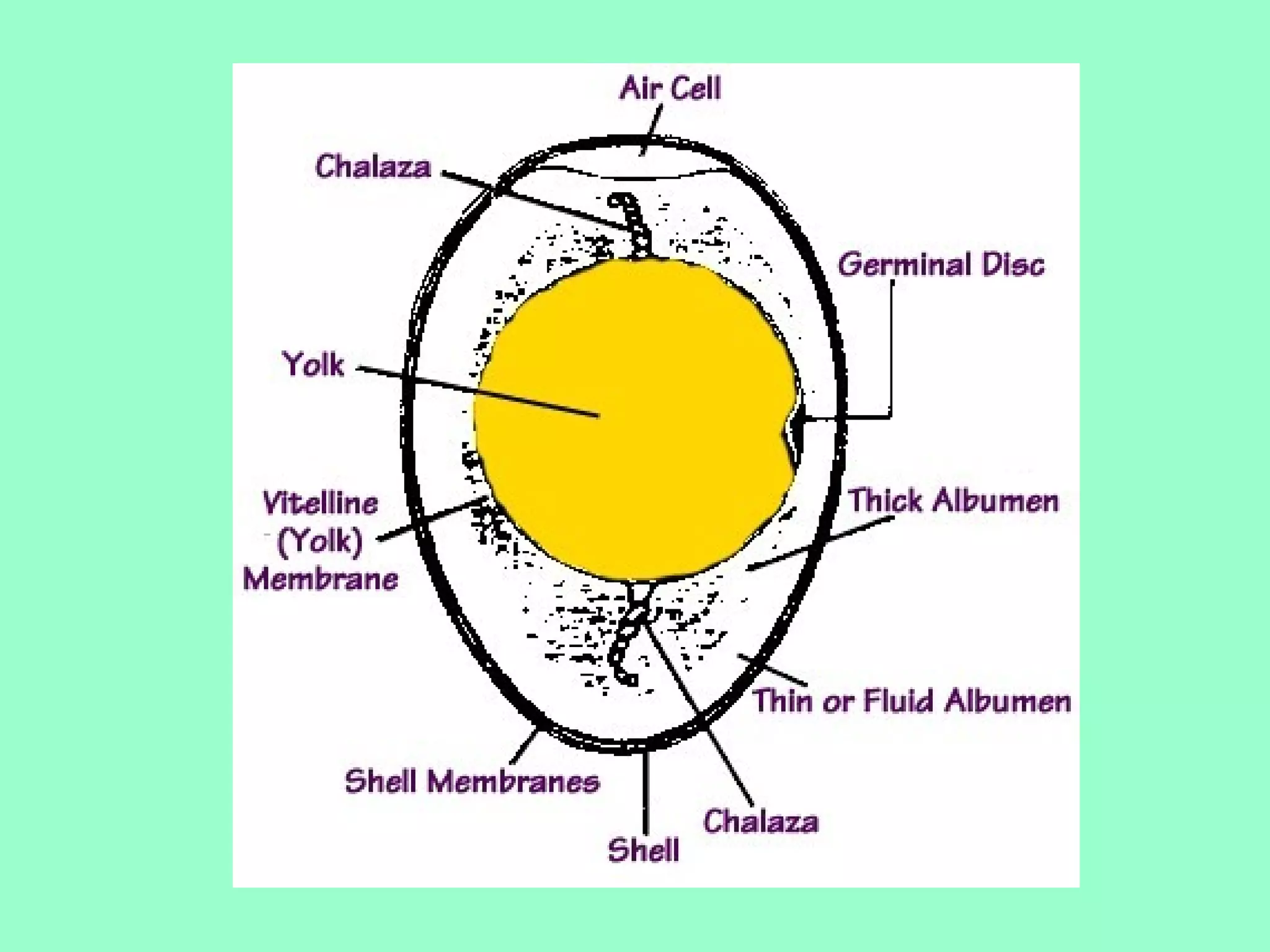
  • #51 When the yolk comes to full size, it is released from the ovary by the rupture of the follicle along the stigma. The discharged yolk and its germinal disc are engulfed by the infundibulum, and within ten minutes the journey down the oviduct commences. It is in the infundibulum that fertilization will occur if the particular ovum is to become a fertile egg. Once the egg has passed through the infundibulum and the layers of albumen have started to be placed on the yolk, fertilization is impossible. The yolk spends approximately 3 hours in the magnum were the thick albumen is added. This is about half of the total egg white. The remainder of the egg white is added after the shell membranes have been formed and the egg has entered the uterus. The two shell membranes are formed in the isthmus during a period of 1.25 hours. The shell membranes influence the shape of the egg. However, the yolk and the thick albumen do not have the appearance of an egg until water secreted in the uterus, passes through the shell membranes and the egg assumes its characteristic shape. After the thin albumen has been formed inside the shell membranes and the egg assumes its normal size and shape, two spiral cords of thick albumen can be seen extending from the yolk toward the two poles of the egg. These spirals are known as chalazae. The egg spends over 20 hours in the uterus, where calcium carbonate is deposited on the outer shell membrane. When the shell structure is complete, the egg passes into the vagina where it may be retained for a few minutes while a very thin coat of albumen-like material is deposited over the shell. This material is referred to as the bloom or cuticle and functions to fill the pores of the shell. The egg passes through the oviduct small end first, but just prior to laying the egg turns horizontally 180 ° so that the large end of the egg comes out first. This allows for more shell surface area on which uterine muscles may apply pressure prior to the egg-laying process.
  • #62 When the yolk comes to full size, it is released from the ovary by the rupture of the follicle along the stigma. The discharged yolk and its germinal disc are engulfed by the infundibulum, and within ten minutes the journey down the oviduct commences. It is in the infundibulum that fertilization will occur if the particular ovum is to become a fertile egg. Once the egg has passed through the infundibulum and the layers of albumen have started to be placed on the yolk, fertilization is impossible. The yolk spends approximately 3 hours in the magnum were the thick albumen is added. This is about half of the total egg white. The remainder of the egg white is added after the shell membranes have been formed and the egg has entered the uterus. The two shell membranes are formed in the isthmus during a period of 1.25 hours. The shell membranes influence the shape of the egg. However, the yolk and the thick albumen do not have the appearance of an egg until water secreted in the uterus, passes through the shell membranes and the egg assumes its characteristic shape. After the thin albumen has been formed inside the shell membranes and the egg assumes its normal size and shape, two spiral cords of thick albumen can be seen extending from the yolk toward the two poles of the egg. These spirals are known as chalazae. The egg spends over 20 hours in the uterus, where calcium carbonate is deposited on the outer shell membrane. When the shell structure is complete, the egg passes into the vagina where it may be retained for a few minutes while a very thin coat of albumen-like material is deposited over the shell. This material is referred to as the bloom or cuticle and functions to fill the pores of the shell. The egg passes through the oviduct small end first, but just prior to laying the egg turns horizontally 180 ° so that the large end of the egg comes out first. This allows for more shell surface area on which uterine muscles may apply pressure prior to the egg-laying process.
  • #64 When the yolk comes to full size, it is released from the ovary by the rupture of the follicle along the stigma. The discharged yolk and its germinal disc are engulfed by the infundibulum, and within ten minutes the journey down the oviduct commences. It is in the infundibulum that fertilization will occur if the particular ovum is to become a fertile egg. Once the egg has passed through the infundibulum and the layers of albumen have started to be placed on the yolk, fertilization is impossible. The yolk spends approximately 3 hours in the magnum were the thick albumen is added. This is about half of the total egg white. The remainder of the egg white is added after the shell membranes have been formed and the egg has entered the uterus. The two shell membranes are formed in the isthmus during a period of 1.25 hours. The shell membranes influence the shape of the egg. However, the yolk and the thick albumen do not have the appearance of an egg until water secreted in the uterus, passes through the shell membranes and the egg assumes its characteristic shape. After the thin albumen has been formed inside the shell membranes and the egg assumes its normal size and shape, two spiral cords of thick albumen can be seen extending from the yolk toward the two poles of the egg. These spirals are known as chalazae. The egg spends over 20 hours in the uterus, where calcium carbonate is deposited on the outer shell membrane. When the shell structure is complete, the egg passes into the vagina where it may be retained for a few minutes while a very thin coat of albumen-like material is deposited over the shell. This material is referred to as the bloom or cuticle and functions to fill the pores of the shell. The egg passes through the oviduct small end first, but just prior to laying the egg turns horizontally 180 ° so that the large end of the egg comes out first. This allows for more shell surface area on which uterine muscles may apply pressure prior to the egg-laying process.