SHALE GAS RESERVOIR
Case Study : Shale gas reservoirs characterization, evaluation,
composition and pore structure.
Aamir Ali
Master Candidate, Tongji University
CONTENTS…
What is Shale Gas?
Shale gas Distribution
Shale Discovery
Important facts of shale gas
Major role of shale gas in the World
Shale Gas Reservoir Characterization
Shale reservoir storage
Background Shale Gas Production
Evaluation of Shale Gas
Extraction of Shale gas
WHAT IS SHALE GAS ?
Shale : fine-Grianed, sedimentary rock characterized by breaks along
thin laminae or parallel layering or bedding, with low porosity and
permeability.
Unconventional deposit
Reserves higher than oil
Enhanced Global Availability
SHALE GAS DISTRIBUTION : SHALE
GAS RESERVES ALL OVER THE WORLD
Figure Current and predicted situations of shale gas resources in different
countries or regions (from EIA). (a) Natural gas production by type. (b)
Shale gas production in different countries. (c) Natural gas consumption in
different regions. (d) Natural gas supply by type in China. (zhang.B et al
.2020)
SHALE GAS BASIN ESTIMATION ON
WORLDWIDE MAP
Map of 38 major shale gas basins in 32 countire
SHALE DISCOVERY
Charles Doolittle Walcott
1907 - 1927
Ottoia , Soft-worm,
Burgess Shale
Cambrian Burgess Shale out crop
30/Aug/1909
https://www.burkemuseum.org/static/bshale/bigbang.html
IMPORTANT FACTS OF SHALE GAS
The permeability of shales is very low- several orders of magnitude
lower that construction-grade cement.
Tight gas development uses the same technology as that contributing
to the recent shale gas boom.
With out stimulation, most shale would not be economic to produce.
UNCONVENTIONAL SHALE GAS
DEPOSITS COMPARISON
MAJOR ROLE OF SHALE GAS IN
THE WORLD
Shale gas has a great attention and major role for World future.
Shale gas replacements for conventional energy in the future.
Shale Gas is the most important energy development since the discovery of oil: (Fred Julander, CEO
of Julander Energy)
Mission Critical: Can shale gas save the world?(ASPO, Sep 2009).
The United States may be close to self-sufficiency in energy by 2030 because of a "shale revolution"
in the country.”
BP CEO Bob Dudley, January 17, 2013
Top 10 Shale Gas reserves in the World
2021 Shale Gas Rating
https://www.oilandgasmiddleeast.com
(Zhang et al. 2020)
SHALE GAS RESERVOIR
CHARACTERIZATION
Depositional Environment
i. Marine Shale :lower clay content & high in brittle minerals.
ii. Non-marine Shale: lacustrine & fluvial(high clay content)
Thermal Maturity : Temp needed to breakdown organic matter,
Vitrinite reflectance, higher thermal maturity :
Total organic Carbon (TOC) content: OM(micro-organism, fossils,
plant matter )
SHALE RESERVOIR STORAGE
Porosity
Gas dissolved in kerogen
Gas absorbed onto kerogen and clay particle surface
Free gas in natural factures and intergranular porosity.
Permeability
Shale matrix permeabilites of typical shales are very low.
Natural fracture systems or hydraulic stimulation.
Hydrocarbon are effectively trapped unable to flow under normal
circumstances in shale
Gas in place
Basic four characteristics : Pressure, Temperature, gas filled porosity
and net organically rich shale.
Pressure: Higher pressure are identified as they have higer gas
concentrations.
Temperature: Temperature gradient of 1 °F per foot
Gas-filled porosity: Determined from Cores & Log Curves.
Fig: Identification of core and thin section
Fig. Different types of shale:
showing the siliceous shale was
mainly formed in the
dysoxic/anoxic
environment,and the
argillaceous shale and silty
shale were formed in the oxic
environment.J. Zhao et al. /
Petroleum Research 2 (2017)
209e221218
Porosity of Shale
SEM images: (a). OM pores & pyrite B). OM pores and cleavage sheet. C) Fluid-inclusion intrapores D) Cleavage-sheet
intrapores. G) fulid inclusion intrapores H) Intercrystalline pores I) cleavage-sheet intrapores. J) Pores different shape
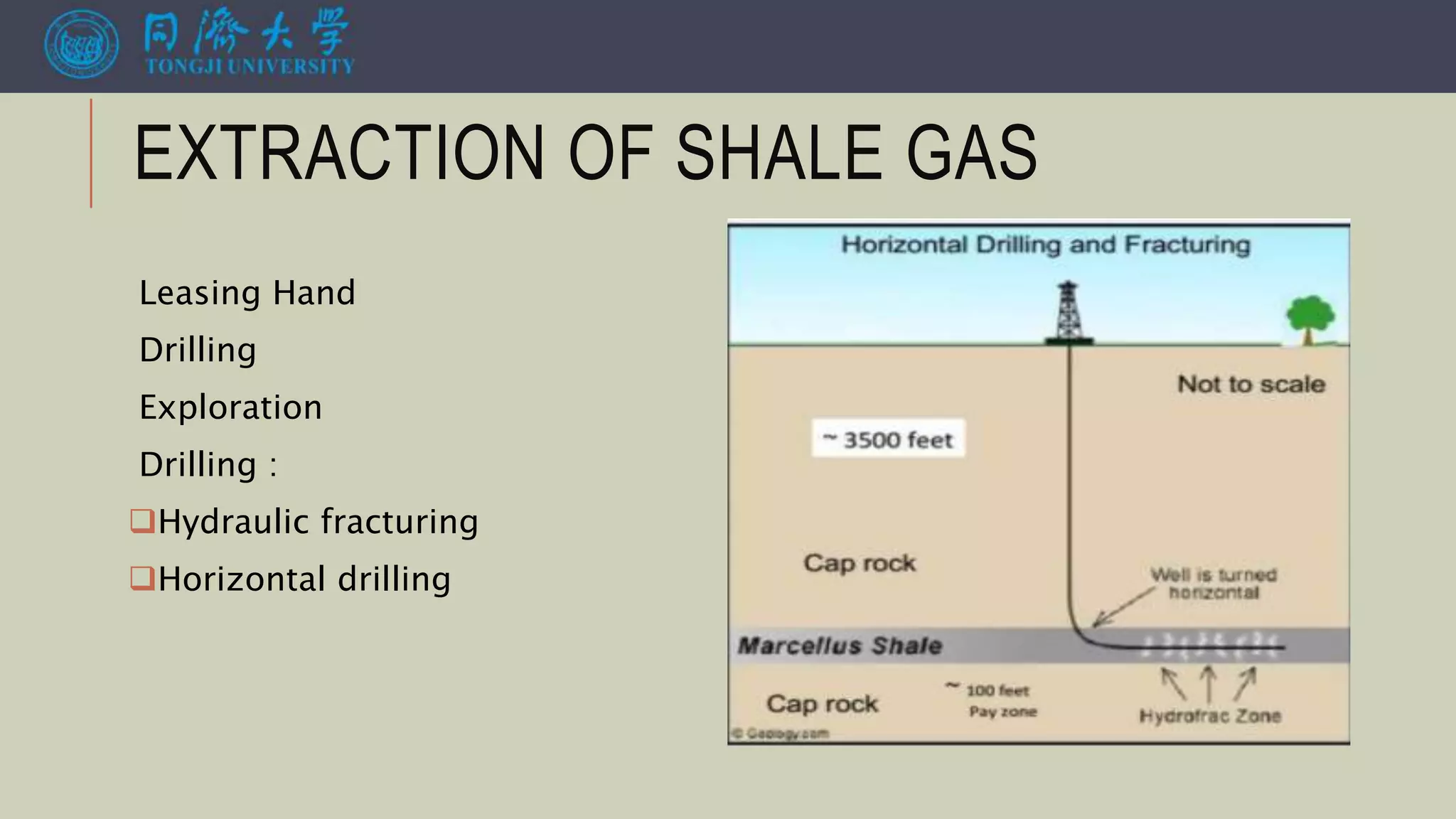
Fig. a. intracrystalline pore. b,. Pyrite intracrystaline pore, c. calcite recrystallization intracrystalline
pore, d. dissolved fracture, e. pores formed hydrocarbon generation f. pores formed by organic acid
solution. G. margin of organic matter, h. interlayered fracture, I. Tectonic micro fracture.
Shale gas Reservoir
SHALE GAS PRODUCTION COST
CURVE
BACKGROUND SHALE GAS
PRODUCTION
Rapid shale gas growth in US : Largest Natural gas production
I. 7 million ton-LNG : 47% total gas production by 2035 in DOE’s
estimate
Global Potential of Shale Gas
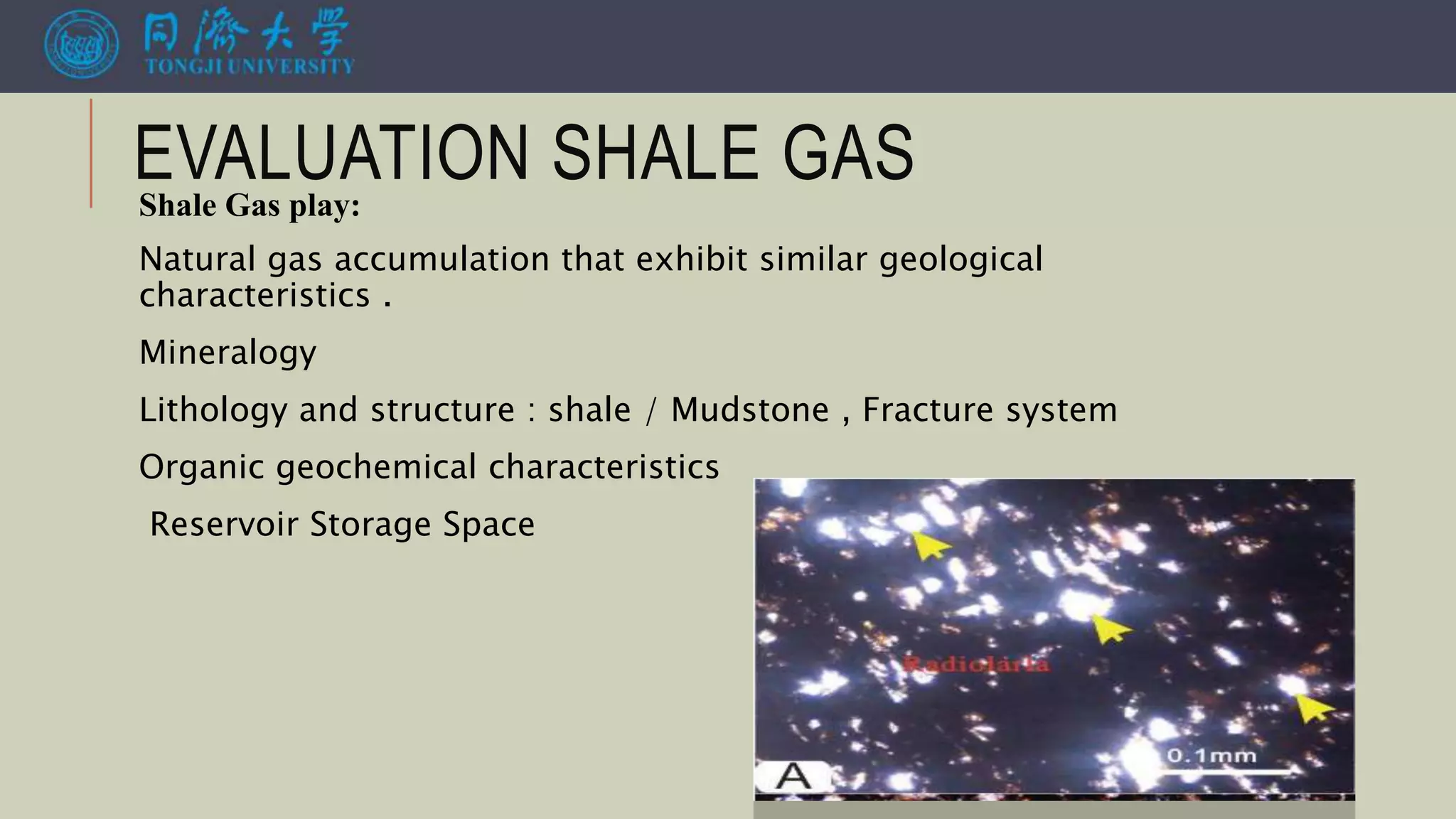
EVALUATION SHALE GAS
Shale Gas play:
Natural gas accumulation that exhibit similar geological
characteristics .
Mineralogy
Lithology and structure : shale / Mudstone , Fracture system
Organic geochemical characteristics
Reservoir Storage Space
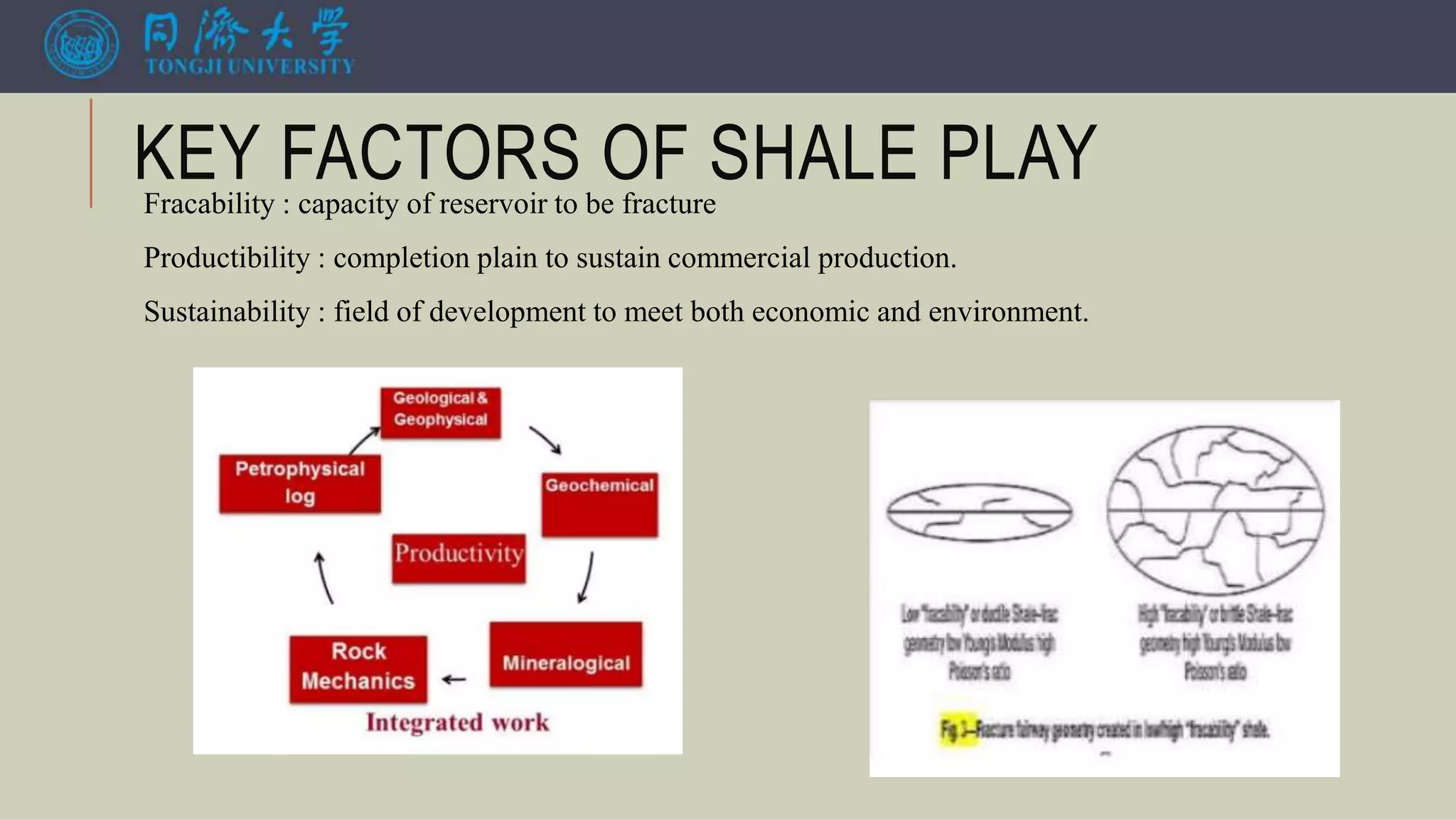
KEY FACTORS OF SHALE PLAY
Fracability : capacity of reservoir to be fracture
Productibility : completion plain to sustain commercial production.
Sustainability : field of development to meet both economic and environment.
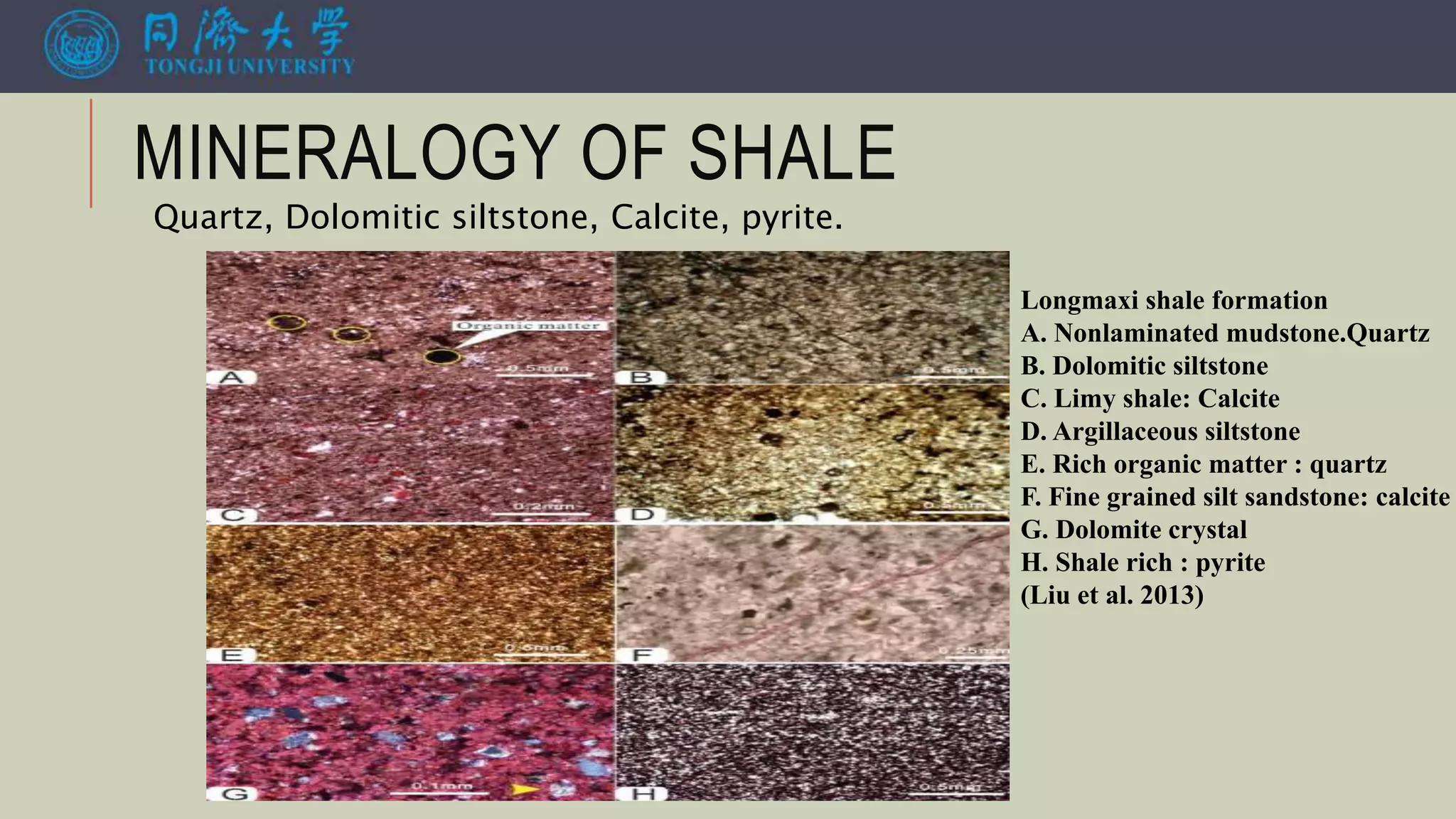
MINERALOGY OF SHALE
Quartz, Dolomitic siltstone, Calcite, pyrite.
Longmaxi shale formation
A. Nonlaminated mudstone.Quartz
B. Dolomitic siltstone
C. Limy shale: Calcite
D. Argillaceous siltstone
E. Rich organic matter : quartz
F. Fine grained silt sandstone: calcite
G. Dolomite crystal
H. Shale rich : pyrite
(Liu et al. 2013)
A.Siliceous shale & pyrite )
B.Replaced by Quartz
C.Dolomitic minerals
D.Replaced by silica
(Liu et al. 2013)
SHALE STRUCTURAL FEATURE
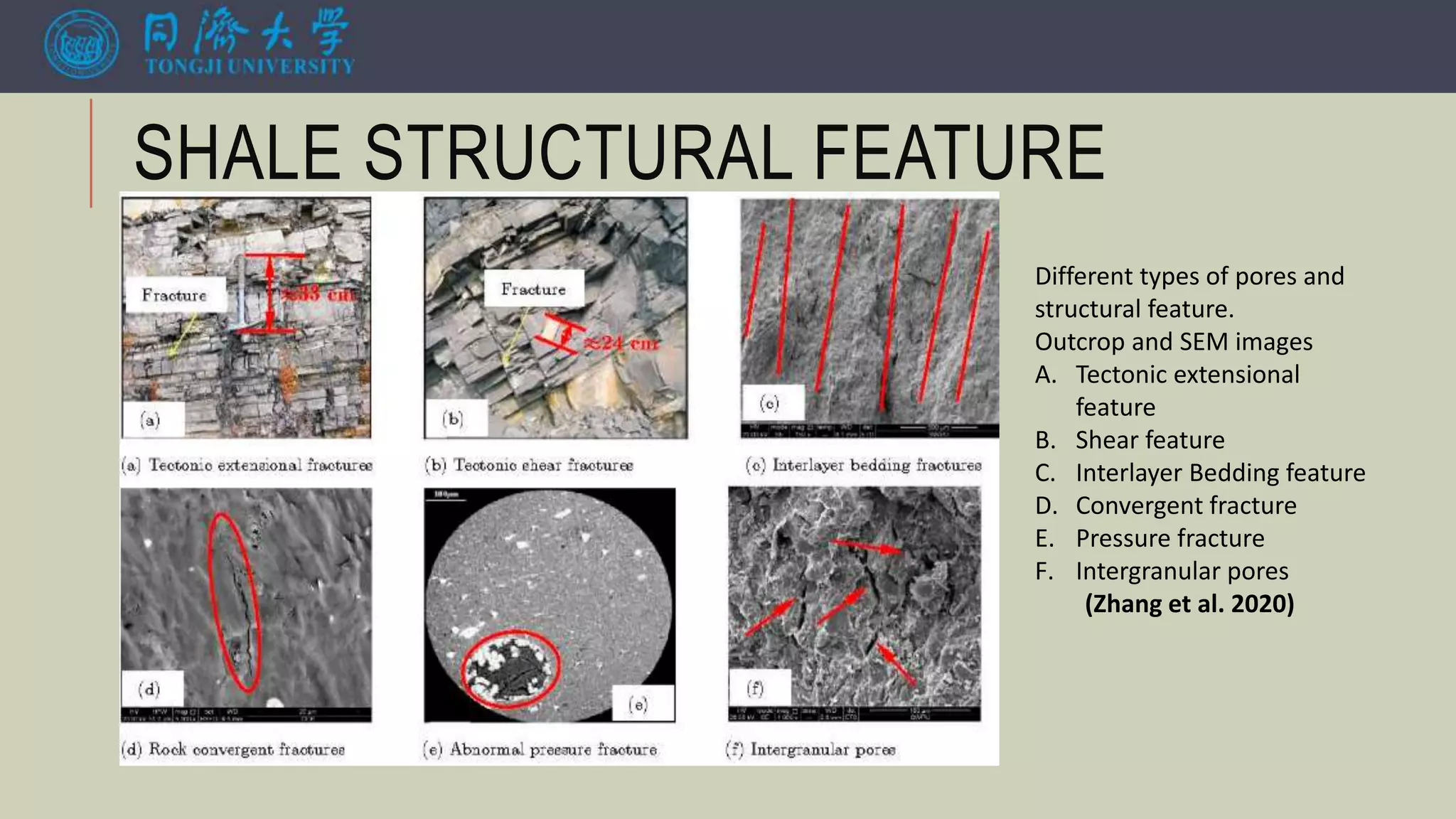
Different types of pores and
structural feature.
Outcrop and SEM images
A. Tectonic extensional
feature
B. Shear feature
C. Interlayer Bedding feature
D. Convergent fracture
E. Pressure fracture
F. Intergranular pores
(Zhang et al. 2020)
A. Pyrite framboid micropores .
B. Intercrystalline micropores, illite sheets
C. Dissolution pores in feldspar
D. Dissolution along fracture
E. Pores filled with mica and ankerite
F. Mircofracture rich area with quartz.
(Zhang et al. 2020)
GEOCHEMICAL APPROACH
Major factor plays in geochemistry study :
TOC %(Total organic Carbon )
Kerogen Types
Thermal maturity Ro
Thermal Maturation
TOC :
Identification the productivity of the Shale
TYPES OF KEROGEN
Kerogen types
GEOLOGICAL APPROACH
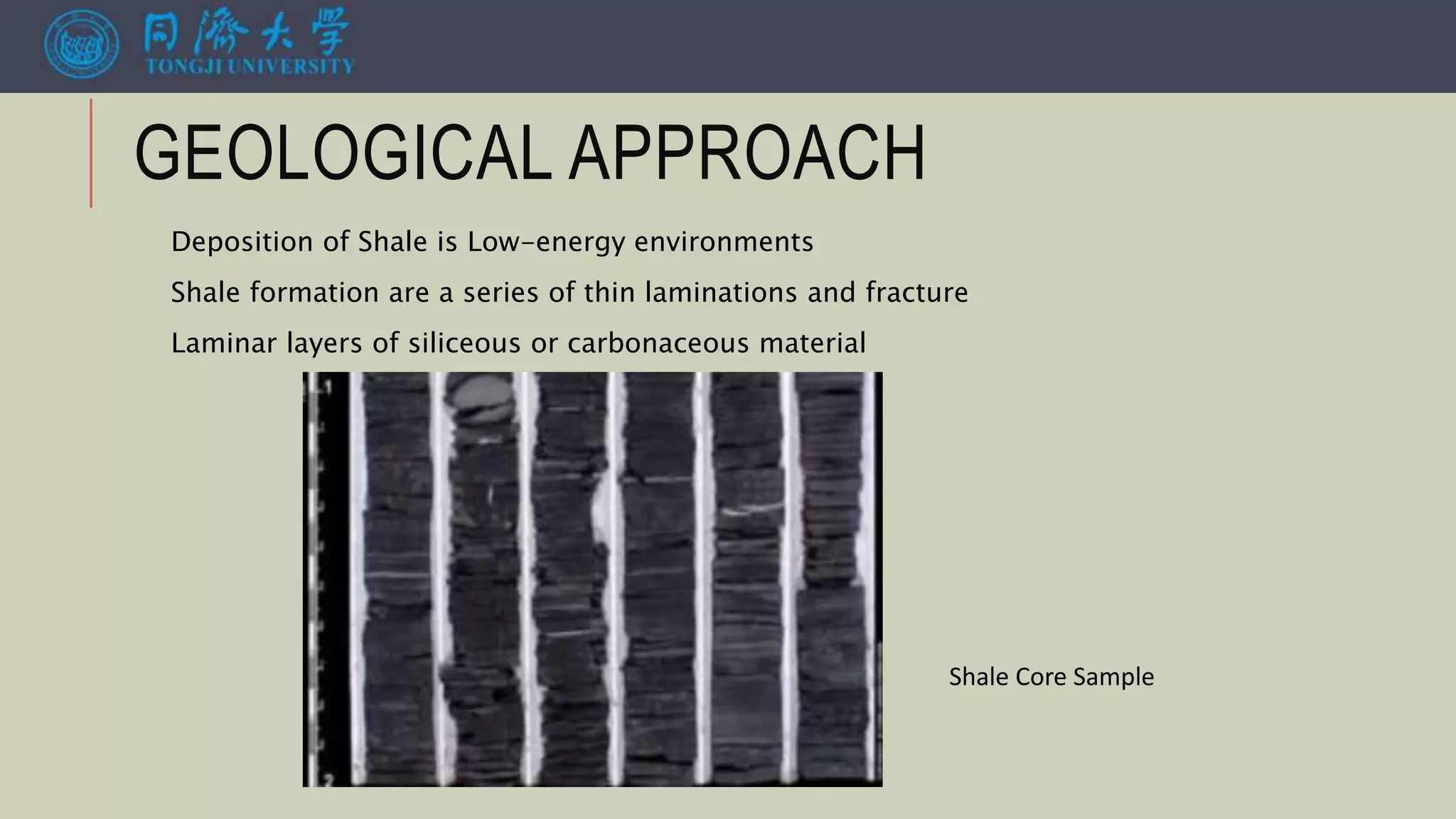
Deposition of Shale is Low-energy environments
Shale formation are a series of thin laminations and fracture
Laminar layers of siliceous or carbonaceous material
Shale Core Sample
GEOPHYSICAL APPROACH
 Vp/Vs is the most optimally sensitive parameter for shale gas
reservoir identification and evaluation
Vp/Vs inversion profile across W1 well.
GEOPHYSICAL, PETRO PHYSICAL &
GEO-MECHANICAL APPROACH
Geophysical study based on the seismic interpretation : regional extent, mapping
the structure and fault .
Well Log interpretation
Potential reservoir to product
EXTRACTION OF SHALE GAS
Leasing Hand
Drilling
Exploration
Drilling :
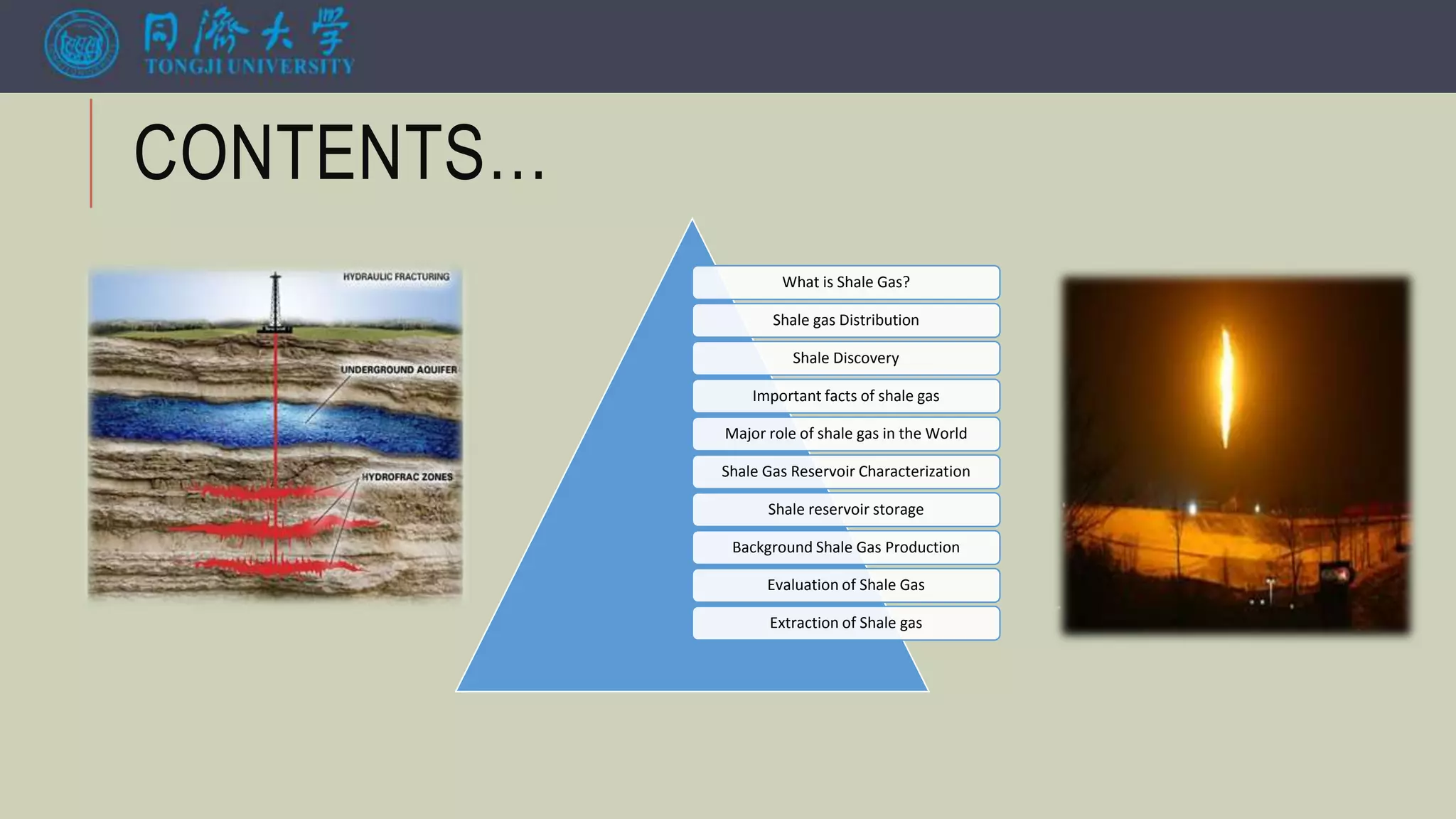
Hydraulic fracturing
Horizontal drilling
HYDRAULIC FRACTURING
Requirement for sealed natural fracture shale gas system
DISADVANTAGES OF FRACKING
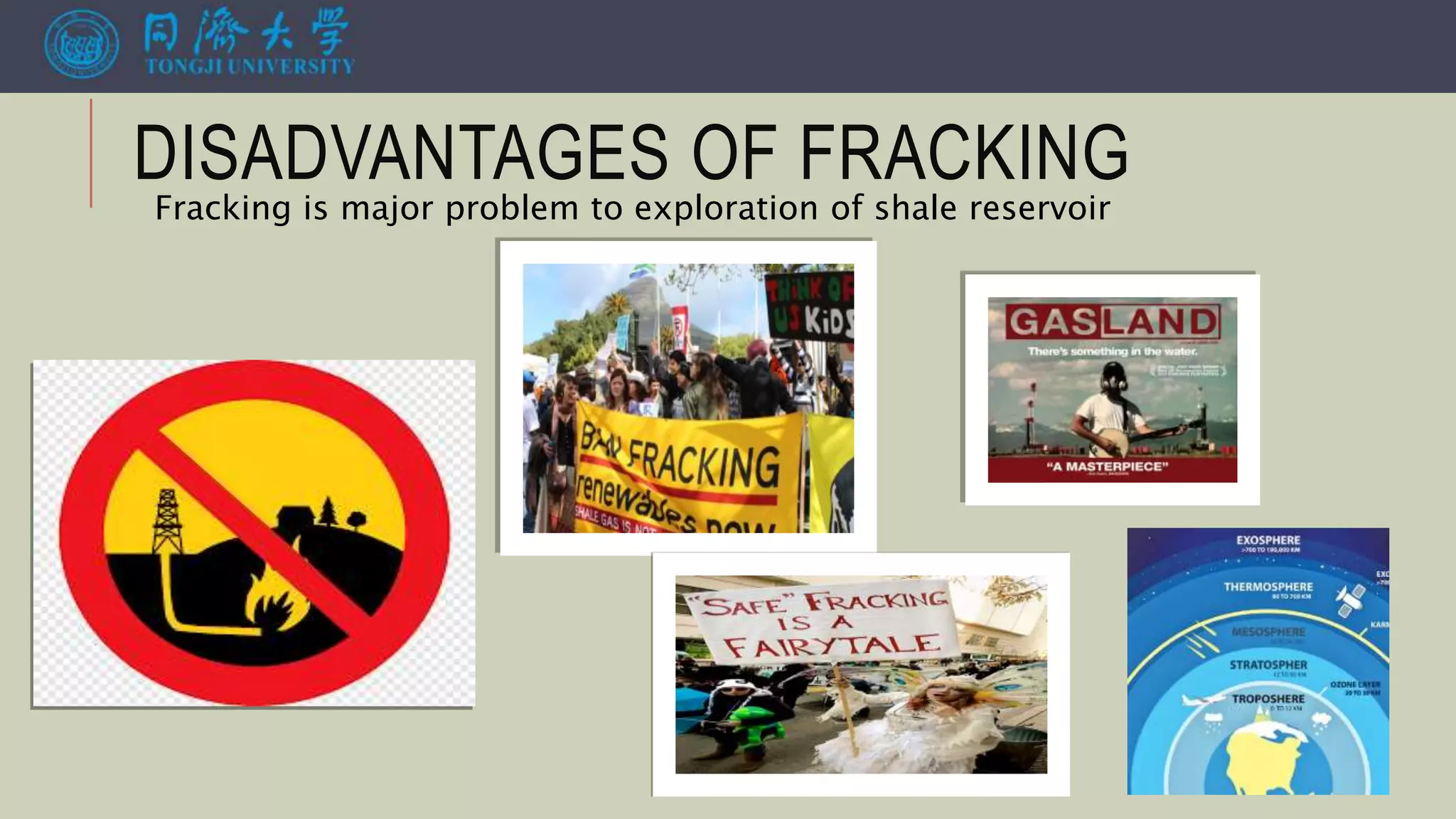
Fracking is major problem to exploration of shale reservoir
 shale gas reservoir

shale gas reservoir

  • 2.
    SHALE GAS RESERVOIR CaseStudy : Shale gas reservoirs characterization, evaluation, composition and pore structure. Aamir Ali Master Candidate, Tongji University
  • 3.
    CONTENTS… What is ShaleGas? Shale gas Distribution Shale Discovery Important facts of shale gas Major role of shale gas in the World Shale Gas Reservoir Characterization Shale reservoir storage Background Shale Gas Production Evaluation of Shale Gas Extraction of Shale gas
  • 4.
    WHAT IS SHALEGAS ? Shale : fine-Grianed, sedimentary rock characterized by breaks along thin laminae or parallel layering or bedding, with low porosity and permeability. Unconventional deposit Reserves higher than oil Enhanced Global Availability
  • 5.
    SHALE GAS DISTRIBUTION: SHALE GAS RESERVES ALL OVER THE WORLD
  • 6.
    Figure Current andpredicted situations of shale gas resources in different countries or regions (from EIA). (a) Natural gas production by type. (b) Shale gas production in different countries. (c) Natural gas consumption in different regions. (d) Natural gas supply by type in China. (zhang.B et al .2020)
  • 7.
    SHALE GAS BASINESTIMATION ON WORLDWIDE MAP Map of 38 major shale gas basins in 32 countire
  • 8.
    SHALE DISCOVERY Charles DoolittleWalcott 1907 - 1927 Ottoia , Soft-worm, Burgess Shale Cambrian Burgess Shale out crop 30/Aug/1909
  • 9.
  • 10.
    IMPORTANT FACTS OFSHALE GAS The permeability of shales is very low- several orders of magnitude lower that construction-grade cement. Tight gas development uses the same technology as that contributing to the recent shale gas boom. With out stimulation, most shale would not be economic to produce.
  • 11.
  • 12.
    MAJOR ROLE OFSHALE GAS IN THE WORLD Shale gas has a great attention and major role for World future. Shale gas replacements for conventional energy in the future. Shale Gas is the most important energy development since the discovery of oil: (Fred Julander, CEO of Julander Energy) Mission Critical: Can shale gas save the world?(ASPO, Sep 2009). The United States may be close to self-sufficiency in energy by 2030 because of a "shale revolution" in the country.” BP CEO Bob Dudley, January 17, 2013
  • 13.
    Top 10 ShaleGas reserves in the World 2021 Shale Gas Rating https://www.oilandgasmiddleeast.com (Zhang et al. 2020)
  • 14.
    SHALE GAS RESERVOIR CHARACTERIZATION DepositionalEnvironment i. Marine Shale :lower clay content & high in brittle minerals. ii. Non-marine Shale: lacustrine & fluvial(high clay content) Thermal Maturity : Temp needed to breakdown organic matter, Vitrinite reflectance, higher thermal maturity : Total organic Carbon (TOC) content: OM(micro-organism, fossils, plant matter )
  • 15.
    SHALE RESERVOIR STORAGE Porosity Gasdissolved in kerogen Gas absorbed onto kerogen and clay particle surface Free gas in natural factures and intergranular porosity. Permeability Shale matrix permeabilites of typical shales are very low. Natural fracture systems or hydraulic stimulation. Hydrocarbon are effectively trapped unable to flow under normal circumstances in shale
  • 16.
    Gas in place Basicfour characteristics : Pressure, Temperature, gas filled porosity and net organically rich shale. Pressure: Higher pressure are identified as they have higer gas concentrations. Temperature: Temperature gradient of 1 °F per foot Gas-filled porosity: Determined from Cores & Log Curves. Fig: Identification of core and thin section
  • 17.
    Fig. Different typesof shale: showing the siliceous shale was mainly formed in the dysoxic/anoxic environment,and the argillaceous shale and silty shale were formed in the oxic environment.J. Zhao et al. / Petroleum Research 2 (2017) 209e221218
  • 18.
    Porosity of Shale SEMimages: (a). OM pores & pyrite B). OM pores and cleavage sheet. C) Fluid-inclusion intrapores D) Cleavage-sheet intrapores. G) fulid inclusion intrapores H) Intercrystalline pores I) cleavage-sheet intrapores. J) Pores different shape
  • 19.
    Fig. a. intracrystallinepore. b,. Pyrite intracrystaline pore, c. calcite recrystallization intracrystalline pore, d. dissolved fracture, e. pores formed hydrocarbon generation f. pores formed by organic acid solution. G. margin of organic matter, h. interlayered fracture, I. Tectonic micro fracture.
  • 20.
  • 21.
  • 22.
    BACKGROUND SHALE GAS PRODUCTION Rapidshale gas growth in US : Largest Natural gas production I. 7 million ton-LNG : 47% total gas production by 2035 in DOE’s estimate Global Potential of Shale Gas
  • 23.
    EVALUATION SHALE GAS ShaleGas play: Natural gas accumulation that exhibit similar geological characteristics . Mineralogy Lithology and structure : shale / Mudstone , Fracture system Organic geochemical characteristics Reservoir Storage Space
  • 24.
    KEY FACTORS OFSHALE PLAY Fracability : capacity of reservoir to be fracture Productibility : completion plain to sustain commercial production. Sustainability : field of development to meet both economic and environment.
  • 25.
    MINERALOGY OF SHALE Quartz,Dolomitic siltstone, Calcite, pyrite. Longmaxi shale formation A. Nonlaminated mudstone.Quartz B. Dolomitic siltstone C. Limy shale: Calcite D. Argillaceous siltstone E. Rich organic matter : quartz F. Fine grained silt sandstone: calcite G. Dolomite crystal H. Shale rich : pyrite (Liu et al. 2013)
  • 26.
    A.Siliceous shale &pyrite ) B.Replaced by Quartz C.Dolomitic minerals D.Replaced by silica (Liu et al. 2013)
  • 27.
    SHALE STRUCTURAL FEATURE Differenttypes of pores and structural feature. Outcrop and SEM images A. Tectonic extensional feature B. Shear feature C. Interlayer Bedding feature D. Convergent fracture E. Pressure fracture F. Intergranular pores (Zhang et al. 2020)
  • 28.
    A. Pyrite framboidmicropores . B. Intercrystalline micropores, illite sheets C. Dissolution pores in feldspar D. Dissolution along fracture E. Pores filled with mica and ankerite F. Mircofracture rich area with quartz. (Zhang et al. 2020)
  • 29.
    GEOCHEMICAL APPROACH Major factorplays in geochemistry study : TOC %(Total organic Carbon ) Kerogen Types Thermal maturity Ro Thermal Maturation
  • 30.
    TOC : Identification theproductivity of the Shale
  • 31.
  • 32.
  • 33.
    GEOLOGICAL APPROACH Deposition ofShale is Low-energy environments Shale formation are a series of thin laminations and fracture Laminar layers of siliceous or carbonaceous material Shale Core Sample
  • 34.
    GEOPHYSICAL APPROACH  Vp/Vsis the most optimally sensitive parameter for shale gas reservoir identification and evaluation Vp/Vs inversion profile across W1 well.
  • 35.
    GEOPHYSICAL, PETRO PHYSICAL& GEO-MECHANICAL APPROACH Geophysical study based on the seismic interpretation : regional extent, mapping the structure and fault . Well Log interpretation Potential reservoir to product
  • 36.
    EXTRACTION OF SHALEGAS Leasing Hand Drilling Exploration Drilling : Hydraulic fracturing Horizontal drilling
  • 37.
    HYDRAULIC FRACTURING Requirement forsealed natural fracture shale gas system
  • 39.
    DISADVANTAGES OF FRACKING Frackingis major problem to exploration of shale reservoir