NaturalGasproduction&Processing
N a t u r a l g a s E n g i n e e r i n g
Course
1
1. Natural gas Overview
Email:Eng20072007@gmail.com
https://www.facebook.com/elsayedameer
Phone : 01065860658
Married with twinsMai& Nada.
Very good grade with degree of honor
Worked for weatherford drilling for 1.5 years
BSC Of petroleum engineering
Currently, Production and process engineer
At SUCO and RWE Dea Egypt Petroleum Co.
Eng. Elsayed Amer
Petroleum Engineer
Overview of Natural
Gas Resources
1
3
5
Introduction:
Natural Gas is a vital component of the world's supply of energy. It is one
of the cleanest, safest, and most useful of all energy sources.
What is Natural Gas:
Natural gas is a combustible mixture of hydrocarbon gases( from CH4 to
C8H18”OCTANE) consisting essentially of METHANE ,other hydrocarbons
and non Hydrocarbon Gases in gaseous state ,which is extracted from the
subsurface of the earth in its natural state ,separately or together with
liquid hydrocarbons
6
7
8
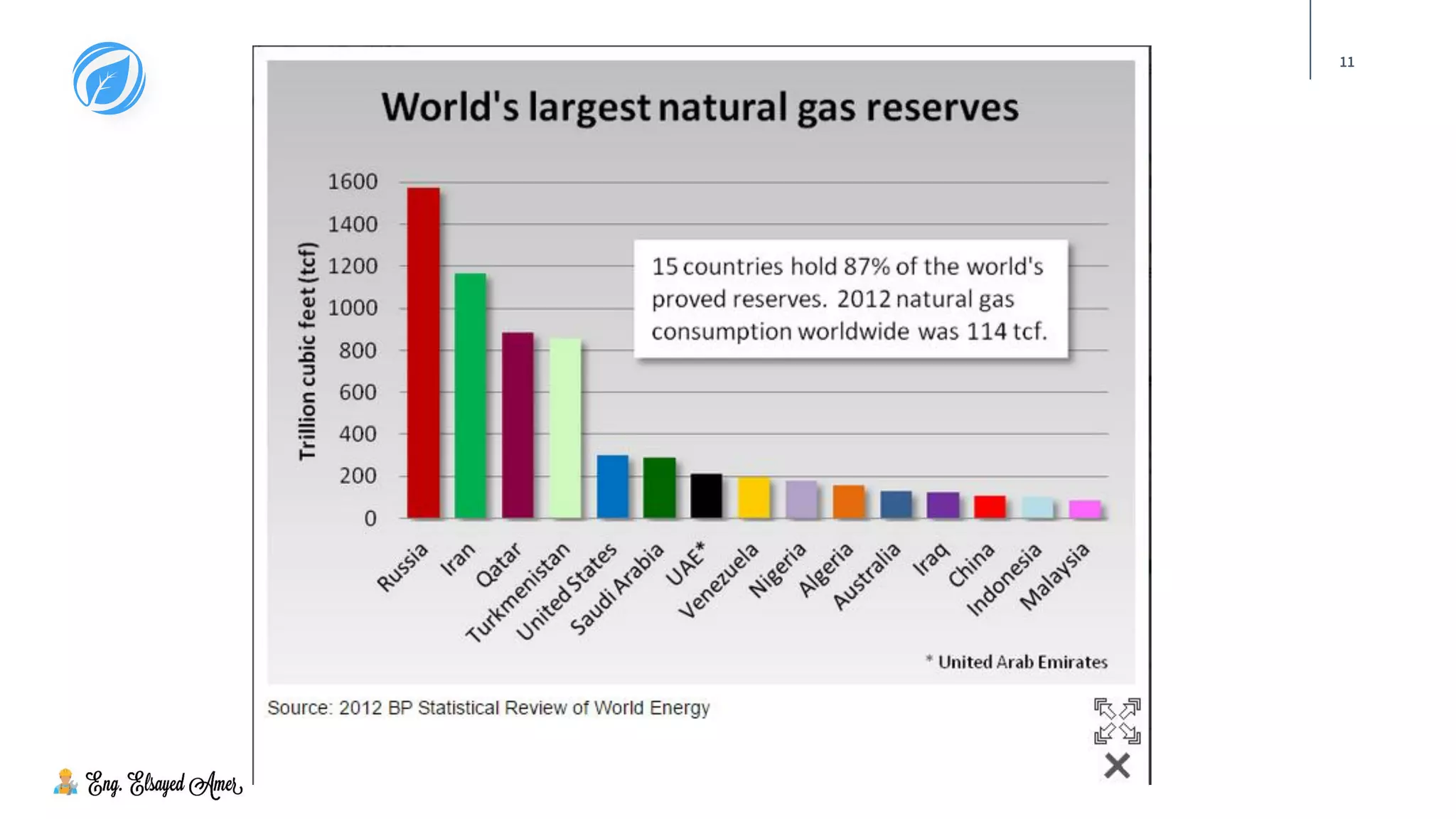
Globally, natural gas has a proved reserves life index of 64 years. The IEA (2012)
estimates that there are nearly 404 trillion cubic meters (tcm) (14,285 trillion cubic feet (tcf))
of remaining recoverable resources (including all resource categories) of conventional gas
worldwide, a value that is equivalent to almost 130 years of production at 2011 rates.
9
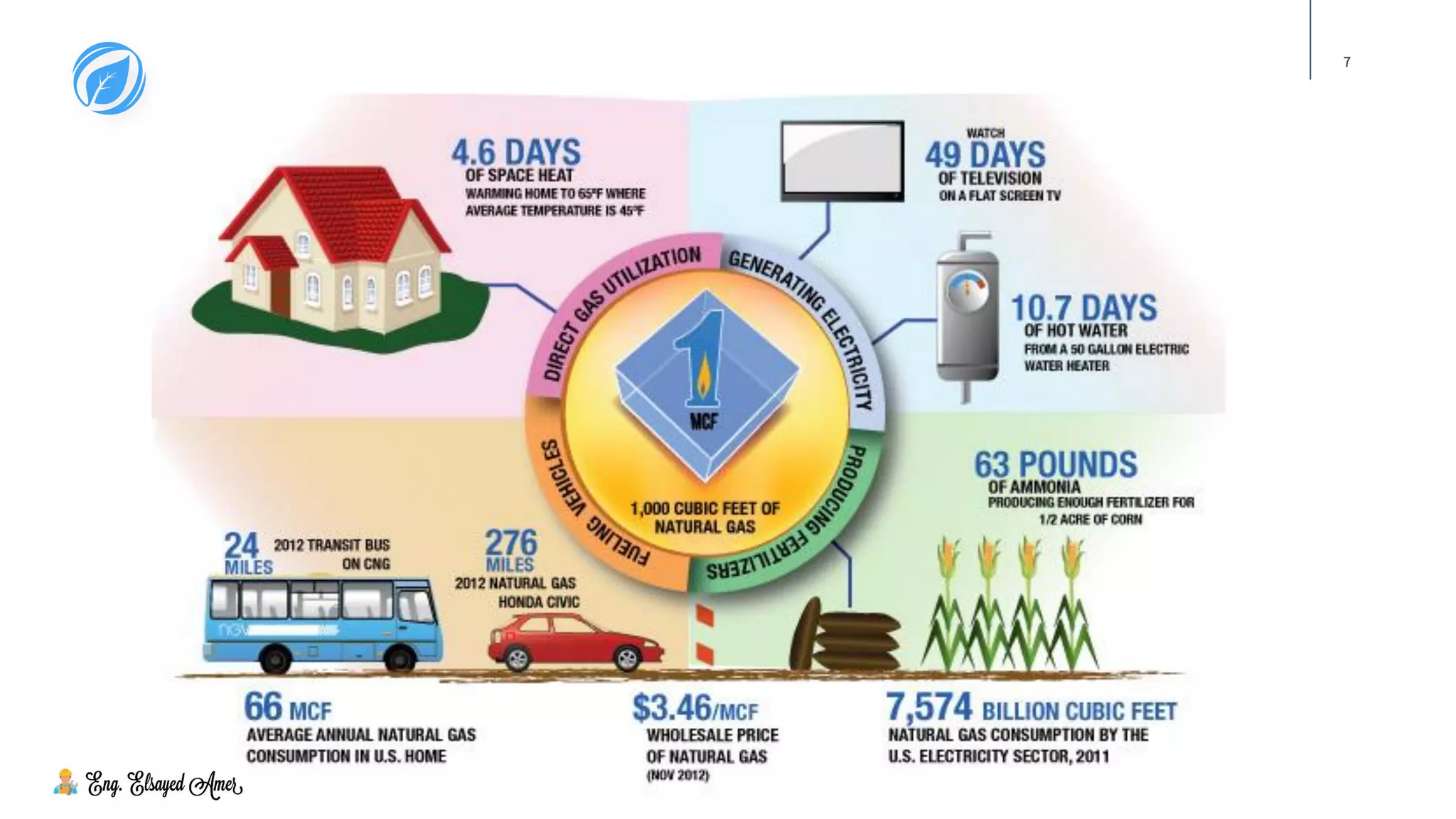
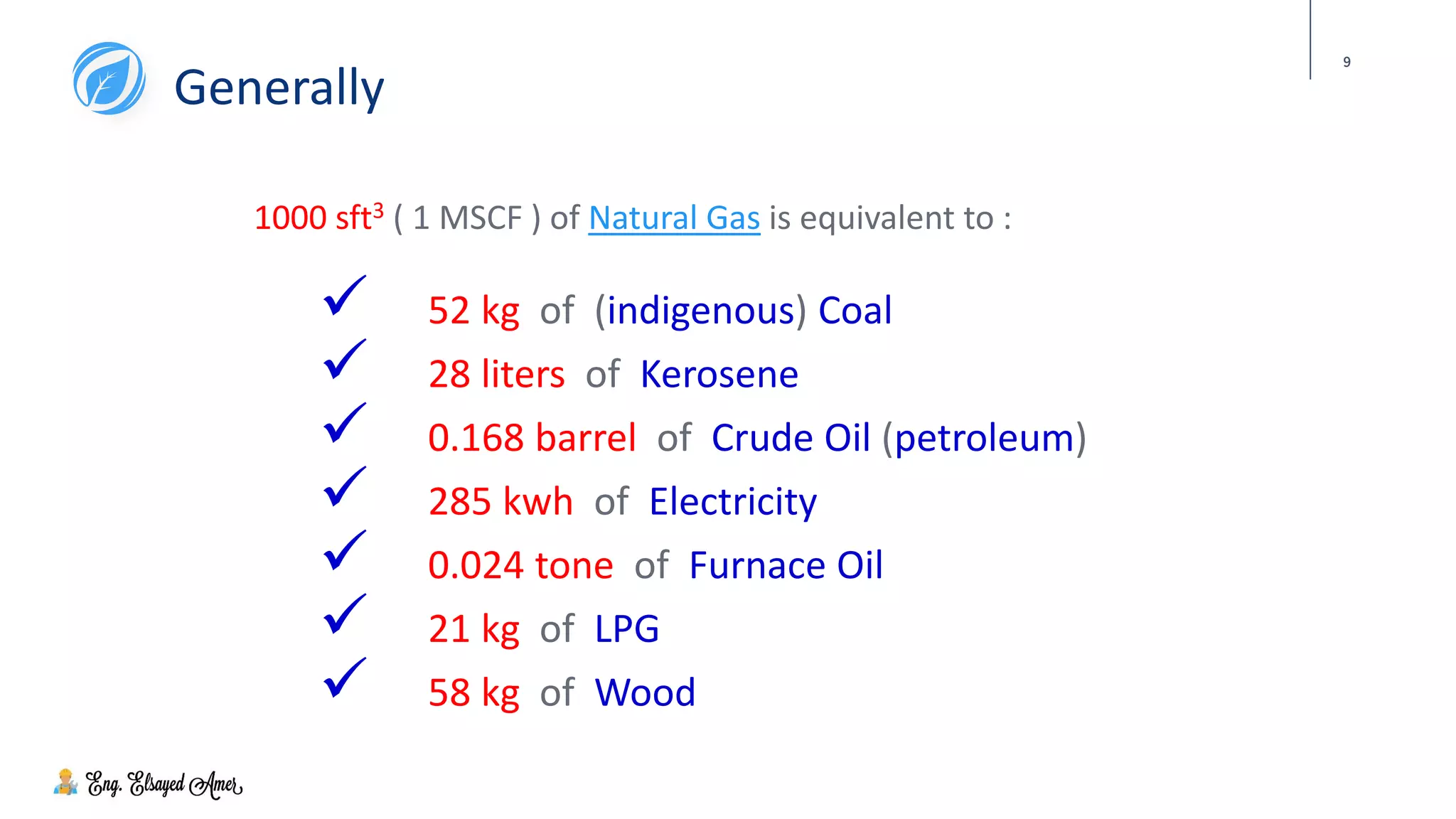
1000 sft3 ( 1 MSCF ) of Natural Gas is equivalent to :
 52 kg of (indigenous) Coal
 28 liters of Kerosene
 0.168 barrel of Crude Oil (petroleum)
 285 kwh of Electricity
 0.024 tone of Furnace Oil
 21 kg of LPG
 58 kg of Wood
Generally
10
11
Eng. Elsayed Amer
Eng. Elsayed Amer
Eng. Elsayed Amer
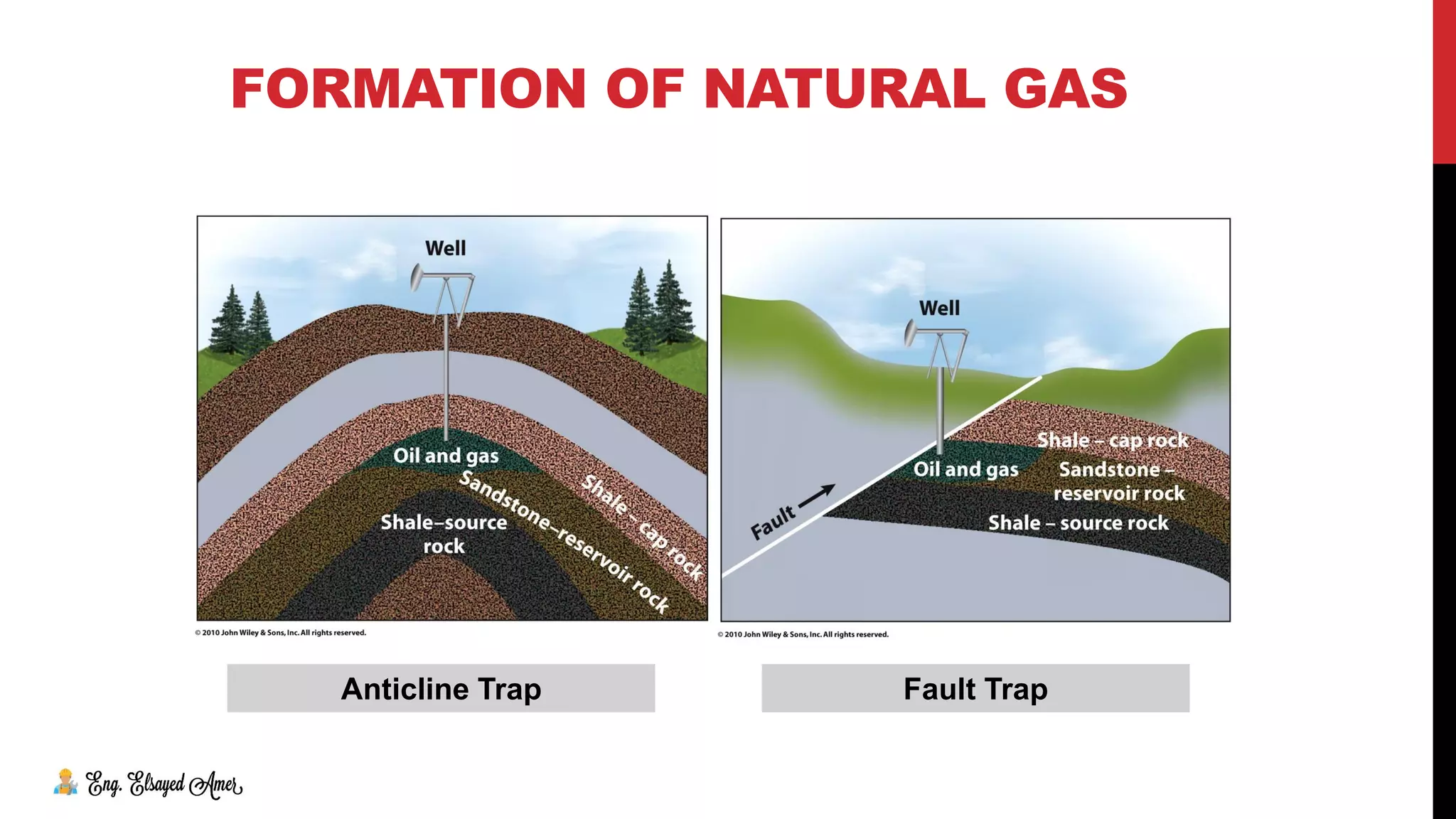
FORMATION OF NATURAL GAS
Anticline Trap Fault Trap
NATURAL GAS
• Natural gas resources
• Crude oil wells with a gas cap above the crude oil trap
or gas dissolved in the oil produce associated gas
• Gas wells and condensate wells are gas sources that
contain little to no crude oil and are called non-
associated gas
• Condensate wells that contain heavier forms of natural
gas (pentane) can also produce low weight
hydrocarbons in the gas product
17
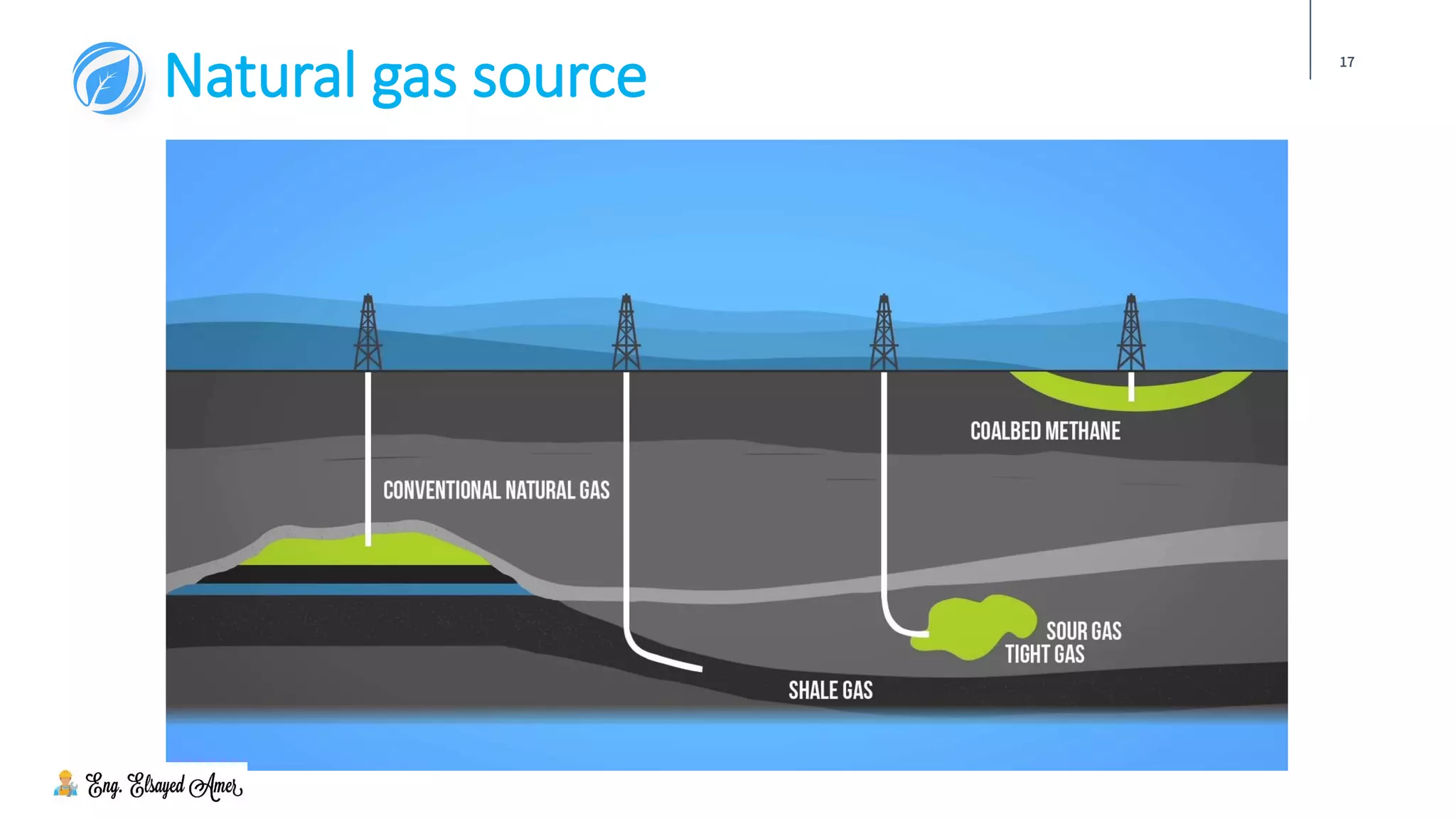
Natural gas source
18
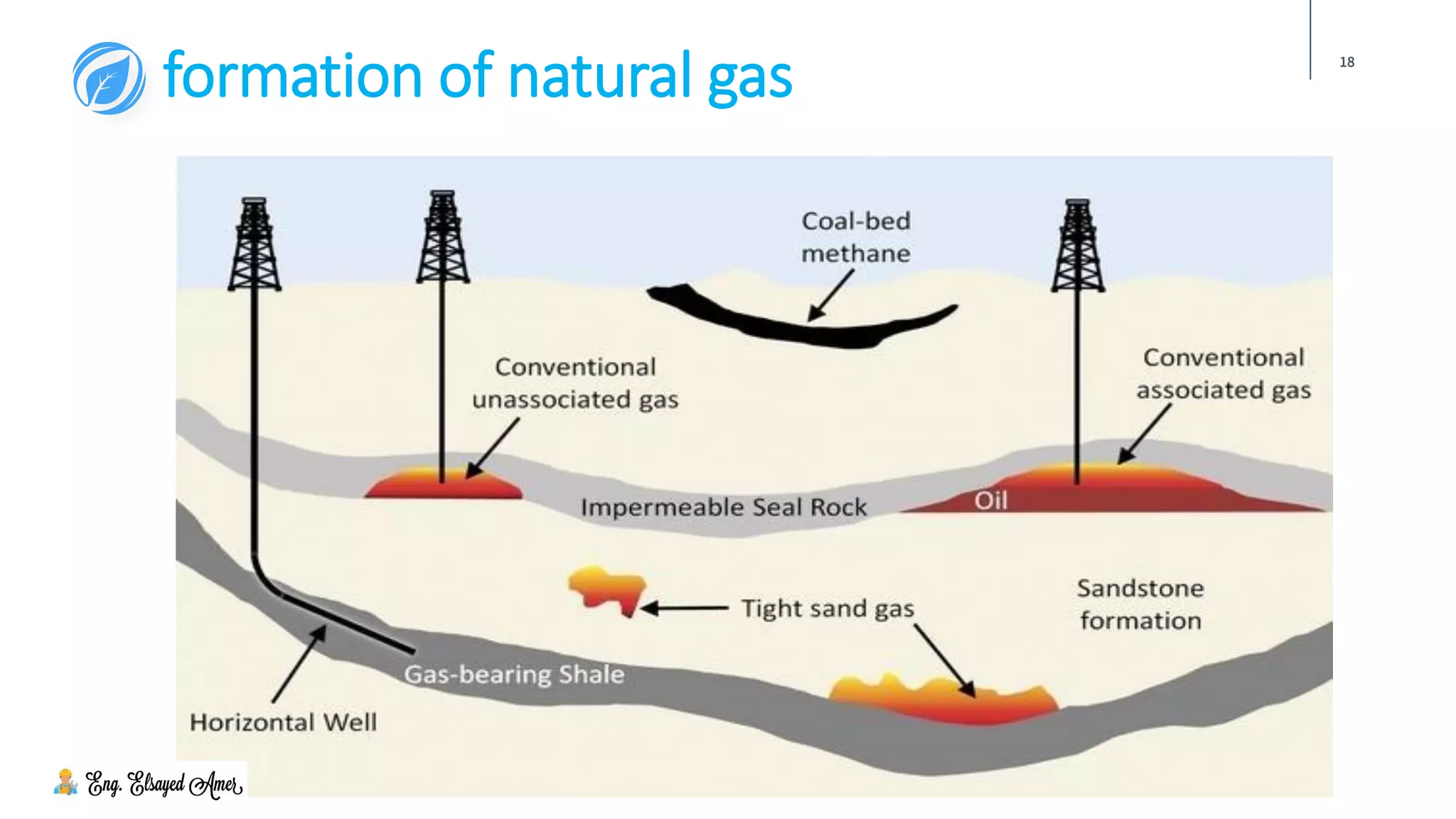
formation of natural gas
19
Gas reservoir fluids
• Dry gas
• Wet gas
• Gas condensate
Gas produced from gas reservoirs,
Comes naturally at high pressure, enough to propel
through processing and transmission to point of use.
may or may not be condensate production together
with the gas
Gas produced with crude oil.
Comes at low pressure. Requires compression to propel
through processing and transmission.
Often flared when processing and transmission to point
of need is uneconomic
Non Associated NG Associated NG
Natural gas sources
Natural gas source
1. natural gas overview

1. natural gas overview

  • 1.
    NaturalGasproduction&Processing N a tu r a l g a s E n g i n e e r i n g Course 1
  • 2.
  • 3.
    Email:Eng20072007@gmail.com https://www.facebook.com/elsayedameer Phone : 01065860658 Marriedwith twinsMai& Nada. Very good grade with degree of honor Worked for weatherford drilling for 1.5 years BSC Of petroleum engineering Currently, Production and process engineer At SUCO and RWE Dea Egypt Petroleum Co. Eng. Elsayed Amer Petroleum Engineer
  • 4.
  • 5.
    5 Introduction: Natural Gas isa vital component of the world's supply of energy. It is one of the cleanest, safest, and most useful of all energy sources. What is Natural Gas: Natural gas is a combustible mixture of hydrocarbon gases( from CH4 to C8H18”OCTANE) consisting essentially of METHANE ,other hydrocarbons and non Hydrocarbon Gases in gaseous state ,which is extracted from the subsurface of the earth in its natural state ,separately or together with liquid hydrocarbons
  • 6.
  • 7.
  • 8.
    8 Globally, natural gashas a proved reserves life index of 64 years. The IEA (2012) estimates that there are nearly 404 trillion cubic meters (tcm) (14,285 trillion cubic feet (tcf)) of remaining recoverable resources (including all resource categories) of conventional gas worldwide, a value that is equivalent to almost 130 years of production at 2011 rates.
  • 9.
    9 1000 sft3 (1 MSCF ) of Natural Gas is equivalent to :  52 kg of (indigenous) Coal  28 liters of Kerosene  0.168 barrel of Crude Oil (petroleum)  285 kwh of Electricity  0.024 tone of Furnace Oil  21 kg of LPG  58 kg of Wood Generally
  • 10.
  • 11.
  • 12.
  • 13.
  • 14.
  • 15.
    FORMATION OF NATURALGAS Anticline Trap Fault Trap
  • 16.
    NATURAL GAS • Naturalgas resources • Crude oil wells with a gas cap above the crude oil trap or gas dissolved in the oil produce associated gas • Gas wells and condensate wells are gas sources that contain little to no crude oil and are called non- associated gas • Condensate wells that contain heavier forms of natural gas (pentane) can also produce low weight hydrocarbons in the gas product
  • 17.
  • 18.
  • 19.
    19 Gas reservoir fluids •Dry gas • Wet gas • Gas condensate
  • 20.
    Gas produced fromgas reservoirs, Comes naturally at high pressure, enough to propel through processing and transmission to point of use. may or may not be condensate production together with the gas Gas produced with crude oil. Comes at low pressure. Requires compression to propel through processing and transmission. Often flared when processing and transmission to point of need is uneconomic Non Associated NG Associated NG Natural gas sources
  • 21.