Aamir Ali,
Master Candidate, Tongji University
fate of
Fluxes and Fate of Dissolved Methane
released at the seafloor & land limit of Gas
Hydrate Stability Zone offshore
Case Study : Western Svalbard.
CONTENTS
• History of the Gas Hydrate
• Gas Hydrate occurrence in the space
• Gas hydrate, Hydrate samples, Sources & Uses
• Where are gas hydrates located?
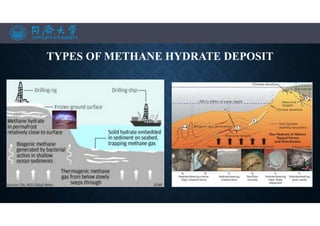
• Types of Methane hydrate deposit
• Researchers (Et al) Contribution about the Gas hydrate Stability
• Oceanographic Setting
• Sampling and Analytical Methods, Box Model, Sea-Air Fluxes
• Result and Discussions
• Summary
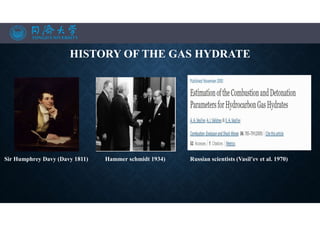
HISTORY OF THE GAS HYDRATE
Sir Humphrey Davy (Davy 1811) Hammer schmidt 1934) Russian scientists (Vasil’ev et al. 1970)
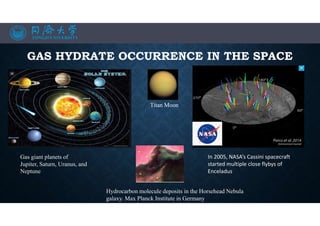
GAS HYDRATE OCCURRENCE IN THE SPACE
In 2005, NASA’s Cassini spacecraft
started multiple close flybys of
Enceladus
Gas giant planets of
Jupiter, Saturn, Uranus, and
Neptune.
Titan Moon
Hydrocarbon molecule deposits in the Horsehead Nebula
galaxy. Max Planck Institute in Germany
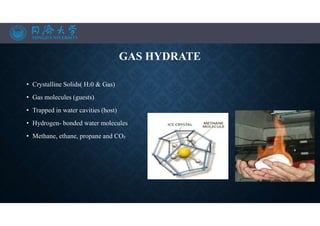
GAS HYDRATE
• Crystalline Solids( H20 & Gas)
• Gas molecules (guests)
• Trapped in water cavities (host)
• Hydrogen- bonded water molecules
• Methane, ethane, propane and CO₂
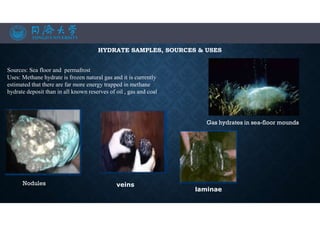
HYDRATE SAMPLES, SOURCES & USES
Gas hydrates in sea-floor mounds
Nodules
laminae
veins
Sources: Sea floor and permafrost
Uses: Methane hydrate is frozen natural gas and it is currently
estimated that there are far more energy trapped in methane
hydrate deposit than in all known reserves of oil , gas and coal
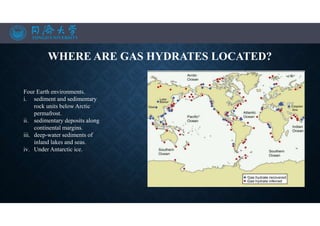
WHERE ARE GAS HYDRATES LOCATED?
Four Earth environments.
i. sediment and sedimentary
rock units below Arctic
permafrost.
ii. sedimentary deposits along
continental margins.
iii. deep-water sediments of
inland lakes and seas.
iv. Under Antarctic ice.
TYPES OF METHANE HYDRATE DEPOSIT
•
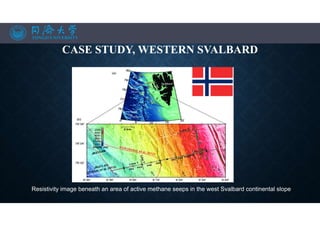
CASE STUDY, WESTERN SVALBARD
Resistivity image beneath an area of active methane seeps in the west Svalbard continental slope
RESEARCHERS (ET AL)
ANALYSIS ABOUT THE METHANE GAS HYDRATE
STABILITY
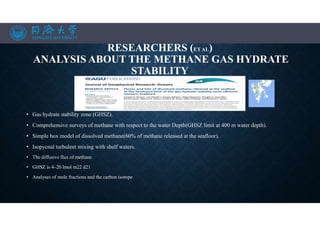
• Gas hydrate stability zone (GHSZ).
• Comprehensive surveys of methane with respect to the water Depth(GHSZ limit at 400 m water depth).
• Simple box model of dissolved methane(60% of methane released at the seafloor).
• Isopycnal turbulent mixing with shelf waters.
• The diffusive flux of methane
• GHSZ is 4–20 lmol m22 d21
• Analyses of mole fractions and the carbon isotope
RESEARCHER CONTRIBUTION &
DETERMINATIONS: GHSZ
• Methane in the water column in the vicinity of the landward limit
• GHSZ for three separate sampling:
• Box model to quantify the fate of methane released from the seabed
• Vertical mixing into the surface mixed layer is slow
• Methane release to the atmosphere at the landward limit
OCEANOGRAPHIC SETTING
Map of the study area and water column sampling sites. Bathymetry in Figure
1a is from the GEBCO_08 Grid version 20100927 (http://gebco.net), contour
interval is 100 m; light blue indicates He-386 cruise track, and yellow
rectangle indicates the area expanded in Figure 1b, showing shipboard
bathymetry from cruise JR253. Red circles show positions of
cruise JR253 sampling stations; red lines indicate sampling transects T1–T4.
Blue diamonds show sampling stations from cruise MSM21/4. Locations of
seafloor bubble seeps identified by shipboard sonar during sampling are
indicated by crosses. (c) The dominant direction of the main ocean currents in
this region: the West Spitsbergen Current (WSC) in red, and the
East Spitsbergen Current (ESC) in blue, modified from Saloranta and
Svendsen [2001].
SAMPLING AND ANALYTICAL METHODS
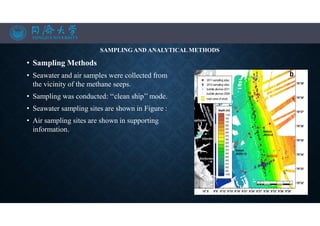
• Sampling Methods
• Seawater and air samples were collected from
the vicinity of the methane seeps.
• Sampling was conducted: ‘‘clean ship’’ mode.
• Seawater sampling sites are shown in Figure :
• Air sampling sites are shown in supporting
information.
•
•
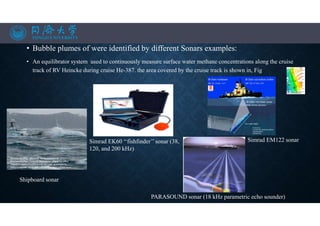
• Bubble plumes of were identified by different Sonars examples:
• An equilibrator system used to continuously measure surface water methane concentrations along the cruise
track of RV Heincke during cruise He-387. the area covered by the cruise track is shown in, Fig
Figure 1a
Shipboard sonar
Simrad EK60 ‘‘fishfinder’’ sonar (38,
120, and 200 kHz)
Simrad EM122 sonar
PARASOUND sonar (18 kHz parametric echo sounder)
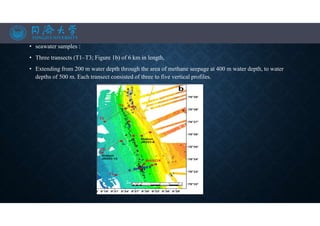
• seawater samples :
• Three transects (T1–T3; Figure 1b) of 6 km in length,
• Extending from 200 m water depth through the area of methane seepage at 400 m water depth, to water
depths of 500 m. Each transect consisted of three to five vertical profiles.
•
•
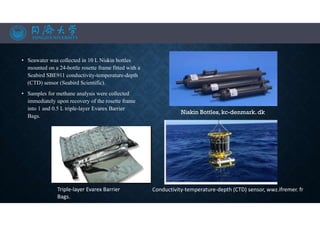
• Seawater was collected in 10 L Niskin bottles
mounted on a 24-bottle rosette frame fitted with a
Seabird SBE911 conductivity-temperature-depth
(CTD) sensor (Seabird Scientific).
• Samples for methane analysis were collected
immediately upon recovery of the rosette frame
into 1 and 0.5 L triple-layer Evarex Barrier
Bags.
•
Niskin Bottles, kc-denmark.dk
Conductivity-temperature-depth (CTD) sensor, wwz.ifremer. frTriple-layer Evarex Barrier
Bags.
• Samples for methane isotopes were taken into 125 mL glass vials with crimp
seal tops, and poisoned
with 2 mL saturated mercuric chloride solution (MSM21/4, MASOX site only.
• Quadruplicate samples for methane oxidation rate measurements were
collected in 20 mL crimp-top vials, and filled bubble free (MSM21/4 only).
• Air samples were collected as described in Fisher et al. [2011], from the
ship’s bridge (16 and 29 m above sea level for JR253 and MSM21/4,
respectively) by directing a hose into the direction of incoming wind and
pumping into 5 L Tedlar bags.
Glass vials with crimp seal tops
Tedlar bags.
ANALYTICAL METHODS
• Methane concentrations were determined using a headspace technique: 20 mL of N2 was added
to each sample bag and mixed vigorously.
• Analysis by gas chromatography: Seawater was equilibrated with the headspace gas for several
hours before 2 mL of gas was subsampled.
• Mass Spectrometry Facility’s Lancaster Node: The carbon isotopic composition of dissolved
methane in seawater was determined at the Natural Environment Research.
• Off-Axis Integrated Cavity Output Spectroscopy: The equilibrator system measured methane
concentrations in air equilibrated with surface seawater
BOX MODEL
• Chemical and physical processes which modify the dissolved methane concentration in a parcel of water above the
seep site, as that parcel of water is transported away from the seeps by the strong local bottom water currents.
• Processes considered in the model are: (i) aerobic oxidation (MOx), (ii) isopycnal mixing, and (iii) diapycnal
mixing.
• The box is defined to represent the portion of the water column into which methane bubbles dissolve: the height of
the box is given by the depth at which essentially all methane has dissolved (75 m), based on measurements of
dissolved methane concentration
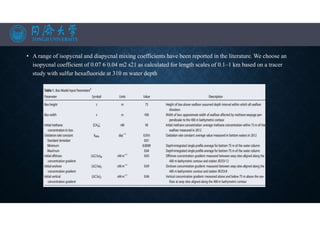
• A range of isopycnal and diapycnal mixing coefficients have been reported in the literature. We choose an
isopycnal coefficient of 0.07 6 0.04 m2 s21 as calculated for length scales of 0.1–1 km based on a tracer
study with sulfur hexafluoride at 310 m water depth
SEA-AIR FLUXES
• The flux of methane from surface waters to the atmosphere is given by:
• Where k is the gas transfer velocity and [CH4]surface and [CH4]equilibrium are, respectively, the
measured concentration of methane in surface seawater and the calculated concentration of methane in
surface seawater at equilibrium with the atmosphere.
Distribution of methane along east-west transects T1–T3, and north to south along transect T4 for transect locations).
Sampling points are shown by the open circles. Contours show the density anomaly (rh; kg/m3).
• This data set provided simultaneous measurement of wind speed, surface seawater methane concentration,
temperature and salinity, and atmospheric pressure.
• Atmospheric methane mole fractions were not simultaneously measured, so
the average value of the air samples collected in 2012 was used. This contributes less than 65% to the
overall uncertainty of the sea-air flux.
RESULT AND DISCUSSIONS
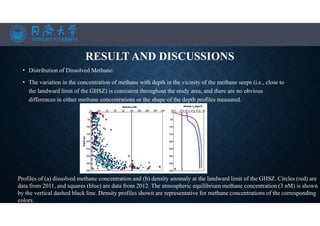
• Distribution of Dissolved Methane:
• The variation in the concentration of methane with depth in the vicinity of the methane seeps (i.e., close to
the landward limit of the GHSZ) is consistent throughout the study area, and there are no obvious
differences in either methane concentrations or the shape of the depth profiles measured.
Profiles of (a) dissolved methane concentration and (b) density anomaly at the landward limit of the GHSZ. Circles (red) are
data from 2011, and squares (blue) are data from 2012. The atmospheric equilibrium methane concentration (3 nM) is shown
by the vertical dashed black line. Density profiles shown are representative for methane concentrations of the corresponding
colors.
FLUXES, SOURCES, AND FATE OF DISSOLVED METHANE IN THE WATER COLUMN
OFFSHORE SVALBARD
Methane concentration in surface seawater measured using the equilibrator system during RV Heincke cruise He-387.
Black crosses show the location of seafloor methane seeps mapped during the cruise [Sahling et al., 2012, 2014]. Yellow
star indicates the position of the depth profile sampling station (cruise MSM 21/4) to the south of the main study area.
• ssg
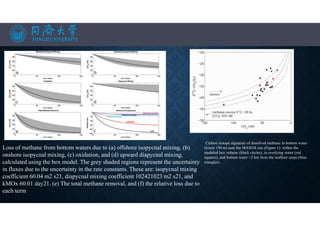
Loss of methane from bottom waters due to (a) offshore isopycnal mixing, (b)
onshore isopycnal mixing, (c) oxidation, and (d) upward diapycnal mixing,
calculated using the box model. The grey shaded regions represent the uncertainty
in fluxes due to the uncertainty in the rate constants. These are: isopycnal mixing
coefficient 60.04 m2 s21, diapycnal mixing coefficient 102421023 m2 s21, and
kMOx 60.01 day21. (e) The total methane removal, and (f) the relative loss due to
each term.
. Carbon isotope signature of dissolved methane in bottom water
(lower 150 m) near the MASOX site (Figure 1): within the
modeled box volume (black circles), in overlying water (red
squares), and bottom water >2 km from the seafloor seeps (blue
triangles).
SOURCES OF METHANE TO THE UPPER WATER COLUMN
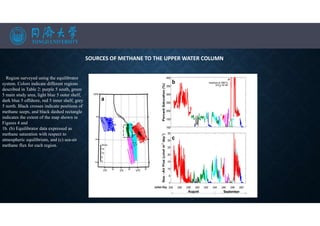
(aRegion surveyed using the equilibrator
system. Colors indicate different regions
described in Table 2: purple 5 south, green
5 main study area, light blue 5 outer shelf,
dark blue 5 offshore, red 5 inner shelf, grey
5 north. Black crosses indicate positions of
methane seeps, and black dashed rectangle
indicates the extent of the map shown in
Figures 4 and
1b. (b) Equilibrator data expressed as
methane saturation with respect to
atmospheric equilibrium, and (c) sea-air
methane flux for each region.
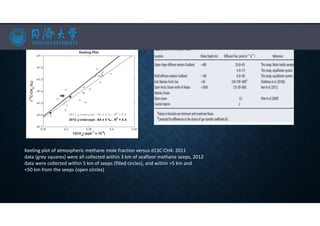
Keeling plot of atmospheric methane mole fraction versus d13C-CH4: 2011
data (grey squares) were all collected within 3 km of seafloor methane seeps, 2012
data were collected within 5 km of seeps (filled circles), and within >5 km and
<50 km from the seeps (open circles)
METHANE FLUX TO THE ATMOSPHERE
• Both methane saturation and sea to air methane fluxes were highest on the shelf, where the water depth is
relatively shallow.
• seafloor seeps are present on the outer part of the shelf and water depths become progressively deeper, so
that methane fluxes are lower and similar to those calculated at the landward limit of the GHSZ. Lowest
methane fluxes were found furthest offshore.
• The fluxes that we measure are also lower than those observed during an aircraft survey over open leads
(fractures in sea ice) and regions with fractional ice cover in the Arctic Ocean , which are attributed to
release of methane that may accumulate under ice in the winter months and/or biological production of
methane in the vicinity of melting ice.
SUMMARY
• Gas hydrate stability offshore western Svalbard leads to high concentrations of dissolved methane (up to 825 nM)
in bottom waters of the northward-flowing West Spitsbergen Current.
• Simple box modeling indicates that methane released at the seafloor is mainly lost by oxidation (to carbon
dioxide) and advection by fast bottom water currents.
• High concentrations of methane at the sea surface to the north of the seafloor seeps suggest that enhanced vertical
mixing of methane from the WSC may provide a mechanism for methane escape from seafloor seeps at the GHSZ
limit to the atmosphere on longer time scales
• Thus, aerobic methanotrophy in the water column at the GHSZ limit offshore western Svalbard provides an
effective barrier to direct release of significant quantities of methane, including that which may be released from
methane hydrate, to the atmosphere.
•
谢谢你们!!

Gas hydrates

  • 1.
  • 2.
    fate of Fluxes andFate of Dissolved Methane released at the seafloor & land limit of Gas Hydrate Stability Zone offshore Case Study : Western Svalbard.
  • 3.
    CONTENTS • History ofthe Gas Hydrate • Gas Hydrate occurrence in the space • Gas hydrate, Hydrate samples, Sources & Uses • Where are gas hydrates located? • Types of Methane hydrate deposit • Researchers (Et al) Contribution about the Gas hydrate Stability • Oceanographic Setting • Sampling and Analytical Methods, Box Model, Sea-Air Fluxes • Result and Discussions • Summary
  • 4.
    HISTORY OF THEGAS HYDRATE Sir Humphrey Davy (Davy 1811) Hammer schmidt 1934) Russian scientists (Vasil’ev et al. 1970)
  • 5.
    GAS HYDRATE OCCURRENCEIN THE SPACE In 2005, NASA’s Cassini spacecraft started multiple close flybys of Enceladus Gas giant planets of Jupiter, Saturn, Uranus, and Neptune. Titan Moon Hydrocarbon molecule deposits in the Horsehead Nebula galaxy. Max Planck Institute in Germany
  • 6.
    GAS HYDRATE • CrystallineSolids( H20 & Gas) • Gas molecules (guests) • Trapped in water cavities (host) • Hydrogen- bonded water molecules • Methane, ethane, propane and CO₂
  • 7.
    HYDRATE SAMPLES, SOURCES& USES Gas hydrates in sea-floor mounds Nodules laminae veins Sources: Sea floor and permafrost Uses: Methane hydrate is frozen natural gas and it is currently estimated that there are far more energy trapped in methane hydrate deposit than in all known reserves of oil , gas and coal
  • 8.
    WHERE ARE GASHYDRATES LOCATED? Four Earth environments. i. sediment and sedimentary rock units below Arctic permafrost. ii. sedimentary deposits along continental margins. iii. deep-water sediments of inland lakes and seas. iv. Under Antarctic ice.
  • 9.
    TYPES OF METHANEHYDRATE DEPOSIT •
  • 10.
    CASE STUDY, WESTERNSVALBARD Resistivity image beneath an area of active methane seeps in the west Svalbard continental slope
  • 11.
    RESEARCHERS (ET AL) ANALYSISABOUT THE METHANE GAS HYDRATE STABILITY • Gas hydrate stability zone (GHSZ). • Comprehensive surveys of methane with respect to the water Depth(GHSZ limit at 400 m water depth). • Simple box model of dissolved methane(60% of methane released at the seafloor). • Isopycnal turbulent mixing with shelf waters. • The diffusive flux of methane • GHSZ is 4–20 lmol m22 d21 • Analyses of mole fractions and the carbon isotope
  • 12.
    RESEARCHER CONTRIBUTION & DETERMINATIONS:GHSZ • Methane in the water column in the vicinity of the landward limit • GHSZ for three separate sampling: • Box model to quantify the fate of methane released from the seabed • Vertical mixing into the surface mixed layer is slow • Methane release to the atmosphere at the landward limit
  • 13.
    OCEANOGRAPHIC SETTING Map ofthe study area and water column sampling sites. Bathymetry in Figure 1a is from the GEBCO_08 Grid version 20100927 (http://gebco.net), contour interval is 100 m; light blue indicates He-386 cruise track, and yellow rectangle indicates the area expanded in Figure 1b, showing shipboard bathymetry from cruise JR253. Red circles show positions of cruise JR253 sampling stations; red lines indicate sampling transects T1–T4. Blue diamonds show sampling stations from cruise MSM21/4. Locations of seafloor bubble seeps identified by shipboard sonar during sampling are indicated by crosses. (c) The dominant direction of the main ocean currents in this region: the West Spitsbergen Current (WSC) in red, and the East Spitsbergen Current (ESC) in blue, modified from Saloranta and Svendsen [2001].
  • 14.
    SAMPLING AND ANALYTICALMETHODS • Sampling Methods • Seawater and air samples were collected from the vicinity of the methane seeps. • Sampling was conducted: ‘‘clean ship’’ mode. • Seawater sampling sites are shown in Figure : • Air sampling sites are shown in supporting information. • •
  • 15.
    • Bubble plumesof were identified by different Sonars examples: • An equilibrator system used to continuously measure surface water methane concentrations along the cruise track of RV Heincke during cruise He-387. the area covered by the cruise track is shown in, Fig Figure 1a Shipboard sonar Simrad EK60 ‘‘fishfinder’’ sonar (38, 120, and 200 kHz) Simrad EM122 sonar PARASOUND sonar (18 kHz parametric echo sounder)
  • 16.
    • seawater samples: • Three transects (T1–T3; Figure 1b) of 6 km in length, • Extending from 200 m water depth through the area of methane seepage at 400 m water depth, to water depths of 500 m. Each transect consisted of three to five vertical profiles. • •
  • 17.
    • Seawater wascollected in 10 L Niskin bottles mounted on a 24-bottle rosette frame fitted with a Seabird SBE911 conductivity-temperature-depth (CTD) sensor (Seabird Scientific). • Samples for methane analysis were collected immediately upon recovery of the rosette frame into 1 and 0.5 L triple-layer Evarex Barrier Bags. • Niskin Bottles, kc-denmark.dk Conductivity-temperature-depth (CTD) sensor, wwz.ifremer. frTriple-layer Evarex Barrier Bags.
  • 18.
    • Samples formethane isotopes were taken into 125 mL glass vials with crimp seal tops, and poisoned with 2 mL saturated mercuric chloride solution (MSM21/4, MASOX site only. • Quadruplicate samples for methane oxidation rate measurements were collected in 20 mL crimp-top vials, and filled bubble free (MSM21/4 only). • Air samples were collected as described in Fisher et al. [2011], from the ship’s bridge (16 and 29 m above sea level for JR253 and MSM21/4, respectively) by directing a hose into the direction of incoming wind and pumping into 5 L Tedlar bags. Glass vials with crimp seal tops Tedlar bags.
  • 19.
    ANALYTICAL METHODS • Methaneconcentrations were determined using a headspace technique: 20 mL of N2 was added to each sample bag and mixed vigorously. • Analysis by gas chromatography: Seawater was equilibrated with the headspace gas for several hours before 2 mL of gas was subsampled. • Mass Spectrometry Facility’s Lancaster Node: The carbon isotopic composition of dissolved methane in seawater was determined at the Natural Environment Research. • Off-Axis Integrated Cavity Output Spectroscopy: The equilibrator system measured methane concentrations in air equilibrated with surface seawater
  • 20.
    BOX MODEL • Chemicaland physical processes which modify the dissolved methane concentration in a parcel of water above the seep site, as that parcel of water is transported away from the seeps by the strong local bottom water currents. • Processes considered in the model are: (i) aerobic oxidation (MOx), (ii) isopycnal mixing, and (iii) diapycnal mixing. • The box is defined to represent the portion of the water column into which methane bubbles dissolve: the height of the box is given by the depth at which essentially all methane has dissolved (75 m), based on measurements of dissolved methane concentration
  • 21.
    • A rangeof isopycnal and diapycnal mixing coefficients have been reported in the literature. We choose an isopycnal coefficient of 0.07 6 0.04 m2 s21 as calculated for length scales of 0.1–1 km based on a tracer study with sulfur hexafluoride at 310 m water depth
  • 22.
    SEA-AIR FLUXES • Theflux of methane from surface waters to the atmosphere is given by: • Where k is the gas transfer velocity and [CH4]surface and [CH4]equilibrium are, respectively, the measured concentration of methane in surface seawater and the calculated concentration of methane in surface seawater at equilibrium with the atmosphere. Distribution of methane along east-west transects T1–T3, and north to south along transect T4 for transect locations). Sampling points are shown by the open circles. Contours show the density anomaly (rh; kg/m3).
  • 23.
    • This dataset provided simultaneous measurement of wind speed, surface seawater methane concentration, temperature and salinity, and atmospheric pressure. • Atmospheric methane mole fractions were not simultaneously measured, so the average value of the air samples collected in 2012 was used. This contributes less than 65% to the overall uncertainty of the sea-air flux.
  • 24.
    RESULT AND DISCUSSIONS •Distribution of Dissolved Methane: • The variation in the concentration of methane with depth in the vicinity of the methane seeps (i.e., close to the landward limit of the GHSZ) is consistent throughout the study area, and there are no obvious differences in either methane concentrations or the shape of the depth profiles measured. Profiles of (a) dissolved methane concentration and (b) density anomaly at the landward limit of the GHSZ. Circles (red) are data from 2011, and squares (blue) are data from 2012. The atmospheric equilibrium methane concentration (3 nM) is shown by the vertical dashed black line. Density profiles shown are representative for methane concentrations of the corresponding colors.
  • 25.
    FLUXES, SOURCES, ANDFATE OF DISSOLVED METHANE IN THE WATER COLUMN OFFSHORE SVALBARD Methane concentration in surface seawater measured using the equilibrator system during RV Heincke cruise He-387. Black crosses show the location of seafloor methane seeps mapped during the cruise [Sahling et al., 2012, 2014]. Yellow star indicates the position of the depth profile sampling station (cruise MSM 21/4) to the south of the main study area.
  • 26.
    • ssg Loss ofmethane from bottom waters due to (a) offshore isopycnal mixing, (b) onshore isopycnal mixing, (c) oxidation, and (d) upward diapycnal mixing, calculated using the box model. The grey shaded regions represent the uncertainty in fluxes due to the uncertainty in the rate constants. These are: isopycnal mixing coefficient 60.04 m2 s21, diapycnal mixing coefficient 102421023 m2 s21, and kMOx 60.01 day21. (e) The total methane removal, and (f) the relative loss due to each term. . Carbon isotope signature of dissolved methane in bottom water (lower 150 m) near the MASOX site (Figure 1): within the modeled box volume (black circles), in overlying water (red squares), and bottom water >2 km from the seafloor seeps (blue triangles).
  • 27.
    SOURCES OF METHANETO THE UPPER WATER COLUMN (aRegion surveyed using the equilibrator system. Colors indicate different regions described in Table 2: purple 5 south, green 5 main study area, light blue 5 outer shelf, dark blue 5 offshore, red 5 inner shelf, grey 5 north. Black crosses indicate positions of methane seeps, and black dashed rectangle indicates the extent of the map shown in Figures 4 and 1b. (b) Equilibrator data expressed as methane saturation with respect to atmospheric equilibrium, and (c) sea-air methane flux for each region.
  • 28.
    Keeling plot ofatmospheric methane mole fraction versus d13C-CH4: 2011 data (grey squares) were all collected within 3 km of seafloor methane seeps, 2012 data were collected within 5 km of seeps (filled circles), and within >5 km and <50 km from the seeps (open circles)
  • 29.
    METHANE FLUX TOTHE ATMOSPHERE • Both methane saturation and sea to air methane fluxes were highest on the shelf, where the water depth is relatively shallow. • seafloor seeps are present on the outer part of the shelf and water depths become progressively deeper, so that methane fluxes are lower and similar to those calculated at the landward limit of the GHSZ. Lowest methane fluxes were found furthest offshore. • The fluxes that we measure are also lower than those observed during an aircraft survey over open leads (fractures in sea ice) and regions with fractional ice cover in the Arctic Ocean , which are attributed to release of methane that may accumulate under ice in the winter months and/or biological production of methane in the vicinity of melting ice.
  • 30.
    SUMMARY • Gas hydratestability offshore western Svalbard leads to high concentrations of dissolved methane (up to 825 nM) in bottom waters of the northward-flowing West Spitsbergen Current. • Simple box modeling indicates that methane released at the seafloor is mainly lost by oxidation (to carbon dioxide) and advection by fast bottom water currents. • High concentrations of methane at the sea surface to the north of the seafloor seeps suggest that enhanced vertical mixing of methane from the WSC may provide a mechanism for methane escape from seafloor seeps at the GHSZ limit to the atmosphere on longer time scales • Thus, aerobic methanotrophy in the water column at the GHSZ limit offshore western Svalbard provides an effective barrier to direct release of significant quantities of methane, including that which may be released from methane hydrate, to the atmosphere. •
  • 31.