By / Mohammed elsayed
Mohammed abdalmoati
Oil Shale
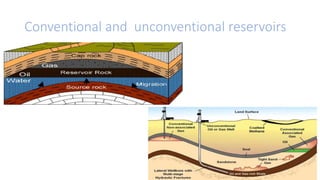
Conventional and unconventional reservoirs
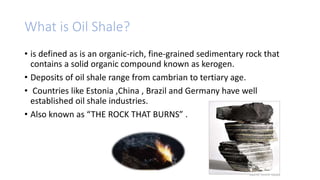
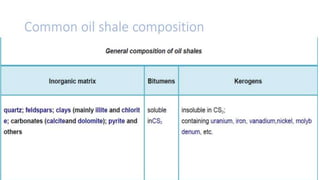
What is Oil Shale?
• is defined as is an organic-rich, fine-grained sedimentary rock that
contains a solid organic compound known as kerogen.
• Deposits of oil shale range from cambrian to tertiary age.
• Countries like Estonia ,China , Brazil and Germany have well
established oil shale industries.
• Also known as “THE ROCK THAT BURNS” .
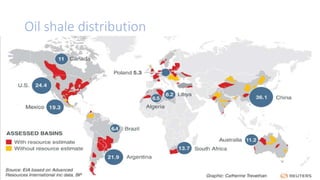
Oil shale distribution
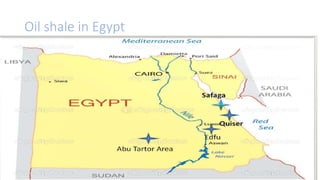
Oil shale in Egypt
Oil shale
reserves
World reserves of oil shale are estimated to be around 660
billion TOE (tons of oil equivalent) content of shale oil.
30% of these are technically extractable; they are therefore
superior to the 175 billion TOE of proven reserves of
conventional oil.
About 2/3 of the reserves are in the United States.
Russia and Brazil,which together have a share of 20%.
The largest known deposit is in the Green River Formation in
the western United States; it contains an estimated 213
billion tons of in-situ shale oil.
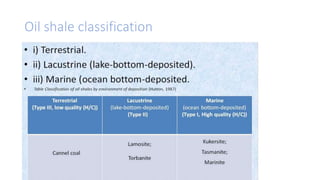
Oil shale classification
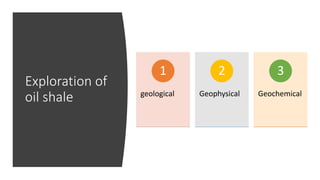
Exploration of
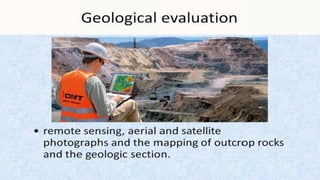
oil shale geological
1
Geophysical
2
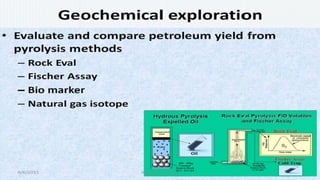
Geochemical
3
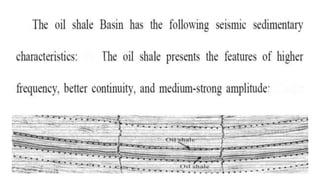
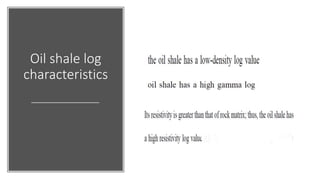
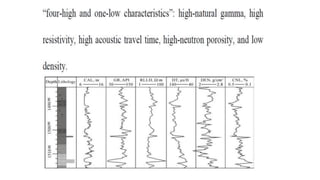
Oil shale log
characteristics
Impact on environment
• Oil shale production is also considered to be quite harmful to the environment.
• Both mining and processing of oil shale involve a variety of environmental impact,
such as global warming and greenhouse gas emissions, disturbance of mined
land, impacts on wildlife and air and water quality.
• These include acid drainage induced by the sudden rapid exposure and
subsequent oxidation of formerly buried materials, the introduction of metals
including mercury into surface-water and groundwater, increased erosion, sulfur-
gas emissions, and air pollution caused by the production of particulates during
processing, transport, and support activities.
• In 2002, about 97% of air pollution, 86% of total waste and 23% of water
pollution in Estonia came from the power industry, which uses oil shale as the
main resource for its power production.
• It uses vast quantities of water (which are not always available where the shale
is).
Thank you

Oil shale

  • 1.
    By / Mohammedelsayed Mohammed abdalmoati Oil Shale
  • 2.
  • 4.
    What is OilShale? • is defined as is an organic-rich, fine-grained sedimentary rock that contains a solid organic compound known as kerogen. • Deposits of oil shale range from cambrian to tertiary age. • Countries like Estonia ,China , Brazil and Germany have well established oil shale industries. • Also known as “THE ROCK THAT BURNS” .
  • 6.
  • 7.
  • 8.
    Oil shale reserves World reservesof oil shale are estimated to be around 660 billion TOE (tons of oil equivalent) content of shale oil. 30% of these are technically extractable; they are therefore superior to the 175 billion TOE of proven reserves of conventional oil. About 2/3 of the reserves are in the United States. Russia and Brazil,which together have a share of 20%. The largest known deposit is in the Green River Formation in the western United States; it contains an estimated 213 billion tons of in-situ shale oil.
  • 9.
  • 10.
    Exploration of oil shalegeological 1 Geophysical 2 Geochemical 3
  • 13.
  • 17.
    Impact on environment •Oil shale production is also considered to be quite harmful to the environment. • Both mining and processing of oil shale involve a variety of environmental impact, such as global warming and greenhouse gas emissions, disturbance of mined land, impacts on wildlife and air and water quality. • These include acid drainage induced by the sudden rapid exposure and subsequent oxidation of formerly buried materials, the introduction of metals including mercury into surface-water and groundwater, increased erosion, sulfur- gas emissions, and air pollution caused by the production of particulates during processing, transport, and support activities. • In 2002, about 97% of air pollution, 86% of total waste and 23% of water pollution in Estonia came from the power industry, which uses oil shale as the main resource for its power production. • It uses vast quantities of water (which are not always available where the shale is).
  • 18.