UNIVERSITY OF GAZANTEP 
DEPARTMENT OF MECHANICAL ENGINEERING 
ME-307 MACHINE ELEMENTS -1- 
DESIGN OF AN INDUSTRIAL RAILWAY CAR SHAFT 
05.12.2005 
Submitted by: Semih Ugurluel 
Submitted to : Prof. Dr. . Hüseyin Filiz
ABSTRACT 
This paper discusses how to design of a shaft under specific loading conditions. Failures 
causing while the existence of pure torsion, pure bending, axial loading, shear loading and 
varying type of these loadings are possible seperately or in a combined manner for a 
particular situation. The effect of these loadings may cause different failures fort he specific 
conditions such as fatigue failure, creep failure, bending failure or tensile and compressive 
failue… However all these failure possibilities also more can have a word on the failure, so 
what is our design procedure? The answer is that; there are some stresses which play more 
effective roles on the failure than the other ones for a specific loading situation. Here we are 
going to develop our design in the aspect of fatigue failure which is dominant for our 
particular situation. 
CONTENTS 
Abstract II 
1.Introductin 1 
1.1 Method of Solution ……………………………………………………………. 1 
2.Design Analysis 
2.1 Shaft Analysis …………………………………………………………………. 2 
Free Body of Axle ……………………………………………………………….. 2 
Table 1:Shaft properties ………………………………………………………… 2 
Shear Diagram …………………………………………………………………… 3 
Moment Diagram ………………………………………………………………… 3 
2.1.1Static Failure Analysis …………………………………………………… 3 
2.1.2Fatigue Failure Analysis ………………………………………………… 4 
2.1.3Fatigue Failure Analysis with Torsion …………………………………. 6 
Engine speed torque diagram ………………………………………….. 6 
3.Deflection Analysis ……………………………………………………………….. 8 
3.1Deflection Analysis due to Bending ……………………………………………10 
3.2Deflection Analysis due to Bending  Torsion ………………………………..10 
4.Conclusion and Future Developments …………………………………………… 11 
References 11 
Appendix 11
1-INTRODUCTION 
There are a great many factors to be considered, even for very simple load cases. The 
bahaviour of machine parts is entirely different when they are subjected to time-varying 
loading besides other loading types. The methods of fatigue failure analysis represent a 
combination of engineering and science. Often science fails to provide the complete answers 
that are needed. But the airplane must stil be made to fly safely. And the automobile must be 
manufactured with a reliability that will ensure a long and trouble free life and at the same 
time produce profits fort he stockholders of the ındustry.Thus, while science has not yet 
completely explained the complete mechanism of fatigue, the engineer must stil design things 
that will not fail. In a sense this is aclassic example of the true meaning of engineering as 
contrasted with science. Engineers use science to solve their problems if the science is 
available. But available or not, the problem must be solved, and whatever form the solution 
takes under these conditions is called engineering. 
Our problem is designing an industrial car axle running on rails, when loaded 10 kN is applied 
on each wheel. 
1.1 Our way to solve the problem is: 
1. Since the axle is the rotating component, there will be reversed bending stresses 
because of the load, shear stresses and torsional stresses. 
2. Understanding of the dominant stress component. 
3. Static failure analysis. 
4. Estimate a diameter from static analysis. 
5. Faitgue failure analysis 
6. Evaluate the desired diameter from fatigue failure analysis. 
7. Find the location of the maximum deflection point. 
8. Decide the most effective stress component causing the deflection. 
9. By using Castigliano’s Energy Theorem find the deflection. 
The varying bending stress component plays the most important role on the fatigue life of the 
life, therefore after a static failure analysis, faitige failure analysis must be done.
2.DESIGN ANALYSIS 
2.1-SHAFT DESIGN 
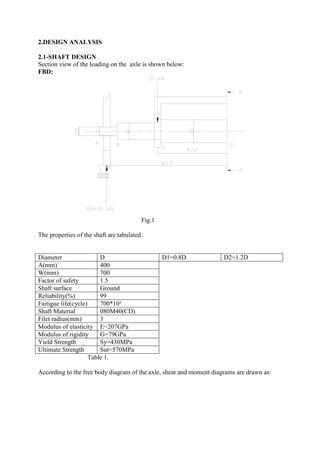
Section view of the loading on the axle is shown below: 
FBD: 
Fig.1 
The properties of the shaft are tabulated: 
Diameter D D1=0.8D D2=1.2D 
A(mm) 400 
W(mm) 700 
Factor of safety 1.5 
Shaft surface Ground 
Reliability(%) 99 
Faitigue life(cycle) 700*10³ 
Shaft Material 080M40(CD) 
Filet radius(mm) 3 
Modulus of elasticity E=207GPa 
Modulus of rigidity G=79GPa 
Yield Strength Sy=430MPa 
Ultimate Strength Sut=570MPa 
Table 1. 
According to the free body diagram of the axle, shear and moment diagrams are drawn as:
0 200 400 600 800 
Fig.1 
Shear diagram 
Distance(mm) 
Fig 2. 
Fig 3. 
15 
10 
5 
0 
-5 
-10 
-15 
Shaer Force(kN) 
1600 
1400 
1200 
1000 
800 
600 
400 
200 
2.1.1-STATIC FAILURE ANALYSIS 
After drawing FBD and shear, moment diagrams.First size the shaft based on the possibility 
of a static failure.Since I/c =Hd³/32, the permissible stress is Ip=M/(I/c). 
From the FBD, loading and moment diagrams it seems that section C (150mm) is critcal, for 
safety of our calculations let’s check. 
A-B 
AB=75mm 
Ra * 75 * 32 * 
n 
M max = Ra * 75  p 
= 
 
* 0.83 * D 
3 
B-C 
BC=75mm, AC=150mm 
M max = Ra *150 * 3 
*150 * 32 * 
Ra n 
 = LARGEST! 
D 
p 
 
C-D 
CD=200mm, AD=350mm 
M max = Ra * 350 −10 * 200 = Ra *150 *1.23 * 3 
*150 * 32 * 
Ra n 
D 
p 
 
 = 
After calculations, we confirmed our assumption. 
Seri 1 
Moment Diagram 
0 
0 200 400 600 800 
Distance(mm) 
Moment(Nm) 
Seri 1
2.1.2-FATIGUE FAILURE ANALYSIS 
Now we will size our shaft for the critical section and find diameter for the static failure. 
The material properties are taken from Table 1 are: 
Sy=430MPa, Sut=570Mpa, E=213GPa, G=79GPa 
By introducing factor of safety, n=1.5 
10 *150 *103 * 32 *1.5 
= D = 37.63mm 
3 
430 
D 
A rough value of the shaft is found from static failure. 
The next problem is to size the shaft based on the possibility of a fatigue failure. Because of 
the rotation the bending load will produce varying stresses which make fatigue analysis 
unavoidable. The dominant stress on the fatigue failure is bending.By neglecting torsion and 
shear and using Marin factors, we can estimate the endurance limit. 
But for the calculations we need diameter, in order to get an idea we can use the diameter 
evaluated from static failure analysis and then we will check it for a factor of safety of 1.5. 
Marin factors are; 
Surface factor, b ka = aSut 
a=1.58 b=0.085 for ground surface finish from Appenix Table 4 then , 
ka = 0.92 
Size factor, = 1.189 −0.097 = 0.831 kb d 
Reliability factor, kc=0.814 from Appendix Table 6 
Temperature factor, kd=1 Assuming the working conditions are at room temperature. 
Stress concentration factor, ke=1/Kf Kf=1+q(Kt-1) 
Kt from Appendix Table 7 
According to r/d=3/40=0.075, D/d=1.2 from interpolation Kt=1.808 
q from Appendix Table 2 
According to r=3mm and Sut=570Mpa from 2 interpolation q=0.8 
Kf=1+0.8(1.808-1) 
Kf=1.64 
Ke=1/Kf 
Ke=0.609 
Miscellenaeous factor, kf =1 since no other conditions are known. 
After calculating Marin factors, the endurance limit is estimated by;
Se = ka * kb * kc * kd * ke * kf * Se where Se = 0.5 * Sut = 0.5 * 570 = 285MPa 
Se = 0.92* 0.831*0.814*1*0.609*1* 285 = 108MPa 
Since the axle of a car is rotating, bending load considered is to be completely reversed and 
alternating component of the stress is equal to the maximum stresses. 
Now we can find the fatigue strength for a finite life of 500*10³ cycles :
Su 
1 
C b N Sf 10 = where  

 
= − 
Se 
b 
0.8 
log 
3 
 
 
Su 
and 
 
 
= 
Se 
C 
(0.8 )2 
log 
According to these equations and taking Su from Table 1. 
b=-0.208, C=3.28 and Sf=124.34Mpa 
Since we have only alternating component of stress, according to Modified Goodman theory; 
  
a 1 + m 
= 
Sut n 
Sf 
where Im=0 M 
Sf 
a 
n 
 
= 
If we introduce n=1.5 and solve for d then; 
mm 
32 * Mb * = n 
32 *1500 *10 3 
*1.5 
= = 
d 57.06 
  
Sf 
*124.34 
* 
Finding the exact diameter desired for factor of safety 
As the preffered size, if we select d=58mm, we have to go through the calculations and check 
the design for factor of safety. 
The effect of diameter change will be negligible on stress concentration factor, because filet 
radius is expressed in terms of radius of shaft. But its effect on size factor must be determined. 
=1.189 * −0.097 =1.189 * 58−0.097 = 0.8 kb d 
The new value of endurance limit will be: 
0.8 * Se = 104MPa 
Se(new)=104MPa 
0.83 
Fatigue strength and factor of safety are recalculated by replacing Se with new one:
Su 
1 
C b N Sf 10 = where  

 
= − 
Se 
b 
0.8 
log 
3 
 
 
Su 
and 
 
 
= 
Se 
C 
(0.8 )2 
log 
b=-0.213, C=3.3 and Sf=121.93Mpa
32 *1500 *10 
a 78.3MPa 
* 58 
3 
3 
= = 
 
 
1.55 
121.93 = = = 
78.3 
Sf 
a 
n 
 Which shows design with 58mm is safer than desired. 
2.1.3-AN IDEA FOR FATIGUE FAILURE ANALYSIS WITH TORSION 
As I said before the shaft(axle) is the rotating part which transmits revolution to wheels in 
order to introduce tractive force for moving car, as shown simply in fig2. So far, a more 
reliable design should include torsional forces acting on the axle. Due to the nature of car this 
torque varies between zero and a peak value and frequently alternates. Also a radial force has 
effect on the shaft and shear force already exists. And since the shaft has a finite life we 
should also consider cumulative fatigue damage on the axle. Therefore the endurance limit 
decreases and the corresponding life reduces. Also in practical life temperature and 
miscellaneous effects will be significant. These are why we use factor of safety. 
Fig 4. 
For a more practical approach, let’s evaluate an average torque. The torque that an engine can 
deliver depends on the speed at which the engine is turning. 
From the figure 5. for aV8 the maximum torque is 450Nm for an engine speed of 4500rpm 
and 240kw power supply. The torque 
acting on the axle will be greater than the 
engine torque related to the gear ratio. 
. 
Fig 5.
In our case the industrial car running on rails will not need such high velocities but may be 
used for transportation in a plant as a conveyor. Therefore high torque producing engines will 
be needed as in locomotives(having approximately 20kNm maximum torque on each wheel). 
I take an average value of 100Nm for the value of torque applied on the axle, and then 
rearrange my calculations in order to have an idea how much my assumption is acceptable. 
Here in this situation, two types of load will result different size factors and stress 
concentration factors. 
By taking the d=58mm from fatigue failure analysis, Marin factors are: 
Surface factor, ka = aSut b 
a=1.58 b=0.085 for ground surface finish from Appenix Table 4 then, 
ka = 0.92 
Size factor, = 1.189 −0.097 = 0.8 kb d Assuming same for both loading. 
Reliability factor, kc=0.814 from Appendix Table 6 
Temperature factor, kd=1 Assuming the working conditions are at room temperature. 
Stress concentration factor, ke=1/Kf take Kf=1 since it will be introduced later seperately 
for bending and torsion. Then ke=1. 
Miscellenaeous factor, kf =1 since no other conditions are known. 
After calculating Marin factors, the endurance limit is estimated by; 
Se = ka * kb * kc * kd * ke * kf * Se where Se = 0.5 * Sut = 0.5 * 570 = 285MPa 
Se = 0.92* 0.8* 0.814* 285 =170.74MPa 
For torsional load stress concentration factor Kfs is calculated; 
From Appendix Table 5; 
r/d=3/58=0.05, D/d=1.2 then Kt=1.576 for torsion 
Next using Appendix Table 1 with a notch radius of 3 mm. q=1 for torsion. 
Then, Kfs=1+q(Kt-1)=1.576, Kf=1.64 
xa = Kf *bending =1.64*78.3 =128.412MPa 
As we already know from previos calculations Jxm=0 
Since the torsion applied is of repeated type. 
Mpa 
* 
m d 
50 *16 *10 
* 
xya xym 1.305 
j 
a d 
j 
* 58 
2 
2 
3 
3 
= = = = =
xya = Kfs *torsion =1.576 *1.305 = 2.05MPa 
xym = 2.05MPa 
The Von Misses stress components, a and m are; 
a = xa 2 + 3xya2 =128.5MPa 
m = 3xym2 = 3.55MPa 
Fatigue strength and factor of safety are recalculated by replacing Se with newer one:
Su 
1 
C b N Sf 10 = where  

 
= − 
Se 
b 
0.8 
log 
3 
 
 
Su 
and 
 
 
= 
Se 
C 
(0.8 )2 
log 
b=-0.142, C=3.08 and Sf=186.52Mpa 
According to Modified Goodman theory; 
  
a 1 + m 
= 
Sut n 
Sf 
n=1.438 which does not satisfy the desired factor of safety. 
By following the same procedure for 60mm gives a factor of safety of n=1.59 
The error neglecting torsion is about 2 percent and it stays in the safe region because of the 
factor of safety, for our particular solution our assumption is acceptable. But for the car we 
used in daily life or for a locomotive this error would climb to 10-15 percent for the former, 
and more for the latter. So we should consider it. 
3-DEFLECTION ANALYSIS 
From FBD of axle , we can easily decide the maximum deflection, which is at the middle of 
shaft, because of the symmetric loading. The strain energy stored by the shaft is due to the 
bending, shear and torsion. But for the shafts having high length to diameter ratios, the 
effective stress causing deflection is bending and error is in the range of 5 percent.(L5D will 
be enough for neglecting shear effect.) 
By using Castigliano’s Theorem we can find maximum deflection at the middle of the shaft 
by putting a fictitious force Q at the middle of the shaft. And then by calculating 
complementary energy of the shaft and taking derivative with respect to force Q will give us 
deflection at the application of that force Q, which is the maximum deflection. Section view 
of Free body diagram with fictitious force Q is shown below.
FBD 
Fig 6. 
From A to B 
1 = 
 
V 
V=Ra=P + Q/2,  
2 
 
Q 
 
 
M 
1 = 
M=(P + Q/2)x, x 
Q 
2 
 
From B to C, 
1 = 
 
 
V 
V=Ra=P + Q/2,  
Q 
2 
 
 
M 
1 = 
M=(P + Q/2)x, x 
Q 
2 
 
From C to D 
1 = 
 
 
V 
V=Ra=P + Q/2 – P= Q/2,  
Q 
2 
 
 
M 
1 = 
M=(P + Q/2)x – P(x-SABS), x 
Q 
2
3.1-DEFLECTION ANALYSIS WITH PURE BENDING 
dx 
 
M 
Q 
M 
EI 
 
Um 
=  dx 
  2 
Q 
M 
EI 
Um 
 
= 
 
2 
where Um:Complementary energy stored due to bending, 
Um 
 
Q 
 
:deflection due to bending 
We have a length to diameter ratio of 700/58=12 so we can neglect shear effects.
+ − − 
+

Shaft design Erdi Karaçal Mechanical Engineer University of Gaziantep

  • 1.
    UNIVERSITY OF GAZANTEP DEPARTMENT OF MECHANICAL ENGINEERING ME-307 MACHINE ELEMENTS -1- DESIGN OF AN INDUSTRIAL RAILWAY CAR SHAFT 05.12.2005 Submitted by: Semih Ugurluel Submitted to : Prof. Dr. . Hüseyin Filiz
  • 2.
    ABSTRACT This paperdiscusses how to design of a shaft under specific loading conditions. Failures causing while the existence of pure torsion, pure bending, axial loading, shear loading and varying type of these loadings are possible seperately or in a combined manner for a particular situation. The effect of these loadings may cause different failures fort he specific conditions such as fatigue failure, creep failure, bending failure or tensile and compressive failue… However all these failure possibilities also more can have a word on the failure, so what is our design procedure? The answer is that; there are some stresses which play more effective roles on the failure than the other ones for a specific loading situation. Here we are going to develop our design in the aspect of fatigue failure which is dominant for our particular situation. CONTENTS Abstract II 1.Introductin 1 1.1 Method of Solution ……………………………………………………………. 1 2.Design Analysis 2.1 Shaft Analysis …………………………………………………………………. 2 Free Body of Axle ……………………………………………………………….. 2 Table 1:Shaft properties ………………………………………………………… 2 Shear Diagram …………………………………………………………………… 3 Moment Diagram ………………………………………………………………… 3 2.1.1Static Failure Analysis …………………………………………………… 3 2.1.2Fatigue Failure Analysis ………………………………………………… 4 2.1.3Fatigue Failure Analysis with Torsion …………………………………. 6 Engine speed torque diagram ………………………………………….. 6 3.Deflection Analysis ……………………………………………………………….. 8 3.1Deflection Analysis due to Bending ……………………………………………10 3.2Deflection Analysis due to Bending Torsion ………………………………..10 4.Conclusion and Future Developments …………………………………………… 11 References 11 Appendix 11
  • 3.
    1-INTRODUCTION There area great many factors to be considered, even for very simple load cases. The bahaviour of machine parts is entirely different when they are subjected to time-varying loading besides other loading types. The methods of fatigue failure analysis represent a combination of engineering and science. Often science fails to provide the complete answers that are needed. But the airplane must stil be made to fly safely. And the automobile must be manufactured with a reliability that will ensure a long and trouble free life and at the same time produce profits fort he stockholders of the ındustry.Thus, while science has not yet completely explained the complete mechanism of fatigue, the engineer must stil design things that will not fail. In a sense this is aclassic example of the true meaning of engineering as contrasted with science. Engineers use science to solve their problems if the science is available. But available or not, the problem must be solved, and whatever form the solution takes under these conditions is called engineering. Our problem is designing an industrial car axle running on rails, when loaded 10 kN is applied on each wheel. 1.1 Our way to solve the problem is: 1. Since the axle is the rotating component, there will be reversed bending stresses because of the load, shear stresses and torsional stresses. 2. Understanding of the dominant stress component. 3. Static failure analysis. 4. Estimate a diameter from static analysis. 5. Faitgue failure analysis 6. Evaluate the desired diameter from fatigue failure analysis. 7. Find the location of the maximum deflection point. 8. Decide the most effective stress component causing the deflection. 9. By using Castigliano’s Energy Theorem find the deflection. The varying bending stress component plays the most important role on the fatigue life of the life, therefore after a static failure analysis, faitige failure analysis must be done.
  • 4.
    2.DESIGN ANALYSIS 2.1-SHAFTDESIGN Section view of the loading on the axle is shown below: FBD: Fig.1 The properties of the shaft are tabulated: Diameter D D1=0.8D D2=1.2D A(mm) 400 W(mm) 700 Factor of safety 1.5 Shaft surface Ground Reliability(%) 99 Faitigue life(cycle) 700*10³ Shaft Material 080M40(CD) Filet radius(mm) 3 Modulus of elasticity E=207GPa Modulus of rigidity G=79GPa Yield Strength Sy=430MPa Ultimate Strength Sut=570MPa Table 1. According to the free body diagram of the axle, shear and moment diagrams are drawn as:
  • 5.
    0 200 400600 800 Fig.1 Shear diagram Distance(mm) Fig 2. Fig 3. 15 10 5 0 -5 -10 -15 Shaer Force(kN) 1600 1400 1200 1000 800 600 400 200 2.1.1-STATIC FAILURE ANALYSIS After drawing FBD and shear, moment diagrams.First size the shaft based on the possibility of a static failure.Since I/c =Hd³/32, the permissible stress is Ip=M/(I/c). From the FBD, loading and moment diagrams it seems that section C (150mm) is critcal, for safety of our calculations let’s check. A-B AB=75mm Ra * 75 * 32 * n M max = Ra * 75 p = * 0.83 * D 3 B-C BC=75mm, AC=150mm M max = Ra *150 * 3 *150 * 32 * Ra n = LARGEST! D p C-D CD=200mm, AD=350mm M max = Ra * 350 −10 * 200 = Ra *150 *1.23 * 3 *150 * 32 * Ra n D p = After calculations, we confirmed our assumption. Seri 1 Moment Diagram 0 0 200 400 600 800 Distance(mm) Moment(Nm) Seri 1
  • 6.
    2.1.2-FATIGUE FAILURE ANALYSIS Now we will size our shaft for the critical section and find diameter for the static failure. The material properties are taken from Table 1 are: Sy=430MPa, Sut=570Mpa, E=213GPa, G=79GPa By introducing factor of safety, n=1.5 10 *150 *103 * 32 *1.5 = D = 37.63mm 3 430 D A rough value of the shaft is found from static failure. The next problem is to size the shaft based on the possibility of a fatigue failure. Because of the rotation the bending load will produce varying stresses which make fatigue analysis unavoidable. The dominant stress on the fatigue failure is bending.By neglecting torsion and shear and using Marin factors, we can estimate the endurance limit. But for the calculations we need diameter, in order to get an idea we can use the diameter evaluated from static failure analysis and then we will check it for a factor of safety of 1.5. Marin factors are; Surface factor, b ka = aSut a=1.58 b=0.085 for ground surface finish from Appenix Table 4 then , ka = 0.92 Size factor, = 1.189 −0.097 = 0.831 kb d Reliability factor, kc=0.814 from Appendix Table 6 Temperature factor, kd=1 Assuming the working conditions are at room temperature. Stress concentration factor, ke=1/Kf Kf=1+q(Kt-1) Kt from Appendix Table 7 According to r/d=3/40=0.075, D/d=1.2 from interpolation Kt=1.808 q from Appendix Table 2 According to r=3mm and Sut=570Mpa from 2 interpolation q=0.8 Kf=1+0.8(1.808-1) Kf=1.64 Ke=1/Kf Ke=0.609 Miscellenaeous factor, kf =1 since no other conditions are known. After calculating Marin factors, the endurance limit is estimated by;
  • 7.
    Se = ka* kb * kc * kd * ke * kf * Se where Se = 0.5 * Sut = 0.5 * 570 = 285MPa Se = 0.92* 0.831*0.814*1*0.609*1* 285 = 108MPa Since the axle of a car is rotating, bending load considered is to be completely reversed and alternating component of the stress is equal to the maximum stresses. Now we can find the fatigue strength for a finite life of 500*10³ cycles :
  • 8.
    Su 1 Cb N Sf 10 = where = − Se b 0.8 log 3 Su and = Se C (0.8 )2 log According to these equations and taking Su from Table 1. b=-0.208, C=3.28 and Sf=124.34Mpa Since we have only alternating component of stress, according to Modified Goodman theory; a 1 + m = Sut n Sf where Im=0 M Sf a n = If we introduce n=1.5 and solve for d then; mm 32 * Mb * = n 32 *1500 *10 3 *1.5 = = d 57.06 Sf *124.34 * Finding the exact diameter desired for factor of safety As the preffered size, if we select d=58mm, we have to go through the calculations and check the design for factor of safety. The effect of diameter change will be negligible on stress concentration factor, because filet radius is expressed in terms of radius of shaft. But its effect on size factor must be determined. =1.189 * −0.097 =1.189 * 58−0.097 = 0.8 kb d The new value of endurance limit will be: 0.8 * Se = 104MPa Se(new)=104MPa 0.83 Fatigue strength and factor of safety are recalculated by replacing Se with new one:
  • 9.
    Su 1 Cb N Sf 10 = where = − Se b 0.8 log 3 Su and = Se C (0.8 )2 log b=-0.213, C=3.3 and Sf=121.93Mpa
  • 10.
    32 *1500 *10 a 78.3MPa * 58 3 3 = = 1.55 121.93 = = = 78.3 Sf a n Which shows design with 58mm is safer than desired. 2.1.3-AN IDEA FOR FATIGUE FAILURE ANALYSIS WITH TORSION As I said before the shaft(axle) is the rotating part which transmits revolution to wheels in order to introduce tractive force for moving car, as shown simply in fig2. So far, a more reliable design should include torsional forces acting on the axle. Due to the nature of car this torque varies between zero and a peak value and frequently alternates. Also a radial force has effect on the shaft and shear force already exists. And since the shaft has a finite life we should also consider cumulative fatigue damage on the axle. Therefore the endurance limit decreases and the corresponding life reduces. Also in practical life temperature and miscellaneous effects will be significant. These are why we use factor of safety. Fig 4. For a more practical approach, let’s evaluate an average torque. The torque that an engine can deliver depends on the speed at which the engine is turning. From the figure 5. for aV8 the maximum torque is 450Nm for an engine speed of 4500rpm and 240kw power supply. The torque acting on the axle will be greater than the engine torque related to the gear ratio. . Fig 5.
  • 11.
    In our casethe industrial car running on rails will not need such high velocities but may be used for transportation in a plant as a conveyor. Therefore high torque producing engines will be needed as in locomotives(having approximately 20kNm maximum torque on each wheel). I take an average value of 100Nm for the value of torque applied on the axle, and then rearrange my calculations in order to have an idea how much my assumption is acceptable. Here in this situation, two types of load will result different size factors and stress concentration factors. By taking the d=58mm from fatigue failure analysis, Marin factors are: Surface factor, ka = aSut b a=1.58 b=0.085 for ground surface finish from Appenix Table 4 then, ka = 0.92 Size factor, = 1.189 −0.097 = 0.8 kb d Assuming same for both loading. Reliability factor, kc=0.814 from Appendix Table 6 Temperature factor, kd=1 Assuming the working conditions are at room temperature. Stress concentration factor, ke=1/Kf take Kf=1 since it will be introduced later seperately for bending and torsion. Then ke=1. Miscellenaeous factor, kf =1 since no other conditions are known. After calculating Marin factors, the endurance limit is estimated by; Se = ka * kb * kc * kd * ke * kf * Se where Se = 0.5 * Sut = 0.5 * 570 = 285MPa Se = 0.92* 0.8* 0.814* 285 =170.74MPa For torsional load stress concentration factor Kfs is calculated; From Appendix Table 5; r/d=3/58=0.05, D/d=1.2 then Kt=1.576 for torsion Next using Appendix Table 1 with a notch radius of 3 mm. q=1 for torsion. Then, Kfs=1+q(Kt-1)=1.576, Kf=1.64 xa = Kf *bending =1.64*78.3 =128.412MPa As we already know from previos calculations Jxm=0 Since the torsion applied is of repeated type. Mpa * m d 50 *16 *10 * xya xym 1.305 j a d j * 58 2 2 3 3 = = = = =
  • 12.
    xya = Kfs*torsion =1.576 *1.305 = 2.05MPa xym = 2.05MPa The Von Misses stress components, a and m are; a = xa 2 + 3xya2 =128.5MPa m = 3xym2 = 3.55MPa Fatigue strength and factor of safety are recalculated by replacing Se with newer one:
  • 13.
    Su 1 Cb N Sf 10 = where = − Se b 0.8 log 3 Su and = Se C (0.8 )2 log b=-0.142, C=3.08 and Sf=186.52Mpa According to Modified Goodman theory; a 1 + m = Sut n Sf n=1.438 which does not satisfy the desired factor of safety. By following the same procedure for 60mm gives a factor of safety of n=1.59 The error neglecting torsion is about 2 percent and it stays in the safe region because of the factor of safety, for our particular solution our assumption is acceptable. But for the car we used in daily life or for a locomotive this error would climb to 10-15 percent for the former, and more for the latter. So we should consider it. 3-DEFLECTION ANALYSIS From FBD of axle , we can easily decide the maximum deflection, which is at the middle of shaft, because of the symmetric loading. The strain energy stored by the shaft is due to the bending, shear and torsion. But for the shafts having high length to diameter ratios, the effective stress causing deflection is bending and error is in the range of 5 percent.(L5D will be enough for neglecting shear effect.) By using Castigliano’s Theorem we can find maximum deflection at the middle of the shaft by putting a fictitious force Q at the middle of the shaft. And then by calculating complementary energy of the shaft and taking derivative with respect to force Q will give us deflection at the application of that force Q, which is the maximum deflection. Section view of Free body diagram with fictitious force Q is shown below.
  • 14.
    FBD Fig 6. From A to B 1 = V V=Ra=P + Q/2, 2 Q M 1 = M=(P + Q/2)x, x Q 2 From B to C, 1 = V V=Ra=P + Q/2, Q 2 M 1 = M=(P + Q/2)x, x Q 2 From C to D 1 = V V=Ra=P + Q/2 – P= Q/2, Q 2 M 1 = M=(P + Q/2)x – P(x-SABS), x Q 2
  • 15.
    3.1-DEFLECTION ANALYSIS WITHPURE BENDING dx M Q M EI Um = dx 2 Q M EI Um = 2 where Um:Complementary energy stored due to bending, Um Q :deflection due to bending We have a length to diameter ratio of 700/58=12 so we can neglect shear effects.
  • 16.