Career Point university
Kota, Rajasthan
Presentation
on
“Torsion Test.”
Prepare By-
Abhishek {K11535} & Ajay {K11876}
B.Tech M.E. 2nd
year
 In many areas of engineering applications, materials are sometimes subjected
to torsion in services, for example, drive shafts, axles and twisted drills.
 Moreover, structural applications such as bridges, springs, car bodies,
airplane fuselages and boat hulls are randomly subjected to torsion.
 The materials used in this case should require not only adequate strength but
also be able to withstand torque in operation.
 Torsion test is applicable for testing brittle materials such as tool steels and
cast iron.
Torsion uses in daily life applications.
Torsion Test
 Generally, torsion occurs when the twisting moment or torque is applied to a
member.
 The torque is the product of tangential force multiplied by the radial distance
from the twisting axis and the tangent, measured in a unit of N.m.
 In torsion testing, the relationship between torque and degree of rotation is
graphically presented and parameters such as ultimate torsional shearing
strength (modulus of rupture), shear strength at proportional limit and
shear modulus (modulus of rigidity) are generally investigated
Objective of Torsion test.
To observe the mode of the failure of the metal.
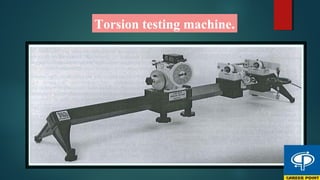
Torsion testing machine.
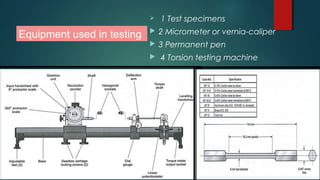
 1 Test specimens
 2 Micrometer or vernia-caliper
 3 Permanent pen
  4 Torsion testing machine
Equipment used in testing
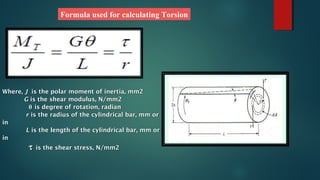
Formula used for calculating Torsion
Where,Where, JJ is the polar moment of inertia, mm2is the polar moment of inertia, mm2
GG is the shear modulus, N/mm2is the shear modulus, N/mm2
θθ is degree of rotation, radianis degree of rotation, radian
rr is the radius of the cylindrical bar, mm oris the radius of the cylindrical bar, mm or
inin
LL is the length of the cylindrical bar, mm oris the length of the cylindrical bar, mm or
inin
ττ is the shear stress, N/mm2is the shear stress, N/mm2
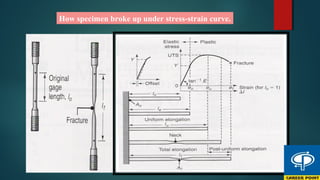
How specimen broke up under stress-strain curve.
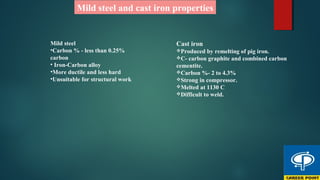
Mild steel and cast iron properties
Mild steel
•Carbon % - less than 0.25%
carbon
• Iron-Carbon alloy
•More ductile and less hard
•Unsuitable for structural work
Cast iron
Produced by remelting of pig iron.
C- carbon graphite and combined carbon
cementite.
Carbon %- 2 to 4.3%
Strong in compressor.
Melted at 1130 C
Difficult to weld.
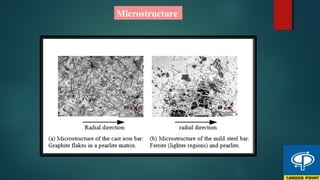
Microstructure
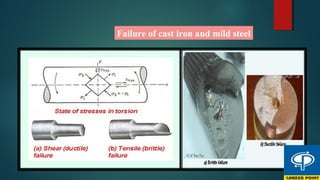
Failure of cast iron and mild steel
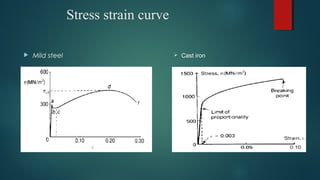
Stress strain curve
 Mild steel  Cast iron
Conclusion
 Torsion failures are different from tension failures and normally provide
little deformation or elongation.
 The characteristic of the fracture surface is related to the state of stress at
the point on the bar surface.
 It can be seen that the maximum shear stresses exist along two planes,
which are perpendicular to each other.
 The characteristics of torsion fractures are influenced by torsional and
tensile forces.
 These result in two types of torsion failures;
1) ductile failure due to the shear stresses in mild steel.
2) brittle failure due to the tensile stresses in cast iron.
Material science ppt.

Material science ppt.

  • 1.
    Career Point university Kota,Rajasthan Presentation on “Torsion Test.” Prepare By- Abhishek {K11535} & Ajay {K11876} B.Tech M.E. 2nd year
  • 2.
     In manyareas of engineering applications, materials are sometimes subjected to torsion in services, for example, drive shafts, axles and twisted drills.  Moreover, structural applications such as bridges, springs, car bodies, airplane fuselages and boat hulls are randomly subjected to torsion.  The materials used in this case should require not only adequate strength but also be able to withstand torque in operation.  Torsion test is applicable for testing brittle materials such as tool steels and cast iron. Torsion uses in daily life applications.
  • 3.
    Torsion Test  Generally,torsion occurs when the twisting moment or torque is applied to a member.  The torque is the product of tangential force multiplied by the radial distance from the twisting axis and the tangent, measured in a unit of N.m.  In torsion testing, the relationship between torque and degree of rotation is graphically presented and parameters such as ultimate torsional shearing strength (modulus of rupture), shear strength at proportional limit and shear modulus (modulus of rigidity) are generally investigated
  • 4.
    Objective of Torsiontest. To observe the mode of the failure of the metal.
  • 5.
  • 6.
     1 Testspecimens  2 Micrometer or vernia-caliper  3 Permanent pen   4 Torsion testing machine Equipment used in testing
  • 7.
    Formula used forcalculating Torsion Where,Where, JJ is the polar moment of inertia, mm2is the polar moment of inertia, mm2 GG is the shear modulus, N/mm2is the shear modulus, N/mm2 θθ is degree of rotation, radianis degree of rotation, radian rr is the radius of the cylindrical bar, mm oris the radius of the cylindrical bar, mm or inin LL is the length of the cylindrical bar, mm oris the length of the cylindrical bar, mm or inin ττ is the shear stress, N/mm2is the shear stress, N/mm2
  • 8.
    How specimen brokeup under stress-strain curve.
  • 9.
    Mild steel andcast iron properties Mild steel •Carbon % - less than 0.25% carbon • Iron-Carbon alloy •More ductile and less hard •Unsuitable for structural work Cast iron Produced by remelting of pig iron. C- carbon graphite and combined carbon cementite. Carbon %- 2 to 4.3% Strong in compressor. Melted at 1130 C Difficult to weld.
  • 10.
  • 11.
    Failure of castiron and mild steel
  • 12.
    Stress strain curve Mild steel  Cast iron
  • 13.
    Conclusion  Torsion failuresare different from tension failures and normally provide little deformation or elongation.  The characteristic of the fracture surface is related to the state of stress at the point on the bar surface.  It can be seen that the maximum shear stresses exist along two planes, which are perpendicular to each other.  The characteristics of torsion fractures are influenced by torsional and tensile forces.  These result in two types of torsion failures; 1) ductile failure due to the shear stresses in mild steel. 2) brittle failure due to the tensile stresses in cast iron.