DR. Khushbu Samani
Post Graduate
Department of Prosthodontics crown and bridge
 Basics of Colour
 Lighting and environment
 Visual shade guide systems
 Instrumental shade guide systems
 Gingival shade guides
 Literature review
 References
MUNSELL COLOR SYSTEM CIELAB COLOR SYSTEM
 Basic color- That quality by which we distinguish one color family from the rest
10 hue families
Primary hues:
Red (R),
Yellow (Y),
Green (G),
Blue (B)
Purple (P)
Intermediate hues:
Yellow red (YR),
Green Yellow (GY),
Blue Green (BG),
Purple Blue (PB),
Red Purple (RP).
Reddish-
brownish
Reddish-
yellowish
Greyish Reddish grey
 concentration of pigment/hue
Low Chroma High Chrom
 Relative lightness or darkness of a color or the
brightness of an object.
 direct consequence of the amount of light energy the object
reflects or transmits
 objects of different hues to reflect the same number of
photons and thus have the same brightness or value.
 Values extend from zero ( black) to ten (white) , with
 a range of grays in between.
 Low value – darker color
 High value – lighter color
 Hue range: 6 YR to 9.3 Y
 Value range: 4 to 8
The value range of teeth is toward the lighter portion of the scale, which indicates that very dark
teeth were not found in the study.
 Chroma range: 0 to 7
The chroma range is toward the lower portion of the chroma scale, which indicates that strong
colors were not found among the studied teeth
Clark, E. Bruce (1931). An Analysis of Tooth Color. The Journal of the American Dental Association (1922), 18(11), 2
 Hue :7.5 YR to 2.7 R
 Value: 5.8-8.5
 Chroma: 1.5-5.6
Goldstein RE, Chu SJ, Lee EA, Stappert CF, editors. Ronald E. Goldstein's Esthetics in Dentistry. John
Wiley & Sons; 2018 Aug 7.
CIELAB COLOR SYSTEM
 CIE: acronym for Commission Internationale d’ Eclairage, 1978
 Used exclusively for color research in dentistry around the world.
 Defines color space by 3 coordinates : L*, a*, b*.
 • L* = Lightness = achromatic characteristics
 • a*, b* coordinates = chromatic characteristics
 define the location of color on a plane of given lightness.
 a* - Represents the position of the object’s color on a pure
green and pure red scale.
 b* - Represents the position of the object’s color on a pure blue
and pure yellow scale.
SHADE SELECTION
Visual Method Instrumental Method
 Shade selection involves the perception of color, which depends on three entities:
 Illumination
 The environment
 The viewer.
Natural Daylight
Artificial Light
 1. Natural daylight
 closest to emitting the full spectrum light and thus renders colour more true than artificial light.
 Although daylight was initially thought to be the ideal light source for color matching,
 its use is not recommended- natural daylight is variable and inconsistent.
 Most bulbs emit a white light, but this white light can range from warm to cool.
 lack in an equal distribution of color.
 Incadescent Light :
 Predominantly red – yellow and lacking in blue.
 Makes reds and yellows stronger and blues weaker.
 2. Cool – white fluorescent Light :
 Predominantly blue green and low in red.
 Makes. blue strong and reds weak
 The suitability of artificial lighting for use in color comparison procedures is based on
the ability of the light source to approximate standard daylight.
 The reproducing capacity of artificial light is measured by using
 i. Color temperature
 ii. Color rendering index (CRI)
COLOR TEMPERATURE
 colour temperature is measured in degrees Kelvin on a scale from
1,000 to 10,000.
 Light source close to 5500oK – ideal for color matching
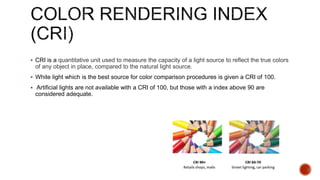
 CRI is a quantitative unit used to measure the capacity of a light source to reflect the true colors
of any object in place, compared to the natural light source.
 White light which is the best source for color comparison procedures is given a CRI of 100.
 Artificial lights are not available with a CRI of 100, but those with a index above 90 are
considered adequate.
CRI above 90
Color temperature: 5000-6000k
 The use of a dental operating light is not recommended because it is often
overpowering and therefore interferes with fine discrimination of the three dimensions
of color. Use of only ambient lighting provides a more natural lighting environment
COLOR CORRECTED LIGHTS
 Special lights to emit a more uniform distribution of color.
 CRI above 90
 Lighting of these characteristics would have a spectral
power distribution (SPD) that is similar to standard daylight.
 Aim: To evaluate the ability of dental students to match shades under three various
light conditions natural light, clinical light, and correcting light .
 Materials and methods: All students were tested for color deficiency using Ishahara’s
tests. Nine classical vita shade tabs were randomly selected and their identification
codes were concealed. The students were asked to match these 9 selected items by
using a complete vita shade guide under three various light conditions (natural light,
clinical light, and correcting light source). The chosen shade tabs were recorded and
the correct matches were counted. Scores were calculated by adding the number of
correct matches.
 Conclusion: The students showed a better performance in shade matching under the
correcting light source than natural light and clinical light. Gender had no effect on
shade matching selection and there was no difference in shade matching ability
among vita A, B, C, D shades.
Nakhaei M, Ghanbarzadeh J, Keyvanloo S, Alavi S, Jafarzadeh H. Shade Matching Performance of Dental Students with Three Various Lighting Conditions. J Contemp Dent
Pract 2013;14(1):100-103.
Chroma: 4 Munsell units or
neutral gray tones
Munsell value of 7-9
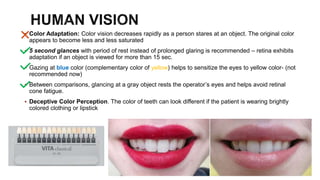
 Color Adaptation: Color vision decreases rapidly as a person stares at an object. The original color
appears to become less and less saturated
 5 second glances with period of rest instead of prolonged glaring is recommended – retina exhibits
adaptation if an object is viewed for more than 15 sec.
 Gazing at blue color (complementary color of yellow) helps to sensitize the eyes to yellow color- (not
recommended now)
 Between comparisons, glancing at a gray object rests the operator’s eyes and helps avoid retinal
cone fatigue.
 Deceptive Color Perception. The color of teeth can look different if the patient is wearing brightly
colored clothing or lipstick
Hue Chroma Value
Introduced in 1956.
Consists of sixteen tabs
The tabs are arranged into four
groups:
• A1 - A4 (reddish-brown)
• B1 - B4 (reddish-yellow)
• C1 - C4 (greyish shades)
• D2 - D4 (reddish-grey)
1= least chromatic and highest value
4= most chromatic ,lowest value
 Attention is focused on the range of shade that best represents the value of the tooth and
corelate if that range relates to the tab matching for hue and saturation
 By squinting, the observer can reduce the amount of light that reaches the retina.
 Stimulation of the cones is reduced, and a greater sensitivity to achromatic conditions by rods
may result.
 While squinting, the observer concentrates on which disappears from sight first: the tooth or the
shade tab. The one that fades first has the lower value.
 Squinting reduces the influence of hue
 Limitations:
 No importance is given to value of tooth
 Not uniformly positioned throughout tooth color space.
 No standard incremental difference between adjacent shades.
 Introduced in 1998.
 There is systematic and equidistant
coverage of the natural tooth shade
spectrum.
 The shade sample are grouped in six
lightness levels each of which has
chroma variations in evenly spaced
steps.
 The shade is spaced in steps of
CIELAB 4 units in the lightness
dimension and 2 CIELAB units in the
hue and chroma dimensions.
Addressed the most important deficiency of the other shade guides- a more ordered color
distribution based on scientific criteria, within the natural tooth color space and an objective,
numerical measure of color, according to the colorimetric CIELab* order principle, rather than
on the mere observation of the natural tissue aspects
Involves the sequential selection of Lightness, Chroma and Hue- This approach reinforces
the importance of Lightness selection, which is particularly important since Lightness is the
parameter most perceptible to the human eye
Ease with which the color can be corrected- After the try-in it is now possible to communicate
the need for color correction referring to one color parameter at a time instead of two
simultaneously as with the Vitapan Classical shade guide.
× Adoption in dentistry was initially limited- required some additional education in terms of
of color knowledge
To facilitate routine clinical work, the manufacturer recently introduced the Linearguide 3D-
Master
 It comprises of five detachable color
groups.
 It is arranged in groups based on the hue.
 20 shades
1. 100 = White
2. 200 = Yellow
3. 300 = Orange
4. 400 = Gray
5. 500 = Brown
 Within the groups it is arranged according to increasing
chroma from 10 to 40.
 Translucency
 Translucency is a property of substances that permits the passage of light but
disperses the light
 The degree of translucency depends on the structure and thickness of the
enamel and dentin.
 Dentin Shade Guides
 translucent all-ceramic system for a crown or veneer is used
 shade of the prepared dentin
 IPS Empress Ivoclar Vivadent provides specially colored die materials that match
the dentin
Incisal third of maxillary central
incisors more translucent than
gingival.
Dentin Shade Guides
 stain the closest matching selected shade guide, at chairside during the shadematching phase, with a light
polymerized porcelain staining system
 This system comes as a 14-stain kit or a 6-stain introductory kit
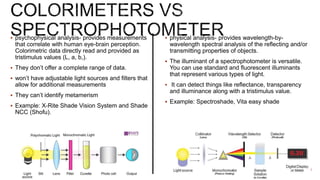
 psychophysical analysis- provides measurements
that correlate with human eye-brain perception.
Colorimetric data directly read and provided as
tristimulus values (L, a, b,).
 They don’t offer a complete range of data.
 won’t have adjustable light sources and filters that
allow for additional measurements
 They can’t identify metamerism
 Example: X-Rite Shade Vision System and Shade
NCC (Shofu).
 physical analysis- provides wavelength-by-
wavelength spectral analysis of the reflecting and/or
transmitting properties of objects.
 The illuminant of a spectrophotometer is versatile.
You can use standard and fluorescent illuminants
that represent various types of light.
 It can detect things like reflectance, transparency
and illuminance along with a tristimulus value.
 Example: Spectroshade, Vita easy shade
SHOFU’S SHADE NCC (NATURAL COLOR CONCEPT)
CHROMA METER
Introduced in 1990s.
Database of porcelain samples stored in memory.
Output: tooth number
 closest Vita classical shade guide designation
 Specific opaque, body, and enamel powders.
Although developed for use with the Vintage Halo Porcelain system (Shofu Dental), updated software
versionshave reference for other popular porcelains as well .
 combines digital color analysis with colorimetric analysis
 It consists of a hand-held device with its own light source, and an LCD screen
facilitates positioning on the tooth.
 Shade and translucency mapping, are possible, and colorimetric data (CIE L*a*b*
values) can be downloaded from the computer.
THE VITA EASYSHADE (VIDENT, BREA, CALIFORNIA)
 Vita Easy shade is cordless, small, portable, cost efficient, battery operated, contact-type
spectrophotometer
 The contact probe tip is approximately 5 mm in diameter
 Areas of application:
 Basic shade determination for-
1. Selection of CAD/CAM materials.
2. Materials for direct fillings.
3. Selection of prosthetic teeth
4. Shade determination for restorations
5. Intraoral and extra oral shade determination of existing ceramic restoration
 no need to standardize the light environment in the dental clinic and the user independent
accuracy and reliability
 most complex in design and is the most cumbersome in terms of hardware
 It is the only one that combines digital color imaging with spectrophotometric analysis
 The hand piece is relatively large compared with the contact probe designs, and positioning can be
tricky
 The software contains shade guide references for most porcelain systems
 A digital image of the tooth, the shade mapping, and the colorimetric data can be transmitted to the
laboratory
 Digital Cameras acquire red, green and blue image information that is utilized to create a color image.
 The RGB color model is an additive model in which red, green and blue light are added together in various
ways to reproduce a broad array of colors.
 Factors that affect how colour is perceived by the camera:
1. Illumination
2. Angle of the photograph
 Various approaches have been used to translate this data into useful dental color information:
 computer software (Toodent)
 Adobe Photoshop software
CLEARMATCH SYSTEM (SMART TECHNOLOGY, HOOD
RIVER, OREGON)
 ClearMatch (Smart Technology, Hood River, OR) is a software system that uses high-resolution digital
images and compares shades over the entire tooth with known reference shades.
 contains the color database of industry-standard shade guides
 software only, it is the most reasonably priced.
 TRIOS® Color automatically measures the shade while scanning the teeth by
combining color information recorded in 3D images obtained from multiple angles.
This color information is processed intelligently, using knowledge of the tooth´s 3D
geometry and the angle of scanning. The final color was in the present experiment
translated into the Vita 3D-Master shade system by selecting
 IOS shade guide applications
 Converts shades from vita classic to
3D Master and vice versa
 The colour of gingiva is variable ranging from a pale pink to deep bluish.
 Colour depends on:
 Intensity of melanogenesis,
 Epithelial keratinization
 Vascularization
 Use of pink gingival ceramics can reduce the necessity for extensive surgical
procedures attempting to restore missing soft and hard tissues in the maxillary
esthetic zone.
VITA VMK Master Gingiva
 This study evaluated the infuence of 120 autoclave sterilization cycles on the color stability of
two commercial shade guides (Vita Classical and Vita System 3D-Master).
 The specimens were evaluated by spectrophotometer before and after the sterilization cycles.
 The color was described using the three-dimensional CIELab system.
 All specimens became darker after autoclave sterilization cycles.
 However, specimens of Vita Classical became redder, while those of the Vita System 3D-
Master became more yellow.
 Repeated cycles of autoclave sterilization caused statistically significant changes in the color
coordinates of the two shade guides. However, these differences are considered clinically
acceptable.
 Aim: to compare the colour matching ability of instrumental colorimetry with that of a
conventional visual colour matching technique.
 Setting: The study was conducted in a dental clinic at the University of Otago, School of
Dentistry, New Zealand.
 Materials and methods: Three dentists with normal colour vision used a Vita Classical shade
guide to determine the shade of the maxillary right central incisor of 10 randomly chosen
individuals. The tooth colour of the same teeth was then determined with the Shade Vision
colorimeter. The shades selected were assigned numeric Delta E values for data compilation
and statistical analysis, and the degree of examiner reliability was determined using the
intraclass correlation coefficient (ICC).
 Conclusion: This study found no significant difference in the accuracy of shade selection when
using either a conventional visual assessment technique or a colorimetric instrument. There was,
however, some discrepancy when the two shade selection techniques were compared for shade
selection of the same tooth. The clinical relevance of this difference is unclear, suggesting that
additional research is needed to determine the clinical advantage of using a colorimeter.
 Aim: The objective of this study was to compare the
performance of visual shade matching and
spectrophotometric measurements.
 Methodology: A total of 100 observers matched pairs
of corresponding shade tabs from two VITA classical
A1-D4 shade guides. The tab identifiers on one shade
guide were masked. Differences between the
corresponding tabs was confirmed by means of an
intraoral spectrophotometer. Differences between the
corresponding tabs was confirmed by means of an
intraoral spectrophotometer.
 Results: A total of 72.5% of tab pairs were matched
using the visual method, and 98.9% were matched
using the spectrophotometer (P < 0.001).
 Female observers showed significantly better results
than male observers (P = 0.027).
 Aim: to compare the repeatability of an intraoral scanner (3Shape TRIOS) with the
traditional visual method for dental shade matching in patients and to assess the
influence of ambient lighting
 Methodology: Thirty observers, grouped by professional experience, selected the
shade of the right maxillary central incisor in 10 patients on three different occasions
under different ambient lighting conditions (twice under studio clinic lighting and once
under natural light). The same procedure was repeated using an intraoral scanner. All
shades were selected based on the VITA Toothguide 3D-MASTER. The repeatability
of each observer and the intraoral scanner were recorded for each color dimension
(hue, chroma, and value).
 Results: The TRIOS intraoral scanner obtained a mean repeatability of 86.66% in
dental shade matching compared to 75.22% achieved by the visual method. Ambient
lighting had a direct effect on the repeatability of the shade selection for the visual
method
shade selection seminar.pptx

shade selection seminar.pptx

  • 1.
    DR. Khushbu Samani PostGraduate Department of Prosthodontics crown and bridge
  • 2.
     Basics ofColour  Lighting and environment  Visual shade guide systems  Instrumental shade guide systems  Gingival shade guides  Literature review  References
  • 5.
    MUNSELL COLOR SYSTEMCIELAB COLOR SYSTEM
  • 6.
     Basic color-That quality by which we distinguish one color family from the rest
  • 7.
    10 hue families Primaryhues: Red (R), Yellow (Y), Green (G), Blue (B) Purple (P) Intermediate hues: Yellow red (YR), Green Yellow (GY), Blue Green (BG), Purple Blue (PB), Red Purple (RP).
  • 8.
  • 9.
     concentration ofpigment/hue Low Chroma High Chrom
  • 10.
     Relative lightnessor darkness of a color or the brightness of an object.  direct consequence of the amount of light energy the object reflects or transmits  objects of different hues to reflect the same number of photons and thus have the same brightness or value.  Values extend from zero ( black) to ten (white) , with  a range of grays in between.  Low value – darker color  High value – lighter color
  • 12.
     Hue range:6 YR to 9.3 Y  Value range: 4 to 8 The value range of teeth is toward the lighter portion of the scale, which indicates that very dark teeth were not found in the study.  Chroma range: 0 to 7 The chroma range is toward the lower portion of the chroma scale, which indicates that strong colors were not found among the studied teeth Clark, E. Bruce (1931). An Analysis of Tooth Color. The Journal of the American Dental Association (1922), 18(11), 2
  • 13.
     Hue :7.5YR to 2.7 R  Value: 5.8-8.5  Chroma: 1.5-5.6 Goldstein RE, Chu SJ, Lee EA, Stappert CF, editors. Ronald E. Goldstein's Esthetics in Dentistry. John Wiley & Sons; 2018 Aug 7.
  • 14.
    CIELAB COLOR SYSTEM CIE: acronym for Commission Internationale d’ Eclairage, 1978  Used exclusively for color research in dentistry around the world.  Defines color space by 3 coordinates : L*, a*, b*.  • L* = Lightness = achromatic characteristics  • a*, b* coordinates = chromatic characteristics  define the location of color on a plane of given lightness.  a* - Represents the position of the object’s color on a pure green and pure red scale.  b* - Represents the position of the object’s color on a pure blue and pure yellow scale.
  • 15.
    SHADE SELECTION Visual MethodInstrumental Method
  • 16.
     Shade selectioninvolves the perception of color, which depends on three entities:  Illumination  The environment  The viewer. Natural Daylight Artificial Light
  • 17.
     1. Naturaldaylight  closest to emitting the full spectrum light and thus renders colour more true than artificial light.  Although daylight was initially thought to be the ideal light source for color matching,  its use is not recommended- natural daylight is variable and inconsistent.
  • 18.
     Most bulbsemit a white light, but this white light can range from warm to cool.  lack in an equal distribution of color.  Incadescent Light :  Predominantly red – yellow and lacking in blue.  Makes reds and yellows stronger and blues weaker.  2. Cool – white fluorescent Light :  Predominantly blue green and low in red.  Makes. blue strong and reds weak
  • 19.
     The suitabilityof artificial lighting for use in color comparison procedures is based on the ability of the light source to approximate standard daylight.  The reproducing capacity of artificial light is measured by using  i. Color temperature  ii. Color rendering index (CRI)
  • 20.
    COLOR TEMPERATURE  colourtemperature is measured in degrees Kelvin on a scale from 1,000 to 10,000.  Light source close to 5500oK – ideal for color matching
  • 21.
     CRI isa quantitative unit used to measure the capacity of a light source to reflect the true colors of any object in place, compared to the natural light source.  White light which is the best source for color comparison procedures is given a CRI of 100.  Artificial lights are not available with a CRI of 100, but those with a index above 90 are considered adequate.
  • 22.
    CRI above 90 Colortemperature: 5000-6000k
  • 23.
     The useof a dental operating light is not recommended because it is often overpowering and therefore interferes with fine discrimination of the three dimensions of color. Use of only ambient lighting provides a more natural lighting environment
  • 24.
    COLOR CORRECTED LIGHTS Special lights to emit a more uniform distribution of color.  CRI above 90  Lighting of these characteristics would have a spectral power distribution (SPD) that is similar to standard daylight.
  • 25.
     Aim: Toevaluate the ability of dental students to match shades under three various light conditions natural light, clinical light, and correcting light .  Materials and methods: All students were tested for color deficiency using Ishahara’s tests. Nine classical vita shade tabs were randomly selected and their identification codes were concealed. The students were asked to match these 9 selected items by using a complete vita shade guide under three various light conditions (natural light, clinical light, and correcting light source). The chosen shade tabs were recorded and the correct matches were counted. Scores were calculated by adding the number of correct matches.  Conclusion: The students showed a better performance in shade matching under the correcting light source than natural light and clinical light. Gender had no effect on shade matching selection and there was no difference in shade matching ability among vita A, B, C, D shades. Nakhaei M, Ghanbarzadeh J, Keyvanloo S, Alavi S, Jafarzadeh H. Shade Matching Performance of Dental Students with Three Various Lighting Conditions. J Contemp Dent Pract 2013;14(1):100-103.
  • 26.
    Chroma: 4 Munsellunits or neutral gray tones Munsell value of 7-9
  • 27.
     Color Adaptation:Color vision decreases rapidly as a person stares at an object. The original color appears to become less and less saturated  5 second glances with period of rest instead of prolonged glaring is recommended – retina exhibits adaptation if an object is viewed for more than 15 sec.  Gazing at blue color (complementary color of yellow) helps to sensitize the eyes to yellow color- (not recommended now)  Between comparisons, glancing at a gray object rests the operator’s eyes and helps avoid retinal cone fatigue.  Deceptive Color Perception. The color of teeth can look different if the patient is wearing brightly colored clothing or lipstick
  • 29.
    Hue Chroma Value Introducedin 1956. Consists of sixteen tabs The tabs are arranged into four groups: • A1 - A4 (reddish-brown) • B1 - B4 (reddish-yellow) • C1 - C4 (greyish shades) • D2 - D4 (reddish-grey) 1= least chromatic and highest value 4= most chromatic ,lowest value
  • 30.
     Attention isfocused on the range of shade that best represents the value of the tooth and corelate if that range relates to the tab matching for hue and saturation  By squinting, the observer can reduce the amount of light that reaches the retina.  Stimulation of the cones is reduced, and a greater sensitivity to achromatic conditions by rods may result.  While squinting, the observer concentrates on which disappears from sight first: the tooth or the shade tab. The one that fades first has the lower value.  Squinting reduces the influence of hue
  • 32.
     Limitations:  Noimportance is given to value of tooth  Not uniformly positioned throughout tooth color space.  No standard incremental difference between adjacent shades.
  • 33.
     Introduced in1998.  There is systematic and equidistant coverage of the natural tooth shade spectrum.  The shade sample are grouped in six lightness levels each of which has chroma variations in evenly spaced steps.  The shade is spaced in steps of CIELAB 4 units in the lightness dimension and 2 CIELAB units in the hue and chroma dimensions.
  • 35.
    Addressed the mostimportant deficiency of the other shade guides- a more ordered color distribution based on scientific criteria, within the natural tooth color space and an objective, numerical measure of color, according to the colorimetric CIELab* order principle, rather than on the mere observation of the natural tissue aspects Involves the sequential selection of Lightness, Chroma and Hue- This approach reinforces the importance of Lightness selection, which is particularly important since Lightness is the parameter most perceptible to the human eye Ease with which the color can be corrected- After the try-in it is now possible to communicate the need for color correction referring to one color parameter at a time instead of two simultaneously as with the Vitapan Classical shade guide. × Adoption in dentistry was initially limited- required some additional education in terms of of color knowledge To facilitate routine clinical work, the manufacturer recently introduced the Linearguide 3D- Master
  • 38.
     It comprisesof five detachable color groups.  It is arranged in groups based on the hue.  20 shades 1. 100 = White 2. 200 = Yellow 3. 300 = Orange 4. 400 = Gray 5. 500 = Brown  Within the groups it is arranged according to increasing chroma from 10 to 40.
  • 39.
     Translucency  Translucencyis a property of substances that permits the passage of light but disperses the light  The degree of translucency depends on the structure and thickness of the enamel and dentin.  Dentin Shade Guides  translucent all-ceramic system for a crown or veneer is used  shade of the prepared dentin  IPS Empress Ivoclar Vivadent provides specially colored die materials that match the dentin Incisal third of maxillary central incisors more translucent than gingival. Dentin Shade Guides
  • 40.
     stain theclosest matching selected shade guide, at chairside during the shadematching phase, with a light polymerized porcelain staining system  This system comes as a 14-stain kit or a 6-stain introductory kit
  • 45.
     psychophysical analysis-provides measurements that correlate with human eye-brain perception. Colorimetric data directly read and provided as tristimulus values (L, a, b,).  They don’t offer a complete range of data.  won’t have adjustable light sources and filters that allow for additional measurements  They can’t identify metamerism  Example: X-Rite Shade Vision System and Shade NCC (Shofu).  physical analysis- provides wavelength-by- wavelength spectral analysis of the reflecting and/or transmitting properties of objects.  The illuminant of a spectrophotometer is versatile. You can use standard and fluorescent illuminants that represent various types of light.  It can detect things like reflectance, transparency and illuminance along with a tristimulus value.  Example: Spectroshade, Vita easy shade
  • 46.
    SHOFU’S SHADE NCC(NATURAL COLOR CONCEPT) CHROMA METER Introduced in 1990s. Database of porcelain samples stored in memory. Output: tooth number  closest Vita classical shade guide designation  Specific opaque, body, and enamel powders. Although developed for use with the Vintage Halo Porcelain system (Shofu Dental), updated software versionshave reference for other popular porcelains as well .
  • 47.
     combines digitalcolor analysis with colorimetric analysis  It consists of a hand-held device with its own light source, and an LCD screen facilitates positioning on the tooth.  Shade and translucency mapping, are possible, and colorimetric data (CIE L*a*b* values) can be downloaded from the computer.
  • 48.
    THE VITA EASYSHADE(VIDENT, BREA, CALIFORNIA)  Vita Easy shade is cordless, small, portable, cost efficient, battery operated, contact-type spectrophotometer  The contact probe tip is approximately 5 mm in diameter  Areas of application:  Basic shade determination for- 1. Selection of CAD/CAM materials. 2. Materials for direct fillings. 3. Selection of prosthetic teeth 4. Shade determination for restorations 5. Intraoral and extra oral shade determination of existing ceramic restoration  no need to standardize the light environment in the dental clinic and the user independent accuracy and reliability
  • 50.
     most complexin design and is the most cumbersome in terms of hardware  It is the only one that combines digital color imaging with spectrophotometric analysis  The hand piece is relatively large compared with the contact probe designs, and positioning can be tricky  The software contains shade guide references for most porcelain systems  A digital image of the tooth, the shade mapping, and the colorimetric data can be transmitted to the laboratory
  • 51.
     Digital Camerasacquire red, green and blue image information that is utilized to create a color image.  The RGB color model is an additive model in which red, green and blue light are added together in various ways to reproduce a broad array of colors.  Factors that affect how colour is perceived by the camera: 1. Illumination 2. Angle of the photograph  Various approaches have been used to translate this data into useful dental color information:  computer software (Toodent)  Adobe Photoshop software
  • 52.
    CLEARMATCH SYSTEM (SMARTTECHNOLOGY, HOOD RIVER, OREGON)  ClearMatch (Smart Technology, Hood River, OR) is a software system that uses high-resolution digital images and compares shades over the entire tooth with known reference shades.  contains the color database of industry-standard shade guides  software only, it is the most reasonably priced.
  • 53.
     TRIOS® Colorautomatically measures the shade while scanning the teeth by combining color information recorded in 3D images obtained from multiple angles. This color information is processed intelligently, using knowledge of the tooth´s 3D geometry and the angle of scanning. The final color was in the present experiment translated into the Vita 3D-Master shade system by selecting
  • 54.
     IOS shadeguide applications
  • 55.
     Converts shadesfrom vita classic to 3D Master and vice versa
  • 56.
     The colourof gingiva is variable ranging from a pale pink to deep bluish.  Colour depends on:  Intensity of melanogenesis,  Epithelial keratinization  Vascularization
  • 57.
     Use ofpink gingival ceramics can reduce the necessity for extensive surgical procedures attempting to restore missing soft and hard tissues in the maxillary esthetic zone. VITA VMK Master Gingiva
  • 59.
     This studyevaluated the infuence of 120 autoclave sterilization cycles on the color stability of two commercial shade guides (Vita Classical and Vita System 3D-Master).  The specimens were evaluated by spectrophotometer before and after the sterilization cycles.  The color was described using the three-dimensional CIELab system.  All specimens became darker after autoclave sterilization cycles.  However, specimens of Vita Classical became redder, while those of the Vita System 3D- Master became more yellow.  Repeated cycles of autoclave sterilization caused statistically significant changes in the color coordinates of the two shade guides. However, these differences are considered clinically acceptable.
  • 60.
     Aim: tocompare the colour matching ability of instrumental colorimetry with that of a conventional visual colour matching technique.  Setting: The study was conducted in a dental clinic at the University of Otago, School of Dentistry, New Zealand.  Materials and methods: Three dentists with normal colour vision used a Vita Classical shade guide to determine the shade of the maxillary right central incisor of 10 randomly chosen individuals. The tooth colour of the same teeth was then determined with the Shade Vision colorimeter. The shades selected were assigned numeric Delta E values for data compilation and statistical analysis, and the degree of examiner reliability was determined using the intraclass correlation coefficient (ICC).  Conclusion: This study found no significant difference in the accuracy of shade selection when using either a conventional visual assessment technique or a colorimetric instrument. There was, however, some discrepancy when the two shade selection techniques were compared for shade selection of the same tooth. The clinical relevance of this difference is unclear, suggesting that additional research is needed to determine the clinical advantage of using a colorimeter.
  • 61.
     Aim: Theobjective of this study was to compare the performance of visual shade matching and spectrophotometric measurements.  Methodology: A total of 100 observers matched pairs of corresponding shade tabs from two VITA classical A1-D4 shade guides. The tab identifiers on one shade guide were masked. Differences between the corresponding tabs was confirmed by means of an intraoral spectrophotometer. Differences between the corresponding tabs was confirmed by means of an intraoral spectrophotometer.  Results: A total of 72.5% of tab pairs were matched using the visual method, and 98.9% were matched using the spectrophotometer (P < 0.001).  Female observers showed significantly better results than male observers (P = 0.027).
  • 62.
     Aim: tocompare the repeatability of an intraoral scanner (3Shape TRIOS) with the traditional visual method for dental shade matching in patients and to assess the influence of ambient lighting  Methodology: Thirty observers, grouped by professional experience, selected the shade of the right maxillary central incisor in 10 patients on three different occasions under different ambient lighting conditions (twice under studio clinic lighting and once under natural light). The same procedure was repeated using an intraoral scanner. All shades were selected based on the VITA Toothguide 3D-MASTER. The repeatability of each observer and the intraoral scanner were recorded for each color dimension (hue, chroma, and value).  Results: The TRIOS intraoral scanner obtained a mean repeatability of 86.66% in dental shade matching compared to 75.22% achieved by the visual method. Ambient lighting had a direct effect on the repeatability of the shade selection for the visual method

Editor's Notes

  • #6 more visually descriptive Munsell color order system: The three attributes of color in this system are called hue, chroma, and value. and the more quantitative Commission Internationale de l’Éclairage L*a*b* (CIELAB) color system.
  • #7 Determined by the wavelength of the reflected/ transmitted light: 4oo nm to 700 nm In the Munsell color system, Hues are arranged around a wheel 10 hue families in the Munsell Color Order system.
  • #8 Each is subdivided into ten equal parts, so that the whole circle is divided into a total of 100 equal angular intervals.
  • #9 In dentistry, hue is represented by A, B, C, or D on the commonly used Vita Classic shade guide.
  • #10 imagine a glass of water. When one drop of ink is added, a solution of low chroma results. Adding a second drop of ink increases the chroma, and so on, until a solution is obtained that is almost all ink and consequently of high chroma
  • #11 The more the value of the object the brighter it appears
  • #16 Visual or instrumental
  • #18 Mid-day light is said to be best for shade selection because at this time light is most balanced. The color of daylight can vary from red-orange at sunset to blue when the sky is clear. The relative intensity of daylight also fluctuates with cloud cover
  • #19 Perception The color of an object can change depending on the type of illuminant.
  • #21 (from red at 10000K to white at 50000 K to a pale blue at 80000K). Unlike measuring temperature in degrees celsius, the warmer a bulb’s light is, the lower its temperature will be. A cooler temperature will have a higher value.
  • #27 walls, staff clothing, patient drape, and shade-matching environment have a Chroma of four Munsell units or which are neutral gray tones. ceiling have a Munsell Value of 9. All other major reflectors (e.g., walls, cabinets) should present at least a Munsell Value of 7 and a Munsell Chroma of no more than 4.
  • #30 Choosing the nearest hue first and then selecting the appropriate match of chroma and value from the tabs available is the recommended technique. Once the hue is selected, the best chroma match is chosen. For example, if a B hue is determined to be the best match for color variety, four gradations (tabs) of that hue are available: B1, B2, B3, and B4
  • #31 value is determined with a second commercial guide whose samples are arranged in order of increasing lightness Attention is focused on the range of shade that best represents the value of the tooth and how that range relates to the tab matching for hue and saturation. If the independent value determination is lower than the value of the sample selected for hue and chroma, a change is usually necessary because increasing the value of an object by adding surface stain (which always reduces brightness) is not possible. If the value determination is higher than the hue determination, the operator should decide whether this difference can be bridged through internal or surface characterization of the restoration.
  • #37 Value selection: A dark-gray holder containing only six middle tabs (0M2 to 5M2) is used. The small number of tabs with large color differences and the linear tab arrangement simplify group selection. • Chroma and hue selection: In a final selection, based on the chroma and hue is made from initial value group selected
  • #49 The colorimeter starts with a simple light source. With the help of a lens and tristimulus absorption filters, the beam of light becomes a single, focused wavelength which then moves through to the sample solution. On the other side of the solution is a photocell detector that identifies how much of the wavelength got absorbed.
  • #52 the too A combination of various filters and photodiode arrays receive the light as it is directed through the return fibers located in the center of the probe tip. Through this arrangement, spectral reflectance of the scattered light is essentially measured in 25 nm bandwidths th is illuminated by the periphery of the tip, directing the light from a halogen bulb in the base unit into the tooth surface.
  • #53 Different measurement modes are possible with Easyshade Compact: tooth single mode, tooth area mode (cervical, middle and incisal shades), restoration color verification (includes lightness, chroma and hue comparison) and shade tab mode (practice/training mode).
  • #58  taking a photo by the smart phone camera of the proposed tooth under uniform light conditions.