CONTENT:-
1. INTRODUCTION
2. DEFINATION
3. TRIDIMENSIONAL PROPERTY OF COLOUR
4. PERCEPTION OF COLOUR
5. SHADE SELECTION BASED ON
6. SHADE SELECTION TECNIQUE
A) VISUAL
- VITASPAN CLASSICAL SHADE
- VITASPAN 3D SHADE GUIDE
B) INSTRUMENTAL
- RGB DEVICE
- SPECTROPHOTOMETER
- VITA EASY SHADE
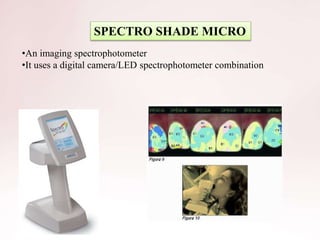
- SPECTRO SHADE MICRO
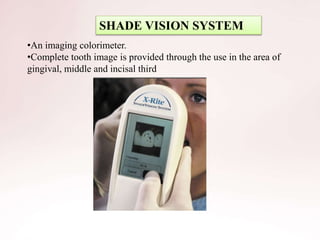
- SHADE VISION SYSTEM
6. PROCEDURE
7. PROBLEM INHERENT TO MATCHING SHADES OF TEETH
7. CONCLUSION
8. REFERENCES
INTRODUCTION
Major challenges in cosmetic dentistry are to accomplish
appropriate and satisfactory reproduction of natural shade of
teeth.1
The kind of shade guide, individual ability to choose shades and
conditions the choice is made under, all have influence on
reliability and accuracy of the procedure.
Shade selection in dental practice is an important but difficult
task.
Dentists are challenged to satisfy the aesthetic requirement of
patients when they select the shades for fabrication of prosthesis.
Most dentists are usually not trained for shade selection.2
DEFINATION
SHADE SELECTION:-
According to the Glossary of Prosthodontic terms
“ The determination of the color and other attributes of
appearance of an artificial tooth or set of teeth for a given
individual”
COLOUR:-
According to the Glossary of Prosthodontic terms
“The quality of an object or substance with respect to light
reflected or transmitted by it.”
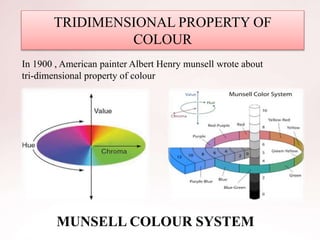
TRIDIMENSIONAL PROPERTY OF
COLOUR
In 1900 , American painter Albert Henry munsell wrote about
tri-dimensional property of colour
MUNSELL COLOUR SYSTEM
HUE VAL UE
Most important factor in
tooth shade matching.
CHROMA
Dominant colour of object
(red, yellow, green)
lncrease toward high end
(Lighter) and Decrease toward
low end (Darker)
Degree of
saturation/strength/intensity of
the particular hue
Short wave length = Violet
Hue
•Long wave length = Red Hue
Vital teeth- High value
Non vital teeth- Low value
Grey
High Chroma = High amount
of Hue with little dilution
Low Chroma = Small amount
of Hue with large amount of
dilution
Most natural teeth fall in a
Hue range between yellow and
yellow-red -6YR-9.3YR
Most teeth fall in a range from
4-8
Teeth have a Chroma range of
0-7
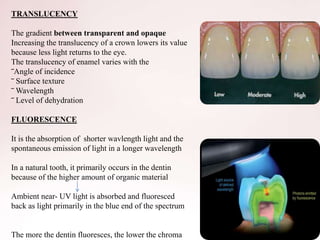
TRANSLUCENCY
The gradient between transparent and opaque
Increasing the translucency of a crown lowers its value
because less light returns to the eye.
The translucency of enamel varies with the
‾Angle of incidence
‾ Surface texture
‾ Wavelength
‾ Level of dehydration
FLUORESCENCE
It is the absorption of shorter wavlength light and the
spontaneous emission of light in a longer wavelength
In a natural tooth, it primarily occurs in the dentin
because of the higher amount of organic material
Ambient near- UV light is absorbed and fluoresced
back as light primarily in the blue end of the spectrum
The more the dentin fluoresces, the lower the chroma
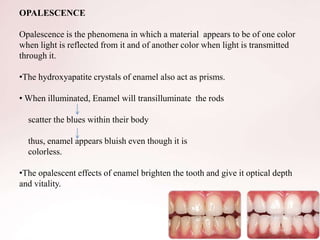
OPALESCENCE
Opalescence is the phenomena in which a material appears to be of one color
when light is reflected from it and of another color when light is transmitted
through it.
•The hydroxyapatite crystals of enamel also act as prisms.
• When illuminated, Enamel will transilluminate the rods
scatter the blues within their body
thus, enamel appears bluish even though it is
colorless.
•The opalescent effects of enamel brighten the tooth and give it optical depth
and vitality.
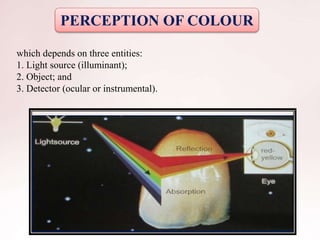
PERCEPTION OF COLOUR
which depends on three entities:
1. Light source (illuminant);
2. Object; and
3. Detector (ocular or instrumental).
1. LIGHT SORCE (ILLUMINANTS) :-
COLOUR RENDITION:-
The property of light source to influence colour of object
Three main illuminants within any dental practice
oNatural
oIncandescent – higher concentration of yellow light
oFluorescent - higher concentrations of blue light waves
Acc to ADA , “color-corrected” fluorescent lighting with a CRI
of 90 or above is recommended for shade selection
2. OBJECT
Hue is wavelength of light and dependent on the spectral reflectance
from an object.
Chroma is the concentration of colour or colour intensity of object
High value object reflects most the light falling on surface and appears
bright.
Low value object absorbing most of the light and appears dull.
3. DETECTOR (SENSATION):-
The difficulty of shade selection is that clinicians must be able to
interpret a multi-layered structure of varying thickness, opacities and
optical surface characteristics.
The basic hue of the tooth is determined by the colour of the
underlying dentine, while value is a quality of the enamel overlay
Muia in 1993 stated, “The dentine imparts all the colour. Enamel is
like a fiber optic structure conducting light through its rods”
SHADE SELECTION BASED ON
(ACC TO JOINER AND ALVIN)
•Physical and Optical properties of tooth being
viewed
•Nature of light to which tooth is exposed
•Assessment of tooth shade by observer
•Relationship of tooth to its surrounding colour
structure
(A) PHYSICAL AND OPTICAL PROPERTIES OF TOOTH BEING VIEWED
•Most important physical property related to a tooth’s shade is its moisture
content
•Appears whiter and less saturated in dry condition
•If tooth dry than it will takes almost 20–30 minutes for the tooth color to
return to its baseline values
•To make shade selections at the start of a dental procedure rather than at its
end
•Research by Ten-Bosch and Coops, showed that dentine was responsible for
imparting the basic tooth color, which was further modified by its external
features
•On the basis of these normal physiologic phenomena,
Wagenaar and Smith have suggested that the shade selection process is
directly
related to three essential factors:
oThe Tooth being viewed
oThe Light source being used
oThe Eyes of the observer.
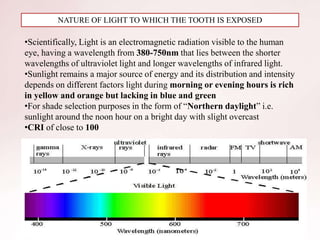
NATURE OF LIGHT TO WHICH THE TOOTH IS EXPOSED
•Scientifically, Light is an electromagnetic radiation visible to the human
eye, having a wavelength from 380-750nm that lies between the shorter
wavelengths of ultraviolet light and longer wavelengths of infrared light.
•Sunlight remains a major source of energy and its distribution and intensity
depends on different factors light during morning or evening hours is rich
in yellow and orange but lacking in blue and green
•For shade selection purposes in the form of “Northern daylight” i.e.
sunlight around the noon hour on a bright day with slight overcast
•CRI of close to 100
ASSESSMENT OF TOOTH SHADE BY AN OBSERVER
•Capability of the eyes to decrease when a tooth is viewed for
longer than 10 seconds observed color becomes less and less
saturated while simultaneously increasing the chroma of
complementary colors.
•It has been recommended by Alvin and Azad et al to paint the
operatory walls in pale blue (complimentary to yellow color of
teeth) and to resensitize the eyes to yellow color of teeth by
focusing on a pale gray-blue surface immediately before and during
the shade selection procedure.
RELATIONSHIP OF THE TOOTH TO ITS SURROUNDING COLORED
STRUCTURES AND SURFACES
Tooth color perceived by an observer is influenced by other colored
structures surrounding the tooth such as
adjacent teeth, gingival, lips, face skin, clothing of the patient and
operatory walls.
Presence of dark colored lipstick creates the illusion of whiter teeth
it is believed that individuals with darker skin colors have lighter shades
of teeth, which is explained by the illusion of greater contrast between
skin color and tooth shade
Clothing worn by the patient and color of operatory walls can
create contrast effects during the shade selection process Therefore, it
has been recommended to drape all bright colored clothing prior to
shade selection while the operatory walls should be painted in a neutral
(pale gray-blue) color
SHADE SELECTION
TECNIQUE
1. VISUAL
Quick
Cost effective
Subjective
Color discrimination
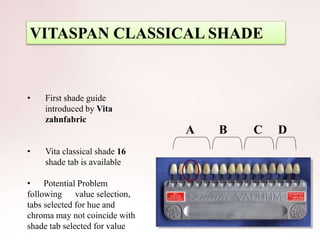
• First shade guide
introduced by Vita
zahnfabric
• Vita classical shade 16
shade tab is available
• Potential Problem
following value selection,
tabs selected for hue and
chroma may not coincide with
shade tab selected for value
A B C D
VITASPAN CLASSICAL SHADE
Vita Classic – Step 1
(Hue Selection)
•Four categories representing hue
•A, yellow-red
•B. yellow
•C. gray
•D. red-yellow-gray
•Operator should select hue closest to that of natural tooth
•Use area of tooth highest in chroma for hue selection
•Difficult to select hue for teeth low in chroma
Vita Classic – Step 2
(Chroma Selection)
•Hue selection has been made (B)
•Chroma is selected from gradations within the B tabs
•B1, B2, B3, B4
•Several comparisons should be made
•Avoid retinal fatigue
•Rest eyes between comparisons (blue-gray)
Vita Classic – Step 3
(Value Selection)
Use of second, value ordered shade guide is recommended
Value oriented shade guide
B1, A1, B2, D2, A2, C1, C2, D4, A3,
D3, B3, A3.5, B4, C3, A4, C4
Value best determined by squinting with comparisons made at arms
length ,decreases light
Diminishes cone sensitivity, increases rod sensitivity and
Tooth fading first has a lower value
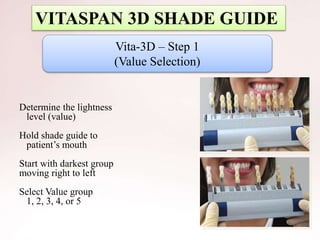
Vita-3D – Step 1
(Value Selection)
Determine the lightness
level (value)
Hold shade guide to
patient’s mouth
Start with darkest group
moving right to left
Select Value group
1, 2, 3, 4, or 5
VITASPAN 3D SHADE GUIDE
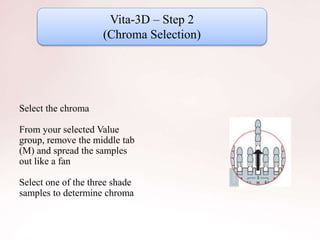
Vita-3D – Step 2
(Chroma Selection)
Select the chroma
From your selected Value
group, remove the middle tab
(M) and spread the samples
out like a fan
Select one of the three shade
samples to determine chroma
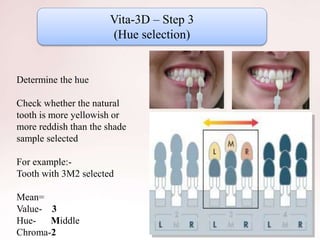
Vita-3D – Step 3
(Hue selection)
Determine the hue
Check whether the natural
tooth is more yellowish or
more reddish than the shade
sample selected
For example:-
Tooth with 3M2 selected
Mean=
Value- 3
Hue- Middle
Chroma-2
2. INSTRUMENT
Objective
Reproducible
Equipment cost
Operational difficulties
SHADE SELECTION
TECNIQUE
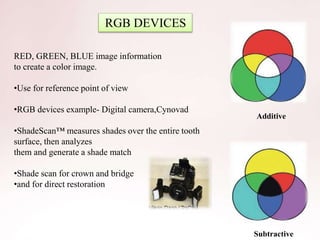
RED, GREEN, BLUE image information
to create a color image.
•Use for reference point of view
•RGB devices example- Digital camera,Cynovad
•ShadeScan™ measures shades over the entire tooth
surface, then analyzes
them and generate a shade match
•Shade scan for crown and bridge
•and for direct restoration
RGB DEVICES
Additive
Subtractive
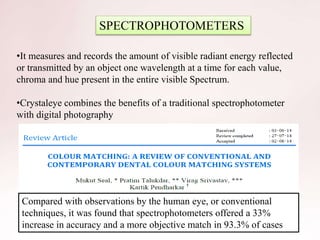
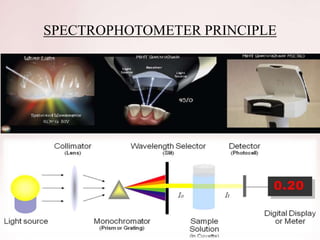
•It measures and records the amount of visible radiant energy reflected
or transmitted by an object one wavelength at a time for each value,
chroma and hue present in the entire visible Spectrum.
•Crystaleye combines the benefits of a traditional spectrophotometer
with digital photography
SPECTROPHOTOMETERS
Compared with observations by the human eye, or conventional
techniques, it was found that spectrophotometers offered a 33%
increase in accuracy and a more objective match in 93.3% of cases
SPECTROPHOTOMETER PRINCIPLE
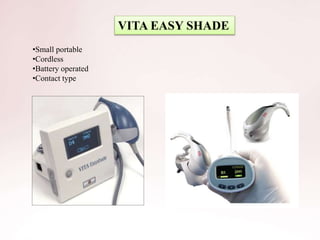
VITA EASY SHADE
•Small portable
•Cordless
•Battery operated
•Contact type
SPECTRO SHADE MICRO
•An imaging spectrophotometer
•It uses a digital camera/LED spectrophotometer combination
SHADE VISION SYSTEM
•An imaging colorimeter.
•Complete tooth image is provided through the use in the area of
gingival, middle and incisal third
•According to Kuzmanović and Lyons Study found no significant
difference in the accuracy of shade selection when using either a
conventional visual assessment technique or a colorimetric
instrument.
•Colorimeters are significantly less reliable than spectrophotometers
and digital camera
•Combination of visual color determination (Vitapan 3D-Master
shade guide and Linear guide) with digital cameras and electronic
devices (spectrophotometers) increase chances for successful shade
matching
PROCEDURE
Remove bright color from the working field.
If the patient is wearing bright clothing, it is prudent to cover the patient with neutral color bib (grey).
Any dark color lipstick should be removed, because it could affect shade matching.
Always clean the tooth by using prophylaxis paste prior to shade selection.
Its important to view the shade comparison for not more than 5-7 s to avoid eye fatigues.
Clinician should be at a distance of 28-33 cm from the patient during shade selection.
Always determine shade when the teeth are most hydrated,
because enamel dehydration reduces its translucency by 82%,
misleading the clinician.
Shade comparison should always be done in between 10
am and 2 pm, because at this time color temperature is
around 5500 K and then under color corrected light to
ensure the accuracy of the match.
During the shade comparison always place shade tabs
either above or below the tooth to be match, never place
shade tab adjacent to the tooth to avoid binocular effect.
Always, value is analyzed first, followed by chroma and then hue.
Shade selection should not be done immediately after bleaching,
patient should be recalled after 2-3 weeks for shade comparison.
Always during shade selection teeth should be divided in 3 regions.
Gingival area (gives accurate determination of dentinal chroma),
Body area and Incisal area
(enamel is thickest here and varies from translucent to transparent).
DIRECT COMPOSITE PLACEMENT TECHNIQUE
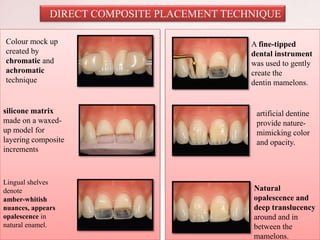
Colour mock up
created by
chromatic and
achromatic
technique
silicone matrix
made on a waxed-
up model for
layering composite
increments
Lingual shelves
denote
amber-whitish
nuances, appears
opalescence in
natural enamel.
A fine-tipped
dental instrument
was used to gently
create the
dentin mamelons.
artificial dentine
provide nature-
mimicking color
and opacity.
Natural
opalescence and
deep translucency
around and in
between the
mamelons.
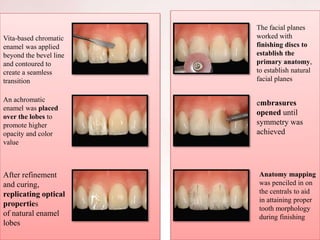
Vita-based chromatic
enamel was applied
beyond the bevel line
and contoured to
create a seamless
transition
An achromatic
enamel was placed
over the lobes to
promote higher
opacity and color
value
After refinement
and curing,
replicating optical
properties
of natural enamel
lobes
The facial planes
worked with
finishing discs to
establish the
primary anatomy,
to establish natural
facial planes
embrasures
opened until
symmetry was
achieved
Anatomy mapping
was penciled in on
the centrals to aid
in attaining proper
tooth morphology
during finishing
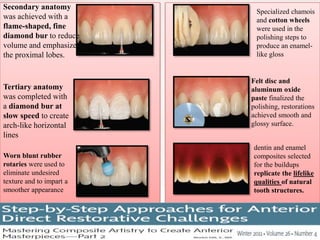
Secondary anatomy
was achieved with a
flame-shaped, fine
diamond bur to reduce
volume and emphasize
the proximal lobes.
Tertiary anatomy
was completed with
a diamond bur at
slow speed to create
arch-like horizontal
lines
Worn blunt rubber
rotaries were used to
eliminate undesired
texture and to impart a
smoother appearance
Specialized chamois
and cotton wheels
were used in the
polishing steps to
produce an enamel-
like gloss
Felt disc and
aluminum oxide
paste finalized the
polishing, restorations
achieved smooth and
glossy surface.
dentin and enamel
composites selected
for the buildups
replicate the lifelike
qualities of natural
tooth structures.
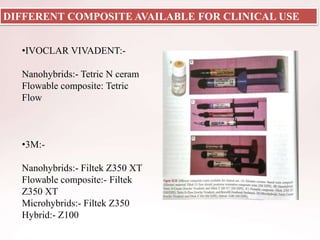
DIFFERENT COMPOSITE AVAILABLE FOR CLINICAL USE
•IVOCLAR VIVADENT:-
Nanohybrids:- Tetric N ceram
Flowable composite: Tetric
Flow
•3M:-
Nanohybrids:- Filtek Z350 XT
Flowable composite:- Filtek
Z350 XT
Microhybrids:- Filtek Z350
Hybrid:- Z100
FACTORS AFFECTING COLOR PERCEPTION
 Light in the dental office of the observer
 Color blindness
 Metamerism
 Age
 Gender
 Experience
 Eye fatigue
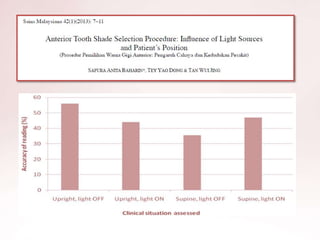
 Position of the patient
 Time of the day
 Background colors
• Accurate shade selection that allows restorations to match the
natural dentition positively influences the patients appearance and
esthetic self-esteem. Patients are demanding contemporary
esthetic dentistry, which has prompted the industry to
continuously raise the bar with regard to esthetic detail
• From the preceding discussion, it is clear that tooth shade
selection is a highly complex process that requires an interaction
of scientific, physiological, psychological and artistic factors for
an accurate outcome. Scientific principles related to light and
color play a key role in determining the tooth shade perceived.
CONCLUSION
1. Mehta , kumar Goel m, Kumar , Arora t, Pande s, shade selection: blending of
conventional and digital methods- an updated review. Johcd 2014;8
2. Dr. Vijayanti Lotwani, Dr. Mahesh Gandhewar, Dr. Shikha Gupta, Dr. Revathi
k, Dr. Srikanth
3. Reddy, a clinical approach to shade selection and communication
4. Freedman G. Buyer‟s guide to cosmetic imaging systems. Cosmetic
imaging creates projection of restorative treatment. Dent Today
2009;28(7):134-8.
5. Glick K. Cosmetic dentistry is still dentistry. J Can Dent Assoc
2000;66(2):88-9
6. Jeannin T, Ubassy G. Anterior prosthetic restoration. Cah Prothese
1984;12(46):93-100.
7. Mukut seal, pratim talukdar, virag srivastav, kartik pendharkar, colour
matching: a review of conventional and contemporary dental colour matching
systems. 2014;2
8. Mayekar sm. Shades of a color: illusion or reality? Dent clinnorth am. 2001;45
REFERENCES

Shade selection

  • 2.
    CONTENT:- 1. INTRODUCTION 2. DEFINATION 3.TRIDIMENSIONAL PROPERTY OF COLOUR 4. PERCEPTION OF COLOUR 5. SHADE SELECTION BASED ON 6. SHADE SELECTION TECNIQUE A) VISUAL - VITASPAN CLASSICAL SHADE - VITASPAN 3D SHADE GUIDE B) INSTRUMENTAL - RGB DEVICE - SPECTROPHOTOMETER - VITA EASY SHADE - SPECTRO SHADE MICRO - SHADE VISION SYSTEM 6. PROCEDURE 7. PROBLEM INHERENT TO MATCHING SHADES OF TEETH 7. CONCLUSION 8. REFERENCES
  • 3.
    INTRODUCTION Major challenges incosmetic dentistry are to accomplish appropriate and satisfactory reproduction of natural shade of teeth.1 The kind of shade guide, individual ability to choose shades and conditions the choice is made under, all have influence on reliability and accuracy of the procedure. Shade selection in dental practice is an important but difficult task. Dentists are challenged to satisfy the aesthetic requirement of patients when they select the shades for fabrication of prosthesis. Most dentists are usually not trained for shade selection.2
  • 4.
    DEFINATION SHADE SELECTION:- According tothe Glossary of Prosthodontic terms “ The determination of the color and other attributes of appearance of an artificial tooth or set of teeth for a given individual” COLOUR:- According to the Glossary of Prosthodontic terms “The quality of an object or substance with respect to light reflected or transmitted by it.”
  • 5.
    TRIDIMENSIONAL PROPERTY OF COLOUR In1900 , American painter Albert Henry munsell wrote about tri-dimensional property of colour MUNSELL COLOUR SYSTEM
  • 6.
    HUE VAL UE Mostimportant factor in tooth shade matching. CHROMA Dominant colour of object (red, yellow, green) lncrease toward high end (Lighter) and Decrease toward low end (Darker) Degree of saturation/strength/intensity of the particular hue Short wave length = Violet Hue •Long wave length = Red Hue Vital teeth- High value Non vital teeth- Low value Grey High Chroma = High amount of Hue with little dilution Low Chroma = Small amount of Hue with large amount of dilution Most natural teeth fall in a Hue range between yellow and yellow-red -6YR-9.3YR Most teeth fall in a range from 4-8 Teeth have a Chroma range of 0-7
  • 7.
    TRANSLUCENCY The gradient betweentransparent and opaque Increasing the translucency of a crown lowers its value because less light returns to the eye. The translucency of enamel varies with the ‾Angle of incidence ‾ Surface texture ‾ Wavelength ‾ Level of dehydration FLUORESCENCE It is the absorption of shorter wavlength light and the spontaneous emission of light in a longer wavelength In a natural tooth, it primarily occurs in the dentin because of the higher amount of organic material Ambient near- UV light is absorbed and fluoresced back as light primarily in the blue end of the spectrum The more the dentin fluoresces, the lower the chroma
  • 8.
    OPALESCENCE Opalescence is thephenomena in which a material appears to be of one color when light is reflected from it and of another color when light is transmitted through it. •The hydroxyapatite crystals of enamel also act as prisms. • When illuminated, Enamel will transilluminate the rods scatter the blues within their body thus, enamel appears bluish even though it is colorless. •The opalescent effects of enamel brighten the tooth and give it optical depth and vitality.
  • 9.
    PERCEPTION OF COLOUR whichdepends on three entities: 1. Light source (illuminant); 2. Object; and 3. Detector (ocular or instrumental).
  • 10.
    1. LIGHT SORCE(ILLUMINANTS) :- COLOUR RENDITION:- The property of light source to influence colour of object Three main illuminants within any dental practice oNatural oIncandescent – higher concentration of yellow light oFluorescent - higher concentrations of blue light waves Acc to ADA , “color-corrected” fluorescent lighting with a CRI of 90 or above is recommended for shade selection
  • 11.
    2. OBJECT Hue iswavelength of light and dependent on the spectral reflectance from an object. Chroma is the concentration of colour or colour intensity of object High value object reflects most the light falling on surface and appears bright. Low value object absorbing most of the light and appears dull. 3. DETECTOR (SENSATION):- The difficulty of shade selection is that clinicians must be able to interpret a multi-layered structure of varying thickness, opacities and optical surface characteristics. The basic hue of the tooth is determined by the colour of the underlying dentine, while value is a quality of the enamel overlay Muia in 1993 stated, “The dentine imparts all the colour. Enamel is like a fiber optic structure conducting light through its rods”
  • 12.
    SHADE SELECTION BASEDON (ACC TO JOINER AND ALVIN) •Physical and Optical properties of tooth being viewed •Nature of light to which tooth is exposed •Assessment of tooth shade by observer •Relationship of tooth to its surrounding colour structure
  • 13.
    (A) PHYSICAL ANDOPTICAL PROPERTIES OF TOOTH BEING VIEWED •Most important physical property related to a tooth’s shade is its moisture content •Appears whiter and less saturated in dry condition •If tooth dry than it will takes almost 20–30 minutes for the tooth color to return to its baseline values •To make shade selections at the start of a dental procedure rather than at its end •Research by Ten-Bosch and Coops, showed that dentine was responsible for imparting the basic tooth color, which was further modified by its external features •On the basis of these normal physiologic phenomena, Wagenaar and Smith have suggested that the shade selection process is directly related to three essential factors: oThe Tooth being viewed oThe Light source being used oThe Eyes of the observer.
  • 14.
    NATURE OF LIGHTTO WHICH THE TOOTH IS EXPOSED •Scientifically, Light is an electromagnetic radiation visible to the human eye, having a wavelength from 380-750nm that lies between the shorter wavelengths of ultraviolet light and longer wavelengths of infrared light. •Sunlight remains a major source of energy and its distribution and intensity depends on different factors light during morning or evening hours is rich in yellow and orange but lacking in blue and green •For shade selection purposes in the form of “Northern daylight” i.e. sunlight around the noon hour on a bright day with slight overcast •CRI of close to 100
  • 15.
    ASSESSMENT OF TOOTHSHADE BY AN OBSERVER •Capability of the eyes to decrease when a tooth is viewed for longer than 10 seconds observed color becomes less and less saturated while simultaneously increasing the chroma of complementary colors. •It has been recommended by Alvin and Azad et al to paint the operatory walls in pale blue (complimentary to yellow color of teeth) and to resensitize the eyes to yellow color of teeth by focusing on a pale gray-blue surface immediately before and during the shade selection procedure.
  • 16.
    RELATIONSHIP OF THETOOTH TO ITS SURROUNDING COLORED STRUCTURES AND SURFACES Tooth color perceived by an observer is influenced by other colored structures surrounding the tooth such as adjacent teeth, gingival, lips, face skin, clothing of the patient and operatory walls. Presence of dark colored lipstick creates the illusion of whiter teeth it is believed that individuals with darker skin colors have lighter shades of teeth, which is explained by the illusion of greater contrast between skin color and tooth shade Clothing worn by the patient and color of operatory walls can create contrast effects during the shade selection process Therefore, it has been recommended to drape all bright colored clothing prior to shade selection while the operatory walls should be painted in a neutral (pale gray-blue) color
  • 17.
    SHADE SELECTION TECNIQUE 1. VISUAL Quick Costeffective Subjective Color discrimination
  • 18.
    • First shadeguide introduced by Vita zahnfabric • Vita classical shade 16 shade tab is available • Potential Problem following value selection, tabs selected for hue and chroma may not coincide with shade tab selected for value A B C D VITASPAN CLASSICAL SHADE
  • 19.
    Vita Classic –Step 1 (Hue Selection) •Four categories representing hue •A, yellow-red •B. yellow •C. gray •D. red-yellow-gray •Operator should select hue closest to that of natural tooth •Use area of tooth highest in chroma for hue selection •Difficult to select hue for teeth low in chroma
  • 20.
    Vita Classic –Step 2 (Chroma Selection) •Hue selection has been made (B) •Chroma is selected from gradations within the B tabs •B1, B2, B3, B4 •Several comparisons should be made •Avoid retinal fatigue •Rest eyes between comparisons (blue-gray)
  • 21.
    Vita Classic –Step 3 (Value Selection) Use of second, value ordered shade guide is recommended Value oriented shade guide B1, A1, B2, D2, A2, C1, C2, D4, A3, D3, B3, A3.5, B4, C3, A4, C4 Value best determined by squinting with comparisons made at arms length ,decreases light Diminishes cone sensitivity, increases rod sensitivity and Tooth fading first has a lower value
  • 22.
    Vita-3D – Step1 (Value Selection) Determine the lightness level (value) Hold shade guide to patient’s mouth Start with darkest group moving right to left Select Value group 1, 2, 3, 4, or 5 VITASPAN 3D SHADE GUIDE
  • 23.
    Vita-3D – Step2 (Chroma Selection) Select the chroma From your selected Value group, remove the middle tab (M) and spread the samples out like a fan Select one of the three shade samples to determine chroma
  • 24.
    Vita-3D – Step3 (Hue selection) Determine the hue Check whether the natural tooth is more yellowish or more reddish than the shade sample selected For example:- Tooth with 3M2 selected Mean= Value- 3 Hue- Middle Chroma-2
  • 25.
  • 26.
    RED, GREEN, BLUEimage information to create a color image. •Use for reference point of view •RGB devices example- Digital camera,Cynovad •ShadeScan™ measures shades over the entire tooth surface, then analyzes them and generate a shade match •Shade scan for crown and bridge •and for direct restoration RGB DEVICES Additive Subtractive
  • 27.
    •It measures andrecords the amount of visible radiant energy reflected or transmitted by an object one wavelength at a time for each value, chroma and hue present in the entire visible Spectrum. •Crystaleye combines the benefits of a traditional spectrophotometer with digital photography SPECTROPHOTOMETERS Compared with observations by the human eye, or conventional techniques, it was found that spectrophotometers offered a 33% increase in accuracy and a more objective match in 93.3% of cases
  • 28.
  • 29.
    VITA EASY SHADE •Smallportable •Cordless •Battery operated •Contact type
  • 30.
    SPECTRO SHADE MICRO •Animaging spectrophotometer •It uses a digital camera/LED spectrophotometer combination
  • 31.
    SHADE VISION SYSTEM •Animaging colorimeter. •Complete tooth image is provided through the use in the area of gingival, middle and incisal third
  • 32.
    •According to Kuzmanovićand Lyons Study found no significant difference in the accuracy of shade selection when using either a conventional visual assessment technique or a colorimetric instrument. •Colorimeters are significantly less reliable than spectrophotometers and digital camera •Combination of visual color determination (Vitapan 3D-Master shade guide and Linear guide) with digital cameras and electronic devices (spectrophotometers) increase chances for successful shade matching
  • 33.
    PROCEDURE Remove bright colorfrom the working field. If the patient is wearing bright clothing, it is prudent to cover the patient with neutral color bib (grey). Any dark color lipstick should be removed, because it could affect shade matching. Always clean the tooth by using prophylaxis paste prior to shade selection. Its important to view the shade comparison for not more than 5-7 s to avoid eye fatigues. Clinician should be at a distance of 28-33 cm from the patient during shade selection.
  • 34.
    Always determine shadewhen the teeth are most hydrated, because enamel dehydration reduces its translucency by 82%, misleading the clinician. Shade comparison should always be done in between 10 am and 2 pm, because at this time color temperature is around 5500 K and then under color corrected light to ensure the accuracy of the match. During the shade comparison always place shade tabs either above or below the tooth to be match, never place shade tab adjacent to the tooth to avoid binocular effect.
  • 35.
    Always, value isanalyzed first, followed by chroma and then hue. Shade selection should not be done immediately after bleaching, patient should be recalled after 2-3 weeks for shade comparison. Always during shade selection teeth should be divided in 3 regions. Gingival area (gives accurate determination of dentinal chroma), Body area and Incisal area (enamel is thickest here and varies from translucent to transparent).
  • 36.
    DIRECT COMPOSITE PLACEMENTTECHNIQUE Colour mock up created by chromatic and achromatic technique silicone matrix made on a waxed- up model for layering composite increments Lingual shelves denote amber-whitish nuances, appears opalescence in natural enamel. A fine-tipped dental instrument was used to gently create the dentin mamelons. artificial dentine provide nature- mimicking color and opacity. Natural opalescence and deep translucency around and in between the mamelons.
  • 37.
    Vita-based chromatic enamel wasapplied beyond the bevel line and contoured to create a seamless transition An achromatic enamel was placed over the lobes to promote higher opacity and color value After refinement and curing, replicating optical properties of natural enamel lobes The facial planes worked with finishing discs to establish the primary anatomy, to establish natural facial planes embrasures opened until symmetry was achieved Anatomy mapping was penciled in on the centrals to aid in attaining proper tooth morphology during finishing
  • 38.
    Secondary anatomy was achievedwith a flame-shaped, fine diamond bur to reduce volume and emphasize the proximal lobes. Tertiary anatomy was completed with a diamond bur at slow speed to create arch-like horizontal lines Worn blunt rubber rotaries were used to eliminate undesired texture and to impart a smoother appearance Specialized chamois and cotton wheels were used in the polishing steps to produce an enamel- like gloss Felt disc and aluminum oxide paste finalized the polishing, restorations achieved smooth and glossy surface. dentin and enamel composites selected for the buildups replicate the lifelike qualities of natural tooth structures.
  • 39.
    DIFFERENT COMPOSITE AVAILABLEFOR CLINICAL USE •IVOCLAR VIVADENT:- Nanohybrids:- Tetric N ceram Flowable composite: Tetric Flow •3M:- Nanohybrids:- Filtek Z350 XT Flowable composite:- Filtek Z350 XT Microhybrids:- Filtek Z350 Hybrid:- Z100
  • 41.
    FACTORS AFFECTING COLORPERCEPTION  Light in the dental office of the observer  Color blindness  Metamerism  Age  Gender  Experience  Eye fatigue  Position of the patient  Time of the day  Background colors
  • 42.
    • Accurate shadeselection that allows restorations to match the natural dentition positively influences the patients appearance and esthetic self-esteem. Patients are demanding contemporary esthetic dentistry, which has prompted the industry to continuously raise the bar with regard to esthetic detail • From the preceding discussion, it is clear that tooth shade selection is a highly complex process that requires an interaction of scientific, physiological, psychological and artistic factors for an accurate outcome. Scientific principles related to light and color play a key role in determining the tooth shade perceived. CONCLUSION
  • 43.
    1. Mehta ,kumar Goel m, Kumar , Arora t, Pande s, shade selection: blending of conventional and digital methods- an updated review. Johcd 2014;8 2. Dr. Vijayanti Lotwani, Dr. Mahesh Gandhewar, Dr. Shikha Gupta, Dr. Revathi k, Dr. Srikanth 3. Reddy, a clinical approach to shade selection and communication 4. Freedman G. Buyer‟s guide to cosmetic imaging systems. Cosmetic imaging creates projection of restorative treatment. Dent Today 2009;28(7):134-8. 5. Glick K. Cosmetic dentistry is still dentistry. J Can Dent Assoc 2000;66(2):88-9 6. Jeannin T, Ubassy G. Anterior prosthetic restoration. Cah Prothese 1984;12(46):93-100. 7. Mukut seal, pratim talukdar, virag srivastav, kartik pendharkar, colour matching: a review of conventional and contemporary dental colour matching systems. 2014;2 8. Mayekar sm. Shades of a color: illusion or reality? Dent clinnorth am. 2001;45 REFERENCES