Color
Science
Contents
- Definition of light
- Visible spectrum of light
- Color
 Definition
 Description
 Perception
 Replication process
- Guidelines for correct shade selection
TO SEE THE COLOR OF ANY OBJECT, THERE
MUST BE AN INTERACTION BETWEEN THIS
OBJECT AND THE LIGHT
What is Light ?
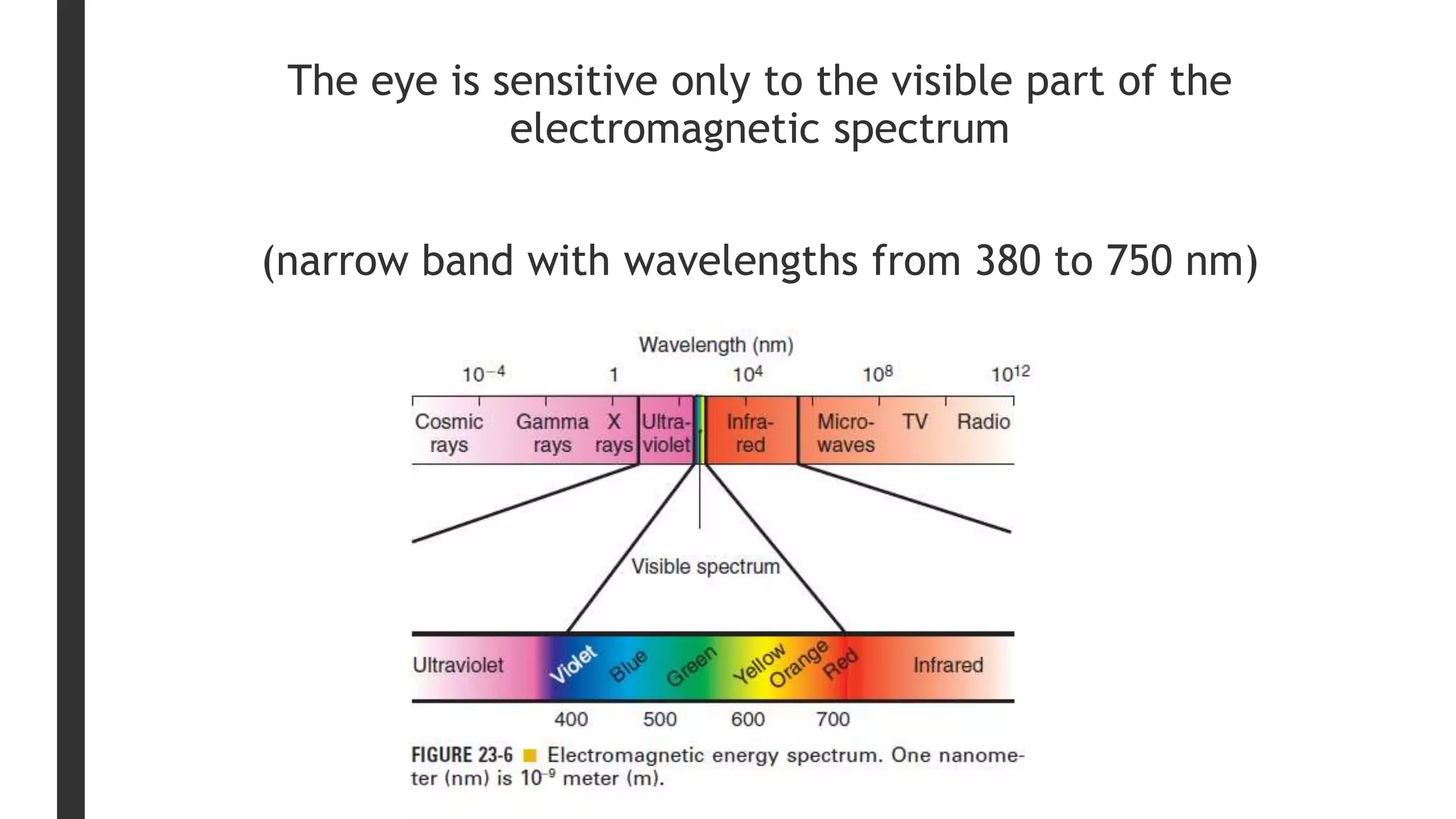
■ Scientifically, light is described as visible electromagnetic
energy whose wavelength is measured in nanometers
The eye is sensitive only to the visible part of the
electromagnetic spectrum
(narrow band with wavelengths from 380 to 750 nm)
COLOR
What is color ?
■ Color is phenomenon of light occurs as the object
absorbs all light and reflects its own
Color Description
■ Color Dimentions (parameters)
1- Hue
2- Chroma
3- value
Hue
■ the particular variety of a color.
(name of the color)
■ Determined by the reflected wavelength.
Chroma
■ intensity of a hue.
(degree of saturation)
Value
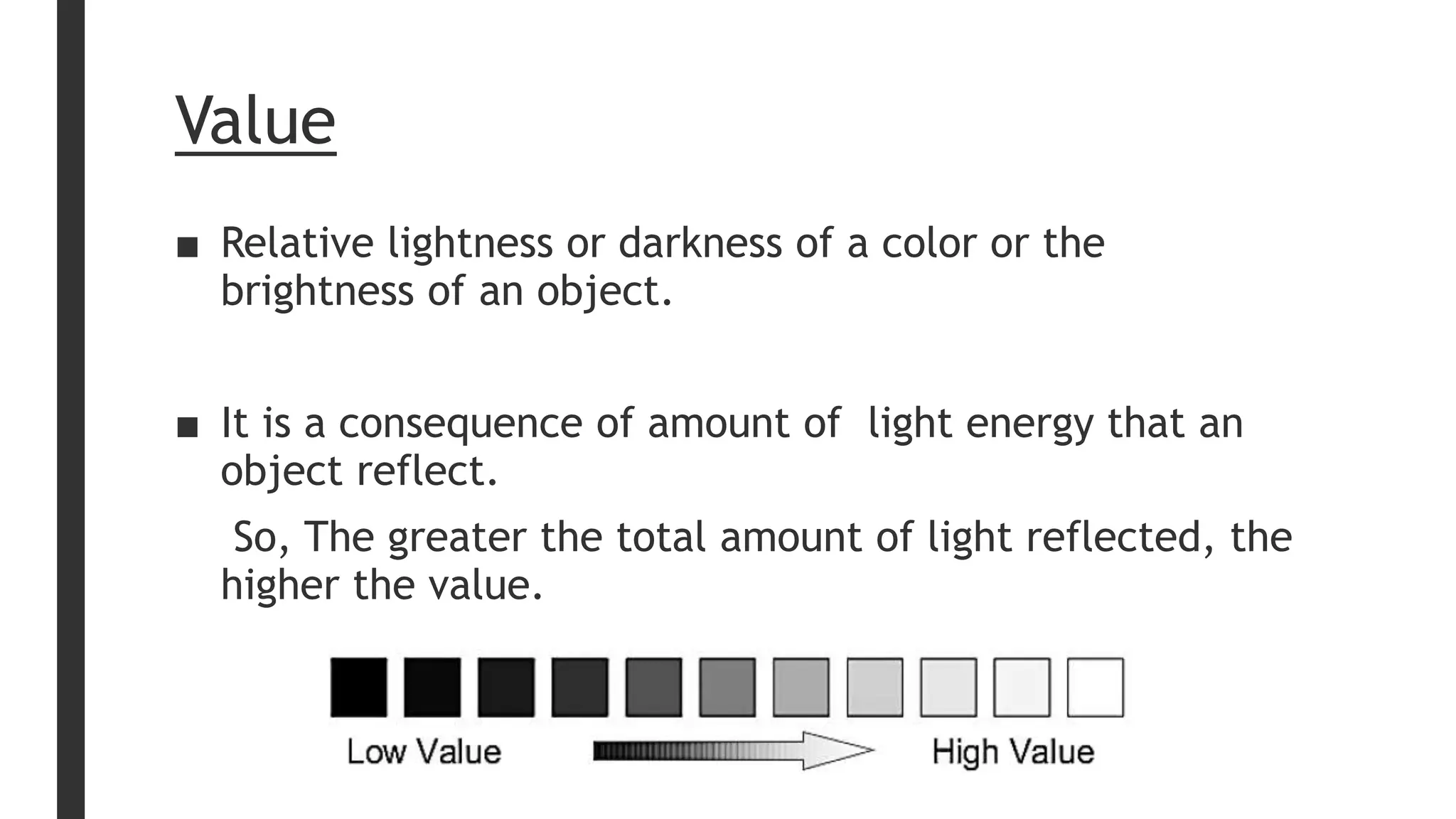
■ Relative lightness or darkness of a color or the
brightness of an object.
■ It is a consequence of amount of light energy that an
object reflect.
So, The greater the total amount of light reflected, the
higher the value.
Objects of different hue/ chroma can be of the same
value
Munsell color order system.
■ He identified the three dimensions of colors as (hue,
chroma and value).
■ Hues: are divided into 10 gradations, arranged
around the wheel
■ Chromas: more intense in the outer rim
■ Values: divided into 10 gradations
From 0 to 10.
(black is 0 while white is 10) & Natural teeth value from
4-8.
CIELAB
■ The CIELAB color system is used almost exclusively for
color research in dentistry around the world.
■ The CIELAB color order system defines color space by
three coordinates: L*, a*, and b*.
■ L* describes the achromatic character (value)
■ a* and b* describe the chromatic characteristics (hue
and chroma)
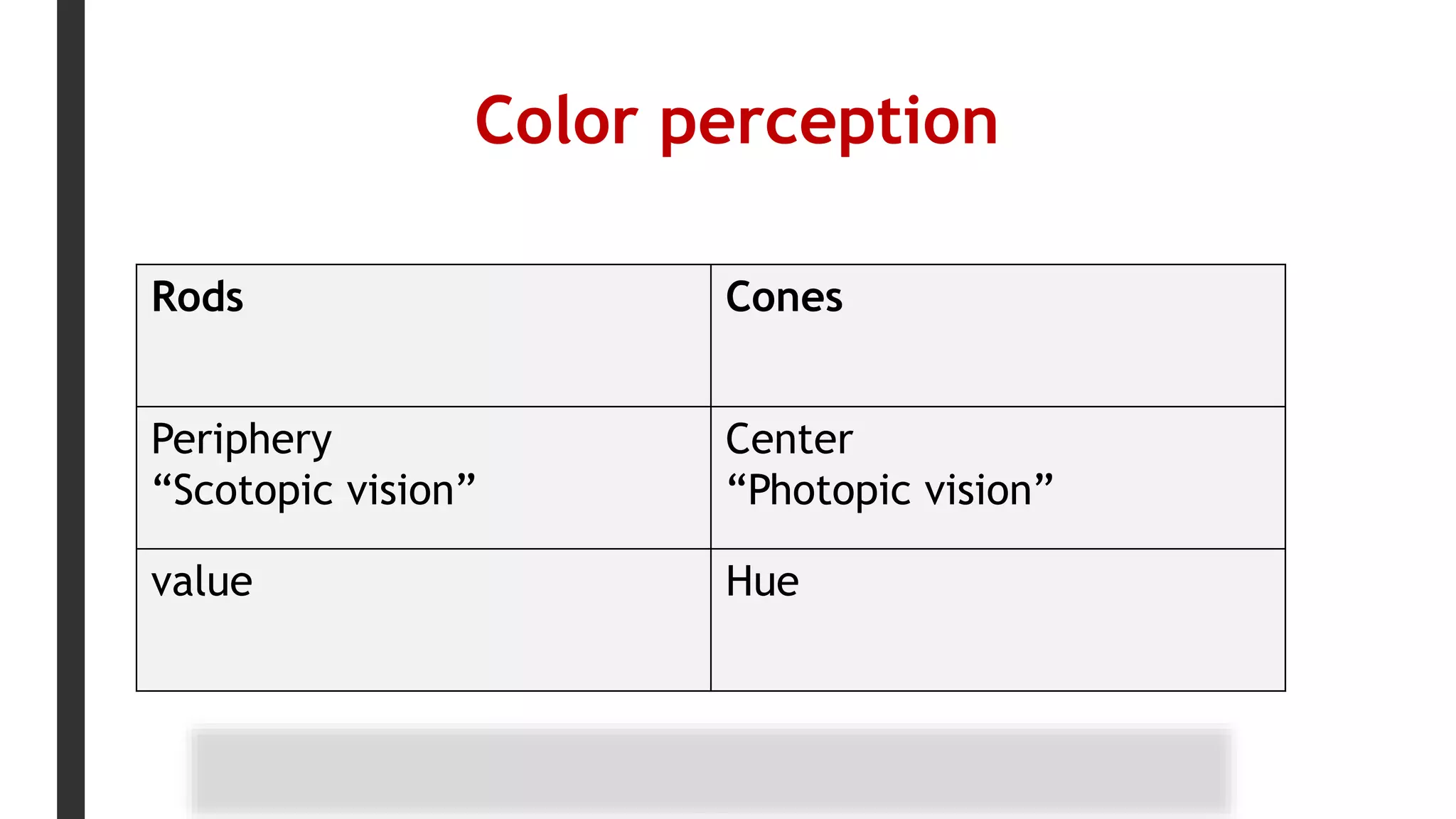
Color perception
■ Sensory cells of the retina
Rods Cones
Periphery
“Scotopic vision”
Center
“Photopic vision”
value Hue
While selecting the value …
■ squinting the eyes:
By squinting, the observer can reduce the amount of light
that reaches the retina. Stimulation of the cones is
reduced, and a greater sensitivity to achromatic
conditions may result.
Color Replication
1- shade matching (clinic)
2- shade duplication (lab.)
SHADE MATCHING
Shade Matching
■ Visual
■ Digital
AVAILABLE SHADE GUIDES:
1. Visual shade guides:
a. The vita lumen shade guide.
b. vitapan 3D Master.
c. dentin shade guide.
c. custom shade guide.
e. Shade Distribution Chart or Images.
f. Extended Range Shade Guides.
2. Digital shade matching:
a. Spectrophotometers (Vita EasyShade).
b. Colorimeters (ShadeVision).
c. Digital camera (ShadeScan).
1- VISUAL SHADE MATCHING
:
Factors affecting color perception:
■ ILLUMINATION
■ OBSERVER
■ OBJECT
1- Illumination
■ A light source of the appropriate quality should be used
during visual shade matching.
■ The appropriate color temperature with appropriate
spectral energy distribution and color-rendering index
(CRI) must be considered in the selection of a light
source.
Appropriate light source should have
■ color temperature close to 5500°K (D55)
■ CRI greater than 90.
The CRI is measure of the ability of a light source to reveal the
colors of various objects in comparison with an ideal or natural
light source.
■ The most common light sources in dental offices are
incandescent and fluorescent,
neither of which are pure white light.
a. Natural sunlight:
The best source of light is the indirect sunlight
especially in the noon hours (10-12 o'clock) in clear sunny day
(with no pollution or humidity as they affectthe light)
this will give color rendering index approximates 100.
Types of light:
b. Artificial light:
Recently ..
Color Corrected light is developed and considered the best
artificial light forshade selection
(it has colorrendering index=90).
The human eye contains the color sensitive receptors on
the retina.
Color perception:
The electromagnetic energy of the color is changed into impulses
then the impulses are transferred to the optical center in the brain to
be interpretated intocolors.
2. Observer
Deceptive color perception:
1. color blindness:
8% of population have some form of color blindness and are inable of
seeing certain colors (male more than female).
 Achromatism: Compelete lack of hue sensitivity
(the receptors are absent).
 Dichromatism: Sensitivity to only two of primary
color
(1 receptor is absent).
 Anomalus trichromatism: sensitive to all three
hues with abnormality or deficiency of one
(the 3 receptor are present but 1 is defective).
2. Color adaptation:
Prolonged observation of colored object may decrease the response to
that color…
color become less saturated until it become gray i.e. the chroma of
complemntary colors appear greater
Therefore… pale blue – gray painting (complementary to yellow) is
better to be glanced while selectingtheshadeofteeth.
Must take short breaks when performing shade selection for
multiple restorations.
Shade selection should be performed at the beginning of the
visit.
3. Metamerism
When colorof 2 objects appear identical underone lighting
condition butwhen light condition is changed The 2 objectappear
different ….. metameric pair.
Can be minimized by performing shade selection and
verification underdifferent lighting conditions.
When the colorof the 2 object is identical underall light
source ….. They form isomeric pair.
3. Object “Tooth”
■ Translucency
■ Florescence
■ opalescence
1. Translucency:
It is theamountof light transmitted byan object which scatter partof light
(Givesa life likeappearance).
 It occur in incisal edge & cusp tipsand proximal surface, while itdecreases
cervicallydue to increase dentin thickness.
 Isagradient between transparentand opaque.
 As translucency increases, valuedecreases.
 Lateralsshow the highest translucency while cuspids havevery little
translucency.
Optical triad
2. Flourescence
• Absorption of light by a material and its spontaneous
reemission in a longerwavelength.
• It is the glow of objectwhen illuminated by ultraviolet light, it
ceases immediatelyafter removal of the illumination.
Are natural teeth fluorescent ????
In natural teeth, fluorescence occurs primarily in dentin
due to its higherorganic content.
The more the dentin fluoresces, the lower the chroma.
3. Opalescence:
• A phenomenon wherea material appears to be one colourwhen you
observe light ref lected from it and looks another colour when you see
light transmitted through it.
• Itappear blue in reflected light and red orange in transilmuinated
light.
VISUAL SHADE
GUIDES
1- Vita lumen shade guide ( vitapan classical):
it is composed of 4 hues:
A. Reddish brown.
B. Orange yellow.
C. Grayish shades.
D. Reddish grey.
Procedure:
1. Choose the tab with the nearest hue, then select the
appropriate match of choroma and value from the tab available
A,B,C, or D
2.chroma selection is next from within the same hue group
e.g. select 1,2,3 or 4 from each hue group A,B,C,D.
3. value is determined with second shade guide whosesamples are
arranged in order of increasing lightness.
2. vitapan 3D Master:
 Recently, the Vita company launched its Vita Pan 3D Master in
accordance with the basic Munsell colorordersystem.
 It incorporates the threecolorimetricdimensions of color.
Value Chroma Hue
Procedure
Step 1:
thevalue (lightness) is determined.
Select thevalue fromthe five groups (level 1-5) that is close to the value of
the tooth to becompared.
Pull out the medium shade sample (M) from the selected valuegroup
Step 2:
In the second step thechroma (levels 1,2,3) is determined.
Select thecolorsampleof the selected M group that is close to the tooth
to becompared
Step 3:
In the third step the hue (L,M,R) is determined.
Check whether the natural tooth displays a more yellowish (L) or
more reddish(R) shade from the color sample of M group that has
been selected in the second step.
Now the best matching shade sample is determined and the
information is recorded from the color communication form.
3. Dentin shade guide
4. custom shade guide.
5. Shade Distribution Chart or
Images.
6. Extended Range Shade Guides.
Advantages of visual shade guide:
1. practical.
2. Low cost.
3. No complicated equipment.
4. Easy to communicate between clinician and laboratory.
Disadvantages of visual shade guide:
1. Less accurate.
2. Subjective i.e. affected by skill level of shade taker/
fatigue / lighting.
3. Represent only 30 % of color change of natural dentition.
4. Shade guide tabs are 4- 5 mm thick compared to the thin
1.5 mm thickness of porcelain used for the restoration.
5. Shade guide tabs lack metal backing when using PFM
restoration.
DIGITAL SHADE
MATCHING
There are 3 basic types of devices used:
1.Spectrophotometry e.g. Vita EasyShade.
2.Colorimeter e.g. ShadeVision.
3.Digital camera and RGB devices e.g. ShadeScan.
2. Digital shade guides
1. Spectrophotometry
• Measures and record the amount of visible
radiant energy reflected or transmitted by
an object.
• It measures light reflectance at wavelength
intervals.
• The extensive data obtained from
spectrophotometers must be manipulated, and
a data reduction strategy employed, to
translate the data into a useful format.
Vita easy shade
VITA Easyshade Compact
Advantages:
1. Fast and reliable shade taking at the push of a button
2.High measuring accuracy thanks to
spectrophotometric measuring
3.Perfectlysimple handling
4.Cordless, mobileand lightweight compact unit
5.Betterresultssince independentof lighting
conditions and user
6.Up to 25 shade taking results can be stored
2. colorimeters
 Colorimeters are optical reading devices that can
assess what wavelengthsare reflected back to its
sensors.
 Providesdirect colorcoordinate specifications
without mathematical manipulations.
 Measures color bycomparing tooth coloragainst
reference.
 Disadv: Colorimeters are difficult to design and, if
made improperly, will result in reduced accuracy
compared with a spectrophotometer.
• As reference photographs can reveal the
translucency and the opacity as well as the
surface texture of teeth. These informations are
for lab technician who will incorporate these
characteristics into the restoration.
• However, the use of a digital cameraalone is
not effective for shadeanalysis.
3.Digital cameras
Advantages of digital shade guide:
1.Record shade without being affected light conditions & observer
and eye fatigue.
2.Can measure color through entire tooth.
3.Time saving.
4.Can create accurate shade maps denoting translucency, surface
texture, value difference, chroma variance & hue distinction.
Disadvantages of digital shade guide:
1.expensive.
2.Need special training.
3.Some device doesn’t measure transluceny / texture effect.
4.Technician and clinical must understanding of color map
technique For accurate reading and interpretation of shade
reports.
5.Not a replacement for traditional methods i.e. recommendation
to be used in combined with visual shade guide.
GUIDELINES FOR CORRECT
SHADE SELECTION
Principles of color selection:
1. Teeth polished and moist
2. At the beginning of the visit
3. Patient sitting in an upright position
4. Removal of bright clothes and lipstick
5. From a distance of 3-6 feet
6. Operator standing between patient and light source
7. Light grey walls of the office
8. Looking at the cervical region
9. Any surface characteristics must be recorded
10. Under different lightening conditions
11. Taking another opinion
Thank you
,,,

color science 1.pptx

  • 1.
  • 2.
    Contents - Definition oflight - Visible spectrum of light - Color  Definition  Description  Perception  Replication process - Guidelines for correct shade selection
  • 3.
    TO SEE THECOLOR OF ANY OBJECT, THERE MUST BE AN INTERACTION BETWEEN THIS OBJECT AND THE LIGHT
  • 5.
    What is Light? ■ Scientifically, light is described as visible electromagnetic energy whose wavelength is measured in nanometers
  • 6.
    The eye issensitive only to the visible part of the electromagnetic spectrum (narrow band with wavelengths from 380 to 750 nm)
  • 7.
  • 8.
    What is color? ■ Color is phenomenon of light occurs as the object absorbs all light and reflects its own
  • 9.
    Color Description ■ ColorDimentions (parameters) 1- Hue 2- Chroma 3- value
  • 10.
    Hue ■ the particularvariety of a color. (name of the color) ■ Determined by the reflected wavelength.
  • 11.
    Chroma ■ intensity ofa hue. (degree of saturation)
  • 12.
    Value ■ Relative lightnessor darkness of a color or the brightness of an object. ■ It is a consequence of amount of light energy that an object reflect. So, The greater the total amount of light reflected, the higher the value.
  • 13.
    Objects of differenthue/ chroma can be of the same value
  • 14.
    Munsell color ordersystem. ■ He identified the three dimensions of colors as (hue, chroma and value). ■ Hues: are divided into 10 gradations, arranged around the wheel ■ Chromas: more intense in the outer rim ■ Values: divided into 10 gradations From 0 to 10. (black is 0 while white is 10) & Natural teeth value from 4-8.
  • 16.
    CIELAB ■ The CIELABcolor system is used almost exclusively for color research in dentistry around the world. ■ The CIELAB color order system defines color space by three coordinates: L*, a*, and b*. ■ L* describes the achromatic character (value) ■ a* and b* describe the chromatic characteristics (hue and chroma)
  • 18.
    Color perception ■ Sensorycells of the retina Rods Cones Periphery “Scotopic vision” Center “Photopic vision” value Hue
  • 21.
    While selecting thevalue … ■ squinting the eyes: By squinting, the observer can reduce the amount of light that reaches the retina. Stimulation of the cones is reduced, and a greater sensitivity to achromatic conditions may result.
  • 22.
    Color Replication 1- shadematching (clinic) 2- shade duplication (lab.)
  • 23.
  • 24.
  • 25.
    AVAILABLE SHADE GUIDES: 1.Visual shade guides: a. The vita lumen shade guide. b. vitapan 3D Master. c. dentin shade guide. c. custom shade guide. e. Shade Distribution Chart or Images. f. Extended Range Shade Guides. 2. Digital shade matching: a. Spectrophotometers (Vita EasyShade). b. Colorimeters (ShadeVision). c. Digital camera (ShadeScan).
  • 26.
    1- VISUAL SHADEMATCHING :
  • 27.
    Factors affecting colorperception: ■ ILLUMINATION ■ OBSERVER ■ OBJECT
  • 28.
    1- Illumination ■ Alight source of the appropriate quality should be used during visual shade matching. ■ The appropriate color temperature with appropriate spectral energy distribution and color-rendering index (CRI) must be considered in the selection of a light source.
  • 29.
    Appropriate light sourceshould have ■ color temperature close to 5500°K (D55) ■ CRI greater than 90. The CRI is measure of the ability of a light source to reveal the colors of various objects in comparison with an ideal or natural light source.
  • 30.
    ■ The mostcommon light sources in dental offices are incandescent and fluorescent, neither of which are pure white light.
  • 31.
    a. Natural sunlight: Thebest source of light is the indirect sunlight especially in the noon hours (10-12 o'clock) in clear sunny day (with no pollution or humidity as they affectthe light) this will give color rendering index approximates 100. Types of light:
  • 32.
  • 33.
    Recently .. Color Correctedlight is developed and considered the best artificial light forshade selection (it has colorrendering index=90).
  • 34.
    The human eyecontains the color sensitive receptors on the retina. Color perception: The electromagnetic energy of the color is changed into impulses then the impulses are transferred to the optical center in the brain to be interpretated intocolors. 2. Observer
  • 35.
    Deceptive color perception: 1.color blindness: 8% of population have some form of color blindness and are inable of seeing certain colors (male more than female).
  • 36.
     Achromatism: Compeletelack of hue sensitivity (the receptors are absent).  Dichromatism: Sensitivity to only two of primary color (1 receptor is absent).  Anomalus trichromatism: sensitive to all three hues with abnormality or deficiency of one (the 3 receptor are present but 1 is defective).
  • 38.
    2. Color adaptation: Prolongedobservation of colored object may decrease the response to that color… color become less saturated until it become gray i.e. the chroma of complemntary colors appear greater Therefore… pale blue – gray painting (complementary to yellow) is better to be glanced while selectingtheshadeofteeth.
  • 39.
    Must take shortbreaks when performing shade selection for multiple restorations. Shade selection should be performed at the beginning of the visit.
  • 40.
    3. Metamerism When colorof2 objects appear identical underone lighting condition butwhen light condition is changed The 2 objectappear different ….. metameric pair.
  • 41.
    Can be minimizedby performing shade selection and verification underdifferent lighting conditions. When the colorof the 2 object is identical underall light source ….. They form isomeric pair.
  • 42.
    3. Object “Tooth” ■Translucency ■ Florescence ■ opalescence
  • 43.
    1. Translucency: It istheamountof light transmitted byan object which scatter partof light (Givesa life likeappearance).  It occur in incisal edge & cusp tipsand proximal surface, while itdecreases cervicallydue to increase dentin thickness.  Isagradient between transparentand opaque.  As translucency increases, valuedecreases.  Lateralsshow the highest translucency while cuspids havevery little translucency. Optical triad
  • 46.
    2. Flourescence • Absorptionof light by a material and its spontaneous reemission in a longerwavelength. • It is the glow of objectwhen illuminated by ultraviolet light, it ceases immediatelyafter removal of the illumination.
  • 47.
    Are natural teethfluorescent ???? In natural teeth, fluorescence occurs primarily in dentin due to its higherorganic content. The more the dentin fluoresces, the lower the chroma.
  • 48.
    3. Opalescence: • Aphenomenon wherea material appears to be one colourwhen you observe light ref lected from it and looks another colour when you see light transmitted through it. • Itappear blue in reflected light and red orange in transilmuinated light.
  • 49.
  • 50.
    1- Vita lumenshade guide ( vitapan classical): it is composed of 4 hues: A. Reddish brown. B. Orange yellow. C. Grayish shades. D. Reddish grey.
  • 51.
    Procedure: 1. Choose thetab with the nearest hue, then select the appropriate match of choroma and value from the tab available A,B,C, or D 2.chroma selection is next from within the same hue group e.g. select 1,2,3 or 4 from each hue group A,B,C,D. 3. value is determined with second shade guide whosesamples are arranged in order of increasing lightness.
  • 52.
    2. vitapan 3DMaster:  Recently, the Vita company launched its Vita Pan 3D Master in accordance with the basic Munsell colorordersystem.  It incorporates the threecolorimetricdimensions of color. Value Chroma Hue
  • 53.
    Procedure Step 1: thevalue (lightness)is determined. Select thevalue fromthe five groups (level 1-5) that is close to the value of the tooth to becompared. Pull out the medium shade sample (M) from the selected valuegroup
  • 54.
    Step 2: In thesecond step thechroma (levels 1,2,3) is determined. Select thecolorsampleof the selected M group that is close to the tooth to becompared
  • 55.
    Step 3: In thethird step the hue (L,M,R) is determined. Check whether the natural tooth displays a more yellowish (L) or more reddish(R) shade from the color sample of M group that has been selected in the second step. Now the best matching shade sample is determined and the information is recorded from the color communication form.
  • 56.
  • 57.
  • 58.
    5. Shade DistributionChart or Images.
  • 59.
    6. Extended RangeShade Guides.
  • 60.
    Advantages of visualshade guide: 1. practical. 2. Low cost. 3. No complicated equipment. 4. Easy to communicate between clinician and laboratory.
  • 61.
    Disadvantages of visualshade guide: 1. Less accurate. 2. Subjective i.e. affected by skill level of shade taker/ fatigue / lighting. 3. Represent only 30 % of color change of natural dentition. 4. Shade guide tabs are 4- 5 mm thick compared to the thin 1.5 mm thickness of porcelain used for the restoration. 5. Shade guide tabs lack metal backing when using PFM restoration.
  • 62.
  • 63.
    There are 3basic types of devices used: 1.Spectrophotometry e.g. Vita EasyShade. 2.Colorimeter e.g. ShadeVision. 3.Digital camera and RGB devices e.g. ShadeScan. 2. Digital shade guides
  • 64.
    1. Spectrophotometry • Measuresand record the amount of visible radiant energy reflected or transmitted by an object. • It measures light reflectance at wavelength intervals. • The extensive data obtained from spectrophotometers must be manipulated, and a data reduction strategy employed, to translate the data into a useful format.
  • 65.
  • 66.
    VITA Easyshade Compact Advantages: 1.Fast and reliable shade taking at the push of a button 2.High measuring accuracy thanks to spectrophotometric measuring 3.Perfectlysimple handling 4.Cordless, mobileand lightweight compact unit 5.Betterresultssince independentof lighting conditions and user 6.Up to 25 shade taking results can be stored
  • 67.
    2. colorimeters  Colorimetersare optical reading devices that can assess what wavelengthsare reflected back to its sensors.  Providesdirect colorcoordinate specifications without mathematical manipulations.  Measures color bycomparing tooth coloragainst reference.  Disadv: Colorimeters are difficult to design and, if made improperly, will result in reduced accuracy compared with a spectrophotometer.
  • 68.
    • As referencephotographs can reveal the translucency and the opacity as well as the surface texture of teeth. These informations are for lab technician who will incorporate these characteristics into the restoration. • However, the use of a digital cameraalone is not effective for shadeanalysis. 3.Digital cameras
  • 69.
    Advantages of digitalshade guide: 1.Record shade without being affected light conditions & observer and eye fatigue. 2.Can measure color through entire tooth. 3.Time saving. 4.Can create accurate shade maps denoting translucency, surface texture, value difference, chroma variance & hue distinction.
  • 70.
    Disadvantages of digitalshade guide: 1.expensive. 2.Need special training. 3.Some device doesn’t measure transluceny / texture effect. 4.Technician and clinical must understanding of color map technique For accurate reading and interpretation of shade reports. 5.Not a replacement for traditional methods i.e. recommendation to be used in combined with visual shade guide.
  • 71.
  • 72.
    Principles of colorselection: 1. Teeth polished and moist 2. At the beginning of the visit 3. Patient sitting in an upright position 4. Removal of bright clothes and lipstick 5. From a distance of 3-6 feet 6. Operator standing between patient and light source 7. Light grey walls of the office 8. Looking at the cervical region 9. Any surface characteristics must be recorded 10. Under different lightening conditions 11. Taking another opinion
  • 73.