Downloaded 13 times
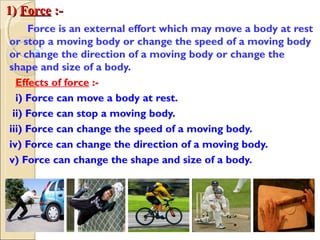
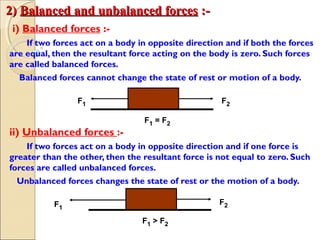
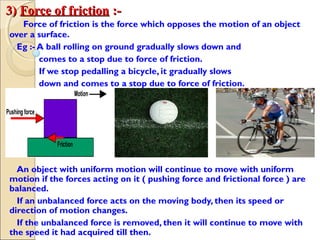
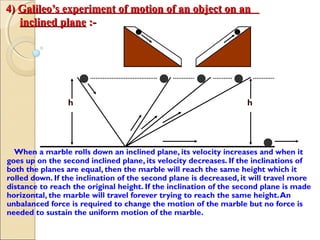
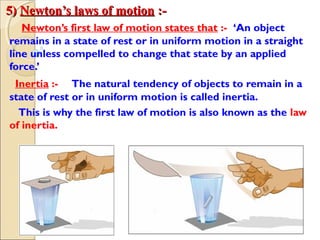
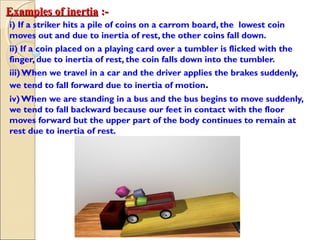

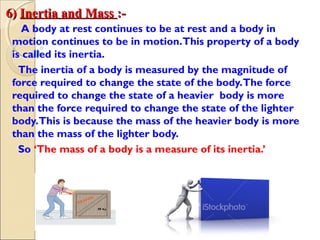
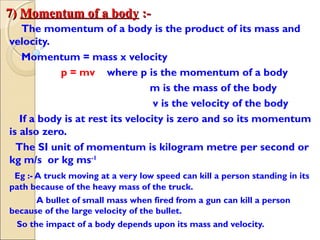
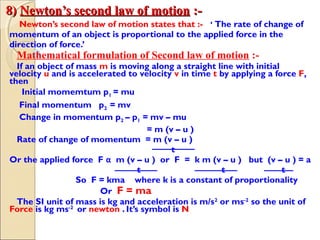
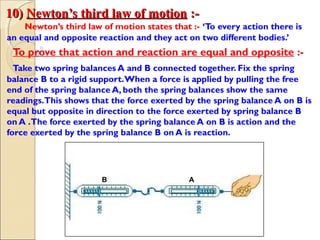
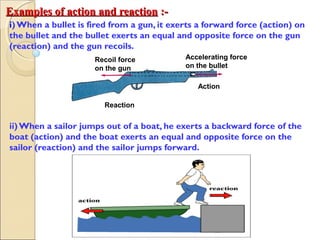
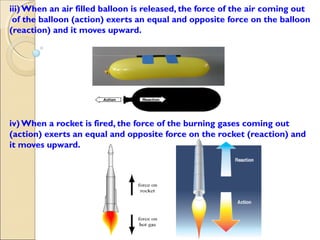
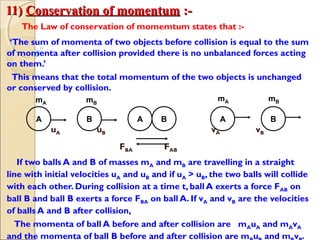
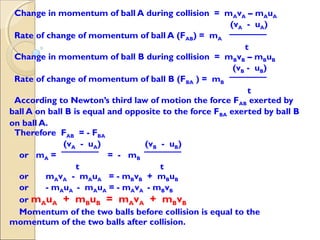

1. Forces can change the motion of an object by moving it from rest, changing its speed or direction. Balanced forces do not change motion while unbalanced forces do. 2. Friction opposes the motion of objects over a surface, causing rolling objects to slow down and stop. Galileo's experiments showed that unbalanced forces are needed to change an object's motion but not to maintain uniform motion. 3. Newton's Second Law states that applying a force to an object will cause it to accelerate, with a greater force producing greater acceleration. Momentum is the product of mass and velocity, and inertia is an object's resistance to changes in its motion.


