SEXUAL REPRODUCTION IN FLOWERING PLANTS-sudhir singh DAV Kathmandu.pptx
sexual reproduction in flowering plants is the second chapter from NCERT Biology(044) which is very important for CBSE BOARD EXAM as well as for NEET EXAMINATION.
• Modified shoot.
•Develops from floral primordia.
• Primordia develop first into floral bud and then into a
flower.
• Reproductive part of plant.
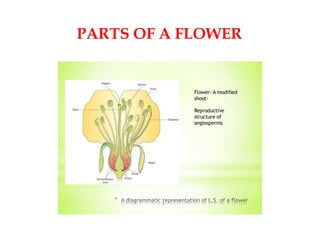
• Androecium is male reproductive whorl, consists of
stamens.
• Gynoecium is female reproductive part of flower, consists
of carpel(S).
FLOWER
4.
STAMEN
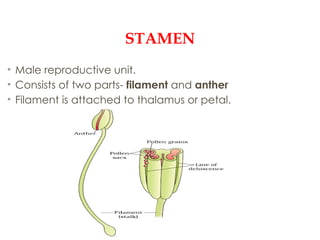
• Male reproductiveunit.
• Consists of two parts- filament and anther
• Filament is attached to thalamus or petal.
STRUCTURE OF ANTHER
(MICROSPORANGIUM)
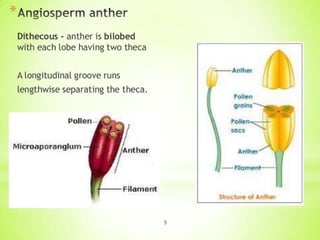
•Bilobed and dithecous.
• A longitudinal groove separate the theca.
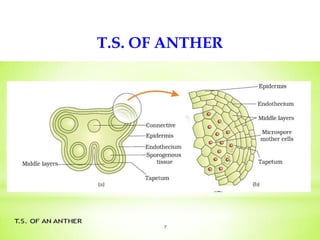
• In a cross- section anther is a tetragonal structure,
consisting of 4 microsporangia, two in each lobes.
• Later two microsporangia of each lobe fuse as a
pollen sac.
8.
STRUCTURE OF ANTHER
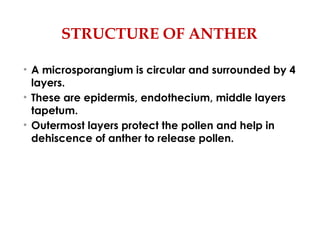
•A microsporangium is circular and surrounded by 4
layers.
• These are epidermis, endothecium, middle layers
tapetum.
• Outermost layers protect the pollen and help in
dehiscence of anther to release pollen.
9.
STRUCTURE OF ANTHER
•Tapetum nourishes the developing pollen grains.
• When the anther is young a group of compactly
arranged homogenous cells called sporogenous tissue
occupies the centre of each microsporangium.
10.
MICROSPOROGENESIS
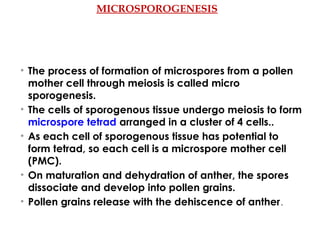
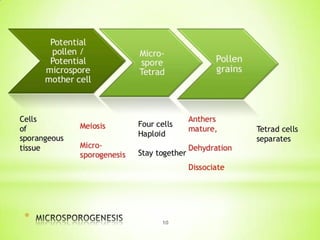
• The processof formation of microspores from a pollen
mother cell through meiosis is called micro
sporogenesis.
• The cells of sporogenous tissue undergo meiosis to form
microspore tetrad arranged in a cluster of 4 cells..
• As each cell of sporogenous tissue has potential to
form tetrad, so each cell is a microspore mother cell
(PMC).
• On maturation and dehydration of anther, the spores
dissociate and develop into pollen grains.
• Pollen grains release with the dehiscence of anther.
12.
POLLEN GRAIN
(MALE GAMETOPHYTE)
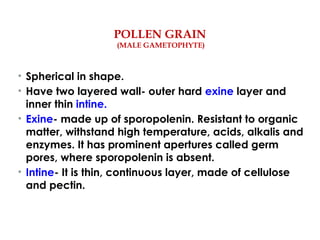
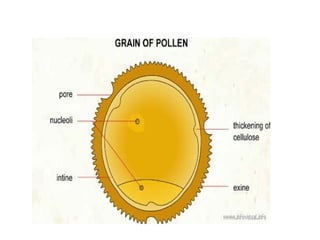
•Spherical in shape.
• Have two layered wall- outer hard exine layer and
inner thin intine.
• Exine- made up of sporopolenin. Resistant to organic
matter, withstand high temperature, acids, alkalis and
enzymes. It has prominent apertures called germ
pores, where sporopolenin is absent.
• Intine- It is thin, continuous layer, made of cellulose
and pectin.
14.
POLLEN GRAIN
(MALE GAMETOPHYTE)
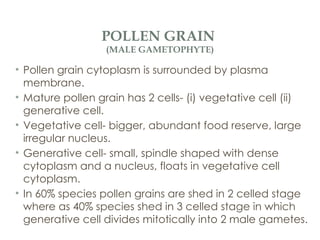
•Pollen grain cytoplasm is surrounded by plasma
membrane.
• Mature pollen grain has 2 cells- (i) vegetative cell (ii)
generative cell.
• Vegetative cell- bigger, abundant food reserve, large
irregular nucleus.
• Generative cell- small, spindle shaped with dense
cytoplasm and a nucleus, floats in vegetative cell
cytoplasm.
• In 60% species pollen grains are shed in 2 celled stage
where as 40% species shed in 3 celled stage in which
generative cell divides mitotically into 2 male gametes.
15.
FEMALE REPRODUCTIVE UNIT-PISTIL
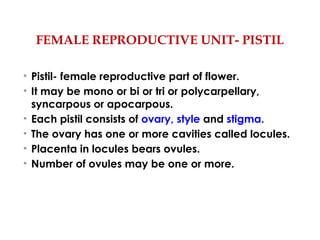
• Pistil- female reproductive part of flower.
• It may be mono or bi or tri or polycarpellary,
syncarpous or apocarpous.
• Each pistil consists of ovary, style and stigma.
• The ovary has one or more cavities called locules.
• Placenta in locules bears ovules.
• Number of ovules may be one or more.
16.
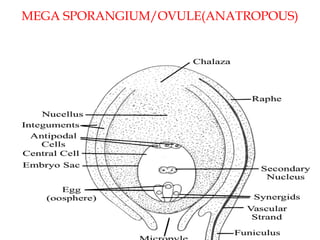
OVULE
• Arises asprimordium on placenta.
• The short stalk which attach ovule with placenta is
funicle.
• The primordium grows into a mass of cells forming
nucellus, the body of ovule.
• The two protective covering of nucellus is
integuments, except at the tip leaving a small
opening called Micropyle.
17.
OVULE
• Basal partof ovule is called chalaza that lie
opposite to micropyle.
• Cells of nucellus are rich in reserve food.
• A single embryo sac or female gametophyte
located in the nucellus, which is developed from
megaspore.
MEGASPOROGENESIS AND DEVELOPMENT
OFFEMALE GAMETOPHYTE
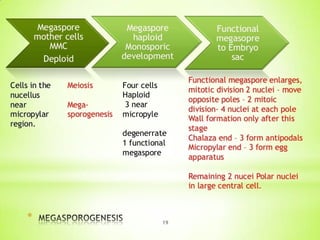
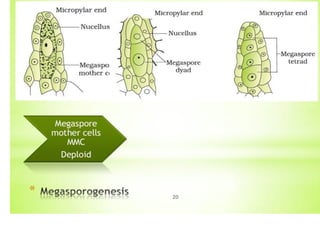
• One of the nucellar cell in the micropylar region is
differentiated into megaspore mother cell.
• The cell is larger, contains dense cytoplasm and a
prominent nucleus.
• It undergoes meiosis forming 4 haploid cells called
megaspore tetrad.
• 3 megaspores degenerate and only one megaspore
become functional.
22.
MEGASPOROGENESIS AND DEVELOPMENT
OFFEMALE GAMETOPHYTE
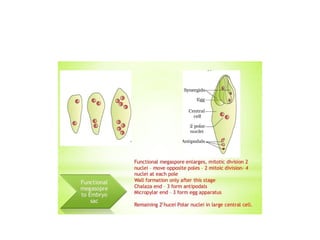
• Functional megaspore is the first cell of female
gametophyte.
• Its nucleus undergoes mitosis and the two nuclei
move to opposite poles and form 2 nucleate
embryo sac.
• Two successive mitotic division in each of these 2
nuclei form an 8 nucleate embryo sac.
25.
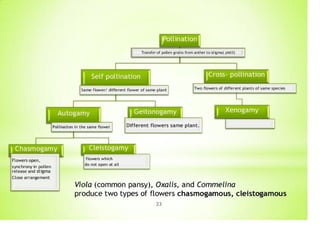
DEVICES FOR AUTOGAMY
•Simultaneous maturation of anther and pistil.
• Anther and stigma lie close to each other.
• Cleistogamous flower (oxalis, commelina,viola)
26.
DEVICES FOR XENOGAMY
•Unisexual flower and diocious plants.
• Pollen release and stigma receptivity are not
• synchronised.
• Different orientation of anther and stigma of
• flower.
• Self incompability.
27.
ADAPTATION OF WINDPOLLINATED
FLOWERS
• Pollen grains are light, non sticky/ dry, sometimes
winged.
• Well exposed anther.
• Large feathery stigma.
• Flowers arranged as inflorescence.
• Single ovules.
28.
ADAPTATION OF WATERPOLLINATED
FLOWERS
• Seen in submerged flowers like Vallisneria and
Hydrilla and Zostera.
• In Vallisneria male flowers released on water surface
and female flowers reaches the surface for
pollination.
• In sea grasses, pollen grains are long ribbon like and
carried passively to submerged female flowers.
• Mucilage coated pollen grains.
29.
ADAPTATION IN INSECTPOLLINATED
FLOWERS
• Large
• Brightly colored and showy.
• If flowers are small, grouped into inflorescence.
• Highly fragrant
• Produce nectar
• Sticky pollen and stigmatic surface
• Provide rewards to animal pollinator such as nectar,
food (pollen) or provide safe place for laying eggs.
30.
POLLEN-PISTIL INTERACTION
• Recognitionof compatible pollen-It is the
interaction between chemical components of
pollen and those of stigma.
• Germination of pollen and development of male
gametophyte-
• (a) compatible pollen starts its germination, stimulated by
certain secretion of stigma.
• (b) intine grows out through one of germ pore.
• (c) content of pollen moves into the tube i.e. vegetative
and generative / 2 male gametes.
31.
POLLEN-PISTIL INTERACTION
• (d)pollen tube grows through the tissues of stigma and style
by secreting enzymes to digest them and enters ovule
through micropyle.
• (e)It enters the embryo sac through filliform apparatus of
one synergids to liberate male gametes.
• (f) germinated pollen grain with pollen tube carrying
vegetative nucleus and 2 male gametes is the fully
developed female gametophyte.
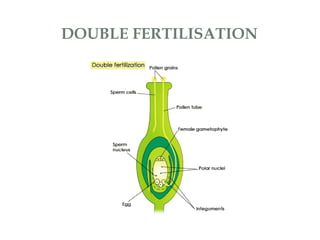
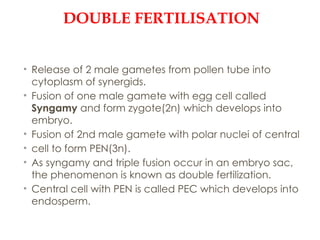
DOUBLE FERTILISATION
• Releaseof 2 male gametes from pollen tube into
cytoplasm of synergids.
• Fusion of one male gamete with egg cell called
Syngamy and form zygote(2n) which develops into
embryo.
• Fusion of 2nd male gamete with polar nuclei of central
• cell to form PEN(3n).
• As syngamy and triple fusion occur in an embryo sac,
the phenomenon is known as double fertilization.
• Central cell with PEN is called PEC which develops into
endosperm.
34.
POST FERTILISATION EVENTS
•Development of endosperm
• Development of embryo
• Maturation of ovule into seed
• Maturation of ovary into fruit.
35.
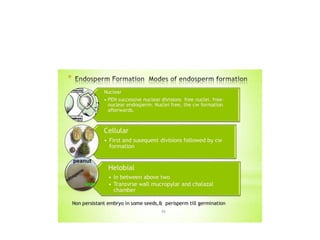
ENDOSPERM
• Its developmentprecedes embryo development.
• There are 3 methods of embryo development :
nuclear, cellular, helobial.
• In nuclear type PEN divides mitotically without
cytokinesis and endosperm is free nuclear, then cell
wall formation starts from periphery and endosperm
become nuclear.
• It provides food to developing embryo.
• If endosperm is completely utilised by embryo, seed
is non-albuminous, if present ,seed is albuminous.
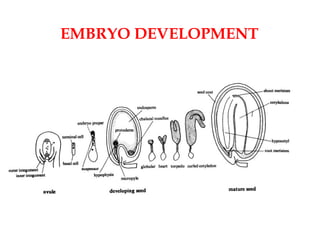
EMBRYO
• It startsafter certain embryo formation.
• Zygote divides mitotically and form proembryo.
• Then it develops into globular and heart shaped
embryo and then horse shoe shaped mature
embryo with one or two cotyledon.
39.
SPECIAL REPRODUCTION
(APOMIXIS /AGAMOSPORY)
• Seeds are formed without fertilisation.
• It may develop if a diploid egg cell develops into
embryo without fertilisation.
• If cells of nucellus may develop into embryo and
pushed into the embryo.
40.
SPECIAL REPRODUCTION
(POLYEMBRYONY)
• Ifmore than one egg may form in embryo sac.
• If more than one embryo sac formed in an ovule.
• Other cells like synergids or nucellus develop into
embryo.
• E.g. orange, lemon, mango, onion, groundnut etc.
 Most read
 Most read
 Most read