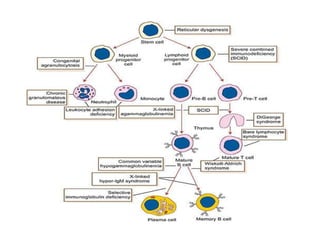
Immunodeficiency
By PHD Student Sajjad Alfadul
Immunodeficiency
Defect in 1 or more components of immune system and lead to
failure of the immune system to protect against disease or
malignancy
Types:
 Primary or Congenital:
 Caused by genetic defects that lead to impaired maturation or
function of different components of the immune system.
 Frequently manifested in infancy and early childhood but is
sometimes clinically detected later in life.
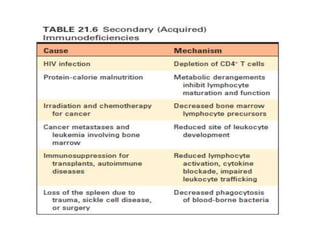
 Secondary or Acquired:
 Loss or decreased function of various components of the immune
cells due to disseminated cancer, treatment with
immunosuppressive drugs, burns, trauma, radiation,
chemotherapy, surgery, aging, malnutrition or infection of cells of
the immune system, most notably with the human
immunodeficiency virus (HIV).
Types of inheritance in immunodeficiency
Autosomal recessive (most AA normal; Aa carrier; aa
affected) A genetic condition can occur when the child inherits
one copy of a mutated (changed) gene from each parent. –
majority of immunodeficiency
Autosomal dominant (Aa affected; aa is normal)
A genetic condition can occur when the child inherits the
abnormal gene from only one parent. e.g. DiGeorge syndrome
X-linked (XX carrier daughter; XY affected son)
Means that the gene causing the trait or the disorder is located
on the X chromosome. e.g. X-Linked Agammaglobulinemic
(XLA)
Congenital (Primary) immunodeficiency
In different primary immunodeficiency, the
causative abnormality may be in components of the
innate immune system, or different stages of
lymphocyte development and activation
primary immunodeficiency include:
Combined T- & B-Cell Deficiency
T-Cell Deficiencies
B-Cell Deficiencies
defects in components of the innate immune
system
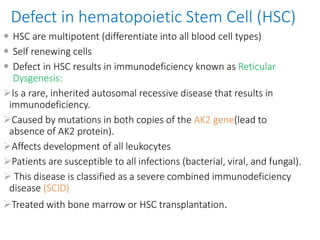
Defect in hematopoietic Stem Cell (HSC)
 HSC are multipotent (differentiate into all blood cell types)
 Self renewing cells
 Defect in HSC results in immunodeficiency known as Reticular
Dysgenesis:
Is a rare, inherited autosomal recessive disease that results in
immunodeficiency.
Caused by mutations in both copies of the AK2 gene(lead to
absence of AK2 protein).
Affects development of all leukocytes
Patients are susceptible to all infections (bacterial, viral, and fungal).
 This disease is classified as a severe combined immunodeficiency
disease (SCID)
Treated with bone marrow or HSC transplantation.
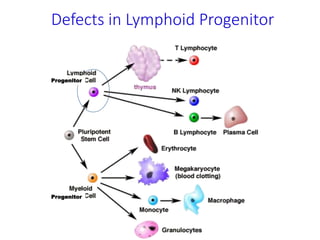
Defects in Lymphoid Progenitor
Progenitor
Progenitor
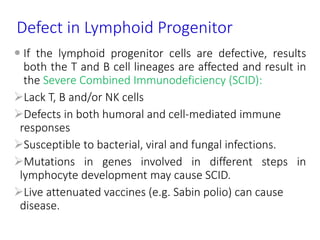
Defect in Lymphoid Progenitor
 If the lymphoid progenitor cells are defective, results
both the T and B cell lineages are affected and result in
the Severe Combined Immunodeficiency (SCID):
Lack T, B and/or NK cells
Defects in both humoral and cell-mediated immune
responses
Susceptible to bacterial, viral and fungal infections.
Mutations in genes involved in different steps in
lymphocyte development may cause SCID.
Live attenuated vaccines (e.g. Sabin polio) can cause
disease.
Types of SCID
RAG-1/2 (Recombinase activating gene) deficiency:
Genes that encode the recombinase enzymes that catalyze the
recombination of the DNA required to generate the T-cell antigen
receptor and the IgM monomer on the B cell that acts as the antigen
receptor.
IL-2R γ gene defect (X-linked):
• Is caused by mutations in the one gene encoding the common γ (γc)
chain shared by the receptors for the cytokines IL-2, IL-4, IL-7, IL-9,
and IL-15, that are responsible for proliferation and development of
lymphocyte
 Adenosine deaminase (ADA) deficiency:
• Enzyme responsible for converting adenosine to inosine
• ADA deficiency (due to mutations in the ADA gene) leads to
accumulation of adenosine which results in production of toxic
metabolites that accumulation in lymphocytes.
Defect in T cell (T cell deficiency)
•T cell deficiency affects not only cell-mediated
immunity but also humoral immunity.
• The patients are susceptible to viral, protozoal and
fungal infections as well as to intracellular bacterial
infections.
•There are many of diseases that are associated with
T cell deficiency:
(DiGeorge’s syndrome)
Ataxia-telangiectasia
Wiskott-Aldrich syndrome
Bare lymphocyte syndrome
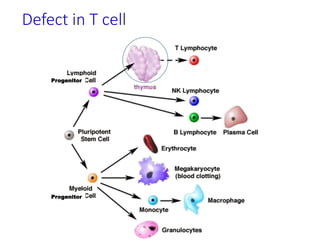
Defect in T cell
Progenitor
Progenitor
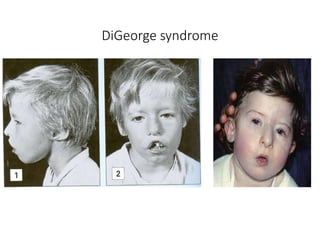
DiGeorge’s syndrome
Autosomal dominant trait characterized by cellular (T-cell)
deficiency results from deletion of a region on chromosome 22
during development of 3rd and 4th pharyngeal pouch. The
patients with DiGeorge Syndrome may have:
• Thymic aplasia (leading to deficient T cell maturation)
• Congenital heart problems
• hypocalcemia/hypoparathyroidism (due to defect development
in parathyroid glands)
• Cleft palate
• low set notched ears and fish-shaped mouth
• Developmental delays
About 90% of cases occur due to a new mutation during early
development, while 10% are inherited from a person's parents.
Treatment is with a thymic graft.
DiGeorge syndrome
Ataxia-telangiectasia
It is an autosomal recessive that affects the nervous system,
immune system, and other body systems disease caused by
mutations in the ATM genes that encode DNA repair enzymes.
Ataxia meaning (difficulty in maintaining balance) and
telangiectasia (enlarged small blood vessels of the conjunctivas
and skin).
 About two-thirds of patients have lymphopenia and low
immunoglobulins, particularly IgA, which results in recurrent
pyogenic upper respiratory infections.
Patients with Ataxia may have:
• Ataxia (difficulty with control of movement) in early childhood.
• Oculomotor apraxia (difficulty with coordination of head and
eye movement)
• Slowed rate of growth, decreasing mental development,
Wiskott-Aldrich syndrome
It is an X-linked disease caused by mutations in the
WAS gene (lead to lack of any functional WAS protein),
leading to a defect in actin filament assembly that is
important for T cells to respond to antigen presentation
and for B cells to be activated by signals from the B-cell
receptor.
Wiskott-Aldrich syndrome is characterized:
•Abnormal or nonfunctional immune system cells
•Poorly responds to polysaccharide infection
•Eczema
•low platelets (thrompocytopenia)
•purpura, or variably sized rashes made up of tiny red
spots called petechiae
Bare lymphocyte syndrome
IS a rare recessive genetic condition characterized
defective MHC class II expression due to defects in
transcription factors that regulating MHC class II
gene expression like (CIITA), causing inability to
display antigens to T cells.
Deficiency in CD4+ T cells; defective cell-mediated
immunity and T-dependent humoral immune
responses.
It is a form of severe combined immunodeficiency
(SCID)
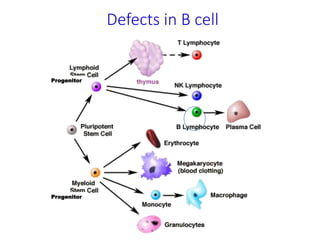
Defects in B cell
Progenitor
Progenitor
X-linked Agammaglobulinemia (x-LA)
Is caused by mutations or deletions in the gene
encoding an enzyme called Bruton tyrosine kinase
(Btk) that result in a failure of B cells to mature.
The disease is characterized by decreased in all
serum Ig isotypes and reduced B cell numbers.
T cell–mediated reactions are normal.
Selective IgA deficiency
It is the disease that characterized by decreased
level of IgA
IgA deficiency results from a defect in the class
switching, due to mutations in TACI (transmembrane
activator and calcium modulator and cyclophilin
ligand interactor), in some patients.
Recurrent respiratory, gastrointestinal and/or
genitourinary infection
Common variable immunodeficiency
(CVID)
Is a group of heterogeneous disorders
characrtrized by reduced levels of serum Ig,
impaired antibody responses to infection and
vaccines, and increased incidence of infections.
Occur due to fail of B cell to differentiation into
plasma cell (Due mutations in ICOS and TACI )
Patents become susceptible to pyogenic bacteria
and intestinal protozoa.
Hyper-IgM Syndrome
It condition that characterized with high level of IgM
,but exhibit deficiency in IgG, IgA and IgE
 Occur due to a defect in the differentiation
(switching) of IgM producing cells to cells producing
other Igs.
 Defect of switching of IgM are due to defect in gene
encoding CD40L.
 Treatment with pooled gamma globulin.
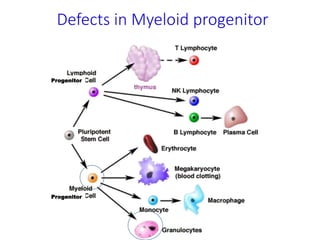
Defects in Myeloid progenitor
Progenitor
Progenitor
. Defects in Myeloid progenitor
Causes immunodeficiency that effect on non
specific immune system like
Phagocytes
NK cells
Complement
Congenital Agranulomatosis
Patients have a decrease in the neutrophil count.
It is due to a defect in the myeloid progenitor cell
that differentiation into neutrophils.
These patients are treated with granulocyte-
macrophage colony stimulating factor (GM-CSF) or
granulocyte colony stimulating factor (G-CSF).
Chronic Granulomatous Disease
Defective production of reactive oxygen species
(ROS) by phagocytes; due to defects in NADPH
oxidase and results in a failure to kill phagocytosed
microbes.
This is an autosomal recessive or X-linked trait.
Have recurrent bacterial and fungal infections.
Treated with antibiotics/IFN-g against infections.
Leukocyte Adhesion Deficiencies
Are a group of autosomal recessive disorders caused by
defects in leukocyte and endothelial adhesion molecules
like(integrins).
These diseases are characterized by a failure of
leukocyte, particularly neutrophil, recruitment to sites
of infection, adhesion to endothelial cells, and rolling
due to mutations in different genes.
Treated with BM transplantation or with gene therapy.
Chédiak-Higashi syndrome
Is a rare autosomal recessive result in defective
phagosome lysosome fusion and lysosomal function
in neutrophils, macrophages, dendritic cells, NK
cells, cytotoxic T cells, and many other cell types;
due to mutation in LYST gene.
Complement Deficiencies
Patients with C3 deficiency are particularly
susceptible to sepsis with pyogenic bacteria
such as S. aureus.
Patients with deficiencies C6, C7, or C8 (which
form the membrane attack complex) become
susceptible Neisseria meningitidis or Neisseria
gonorrhoeae.
Pattern-Recognition Receptor Deficiency
Occur due to mutations in the genes that encoding
the pattern recognition receptors (PRRs) on the
surface of cells (e.x TLR-5) and within the cells (e.x
RIG,NOD) of the innate immune system result in
susceptibility to severe infections
Secondary or Acquired Immunodeficiency
Deficiencies of the immune system often
develop because of abnormalities that are not
genetic but acquired during life.
Immunodeficiency
Immunodeficiency

Immunodeficiency

  • 1.
  • 2.
    Immunodeficiency Defect in 1or more components of immune system and lead to failure of the immune system to protect against disease or malignancy Types:  Primary or Congenital:  Caused by genetic defects that lead to impaired maturation or function of different components of the immune system.  Frequently manifested in infancy and early childhood but is sometimes clinically detected later in life.  Secondary or Acquired:  Loss or decreased function of various components of the immune cells due to disseminated cancer, treatment with immunosuppressive drugs, burns, trauma, radiation, chemotherapy, surgery, aging, malnutrition or infection of cells of the immune system, most notably with the human immunodeficiency virus (HIV).
  • 3.
    Types of inheritancein immunodeficiency Autosomal recessive (most AA normal; Aa carrier; aa affected) A genetic condition can occur when the child inherits one copy of a mutated (changed) gene from each parent. – majority of immunodeficiency Autosomal dominant (Aa affected; aa is normal) A genetic condition can occur when the child inherits the abnormal gene from only one parent. e.g. DiGeorge syndrome X-linked (XX carrier daughter; XY affected son) Means that the gene causing the trait or the disorder is located on the X chromosome. e.g. X-Linked Agammaglobulinemic (XLA)
  • 4.
    Congenital (Primary) immunodeficiency Indifferent primary immunodeficiency, the causative abnormality may be in components of the innate immune system, or different stages of lymphocyte development and activation primary immunodeficiency include: Combined T- & B-Cell Deficiency T-Cell Deficiencies B-Cell Deficiencies defects in components of the innate immune system
  • 6.
    Defect in hematopoieticStem Cell (HSC)  HSC are multipotent (differentiate into all blood cell types)  Self renewing cells  Defect in HSC results in immunodeficiency known as Reticular Dysgenesis: Is a rare, inherited autosomal recessive disease that results in immunodeficiency. Caused by mutations in both copies of the AK2 gene(lead to absence of AK2 protein). Affects development of all leukocytes Patients are susceptible to all infections (bacterial, viral, and fungal).  This disease is classified as a severe combined immunodeficiency disease (SCID) Treated with bone marrow or HSC transplantation.
  • 7.
    Defects in LymphoidProgenitor Progenitor Progenitor
  • 8.
    Defect in LymphoidProgenitor  If the lymphoid progenitor cells are defective, results both the T and B cell lineages are affected and result in the Severe Combined Immunodeficiency (SCID): Lack T, B and/or NK cells Defects in both humoral and cell-mediated immune responses Susceptible to bacterial, viral and fungal infections. Mutations in genes involved in different steps in lymphocyte development may cause SCID. Live attenuated vaccines (e.g. Sabin polio) can cause disease.
  • 9.
    Types of SCID RAG-1/2(Recombinase activating gene) deficiency: Genes that encode the recombinase enzymes that catalyze the recombination of the DNA required to generate the T-cell antigen receptor and the IgM monomer on the B cell that acts as the antigen receptor. IL-2R γ gene defect (X-linked): • Is caused by mutations in the one gene encoding the common γ (γc) chain shared by the receptors for the cytokines IL-2, IL-4, IL-7, IL-9, and IL-15, that are responsible for proliferation and development of lymphocyte  Adenosine deaminase (ADA) deficiency: • Enzyme responsible for converting adenosine to inosine • ADA deficiency (due to mutations in the ADA gene) leads to accumulation of adenosine which results in production of toxic metabolites that accumulation in lymphocytes.
  • 10.
    Defect in Tcell (T cell deficiency) •T cell deficiency affects not only cell-mediated immunity but also humoral immunity. • The patients are susceptible to viral, protozoal and fungal infections as well as to intracellular bacterial infections. •There are many of diseases that are associated with T cell deficiency: (DiGeorge’s syndrome) Ataxia-telangiectasia Wiskott-Aldrich syndrome Bare lymphocyte syndrome
  • 11.
    Defect in Tcell Progenitor Progenitor
  • 12.
    DiGeorge’s syndrome Autosomal dominanttrait characterized by cellular (T-cell) deficiency results from deletion of a region on chromosome 22 during development of 3rd and 4th pharyngeal pouch. The patients with DiGeorge Syndrome may have: • Thymic aplasia (leading to deficient T cell maturation) • Congenital heart problems • hypocalcemia/hypoparathyroidism (due to defect development in parathyroid glands) • Cleft palate • low set notched ears and fish-shaped mouth • Developmental delays About 90% of cases occur due to a new mutation during early development, while 10% are inherited from a person's parents. Treatment is with a thymic graft.
  • 13.
  • 14.
    Ataxia-telangiectasia It is anautosomal recessive that affects the nervous system, immune system, and other body systems disease caused by mutations in the ATM genes that encode DNA repair enzymes. Ataxia meaning (difficulty in maintaining balance) and telangiectasia (enlarged small blood vessels of the conjunctivas and skin).  About two-thirds of patients have lymphopenia and low immunoglobulins, particularly IgA, which results in recurrent pyogenic upper respiratory infections. Patients with Ataxia may have: • Ataxia (difficulty with control of movement) in early childhood. • Oculomotor apraxia (difficulty with coordination of head and eye movement) • Slowed rate of growth, decreasing mental development,
  • 15.
    Wiskott-Aldrich syndrome It isan X-linked disease caused by mutations in the WAS gene (lead to lack of any functional WAS protein), leading to a defect in actin filament assembly that is important for T cells to respond to antigen presentation and for B cells to be activated by signals from the B-cell receptor. Wiskott-Aldrich syndrome is characterized: •Abnormal or nonfunctional immune system cells •Poorly responds to polysaccharide infection •Eczema •low platelets (thrompocytopenia) •purpura, or variably sized rashes made up of tiny red spots called petechiae
  • 16.
    Bare lymphocyte syndrome ISa rare recessive genetic condition characterized defective MHC class II expression due to defects in transcription factors that regulating MHC class II gene expression like (CIITA), causing inability to display antigens to T cells. Deficiency in CD4+ T cells; defective cell-mediated immunity and T-dependent humoral immune responses. It is a form of severe combined immunodeficiency (SCID)
  • 17.
    Defects in Bcell Progenitor Progenitor
  • 18.
    X-linked Agammaglobulinemia (x-LA) Iscaused by mutations or deletions in the gene encoding an enzyme called Bruton tyrosine kinase (Btk) that result in a failure of B cells to mature. The disease is characterized by decreased in all serum Ig isotypes and reduced B cell numbers. T cell–mediated reactions are normal.
  • 19.
    Selective IgA deficiency Itis the disease that characterized by decreased level of IgA IgA deficiency results from a defect in the class switching, due to mutations in TACI (transmembrane activator and calcium modulator and cyclophilin ligand interactor), in some patients. Recurrent respiratory, gastrointestinal and/or genitourinary infection
  • 20.
    Common variable immunodeficiency (CVID) Isa group of heterogeneous disorders characrtrized by reduced levels of serum Ig, impaired antibody responses to infection and vaccines, and increased incidence of infections. Occur due to fail of B cell to differentiation into plasma cell (Due mutations in ICOS and TACI ) Patents become susceptible to pyogenic bacteria and intestinal protozoa.
  • 21.
    Hyper-IgM Syndrome It conditionthat characterized with high level of IgM ,but exhibit deficiency in IgG, IgA and IgE  Occur due to a defect in the differentiation (switching) of IgM producing cells to cells producing other Igs.  Defect of switching of IgM are due to defect in gene encoding CD40L.  Treatment with pooled gamma globulin.
  • 22.
    Defects in Myeloidprogenitor Progenitor Progenitor
  • 23.
    . Defects inMyeloid progenitor Causes immunodeficiency that effect on non specific immune system like Phagocytes NK cells Complement
  • 24.
    Congenital Agranulomatosis Patients havea decrease in the neutrophil count. It is due to a defect in the myeloid progenitor cell that differentiation into neutrophils. These patients are treated with granulocyte- macrophage colony stimulating factor (GM-CSF) or granulocyte colony stimulating factor (G-CSF).
  • 25.
    Chronic Granulomatous Disease Defectiveproduction of reactive oxygen species (ROS) by phagocytes; due to defects in NADPH oxidase and results in a failure to kill phagocytosed microbes. This is an autosomal recessive or X-linked trait. Have recurrent bacterial and fungal infections. Treated with antibiotics/IFN-g against infections.
  • 26.
    Leukocyte Adhesion Deficiencies Area group of autosomal recessive disorders caused by defects in leukocyte and endothelial adhesion molecules like(integrins). These diseases are characterized by a failure of leukocyte, particularly neutrophil, recruitment to sites of infection, adhesion to endothelial cells, and rolling due to mutations in different genes. Treated with BM transplantation or with gene therapy.
  • 27.
    Chédiak-Higashi syndrome Is arare autosomal recessive result in defective phagosome lysosome fusion and lysosomal function in neutrophils, macrophages, dendritic cells, NK cells, cytotoxic T cells, and many other cell types; due to mutation in LYST gene.
  • 28.
    Complement Deficiencies Patients withC3 deficiency are particularly susceptible to sepsis with pyogenic bacteria such as S. aureus. Patients with deficiencies C6, C7, or C8 (which form the membrane attack complex) become susceptible Neisseria meningitidis or Neisseria gonorrhoeae.
  • 29.
    Pattern-Recognition Receptor Deficiency Occurdue to mutations in the genes that encoding the pattern recognition receptors (PRRs) on the surface of cells (e.x TLR-5) and within the cells (e.x RIG,NOD) of the innate immune system result in susceptibility to severe infections
  • 30.
    Secondary or AcquiredImmunodeficiency Deficiencies of the immune system often develop because of abnormalities that are not genetic but acquired during life.

Editor's Notes