This chapter willintroduce several concepts about
communication beginning from the Ancient Greeks
until the 21st
century. It will illuminate several
perspectives about communication, the most
important one being that is a necessary and
important skill that should be honed to become
better citizens and to help in building one’s society.
It will explore the use of English in the world, as well
as its usage in the Philippines. It will also discuss the
perils of language, and how we can find the seeds of
racism, sexism, and classism in the language that we
use – and what one can do to ensure that one’s
language is as academic and inclusive as possible.
3.
Chapter Objectives:
By theend of this chapter, you should be able to:
1. have a thorough understanding of communication models and
processes;
2. understand the importance of ethics in communication and
academic writing; and
3. discover how the English language spread throughout the
world,and appreciate the differences between Standard English,
World Englishes, and Philippine English.
4.
1. Why iscommunication
important to you?
2. Why is communication
important to society?
3. Why do you think
communication skills are
considered to be
essential in being good
citizens?
5.
introduction
“ The artof communication is the language of
leadership” (James Humes)
It is a mistake to believe that communication is a
simple process. Although people communicate with
one another every day, the real question is whether
the ideas one has expressed are truly understood by
another.
The art ofone’s communication
reflects the art of one’s thinking.
According to James Berlin (1982), one
of the major proponents of The New
Rhetoric, “In teaching writing, we are
not simply offering training in a useful
technical skill that is meant as a
simple complement to the more
important studies of other areas. We
are teaching a way of experiencing
the world, a way of ordering and
making sense of it” (776)
8.
What doesBerlin mean when he
says “ (In teaching writing), we are
teaching a way of experiencing the
world, a way of ordering and
making sense of it”?
9.
The earliest model
comesfrom Aristotle
at around 5 B.C. In
this model, Aristotle
explains that
speakers should
adjust their messages
according to their
audience and the
occasion to achieve a
particular effect.
11.
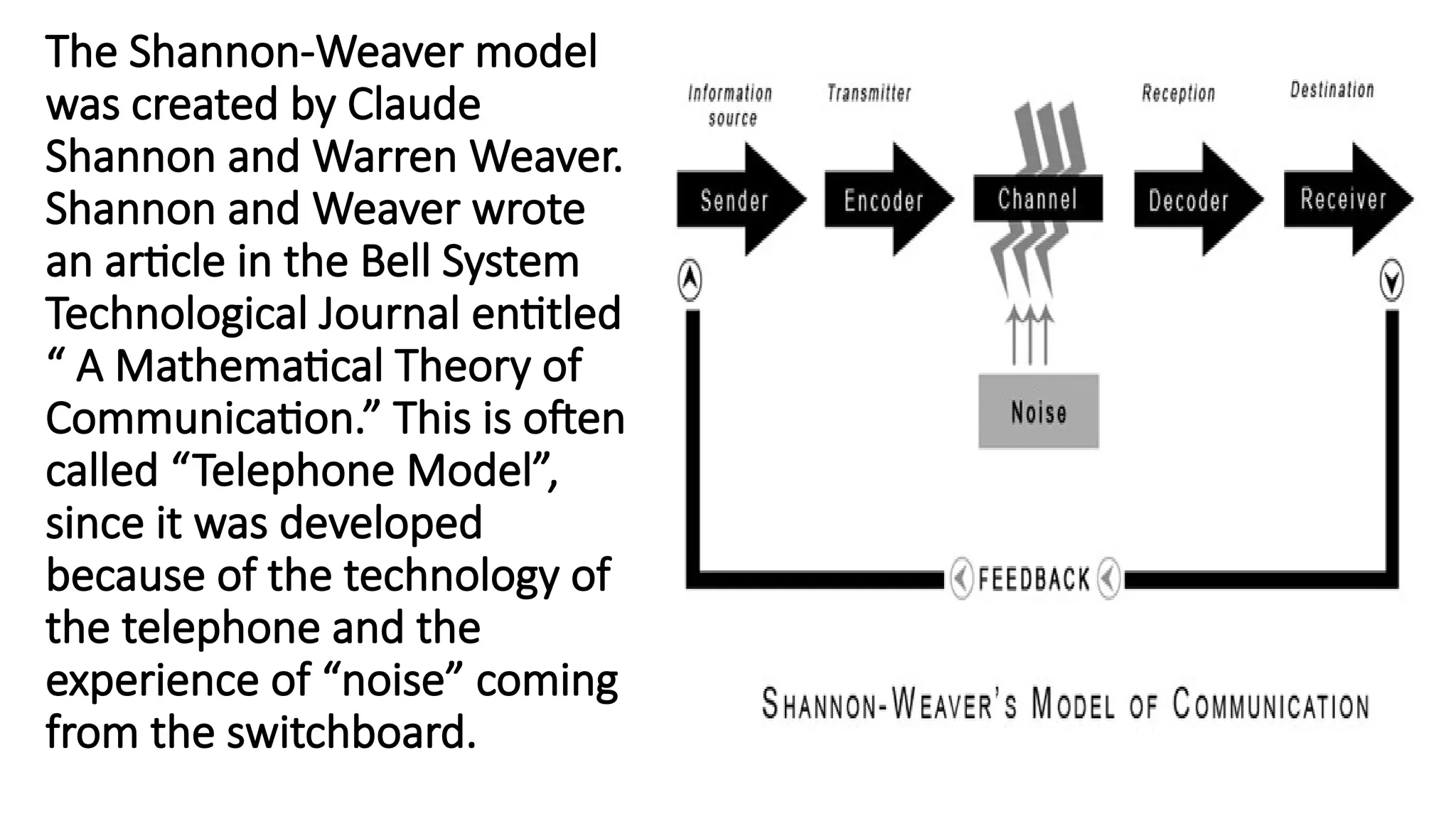
The Shannon-Weaver model
wascreated by Claude
Shannon and Warren Weaver.
Shannon and Weaver wrote
an article in the Bell System
Technological Journal entitled
“ A Mathematical Theory of
Communication.” This is often
called “Telephone Model”,
since it was developed
because of the technology of
the telephone and the
experience of “noise” coming
from the switchboard.
13.
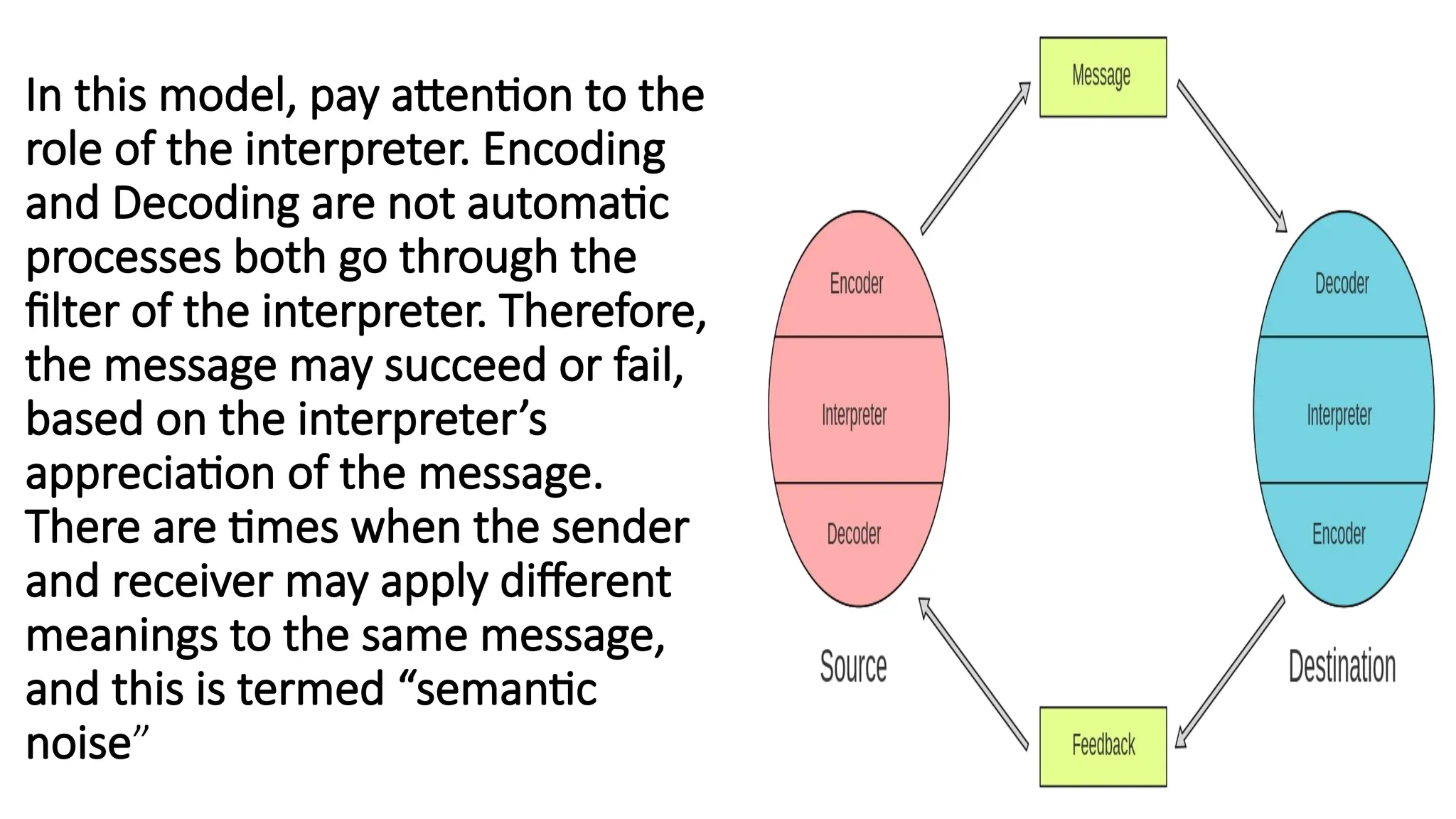
In this model,pay attention to the
role of the interpreter. Encoding
and Decoding are not automatic
processes both go through the
filter of the interpreter. Therefore,
the message may succeed or fail,
based on the interpreter’s
appreciation of the message.
There are times when the sender
and receiver may apply different
meanings to the same message,
and this is termed “semantic
noise”
14.
His second model,on the other
hand, builds this theory about the
interpreter into the different fields of
experience of the sender and the
receiver.For the message to reach
the receiver, there must be a
common field of experience between
the sender and the receiver.
Although the receiver might not fully
appreciate all the nuances of the
message, as there are parts of the
sender’s experience that the receiver
has no knowledge of, the receiver
may still understand the core
meaning of the message.
16.
The last modelis Eugene White’s Stages of
Oral Communication. According to White, it
is possible at any of the stages outlined in
his model. People are under the mistaken
impression that when we communicate,
we usually start with thinking, but that is
not necessarily the case. Since it is a
circular model, it means that oral
communication is a continuous process
with no real beginning or end. The most
important contribution from Eugene
White’s Model is the concept of feedback,
which can only be processed by the
speaker if he or she has been monitoring
the audience or the listener. Hence, the
speaker must also pay attention to the
listener’s verbal and non-verbal cues.
19.
Learning Task:
Break intofive small groups.
Each group should do the
following:
1. Through a role play, explain
the communication model
assigned to them which
shows both successful and
failed communication
2. Use their own examples to
explain the model.










![PROCESS OF COMMUNICATION [Autosaved].pptx](https://cdn.slidesharecdn.com/ss_thumbnails/processofcommunicationautosaved-230213040504-e4f1dc44-thumbnail.jpg?width=640&height=640&fit=bounds)


