The Communication Tradition


      Week One: Chapter One
Chapter One Objectives:
• Identify the four periods of rhetorical study
• Describe the way in which scholars viewed
  communication in the classical period
• Describe the five canons of rhetoric
• Explain the major characteristics of
  communication study during the medieval period
  and the Renaissance
• Outline rhetorical study during the modern
  period
• Distinguish between humanistic and scientific
  approaches to communication study
The Four Periods of Rhetorical Study

The Classical Period   The Medieval Period
 (500BC – 400CE)          (400 – 1600)
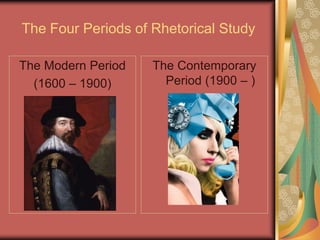
The Four Periods of Rhetorical Study

The Modern Period   The Contemporary
  (1600 – 1900)       Period (1900 – )
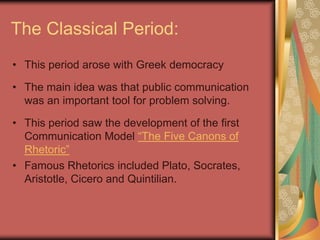
The Classical Period:
• This period arose with Greek democracy

• The main idea was that public communication
  was an important tool for problem solving.

• This period saw the development of the first
  Communication Model “The Five Canons of
  Rhetoric”
• Famous Rhetorics included Plato, Socrates,
  Aristotle, Cicero and Quintilian.
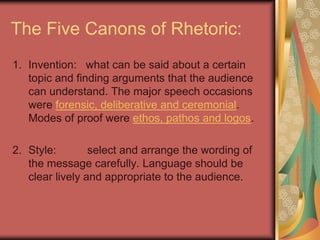
The Five Canons of Rhetoric:
1. Invention: what can be said about a certain
   topic and finding arguments that the audience
   can understand. The major speech occasions
   were forensic, deliberative and ceremonial.
   Modes of proof were ethos, pathos and logos.

2. Style:        select and arrange the wording of
   the message carefully. Language should be
   clear lively and appropriate to the audience.
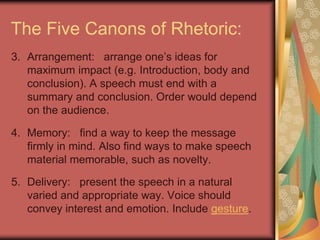
The Five Canons of Rhetoric:
3. Arrangement: arrange one‟s ideas for
   maximum impact (e.g. Introduction, body and
   conclusion). A speech must end with a
   summary and conclusion. Order would depend
   on the audience.

4. Memory: find a way to keep the message
   firmly in mind. Also find ways to make speech
   material memorable, such as novelty.

5. Delivery: present the speech in a natural
   varied and appropriate way. Voice should
   convey interest and emotion. Include gesture.
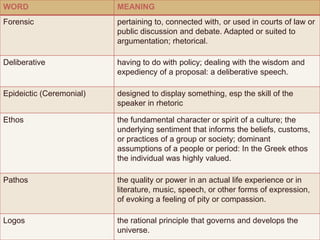
WORD                      MEANING
Forensic                  pertaining to, connected with, or used in courts of law or
                          public discussion and debate. Adapted or suited to
                          argumentation; rhetorical.

Deliberative              having to do with policy; dealing with the wisdom and
                          expediency of a proposal: a deliberative speech.

Epideictic (Ceremonial)   designed to display something, esp the skill of the
                          speaker in rhetoric

Ethos                     the fundamental character or spirit of a culture; the
                          underlying sentiment that informs the beliefs, customs,
                          or practices of a group or society; dominant
                          assumptions of a people or period: In the Greek ethos
                          the individual was highly valued.

Pathos                    the quality or power in an actual life experience or in
                          literature, music, speech, or other forms of expression,
                          of evoking a feeling of pity or compassion.

Logos                     the rational principle that governs and develops the
                          universe.
The Medieval Period:
• This period arose with the rise of monolithic
  Christianity. Rhetoric became second to
  theology.

• The main idea was an emphasis on letters and
  preaching, with the focus being prescriptive not
  theoretical. The emphasis was also on
  embellishing and amplifying rhetorical style.

• Famous Rhetorics included Augustine,
  Cassiodorus, John of Salisbury and Erasmus.
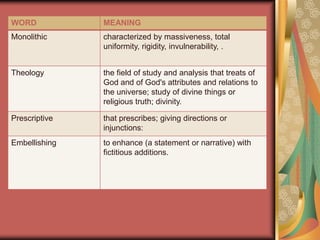
WORD           MEANING
Monolithic     characterized by massiveness, total
               uniformity, rigidity, invulnerability, .


Theology       the field of study and analysis that treats of
               God and of God's attributes and relations to
               the universe; study of divine things or
               religious truth; divinity.

Prescriptive   that prescribes; giving directions or
               injunctions:
Embellishing   to enhance (a statement or narrative) with
               fictitious additions.
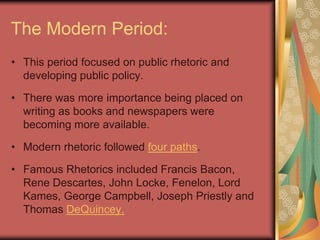
The Modern Period:
• This period focused on public rhetoric and
  developing public policy.

• There was more importance being placed on
  writing as books and newspapers were
  becoming more available.

• Modern rhetoric followed four paths.

• Famous Rhetorics included Francis Bacon,
  Rene Descartes, John Locke, Fenelon, Lord
  Kames, George Campbell, Joseph Priestly and
  Thomas DeQuincey.
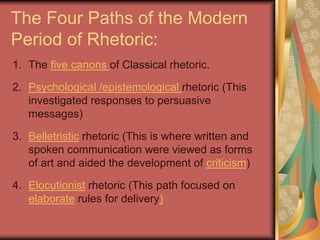
The Four Paths of the Modern
Period of Rhetoric:
1. The five canons of Classical rhetoric.

2. Psychological /epistemological rhetoric (This
   investigated responses to persuasive
   messages)

3. Belletristic rhetoric (This is where written and
   spoken communication were viewed as forms
   of art and aided the development of criticism)

4. Elocutionist rhetoric (This path focused on
   elaborate rules for delivery)
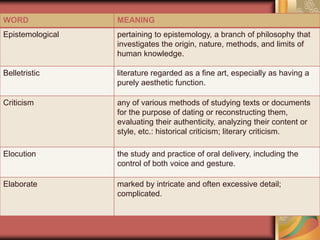
WORD              MEANING
Epistemological   pertaining to epistemology, a branch of philosophy that
                  investigates the origin, nature, methods, and limits of
                  human knowledge.

Belletristic      literature regarded as a fine art, especially as having a
                  purely aesthetic function.

Criticism         any of various methods of studying texts or documents
                  for the purpose of dating or reconstructing them,
                  evaluating their authenticity, analyzing their content or
                  style, etc.: historical criticism; literary criticism.

Elocution         the study and practice of oral delivery, including the
                  control of both voice and gesture.

Elaborate         marked by intricate and often excessive detail;
                  complicated.
Contemporary Period:
• This period saw the study of communication divide
  into two sides: Rhetoric and Communication Theory

• Rhetoricians used humanistic methods to analyse
  public discussion.

• Communication Theorists used scientific methods to
  analyse communication behaviors.

• This period also expanded communication study to
  include interpersonal, group and public
  communication.

• The rise in electronic media and rapid development
  of technology has also signaled many extra changes
  in communication therefore the study of
  communication.
Humanistic vs. Scientific approaches
to communication study:
• Both approaches want to understand how
  communicators affect each other as they interact.

• Humanistic approaches use the historical and critical
  methods of the humanities in their studies of the
  ways which symbolic activity shapes public response
  to political and ethical issues.

• Scientific methods use controlled laboratory
  experimentations, with careful, objective
  measurement to reduce a phenomenon to its most
  basic elements and variables. They would then test
  these variables in other controlled conditions. Areas
  of science such as psychology, anthropology and
  sociology developed during this contemporary period.
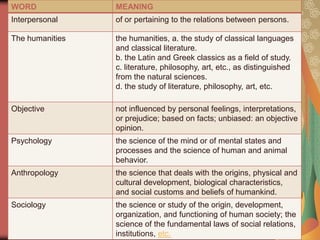
WORD             MEANING
Interpersonal    of or pertaining to the relations between persons.

The humanities   the humanities, a. the study of classical languages
                 and classical literature.
                 b. the Latin and Greek classics as a field of study.
                 c. literature, philosophy, art, etc., as distinguished
                 from the natural sciences.
                 d. the study of literature, philosophy, art, etc.

Objective        not influenced by personal feelings, interpretations,
                 or prejudice; based on facts; unbiased: an objective
                 opinion.
Psychology       the science of the mind or of mental states and
                 processes and the science of human and animal
                 behavior.
Anthropology     the science that deals with the origins, physical and
                 cultural development, biological characteristics,
                 and social customs and beliefs of humankind.
Sociology        the science or study of the origin, development,
                 organization, and functioning of human society; the
                 science of the fundamental laws of social relations,
                 institutions, etc.
Studying Communication:
• People who study communication (Rhetoricians and
  Communication Scientists) can enter into professions
  such as: speechwriters, political consultants,
  politicians, legal consultants, lawyers, advertising
  executives, public relations experts, counselors,
  organizational training and development specialists,
  professional negotiators, personnel managers,
  specialists in information storage and retrieval, radio
  or television performers, media consultants, and so
  on!

• Communication study is something that could help
  you in any future profession, and can even help in
  your personal life.
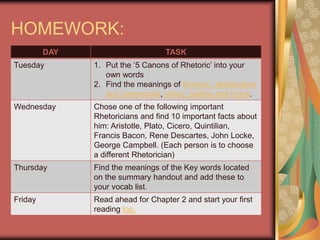
HOMEWORK:
         DAY                       TASK
Tuesday        1. Put the „5 Canons of Rhetoric‟ into your
                  own words
               2. Find the meanings of forensic, deliberative
                  and ceremonial, ethos, pathos and logos.
Wednesday      Chose one of the following important
               Rhetoricians and find 10 important facts about
               him: Aristotle, Plato, Cicero, Quintilian,
               Francis Bacon, Rene Descartes, John Locke,
               George Campbell. (Each person is to choose
               a different Rhetorician)
Thursday       Find the meanings of the Key words located
               on the summary handout and add these to
               your vocab list.
Friday         Read ahead for Chapter 2 and start your first
               reading log.

Chapter 1 the communication tradition

  • 1.
    The Communication Tradition Week One: Chapter One
  • 2.
    Chapter One Objectives: •Identify the four periods of rhetorical study • Describe the way in which scholars viewed communication in the classical period • Describe the five canons of rhetoric • Explain the major characteristics of communication study during the medieval period and the Renaissance • Outline rhetorical study during the modern period • Distinguish between humanistic and scientific approaches to communication study
  • 3.
    The Four Periodsof Rhetorical Study The Classical Period The Medieval Period (500BC – 400CE) (400 – 1600)
  • 4.
    The Four Periodsof Rhetorical Study The Modern Period The Contemporary (1600 – 1900) Period (1900 – )
  • 5.
    The Classical Period: •This period arose with Greek democracy • The main idea was that public communication was an important tool for problem solving. • This period saw the development of the first Communication Model “The Five Canons of Rhetoric” • Famous Rhetorics included Plato, Socrates, Aristotle, Cicero and Quintilian.
  • 6.
    The Five Canonsof Rhetoric: 1. Invention: what can be said about a certain topic and finding arguments that the audience can understand. The major speech occasions were forensic, deliberative and ceremonial. Modes of proof were ethos, pathos and logos. 2. Style: select and arrange the wording of the message carefully. Language should be clear lively and appropriate to the audience.
  • 7.
    The Five Canonsof Rhetoric: 3. Arrangement: arrange one‟s ideas for maximum impact (e.g. Introduction, body and conclusion). A speech must end with a summary and conclusion. Order would depend on the audience. 4. Memory: find a way to keep the message firmly in mind. Also find ways to make speech material memorable, such as novelty. 5. Delivery: present the speech in a natural varied and appropriate way. Voice should convey interest and emotion. Include gesture.
  • 8.
    WORD MEANING Forensic pertaining to, connected with, or used in courts of law or public discussion and debate. Adapted or suited to argumentation; rhetorical. Deliberative having to do with policy; dealing with the wisdom and expediency of a proposal: a deliberative speech. Epideictic (Ceremonial) designed to display something, esp the skill of the speaker in rhetoric Ethos the fundamental character or spirit of a culture; the underlying sentiment that informs the beliefs, customs, or practices of a group or society; dominant assumptions of a people or period: In the Greek ethos the individual was highly valued. Pathos the quality or power in an actual life experience or in literature, music, speech, or other forms of expression, of evoking a feeling of pity or compassion. Logos the rational principle that governs and develops the universe.
  • 9.
    The Medieval Period: •This period arose with the rise of monolithic Christianity. Rhetoric became second to theology. • The main idea was an emphasis on letters and preaching, with the focus being prescriptive not theoretical. The emphasis was also on embellishing and amplifying rhetorical style. • Famous Rhetorics included Augustine, Cassiodorus, John of Salisbury and Erasmus.
  • 10.
    WORD MEANING Monolithic characterized by massiveness, total uniformity, rigidity, invulnerability, . Theology the field of study and analysis that treats of God and of God's attributes and relations to the universe; study of divine things or religious truth; divinity. Prescriptive that prescribes; giving directions or injunctions: Embellishing to enhance (a statement or narrative) with fictitious additions.
  • 11.
    The Modern Period: •This period focused on public rhetoric and developing public policy. • There was more importance being placed on writing as books and newspapers were becoming more available. • Modern rhetoric followed four paths. • Famous Rhetorics included Francis Bacon, Rene Descartes, John Locke, Fenelon, Lord Kames, George Campbell, Joseph Priestly and Thomas DeQuincey.
  • 12.
    The Four Pathsof the Modern Period of Rhetoric: 1. The five canons of Classical rhetoric. 2. Psychological /epistemological rhetoric (This investigated responses to persuasive messages) 3. Belletristic rhetoric (This is where written and spoken communication were viewed as forms of art and aided the development of criticism) 4. Elocutionist rhetoric (This path focused on elaborate rules for delivery)
  • 13.
    WORD MEANING Epistemological pertaining to epistemology, a branch of philosophy that investigates the origin, nature, methods, and limits of human knowledge. Belletristic literature regarded as a fine art, especially as having a purely aesthetic function. Criticism any of various methods of studying texts or documents for the purpose of dating or reconstructing them, evaluating their authenticity, analyzing their content or style, etc.: historical criticism; literary criticism. Elocution the study and practice of oral delivery, including the control of both voice and gesture. Elaborate marked by intricate and often excessive detail; complicated.
  • 14.
    Contemporary Period: • Thisperiod saw the study of communication divide into two sides: Rhetoric and Communication Theory • Rhetoricians used humanistic methods to analyse public discussion. • Communication Theorists used scientific methods to analyse communication behaviors. • This period also expanded communication study to include interpersonal, group and public communication. • The rise in electronic media and rapid development of technology has also signaled many extra changes in communication therefore the study of communication.
  • 15.
    Humanistic vs. Scientificapproaches to communication study: • Both approaches want to understand how communicators affect each other as they interact. • Humanistic approaches use the historical and critical methods of the humanities in their studies of the ways which symbolic activity shapes public response to political and ethical issues. • Scientific methods use controlled laboratory experimentations, with careful, objective measurement to reduce a phenomenon to its most basic elements and variables. They would then test these variables in other controlled conditions. Areas of science such as psychology, anthropology and sociology developed during this contemporary period.
  • 16.
    WORD MEANING Interpersonal of or pertaining to the relations between persons. The humanities the humanities, a. the study of classical languages and classical literature. b. the Latin and Greek classics as a field of study. c. literature, philosophy, art, etc., as distinguished from the natural sciences. d. the study of literature, philosophy, art, etc. Objective not influenced by personal feelings, interpretations, or prejudice; based on facts; unbiased: an objective opinion. Psychology the science of the mind or of mental states and processes and the science of human and animal behavior. Anthropology the science that deals with the origins, physical and cultural development, biological characteristics, and social customs and beliefs of humankind. Sociology the science or study of the origin, development, organization, and functioning of human society; the science of the fundamental laws of social relations, institutions, etc.
  • 17.
    Studying Communication: • Peoplewho study communication (Rhetoricians and Communication Scientists) can enter into professions such as: speechwriters, political consultants, politicians, legal consultants, lawyers, advertising executives, public relations experts, counselors, organizational training and development specialists, professional negotiators, personnel managers, specialists in information storage and retrieval, radio or television performers, media consultants, and so on! • Communication study is something that could help you in any future profession, and can even help in your personal life.
  • 18.
    HOMEWORK: DAY TASK Tuesday 1. Put the „5 Canons of Rhetoric‟ into your own words 2. Find the meanings of forensic, deliberative and ceremonial, ethos, pathos and logos. Wednesday Chose one of the following important Rhetoricians and find 10 important facts about him: Aristotle, Plato, Cicero, Quintilian, Francis Bacon, Rene Descartes, John Locke, George Campbell. (Each person is to choose a different Rhetorician) Thursday Find the meanings of the Key words located on the summary handout and add these to your vocab list. Friday Read ahead for Chapter 2 and start your first reading log.