Business Psychology
Job Analysis
Syed Md. Sajjad Kabir
Lecturer, Dept. of Psychology, CU
SMS Kabir, smskabir@psy.jnu.ac.bd;
smskabir218@gmail.com 1
What is Job Analysis
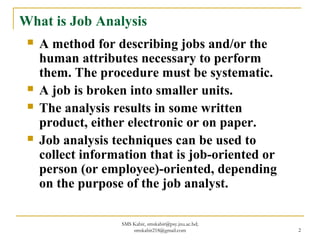
 A method for describing jobs and/or the
human attributes necessary to perform
them. The procedure must be systematic.
 A job is broken into smaller units.
 The analysis results in some written
product, either electronic or on paper.
 Job analysis techniques can be used to
collect information that is job-oriented or
person (or employee)-oriented, depending
on the purpose of the job analyst.
SMS Kabir, smskabir@psy.jnu.ac.bd;
smskabir218@gmail.com 2
Approach/ Terminology
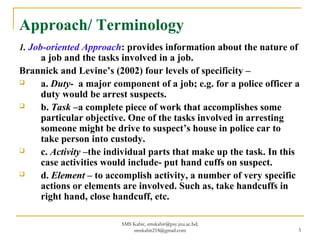
1. Job-oriented Approach: provides information about the nature of
a job and the tasks involved in a job.
Brannick and Levine’s (2002) four levels of specificity –
 a. Duty- a major component of a job; e.g. for a police officer a
duty would be arrest suspects.
 b. Task –a complete piece of work that accomplishes some
particular objective. One of the tasks involved in arresting
someone might be drive to suspect’s house in police car to
take person into custody.
 c. Activity –the individual parts that make up the task. In this
case activities would include- put hand cuffs on suspect.
 d. Element – to accomplish activity, a number of very specific
actions or elements are involved. Such as, take handcuffs in
right hand, close handcuff, etc.
SMS Kabir, smskabir@psy.jnu.ac.bd;
smskabir218@gmail.com 3
Approach/ Terminology
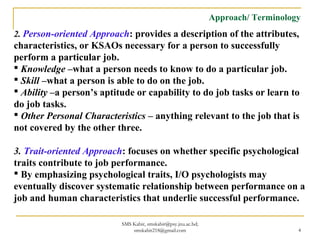
2. Person-oriented Approach: provides a description of the attributes,
characteristics, or KSAOs necessary for a person to successfully
perform a particular job.
 Knowledge –what a person needs to know to do a particular job.
 Skill –what a person is able to do on the job.
 Ability –a person’s aptitude or capability to do job tasks or learn to
do job tasks.
 Other Personal Characteristics – anything relevant to the job that is
not covered by the other three.
3. Trait-oriented Approach: focuses on whether specific psychological
traits contribute to job performance.
 By emphasizing psychological traits, I/O psychologists may
eventually discover systematic relationship between performance on a
job and human characteristics that underlie successful performance.
SMS Kabir, smskabir@psy.jnu.ac.bd;
smskabir218@gmail.com 4
Purposes of Job Analysis
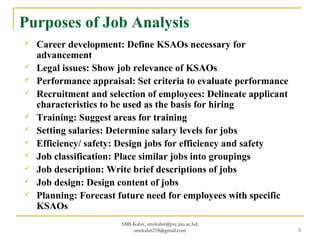
 Career development: Define KSAOs necessary for
advancement
 Legal issues: Show job relevance of KSAOs
 Performance appraisal: Set criteria to evaluate performance
 Recruitment and selection of employees: Delineate applicant
characteristics to be used as the basis for hiring
 Training: Suggest areas for training
 Setting salaries: Determine salary levels for jobs
 Efficiency/ safety: Design jobs for efficiency and safety
 Job classification: Place similar jobs into groupings
 Job description: Write brief descriptions of jobs
 Job design: Design content of jobs
 Planning: Forecast future need for employees with specific
KSAOs
SMS Kabir, smskabir@psy.jnu.ac.bd;
smskabir218@gmail.com 5
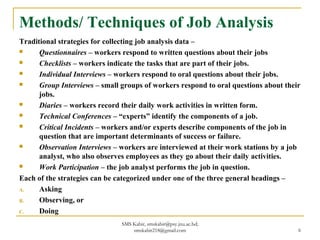
Methods/ Techniques of Job Analysis
Traditional strategies for collecting job analysis data –
 Questionnaires – workers respond to written questions about their jobs
 Checklists – workers indicate the tasks that are part of their jobs.
 Individual Interviews – workers respond to oral questions about their jobs.
 Group Interviews – small groups of workers respond to oral questions about their
jobs.
 Diaries – workers record their daily work activities in written form.
 Technical Conferences – “experts” identify the components of a job.
 Critical Incidents – workers and/or experts describe components of the job in
question that are important determinants of success or failure.
 Observation Interviews – workers are interviewed at their work stations by a job
analyst, who also observes employees as they go about their daily activities.
 Work Participation – the job analyst performs the job in question.
Each of the strategies can be categorized under one of the three general headings –
A. Asking
B. Observing, or
C. Doing
SMS Kabir, smskabir@psy.jnu.ac.bd;
smskabir218@gmail.com 6
Methods/ Techniques of Job Analysis
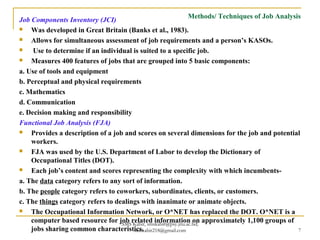
Job Components Inventory (JCI)
 Was developed in Great Britain (Banks et al., 1983).
 Allows for simultaneous assessment of job requirements and a person’s KASOs.
 Use to determine if an individual is suited to a specific job.
 Measures 400 features of jobs that are grouped into 5 basic components:
a. Use of tools and equipment
b. Perceptual and physical requirements
c. Mathematics
d. Communication
e. Decision making and responsibility
Functional Job Analysis (FJA)
 Provides a description of a job and scores on several dimensions for the job and potential
workers.
 FJA was used by the U.S. Department of Labor to develop the Dictionary of
Occupational Titles (DOT).
 Each job’s content and scores representing the complexity with which incumbents-
a. The data category refers to any sort of information.
b. The people category refers to coworkers, subordinates, clients, or customers.
c. The things category refers to dealings with inanimate or animate objects.
 The Occupational Information Network, or O*NET has replaced the DOT. O*NET is a
computer based resource for job related information on approximately 1,100 groups of
jobs sharing common characteristics.
SMS Kabir, smskabir@psy.jnu.ac.bd;
smskabir218@gmail.com 7
Methods/ Techniques of Job AnalysisPosition Analysis Questionnaire (PAQ)
Elements are grouped into 6 major categories and several minor ones. The major
categories include:
 Information input
 Mediation processes
 Work output
 Interpersonal activities
 Work situation and job context
 Miscellaneous aspects
Task Inventories
 Questionnaires that contain lists of specific tasks that might be done on a job
and a rating scale for each task.
 For each task, job incumbents are usually asked to provide ratings on
dimensions such as time spent on task, importance, and difficulty of learning.
 Task inventories are most often used for purposes where individual differences
among people with the same job are of no interest.
 The Combination Job Analysis Method (C-JAM) is an example of this type of
approach. It uses interviews and questionnaires to collect information and
produces a detailed picture of the KSAOs for a job.
SMS Kabir, smskabir@psy.jnu.ac.bd;
smskabir218@gmail.com 8
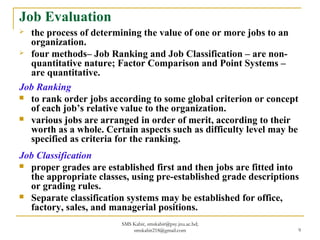
Job Evaluation
 the process of determining the value of one or more jobs to an
organization.
 four methods– Job Ranking and Job Classification – are non-
quantitative nature; Factor Comparison and Point Systems –
are quantitative.
Job Ranking
 to rank order jobs according to some global criterion or concept
of each job’s relative value to the organization.
 various jobs are arranged in order of merit, according to their
worth as a whole. Certain aspects such as difficulty level may be
specified as criteria for the ranking.
Job Classification
 proper grades are established first and then jobs are fitted into
the appropriate classes, using pre-established grade descriptions
or grading rules.
 Separate classification systems may be established for office,
factory, sales, and managerial positions.
SMS Kabir, smskabir@psy.jnu.ac.bd;
smskabir218@gmail.com 9
Job Evaluation
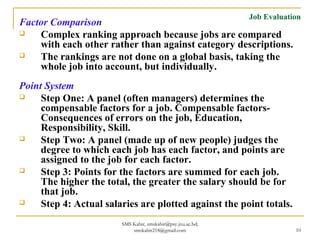
Factor Comparison
 Complex ranking approach because jobs are compared
with each other rather than against category descriptions.
 The rankings are not done on a global basis, taking the
whole job into account, but individually.
Point System
 Step One: A panel (often managers) determines the
compensable factors for a job. Compensable factors-
Consequences of errors on the job, Education,
Responsibility, Skill.
 Step Two: A panel (made up of new people) judges the
degree to which each job has each factor, and points are
assigned to the job for each factor.
 Step 3: Points for the factors are summed for each job.
The higher the total, the greater the salary should be for
that job.
 Step 4: Actual salaries are plotted against the point totals.
SMS Kabir, smskabir@psy.jnu.ac.bd;
smskabir218@gmail.com 10

Job Analysis

  • 1.
    Business Psychology Job Analysis SyedMd. Sajjad Kabir Lecturer, Dept. of Psychology, CU SMS Kabir, smskabir@psy.jnu.ac.bd; smskabir218@gmail.com 1
  • 2.
    What is JobAnalysis  A method for describing jobs and/or the human attributes necessary to perform them. The procedure must be systematic.  A job is broken into smaller units.  The analysis results in some written product, either electronic or on paper.  Job analysis techniques can be used to collect information that is job-oriented or person (or employee)-oriented, depending on the purpose of the job analyst. SMS Kabir, smskabir@psy.jnu.ac.bd; smskabir218@gmail.com 2
  • 3.
    Approach/ Terminology 1. Job-orientedApproach: provides information about the nature of a job and the tasks involved in a job. Brannick and Levine’s (2002) four levels of specificity –  a. Duty- a major component of a job; e.g. for a police officer a duty would be arrest suspects.  b. Task –a complete piece of work that accomplishes some particular objective. One of the tasks involved in arresting someone might be drive to suspect’s house in police car to take person into custody.  c. Activity –the individual parts that make up the task. In this case activities would include- put hand cuffs on suspect.  d. Element – to accomplish activity, a number of very specific actions or elements are involved. Such as, take handcuffs in right hand, close handcuff, etc. SMS Kabir, smskabir@psy.jnu.ac.bd; smskabir218@gmail.com 3
  • 4.
    Approach/ Terminology 2. Person-orientedApproach: provides a description of the attributes, characteristics, or KSAOs necessary for a person to successfully perform a particular job.  Knowledge –what a person needs to know to do a particular job.  Skill –what a person is able to do on the job.  Ability –a person’s aptitude or capability to do job tasks or learn to do job tasks.  Other Personal Characteristics – anything relevant to the job that is not covered by the other three. 3. Trait-oriented Approach: focuses on whether specific psychological traits contribute to job performance.  By emphasizing psychological traits, I/O psychologists may eventually discover systematic relationship between performance on a job and human characteristics that underlie successful performance. SMS Kabir, smskabir@psy.jnu.ac.bd; smskabir218@gmail.com 4
  • 5.
    Purposes of JobAnalysis  Career development: Define KSAOs necessary for advancement  Legal issues: Show job relevance of KSAOs  Performance appraisal: Set criteria to evaluate performance  Recruitment and selection of employees: Delineate applicant characteristics to be used as the basis for hiring  Training: Suggest areas for training  Setting salaries: Determine salary levels for jobs  Efficiency/ safety: Design jobs for efficiency and safety  Job classification: Place similar jobs into groupings  Job description: Write brief descriptions of jobs  Job design: Design content of jobs  Planning: Forecast future need for employees with specific KSAOs SMS Kabir, smskabir@psy.jnu.ac.bd; smskabir218@gmail.com 5
  • 6.
    Methods/ Techniques ofJob Analysis Traditional strategies for collecting job analysis data –  Questionnaires – workers respond to written questions about their jobs  Checklists – workers indicate the tasks that are part of their jobs.  Individual Interviews – workers respond to oral questions about their jobs.  Group Interviews – small groups of workers respond to oral questions about their jobs.  Diaries – workers record their daily work activities in written form.  Technical Conferences – “experts” identify the components of a job.  Critical Incidents – workers and/or experts describe components of the job in question that are important determinants of success or failure.  Observation Interviews – workers are interviewed at their work stations by a job analyst, who also observes employees as they go about their daily activities.  Work Participation – the job analyst performs the job in question. Each of the strategies can be categorized under one of the three general headings – A. Asking B. Observing, or C. Doing SMS Kabir, smskabir@psy.jnu.ac.bd; smskabir218@gmail.com 6
  • 7.
    Methods/ Techniques ofJob Analysis Job Components Inventory (JCI)  Was developed in Great Britain (Banks et al., 1983).  Allows for simultaneous assessment of job requirements and a person’s KASOs.  Use to determine if an individual is suited to a specific job.  Measures 400 features of jobs that are grouped into 5 basic components: a. Use of tools and equipment b. Perceptual and physical requirements c. Mathematics d. Communication e. Decision making and responsibility Functional Job Analysis (FJA)  Provides a description of a job and scores on several dimensions for the job and potential workers.  FJA was used by the U.S. Department of Labor to develop the Dictionary of Occupational Titles (DOT).  Each job’s content and scores representing the complexity with which incumbents- a. The data category refers to any sort of information. b. The people category refers to coworkers, subordinates, clients, or customers. c. The things category refers to dealings with inanimate or animate objects.  The Occupational Information Network, or O*NET has replaced the DOT. O*NET is a computer based resource for job related information on approximately 1,100 groups of jobs sharing common characteristics. SMS Kabir, smskabir@psy.jnu.ac.bd; smskabir218@gmail.com 7
  • 8.
    Methods/ Techniques ofJob AnalysisPosition Analysis Questionnaire (PAQ) Elements are grouped into 6 major categories and several minor ones. The major categories include:  Information input  Mediation processes  Work output  Interpersonal activities  Work situation and job context  Miscellaneous aspects Task Inventories  Questionnaires that contain lists of specific tasks that might be done on a job and a rating scale for each task.  For each task, job incumbents are usually asked to provide ratings on dimensions such as time spent on task, importance, and difficulty of learning.  Task inventories are most often used for purposes where individual differences among people with the same job are of no interest.  The Combination Job Analysis Method (C-JAM) is an example of this type of approach. It uses interviews and questionnaires to collect information and produces a detailed picture of the KSAOs for a job. SMS Kabir, smskabir@psy.jnu.ac.bd; smskabir218@gmail.com 8
  • 9.
    Job Evaluation  theprocess of determining the value of one or more jobs to an organization.  four methods– Job Ranking and Job Classification – are non- quantitative nature; Factor Comparison and Point Systems – are quantitative. Job Ranking  to rank order jobs according to some global criterion or concept of each job’s relative value to the organization.  various jobs are arranged in order of merit, according to their worth as a whole. Certain aspects such as difficulty level may be specified as criteria for the ranking. Job Classification  proper grades are established first and then jobs are fitted into the appropriate classes, using pre-established grade descriptions or grading rules.  Separate classification systems may be established for office, factory, sales, and managerial positions. SMS Kabir, smskabir@psy.jnu.ac.bd; smskabir218@gmail.com 9
  • 10.
    Job Evaluation Factor Comparison Complex ranking approach because jobs are compared with each other rather than against category descriptions.  The rankings are not done on a global basis, taking the whole job into account, but individually. Point System  Step One: A panel (often managers) determines the compensable factors for a job. Compensable factors- Consequences of errors on the job, Education, Responsibility, Skill.  Step Two: A panel (made up of new people) judges the degree to which each job has each factor, and points are assigned to the job for each factor.  Step 3: Points for the factors are summed for each job. The higher the total, the greater the salary should be for that job.  Step 4: Actual salaries are plotted against the point totals. SMS Kabir, smskabir@psy.jnu.ac.bd; smskabir218@gmail.com 10