
GARY DESSLER
HUMAN RESOURCE MANAGEMENT
Global Edition 12e
Chapter 6
Employee Testing
and Selection
PowerPoint Presentation by Charlie Cook
The University of West Alabama
Copyright © 2011 Pearson Education
Part 2 Recruitment and Placement
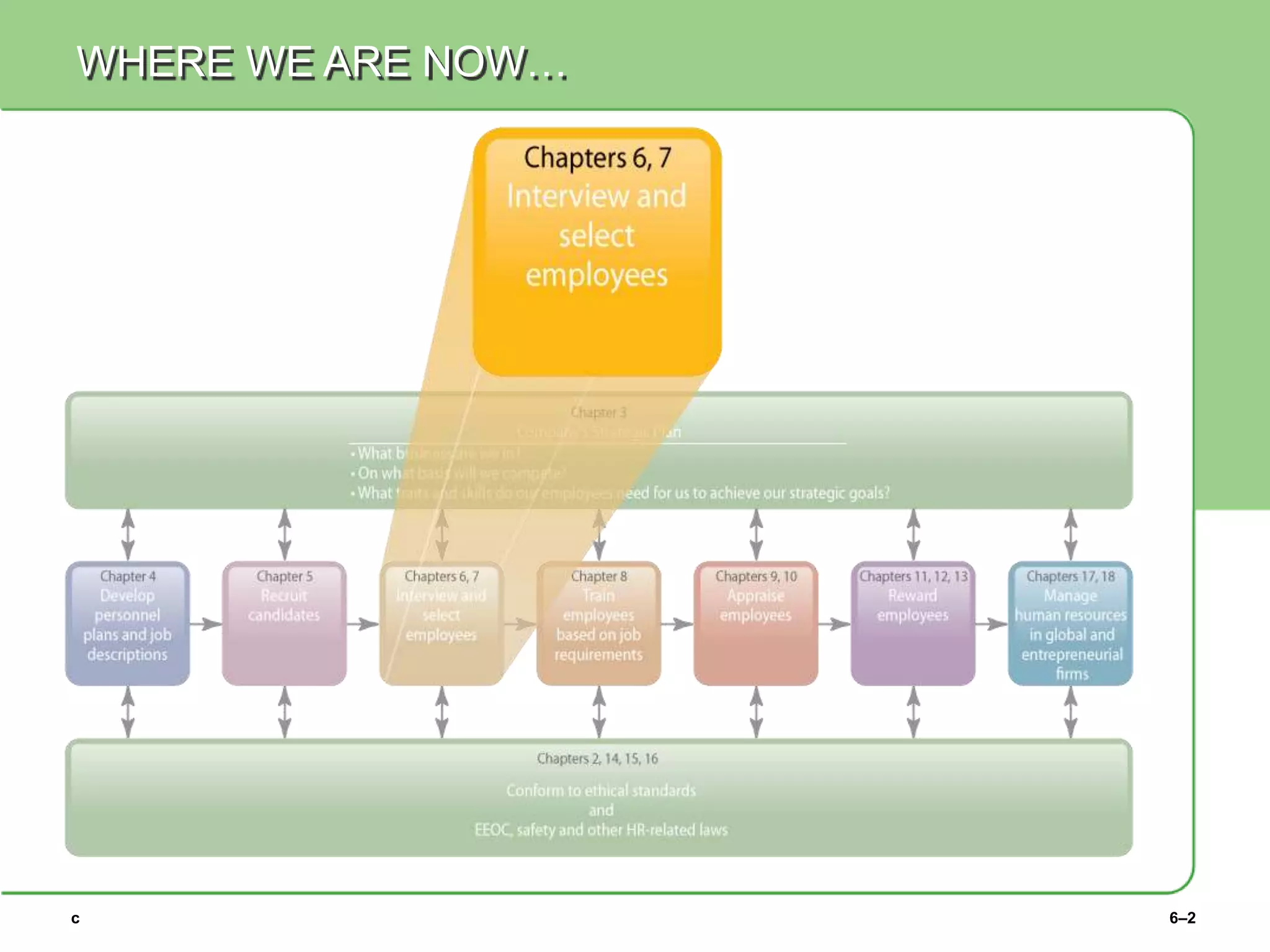
c 6–2
WHERE WE ARE NOW…
Copyright © 2011 Pearson Education 6–3
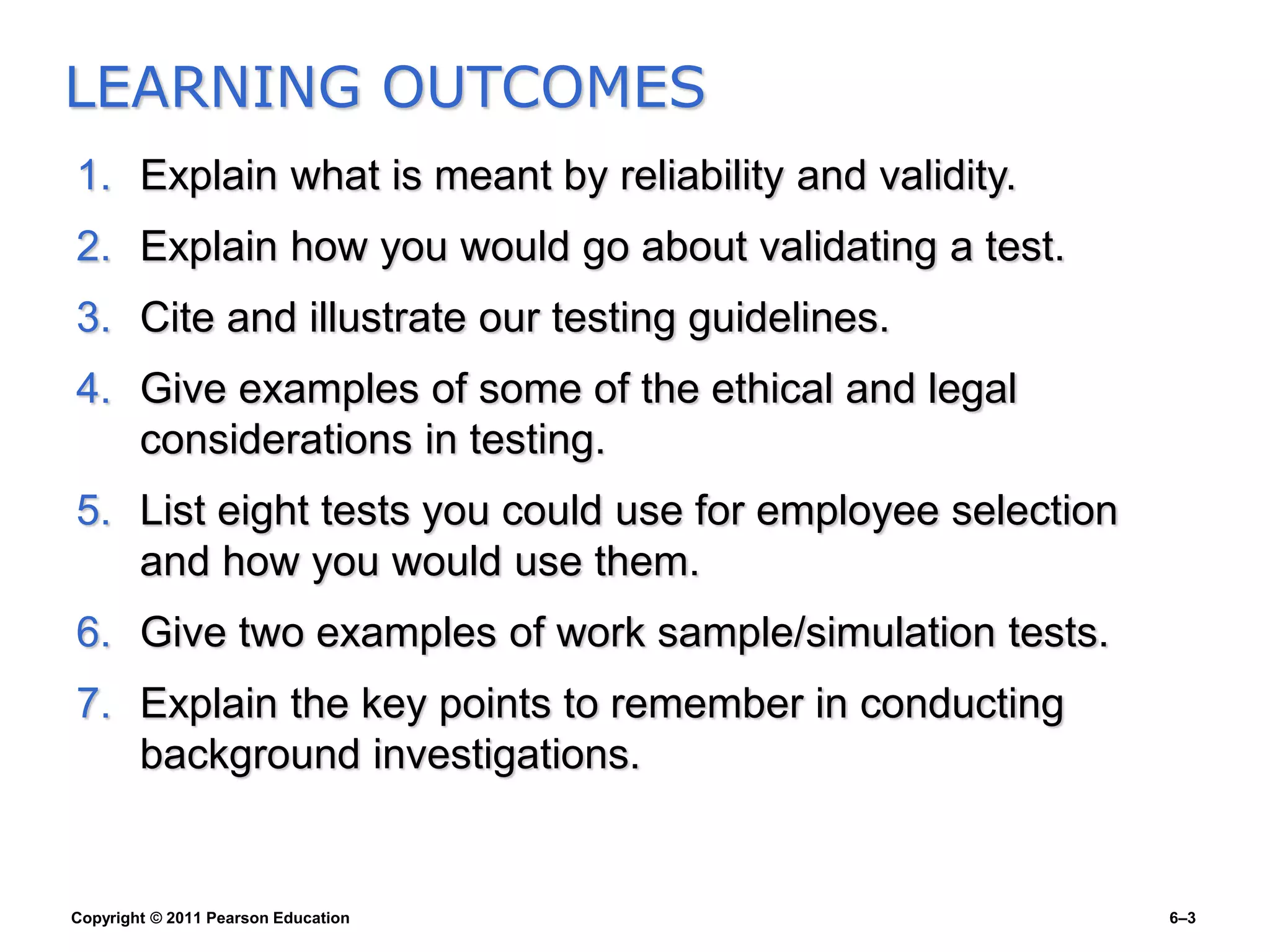
1. Explain what is meant by reliability and validity.
2. Explain how you would go about validating a test.
3. Cite and illustrate our testing guidelines.
4. Give examples of some of the ethical and legal
considerations in testing.
5. List eight tests you could use for employee selection
and how you would use them.
6. Give two examples of work sample/simulation tests.
7. Explain the key points to remember in conducting
background investigations.
LEARNING OUTCOMES
Copyright © 2011 Pearson Education 6–4
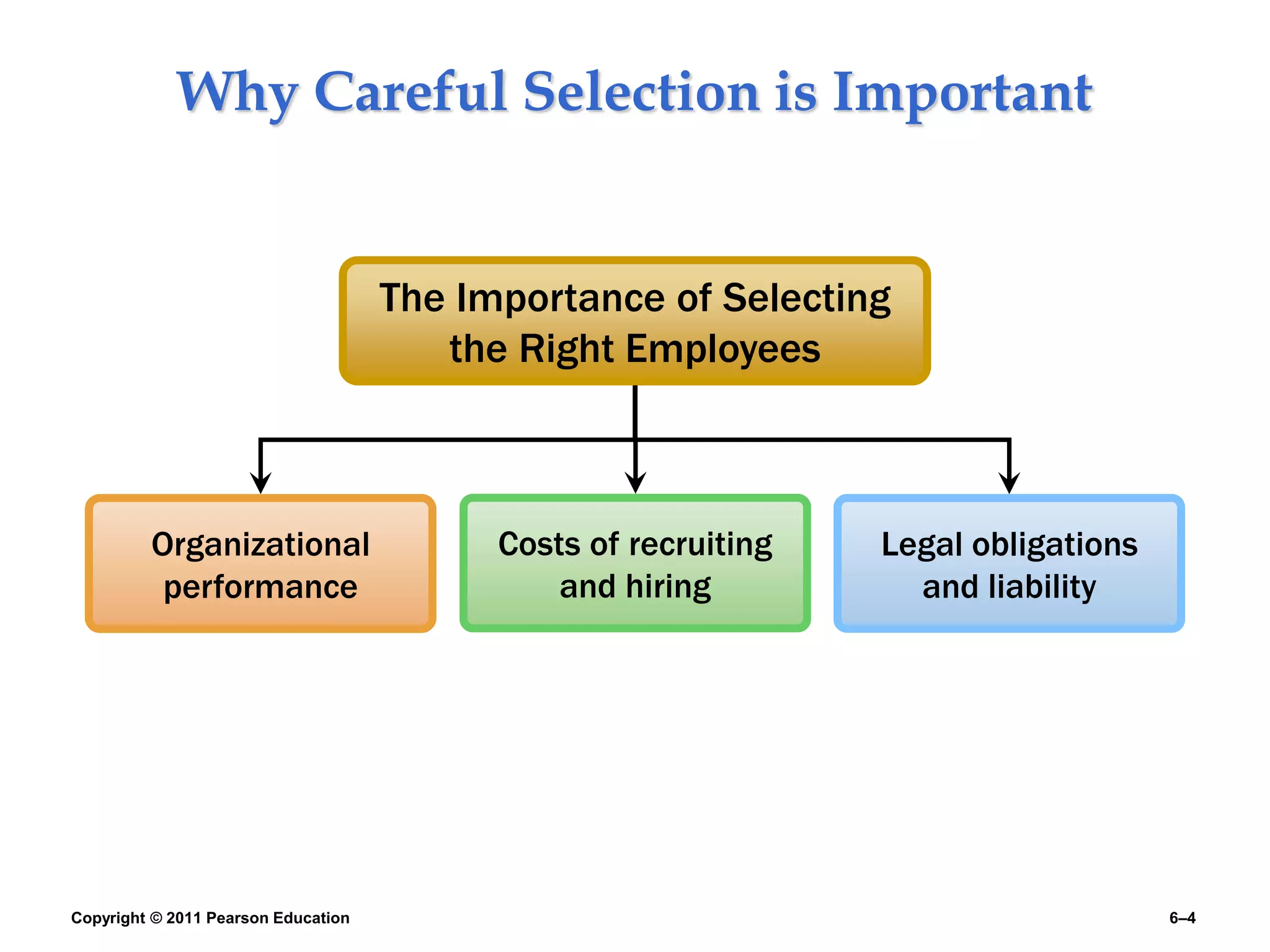
Why Careful Selection is Important
Organizational
performance
Costs of recruiting
and hiring
The Importance of Selecting
the Right Employees
Legal obligations
and liability
Copyright © 2011 Pearson Education 6–5
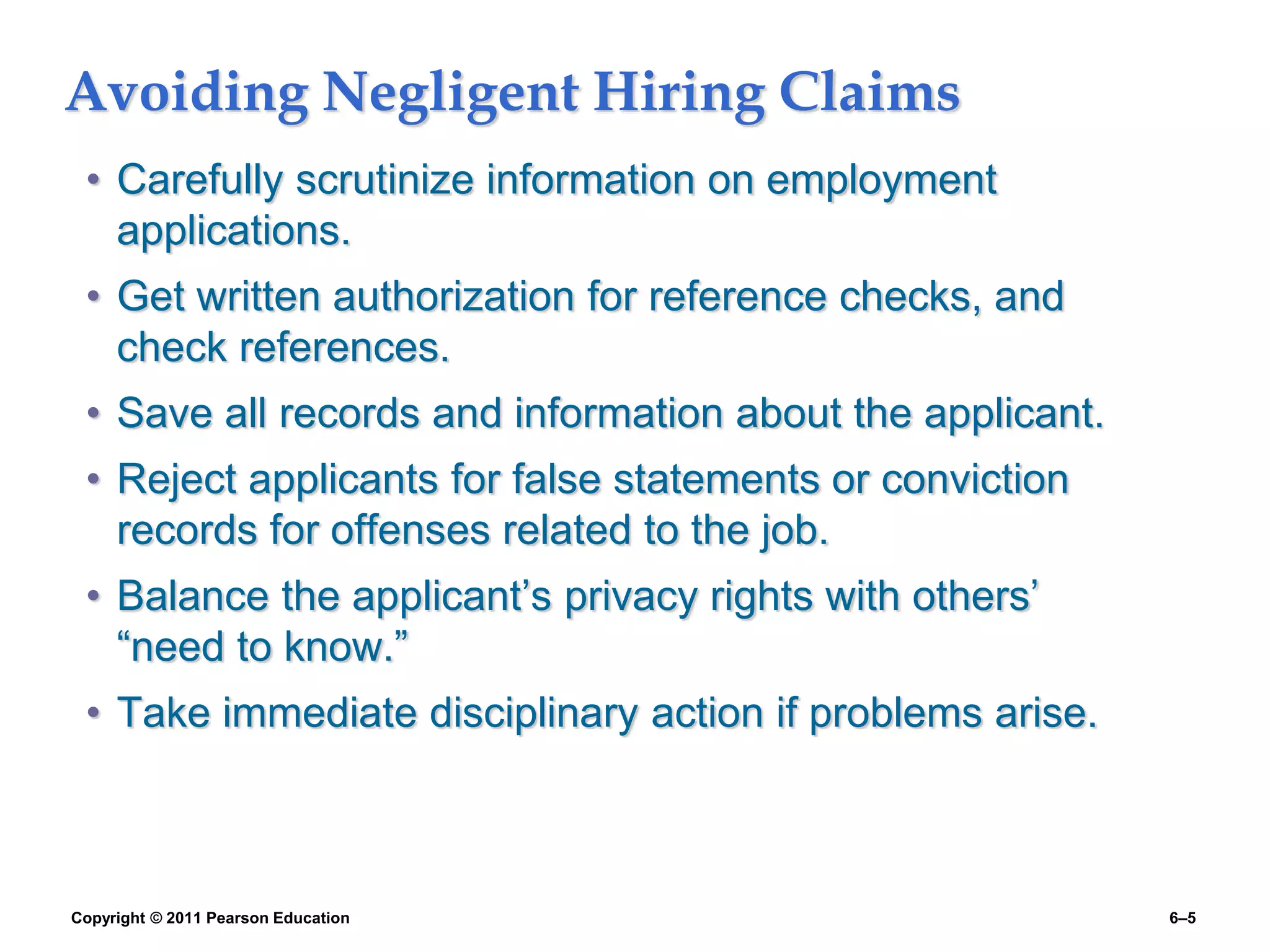
Avoiding Negligent Hiring Claims
• Carefully scrutinize information on employment
applications.
• Get written authorization for reference checks, and
check references.
• Save all records and information about the applicant.
• Reject applicants for false statements or conviction
records for offenses related to the job.
• Balance the applicant’s privacy rights with others’
“need to know.”
• Take immediate disciplinary action if problems arise.
Copyright © 2011 Pearson Education 6–6
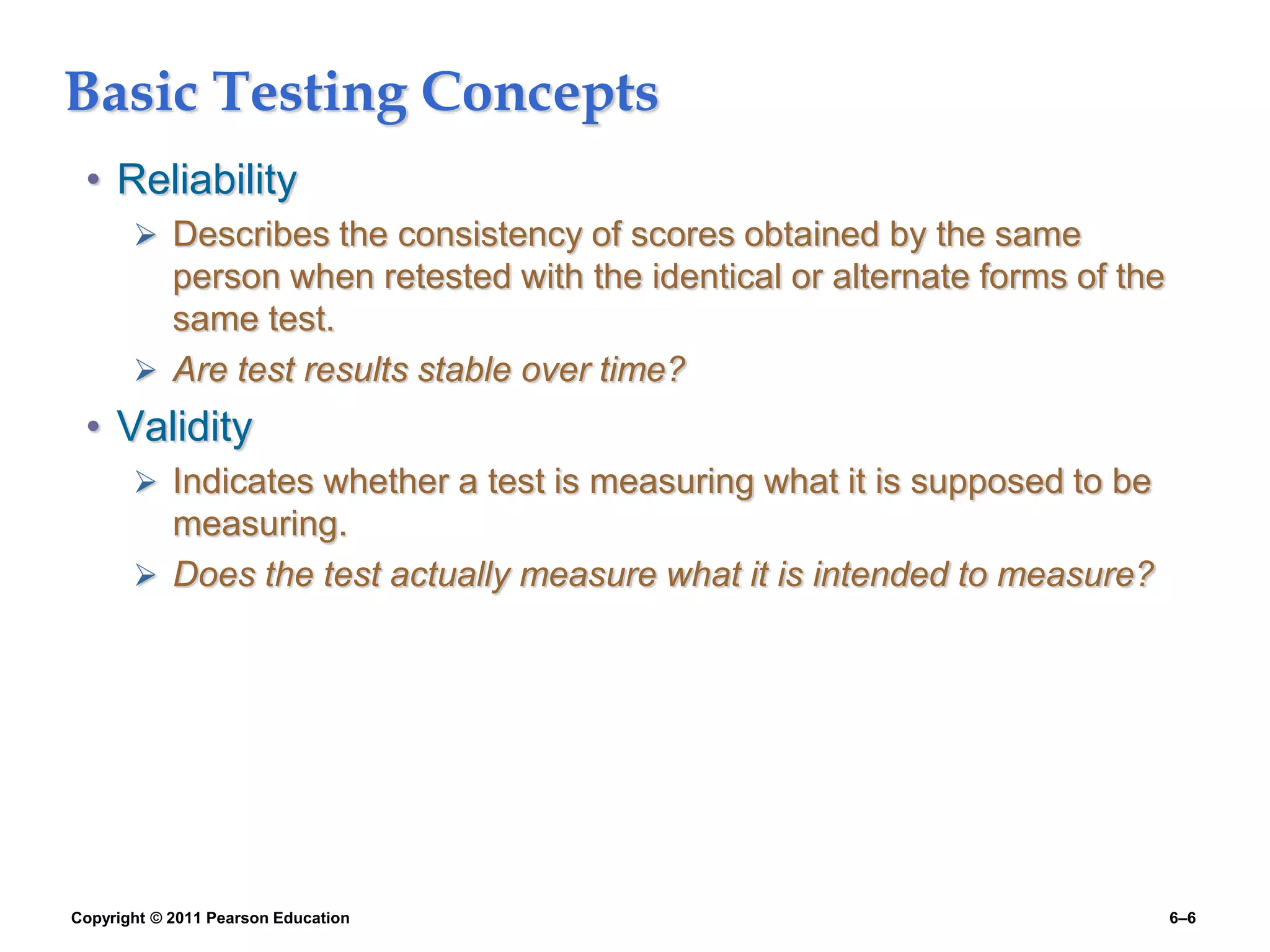
Basic Testing Concepts
• Reliability
 Describes the consistency of scores obtained by the same
person when retested with the identical or alternate forms of the
same test.
 Are test results stable over time?
• Validity
 Indicates whether a test is measuring what it is supposed to be
measuring.
 Does the test actually measure what it is intended to measure?
Copyright © 2011 Pearson Education 6–7
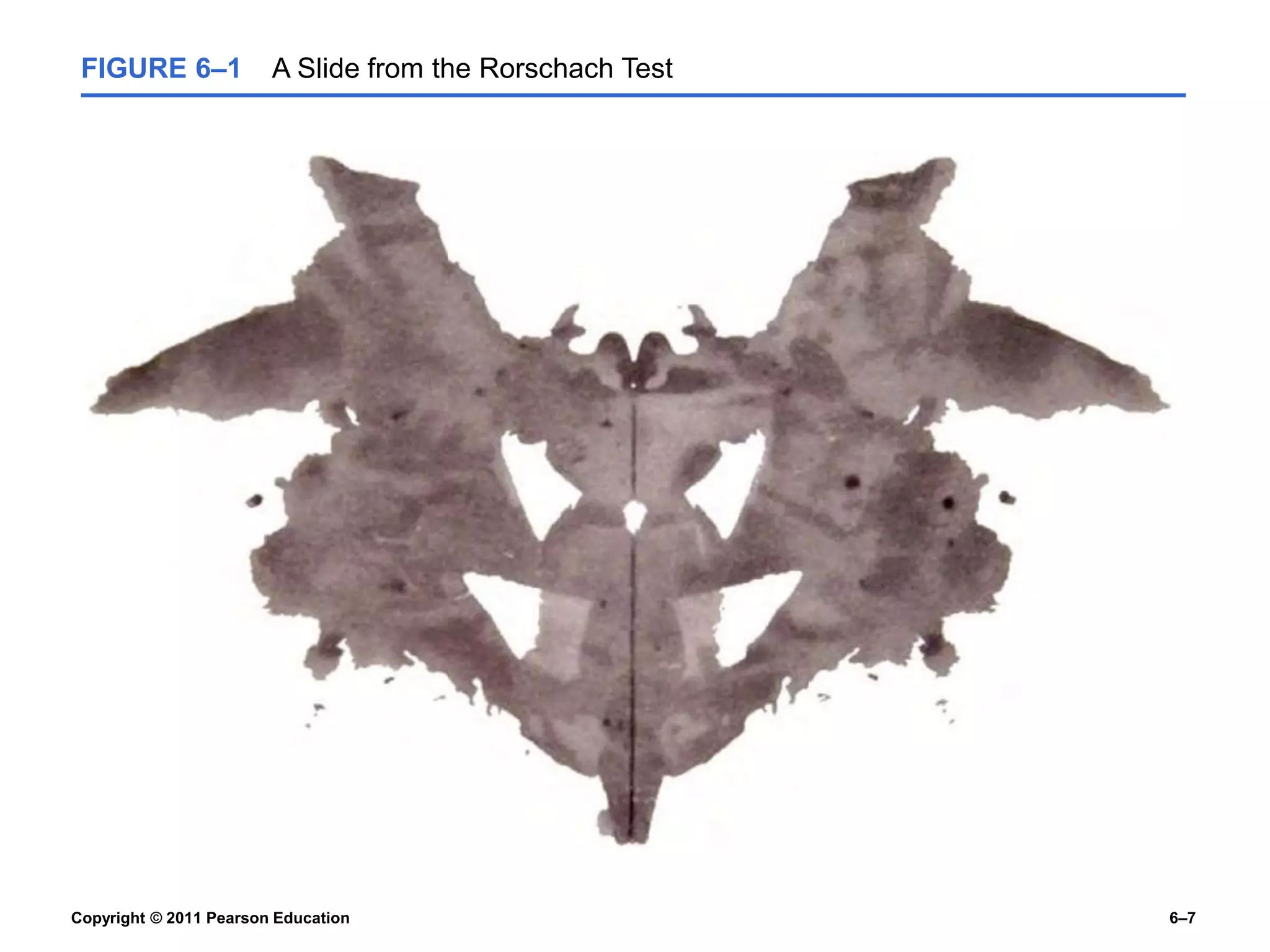
FIGURE 6–1 A Slide from the Rorschach Test
Copyright © 2011 Pearson Education 6–8
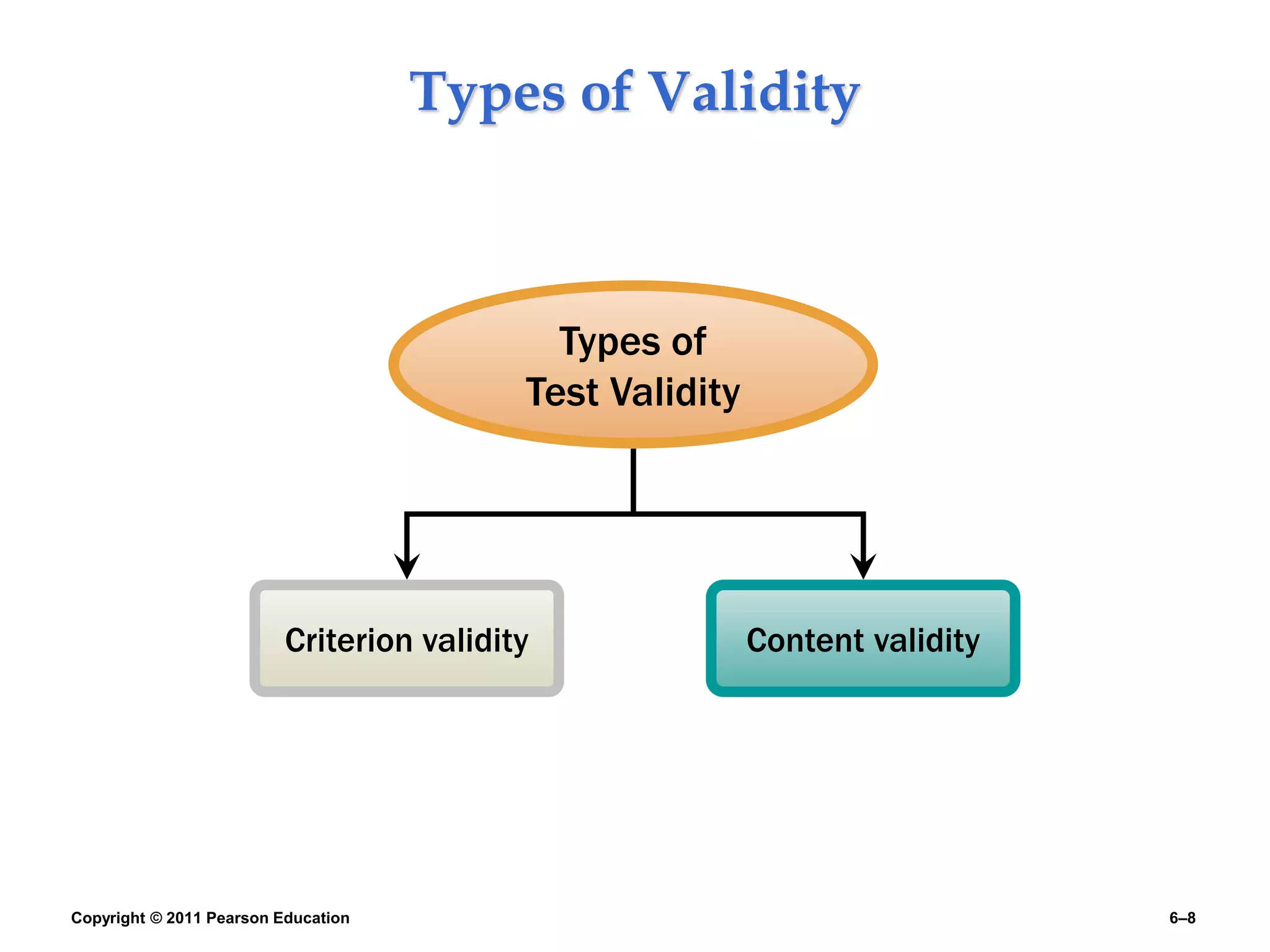
Types of Validity
Criterion validity Content validity
Types of
Test Validity
Copyright © 2011 Pearson Education 6–9
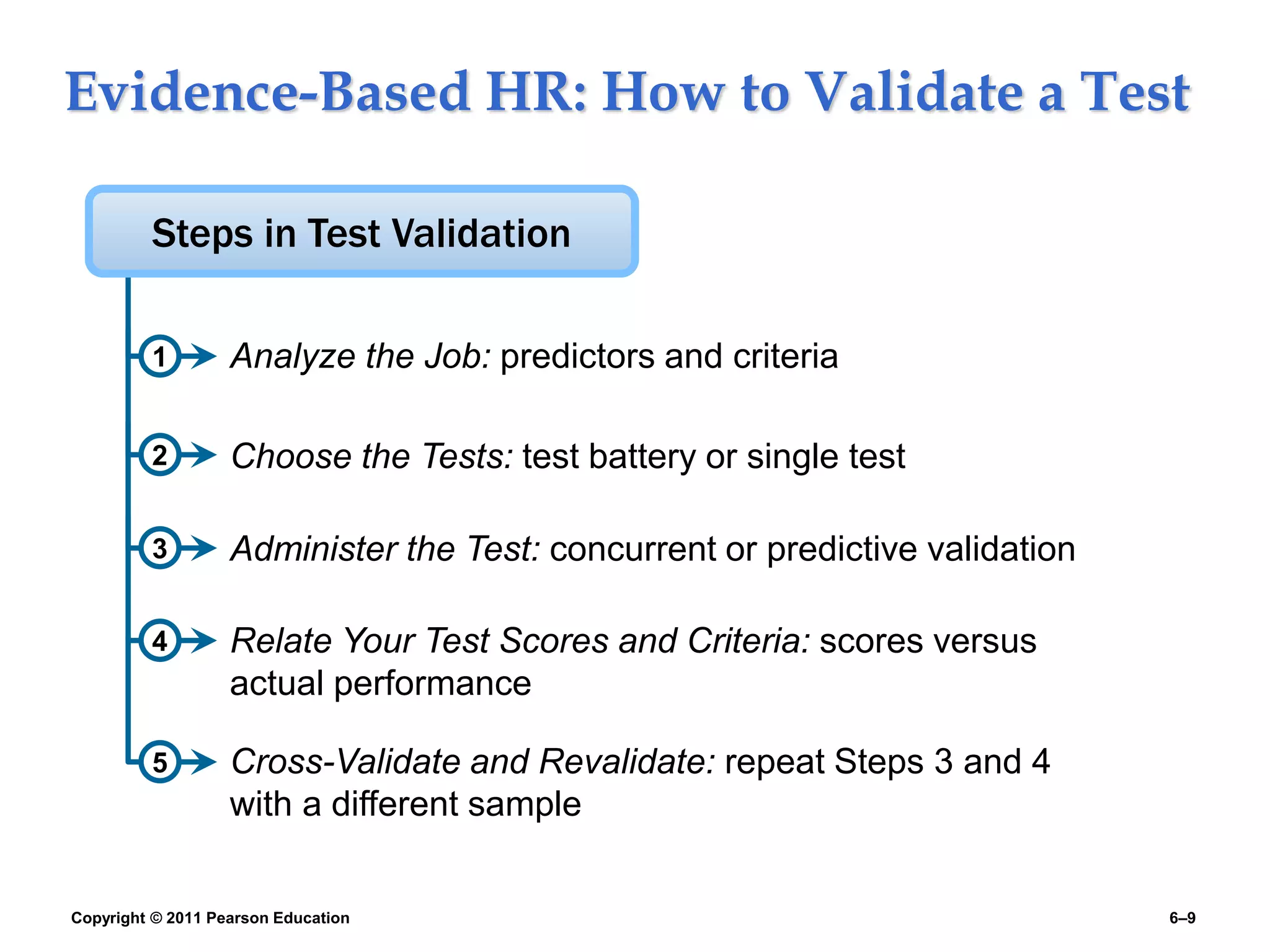
Evidence-Based HR: How to Validate a Test
1
Relate Your Test Scores and Criteria: scores versus
actual performance
Choose the Tests: test battery or single test
Steps in Test Validation
Analyze the Job: predictors and criteria
Administer the Test: concurrent or predictive validation
2
3
4
Cross-Validate and Revalidate: repeat Steps 3 and 4
with a different sample
5
Copyright © 2011 Pearson Education 6–10
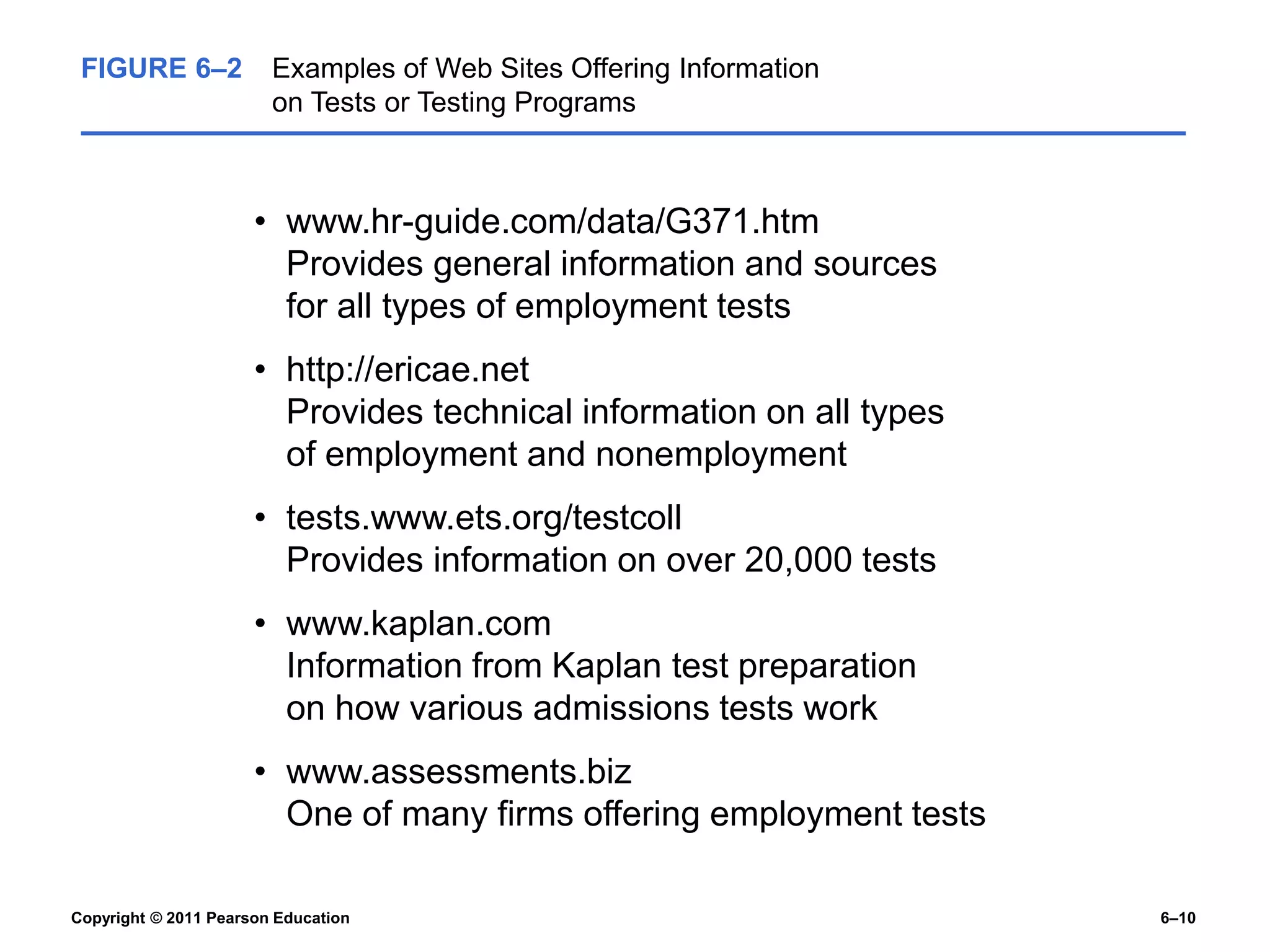
FIGURE 6–2 Examples of Web Sites Offering Information
on Tests or Testing Programs
• www.hr-guide.com/data/G371.htm
Provides general information and sources
for all types of employment tests
• http://ericae.net
Provides technical information on all types
of employment and nonemployment
• tests.www.ets.org/testcoll
Provides information on over 20,000 tests
• www.kaplan.com
Information from Kaplan test preparation
on how various admissions tests work
• www.assessments.biz
One of many firms offering employment tests
Copyright © 2011 Pearson Education 6–11
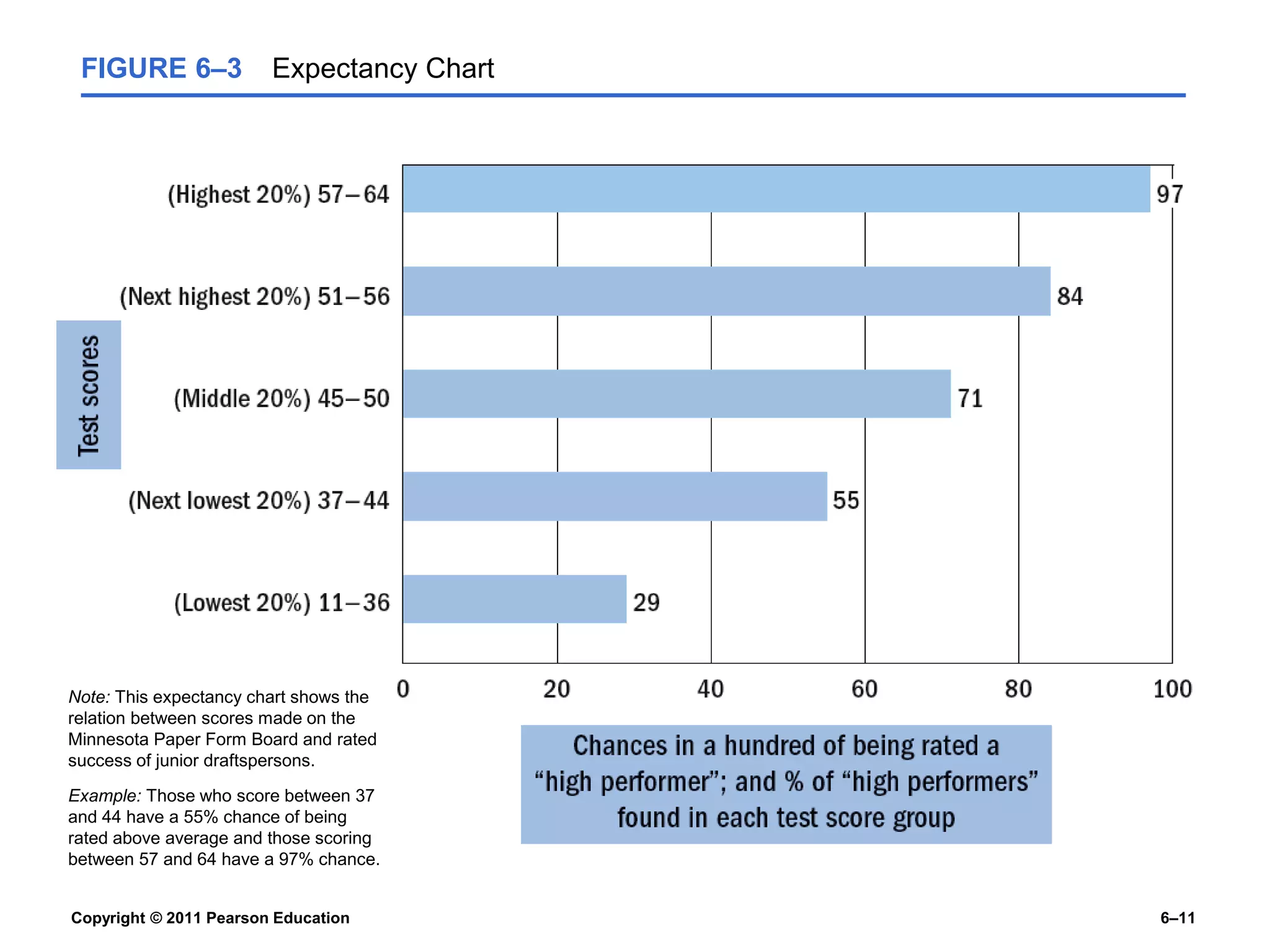
FIGURE 6–3 Expectancy Chart
Note: This expectancy chart shows the
relation between scores made on the
Minnesota Paper Form Board and rated
success of junior draftspersons.
Example: Those who score between 37
and 44 have a 55% chance of being
rated above average and those scoring
between 57 and 64 have a 97% chance.
Copyright © 2011 Pearson Education 6–12
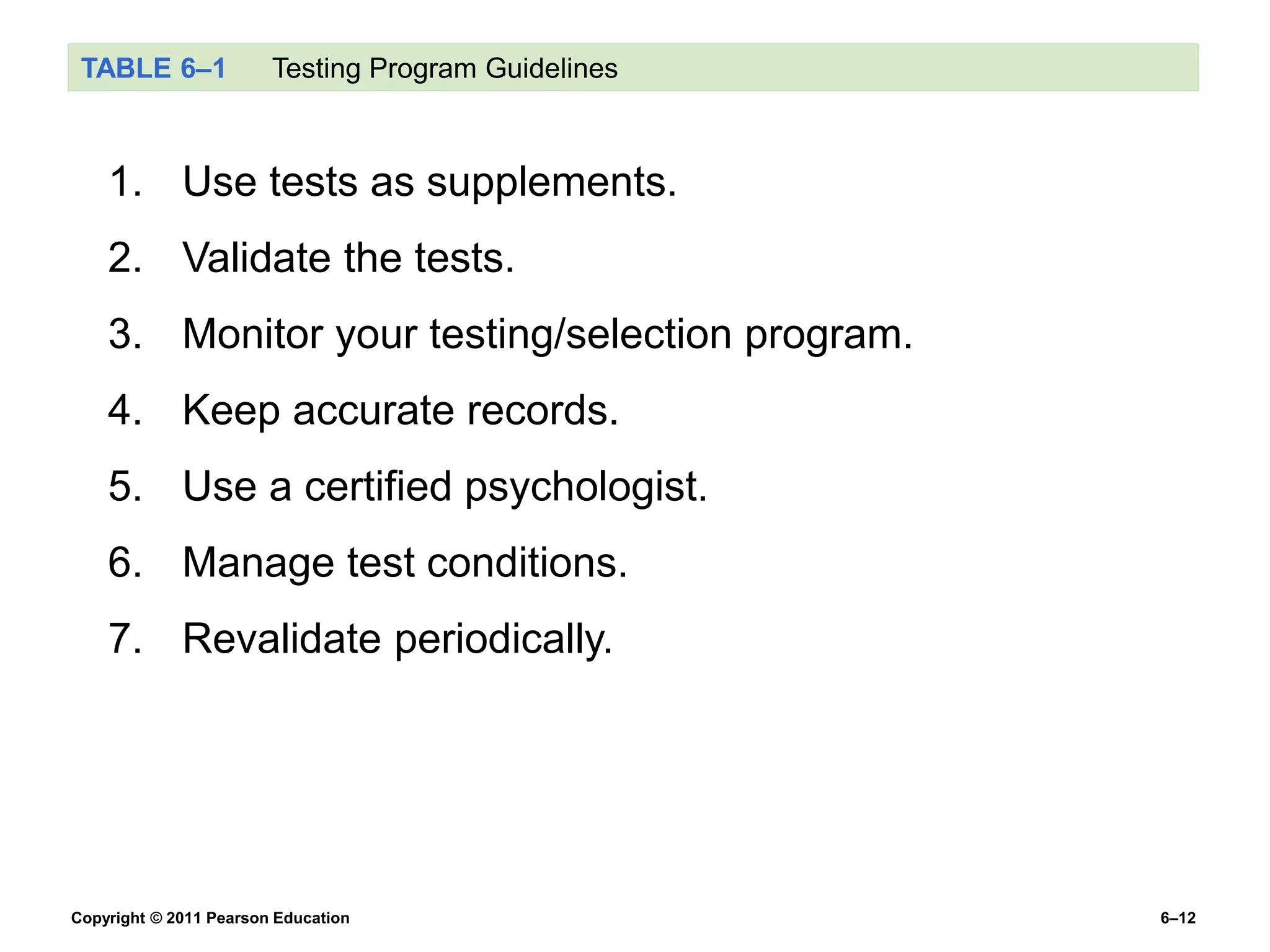
TABLE 6–1 Testing Program Guidelines
1. Use tests as supplements.
2. Validate the tests.
3. Monitor your testing/selection program.
4. Keep accurate records.
5. Use a certified psychologist.
6. Manage test conditions.
7. Revalidate periodically.
Copyright © 2011 Pearson Education 6–13
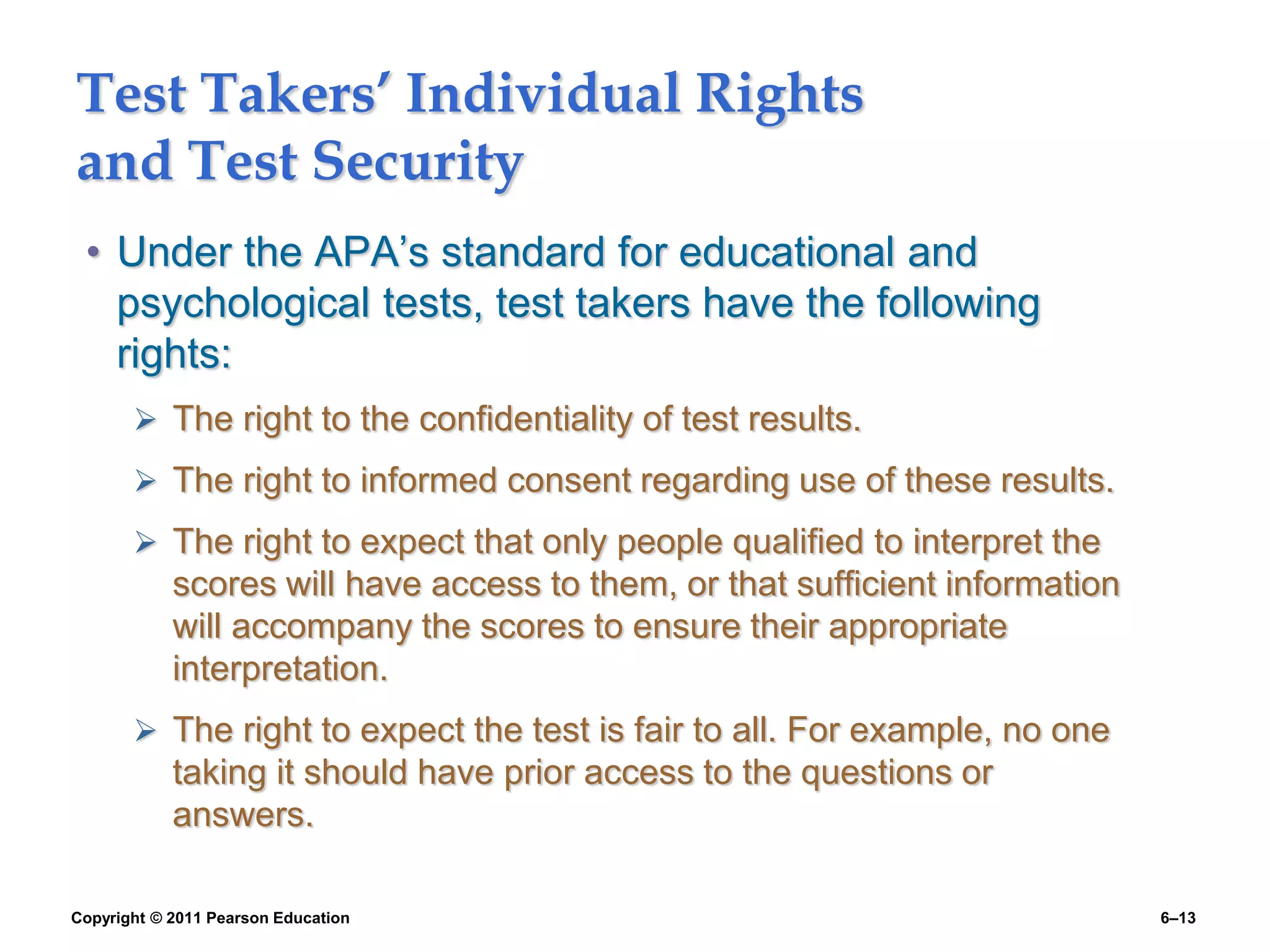
Test Takers’ Individual Rights
and Test Security
• Under the APA’s standard for educational and
psychological tests, test takers have the following
rights:
 The right to the confidentiality of test results.
 The right to informed consent regarding use of these results.
 The right to expect that only people qualified to interpret the
scores will have access to them, or that sufficient information
will accompany the scores to ensure their appropriate
interpretation.
 The right to expect the test is fair to all. For example, no one
taking it should have prior access to the questions or
answers.
Copyright © 2011 Pearson Education 6–14
Legal Privacy Issues
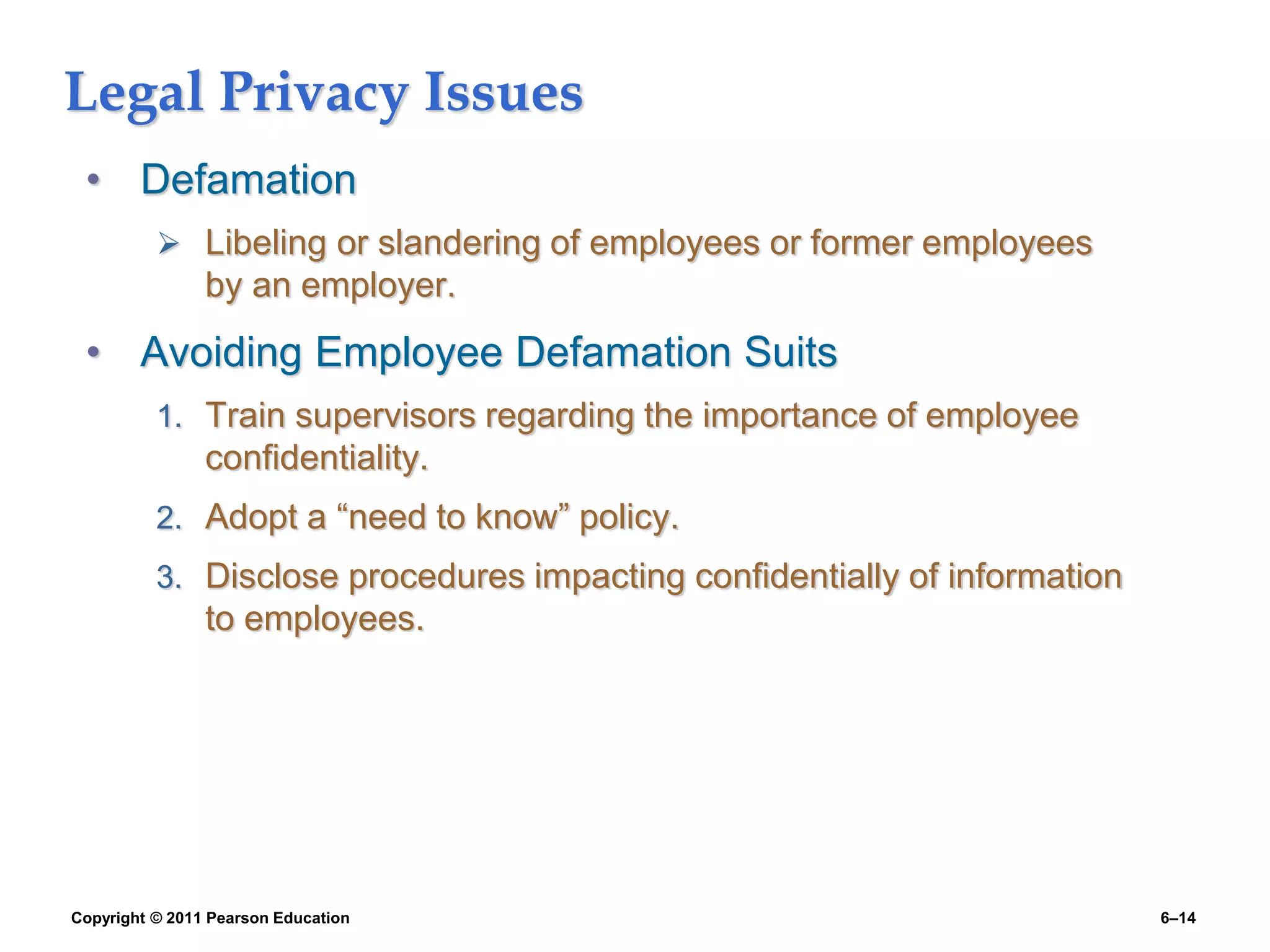
• Defamation
 Libeling or slandering of employees or former employees
by an employer.
• Avoiding Employee Defamation Suits
1. Train supervisors regarding the importance of employee
confidentiality.
2. Adopt a “need to know” policy.
3. Disclose procedures impacting confidentially of information
to employees.
Copyright © 2011 Pearson Education 6–15
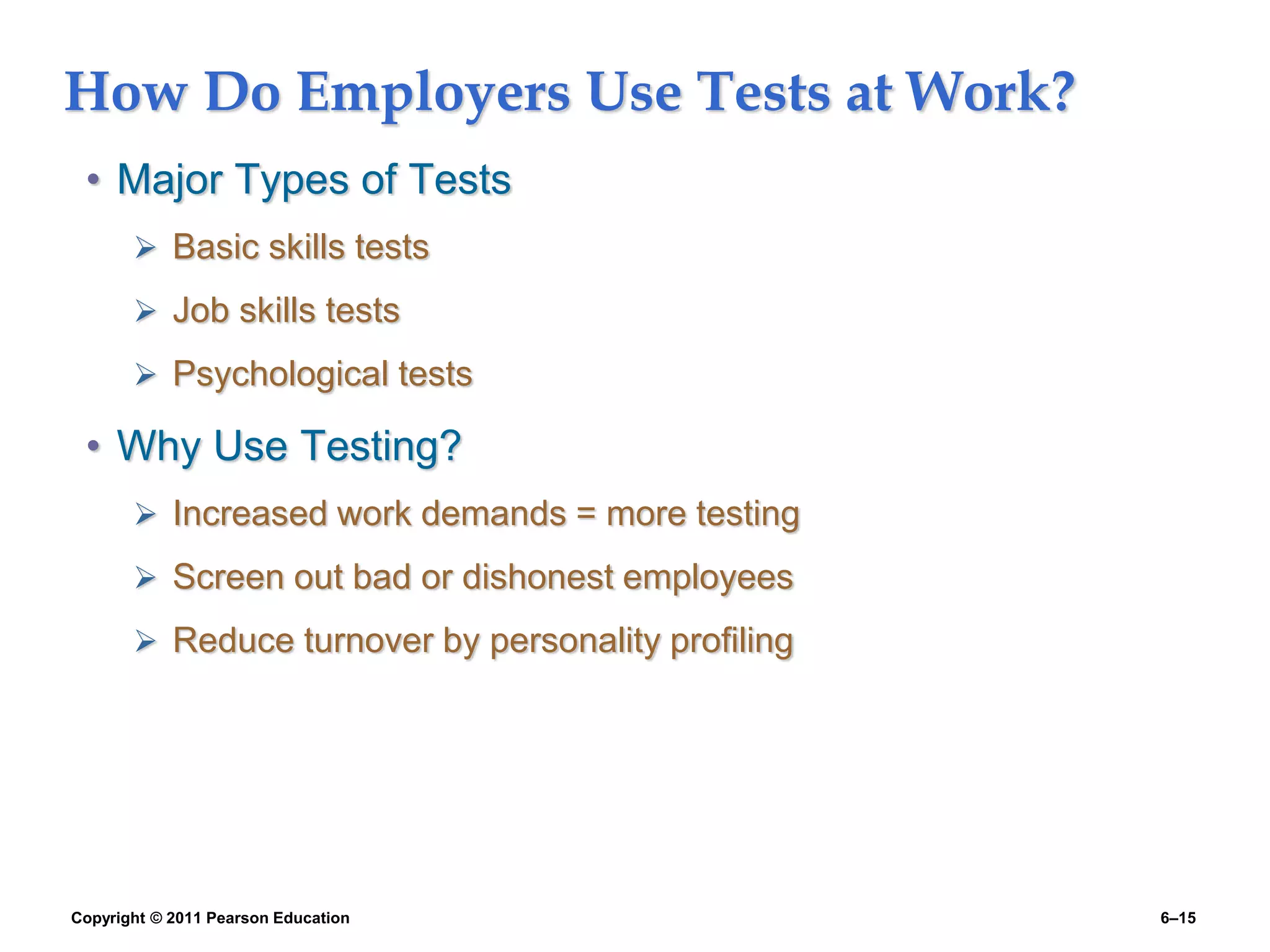
How Do Employers Use Tests at Work?
• Major Types of Tests
 Basic skills tests
 Job skills tests
 Psychological tests
• Why Use Testing?
 Increased work demands = more testing
 Screen out bad or dishonest employees
 Reduce turnover by personality profiling
Copyright © 2011 Pearson Education 6–16
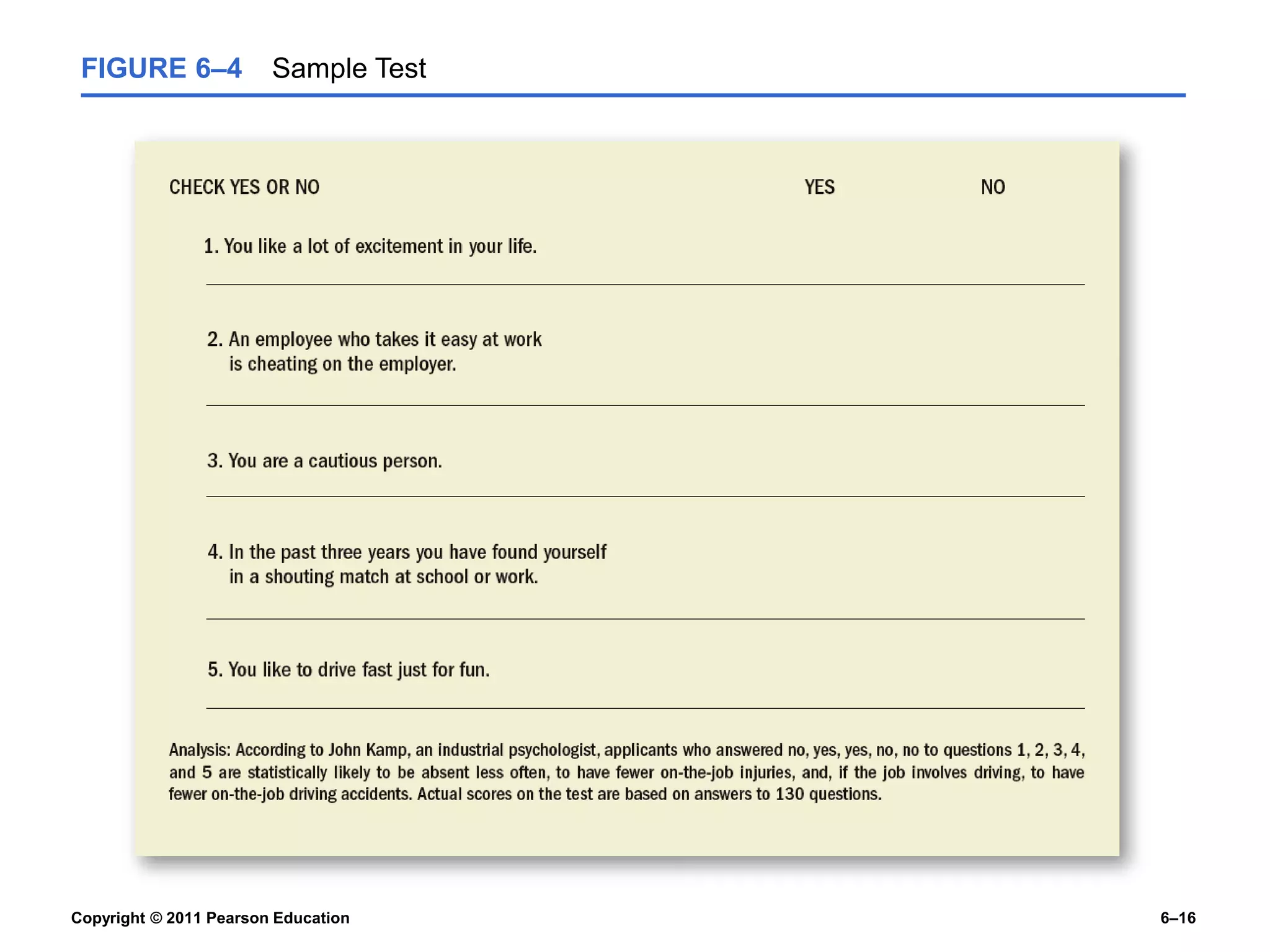
FIGURE 6–4 Sample Test
Copyright © 2011 Pearson Education 6–17
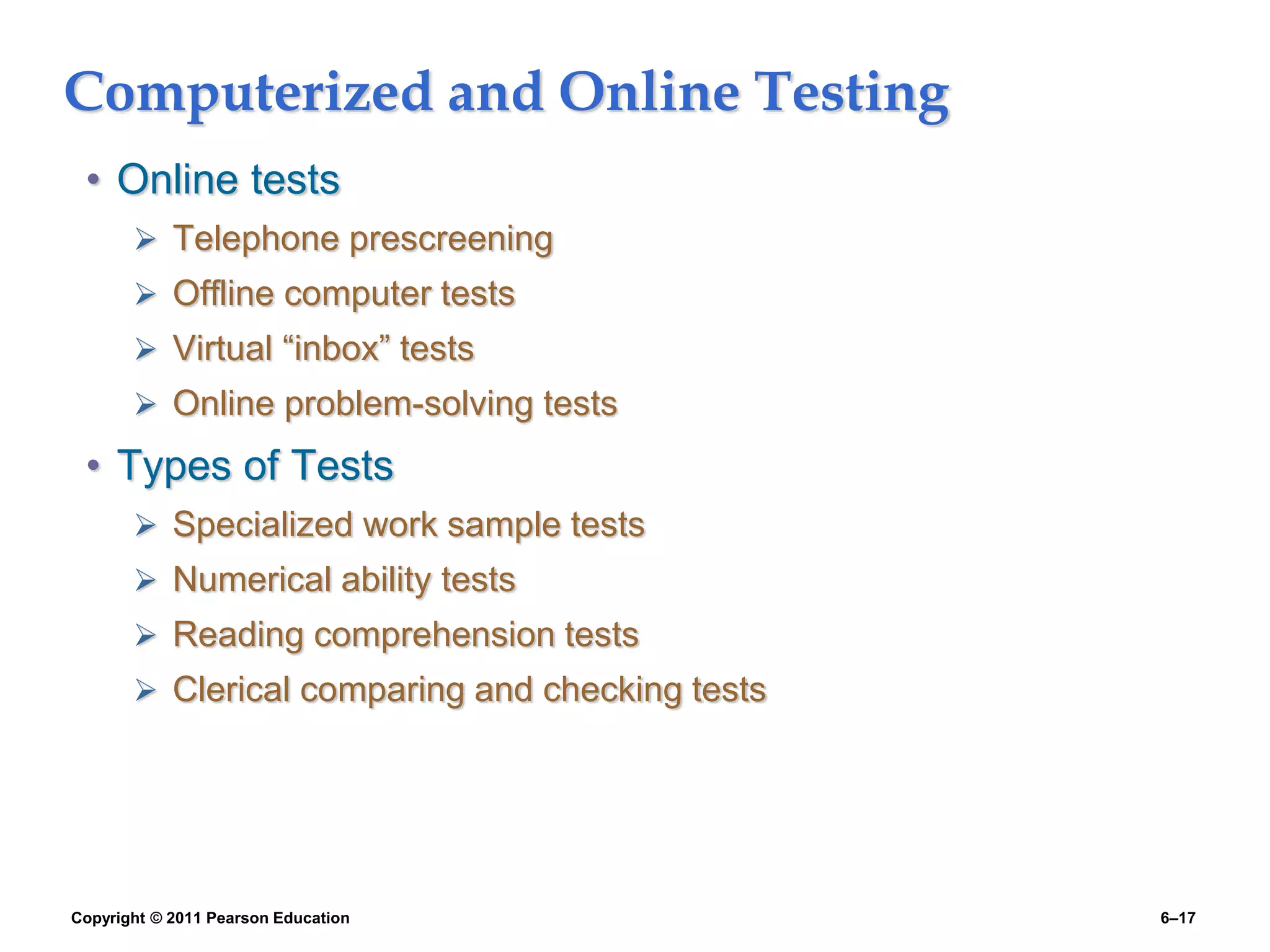
Computerized and Online Testing
• Online tests
 Telephone prescreening
 Offline computer tests
 Virtual “inbox” tests
 Online problem-solving tests
• Types of Tests
 Specialized work sample tests
 Numerical ability tests
 Reading comprehension tests
 Clerical comparing and checking tests
Copyright © 2011 Pearson Education 6–18
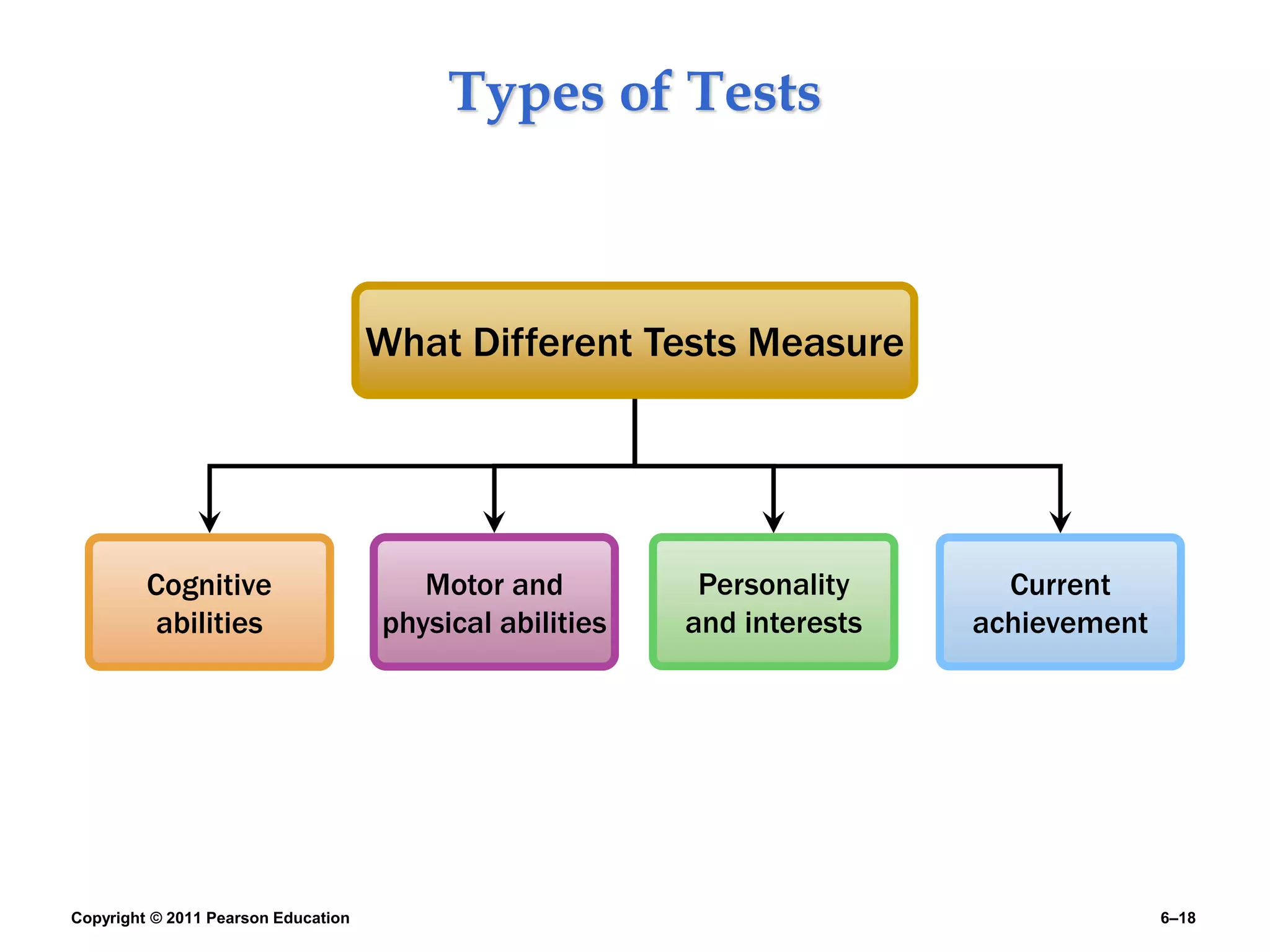
Types of Tests
Cognitive
abilities
Motor and
physical abilities
Personality
and interests
What Different Tests Measure
Current
achievement
Copyright © 2011 Pearson Education 6–19
FIGURE 6–5 Type of Question Applicant Might Expect
on a Test of Mechanical Comprehension
Copyright © 2011 Pearson Education 6–20
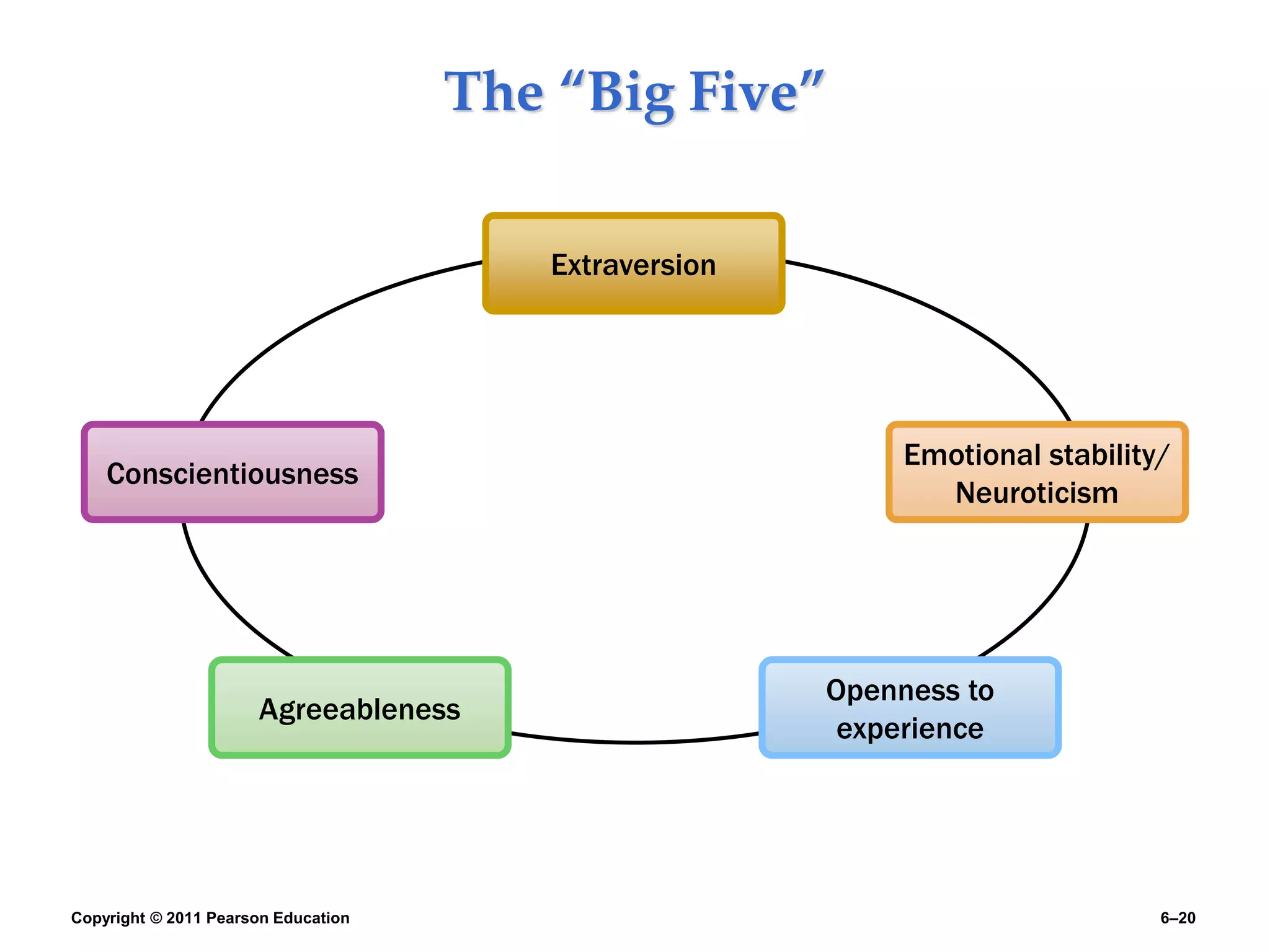
The “Big Five”
Extraversion
Emotional stability/
Neuroticism
Agreeableness
Openness to
experience
Conscientiousness
Copyright © 2011 Pearson Education 6–21
Work Samples and Simulations
Work
samples
Management
assessment
centers
Video-based
situational
testing
Measuring Work Performance
Directly
Miniature job
training and
evaluation
Copyright © 2011 Pearson Education 6–22
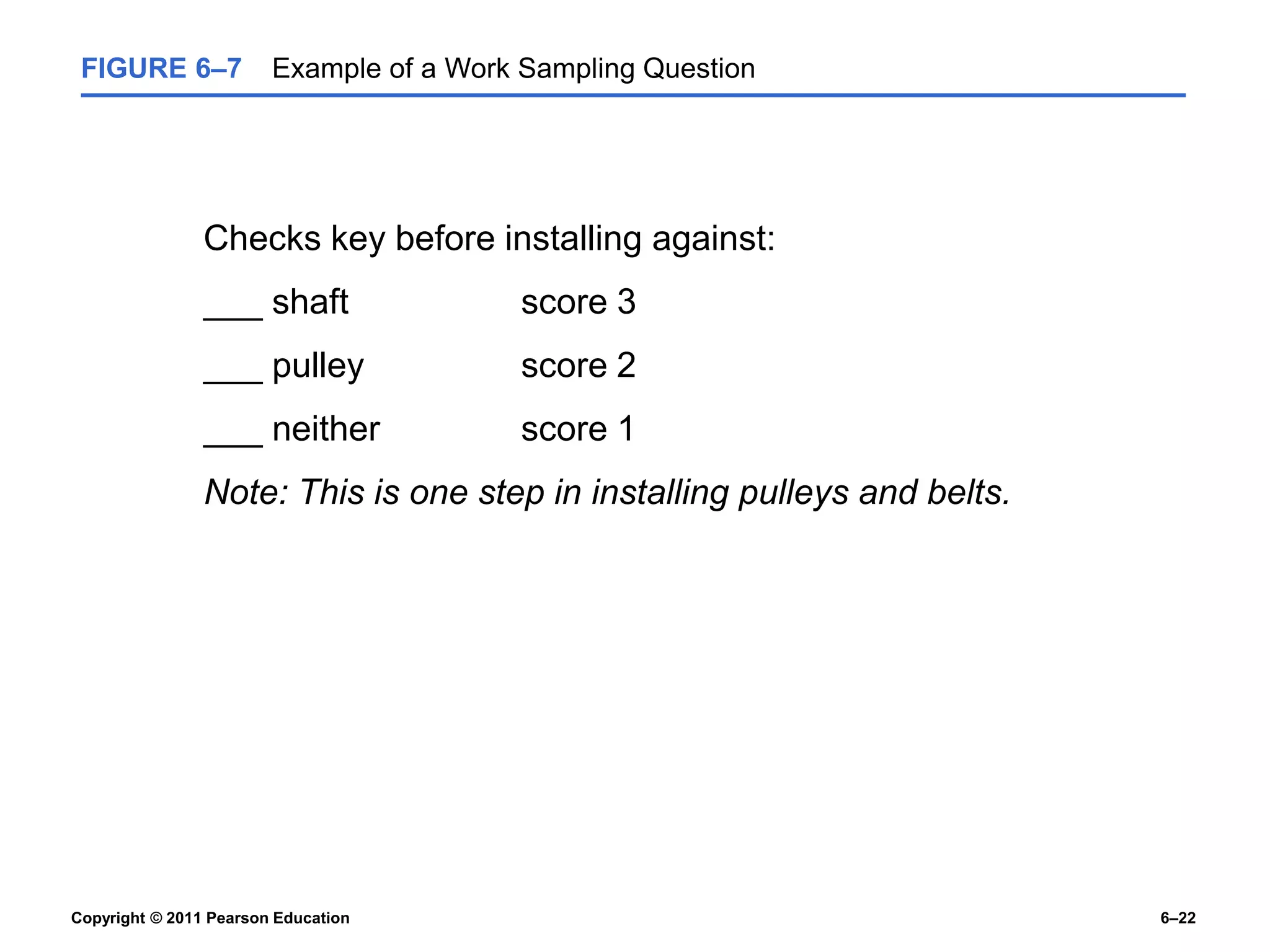
FIGURE 6–7 Example of a Work Sampling Question
Checks key before installing against:
___ shaft score 3
___ pulley score 2
___ neither score 1
Note: This is one step in installing pulleys and belts.
Copyright © 2011 Pearson Education 6–23
TABLE 6–2 Evaluation of Assessment Methods on Four Key Criteria
Assessment Method Validity Adverse Impact
Costs (Develop/
Administer) Applicant Reactions
Cognitive ability tests High High (against minorities) Low/low Somewhat favorable
Job knowledge test High High (against minorities) Low/low More favorable
Personality tests Low to
moderate
Low Low/low Less favorable
Biographical data inventories Moderate Low to high for different
types
High/low Less favorable
Integrity tests Moderate to
high
Low Low/low Less favorable
Structured interviews High Low High/high More favorable
Physical fitness tests Moderate to
high
High (against females and
older workers)
High/high More favorable
Situational judgment tests Moderate Moderate (against
minorities)
High/low More favorable
Work samples High Low High/high More favorable
Assessment centers Moderate to
high
Low to moderate,
depending on exercise
High/high More favorable
Physical ability tests Moderate to
high
High (against females and
older workers)
High/high More favorable
Note: There was limited research evidence available on applicant reactions to situational judgment tests and physical ability tests. However,
because these tests tend to appear very relevant to the job, it is likely that applicant reactions to them would be favorable.
Copyright © 2011 Pearson Education 6–24
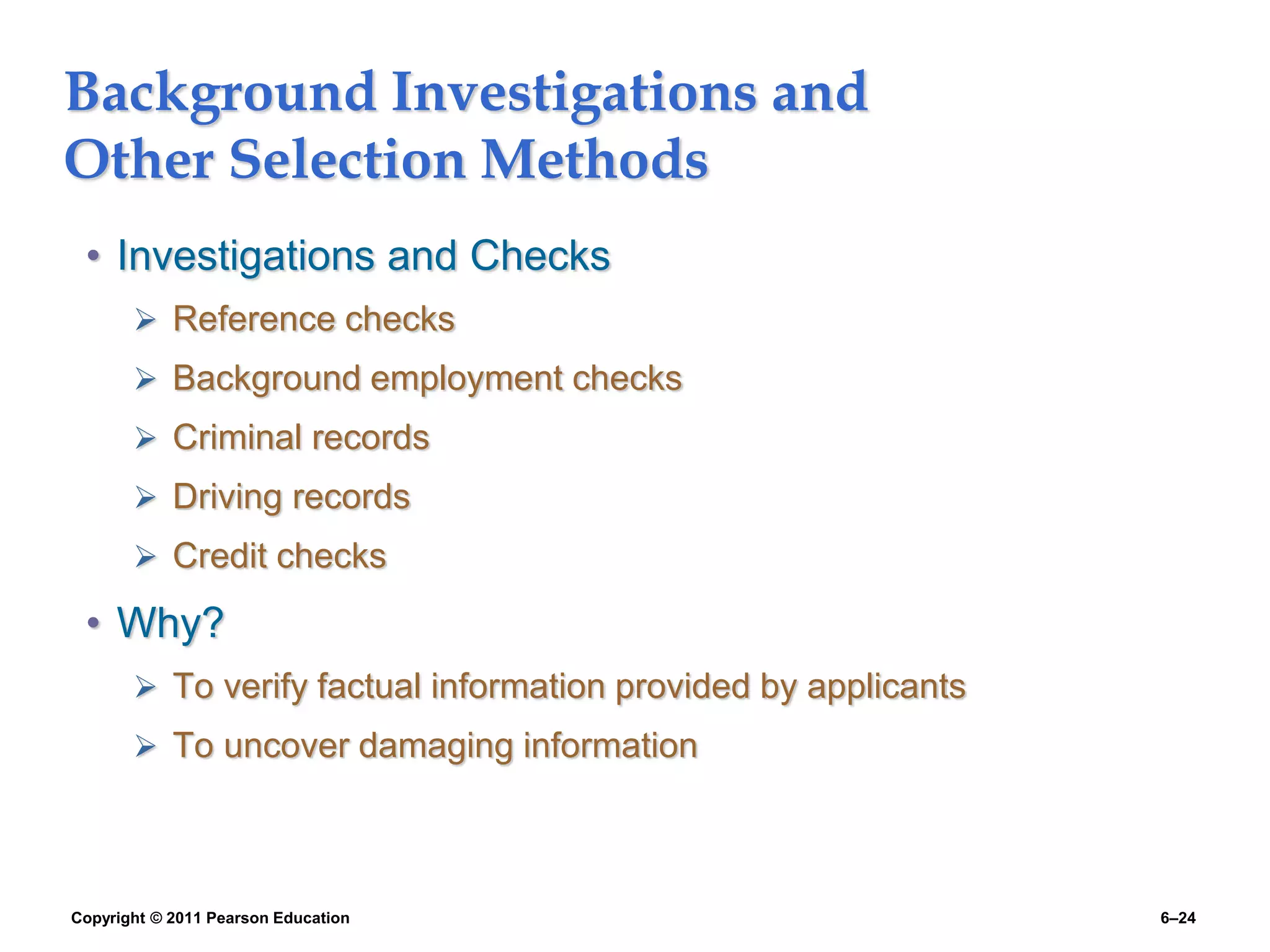
Background Investigations and
Other Selection Methods
• Investigations and Checks
 Reference checks
 Background employment checks
 Criminal records
 Driving records
 Credit checks
• Why?
 To verify factual information provided by applicants
 To uncover damaging information
Copyright © 2011 Pearson Education 6–25
Background Investigations and
Reference Checks
Former Employers
Current Supervisors
Written References
Social Networking Sites
Commercial Credit
Rating Companies
Sources of
Information
Copyright © 2011 Pearson Education 6–26
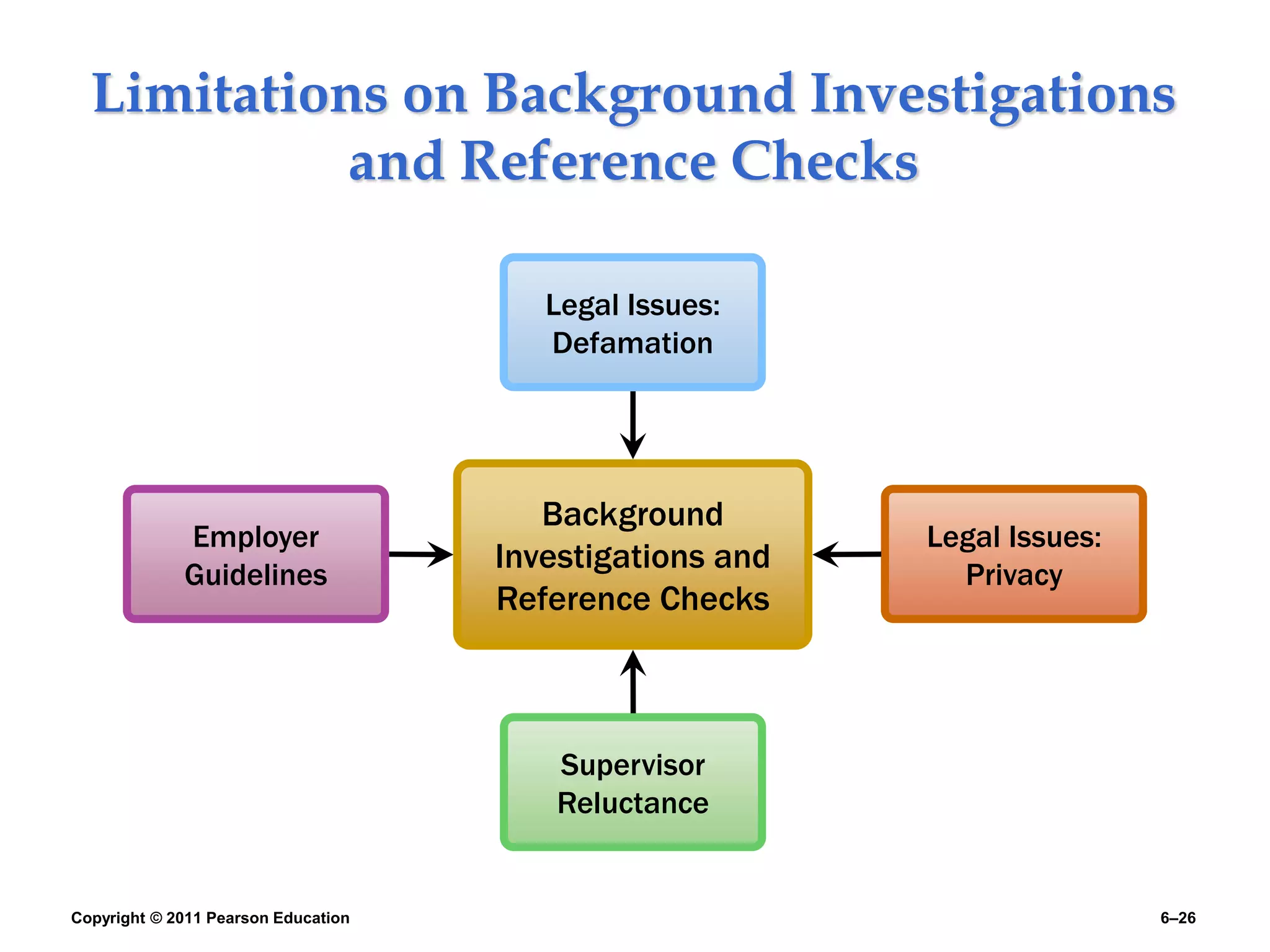
Limitations on Background Investigations
and Reference Checks
Background
Investigations and
Reference Checks
Supervisor
Reluctance
Employer
Guidelines
Legal Issues:
Privacy
Legal Issues:
Defamation
Copyright © 2011 Pearson Education 6–27
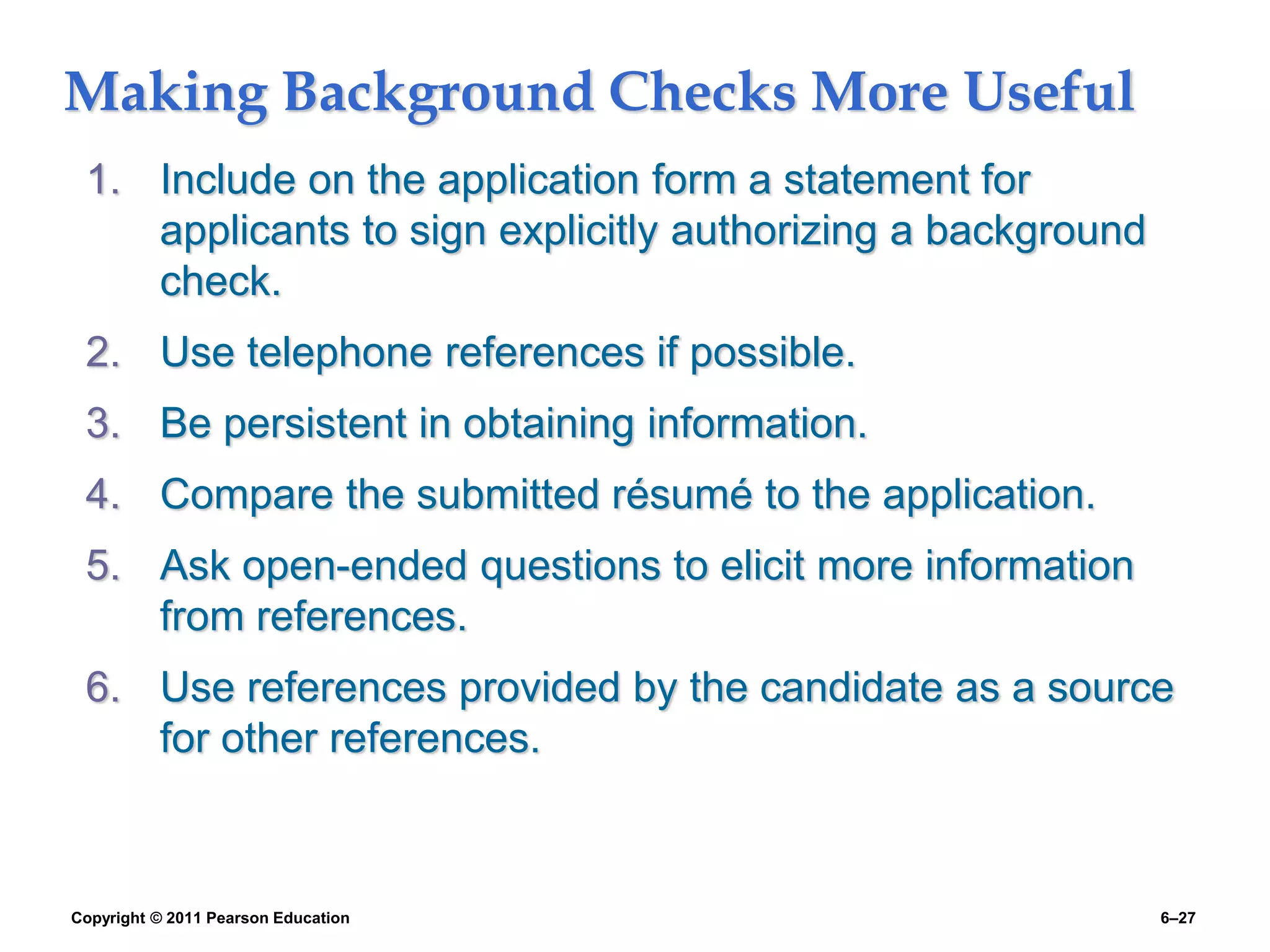
Making Background Checks More Useful
1. Include on the application form a statement for
applicants to sign explicitly authorizing a background
check.
2. Use telephone references if possible.
3. Be persistent in obtaining information.
4. Compare the submitted résumé to the application.
5. Ask open-ended questions to elicit more information
from references.
6. Use references provided by the candidate as a source
for other references.
Copyright © 2011 Pearson Education 6–28
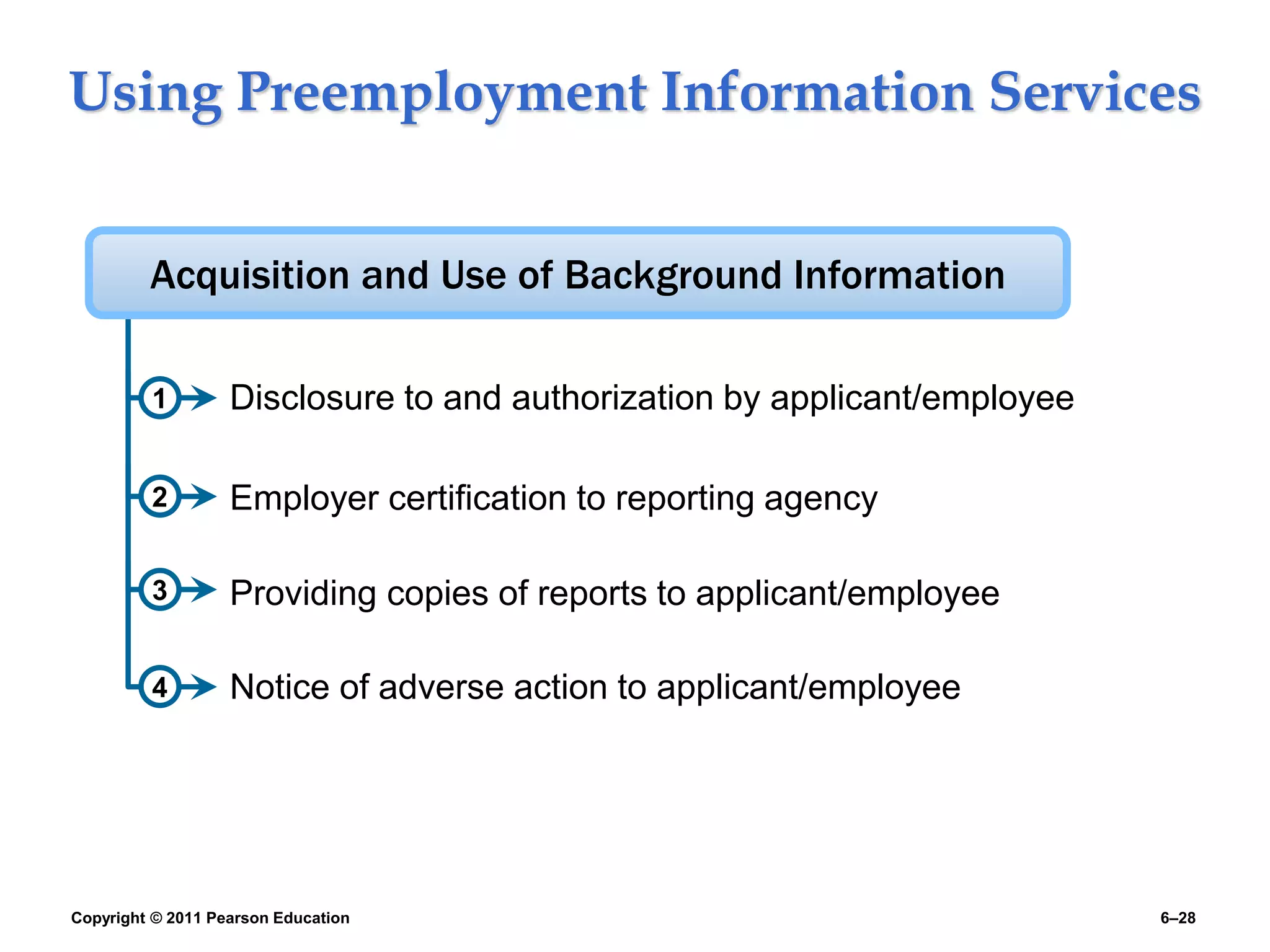
Using Preemployment Information Services
1
Notice of adverse action to applicant/employee
Employer certification to reporting agency
Acquisition and Use of Background Information
Disclosure to and authorization by applicant/employee
Providing copies of reports to applicant/employee
2
3
4
Copyright © 2011 Pearson Education 6–29
The Polygraph and Honesty Testing
• Employee Polygraph Protection Act of 1988
 Generally prohibits polygraph examinations by all private
employers unless:
 The employer has suffered an economic loss or injury.
 The employee in question had access to the property.
 There is a reasonable prior suspicion.
 The employee is told the details of the investigation, as well
as questions to be asked on the polygraph test itself.
 Private business exceptions:
 Private security employees
 Employees with access to drugs
 Ongoing economic loss or injury investigations
Copyright © 2011 Pearson Education 6–30
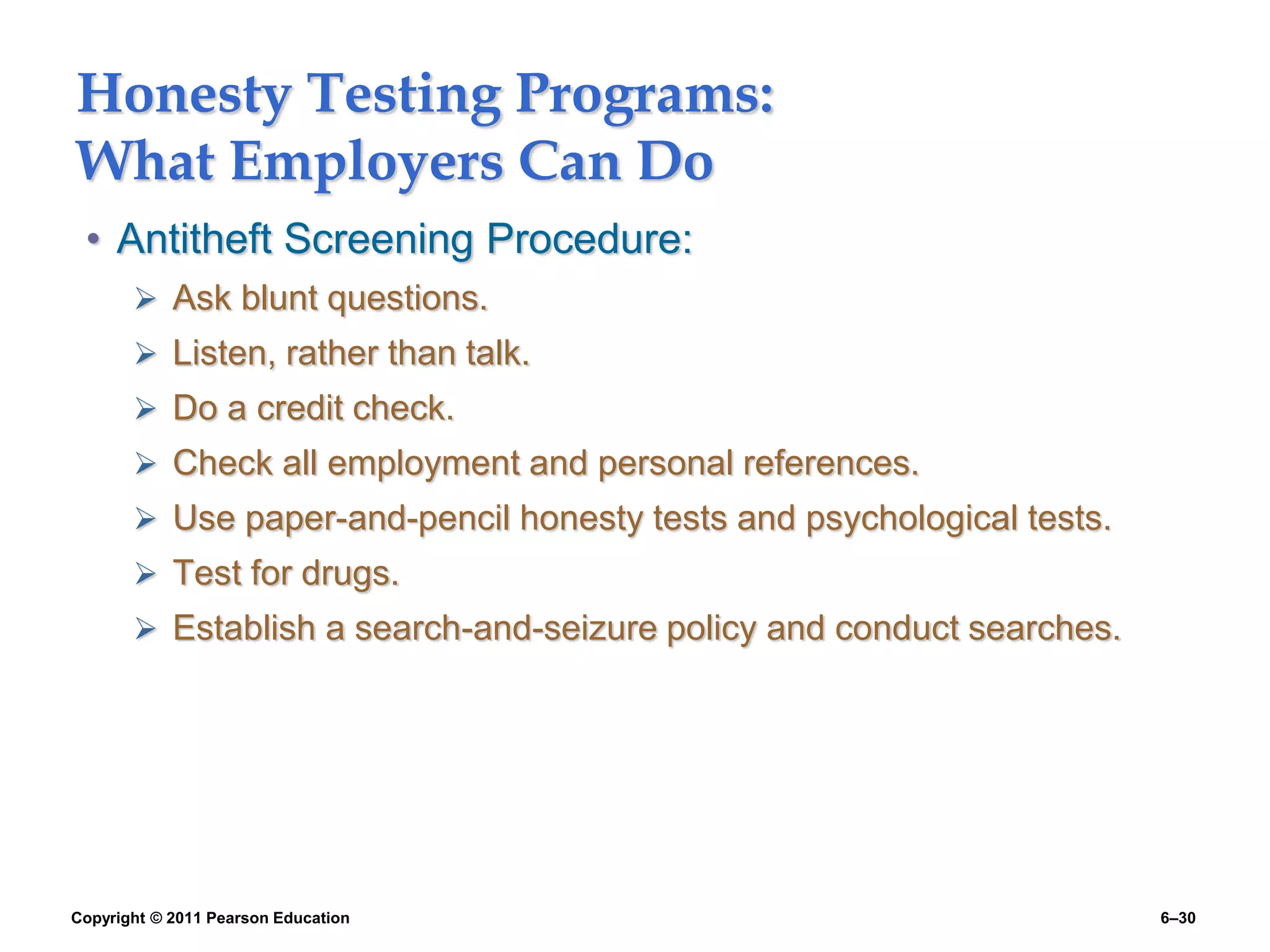
Honesty Testing Programs:
What Employers Can Do
• Antitheft Screening Procedure:
 Ask blunt questions.
 Listen, rather than talk.
 Do a credit check.
 Check all employment and personal references.
 Use paper-and-pencil honesty tests and psychological tests.
 Test for drugs.
 Establish a search-and-seizure policy and conduct searches.
Copyright © 2011 Pearson Education 6–31
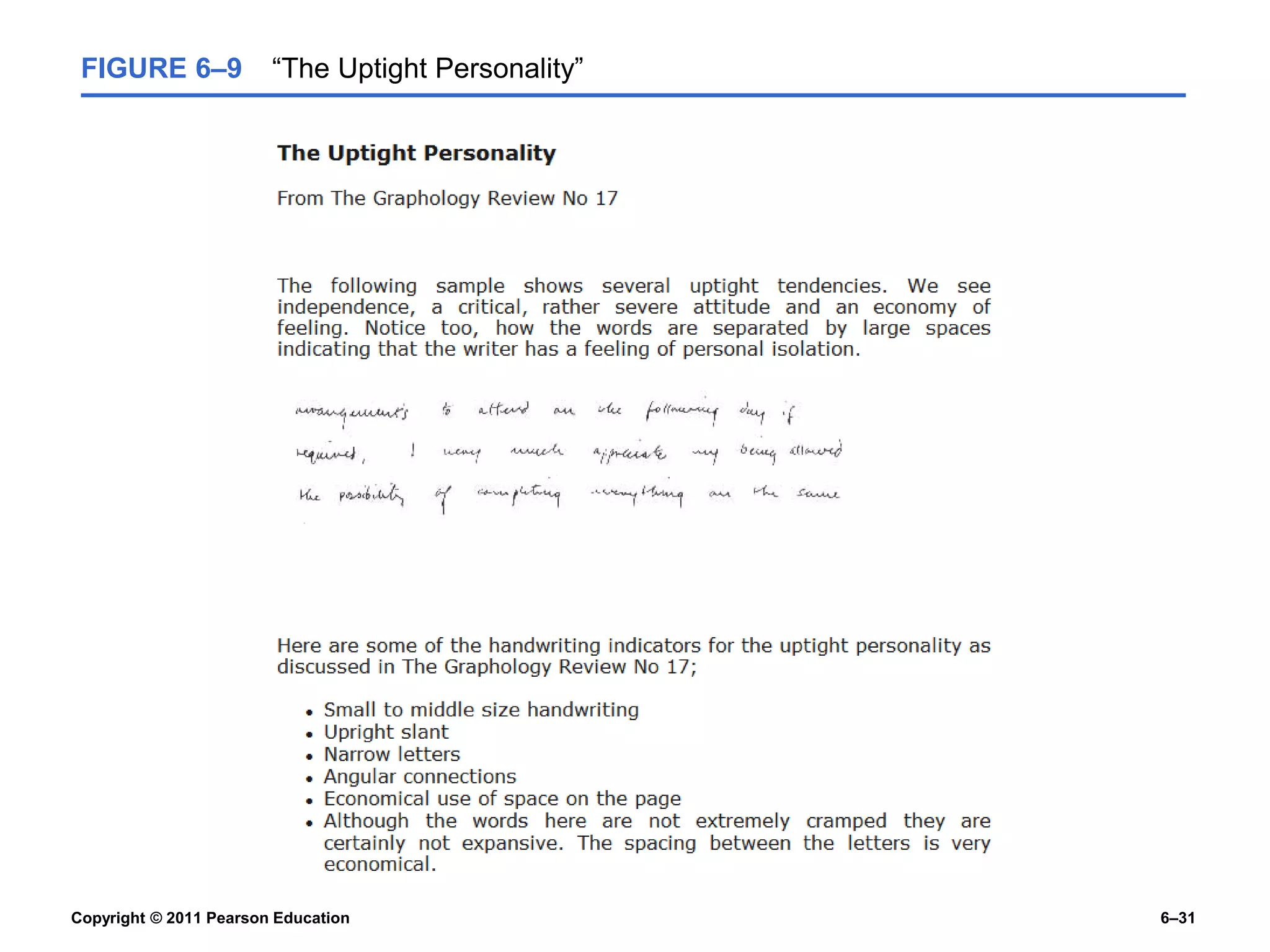
FIGURE 6–9 “The Uptight Personality”
Copyright © 2011 Pearson Education 6–32
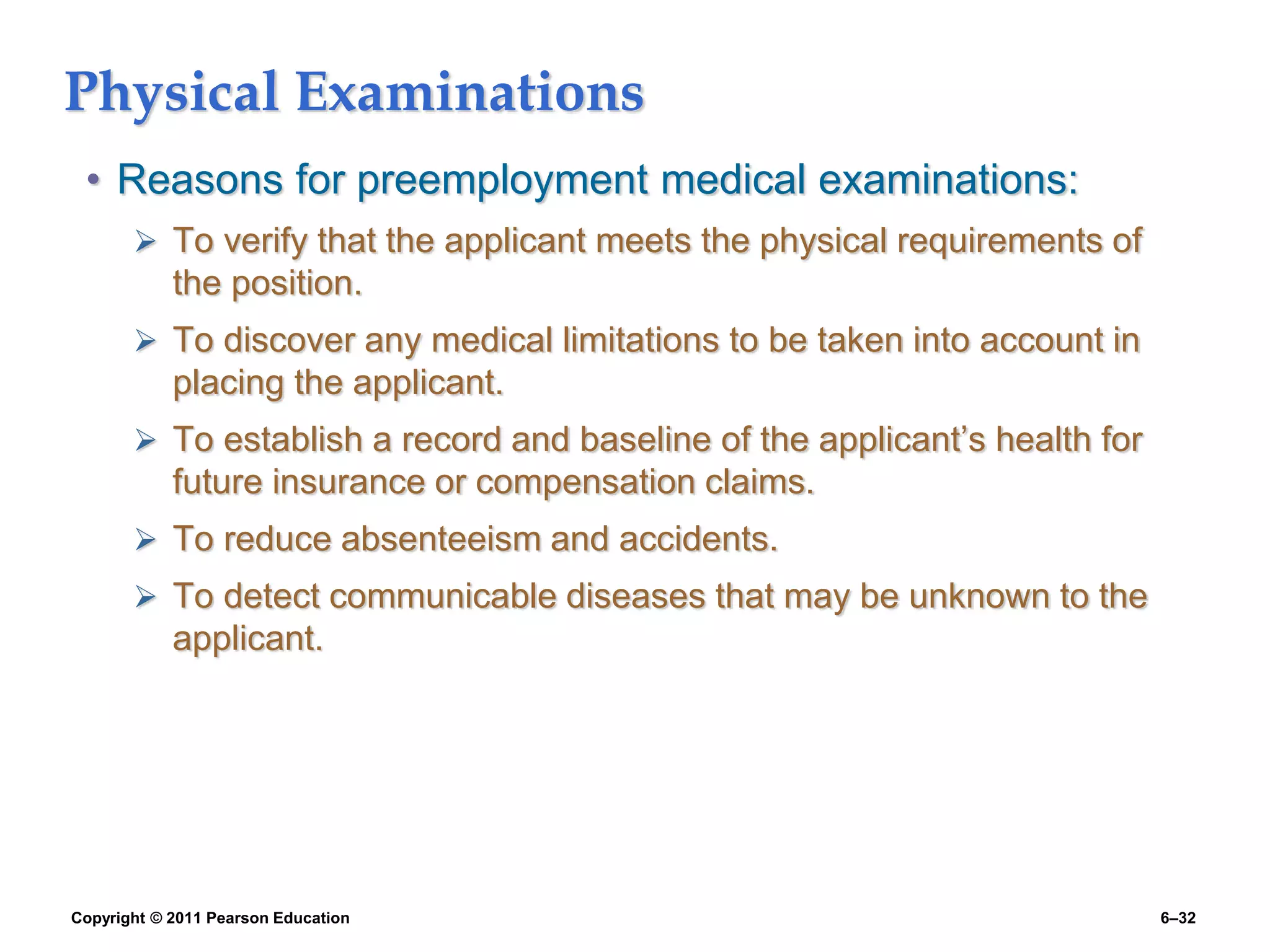
Physical Examinations
• Reasons for preemployment medical examinations:
 To verify that the applicant meets the physical requirements of
the position.
 To discover any medical limitations to be taken into account in
placing the applicant.
 To establish a record and baseline of the applicant’s health for
future insurance or compensation claims.
 To reduce absenteeism and accidents.
 To detect communicable diseases that may be unknown to the
applicant.
Copyright © 2011 Pearson Education 6–33
Substance Abuse Screening
• Types of Screening
 Before formal hiring
 After a work accident
 Presence of obvious behavioral symptoms
 Random or periodic basis
 Transfer or promotion to new position
• Types of Tests
 Urinalysis
 Hair follicle testing
Copyright © 2011 Pearson Education 6–34
Substance Abuse Screening Issues
Safety:
impairment vs.
presence
Recreational use
vs. addiction
American with
Disabilities Act
Drug Free
Workplace Act of
1998
Intrusiveness of
testing procedures
Accuracy of tests
Ethical and
Legal Issues
Copyright © 2011 Pearson Education 6–35
FIGURE 6–10 Procedure in Complying with Immigration Law
1. Hire only citizens and aliens lawfully authorized to work in the
United States.
2. Advise all new job applicants of your policy.
3. Require all new employees to complete and sign the verification
form (the “I-9 form”) designated by the Immigration and
Naturalization Service (INS) to certify that they are eligible for
employment.
4. Examine documentation presented by all new employees, record
information about the documents on the verification form, and
sign the form.
5. Retain the form for three years or for one year past the
employment of the individual, whichever is longer.
6. If requested, present the form for inspection by INS or
Department of Labor officers. No reporting is required.
Copyright © 2011 Pearson Education 6–36
Improving Productivity Through HRIS:
Using Automated Applicant Tracking
and Screening Systems (ATS)
“Knock out”
applicants who
do not meet job
requirements
Allows employers to
extensively test and
screen applicants
online
Benefits of Applicant
Tracking Systems
Can match “hidden
talents” of applicants
to available openings
Copyright © 2011 Pearson Education 6–37
FIGURE 6–11 Checklist: What to Look For in an Applicant Tracking System (ATS)
The employer thinking of adopting an ATS should seek one that meets several
minimum functionality requirements. Among other things, the ATS should be:
• Easy to use.
• Capable of being integrated into the company’s existing HRIS platform, so that, for
instance, data on a newly hired candidate can flow seamlessly into the HRIS
payroll system.
• Able to capture, track, and report applicant EEO data.
• Able to provide employee selection performance metrics reports, including “time to
fill,” “cost to hire,” and “applicant source statistics.”
• Able to facilitate scheduling and tracking of candidate interviews, email
communications, and completed forms, including job offers.
• Able to provide automated screening and ranking of candidates based upon job
skill profiles.
• Able to provide an internal job posting service that supports applications from
current employees and employee referral programs.
• Able to cross-post jobs to commercial job boards such as www.monster.com.
• Able to integrate the ATS job board with your company’s own Web site; for
instance, by linking it to your site’s “careers” section.
• Able to provide for requisition creation and signoff approvals.
Copyright © 2011 Pearson Education 6–38
K E Y T E R M S
reliability
test validity
criterion validity
content validity
expectancy chart
interest inventory
work samples
work sampling technique
management assessment center
situational test
video-based simulation
miniature job training and evaluation
Copyright © 2011 Pearson Education 6–39
All rights reserved. No part of this publication may be reproduced,
stored in a retrieval system, or transmitted, in any form or by any
means, electronic, mechanical, photocopying, recording, or
otherwise, without the prior written permission of the publisher.
Printed in the United States of America.

Dessler hrm12e ppt_06

  • 1.
    GARY DESSLER HUMAN RESOURCEMANAGEMENT Global Edition 12e Chapter 6 Employee Testing and Selection PowerPoint Presentation by Charlie Cook The University of West Alabama Copyright © 2011 Pearson Education Part 2 Recruitment and Placement
  • 2.
    c 6–2 WHERE WEARE NOW…
  • 3.
    Copyright © 2011Pearson Education 6–3 1. Explain what is meant by reliability and validity. 2. Explain how you would go about validating a test. 3. Cite and illustrate our testing guidelines. 4. Give examples of some of the ethical and legal considerations in testing. 5. List eight tests you could use for employee selection and how you would use them. 6. Give two examples of work sample/simulation tests. 7. Explain the key points to remember in conducting background investigations. LEARNING OUTCOMES
  • 4.
    Copyright © 2011Pearson Education 6–4 Why Careful Selection is Important Organizational performance Costs of recruiting and hiring The Importance of Selecting the Right Employees Legal obligations and liability
  • 5.
    Copyright © 2011Pearson Education 6–5 Avoiding Negligent Hiring Claims • Carefully scrutinize information on employment applications. • Get written authorization for reference checks, and check references. • Save all records and information about the applicant. • Reject applicants for false statements or conviction records for offenses related to the job. • Balance the applicant’s privacy rights with others’ “need to know.” • Take immediate disciplinary action if problems arise.
  • 6.
    Copyright © 2011Pearson Education 6–6 Basic Testing Concepts • Reliability  Describes the consistency of scores obtained by the same person when retested with the identical or alternate forms of the same test.  Are test results stable over time? • Validity  Indicates whether a test is measuring what it is supposed to be measuring.  Does the test actually measure what it is intended to measure?
  • 7.
    Copyright © 2011Pearson Education 6–7 FIGURE 6–1 A Slide from the Rorschach Test
  • 8.
    Copyright © 2011Pearson Education 6–8 Types of Validity Criterion validity Content validity Types of Test Validity
  • 9.
    Copyright © 2011Pearson Education 6–9 Evidence-Based HR: How to Validate a Test 1 Relate Your Test Scores and Criteria: scores versus actual performance Choose the Tests: test battery or single test Steps in Test Validation Analyze the Job: predictors and criteria Administer the Test: concurrent or predictive validation 2 3 4 Cross-Validate and Revalidate: repeat Steps 3 and 4 with a different sample 5
  • 10.
    Copyright © 2011Pearson Education 6–10 FIGURE 6–2 Examples of Web Sites Offering Information on Tests or Testing Programs • www.hr-guide.com/data/G371.htm Provides general information and sources for all types of employment tests • http://ericae.net Provides technical information on all types of employment and nonemployment • tests.www.ets.org/testcoll Provides information on over 20,000 tests • www.kaplan.com Information from Kaplan test preparation on how various admissions tests work • www.assessments.biz One of many firms offering employment tests
  • 11.
    Copyright © 2011Pearson Education 6–11 FIGURE 6–3 Expectancy Chart Note: This expectancy chart shows the relation between scores made on the Minnesota Paper Form Board and rated success of junior draftspersons. Example: Those who score between 37 and 44 have a 55% chance of being rated above average and those scoring between 57 and 64 have a 97% chance.
  • 12.
    Copyright © 2011Pearson Education 6–12 TABLE 6–1 Testing Program Guidelines 1. Use tests as supplements. 2. Validate the tests. 3. Monitor your testing/selection program. 4. Keep accurate records. 5. Use a certified psychologist. 6. Manage test conditions. 7. Revalidate periodically.
  • 13.
    Copyright © 2011Pearson Education 6–13 Test Takers’ Individual Rights and Test Security • Under the APA’s standard for educational and psychological tests, test takers have the following rights:  The right to the confidentiality of test results.  The right to informed consent regarding use of these results.  The right to expect that only people qualified to interpret the scores will have access to them, or that sufficient information will accompany the scores to ensure their appropriate interpretation.  The right to expect the test is fair to all. For example, no one taking it should have prior access to the questions or answers.
  • 14.
    Copyright © 2011Pearson Education 6–14 Legal Privacy Issues • Defamation  Libeling or slandering of employees or former employees by an employer. • Avoiding Employee Defamation Suits 1. Train supervisors regarding the importance of employee confidentiality. 2. Adopt a “need to know” policy. 3. Disclose procedures impacting confidentially of information to employees.
  • 15.
    Copyright © 2011Pearson Education 6–15 How Do Employers Use Tests at Work? • Major Types of Tests  Basic skills tests  Job skills tests  Psychological tests • Why Use Testing?  Increased work demands = more testing  Screen out bad or dishonest employees  Reduce turnover by personality profiling
  • 16.
    Copyright © 2011Pearson Education 6–16 FIGURE 6–4 Sample Test
  • 17.
    Copyright © 2011Pearson Education 6–17 Computerized and Online Testing • Online tests  Telephone prescreening  Offline computer tests  Virtual “inbox” tests  Online problem-solving tests • Types of Tests  Specialized work sample tests  Numerical ability tests  Reading comprehension tests  Clerical comparing and checking tests
  • 18.
    Copyright © 2011Pearson Education 6–18 Types of Tests Cognitive abilities Motor and physical abilities Personality and interests What Different Tests Measure Current achievement
  • 19.
    Copyright © 2011Pearson Education 6–19 FIGURE 6–5 Type of Question Applicant Might Expect on a Test of Mechanical Comprehension
  • 20.
    Copyright © 2011Pearson Education 6–20 The “Big Five” Extraversion Emotional stability/ Neuroticism Agreeableness Openness to experience Conscientiousness
  • 21.
    Copyright © 2011Pearson Education 6–21 Work Samples and Simulations Work samples Management assessment centers Video-based situational testing Measuring Work Performance Directly Miniature job training and evaluation
  • 22.
    Copyright © 2011Pearson Education 6–22 FIGURE 6–7 Example of a Work Sampling Question Checks key before installing against: ___ shaft score 3 ___ pulley score 2 ___ neither score 1 Note: This is one step in installing pulleys and belts.
  • 23.
    Copyright © 2011Pearson Education 6–23 TABLE 6–2 Evaluation of Assessment Methods on Four Key Criteria Assessment Method Validity Adverse Impact Costs (Develop/ Administer) Applicant Reactions Cognitive ability tests High High (against minorities) Low/low Somewhat favorable Job knowledge test High High (against minorities) Low/low More favorable Personality tests Low to moderate Low Low/low Less favorable Biographical data inventories Moderate Low to high for different types High/low Less favorable Integrity tests Moderate to high Low Low/low Less favorable Structured interviews High Low High/high More favorable Physical fitness tests Moderate to high High (against females and older workers) High/high More favorable Situational judgment tests Moderate Moderate (against minorities) High/low More favorable Work samples High Low High/high More favorable Assessment centers Moderate to high Low to moderate, depending on exercise High/high More favorable Physical ability tests Moderate to high High (against females and older workers) High/high More favorable Note: There was limited research evidence available on applicant reactions to situational judgment tests and physical ability tests. However, because these tests tend to appear very relevant to the job, it is likely that applicant reactions to them would be favorable.
  • 24.
    Copyright © 2011Pearson Education 6–24 Background Investigations and Other Selection Methods • Investigations and Checks  Reference checks  Background employment checks  Criminal records  Driving records  Credit checks • Why?  To verify factual information provided by applicants  To uncover damaging information
  • 25.
    Copyright © 2011Pearson Education 6–25 Background Investigations and Reference Checks Former Employers Current Supervisors Written References Social Networking Sites Commercial Credit Rating Companies Sources of Information
  • 26.
    Copyright © 2011Pearson Education 6–26 Limitations on Background Investigations and Reference Checks Background Investigations and Reference Checks Supervisor Reluctance Employer Guidelines Legal Issues: Privacy Legal Issues: Defamation
  • 27.
    Copyright © 2011Pearson Education 6–27 Making Background Checks More Useful 1. Include on the application form a statement for applicants to sign explicitly authorizing a background check. 2. Use telephone references if possible. 3. Be persistent in obtaining information. 4. Compare the submitted résumé to the application. 5. Ask open-ended questions to elicit more information from references. 6. Use references provided by the candidate as a source for other references.
  • 28.
    Copyright © 2011Pearson Education 6–28 Using Preemployment Information Services 1 Notice of adverse action to applicant/employee Employer certification to reporting agency Acquisition and Use of Background Information Disclosure to and authorization by applicant/employee Providing copies of reports to applicant/employee 2 3 4
  • 29.
    Copyright © 2011Pearson Education 6–29 The Polygraph and Honesty Testing • Employee Polygraph Protection Act of 1988  Generally prohibits polygraph examinations by all private employers unless:  The employer has suffered an economic loss or injury.  The employee in question had access to the property.  There is a reasonable prior suspicion.  The employee is told the details of the investigation, as well as questions to be asked on the polygraph test itself.  Private business exceptions:  Private security employees  Employees with access to drugs  Ongoing economic loss or injury investigations
  • 30.
    Copyright © 2011Pearson Education 6–30 Honesty Testing Programs: What Employers Can Do • Antitheft Screening Procedure:  Ask blunt questions.  Listen, rather than talk.  Do a credit check.  Check all employment and personal references.  Use paper-and-pencil honesty tests and psychological tests.  Test for drugs.  Establish a search-and-seizure policy and conduct searches.
  • 31.
    Copyright © 2011Pearson Education 6–31 FIGURE 6–9 “The Uptight Personality”
  • 32.
    Copyright © 2011Pearson Education 6–32 Physical Examinations • Reasons for preemployment medical examinations:  To verify that the applicant meets the physical requirements of the position.  To discover any medical limitations to be taken into account in placing the applicant.  To establish a record and baseline of the applicant’s health for future insurance or compensation claims.  To reduce absenteeism and accidents.  To detect communicable diseases that may be unknown to the applicant.
  • 33.
    Copyright © 2011Pearson Education 6–33 Substance Abuse Screening • Types of Screening  Before formal hiring  After a work accident  Presence of obvious behavioral symptoms  Random or periodic basis  Transfer or promotion to new position • Types of Tests  Urinalysis  Hair follicle testing
  • 34.
    Copyright © 2011Pearson Education 6–34 Substance Abuse Screening Issues Safety: impairment vs. presence Recreational use vs. addiction American with Disabilities Act Drug Free Workplace Act of 1998 Intrusiveness of testing procedures Accuracy of tests Ethical and Legal Issues
  • 35.
    Copyright © 2011Pearson Education 6–35 FIGURE 6–10 Procedure in Complying with Immigration Law 1. Hire only citizens and aliens lawfully authorized to work in the United States. 2. Advise all new job applicants of your policy. 3. Require all new employees to complete and sign the verification form (the “I-9 form”) designated by the Immigration and Naturalization Service (INS) to certify that they are eligible for employment. 4. Examine documentation presented by all new employees, record information about the documents on the verification form, and sign the form. 5. Retain the form for three years or for one year past the employment of the individual, whichever is longer. 6. If requested, present the form for inspection by INS or Department of Labor officers. No reporting is required.
  • 36.
    Copyright © 2011Pearson Education 6–36 Improving Productivity Through HRIS: Using Automated Applicant Tracking and Screening Systems (ATS) “Knock out” applicants who do not meet job requirements Allows employers to extensively test and screen applicants online Benefits of Applicant Tracking Systems Can match “hidden talents” of applicants to available openings
  • 37.
    Copyright © 2011Pearson Education 6–37 FIGURE 6–11 Checklist: What to Look For in an Applicant Tracking System (ATS) The employer thinking of adopting an ATS should seek one that meets several minimum functionality requirements. Among other things, the ATS should be: • Easy to use. • Capable of being integrated into the company’s existing HRIS platform, so that, for instance, data on a newly hired candidate can flow seamlessly into the HRIS payroll system. • Able to capture, track, and report applicant EEO data. • Able to provide employee selection performance metrics reports, including “time to fill,” “cost to hire,” and “applicant source statistics.” • Able to facilitate scheduling and tracking of candidate interviews, email communications, and completed forms, including job offers. • Able to provide automated screening and ranking of candidates based upon job skill profiles. • Able to provide an internal job posting service that supports applications from current employees and employee referral programs. • Able to cross-post jobs to commercial job boards such as www.monster.com. • Able to integrate the ATS job board with your company’s own Web site; for instance, by linking it to your site’s “careers” section. • Able to provide for requisition creation and signoff approvals.
  • 38.
    Copyright © 2011Pearson Education 6–38 K E Y T E R M S reliability test validity criterion validity content validity expectancy chart interest inventory work samples work sampling technique management assessment center situational test video-based simulation miniature job training and evaluation
  • 39.
    Copyright © 2011Pearson Education 6–39 All rights reserved. No part of this publication may be reproduced, stored in a retrieval system, or transmitted, in any form or by any means, electronic, mechanical, photocopying, recording, or otherwise, without the prior written permission of the publisher. Printed in the United States of America.

Editor's Notes

  • #2 Copyright © 2011 Pearson Education
  • #3 Copyright © 2011 Pearson Education
  • #4 Copyright © 2011 Pearson Education
  • #5 Copyright © 2011 Pearson Education
  • #6 Copyright © 2011 Pearson Education
  • #7 Copyright © 2011 Pearson Education
  • #8 Copyright © 2011 Pearson Education
  • #9 Copyright © 2011 Pearson Education
  • #10 Copyright © 2011 Pearson Education
  • #11 Copyright © 2011 Pearson Education
  • #12 Copyright © 2011 Pearson Education
  • #13 Copyright © 2011 Pearson Education
  • #14 Copyright © 2011 Pearson Education
  • #15 Copyright © 2011 Pearson Education
  • #16 Copyright © 2011 Pearson Education
  • #17 Copyright © 2011 Pearson Education
  • #18 Copyright © 2011 Pearson Education
  • #19 Copyright © 2011 Pearson Education
  • #20 Copyright © 2011 Pearson Education
  • #21 Copyright © 2011 Pearson Education
  • #22 Copyright © 2011 Pearson Education
  • #23 Copyright © 2011 Pearson Education
  • #24 Copyright © 2011 Pearson Education
  • #25 Copyright © 2011 Pearson Education
  • #26 Copyright © 2011 Pearson Education
  • #27 Copyright © 2011 Pearson Education
  • #28 Copyright © 2011 Pearson Education
  • #29 Copyright © 2011 Pearson Education
  • #30 Copyright © 2011 Pearson Education
  • #31 Copyright © 2011 Pearson Education
  • #32 Copyright © 2011 Pearson Education
  • #33 Copyright © 2011 Pearson Education
  • #34 Copyright © 2011 Pearson Education
  • #35 Copyright © 2011 Pearson Education
  • #36 Copyright © 2011 Pearson Education
  • #37 Copyright © 2011 Pearson Education
  • #38 Copyright © 2011 Pearson Education
  • #39 Copyright © 2011 Pearson Education
  • #40 Copyright © 2011 Pearson Education