Time management quotes
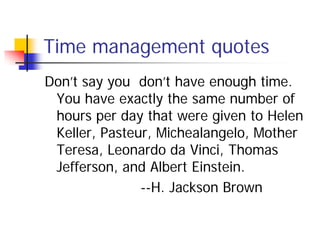
Don’t say you don’t have enough time.
 You have exactly the same number of
 hours per day that were given to Helen
 Keller, Pasteur, Michealangelo, Mother
 Teresa, Leonardo da Vinci, Thomas
 Jefferson, and Albert Einstein.
               --H. Jackson Brown
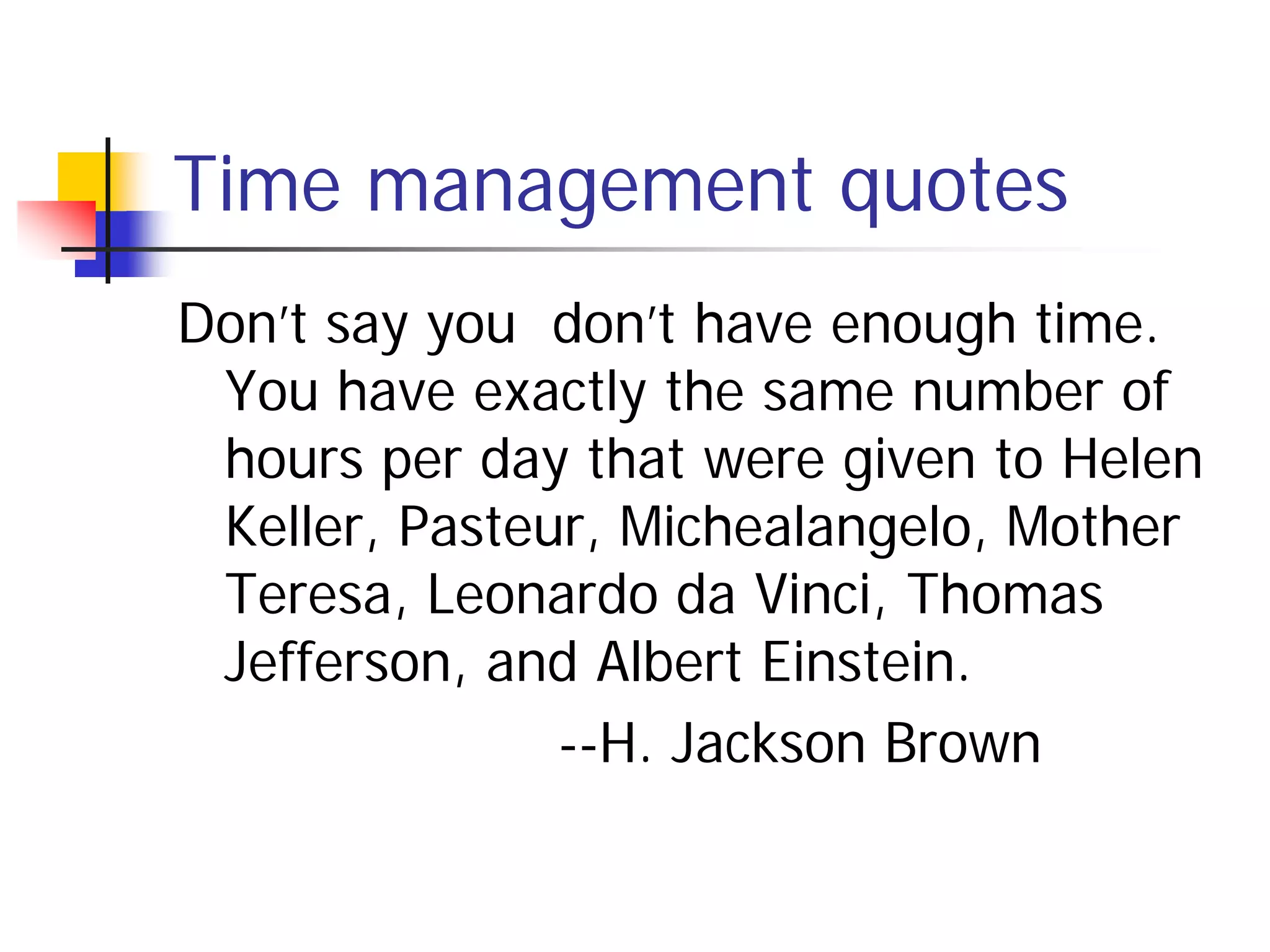
The bad news is time files. The good
  news is you’re the pilot.
                 --Michael Althusuler
A wise person does at once, what a fool
  does at last. Both do the same thing,
  only at different times.
                 --Baltsar Gracian
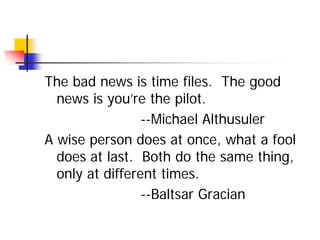
Never let yesterday use up today.
               --Richard. H. Nelson
SMART goals
S = Specific

M = Measurable

A = Attainable

R = Realistic

T = Timely
Specific
   Specific
       Goals should be straightforward and
        emphasize what you want to happen.
        Specifics help us to focus our efforts and
        clearly define what we are going to
        do.
Specific
      Specific is the What, Why, and How of the
    SMART model.
   W HAT are you going to do? Use action
    words such as direct, organize, coordinate,
    lead, develop, plan, build etc.
   W HY is this important to do at this time?
    What do you want to ultimately accomplish?
   HOW are you going to do it? (By...)
Specific
Ensure the goal you set is very specific,
 clear and easy. Instead of setting a
 goal to lose weight or be healthier, set
 a specific goal to lose 2 inches off your
 waistline or to walk 5 miles at an
 aerobically challenging pace.
Measurable

       If you can't measure it, you can't
    manage it. In the broadest sense, the
    whole goal statement is a measure for the
    project; if the goal is accomplished, then it
    is a success. However, there are usually
    several short-term or small measurements
    that can be built into the goal.
Measurable
Choose a goal with measurable progress,
  so you can see the change occur.
  How will you see when you reach your
  goal?
Be specific! "I want to read 3 chapter
  books of 100 pages on my own before
  my birthday" shows the specific target
  to be measure.
"I want to be a good reader" is not as
  measurable.
Measurable
Establish concrete criteria for
 measuring progress toward the
 attainment of each goal you set.
When you measure your progress, you
 stay on track, reach your target dates,
 and experience the exhilaration of
 achievement that spurs you on to
 continued effort required to reach your
 goals.
Attainable

When you identify goals that are most important to you,
  you begin to figure out ways you can make them
  come true.
You develop the attitudes, abilities, skills, and financial
  capacity to reach them.

You begin seeing previously overlooked opportunities
  to bring yourself closer to the achievement of your
  goals.
Attainable
   Goals you set which are too far out of
    your reach, you probably won't commit
    to doing. Although you may start with
    the best of intentions, the knowledge
    that it's too much for you means your
    subconscious will keep reminding you of
    this fact and will stop you from even
    giving it your best.
Attainable
    A goal needs to stretch you slightly so
    you feel you can do it and it will need a
    real commitment from you. For instance,
    if you aim to lose 20lbs in one week, we all
    know that isn't achievable. But setting a goal
    to loose 1lb and when you've achieved that,
    aiming to lose a further 1lb, will keep it
    achievable for you.
       The feeling of success which this
    brings helps you to remain motivated
Realistic

       This is not a synonym for "easy."
    Realistic, in this case, means "do-able."
    It means that the skills needed to do the
    work are available.
   A realistic goal may push the skills and
    knowledge of the person working on it but
    it shouldn't break them.
Realistic
      Devise a plan or a way of getting
    there which makes the goal realistic.
    The goal needs to be realistic for you
    and where you are at the moment. A
    goal of never again eating sweets,
    cakes, chips and chocolate may not be
    realistic for someone who really enjoys
    these foods.
Realistic
       For instance, it may be more
    realistic to set a goal of eating a piece
    of fruit each day instead of one sweet
    item. You can then choose to work
    towards reducing the amount of sweet
    products gradually as and when this
    feels realistic for you.
Realistic
       Be sure to set goals that you can
    attain with some effort! Too difficult
    and you set the stage for failure, but
    too low sends the message that you
    aren't very capable. Set the bar high
    enough for a satisfying
    achievement
Timely
Set a timeframe for the goal: for next week,
  in three months, by second semester.
Putting an end point on your goal gives you
  a clear target to work towards.
Timely
    If you don't set a time, the
    commitment is too vague. It tends not
    to happen because you feel you can
    start at any time. Without a time limit,
    there's no urgency to start taking action
    now.
       Time must be measurable,
    attainable and realistic.
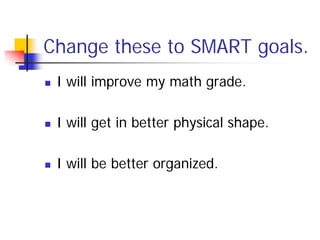
Change these to SMART goals.
   I will improve my math grade.

   I will get in better physical shape.

   I will be better organized.

Smartgoals

  • 1.
    Time management quotes Don’tsay you don’t have enough time. You have exactly the same number of hours per day that were given to Helen Keller, Pasteur, Michealangelo, Mother Teresa, Leonardo da Vinci, Thomas Jefferson, and Albert Einstein. --H. Jackson Brown
  • 2.
    The bad newsis time files. The good news is you’re the pilot. --Michael Althusuler A wise person does at once, what a fool does at last. Both do the same thing, only at different times. --Baltsar Gracian
  • 3.
    Never let yesterdayuse up today. --Richard. H. Nelson
  • 4.
    SMART goals S =Specific M = Measurable A = Attainable R = Realistic T = Timely
  • 5.
    Specific  Specific  Goals should be straightforward and emphasize what you want to happen. Specifics help us to focus our efforts and clearly define what we are going to do.
  • 6.
    Specific  Specific is the What, Why, and How of the SMART model.  W HAT are you going to do? Use action words such as direct, organize, coordinate, lead, develop, plan, build etc.  W HY is this important to do at this time? What do you want to ultimately accomplish?  HOW are you going to do it? (By...)
  • 7.
    Specific Ensure the goalyou set is very specific, clear and easy. Instead of setting a goal to lose weight or be healthier, set a specific goal to lose 2 inches off your waistline or to walk 5 miles at an aerobically challenging pace.
  • 8.
    Measurable  If you can't measure it, you can't manage it. In the broadest sense, the whole goal statement is a measure for the project; if the goal is accomplished, then it is a success. However, there are usually several short-term or small measurements that can be built into the goal.
  • 9.
    Measurable Choose a goalwith measurable progress, so you can see the change occur. How will you see when you reach your goal? Be specific! "I want to read 3 chapter books of 100 pages on my own before my birthday" shows the specific target to be measure. "I want to be a good reader" is not as measurable.
  • 10.
    Measurable Establish concrete criteriafor measuring progress toward the attainment of each goal you set. When you measure your progress, you stay on track, reach your target dates, and experience the exhilaration of achievement that spurs you on to continued effort required to reach your goals.
  • 11.
    Attainable When you identifygoals that are most important to you, you begin to figure out ways you can make them come true. You develop the attitudes, abilities, skills, and financial capacity to reach them. You begin seeing previously overlooked opportunities to bring yourself closer to the achievement of your goals.
  • 12.
    Attainable  Goals you set which are too far out of your reach, you probably won't commit to doing. Although you may start with the best of intentions, the knowledge that it's too much for you means your subconscious will keep reminding you of this fact and will stop you from even giving it your best.
  • 13.
    Attainable  A goal needs to stretch you slightly so you feel you can do it and it will need a real commitment from you. For instance, if you aim to lose 20lbs in one week, we all know that isn't achievable. But setting a goal to loose 1lb and when you've achieved that, aiming to lose a further 1lb, will keep it achievable for you.  The feeling of success which this brings helps you to remain motivated
  • 14.
    Realistic  This is not a synonym for "easy." Realistic, in this case, means "do-able." It means that the skills needed to do the work are available.  A realistic goal may push the skills and knowledge of the person working on it but it shouldn't break them.
  • 15.
    Realistic  Devise a plan or a way of getting there which makes the goal realistic. The goal needs to be realistic for you and where you are at the moment. A goal of never again eating sweets, cakes, chips and chocolate may not be realistic for someone who really enjoys these foods.
  • 16.
    Realistic  For instance, it may be more realistic to set a goal of eating a piece of fruit each day instead of one sweet item. You can then choose to work towards reducing the amount of sweet products gradually as and when this feels realistic for you.
  • 17.
    Realistic  Be sure to set goals that you can attain with some effort! Too difficult and you set the stage for failure, but too low sends the message that you aren't very capable. Set the bar high enough for a satisfying achievement
  • 18.
    Timely Set a timeframefor the goal: for next week, in three months, by second semester. Putting an end point on your goal gives you a clear target to work towards.
  • 19.
    Timely  If you don't set a time, the commitment is too vague. It tends not to happen because you feel you can start at any time. Without a time limit, there's no urgency to start taking action now.  Time must be measurable, attainable and realistic.
  • 20.
    Change these toSMART goals.  I will improve my math grade.  I will get in better physical shape.  I will be better organized.