

Goal Setting
   2013
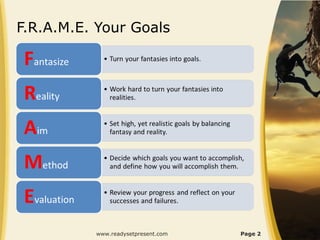
F.R.A.M.E. Your Goals


          www.readysetpresent.com   Page 2
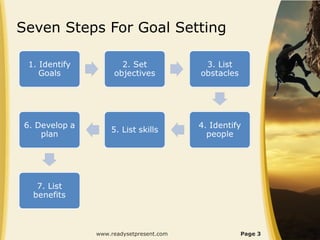
Seven Steps For Goal Setting


          www.readysetpresent.com   Page 3
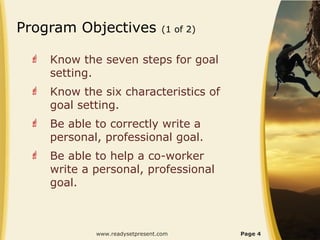
Program Objectives               (1 of 2)


    Know the seven steps for goal
     setting.
    Know the six characteristics of
     goal setting.
    Be able to correctly write a
     personal, professional goal.
    Be able to help a co-worker
     write a personal, professional
     goal.


             www.readysetpresent.com        Page 4
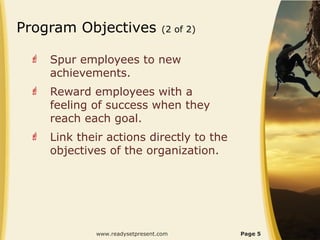
Program Objectives               (2 of 2)


    Spur employees to new
     achievements.
    Reward employees with a
     feeling of success when they
     reach each goal.
    Link their actions directly to the
     objectives of the organization.


             www.readysetpresent.com        Page 5
How to set Goals               (1 of 3)


    State each goal positively.
     –   “Become more outgoing” instead of
         “Don’t be so shy.”
    Be precise.
     –   Set dates, time periods, and
         measurements of success.
    Set priorities.
     –   Give each goal a priority so you can
         focus on what is most important.


                www.readysetpresent.com         Page 6
How to set Goals               (3 of 3)


    Set realistic goals.
     –   It is good to have high goals.
         However, make sure that they can
         realistically be accomplished.
    Do not set low goals.
     –   If your goals are too low, it will be
         difficult to take them seriously, and
         the accomplishment will not mean
         much.


                www.readysetpresent.com          Page 7
Seven Types Of Goals                   (1 of 3)


    Physical: appearance, medical
     check-ups, exercise, weight,
     nutrition
    Family: listening, forgiving, role
     modeling, spending quality
     time, supporting, respecting,
     loving
    Financial: earnings, savings/
     investments, budget,
     insurance, charge accounts


             www.readysetpresent.com              Page 8
Performance Goals – S.M.A.R.T

  Specific
  Measurable
  Attainable
  Realistic
  Tangible


              www.readysetpresent.com   Page 9
Performance Goals – S

       Specific
           –    A goal that is specific is more likely
                to be accomplished. Specify:
                   • Who is involved.
                   • What you want to accomplish.
                   • When you want to accomplish
                     the goal.
                   • Which requirements/restraints
                     will provide obstacles.
                   • Why you want to accomplish
                     the goal.

Paul J. Meyer
“Attitude is
Everything”                                              Page 10
                       www.readysetpresent.com
Principles of Goal Setting             (1 of 2)


    Keep records to find out where
     you are.
    Commit to paper the goals you
     want to achieve.
    Be very specific.
    Set high, yet reachable, goals
     for the excitement/challenge.
    Make goals long-range to avoid
     daily frustrations.


             www.readysetpresent.com              Page 11
Seven Types Of Goals


              www.readysetpresent.com   Page 12
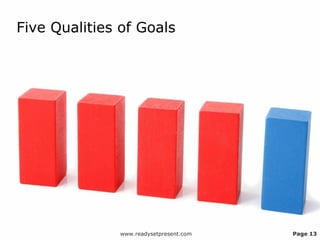
Five Qualities of Goals


               www.readysetpresent.com   Page 13
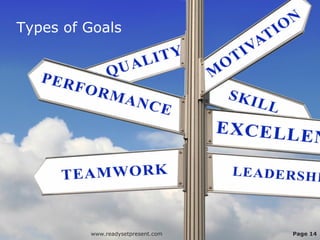
Types of Goals


         www.readysetpresent.com   Page 14
Steps to Writing Goals


              www.readysetpresent.com   Page 15
Download “Goal Setting”
               PowerPoint presentation
              at ReadySetPresent.com

150 slides include: 2 definitions of goals and goal setting, 4
  reasons why people do not set goals, 7 tips on how to set
 goals, 5 points of view and their perception versus reality, 7
   types of goals, 11 points on developing goals, 7 steps for
  goal setting, 10 benefits of goals, 5 points on performance
goals, 5 slides on S.M.A.R.T, 4 overarching objectives for goal
setting, 3 points on defining key responsibilities, 9 principles
      of goal setting, 12 points on performance goals and
   standards, 4 slides on goal integration, 2 points on goals
   versus activities, 12 slides on the 5 qualities of goals, 13
  slides on the 6 types of goals, 10 steps to writing goals, 4
     points on goal integration procedure, 7 points on goal
  discussion procedure, 6 reasons why goals fail, 6 reasons
     why goals succeed, 16 action steps, and much more.

    Royalty Free - Use Them Over and Over Again.
              Updated & Expanded 2013
     Now: more content, graphics, and diagrams
                      www.readysetpresent.com             Page 16

Goal Setting PowerPoint PPT Content Modern Sample

  • 1.
  • 2.
    F.R.A.M.E. Your Goals www.readysetpresent.com Page 2
  • 3.
    Seven Steps ForGoal Setting www.readysetpresent.com Page 3
  • 4.
    Program Objectives (1 of 2)  Know the seven steps for goal setting.  Know the six characteristics of goal setting.  Be able to correctly write a personal, professional goal.  Be able to help a co-worker write a personal, professional goal. www.readysetpresent.com Page 4
  • 5.
    Program Objectives (2 of 2)  Spur employees to new achievements.  Reward employees with a feeling of success when they reach each goal.  Link their actions directly to the objectives of the organization. www.readysetpresent.com Page 5
  • 6.
    How to setGoals (1 of 3)  State each goal positively. – “Become more outgoing” instead of “Don’t be so shy.”  Be precise. – Set dates, time periods, and measurements of success.  Set priorities. – Give each goal a priority so you can focus on what is most important. www.readysetpresent.com Page 6
  • 7.
    How to setGoals (3 of 3)  Set realistic goals. – It is good to have high goals. However, make sure that they can realistically be accomplished.  Do not set low goals. – If your goals are too low, it will be difficult to take them seriously, and the accomplishment will not mean much. www.readysetpresent.com Page 7
  • 8.
    Seven Types OfGoals (1 of 3)  Physical: appearance, medical check-ups, exercise, weight, nutrition  Family: listening, forgiving, role modeling, spending quality time, supporting, respecting, loving  Financial: earnings, savings/ investments, budget, insurance, charge accounts www.readysetpresent.com Page 8
  • 9.
    Performance Goals –S.M.A.R.T  Specific  Measurable  Attainable  Realistic  Tangible www.readysetpresent.com Page 9
  • 10.
    Performance Goals –S  Specific – A goal that is specific is more likely to be accomplished. Specify: • Who is involved. • What you want to accomplish. • When you want to accomplish the goal. • Which requirements/restraints will provide obstacles. • Why you want to accomplish the goal. Paul J. Meyer “Attitude is Everything” Page 10 www.readysetpresent.com
  • 11.
    Principles of GoalSetting (1 of 2)  Keep records to find out where you are.  Commit to paper the goals you want to achieve.  Be very specific.  Set high, yet reachable, goals for the excitement/challenge.  Make goals long-range to avoid daily frustrations. www.readysetpresent.com Page 11
  • 12.
    Seven Types OfGoals www.readysetpresent.com Page 12
  • 13.
    Five Qualities ofGoals www.readysetpresent.com Page 13
  • 14.
    Types of Goals www.readysetpresent.com Page 14
  • 15.
    Steps to WritingGoals www.readysetpresent.com Page 15
  • 16.
    Download “Goal Setting” PowerPoint presentation at ReadySetPresent.com 150 slides include: 2 definitions of goals and goal setting, 4 reasons why people do not set goals, 7 tips on how to set goals, 5 points of view and their perception versus reality, 7 types of goals, 11 points on developing goals, 7 steps for goal setting, 10 benefits of goals, 5 points on performance goals, 5 slides on S.M.A.R.T, 4 overarching objectives for goal setting, 3 points on defining key responsibilities, 9 principles of goal setting, 12 points on performance goals and standards, 4 slides on goal integration, 2 points on goals versus activities, 12 slides on the 5 qualities of goals, 13 slides on the 6 types of goals, 10 steps to writing goals, 4 points on goal integration procedure, 7 points on goal discussion procedure, 6 reasons why goals fail, 6 reasons why goals succeed, 16 action steps, and much more. Royalty Free - Use Them Over and Over Again. Updated & Expanded 2013 Now: more content, graphics, and diagrams www.readysetpresent.com Page 16