MARCH 2004 • KRISTINA FLODMAN BECKER 
Fact finding study 
The Informal 
Economy
1 
Content 
Executive Summary ...................................................................... 3 
1 Introduction ............................................................................... 5 
2. Objectives of the study .............................................................. 7 
3. The informal economy development, definitions and composition . 8 
3.1 Development and growth of the informal economy..................... 8 
3.2 How to define the informal economy ......................................... 10 
3.3 How to measure the informal economy ...................................... 15 
3.4 The informal economy in developing countries: 
regional differences....................................................................... 17 
3.5 Especially exposed groups within the informal economy ........... 21 
4. Informal enterprises ................................................................ 22 
4.1 Obstacles faced by informal enterprises ...................................... 22 
4.2 Transition from informality to formality ..................................... 23 
5. Examples of Policies, Strategies and Programmes 
aimed at the Informal Economy ............................................... 27 
5.1 The Role of Governments .......................................................... 27 
5.2 Examples of Government Policies and Programmes ................. 28 
5.3 Examples of International Programmes ..................................... 31 
5.4 The Role of Donors .................................................................... 32 
5.5 Conclusions on policy and strategy development ....................... 34 
6 The Informal Economy in Sida’s Policies, Strategies and Projects 36 
6.1 Sida sector policies and strategies ................................................ 36 
6.2 Sida Country Strategies ............................................................... 36 
6.3 An inventory on the informal economy in five 
Sida partner countries .................................................................. 37 
6.4 Examples of Sida projects targeting informal 
economy actors ............................................................................. 40 
6.5 The relevance of a strategy for the informal economy ............... 41 
7. Main findings .......................................................................... 45 
8. Recommendations .................................................................. 48 
Bibliography ............................................................................... 49 
Appendix .................................................................................... 52
Published by Sida 2004 
Department for Infrastructure and Economic Co-operation 
Author: Kristina Flodman Becker 
Cover Photos: Agneta Sundgren 
Production: ORGUT Consulting AB 
Printed by Edita Sverige AB, 2004 
Art. no.: SIDA3630en 
This publication can be downloaded/ordered from www.sida.se/publications 
2
3 
Executive Summary 
Since the “discovery” of the informal economy in the beginning of the 
seventies, many observers subscribed to the notion that the informal 
economy was marginal and peripheral and not linked to the formal 
sector or to modern capitalist development. Some continued to believe 
that the informal economy in developing countries would disappear once 
these countries achieved sufficient levels of economic growth and mod-ern 
industrial development. 
The informal economy can however no longer be considered as a 
temporary phenomenon. Furthermore, the informal economy has been 
observed to have more of a fixed character in countries where incomes 
and assets are not equitably distributed. It seems that if economic growth 
is not accompanied by improvements in employment levels and income 
distribution, the informal economy does not shrink. The situation is 
therefore that the informal economy is continuously increasing in most 
developing countries, even in rural areas. Estimates show that the non-agricultural 
employment share of the informal workforce is 78% in 
Africa, 57% in Latin America and the Caribbean, and 45–85% In Asia. 
In all developing countries, self-employment comprises a greater 
share of informal employment than wage employment. Specifically, self-employment 
represents 70% of informal employment in Sub-Saharan 
Africa (if South Africa is excluded, the share is 81% 1), 62% in North 
Africa, 60% in Latin America and 59% in Asia. Consequently, informal 
wage employment in the developing world constitutes 30 to 40% of the 
informal employment outside of agriculture. 
Over the last decades, it has become clear that the informal economy 
has a significant job and income generation potential. Therefore, appro-priate 
policy frameworks and strategies aimed at the informal economy 
must be developed, without hampering the potential of the informal 
economy for job creation and economic growth. The main challenge is 
thus to develop innovative and supportive policies that recognise the 
contributions of the informal economy and its workforce. 
As indicated in the Sida background document for PSD, “Making 
Markets Work for the Poor”, donors have principally devised support 
programmes towards the informal economy in the form of training 
programmes for entrepreneurs, technical assistance to enterprises as well 
1 ILO, Women and Men in the Informal Economy, A Statistical Picture, 2002
as credit schemes. In particular the vast majority of the clients of micro 
finance programmes are informal economy actors. However, there is 
seemingly no consensus amongst donors on how to approach the informal 
economy, what the main problems are and how these could be resolved. An 
international best practice within this field therefore seems to be lacking. 
4 
Nevertheless, during the 89th session of the International Labour Confer-ence 
in June 2001, one central statement was that “The fundamental chal-lenge 
posed by the informal economy is how to integrate it into the formal 
economy. It is a matter of equity and social solidarity. Policies must encour-age 
movement away from the informal economy. Support for exposed 
groups in the informal economy should be financed by society as a whole.” 
The steering documents for the Swedish development co-operation, such 
as the Government Proposition “Shared Responsibilities”, clearly state 
that measures regarding the informal economy should be taken as part 
of the necessary steps towards poverty alleviation. The relevance of 
addressing the problems of the informal economy is also stressed in 
“Perspectives on Poverty”, Sida’s analytical approach to poverty issues. 
Ensuring property rights and removing barriers to graduation from the 
informal to the formal economies of the economy are indicated as 
means of achieving poverty reduction through economic development. 
In addition, the informal economy is an issue of concern within Sida’s 
main areas of activity such as poverty, gender equality, health, HIV/ 
AIDS, democracy and good governance. Sida should therefore increase 
the knowledge of the informal economy within the organisation in 
order to address the problems at hand. 
There are Sida projects actually targeting completely or partially 
informal economy actors. However, in order increase project impact in 
relation to the informal economy, interventions must be very clear on what 
the target group(s) is (are). More differentiated target group analyses during 
project preparation, based on an awareness of the informal economy and 
its specific characteristics, would strengthen the positive effects of the 
projects in relation to the informal economy target groups. Moreover, 
because of the innate weakness of the informal economy actors, target 
group analyses are also important to avoid that interventions have negative 
effects, which may be the case if any specific groups or segments are 
overlooked. 
Sida has, in its background document for Private Sector Development, 
“Making Markets Work for the Poor”, already taken a major step towards 
identifying strategic areas of intervention aimed at informal economy 
actors. The next step for Sida should therefore not be to develop a strategy 
but to focus on the development of an operational approach in relation to 
the informal economy. As mentioned above, Sida could for instance con-duct 
direct surveys in partner countries to identify the actual priorities of 
the informal economy actors. 
Finally, as the rights perspective in the Government Proposition focuses 
on discriminated, excluded and marginalized individuals and groups, infor-mal 
economy actors evidently qualify for all of these denominations. They 
have limited voice as well as influence, which are fundamental rights for all. 
The underlying objectives of all Sida interventions aimed at the informal 
economy should be to make these invisible groups visible so that they can 
claim their rights as well as contribute to the development of their countries.
5 
1 Introduction 
During 2002, Sida initiated the development of a private sector policy. 
According to the instructions for the policy development, Sida should 
among others highlight issues of relevance to the informal economy 
in its partner countries. In addition, the Private Sector Development 
working group is planning to conduct a seminar on the informal 
economy in developing countries. Within the framework of the 
current Private Sector Policy Development and in view of the future 
seminar, Sida has commissioned a consultant, Ms Kristina Flodman 
Becker, to provide a background for further discussions within Sida 
related to the informal economy in Sida’s partner countries. The 
consultant has received invaluable assistance from Ms Annika Nilsson 
at Sida who has recently returned from Bolivia where she was ap-pointed 
as an Associate Bilateral Expert at the National Chamber of 
Industries. 
The labour market is of key importance to Sida’s programmes. The poor 
in the developing world depend on the labour market for their suste-nance. 
The informal economy, which presently harbours many of the 
workers in the developing countries, has grown substantially during the 
last decades. The main reason for this growth appears to be that the 
formal labour markets have not been able to generate sufficient 
amounts of jobs and absorb a continuously growing and many times 
unskilled workforce. The informal economy thus provides opportunities 
for income earning for those that have no other means to survive. 
However, it is also believed that people voluntarily engage in informal 
economic activities because of excessive taxation and regulation from 
the part of governments. 
Major donors such as the World Bank and multilateral agencies such 
as the ILO increasingly stress the importance of dealing with the infor-mal 
sector/economy and the related issues of concern. But reality speaks 
for itself: how could any major stakeholder disregard the part of the 
economy where often the majority of the populations, in particularly the 
poorest, are supporting themselves? As an example, the size of the 
informal labour force in Africa is almost 80% and the sector also ac-counts 
for over 90% of the new jobs that are created (see table page 17). 
2 Section 5.4.5, Main characteristics of the development policy: economic growth
6 
In the context of the framework of Swedish development co-opera-tion, 
the Swedish Government proposition “Shared Responsibilities” of 
2002/03,2 states that “by creating opportunities for (...) the poor to fully contribute 
to economic development, economic growth will be an efficient tool for the fight against 
poverty. The informal sector is often decisive for a large part of the income of the poor 
(...). How to integrate it in the formal sector is an important challenge for economic 
policies.” 
In fact, as will be described in Chapter 6, various steering documents 
for the Swedish development co-operation reflect the importance of 
addressing the problems of the large informal economies in Sida’s 
partner countries.
2. Objectives of 
the study 
The objectives of the study are twofold: 
1. Determine the relevance for a Sida strategy on the informal economy. 
2. Provide a background for further analysis of the informal economy in 
7 
view of the Sida strategy elaboration. 
In essence, this study will attempt to provide a comprehensive picture of 
the informal economy and the relevant issues at stake and thereby assist 
Sida in deepening the understanding of what the informal economy 
really is. 
The study will not directly encompass on-farm activities, the main reason 
being that Sida’s department on Natural Resources (Natur) is already 
conducting studies within this framework. However, this does not 
signify that the informal economy will be viewed as a purely urban 
phenomenon. There is a grey zone between the rural and urban areas 
where informal activities also take place and that should not be 
disregarded.
3. The informal 
economy develop-ment, 
definitions 
and composition 
3.1 Development and growth of the informal economy 
In the mid-1950s, W. Arthur Lewis developed a theoretical model of 
economic development based on the assumptions that there was an unlim-ited 
8 
supply of labour in most developing countries and that this vast pool 
of surplus labour would be absorbed as the modern industrial sector in 
these countries grew. It was therefore assumed that the traditional sector 
comprised of petty traders, small producers and a range of casual jobs 
would eventually be absorbed into the formal economy and disappear3. 
The first ILO employment mission in 1972 to Africa, Kenya, recog-nised 
that the traditional sector, named the “informal sector”, had not 
just persisted but expanded. The mission also observed that the informal 
sector, described as activities that are unrecognised, unrecorded, unpro-tected 
or unregulated by public authorities, was not confined to marginal 
activities but also included profitable enterprises. Furthermore, the 
activities of the informal sector were mostly ignored, rarely supported 
and sometimes actively discouraged by policy makers and governments. 
Economic development had thus failed to create enough modern jobs to 
absorb the increasing numbers of unemployed people. 
However, critics argued that economic growth in countries such as 
Kenya had not been sufficient enough to induce industrial growth for 
absorbing the surplus labour. Moreover, many believed that the informal 
sector was marginal and peripheral and thus not linked to the formal 
economy at all. 
Nevertheless, contrary to the predictions of many economists influ-enced 
by the thinking of W. Arthur Lewis, the informal sector in devel-oping 
countries has been steadily growing during the last three decades. 
A huge pool of surplus labour has thus created its own source of liveli-hood 
to survive. 
The informal sector is increasingly being referred to as the informal 
economy to get away from the idea that informality is confined to a specific 
sector of economic activity but rather cuts across many sectors. “Infor-mal 
economy” also emphasises the existence of a continuum from the 
informal to the formal ends of the economy and thus the interdepend-ence 
between the two sides. 
3 Chen M.et al, Supporting Workers in the Informal Economy: a Policy Framework, 2002.
The reasons cited for the growth of the informal economy during the 
9 
last decades, often interrelated and to some extent overlapping, are the 
following: 
Limited absorption of surplus labour 
– The limited capacity of agriculture and the formal economy to 
absorb surplus labour, together with increasing numbers of job 
seekers, has boosted the size of the informal economy. In countries 
with high rates of population growth or urbanisation, the informal 
economy tends to absorb most of the growing labour force in the 
urban areas when the manufacturing industry and off-farm activities 
in general do not grow at the same pace. 
Barriers of entry into the formal economy 
– Excessive costs and government regulations as well as corruption in 
areas such as business start-up, granting of business permits and land 
titles, according to scholars such as Hernando de Soto (a renowned 
Peruvian development economist), have forced people to remain 
informal4. 
Weak institutions 
– The weak capability of formal institutions to provide education, 
training and infrastructure as well as other incentives for structural 
reforms has contributed to the growth of the informal economy. 
Redundancies 
– Structural adjustment programmes during the eighties and nineties 
have fuelled the growth of the informal economy in developing 
countries. The disappearance of public sector jobs and the closure of 
uncompetitive businesses have forced many laid-off workers to find 
other ways to survive. 
Capital is favoured over labour 
– Global integration privileges companies who can move easily and 
quickly across borders to the disadvantage of workers. The 
globalisation of the world economy as well as global trade and invest-ment 
patterns thus tends to privilege capital and disadvantage labour, 
especially lower-skilled workers that cannot migrate easily or at all 
(Rodrik 1997)5. 
Demand for low-cost goods and services 
– The informal economy has been boosted by rural to urban migration 
in conjunction with the demand for low-cost goods and services from 
those employed in the formal and informal economies. 
Uncommitted or unaware governments 
– Many governments are unaware of the economic contributions of the 
informal economy and the problems found in it and have therefore 
found it unnecessary to intervene because of the belief that the 
informal economy would die out. The informal economy has often 
been left unattended and has thus had few obstacles for its growth. 
Economic hardship and poverty 
4 De Soto H., Mystery of Capital: Why Capitalism Triumphs in the West & Fails Everywhere Else, 2000 
5 ILO, Globalization and the Informal Economy: How global trade and investment impact on the working poor, 2002
– Migration because of poverty and the impact of the HIV/AIDS 
10 
pandemic are elements that tend to increase the number of people 
that enter the informal economy. 
More women entering labour markets 
– There are growing numbers of women that enter the labour markets 
outside of agriculture. However, although many women own or run 
micro enterprises, only a small number of women entrepreneurs 
actually enter the formal economy 6. In addition, women’s participa-tion 
within the informal economy tends to be even higher when the 
access and the right to control and own property or land are denied to 
them. 
Mainly because of the lack of appropriate mechanisms that would have 
contributed to the absorption of the labour force into the national 
economy, the bulk of new employment in recent years in many of the 
least developed countries has taken place in the informal economy. 
Moreover, all segments of the informal workforce – self-employed, 
casual, sub-contract, temporary and part-time workers and micro-entrepreneurs 
– also appear to be growing 7. 
To conclude, the informal economy can no longer be considered as a 
temporary phenomenon. Moreover, it is clear that the informal economy 
has a significant job and income generation potential and that the exist-ence 
of the informal economy also helps to meet the needs of poor 
consumers by providing accessible and low-priced goods and services. 
Therefore, in order to intervene in the best way to stimulate sustainable 
economic growth and job creation, the informal economy needs to be 
better understood both by governments and donors. 
3.2 How to define the informal economy 
3.2.1 Views on the informal economy 
There are three main schools of thought regarding the relationship 
between the formal and informal economies 8: 
– The dualists: the informal economy is a separate marginal economy not 
directly linked to the formal economy, providing income or a safety 
net for the poor (ILO 1972). 
– The structuralists: the informal economy is subordinated to the formal 
economy. In order to reduce costs, privileged capitalists seek to subor-dinate 
petty producers and traders (Castells and Portes 1989). 
– The legalists: informal work arrangements are a rational response by 
micro-entrepreneurs to over-regulation by government bureaucracies 
(de Soto ). 
In fact, it has increasingly become clear that there are many 
interdependencies between the informal and the formal economies. 
Market links exist through the trade of 9 goods, raw materials, tools and 
equipment and acquisitions of skills and know-how. Informal actors 
6 United Nations, Growing Micro and Small Entreprises in LDCs, 2001 
7 WIEGO, A Policy Response to the Informal Economy, 2001. 
8 Chen M et al, Supporting Workers in the Informal Economy: a Policy Framework, 2002. 
9 Amin, N., The Informal Sector in Asia from Decent Work Perspective, 2002.
provide services to formal actors on a sub-contracting basis. In addition, 
individuals can participate both in the formal and the informal econo-mies. 
11 
In the current debate, some also highlight the informal economy’s 
role in for instance stimulating the growth of the market economy, 
promoting a flexible labour market and absorbing retrenched labour 
from the formal sector. Others on the other hand claim that informal 
labour has become a convenient means of pursuing the global agenda of 
privatisation and liberalisation10 (for more information regarding the 
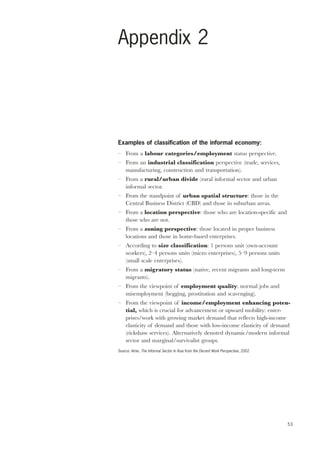
“old” and “new” views of the informal economy, see Appendix 1, p.53). 
3.2.2 General characteristics of the informal economy 
In very general terms, the informal economy is the unregulated non-formal 
portion of the market economy that produces goods and services 
for sale or for other forms of remuneration. The term “informal 
economy” thus refers to all economic activities by workers and economic 
units that are – in law or in practice – not covered or insufficiently 
covered by formal arrangements. 
The informal economy is largely characterised by: 
– Low entry requirements in terms of capital and professional qualifica-tions. 
– A small scale of operations. 
– Skills often acquired outside of formal education. 
– Labour-intensive methods of production and adapted technology. 
The informal economy does not comprise the reproductive or care 
economy, comprised of unpaid domestic work and care activities. 
Traditionally, the informal economy was perceived as comprising 
mainly survivalist activities. Various negative aspects were used to de-scribe 
the informal economy ranging from undeclared labour, tax eva-sion, 
unregulated enterprises, illegal and criminal activity 11. 
Nevertheless, the vast majority of informal economy activities provide 
goods and services whose production and distribution are perfectly legal. 
In addition, informal economy activities are not necessarily performed 
with the deliberate intention of evading the payment of taxes or social 
security contributions, or infringing labour legislation or other regula-tions. 
The informal economy can however include restricted illegal and 
restricted legal operations or legal and irregular operators, but no crimi-nal 
operators 12. The informal economy should therefore not be confused 
with the criminal economy. 
Due to the heterogeneous character of the informal economy, numer-ous 
definitions have been elaborated. This study cannot cover all the 
existing definitions of the informal economy. However, some of the main 
definitions in use will be explained in order to illustrate the multitude of 
perspectives from which the informal economy can be viewed (for exam-ples 
of classifications of the informal economy, see Appendix 2, p.55). 
10 Amin, N., The Informal Sector in Asia from Decent Work Perspective, 2002. 
11 Horn et al, The Informal Sector in Sub-Saharan Africa, 2002 
12 ILO, A policy framework, 2002
3.2.3 Definition by activities (economic units/enterprises) 
The definition of the informal economy by activities (economic units/ 
enterprises) is the most traditional of the various definitions of the 
informal economy. 
12 
Informal enterprises are characterised as informal because they rarely 
comply with all the regulations that apply to their trade, for example 
concerning registration, tax payment, conditions of employment and 
operating licenses. 
Informal enterprises are not only units that employ hired labour but 
also those that are owned and operated by single individuals working as 
self-employed. Accordingly, independent street vendors, taxi drivers and 
home-based workers are all considered to be enterprises. Since these 
enterprises have limited capital resources, they rarely engage in transac-tions, 
enter into contracts or incur liabilities. Owners generally have to 
raise the necessary finance at their own risk. Informal enterprises also 
rarely have any accounting system in place. 
In order to be consistent with the framework of the System of Na-tional 
Accounts and provide for a separate accounting of Gross Domestic 
Production (GDP) in the informal economy, the International Confer-ence 
of Labour Statisticians (ICLS) of 1993 elaborated a definition based 
on production units rather than on employment relations: 
“Units engaged in the production of goods and services with the primary objective 
of generating employment and incomes to the persons involved. These units typically 
operate at a low level of organisation, with little or no division between labour and 
capital as factors of production and on a small scale. Labour relations – where they 
exist – are based mostly on casual employment, kinship or personal and social relations 
rather than contractual arrangements with formal guarantees.” 
The international concept also distinguishes between the two sub-categories 
of informal economy enterprises 13: 
– Family enterprises comprised of independent and own-account 
workers, family workers, apprentices and workers, and with no per-manent 
employees. 
– Micro-enterprises comprised of units with less than 5 to 10 employees 
(or jobs), and which are not registered as enterprises 
Under the 1993 ICLS definition, individual countries can decide what 
size of unregistered units should be included in the informal sector and 
whether the agriculture sector and domestic workers should be included. 
Nevertheless, some observers such as the Women in Informal Employ-ment: 
Globalizing and Organizing (WIEGO) recommend an employ-ment- 
based definition of the informal economy that would include all 
non-standard wage workers, whether they work for informal or formal 
firms, who work without minimum wage, assured work or benefits. 
As the ICLS definition concentrates on enterprises, it misses out on 
the myriad of informal wage work arrangements and does not capture 
all dimensions of informal employment. In 1993, the ICLS therefore 
recommended that further work was needed on the employment-based 
dimensions of informality. 
13 www.worldbank.org (Urban Development, Program and Project Options, What is the Informal Economy, 2003-10-10)
3.2.4 Definition by employment categories 
Informal employment is all remunerative work, both self-employment 
and wage employment that is not recognised, regulated, or protected by 
existing legal or regulatory frameworks as well as non-remunerative work 
undertaken in an income-producing enterprise. 
13 
The informal economy can be described through the following 
employment categories 14: 
– (a) Self-employed, i.e. own-account workers 15, heads of family busi-nesses 
and unpaid family workers 16; 
– (b) Wage workers, i.e. employees of informal enterprises, casual 
workers without a fixed employer, home workers 17, paid domestic 
workers, temporary and part-time workers and unregistered workers. 
– (c) Employers, i.e. owners and owner operators of informal enter-prises 
18 
3.2.5 Definition based on the location of informal economy actors 
This definition is based on a description of the location within which 
these actors operate 19. The question of “place of work” was raised 
during the International Conference of Labour Statisticians (ICLS) of 
1993 in connection with the renewed efforts towards a better measure-ment 
of women’s activities. 
The categories are: 
1. Home-based workers: 
a) Dependent home-based workers which: 
– Work at home outside the establishment that buys their 
product; 
– Agree by prior arrangements to supply goods or services to a 
particular enterprise; 
– Get remunerated through what is paid for their products; 
– Do not employ workers on a regular basis. 
b) Independent home-based workers are those who work in their 
home and deliver their products or services to prospective buyers. 
Their characteristics are those of the self-employed and are 
classified as part of the “account workers”. 
2. Street traders and street vendors. 
3. Itinerant, seasonal or temporary job workers on building sites or road 
works. 
4. Those in between the streets and home, e.g. waste collectors. 
14 According to the 2002 employment census in Mexico, group (a) accounted for 57%, group (b) for 37% and group (c) for 6 % of 
the 23.9 million people employed in the informal economy (the labour force in the formal economy amounts to 15.1 million). 
15 According to the report “Informal Sector in Asia”, Amin 2002, the own-account workers are the most common labour group 
in the informal sector. 
16 According to the report “Informal Sector in Asia”, Amin 2002, unpaid family labour often includes the use of child labour. 
17 ILO, Women and men in the informal economy A statistical picture, 2002 
18 According to the report “Informal Sector in Asia”, Amin 2002, employers defined as persons who operate their enterprises 
for profits or dividends and which hire one or more employees, are not a predominant group within the informal economy. 
19 www.worldbank.org (Urban Development, Program and Project Options, What is the Informal Economy, 2003-10-10)
3.2.6 Definition by income and employment enhancing potential 
As the informal economy is quite heterogeneous in terms of capital 
invested, technology in use, adopted management practices, productivity 
levels and net earnings, its players also constitute a heterogeneous group 
with different reasons for joining the informal economy. In fact, at one 
end of the spectrum of the informal economy are small-scale modern 
manufacturing and service enterprises. At the other end are street ven-dors, 
14 
shoe shiners, junk collectors and domestic servants. Both of these 
spectra are strongly gender-biased and in particular regarding the access 
to rights and justice. In between are a whole range of primary service 
activities such as informal transport services, small trading and commer-cial 
establishments 20. These main segments are: 
1. Enterprises with the potential of becoming a significant contributor to 
the national economy and that take up informal economic activities 
because of their potential for generating growth or wealth. What 
attracts some is the fact that informal activities are thought to be 
unregulated and untaxed and, therefore, to have the potential for 
autonomy and profits. 21 These enterprises can be linked to organised 
and emerging national or international markets. 
2. Individuals or households who take up informal activities for survival 
purposes. The factors that may attract them are the relative ease of 
entry, reliance on local resources and a minimum of capital invest-ments. 
Informal activities also allow disadvantaged individuals or 
households to maximise their only asset: labour. This group operates 
informally either because the costs of formalising the activities are too 
high or because the procedures for registration are too complicated 
and time-consuming. 
3. Individuals that devote part-time to informal activities while working 
elsewhere. For instance, civil servants in both Asia and Africa, because 
of low and irregular salaries, have alternative incomes to secure their 
living. 
This type of segmentation actually describes the informal economy from 
the standpoint of its income and employment enhancing potential. This 
potential is crucial for determining the scope for advancement or upward 
mobility of various enterprises. From this perspective, the informal 
economy is comprised of enterprises/work with a growing market demand 
that reflects a high-income elasticity of demand (e.g., tourism services) and 
those with low-income elasticity of demand (e.g. rickshaw services). Alter-natively, 
these two groups can be denoted respectively as the dynamic/ 
modern informal economy and marginal/survivalist groups. 
In addition, conditions of work and the level of earnings differ 
markedly among those who scavenge on the streets for rags and papers, 
those who produce garments on a sub-contract from their homes, those 
who sell goods on the streets and those who work as temporary data 
processors22. As an example, female street hawkers face a high risk of 
being exposed to violence and physical abuse. 
20 Chadaw G. and Oberay A, Urban informal sector in India, Issues and Policy Options, 2001 
21 ILO, Supporting workers in the IE: a Policy Framework, 2002 
22 ILO, Women and Men in the Informal Economy, A Statistical Picture, 2002
To conclude, due to its intrinsic heterogeneity, there are many ways of 
15 
defining the informal economy. The informal economy could be de-scribed 
through the specific occupations of its participants, i.e. street 
traders, rickshaw drivers, construction workers and waste pickers. There 
are still more useful distinctions that could be made for any specific 
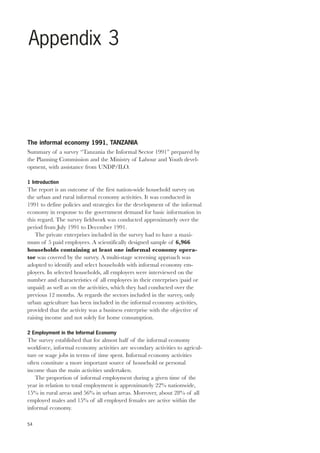
purpose, in particular for policy making (see Appendix 3, p.56). 
Nevertheless, this vast array of definitions should not be seen as an 
obstacle but a possibility to identify relevant entry points and to select 
target groups for various interventions. The formal economy is also 
defined through a range of sub-categories, which are tackled in different 
ways through various policies and programmes. 
However, to refer to the informal economy without further specifica-tion 
easily creates misunderstandings. It must be clear which groups or 
segments are referred to when the informal economy is discussed, which 
is why it is useful to be aware of the different definitions that are avail-able. 
3.3 How to measure the informal economy 
Estimating the size of the informal economy is problematic, although 
there are internationally defined measurement methods to define the size 
and contribution of the informal economy to national accounts. In 
addition, data on the informal sector (excluding agriculture) is often 
compared to data on the total workforce (including agriculture), resulting 
in an under-estimation of the significance of the informal sector. The 
informal economy is therefore not necessarily adequately reflected in the 
national accounts. Consequently, the use of for instance the GDP as a 
measurement for economic development does not always reflect the 
actual situation in a country23. 
3.3.1 Indirect measurement methods 
With the exeption of Latin American countries and of a few Asian 
countries, most countries still rely on indirect estimates for measuring the 
size and even more the contribution of the informal sector to the na-tional 
economy. 
Indirect estimation methods are based on the residual balance tech-nique 
which consists in choosing a specific definition of the informal 
sector for instance registration, or employment size from which the size 
of the sector can be inferred. With regard to the labour force, the main 
purpose is to segment the popultation of wage employees enumerated in 
the population census or the labour force surveys, in order to determine 
which ones belong to the informal sector (enterprises of informal em-ployers) 
and which ones to the formal sector. It is in fact practically 
impossible to strictly apply the concept of informal sector, as surveys do 
not generally include questions on the economic unit in which the 
employee works. Comparisons then have to be made with data on estab-lishments 
or enterprises (surveys or administrative records). The degree 
of approximation will depend on the quality of the source used. 
23 Charmes J., Estimation Survey methods for the Informal Sector, 2002
16 
The residual balance technique can also be used for estimating the 
contribution of the informal sector to the GDP. It consists in comparing 
the value added by sector of industry in the National Accounts with the 
value added in the formal sector of this industry. But unless national 
accountants have used the results of recent informal sector surveys, the 
comparison between the indirect estimation of employment in the 
informal sector and the indirect estimation of its contribution to the 
GDP will, because of current economic thinking, assume low productiv-ity 
and low income per capita in the informal sector. 
3.3.2 Direct measurement methods 
Following the adoption of the 1993 definition, household surveys, and 
especially mixed (household and enterprise) surveys, have been 
recommened as the best means to capture the informal sector. However, 
some African (Mali 1989) or Latin American (Mexico 1989) countries 
already had some experiences of surveying. 
The principle of these surveys consists in selecting a representative 
sample of households and, in these selected households, to identify those 
own-account workers and employers who, according to the criteria of the 
new definition, belong to the informal sector. As an example, the Central 
Bank of Nicaragua has estimated the production of households trough a 
household survey (excluding domestic consumption). The survey shows 
that the value of the production of households is 41% of the total GDP24 
Results from a household survey on the overall profile of 
the informal sector in Tanzania It is estimated that 34% of total 
households in mainland Tanzania are engaged in informal sector activi-ties 
at any given point of time in the year. The proportion is much higher 
in urban areas with a peak of 55% of households in Dar es Salaam. In 
some remote sample villages there were extremely few informal busi-nesses 
while others near main roads had very high proportions. An 
enterprise in the informal sector operates on average for a period of 8 
months in a year. 69 percent of male and female informal sector opera-tors 
expect to expand production. The major problems affecting infor-mal 
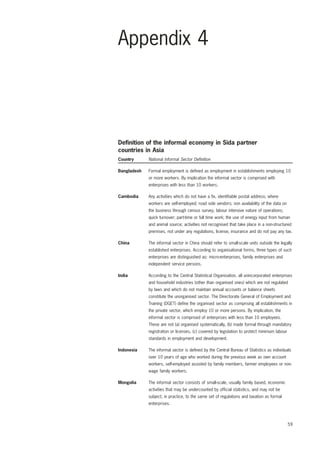
sector enterprises are: unavailability of capital/credit; lack of mar-ket/ 
customers, lack of equipment/spare parts, finding working premises, 
problems with transport and finally government regulations. In mainland 
Tanzania, the informal economy plays a significant role in providing 
employment opportunities. About 22 percent of total employment is 
engaged totally or partly in this sector, the majority being males and 
primary school dropouts. Almost three quarters of the people working 
within the informal economy are employers. The highest proportion of 
the total informal sector workforce is engaged in trade/restaurants/ 
hotels. In rural areas, the highest proportion is engaged in small-scale 
manufacturing. Sale of local beer is the leading business of the informal 
economy, which by itself provides employment to about 15 percent of 
the total workforce. However, in Dar es Salaam, the leading business is 
the sale of cooked food and, for other urban areas, it is urban agriculture 
and livestock keeping. Informal employees were mainly divided between 
paid employees and unpaid helpers. Women are heavily under-repre- 
24 Banco Central de Nicaragua, Calculo de la Produccion de los Hogares, 2003
sented in the paid employee category. Most are unpaid workers helping 
in family businesses.The total estimated annual (1991) gross output for 
the entire sector amounted to T.Shs. 489.9 billion, which was more than 
the entire parastatal sector’s gross output of T.Shs. 336.1 billion. (For 
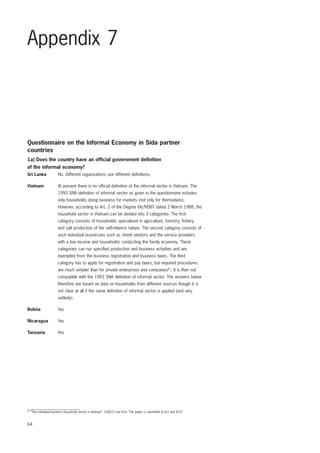
more information about the results from this survey in Tanzania see 
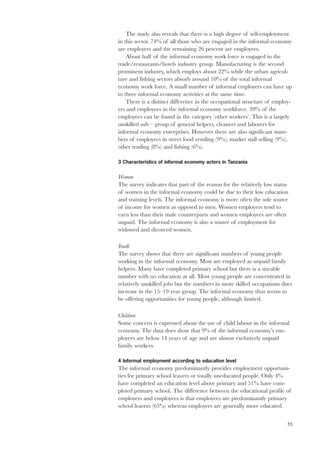
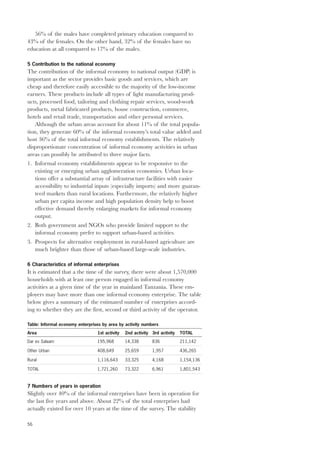
Appendix 3, p. 56)25. 
A disadvantage of direct methods is that they only lead to estimates at 
17 
a certain point in time. Moreover, it is unlikely that they capture all 
“shadow” activities, so they can be seen as providing lower bound esti-mates. 
They are unable (at least at present) to provide estimates of the 
development and growth of the informal economy over a long period of 
time. They have, however, at least one considerable advantage – they can 
provide detailed information about informal economy activities and the 
structure and composition of those who work in it26. 
3.3.3 Enterprise and establishments surveys 
Establishment censuses (and consecutive sample surveys) are usually 
taken as the old-fashioned approach for surveying the informal sector. 
They actually fail to capture the diversity of informal sector activities as 
they do not cover the households. This is why mixed surveys are now 
preferred and recommended27. 
To conclude on measurement methods, major progress has been 
made in the measurement of the informal economy, of which the contri-bution 
as well as the potential for growth are admittedly important. 
Mixed surveys combining household approaches with establishment 
approaches, are recognised as the most efficient and comprehensive way 
towards capturing the informal economy. However, there is still room left 
for indirect methods of estimation and for establishment surveys which 
both contribute to greater knowledge of the sector. 
3.4 The informal economy in developing countries: 
regional differences 
The informal economy’s growth or decline has essentially been linked to 
the growth or decrease of the formal economy. In some countries in Asia, 
the informal economy has in effect declined during economic boom and 
increased during economic recession. 
However, the informal economy has been observed to have more of a 
fixed character in countries where incomes and assets are not equitably 
distributed. It seems that if economic growth is not accompanied by 
improvements in employment levels and income distribution, the infor-mal 
economy does not shrink. The situation is therefore that the informal 
economy is continuously increasing in most developing countries, even in 
rural areas. 
Mapping the informal economy so as to comprehend its size, compo-sition 
and evolution is a difficult and inevitably imprecise exercise 28. It is 
also difficult to make international comparisons as different definitions 
25 The Planning Commission and the Ministry of Labour and Youth Development, Tanzania the Informal Sector 1991, 1991 
26 Schneider F. and Frey B., Informal and Underground Economy, 2000 
27 Charmes J., Estimation Survey methods for the Informal Sector, 2002 
28 ILO, Decent work and the informal economy, International Labour Conference 90th session, 2002
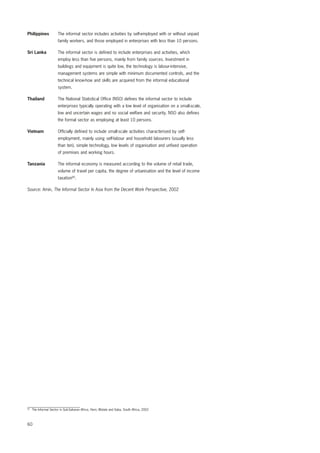
are used (see Appendix 4, p.61). Furthermore, within different countries, 
the informal economy is highly segmented by location of work, sector of 
the economy and status of employment and, across these segments, by 
social group and gender 29 (for examples on definitions in different 
countries, see Appendix 3). Despite these facts, some generalisations can 
be made on a regional basis. 
18 
In all developing countries, self-employment comprises a greater 
share of informal employment than wage employment. Specifically, self-employment 
represents 70% of informal employment in Sub-Saharan 
Africa (if South Africa is excluded, the share is 81% 30), 62% in North 
Africa, 60% in Latin America and 59% in Asia. Consequently, informal 
wage employment in the developing world constitutes 30 to 40% of the 
informal employment outside of agriculture. 
Home-based workers and street vendors are two of the largest sub-groups 
of the informal workforce. Taken together, they represent 10– 
25% of the total workforce in developing countries. Within these two 
groups, women in the developing world constitute 30–90% of all street 
vendors, 35–80% of all home-based workers and over 80% of home-workers 
(industrial outworkers who work at home) 31. 
3.4.1 Size of the informal workforce in developing countries 32 
In Africa, informal work during the past decade is estimated to have 
accounted for almost 80% of non-agricultural employment, over 60% of 
urban employment and over 90% of new jobs33. For women in sub- 
Saharan Africa, the informal economy represents 92% of the total job 
opportunities outside of agriculture (against 71% for men). Almost 95% 
of these jobs are performed by women as self-employed or own-account 
workers, and only 5% as paid employees. In sub-Saharan Africa in 
particular, street vending predominates in much of the informal 
economy 34. 
In Latin America, data shows that urban informal employment as a 
percentage of total urban employment grew from 52% in 1990 to 58% 
in 1997 35. The increase in the informal economy was attributed, on the 
one hand to growth of the labour force due to demographic factors, a 
rise in the activity rate (particularly of women), substantial rural-urban 
migration and contraction of employment in the formal economy 36. 
Latin America experienced a debt crisis in the 1980s. The 1990s was 
generally a period of economic growth and recovery, declining inflation 
and technological progress. However, it was also a period of jobless 
growth, which, combined with retrenchment and the search for ever 
more flexible forms of labour led to the expansion of the informal 
economy in nearly every country as well as a reduction in social protec-tion 
coverage 37. 
29 ILO, Women and Men in the Informal Economy, A Statistical Picture, 2002 
30 ILO, Women and Men in the Informal Economy, A Statistical Picture, 2002 
31 ILO, Women and Men in the Informal Economy, A Statistical Picture, 2002 
32 ILO, Supporting workers in the IE: a Policy Framework, 2002 
33 J. Charmes, cited at Women in Informal Employment: Globalizing and Organizing (WIEGO), Second Annual Meeting, 
Cambridge, Massachusetts, 22–24 May 2002 
34 ILO, Decent work and the informal economy, International Labour Conference 90th session, 2002 
35 Verdera F. Informality in Latin America, Recent trends, policies and prospects, 2001 
36 ILO, Decent work and the informal economy, International Labour Conference 90th session, 2002 
37 ILO, Decent Work in the Informal Sector, Latin America, 2002
19 
In Asia, the share of informal workers ranges from 45 to 85% of 
non-agricultural employment and from 40 to 60% of urban employ-ment. 
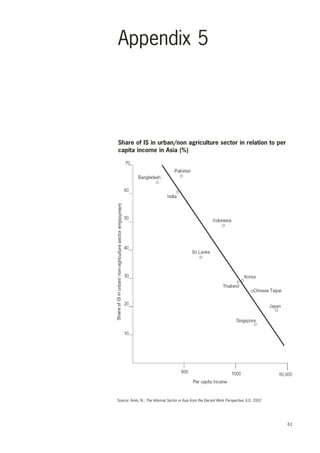
In parts of East Asia, the informal economy declined as manufac-turing 
and industry expanded and created jobs in the formal economy 
(see Appendix 5, p.63). As the demand for skilled workers increased, 
social protection was expanded, wages rose and working conditions 
improved. Nevertheless, one of the consequences was the need to identify 
cheaper sources of labour for more repetitive and labour-intensive 
manufacturing industries, which in turn boosted the informal economy 
38. 
Informal Workforce as share of: Africa Latin America andCaribbean Asia 
Non-agricultural employment 78% 57% 45–85% 
Urban Employment 61% 40% 40–60% 
New jobs 93% 83% NA 
Source: Charmes 1998, updated 2000 
3.4.2 The informal economy and Gross Domestic Product (GDP) 
Estimates have been made of the contribution of the informal sector (i.e. 
not the informal economy as a whole, only informal enterprises) to the 
GDP. These estimates indicate that the contribution of informal enter-prises 
to non-agricultural GDP is significant39. 
The average share of the informal enterprise sector in non-agricul-tural 
official GDP varies from a low of 27% in Northern Africa to a high 
of 41% in Sub-Saharan Africa. The fact that such a large number of 
countries in Sub-Saharan Africa have such estimates reflects a recogni-tion 
of the importance of the informal sector in total GDP. The contri-bution 
of the informal sector to GDP is 29% for Latin America and 41% 
for Asia. 
38 Amin, N., The Informal Sector in Asia from Decent Work Perspective, 2002 
39 ILO, Women and men in the informal economy – a statistical picture, 2002
Contribution of the informal sector40 to the GDP in selected developing countries 
Country (year)Informal sector GDP as percentage of non-agricultural GDP 
Northern Africa 27 
Sub-Saharan Africa 41 
Benin (1993) 43 
Cameroon (1995–96) 42 
Kenya (1999) 25 
Mozambique (1994) 39 
Tanzania (1991) 43 
Latin America 29 
Colombia 25 
Mexico (1998) 13 
Peru (1979) 49 
Asia 31 
India (1990–91) 45 
Indonesia (1998) 31 
Philippines (1995) 17 
Source: ILO, Women and men in the informal economy – a statistical picture 2002 
For some countries, estimates have been made of the contribution of 
women and men to the informal non-agricultural economy (table below). 
One example shows that, in Burkina Faso, women’s contribution is signifi-cantly 
20 
higher than for men. The relatively high contribution of women in 
Burkina Faso has been explained by the inclusion in the official accounts of 
the contribution through secondary activities which for women are mainly 
non-agricultural but for men are agricultural activities41. 
Percentage of the contribution of women and men in non-agricul-tural 
informal sector employment in relation of to the total non-agricul-tural 
GDP in selected developing countries 
Country (year) Women’s non-agricultural informal Men’s non-agricultural informal 
sector GDP as percentage of sector GDP as percentage of 
total non-agricultural GDP total non-agricultural GDP 
Africa 
Benin (1992) 51 49 
Burkina Faso (1992) 81 19 
Kenya (1998) 44 56 
Tunisia (1994–96) 17 83 
Asia 
India (1993) 21 79 
Indonesia 48 52 
Philippines (1995) 44 56 
Source: Data prepared on basis of ILO, Women and men in the informal economy – a statistical picture 2002 
40 Informal entreprises 
41 ILO, Women and men in the informal economy – a statistical picture, 2002
3.5 Especially exposed groups within the informal economy 
The informal economy comprises some of the most exposed as well as 
poor groups on the labour market. Although the informal economy 
actors are not all poor, the majority of the poor are found in the informal 
economy. 
21 
During the 89th session of the International Labour Conference in 
June 2001, a central statement was that “The fundamental challenge 
posed by the informal economy is how to integrate it into the formal 
economy. It is a matter of equity and social solidarity. Policies must 
encourage movement away from the informal economy. Support for 
exposed groups in the informal economy should be financed by society as 
a whole.” 
The problems faced by informal wageworkers are numerous. They 
suffer from inadequate labour legislation, labour protection and social 
security schemes and have limited access to wage workers organisations. 
In addition, their incomes are low and irregular and they have a very 
limited bargaining power to increase salaries. The work-related risks are 
greater, such as less secure contracts, fewer benefits and poorer working 
conditions for wageworkers 42. 
Women’s share of informal economy employment worldwide has 
remained between 60 and 80%. Moreover, the number of females in the 
labour force is continuously on the rise and women in the informal 
economy most probably number much more than reflected in available 
statistics. They comprise most of the unpaid labour, are often home-based 
workers, and thus fall easily through gaps in enumeration as data 
and statistics on household level is still difficult to measure43. If produc-tive 
but unpaid work is performed, these women are to be included in the 
informal economy workforce. Another important aspect of women’s and 
girl’s high participation in the informal economy is that they lack the 
right to own and inherit property of any kind in many countries. This 
obstructs women even more from the so-called formal economy, as they 
do not have any assets to use as security for credits, etc. 
The work of boys and girls in the informal economy is a major 
concern. Although the presence of children in the labour force of the 
East and Southeast Asian countries is very limited, it is in contrast wide-spread 
in the South Asian Countries and Africa. This suggests a connec-tion 
between the level of economic development and work of children. 
Children tend to work in low paying and hazardous occupations: waste– 
picking, domestic work, apprenticeship and as casual labour. In addition, 
girls and boys face different problems and hardships that must be ac-knowledged 
and addressed. 
Due to the high levels of unemployment among youth, in developing 
countries in particular, young people are also disproportionately found to 
be working informally. By the end of the 1990s, 57% of those involved in 
non-agricultural work in the age group 15–19 years were to be found in 
the informal economy. Internal migrants and immigrants are also 
found to work largely in the informal economy44. 
42 Chen M., Risk, Insurance and the Informal Economy, 2000 
43 www.ilo.org (Skills Development for the Informal Economy, ILO Key Indicators of the Labour Market 1999, 2003-10-10) 
44 Thomas J., Decent work in the Informal sector: Latin America, 2002.
4. Informal 
enterprises 
4.1 Obstacles faced by informal enterprises 
Enterprises in the informal economy are facing obstacles that are some-times 
22 
similar to those experienced by formal enterprises. However, infor-mal 
enterprises are much more vulnerable in relation to these problems. 
– Infrastructure issues 
– Poor infrastructure such as transport, storage facilities, water, 
electricity. 
– Lack of working premises. 
– Poorly developed physical markets. 
– Institutional issues 
– No access to formal training and, as a result, lack of skills in particu-lar 
as regards basic economic skills and managerial expertise. 
– Lack of formal schooling sometimes even resulting in illiteracy. 
– Limited access to land and property rights. 
– Limited access to formal finance and banking institutions. 
– Reliance on self-supporting and informal institutional arrangements. 
– Too restrictive or cumbersome taxation systems and labour laws. 
– Excessive government regulations in areas such as business start-up, 
in particular as regards cumbersome, time demanding and 
costly procedures for business registration. 
– Limited access to employers´ organisations, i.e. limited possibilities 
to exercise influence. 
– Lack of access to official social security schemes. 
– Lack of information on prices, viability of products, etc. 
– Fewer market opportunities due for instance to non-compliance to 
international standards. 
– Economic issues 
– Excessive registration and transaction costs of starting or operating 
businesses. 
– Limited access to technology. 
– Lack of opportunities for bulk purchase of inputs. 
– Low incomes or lack of regular income as household consumption 
competes for the use of business earnings. 
– Lack of working capital: credit has to be obtained from informal 
sources such as friends or relatives or non-banking financial 
agencies with unfavourable terms. 
– Insufficient funds do not allow for further investments.
These obstacles are more or less interlinked and create vicious circles of 
poverty and high risk. For instance, the main reasons for the lack of funds 
or skills is that the informal economy enterprises cannot access resource 
institutions generally available to the formal economy such as banks and 
other financing institutions, training and education institutions, market-ing 
23 
and consultancy firms, etc. In fact, all these various obstacles create 
an overall context that in itself constitutes a barrier of entry into the 
formal economy. 
These obstacles will of course be more or less serious depending on 
the phase in which the business is, on the type of enterprise and on the 
level of development of the society in general. In fact, these constitute 
major barriers to growth mainly for the group of enterprises that belong 
to the dynamic/modern informal economy described in section 3.2.6. 
Many scholars seem to agree on that micro enterprises can become 
effective creators of employment, innovation, income and growth. 
However, micro enterprises do mostly not realise their full potential 
because they lack access to markets, finance, technology and business 
skills. Production is becoming increasingly knowledge-based and entre-preneurs 
therefore need to become innovative and to develop an exten-sive 
knowledge of markets and technology45. 
4.2 Transition from informality to formality 
Enterprises in the informal economy have an entrepreneurial potential 
that could flourish if some major obstacles to growth were to be re-moved. 
Furthermore, even if only a fraction of informal enterprises 
would have the possibility to upgrade themselves, it would probably 
contribute substantially to increased economic growth. 
However, the formalisation of enterprises in many developing coun-tries 
is cumbersome mainly due to heavy regulations, which generally 
bring longer delays and higher costs of public services, higher corruption 
and less investments. It is a fact that developing countries not only have 
more regulations but have more difficulties in enforcing these than 
developed countries. 
In developing countries, the checks and balances in government are 
also the weakest and the possibility of using regulation to harass entre-preneurs 
and extract bribes is high. There are numerous examples to 
describe the difficulties encountered by entrepreneurs. As an example, in 
many developing countries, it could take up to a decade to go through 
the procedure of declaring bankruptcy46. 
However, many reforms that are undertaken in developed countries 
could also be implemented in developing countries. Professor Hernando 
de Soto, a renowned Peruvian development economist, works directly 
with governments in order to tackle the problems of the informal 
economy. De Soto’s vision is to develop proper legal frameworks, which 
recognises the assets of the informal economy and create a system of 
protecting and giving value to the property of the poor so they can access 
45 United Nations, Growing Micro and Small Enterprises in LDC:s, the Missing Middle in LDCs, 2001 
46 Wolf M, A scandalous burden for the world’s poorest nations, Financial Times 29/10, 2003
capital from financial institutions. De Soto’s approach involves a com-plete 
24 
re-examination of the existing regulatory framework and a further 
understanding of the notion of “dead capital”47. 
Actors such as the World Bank have also defined some main reform 
areas that could be addressed to generally facilitate the transition from 
informality to formality and which are viewed as “win-win changes for 
governments and businesses alike” 48: 
– Reducing the number of business licenses, permits, approvals. 
– Streamlining administrative processes. 
– Adopting uniform taxes. 
– Enhancing access to capital. 
The table below illustrates how the number of procedures, the time 
required and the financial costs for starting a business vary substantially 
between developed and developing countries. 
Indicators for Starting a Business 
Country Number of procedures Time (days) Cost (US$) Cost(% of 
income per capita) 
Bolivia 18 67 1499 166 
Denmark 4 4 0 0 
Ethiopia 8 44 422 421 
Kenya 11 61 194 54 
Nicaragua 12 71 1335 337 
Peru 9 100 510 24 
Sweden 3 16 190 1 
Tanzania 13 35 557 199 
Uganda 17 36 338 135 
Source: The World Bank, Doing business in 2004 – Understanding Regulation, 2003 
However, informality is not an all-or-nothing state, there are degrees of 
informality and formality. Small-scale entrepreneurs make an economic 
calculation along the lines of a cost-benefit analysis, which determines a 
minimum threshold of participation in formal arrangements for which 
the cost remain lower than the benefits. Some firms will therefore choose 
to participate in only a subset of institutions at any point in time. In 
addition, benefits and costs of participating in a formal context vary for 
firms of different size and expected lifetime. It would for instance seem 
that young, inefficient and small firms are disproportionately informal 49. 
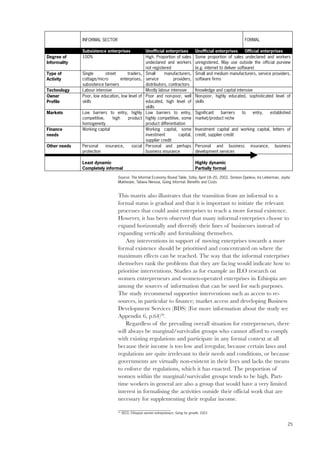
The matrix below illustrates the degrees of informality of informal 
sector enterprises: 
47 De Soto H., Mystery of Capital: Why Capitalism Triumphs in the West & Fails Everywhere Else, 2000. 
48 Djankov S, World Bank 
49 Levenson and Maloney, The Informal Sector, Firm Dynamics and Institutional Participation, 1998.
INFORMAL SECTOR FORMAL 
Subsistence enterprises Unofficial enterprises Unofficial enterprises Official enterprises 
Source: The Informal Economy Round Table, Sofia, April 18–20, 2002, Simeon Djankov, Ira Lieberman, Joyita 
Mukherjee, Tatiana Nenova, Going Informal: Benefits and Costs 
This matrix also illustrates that the transition from an informal to a 
formal status is gradual and that it is important to initiate the relevant 
processes that could assist enterprises to reach a more formal existence. 
However, it has been observed that many informal enterprises choose to 
expand horizontally and diversify their lines of businesses instead of 
expanding vertically and formalising themselves. 
25 
Any interventions in support of moving enterprises towards a more 
formal existence should be prioritised and concentrated on where the 
maximum effects can be reached. The way that the informal enterprises 
themselves rank the problems that they are facing would indicate how to 
prioritise interventions. Studies as for example an ILO research on 
women entrepreneurs and women-operated enterprises in Ethiopia are 
among the sources of information that can be used for such purposes. 
The study recommend supportive interventions such as access to re-sources, 
in particular to finance; market access and developing Business 
Development Services (BDS) (For more information about the study see 
Appendix 6, p.64)50. 
Regardless of the prevailing overall situation for entrepreneurs, there 
will always be marginal/survivalist groups who cannot afford to comply 
with existing regulations and participate in any formal context at all 
because their income is too low and irregular, because certain laws and 
regulations are quite irrelevant to their needs and conditions, or because 
governments are virtually non-existent in their lives and lacks the means 
to enforce the regulations, which it has enacted. The proportion of 
women within the marginal/survivalist groups tends to be high. Part-time 
workers in general are also a group that would have a very limited 
interest in formalising the activities outside their official work that are 
necessary for supplementing their regular income. 
Degree of 
Informality 
100% High. Proportion of sales 
undeclared and workers 
not registered 
Some proportion of sales undeclared and workers 
unregistered. May use outside the official purview 
(e.g. internet to deliver software) 
Type of 
Activity 
Single street traders, 
cottage/micro enterprises, 
subsistence farmers 
Small manufacturers, 
service providers, 
distributors, contractors 
Small and medium manufacturers, service providers, 
software firms 
Technology Labour intensive Mostly labour intensive Knowledge and capital intensive 
Owner 
Poor, low education, low level of 
Profile 
skills 
Poor and non-poor, well 
educated, high level of 
skills 
Non-poor, highly educated, sophisticated level of 
skills 
Markets Low barriers to entry, highly 
competitive, high product 
homogeneity 
Low barriers to entry, 
highly competitive, some 
product differentiation 
Significant barriers to entry, established 
market/product niche 
Finance 
needs 
Working capital Working capital, some 
investment capital, 
supplier credit 
Investment capital and working capital, letters of 
credit, supplier credit 
Other needs Personal insurance, social 
protection 
Personal and perhaps 
business insurance 
Personal and business insurance, business 
development services 
Least dynamic 
Completely informal 
Highly dynamic 
Partially formal 
50 SEED, Ethiopian women entrepreneurs: Going for growth, 2003
26 
One question that comes into mind when going through all these 
disadvantages of being an informal enterprise is: are there any advan-tages 
at all? The obvious benefits for entrepreneurs who operate in the 
informal economy are avoiding costly and burdensome government 
regulations as well as high and complex taxes. However, it seems that if 
there are any advantages of being informal, these are a function of the 
seriousness of the problems of the surrounding environment. The reason 
why the informal sector is so large in developing countries is that the 
benefits of formality are dwarfed by its costs 51. 
Thus, in a perfect world, there would be few advantages of remaining 
outside the formal national economy. Taxes and fees would be recipro-cated 
by adequate service delivery from the part of Government and 
access to proper and relevant institutions. Therefore, the more complex 
and unfavourable the institutional framework is, the greater becomes the 
incentive to remain informal. 
51 www.worldbank.org (Simeon Djankow, Discussion board – Why is the informal economy so large?)
5. Examples of 
Policies, Strategies 
and Programmes 
aimed at the Informal 
Economy 
27 
5.1 The Role of Governments 
There are different views on whether governments should intervene or 
not in relation to the informal economy52: 
1. Markets operate efficiently. Government interventions lead to ineffi-ciencies 
and distortions and the informal economy will in any case 
decline with economic growth. 
2. The informal economy is beyond the reach of governments, in part 
because those who operate in it want to avoid regulation and taxation. 
3. The informal economy is here to stay and requires appropriate 
regulations, laws and policies. 
The current position taken by many stakeholders is that, as the informal 
economy is here to stay, governments have a responsibility to intervene 
and correct policy biases that have favoured the formal parts of the 
economy to the detriment of the informal economy. To cite the words of 
an NGO: “The informal sector should not be romanticised as a perma-nent 
fixture of the economy or accepted as a necessary catch basin of 
surplus labour. To do so is to perpetuate the duality between the formal 
and informal economies where a minority enjoys disproportionate access 
to resources while the vast majority, though anxious to participate, are 
excluded by virtue of decades-old policy biases” 53. 
Given the economic contributions of the informal economy, it is 
widely believed that governments therefore should be developing policies 
that recognise the importance of the informal economy, restrict and 
regulate it when necessary, but mostly seek to increase the productivity 
and improve the working conditions of those who work in it” 54. The 
state is generally perceived as the “architect of a positive enabling envi-ronment” 
55. The state has particularly a role to play in making it possible 
for the private sector to flourish and to ensure that growth contributes to 
poverty reduction, but the actual economic growth is best reached 
through the private sector 56. Governments are also responsible for 
52 The Informal Sector, Firm Dynamics and Institutional Participation, 1998 
53 Sandra o Yu, Supporting the informal sector, cases of NGO assistance programmes, 1994 
54 The Informal Sector, Firm Dynamics and Institutional Participation, 1998 
55 Schulpen and Gibbon, Private Sector Development, Policies, Practices and Problems, 2001 
56 Ibid.
mobilising political will for dealing constructively with the informal 
economy. 
28 
It is also believed that if the employment needs and the vulnerability 
of those who work in the informal economy, are not addressed, most 
efforts to reduce poverty will not succeed. The formalisation of the 
informal economy reduces for instance the need for poverty combating 
government programmes such as subsidized health care, large unemploy-ment 
benefits, etc.57 
Some of the main responsibilities of governments are to 58: 
– Provide the macroeconomic, social, legal and political frameworks for 
the large-scale creation of sustainable, decent jobs and business 
opportunities. 
– Focus policies and programmes on bringing informal workers and 
economic units into the economic and social mainstream, thereby 
reducing their vulnerability and exclusion. Programmes designed to 
address the informal economy, such as provision of education, train-ing, 
micro-finance, should be designed and implemented with the 
main objective of bringing informal workers or economic units into 
the mainstream, so that they are covered by the legal and institutional 
framework. 
– Provide a conducive policy and legal environment that a) lowers the 
cost to establish and operate a business, including simplified registra-tion 
and licensing procedures, appropriate rules and regulations, 
reasonable and fair taxation, b) increases the benefits of legal registra-tion, 
facilitating access to commercial buyers, more favourable credit 
terms, legal protection, contract enforcement, access to technology, 
etc. Such an environment helps new businesses to start and helps 
smaller businesses to enter the formal economy and create new jobs. 
– Ensure that the national legislation addresses the issues of recognition 
and protection of employers and workers in the informal economy, 
with special emphasis on human rights and gender equality. 
– Provide an enabling framework at national and local levels to support 
representational rights. National legislation must guarantee and 
defend the freedom of all workers and employers, irrespective of 
where and how they work and of sex and age. Obstacles to the 
recognition of organisations of employers and workers in the infor-mal 
economy must be removed so that they are able to participate in 
social dialogue, structures and processes. 
5.2 Examples of Government Policies and Programmes 
India 
The National Commission on Labour in India, set up in 1999, has been 
working on developing, implementing and enforcing national labour 
legislation for the unorganised sector, as India calls the informal 
economy. The Commission decided to recognise informal workers and to 
formulate an umbrella legislation for the sector. The Commission was 
57 Djankov S, representing the World Bank at the seminar “Cost of Doing Business”, Stockholm School of 
Economics October 2003
29 
also charged with improving the effectiveness of social security, occupa-tional 
health and safety measures, as well as minimum wages, with 
attention to safeguarding women and handicapped workers. A study 
group on Women Workers and Child Labour recommended a broaden-ing 
of the definition of worker to accommodate more categories of 
informal workers. Some of the recommendations of this group include 
concrete and comprehensive ideas on how to extend national labour 
legislation to cover for instance informal women workers 59. 
Kenya 
Kenya has played a role in policy development for the informal economy. 
The informal economy in Kenya became known as Jua Kali (hot sun) 
referring to the micro-enterprises that worked without shelter under the 
hot sun. In 1986, the Kenyan Government began to incorporate the 
informal economy into national economic policy. Policy-makers elabo-rated 
direct assistance to individuals and small businesses, including 
among others flexible credit schemes, encouragement of the informal 
economy to produce cheap alternatives to expensive imported items, 
promotion of cooperatives to access credit, group purchasing and mar-keting, 
information and assistance on new technologies. Government 
would also be able to subcontract the Jua Kali for various assignments. 
This work led to a policy on the informal economy in 1992, identify-ing 
the economy as having the greatest potential for employment crea-tion 
in Kenya. However, there is no coordinating body in government 
responsible for the implementation of the policy. The Jua Kali policy 
needs to be seen as an integral part of overall technology and industry 
policy. Moreover, the voice of its principal actors is absent: the Jua Kali 
themselves do not seem to have had the opportunity to make recommen-dations 
for themselves 60. The consultant has also talked with one Jua 
Kali association in Nairobi that confirms this picture. 
A recent example from Kenya is that the Nairobi City Council (NCC) 
has started to register all street hawkers in Nairobi and whether they have 
paid their fees to the NCC. The major achievement of this registration is 
that these traders have somewhere to turn if they are harassed by the 
NCC or other civil servants. They can now prove that they have actually 
paid their dues. The number of harassments of street hawkers has 
allegedly decreased since this system of registration was introduced. 
South Africa 
The Durban Metropolitan Local Government has elaborated an “Infor-mal 
Economy Policy” that has been very successful in incorporating 
street traders into city-planning processes. As the initial narrow focus on 
street traders resulted in that other categories of informal workers were 
not benefiting, the policy framework was widened to include the whole 
informal economy. The Local Government thus allocated resources for 
further data gathering, information dissemination and consultation 
between the Council and a wide range of stakeholders.61. 
58 ILO, The Ninetieth session of the International Labour Conference of 2002, 2002 
59 WIEGO, A Policy Response to the Informal Economy, 2001 
60 WIEGO, A Policy Response to the Informal Economy, 2001 
61 Horne et al, The Informal Sector in Sub-Saharan Africa, 2002
China 
The concept of informal economy is fairly new in China. Until 1978 the 
ideological emphasis upon state and collective ownership sharply limited 
the scope for the private and informal economy. In the wake of the 
reforms in 1978, the role of the private economy expanded rapidly, 
particularly in the 1990s. With the intensification of state enterprise 
reform from the mid-1990s onwards, and subsequent mass redundancies, 
the Chinese Government has taken increasing interest in the informal 
economy as a means to address the issue of unemployment. Shanghai 
Municipal Government has proceeded furthest in creating a favourable 
policy and regulatory environment for promoting the informal economy, 
and is considered to be a pioneering model for the development of the 
informal economy in China 62. 
30 
In 1996, in order to assist laid-off and unemployed workers, the 
Shanghai Municipal Government initiated a scheme of “informal labour 
organisations” comprised by individual ventures or small firms. These 
organisations did not have a legal status as economic entities, were too 
small in scale or had too little capital to meet the requirements for 
registration. These informal labour organisations became a sub-category 
of the informal economy. As special policies and regulations were formu-lated 
to facilitate the growth of the organisations, they became an inter-mediary 
or bridge category between the formal and the informal 
economy. 
Subsequently, the Municipal Government established employment 
service organisations at the levels of city, district and county, street 
committee and town. For example, the Street Committee Employment 
Service Organ would provide the seal to approve the formation of 
venture, registers employees, assists with setting up bank accounts, issues 
receipts and organises collection of data for reporting to higher authori-ties. 
In addition, the Municipal Government has issued special protective 
measures and policies such as social insurance, training opportunities for 
employers and employees of the informal economy, preferential tax 
policies, risk insurance and credit support with the City Employment 
Promotion Fund as guarantor as well as a provider of voluntary support 
from experts 63. 
To conclude, even though some countries have developed policies 
and programmes, the effects of such efforts are not always well docu-mented. 
For instance, there have been many government interventions 
in Sub-Saharan Africa aimed at developing the informal economy and 
Small, Medium and Micro Enterprises (SMMEs). A report on the 
Informal Sector in Sub-Saharan Africa 64 suggests that these interven-tions 
have mistakenly assumed that SMMEs and informal enterprises 
are the same phenomenon. Therefore, many interventions have not 
sufficiently taken into account the specific conditions of informal 
enterprises. 
62 Howell J., Good Practice Study in Shanghai on Employment Services for the Informal Economy, 2002 
63 Howell J., Good Practice Study in Shanghai on Employment Services for the Informal Economy, 2002 
64 Horne et al, The Informal Sector in Sub-Saharan Africa, 2002
31 
5.3 Examples of International Programmes 
The Decent Work Programme of the ILO 
In 1991, the 78th session of the International Labour Conference dis-cussed 
the dilemma of the informal sector. The dilemma of the informal 
sector was formulated as whether the ILO and its constituents should 
promote the informal sector as a provider of employment and incomes 
or seek to extend regulation and social protection to it and thereby 
possibly reduce its capacity to provide jobs and incomes for an ever-expanding 
labour force 65. 
In 1999, the Director General of the ILO formulated a vision of 
Decent Work for all workers. His report assigned significant importance 
not only to small enterprises but also to the informal economy, particu-larly 
as a means of creating new employment opportunities. The ILO 
recognised that decent work deficits were more common in the informal 
economy than in the formal economy. Its concern for decent work 
therefore became applied to those working in the informal economy. 
Within the framework of the Decent Work Programme, the decent 
work deficits are defined as: 
– The absence of sufficient employment opportunities; 
– Inadequate social protection; 
– Denial of workers ´ rights and benefits; 
– The exclusion from social dialogue. 
Reducing decent work deficits therefore signifies reducing the employ-ment 
gap, improving the rights at work, providing social protection and 
increasing the voice of workers. 
However, in order to promote decent work, the negative aspects of 
informality should be eliminated whilst ensuring that opportunities for 
livelihood and entrepreneurship created within the framework of the 
informal economy are not destroyed 66. 
Programme to improve the statistics on the informal economy 
In 1995, the Self-Employed Women’s Association (SEWA) and the 
international alliance of home-based workers (HomeNet) realised that 
they needed statistics for their lobbying activities. It subsequently became 
clear that very few official statistical data on home workers within the 
informal economy were available worldwide. In order to ameliorate the 
knowledge base regarding the informal economy, activists organising 
informal workers began collaborating with researchers and statisticians to 
improve statistics on the informal economy 67. In 1997, representatives of 
SEWA and HomeNet joined other experts on the Informal Economy to 
form a global network called Women in Informal Employment: 
Globalising and Organising (WIEGO). WIEGO works closely with the 
ILO, the United Nations Statistics Division and the International Expert 
Group on Informal Economy Statistics, the Delhi Group, formed by the 
UN Statistics Commission. 
65 ILO, Decent work and the informal economy, International Labour Conference 90th session, 2002 
66 ILO, ILO Conclusions on Decent Work and the Informal Economy, 2003 
67 ILO, Women and men in the informal economy, a statistical picture, 2002
32 
These networks argue that although the disaggregation of statistical 
data has improved, further improvement of the statistics on the informal 
economy would increases the visibility of those who work in the informal 
economy as well as the understanding of the informal economy, includ-ing 
its contribution to economic growth and its links with poverty. 
5.4 The Role of Donors 
5.4.1 Levels of Intervention 
Donors can intervene on different levels and employ a variety of instru-ments 
to promote the transformation of the economies in their partner 
countries. 
Policy dialogues 
– Mainstream the issues concerning solutions to the challenges of the 
informal economy often presented in Poverty Reduction Strategy 
Papers (PRSPs). 
– Helping governments to formulate and implement national policies 
aimed at moving workers and economic units from the informal 
economy to the formal economy. 
– Assist governments in ensuring that policies and programmes specifi-cally 
target the most vulnerable, in particular women, youth, older 
retrenched workers, migrants and those afflicted by HIV/AIDS. 
Direct action programmes 
– Support programmes for education, skill building and training oppor-tunities 
in order to help workers and employers to move into the 
formal economy. 
– Assist governments in developing appropriate legal and regulatory 
frameworks to secure property rights and title assets, especially for 
women and girls, and to encourage and support the start-up and 
sustainable growth of enterprises and their transition from the infor-mal 
to the formal economy. 
Focused research and statistics 
– Assist governments to collect, analyse and disseminate consistent, 
disaggregated statistics on the size, composition and contribution of 
the informal economy. Developing countries generally need to do 
more in terms of regular household or enterprise surveys, which will 
enable the identification of specific groups of workers and economic 
units as well as their problems in the informal economy, which will in 
turn contribute to the formulation of appropriate policies and pro-grammes 
beneficial for overall economic growth. 
Empowerment of informal economy actors 
– In order to empower people who by definition have no saying and 
who are in fact invisible in the eyes of policy makers, support should 
be provided to strengthen existing or emerging networks and organi-sations 
of informal enterprises or workers. 
5.4.2 Examples of Donor Private Sector Development Policies and Strategies 
A majority of DAC members now have Private Sector Development 
policies or are moving towards their adoption. These PSD policies cover
such diverse substantive fields as good governance finance, infrastructure, 
training, investment and trade. They address them at an international, 
macro, meso or micro level 68. The question is whether donors have 
formulated specific policies within the PSD policy frameworks specifically 
aimed at the informal economy, as the informal economy evidently is a 
part of the private sector. 
CIDA 
Canadian CIDA’s PSD Policy Framework (draft version of July 2003) sets 
out five conceptual levels for PSD interventions: the informal sector level, 
enterprise/transactional level, institutional/sectoral level, macro/na-tional 
33 
level, and global/international level. The scope of the Policy 
extends to “rural and urban economic and market development, to a 
diverse range of enterprises and producers in the informal and formal 
economies, as well as to cottage industries and cooperatives engaged in 
market activities.” Increased incomes and increased productive capacities 
will be achieved through “enabling entry (by removing of barriers) of 
informal entrepreneurs and enterprises into the formal economy and 
markets. 
One way of creating an enabling business environment is “strength-ening 
government and institutional capacity to develop pro-poor growth 
policies, including analysis and development of policies for the informal 
economy. In fact, CIDA’s PSD Policy framework mentions the informal 
economy on several occasions and often in connection with the formal 
economy. 
The Dutch Foreign Ministry 
The Dutch Government’s PSD Policy, “In Business against Poverty” 
(2002) has a strong focus on socially responsible economic growth, i.e. 
pro-poor growth which should go hand in hand with sustainable job 
creation, health care and education, reform of access to land and other 
means of production, fair wages and salaries and attention for the most 
vulnerable groups. 
The informal economy forms part of the private sector profile of 
developing countries in this PSD. The sector is described as follows: 
“The informal sector consists primarily of subsistence farmers and 
micro-enterprises in urban settings. A large proportion of these busi-nesses 
were established not in response to the drive for commercial gain 
or the desire to exploit market opportunities, but simply to survive.” 
The Norwegian Foreign Ministry 
The Norwegian Government’s Strategy for Norwegian Support of 
Private Sector Development in Developing Countries (1999) establishes 
that the creation of jobs and incomes is a necessary condition for lasting 
poverty reduction, and that economic growth over time must be larger 
than the population growth. Furthermore, it is stated that private sector 
development and economic growth in developing countries is essential 
68 Schulpen L. and Gibbon P., Private Sector Development, Policies, Practices and Problems, 2001
and that private sector development includes activities in both the formal 
and informal sectors. 
34 
The strategy for instance stresses the need for government institutions 
to support private sector development and further mentions the impor-tance 
of stable and predictable legal frameworks for commercial activi-ties. 
The strategy also indicates that Norway’s assistance through 
NORAD could be used for “supporting individual projects and pro-grammes 
within infrastructure, capacity building and support for small 
and medium-sized enterprises, including micro-finance and business 
counselling”. There is however no differentiation made between formal 
and informal enterprises in this context. 
5.4.3 Donor supported programmes: general observations 
As indicated in the Sida background document for PSD, “Making Mar-kets 
Work for the Poor”, donors have principally devised support pro-grammes 
towards the informal economy in the form of training pro-grammes 
for entrepreneurs, technical assistance to enterprises as well as 
credit schemes. In particular the vast majority of the clients of micro 
finance programmes are informal economy actors. However, there is 
seemingly no consensus amongst donors on how to approach the infor-mal 
economy, what the main problems are and how these could be 
resolved. An international best practice within this field therefore seems 
to be lacking. 
There are also some critical voices regarding what has been achieved 
through donor financing. A report on the “Informal Sector in Asia”, 
(Amin 2002), states that “In recent years, micro and small enterprise 
development programmes have been undertaken in many countries with 
the assistance of donor communities and UN agencies, including the 
ILO. For enterprise development, micro-credits and technology upgrad-ing 
have been two key instruments. Although support for Medium and 
Small Enterprises (MSE) does assist some informal enterprises to become 
upwardly mobile, groups such as the own-account workers the informal 
economy are still largely overlooked in both SMME and MSE promo-tional 
projects. 
5.5 Conclusions on policy and strategy development 
Appropriate policy frameworks and strategies aimed at the informal 
economy should be developed without hampering the potential of the 
informal economy for job creation and economic growth. The main 
challenge is thus to develop innovative and supportive policies that 
recognise the contributions of the informal economy and its workforce. It 
is also crucial for policy makers to understand the composition of the 
informal economy and the processes behind its growth in order to reach 
the maximum impact of interventions. 
In addition, since what happens the formal economy is very likely to 
have consequences on the informal economy, PSD interventions must 
simultaneously consider the needs of both the formal and the informal 
economies. 
A major problem regarding many interventions aimed at informal 
actors, be it through government or donors, seems to be that in particular
those that are undertaken for the benefit of the poor do not reach them 
or that the presumptive beneficiaries have not been involved in any of 
the decisions taken on their behalf. 
35 
Any policy process aimed at the informal economy should therefore 
be inclusive, participatory and gender aware. This is especially important 
because of the voicelessness of the informal economy participants. The 
policy process must therefore consult informal workers and their organi-sations 
as well as relevant interest groups. The policy process should also 
allow for policies to be developed through consensus of appropriate 
government departments and interest groups, based on a shared under-standing 
of the economic importance of formal workers 69. 
Not only target groups and intervention areas need to be identified in 
view of policy and strategy development as well as programme imple-mentation. 
There are also many actors besides governments and donor 
agencies such as the civil society and the private sector that must contrib-ute 
to improvements of the situation of the informal economy. 
69 WIEGO, A Policy Response to the Informal Economy, 2001
6 The Informal Eco-nomy 
in Sida’s Poli-cies, 
Strategies and 
Projects 
6.1 Sida sector policies and strategies 
The Policy Guidelines for Sida’s Support to Private Sector Development 
(PSD) describe the purpose and key principles of Sida’s support to PSD. 
One key principle includes that Sida will give special attention to markets 
in which poor women and men are directly involved, primarily agricul-ture 
36 
(including fishery, livestock and forestry) and the informal economy. 
The background document for Sida’s PSD, “making Markets Work for 
the Poor”, indicates the following areas of intervention in relation to the 
informal economy: 
– Assist governments in streamlining the regulatory framework for 
business in order to reduce the costs for small enterprises to become 
formal. The regulatory burden is a major reason for informal enter-prises 
to remain informal; 
– Address property rights in the informal sector; 
– Assist government to eliminate gender discrimination in business; 
– Support efforts to spread micro-credit programmes, the only success-ful 
major model for non-collateral small-scale credits to informal 
economy operators; 
– Support selected programmes for training and capacity building of 
entrepreneurs. Gender-specific training might be a strategy to tailor-make 
support to address gender inequalities. 
The Sida PSD thus takes a major step towards identifying specific areas 
of intervention aimed at improving the situation of the informal 
economy actors and thereby actively includes them among the target 
groups for private sector development. However, Sida could be even 
more specific in relation to these intervention areas and for instance 
conduct direct surveys in partner countries to identify the actual priorities 
of the informal economy actors. 
6.2 Sida Country Strategies 
Some of the recent Sida country strategies have begun to touch upon the 
subject of the informal economy. The strategy for Ethiopia (2003–2007) 
states that “the informal business sector is of vital importance to the 
Ethiopian economy. Bearing in mind the urgent need to absorb the huge
labour surplus in the agricultural sector, Sida, possibly in co-operation 
with other donors such as the GTZ and ILO, should become involved in 
programmes capable of speeding up the expansion and development of 
businesses in this sector. In addition to measures associated with capacity 
building and financing, there are plans to support urban development 
projects that will supplement the establishment of market and business 
opportunities for informal entrepreneurs.” 
37 
The Sida strategy for Bolivia (2003–2007) states that “the country is 
very much in need of increased employment opportunities for the large 
proportion of the population which is unemployed, underemployed or 
active within the informal sector. Women ’s increased participation in the 
formal market is an important future potential for the Bolivian economy 
and its growth.” It is interesting to note that Bolivia’s Poverty Reduction 
Strategy recognises the key role of the informal economy for poor 
people’s livelihood. 
The Sida strategy for South Africa currently under development, 
states that formal employment has not kept pace with population growth. 
The main reasons indicated are economic deregulation and a shift from 
labour-based primary production to capital-intensive manufacturing. As 
a result, black unemployment is critically high and the “combination of 
inequalities and joblessness goes a long way to explain the extraordinary 
prevalence of social aberrations such as violent crime, sexual assault and 
domestic violence”. 
6.3 An inventory on the informal economy in five 
Sida partner countries 
Within the framework of this study, a questionnaire was sent to a selected 
number of Swedish Embassies (Sri Lanka, Vietnam, Bolivia, Nicaragua 
and Tanzania) to enquire on a number of issues pertaining to the infor-mal 
economy such as the existence of national definitions, if and how the 
informal economy is included in national accounts and whether policies 
and programmes take the informal economy into consideration (see 
Appendix 7, p.66). 
6.3.1 Official definition of the informal economy 
One of the main observations is that although the countries are aware of 
the magnitude of the informal economy, there are only two countries 
(Nicaragua and Tanzania) that have an official definition of the sector. 
Instead, some institutions in these countries have created their own 
definition of the informal economy. 
The Central Bank of Sri Lanka (CBSL) classifies organisations that 
pay the “Employees Fund and Employees Trust Fund” as formal organi-sations. 
The starting point of the Sri Lanka Department of Statistics is 
whether an organisation has accounting systems, management systems 
and a permanent location. 
In Vietnam, on the other hand, the 1993 SNA definition of the 
informal economy only includes ‘households engaged in production for 
markets. Vietnam has gone as far as to divide the household sector into 
three categories. The first category consists of households specialised in 
agriculture, forestry, fishery, and salt production of a self-reliance nature.
The second category consists of such individual businesses such as street 
vendors and service providers with a low income and households running 
the family economy. Both these categories are exempt from business 
registration and taxes. The third household category has to apply for 
registration and pay taxes, but required procedures are much simpler 
than for private enterprises and companies70. 
38 
A Bolivian enterprise can be semi-formal or informal. Semi formal is 
an enterprise that is registered in some institutions and that pay partial 
taxes and duties. Informal enterprises are the ones that are registered and 
that do not pay any tax or duties at all. 
6.3.2 Size of the informal economy in terms of people involved and/or 
its share of the labour force 
Although there is very little information about the size of the informal 
economy, the questionnaire shows that there are attempts made to 
measure the size of the informal economy in terms of the number of 
people involved. The methods used are nevertheless not similar between 
the countries. 
In Sri Lanka the information has been collected by the Central Bank 
through a country wide Data Collection System since 1978. The infor-mal 
economy’s labour force in the agricultural and construction sectors is 
accounted for separately. 
Vietnam, Nicaragua and Tanzania are using direct methods to 
measure the size of the informal economy. In Vietnam the outcome of 
direct household surveys shows that non-farm households are estimated 
to employ 24.% adult workers in 1998. Nevertheless, the number of 
children at work is not available, although the informal sector supposedly 
involves a considerable number of children. 
In Bolivia, indirect methods are used. A specific definition of the 
informal sector is used, such as registration or employment size, from 
which the size of the sector can be inferred. The informal economy 
labour force is measured through a segmentation of the population of 
wage employees enumerated in the population census or in the labour 
force surveys. 
When estimating the informal economy, one has to be aware of that 
the majority of the countries include the agricultural sector workers. The 
questionnaire shows that only Vietnam does not include agricultural 
sector workers while Sri Lanka, Bolivia, Nicaragua and Tanzania do 
include them. 
There are efforts being made to gender segregate the data. The 
questionnaire shows that Sri Lanka and Tanzania take special gender 
considerations in the data presentation. In Vietnam, gender is specified 
when estimating the household sector. 
6.3.3 Value of the informal economy 
The value of the contribution of the informal economy in terms of the 
total GDP and of the non-agricultural GDP is taken into consideration 
to some extent in all the countries participating in the survey. In Viet- 
70 “The individual business household sector in Vietnam”. LEACO Law Firm. The paper is submitted to ILO and VCCI
nam, the value of the household sector is almost one third of total GDP 
(32% in 2001) and non-agricultural GDP domestic non-state contributes 
to 23.5%, for which households contribute the largest part (11%). In 
Bolivia there are also estimations for contraband activities. 
39 
To summarise, as is shown through the examples above, there are 
attempts in the least developed countries to measure the informal econo-my’s 
contribution to the labour force and to the value of GDP as well as 
to segment the statistics according to characteristics such as gender. A 
limitation is that very few countries have undertaken regular surveys on 
the informal sector. In addition, there are a number of problems that 
limit the international comparability of the data. Countries apply differ-ent 
criteria for the informal sector, the official data is not comprehensive 
and most countries exclude agriculture from their measurement of the 
informal sector and measure only the urban sector. Furthermore, it is not 
clear what the data includes or excludes. Nevertheless, it is hoped from 
recent concern and progress that more and more data will be 
disaggregated by sub-sector, industries, status in employment and above 
all by sex 71. 
6.3.4 Policies and programmes 
As concerns policies and programmes of these five countries, the infor-mal 
economy is accounted for in all PRSPs. The information pertaining 
to specific government strategies and programmes directly supporting the 
informal economy is often inconclusive. The only countries that have 
provided concrete examples are Sri Lanka and Vietnam. 
In Sri Lanka the government has, with the support of donors, initi-ated 
a training programme to enable people in the informal sector to 
obtain technical skills from both private and public training institutions. 
The government of Sri Lanka is also establishing regional central mar-kets 
with the purpose to help the rural agricultural producers to sell their 
produce directly to buyers rather than having to go through middlemen. 
It is expected that there will be eight market centres in various central 
locations by the end of 2003. 
With the support of donors the government of Sri Lanka is also in the 
process of establishing a supervisory agency for micro-credit organisa-tions, 
which generally lend to the informal sector and accept deposits 
from those in these sectors. The regulation is expected to improve the 
services offered by these financial institutions. 
Most rural dwellers in developing countries do not own the land that 
they live on or use for productive purposes and thus have difficulty in 
accessing formal financial sources. In Sri Lanka, 80% of the land belongs 
to the government who is in the process of piloting a land titling system 
(the present is a deed system) and also of providing legal tenure to 
around 1.3 million families (1/3 of all families in Sri Lanka) for the land 
they have been living and working on. 
In Vietnam there are similar initiatives that have been taken. For 
example, several government programmes have been launched, includ-ing 
the provision of favourable credits to household businesses in rural 
71 Charmes, J, Estimation and Survey methods for the Informal Sector, 2002
areas, vocational training to boost non-agricultural activities (at local 
level), bringing technology and advanced knowledge to traditional 
farming and fish farming through on site training by staff from local 
agriculture-boosting units. 
6.4 Examples of Sida projects targeting informal 
economy actors 
It has not been possible within the scope of this study to perform a full 
inventory of the projects that directly or indirectly concern issues per-taining 
40 
to the informal economy. Nevertheless, a number of projects have 
been selected, within which there is more or less of an interaction with 
informal economy actors. 
PRODEL (Nicaragua) 
The Programme for Local Development (Sida/Natur) has as its objective 
to improve the physical environment and socio-economic conditions of 
families, especially women, who live in low-income marginalized urban 
neighbourhoods. PRODEL provides community grants or matching funds 
for the provision of infrastructure. PRODEL also offers micro enterprises 
loans for small businesses as well as loans for incremental upgrading, 
replacement and expansion of housing. The micro credit for housing 
includes technical assistance services tailored to the needs of the families. 
The micro-loans to small businesses have enabled the working poor, 
especially women (60% of the borrowers) with home-based activities to 
strengthen and develop their economic activities. Some have been able to 
expand the range and quality of goods and services offered to their 
clients, others have increased sales and created employment by taking on 
more employees. 
In some neighbourhoods, the housing loans component has had a 
positive impact on the increase of title deeds for families from 15% in 
1994 to over 70% in 2001. The possession of title deeds provides families 
with a security and a possibility to take further loans. The overall result is 
that “the integrated approach to neighbourhood upgrading has contrib-uted 
to formalising previously informal and marginalized communities”. 
FONDEAGRO (Nicaragua) 
FONDEAGRO (Sida/Natur) is a programme with the objective to 
reduce poverty among small-scale farmers by increasing agricultural 
productivity and incomes of farmers in the departments of Jinotega and 
Matagalpa in Nicaragua. The programme covers the production and 
marketing of coffee and other commercially interesting products. The 
main components of the programme are credits, training, legal services 
(registration of title deeds) and household economy.’ 
The legal services component has assisted farmers in the formal 
registration of their land. The problem for the farmers does not seem to 
be the lack of land but the informality of the property rights. Once a 
farmer manages to register the land, he becomes in a sense a formal 
actor. The property right can also be used as a security for loans outside 
the programme. Thereby the programme actually contributes in the 
formalisation of the production activities of small-scale farmers.
41 
Developing Radio Programming and Journalism Targeting Small 
Businesses (Uganda) 
The project, which is in the process of being initiated, will build on 
ILO’s experiences in supporting private radio stations and establishing 
markets for BSD providers. The objectives are to increase the number 
and outreach of radio programmes focused on the MSE sector in 
Uganda, to improve the quality, relevance and value provided by the 
mass media in Uganda to MSEs and to expand the range of services and 
information that is being provided by the radio to MSEs. The project 
target group are micro and small enterprises. 
This is an example of a project for which the informal economy 
enterprises are an actual target group. However, no specific analysis to 
differentiate this particular target group has been made, although the 
concerns and needs of informal economy enterprises are partly different 
from those of MSEs. A differentiated target group analysis could thus 
enforce positive effects of the project on the informal economy enter-prises. 
To conclude, there are Sida projects actually targeting completely or partially 
informal economy actors. In particular, micro enterprise development programmes do 
target informal enterprises. However, in order to increase effectiveness and project 
impact, interventions should thus be very clear on what the target group(s) is (are). 
More differentiated target group analyses during project preparation, based on an 
awareness of the informal economy and its specific characteristics, could possibly 
strengthen the positive effects of the projects in relation to the informal economy target 
groups. Moreover, because of the innate weakness of the informal economy actors, 
target group analyses are also important to avoid that interventions have negative effect. 
6.5 The relevance of a strategy for the informal economy 
As has been described in the examples above, there are a number of 
sector policies and strategies as well as country strategies that express the 
need to address the problems of the informal economy. 
There is a broad consensus amongst the donor community that the 
eradication of extreme poverty and hunger, in accordance with the first 
UN Millennium Development Goal, could not be achieved without 
broad economic growth based on pro-poor policies. As the informal 
economy constitutes such a considerable portion of economic activities in 
the developing countries, it is clear that the contribution of informal 
economy actors is crucial in order to achieve pro-poor economic growth. 
As mentioned in the introduction to this study, the Swedish Govern-ment 
Proposition “Shared Responsibilities” of 2002/03, 72 states that 
“the informal economy is often decisive for a large part of the income of 
the poor (...). How to integrate it in the formal economy is an important 
challenge for economic policies.” Furthermore, the rights perspective in 
the Government Proposition focuses on discriminated, excluded and 
marginalized individuals and groups. 
From a broader perspective, Perspectives on Poverty” (PoP) which 
outlines Sida’s analytical approach to poverty issues, emphasises that 
“increases in employment and labour productivity provide the main link 
72 Foreign Ministry of Sweden, Perspectives on Poverty, 2003.
between economic growth and poverty reduction. In order to reduce 
poverty, it is essential both to enhance the capacity of the economy to 
generate productive employment and decent working conditions, and to 
strengthen the ability of the poor to access these opportunities.” The PoP 
also emphasises the importance of power and power relations in under-standing 
42 
poverty and poor groups. This is especially important when 
dealing with the rights and realities of women and men and the aspect of 
gender equality. 
The relevance of addressing the problems of the informal economy is 
stressed in the PoP: Ensuring property rights and removing barriers to 
graduation from the informal to the formal economies of the economy 
are indicated as means of achieving poverty reduction through economic 
development. 
Finally, according to Perspectives on Poverty, Sida should support: 
1) The creation of an enabling environment for entrepreneurship. 
2) A legal and institutional framework in tune with social and economic 
realities 
3) The development of effective markets working for the poor. 
The informal economy is an issue of concern within Sida’s main areas of 
activity. Below are examples of how the informal economy topic relates 
to some of these areas. 
Poverty 
There are links between working informally and being poor. Average 
incomes are for instance lower in the informal economy than in the 
formal economy. There is nevertheless no simple relationship between 
working informally and being poor. The relationship only appears when 
informal workers are classified by employment status and by industry or 
trade. Informal incomes tend to decline as one moves across the follow-ing 
types of employment: from employer to self-employed to informal 
and casual wageworkers to industrial outworkers 73. The main poverty 
dimensions, i.e. lack of income and assets, lack of voice and power as 
well as vulnerability 74 have more impact on the lives of the informal 
economy actors than on formal economy entrepreneurs and workers. 
The informal economy actors are not all poor, but the majority of the 
poor and vulnerable are in the informal economy. 
Gender Equality 
The link between working in the informal economy and being poor is 
stronger for women than for men. Even girls are an important subgroup 
when studying and working within the informal economy in many parts 
of the world. A higher percentage of women than men world wide, work 
in the informal economy. Women are also more often victimised by 
governmental officials where sexualised violence is used as a means to 
control groups and individuals. For instance, abuses committed by 
73 ILO, Supporting workers in the IE: a Policy Framework, 2002 
74 UNDP, World Development Report 2000/2001, p.34–37
43 
officials against women range from incarceration for selling their prod-ucts 
in the street without a licence, to bribes and violence. 
There are also gender-based gaps in incomes and wages in the infor-mal 
economy. Women and girls in the informal economy are under-represented 
in higher income employment statuses and over-represented 
in the lower income statuses 75. Women in the informal economy are 
mostly found in positions with low earning capacity. Women, in many 
parts of the world are also deprived the right to own, and/or control 
property of any kind which makes their security and livelihood much 
more exposed. 
Child labour – boys and girls 
According to information on the website of the Statistical Information 
and Monitoring Programme on Child Labour of the ILO, some 211 
million children between the ages of 5 and 14 were working in develop-ing 
countries in 2000. Moreover, ILO studies in Sub-Saharan Africa, 
where the incidence of child labour is the highest, show that in 1998, 
there was an incidence of child labour in Africa ’s informal economy of 
32%. 
Health 
Despite known occupational hazards and health risks associated with 
some informal work (waste dumpsites, metal workshops, etc), many 
workers do not have the means to take necessary actions to eliminate or 
reduce hazards. Bad health is a direct risk threatening people´ s ability to 
generate income and can create vicious circles of poverty, in particular 
for workers within the informal economy. 
HIV/AIDS 
The implications of the HIV/AIDS pandemic for the informal economy 
are serious. An increasing number of elderly persons and children are 
being forced to find work in the informal economy for their survival. 
Moreover, mobility is often a sign of poverty, with people travelling out 
of their areas looking for opportunities. In this context, female informal 
traders are considered to be a particularly vulnerable group for contract-ing 
HIV/AIDS. According to a study by the International Organisation 
for Migration (IOM) and Care International, Zimbabwean women in 
border towns face high rates of harassment and even rape, particularly 
by customs and immigration officials. 
Democracy and education 
The informal economy is composed of people who are in essence not 
officially recognised within their line of work. There are therefore no 
organisations with an official status that can speak for them. The infor-mal 
economy workers are often organised between themselves, but in 
order to influence national policies and strategies, it is important that the 
various groups of concern make themselves heard. 
Many of the informal economy participants lack formal education. 
For an illiterate person, working in the informal economy may be the 
75 ILO, Supporting workers in the IE: a Policy Framework, ILO 2002
only way to survive. However, struggling for survival does not easily allow 
for further education. Illiteracy is a democratic problem and the difficult 
conditions involved with being an informal worker could perpetuate 
illiteracy. 
Good Governance 
Informality is partly caused by lack of good governance. The growth of 
the informal economy can often be traced to inappropriate, ineffective, 
misguided or badly implemented macroeconomic and social policies 76. 
Developing countries often lack conducive legal and institutional frame-works 
44 
and the instruments for effectively implementing policies and laws. 
To conclude, the steering documents for the Swedish development co-operation 
cited in this report clearly state that measures regarding the 
informal economy should be taken as part of the necessary steps towards 
poverty alleviation. Furthermore, as the rights perspective in the Govern-ment 
Proposition focuses on discriminated, excluded and marginalized 
individuals and groups, informal economy actors would evidently qualify 
for all these denominations. They have limited voice and influence, 
which are fundamental rights for all people. 
Sida should therefore increase the knowledge of the issue within the 
organisation and address the problems at hand. This study indicates that 
if further consideration were to be given to the informal economy in 
Sida’s programmes, it would contribute to strengthening the economic 
growth processes in Sida’s partner countries. It would also increase the 
possibility that economic development should trickle down to some of 
the most vulnerable groups of the developing world, equally considering 
women and men, girls and boys and their different realities and rights. 
The underlying objectives of all Sida interventions aimed at the informal 
economy should be to make these invisible groups visible so that they can 
claim their rights as well as contribute to the development of their 
countries. 
Sida has, in its background document for Private Sector Develop-ment, 
“making Markets Work for the Poor”, already taken a major step 
towards identifying strategic areas of intervention aimed at informal 
economy actors. The next step for Sida should therefore not be to de-velop 
a strategy but to focus on the development of an operational 
approach in relation to the informal economy. As mentioned above, Sida 
could for instance conduct direct surveys in partner countries to identify 
the actual priorities of the informal economy actors. 
76 ILO, Ninetieth session of the International Labour Conference 2002, 2002
45 
7. Main findings 
– The informal economy can no longer be considered as a temporary 
phenomenon. It is clear that the informal economy has a significant 
job and income generation potential. Therefore, in order to intervene 
in the best way to stimulate sustainable economic growth and job 
creation, the informal economy needs to be better understood both by 
governments and donors. 
– Due to its intrinsic heterogeneity, there are many ways of defining and 
analysing the informal economy. Nevertheless, this vast array of 
definitions should not be seen as an obstacle but a possibility to 
identify relevant entry points and to select target groups for various 
interventions. The formal economy is also defined through a range of 
sub-categories, which are tackled in different ways through various 
policies and programmes. The informal economy is just as the hetero-geneous 
as the formal economy. 
– Major progress has been made in the measurement of the informal 
economy, of which the contribution as well as the potential for growth are 
admittedly important. Mixed surveys combining household approaches 
with establishment approaches, are recognised as the most efficient and 
comprehensive way towards capturing the informal economy. However, 
there is still room left for indirect methods of estimation and for establish-ment 
surveys which both contribute to greater knowledge of the sector. 
– The informal economy has been observed to have more of a fixed 
character in countries where incomes and assets are not equitably 
distributed. It seems that if economic growth is not accompanied by 
improvements in employment levels and income distribution, the 
informal economy does not shrink. The situation is therefore that the 
informal economy is continuously increasing in most developing 
countries, even in rural areas. 
77 ILO, Women and Men in the Informal Economy, A Statistical Picture, 2002
– In all developing countries, self-employment comprises a greater 
46 
share of informal employment than wage employment. Specifically, 
self-employment represents 70% of informal employment in Sub- 
Saharan Africa (if South Africa is excluded, the share is 81% 77), 62% 
in North Africa, 60% in Latin America and 59% in Asia. Conse-quently, 
informal wage employment in the developing world consti-tutes 
30 to 40% of the informal employment outside of agriculture. 
– Enterprises in the informal economy are facing obstacles that are 
sometimes similar to those experienced by formal enterprises. How-ever, 
informal enterprises are much more vulnerable in relation to 
these problems. These obstacles are mainly infrastructural, institu-tional 
and economical and are more or less interlinked, creating 
vicious circles of poverty and high risk. In fact, all these various 
obstacles create an overall context that in itself constitutes a barrier of 
entry into the formal economy. 
– The transition from an informal to a formal status is gradual and it is 
important to initiate the relevant processes that could assist enter-prises 
to reach a more formal existence. However, it has been ob-served 
that many informal enterprises choose to expand horizontally 
and diversify their lines of businesses instead of expanding vertically 
and formalising themselves. 
– The obvious benefits for entrepreneurs who operate in the informal 
economy are to avoid costly and burdensome government regulations 
as well as high and complex taxes. However, it seems that if there are 
any advantages of being informal, these are only a function of the 
seriousness of the problems of the surrounding environment. The 
reason why the informal sector is so large in developing countries is 
that the benefits of formality are dwarfed by its costs 78. 
– Given the economic contributions of the informal economy, it is 
widely believed that governments should be developing policies that 
recognise the importance of the informal economy, restrict and 
regulate it when necessary, but mostly seek to increase the productivity 
and improve the working conditions of those who work in it” 79.It is 
also believed that if the employment needs and the vulnerability of 
those who work in the informal economy, are not addressed, most 
efforts to reduce poverty will not succeed. 
– In 1999, the Director General of the ILO formulated a vision of 
Decent Work for all workers. His report assigned significant impor-tance 
not only to small enterprises but also to the informal economy, 
particularly as a means of creating new employment opportunities. 
The ILO recognised that decent work deficits were more common in 
the informal economy than in the formal economy. Its concern for 
decent work therefore became applied to those working in the infor-mal 
economy. Reducing decent work deficits signifies reducing the 
employment gap, improving the rights at work, providing social 
protection and increasing the voice of workers. 
78 www.worldbank.org (Simeon Djankow, Discussion board – The informal economy:large and growing in most)developing 
countries, 2003-10-10) 
79 The Informal Sector, Firm Dynamics and Institutional Participation, 1998
47 
– Donors can intervene on different levels and employ a variety of 
instruments to promote the transformation of the economies in their 
partner countries such as policy dialogues, direct action programmes, 
focused research and statistics as well as empowerment of informal 
economy actors. 
– As indicated in the Sida background document for PSD, “Making 
Markets Work for the Poor”, donors have principally devised support 
programmes towards the informal economy in the form of training 
programmes for entrepreneurs, technical assistance to enterprises as 
well as credit schemes. In particular the vast majority of the clients of 
micro finance programmes are informal economy actors. However, 
there is seemingly no consensus amongst donors on how to approach 
the informal economy, what the main problems are and how these 
could be resolved. An international best practice within this field 
therefore seems to be lacking. 
A number of steering documents for Swedish development co-operation, 
such as the Government Proposition “Shared Responsibilities”, clearly 
state that measures regarding the informal economy must be taken as 
part of the necessary steps towards poverty alleviation. Furthermore, the 
rights perspective in the Government Proposition focuses on discrimi-nated, 
excluded and marginalized individuals and groups. Informal 
economy actors evidently qualify for all these denominations. They have 
limited voice and influence, which are fundamental rights for all people. 
The relevance of addressing the problems of the informal economy is 
also stressed in “Perspectives on Poverty”, Sida’s analytical approach to 
poverty issues. Ensuring property rights and removing barriers to gradua-tion 
from the informal to the formal economies of the economy are 
indicated as means of achieving poverty reduction through economic 
development. In addition, the informal economy is an issue of concern 
within Sida’s main areas of activity such as poverty, gender equality, 
health, HIV/AIDS, democracy and good governance. 
– Sida should therefore increase the knowledge of the issue within the 
organisation and address the problems at hand. This study indicates 
that if further consideration were given to the informal economy in 
Sida’s programmes, it would contribute to strengthening the eco-nomic 
growth processes in Sida’s partner countries. It would also 
increase the possibility that economic development would trickle 
down to some of the most vulnerable groups of the developing world 
and equally considering women and men, girls and boys and their 
different realities and rights. The underlying objectives of all Sida 
interventions aimed at the informal economy should be to make these 
invisible groups visible so that they can claim their rights as well as 
contribute to the development of their countries. 
– Sida has, in its background document for Private Sector Develop-ment, 
“making Markets Work for the Poor”, already taken a major 
step towards identifying strategic areas of intervention aimed at 
informal economy actors. The next step for Sida should therefore not 
be to develop a strategy but to focus on the development of an opera-tional 
approach in relation to the informal economy.
8. Recommendations 
1. Sida should develop an operational approach towards the informal 
48 
economy, for which the relevance has been shown in this study. 
During this development process, Sida should seek to clarify its views 
on the informal economy, what the overall objectives of Sida pro-grammes 
aimed at the informal economy should be and at what levels 
Sida should intervene (policy level, targeted programmes, etc). 
2. For future project preparation processes, Sida should ensure that 
projects that directly or indirectly target informal economy actors 
include differentiated target group analyses in order to ensure the 
maximum project impact. Target group analyses should also be 
gender differentiated. A deepened knowledge of the specifics of size, 
composition and contribution of the informal economies in Sida 
partner countries would contribute to increased project impact. 
3. In order to identify the scope of future direct programmes aimed at 
the informal economy, Sida should perform field studies in a number 
of partner countries with the objective of identifying which interven-tion 
areas would generate the greatest impact. 
4. Sida should reassess existing projects that are targeting groups belong-ing 
to the informal economy, in order to increase the effectiveness and 
impact of these projects as well as to avoid any negative effects. As a 
support for target group analyses, the matrix in section 4.2 could be 
used. 
5. Sida should exchange views with other donors on matters related to 
the design, implementation and evaluation of informal economy 
programmes and projects. Sida should also support international 
efforts to gain an increased understanding of the factors that influ-ence 
the development and the monitoring of the informal economy. 
6. Sida/INEC should pursue the idea to conduct a seminar on how to 
best support informal enterprises in order to gradually integrate 
informal economic units into the formal economy.
49 
Bibliography 
Amin, N., The Informal Sector in Asia from Decent Work Perspective, Asian 
Institute of Technology, Bangkok, ILO, 2002 
BID, Bolivia Modernización del servicio de registro de comercio, Banco 
Interamericano de Desarrollo, 2002 
Charmes, J., Estimations and Survey methods for the Informal Sector, University 
of Versailles, 2002 
Chen M. et al, Supporting Workers in the the Informal Economy: a Policy 
Framework, ILO, 2002 
Chen, M.: Risk Insurance and the Informal Economy, Harvard University, 
WIEGO, 2000 
Chen.M.et al, Globalization and the Informal Economy: How global trade and 
investment impact on the working poor, Harvard University, ILO, 2002 
CIPE, Barriers to participation: The informal sector in emerging democracies, 2000 
Collier, P. and Gunning, J., Why has Africa Grown Slowly?, Journal of 
Economic Perspectives-Volume 13, Number 3-Summer 1999-Pages 3–22 
Cross, J., The Informal Sector, Encyclopaedia of Political Economy, London 
& New York, 1998 
de Soto H., Mystery of Capital: Why Capitalism Triumphs in the West & Fails 
Everywhere Else, 2000 
Foreign Ministry of Sweden, Perspectives on Poverty, Swedish Government, 
2003 
Horn, P. et al., The Informal: The Informal Sector in Sub-Saharan Africa, South 
Africa, Trade Union Research project, ILO, 2002 
Howell, J., Good practice Study in Shanghai on Employment Services for the Infor-mal 
Economy, University of Sussex, ILO, 2002 
ILO, A Policy Framework, ILO, 2002 
ILO, Conclusions on Decent Work and the Informal Economy, 2003
ILO, Decent Work and the Informal Economy, International Labour Confer-ence 
50 
90th session, 2002 
ILO, Main Outcome of the Turin Workshop on the follow-up of the ICL Conclu-sions 
on Decent Work and the Informal Economy, ILO International Training 
Centre, 2003 
ILO, Supporting workers in the IE: a Policy Framework, ILO, 2002 
ILO, The Dilemma of the Informal Sector, International Labour Conference, 
Report of the Director General, 1991 
ILO, Women and men in the informal economy: A statistical picture, ILO, 2002 
Islam. et al., Small Firms Informally Financed Studies from Bangladesh, World 
Bank Discussion Papers No 253, World Bank 
Levenson and Maloney: The Informal Sector, Firm Dynamics and Institutional 
Participation, World Bank, 1998 
Schneider F. and Ernst D, Shadow Economies around the world – size, causes 
and consequences, Working Paper No 196, CESifo, 1999 
Schneider F. and Frey B., Informal and Underground Economy, Forthcoming 
in Orley Ashenfelter: International Encyclopedia of Social and Behav-ioural 
Science, 2000. 
Schneider, F.: Measurement of the Informal Economy in 110 Countries Around the 
World, World Bank, 2002 
Schulpen, L. and Gibbon, P.: Private Sector Development Policies, Practices and 
Problems, Centre for Development Research, May 2001 
SEED, Do decent jobs require good policies? Research presentation, ILO, 2000 
SEED, Ethiopian women entrepreneurs: Going for growth, ILO, 2003 
Sida, Perspectives on Poverty, 2002 
Supporting workers in the Informal Economy, A statistical Picture, ILO, 2002 
The Informal Sector, Firm Dynamics and Institutional Participation, 1998 
ILO, The Ninetieth session of the International Labour Conference of 2002, IILO, 
2002 
The Planning Commission and the Ministry of Labour and Youth 
Development, Tanzania the Informal Sector 1991, 1991 
The World Bank, Doing Business in 2004 – Understanding Regulation, World 
Bank, 2004 
Thomas J., Decent work in the Informal sector: Latin America, London School 
of Economics, ILO, 2002 
Thomas, J., Decent Work in the Informal Sector: Latin America, London School 
of Economics, ILO, 2002
51 
United Nations, Growing Micro and Small Enterprises in LDCs, the Missing 
Middle, 2001 
United Nations, World Development Report 2000/2001, United Nations, 
2000 
Oberay A. and Chadaw G., Urban Informal Sector in India, Issues and Policy 
Options, 2001 
Verdera F., Informality in Latin America, Recent trends, policies and prospects, 
2001 
WIEGO, A Policy Response to the Informal Economy, WIEGO, 2001 
WIEGO, Women in Informal Employment: Globalizing and Organizing 
(WIEGO), Second Annual Meeting, Cambridge, Massachusetts, 22–24 
May 2002 
Wolf M., “A scandalous burden for the world’s poorest nations”, Finan-cial 
Times 29/10–2003 
World Bank Group, Guiding Principles for Donor Interventions, World Bank, 
2001 
World Economic Forum, Key Competitiveness Rankings 2001, Global Com-petitiveness 
Report, 2001 
Banco Central de Nicaragua, Cálculo de la Producción de los Hogares, March 
2003 
Internet: 
www.worldbank.org (Urban development, what is the Informal 
Economy? 2003-10-10) 
www.worldbank.org (Discussion board – The informal economy: large 
and growing in most developing countries, 2003-10-10) 
www.ilo.org (ILO Key Indicators of the Labour Market 1999 Skills 
Development for the Informal Economy 2003-10-10) 
Seminars: 
Christer Gunnarsson, ekonomisk tillväxt och fattigdom, arranged by Sida 
September 2003 
World Bank seminar “Cost of Doing Business” arranged by Sida, 
October 2003
Appendix 1 
The Old View The New View 
The informal sector is the traditional 
economy that will wither away and die 
with modern, industrial growth. 
52 
The informal economy is increasing with modern, industrial growth – accounting for more than 
half of the new jobs in Latin America and 80 percent of new jobs in Africa. In India, more than 90 
percent of the labour force is in it. It is a feature of economic transition as well as capitalist 
industrialisation. 
It is only marginally productive. Virtually everywhere the informal economy is efficient and resilient, creating jobs. It is a major 
provider of employment, goods and services for lower-income groups. It contributes significantly 
to GDP. 
It exists separately from the formal 
economy. 
It is linked to the formal economy – it produces for, trades with, distributes for, and provides 
services to the formal economy. 
It represents a reserve pool of surplus 
labour. 
Much of the recent rise in informality reflects the decline in formal employment associated with 
structural adjustment and global competition. It reflects not only the incapacity of formal firms to 
absorb labour, but also their unwillingness to do so. 
Most of those in the sector are 
entrepreneurs of illegal and 
unregistered enterprises seeking to 
avoid regulation and taxation. 
It should not be equated with the criminal or illegal economy. It is made up of non-standard 
wageworkers as well as entrepreneurs and self-employed persons producing legal goods and 
services, albeit through irregular or unregulated means. Most entrepreneurs and the self-employed 
are amenable to, and would welcome, efforts to reduce barriers to registration and 
related transaction costs and to increase benefits from regulation. Most non-standard workers 
would also welcome more stable jobs and workers´ rights. 
Work in the informal economy is 
comprised mostly of survival activities 
and thus is not a subject for economic 
policy. 
Informal enterprises include not only survival activities but also stable enterprises and dynamic 
growing businesses. All informal enterprises are affected by economic policies. 
It is comprised mainly of unregistered 
business. 
It is comprised not only of informal enterprises but also of informal jobs, including employees of 
informal firms, casual day labourers, and domestic workers as well as industrial outworkers and 
other non-standard workers in both informal and formal firms. 
It is comprised mostly of street 
traders and very small-scale 
producers. 
It is made up of a wide range of informal arrangements- both ”resilient old forms” and ”emerging 
new ones” (temporary and part-time jobs plus home-based work for high tech industries). Its two 
basic segments are informal enterprises and informal jobs. 
It is unregulated. Some informal enterprises-such as street vendors-are highly regulated, so much so that regulations 
are impossible to enforce or comply with and are often not clear either to local authorities or to 
vendors. Regulations become a tool of harassment and control, not a way to encourage economic 
contributions of street vendors. On the other hand, the employers of most informal workers often 
seek to avoid complying with labour legislation. 
Because it is unregulated and untaxed, 
many working in the informal sector 
are wealthy. 
Average incomes are lower in the informal economy than in the formal economy. A higher 
percentage of people working in the informal economy are micro entrepreneurs who hire others. 
The poorest are, typically, informal wageworkers, especially industrial outworkers. 
To regulate the informal economy is 
unnecessary interference with its 
workings. 
In today’s globalised economy, the active role of government is needed in the regulation of 
economic activities, including the informal economy. Clear rules and appropriate legislation are 
needed to regulate the relationship between governments, foreign investors, local enterprises, and 
the workforce. 
Street traders are to blame for crime 
in the inner sites. 
Criminals are a threat to business interests of both formal and informal enterprises. 
It does not contribute to economic 
growth. 
It contributes substantially to the economy and needs to be encouraged and facilitated. 
Source: WIEGO, A Policy Response to the Informal Economy, 2001
53 
Appendix 2 
Examples of classification of the informal economy: 
– From a labour categories/employment status perspective. 
– From an industrial classification perspective (trade, services, 
manufacturing, construction and transportation). 
– From a rural/urban divide (rural informal sector and urban 
informal sector. 
– From the standpoint of urban spatial structure: those in the 
Central Business District (CBD) and those in suburban areas. 
– From a location perspective: those who are location-specific and 
those who are not. 
– From a zoning perspective: those located in proper business 
locations and those in home-based enterprises. 
– According to size classification: 1 persons unit (own-account 
workers), 2–4 persons units (micro enterprises), 5–9 persons units 
(small scale enterprises). 
– From a migratory status (native, recent migrants and long-term 
migrants). 
– From the viewpoint of employment quality: normal jobs and 
misemployment (begging, prostitution and scavenging). 
– From the viewpoint of income/employment enhancing poten-tial, 
which is crucial for advancement or upward mobility: enter-prises/ 
work with growing market demand that reflects high-income 
elasticity of demand and those with low-income elasticity of demand 
(rickshaw services). Alternatively denoted dynamic/modern informal 
sector and marginal/survivalist groups. 
Source: Amin, The Informal Sector In Asia from the Decent Work Perspective, 2002
Appendix 3 
The informal economy 1991, TANZANIA 
Summary of a survey “Tanzania the Informal Sector 1991” prepared by 
the Planning Commission and the Ministry of Labour and Youth devel-opment, 
54 
with assistance from UNDP/ILO. 
1 Introduction 
The report is an outcome of the first nation-wide household survey on 
the urban and rural informal economy activities. It was conducted in 
1991 to define policies and strategies for the development of the informal 
economy in response to the government demand for basic information in 
this regard. The survey fieldwork was conducted approximately over the 
period from July 1991 to December 1991. 
The private enterprises included in the survey had to have a maxi-mum 
of 5 paid employees. A scientifically designed sample of 6,966 
households containing at least one informal economy opera-tor 
was covered by the survey. A multi-stage screening approach was 
adopted to identify and select households with informal economy em-ployers. 
In selected households, all employers were interviewed on the 
number and characteristics of all employees in their enterprises (paid or 
unpaid) as well as on the activities, which they had conducted over the 
previous 12 months. As regards the sectors included in the survey, only 
urban agriculture has been included in the informal economy activities, 
provided that the activity was a business enterprise with the objective of 
raising income and not solely for home consumption. 
2 Employment in the Informal Economy 
The survey established that for almost half of the informal economy 
workforce, informal economy activities are secondary activities to agricul-ture 
or wage jobs in terms of time spent. Informal economy activities 
often constitute a more important source of household or personal 
income than the main activities undertaken. 
The proportion of informal employment during a given time of the 
year in relation to total employment is approximately 22% nationwide, 
15% in rural areas and 56% in urban areas. Moreover, about 28% of all 
employed males and 15% of all employed females are active within the 
informal economy.
The study also reveals that there is a high degree of self-employment 
in this sector. 74% of all those who are engaged in the informal economy 
are employers and the remaining 26 percent are employees. 
55 
About half of the informal economy work force is engaged in the 
trade/restaurants/hotels industry group. Manufacturing is the second 
prominent industry, which employs about 22% while the urban agricul-ture 
and fishing sectors absorb around 10% of the total informal 
economy work force. A small number of informal employers can have up 
to three informal economy activities at the same time. 
There is a distinct difference in the occupational structure of employ-ers 
and employees in the informal economy workforce. 39% of the 
employees can be found in the category ‘other workers’. This is a largely 
unskilled sub – group of general helpers, cleaners and laborers for 
informal economy enterprises. However there are also significant num-bers 
of employees in street food vending (9%), market stall selling (9%), 
other trading (8%) and fishing (6%). 
3 Characteristics of informal economy actors in Tanzania 
Women 
The survey indicates that part of the reason for the relatively low status 
of women in the informal economy could be due to their low education 
and training levels. The informal economy is more often the sole source 
of income for women as opposed to men. Women employers tend to 
earn less than their male counterparts and women employees are often 
unpaid. The informal economy is also a source of employment for 
widowed and divorced women. 
Youth 
The survey shows that there are significant numbers of young people 
working in the informal economy. Most are employed as unpaid family 
helpers. Many have completed primary school but there is a sizeable 
number with no education at all. Most young people are concentrated in 
relatively unskilled jobs but the numbers in more skilled occupations does 
increase in the 15–19 year group. The informal economy thus seems to 
be offering opportunities for young people, although limited. 
Children 
Some concern is expressed about the use of child labour in the informal 
economy. The data does show that 9% of the informal economy’s em-ployees 
are below 14 years of age and are almost exclusively unpaid 
family workers. 
4 Informal employment according to education level 
The informal economy predominantly provides employment opportuni-ties 
for primary school leavers or totally uneducated people. Only 4% 
have completed an education level above primary and 51% have com-pleted 
primary school. The difference between the educational profile of 
employers and employees is that employees are predominantly primary 
school leavers (65%) whereas employers are generally more educated.
56 
56% of the males have completed primary education compared to 
43% of the females. On the other hand, 32% of the females have no 
education at all compared to 17% of the males. 
5 Contribution to the national economy 
The contribution of the informal economy to national output (GDP) is 
important as the sector provides basic goods and services, which are 
cheap and therefore easily accessible to the majority of the low-income 
earners. These products include all types of light manufacturing prod-ucts, 
processed food, tailoring and clothing repair services, wood-work 
products, metal fabricated products, house construction, commerce, 
hotels and retail trade, transportation and other personal services. 
Although the urban areas account for about 11% of the total popula-tion, 
they generate 60% of the informal economy’s total value added and 
host 36% of the total informal economy establishments. The relatively 
disproportionate concentration of informal economy activities in urban 
areas can possibly be attributed to three major facts. 
1. Informal economy establishments appear to be responsive to the 
existing or emerging urban agglomeration economies. Urban loca-tions 
offer a substantial array of infrastructure facilities with easier 
accessibility to industrial inputs (especially imports) and more guaran-teed 
markets than rural locations. Furthermore, the relatively higher 
urban per capita income and high population density help to boost 
effective demand thereby enlarging markets for informal economy 
output. 
2. Both government and NGOs who provide limited support to the 
informal economy prefer to support urban-based activities. 
3. Prospects for alternative employment in rural-based agriculture are 
much brighter than those of urban-based large-scale industries. 
6 Characteristics of informal enterprises 
It is estimated that a the time of the survey, there were about 1,570,000 
households with at least one person engaged in informal economy 
activities at a given time of the year in mainland Tanzania. These em-ployers 
may have more than one informal economy enterprise. The table 
below gives a summary of the estimated number of enterprises accord-ing 
to whether they are the first, second or third activity of the operator. 
Table: Informal economy enterprises by area by activity numbers 
Area 1st activity 2nd activity 3rd activity TOTAL 
Dar es Salaam 195,968 14,338 836 211,142 
Other Urban 408,649 25,659 1,957 436,265 
Rural 1,116,643 33,325 4,168 1,154,136 
TOTAL 1,721,260 73,322 6,961 1,801,543 
7 Numbers of years in operation 
Slightly over 40% of the informal enterprises have been in operation for 
the last five years and above. About 22% of the total enterprises had 
actually existed for over 10 years at the time of the survey. The stability
57 
of an enterprise seems to depend on the type of the activity. For exam-ple, 
over 50% of enterprises in the manufacturing, construction, commu-nity/ 
personal services and mining and quarrying sectors have existed for 
five years or more. However, only about 25% of informal sector activities 
in the transport sector and 31% in the trade/restaurant/hotels sector 
have existed this long. 
The survey also shows that on average, an enterprise in the informal 
economy operates for a period of 8 months in a year. Dar es Salaam 
enterprises operate for a longer period with an average of 10 months in 
other urban and rural area respectively. 
8 Home worker enterprises 
Generally, informal enterprises make an average monthly profit greater 
than the minimum wage. There is also a high return to capital in the 
informal economy. However, the informal economy is not a capital-intensive 
sector but rather labour-intensive with employers and unpaid 
family workers working long hours for moderate returns. 
9 How informal operators view the future 
The largest proportion of informal economy employers, 69 percent, 
anticipates expanding production. This is true for both for male and 
female employers. 
It has been noted that many employers have expressed that they 
would expand if they were given assistance, particularly with loans. 
Furthermore, informal economy employers like to start new activities, 
the percentage of female employers in this regard being slightly higher 
than that of male employers. Employers in urban areas anticipate start-ing 
new activities more often than rural employers. 
10 Problems when establishing and running a business 
The three major problems affecting the establishment of informal 
economy enterprises are: unavailability of capital/credit; lack of market/ 
customers and lack of equipment/spare parts, followed by finding 
premises and problems with transport and government regulations. 
Lack of capital 
For the majority of the entrepreneurs especially in the informal economy, 
the problem of capital can be quite severe. This has implications on the 
type of enterprises that are in the informal economy such as sale of 
peanuts, cooked foods, sale of charcoal etc. The survey showed that the 
most important source of capital is personal savings as well as assistance 
and borrowing from friends (95% financed from these sources). 
The survey shows that the main problem mentioned by over 41% of 
all enterprises is the lack of finance. The trade, restaurant and hotel 
industry was sector most affected by this problem followed by urban 
agriculture and fishing (30%) and transport (25%). The magnitude of 
this problem was by and large the same for both male and female em-ployers.
Lack of equipment/Spare parts 
This problem was mentioned by 17% of the enterprises. It was also 
viewed by 21% of enterprises to be the second most important problem. 
However it was particularly common in certain industries. About 48% of 
the total problems of the mining and quarrying sector were of this type. 
The problem was more common in the smaller urban centers and rural 
areas than in Dar es Salaam. 
Lack of Market/Customers 
This problem was mentioned by 18% of the surveyed enterprises and the 
problem was the ranked as the third most important. It was spread over 
most industries and in rural as well as urban areas. 
Other problems 
Finding suitable premises was more conspicuous for urban based enter-prises 
58 
rather than for those in rural areas. 
Transport was a major problem only for 3% of the enterprises, espe-cially 
those in rural areas. 
Government regulations ranked surprisingly low (5%). This is probably a 
reflection of the fact that most employers accept the considerable time 
taken to obtain licenses etc.
59 
Appendix 4 
Definition of the informal economy in Sida partner 
countries in Asia 
Country National Informal Sector Definition 
Bangladesh Formal employment is defined as employment in establishments employing 10 
or more workers. By implication the informal sector is comprised with 
enterprises with less than 10 workers. 
Cambodia Any activities which do not have a fix, identifiable postal address; where 
workers are self-employed; road side vendors; non availability of the data on 
the business through census survey; labour intensive nature of operations; 
quick turnover; part-time or full time work; the use of energy input from human 
and animal source; activities not recognised that take place in a non-structured 
premises, not under any regulations, license, insurance and do not pay any tax. 
China The informal sector in China should refer to small-scale units outside the legally 
established enterprises. According to organisational forms, three types of such 
enterprises are distinguished as: micro-enterprises, family enterprises and 
independent service persons. 
India According to the Central Statistical Organisation, all unincorporated enterprises 
and household industries (other than organised ones) which are not regulated 
by laws and which do not maintain annual accounts or balance sheets 
constitute the unorganised sector. The Directorate General of Employment and 
Training (DGET) define the organised sector as comprising all establishments in 
the private sector, which employ 10 or more persons. By implication, the 
informal sector is comprised of enterprises with less than 10 employees. 
These are not (a) organised systematically, (b) made formal through mandatory 
registration or licenses, (c) covered by legislation to protect minimum labour 
standards in employment and development. 
Indonesia The informal sector is defined by the Central Bureau of Statistics as individuals 
over 10 years of age who worked during the previous week as own account 
workers, self-employed assisted by family members, farmer employees or non-wage 
family workers. 
Mongolia The informal sector consists of small-scale, usually family based, economic 
activities that may be undercounted by official statistics, and may not be 
subject, in practice, to the same set of regulations and taxation as formal 
enterprises.
Philippines The informal sector includes activities by self-employed with or without unpaid 
60 
family workers, and those employed in enterprises with less than 10 persons. 
Sri Lanka The informal sector is defined to include enterprises and activities, which 
employ less than five persons, mainly from family sources. Investment in 
buildings and equipment is quite low, the technology is labour-intensive, 
management systems are simple with minimum documented controls, and the 
technical know-how and skills are acquired from the informal educational 
system. 
Thailand The National Statistical Office (NSO) defines the informal sector to include 
enterprises typically operating with a low level of organisation on a small-scale, 
low and uncertain wages and no social welfare and security. NSO also defines 
the formal sector as employing at least 10 persons. 
Vietnam Officially defined to include small-scale activities characterised by self-employment, 
mainly using self-labour and household labourers (usually less 
than ten), simple technology, low levels of organisation and unfixed operation 
of premises and working hours. 
Tanzania The informal economy is measured according to the volume of retail trade, 
volume of travel per capita, the degree of urbanisation and the level of income 
taxation80. 
Source: Amin, The Informal Sector In Asia from the Decent Work Perspective, 2002 
80 The Informal Sector in Sub-Saharan Africa, Horn, Motala and Xaba, South Africa, 2002
61 
Appendix 5 
Share of IS in urban/non agriculture sector in relation to per 
capita income in Asia (%) 
Source: Amin, N., The Informal Sector in Asia from the Decent Work Perspective, ILO, 2002
Appendix 6 
Outcome from an ILO research on women entrepreneurs and women-operated 
enterprises in Ethiopia 
– The 123 women entrepreneurs included in the survey have created 852 jobs for 
62 
themselves, their families and others, of which 596 are fully paid jobs (an average of 8 jobs 
per enterprise).* The major motivating factors for women to start their own business were 
to support their families, to be self-employed, and to generate their own income. 
– The main sources for the start-up and expansion of women operated enterprises came 
from personal savings and family loans/contributions. Most of these women entrepre-neurs 
sell their products directly to consumers, and to few markets through intermedi-aries 
such as wholesalers. 
– The limited linkages between the women micro-entrepreneurs and the medium and large 
business also mean that their opportunities are limited for networking and growth. 
– Where it comes to finding appropriate funds to finance business growth, there would appear 
to be a ”missing middle” to finance the progression from informal to formal, and 
from micro-level to small and medium-scale enterprises. Issues of land title and lack of 
working premises featured prominently among the major barriers in establishing and 
growing their enterprises. 
Recommendations: 
a) Access to resources, in particular to financeStrengthen the capacities of Micro 
Finance Institutions so that they are better able to: 
– Extend their activities to more women entrepreneurs; 
– Improve their services across the country; 
– Improve their products and lending services to meet the needs of growth-oriented 
businesswomen by providing larger loans and longer repayment periods; 
– Review interest rates with a view to offering variable rates based on business needs. 
b) Market access and developing Business Development Services (BDS) 
– In the face of apparent market failure, BDS providers should consider offering assist-ance 
for marketing on local, regional and international markets. 
– The ILO should continue with its support for improving market access for women 
entrepreneurs. 
– BDS products and services should be promoted to move women entrepreneurs into 
more profitable sectors and to help render their enterprises more productive and 
competitive.
63 
c) Capacity building for BDS Improve women entrepreneurs’ access to resources 
by, for example: 
– Encouraging associations of women entrepreneurs to help their members to access 
BDS through referral systems. 
– Develop capacities and capabilities of BDS providers in areas such as networking, 
lobbying, empowerment, gender equality issues, and decision making for women 
entrepreneurs. 
– BDS providers can encourage the greater uptake of their services through cost sharing 
initiatives and by providing demand-driven services. 
– BDS providers should promote the provision of integrated support across the MSE 
sector, and for women entrepreneurs in particular, that meets a wide range of client 
needs and avoids duplication. 
d) Enabling EnvironmentAs the informal economy is largely dominated by women, it is 
important that steps are taken by the Government and BDS providers to improve the 
economic and social protection of women by: 
– Providing some form of official recognition to informal workers to protect them 
from harassment and provide basic forms of social protection; Providing financial 
and non-financial support to women in the informal economy so that they can 
more easily access and navigate the steps involved in formalizing their businesses. 
– The Government should take the lead in a number of initiatives aimed at changing the 
attitudes of society towards women entrepreneurs and creating a more positive and 
constructive environment for their expansion and growth. 
– Special offers should be made to improve partnerships between all actors who 
influences the socio-economic environment for women in general, and for women 
entrepreneurs in particular. This could be done within the framework of the PRSP 
process, and under the umbrella of the Women’s Affairs Division, Office of the Prime 
Minister. 
– There is a need to promote and support the practice of good governance by all, 
in Government, business and non-government organizations. There is a need to 
highlight and reward positive, honest and transparent practices.There is a need to 
promote gender equality in enterprise development through : 
– Enforcing laws in an equitable and transparent mannerIdentifying and promoting the 
dissemination of good practice examples from other countries 
– Promoting women entrepreneur role models through videos films and other publicity 
and promotional materials 
– Develop women entrepreneurs’ voice through advocacy and lobbying. Women 
entrepreneurs need to be supported and profiled in exercising their rights. 
Source: SEED, Ethiopian women entrepreneurs: Going for growth, ILO, 2003
Appendix 7 
Questionnaire on the Informal Economy in Sida partner 
countries 
1a) Does the country have an official government definition 
of the informal economy? 
Sri Lanka No. Different organisations use different definitions. 
Vietnam At present there is no official definition of the informal sector in Vietnam. The 
64 
1993 SNA definition of informal sector as given in the questionnaire includes 
only households doing business for markets (not only for themselves). 
However, according to Art. 2 of the Degree 66/HDBT dated 2 March 1988, the 
household sector in Vietnam can be divided into 3 categories. The first 
category consists of households specialised in agriculture, forestry, fishery, 
and salt production of the self-reliance nature. The second category consists of 
such individual businesses such as street vendors and the service providers 
with a low income and households conducting the family economy. These 
categories can run specified production and business activities and are 
exempted from the business registration and business taxes. The third 
category has to apply for registration and pay taxes, but required procedures 
are much simpler than for private enterprises and companies81. It is then not 
compatible with the 1993 SNA definition of informal sector. The answers below 
therefore are based on data on households from different sources though it is 
not clear at all if the same definition of informal sector is applied (and very 
unlikely). 
Bolivia Yes 
Nicaragua Yes 
Tanzania Yes 
81 “The individual business household sector in Vietnam”. LEACO Law Firm. The paper is submitted to ILO and VCCI
b) If yes, are there any specific characteristics used to describe an enterpri-se 
that belongs to the informal economy, for example non-registration, legal 
65 
status, size of the unit, lack of land tenure etc.? 
Sri Lanka (Though the answer is no, for question 1 a) for completion, the following 
explanation is provided on definitions) The Central Bank of Sri Lanka (CBSL) 
classifies organisations that pay the Employees Provident Fund (EPF) and 
Employees Trust Fund (ETF) as formal organisations and the others informal 
organisations. The Department of Census & Statistics (DCS) goes on the basis 
of whether an organisations has accounting systems, management systems 
and permanent location. 
Vietnam The common divisions in the official national economy statistics are: state, 
collective (or co-operatives), private (formal private sector), households, mixed 
(between different ownerships) and foreign investment sector. Vietnam issued 
the Law on Enterprises in 2000, which is applied to the classified as formal 
businesses only, that is those, which officially register as private, limited or 
joint stock companies and pay corporate tax based on their commercial 
profits. The other main economic actors are co-operatives, household 
enterprises, farmers and self-employed individuals or individual businesses. 
From the Law of Enterprises, it is clear that all non-formal businesses including 
households businesses may lack some of advantages of the formal ones, such 
as right of borrowing from banks, expanding to other than their own district 
and signing direct export-import contracts with foreign partners. In general, the 
size of business can be various in households businesses. For example a 
household business can employ from one to several hundreds of workers, the 
big ones are sometimes more than most limited companies. Though it is not 
for all cases, non-formal businesses including households usually find it more 
difficult to rent a space for production. Of course they cannot sign contract to 
lease land, as they do not have legal status to do that. The situation is easier in 
agriculture, forestry or fishery in rural areas as the land price is much cheaper 
there than in the industrial and service sector in urban areas. In fact, most 
households use their own residential houses to run businesses. 
Bolivia Formal: registered in all mandatory institutional data bases (Tax authority, local 
government, etc.) and paying all taxes and duties.Semi-formal: registered in 
some institutions, and paying partially taxes and duties.Informal: non registered 
and not paying any tax or duty. 
Nicaragua Suppose Yes. 
Tanzania Yes
2a) Is there any data available on the size of the informal economy in terms 
of number of people involved and/or its share of the labour force. If yes, are 
the figures calculated on the basis of Direct or Indirect Methods82: 
Sri Lanka No direct references available. The information on the size of the informal 
66 
sector can be inferred (attached excel file). The DCS uses household surveys in 
its determination of labour force participation (direct method). Information 
collected by the Central Bank is through a Countrywide Data Collection System 
(CWDCS), which has been in operation since 1978 and looks at wages in the 
various sector of the economy and has specific categories for Daily wages in 
the informal sector in the agricultural and construction sector. 
Vietnam Non-farm household enterprises employ 25.7% adult workers in 1993 and 
24.2% in 1998. The number of children working in this sector is not available 
though it may be quite big. The figures come from direct surveys (VLSS 1992- 
1993 and 1997-1998). 
Bolivia Indirect methods, also called residual balance technique methods, which 
choose a specific definition of the informal sector, such as registration or 
employment size, from which the size of the sector can be inferred. With 
regard to the labour force, the principle is to segment the population of wage 
employees enumerated in the population census or the labour force surveys in 
order to determine which ones belong to the informal sector. 
Nicaragua Direct methods. Do not know if indirect methods are used. 
Tanzania Direct methods. 
b) Does the data include agricultural sector workers? 
Sri Lanka (Yes) 
Vietnam No, the figure does not include agricultural sector workers, but as seen below, 
some households still do farming at the same time with their main activity. 
Bolivia Yes 
Nicaragua Yes 
Tanzania Yes 
82 i) Direct methods – for example the household and/or enterprise surveys are direct methods of measurement;ii) Indirect 
methods, also called residual balance technique methods, which choose a specific definition of the informal sector, such as 
registration or employment size, from which the size of the sector can be inferred. With regard to the labour force, the 
principle is to segment the population of wage employees enumerated in the population census or the labour force surveys in 
order to determine which ones belong to the informal sector.
c) Is the data divided into different categories of informal sector workers, for 
example employers, self-employed and wageworkers and/or other categories? 
Sri Lanka Information as far as self-employed and unpaid family workers is available. 
67 
However, the segregation as far as employers are concerned is not possible 
based on the present data. 
Vietnam Data available for the division of households into following categories: 
Year 1993 1998 
Household employment in % of total 25.7 24.2 
Only activity 9.5 10.2 
With farming only 12.3 11.3 
With wage employment only 1.3 1.2 
With farming and wage employment 2.7 1.4 
Bolivia No 
Nicaragua Do not know. 
Tanzania Yes 
d) Is the data gender segregated? 
Sri Lanka Yes 
Vietnam Also according to VLSS 1992–1993 and 1997–1998, female entrepreneurs in 
households are 81.2% in 1993, but only more than 50% in 1998. 
Bolivia No 
Nicaragua Suppose no. 
Tanzania Yes 
e) For what time period is there any data available? 
Sri Lanka The census of population started in 1946, where labour force statistics were 
included. Labour force surveys were done in 1973 and 1985, while quarterly 
labour force survey publications commenced in 1990. 
Vietnam As said, only for 2 years of survey: 1993 and 1998. 
Bolivia 1998 –2000 
Nicaragua 
Tanzania 1990–2001
3a) Is there any data available on the value of the contribution of the infor-mal 
68 
sector in terms of its share of the total GDP and of the non-agricultural 
GDP? 83 
Sri Lanka No, but is included. (Example paddy production is calculated from reportsfrom 
the Divisional Secretary who reports the paddy area cultivated and the average 
yield from sample selected plots). 
Vietnam Households contribute almost one third of total GDP (32% in 2001). For non-agricultural 
GDP, in 2001 domestic non-state sector contributes 23.5%, in 
which households contribute the largest part of 11%. 
Bolivia There is data processed only for measuring contraband. 
Nicaragua Yes/No. 
Tanzania Yes 
b) Is the available data gender segregated? 
Sri Lanka No 
Vietnam No 
Bolivia No 
Nicaragua Suppose no. 
Tanzania No 
c) Time period of the available data? 
Sri Lanka GDP data is available from 1948. 
Vietnam Statistics Year Books from 1990 to 2001 
Bolivia Since 1998 
Nicaragua 
Tanzania 1990–2001 
83 According to the 1993 System of National Accounts (SNA), the informal sector is regarded as a group of production units 
forming part of the household sector. However, the production of the households for their own final use should not be 
included, such as domestic and personal services provided by unpaid household members and volunteer services. Paid 
domestic services, “imputed rents” and subsistence agriculture could thus be deducted from the household sector. The 
estimation of the informal sector’s share of the GDP therefore requires that the accounts of the household institutional sector 
are available by detailed industrial sectors, making it possible to distinguish agriculture and primary activities as well as the 
estimates for rents and domestic services.
4) Does the government take into account the informal economy in their 
development plans, PRSPs or policy statements? 
Sri Lanka Recognised in other words, such as rural, low productive, subsistence-oriented 
etc. The overall policy framework of the government is stated in a document 
titled ‘Regaining Sri Lanka’ and the Poverty Reduction Strategy of Sri Lanka is 
part of this document. The recognition is translated into actions such as 
supporting the small and medium-scale enterprises, structural changes and 
reforms that would create an enabling environment for the presently informal 
economy to be mainstreamed and infrastructure development to open up the 
market for rural areas produce, where the larger informal economy is present. 
69 
Vietnam No directly supporting strategies/programmes to informal sector exclusively 
can be mentioned at this moment. However Vietnam government has just 
approved Comprehensive Poverty Reduction and Growth Strategy (equivalent to 
PRSP), which is actually now used as framework in most donors’ development 
support programs/strategies in the country. The CPRGS implementation can 
bring benefits to all the poor as well as promote private sector development. In 
general it can be assumed that households can receive benefits from that 
strategy in various ways, such as in improving the living and working conditions 
and more opportunities to do business. At the same time, the government 
issues many laws and incentive policies to encourage the development of the 
formal private sector, which likely result in the shift from informal businesses 
(and mainly households) into formal ones whenever possible for taking 
advantage of those incentives. However the impact of such incentives is 
considered not very effective. 
Bolivia Yes, the PRS includes the informal economy. 
Nicaragua Yes/No
5) Are there any specific government strategies/ programmes directly 
supporting the informal economy in terms of: 
Improvement of the productive potential of the informal economy as regards 
markets, finance and credit, training, technology or infrastructure. 
Sri Lanka Sri Lanka has a large informal economy encompassing agricultural, fisheries and 
70 
construction industry. In addition, the retail trade is also largely informal.The 
government of Sri Lanka is establishing regional market centres in areas, which 
have a central location enabling especially the rural agricultural producers to sell 
their produce directly to large-scale buyers rather than having to go through middle 
men thus improving their income potential. It is expected that there would be eight 
such centres in various central locations of the country by the end of 2003.It is 
estimated that around 80% of land in Sri Lanka yet belong to the government. 
Most rural dwellers do not have ownership to the land that they live or use for 
productive purposes and thus have difficulty in accessing formal financial sources. 
The government is now in the processes of assessing the feasibility and piloting a 
land titling system (the present is a deed system) and also providing legal tenure to 
around 1.3 million families (1/3 of the total families) for the lands they have been 
living and working in, enabling the removal of land market distortions and 
encouraging better access to land for commercial activities.Though Sri Lanka’s 
social indicators of health and education are in par with that of the developed 
countries, the education is not considered responsive to the needs of the market. 
The government has initiated reform at all three levels of the educational system, 
viz., primary, secondary and tertiary levels and is reforming the vocational 
education system too. Together with the Asian Development Bank, the government 
of Sri Lanka has initiated a training programme based on a voucher scheme that 
would enable people largely in the informal sector to obtain the requisite technical 
skills from both private and public vocational training institutions. Credit for the 
informal sector due to the lack of security has been a major issue that has 
continued to hamper its activities. Thus, the government with the support of donors 
has initiated a number of credit programmes to assist the small and medium scale 
entrepreneurs to start-up or upscale their activities. Sri Lanka has been able to 
maintain its urban population at 30%, because of the substantial infrastructure that 
has been developed in the rural areas. One of the present thrusts of the 
government is the rural electrification programmes (65% of Sri Lanka is connected 
to the grid), which is expected to enhance the economic potential of the rural 
areas. Though the per capita road density is quite high and after 1960s there has 
been an exponential growth in the secondary road network, the connectivity is yet 
an issue and it too is being addressed by the government through various donor 
assisted road network development programmes.At present almost 85% of the tax 
revenue originates from indirect taxes (VAT etc.) and only 5% of the total work 
force pays income taxes, which is an indication of the level of informal economy. 
The tax reforms of the government of Sri Lanka would impact, even marginally, the 
informal sector, bringing them in to the formal sector and thus benefiting them by 
conforming legality to them. 
Vietnam To aim broadly to poverty reduction, several government programmes have 
been launched, including providing favourable credit to household business in 
rural areas, vocational training to boost non-agricultural activities (at local 
level), bringing technology and advanced knowledge in farming and fish raising 
through training at site by local agriculture-boosting units‘ staff, infrastructure 
for the poor regions (using ODA), etc. 
Bolivia The Bolivian Poverty Reduction Strategy deals with this and other issues. 
Nicaragua Yes 
Tanzania Yes
71 
Improvement of the regulatory framework and social protection areas, for 
example within the core areas of labour legislation such as freedom of 
association, freedom from forced labour and discrimination, reduction of 
abusive exploitation, and occupational safety and health. 
Sri Lanka The government as part of its reform of the regulatory mechanism is in the 
process of establishing an agency for regulating the activities of micro-credit 
organisations, which generally lend to the informal sector and accept deposits 
from those in these sectors. The regulation is expected to improve the services 
offered by these financial institutions.The labour laws in Sri Lanka are quite 
stringent and are generally biased towards the employee. The laws were 
established during the process of nationalisation (which stifled economic 
activity leading to economy’s down turn) implemented by the then government 
in 1970s, to prevent arbitrary discharges. Exception was made in early 1980s 
when Sri Lanka started wooing foreign direct investment and these laws were 
not applicable in ‘free trade zones’ where these investments were made. This 
was because the stringency of the labour laws would not have otherwise 
attracted any foreign investment. Revisions are being made to the labour laws 
which would balance both employers and employees expectations. 
Vietnam No information 
Bolivia The Bolivian Poverty Reduction Strategy deals with this and other issues. 
Nicaragua No information. 
Tanzania Yes 
Strengthening the information base of the informal sector through designing 
and implementing surveys and studies of the informal sector. 
Sri Lanka As indicated above the government agencies that have the ability to do such 
surveys are the CBSL and DCS. However, they largely concentrate on the 
formal sector with CBSL covering specifically the informal sector wages to 
highlight this issue. 
Vietnam Currently surveys on households are carried out by General Statistics Office 
(GSO) with Sida’s and UNDP joint funding. Those will become regular (after 2 or 
4 years) in the future, thus to provide a good information base of informal 
sector. However since the definition of informal sector as given and household 
sector in Vietnam are not the same, the data received may still be not exactly 
as asked. 
Bolivia The Bolivian Poverty Reduction Strategy deals with this and other issues. 
Nicaragua No information.
72
Halving poverty by 2015 is one of the greatest 
challenges of our time, requiring cooperation 
and sustainability. The partner countries are 
responsible for their own development. Sida 
provides resources and develops knowledge and 
expertise, making the world a richer place. 
SWEDISH INTERNATIONAL 
DEVELOPMENT COOPERATION AGENCY 
SE-105 25 Stockholm Sweden 
Phone: +46 (0)8 698 50 00 
Fax: +46 (0)8 698 56 15 
info@sida.se, www.sida.se

Sida

  • 1.
    MARCH 2004 •KRISTINA FLODMAN BECKER Fact finding study The Informal Economy
  • 3.
    1 Content ExecutiveSummary ...................................................................... 3 1 Introduction ............................................................................... 5 2. Objectives of the study .............................................................. 7 3. The informal economy development, definitions and composition . 8 3.1 Development and growth of the informal economy..................... 8 3.2 How to define the informal economy ......................................... 10 3.3 How to measure the informal economy ...................................... 15 3.4 The informal economy in developing countries: regional differences....................................................................... 17 3.5 Especially exposed groups within the informal economy ........... 21 4. Informal enterprises ................................................................ 22 4.1 Obstacles faced by informal enterprises ...................................... 22 4.2 Transition from informality to formality ..................................... 23 5. Examples of Policies, Strategies and Programmes aimed at the Informal Economy ............................................... 27 5.1 The Role of Governments .......................................................... 27 5.2 Examples of Government Policies and Programmes ................. 28 5.3 Examples of International Programmes ..................................... 31 5.4 The Role of Donors .................................................................... 32 5.5 Conclusions on policy and strategy development ....................... 34 6 The Informal Economy in Sida’s Policies, Strategies and Projects 36 6.1 Sida sector policies and strategies ................................................ 36 6.2 Sida Country Strategies ............................................................... 36 6.3 An inventory on the informal economy in five Sida partner countries .................................................................. 37 6.4 Examples of Sida projects targeting informal economy actors ............................................................................. 40 6.5 The relevance of a strategy for the informal economy ............... 41 7. Main findings .......................................................................... 45 8. Recommendations .................................................................. 48 Bibliography ............................................................................... 49 Appendix .................................................................................... 52
  • 4.
    Published by Sida2004 Department for Infrastructure and Economic Co-operation Author: Kristina Flodman Becker Cover Photos: Agneta Sundgren Production: ORGUT Consulting AB Printed by Edita Sverige AB, 2004 Art. no.: SIDA3630en This publication can be downloaded/ordered from www.sida.se/publications 2
  • 5.
    3 Executive Summary Since the “discovery” of the informal economy in the beginning of the seventies, many observers subscribed to the notion that the informal economy was marginal and peripheral and not linked to the formal sector or to modern capitalist development. Some continued to believe that the informal economy in developing countries would disappear once these countries achieved sufficient levels of economic growth and mod-ern industrial development. The informal economy can however no longer be considered as a temporary phenomenon. Furthermore, the informal economy has been observed to have more of a fixed character in countries where incomes and assets are not equitably distributed. It seems that if economic growth is not accompanied by improvements in employment levels and income distribution, the informal economy does not shrink. The situation is therefore that the informal economy is continuously increasing in most developing countries, even in rural areas. Estimates show that the non-agricultural employment share of the informal workforce is 78% in Africa, 57% in Latin America and the Caribbean, and 45–85% In Asia. In all developing countries, self-employment comprises a greater share of informal employment than wage employment. Specifically, self-employment represents 70% of informal employment in Sub-Saharan Africa (if South Africa is excluded, the share is 81% 1), 62% in North Africa, 60% in Latin America and 59% in Asia. Consequently, informal wage employment in the developing world constitutes 30 to 40% of the informal employment outside of agriculture. Over the last decades, it has become clear that the informal economy has a significant job and income generation potential. Therefore, appro-priate policy frameworks and strategies aimed at the informal economy must be developed, without hampering the potential of the informal economy for job creation and economic growth. The main challenge is thus to develop innovative and supportive policies that recognise the contributions of the informal economy and its workforce. As indicated in the Sida background document for PSD, “Making Markets Work for the Poor”, donors have principally devised support programmes towards the informal economy in the form of training programmes for entrepreneurs, technical assistance to enterprises as well 1 ILO, Women and Men in the Informal Economy, A Statistical Picture, 2002
  • 6.
    as credit schemes.In particular the vast majority of the clients of micro finance programmes are informal economy actors. However, there is seemingly no consensus amongst donors on how to approach the informal economy, what the main problems are and how these could be resolved. An international best practice within this field therefore seems to be lacking. 4 Nevertheless, during the 89th session of the International Labour Confer-ence in June 2001, one central statement was that “The fundamental chal-lenge posed by the informal economy is how to integrate it into the formal economy. It is a matter of equity and social solidarity. Policies must encour-age movement away from the informal economy. Support for exposed groups in the informal economy should be financed by society as a whole.” The steering documents for the Swedish development co-operation, such as the Government Proposition “Shared Responsibilities”, clearly state that measures regarding the informal economy should be taken as part of the necessary steps towards poverty alleviation. The relevance of addressing the problems of the informal economy is also stressed in “Perspectives on Poverty”, Sida’s analytical approach to poverty issues. Ensuring property rights and removing barriers to graduation from the informal to the formal economies of the economy are indicated as means of achieving poverty reduction through economic development. In addition, the informal economy is an issue of concern within Sida’s main areas of activity such as poverty, gender equality, health, HIV/ AIDS, democracy and good governance. Sida should therefore increase the knowledge of the informal economy within the organisation in order to address the problems at hand. There are Sida projects actually targeting completely or partially informal economy actors. However, in order increase project impact in relation to the informal economy, interventions must be very clear on what the target group(s) is (are). More differentiated target group analyses during project preparation, based on an awareness of the informal economy and its specific characteristics, would strengthen the positive effects of the projects in relation to the informal economy target groups. Moreover, because of the innate weakness of the informal economy actors, target group analyses are also important to avoid that interventions have negative effects, which may be the case if any specific groups or segments are overlooked. Sida has, in its background document for Private Sector Development, “Making Markets Work for the Poor”, already taken a major step towards identifying strategic areas of intervention aimed at informal economy actors. The next step for Sida should therefore not be to develop a strategy but to focus on the development of an operational approach in relation to the informal economy. As mentioned above, Sida could for instance con-duct direct surveys in partner countries to identify the actual priorities of the informal economy actors. Finally, as the rights perspective in the Government Proposition focuses on discriminated, excluded and marginalized individuals and groups, infor-mal economy actors evidently qualify for all of these denominations. They have limited voice as well as influence, which are fundamental rights for all. The underlying objectives of all Sida interventions aimed at the informal economy should be to make these invisible groups visible so that they can claim their rights as well as contribute to the development of their countries.
  • 7.
    5 1 Introduction During 2002, Sida initiated the development of a private sector policy. According to the instructions for the policy development, Sida should among others highlight issues of relevance to the informal economy in its partner countries. In addition, the Private Sector Development working group is planning to conduct a seminar on the informal economy in developing countries. Within the framework of the current Private Sector Policy Development and in view of the future seminar, Sida has commissioned a consultant, Ms Kristina Flodman Becker, to provide a background for further discussions within Sida related to the informal economy in Sida’s partner countries. The consultant has received invaluable assistance from Ms Annika Nilsson at Sida who has recently returned from Bolivia where she was ap-pointed as an Associate Bilateral Expert at the National Chamber of Industries. The labour market is of key importance to Sida’s programmes. The poor in the developing world depend on the labour market for their suste-nance. The informal economy, which presently harbours many of the workers in the developing countries, has grown substantially during the last decades. The main reason for this growth appears to be that the formal labour markets have not been able to generate sufficient amounts of jobs and absorb a continuously growing and many times unskilled workforce. The informal economy thus provides opportunities for income earning for those that have no other means to survive. However, it is also believed that people voluntarily engage in informal economic activities because of excessive taxation and regulation from the part of governments. Major donors such as the World Bank and multilateral agencies such as the ILO increasingly stress the importance of dealing with the infor-mal sector/economy and the related issues of concern. But reality speaks for itself: how could any major stakeholder disregard the part of the economy where often the majority of the populations, in particularly the poorest, are supporting themselves? As an example, the size of the informal labour force in Africa is almost 80% and the sector also ac-counts for over 90% of the new jobs that are created (see table page 17). 2 Section 5.4.5, Main characteristics of the development policy: economic growth
  • 8.
    6 In thecontext of the framework of Swedish development co-opera-tion, the Swedish Government proposition “Shared Responsibilities” of 2002/03,2 states that “by creating opportunities for (...) the poor to fully contribute to economic development, economic growth will be an efficient tool for the fight against poverty. The informal sector is often decisive for a large part of the income of the poor (...). How to integrate it in the formal sector is an important challenge for economic policies.” In fact, as will be described in Chapter 6, various steering documents for the Swedish development co-operation reflect the importance of addressing the problems of the large informal economies in Sida’s partner countries.
  • 9.
    2. Objectives of the study The objectives of the study are twofold: 1. Determine the relevance for a Sida strategy on the informal economy. 2. Provide a background for further analysis of the informal economy in 7 view of the Sida strategy elaboration. In essence, this study will attempt to provide a comprehensive picture of the informal economy and the relevant issues at stake and thereby assist Sida in deepening the understanding of what the informal economy really is. The study will not directly encompass on-farm activities, the main reason being that Sida’s department on Natural Resources (Natur) is already conducting studies within this framework. However, this does not signify that the informal economy will be viewed as a purely urban phenomenon. There is a grey zone between the rural and urban areas where informal activities also take place and that should not be disregarded.
  • 10.
    3. The informal economy develop-ment, definitions and composition 3.1 Development and growth of the informal economy In the mid-1950s, W. Arthur Lewis developed a theoretical model of economic development based on the assumptions that there was an unlim-ited 8 supply of labour in most developing countries and that this vast pool of surplus labour would be absorbed as the modern industrial sector in these countries grew. It was therefore assumed that the traditional sector comprised of petty traders, small producers and a range of casual jobs would eventually be absorbed into the formal economy and disappear3. The first ILO employment mission in 1972 to Africa, Kenya, recog-nised that the traditional sector, named the “informal sector”, had not just persisted but expanded. The mission also observed that the informal sector, described as activities that are unrecognised, unrecorded, unpro-tected or unregulated by public authorities, was not confined to marginal activities but also included profitable enterprises. Furthermore, the activities of the informal sector were mostly ignored, rarely supported and sometimes actively discouraged by policy makers and governments. Economic development had thus failed to create enough modern jobs to absorb the increasing numbers of unemployed people. However, critics argued that economic growth in countries such as Kenya had not been sufficient enough to induce industrial growth for absorbing the surplus labour. Moreover, many believed that the informal sector was marginal and peripheral and thus not linked to the formal economy at all. Nevertheless, contrary to the predictions of many economists influ-enced by the thinking of W. Arthur Lewis, the informal sector in devel-oping countries has been steadily growing during the last three decades. A huge pool of surplus labour has thus created its own source of liveli-hood to survive. The informal sector is increasingly being referred to as the informal economy to get away from the idea that informality is confined to a specific sector of economic activity but rather cuts across many sectors. “Infor-mal economy” also emphasises the existence of a continuum from the informal to the formal ends of the economy and thus the interdepend-ence between the two sides. 3 Chen M.et al, Supporting Workers in the Informal Economy: a Policy Framework, 2002.
  • 11.
    The reasons citedfor the growth of the informal economy during the 9 last decades, often interrelated and to some extent overlapping, are the following: Limited absorption of surplus labour – The limited capacity of agriculture and the formal economy to absorb surplus labour, together with increasing numbers of job seekers, has boosted the size of the informal economy. In countries with high rates of population growth or urbanisation, the informal economy tends to absorb most of the growing labour force in the urban areas when the manufacturing industry and off-farm activities in general do not grow at the same pace. Barriers of entry into the formal economy – Excessive costs and government regulations as well as corruption in areas such as business start-up, granting of business permits and land titles, according to scholars such as Hernando de Soto (a renowned Peruvian development economist), have forced people to remain informal4. Weak institutions – The weak capability of formal institutions to provide education, training and infrastructure as well as other incentives for structural reforms has contributed to the growth of the informal economy. Redundancies – Structural adjustment programmes during the eighties and nineties have fuelled the growth of the informal economy in developing countries. The disappearance of public sector jobs and the closure of uncompetitive businesses have forced many laid-off workers to find other ways to survive. Capital is favoured over labour – Global integration privileges companies who can move easily and quickly across borders to the disadvantage of workers. The globalisation of the world economy as well as global trade and invest-ment patterns thus tends to privilege capital and disadvantage labour, especially lower-skilled workers that cannot migrate easily or at all (Rodrik 1997)5. Demand for low-cost goods and services – The informal economy has been boosted by rural to urban migration in conjunction with the demand for low-cost goods and services from those employed in the formal and informal economies. Uncommitted or unaware governments – Many governments are unaware of the economic contributions of the informal economy and the problems found in it and have therefore found it unnecessary to intervene because of the belief that the informal economy would die out. The informal economy has often been left unattended and has thus had few obstacles for its growth. Economic hardship and poverty 4 De Soto H., Mystery of Capital: Why Capitalism Triumphs in the West & Fails Everywhere Else, 2000 5 ILO, Globalization and the Informal Economy: How global trade and investment impact on the working poor, 2002
  • 12.
    – Migration becauseof poverty and the impact of the HIV/AIDS 10 pandemic are elements that tend to increase the number of people that enter the informal economy. More women entering labour markets – There are growing numbers of women that enter the labour markets outside of agriculture. However, although many women own or run micro enterprises, only a small number of women entrepreneurs actually enter the formal economy 6. In addition, women’s participa-tion within the informal economy tends to be even higher when the access and the right to control and own property or land are denied to them. Mainly because of the lack of appropriate mechanisms that would have contributed to the absorption of the labour force into the national economy, the bulk of new employment in recent years in many of the least developed countries has taken place in the informal economy. Moreover, all segments of the informal workforce – self-employed, casual, sub-contract, temporary and part-time workers and micro-entrepreneurs – also appear to be growing 7. To conclude, the informal economy can no longer be considered as a temporary phenomenon. Moreover, it is clear that the informal economy has a significant job and income generation potential and that the exist-ence of the informal economy also helps to meet the needs of poor consumers by providing accessible and low-priced goods and services. Therefore, in order to intervene in the best way to stimulate sustainable economic growth and job creation, the informal economy needs to be better understood both by governments and donors. 3.2 How to define the informal economy 3.2.1 Views on the informal economy There are three main schools of thought regarding the relationship between the formal and informal economies 8: – The dualists: the informal economy is a separate marginal economy not directly linked to the formal economy, providing income or a safety net for the poor (ILO 1972). – The structuralists: the informal economy is subordinated to the formal economy. In order to reduce costs, privileged capitalists seek to subor-dinate petty producers and traders (Castells and Portes 1989). – The legalists: informal work arrangements are a rational response by micro-entrepreneurs to over-regulation by government bureaucracies (de Soto ). In fact, it has increasingly become clear that there are many interdependencies between the informal and the formal economies. Market links exist through the trade of 9 goods, raw materials, tools and equipment and acquisitions of skills and know-how. Informal actors 6 United Nations, Growing Micro and Small Entreprises in LDCs, 2001 7 WIEGO, A Policy Response to the Informal Economy, 2001. 8 Chen M et al, Supporting Workers in the Informal Economy: a Policy Framework, 2002. 9 Amin, N., The Informal Sector in Asia from Decent Work Perspective, 2002.
  • 13.
    provide services toformal actors on a sub-contracting basis. In addition, individuals can participate both in the formal and the informal econo-mies. 11 In the current debate, some also highlight the informal economy’s role in for instance stimulating the growth of the market economy, promoting a flexible labour market and absorbing retrenched labour from the formal sector. Others on the other hand claim that informal labour has become a convenient means of pursuing the global agenda of privatisation and liberalisation10 (for more information regarding the “old” and “new” views of the informal economy, see Appendix 1, p.53). 3.2.2 General characteristics of the informal economy In very general terms, the informal economy is the unregulated non-formal portion of the market economy that produces goods and services for sale or for other forms of remuneration. The term “informal economy” thus refers to all economic activities by workers and economic units that are – in law or in practice – not covered or insufficiently covered by formal arrangements. The informal economy is largely characterised by: – Low entry requirements in terms of capital and professional qualifica-tions. – A small scale of operations. – Skills often acquired outside of formal education. – Labour-intensive methods of production and adapted technology. The informal economy does not comprise the reproductive or care economy, comprised of unpaid domestic work and care activities. Traditionally, the informal economy was perceived as comprising mainly survivalist activities. Various negative aspects were used to de-scribe the informal economy ranging from undeclared labour, tax eva-sion, unregulated enterprises, illegal and criminal activity 11. Nevertheless, the vast majority of informal economy activities provide goods and services whose production and distribution are perfectly legal. In addition, informal economy activities are not necessarily performed with the deliberate intention of evading the payment of taxes or social security contributions, or infringing labour legislation or other regula-tions. The informal economy can however include restricted illegal and restricted legal operations or legal and irregular operators, but no crimi-nal operators 12. The informal economy should therefore not be confused with the criminal economy. Due to the heterogeneous character of the informal economy, numer-ous definitions have been elaborated. This study cannot cover all the existing definitions of the informal economy. However, some of the main definitions in use will be explained in order to illustrate the multitude of perspectives from which the informal economy can be viewed (for exam-ples of classifications of the informal economy, see Appendix 2, p.55). 10 Amin, N., The Informal Sector in Asia from Decent Work Perspective, 2002. 11 Horn et al, The Informal Sector in Sub-Saharan Africa, 2002 12 ILO, A policy framework, 2002
  • 14.
    3.2.3 Definition byactivities (economic units/enterprises) The definition of the informal economy by activities (economic units/ enterprises) is the most traditional of the various definitions of the informal economy. 12 Informal enterprises are characterised as informal because they rarely comply with all the regulations that apply to their trade, for example concerning registration, tax payment, conditions of employment and operating licenses. Informal enterprises are not only units that employ hired labour but also those that are owned and operated by single individuals working as self-employed. Accordingly, independent street vendors, taxi drivers and home-based workers are all considered to be enterprises. Since these enterprises have limited capital resources, they rarely engage in transac-tions, enter into contracts or incur liabilities. Owners generally have to raise the necessary finance at their own risk. Informal enterprises also rarely have any accounting system in place. In order to be consistent with the framework of the System of Na-tional Accounts and provide for a separate accounting of Gross Domestic Production (GDP) in the informal economy, the International Confer-ence of Labour Statisticians (ICLS) of 1993 elaborated a definition based on production units rather than on employment relations: “Units engaged in the production of goods and services with the primary objective of generating employment and incomes to the persons involved. These units typically operate at a low level of organisation, with little or no division between labour and capital as factors of production and on a small scale. Labour relations – where they exist – are based mostly on casual employment, kinship or personal and social relations rather than contractual arrangements with formal guarantees.” The international concept also distinguishes between the two sub-categories of informal economy enterprises 13: – Family enterprises comprised of independent and own-account workers, family workers, apprentices and workers, and with no per-manent employees. – Micro-enterprises comprised of units with less than 5 to 10 employees (or jobs), and which are not registered as enterprises Under the 1993 ICLS definition, individual countries can decide what size of unregistered units should be included in the informal sector and whether the agriculture sector and domestic workers should be included. Nevertheless, some observers such as the Women in Informal Employ-ment: Globalizing and Organizing (WIEGO) recommend an employ-ment- based definition of the informal economy that would include all non-standard wage workers, whether they work for informal or formal firms, who work without minimum wage, assured work or benefits. As the ICLS definition concentrates on enterprises, it misses out on the myriad of informal wage work arrangements and does not capture all dimensions of informal employment. In 1993, the ICLS therefore recommended that further work was needed on the employment-based dimensions of informality. 13 www.worldbank.org (Urban Development, Program and Project Options, What is the Informal Economy, 2003-10-10)
  • 15.
    3.2.4 Definition byemployment categories Informal employment is all remunerative work, both self-employment and wage employment that is not recognised, regulated, or protected by existing legal or regulatory frameworks as well as non-remunerative work undertaken in an income-producing enterprise. 13 The informal economy can be described through the following employment categories 14: – (a) Self-employed, i.e. own-account workers 15, heads of family busi-nesses and unpaid family workers 16; – (b) Wage workers, i.e. employees of informal enterprises, casual workers without a fixed employer, home workers 17, paid domestic workers, temporary and part-time workers and unregistered workers. – (c) Employers, i.e. owners and owner operators of informal enter-prises 18 3.2.5 Definition based on the location of informal economy actors This definition is based on a description of the location within which these actors operate 19. The question of “place of work” was raised during the International Conference of Labour Statisticians (ICLS) of 1993 in connection with the renewed efforts towards a better measure-ment of women’s activities. The categories are: 1. Home-based workers: a) Dependent home-based workers which: – Work at home outside the establishment that buys their product; – Agree by prior arrangements to supply goods or services to a particular enterprise; – Get remunerated through what is paid for their products; – Do not employ workers on a regular basis. b) Independent home-based workers are those who work in their home and deliver their products or services to prospective buyers. Their characteristics are those of the self-employed and are classified as part of the “account workers”. 2. Street traders and street vendors. 3. Itinerant, seasonal or temporary job workers on building sites or road works. 4. Those in between the streets and home, e.g. waste collectors. 14 According to the 2002 employment census in Mexico, group (a) accounted for 57%, group (b) for 37% and group (c) for 6 % of the 23.9 million people employed in the informal economy (the labour force in the formal economy amounts to 15.1 million). 15 According to the report “Informal Sector in Asia”, Amin 2002, the own-account workers are the most common labour group in the informal sector. 16 According to the report “Informal Sector in Asia”, Amin 2002, unpaid family labour often includes the use of child labour. 17 ILO, Women and men in the informal economy A statistical picture, 2002 18 According to the report “Informal Sector in Asia”, Amin 2002, employers defined as persons who operate their enterprises for profits or dividends and which hire one or more employees, are not a predominant group within the informal economy. 19 www.worldbank.org (Urban Development, Program and Project Options, What is the Informal Economy, 2003-10-10)
  • 16.
    3.2.6 Definition byincome and employment enhancing potential As the informal economy is quite heterogeneous in terms of capital invested, technology in use, adopted management practices, productivity levels and net earnings, its players also constitute a heterogeneous group with different reasons for joining the informal economy. In fact, at one end of the spectrum of the informal economy are small-scale modern manufacturing and service enterprises. At the other end are street ven-dors, 14 shoe shiners, junk collectors and domestic servants. Both of these spectra are strongly gender-biased and in particular regarding the access to rights and justice. In between are a whole range of primary service activities such as informal transport services, small trading and commer-cial establishments 20. These main segments are: 1. Enterprises with the potential of becoming a significant contributor to the national economy and that take up informal economic activities because of their potential for generating growth or wealth. What attracts some is the fact that informal activities are thought to be unregulated and untaxed and, therefore, to have the potential for autonomy and profits. 21 These enterprises can be linked to organised and emerging national or international markets. 2. Individuals or households who take up informal activities for survival purposes. The factors that may attract them are the relative ease of entry, reliance on local resources and a minimum of capital invest-ments. Informal activities also allow disadvantaged individuals or households to maximise their only asset: labour. This group operates informally either because the costs of formalising the activities are too high or because the procedures for registration are too complicated and time-consuming. 3. Individuals that devote part-time to informal activities while working elsewhere. For instance, civil servants in both Asia and Africa, because of low and irregular salaries, have alternative incomes to secure their living. This type of segmentation actually describes the informal economy from the standpoint of its income and employment enhancing potential. This potential is crucial for determining the scope for advancement or upward mobility of various enterprises. From this perspective, the informal economy is comprised of enterprises/work with a growing market demand that reflects a high-income elasticity of demand (e.g., tourism services) and those with low-income elasticity of demand (e.g. rickshaw services). Alter-natively, these two groups can be denoted respectively as the dynamic/ modern informal economy and marginal/survivalist groups. In addition, conditions of work and the level of earnings differ markedly among those who scavenge on the streets for rags and papers, those who produce garments on a sub-contract from their homes, those who sell goods on the streets and those who work as temporary data processors22. As an example, female street hawkers face a high risk of being exposed to violence and physical abuse. 20 Chadaw G. and Oberay A, Urban informal sector in India, Issues and Policy Options, 2001 21 ILO, Supporting workers in the IE: a Policy Framework, 2002 22 ILO, Women and Men in the Informal Economy, A Statistical Picture, 2002
  • 17.
    To conclude, dueto its intrinsic heterogeneity, there are many ways of 15 defining the informal economy. The informal economy could be de-scribed through the specific occupations of its participants, i.e. street traders, rickshaw drivers, construction workers and waste pickers. There are still more useful distinctions that could be made for any specific purpose, in particular for policy making (see Appendix 3, p.56). Nevertheless, this vast array of definitions should not be seen as an obstacle but a possibility to identify relevant entry points and to select target groups for various interventions. The formal economy is also defined through a range of sub-categories, which are tackled in different ways through various policies and programmes. However, to refer to the informal economy without further specifica-tion easily creates misunderstandings. It must be clear which groups or segments are referred to when the informal economy is discussed, which is why it is useful to be aware of the different definitions that are avail-able. 3.3 How to measure the informal economy Estimating the size of the informal economy is problematic, although there are internationally defined measurement methods to define the size and contribution of the informal economy to national accounts. In addition, data on the informal sector (excluding agriculture) is often compared to data on the total workforce (including agriculture), resulting in an under-estimation of the significance of the informal sector. The informal economy is therefore not necessarily adequately reflected in the national accounts. Consequently, the use of for instance the GDP as a measurement for economic development does not always reflect the actual situation in a country23. 3.3.1 Indirect measurement methods With the exeption of Latin American countries and of a few Asian countries, most countries still rely on indirect estimates for measuring the size and even more the contribution of the informal sector to the na-tional economy. Indirect estimation methods are based on the residual balance tech-nique which consists in choosing a specific definition of the informal sector for instance registration, or employment size from which the size of the sector can be inferred. With regard to the labour force, the main purpose is to segment the popultation of wage employees enumerated in the population census or the labour force surveys, in order to determine which ones belong to the informal sector (enterprises of informal em-ployers) and which ones to the formal sector. It is in fact practically impossible to strictly apply the concept of informal sector, as surveys do not generally include questions on the economic unit in which the employee works. Comparisons then have to be made with data on estab-lishments or enterprises (surveys or administrative records). The degree of approximation will depend on the quality of the source used. 23 Charmes J., Estimation Survey methods for the Informal Sector, 2002
  • 18.
    16 The residualbalance technique can also be used for estimating the contribution of the informal sector to the GDP. It consists in comparing the value added by sector of industry in the National Accounts with the value added in the formal sector of this industry. But unless national accountants have used the results of recent informal sector surveys, the comparison between the indirect estimation of employment in the informal sector and the indirect estimation of its contribution to the GDP will, because of current economic thinking, assume low productiv-ity and low income per capita in the informal sector. 3.3.2 Direct measurement methods Following the adoption of the 1993 definition, household surveys, and especially mixed (household and enterprise) surveys, have been recommened as the best means to capture the informal sector. However, some African (Mali 1989) or Latin American (Mexico 1989) countries already had some experiences of surveying. The principle of these surveys consists in selecting a representative sample of households and, in these selected households, to identify those own-account workers and employers who, according to the criteria of the new definition, belong to the informal sector. As an example, the Central Bank of Nicaragua has estimated the production of households trough a household survey (excluding domestic consumption). The survey shows that the value of the production of households is 41% of the total GDP24 Results from a household survey on the overall profile of the informal sector in Tanzania It is estimated that 34% of total households in mainland Tanzania are engaged in informal sector activi-ties at any given point of time in the year. The proportion is much higher in urban areas with a peak of 55% of households in Dar es Salaam. In some remote sample villages there were extremely few informal busi-nesses while others near main roads had very high proportions. An enterprise in the informal sector operates on average for a period of 8 months in a year. 69 percent of male and female informal sector opera-tors expect to expand production. The major problems affecting infor-mal sector enterprises are: unavailability of capital/credit; lack of mar-ket/ customers, lack of equipment/spare parts, finding working premises, problems with transport and finally government regulations. In mainland Tanzania, the informal economy plays a significant role in providing employment opportunities. About 22 percent of total employment is engaged totally or partly in this sector, the majority being males and primary school dropouts. Almost three quarters of the people working within the informal economy are employers. The highest proportion of the total informal sector workforce is engaged in trade/restaurants/ hotels. In rural areas, the highest proportion is engaged in small-scale manufacturing. Sale of local beer is the leading business of the informal economy, which by itself provides employment to about 15 percent of the total workforce. However, in Dar es Salaam, the leading business is the sale of cooked food and, for other urban areas, it is urban agriculture and livestock keeping. Informal employees were mainly divided between paid employees and unpaid helpers. Women are heavily under-repre- 24 Banco Central de Nicaragua, Calculo de la Produccion de los Hogares, 2003
  • 19.
    sented in thepaid employee category. Most are unpaid workers helping in family businesses.The total estimated annual (1991) gross output for the entire sector amounted to T.Shs. 489.9 billion, which was more than the entire parastatal sector’s gross output of T.Shs. 336.1 billion. (For more information about the results from this survey in Tanzania see Appendix 3, p. 56)25. A disadvantage of direct methods is that they only lead to estimates at 17 a certain point in time. Moreover, it is unlikely that they capture all “shadow” activities, so they can be seen as providing lower bound esti-mates. They are unable (at least at present) to provide estimates of the development and growth of the informal economy over a long period of time. They have, however, at least one considerable advantage – they can provide detailed information about informal economy activities and the structure and composition of those who work in it26. 3.3.3 Enterprise and establishments surveys Establishment censuses (and consecutive sample surveys) are usually taken as the old-fashioned approach for surveying the informal sector. They actually fail to capture the diversity of informal sector activities as they do not cover the households. This is why mixed surveys are now preferred and recommended27. To conclude on measurement methods, major progress has been made in the measurement of the informal economy, of which the contri-bution as well as the potential for growth are admittedly important. Mixed surveys combining household approaches with establishment approaches, are recognised as the most efficient and comprehensive way towards capturing the informal economy. However, there is still room left for indirect methods of estimation and for establishment surveys which both contribute to greater knowledge of the sector. 3.4 The informal economy in developing countries: regional differences The informal economy’s growth or decline has essentially been linked to the growth or decrease of the formal economy. In some countries in Asia, the informal economy has in effect declined during economic boom and increased during economic recession. However, the informal economy has been observed to have more of a fixed character in countries where incomes and assets are not equitably distributed. It seems that if economic growth is not accompanied by improvements in employment levels and income distribution, the infor-mal economy does not shrink. The situation is therefore that the informal economy is continuously increasing in most developing countries, even in rural areas. Mapping the informal economy so as to comprehend its size, compo-sition and evolution is a difficult and inevitably imprecise exercise 28. It is also difficult to make international comparisons as different definitions 25 The Planning Commission and the Ministry of Labour and Youth Development, Tanzania the Informal Sector 1991, 1991 26 Schneider F. and Frey B., Informal and Underground Economy, 2000 27 Charmes J., Estimation Survey methods for the Informal Sector, 2002 28 ILO, Decent work and the informal economy, International Labour Conference 90th session, 2002
  • 20.
    are used (seeAppendix 4, p.61). Furthermore, within different countries, the informal economy is highly segmented by location of work, sector of the economy and status of employment and, across these segments, by social group and gender 29 (for examples on definitions in different countries, see Appendix 3). Despite these facts, some generalisations can be made on a regional basis. 18 In all developing countries, self-employment comprises a greater share of informal employment than wage employment. Specifically, self-employment represents 70% of informal employment in Sub-Saharan Africa (if South Africa is excluded, the share is 81% 30), 62% in North Africa, 60% in Latin America and 59% in Asia. Consequently, informal wage employment in the developing world constitutes 30 to 40% of the informal employment outside of agriculture. Home-based workers and street vendors are two of the largest sub-groups of the informal workforce. Taken together, they represent 10– 25% of the total workforce in developing countries. Within these two groups, women in the developing world constitute 30–90% of all street vendors, 35–80% of all home-based workers and over 80% of home-workers (industrial outworkers who work at home) 31. 3.4.1 Size of the informal workforce in developing countries 32 In Africa, informal work during the past decade is estimated to have accounted for almost 80% of non-agricultural employment, over 60% of urban employment and over 90% of new jobs33. For women in sub- Saharan Africa, the informal economy represents 92% of the total job opportunities outside of agriculture (against 71% for men). Almost 95% of these jobs are performed by women as self-employed or own-account workers, and only 5% as paid employees. In sub-Saharan Africa in particular, street vending predominates in much of the informal economy 34. In Latin America, data shows that urban informal employment as a percentage of total urban employment grew from 52% in 1990 to 58% in 1997 35. The increase in the informal economy was attributed, on the one hand to growth of the labour force due to demographic factors, a rise in the activity rate (particularly of women), substantial rural-urban migration and contraction of employment in the formal economy 36. Latin America experienced a debt crisis in the 1980s. The 1990s was generally a period of economic growth and recovery, declining inflation and technological progress. However, it was also a period of jobless growth, which, combined with retrenchment and the search for ever more flexible forms of labour led to the expansion of the informal economy in nearly every country as well as a reduction in social protec-tion coverage 37. 29 ILO, Women and Men in the Informal Economy, A Statistical Picture, 2002 30 ILO, Women and Men in the Informal Economy, A Statistical Picture, 2002 31 ILO, Women and Men in the Informal Economy, A Statistical Picture, 2002 32 ILO, Supporting workers in the IE: a Policy Framework, 2002 33 J. Charmes, cited at Women in Informal Employment: Globalizing and Organizing (WIEGO), Second Annual Meeting, Cambridge, Massachusetts, 22–24 May 2002 34 ILO, Decent work and the informal economy, International Labour Conference 90th session, 2002 35 Verdera F. Informality in Latin America, Recent trends, policies and prospects, 2001 36 ILO, Decent work and the informal economy, International Labour Conference 90th session, 2002 37 ILO, Decent Work in the Informal Sector, Latin America, 2002
  • 21.
    19 In Asia,the share of informal workers ranges from 45 to 85% of non-agricultural employment and from 40 to 60% of urban employ-ment. In parts of East Asia, the informal economy declined as manufac-turing and industry expanded and created jobs in the formal economy (see Appendix 5, p.63). As the demand for skilled workers increased, social protection was expanded, wages rose and working conditions improved. Nevertheless, one of the consequences was the need to identify cheaper sources of labour for more repetitive and labour-intensive manufacturing industries, which in turn boosted the informal economy 38. Informal Workforce as share of: Africa Latin America andCaribbean Asia Non-agricultural employment 78% 57% 45–85% Urban Employment 61% 40% 40–60% New jobs 93% 83% NA Source: Charmes 1998, updated 2000 3.4.2 The informal economy and Gross Domestic Product (GDP) Estimates have been made of the contribution of the informal sector (i.e. not the informal economy as a whole, only informal enterprises) to the GDP. These estimates indicate that the contribution of informal enter-prises to non-agricultural GDP is significant39. The average share of the informal enterprise sector in non-agricul-tural official GDP varies from a low of 27% in Northern Africa to a high of 41% in Sub-Saharan Africa. The fact that such a large number of countries in Sub-Saharan Africa have such estimates reflects a recogni-tion of the importance of the informal sector in total GDP. The contri-bution of the informal sector to GDP is 29% for Latin America and 41% for Asia. 38 Amin, N., The Informal Sector in Asia from Decent Work Perspective, 2002 39 ILO, Women and men in the informal economy – a statistical picture, 2002
  • 22.
    Contribution of theinformal sector40 to the GDP in selected developing countries Country (year)Informal sector GDP as percentage of non-agricultural GDP Northern Africa 27 Sub-Saharan Africa 41 Benin (1993) 43 Cameroon (1995–96) 42 Kenya (1999) 25 Mozambique (1994) 39 Tanzania (1991) 43 Latin America 29 Colombia 25 Mexico (1998) 13 Peru (1979) 49 Asia 31 India (1990–91) 45 Indonesia (1998) 31 Philippines (1995) 17 Source: ILO, Women and men in the informal economy – a statistical picture 2002 For some countries, estimates have been made of the contribution of women and men to the informal non-agricultural economy (table below). One example shows that, in Burkina Faso, women’s contribution is signifi-cantly 20 higher than for men. The relatively high contribution of women in Burkina Faso has been explained by the inclusion in the official accounts of the contribution through secondary activities which for women are mainly non-agricultural but for men are agricultural activities41. Percentage of the contribution of women and men in non-agricul-tural informal sector employment in relation of to the total non-agricul-tural GDP in selected developing countries Country (year) Women’s non-agricultural informal Men’s non-agricultural informal sector GDP as percentage of sector GDP as percentage of total non-agricultural GDP total non-agricultural GDP Africa Benin (1992) 51 49 Burkina Faso (1992) 81 19 Kenya (1998) 44 56 Tunisia (1994–96) 17 83 Asia India (1993) 21 79 Indonesia 48 52 Philippines (1995) 44 56 Source: Data prepared on basis of ILO, Women and men in the informal economy – a statistical picture 2002 40 Informal entreprises 41 ILO, Women and men in the informal economy – a statistical picture, 2002
  • 23.
    3.5 Especially exposedgroups within the informal economy The informal economy comprises some of the most exposed as well as poor groups on the labour market. Although the informal economy actors are not all poor, the majority of the poor are found in the informal economy. 21 During the 89th session of the International Labour Conference in June 2001, a central statement was that “The fundamental challenge posed by the informal economy is how to integrate it into the formal economy. It is a matter of equity and social solidarity. Policies must encourage movement away from the informal economy. Support for exposed groups in the informal economy should be financed by society as a whole.” The problems faced by informal wageworkers are numerous. They suffer from inadequate labour legislation, labour protection and social security schemes and have limited access to wage workers organisations. In addition, their incomes are low and irregular and they have a very limited bargaining power to increase salaries. The work-related risks are greater, such as less secure contracts, fewer benefits and poorer working conditions for wageworkers 42. Women’s share of informal economy employment worldwide has remained between 60 and 80%. Moreover, the number of females in the labour force is continuously on the rise and women in the informal economy most probably number much more than reflected in available statistics. They comprise most of the unpaid labour, are often home-based workers, and thus fall easily through gaps in enumeration as data and statistics on household level is still difficult to measure43. If produc-tive but unpaid work is performed, these women are to be included in the informal economy workforce. Another important aspect of women’s and girl’s high participation in the informal economy is that they lack the right to own and inherit property of any kind in many countries. This obstructs women even more from the so-called formal economy, as they do not have any assets to use as security for credits, etc. The work of boys and girls in the informal economy is a major concern. Although the presence of children in the labour force of the East and Southeast Asian countries is very limited, it is in contrast wide-spread in the South Asian Countries and Africa. This suggests a connec-tion between the level of economic development and work of children. Children tend to work in low paying and hazardous occupations: waste– picking, domestic work, apprenticeship and as casual labour. In addition, girls and boys face different problems and hardships that must be ac-knowledged and addressed. Due to the high levels of unemployment among youth, in developing countries in particular, young people are also disproportionately found to be working informally. By the end of the 1990s, 57% of those involved in non-agricultural work in the age group 15–19 years were to be found in the informal economy. Internal migrants and immigrants are also found to work largely in the informal economy44. 42 Chen M., Risk, Insurance and the Informal Economy, 2000 43 www.ilo.org (Skills Development for the Informal Economy, ILO Key Indicators of the Labour Market 1999, 2003-10-10) 44 Thomas J., Decent work in the Informal sector: Latin America, 2002.
  • 24.
    4. Informal enterprises 4.1 Obstacles faced by informal enterprises Enterprises in the informal economy are facing obstacles that are some-times 22 similar to those experienced by formal enterprises. However, infor-mal enterprises are much more vulnerable in relation to these problems. – Infrastructure issues – Poor infrastructure such as transport, storage facilities, water, electricity. – Lack of working premises. – Poorly developed physical markets. – Institutional issues – No access to formal training and, as a result, lack of skills in particu-lar as regards basic economic skills and managerial expertise. – Lack of formal schooling sometimes even resulting in illiteracy. – Limited access to land and property rights. – Limited access to formal finance and banking institutions. – Reliance on self-supporting and informal institutional arrangements. – Too restrictive or cumbersome taxation systems and labour laws. – Excessive government regulations in areas such as business start-up, in particular as regards cumbersome, time demanding and costly procedures for business registration. – Limited access to employers´ organisations, i.e. limited possibilities to exercise influence. – Lack of access to official social security schemes. – Lack of information on prices, viability of products, etc. – Fewer market opportunities due for instance to non-compliance to international standards. – Economic issues – Excessive registration and transaction costs of starting or operating businesses. – Limited access to technology. – Lack of opportunities for bulk purchase of inputs. – Low incomes or lack of regular income as household consumption competes for the use of business earnings. – Lack of working capital: credit has to be obtained from informal sources such as friends or relatives or non-banking financial agencies with unfavourable terms. – Insufficient funds do not allow for further investments.
  • 25.
    These obstacles aremore or less interlinked and create vicious circles of poverty and high risk. For instance, the main reasons for the lack of funds or skills is that the informal economy enterprises cannot access resource institutions generally available to the formal economy such as banks and other financing institutions, training and education institutions, market-ing 23 and consultancy firms, etc. In fact, all these various obstacles create an overall context that in itself constitutes a barrier of entry into the formal economy. These obstacles will of course be more or less serious depending on the phase in which the business is, on the type of enterprise and on the level of development of the society in general. In fact, these constitute major barriers to growth mainly for the group of enterprises that belong to the dynamic/modern informal economy described in section 3.2.6. Many scholars seem to agree on that micro enterprises can become effective creators of employment, innovation, income and growth. However, micro enterprises do mostly not realise their full potential because they lack access to markets, finance, technology and business skills. Production is becoming increasingly knowledge-based and entre-preneurs therefore need to become innovative and to develop an exten-sive knowledge of markets and technology45. 4.2 Transition from informality to formality Enterprises in the informal economy have an entrepreneurial potential that could flourish if some major obstacles to growth were to be re-moved. Furthermore, even if only a fraction of informal enterprises would have the possibility to upgrade themselves, it would probably contribute substantially to increased economic growth. However, the formalisation of enterprises in many developing coun-tries is cumbersome mainly due to heavy regulations, which generally bring longer delays and higher costs of public services, higher corruption and less investments. It is a fact that developing countries not only have more regulations but have more difficulties in enforcing these than developed countries. In developing countries, the checks and balances in government are also the weakest and the possibility of using regulation to harass entre-preneurs and extract bribes is high. There are numerous examples to describe the difficulties encountered by entrepreneurs. As an example, in many developing countries, it could take up to a decade to go through the procedure of declaring bankruptcy46. However, many reforms that are undertaken in developed countries could also be implemented in developing countries. Professor Hernando de Soto, a renowned Peruvian development economist, works directly with governments in order to tackle the problems of the informal economy. De Soto’s vision is to develop proper legal frameworks, which recognises the assets of the informal economy and create a system of protecting and giving value to the property of the poor so they can access 45 United Nations, Growing Micro and Small Enterprises in LDC:s, the Missing Middle in LDCs, 2001 46 Wolf M, A scandalous burden for the world’s poorest nations, Financial Times 29/10, 2003
  • 26.
    capital from financialinstitutions. De Soto’s approach involves a com-plete 24 re-examination of the existing regulatory framework and a further understanding of the notion of “dead capital”47. Actors such as the World Bank have also defined some main reform areas that could be addressed to generally facilitate the transition from informality to formality and which are viewed as “win-win changes for governments and businesses alike” 48: – Reducing the number of business licenses, permits, approvals. – Streamlining administrative processes. – Adopting uniform taxes. – Enhancing access to capital. The table below illustrates how the number of procedures, the time required and the financial costs for starting a business vary substantially between developed and developing countries. Indicators for Starting a Business Country Number of procedures Time (days) Cost (US$) Cost(% of income per capita) Bolivia 18 67 1499 166 Denmark 4 4 0 0 Ethiopia 8 44 422 421 Kenya 11 61 194 54 Nicaragua 12 71 1335 337 Peru 9 100 510 24 Sweden 3 16 190 1 Tanzania 13 35 557 199 Uganda 17 36 338 135 Source: The World Bank, Doing business in 2004 – Understanding Regulation, 2003 However, informality is not an all-or-nothing state, there are degrees of informality and formality. Small-scale entrepreneurs make an economic calculation along the lines of a cost-benefit analysis, which determines a minimum threshold of participation in formal arrangements for which the cost remain lower than the benefits. Some firms will therefore choose to participate in only a subset of institutions at any point in time. In addition, benefits and costs of participating in a formal context vary for firms of different size and expected lifetime. It would for instance seem that young, inefficient and small firms are disproportionately informal 49. The matrix below illustrates the degrees of informality of informal sector enterprises: 47 De Soto H., Mystery of Capital: Why Capitalism Triumphs in the West & Fails Everywhere Else, 2000. 48 Djankov S, World Bank 49 Levenson and Maloney, The Informal Sector, Firm Dynamics and Institutional Participation, 1998.
  • 27.
    INFORMAL SECTOR FORMAL Subsistence enterprises Unofficial enterprises Unofficial enterprises Official enterprises Source: The Informal Economy Round Table, Sofia, April 18–20, 2002, Simeon Djankov, Ira Lieberman, Joyita Mukherjee, Tatiana Nenova, Going Informal: Benefits and Costs This matrix also illustrates that the transition from an informal to a formal status is gradual and that it is important to initiate the relevant processes that could assist enterprises to reach a more formal existence. However, it has been observed that many informal enterprises choose to expand horizontally and diversify their lines of businesses instead of expanding vertically and formalising themselves. 25 Any interventions in support of moving enterprises towards a more formal existence should be prioritised and concentrated on where the maximum effects can be reached. The way that the informal enterprises themselves rank the problems that they are facing would indicate how to prioritise interventions. Studies as for example an ILO research on women entrepreneurs and women-operated enterprises in Ethiopia are among the sources of information that can be used for such purposes. The study recommend supportive interventions such as access to re-sources, in particular to finance; market access and developing Business Development Services (BDS) (For more information about the study see Appendix 6, p.64)50. Regardless of the prevailing overall situation for entrepreneurs, there will always be marginal/survivalist groups who cannot afford to comply with existing regulations and participate in any formal context at all because their income is too low and irregular, because certain laws and regulations are quite irrelevant to their needs and conditions, or because governments are virtually non-existent in their lives and lacks the means to enforce the regulations, which it has enacted. The proportion of women within the marginal/survivalist groups tends to be high. Part-time workers in general are also a group that would have a very limited interest in formalising the activities outside their official work that are necessary for supplementing their regular income. Degree of Informality 100% High. Proportion of sales undeclared and workers not registered Some proportion of sales undeclared and workers unregistered. May use outside the official purview (e.g. internet to deliver software) Type of Activity Single street traders, cottage/micro enterprises, subsistence farmers Small manufacturers, service providers, distributors, contractors Small and medium manufacturers, service providers, software firms Technology Labour intensive Mostly labour intensive Knowledge and capital intensive Owner Poor, low education, low level of Profile skills Poor and non-poor, well educated, high level of skills Non-poor, highly educated, sophisticated level of skills Markets Low barriers to entry, highly competitive, high product homogeneity Low barriers to entry, highly competitive, some product differentiation Significant barriers to entry, established market/product niche Finance needs Working capital Working capital, some investment capital, supplier credit Investment capital and working capital, letters of credit, supplier credit Other needs Personal insurance, social protection Personal and perhaps business insurance Personal and business insurance, business development services Least dynamic Completely informal Highly dynamic Partially formal 50 SEED, Ethiopian women entrepreneurs: Going for growth, 2003
  • 28.
    26 One questionthat comes into mind when going through all these disadvantages of being an informal enterprise is: are there any advan-tages at all? The obvious benefits for entrepreneurs who operate in the informal economy are avoiding costly and burdensome government regulations as well as high and complex taxes. However, it seems that if there are any advantages of being informal, these are a function of the seriousness of the problems of the surrounding environment. The reason why the informal sector is so large in developing countries is that the benefits of formality are dwarfed by its costs 51. Thus, in a perfect world, there would be few advantages of remaining outside the formal national economy. Taxes and fees would be recipro-cated by adequate service delivery from the part of Government and access to proper and relevant institutions. Therefore, the more complex and unfavourable the institutional framework is, the greater becomes the incentive to remain informal. 51 www.worldbank.org (Simeon Djankow, Discussion board – Why is the informal economy so large?)
  • 29.
    5. Examples of Policies, Strategies and Programmes aimed at the Informal Economy 27 5.1 The Role of Governments There are different views on whether governments should intervene or not in relation to the informal economy52: 1. Markets operate efficiently. Government interventions lead to ineffi-ciencies and distortions and the informal economy will in any case decline with economic growth. 2. The informal economy is beyond the reach of governments, in part because those who operate in it want to avoid regulation and taxation. 3. The informal economy is here to stay and requires appropriate regulations, laws and policies. The current position taken by many stakeholders is that, as the informal economy is here to stay, governments have a responsibility to intervene and correct policy biases that have favoured the formal parts of the economy to the detriment of the informal economy. To cite the words of an NGO: “The informal sector should not be romanticised as a perma-nent fixture of the economy or accepted as a necessary catch basin of surplus labour. To do so is to perpetuate the duality between the formal and informal economies where a minority enjoys disproportionate access to resources while the vast majority, though anxious to participate, are excluded by virtue of decades-old policy biases” 53. Given the economic contributions of the informal economy, it is widely believed that governments therefore should be developing policies that recognise the importance of the informal economy, restrict and regulate it when necessary, but mostly seek to increase the productivity and improve the working conditions of those who work in it” 54. The state is generally perceived as the “architect of a positive enabling envi-ronment” 55. The state has particularly a role to play in making it possible for the private sector to flourish and to ensure that growth contributes to poverty reduction, but the actual economic growth is best reached through the private sector 56. Governments are also responsible for 52 The Informal Sector, Firm Dynamics and Institutional Participation, 1998 53 Sandra o Yu, Supporting the informal sector, cases of NGO assistance programmes, 1994 54 The Informal Sector, Firm Dynamics and Institutional Participation, 1998 55 Schulpen and Gibbon, Private Sector Development, Policies, Practices and Problems, 2001 56 Ibid.
  • 30.
    mobilising political willfor dealing constructively with the informal economy. 28 It is also believed that if the employment needs and the vulnerability of those who work in the informal economy, are not addressed, most efforts to reduce poverty will not succeed. The formalisation of the informal economy reduces for instance the need for poverty combating government programmes such as subsidized health care, large unemploy-ment benefits, etc.57 Some of the main responsibilities of governments are to 58: – Provide the macroeconomic, social, legal and political frameworks for the large-scale creation of sustainable, decent jobs and business opportunities. – Focus policies and programmes on bringing informal workers and economic units into the economic and social mainstream, thereby reducing their vulnerability and exclusion. Programmes designed to address the informal economy, such as provision of education, train-ing, micro-finance, should be designed and implemented with the main objective of bringing informal workers or economic units into the mainstream, so that they are covered by the legal and institutional framework. – Provide a conducive policy and legal environment that a) lowers the cost to establish and operate a business, including simplified registra-tion and licensing procedures, appropriate rules and regulations, reasonable and fair taxation, b) increases the benefits of legal registra-tion, facilitating access to commercial buyers, more favourable credit terms, legal protection, contract enforcement, access to technology, etc. Such an environment helps new businesses to start and helps smaller businesses to enter the formal economy and create new jobs. – Ensure that the national legislation addresses the issues of recognition and protection of employers and workers in the informal economy, with special emphasis on human rights and gender equality. – Provide an enabling framework at national and local levels to support representational rights. National legislation must guarantee and defend the freedom of all workers and employers, irrespective of where and how they work and of sex and age. Obstacles to the recognition of organisations of employers and workers in the infor-mal economy must be removed so that they are able to participate in social dialogue, structures and processes. 5.2 Examples of Government Policies and Programmes India The National Commission on Labour in India, set up in 1999, has been working on developing, implementing and enforcing national labour legislation for the unorganised sector, as India calls the informal economy. The Commission decided to recognise informal workers and to formulate an umbrella legislation for the sector. The Commission was 57 Djankov S, representing the World Bank at the seminar “Cost of Doing Business”, Stockholm School of Economics October 2003
  • 31.
    29 also chargedwith improving the effectiveness of social security, occupa-tional health and safety measures, as well as minimum wages, with attention to safeguarding women and handicapped workers. A study group on Women Workers and Child Labour recommended a broaden-ing of the definition of worker to accommodate more categories of informal workers. Some of the recommendations of this group include concrete and comprehensive ideas on how to extend national labour legislation to cover for instance informal women workers 59. Kenya Kenya has played a role in policy development for the informal economy. The informal economy in Kenya became known as Jua Kali (hot sun) referring to the micro-enterprises that worked without shelter under the hot sun. In 1986, the Kenyan Government began to incorporate the informal economy into national economic policy. Policy-makers elabo-rated direct assistance to individuals and small businesses, including among others flexible credit schemes, encouragement of the informal economy to produce cheap alternatives to expensive imported items, promotion of cooperatives to access credit, group purchasing and mar-keting, information and assistance on new technologies. Government would also be able to subcontract the Jua Kali for various assignments. This work led to a policy on the informal economy in 1992, identify-ing the economy as having the greatest potential for employment crea-tion in Kenya. However, there is no coordinating body in government responsible for the implementation of the policy. The Jua Kali policy needs to be seen as an integral part of overall technology and industry policy. Moreover, the voice of its principal actors is absent: the Jua Kali themselves do not seem to have had the opportunity to make recommen-dations for themselves 60. The consultant has also talked with one Jua Kali association in Nairobi that confirms this picture. A recent example from Kenya is that the Nairobi City Council (NCC) has started to register all street hawkers in Nairobi and whether they have paid their fees to the NCC. The major achievement of this registration is that these traders have somewhere to turn if they are harassed by the NCC or other civil servants. They can now prove that they have actually paid their dues. The number of harassments of street hawkers has allegedly decreased since this system of registration was introduced. South Africa The Durban Metropolitan Local Government has elaborated an “Infor-mal Economy Policy” that has been very successful in incorporating street traders into city-planning processes. As the initial narrow focus on street traders resulted in that other categories of informal workers were not benefiting, the policy framework was widened to include the whole informal economy. The Local Government thus allocated resources for further data gathering, information dissemination and consultation between the Council and a wide range of stakeholders.61. 58 ILO, The Ninetieth session of the International Labour Conference of 2002, 2002 59 WIEGO, A Policy Response to the Informal Economy, 2001 60 WIEGO, A Policy Response to the Informal Economy, 2001 61 Horne et al, The Informal Sector in Sub-Saharan Africa, 2002
  • 32.
    China The conceptof informal economy is fairly new in China. Until 1978 the ideological emphasis upon state and collective ownership sharply limited the scope for the private and informal economy. In the wake of the reforms in 1978, the role of the private economy expanded rapidly, particularly in the 1990s. With the intensification of state enterprise reform from the mid-1990s onwards, and subsequent mass redundancies, the Chinese Government has taken increasing interest in the informal economy as a means to address the issue of unemployment. Shanghai Municipal Government has proceeded furthest in creating a favourable policy and regulatory environment for promoting the informal economy, and is considered to be a pioneering model for the development of the informal economy in China 62. 30 In 1996, in order to assist laid-off and unemployed workers, the Shanghai Municipal Government initiated a scheme of “informal labour organisations” comprised by individual ventures or small firms. These organisations did not have a legal status as economic entities, were too small in scale or had too little capital to meet the requirements for registration. These informal labour organisations became a sub-category of the informal economy. As special policies and regulations were formu-lated to facilitate the growth of the organisations, they became an inter-mediary or bridge category between the formal and the informal economy. Subsequently, the Municipal Government established employment service organisations at the levels of city, district and county, street committee and town. For example, the Street Committee Employment Service Organ would provide the seal to approve the formation of venture, registers employees, assists with setting up bank accounts, issues receipts and organises collection of data for reporting to higher authori-ties. In addition, the Municipal Government has issued special protective measures and policies such as social insurance, training opportunities for employers and employees of the informal economy, preferential tax policies, risk insurance and credit support with the City Employment Promotion Fund as guarantor as well as a provider of voluntary support from experts 63. To conclude, even though some countries have developed policies and programmes, the effects of such efforts are not always well docu-mented. For instance, there have been many government interventions in Sub-Saharan Africa aimed at developing the informal economy and Small, Medium and Micro Enterprises (SMMEs). A report on the Informal Sector in Sub-Saharan Africa 64 suggests that these interven-tions have mistakenly assumed that SMMEs and informal enterprises are the same phenomenon. Therefore, many interventions have not sufficiently taken into account the specific conditions of informal enterprises. 62 Howell J., Good Practice Study in Shanghai on Employment Services for the Informal Economy, 2002 63 Howell J., Good Practice Study in Shanghai on Employment Services for the Informal Economy, 2002 64 Horne et al, The Informal Sector in Sub-Saharan Africa, 2002
  • 33.
    31 5.3 Examplesof International Programmes The Decent Work Programme of the ILO In 1991, the 78th session of the International Labour Conference dis-cussed the dilemma of the informal sector. The dilemma of the informal sector was formulated as whether the ILO and its constituents should promote the informal sector as a provider of employment and incomes or seek to extend regulation and social protection to it and thereby possibly reduce its capacity to provide jobs and incomes for an ever-expanding labour force 65. In 1999, the Director General of the ILO formulated a vision of Decent Work for all workers. His report assigned significant importance not only to small enterprises but also to the informal economy, particu-larly as a means of creating new employment opportunities. The ILO recognised that decent work deficits were more common in the informal economy than in the formal economy. Its concern for decent work therefore became applied to those working in the informal economy. Within the framework of the Decent Work Programme, the decent work deficits are defined as: – The absence of sufficient employment opportunities; – Inadequate social protection; – Denial of workers ´ rights and benefits; – The exclusion from social dialogue. Reducing decent work deficits therefore signifies reducing the employ-ment gap, improving the rights at work, providing social protection and increasing the voice of workers. However, in order to promote decent work, the negative aspects of informality should be eliminated whilst ensuring that opportunities for livelihood and entrepreneurship created within the framework of the informal economy are not destroyed 66. Programme to improve the statistics on the informal economy In 1995, the Self-Employed Women’s Association (SEWA) and the international alliance of home-based workers (HomeNet) realised that they needed statistics for their lobbying activities. It subsequently became clear that very few official statistical data on home workers within the informal economy were available worldwide. In order to ameliorate the knowledge base regarding the informal economy, activists organising informal workers began collaborating with researchers and statisticians to improve statistics on the informal economy 67. In 1997, representatives of SEWA and HomeNet joined other experts on the Informal Economy to form a global network called Women in Informal Employment: Globalising and Organising (WIEGO). WIEGO works closely with the ILO, the United Nations Statistics Division and the International Expert Group on Informal Economy Statistics, the Delhi Group, formed by the UN Statistics Commission. 65 ILO, Decent work and the informal economy, International Labour Conference 90th session, 2002 66 ILO, ILO Conclusions on Decent Work and the Informal Economy, 2003 67 ILO, Women and men in the informal economy, a statistical picture, 2002
  • 34.
    32 These networksargue that although the disaggregation of statistical data has improved, further improvement of the statistics on the informal economy would increases the visibility of those who work in the informal economy as well as the understanding of the informal economy, includ-ing its contribution to economic growth and its links with poverty. 5.4 The Role of Donors 5.4.1 Levels of Intervention Donors can intervene on different levels and employ a variety of instru-ments to promote the transformation of the economies in their partner countries. Policy dialogues – Mainstream the issues concerning solutions to the challenges of the informal economy often presented in Poverty Reduction Strategy Papers (PRSPs). – Helping governments to formulate and implement national policies aimed at moving workers and economic units from the informal economy to the formal economy. – Assist governments in ensuring that policies and programmes specifi-cally target the most vulnerable, in particular women, youth, older retrenched workers, migrants and those afflicted by HIV/AIDS. Direct action programmes – Support programmes for education, skill building and training oppor-tunities in order to help workers and employers to move into the formal economy. – Assist governments in developing appropriate legal and regulatory frameworks to secure property rights and title assets, especially for women and girls, and to encourage and support the start-up and sustainable growth of enterprises and their transition from the infor-mal to the formal economy. Focused research and statistics – Assist governments to collect, analyse and disseminate consistent, disaggregated statistics on the size, composition and contribution of the informal economy. Developing countries generally need to do more in terms of regular household or enterprise surveys, which will enable the identification of specific groups of workers and economic units as well as their problems in the informal economy, which will in turn contribute to the formulation of appropriate policies and pro-grammes beneficial for overall economic growth. Empowerment of informal economy actors – In order to empower people who by definition have no saying and who are in fact invisible in the eyes of policy makers, support should be provided to strengthen existing or emerging networks and organi-sations of informal enterprises or workers. 5.4.2 Examples of Donor Private Sector Development Policies and Strategies A majority of DAC members now have Private Sector Development policies or are moving towards their adoption. These PSD policies cover
  • 35.
    such diverse substantivefields as good governance finance, infrastructure, training, investment and trade. They address them at an international, macro, meso or micro level 68. The question is whether donors have formulated specific policies within the PSD policy frameworks specifically aimed at the informal economy, as the informal economy evidently is a part of the private sector. CIDA Canadian CIDA’s PSD Policy Framework (draft version of July 2003) sets out five conceptual levels for PSD interventions: the informal sector level, enterprise/transactional level, institutional/sectoral level, macro/na-tional 33 level, and global/international level. The scope of the Policy extends to “rural and urban economic and market development, to a diverse range of enterprises and producers in the informal and formal economies, as well as to cottage industries and cooperatives engaged in market activities.” Increased incomes and increased productive capacities will be achieved through “enabling entry (by removing of barriers) of informal entrepreneurs and enterprises into the formal economy and markets. One way of creating an enabling business environment is “strength-ening government and institutional capacity to develop pro-poor growth policies, including analysis and development of policies for the informal economy. In fact, CIDA’s PSD Policy framework mentions the informal economy on several occasions and often in connection with the formal economy. The Dutch Foreign Ministry The Dutch Government’s PSD Policy, “In Business against Poverty” (2002) has a strong focus on socially responsible economic growth, i.e. pro-poor growth which should go hand in hand with sustainable job creation, health care and education, reform of access to land and other means of production, fair wages and salaries and attention for the most vulnerable groups. The informal economy forms part of the private sector profile of developing countries in this PSD. The sector is described as follows: “The informal sector consists primarily of subsistence farmers and micro-enterprises in urban settings. A large proportion of these busi-nesses were established not in response to the drive for commercial gain or the desire to exploit market opportunities, but simply to survive.” The Norwegian Foreign Ministry The Norwegian Government’s Strategy for Norwegian Support of Private Sector Development in Developing Countries (1999) establishes that the creation of jobs and incomes is a necessary condition for lasting poverty reduction, and that economic growth over time must be larger than the population growth. Furthermore, it is stated that private sector development and economic growth in developing countries is essential 68 Schulpen L. and Gibbon P., Private Sector Development, Policies, Practices and Problems, 2001
  • 36.
    and that privatesector development includes activities in both the formal and informal sectors. 34 The strategy for instance stresses the need for government institutions to support private sector development and further mentions the impor-tance of stable and predictable legal frameworks for commercial activi-ties. The strategy also indicates that Norway’s assistance through NORAD could be used for “supporting individual projects and pro-grammes within infrastructure, capacity building and support for small and medium-sized enterprises, including micro-finance and business counselling”. There is however no differentiation made between formal and informal enterprises in this context. 5.4.3 Donor supported programmes: general observations As indicated in the Sida background document for PSD, “Making Mar-kets Work for the Poor”, donors have principally devised support pro-grammes towards the informal economy in the form of training pro-grammes for entrepreneurs, technical assistance to enterprises as well as credit schemes. In particular the vast majority of the clients of micro finance programmes are informal economy actors. However, there is seemingly no consensus amongst donors on how to approach the infor-mal economy, what the main problems are and how these could be resolved. An international best practice within this field therefore seems to be lacking. There are also some critical voices regarding what has been achieved through donor financing. A report on the “Informal Sector in Asia”, (Amin 2002), states that “In recent years, micro and small enterprise development programmes have been undertaken in many countries with the assistance of donor communities and UN agencies, including the ILO. For enterprise development, micro-credits and technology upgrad-ing have been two key instruments. Although support for Medium and Small Enterprises (MSE) does assist some informal enterprises to become upwardly mobile, groups such as the own-account workers the informal economy are still largely overlooked in both SMME and MSE promo-tional projects. 5.5 Conclusions on policy and strategy development Appropriate policy frameworks and strategies aimed at the informal economy should be developed without hampering the potential of the informal economy for job creation and economic growth. The main challenge is thus to develop innovative and supportive policies that recognise the contributions of the informal economy and its workforce. It is also crucial for policy makers to understand the composition of the informal economy and the processes behind its growth in order to reach the maximum impact of interventions. In addition, since what happens the formal economy is very likely to have consequences on the informal economy, PSD interventions must simultaneously consider the needs of both the formal and the informal economies. A major problem regarding many interventions aimed at informal actors, be it through government or donors, seems to be that in particular
  • 37.
    those that areundertaken for the benefit of the poor do not reach them or that the presumptive beneficiaries have not been involved in any of the decisions taken on their behalf. 35 Any policy process aimed at the informal economy should therefore be inclusive, participatory and gender aware. This is especially important because of the voicelessness of the informal economy participants. The policy process must therefore consult informal workers and their organi-sations as well as relevant interest groups. The policy process should also allow for policies to be developed through consensus of appropriate government departments and interest groups, based on a shared under-standing of the economic importance of formal workers 69. Not only target groups and intervention areas need to be identified in view of policy and strategy development as well as programme imple-mentation. There are also many actors besides governments and donor agencies such as the civil society and the private sector that must contrib-ute to improvements of the situation of the informal economy. 69 WIEGO, A Policy Response to the Informal Economy, 2001
  • 38.
    6 The InformalEco-nomy in Sida’s Poli-cies, Strategies and Projects 6.1 Sida sector policies and strategies The Policy Guidelines for Sida’s Support to Private Sector Development (PSD) describe the purpose and key principles of Sida’s support to PSD. One key principle includes that Sida will give special attention to markets in which poor women and men are directly involved, primarily agricul-ture 36 (including fishery, livestock and forestry) and the informal economy. The background document for Sida’s PSD, “making Markets Work for the Poor”, indicates the following areas of intervention in relation to the informal economy: – Assist governments in streamlining the regulatory framework for business in order to reduce the costs for small enterprises to become formal. The regulatory burden is a major reason for informal enter-prises to remain informal; – Address property rights in the informal sector; – Assist government to eliminate gender discrimination in business; – Support efforts to spread micro-credit programmes, the only success-ful major model for non-collateral small-scale credits to informal economy operators; – Support selected programmes for training and capacity building of entrepreneurs. Gender-specific training might be a strategy to tailor-make support to address gender inequalities. The Sida PSD thus takes a major step towards identifying specific areas of intervention aimed at improving the situation of the informal economy actors and thereby actively includes them among the target groups for private sector development. However, Sida could be even more specific in relation to these intervention areas and for instance conduct direct surveys in partner countries to identify the actual priorities of the informal economy actors. 6.2 Sida Country Strategies Some of the recent Sida country strategies have begun to touch upon the subject of the informal economy. The strategy for Ethiopia (2003–2007) states that “the informal business sector is of vital importance to the Ethiopian economy. Bearing in mind the urgent need to absorb the huge
  • 39.
    labour surplus inthe agricultural sector, Sida, possibly in co-operation with other donors such as the GTZ and ILO, should become involved in programmes capable of speeding up the expansion and development of businesses in this sector. In addition to measures associated with capacity building and financing, there are plans to support urban development projects that will supplement the establishment of market and business opportunities for informal entrepreneurs.” 37 The Sida strategy for Bolivia (2003–2007) states that “the country is very much in need of increased employment opportunities for the large proportion of the population which is unemployed, underemployed or active within the informal sector. Women ’s increased participation in the formal market is an important future potential for the Bolivian economy and its growth.” It is interesting to note that Bolivia’s Poverty Reduction Strategy recognises the key role of the informal economy for poor people’s livelihood. The Sida strategy for South Africa currently under development, states that formal employment has not kept pace with population growth. The main reasons indicated are economic deregulation and a shift from labour-based primary production to capital-intensive manufacturing. As a result, black unemployment is critically high and the “combination of inequalities and joblessness goes a long way to explain the extraordinary prevalence of social aberrations such as violent crime, sexual assault and domestic violence”. 6.3 An inventory on the informal economy in five Sida partner countries Within the framework of this study, a questionnaire was sent to a selected number of Swedish Embassies (Sri Lanka, Vietnam, Bolivia, Nicaragua and Tanzania) to enquire on a number of issues pertaining to the infor-mal economy such as the existence of national definitions, if and how the informal economy is included in national accounts and whether policies and programmes take the informal economy into consideration (see Appendix 7, p.66). 6.3.1 Official definition of the informal economy One of the main observations is that although the countries are aware of the magnitude of the informal economy, there are only two countries (Nicaragua and Tanzania) that have an official definition of the sector. Instead, some institutions in these countries have created their own definition of the informal economy. The Central Bank of Sri Lanka (CBSL) classifies organisations that pay the “Employees Fund and Employees Trust Fund” as formal organi-sations. The starting point of the Sri Lanka Department of Statistics is whether an organisation has accounting systems, management systems and a permanent location. In Vietnam, on the other hand, the 1993 SNA definition of the informal economy only includes ‘households engaged in production for markets. Vietnam has gone as far as to divide the household sector into three categories. The first category consists of households specialised in agriculture, forestry, fishery, and salt production of a self-reliance nature.
  • 40.
    The second categoryconsists of such individual businesses such as street vendors and service providers with a low income and households running the family economy. Both these categories are exempt from business registration and taxes. The third household category has to apply for registration and pay taxes, but required procedures are much simpler than for private enterprises and companies70. 38 A Bolivian enterprise can be semi-formal or informal. Semi formal is an enterprise that is registered in some institutions and that pay partial taxes and duties. Informal enterprises are the ones that are registered and that do not pay any tax or duties at all. 6.3.2 Size of the informal economy in terms of people involved and/or its share of the labour force Although there is very little information about the size of the informal economy, the questionnaire shows that there are attempts made to measure the size of the informal economy in terms of the number of people involved. The methods used are nevertheless not similar between the countries. In Sri Lanka the information has been collected by the Central Bank through a country wide Data Collection System since 1978. The infor-mal economy’s labour force in the agricultural and construction sectors is accounted for separately. Vietnam, Nicaragua and Tanzania are using direct methods to measure the size of the informal economy. In Vietnam the outcome of direct household surveys shows that non-farm households are estimated to employ 24.% adult workers in 1998. Nevertheless, the number of children at work is not available, although the informal sector supposedly involves a considerable number of children. In Bolivia, indirect methods are used. A specific definition of the informal sector is used, such as registration or employment size, from which the size of the sector can be inferred. The informal economy labour force is measured through a segmentation of the population of wage employees enumerated in the population census or in the labour force surveys. When estimating the informal economy, one has to be aware of that the majority of the countries include the agricultural sector workers. The questionnaire shows that only Vietnam does not include agricultural sector workers while Sri Lanka, Bolivia, Nicaragua and Tanzania do include them. There are efforts being made to gender segregate the data. The questionnaire shows that Sri Lanka and Tanzania take special gender considerations in the data presentation. In Vietnam, gender is specified when estimating the household sector. 6.3.3 Value of the informal economy The value of the contribution of the informal economy in terms of the total GDP and of the non-agricultural GDP is taken into consideration to some extent in all the countries participating in the survey. In Viet- 70 “The individual business household sector in Vietnam”. LEACO Law Firm. The paper is submitted to ILO and VCCI
  • 41.
    nam, the valueof the household sector is almost one third of total GDP (32% in 2001) and non-agricultural GDP domestic non-state contributes to 23.5%, for which households contribute the largest part (11%). In Bolivia there are also estimations for contraband activities. 39 To summarise, as is shown through the examples above, there are attempts in the least developed countries to measure the informal econo-my’s contribution to the labour force and to the value of GDP as well as to segment the statistics according to characteristics such as gender. A limitation is that very few countries have undertaken regular surveys on the informal sector. In addition, there are a number of problems that limit the international comparability of the data. Countries apply differ-ent criteria for the informal sector, the official data is not comprehensive and most countries exclude agriculture from their measurement of the informal sector and measure only the urban sector. Furthermore, it is not clear what the data includes or excludes. Nevertheless, it is hoped from recent concern and progress that more and more data will be disaggregated by sub-sector, industries, status in employment and above all by sex 71. 6.3.4 Policies and programmes As concerns policies and programmes of these five countries, the infor-mal economy is accounted for in all PRSPs. The information pertaining to specific government strategies and programmes directly supporting the informal economy is often inconclusive. The only countries that have provided concrete examples are Sri Lanka and Vietnam. In Sri Lanka the government has, with the support of donors, initi-ated a training programme to enable people in the informal sector to obtain technical skills from both private and public training institutions. The government of Sri Lanka is also establishing regional central mar-kets with the purpose to help the rural agricultural producers to sell their produce directly to buyers rather than having to go through middlemen. It is expected that there will be eight market centres in various central locations by the end of 2003. With the support of donors the government of Sri Lanka is also in the process of establishing a supervisory agency for micro-credit organisa-tions, which generally lend to the informal sector and accept deposits from those in these sectors. The regulation is expected to improve the services offered by these financial institutions. Most rural dwellers in developing countries do not own the land that they live on or use for productive purposes and thus have difficulty in accessing formal financial sources. In Sri Lanka, 80% of the land belongs to the government who is in the process of piloting a land titling system (the present is a deed system) and also of providing legal tenure to around 1.3 million families (1/3 of all families in Sri Lanka) for the land they have been living and working on. In Vietnam there are similar initiatives that have been taken. For example, several government programmes have been launched, includ-ing the provision of favourable credits to household businesses in rural 71 Charmes, J, Estimation and Survey methods for the Informal Sector, 2002
  • 42.
    areas, vocational trainingto boost non-agricultural activities (at local level), bringing technology and advanced knowledge to traditional farming and fish farming through on site training by staff from local agriculture-boosting units. 6.4 Examples of Sida projects targeting informal economy actors It has not been possible within the scope of this study to perform a full inventory of the projects that directly or indirectly concern issues per-taining 40 to the informal economy. Nevertheless, a number of projects have been selected, within which there is more or less of an interaction with informal economy actors. PRODEL (Nicaragua) The Programme for Local Development (Sida/Natur) has as its objective to improve the physical environment and socio-economic conditions of families, especially women, who live in low-income marginalized urban neighbourhoods. PRODEL provides community grants or matching funds for the provision of infrastructure. PRODEL also offers micro enterprises loans for small businesses as well as loans for incremental upgrading, replacement and expansion of housing. The micro credit for housing includes technical assistance services tailored to the needs of the families. The micro-loans to small businesses have enabled the working poor, especially women (60% of the borrowers) with home-based activities to strengthen and develop their economic activities. Some have been able to expand the range and quality of goods and services offered to their clients, others have increased sales and created employment by taking on more employees. In some neighbourhoods, the housing loans component has had a positive impact on the increase of title deeds for families from 15% in 1994 to over 70% in 2001. The possession of title deeds provides families with a security and a possibility to take further loans. The overall result is that “the integrated approach to neighbourhood upgrading has contrib-uted to formalising previously informal and marginalized communities”. FONDEAGRO (Nicaragua) FONDEAGRO (Sida/Natur) is a programme with the objective to reduce poverty among small-scale farmers by increasing agricultural productivity and incomes of farmers in the departments of Jinotega and Matagalpa in Nicaragua. The programme covers the production and marketing of coffee and other commercially interesting products. The main components of the programme are credits, training, legal services (registration of title deeds) and household economy.’ The legal services component has assisted farmers in the formal registration of their land. The problem for the farmers does not seem to be the lack of land but the informality of the property rights. Once a farmer manages to register the land, he becomes in a sense a formal actor. The property right can also be used as a security for loans outside the programme. Thereby the programme actually contributes in the formalisation of the production activities of small-scale farmers.
  • 43.
    41 Developing RadioProgramming and Journalism Targeting Small Businesses (Uganda) The project, which is in the process of being initiated, will build on ILO’s experiences in supporting private radio stations and establishing markets for BSD providers. The objectives are to increase the number and outreach of radio programmes focused on the MSE sector in Uganda, to improve the quality, relevance and value provided by the mass media in Uganda to MSEs and to expand the range of services and information that is being provided by the radio to MSEs. The project target group are micro and small enterprises. This is an example of a project for which the informal economy enterprises are an actual target group. However, no specific analysis to differentiate this particular target group has been made, although the concerns and needs of informal economy enterprises are partly different from those of MSEs. A differentiated target group analysis could thus enforce positive effects of the project on the informal economy enter-prises. To conclude, there are Sida projects actually targeting completely or partially informal economy actors. In particular, micro enterprise development programmes do target informal enterprises. However, in order to increase effectiveness and project impact, interventions should thus be very clear on what the target group(s) is (are). More differentiated target group analyses during project preparation, based on an awareness of the informal economy and its specific characteristics, could possibly strengthen the positive effects of the projects in relation to the informal economy target groups. Moreover, because of the innate weakness of the informal economy actors, target group analyses are also important to avoid that interventions have negative effect. 6.5 The relevance of a strategy for the informal economy As has been described in the examples above, there are a number of sector policies and strategies as well as country strategies that express the need to address the problems of the informal economy. There is a broad consensus amongst the donor community that the eradication of extreme poverty and hunger, in accordance with the first UN Millennium Development Goal, could not be achieved without broad economic growth based on pro-poor policies. As the informal economy constitutes such a considerable portion of economic activities in the developing countries, it is clear that the contribution of informal economy actors is crucial in order to achieve pro-poor economic growth. As mentioned in the introduction to this study, the Swedish Govern-ment Proposition “Shared Responsibilities” of 2002/03, 72 states that “the informal economy is often decisive for a large part of the income of the poor (...). How to integrate it in the formal economy is an important challenge for economic policies.” Furthermore, the rights perspective in the Government Proposition focuses on discriminated, excluded and marginalized individuals and groups. From a broader perspective, Perspectives on Poverty” (PoP) which outlines Sida’s analytical approach to poverty issues, emphasises that “increases in employment and labour productivity provide the main link 72 Foreign Ministry of Sweden, Perspectives on Poverty, 2003.
  • 44.
    between economic growthand poverty reduction. In order to reduce poverty, it is essential both to enhance the capacity of the economy to generate productive employment and decent working conditions, and to strengthen the ability of the poor to access these opportunities.” The PoP also emphasises the importance of power and power relations in under-standing 42 poverty and poor groups. This is especially important when dealing with the rights and realities of women and men and the aspect of gender equality. The relevance of addressing the problems of the informal economy is stressed in the PoP: Ensuring property rights and removing barriers to graduation from the informal to the formal economies of the economy are indicated as means of achieving poverty reduction through economic development. Finally, according to Perspectives on Poverty, Sida should support: 1) The creation of an enabling environment for entrepreneurship. 2) A legal and institutional framework in tune with social and economic realities 3) The development of effective markets working for the poor. The informal economy is an issue of concern within Sida’s main areas of activity. Below are examples of how the informal economy topic relates to some of these areas. Poverty There are links between working informally and being poor. Average incomes are for instance lower in the informal economy than in the formal economy. There is nevertheless no simple relationship between working informally and being poor. The relationship only appears when informal workers are classified by employment status and by industry or trade. Informal incomes tend to decline as one moves across the follow-ing types of employment: from employer to self-employed to informal and casual wageworkers to industrial outworkers 73. The main poverty dimensions, i.e. lack of income and assets, lack of voice and power as well as vulnerability 74 have more impact on the lives of the informal economy actors than on formal economy entrepreneurs and workers. The informal economy actors are not all poor, but the majority of the poor and vulnerable are in the informal economy. Gender Equality The link between working in the informal economy and being poor is stronger for women than for men. Even girls are an important subgroup when studying and working within the informal economy in many parts of the world. A higher percentage of women than men world wide, work in the informal economy. Women are also more often victimised by governmental officials where sexualised violence is used as a means to control groups and individuals. For instance, abuses committed by 73 ILO, Supporting workers in the IE: a Policy Framework, 2002 74 UNDP, World Development Report 2000/2001, p.34–37
  • 45.
    43 officials againstwomen range from incarceration for selling their prod-ucts in the street without a licence, to bribes and violence. There are also gender-based gaps in incomes and wages in the infor-mal economy. Women and girls in the informal economy are under-represented in higher income employment statuses and over-represented in the lower income statuses 75. Women in the informal economy are mostly found in positions with low earning capacity. Women, in many parts of the world are also deprived the right to own, and/or control property of any kind which makes their security and livelihood much more exposed. Child labour – boys and girls According to information on the website of the Statistical Information and Monitoring Programme on Child Labour of the ILO, some 211 million children between the ages of 5 and 14 were working in develop-ing countries in 2000. Moreover, ILO studies in Sub-Saharan Africa, where the incidence of child labour is the highest, show that in 1998, there was an incidence of child labour in Africa ’s informal economy of 32%. Health Despite known occupational hazards and health risks associated with some informal work (waste dumpsites, metal workshops, etc), many workers do not have the means to take necessary actions to eliminate or reduce hazards. Bad health is a direct risk threatening people´ s ability to generate income and can create vicious circles of poverty, in particular for workers within the informal economy. HIV/AIDS The implications of the HIV/AIDS pandemic for the informal economy are serious. An increasing number of elderly persons and children are being forced to find work in the informal economy for their survival. Moreover, mobility is often a sign of poverty, with people travelling out of their areas looking for opportunities. In this context, female informal traders are considered to be a particularly vulnerable group for contract-ing HIV/AIDS. According to a study by the International Organisation for Migration (IOM) and Care International, Zimbabwean women in border towns face high rates of harassment and even rape, particularly by customs and immigration officials. Democracy and education The informal economy is composed of people who are in essence not officially recognised within their line of work. There are therefore no organisations with an official status that can speak for them. The infor-mal economy workers are often organised between themselves, but in order to influence national policies and strategies, it is important that the various groups of concern make themselves heard. Many of the informal economy participants lack formal education. For an illiterate person, working in the informal economy may be the 75 ILO, Supporting workers in the IE: a Policy Framework, ILO 2002
  • 46.
    only way tosurvive. However, struggling for survival does not easily allow for further education. Illiteracy is a democratic problem and the difficult conditions involved with being an informal worker could perpetuate illiteracy. Good Governance Informality is partly caused by lack of good governance. The growth of the informal economy can often be traced to inappropriate, ineffective, misguided or badly implemented macroeconomic and social policies 76. Developing countries often lack conducive legal and institutional frame-works 44 and the instruments for effectively implementing policies and laws. To conclude, the steering documents for the Swedish development co-operation cited in this report clearly state that measures regarding the informal economy should be taken as part of the necessary steps towards poverty alleviation. Furthermore, as the rights perspective in the Govern-ment Proposition focuses on discriminated, excluded and marginalized individuals and groups, informal economy actors would evidently qualify for all these denominations. They have limited voice and influence, which are fundamental rights for all people. Sida should therefore increase the knowledge of the issue within the organisation and address the problems at hand. This study indicates that if further consideration were to be given to the informal economy in Sida’s programmes, it would contribute to strengthening the economic growth processes in Sida’s partner countries. It would also increase the possibility that economic development should trickle down to some of the most vulnerable groups of the developing world, equally considering women and men, girls and boys and their different realities and rights. The underlying objectives of all Sida interventions aimed at the informal economy should be to make these invisible groups visible so that they can claim their rights as well as contribute to the development of their countries. Sida has, in its background document for Private Sector Develop-ment, “making Markets Work for the Poor”, already taken a major step towards identifying strategic areas of intervention aimed at informal economy actors. The next step for Sida should therefore not be to de-velop a strategy but to focus on the development of an operational approach in relation to the informal economy. As mentioned above, Sida could for instance conduct direct surveys in partner countries to identify the actual priorities of the informal economy actors. 76 ILO, Ninetieth session of the International Labour Conference 2002, 2002
  • 47.
    45 7. Mainfindings – The informal economy can no longer be considered as a temporary phenomenon. It is clear that the informal economy has a significant job and income generation potential. Therefore, in order to intervene in the best way to stimulate sustainable economic growth and job creation, the informal economy needs to be better understood both by governments and donors. – Due to its intrinsic heterogeneity, there are many ways of defining and analysing the informal economy. Nevertheless, this vast array of definitions should not be seen as an obstacle but a possibility to identify relevant entry points and to select target groups for various interventions. The formal economy is also defined through a range of sub-categories, which are tackled in different ways through various policies and programmes. The informal economy is just as the hetero-geneous as the formal economy. – Major progress has been made in the measurement of the informal economy, of which the contribution as well as the potential for growth are admittedly important. Mixed surveys combining household approaches with establishment approaches, are recognised as the most efficient and comprehensive way towards capturing the informal economy. However, there is still room left for indirect methods of estimation and for establish-ment surveys which both contribute to greater knowledge of the sector. – The informal economy has been observed to have more of a fixed character in countries where incomes and assets are not equitably distributed. It seems that if economic growth is not accompanied by improvements in employment levels and income distribution, the informal economy does not shrink. The situation is therefore that the informal economy is continuously increasing in most developing countries, even in rural areas. 77 ILO, Women and Men in the Informal Economy, A Statistical Picture, 2002
  • 48.
    – In alldeveloping countries, self-employment comprises a greater 46 share of informal employment than wage employment. Specifically, self-employment represents 70% of informal employment in Sub- Saharan Africa (if South Africa is excluded, the share is 81% 77), 62% in North Africa, 60% in Latin America and 59% in Asia. Conse-quently, informal wage employment in the developing world consti-tutes 30 to 40% of the informal employment outside of agriculture. – Enterprises in the informal economy are facing obstacles that are sometimes similar to those experienced by formal enterprises. How-ever, informal enterprises are much more vulnerable in relation to these problems. These obstacles are mainly infrastructural, institu-tional and economical and are more or less interlinked, creating vicious circles of poverty and high risk. In fact, all these various obstacles create an overall context that in itself constitutes a barrier of entry into the formal economy. – The transition from an informal to a formal status is gradual and it is important to initiate the relevant processes that could assist enter-prises to reach a more formal existence. However, it has been ob-served that many informal enterprises choose to expand horizontally and diversify their lines of businesses instead of expanding vertically and formalising themselves. – The obvious benefits for entrepreneurs who operate in the informal economy are to avoid costly and burdensome government regulations as well as high and complex taxes. However, it seems that if there are any advantages of being informal, these are only a function of the seriousness of the problems of the surrounding environment. The reason why the informal sector is so large in developing countries is that the benefits of formality are dwarfed by its costs 78. – Given the economic contributions of the informal economy, it is widely believed that governments should be developing policies that recognise the importance of the informal economy, restrict and regulate it when necessary, but mostly seek to increase the productivity and improve the working conditions of those who work in it” 79.It is also believed that if the employment needs and the vulnerability of those who work in the informal economy, are not addressed, most efforts to reduce poverty will not succeed. – In 1999, the Director General of the ILO formulated a vision of Decent Work for all workers. His report assigned significant impor-tance not only to small enterprises but also to the informal economy, particularly as a means of creating new employment opportunities. The ILO recognised that decent work deficits were more common in the informal economy than in the formal economy. Its concern for decent work therefore became applied to those working in the infor-mal economy. Reducing decent work deficits signifies reducing the employment gap, improving the rights at work, providing social protection and increasing the voice of workers. 78 www.worldbank.org (Simeon Djankow, Discussion board – The informal economy:large and growing in most)developing countries, 2003-10-10) 79 The Informal Sector, Firm Dynamics and Institutional Participation, 1998
  • 49.
    47 – Donorscan intervene on different levels and employ a variety of instruments to promote the transformation of the economies in their partner countries such as policy dialogues, direct action programmes, focused research and statistics as well as empowerment of informal economy actors. – As indicated in the Sida background document for PSD, “Making Markets Work for the Poor”, donors have principally devised support programmes towards the informal economy in the form of training programmes for entrepreneurs, technical assistance to enterprises as well as credit schemes. In particular the vast majority of the clients of micro finance programmes are informal economy actors. However, there is seemingly no consensus amongst donors on how to approach the informal economy, what the main problems are and how these could be resolved. An international best practice within this field therefore seems to be lacking. A number of steering documents for Swedish development co-operation, such as the Government Proposition “Shared Responsibilities”, clearly state that measures regarding the informal economy must be taken as part of the necessary steps towards poverty alleviation. Furthermore, the rights perspective in the Government Proposition focuses on discrimi-nated, excluded and marginalized individuals and groups. Informal economy actors evidently qualify for all these denominations. They have limited voice and influence, which are fundamental rights for all people. The relevance of addressing the problems of the informal economy is also stressed in “Perspectives on Poverty”, Sida’s analytical approach to poverty issues. Ensuring property rights and removing barriers to gradua-tion from the informal to the formal economies of the economy are indicated as means of achieving poverty reduction through economic development. In addition, the informal economy is an issue of concern within Sida’s main areas of activity such as poverty, gender equality, health, HIV/AIDS, democracy and good governance. – Sida should therefore increase the knowledge of the issue within the organisation and address the problems at hand. This study indicates that if further consideration were given to the informal economy in Sida’s programmes, it would contribute to strengthening the eco-nomic growth processes in Sida’s partner countries. It would also increase the possibility that economic development would trickle down to some of the most vulnerable groups of the developing world and equally considering women and men, girls and boys and their different realities and rights. The underlying objectives of all Sida interventions aimed at the informal economy should be to make these invisible groups visible so that they can claim their rights as well as contribute to the development of their countries. – Sida has, in its background document for Private Sector Develop-ment, “making Markets Work for the Poor”, already taken a major step towards identifying strategic areas of intervention aimed at informal economy actors. The next step for Sida should therefore not be to develop a strategy but to focus on the development of an opera-tional approach in relation to the informal economy.
  • 50.
    8. Recommendations 1.Sida should develop an operational approach towards the informal 48 economy, for which the relevance has been shown in this study. During this development process, Sida should seek to clarify its views on the informal economy, what the overall objectives of Sida pro-grammes aimed at the informal economy should be and at what levels Sida should intervene (policy level, targeted programmes, etc). 2. For future project preparation processes, Sida should ensure that projects that directly or indirectly target informal economy actors include differentiated target group analyses in order to ensure the maximum project impact. Target group analyses should also be gender differentiated. A deepened knowledge of the specifics of size, composition and contribution of the informal economies in Sida partner countries would contribute to increased project impact. 3. In order to identify the scope of future direct programmes aimed at the informal economy, Sida should perform field studies in a number of partner countries with the objective of identifying which interven-tion areas would generate the greatest impact. 4. Sida should reassess existing projects that are targeting groups belong-ing to the informal economy, in order to increase the effectiveness and impact of these projects as well as to avoid any negative effects. As a support for target group analyses, the matrix in section 4.2 could be used. 5. Sida should exchange views with other donors on matters related to the design, implementation and evaluation of informal economy programmes and projects. Sida should also support international efforts to gain an increased understanding of the factors that influ-ence the development and the monitoring of the informal economy. 6. Sida/INEC should pursue the idea to conduct a seminar on how to best support informal enterprises in order to gradually integrate informal economic units into the formal economy.
  • 51.
    49 Bibliography Amin,N., The Informal Sector in Asia from Decent Work Perspective, Asian Institute of Technology, Bangkok, ILO, 2002 BID, Bolivia Modernización del servicio de registro de comercio, Banco Interamericano de Desarrollo, 2002 Charmes, J., Estimations and Survey methods for the Informal Sector, University of Versailles, 2002 Chen M. et al, Supporting Workers in the the Informal Economy: a Policy Framework, ILO, 2002 Chen, M.: Risk Insurance and the Informal Economy, Harvard University, WIEGO, 2000 Chen.M.et al, Globalization and the Informal Economy: How global trade and investment impact on the working poor, Harvard University, ILO, 2002 CIPE, Barriers to participation: The informal sector in emerging democracies, 2000 Collier, P. and Gunning, J., Why has Africa Grown Slowly?, Journal of Economic Perspectives-Volume 13, Number 3-Summer 1999-Pages 3–22 Cross, J., The Informal Sector, Encyclopaedia of Political Economy, London & New York, 1998 de Soto H., Mystery of Capital: Why Capitalism Triumphs in the West & Fails Everywhere Else, 2000 Foreign Ministry of Sweden, Perspectives on Poverty, Swedish Government, 2003 Horn, P. et al., The Informal: The Informal Sector in Sub-Saharan Africa, South Africa, Trade Union Research project, ILO, 2002 Howell, J., Good practice Study in Shanghai on Employment Services for the Infor-mal Economy, University of Sussex, ILO, 2002 ILO, A Policy Framework, ILO, 2002 ILO, Conclusions on Decent Work and the Informal Economy, 2003
  • 52.
    ILO, Decent Workand the Informal Economy, International Labour Confer-ence 50 90th session, 2002 ILO, Main Outcome of the Turin Workshop on the follow-up of the ICL Conclu-sions on Decent Work and the Informal Economy, ILO International Training Centre, 2003 ILO, Supporting workers in the IE: a Policy Framework, ILO, 2002 ILO, The Dilemma of the Informal Sector, International Labour Conference, Report of the Director General, 1991 ILO, Women and men in the informal economy: A statistical picture, ILO, 2002 Islam. et al., Small Firms Informally Financed Studies from Bangladesh, World Bank Discussion Papers No 253, World Bank Levenson and Maloney: The Informal Sector, Firm Dynamics and Institutional Participation, World Bank, 1998 Schneider F. and Ernst D, Shadow Economies around the world – size, causes and consequences, Working Paper No 196, CESifo, 1999 Schneider F. and Frey B., Informal and Underground Economy, Forthcoming in Orley Ashenfelter: International Encyclopedia of Social and Behav-ioural Science, 2000. Schneider, F.: Measurement of the Informal Economy in 110 Countries Around the World, World Bank, 2002 Schulpen, L. and Gibbon, P.: Private Sector Development Policies, Practices and Problems, Centre for Development Research, May 2001 SEED, Do decent jobs require good policies? Research presentation, ILO, 2000 SEED, Ethiopian women entrepreneurs: Going for growth, ILO, 2003 Sida, Perspectives on Poverty, 2002 Supporting workers in the Informal Economy, A statistical Picture, ILO, 2002 The Informal Sector, Firm Dynamics and Institutional Participation, 1998 ILO, The Ninetieth session of the International Labour Conference of 2002, IILO, 2002 The Planning Commission and the Ministry of Labour and Youth Development, Tanzania the Informal Sector 1991, 1991 The World Bank, Doing Business in 2004 – Understanding Regulation, World Bank, 2004 Thomas J., Decent work in the Informal sector: Latin America, London School of Economics, ILO, 2002 Thomas, J., Decent Work in the Informal Sector: Latin America, London School of Economics, ILO, 2002
  • 53.
    51 United Nations,Growing Micro and Small Enterprises in LDCs, the Missing Middle, 2001 United Nations, World Development Report 2000/2001, United Nations, 2000 Oberay A. and Chadaw G., Urban Informal Sector in India, Issues and Policy Options, 2001 Verdera F., Informality in Latin America, Recent trends, policies and prospects, 2001 WIEGO, A Policy Response to the Informal Economy, WIEGO, 2001 WIEGO, Women in Informal Employment: Globalizing and Organizing (WIEGO), Second Annual Meeting, Cambridge, Massachusetts, 22–24 May 2002 Wolf M., “A scandalous burden for the world’s poorest nations”, Finan-cial Times 29/10–2003 World Bank Group, Guiding Principles for Donor Interventions, World Bank, 2001 World Economic Forum, Key Competitiveness Rankings 2001, Global Com-petitiveness Report, 2001 Banco Central de Nicaragua, Cálculo de la Producción de los Hogares, March 2003 Internet: www.worldbank.org (Urban development, what is the Informal Economy? 2003-10-10) www.worldbank.org (Discussion board – The informal economy: large and growing in most developing countries, 2003-10-10) www.ilo.org (ILO Key Indicators of the Labour Market 1999 Skills Development for the Informal Economy 2003-10-10) Seminars: Christer Gunnarsson, ekonomisk tillväxt och fattigdom, arranged by Sida September 2003 World Bank seminar “Cost of Doing Business” arranged by Sida, October 2003
  • 54.
    Appendix 1 TheOld View The New View The informal sector is the traditional economy that will wither away and die with modern, industrial growth. 52 The informal economy is increasing with modern, industrial growth – accounting for more than half of the new jobs in Latin America and 80 percent of new jobs in Africa. In India, more than 90 percent of the labour force is in it. It is a feature of economic transition as well as capitalist industrialisation. It is only marginally productive. Virtually everywhere the informal economy is efficient and resilient, creating jobs. It is a major provider of employment, goods and services for lower-income groups. It contributes significantly to GDP. It exists separately from the formal economy. It is linked to the formal economy – it produces for, trades with, distributes for, and provides services to the formal economy. It represents a reserve pool of surplus labour. Much of the recent rise in informality reflects the decline in formal employment associated with structural adjustment and global competition. It reflects not only the incapacity of formal firms to absorb labour, but also their unwillingness to do so. Most of those in the sector are entrepreneurs of illegal and unregistered enterprises seeking to avoid regulation and taxation. It should not be equated with the criminal or illegal economy. It is made up of non-standard wageworkers as well as entrepreneurs and self-employed persons producing legal goods and services, albeit through irregular or unregulated means. Most entrepreneurs and the self-employed are amenable to, and would welcome, efforts to reduce barriers to registration and related transaction costs and to increase benefits from regulation. Most non-standard workers would also welcome more stable jobs and workers´ rights. Work in the informal economy is comprised mostly of survival activities and thus is not a subject for economic policy. Informal enterprises include not only survival activities but also stable enterprises and dynamic growing businesses. All informal enterprises are affected by economic policies. It is comprised mainly of unregistered business. It is comprised not only of informal enterprises but also of informal jobs, including employees of informal firms, casual day labourers, and domestic workers as well as industrial outworkers and other non-standard workers in both informal and formal firms. It is comprised mostly of street traders and very small-scale producers. It is made up of a wide range of informal arrangements- both ”resilient old forms” and ”emerging new ones” (temporary and part-time jobs plus home-based work for high tech industries). Its two basic segments are informal enterprises and informal jobs. It is unregulated. Some informal enterprises-such as street vendors-are highly regulated, so much so that regulations are impossible to enforce or comply with and are often not clear either to local authorities or to vendors. Regulations become a tool of harassment and control, not a way to encourage economic contributions of street vendors. On the other hand, the employers of most informal workers often seek to avoid complying with labour legislation. Because it is unregulated and untaxed, many working in the informal sector are wealthy. Average incomes are lower in the informal economy than in the formal economy. A higher percentage of people working in the informal economy are micro entrepreneurs who hire others. The poorest are, typically, informal wageworkers, especially industrial outworkers. To regulate the informal economy is unnecessary interference with its workings. In today’s globalised economy, the active role of government is needed in the regulation of economic activities, including the informal economy. Clear rules and appropriate legislation are needed to regulate the relationship between governments, foreign investors, local enterprises, and the workforce. Street traders are to blame for crime in the inner sites. Criminals are a threat to business interests of both formal and informal enterprises. It does not contribute to economic growth. It contributes substantially to the economy and needs to be encouraged and facilitated. Source: WIEGO, A Policy Response to the Informal Economy, 2001
  • 55.
    53 Appendix 2 Examples of classification of the informal economy: – From a labour categories/employment status perspective. – From an industrial classification perspective (trade, services, manufacturing, construction and transportation). – From a rural/urban divide (rural informal sector and urban informal sector. – From the standpoint of urban spatial structure: those in the Central Business District (CBD) and those in suburban areas. – From a location perspective: those who are location-specific and those who are not. – From a zoning perspective: those located in proper business locations and those in home-based enterprises. – According to size classification: 1 persons unit (own-account workers), 2–4 persons units (micro enterprises), 5–9 persons units (small scale enterprises). – From a migratory status (native, recent migrants and long-term migrants). – From the viewpoint of employment quality: normal jobs and misemployment (begging, prostitution and scavenging). – From the viewpoint of income/employment enhancing poten-tial, which is crucial for advancement or upward mobility: enter-prises/ work with growing market demand that reflects high-income elasticity of demand and those with low-income elasticity of demand (rickshaw services). Alternatively denoted dynamic/modern informal sector and marginal/survivalist groups. Source: Amin, The Informal Sector In Asia from the Decent Work Perspective, 2002
  • 56.
    Appendix 3 Theinformal economy 1991, TANZANIA Summary of a survey “Tanzania the Informal Sector 1991” prepared by the Planning Commission and the Ministry of Labour and Youth devel-opment, 54 with assistance from UNDP/ILO. 1 Introduction The report is an outcome of the first nation-wide household survey on the urban and rural informal economy activities. It was conducted in 1991 to define policies and strategies for the development of the informal economy in response to the government demand for basic information in this regard. The survey fieldwork was conducted approximately over the period from July 1991 to December 1991. The private enterprises included in the survey had to have a maxi-mum of 5 paid employees. A scientifically designed sample of 6,966 households containing at least one informal economy opera-tor was covered by the survey. A multi-stage screening approach was adopted to identify and select households with informal economy em-ployers. In selected households, all employers were interviewed on the number and characteristics of all employees in their enterprises (paid or unpaid) as well as on the activities, which they had conducted over the previous 12 months. As regards the sectors included in the survey, only urban agriculture has been included in the informal economy activities, provided that the activity was a business enterprise with the objective of raising income and not solely for home consumption. 2 Employment in the Informal Economy The survey established that for almost half of the informal economy workforce, informal economy activities are secondary activities to agricul-ture or wage jobs in terms of time spent. Informal economy activities often constitute a more important source of household or personal income than the main activities undertaken. The proportion of informal employment during a given time of the year in relation to total employment is approximately 22% nationwide, 15% in rural areas and 56% in urban areas. Moreover, about 28% of all employed males and 15% of all employed females are active within the informal economy.
  • 57.
    The study alsoreveals that there is a high degree of self-employment in this sector. 74% of all those who are engaged in the informal economy are employers and the remaining 26 percent are employees. 55 About half of the informal economy work force is engaged in the trade/restaurants/hotels industry group. Manufacturing is the second prominent industry, which employs about 22% while the urban agricul-ture and fishing sectors absorb around 10% of the total informal economy work force. A small number of informal employers can have up to three informal economy activities at the same time. There is a distinct difference in the occupational structure of employ-ers and employees in the informal economy workforce. 39% of the employees can be found in the category ‘other workers’. This is a largely unskilled sub – group of general helpers, cleaners and laborers for informal economy enterprises. However there are also significant num-bers of employees in street food vending (9%), market stall selling (9%), other trading (8%) and fishing (6%). 3 Characteristics of informal economy actors in Tanzania Women The survey indicates that part of the reason for the relatively low status of women in the informal economy could be due to their low education and training levels. The informal economy is more often the sole source of income for women as opposed to men. Women employers tend to earn less than their male counterparts and women employees are often unpaid. The informal economy is also a source of employment for widowed and divorced women. Youth The survey shows that there are significant numbers of young people working in the informal economy. Most are employed as unpaid family helpers. Many have completed primary school but there is a sizeable number with no education at all. Most young people are concentrated in relatively unskilled jobs but the numbers in more skilled occupations does increase in the 15–19 year group. The informal economy thus seems to be offering opportunities for young people, although limited. Children Some concern is expressed about the use of child labour in the informal economy. The data does show that 9% of the informal economy’s em-ployees are below 14 years of age and are almost exclusively unpaid family workers. 4 Informal employment according to education level The informal economy predominantly provides employment opportuni-ties for primary school leavers or totally uneducated people. Only 4% have completed an education level above primary and 51% have com-pleted primary school. The difference between the educational profile of employers and employees is that employees are predominantly primary school leavers (65%) whereas employers are generally more educated.
  • 58.
    56 56% ofthe males have completed primary education compared to 43% of the females. On the other hand, 32% of the females have no education at all compared to 17% of the males. 5 Contribution to the national economy The contribution of the informal economy to national output (GDP) is important as the sector provides basic goods and services, which are cheap and therefore easily accessible to the majority of the low-income earners. These products include all types of light manufacturing prod-ucts, processed food, tailoring and clothing repair services, wood-work products, metal fabricated products, house construction, commerce, hotels and retail trade, transportation and other personal services. Although the urban areas account for about 11% of the total popula-tion, they generate 60% of the informal economy’s total value added and host 36% of the total informal economy establishments. The relatively disproportionate concentration of informal economy activities in urban areas can possibly be attributed to three major facts. 1. Informal economy establishments appear to be responsive to the existing or emerging urban agglomeration economies. Urban loca-tions offer a substantial array of infrastructure facilities with easier accessibility to industrial inputs (especially imports) and more guaran-teed markets than rural locations. Furthermore, the relatively higher urban per capita income and high population density help to boost effective demand thereby enlarging markets for informal economy output. 2. Both government and NGOs who provide limited support to the informal economy prefer to support urban-based activities. 3. Prospects for alternative employment in rural-based agriculture are much brighter than those of urban-based large-scale industries. 6 Characteristics of informal enterprises It is estimated that a the time of the survey, there were about 1,570,000 households with at least one person engaged in informal economy activities at a given time of the year in mainland Tanzania. These em-ployers may have more than one informal economy enterprise. The table below gives a summary of the estimated number of enterprises accord-ing to whether they are the first, second or third activity of the operator. Table: Informal economy enterprises by area by activity numbers Area 1st activity 2nd activity 3rd activity TOTAL Dar es Salaam 195,968 14,338 836 211,142 Other Urban 408,649 25,659 1,957 436,265 Rural 1,116,643 33,325 4,168 1,154,136 TOTAL 1,721,260 73,322 6,961 1,801,543 7 Numbers of years in operation Slightly over 40% of the informal enterprises have been in operation for the last five years and above. About 22% of the total enterprises had actually existed for over 10 years at the time of the survey. The stability
  • 59.
    57 of anenterprise seems to depend on the type of the activity. For exam-ple, over 50% of enterprises in the manufacturing, construction, commu-nity/ personal services and mining and quarrying sectors have existed for five years or more. However, only about 25% of informal sector activities in the transport sector and 31% in the trade/restaurant/hotels sector have existed this long. The survey also shows that on average, an enterprise in the informal economy operates for a period of 8 months in a year. Dar es Salaam enterprises operate for a longer period with an average of 10 months in other urban and rural area respectively. 8 Home worker enterprises Generally, informal enterprises make an average monthly profit greater than the minimum wage. There is also a high return to capital in the informal economy. However, the informal economy is not a capital-intensive sector but rather labour-intensive with employers and unpaid family workers working long hours for moderate returns. 9 How informal operators view the future The largest proportion of informal economy employers, 69 percent, anticipates expanding production. This is true for both for male and female employers. It has been noted that many employers have expressed that they would expand if they were given assistance, particularly with loans. Furthermore, informal economy employers like to start new activities, the percentage of female employers in this regard being slightly higher than that of male employers. Employers in urban areas anticipate start-ing new activities more often than rural employers. 10 Problems when establishing and running a business The three major problems affecting the establishment of informal economy enterprises are: unavailability of capital/credit; lack of market/ customers and lack of equipment/spare parts, followed by finding premises and problems with transport and government regulations. Lack of capital For the majority of the entrepreneurs especially in the informal economy, the problem of capital can be quite severe. This has implications on the type of enterprises that are in the informal economy such as sale of peanuts, cooked foods, sale of charcoal etc. The survey showed that the most important source of capital is personal savings as well as assistance and borrowing from friends (95% financed from these sources). The survey shows that the main problem mentioned by over 41% of all enterprises is the lack of finance. The trade, restaurant and hotel industry was sector most affected by this problem followed by urban agriculture and fishing (30%) and transport (25%). The magnitude of this problem was by and large the same for both male and female em-ployers.
  • 60.
    Lack of equipment/Spareparts This problem was mentioned by 17% of the enterprises. It was also viewed by 21% of enterprises to be the second most important problem. However it was particularly common in certain industries. About 48% of the total problems of the mining and quarrying sector were of this type. The problem was more common in the smaller urban centers and rural areas than in Dar es Salaam. Lack of Market/Customers This problem was mentioned by 18% of the surveyed enterprises and the problem was the ranked as the third most important. It was spread over most industries and in rural as well as urban areas. Other problems Finding suitable premises was more conspicuous for urban based enter-prises 58 rather than for those in rural areas. Transport was a major problem only for 3% of the enterprises, espe-cially those in rural areas. Government regulations ranked surprisingly low (5%). This is probably a reflection of the fact that most employers accept the considerable time taken to obtain licenses etc.
  • 61.
    59 Appendix 4 Definition of the informal economy in Sida partner countries in Asia Country National Informal Sector Definition Bangladesh Formal employment is defined as employment in establishments employing 10 or more workers. By implication the informal sector is comprised with enterprises with less than 10 workers. Cambodia Any activities which do not have a fix, identifiable postal address; where workers are self-employed; road side vendors; non availability of the data on the business through census survey; labour intensive nature of operations; quick turnover; part-time or full time work; the use of energy input from human and animal source; activities not recognised that take place in a non-structured premises, not under any regulations, license, insurance and do not pay any tax. China The informal sector in China should refer to small-scale units outside the legally established enterprises. According to organisational forms, three types of such enterprises are distinguished as: micro-enterprises, family enterprises and independent service persons. India According to the Central Statistical Organisation, all unincorporated enterprises and household industries (other than organised ones) which are not regulated by laws and which do not maintain annual accounts or balance sheets constitute the unorganised sector. The Directorate General of Employment and Training (DGET) define the organised sector as comprising all establishments in the private sector, which employ 10 or more persons. By implication, the informal sector is comprised of enterprises with less than 10 employees. These are not (a) organised systematically, (b) made formal through mandatory registration or licenses, (c) covered by legislation to protect minimum labour standards in employment and development. Indonesia The informal sector is defined by the Central Bureau of Statistics as individuals over 10 years of age who worked during the previous week as own account workers, self-employed assisted by family members, farmer employees or non-wage family workers. Mongolia The informal sector consists of small-scale, usually family based, economic activities that may be undercounted by official statistics, and may not be subject, in practice, to the same set of regulations and taxation as formal enterprises.
  • 62.
    Philippines The informalsector includes activities by self-employed with or without unpaid 60 family workers, and those employed in enterprises with less than 10 persons. Sri Lanka The informal sector is defined to include enterprises and activities, which employ less than five persons, mainly from family sources. Investment in buildings and equipment is quite low, the technology is labour-intensive, management systems are simple with minimum documented controls, and the technical know-how and skills are acquired from the informal educational system. Thailand The National Statistical Office (NSO) defines the informal sector to include enterprises typically operating with a low level of organisation on a small-scale, low and uncertain wages and no social welfare and security. NSO also defines the formal sector as employing at least 10 persons. Vietnam Officially defined to include small-scale activities characterised by self-employment, mainly using self-labour and household labourers (usually less than ten), simple technology, low levels of organisation and unfixed operation of premises and working hours. Tanzania The informal economy is measured according to the volume of retail trade, volume of travel per capita, the degree of urbanisation and the level of income taxation80. Source: Amin, The Informal Sector In Asia from the Decent Work Perspective, 2002 80 The Informal Sector in Sub-Saharan Africa, Horn, Motala and Xaba, South Africa, 2002
  • 63.
    61 Appendix 5 Share of IS in urban/non agriculture sector in relation to per capita income in Asia (%) Source: Amin, N., The Informal Sector in Asia from the Decent Work Perspective, ILO, 2002
  • 64.
    Appendix 6 Outcomefrom an ILO research on women entrepreneurs and women-operated enterprises in Ethiopia – The 123 women entrepreneurs included in the survey have created 852 jobs for 62 themselves, their families and others, of which 596 are fully paid jobs (an average of 8 jobs per enterprise).* The major motivating factors for women to start their own business were to support their families, to be self-employed, and to generate their own income. – The main sources for the start-up and expansion of women operated enterprises came from personal savings and family loans/contributions. Most of these women entrepre-neurs sell their products directly to consumers, and to few markets through intermedi-aries such as wholesalers. – The limited linkages between the women micro-entrepreneurs and the medium and large business also mean that their opportunities are limited for networking and growth. – Where it comes to finding appropriate funds to finance business growth, there would appear to be a ”missing middle” to finance the progression from informal to formal, and from micro-level to small and medium-scale enterprises. Issues of land title and lack of working premises featured prominently among the major barriers in establishing and growing their enterprises. Recommendations: a) Access to resources, in particular to financeStrengthen the capacities of Micro Finance Institutions so that they are better able to: – Extend their activities to more women entrepreneurs; – Improve their services across the country; – Improve their products and lending services to meet the needs of growth-oriented businesswomen by providing larger loans and longer repayment periods; – Review interest rates with a view to offering variable rates based on business needs. b) Market access and developing Business Development Services (BDS) – In the face of apparent market failure, BDS providers should consider offering assist-ance for marketing on local, regional and international markets. – The ILO should continue with its support for improving market access for women entrepreneurs. – BDS products and services should be promoted to move women entrepreneurs into more profitable sectors and to help render their enterprises more productive and competitive.
  • 65.
    63 c) Capacitybuilding for BDS Improve women entrepreneurs’ access to resources by, for example: – Encouraging associations of women entrepreneurs to help their members to access BDS through referral systems. – Develop capacities and capabilities of BDS providers in areas such as networking, lobbying, empowerment, gender equality issues, and decision making for women entrepreneurs. – BDS providers can encourage the greater uptake of their services through cost sharing initiatives and by providing demand-driven services. – BDS providers should promote the provision of integrated support across the MSE sector, and for women entrepreneurs in particular, that meets a wide range of client needs and avoids duplication. d) Enabling EnvironmentAs the informal economy is largely dominated by women, it is important that steps are taken by the Government and BDS providers to improve the economic and social protection of women by: – Providing some form of official recognition to informal workers to protect them from harassment and provide basic forms of social protection; Providing financial and non-financial support to women in the informal economy so that they can more easily access and navigate the steps involved in formalizing their businesses. – The Government should take the lead in a number of initiatives aimed at changing the attitudes of society towards women entrepreneurs and creating a more positive and constructive environment for their expansion and growth. – Special offers should be made to improve partnerships between all actors who influences the socio-economic environment for women in general, and for women entrepreneurs in particular. This could be done within the framework of the PRSP process, and under the umbrella of the Women’s Affairs Division, Office of the Prime Minister. – There is a need to promote and support the practice of good governance by all, in Government, business and non-government organizations. There is a need to highlight and reward positive, honest and transparent practices.There is a need to promote gender equality in enterprise development through : – Enforcing laws in an equitable and transparent mannerIdentifying and promoting the dissemination of good practice examples from other countries – Promoting women entrepreneur role models through videos films and other publicity and promotional materials – Develop women entrepreneurs’ voice through advocacy and lobbying. Women entrepreneurs need to be supported and profiled in exercising their rights. Source: SEED, Ethiopian women entrepreneurs: Going for growth, ILO, 2003
  • 66.
    Appendix 7 Questionnaireon the Informal Economy in Sida partner countries 1a) Does the country have an official government definition of the informal economy? Sri Lanka No. Different organisations use different definitions. Vietnam At present there is no official definition of the informal sector in Vietnam. The 64 1993 SNA definition of informal sector as given in the questionnaire includes only households doing business for markets (not only for themselves). However, according to Art. 2 of the Degree 66/HDBT dated 2 March 1988, the household sector in Vietnam can be divided into 3 categories. The first category consists of households specialised in agriculture, forestry, fishery, and salt production of the self-reliance nature. The second category consists of such individual businesses such as street vendors and the service providers with a low income and households conducting the family economy. These categories can run specified production and business activities and are exempted from the business registration and business taxes. The third category has to apply for registration and pay taxes, but required procedures are much simpler than for private enterprises and companies81. It is then not compatible with the 1993 SNA definition of informal sector. The answers below therefore are based on data on households from different sources though it is not clear at all if the same definition of informal sector is applied (and very unlikely). Bolivia Yes Nicaragua Yes Tanzania Yes 81 “The individual business household sector in Vietnam”. LEACO Law Firm. The paper is submitted to ILO and VCCI
  • 67.
    b) If yes,are there any specific characteristics used to describe an enterpri-se that belongs to the informal economy, for example non-registration, legal 65 status, size of the unit, lack of land tenure etc.? Sri Lanka (Though the answer is no, for question 1 a) for completion, the following explanation is provided on definitions) The Central Bank of Sri Lanka (CBSL) classifies organisations that pay the Employees Provident Fund (EPF) and Employees Trust Fund (ETF) as formal organisations and the others informal organisations. The Department of Census & Statistics (DCS) goes on the basis of whether an organisations has accounting systems, management systems and permanent location. Vietnam The common divisions in the official national economy statistics are: state, collective (or co-operatives), private (formal private sector), households, mixed (between different ownerships) and foreign investment sector. Vietnam issued the Law on Enterprises in 2000, which is applied to the classified as formal businesses only, that is those, which officially register as private, limited or joint stock companies and pay corporate tax based on their commercial profits. The other main economic actors are co-operatives, household enterprises, farmers and self-employed individuals or individual businesses. From the Law of Enterprises, it is clear that all non-formal businesses including households businesses may lack some of advantages of the formal ones, such as right of borrowing from banks, expanding to other than their own district and signing direct export-import contracts with foreign partners. In general, the size of business can be various in households businesses. For example a household business can employ from one to several hundreds of workers, the big ones are sometimes more than most limited companies. Though it is not for all cases, non-formal businesses including households usually find it more difficult to rent a space for production. Of course they cannot sign contract to lease land, as they do not have legal status to do that. The situation is easier in agriculture, forestry or fishery in rural areas as the land price is much cheaper there than in the industrial and service sector in urban areas. In fact, most households use their own residential houses to run businesses. Bolivia Formal: registered in all mandatory institutional data bases (Tax authority, local government, etc.) and paying all taxes and duties.Semi-formal: registered in some institutions, and paying partially taxes and duties.Informal: non registered and not paying any tax or duty. Nicaragua Suppose Yes. Tanzania Yes
  • 68.
    2a) Is thereany data available on the size of the informal economy in terms of number of people involved and/or its share of the labour force. If yes, are the figures calculated on the basis of Direct or Indirect Methods82: Sri Lanka No direct references available. The information on the size of the informal 66 sector can be inferred (attached excel file). The DCS uses household surveys in its determination of labour force participation (direct method). Information collected by the Central Bank is through a Countrywide Data Collection System (CWDCS), which has been in operation since 1978 and looks at wages in the various sector of the economy and has specific categories for Daily wages in the informal sector in the agricultural and construction sector. Vietnam Non-farm household enterprises employ 25.7% adult workers in 1993 and 24.2% in 1998. The number of children working in this sector is not available though it may be quite big. The figures come from direct surveys (VLSS 1992- 1993 and 1997-1998). Bolivia Indirect methods, also called residual balance technique methods, which choose a specific definition of the informal sector, such as registration or employment size, from which the size of the sector can be inferred. With regard to the labour force, the principle is to segment the population of wage employees enumerated in the population census or the labour force surveys in order to determine which ones belong to the informal sector. Nicaragua Direct methods. Do not know if indirect methods are used. Tanzania Direct methods. b) Does the data include agricultural sector workers? Sri Lanka (Yes) Vietnam No, the figure does not include agricultural sector workers, but as seen below, some households still do farming at the same time with their main activity. Bolivia Yes Nicaragua Yes Tanzania Yes 82 i) Direct methods – for example the household and/or enterprise surveys are direct methods of measurement;ii) Indirect methods, also called residual balance technique methods, which choose a specific definition of the informal sector, such as registration or employment size, from which the size of the sector can be inferred. With regard to the labour force, the principle is to segment the population of wage employees enumerated in the population census or the labour force surveys in order to determine which ones belong to the informal sector.
  • 69.
    c) Is thedata divided into different categories of informal sector workers, for example employers, self-employed and wageworkers and/or other categories? Sri Lanka Information as far as self-employed and unpaid family workers is available. 67 However, the segregation as far as employers are concerned is not possible based on the present data. Vietnam Data available for the division of households into following categories: Year 1993 1998 Household employment in % of total 25.7 24.2 Only activity 9.5 10.2 With farming only 12.3 11.3 With wage employment only 1.3 1.2 With farming and wage employment 2.7 1.4 Bolivia No Nicaragua Do not know. Tanzania Yes d) Is the data gender segregated? Sri Lanka Yes Vietnam Also according to VLSS 1992–1993 and 1997–1998, female entrepreneurs in households are 81.2% in 1993, but only more than 50% in 1998. Bolivia No Nicaragua Suppose no. Tanzania Yes e) For what time period is there any data available? Sri Lanka The census of population started in 1946, where labour force statistics were included. Labour force surveys were done in 1973 and 1985, while quarterly labour force survey publications commenced in 1990. Vietnam As said, only for 2 years of survey: 1993 and 1998. Bolivia 1998 –2000 Nicaragua Tanzania 1990–2001
  • 70.
    3a) Is thereany data available on the value of the contribution of the infor-mal 68 sector in terms of its share of the total GDP and of the non-agricultural GDP? 83 Sri Lanka No, but is included. (Example paddy production is calculated from reportsfrom the Divisional Secretary who reports the paddy area cultivated and the average yield from sample selected plots). Vietnam Households contribute almost one third of total GDP (32% in 2001). For non-agricultural GDP, in 2001 domestic non-state sector contributes 23.5%, in which households contribute the largest part of 11%. Bolivia There is data processed only for measuring contraband. Nicaragua Yes/No. Tanzania Yes b) Is the available data gender segregated? Sri Lanka No Vietnam No Bolivia No Nicaragua Suppose no. Tanzania No c) Time period of the available data? Sri Lanka GDP data is available from 1948. Vietnam Statistics Year Books from 1990 to 2001 Bolivia Since 1998 Nicaragua Tanzania 1990–2001 83 According to the 1993 System of National Accounts (SNA), the informal sector is regarded as a group of production units forming part of the household sector. However, the production of the households for their own final use should not be included, such as domestic and personal services provided by unpaid household members and volunteer services. Paid domestic services, “imputed rents” and subsistence agriculture could thus be deducted from the household sector. The estimation of the informal sector’s share of the GDP therefore requires that the accounts of the household institutional sector are available by detailed industrial sectors, making it possible to distinguish agriculture and primary activities as well as the estimates for rents and domestic services.
  • 71.
    4) Does thegovernment take into account the informal economy in their development plans, PRSPs or policy statements? Sri Lanka Recognised in other words, such as rural, low productive, subsistence-oriented etc. The overall policy framework of the government is stated in a document titled ‘Regaining Sri Lanka’ and the Poverty Reduction Strategy of Sri Lanka is part of this document. The recognition is translated into actions such as supporting the small and medium-scale enterprises, structural changes and reforms that would create an enabling environment for the presently informal economy to be mainstreamed and infrastructure development to open up the market for rural areas produce, where the larger informal economy is present. 69 Vietnam No directly supporting strategies/programmes to informal sector exclusively can be mentioned at this moment. However Vietnam government has just approved Comprehensive Poverty Reduction and Growth Strategy (equivalent to PRSP), which is actually now used as framework in most donors’ development support programs/strategies in the country. The CPRGS implementation can bring benefits to all the poor as well as promote private sector development. In general it can be assumed that households can receive benefits from that strategy in various ways, such as in improving the living and working conditions and more opportunities to do business. At the same time, the government issues many laws and incentive policies to encourage the development of the formal private sector, which likely result in the shift from informal businesses (and mainly households) into formal ones whenever possible for taking advantage of those incentives. However the impact of such incentives is considered not very effective. Bolivia Yes, the PRS includes the informal economy. Nicaragua Yes/No
  • 72.
    5) Are thereany specific government strategies/ programmes directly supporting the informal economy in terms of: Improvement of the productive potential of the informal economy as regards markets, finance and credit, training, technology or infrastructure. Sri Lanka Sri Lanka has a large informal economy encompassing agricultural, fisheries and 70 construction industry. In addition, the retail trade is also largely informal.The government of Sri Lanka is establishing regional market centres in areas, which have a central location enabling especially the rural agricultural producers to sell their produce directly to large-scale buyers rather than having to go through middle men thus improving their income potential. It is expected that there would be eight such centres in various central locations of the country by the end of 2003.It is estimated that around 80% of land in Sri Lanka yet belong to the government. Most rural dwellers do not have ownership to the land that they live or use for productive purposes and thus have difficulty in accessing formal financial sources. The government is now in the processes of assessing the feasibility and piloting a land titling system (the present is a deed system) and also providing legal tenure to around 1.3 million families (1/3 of the total families) for the lands they have been living and working in, enabling the removal of land market distortions and encouraging better access to land for commercial activities.Though Sri Lanka’s social indicators of health and education are in par with that of the developed countries, the education is not considered responsive to the needs of the market. The government has initiated reform at all three levels of the educational system, viz., primary, secondary and tertiary levels and is reforming the vocational education system too. Together with the Asian Development Bank, the government of Sri Lanka has initiated a training programme based on a voucher scheme that would enable people largely in the informal sector to obtain the requisite technical skills from both private and public vocational training institutions. Credit for the informal sector due to the lack of security has been a major issue that has continued to hamper its activities. Thus, the government with the support of donors has initiated a number of credit programmes to assist the small and medium scale entrepreneurs to start-up or upscale their activities. Sri Lanka has been able to maintain its urban population at 30%, because of the substantial infrastructure that has been developed in the rural areas. One of the present thrusts of the government is the rural electrification programmes (65% of Sri Lanka is connected to the grid), which is expected to enhance the economic potential of the rural areas. Though the per capita road density is quite high and after 1960s there has been an exponential growth in the secondary road network, the connectivity is yet an issue and it too is being addressed by the government through various donor assisted road network development programmes.At present almost 85% of the tax revenue originates from indirect taxes (VAT etc.) and only 5% of the total work force pays income taxes, which is an indication of the level of informal economy. The tax reforms of the government of Sri Lanka would impact, even marginally, the informal sector, bringing them in to the formal sector and thus benefiting them by conforming legality to them. Vietnam To aim broadly to poverty reduction, several government programmes have been launched, including providing favourable credit to household business in rural areas, vocational training to boost non-agricultural activities (at local level), bringing technology and advanced knowledge in farming and fish raising through training at site by local agriculture-boosting units‘ staff, infrastructure for the poor regions (using ODA), etc. Bolivia The Bolivian Poverty Reduction Strategy deals with this and other issues. Nicaragua Yes Tanzania Yes
  • 73.
    71 Improvement ofthe regulatory framework and social protection areas, for example within the core areas of labour legislation such as freedom of association, freedom from forced labour and discrimination, reduction of abusive exploitation, and occupational safety and health. Sri Lanka The government as part of its reform of the regulatory mechanism is in the process of establishing an agency for regulating the activities of micro-credit organisations, which generally lend to the informal sector and accept deposits from those in these sectors. The regulation is expected to improve the services offered by these financial institutions.The labour laws in Sri Lanka are quite stringent and are generally biased towards the employee. The laws were established during the process of nationalisation (which stifled economic activity leading to economy’s down turn) implemented by the then government in 1970s, to prevent arbitrary discharges. Exception was made in early 1980s when Sri Lanka started wooing foreign direct investment and these laws were not applicable in ‘free trade zones’ where these investments were made. This was because the stringency of the labour laws would not have otherwise attracted any foreign investment. Revisions are being made to the labour laws which would balance both employers and employees expectations. Vietnam No information Bolivia The Bolivian Poverty Reduction Strategy deals with this and other issues. Nicaragua No information. Tanzania Yes Strengthening the information base of the informal sector through designing and implementing surveys and studies of the informal sector. Sri Lanka As indicated above the government agencies that have the ability to do such surveys are the CBSL and DCS. However, they largely concentrate on the formal sector with CBSL covering specifically the informal sector wages to highlight this issue. Vietnam Currently surveys on households are carried out by General Statistics Office (GSO) with Sida’s and UNDP joint funding. Those will become regular (after 2 or 4 years) in the future, thus to provide a good information base of informal sector. However since the definition of informal sector as given and household sector in Vietnam are not the same, the data received may still be not exactly as asked. Bolivia The Bolivian Poverty Reduction Strategy deals with this and other issues. Nicaragua No information.
  • 74.
  • 76.
    Halving poverty by2015 is one of the greatest challenges of our time, requiring cooperation and sustainability. The partner countries are responsible for their own development. Sida provides resources and develops knowledge and expertise, making the world a richer place. SWEDISH INTERNATIONAL DEVELOPMENT COOPERATION AGENCY SE-105 25 Stockholm Sweden Phone: +46 (0)8 698 50 00 Fax: +46 (0)8 698 56 15 info@sida.se, www.sida.se