Beyond-GDP in Africa: 
Innovative idea for a Regional 
Dashboard 
MEASURING DECENT WORK INDICATORS AND WORK 
STATISTICS 
By 
Dr Coffi Agossou 
Senior Labour Statistics Specialist
Contents 
I. Decent Work concept and ILO 
Objectives 
II. Decent work indicators 
III. Quick look on 19 th ICLS Resolution 
concerning statistics of work, 
employment and labour uderutilization
I Decent Work concept and ILO Objectives
Global issues 
unemployment poverty 
lack of skills 
governance 
migration 
globalization 
jobless growth 
informal economy 
human rights 
social security 
safe work 
child labour
what people, anywhere, want?: 
• work for all who seek to work 
– be it wage- or self-employment, in the formal or the informal 
economy 
• freedom of choice 
– excluding forced or bonded labour and worst forms of child labour 
• productive work 
– providing adequate income, ensuring competitiveness 
• equity in work 
– meaning absence of discrimination in access to, and at work 
• security at work 
– as concerns health and safety, pensions and livelihoods 
• dignity at work 
– in terms of respect extended to workers and their rights at work
ILO concept of decent work 
The concept of Decent Work has been defined by the ILO 
and endorsed by the international community as 
“Opportunities for women and men to obtain decent and 
productive work in conditions of freedom, equity, security 
and human dignity.” 
1999 International Labour Conference Report 
ILO Department of Statistics
Decent work as a global goal 
• Endorsed by ECOSOC, Presidential Summits and Head of State 
Summits in all regions, UN system, European Union, among 
others. 
• ILO Declaration on Social Justice for a Fair Globalization (2008) 
endorses Decent Work Agenda and its 4 dimensions: 
(i) International labour standards and fundamental 
principles and rights at work 
(ii) Employment creation 
(iii) Social Protection 
(iv) Social Dialogue and tripartism 
ILO Department of Statistics
II Different type of decent work indicators
Commitments to monitor 
progress towards decent work 
• 2008 Declaration on Social Justice for a Fair 
Globalization recommends that ILO Members may 
consider: 
“the establishment of appropriate indicators or statistics, if 
necessary with the assistance of the ILO, to monitor and 
evaluate the progress made” 
• Monitoring of Milennium Development Goals 
(MDGs): 
– Goal 1, Target 1B: Achieve full and productive employment 
and decent work for all, including women and young people. 
– Goal 3, Target 3A: Eliminate gender disparity in primary and 
secondary education (indicator 3.2) 
ILO Department of Statistics
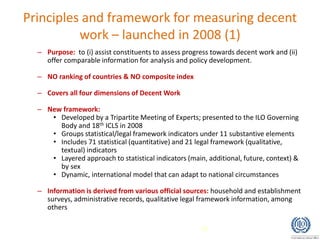
Principles and framework for measuring decent 
work – launched in 2008 (1) 
– Purpose: to (i) assist constituents to assess progress towards decent work and (ii) 
offer comparable information for analysis and policy development. 
– NO ranking of countries & NO composite index 
– Covers all four dimensions of Decent Work 
– New framework: 
• Developed by a Tripartite Meeting of Experts; presented to the ILO Governing 
Body and 18th ICLS in 2008 
• Groups statistical/legal framework indicators under 11 substantive elements 
• Includes 71 statistical (quantitative) and 21 legal framework (qualitative, 
textual) indicators 
• Layered approach to statistical indicators (main, additional, future, context) & 
by sex 
• Dynamic, international model that can adapt to national circumstances 
– Information is derived from various official sources: household and establishment 
surveys, administrative records, qualitative legal framework information, among 
others 
10 
ILO Department of Statistics
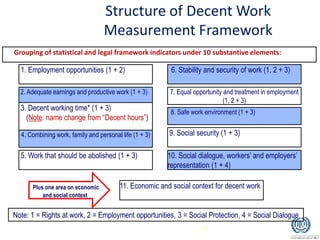
Structure of Decent Work 
Measurement Framework 
Grouping of statistical and legal framework indicators under 10 substantive elements: 
11 
1. Employment opportunities (1 + 2) 
2. Adequate earnings and productive work (1 + 3) 
3. Decent working time* (1 + 3) 
(Note: name change from “Decent hours”) 
4. Combining work, family and personal life (1 + 3) 
5. Work that should be abolished (1 + 3) 
6. Stability and security of work (1, 2 + 3) 
7. Equal opportunity and treatment in employment 
(1, 2 + 3) 
8. Safe work environment (1 + 3) 
9. Social security (1 + 3) 
10. Social dialogue, workers’ and employers’ 
representation (1 + 4) 
11. Economic Plus one area on economic and social context for decent work 
and social context 
Note: 1 = Rights at work, 2 = Employment opportunities, 3 = Social Protection, 4 = Social Dialogue 
ILO Department of Statistics
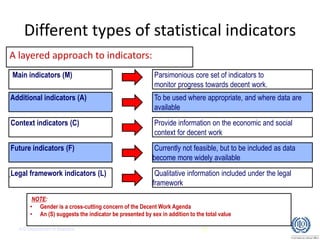
Different types of statistical indicators 
A layered approach to indicators: 
Main indicators (M) Parsimonious core set of indicators to 
monitor progress towards decent work. 
Additional indicators (A) To be used where appropriate, and where data are 
12 
available 
Context indicators (C) Provide information on the economic and social 
context for decent work 
Future indicators (F) Currently not feasible, but to be included as data 
become more widely available 
Legal framework indicators (L) Qualitative information included under the legal 
framework 
NOTE: 
• Gender is a cross-cutting concern of the Decent Work Agenda 
• An (S) suggests the indicator be presented by sex in addition to the total value 
ILO Department of Statistics
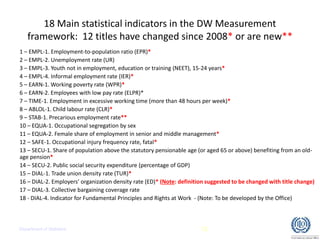
18 Main statistical indicators in the DW Measurement 
framework: 12 titles have changed since 2008* or are new** 
1 – EMPL-1. Employment-to-population ratio (EPR)* 
2 – EMPL-2. Unemployment rate (UR) 
3 – EMPL-3. Youth not in employment, education or training (NEET), 15-24 years* 
4 – EMPL-4. Informal employment rate (IER)* 
5 – EARN-1. Working poverty rate (WPR)* 
6 – EARN-2. Employees with low pay rate (ELPR)* 
7 – TIME-1. Employment in excessive working time (more than 48 hours per week)* 
8 – ABLOL-1. Child labour rate (CLR)* 
9 – STAB-1. Precarious employment rate** 
10 – EQUA-1. Occupational segregation by sex 
11 – EQUA-2. Female share of employment in senior and middle management* 
12 – SAFE-1. Occupational injury frequency rate, fatal* 
13 – SECU-1. Share of population above the statutory pensionable age (or aged 65 or above) benefiting from an old-age 
pension* 
14 – SECU-2. Public social security expenditure (percentage of GDP) 
15 – DIAL-1. Trade union density rate (TUR)* 
16 – DIAL-2. Employers’ organization density rate (ED)* (Note: definition suggested to be changed with title change) 
17 – DIAL-3. Collective bargaining coverage rate 
18 - DIAL-4. Indicator for Fundamental Principles and Rights at Work - (Note: To be developed by the Office) 
Department of Statistics 13
14 
• Labour productivity growth rate, 
• Labour productivity represents the total volume of output (measured in terms of 
GDP) achieved per unit of labour (measured in terms of employed persons). The 
purpose of this indicator is to assess the role of labour, which is one of the inputs to 
the production process, in terms of GDP growth. 
• Analysing labour productivity growth together with employment 
indicators, for example, the employment-to-population ratio or the 
unemployment rate can inform about labour utilization.
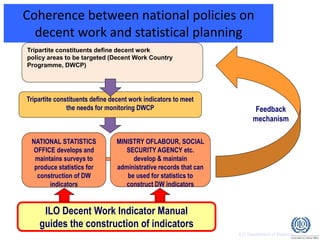
Coherence between national policies on 
decent work and statistical planning 
Tripartite constituents define decent work 
policy areas to be targeted (Decent Work Country 
Programme, DWCP) 
Tripartite constituents define decent work indicators to meet 
the needs for monitoring DWCP Feedback 
mechanism 
NATIONAL STATISTICS 
OFFICE develops and 
maintains surveys to 
produce statistics for 
construction of DW 
indicators 
MINISTRY OFLABOUR, SOCIAL 
SECURITY AGENCY etc. 
develop & maintain 
administrative records that can 
be used for statistics to 
construct DW indicators 
ILO Decent Work Indicator Manual 
guides the construction of indicators 
ILO Department of Statistics
III - QUICK LOOK ON THE 19TH ICLS RESOLUTION 
on statistics of work, employment and labour 
underutilization
New resolution 
• Is Built on existing standards (1982) and good practice 
• Provided expanded guidelines for countries 
• Facilitated progressive implementation 
• Enable reconstruction of existing series 
• Promoted international comparability 
ILO Department of Statistics 17
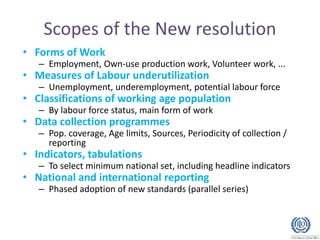
Scopes of the New resolution 
• Forms of Work 
– Employment, Own-use production work, Volunteer work, ... 
• Measures of Labour underutilization 
– Unemployment, underemployment, potential labour force 
• Classifications of working age population 
– By labour force status, main form of work 
• Data collection programmes 
– Pop. coverage, Age limits, Sources, Periodicity of collection / 
reporting 
• Indicators, tabulations 
– To select minimum national set, including headline indicators 
• National and international reporting 
– Phased adoption of new standards (parallel series)
Work 
New statistical definition (I) 
“Any activity performed 
by persons of any sex and age 
to produce goods or provide services 
for use by others or for own use” 
Para 6,Resol I. (19th ICLS, 2013) 
Concept for reference purposes 
Not for direct measurement ! 
Recognizes all productive activities as work 
But WORK ≠ Employment 
ILO Department of Statistics 19
Work 
New statistical definition (II) 
• Aligned with General production boundary (2008 SNA) 
– Must fulfill third person criterion 
– Must result in production of goods or services 
• Can be performed in any kind of economic unit 
– Market units (i.e. for profit units, such as corporations, quasi-corporations 
and household unincorporated market 
enterprises) 
– Non-market units (i.e. government & non-profit institutions) 
– Households producing goods or services for own final use 
• Irrespective of formal, informal nature or legality of 
activity 
Enables coherence between work statistics and economic statistics 
ILO Department of Statistics 20
Economic production as per 2008 SNA 
“Economic production may be defined as 
an activity carried out under the 
control & responsibility of an institutional unit that 
uses inputs of labour, capital, goods & services 
to produce outputs of goods or services” 
Para. 6.24, 2008 SNA 
Defines the General production boundary 
ILO Department of Statistics 21
Economic production and Work 
Activities 
Productive activities 
New reference concept of “Work” == ALL productive activities 
3rd person Previous activity scope for “employment” 
criterion 
ILO Department of Statistics 22 
Market units 
Services Goods 
Non-market units 
Services Goods 
Households 
producing for own final use 
Services Goods 
Non-productive 
activities 
Self-care 
Sleeping 
Learning 
Own-recreation 
Begging 
Stealing 
General 
production 
boundary 
SNA production 
boundary
Productive activities outside the 
SNA production boundary 
• Services for final use by households 
– Excluded when provided 
• Unpaid by household members 
• Unpaid by volunteers 
– Rationale (as per 2008 SNA): 
• Productive, but not easy to value 
• Limits relevance of statistics to assess market behaviour 
– NOTE: These activities are included when provided 
• For pay by domestic employees 
ILO Department of Statistics 23
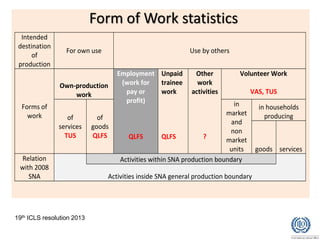
Form of Work statistics 
Intended 
destination 
of 
production 
For own use Use by others 
Forms of 
work 
Own-production 
work 
19th ICLS resolution 2013 
Employment 
(work for 
pay or 
profit) 
QLFS 
Unpaid 
trainee 
work 
QLFS 
Other 
work 
activities 
? 
Volunteer Work 
VAS, TUS 
of 
services 
TUS 
of 
goods 
QLFS 
in 
market 
and 
non 
market 
units 
in households 
producing 
goods services 
Relation 
with 2008 
SNA 
Activities within SNA production boundary 
Activities inside SNA general production boundary
Forms of work framework (II) 
• Distinguishes different “types” of work (i.e. productive activities) 
– Main intended destination of production (own final use / use by others) 
– Type of transaction (for remuneration / without remuneration) 
• Enables their separate measurement in full 
• Supports more targeted monitoring to inform policymaking 
• Permits coherence with national accounts 
– National production & satellite accounts 
ILO Department of Statistics 25
Forms of work framework (III) 
By main intended destination & transaction type 
Productive activities 
(i.e. activities to produce goods and services) 
For own final use 
(by households) 
Own-use 
production 
work 
For use by others (i.e. other units) 
For remuneration (i.e. for pay or profit) 
Employment 
ILO Department of Statistics 26 
Without remuneration 
Unpaid 
trainee work 
Other work 
activities 
(compulsory 
unpaid work) 
Volunteer 
work 
S G Services Goods S G S G G S
Conclusion 
• Workers experience decent work (or decent work deficits) 
from a perspective which goes beyond the scope of 
traditional labour statistics. They might ask: 
– How family-friendly are work arrangements? 
– Do I get a living wage? 
– Do workers have to work long hours? 
– Can I join a union? 
– Do migrant workers face discrimination? 
– What happens when I fall sick? 
– How dangerous is work? 
– Will I get paid maternity / paternity leave when I get a baby? 
• On some of these questions, traditional labour market statistics can give answers – 
but it’s more difficult for others.
Resources and Contact 
• ICLS Resolutions and Guidelines 
http://www.ilo.org/global/statistics-and databases/standards-and-guidelines/ 
• ILO contact 
statistics@ilo.org 
29
Thank you!

MEASURING DECENT WORK INDICATORS AND WORK STATISTICS

  • 1.
    Beyond-GDP in Africa: Innovative idea for a Regional Dashboard MEASURING DECENT WORK INDICATORS AND WORK STATISTICS By Dr Coffi Agossou Senior Labour Statistics Specialist
  • 2.
    Contents I. DecentWork concept and ILO Objectives II. Decent work indicators III. Quick look on 19 th ICLS Resolution concerning statistics of work, employment and labour uderutilization
  • 3.
    I Decent Workconcept and ILO Objectives
  • 4.
    Global issues unemploymentpoverty lack of skills governance migration globalization jobless growth informal economy human rights social security safe work child labour
  • 5.
    what people, anywhere,want?: • work for all who seek to work – be it wage- or self-employment, in the formal or the informal economy • freedom of choice – excluding forced or bonded labour and worst forms of child labour • productive work – providing adequate income, ensuring competitiveness • equity in work – meaning absence of discrimination in access to, and at work • security at work – as concerns health and safety, pensions and livelihoods • dignity at work – in terms of respect extended to workers and their rights at work
  • 6.
    ILO concept ofdecent work The concept of Decent Work has been defined by the ILO and endorsed by the international community as “Opportunities for women and men to obtain decent and productive work in conditions of freedom, equity, security and human dignity.” 1999 International Labour Conference Report ILO Department of Statistics
  • 7.
    Decent work asa global goal • Endorsed by ECOSOC, Presidential Summits and Head of State Summits in all regions, UN system, European Union, among others. • ILO Declaration on Social Justice for a Fair Globalization (2008) endorses Decent Work Agenda and its 4 dimensions: (i) International labour standards and fundamental principles and rights at work (ii) Employment creation (iii) Social Protection (iv) Social Dialogue and tripartism ILO Department of Statistics
  • 8.
    II Different typeof decent work indicators
  • 9.
    Commitments to monitor progress towards decent work • 2008 Declaration on Social Justice for a Fair Globalization recommends that ILO Members may consider: “the establishment of appropriate indicators or statistics, if necessary with the assistance of the ILO, to monitor and evaluate the progress made” • Monitoring of Milennium Development Goals (MDGs): – Goal 1, Target 1B: Achieve full and productive employment and decent work for all, including women and young people. – Goal 3, Target 3A: Eliminate gender disparity in primary and secondary education (indicator 3.2) ILO Department of Statistics
  • 10.
    Principles and frameworkfor measuring decent work – launched in 2008 (1) – Purpose: to (i) assist constituents to assess progress towards decent work and (ii) offer comparable information for analysis and policy development. – NO ranking of countries & NO composite index – Covers all four dimensions of Decent Work – New framework: • Developed by a Tripartite Meeting of Experts; presented to the ILO Governing Body and 18th ICLS in 2008 • Groups statistical/legal framework indicators under 11 substantive elements • Includes 71 statistical (quantitative) and 21 legal framework (qualitative, textual) indicators • Layered approach to statistical indicators (main, additional, future, context) & by sex • Dynamic, international model that can adapt to national circumstances – Information is derived from various official sources: household and establishment surveys, administrative records, qualitative legal framework information, among others 10 ILO Department of Statistics
  • 11.
    Structure of DecentWork Measurement Framework Grouping of statistical and legal framework indicators under 10 substantive elements: 11 1. Employment opportunities (1 + 2) 2. Adequate earnings and productive work (1 + 3) 3. Decent working time* (1 + 3) (Note: name change from “Decent hours”) 4. Combining work, family and personal life (1 + 3) 5. Work that should be abolished (1 + 3) 6. Stability and security of work (1, 2 + 3) 7. Equal opportunity and treatment in employment (1, 2 + 3) 8. Safe work environment (1 + 3) 9. Social security (1 + 3) 10. Social dialogue, workers’ and employers’ representation (1 + 4) 11. Economic Plus one area on economic and social context for decent work and social context Note: 1 = Rights at work, 2 = Employment opportunities, 3 = Social Protection, 4 = Social Dialogue ILO Department of Statistics
  • 12.
    Different types ofstatistical indicators A layered approach to indicators: Main indicators (M) Parsimonious core set of indicators to monitor progress towards decent work. Additional indicators (A) To be used where appropriate, and where data are 12 available Context indicators (C) Provide information on the economic and social context for decent work Future indicators (F) Currently not feasible, but to be included as data become more widely available Legal framework indicators (L) Qualitative information included under the legal framework NOTE: • Gender is a cross-cutting concern of the Decent Work Agenda • An (S) suggests the indicator be presented by sex in addition to the total value ILO Department of Statistics
  • 13.
    18 Main statisticalindicators in the DW Measurement framework: 12 titles have changed since 2008* or are new** 1 – EMPL-1. Employment-to-population ratio (EPR)* 2 – EMPL-2. Unemployment rate (UR) 3 – EMPL-3. Youth not in employment, education or training (NEET), 15-24 years* 4 – EMPL-4. Informal employment rate (IER)* 5 – EARN-1. Working poverty rate (WPR)* 6 – EARN-2. Employees with low pay rate (ELPR)* 7 – TIME-1. Employment in excessive working time (more than 48 hours per week)* 8 – ABLOL-1. Child labour rate (CLR)* 9 – STAB-1. Precarious employment rate** 10 – EQUA-1. Occupational segregation by sex 11 – EQUA-2. Female share of employment in senior and middle management* 12 – SAFE-1. Occupational injury frequency rate, fatal* 13 – SECU-1. Share of population above the statutory pensionable age (or aged 65 or above) benefiting from an old-age pension* 14 – SECU-2. Public social security expenditure (percentage of GDP) 15 – DIAL-1. Trade union density rate (TUR)* 16 – DIAL-2. Employers’ organization density rate (ED)* (Note: definition suggested to be changed with title change) 17 – DIAL-3. Collective bargaining coverage rate 18 - DIAL-4. Indicator for Fundamental Principles and Rights at Work - (Note: To be developed by the Office) Department of Statistics 13
  • 14.
    14 • Labourproductivity growth rate, • Labour productivity represents the total volume of output (measured in terms of GDP) achieved per unit of labour (measured in terms of employed persons). The purpose of this indicator is to assess the role of labour, which is one of the inputs to the production process, in terms of GDP growth. • Analysing labour productivity growth together with employment indicators, for example, the employment-to-population ratio or the unemployment rate can inform about labour utilization.
  • 15.
    Coherence between nationalpolicies on decent work and statistical planning Tripartite constituents define decent work policy areas to be targeted (Decent Work Country Programme, DWCP) Tripartite constituents define decent work indicators to meet the needs for monitoring DWCP Feedback mechanism NATIONAL STATISTICS OFFICE develops and maintains surveys to produce statistics for construction of DW indicators MINISTRY OFLABOUR, SOCIAL SECURITY AGENCY etc. develop & maintain administrative records that can be used for statistics to construct DW indicators ILO Decent Work Indicator Manual guides the construction of indicators ILO Department of Statistics
  • 16.
    III - QUICKLOOK ON THE 19TH ICLS RESOLUTION on statistics of work, employment and labour underutilization
  • 17.
    New resolution •Is Built on existing standards (1982) and good practice • Provided expanded guidelines for countries • Facilitated progressive implementation • Enable reconstruction of existing series • Promoted international comparability ILO Department of Statistics 17
  • 18.
    Scopes of theNew resolution • Forms of Work – Employment, Own-use production work, Volunteer work, ... • Measures of Labour underutilization – Unemployment, underemployment, potential labour force • Classifications of working age population – By labour force status, main form of work • Data collection programmes – Pop. coverage, Age limits, Sources, Periodicity of collection / reporting • Indicators, tabulations – To select minimum national set, including headline indicators • National and international reporting – Phased adoption of new standards (parallel series)
  • 19.
    Work New statisticaldefinition (I) “Any activity performed by persons of any sex and age to produce goods or provide services for use by others or for own use” Para 6,Resol I. (19th ICLS, 2013) Concept for reference purposes Not for direct measurement ! Recognizes all productive activities as work But WORK ≠ Employment ILO Department of Statistics 19
  • 20.
    Work New statisticaldefinition (II) • Aligned with General production boundary (2008 SNA) – Must fulfill third person criterion – Must result in production of goods or services • Can be performed in any kind of economic unit – Market units (i.e. for profit units, such as corporations, quasi-corporations and household unincorporated market enterprises) – Non-market units (i.e. government & non-profit institutions) – Households producing goods or services for own final use • Irrespective of formal, informal nature or legality of activity Enables coherence between work statistics and economic statistics ILO Department of Statistics 20
  • 21.
    Economic production asper 2008 SNA “Economic production may be defined as an activity carried out under the control & responsibility of an institutional unit that uses inputs of labour, capital, goods & services to produce outputs of goods or services” Para. 6.24, 2008 SNA Defines the General production boundary ILO Department of Statistics 21
  • 22.
    Economic production andWork Activities Productive activities New reference concept of “Work” == ALL productive activities 3rd person Previous activity scope for “employment” criterion ILO Department of Statistics 22 Market units Services Goods Non-market units Services Goods Households producing for own final use Services Goods Non-productive activities Self-care Sleeping Learning Own-recreation Begging Stealing General production boundary SNA production boundary
  • 23.
    Productive activities outsidethe SNA production boundary • Services for final use by households – Excluded when provided • Unpaid by household members • Unpaid by volunteers – Rationale (as per 2008 SNA): • Productive, but not easy to value • Limits relevance of statistics to assess market behaviour – NOTE: These activities are included when provided • For pay by domestic employees ILO Department of Statistics 23
  • 24.
    Form of Workstatistics Intended destination of production For own use Use by others Forms of work Own-production work 19th ICLS resolution 2013 Employment (work for pay or profit) QLFS Unpaid trainee work QLFS Other work activities ? Volunteer Work VAS, TUS of services TUS of goods QLFS in market and non market units in households producing goods services Relation with 2008 SNA Activities within SNA production boundary Activities inside SNA general production boundary
  • 25.
    Forms of workframework (II) • Distinguishes different “types” of work (i.e. productive activities) – Main intended destination of production (own final use / use by others) – Type of transaction (for remuneration / without remuneration) • Enables their separate measurement in full • Supports more targeted monitoring to inform policymaking • Permits coherence with national accounts – National production & satellite accounts ILO Department of Statistics 25
  • 26.
    Forms of workframework (III) By main intended destination & transaction type Productive activities (i.e. activities to produce goods and services) For own final use (by households) Own-use production work For use by others (i.e. other units) For remuneration (i.e. for pay or profit) Employment ILO Department of Statistics 26 Without remuneration Unpaid trainee work Other work activities (compulsory unpaid work) Volunteer work S G Services Goods S G S G G S
  • 27.
    Conclusion • Workersexperience decent work (or decent work deficits) from a perspective which goes beyond the scope of traditional labour statistics. They might ask: – How family-friendly are work arrangements? – Do I get a living wage? – Do workers have to work long hours? – Can I join a union? – Do migrant workers face discrimination? – What happens when I fall sick? – How dangerous is work? – Will I get paid maternity / paternity leave when I get a baby? • On some of these questions, traditional labour market statistics can give answers – but it’s more difficult for others.
  • 28.
    Resources and Contact • ICLS Resolutions and Guidelines http://www.ilo.org/global/statistics-and databases/standards-and-guidelines/ • ILO contact statistics@ilo.org 29
  • 29.