BALKAN
BAROMETER
2015
Public Opinion Survey
This project is funded
by the European Union
Public Opinion Survey
Analytical report
Regional Cooperation Council Secretariat (RCC)
Sarajevo, 2015
BALKAN
BAROMETER
2015
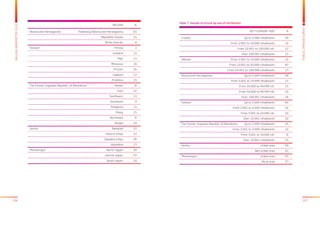
INTRODUCTION ........................................................................................................................................................ 9
MAIN FINDINGS ................................................................................................................................................... 13
BALKAN BAROMETER 2015 - PUBLIC OPINION SURVEY RESULTS ..................................... 17
	 Regional Overview ......................................................................................................................................... 17
	 Public Opinion Sentiment Survey ......................................................................................................... 21
		 BALKAN PUBLIC SENTIMENT INDEX .................................................................................................... 21
		 LIFE SATISFACTION AND ASSESSMENT OF GENERAL TRENDS .................................................... 28
		 ATTITUDES ON EU INTEGRATION AND REGIONAL COOPERATION .............................................. 40
		 INTEGRATED GROWTH – TRADE AND INVESTMENT INTEGRATION ............................................ 50
		 SMART GROWTH – PERCEPTIONS OF SKILLS AND EDUCATION PERFORMANCE .................... 57
		 SUSTAINABLE GROWTH – VIEWS ON CONNECTIVITY AND INFRASTRUCTURE .......................... 64
		 INCLUSIVE GROWTH – EMPLOYMENT AND INCLUSION ................................................................... 74
		 GOVERNANCE FOR GROWTH – SATISFACTION WITH PUBLIC SERVICES AND
		 ATTITUDES ON CORRUPTION ................................................................................................................. 82
	Appendix ............................................................................................................................................................ 93
CONCLUSIONS AND RECOMMENDATIONS ........................................................................................... 99
METHODOLOGY ................................................................................................................................................. 103
CONTENT
BALKAN BAROMETER 2015:
Public Opinion Survey
Author: Group of Authors – GfK
Editor: Erhan Turbedar, PhD (RCC)
Consulting editor: Vladimir Gligorov, PhD (WIIW)
Design: Team Thumm, Zagreb, Croatia
Print: Printline, Sarajevo, Bosnia and Herzegovina
Circulation: 600
ISSN: , Year 1, No. 1
© RCC 2015. All right reserved. The content of this publication may be used for non-commercial purposes,
with the appropriate credit attributed to the RCC. This publication does not reflect the views or policies of
the RCC or the EU. The interpretations and opinions contained in it are solely those of the author(s).
RCC publications are available on the RCC website (www.rcc.int).
6
BALKANBAROMETER2015
9
PUBLICOPINIONSURVEY
The Regional Cooperation Council (RCC)
Secretariat coordinated the development of
theregionalgrowthstrategytitled“SEE2020
Strategy: Jobs and Prosperity in a European
Perspective”. The strategy was adopted by
Ministers of Economy of seven South East
European economies (Albania, Bosnia and
Herzegovina, Croatia, Kosovo*, Montenegro,
Serbia and The Former Yugoslav Republic of
Macedonia) on 21 November 2013. Inspired
by the EU`s 2020 Strategy it seeks to boost
prosperity and job creation and to under-
score the importance of the EU perspec-
tive to the region`s future. The SEE 2020
Strategy contains eleven specific targets
covering the following five pillars:
•	 Integrated growth - by deeper regional
trade and investment linkages and poli-
cies enhancing the flow of goods, invest-
ment, services and persons.
•	 Smart growth - by commitment to com-
pete on value added, promoting knowl-
edge and innovation across the board.
•	 Sustainable growth - by enhancing com-
petitiveness, entrepreneurship and a
commitment to greener and more ener-
gy-efficient development.
•	 Inclusive growth - by skills development,
employment creation and labour market
participation by all, including vulnerable
groups and minorities.
•	 Governance for growth - by improving
the capacity of public administrations
to strengthen the rule of law and re-
duce corruption so as to create a busi-
ness-friendly environment.
With the intention to engage more closely
the general public and the business com-
munity in the context of the SEE 2020
Strategy, the RCC has commissioned a com-
prehensive survey on attitudes, experienc-
es and perceptions, which was carried out
in December 2014, in all seven economies
covered by the Strategy.
This report presents the results of this
survey and includes two main components,
which are The Public Opinion Barometer -
a survey of public opinion of South East
Europe (SEE) citizens, and the Business
Opinion Barometer - a survey of business
sentiment. The report provides data and
analysis on various topics covered by five
pillars of SEE 2020 Strategy, including life/
business satisfaction, assessment of general
trends and attitudes on EU integration and
regional cooperation.
The surveys were conducted face to face
with 1000 respondents per each economy,
INTRODUCTION
*This designation is without prejudice to positions on status, and is in line with UNSCR 1244 and the ICJ Opinion on the
Kosovo declaration of independence.
10
BALKANBAROMETER2015
with the total being 7000 respondents for
Public Opinion Survey aged 18 and old­er,
and for Business Opinion Survey 200 com-
panies per each economy of different size
and differ­ent business areas, which are not
majori­ty-owned by the state or government.
A technical note concerning the method-
ology of survey is annexed to this report.*
The Balkan Barometer report is envisioned
to become an integral part of the SEE 2020
monitoring system, along with the other
components of Annual Implementation
Report, such as the SEE 2020 Scoreboard
and SEE 2020 Competitiveness Outlook.
The Balkan Barometer surveys will be con-
ducted annually in order to assess how
these sentiments are changing and what
progress is being made.
* Throughout the report values in percentages were calculated using the decimal rounding so there is a chance of fluctuations
+/-1% in categorical variables (with 3 or more response categories).
13
PUBLICOPINIONSURVEY
The Public Opinion Survey has looked into
the current sentiment and the expectations
of the public in Southeast Europe. Besides
general assessment of the situation, the
main pillars of the SEE 2020 Strategy have
been covered.
The findings paint a stark picture of a set
of economies that have not been doing
well and are not expected to do much bet-
ter in the future. On top of that, they are
burdened with difficult problems in all the
covered areas of growth: integrated, smart,
sustainable and inclusive growth, as well as
governance for growth..
The Balkan Public Sentiment Index (BPSI)
reports a sentiment that stands at around
one third of the best possible – and the
expectations are not much better than the
assessment of the current state of affairs.
The main problem in the region is lack of
employment and the general economic sit-
uation stemming from it or connected to
it. The paradox of this region is that the
issues of employment and unemployment,
which have been persistent since the start
of the transition, do not feature prominent-
ly in the successive elections. This seems
to have been changing very recently, but
still the political and security issues tend to
dominate the electoral agenda. Otherwise,
it would be hard to explain the toleration of
very high levels of unemployment for many
years, if not decades.
Lower welfare, incomes, and financial securi-
ty must be the consequences of persistently
depressed labour markets. The social and
cultural problems also accumulate. Though
the perceptions of the poverty risk and the
lack of basic necessities are not catastroph-
ic, they are certainly worrying. There is no
doubt that solutions to political and devel-
opmental issues need to be urgently found
for economic growth to accelerate.
There is general support for regional and
EU integration, though not without some
scepticism. The latter is a reflection of the
belief that the EU is not supplying, or sup-
plementing the supply of the public goods
that the economies in the region are defi-
cient in: security, stability, justice and, most
of all, welfare. The last is on the top of the
list of expectations from the EU integration.
This is in part due to the prolonged crisis
in the EU itself and to the stalled process
of enlargement.
Regional trade and financial integration is
looked at as one of the solutions to eco-
nomic problems. The CEFTA is firmly en-
trenched in the conditions for economic im-
provement. The expectation is that regional
MAIN
FINDINGS
14
BALKANBAROMETER2015
economic cooperation will be enhanced and
improved. Though, in some respects, market
integration seems to go against some of
the more protectionist beliefs of the public.
The region remains a migrant one. Given
the situation on the domestic labour mar-
kets, the relevant market to look for a job
is still the world, even before the region
itself. Intra-regional mobility is limited to
ethnic and traditional destinations. Still,
there might be increased opportunities for
intra-regional mobility especially because
of low language and other informal barriers.
Smart growth clearly has a chance in this
region because there is a widespread un-
derstanding that skills and their acquisition
are the answer to securing employment, in-
creasing job security, and improving welfare.
This contrasts rather starkly with the mostly
weak investments in education and in in-
novation, what is characteristic to most of
the SEE region.
In the area of sustainable growth, there is an
emphasis on roads and their improvement,
while clearly the more glaring deficiency is
the lack of railways. Similarly, there is a per-
ception that a sustainable environment is
needed, but there is scant indication that
this is being translated into policies, regu-
lations and the needed investments.
There is a somewhat inconsistent percep-
tion of the inclusiveness of societies. In
most economies, people feel well integrat-
ed and accepted by their societies, while
they also tend to feel excluded from the
labour markets due to the importance that
connections and luck play in getting a job
and advancing in one’s carrier. This differs
from what is known from statistical sources
and the studies about the types and levels
of inclusion, or rather exclusion, where age,
skill, gender, loss of job, minority status and
disability tend to correlate with higher rates
of unemployment.
Finally, the overall assessment of the gov-
ernance is that it is bad rather than good:
in terms of corruption, transparency, effi-
ciency, and responsiveness. That certain-
ly correlates with other evaluations of the
state of good governance in the region.
That is one crucial obstacle for growth and
development.
The overall conclusion is that a comprehen-
sive, sustained, regional and EU-oriented
policy effort is needed in all the SEE region in
order to speed up growth and development.
17
PUBLICOPINIONSURVEY
In the crisis that started in late 2008,
Southeast Europe (SEE) has been faced with
a recession or a growth halt and with persis-
tent challenges in most markets, especially
in the labour market. The larger economies
experienced particularly difficult times, i.e.
Croatia, Serbia and Bosnia and Herzegovina,
The Former Yugoslav Republic of Macedonia,
Kosovo* and Albania have done better, with
Montenegro somewhere in the middle.
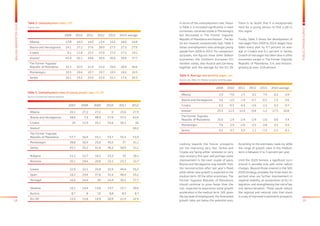
Table 1 shows the growth rates. Croatia has
had an average growth rate of minus 2.2 per-
cent from 2009 to 2014. Serbia had minus
0.3 and Bosnia and Herzegovina achieved
a growth rate of 0.1, while Montenegro a
growth rate of 0.4. Better growth rates were
seen in Albania 2.4, Kosovo* 3.8 and The
Former Yugoslav Republic of Macedonia 1.8.
BALKAN BAROMETER 2015
PUBLIC OPINION
SURVEY RESULTS
Regional Overview
SOUTHEAST EUROPE: STILL A LOT TO DO
	 2009	2010	2011	2012	2013	2014	average
Albania	 3.4	3.7	2.5	1.6	1.4	1.5	2.4
Bosnia and Herzegovina	-2.7	0.8	1.0	-1.2	2.5	0.5	0.1
Croatia	 -7.4	-1.7	-0.3	-2.2	-0.9	-0.6	-2.2
Kosovo*	 3.6	3.3	4.4	2.8	3.4	5.0	3.8
The Former Yugoslav
Republic of Macedonia	 -0.4	3.4	2.3	-0.5	2.7	3.5	1.8
Montenegro	 -5.7	2.5	3.2	-2.5	3.3	1.3	0.4
Serbia	 -3.1	0.6	1.4	-1.0	2.6	-2.0	-0.3
Table 1: Growth rates
Source: wiiw
18 19
BALKANBAROMETER2015
PUBLICOPINIONSURVEY
In terms of the unemployment rate, shown
in Table 2, it increased significantly in most
economies, remained stable in Montenegro,
but decreased in The Former Yugoslav
Republic of Macedonia and Kosovo*. The lev-
els are, however, exceptionally high. Table 3
shows unemployment rates amongst young
people from 2006 to 2012. For comparison
purposes, the figures show other Balkan
economies, the Southern European EU
member states, also Austria and Germany
together with the average for the EU 28.
There is no doubt that it is exceptionally
hard for a young person to find a job in
this region.
Finally, Table 3 shows the development of
real wages from 2009 to 2014. Wages have
fallen every year by 0.7 percent on aver-
age in Croatia and 0.1 percent in Serbia.
Growth of real wages has been slow in other
economies except in The Former Yugoslav
Republic of Macedonia, 3.4, and Kosovo*,
growing at even 10.8 percent.
Looking towards the future, prospects
are not improving very fast. Serbia and
Croatia are facing either recession or very
slow recovery this year and perhaps some
improvement in the next couple of years.
Bosnia and Herzegovina may benefit from
the reconstruction after last year’s flood,
while rather slow growth is expected in the
medium term. Of the other economies, The
Former Yugoslav Republic of Macedonia
should continue to grow faster than the
rest, expected to experience some growth
acceleration in the medium term. Still, given
the low level of employment, the forecasted
growth rates are below the potential ones.
According to the estimates made by WIIW,
the range of growth rates in the medium
term is between 0 to 3 percent per year.
Until the 2020 horizon, a significant turn-
around is possible only with some radical
changes. Beyond those covered in the SEE
2020 Strategy, probably the three most im-
portant ones are further improvement in
regional stability, an acceleration of EU in-
tegration, and strengthening the rule of law
and democratisation. Those would reduce
the regional and national risks that stand
in a way of improved investments prospects.
	 2009	2010	2011	2012	2013	2014	average
Albania	 2.9	-7.0	1.5	0.2	7.4	0.2	0.9
Bosnia and Herzegovina	 5.6	 -1.0	 -1.4	 -0.7	 -0.1	 1.5	 0.6
Croatia	 0.2	-0.5	-0.4	-2.6	-1.5	 0.3	-0.7
Kosovo*	 23.3	12.3	13.4	-0.8	 -1.2	17.5	10.8
The Former Yugoslav
Republic of Macedonia	25.0	1.4	-2.4	-2.9	-1.6	0.6	3.4
Montenegro	 7.6	 2.9	-2.0	-3.3	-3.8	 0.3	 0.3
Serbia	 0.2	0.7	0.2	1.1	-1.5	-1.5	-0.1
Table 4: Average real monthly wages, net
Source: wiiw. Note: For Albania real gross monthly wages.
	 2009	2010	2011	2012	2013	2014	average
Albania	 13.8	14.0	14.0	13.4	15.6	18.0	14.8
Bosnia and Herzegovina	24.1	27.2	27.6	28.0	27.5	27.5	27.0
Croatia	 9.1	11.8	13.5	15.9	17.2	17.3	14.1
Kosovo*	 45.4	45.1	44.8	30.9	30.0	30.0	37.7
The Former Yugoslav
Republic of Macedonia	 32.2	32.0	31.4	31.0	29.0	28.0	30.6
Montenegro	 19.3	19.6	19.7	19.7	19.5	19.0	19.5
Serbia	 16.1	19.2	23.0	23.9	22.1	17.6	20.3
	 2007	2008	2009	2010	2011	2012
Albania	 20,1	27,2	27,2	 0	23,6	27,9
Bosnia and Herzegovina	 58,6	 7,3	 48,9	 57,6	 57,5	 62,8
Croatia	 24	21,9	25,1	32,6	36,1	 43
Kosovo*						60,2
The Former Yugoslav
Republic of Macedonia	 57,7	56,4	55,1	53,7	55,3	53,9
Montenegro	 38,8	30,4	35,6	45,5	 37	41,1
Serbia	 43,7	35,2	41,6	46,2	50,9	51,1
Bulgaria	 15,1	12,7	16,2	23,2	 25	28,1
Romania	 20,1	18,6	20,8	22,1	23,7	22,7
Greece	 22,9	22,1	25,8	32,9	44,4	55,3
Spain	 18,2	24,6	37,8	41,6	46,4	53,2
Portugal	 16,6	16,4	 20	22,4	30,1	37,7
Slovenia	 10,1	10,4	13,6	14,7	15,7	20,6
Austria	 8,7	 8	 10	8,8	8,3	8,7
EU-28	 15,5	15,6	19,9	20,9	21,4	22,9
Table 3: Unemployment rates of young people, ages 15-24
Source: Eurostat and national statistics.
Table 2: Unemployment rates, LFS
Source: wiiw
20 21
BALKANBAROMETER2015
PUBLICOPINIONSURVEY
Public Opinion Sentiment Survey
BALKAN PUBLIC SENTIMENT INDEX
In order to monitor changes over time about
public present sentiment and optimism,
GfK was asked to design the Balkan Public
Sentiment Index (BPSI) which is composed
of the following five questions:
1.	 How are you satisfied with the way things
are going in your place of living? (an-
swers: 5 point scale)
2.	How are you satisfied with the financial
situation of your household? (answers:
5 point scale)
3.	How are you satisfied with the economic
situation of your place of living? (answers:
5 point scale)
4.	What are your expectations for the next
year? Do you think that in 12 months
your financial situation will be better,
worse, the same.
5.	What are your expectations for the na-
tional economy? Do you think that in 12
months the state of the economy will be
better, worse, the same.
BPSI represents a measure of the current
and future state/expectations regarding
the general and economic situation and
the situation of individual households. It is
a measure that helps to monitor changes in
time on the SEE regional level and the level
of individual economies.
The index is constructed with the answers
on five-point scales scored as follows: I’m
completely dissatisfied - 0 points, I’m
mostly unsatisfied – 25 points, neither
satisfied nor dissatisfied – 50 points; I’m
mostly satisfied – 75 points, I’m completely
satisfied – 100 points. Answers for the Q4
and Q5 are scored as follows: better – 100
points, worse – 0 points, the same – 50
points. After responses are recoded, aver-
age value is calculated for the whole SEE
region as well as for each economy sepa-
rately. The index values are expressed on a
scale of 0 to 100.
BPSI was further divided on the two sub
indexes with the aim to monitor separately
the present sentiment among population
as well as their expectation for the future
or their degree of optimism.
a) BPSI – Present Situation index
b) BPSI – Expectation Index
There are also significant challenges in eco-
nomic policies. The crisis has been so severe
in some economies because of accumulated
imbalances both externally and domestical-
ly. Trade and current account deficits have
been very large and have gradually come
down in most economies. There are still sig-
nificant problems in the banking and corpo-
rate sectors due to high levels of non-per-
forming loans which reflect the liquidity and
solvency problems in e.g. the construction
sector and state owned enterprises. They
require restructuring that may prove to be
difficult to accomplish in the context of high
unemployment. This is done in an austere
fiscal and monetary environment, which
makes it difficult to implement.
The opportunities are that the European
environment will improve with gradual
growth recovery. Also, that EU institutions
will strengthen and speed up investment
and structural changes. With most of the
exports from the SEE going to the EU mar-
ket, that would help the transition to more
export-driven growth in the region, which
is certainly needed. In addition, regional in-
vestments in transport and the energy, dis-
cussed at the process that started with the
Berlin Conference on the Western Balkans
(28 August 2014) and complemented by
Western Balkans Six ministerial meetings,
could also be very helpful. In general, im-
proved regional cooperation is expected to
positively affect economic situation of the
region.
The negative risks are connected with con-
tinued turbulences in the EU and in Europe
that may delay the integration process and
cause delays in domestic political and eco-
nomic transformation. In most economies,
democratic decision making has stabilised,
however, there are still constitutional and
political changes and improvements that
are needed for improved democratic legit-
imacy and responsiveness.
Social risks exist due to low employment
and high unemployment. A particularly
vulnerable group is the youth population,
with unemployment rates up to 50 percent
in some cases, but also the long-term un-
employed, which make up a significant part
of those searching for a job. The effects of
the lack of jobs are profound and have long
term negative consequences. In the past,
elections were won and lost on other issues,
with those regarding the labour market
playing a small role. This has been changing
and thus political responsiveness to social
issues should be expected to increase.
The overall sentiment in this region has
been gloomy for quite a long time. This is
the consequence of the long-term economic
deterioration and regress. The effects have
been profound and they are clearly reflect-
ed in the prevalent desire to emigrate and
work and live elsewhere. The period until
2020 can be the beginning of a turnaround.
22 23
BALKANBAROMETER2015
PUBLICOPINIONSURVEY
Parallel to creating an index the changes of
which can be tracked in time, it is impor-
tant to determine what and to what extent
effects the index itself the most, i.e. the in-
vestigated sentiment and level of optimism.
Considering how the SEE 2020 Strategy
consists of five pillars, each of which covers
a specific area and has set goals, this part of
the analysis aims at determining how much
each of the pillars (as an independent var-
iable) effect the BPSI (dependent variable),
with the aim to invest more effort into ob-
taining set goals of „more important” pillars.
Besides the five defined pillars, the analysis
also includes the part relating to regional
cooperation.
In order to conduct the described analy-
sis, we first verified the reliability of the
chosen questions (Reliability analyses)
from the questionnaire (those questions
the structure of which did not support an
analysis were excluded) with the help of the
Cronbach’s Alpha coefficient of 0,83 (on a
scale of 0 to 1). With the help of this co-
efficient, we determined that the reliabil-
ity of the chosen variables (questions) is
very good, i.e. that the correlation between
the chosen questions is high, which leads
to the conclusion that they measure the
same phenomenon.
After that, a regression analysis was used
(with the help of a Shapley value) to deter-
mine the influence of each of the chosen
questions on the BPSI. For further analysis,
the questions chosen were the ones that,
in most economies, have an above average
importance (influence on BPSI). The list of
all of the questions that entered the analy-
sis are presented on the next page. On the
basis of the conducted analysis, we can say
that the chosen questions are the best pre-
dictors for the BPSI, i.e. they best represent
each individual pillar.
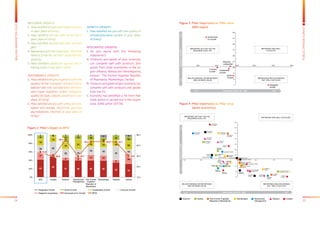
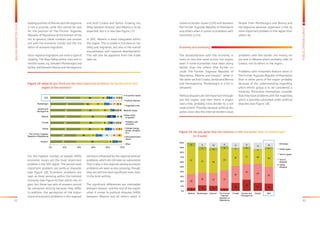
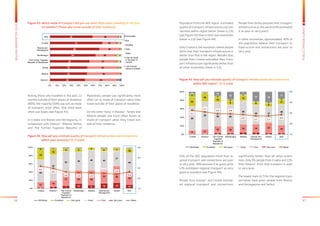
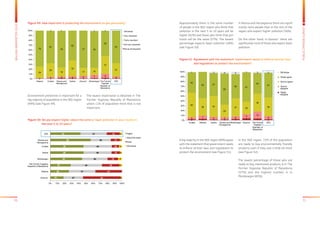
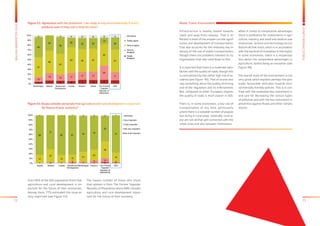
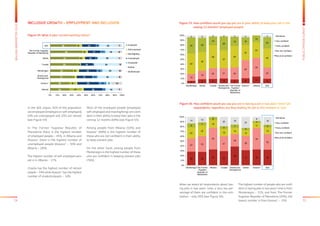
The Figure 2 show the influence of each indi-
vidual pillar on the BPSI for the SEE region,
and for each individual economy. Besides
that, in order to determine the priorities
in the realization of the SEE 2020 Strategy,
the importance relation of individual pillars
on the BPSI was shown, as well as the val-
ue of the pillar itself (see Figure 3 and 4).
The value of the pillar was calculated on the
basis of rescaled answers to questions that
make up each individual pillar. On the basis
of four quadrants (influence on the BPSI x
value of individual pillars of the index), it is
possible to determine which pillars have an
above average influence on the BPSI, and
their current state (index value).
The average pillar importance was calculat-
ed with the formula 100 (total importance)
/6 (number of pillars) = 16,6. While for the
average index value, a value of 50 was taken
(on a scale from 1 to 100).
Questions that were used for each individ-
ual pillar in the analysis.
GOVERNANCE FOR GROWTH
1.	 How satisfied are you with public services
in general in your place of living?
2.	 Do you have confidence in courts and the
judiciary in your place of living?
3.	 Do you agree or disagree that in your place
of living the law is applied and enforced
effectively?
4.	Do you agree or disagree that your govern-
ment fights effectively against corruption?
5.	How would you grade (from 1 to 5, 1 mean-
ing very poor and 5 excellent) the follow-
ing: Price of public services (e.g. issuance
of personal documents, judiciary costs etc).
REGIONAL COOPERATION
1.	 Do you agree that the relations within
SEE are better than 12 months ago?
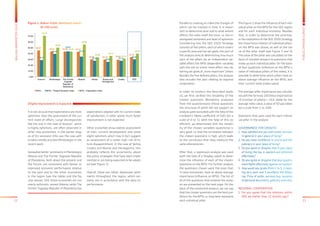
Figure 1: Balkan Public Sentiment indeks
	 (0-100 scale)
45.37
43.61 43.55 43.11
29.98 29.70 29.04
33.79
28.71
39.41
43.61
34.79
27.53 25.82
27.71
29.87
70.76
50.06
43.24
55.58
33.68
35.73
31.21
39.80
0.00
10.00
20.00
30.00
40.00
50.00
60.00
70.00
Kosovo* Montenegro The Former
Yugoslav
Republic of
Macedonia
Albania Serbia Bosnia and
Herzegovina
Croatia SEE
BPSI BPSI - Present Situation index BPSI - Expectation index
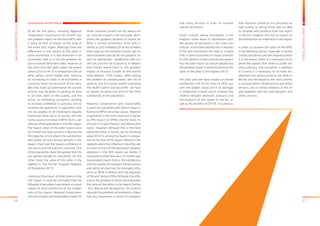
It is not unusual that expectations are more
optimistic than the assessment of the cur-
rent state of affairs. Large discrepancies
like the one in the case of Kosovo*, which
is highly optimistic, are often observed in
other new economies, in the earlier stag-
es of EU accession (this was the case with
Croatia initially and also Montenegro in the
recent past).
Somewhat better sentiments in Montenegro,
Albania and The Former Yugoslav Republic
of Macedonia, both about the present and
the future, are consistent with better or
improved economic performance relative
to the past and to the other economies
in the region (see the tables and the fig-
ures above). Still, these economies are not
overly optimistic, except Albania, while The
Former Yugoslav Republic of Macedonia has
expectations aligned with its current state
of satisfaction, in other words much faster
improvement is not expected.
Other economies show realistic assessment
of their current development and some
slight optimism, which may in fact suggest
an assessment of a rather high risk of fu-
ture disappointment. In the case of Serbia,
Croatia and Bosnia and Herzegovina, this
probably reflects the uncertainty about
the policy strategies that have been imple-
mented or are being expected to be adopt-
ed (see Figure 1).
Overall, these are rather depressed senti-
ments throughout the region, which cer-
tainly are in accordance with the data on
performance.
(Slight) Improvement is Expected
24 25
BALKANBAROMETER2015
PUBLICOPINIONSURVEY
Figure 3: Pillar Importance vs. Pillar value 	
	 (SEE region)
Regional
cooperation
Integrated
Growth
Smart
Growth
Sustainable
Growth
Inclusive
Growth
Governance
for Growth
1
6
11
16
21
26
31
36
41
46
30.0 40.0 50.0 60.0 70.0 80.0
ImportanceonBPSIHighLow
Pillar Index value (0 – 100)Low High
BELOW AVERAGE ON IMPORTANCE
AND ON INDEX VALUE
IMPORTANCE BELOW AVERAGE
BUT WELL FULFILLED
IMPORTANT, BUT NOT ON THE
REQUIRED LEVEL YET
IMPORTANT AND WELL
FULFILLED
Figure 4: Pillar Importance vs. Pillar value 	
	 (seven economies)
Governance
for Growth
Inclusive
Growth
Sustainable Growth
Smart Growth
Integrated
Growth
Governance
for Growth
Inclusive
Growth
Sustainable
Growth
Smart
Growth
Integrated Growth
Governance
for Growth
Regional
cooperation
Inclusive Growth
Sustainable Growth
Smart
Growth
Integrated
Growth
Governance
for Growth
Inclusive
Growth
Sustainable Growth
Smart Growth
Integrated
Growth
Governance
for Growth
Inclusive
Growth
Sustainable Growth
Smart Growth
Integrated
Growth
Governance
for Growth
Inclusive
Growth
Sustainable
Growth
Smart Growth
Integrated
Growth
Governance
for Growth
Inclusive Growth
Sustainable
Growth
Smart Growth
Integrated
Growth
0.0
5.0
10.0
20.0
25.0
30.0
35.0
40.0
45.0
50.0
30.020.0 40.0 60.0 70.0 80.0
Pillar Index value (0 – 100)Low High
ImportanceonBPSIHighLow
IMPORTANT, BUT NOT ON THE
REQUIRED LEVEL YET
BELOW AVERAGE ON IMPORTANCE
AND ON INDEX VALUE
IMPORTANT AND WELL FULFILLED
IMPORTANCE BELOW AVERAGE
BUT WELL FULFILLED
CroatiaSerbia The Former Yugoslav
Republic of Macedonia
Montenegro AlbaniaKosovo* Bosnia and
Herzegovina
Regional
cooperation
Regional
cooperation
Regional
cooperation
Regional
cooperation
Regional cooperation
42
48
41 40 40 40 35 32
17 6
6 8
13 12
6
24
16 28
20 18
19 19
32
10
15
12
16
23 16 13 14 20
9
5
17 10 10
10
12
10
1 0 1 1 2 7
1 5
33.8
29.0
45.4
29.7
43.6 43.6 43.1
30.0
10.0
20.0
30.0
40.0
50.0
0%
20%
40%
60%
80%
100%
SEE Croatia Kosovo* Bosnia and
Herzegovina
The Former
Yugoslav
Republic of
Macedonia
Montenegro Albania Serbia
Integrated Growth Smart Growth Sustainable Growth Inclusive Growth
Regional cooperation Governance for Growth BPSI
INCLUSIVE GROWTH
1.	 How satisfied are you with health services
in your place of living?
2.	How satisfied are you with social life in
your place of living?
3.	How satisfied are you with your present
job?
4.	Agreement with the statement: I feel that
there is a risk for me that I could fall into
poverty.
5.	How confident would you say you are in
having a job in two years’ time?
SUSTAINABLE GROWTH
1.	 How satisfied are you in general with the
quality of the transport infrastructure
(please take into consideration all trans-
port types together: public transport,
quality of roads, railways, airports) in your
place of living?
2.	How satisfied are you with utility services
(water and sewage, electricity, gas sup-
ply, telephone, internet) in your place of
living?
SMARTH GROWTH
1.	 How satisfied are you with the quality of
schools/education system in your place
of living?
INTEGRATED GROWTH
1.	 Do you agree with the following
statements?:
A. Products and goods of your economy
can compete well with products and
goods from other economies in the re-
gion (Albania, Bosnia and Herezegovina,
Kosovo*, The Former Yugoslav Republic
of Macedonia, Montenegro, Serbia) 
B. Products and goods of your economy can
compete well with products and goods
from the EU.
C. Economy has benefited a lot from free
trade (which is carried out in the region
since 2006 within CEFTA).
Figure 2: Pillar’s impact on BPSI
26 27
BALKANBAROMETER2015
PUBLICOPINIONSURVEY
and utility services in order to increase
overall satisfaction.
Smart Growth, whose foundation in the
analysis comes down to satisfaction with
the quality of education, is the main con-
tributor to the total satisfaction in Kosovo*
(17%) and contributes the least in Croatia
(5%). In other economies its impact amounts
to 10%. While in Croatia educational system
has the least impact on overall satisfaction,
the greatest impact is achieved because the
value of the pillar is the highest (56.7).
The pillar with the least impact on overall
satisfaction (1% at the level of SEE), but
with the largest values (67.4 on average)
is Integrated Growth which involves the
relation between domestic products and
the products of the region or the EU, as
well as the benefits of CEFTA. It is obvious
that domestic products are perceived as
high-quality as well as those who are able
to compete with products from the region
or the EU. However, this has no impact on
the satisfaction of inhabitants in the region.
In order to increase the value of the BPSI
in the following period, especially in Serbia,
Croatia and Bosnia and Herzegovina where
it is the lowest, firstly it is necessary to im-
prove the aspects that relate to public ser-
vices, judiciary, and corruption. In addition,
in Croatia it is necessary to increase em-
ployment and reduce poverty risk, while in
Bosnia and Herzegovina the next priority
is transportation infrastructure and utility
services, and in Serbia relations in the re-
gion together with the said transport and
utility services.
Of all the five pillars, including Regional
Cooperation, Governance for Growth has
the greatest impact on the total BPSI with
a share of 42% of impact at the level of
the entire SEE region. Although there are
differences in the impact of this pillar in
some economies, it is still dominant in all
economies, that is, it has the greatest im-
pact on overall sentiment index. However, at
the same time this pillar shows the lowest
values (25.6 to 44.7) in comparison with all
other pillars, which implies that working
on increasing its value in all economies is
a priority. Given the structure of the varia-
bles that make up Governance for Growth,
priority may be given to working on pub-
lic services, both on the quality, and the
prices, to combating corruption, working
to increase confidence in judiciary, and to
increase the awareness in population that
the law applies to all inhabitants equally.
Improving these parts of society will indi-
rectly cause an increase in BPSI, that is, sat-
isfaction of the population in the SEE region.
The lowest value of the pillar Governance
for Growth has been present in Bosnia and
Herzegovina (25.6) where the satisfaction
with public services among persons is the
lowest, they have the lowest confidence in
the courts and the judiciary, and only 15%
of the population share the opinion that the
law applies equally to everybody. On the
other hand, the value of this pillar is the
highest in The Former Yugoslav Republic
of Macedonia (44.7).
Looking at the impact of other pillars in the
SEE region, it could be concluded that the
following three pillars have almost an equal
impact on total satisfaction of the inhabit-
ants of this region: Regional Cooperation,
Inclusive Growth and Sustainable Growth. Of
Contribution of the Pillars
these, Inclusive Growth has the lowest val-
ue. Inclusive Growth is the very pillar which
shows the greatest variation of impact on
BPSI in certain economies: from 10% in
Serbia, to 32% in Albania. Of all the variables
that make up the Inclusive Growth, job-re-
lated variables have by far the greatest im-
pact on satisfaction : satisfaction with cur-
rent job, and the risk of poverty. In Albania
and Croatia, where there is the greatest
impact of Inclusive Growth on the overall
index (Albania - 32%; Croatia - 28%), solving
the problem of unemployment, the risk of
poverty, and to a lesser extent improving
the health system and social life can have
an impact on about one-third of the total
satisfaction of the population.
Regional Cooperation and Sustainable
Growth are two pillars with almost equal in-
fluence on BPSI and similar values. Regional
Cooperation is the most important in Serbia
(a 24% impact on BPSI), and the least im-
portant in Croatia, Kosovo* and Albania (6%
each). However, although this is the most
important pillar in Serbia, yet its resulting
value (39.2) is among the lowest in compar-
ison to the rest of the region. Albania is the
opposite where the influence is low (6%), but
as much as 65% of the population believes
relations in the SEE region are better if
compared to what they were 12 months ago.
Sustainable Growth, that is, the satisfaction
with the quality of transport infrastructure
and utility services has the strongest influ-
ence on BPSI in Bosnia and Herzegovina
(23%) and Serbia (20%). Although the influ-
ence is the greatest in these two economies,
the value of the pillars is the lowest (Serbia
- 38.1, Bosnia and Herzegovina - 41.6) which
requires the greatest commitment in these
two very economies in terms of transport
28 29
BALKANBAROMETER2015
PUBLICOPINIONSURVEY
Figure 6: What do you think are the two most important problems facing your economy?
65 64 63
56
66 65
67
64
58
63
55
45
58 59
48
58
15
19
24
16
13
19
23
19
16
22
5
27
10
21
12
17
12 14
22
6
22
15 15 15
15
9
16
21
13
6 7
12
4
2
4
7
4 3
8
3
0
10
20
30
40
50
60
70
Croatia Serbia Bosnia and
Herzegovina
The Former
Yugoslav
Republic of
Macedonia
Kosovo* Albania Montenegro SEE
Unemployment Economic situation Crime Rising prices
corruption Political instability Protection of human rights State of public finances
Climate change Security issues/terrorism
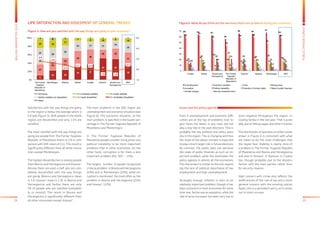
Even if unemployment and economic diffi-
culties are at the top of problems that re-
gion faces the latter, in any case, did not
play a key role in the past elections. This is
probably the key political and policy para-
dox in the region. This is changing and thus
the state of the labour market is expected
to play a much larger role in future elections.
By contrast, the public does not perceive
the state of public finances as such an im-
portant problem, while this dominates the
policy agenda in almost all the economies.
This disconnect is similar to the one regard-
ing the lack of political importance of low
employment and high unemployment.
Strangely enough, inflation is seen as an
relatively important problem, though it has
been contained in most economies for some
time now. Serbia was an exception, while the
rate of price increases has been very low or
even negative throughout the region, in-
cluding Serbia in the last year. That is prob-
ably due to falling wages and other incomes.
The distribution of opinions on other issues
shown in Figure 6 is consistent with what
are taken to be the main challenges that
the region face. Stability is clearly more of
a problem in The Former Yugoslav Republic
of Macedonia and Bosnia and Herzegovina,
and also in Kosovo*. It features in Croatia
too, though probably due to the dissatis-
faction with the main parties rather than
for security reasons.
High concern with crime also reflects the
inefficiencies of the rule of law and a more
general concern with the existing justice.
Again, this is a persistent worry, as it comes
out in most surveys.
Issues and the policy agenda
LIFE SATISFACTION AND ASSESMENT OF GENERAL TRENDS
Satisfaction with the way things are going
in the region is below the average which is
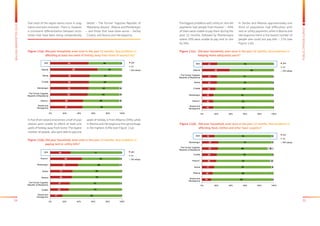
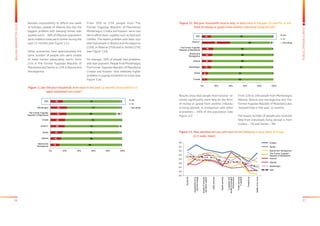
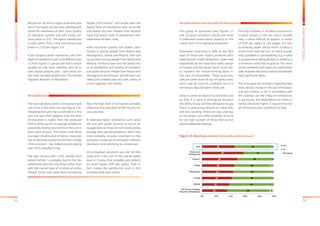
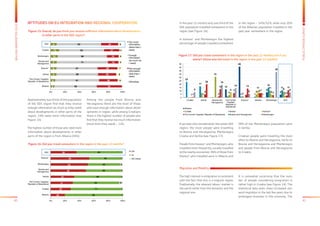
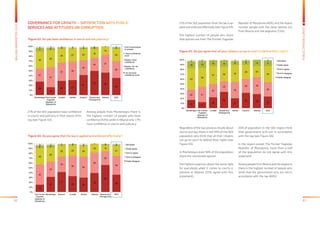
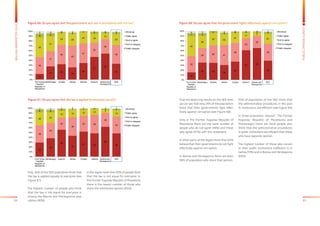
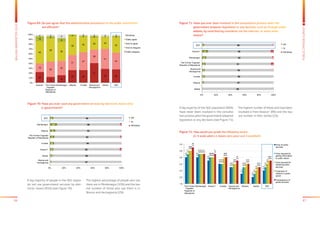
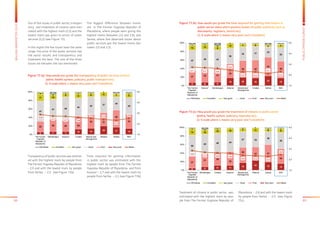
3.0 (see Figure 5). 66% people in the whole
region are dissatisfied and only 11% are
satisfied.
The most satisfied with the way things are
going are people from The Former Yugoslav
Republic of Macedonia (mean is 2.8 in com-
parison with SEE mean of 2,1). This result is
significantly different from all other econo-
mies except Montenegro.
The highest dissatisfaction is among people
from Bosnia and Herzegovina and Kosovo*.
Among them are even a half who are com-
pletely dissatisfied with the way things
are going (Bosnia and Herzegovina mean
is 1.8, Kosovo* mean is 1.9). In Bosnia and
Herzegovina and Serbia there are only
7% of people who are satisfied (complete-
ly or mostly). The result in Bosnia and
Herzegovina is significantly different from
all other economies except Kosovo*.
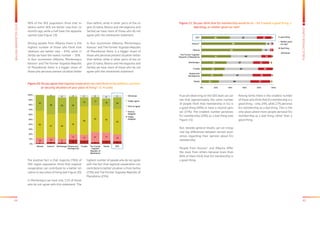
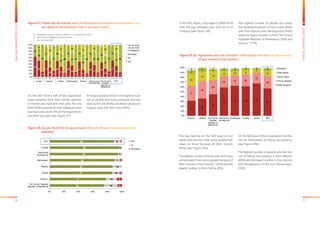
The main problems in the SEE region are
unemployment and economic situation (see
Figure 6). The economic situation, as the
main problem, is specified in the lowest per-
centage in The Former Yugoslav Republic of
Macedonia and Montenegro.
In The Former Yugoslav Republic of
Macedonia people consider rising prices and
political instability to be more important
problems than in other economies. On the
other hand, corruption is for them a less
important problem (6%, SEE – 15%).
The largest number of people recognized
crime as problem in Bosnia and Herzegovina
(24%) and in Montenegro (23%), while cor-
ruption is mentioned the most often as the
problem in Bosnia and Herzegovina (22%)
and Kosovo* (22%).
Figure 5: How are you satisfied with the way things are going in your economy?
11
23 24
34 37
52 50
35
27
24
29
35
36
20 25
31
37
29
28
23 17 17
18
23
23 19
17
7 9 10 6 10
3 4
2 1 1 12 1
2.8
2.6
2.4
2.1 2.0
1.9 1.8
2.1
1.0
2.0
3.0
4.0
5.0
0%
20%
40%
60%
80%
100%
The Former
Yugoslav
Republic of
Macedonia
Montenegro Albania Serbia Croatia Kosovo* Bosnia and
Herzegovina
SEE
DK/refuse I’m completely satisfied I’m mostly satisfied
Neither satisfied nor dissatisfied I’m mostly dissatisfied I’m completely dissatisfied
Mean
30 31
BALKANBAROMETER2015
PUBLICOPINIONSURVEY
Figure 8: How are you satisfied with the general economic situation?
Figure 9: What are your expectations for the next year? Do you think that in 12 months
	 your financial situation will be:
33
14
27 28 39
55
47
56
41
33
38
41
23 37
28
36
37
25
25
16
13
12 12
17
14 12
8
3
7
4 3 51 2 1 11 2 1
2.5
2.3
2.2
1.8
1.7 1.7
1.6
1.9
1.0
2.0
3.0
4.0
5.0
0%
20%
40%
60%
80%
100%
The Former
Yugoslav
Republic of
Macedonia
Montenegro Albania Serbia Kosovo* Croatia Bosnia and
Herzegovina
SEE
DK/refuse
I’m completely satisfied
I’m mostly satisfied
Neither satisfied nor dissatisfied I’m mostly unsatisfied
I’m completely dissatisfied
Mean
49
46
44
49
43
38
36
45
37
36
36
28
24
26
10
32
13
14
17
18
31
37
53
20
2
5
3
4
2
1
3
0% 20% 40% 60% 80% 100%
Croatia
Serbia
Bosnia and
Herzegovina
The Former Yugoslav
Republic of Macedonia
Montenegro
Albania
Kosovo*
SEE better
the same
worse
DK/refuse
more satisfied with their economic situa-
tion than other people in the region except
Montenegro.
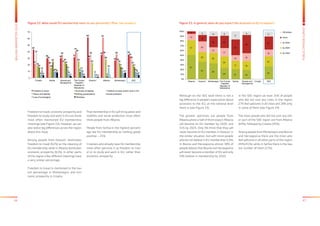
If we compare expectations for the own fi-
nancial situation and expectations for the
national economy, we can see that great-
er optimism is present when it comes to
their own finances. Namely, approximately
the same percent of the SEE population
expect better situation for their financial
situation (20%) and for the national econo-
my (18%), but a larger number expect worse
situation when it comes to national econo-
my (46%) than to own finances (32%). The
highest difference between these two issues
Figure 7: How are you satisfied with the financial situation of your household?
Finally, the concern with corruption is also
not unexpected given what is known about
it from various reports and other sources.
How much of a policy force it is depends
on whether bad economic performance is
connected with it. In prolonged recessions
or stagnations, blaming corruption for bad
welfare deterioration is almost inevitable.
If we take into consideration a scale from 1
to 5, which respondents used to estimate
satisfaction with their financial situation and
observed results for the whole region (2,6),
we can conclude that satisfaction is below
the average (3.0). On the region level the
most people are dissatisfied (46%). Almost
one third of them are neither satisfied nor
dissatisfied and only 23% are satisfied (see
Figure 7).
In general, people in the SEE region are
more satisfied with the financial situation
of their households (SEE mean is 2,6) than
with the way things are going in their plac-
es of living (SEE mean is 2,1). People from
Serbia have significantly lower satisfaction
with financial situation in their households
in comparison with the rest of the region
(52% people are dissatisfied).
The less dissatisfied with financial situ-
ation in their household are people from
The Former Yugoslav Republic of Macedonia
(they are significantly more satisfied than
people in Croatia, Serbia, Bosnia and
Herzegovina and Albania).
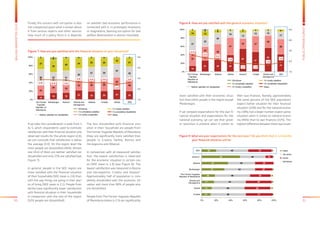
In comparison with all measured satisfac-
tion, the lowest satisfaction is observed
for the economic situation in certain cas-
es (SEE mean is 1.9) (see Figure 8). The
lowest satisfaction was measured in Bosnia
and Herzegovina, Croatia and Kosovo*.
Approximately half of population is com-
pletely dissatisfied with the economic sit-
uation and more than 80% of people who
are dissatisfied.
People from The Former Yugoslav Republic
of Macedonia (mean is 2.5) are significantly
10
16 16
22 19 20 24 20
23
24 19
22 30 29
28
26
38 23 31
28
27 28
32
30
27
30
30
24 22 20
15
21
2
6 3 3 2 3 1 21
2.9 2.9 2.8
2.6 2.6 2.6
2.4
2.6
1.0
2.0
3.0
4.0
5.0
0%
20%
40%
60%
80%
100%
The Former
Yugoslav
Republic of
Macedonia
Montenegro Kosovo* Bosnia and
Herzegovina
Albania Croatia Serbia SEE
DK/refuse
I’m completely satisfied
I’m mostly satisfied
Neither satisfied nor dissatisfied I’m mostly unsatisfied
I’m completely dissatisfied
Mean
32 33
BALKANBAROMETER2015
PUBLICOPINIONSURVEY
Figure 11: Did your household face the following problems (even at least once) during
	 the past 12 months? (Results for SEE)
18
21
21
28
53
79
78
78
71
45
3
1
1
1
2
0% 20% 40% 60% 80% 100%
Unable to pay instalment
on a loan
Unable to keep home
adequately warm
Unable to afford food, clothes
and other basic supplies
Unable to pay rent or utility
bills
Unable to afford at least one
week of holiday away from
home (if wanted to)
yes
no
DK/ refuse
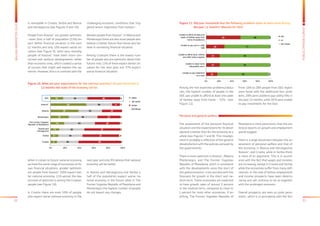
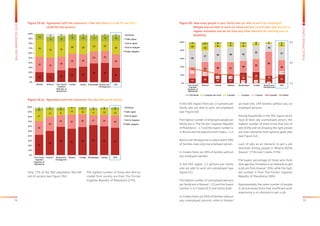
Among the five examined problems/obsta-
cles, the highest number of people in the
SEE was unable to afford at least one week
of holiday away from home – 53%. (see
Figure 11).
From 18% to 28% people from SEE region
were faced with the additional four prob-
lems: 28% were unable to pay utility bills in
the past 12 months, while 18 % were unable
to pay instalments for the loan.
The assessment of the personal financial
situation and the expectations for its devel-
opment is better than for the economy as a
whole (see Figures 7 and 8). This misalign-
ment is probably a reflection of the general
dissatisfaction with the policies pursued by
the governments.
There is more optimism in Kosovo*, Albania,
Montenegro, and The Former Yugoslav
Republic of Macedonia, which is consistent
with the developments since the start of
the global economic crisis and also with the
forecasts for growth in the short and me-
dium term. These economies are expected
to have growth rates of around 3 percent
in the medium term, compared to close to
1 percent for most other economies. If an-
ything, The Former Yugoslav Republic of
Macedonia is more pessimistic than the sta-
tistical reports on growth and employment
would suggest.
There is a large disconnect between the as-
sessment of personal welfare and that of
the economy in Bosnia and Herzegovina,
Kosovo*, and Croatia, while in Serbia there
is more of an alignment. This is in accord-
ance with the fact that wages and incomes
are increasing, except in Croatia and Serbia,
while the economies suffer from many defi-
ciencies. In the case of Serbia, employment
and income prospects have been deterio-
rating and will continue to do so together
with the prolonged recession.
Overall prospects are seen as quite pessi-
mistic, which is in accordance with the fact
Personal and general welfare
is noticeable in Croatia, Serbia and Bosnia
and Herzegovina (see Figures 9 and 10).
People from Kosovo* are greater optimists
- more than a half of population (53%) ex-
pect better financial situation in the next
12 months and only 10% expect worse sit-
uation (see Figure 9). Until very recently,
people of Kosovo* have been more con-
cerned with political developments rather
than economic ones, which created a sense
of success that might well explain this op-
timism. However, this is in contrast with the
challenging economic conditions that trig-
gered recent migrations from Kosovo*.
Besides people from Kosovo*, in Albania and
Montenegro there are also more people who
believe in better future than those who be-
lieve in worsening financial situation.
Among Croatians there is the lowest num-
ber of people who are optimistic about their
future: only 13% of them expect better sit-
uation for the next year, but 37% expect
worse financial situation.
When it comes to future national economy,
we have the same range of economies as for
own financial situations: greater optimists
are people from Kosovo* (50% expect bet-
ter national economy, 11% worse), the low-
est level of optimism is among the Croatian
people (see Figure 10).
In Croatia there are even 59% of people
who expect worse national economy in the
next year and only 9% believe that national
economy will be better.
In Bosnia and Herzegovina and Serbia a
half of the population expect worse na-
tional economy in the future while in The
Former Yugoslav Republic of Macedonia and
Montenegro the highest number of people
do not expect any changes.
Figure 10. What are your expectations for the national economy? Do you think that in
	 12 months the state of the economy will be:
0% 20% 40% 60% 80% 100%
Croatia
Serbia
Bosnia and
Herzegovina
The Former Yugoslav
Republic of Macedonia
Montenegro
Albania
Kosovo*
SEE better
the same
worse
DK/refuse
9
11
13
19
25
39
50
18
30
34
35
43
40
33
36
34
59
51
51
35
32
28
11
46
2
4
2
3
2
3
3
34 35
BALKANBAROMETER2015
PUBLICOPINIONSURVEY
Figure 11(c): . Did your household, even once in the past 12 months, face problems in 	
	 keeping home adequately warm?
0% 20% 40% 60% 80% 100%
Croatia
Serbia
Bosnia and
Herzegovina
The Former Yugoslav
Republic of Macedonia
Montenegro
Albania
Kosovo*
SEE yes
no
DK/ refuse
15
16
16
19
21
21
38
21
84
83
81
81
78
77
62
78
1
1
3
1
2
2
1
The biggest problems with utility or rent bill
payments had people from Kosovo* - 44%
of them were unable to pay them during the
past 12 months, followed by Montenegro
where 39% were unable to pay rent or util-
ity bills.
In Serbia and Albania approximately one
third of population had difficulties with
rent or utility payments, while in Bosnia and
Herzegovina there is the lowest number of
people who could not pay bills – 17% (see
Figure 11b).
Figure 11(d): . Did your household, even once in the past 12 months, face problems in 	
	 affording food, clothes and other basic supplies?
0% 20% 40% 60% 80% 100%
Croatia
Serbia
Bosnia and
Herzegovina
The Former Yugoslav
Republic of Macedonia
Montenegro
Albania
Kosovo*
SEE
yes
no
DK/ refuse
13
15
17
20
20
22
23
18
85
85
79
75
78
69
74
79
2
4
5
2
9
3
3
Figure 11(a): Did your household, even once in the past 12 months, face problems in 	
	 affording at least one week of holiday away from home (if wanted to)?
Figure 11(b): Did your household, even once in the past 12 months, face problems in 	
	 paying rent or utility bills?
0% 20% 40% 60% 80% 100%
Croatia
Serbia
Bosnia and
Herzegovina
The Former Yugoslav
Republic of Macedonia
Montenegro
Albania
Kosovo*
SEE
45
46
52
53
54
55
66
53
54
50
44
43
45
44
34
45
1
4
4
4
1
1
2 yes
no
DK/ refuse
0% 20% 40% 60% 80% 100%
Croatia
Serbia
Bosnia and
Herzegovina
The Former Yugoslav
Republic of Macedonia
Montenegro
Albania
Kosovo*
SEE yes
no
DK/ refuse
17
26
27
30
31
39
44
28
82
74
70
70
68
58
53
71
1
3
1
3
3
1
In five (from seven) economies a half of pop-
ulation were unable to afford at least one
week of holiday away from home. The lowest
number of people who were able to pay one
week of holiday is from Albania (34%), while
in Bosnia and Herzegovina this percentage
is the highest (54%) (see Figure 11a).
that most of the region seems stuck in stag-
nation and even recession. There is, however,
a consistent differentiation between econ-
omies that have been doing comparatively
better – The Former Yugoslav Republic of
Macedonia, Kosovo*, Albania, and Montenegro
– and those that have done worse – Serbia,
Croatia, and Bosnia and Herzegovina.
36 37
BALKANBAROMETER2015
PUBLICOPINIONSURVEY
Figure 12: Did your household receive help, at least once in the past 12 months, in the
	 form of money or goods from another individual living abroad?
Figure 13: How satisfied are you with each of the following in your place of living:
	 (1-5 scale; mean)
0% 20% 40% 60% 80% 100%
Croatia
Serbia
Bosnia and
Herzegovina
The Former Yugoslav
Republic of Macedonia
Montenegro
Albania
Kosovo*
SEE
yes
no
DK/ refuse
7
8
13
14
14
16
39
13
93
91
85
86
85
82
55
87
1
2
1
2
5
1
Sociallife
Cleanlinessofmy
city/town/village
Qualityofschools/
educationsystem
Utilityservices
Healthservices
Ingeneralwith
qualityoftransport
infrastructure
Publicservices
ingeneral
Presentjob
Safetyfromcrime
Croatia
Serbia
Bosnia and Herzegovina
The Former Yugoslav
Republic of Macedonia
Kosovo*
Albania
Montenegro
SEE
2.9 2.9 2.9 2.9
2.7 2.7 2.7
2.5 2.5
2.0
2.2
2.4
2.6
2.8
3.0
3.2
3.4
3.6
Results show that people from Kosovo* re-
ceived significantly more help (in the form
of money or goods from another individu-
al living abroad) in comparison with other
economies – 39% of the population (see
Figure 12).
From 13% to 16% people from Montenegro,
Albania, Bosnia and Herzegovina and The
Former Yugoslav Republic of Macedonia also
received help in the past 12 months.
The lowest number of people who received
help from individuals living abroad is from
Croatia – 7% and Serbia – 8%.
Figure 11 (e): Did your household, even once in the past 12 months, face problems in 	
	 payin instalment on a loan?
0% 20% 40% 60% 80% 100%
Croatia
Serbia
Bosnia and
Herzegovina
The Former Yugoslav
Republic of Macedonia
Montenegro
Albania
Kosovo*
SEE
yes
no
DK/ refuse
13
15
17
20
20
22
23
18
85
85
79
75
78
69
74
79
2
4
5
2
9
3
3
Besides impossibility to afford one week
of holidays, people of Albania also has the
biggest problem with keeping homes ade-
quately warm - 38% of Albanian population
were unable to have warm homes during the
past 12 months (see Figure 11c).
Other economies have approximately the
same number of people who were unable
to keep homes adequately warm: from
21% in The Former Yugoslav Republic of
Macedonia and Serbia to 15% in Bosnia and
Herzegovina.
From 20% to 23% people from The
Former Yugoslav Republic of Macedonia,
Montenegro, Croatia and Kosovo* were una-
ble to afford basic supplies such as food and
clothes. The lowest problem with basic sup-
plies had people in Bosnia and Herzegovina
(13%), in Albania (15%) and in Serbia (17%)
(see Figure 11d).
On average, 18% of people had problems
with loan payment. People from Montenegro,
The Former Yugoslav Republic of Macedonia,
Croatia and Kosovo* face relatively higher
problems in paying instalment on a loan (see
Figure 11e).
38 39
BALKANBAROMETER2015
PUBLICOPINIONSURVEY
Personal welfare and the state of the economy
Figure 14: Would you consider living and working abroad?
0% 20% 40% 60% 80% 100%
Croatia
Serbia
Bosnia and
Herzegovina
The Former Yugoslav
Republic of Macedonia
Montenegro
Albania
Kosovo*
SEE
yes
no
DK/ refuse
35
38
42
43
45
49
58
45
59
62
56
53
50
50
41
52
6
2
3
5
2
2
3
This group of questions (see Figures 11
and 12) gives consistent results with what
is otherwise known about poverty in the
region and in the individual economies.
Somewhat surprising is 18% at the SEE
level of those who report problems with
meeting their credit obligations, given that
households do not have much debt, except
in Croatia, and the banks report much low-
er numbers for nonperforming loans in
the case of households. There could pos-
sibly be some share of out-of-banks loans
which may be more of a problem, but it is
not known how prevalent those are.
When it comes to electricity and other util-
ity bills, it is hard to distinguish between
the ability to pay and the willingness to pay.
There is widespread default on these bills
and also stealing. There are also shortag-
es and power cuts, which probably account
for the high number of those that cannot
ensure adequate heating.
The high numbers in all these questions in
Croatia, except in the one about outside
help, is more difficult to explain. In terms
of GDP per capita or net wages, and also
purchasing power parity terms, Croatia is
much richer than the rest. So, there is prob-
ably a problem in comparability, e.g. in what
is considered an adequate diet or clothing or
a minimum utility fee in general. The more
severe problems with loans are understand-
able, however, because Croatian households
hold significant debts.
The somewhat low numbers regarding help
from abroad, except in the case of Kosovo*,
and also Croatia, is not in accordance with
the statistics on the inflow of remittances.
In particular, the dependence on them in
Serbia should be higher. It may be that not
all remittances are considered as help.
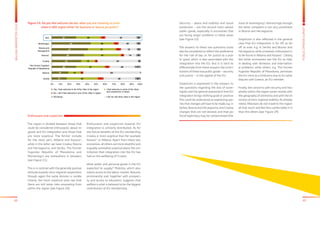
Results for the entire region show that peo-
ple in this region are the most satisfied with
social life, cleanliness of their cities, quality
of education system and with utility ser-
vices (mean is 2.9). The lowest satisfaction
is with safety from crime and present job
(mean is 2.5) (see Figure 13).
If we compare seven economies and their
levels of satisfaction with nine different top-
ics from Figure 13, we can see that Croatian
people are the most satisfied with all is-
sues except present jobs – with which are
the most satisfied people from The Former
Yugoslav Republic of Macedonia.
People from Kosovo* and Serbia have the
lowest level of satisfaction with social life
and health services. People from Albania
have the lowest level of satisfaction with
cleanliness of their cities.
With education system the lowest satis-
faction is among people from Bosnia and
Herzegovina, Serbia and Albania, with util-
ity services among people from Serbia and
Albania. Serbians have also the lowest lev-
el of satisfaction with quality of transport
and public services. People from Bosnia and
Herzegovina and Kosovo* are the least sat-
isfied with present jobs and with safety of
crime, together with Serbia.
The least satisfying factor is the present job,
and crime is the main risk (see Figure 13).
Dissatisfaction with the current job is in line
with the data that suggests that the level
of education is higher than the produced
GDP. In other words, on average, people are
potentially more productive than they are in
their place of work. This means that there
is a major misallocation of labour resources
due to declining production and the change
of its structure – low skilled services taking
over from manufacturing.
The high concern with crime, already men-
tioned before, is probably due to the dis-
satisfaction with the rule of law rather than
with the overall level of criminal activities,
though those may have been increasing.
Also, the high level of corruption probably
influences the evaluation of the risk of crim-
inal activities.
A relatively higher satisfaction with social
life and with public services is not to be
exaggerated as those are still mostly below
average. Also, job dissatisfaction, which also,
most probably, includes treatment on the
workplace, makes social and public relations
relatively more satisfying by comparison.
Intra-regional variations are not terribly
large, and in the case of the overall higher
level in Croatia, that probably just reflects
its much higher GDP per capita. That, in
fact, makes the satisfaction level in this
economy look even worse.
No satisfaction
40 41
BALKANBAROMETER2015
PUBLICOPINIONSURVEY
Figure 17: Did you travel somewhere in the region in the past 12 months and if yes,
	 where? (those who did travel in the region in the past 12 months)
12
46
8
4
23
17
1 1
15
11
31
4 2
5
11 9
1
8
11
4
2
1
5
2
6
3 3
1
20
12
7
13
7
11
8
19
14
5
1
38
8
0
5
10
15
20
25
30
35
40
45
50
Croatia Serbia Bosnia and
Herzegovina
The Former
Yugoslav
Republic of
Macedonia
Kosovo* Albania Montenegro SEE
Albania
Bosnia and Herzegovina
Croatia Kosovo*
The Former Yugoslav Republic of Macedonia Montenegro
Serbia
In the past 12 months only one third of the
SEE population travelled somewhere in the
region (see Figure 16).
In Kosovo* and Montenegro the highest
percentage of people travelled somewhere
in the region – 54%/52%, while only 20%
of the Albanian population travelled in the
past year somewhere in the region.
If we take into consideration the whole SEE
region, the most people were travelling
to Bosnia and Herzegovina, Montenegro,
Croatia and Serbia (see Figure 17).
People from Kosovo* and Montenegro, who
travelled most frequently, usually travelled
to the nearby economies: 46% of those from
Kosovo* who travelled were in Albania and
38% of the Montenegro population were
in Serbia.
Croatian people were travelling the most
often to Bosnia and Herzegovina, Serbs to
Bosnia and Herzegovina and Montenegro
and people from Bosnia and Herzegovina
to Croatia.
The high interest in emigration is consistent
with the fact that this is a migrant region.
Traditionally, the relevant labour market is
the world rather than the domestic and the
regional one.
It is somewhat surprising that the num-
ber of people considering emigration is
rather high in Croatia (see Figure 14). The
statistical data does show increased out-
ward migration in the last few years due to
prolonged recession in this economy. The
Migration and Mobility
Figure 15: Overall, do you think you receive sufficient information about developments
	 in other parts in the SEE region?
0% 20% 40% 60% 80% 100%
Croatia
Serbia
Bosnia and
Herzegovina
The Former Yugoslav
Republic of Macedonia
Montenegro
Albania
Kosovo*
SEE
6
6
8
8
9
10
12
9
59
61
58
57
71
68
63
62
34
26
25
28
15
16
21
24
1
6
8
7
5
5
4
6
Too much
information
(More than I
need)
Enough
information
(as much as
I need)
Not enough
information
(less than I
need)
DK/refuse
Approximately two thirds of the population
of the SEE region find that they receive
enough information (as much as they need)
about developments in other parts of the
region. 24% need more information (see
Figure 15).
The highest number of those who need more
information about developments in other
parts of the region is from Albania (34%).
Among the people from Bosnia and
Herzegovina there are the most of those
who have enough information about devel-
opments in region, while among Croatians
there is the highest number of people who
find that they receive too much information
(more than they need) – 12%.
ATTITUDES ON EU INTEGRATION AND REGIONAL COOPERATION
Figure 16: Did you travel somewhere in the region in the past 12 months?
0% 20% 40% 60% 80% 100%
Croatia
Serbia
Bosnia and
Herzegovina
The Former Yugoslav
Republic of Macedonia
Montenegro
Albania
Kosovo*
SEE
yes
no
DK/ refuse
20
28
31
33
49
52
54
36
80
71
64
65
50
45
45
63
0
1
5
2
1
3
1
1
42 43
BALKANBAROMETER2015
PUBLICOPINIONSURVEY
Figure 19: Do you agree that the relations in SEE are better than 12 months ago?
	 (1-4 scale)
6
12 10
6
16
24
17 15
29
26 27 37
35
32
40
35
57
47 46
43
35
31 28
36
8
7 6
6 2 5
2
4
9 10 8 11 8
13 10
0%
10%
20%
30%
40%
50%
60%
70%
80%
90%
100%
Albania Montenegro Kosovo* The Former
Yugoslav
Republic of
Macedonia
Croatia Bosnia and
Herzegovina
Serbia SEE
DK/refuse
Totally agree
Tend to agree
Tend to
disagree
Totally
disagree
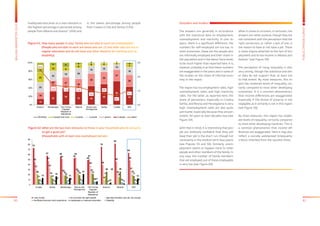
The dissatisfaction with the economy is
more or less the same across the region,
even if some economies have been doing
better than the others (the former in-
clude The Former Yugoslav Republic of
Macedonia, Albania and Kosovo*, while in
the latter we find Croatia, Serbia and Bosnia
and Herzegovina; Montenegro is a bit in
between).
Political disputes are still important through-
out the region, and then there is organ-
ised crime, probably cross-border to a not
small extent. Possibly because political dis-
putes cover also the internal borders issue,
problems with the border are mostly im-
portant in Albania where probably refer to
Greece, not to others in the region.
Problems with minorities feature more in
The Former Yugoslav Republic of Macedonia
than in other parts of the region probably
because of the understanding regarding
which ethnic group is to be considered a
minority. Minorities themselves consider
that they have problems with the majorities,
which is possibly subsumed under political
disputes (see Figure 18).
Economy and animosity
comes to border issues (12%) and between
The Former Yugoslav Republic of Macedonia
and others when it comes to problems with
minorities (11%).
People from Montenegro and Bosnia and
Herzegovina perceive organized crime as
more important problem in the region than
others do.
For the highest number of people (40%)
economic issues are the most important
problem in the SEE region. The second most
important problem are political disputes
(see Figure 18). Economic problems are
seen as more pressing within the national
economy (see Figure 6) than within the re-
gion, but these two sets of answers cannot
be compared directly because they differ.
In addition, the perception of the impor-
tance of economic problems in the regional
setting is influenced by the regional political
problems, which are still seen as substantial.
That is why in the regional setting economic
problems are seen as less pressing, though
they are still the most significant ones, than
in the local setting.
The significant differences are noticeable
between Kosovo* and the rest of the region
when it comes to political disputes (44%),
between Albania and all others when it
leading position of Bosnia and Herzegovina
is not a surprise, while this cannot be said
for the position of The Former Yugoslav
Republic of Macedonia at the bottom of the
list. In general, these numbers are consist-
ent with the economic trends and the tra-
dition of outward migration.
Intra-regional migrations are more a type of
mobility. The flows follow ethnic lines and in-
herited routes, e.g. between Montenegro and
Serbia, and between Bosnia and Herzegovina
and both Croatia and Serbia. Growing mo-
bility between Kosovo* and Albania is to be
expected, but it is new (see Figure 17).
In SEE, Albania is least integrated within
the region. This is visible in the data on mo-
bility and migration, but also in the overall
acquaintance with regional developments.
This will also be apparent from the trade
later on.
Figure 18: What do you think are the most important problems facing the entire SEE
	 region at the moment?
0% 20% 40% 60% 80% 100%
Croatia
Serbia
Bosnia and
Herzegovina
The Former Yugoslav
Republic of Macedonia
Montenegro
Albania
Kosovo*
SEE
36
34
39
40
42
42
44
40
44
19
24
29
32
24
10
26
6
7
8
9
4
15
17
9
3
3
5
2
12
2
3
4
5
6
4
5
4
5
4
1
11
4
3
6
1
3
4
1
8
3
2
2
7
3
3
6
5
2
2
2
3
3
1
4
4
4
2
Economic issues
Political disputes
Organized crime
Border issues
Brain drain/
emigration
Problems with
minorities
Climate change
(floods, droughts,
etc.)
Security/terrorism
issues
Other
44 45
BALKANBAROMETER2015
PUBLICOPINIONSURVEY
Figure 21: Do you think that EU membership would be (is – for Croatia) a good thing, a
	 bad thing, or neither good nor bad?
0% 20% 40% 60% 80% 100%
Croatia
Serbia
Bosnia and
Herzegovina
The Former Yugoslav
Republic of Macedonia
Montenegro
Albania
Kosovo*
SEE good thing
Neither good
nor bad
Bad thing
DK/refuse
24
30
32
35
41
84
89
40
44
41
47
37
42
11
8
37
27
26
20
23
15
4
2
20
5
3
1
6
2
1
3
If we are observing on the SEE level, we can
see that approximately the same number
of people think that membership in EU is
a good thing (40%) or have a neutral opin-
ion (37%). The smallest number perceives
EU membership (20%) as a bad thing (see
Figure 21).
But, besides general results, we can recog-
nize big differences between certain econ-
omies regarding their opinion about EU
membership.
People from Kosovo* and Albania differ
the most from others because more than
80% of them think that EU membership is
a good thing.
Among Serbs there is the smallest number
of those who think that EU membership is a
good thing – only 24%, while 27% perceive
EU membership as a bad thing. This is the
only place where more people perceive EU
membership as a bad thing rather than a
good thing.
The positive fact is that majority (76%) of
SEE region population think that regional
cooperation can contribute to a better sit-
uation in own place of living (see Figure 20).
In Montenegro we have only 11% of those
who do not agree with this statement. The
highest number of people who do not agree
with the fact that regional cooperation can
contribute to better situation is from Serbia
(23%) and The Former Yugoslav Republic of
Macedonia (25%).
40% of the SEE population think that re-
lations within SEE are better now than 12
months ago, while a half have the opposite
opinion (see Figure 19).
Among people from Albania there is the
highest number of those who think that
relations are better now – 65%, while in
Serbia we have the lowest number – 30%.
In four economies (Albania, Montenegro,
Kosovo* and The Former Yugoslav Republic
of Macedonia) there is a bigger share of
those who perceive present situation better
than before, while in other parts of the re-
gion (Croatia, Bosnia and Herzegovina and
Serbia) we have more of those who do not
agree with the mentioned statement.
In four economies (Albania, Montenegro,
Kosovo* and The Former Yugoslav Republic
of Macedonia) there is a bigger share of
those who perceive present situation better
than before, while in other parts of the re-
gion (Croatia, Bosnia and Herzegovina and
Serbia) we have more of those who do not
agree with the mentioned statement.
Figure 20: Do you agree that regional cooperation can contribute to the political, economic
	 or security situation of your place of living? (1-4 scale)
DK/refuse
Totally agree
Tend to agree
Tend to
disagree
Totally
disagree
10 10 8
11 12 21 17
14
2 3 3
8 7 4 6 6
55
47 52
42
58
54 53
52
33
38 32 35
19 17
16 24
2
6 4 5 5 8 5
0%
10%
20%
30%
40%
50%
60%
70%
80%
90%
100%
Albania Kosovo* Montenegro Bosnia and
Herzegovina
Croatia The Former
Yugoslav
Republic of
Macedonia
Serbia SEE
46 47
BALKANBAROMETER2015
PUBLICOPINIONSURVEY
Figure 23: In general, when do you expect the accession to EU to happen?
0%
10%
20%
30%
40%
50%
60%
70%
80%
90%
100%
Albania Kosovo* Montenegro Bosnia and
Herzegovina
CroatiaThe Former
Yugoslav
Republic of
Macedonia
Serbia SEE
51
37 33
24 21 19
27
31
20
22
24
17 19
21
13
23
12
17
12 16
14
5
13
23 25
33
38
27
8 10 9
17
8 11
DK/refuse
never
by 2030
by 2025
by 2020
Although on the SEE level there is not a
big difference in people’s expectation about
accession to the EU, at the national level
there is (see Figure 23).
The greater optimists are people from
Albania where a half of them expect Albania
will become an EU member by 2020, and
31% by 2025. Only 5% think that they will
never become an EU member. In Kosovo* is
the similar situation, but with more people
who do not believe in EU membership (13%).
In Bosnia and Herzegovina almost 38% of
people believe that Bosnia and Herzegovina
will never become a member of EU and only
19% believe in membership by 2020.
In the SEE region we have 35% of people
who did not visit any cities in the region,
27% feel welcome in all cities and 28% only
in some of them (see Figure 24).
The most people who did not visit any oth-
er part of the SEE region are from Albania
(64%), followed by Croatia (45%).
Among people from Montenegro and Bosnia
and Herzegovina there are the most who
feel welcome in all other parts of the region
(44%/41%), while in Serbia there is the low-
est number of them (17%).
Freedom to travel, economic prosperity and
freedom to study and work in EU are three
most often mentioned EU membership
meanings (see Figure 22). However, we can
also notice big differences across the region
about this issue.
Among people from Kosovo* dominates
freedom to travel (62%) as the meaning of
EU membership, while in Albania dominates
economic prosperity (61%). In other parts
of the region a few different meanings have
a very similar percentage.
Freedom to travel is mentioned in the low-
est percentage in Montenegro, and eco-
nomic prosperity in Croatia.
That membership in EU will bring peace and
stability and social protection most often
think people from Albania.
People from Serbia in the highest percent-
age see EU membership as nothing good/
positive – 25%.
Croatians who already have EU membership
most often perceive it as freedom to trav-
el or to study and work in EU, rather than
economic prosperity.
Figure 22: What would EU membership mean to you personally? (Max. two answers)
43
30 30 31
62
35
26
35
21
29
35
41
30
61
36
33
37
20
23
39
36 36
23
29
19
15
24 25
23
28
23
21
16
25
21
9
3
17 17
4
9
13 12
6
15
12
10
12
10
6
8
2 1
7 8
4
8
3 2 2
8
5
0
10
20
30
40
50
60
70
Croatia Serbia Bosnia and
Herzegovina
The Former
Yugoslav
Republic of
Macedonia
Kosovo* Albania Montenegro SEE
Freedom to travel Economic prosperity Freedom to study and/or work in EU
Peace and stability Nothing good/positive Social protection
Loss of sovereignty DK/refuse
48 49
BALKANBAROMETER2015
PUBLICOPINIONSURVEY
Security – peace and stability and social
protection – are the second most valued
public goods, especially in economies that
are facing larger problems in these areas
(see Figure 22).
The answers to these two questions could
also be considered to reflect the preference
for the rule of law, i.e. for justice as a pub-
lic good, which is also associated with the
integration into the EU. But it is hard to
differentiate from these answers the contri-
butions of these two public goods – security
and justice – in the appeal of the EU.
Scepticism is expressed in the answers to
the questions regarding the loss of sover-
eignty and the general assessment that EU
integration brings nothing good or positive.
This could be understood as expressing wor-
ries that changes will have to be made, e.g. in
Serbia, Bosnia and Herzegovina, and Croatia,
changes that are not desired, and that po-
litical legitimacy may be compromised (the
issue of sovereignty). Interestingly enough,
the latter complaint is not very prominent
in Bosnia and Herzegovina.
Scepticism is also reflected in the general
view that EU integration is far off, as far
off as ever, e.g. in Serbia and Bosnia and
Herzegovina, while unrealistic enthusiasm is
to be found in Albania and Kosovo*. Clearly,
the latter economies see the EU as help
in dealing with domestic and internation-
al problems, while others, e.g. The Former
Yugoslav Republic of Macedonia, perceives
the EU more as a hindrance due to its name
dispute with Greece, an EU member.
Finally, the concerns with security and hos-
pitality within the region varies mostly with
the geography of animosity and with the di-
rection of intra-regional mobility. As already
noted, Albanians do not travel to the region
all that much and feel less comfortable in it
than the others (see Figure 24).
Figure 24: Do you feel welcome abroad, when you are traveling to other
	 cities in SEE region either for business or leisure purposes?
17
19
28
33
36
41
44
27
34
14
32
15
41
31
26
28
7
3
6
3
4
6
6
5
35
64
28
45
14
18
20
35
6
1
7
3
5
4
5
5
0% 10% 20% 30% 40% 50% 60% 70% 80% 90% 100%
Serbia
Albania
The Former Yugoslav
Republic of Macedonia
Croatia
Kosovo*
Bosnia and
Herzegovina
Montenegro
SEE
Yes, I feel welcome in all of the cities in the region I feel welcome in some of the cities,
and unwelcome in others
No, I don’t feel welcome in any of the cities in region
I did not visit other cities in the regionDK/refuse
The region is divided between those that
could be considered enthusiastic about re-
gional and EU integration and those that
are more sceptical. The former include,
for the most part, Albania and Kosovo*,
while in the latter we have Croatia, Bosnia
and Herzegovina, and Serbia; The Former
Yugoslav Republic of Macedonia and
Montenegro are somewhere in between
(see Figure 21).
This is in contrast with the generally positive
attitude towards intra-regional cooperation,
though again the same division is visible.
Clearly, the more sceptical ones see that
there are still some risks emanating from
within the region (see Figure 20).
Enthusiasm and scepticism towards EU
in­tegration is similarly distributed. As for
the future benefits of the EU membership,
Croatia is more sceptical than for example
Kosovo* or Albania. Apart from these two
economies, all others are more doubtful and
arguably somewhat sceptical about the con-
tribution that integration into the EU has
had on the wellbeing of Croatia.
What public and personal goods is the EU
expected to supply? Mobility, which also
means access to the labour market, features
prominently and, together with prosperi-
ty and access to education, suggests that
welfare is what is believed to be the biggest
contribution of EU membership.
Enthusiasm and scepticism
50 51
BALKANBAROMETER2015
PUBLICOPINIONSURVEY
Figure 27 (a): Products and goods of my economy can compete well with products and
	 goods from other SEE economies (Agreement level; 1-4 scale)
Figure 26: Do you agree that entering of foreign companies in general in your market 	
	 will improve the situation for your consumers? (1-4 scale)
DK/refuse
Totally agree
Tend to agree
Tend to
disagree
Totally
disagree
1 4 5 5 6 3
8 45
4
11 10 11 14
21
8
27
36
48
36
48
39
40
37
66
52
35
46
33
41
29
49
1 3 3 3 4 3 2
0%
10%
20%
30%
40%
50%
60%
70%
80%
90%
100%
Croatia Serbia Albania Bosnia and
Herzegovina
Montenegro The Former
Yugoslav
Republic of
Macedonia
Kosovo* SEE
5 7 6
11 15 13
28
14
16 14
21
23
28
27
24
24
58
45
49
48
43 45
31
44
21
30
19 10
11 8 10 13
3 5 9
4 7 7 5
0%
10%
20%
30%
40%
50%
60%
70%
80%
90%
100%
Albania Kosovo* The Former
Yugoslav
Republic of
Macedonia
Montenegro Croatia Serbia Bosnia and
Herzegovina
SEE
DK/refuse
Totally agree
Tend to agree
Tend to
disagree
Totally
disagree
A big majority (86%) think that their do-
mestic products and goods can compete
well with products from other parts of the
SEE region (see Figure 27a).
The lowest percentage shares the men-
tioned opinion in Kosovo* (69%) while in
Croatia even 93% believe in quality of their
products in comparison with products from
other parts of the region.
Figure 25: How would you describe trade and commerce links with SEE region?
77 77 75
60
55
50 49
61
20
9
19
26
25 30
37
24
3
6
3
7
9 4
7 6
7
3
8 11 15
7 10
0%
10%
20%
30%
40%
50%
60%
70%
80%
90%
100%
Albania Bosnia and
Herzegovina
Kosovo* Montenegro Croatia Serbia The Former
Yugoslav
Republic of
Macedonia
SEE
DK/refuse
They’re already
too strong
Just about
right
Should be
improved
INTEGRATED GROWTH – TRADE AND INVESTMENT INTEGRATION
Approximately two thirds of people in the
SEE region think that their trade and com-
merce links with the region should be im-
proved, 24% think that connection is just
about right and 6% think that links are al-
ready too strong (see Figure 25).
The highest percentage of people who think
that links should be improved are from
Albania (77%), Bosnia and Herzegovina
(77%) and Kosovo*(75%), and the lowest
number of people share this opinion in The
Former Yugoslav Republic of Macedonia
(49%) and Serbia (50%). Among them there
is the highest number of those who perceive
present links as just about right.
More than a half of the SEE population
(57%) agree with the fact that foreign com-
panies will improve the situation in their
own economies, while 38% do not agree
with that statement (see Figure 26).
In Albania (79%) and Kosovo* (75%) there is
the most of those who believe in consumer
prosperity brought by entering of foreign
companies in their economies.
Bosnia and Herzegovina is the only place
where more people do not agree with this
statement (52%) than believe (41%) in pros-
perity with foreign companies.
52 53
BALKANBAROMETER2015
PUBLICOPINIONSURVEY
On the SEE level, 58% people agree with the
fact that their economies have benefited a
lot from free trade, while 25% do not share
their opinion (see Figure 27c).
If we compare seven economies, we can see
that the highest percentage of people who
agree with this statement is from Albania
(78%), followed by Croatia (61%), while
among people from Bosnia and Herzegovina
are the highest number of those who do not
agree with this statement (36%).
On the SEE level we have almost the same
number of people who think that people
from other parts of the region are some-
thing good for their economy (26%), and
those who have a neutral opinion (31%). 40%
think that this idea is bad for their econo-
mies (see Figure 28).
Only in Albania and Kosovo* there are more
of those who think that people from other
parts of the region are something good for
their economies, while in all others domi-
nates opinion that people from other parts
of the region are bad for their economies.
Figure 28: What do you think about people from other parts of the region coming to
	 live and work in your city? Is it good or bad for your economy?
19
24
24
25
29
42
43
26
33
35
35
36
25
24
16
31
44
37
39
36
43
32
40
40
5
5
2
3
4
2
3
0% 20% 40% 60% 80% 100%
Serbia
Bosnia and
Herzegovina
Croatia
Montenegro
The Former Yugoslav
Republic of Macedonia
Kosovo*
Albania
SEE good
Neither good
nor bad
bad
DK/refuse
Figure 27 (b): Products and goods of my economy can compete well with products and
	 goods from the EU (Agreement level; 1-4 scale)
Figure 27 (c): My economy has benefited a lot from free trade (which is carried out in
	 region from 2006 within CEFTA) (Agreement level; 1-4 scale)
DK/refuse
Totally agree
Tend to agree
Tend to
disagree
Totally
disagree
2 6 4
9 9 11 15
7
9
9 16
13
19
24
23
13
30
37
42 35
39
44 39
37
57
45
34 40
29
21
20
41
2 4 4 3 3 3 3
0%
10%
20%
30%
40%
50%
60%
70%
80%
90%
100%
Croatia Serbia The Former
Yugoslav
Republic of
Macedonia
Bosnia and
Herzegovina
Montenegro Albania Kosovo* SEE
When it comes to products and goods from
the EU, somewhat lower percentage of peo-
ple believe in quality of their domestic prod-
ucts (78% on the SEE level) (see Figure 27b).
In Kosovo* 59% think that their products
and goods can compete well with products
from the EU.
In Croatia there is still the highest percent-
age of people (87%) who think that their
goods and products are as good as those
from the EU.
DK/refuse
Totally agree
Tend to agree
Tend to
disagree
Totally
disagree
3 7 8 8 9
3
13
8
17
18 13
20 21
20
23
17
60
39
39
42 36
37
36
40
18
22
17
13 18
16
17
18
1
15
24
17 16
24
11
16
0%
10%
20%
30%
40%
50%
60%
70%
80%
90%
100%
Albania Croatia Serbia Montenegro Kosovo* The Former
Yugoslav
Republic of
Macedonia
Bosnia and
Herzegovina
SEE
54 55
BALKANBAROMETER2015
PUBLICOPINIONSURVEY
Figure 30: When procuring products and services, should your government give priority
	 to local suppliers, or should they be treated the same as foreign suppliers
	 (provided price and quality is equal)?
60
62
64
74
81
85
87
78
35
37
31
20
17
13
11
20
5
4
6
2
2
2
2
0% 20% 40% 60% 80% 100%
The Former Yugoslav
Republic of Macedonia
Albania
Kosovo*
Montenegro
Croatia
Serbia
Bosnia and
Herzegovina
SEE Local suppliers
should be given
priority
Local suppliers
should be
treated the same
as foreign
suppliers in
public
procurement
DK/refuse
The economies that export more to the
region, e.g. Serbia, The Former Yugoslav
Republic of Macedonia and Croatia, seem
to be happier with the current level of trade
integration than the other economies that
rely a lot on imports from the region but
do not export all that much. Albania is most
keen on improved regional trade, which re-
flects the fact that, in terms of trade, it is
hardly present in the region (see Figure 25).
So, exporters seem to be more content with
the current state of affairs and would sup-
port even further improvement, while im-
porters are eager for improvement as they
are not happy with the current state of play
given that they run significant deficits with
the other economies. In the latter category,
Bosnia and Herzegovina and Kosovo* are
the most prominent.
Bosnia and Herzegovina, Serbia, and Croatia
are less welcoming to foreign companies due
to some bad experiences and for specific
protectionist reasons (e.g. keeping strategic
companies and sectors in domestic owner-
ship). These are also economies that have
received more foreign investments than the
others, with the exception of Montenegro,
which depends heavily on foreign invest-
ment and that is reflected in its more be-
nevolent attitude toward foreign companies
(see Figure 26).
Albania and Kosovo* have proved rath-
er slow in creating enterprises, while The
Former Yugoslav Republic of Macedonia has
been following the policy of inviting foreign
investments with growing success (though
overall inflow is still rather small).
Though the competitiveness of all of these
economies is low or quite low, their trade
deficits being quite high and persistent,
their people believe in the quality of the
goods they produce. When it comes to
Good and Services
On the SEE level a big majority (85%) as
their first choice prefer domestic products,
while for the second choice they are divided
between SEE products (40%) and Western
European products (43%) (see Figure 29).
Among people from The Former Yugoslav
Republic of Macedonia and Albania there
is the lowest number of those who choose
domestic products for the first choice
(71%/72%). In Albania 26% choose products
from the Western Europe for the first choice.
When it comes to the second choice, the
difference exist among two groups of the
economies: in Croatia (53%), Albania (59%),
Serbia (46%) and Kosovo* (42%) dominate
products from Western Europe while in
Bosnia and Herzegovina (63%). Montenegro
(60%) and The Former Yugoslav Republic of
Macedonia (51%) dominate products from
SEE economies.
Looking on the SEE level, more than three
fourths have an opinion that government
should give priority to local suppliers and
only 20% think that local suppliers should
be treated the same as a foreign (see Figure
30).
In Bosnia and Herzegovina (87%) and Serbia
(85%) there is the highest percentage of
those who think that local suppliers should
have a priority.
Among people from The Former Yugoslav
Republic of Macedonia, Albania and Kosovo*
there are approximately 60% who favour
priority for local suppliers and 30% who sup-
port the same treatment for both suppliers.
Figure 29: If you have a choice of product from food and beverages from three different
	 sources: domestic product, product from SEE region and product from Western
	 Europe, which one would be your first choice and which would be
	second?
90
7
90
6
88
7
80
11
79
11
72
22
71
15
85
10
2
33
3
63
1
38
7
28
8
60
2
18
13
51
3
40
6
53
6
25
8
46
11
42
10
21 26
59
12
30
10
43
0%
10%
20%
30%
40%
50%
60%
70%
80%
90%
100%
1.choice
2.choice
1.choice
2.choice
1.choice
2.choice
1.choice
2.choice
1.choice
2.choice
1.choice
2.choice
1.choice
2.choice
1.choice
2.choice
Croatia Bosnia and
Herzegovina
Serbia Kosovo* Montenegro Albania The Former
Yugoslav
Republic of
Macedonia
SEE
Products from
Western Europe
Product from
SEE
Domestic
products
56 57
BALKANBAROMETER2015
PUBLICOPINIONSURVEY
SMART GROWTH – PERCEPTIONS OF SKILLS AND EDUCATION
PERFORMANCE
Figure 31: What do you think is most important for getting ahead in life?
21
23
24
25
27
28
30
25
61
14
18
13
22
22
46
23
9
26
25
28
20
20
16
23
5
24
22
16
21
18
4
18
2
7
7
13
7
8
4
7
2
5
3
3
3
3
3
1
1
1
1
1
0% 20% 40% 60% 80% 100%
Working hard
Having a good
education
Knowing the
right people
Being lucky
Belonging to a
wealthy family
Other
DK/refuse
Kosovo*
Serbia
Croatia
The Former Yugoslav
Republic of Macedonia
Montenegro
Bosnia and
Herzegovina
Albania
SEE
The entire population of the SEE region
stated three main factors as the most im-
portant for making progress in life: hard
work, good education and acquaintance
with “the right people” (see Figure 31).
If we analyse all seven economies, we no-
tice the following main differences between
them: people from Kosovo* differ from all
other economies because majority (61%)
considers a good education to be the most
important factor for making progress in life.
A similar opinion was provided by people
from Albania.
Among inhabitants of The Former Yugoslav
Republic of Macedonia there are significantly
more (13%) of those who think that belong-
ing to a wealthy family is the most impor-
tant factor for a successful life if compared
to people from other economies.
In Serbia there are significantly more people
(24%) (in comparison with Albania, Kosovo*,
Bosnia and Herzegovina and The Former
Yugoslav Republic of Macedonia) who think
that good fortune is the most important
factor for being successful in life.
intra-regional trade, trade surplus econo-
mies like Croatia and Serbia are justified in
their beliefs, but the others, with the partial
exception of The Former Yugoslav Republic
of Macedonia, are less successful on the re-
gional markets (see Figure 27).
In trade with the EU, however, the belief in
the competitiveness of the local production
is a misperception, possibly due to the ten-
dency to think only in terms of the few of
the products that these economies succeed
in exporting to the EU. Or perhaps the in-
tended message is that these economies are
potentially capable of producing everything
that more developed economies produce.
The generally positive assessment of the
competitiveness of their economies, espe-
cially on the intra-regional markets, does
not completely translate into a favourable
assessment of the CEFTA. Still, the over-
all appreciation of this regional free trade
agreement is quite high given that the in-
tra-regional imbalances are also quite high
and persistent. That probably reflects the
assessment that the chances of making it
on the CEFTA markets are still higher than
on the EU or other markets.
Finally, mobility, and that means also sup-
ply of services, is not all that welcomed
throughout the region, even though in pre-
vious answers specific mobility within the
region was seen as a preferable alternative
to staying in one’s own economy. So, there
is a difference when one is on the receiving
end of mobility (see Figure 28).
Consumers prefer domestic to EU products
and to products from other parts of the
region, which probably explains why they
believe that domestic production is com-
petitive. They also believe that domestic
companies should be preferred to foreign
ones. These attitudes, though not to such
extreme, are not that unusual in most EU
economies. Domestic bias is somewhat ex-
ceptionally strong (see Figures 29 and 30).
58 59
BALKANBAROMETER2015
PUBLICOPINIONSURVEY
Figure 33: If you could choose, would you prefer to work in the public or private sector?
Figure 34: Does your education level represent an obstacle in the labour market?
73
73
74
74
80
88
89
79
23
20
26
20
13
9
8
16
4
7
6
7
3
3
5
0% 10% 20% 30% 40% 50% 60% 70% 80% 90% 100%
Montenegro
The Former Yugoslav
Republic of Macedonia
Albania
Croatia
Serbia
Bosnia and
Herzegovina
Kosovo*
SEE public sector
private sector
DK/refuse
SEE population prefer to work in public sec-
tor (79%) and only 16% would choose pri-
vate sector (see Figure 33).
Kosovo* (89%) and Bosnia and Herzegovina
(88%) have significantly more people who
would rather work in public sector than in
private sector.
People from Albania are significantly dif-
ferent from Croatia, Serbia, Bosnia and
Herzegovina and Kosovo* in terms of pri-
vate sector preference.
2
2
3
3
5
8
9
4
11
13
11
16
13
8
18
13
8
9
9
7
14
18
12
10
43
52
62
51
50
55
49
49
28
20
12
17
12
10
9
19
7
4
4
7
6
3
5
0% 10% 20% 30% 40% 50% 60% 70% 80% 90% 100%
Serbia
Croatia
Montenegro
Bosnia and Herzegovina
The Former Yugoslav
Republic of Macedonia
Albania
Kosovo*
SEE
Yes, I consider myself “over educated”
for the labour market
Yes, I think that my kind of education is
not required enough in the labor market
Yes, I consider myself “under
educated” for the labour market
No
I do not have experience
with searching jobs
DK/refuse
Figure 32: In your opinion which two assets should one emphasize in order to easily find
	 a job today? (Max. two answers)
For the SEE region three the most impor-
tant things which person should have in
order to easily find a job are qualification/
education, ability to adapt and professional
experience (see Figure 32).
However, these three things are not the
most important for each economy. Namely,
the biggest difference could be noticed in
Albania and Kosovo*, where qualification/
education is perceived as the most impor-
tant issue for much more people than in
other parts of the region. Also, in these
economies professional experience is per-
ceived as more important issue than in
others.
In Croatia ability to adapt is, with qualifica-
tion/education, the most important skill in
order to easily find a job today, while people
from Montenegro perceived language skills
(45%) as important asset more than other
economies.
50
46
51
46
59
73
46
52
58
51
48
45
19
22
38
45
26
34
26
30
64
67
27
36
27
26
30
32
18
22
45
27
17 18
15
24
11
9
18
16
14
9 11
15
5 6
10 10
8 8
13
7 6
1
7 8
3 1 3
1
0
10
20
30
40
50
60
70
80
Croatia Serbia Bosnia and
Herzegovina
The Former
Yugoslav
Republic of
Macedonia
Kosovo* Albania Montenegro SEE
Level of one’s qualification/education Ability to adapt Professional experience
Language skills Computer skills Willingness to work abroad
other None of these
60 61
BALKANBAROMETER2015
PUBLICOPINIONSURVEY
Figure 36: Which of the following services/products your household possess?
Figure 37: What kind of Internet access do you have at home?
In the SEE region 93% of households pos-
ses mobile phones; 90% TV at home (see
Figure 36).
Approximately two thirds of households
posses personal computers, fixed telephone
and Internet access at home.
Analysing results for specific economy, we
can see that in Albania the lowest num-
ber of households possesses fixed tele-
phone (41%), personal computers (52%) and
Internet access at home (45%). The cause
of lower PC ownership rates in comparison
with the Internet access rate in some econ-
omies could be the fact that the Internet
access is available via other technologies
such as smart phones and laptops.
In Serbia (87%) and Croatia (80%) there
is the highest number of households who
possess fixed telephone, while in Kosovo*
the highest number has Internet access at
home (79%) and personal computers (81%).
92 93
92 89
96 96 93 93
91 89
93
85 82
100
86 90
80
87
60
56
61
41
56
6870 70
65 65
81
52
70
6768 64
66 72
79
45
67
65
0
20
40
60
80
100
120
Croatia Serbia Bosnia and
Herzegovina
The Former
Yugoslav
Republic of
Macedonia
Kosovo* Albania Montenegro SEE
Mobile phone access Television at home Fixed telephone access Personal computer Internet access at home
59
36 36
24
35
29
44
39
5
23
27
43
19
15 14
21
1 1 1 2 4 2 3 21 1 1
15
3 2 24 4 3 4
12
1
7
4
0
10
20
30
40
50
60
70
Croatia Serbia Bosnia and
Herzegovina
The Former
Yugoslav
Republic of
Macedonia
Kosovo* Albania Montenegro SEE
ADSL
Cable
Satellite
Dial-up
Other
For a half of the SEE population (49%) their
education is not an obstacle in the labour
market, 13% think that their education is
not required enough in the labour market,
while 10% think that they are „underedu-
cated”. 19% do not have experience with
searching jobs (see Figure 34).
Serbia is different from the others with sig-
nificantly more people who do not have ex-
perience with searching jobs (28%).
In Montenegro there are the highest per-
centage of people who do not consider their
education as an obstacle in the labour mar-
ket (62%).
In Kosovo* there is the most (18%) of those
who think their education is not required
enough in the labour market, while in
Albania are the highest number of people
who evaluated themselves as „underedu-
cated” (18%).
Approximately a half of the SEE population
(56%) are ready for attending additional ed-
ucation in order to find a job easier (see
Figure 35).
The highest number of people who would
consider attending additional education is
from Kosovo* (67%) and the lowest number
of those who are ready for additional educa-
tion is from The Former Yugoslav Republic
of Macedonia (42%).
52
52
41
37
37
33
25
40
6
5
5
3
4
8
4
0% 10% 20% 30% 40% 50% 60% 70% 80% 90% 100%
The Former Yugoslav
Republic of Macedonia
Albania
Serbia
Montenegro
Croatia
Bosnia and
Herzegovina
Kosovo*
SEE yes
no
DK/refuse
42
47
54
58
60
62
67
56
Figure 35. Would you consider attending additional education/courses to help you find
	 a job?
62 63
BALKANBAROMETER2015
PUBLICOPINIONSURVEY
In Croatia there are significantly more
people (21%) who bought some products
via Internet in the past 12 months than
in Albania (9%), Bosnia and Herzegovina
(12%), Kosovo* (12%) and Serbia (15%).
(see Figure 39).
Statistically, more skilled (educated) people
have greater chances of being employed
and of working in their own field (see Figure
39). The answers to the set of questions on
smart growth suggest that there is a broad-
ly based awareness of that fact. The data
on public spending and on the labour mar-
kets in the region do not indicate, however,
that there is significant increase in spend-
ing on education, both individually or by
the government. In the previous answers,
it came out clearly that access to education
is an important motive to support EU inte-
gration. So, clearly, there is scope to invest
in education directly and via active labour
market policies.
The other important issue in the labour
markets in the region is job security. From
the overwhelming preference for public over
private jobs, it is clear that security of em-
ployment is of paramount importance (see
Figure 33). This goes against the fact that
most jobs that have been and will be creat-
ed in the future will tend to be in the private
sector. However, the recent experience with
large job cuts precisely in the private sector
obviously make them less attractive. The
preference for private sector, expectedly,
fades away with age cohorts but even in
the youngest cohort (18-29) it stays at very
high 75%. This calls attention, among other
things, at the issue of where is the potential
for business and entrepreneurial spirit that
is much needed to push the region on the
growth pathway.
The responses indicate the existence of
market mismatches (there are skills not
demanded enough) and also the under-
standing for the need to acquire additional
skills and education (see Figure 35). That
suggests the need for active labour market
policies which are quite underdeveloped and
underfunded in the region.
The answers suggest that in a number of
economies, Albania and Kosovo* are excep-
tions, being connected and having luck are
considered important factors in getting a
job. This suggests the existence of institu-
tional, formal and informal, inertia in most
post-Yugoslav economies, while that seems
to exist to a smaller extent in Kosovo* and
Albania (see Figure 31).
We know from surveys conducted on small
and medium enterprises, which account to
more than 95 percent of all firms in the re-
gion, that they are not innovative and not
internationalised, which explains the low use
of internet and other resources in educa-
tion and work. This is also due to the fact
that these economies are quite closed in
terms of exports and production of tradable
goods, i.e. industrial products.
Education and Skills
Figure 38: What kind of television connection do you have at home?
	 (Those who have television at home)
Figure 39: Did you personally buy any products or services via the Internet in the last
	 12 months?
Majority of those who have Internet access
at home use ADSL for Internet connection
(39%), followed by cable connection (21%)
(see Figure 37).
The Former Yugoslav Republic of Macedonia
is the only place where more people use
cable (43%) than ADSL (24%) for Internet
connection at home.
In Croatia domination of ADSL connection
is present (59%), while in Kosovo* there is
the highest number of households who use
dial-up (15%) for Internet access at home.
Majority of those who have television at
home use cable TV (52%), while 34% use
antenna and 9% satellite TV (see Figure 38).
21
60 58
77
56
53 55 52
64
26
30
6
29
34
27
34
13
5
8
4
14 16 18
9
0
10
20
30
40
50
60
70
80
90
Croatia Serbia Bosnia and
Herzegovina
The Former
Yugoslav
Republic of
Macedonia
Kosovo* Albania Montenegro SEE
Cable TV
Antena
Satellite TV
91
88
85
85
81
80
79
85
9
12
12
15
17
19
21
15
3
2
1
1
0% 10% 20% 30% 40% 50% 60% 70% 80% 90% 100%
Albania
Bosnia and
Herzegovina
Kosovo*
Serbia
The Former Yugoslav
Republic of Macedonia
Montenegro
Croatia
SEE yes
no
DK/refuse
64 65
BALKANBAROMETER2015
PUBLICOPINIONSURVEY
Figure 41. How often do you use public transportation?
Figure 42: How often do you travel, for work or pleasure, outside of your place of residence,
	 either domestically or abroad? (daily commute outside the city/town of
	 residence is included).
The Former Yugoslav
Republic of Macedonia
8
8
9
17
14
14
22
13
7
10
15
17
19
19
26
16
20
17
16
34
19
23
27
22
8
10
7
9
8
6
3
7
55
55
53
24
38
38
20
42
1
2
1
0% 10% 20% 30% 40% 50% 60% 70% 80% 90% 100%
Montenegro
Bosnia and
Herzegovina
Croatia
Albania
Serbia
Kosovo*
SEE
Every day/
mostly every
day
A few times a
week (2-3)
A few times
during one
month
Seasonal (for
example only
during the
winter)
Never/almost
never
DK/refuse
The Former Yugoslav
Republic of Macedonia
15
22
10
21
17
20
8
17
18
21
22
26
27
31
37
26
14
16
15
23
12
15
16
16
12
4
7
9
6
5
14
8
23
12
14
11
20
11
8
14
17
21
30
11
18
15
13
18
1
4
2
2
2
3
2
0% 10% 20% 30% 40% 50% 60% 70% 80% 90% 100%
Croatia
Bosnia and
Herzegovina
Albania
Montenegro
Serbia
Kosovo*
SEE 1-2 times
per year
3-5 times
per year
Once every
month
Weekly
More often
Never
DK/refuse
In the SEE region, 18% of population have
never travelled outside of their places of
residence (see Figure 42).
The highest number of people who trav-
elled outside of their places of residence is
in Albania (89%) and the lowest number is
in Bosnia and Herzegovina (68%).
In Croatia people travel most frequently –
12% weekly and 23% more often, while in
Serbia there are only 16% who travel week-
ly or more often outside of their places of
residence.
SUSTAINABLE GROWTH – VIEWS ON CONNECTIVITY AND
INFRASTRUCTURE
Figure 40: Does your household own a car? (company cars are not counted)
The Former Yugoslav
Republic of Macedonia
41
52
59
60
61
66
67
59
3
14
6
7
9
9
9
8
1
5
1
1
2
2
2
1
55
29
34
32
28
24
21
32
1
1
1
0% 10% 20% 30% 40% 50% 60% 70% 80% 90% 100%
Albania
Montenegro
Serbia
Bosnia and
Herzegovina
Croatia
Kosovo*
SEE Yes, one car
Yes, two cars
Yes, three
or more
No
DK/refuse
In the SEE region 68% households have
cars. Among them, 59% have only one car
per household and 8% more than one (see
Figure 40).
In Albania there are significantly less house-
holds who have cars (45%) than in all other
parts of the region.
In Kosovo* (78%) and Croatia (77%) there
is the highest number of households with
their own cars.
In the SEE region, 42% of population have
never or almost never used public trans-
portation (see Figure 41).
Public transportation use more often peo-
ple from Kosovo* (79%) and from Albania
(76%).
Although we have very similar usage in
these two economies, it is different based on
frequency of usage: people in Kosovo* use
public transportation every day (26%) or a
few times during one month (27%), while
the highest number of people in Albania
uses it a few times during one month (34%).
A half of the population in Croatia, Bosnia
and Herzegovina and Montenegro do not
use public transportation.
66 67
BALKANBAROMETER2015
PUBLICOPINIONSURVEY
Population from the SEE region estimated
quality of transport infrastructure and con-
nections within region better (mean is 2,9)
(see Figure 45) than in their own economies
(mean is 2,6) (see Figure 44).
Only Croatia is the exception, where people
think that their transport infrastructure is
better than that in the region. Besides that,
people from Croatia estimated their trans-
port infrastructure significantly better than
all other economies (mean is 3,2).
People from Serbia perceive their transport
infrastructure as the worst (54% estimated
it as poor or very poor).
In other economies, approximately 40% of
the population believe their transport in-
frastructure and connections are poor or
very poor.
23% of the SEE population think that re-
gional transport and connections are poor
or very poor, 48% perceive it as good, while
13% estimated regional transport as very
good or excellent (see Figure 45).
People from Kosovo* and Croatia estimat-
ed regional transport and connections
significantly better than all other econo-
mies. Only 9% people from Croatia and 13%
from Kosovo* think that transport is poor
or very poor.
The lowest mark (2,7) for the regional trans-
portation have given people from Bosnia
and Herzegovina and Serbia.
Figure 45: How will you estimate quality of transport infrastructure and connections
	 within SEE region? (1-5 scale)
Croatia Kosovo* The Former
Yugoslav
Republic of
Macedonia
Montenegro Albania Bosnia and
Herzegovina
Serbia
1 2 4 3 5 5 4 4
8 11
16 16
19 19 24
19
56
65 56 50
55
45 37
48
22
20
12
9
13
6
9
11
7
2
3
3
1
1
1
2
5 2
10
18
7
23 26
17
3.3
3.1
2.9 2.9
2.9
2.7 2.7
2.9
1.0
2.0
3.0
4.0
5.0
0%
20%
40%
60%
80%
100%
SEE
DK/refuse Excellent Very good Good Poor Very poor Mean
Figure 43: Which mode of transport did you use most often when travelling in the past
	 12 months? (Those who travel outside of their residence)
Figure 44: How will you estimate quality of transport infrastructure and connections
	 within your economy? (1-5 scale)
Among those who travelled in the past 12
months outside of their places of residence
(80%), the majority (59%) use cars as mode
of transport most often. One third most
often use buses (see Figure 43).
In Croatia and Bosnia and Herzegovina, in
comparison with Kosovo*, Albania, Serbia
and The Former Yugoslav Republic of
Macedonia, people use significantly more
often car as mode of transport when they
travel outside of their places of residence.
On the other hand, in Kosovo*, Serbia and
Albania people use more often buses as
mode of transport when they travel out-
side of their residence.
The Former Yugoslav
Republic of Macedonia
49
52
52
55
64
69
73
59
45
46
43
37
26
28
20
36
1
1
1
1
3
1
2
1
1
3
4
1
3
2
1
1
2
3
3
1
3
2
1
1
1
4
0% 10% 20% 30% 40% 50% 60% 70% 80% 90% 100%
Kosovo*
Albania
Serbia
Montenegro
Bosnia and
Herzegovina
Croatia
SEE Automobile
Bus
Airplane
Train
Other
I did not travel
in the past 12
months
I don't know/
refuse to answer
3 5 7 12 8 12 14 10
13
15
31 32 36
33 40
30
54
62
53 45 49 44
37
46
24
15
6 7
6
6 7
10
6 2 1 2 21 2 3 2 3 2 2
3.2
2.9
2.6 2.5 2.5
2.5
2.4
2.6
1.0
2.0
3.0
4.0
5.0
0%
20%
40%
60%
80%
100%
Croatia Kosovo* The Former
Yugoslav
Republic of
Macedonia
Montenegro Albania Bosnia and
Herzegovina
Serbia SEE
DK/refuse Excellent Very good Good Poor Very poor Mean
68 69
BALKANBAROMETER2015
PUBLICOPINIONSURVEY
Figure 48: When it comes to social and employment issues, in your opinion, in which of
	 the following areas should your government invest its resources as a priority?
In the SEE region, citizens believe improve-
ment of the roads would have the highest
impact on the quality of people’s everyday
life (77%) (see Figure 47).
In whole region dominates a desire for road
improvements.
The biggest difference is obtained in Croatia
where are significantly more people who
think that improvement of railroads would
have the highest impact on their lives (25%).
This is understandable because the majority
of Croatians are satisfied with their roads.
Besides Croatia, even 20% of popula-
tion from Kosovo* are also for railroad
improvements.
When we are observing the whole SEE re-
gion, the agriculture (25%) and industrial
development (28%) are the two most often
mentioned priorities for investments (see
Figure 48).
However, the results are different in spec-
ified economies.
In Croatia, Bosnia and Herzegovina and The
Former Yugoslav Republic of Macedonia are
most of those who think that priority in-
vestment is industrial development, while
in Serbia, Montenegro and Kosovo* people
think that their governments should firstly
invest in agriculture.
Investment in SME development has the
lowest percentage in Kosovo* (5%).
Tourism is on the second position in Albania
and Montenegro (after agriculture) as a pri-
ority of their economies for social and em-
ployment improvement.
Bosnia and
Herzegovina
The Former Yugoslav
Republic of Macedonia
2
4
4
4
6
7
11
4
3
4
1
1
8
7
14
4
6
6
4
5
7
14
12
7
3
19
7
3
5
11
19
7
31
31
21
25
13
28
22
25
4
5
6
4
6
7
1
5
29
15
35
35
31
20
10
28
18
14
21
22
20
5
12
18
3
2
1
1
4
1
2
0% 10% 20% 30% 40% 50% 60% 70% 80% 90% 100%
Serbia
Montenegro
Croatia
Kosovo*
Albania
SEE
Energy sector Transport infrastructure
Social infrastructure (such as schools and hospitals) Tourism
Agriculture Science and technology
Industrial development Small and medium enterprise development
DK/refuse
More than a half of the SEE population (52%)
would not agree that travelling by road in
their economies is safe (see Figure 46).
According to the obtained results, we can
divide these seven economies in three cate-
gories: in the first one is only Croatia where
a big majority (87%) of people agree with
this statement.
In the second category are Kosovo* and
The Former Yugoslav Republic of Macedonia
where are more of those who agree than
those who do not agree with this statement.
And in the third category are Bosnia and
Herzegovina, Montenegro, Albania and
Serbia where more than 60% of population
think that travelling by road in their econ-
omies is not safe.
Figure 46: Would you agree that travelling by road in your economy is safe?
Figure 47: According to your opinion, which passenger transport mode improvements
	 would have the highest impact on the quality of your everyday life?
DK/refuse
Totally agree
Tend to agree
Tend to
disagree
Totally
disagree
2
15
10
29 25 24 22 1811
29
34
34 40 42 45
34
69
45 47
31 31 31 29
40
18
10 6
4 4 3 3 7
1 1 4 1 1 1 1
0%
10%
20%
30%
40%
50%
60%
70%
80%
90%
100%
Croatia Kosovo* The Former
Yugoslav
Republic of
Macedonia
Bosnia and
Herzegovina
Montenegro Albania Serbia SEE
25
11
20
11
6
8
9
13
3
4
3
3
6
1
2
4
7
1
2
2
6
4
1
5
3
4
4
3
3
1
3
4
3
2
0% 10% 20% 30% 40% 50% 60% 70% 80% 90% 100%
Croatia
Montenegro
Kosovo*
Bosnia and
Herzegovina
Serbia
Albania
SEE Roads
Railroads
Air travel
Waterway
transport
None of the
above – I do
not travel
DK/refuse
The Former Yugoslav
Republic of Macedonia
60
72
74
77
78
84
90
77
70 71
BALKANBAROMETER2015
PUBLICOPINIONSURVEY
Approximately there is the same number
of people in the SEE region who think that
pollution in the next 5 to 10 years will be
higher (42%) and those who think that pol-
lution will be the same (37%). The lowest
percentage expects lower pollution (18%)
(see Figure 50).
In Bosnia and Herzegovina there are signif-
icantly more people than in the rest of the
region who expect higher pollution (56%).
On the other hand, in Kosovo* there are
significantly more of those who expect lower
pollution.
A big majority in the SEE region (90%) agree
with the statement that government needs
to enforce stricter laws and regulations to
protect the environment (see Figure 51).
In the SEE region, 72% of the population
are ready to buy environmentally friendly
products even if they cost a little bit more
(see Figure 52).
The lowest percentage of those who are
ready to buy mentioned products is in The
Former Yugoslav Republic of Macedonia
(57%) and the highest number is in
Montenegro (83%).
Figure 51: Agreement with the statement: Government needs to enforce stricter laws 	
	 and regulations to protect the environment?
DK/refuse
Totally agree
Tend to agree
Tend to
disagree
Totally
disagree
2 3 1 1 3 4 3 2
5 7 5 5 6
9
15
6
50
36 43
25
37 25
36
39
42
55 47
65
50 61
43
51
1 3 4 5 1 3 2
0%
10%
20%
30%
40%
50%
60%
70%
80%
90%
100%
Croatia Albania Serbia Bosnia and
Herzegovina
Montenegro Kosovo* The Former
Yugoslav
Republic of
Macedonia
SEE
Environment protection is important for a
big majority of population in the SEE region
(94%) (see Figure 49).
The lowest importance is obtained in The
Former Yugoslav Republic of Macedonia
where 11% of population think that is not
important.
Figure 49: How important is protecting the environment to you personally?
Figure 50: Do you expect higher, about the same or lower pollution in your county in
	 the next 5 to 10 years?
1 1 1 1 1 2 12 3 4 4 5 7 9
4
24
29
19
32
17 14
37
27
75
67
76
62
77 76
52
67
1 1 1 1
0%
10%
20%
30%
40%
50%
60%
70%
80%
90%
100%
Albania Croatia Bosnia and
Herzegovina
Serbia Kosovo* Montenegro The Former
Yugoslav
Republic of
Macedonia
SEE
DK/refuse
Very important
Fairly important
Not very important
Not at all important
27
37
44
36
39
40
28
37
53
37
25
15
12
10
13
18
2
3
5
3
4
3
3
0% 10% 20% 30% 40% 50% 60% 70% 80% 90% 100%
Kosovo*
Albania
The Former Yugoslav
Republic of Macedonia
Montenegro
Serbia
Croatia
Bosnia and
Herzegovina
SEE higher
about the same
lower
DK/refuse
19
26
28
44
46
46
56
42
72 73
BALKANBAROMETER2015
PUBLICOPINIONSURVEY
Infrastructure is heavily biased towards
roads and away from railways. That is re-
flected in most of the answers on the signif-
icance and development of transportation.
That also accounts for the relatively low in-
tensity of the use of public transportation,
though there are problems inherent to its
organisation that also contribute to this.
It is reported that there is a moderate satis-
faction with the quality of roads, though this
is contradicted by the rather high risk of ac-
cidents (see Figure 46). That of course also
says something about the quality of driving
and of the regulation and its enforcement.
But, compared to other European regions,
the quality of roads is much poorer in SEE.
There is, in some economies, a low use of
transportation of any kind, particularly
where there is a sizeable number of popula-
tion living in rural areas. Generally, rural ar-
eas are not all that well connected with the
urban ones and also between themselves.
When it comes to comparative advantages,
there is preference for investments in agri-
culture, industry, and small and medium size
enterprises. Science and technology do not
feature all that much, which is in accordance
with the low level of innovation in the region.
In some economies, there is a mispercep-
tion about the comparative advantages in
agriculture, Serbia being an exception (see
Figure 48).
The overall state of the environment is not
very good, which explains perhaps the gen-
erally favourable attitudes towards envi-
ronmentally friendly policies. This is in con-
trast with the somewhat low investment in
and care for decreasing the various types
of pollution and with the low investment in
prevention against floods and other climatic
shocks.
Roads, Trains, Environment
Even 96% of the SEE population think that
agriculture and rural development is im-
portant for the future of their economies.
Among them, 77% estimated this issue as
very important (see Figure 53).
The lowest number of those who share
that opinion is from The Former Yugoslav
Republic of Macedonia where 88% consider
agriculture and rural development impor-
tant for the future of their economy.
Figure 52: Agreement with the statement: I am ready to buy environmentally friendly
	 products even if they cost a little bit more?
Figure 53: Do you consider personally that agriculture and rural development is important
	 for future of your economy?
DK/refuse
Totally agree
Tend to agree
Tend to
disagree
Totally
disagree
4 7 6 6 8 8 8 7
10
15 13 17
17 17
30
17
41
46
43
53 46 47
44
47
42
32
35
20
23 22
13
25
4 4 5 6 6 5 4
0%
10%
20%
30%
40%
50%
60%
70%
80%
90%
100%
Montenegro Albania Bosnia and
Herzegovina
Croatia Kosovo* Serbia The Former
Yugoslav
Republic of
Macedonia
SEE
DK/refuse
Very important
Fairly important
Not very important
Not at all important
1 1 1 2 12 1
3
3
4 9
2
17
27
15 15
21
23
35
19
82
71
82 81
74 70
53
77
1 1 2 2 2 1
0%
10%
20%
30%
40%
50%
60%
70%
80%
90%
100%
Serbia Albania Croatia Bosnia and
Herzegovina
Montenegro Kosovo* The Former
Yugoslav
Republic of
Macedonia
SEE
74 75
BALKANBAROMETER2015
PUBLICOPINIONSURVEY
Figure 55. How confident would you say you are in your ability to keep your job in the
	 coming 12 months? (employed people)
Figure 56. How confident would you say you are in having a job in two years’ time? (all
	 respondents, regardless are they looking for job at this moment or not)
When we asked all respondents about hav-
ing jobs in two years’ time, a very low per-
centage of them are confident in this esti-
mation – only 20% (see Figure 56).
The highest number of people who are confi-
dent in having jobs in two years’ time is from
Montenegro – 31%, and from The Former
Yugoslav Republic of Macedonia (29%), the
lowest number is from Kosovo* - 15%.
5 8 9 10 8 10 14 10
15
18
22 21 25
38
39
23
42
39
48
37
45
32
33
40
34 30
18
28
19 16
14
24
4 5 3 3 3 4 3
0%
10%
20%
30%
40%
50%
60%
70%
80%
90%
100%
Montenegro Serbia Croatia Bosnia and
Herzegovina
The Former
Yugoslav
Republic of
Macedonia
Kosovo* Albania SEE
DK/refuse
Very confident
Fairly confident
Not very confident
Not at all confident
DK/refuse
Very confident
Fairly confident
Not very confident
Not at all confident
28 28
33 29
39
31 32 32
27 33
45
31
25
29
44
32
23
22
16
15
13
12
11
14
8
7
6
5
7
5
4
6
14 12
1
20 16
23
8
16
0%
10%
20%
30%
40%
50%
60%
70%
80%
90%
100%
MontenegroThe Former
Yugoslav
Republic of
Macedonia
Albania Croatia Bosnia and
Herzegovina
Serbia Kosovo* SEE
In the SEE region, 42% of the population
are employed (employed or self-employed),
19% are unemployed and 25% are retired
(see Figure 54).
In The Former Yugoslav Republic of
Macedonia there is the highest number
of employed people – 45%, in Albania and
Kosovo* there is the highest number of
unemployed people (Kosovo* - 30% and
Albania – 26%).
The highest number of self-employed peo-
ple is in Albania – 17%.
Croatia has the highest number of retired
people – 34% while Kosovo* has the highest
number of students/pupils – 14%.
Most of the employed people (employed,
self-employed and moonlighting) are confi-
dent in their ability to keep their jobs in the
coming 12 months (64%) (see Figure 55).
Among people from Albania (53%) and
Kosovo* (48%) is the highest number of
those who are not confident in their ability
to keep present jobs.
On the other hand, among people from
Montenegro is the highest number of those
who are confident in keeping present jobs
(76%).
INCLUSIVE GROWTH – EMPLOYMENT AND INCLUSION
Figure 54: What is your current working status?
The Former Yugoslav
Republic of Macedonia
26
26
31
32
39
41
45
36
17
9
3
6
2
4
6
6
3
2
3
2
1
3
2
3
26
30
21
24
16
15
17
19
4
10
8
8
2
3
7
5
16
8
28
22
34
26
16
25
7
14
6
6
5
7
8
7
0% 10% 20% 30% 40% 50% 60% 70% 80% 90% 100%
Albania
Kosovo*
Bosnia and
Herzegovina
Montenegro
Croatia
Serbia
SEE Employed
Self-employed
Moonlighting
Unemployed
Housewife
Retired
Student/pupil
76 77
BALKANBAROMETER2015
PUBLICOPINIONSURVEY
In the SEE region, a big majority (88%) think
that the gap between poor and rich is in-
creasing (see Figure 58).
The highest number of people who share
the mentioned opinion is from Croatia (96%)
and from Bosnia and Herzegovina (94%),
while the lowest number is from The Former
Yugoslav Republic of Macedonia (76%) and
Kosovo* (77%).
The big majority on the SEE level do not
agree with the fact that some people look
down on them because of their income
(83%) (see Figure 59a).
The highest number of those who think they
are excluded from some people because of
their income is from Kosovo* (31%) and the
lowest number is from Serbia (9%).
On the SEE level, 40% of population feel the
risk for themselves of falling into poverty
(see Figure 59b).
The highest number of people who feel the
risk of falling into poverty is from Albania
(48%) and the lowest number is from Bosnia
and Herzegovina (33%) and Montenegro
(34%).
Figure 59 (a): Agreement with the statement: Some people look down on you because 	
	 of your income or job situation.
31 36
45
59 62 62
67
57
31
36
29
23 21 24
22
26
24
19 18
10 10 9
7
12
7
9 4 5 5 4 2 46 3 2 2 1 1 2
0%
10%
20%
30%
40%
50%
60%
70%
80%
90%
100%
Kosovo* Albania The Former
Yugoslav
Republic of
Macedonia
Bosnia and
Herzegovina
Montenegro Croatia Serbia SEE
DK/refuse
Totally agree
Tend to agree
Tend to disagree
Totally disagree
Figure 57: Please tell me whether each of the following situations has happened to you,
	 as a result of the economic crisis in the past 3 years?
Figure 58: Do you think that the gap between the rich and poor is increasing in your
	economy?
On the SEE level a half of the population
know someone from their family, relatives
or friends who have lost their jobs. For one
third (34%) someone of their colleagues have
lost their jobs, while 14% of the respondents
lost their own jobs (see Figure 57).
Among Croatians there is the highest num-
ber of people who know someone who has
lost his/her job (62%) and those whose col-
leagues have lost their jobs (50%).
A - Someone from your family, a relative, or a friend lost its job?
B - One of your colleagues has lost its job?
C - You lost your job?
62
50
16
51
29
18
50
31
12
49
36
15
47
21
11
46
37
13
45
25
17
51
34
14
36
34
83
41
31
77
46
40
88
47
37 82
53
48
89
52
38 85
48
40
79
46
39 85
2
2
1
8
6
6 5
3
1 4
4
3 2
3
1 7
7
4 3
3
1
14
34
27 23
31
22 28 24
0%
10%
20%
30%
40%
50%
60%
70%
80%
90%
100%
A
B
C
A
B
C
A
B
C
A
B
C
A
B
C
A
B
C
A
B
C
A
B
C
Croatia Kosovo* Serbia Montenegro Albania Bosnia and
Herzegovina
The Former
Yugoslav
Republic of
Macedonia
SEE
I do not work -
I do not have
a colleagues
DK/refuse
No
Yes
76
77
87
87
90
94
96
88
18
15
10
13
7
5
3
9
6
7
3
3
1
1
2
0% 20% 40% 60% 80% 100%
The Former Yugoslav
Republic of Macedonia
Kosovo*
Serbia
Albania
Montenegro
Bosnia and
Herzegovina
Croatia
SEE yes
no
DK/refuse
78 79
BALKANBAROMETER2015
PUBLICOPINIONSURVEY
Figure 60: How many people in your family who are able to work are employed?
	 (People who are able to work are those who are 15 and older who are not in 	
	 regular education and do not have any other obstacle for working such as 	
	disability)
13
18 23 21
26
28
19
22
27
35 30 31
29
32
58
35
43
27
34 36 32
32
18
31
13
13
9 8 9
7
4
8
4 7 4 4 4 2 1 3
1.7
1.6
1.4 1.4
1.4 1.2
1.2
1.4
1.0
2.0
3.0
0%
20%
40%
60%
80%
100%
The Former
Yugoslav
Republic of
Macedonia
Kosovo* Serbia Albania Montenegro Croatia Bosnia and
Herzegovina
SEE
DK/refuse 4 people and more 3 people 2 people 1 person 0 people Mean
In the SEE region, there are 1,4 persons per
family who are able to work are employed
(see Figure 60).
The highest number of employed people per
family are in The Former Yugoslav Republic
of Macedonia – 1,7 and the lowest number is
in Bosnia and Herzegovina and Croatia – 1,2.
Bosnia and Herzegovina is a place where 58%
of families have only one employed person.
In Croatia there are 28% of families without
any employed member.
In the SEE region, 1,1 persons per family
who are able to work are unemployed (see
Figure 61).
The highest number of unemployed persons
per family are in Kosovo*– 2,5 and the lowest
number is in Croatia (0,7) and Serbia (0,8).
In Croatia there are 56% of families without
any unemployed persons, while in Kosovo*
we have only 14% families without any un-
employed persons.
Among households in the SEE region which
have at least one unemployed person, the
highest number of them think that lack of
jobs (63%) and not knowing the right people
are main obstacles from getting good jobs
(see Figure 62).
Lack of jobs as an obstacle to get a job
dominate among people in Albania (82%),
Kosovo* (75%) and Croatia (73%).
The lowest percentage of those who think
that age discrimination is an obstacle to get
a job are from Kosovo* (9%), while the high-
est number is from The Former Yugoslav
Republic of Macedonia (38%).
Approximately the same number of people
in all economies think that insufficient work
experience is an obstacle to get a job.
Only 17% of the SEE population feel left
out of society (see Figure 59c).
The highest number of those who feel ex-
cluded from society are from The Former
Yugoslav Republic of Macedonia (27%).
Figure 59 (b): Agreement with the statement: I feel that there is a risk for me that I 	
	 could fall into poverty
Figure 59 (c): Agreement with the statement: You feel left out of society
20 19
24
29 32
39 40
30
32 32
28
30 26
24 25
28
35
33 31
28 28
23 20
28
13
11 12
12 12 11 13 12
6 5 2 3 3 2 2
0%
10%
20%
30%
40%
50%
60%
70%
80%
90%
100%
Albania Kosovo* The Former
Yugoslav
Republic of
Macedonia
Croatia Serbia Montenegro Bosnia and
Herzegovina
SEE
DK/refuse
Totally agree
Tend to agree
Tend to disagree
Totally disagree
DK/refuse
Totally agree
Tend to agree
Tend to disagree
Totally disagree
42
50
59 55 58 62 60 57
29
30
24 30 26 21 24 26
21
14 9
13 10 11 12 12
6 5 6
3 5 4 3 53 1 1 2 2 1
0%
10%
20%
30%
40%
50%
60%
70%
80%
90%
100%
The Former
Yugoslav
Republic of
Macedonia
Kosovo* Bosnia and
Herzegovina
Albania Croatia Montenegro Serbia SEE
80 81
BALKANBAROMETER2015
PUBLICOPINIONSURVEY
The answers are generally in accordance
with the statistical data on employment,
unemployment and inactivity. In one re-
spect, there is a significant difference: the
numbers for self-employed are too low. In
most economies, these are the people who
are informally employed and their share in
the population and in the labour force tends
to be much higher than reported here. It is,
however, probably true that these numbers
are exaggerated in the press and in some of
the studies on the share of informal econ-
omy in the region.
The region has low employment rates, high
unemployment rates, and high inactivity
rates. For the latter, as reported here, the
share of pensioners, especially in Croatia,
Serbia, and Bosnia and Herzegovina is very
high. Unemployment rates are also quite
worrisome, especially because they are per-
sistent, for years or even decades now (see
Figure 54).
With that in mind, it is interesting that peo-
ple are relatively confident that they will
keep their job in the short run, though not
necessarily in the medium term (two years)
(see Figures 55 and 56). Similarly, unem-
ployment seems to happen more to other
people and other members of the family. In
any case, the number of family members
that are employed, out of those employable,
is very low (see Figure 60).
When it comes to inclusion, or exclusion, the
answers are rather positive, though they are
not consistent with the perception that the
right connection, or rather a lack of one, is
the reason to have or not have a job. There
is some stigma attached to the lack of em-
ployment and to low income in Albania and
Kosovo* (see Figure 59).
The perception of rising inequality is also
very strong, though the statistical and oth-
er data do not support that, at least not
to that extent. By most measures, this re-
gion has moderate levels of inequality, cer-
tainly compared to most other developing
economies. It is a common phenomenon
that income differences are exaggerated.
Especially if the threat of poverty is not
negligible, as it certainly is not in this region
(see Figure 58).
By most measures, this region has moder-
ate levels of inequality, certainly compared
to most other developing countries. This is
a common phenomenon that income dif-
ferences are exaggerated. Here it may also
reflect a socially widespread (in)equality
criteria inherited from the socialist times.
Outsiders and Insiders
Figure 61. How many people in your family who are able to work are unemployed?
	 (People who are able to work are those who are 15 and older who are not in 	
	 regular education and do not have any other obstacle for working such as 	
	disability)
Figure 62: What are the two main obstacles to those in your household who do not work,
	 to get a good job?
	 (Households with at least one unemployed person)
14
32
39
32 44
49
56
43
16
26 27
30
30
29
27
28
23
23
15 25
18 15
13
18
23
12 9
8
6 5 3
7
24
8 11
5
2 1 1
4
2.5
1.4
1.3 1.3
1.0
0.8
0.7
1.1
0.0
1.0
2.0
3.0
0%
20%
40%
60%
80%
100%
Kosovo* Montenegro The Former
Yugoslav
Republic of
Macedonia
Albania Bosnia and
Herzegovina
Serbia Croatia SEE
DK/refuse 4 people and more 3 people 2 people 1 person 0 people Mean
73
57 56
53
49
75
82
63
45 47
51
54
51
39
46
48
31 33
20
25
38
9
20
27
20
18 18
22 22
17 15
19
11 12
18
19 21
26 26
17
4 4
9
5 6
2
5 4
3 2 3 3
6
3 4 3
13
16
13
21
7
4 2
12
8 6
25
5
0
10
20
30
40
50
60
70
80
90
Croatia Serbia Montenegro Bosnia and
Herzegovina
The Former
Yugoslav
Republic of
Macedonia
Kosovo* Albania SEE
Lack of jobs Do not know the right people Age discrimination (too old, too young)
Insufficient previous work experience Inadequate or irrelevant education Disability
Inadequate education as a main obstacle in
the highest percentage is perceived among
people from Albania and Kosovo* (26%) and
in the lowest percentage among people
from Croatia (11%) and Serbia (12%).
82 83
BALKANBAROMETER2015
PUBLICOPINIONSURVEY
23% of the SEE population think the law is ap-
plied and enforced effectively (see Figure 64).
The highest number of people who share
that opinion are from The Former Yugoslav
Republic of Macedonia (40%), and the lowest
number people with the same opinion are
from Bosnia and Herzegovina (15%).
Regardless of the two previous results about
courts and law, there is still 44% of the SEE
population who think that all their citizens
can go to court to defend their rights (see
Figure 65).
In Montenegro even 58% of the population
share the mentioned opinion.
The highest suspicion about the same right
for everybody when it comes to courts is
present in Albania (35% agree with this
statement).
26% of population in the SEE region think
that government acts are in accordance
with the law (see Figure 66).
In the region, except The Former Yugoslav
Republic of Macedonia, more than a half
of the population do not agree with this
statement.
Among people from Bosnia and Herzegovina
there is the highest number of people who
think that the government acts are not in
accordance with the law (84%).
Figure 65: Do you agree that all your citizens can go to court to defend their rights?
DK/refuse
Totally agree
Tend to agree
Tend to disagree
Totally disagree
17 13
22
33
21
32 29
24
22 31
27
22
34
29 35
30
43
39
37 30 35
29 22
33
15 15
12 14 8 9 13 11
3 2 1 1 3 2 2
0%
10%
20%
30%
40%
50%
60%
70%
80%
90%
100%
Montenegro The Former
Yugoslav
Republic of
Macedonia
Croatia Bosnia and
Herzegovina
Serbia Kosovo* Albania SEE
27% of the SEE population have confidence
in courts and judiciary in their places of liv-
ing (see Figure 63).
Among people from Montenegro there is
the highest number of people who have
confidence (42%), while in Albania only 17%
have confidence in courts and judiciary.
GOVERNANCE FOR GROWTH – SATISFACTION WITH PUBLIC
SERVICES AND ATTITUDES ON CORRUPTION
Figure 63: Do you have confidence in courts and the judiciary?
Figure 64: Do you agree that the law is applied and enforced effectively?
28
16
29 31
41
50 46
35
27
41
37 39
30
26 37
35
35
35
29 27 23
19
16
25
7 5
2 1 3 4
1
23 3 2 3 3 2 2
0%
10%
20%
30%
40%
50%
60%
70%
80%
90%
100%
MontenegroThe Former
Yugoslav
Republic of
Macedonia
Croatia Serbia Kosovo* Bosnia and
Herzegovina
Albania SEE
Don't know/refuse
to answer
I have confidence
at all
Mostly I have
confidence
Mostly I do not
confidence
I do not have
confidence at all
DK/refuse
Totally agree
Tend to agree
Tend to disagree
Totally disagree
15
31
41
33 30
39
56
35
42
32
33
42 44
42
29
39
34
29
22 22 22
18 13
21
6 5
3 2 2
1 2 23 3 1 1 3 1 2
0%
10%
20%
30%
40%
50%
60%
70%
80%
90%
100%
The Former
Yugoslav
Republic of
Macedonia
Montenegro Kosovo* Croatia Serbia Albania Bosnia and
Herzegovina
SEE
84 85
BALKANBAROMETER2015
PUBLICOPINIONSURVEY
Figure 68: Do you agree that the government fights effectively against corruption?
If we are observing results on the SEE level,
we can see that only 24% of the population
think that their governments fight effec-
tively against corruption (see Figure 68).
Only in The Former Yugoslav Republic of
Macedonia there are the same number of
people who do not agree (48%) and those
who agree (47%) with this statement.
In other parts of the region more than 65%
believe that their governments do not fight
effectively against corruption.
In Bosnia and Herzegovina there are even
90% of population who share that opinion.
35% of population of the SEE think that
the administrative procedures in the pub-
lic institutions are efficient (see Figure 69).
In three economies: Kosovo*, The Former
Yugoslav Republic of Macedonia and
Montenegro there are more people who
think that the administrative procedures
in public institutions are efficient than those
who have opposite opinion.
The highest number of those who consid-
er their public institutions inefficient is in
Serbia (70%) and in Bosnia and Herzegovina
(69%).
DK/refuse
Totally agree
Tend to agree
Tend to disagree
Totally disagree
15
35 35
30
37
61 65
39
33
30
36
41
38
24
25
35
40
25
25 22
21
11
7
21
7 5
4
3
2 3 2 34 5 3 2 1 1 2
0%
10%
20%
30%
40%
50%
60%
70%
80%
90%
100%
The Former
Yugoslav
Republic of
Macedonia
Montenegro Albania Serbia Croatia Kosovo* Bosnia and
Herzegovina
SEE
Only 16% of the SEE population think that
the law is applied equally to everyone (see
Figure 67).
The highest number of people who think
that the law is not equal for everyone is
among the Bosnia and Herzegovina pop-
ulation (90%).
In the region more than 60% of people think
that the law is not equal for everyone. In
The Former Yugoslav Republic of Macedonia
there is the lowest number of those who
share the mentioned opinion (65%).
Figure 66: Do you agree that the government acts are in accordance with the law?
Figure 67: Do you agree that the law is applied to everyone equally?
DK/refuse
Totally agree
Tend to agree
Tend to disagree
Totally disagree
12
27
32
25
34
47
54
33
35
31
40
45
41
30
30
39
40
31
24 24
23 18
13
23
8 6
2 2
2 4 3 35 4 2 3 1 2 2
0%
10%
20%
30%
40%
50%
60%
70%
80%
90%
100%
The Former
Yugoslav
Republic of
Macedonia
Montenegro Croatia Serbia Albania Kosovo* Bosnia and
Herzegovina
SEE
DK/refuse
Totally agree
Tend to agree
Tend to disagree
Totally disagree
29
38
56
43
51 48
62
48
36
32
25
38
33 38
28
34
26 22
14 15 13 12 7
14
6 5
4 1 2 2 2 23 4
1 2 1 1 1
0%
10%
20%
30%
40%
50%
60%
70%
80%
90%
100%
The Former
Yugoslav
Republic of
Macedonia
Montenegro Kosovo* Serbia Croatia Albania Bosnia and
Herzegovina
SEE
86 87
BALKANBAROMETER2015
PUBLICOPINIONSURVEY
Figure 71: Have you ever been involved in the consultation process when the
	 government prepares legislation or any decision, such as through public
	 debate, by contributing comments via the internet, or some other
	means?
Figure 72: How would you grade the following issues:
	 (1-5 scale where 1 means very poor and 5 excellent)
Bosnia and
Herzegovina
yes
no
DK/refuse
1
3
4
4
5
6
8
3
98
97
96
95
91
92
88
96
1
1
4
2
4
1
0% 20% 40% 60% 80% 100%
Serbia
Albania
Croatia
The Former Yugoslav
Republic of Macedonia
Montenegro
Kosovo*
SEE
A big majority of the SEE population (96%)
have never been involved in the consulta-
tion process when the government prepared
legislation or any decisions (see Figure 71).
The highest number of those who have been
involved is from Kosovo* (8%) and the low-
est number is from Serbia (1%).
2.6
2.6
2.5
2.4
2.3
2.1
2.0
2.2
2.7
2.7
2.6
2.4
2.3
2.3
2.1
2.3
2.8
2.7
2.6
2.4
2.4
2.3
2.2
2.4
2.8
2.7
2.6
2.6
2.4
2.4
2.3
2.5
2.9
2.7
2.7
2.6
2.5
2.4
2.3
2.5
1.8
2.0
2.2
2.4
2.6
2.8
3.0
The Former
Yugoslav
Republic of
Macedonia
Montenegro Kosovo* Croatia Bosnia and
Herzegovina
Albania Serbia SEE
Price of public
services
Time required for
getting information
in public sector
Time required for
obtaining public
services
Treatment of
citizens in public
sector
Transparency of
public services
Figure 69: Do you agree that the administrative procedures in the public institutions 	
	 are efficient?
Figure 70: Have you ever used any government services by electronic means (like 	
	e-government)?
A big majority of people in the SEE region
do not use government services by elec-
tronic means (95%) (see Figure 70).
The highest percentage of people who use
them are in Montenegro (10%) and the low-
est number of those who use them is in
Bosnia and Herzegovina (2%).
DK/refuse
Totally agree
Tend to agree
Tend to disagree
Totally disagree
22
12 16
26 26
41
29 28
18
32
30
31
37
28
41
34
46
48
39
39
32 25 24
32
10
5
8
4 2 4 1 3
4 4 8
2 3 4 3
0%
10%
20%
30%
40%
50%
60%
70%
80%
90%
100%
Kosovo* The Former
Yugoslav
Republic of
Macedonia
Montenegro Albania Croatia Bosnia and
Herzegovina
Serbia SEE
The Former Yugoslav
Republic of Macedonia
Bosnia and
Herzegovina
yes
no
DK/refuse
2
3
5
6
6
8
10
5
97
96
92
94
92
92
88
95
1
3
2
2
1
0% 20% 40% 60% 80% 100%
Serbia
Kosovo*
Croatia
Albania
Montenegro
SEE
88 89
BALKANBAROMETER2015
PUBLICOPINIONSURVEY
Figure 73 (b): How would you grade the time required for getting information in
	 public sector (data which possess bodies of public authority such as 	
	 documents, registers, record etc).
	 (1-5 scale where 1 means very poor and 5 excellent)
Figure 73 (c): How would you grade the treatment of citizens in public sector
	 (police, health system, judiciary, township etc).
	 (1-5 scale where 1 means very poor and 5 excellent)
DK/refuse Excellent Very good Good Poor Very poor Mean
8 8 9
18 20 18
23 18
27 32 31
33
39 42
43
39
47
45 43
36
32 31
24
32
12 12
9
12 7 6 5 7
1 2
2
1 1 1 14 2 6 2 1 5 3
2.7 2.7 2.6
2.4
2.3 2.3
2.1
2.3
1.0
2.0
3.0
4.0
5.0
0%
20%
40%
60%
80%
100%
The Former
Yugoslav
Republic of
Macedonia
Kosovo* Montenegro Albania Bosnia and
Herzegovina
Croatia Serbia SEE
DK/refuse Excellent Very good Good Poor Very poor Mean
5 8 11 11
18
23 19 16
27
31 30
32
36
31 41
34
50
45 46 44
37 34
30
38
14 10
10 10 7 11 6 9
3
2
2 1 2 1 2 21 4 2 1 1 2 2
2.8
2.7 2.6 2.6
2.4 2.4 2.3
2.5
1.0
2.0
3.0
4.0
5.0
0%
20%
40%
60%
80%
100%
The Former
Yugoslav
Republic of
Macedonia
Montenegro Croatia Kosovo* Bosnia and
Herzegovina
Albania Serbia SEE
Treatment of citizens in public sector was
estimated with the highest mark by peo-
ple from The Former Yugoslav Republic of
Macedonia - 2,8 and with the lowest mark
by people from Serbia – 2,3. (see Figure
73c).
Figure 73 (a): How would you grade the transparency of public services (school,
	 police, health system, judiciary, public transport etc).
	 (1-5 scale where 1 means very poor and 5 excellent)
Out of five issues in public sector, transpar-
ency and treatment of citizens were esti-
mated with the highest mark (2,5) and the
lowest mark was given to prices of public
services (2,2) (see Figure 72).
In the region the five issues have the same
range: the price of the public services has
the worst results and transparency and
treatment the best. The rest of the three
issues are between the two mentioned.
The biggest difference between marks
are in The Former Yugoslav Republic of
Macedonia, where people were giving the
highest marks (between 2,6 and 2,9), and
Serbia, where five observed issues about
public services got the lowest marks (be-
tween 2,0 and 2,3).
Transparency of public services was estimat-
ed with the highest mark by people from
The Former Yugoslav Republic of Macedonia
– 2,9 and with the lowest mark by people
from Serbia – 2,3. (see Figure 73a).
Time required for getting information
in public sector was estimated with the
highest mark by people from The Former
Yugoslav Republic of Macedonia and from
Kosovo*– 2,7 and with the lowest mark by
people from Serbia – 2,1 (see Figure 73b).
6 7 7
12 14
20 17 14
25
29 26 30
32 31
40
33
47
47 55
42
42 37
30
39
17 10
8 11 8 11 7 9
4
3
2 3 2 1
1 22 5 2 2 2 4 2
2.9
2.7 2.7 2.6
2.5 2.4
2.3
2.5
1.0
2.0
3.0
4.0
5.0
0%
20%
40%
60%
80%
100%
The Former
Yugoslav
Republic of
Macedonia
Montenegro Kosovo* Croatia Bosnia and
Herzegovina
Albania Serbia SEE
DK/refuse Excellent Very good Good Poor Very poor Mean
90 91
BALKANBAROMETER2015
PUBLICOPINIONSURVEY
Figure 74: Do you think that the giving and taking of bribes, and the abuse of positions 	
	 of power for personal gain, are widespread among any of the following?
	 (Max. two answers)
45
28
38
18
43
37
22
34
17
38
28
23
13
24
30
28
38
22 23
12
27
18
14
24
14
20
11
18
13
47
16
20
8
24
26
9
7
9
22
1718
16
17
23
15
11
13
16
7
13
15
19
9
14
17
1213
5
8
7
28
14
7
10
7
5 5
11
17
9 8 7
4 5
2
8
5
4 4 4
3 3 4
7
3
9
5 4
2 2 3
4
3
4
2
7 7
5
17
3
13
6
0
5
10
15
20
25
30
35
40
45
50
Croatia Serbia Bosnia and
Herzegovina
The Former
Yugoslav
Republic of
Macedonia
Kosovo* Albania Montenegro SEE
Politicians at national level
People working in the public health sector
Politicians at local level
People working in judicial services
Police
Inspectors (health, construction, food quality, sanitary control and licensing)
People working in the customs service (carina, carinska uprava)–
Officials awarding public tenders
Officials issuing building permits
Officials issuing business permits
People working in the education sector
other
DK/refuse
People in the SEE region think that among
politicians on the national level (34%), on
the local level (28%) and among people
working in the public health sector, giving
and taking bribe and the abuse of positions
of power for personal gain are widespread
the most (see Figure 74).
However, we can also observe differences
across the region regarding this problem.
Croatia is different from others because
they perceive politicians – on the national
and local level as those who give and take
bribes the most often and who use their
positions for personal gain.
On the other hand, people in Serbia and
Montenegro think that taking and giving
bribes are spread the most among people
working in the public health sector. Albania
stands out because of the fact that the
highest number of people thinks that bribe
is spread the most among people work-
ing in judicial services. More than in other
parts of the region, people from Kosovo*
perceive that taking and giving bribes is
spread among officials awarding public ten-
ders. Among population of the The Former
Yugoslav Republic of Macedonia there is the
lowest number of people who blame pol-
iticians for giving and taking bribes, but,
on the other hand, they more than others
blame inspectors for bribes.
Among people from Serbia, Bosnia and
Herzegovina and Montenegro there is the
highest number of those who think that
among police bribe is spread the most as
well as usage of position for the personal
gain.
Figure 73 (d): How would you grade time required for obtaining public services
	 (police, health system, judiciary, township etc).
	 (1-5 scale where 1 means very poor and 5 excellent)
Figure 73 (e): How would you grade the price of public services (e.g. issuance of
	 personal documents, judiciary costs etc).
	 (1-5 scale where 1 means very poor and 5 excellent)
Time required for obtaining public services
was estimated with the highest mark by peo-
ple from The Former Yugoslav Republic of
Macedonia – 2,8 and with the lowest mark by
people from Serbia – 2,2. (see Figure 73d).
Price of public services was estimated with
the highest mark by people from The Former
Yugoslav Republic of Macedonia and from
Kosovo*– 2,6 and with the lowest mark by
people from Serbia – 2,0 (see Figure 73e).
DK/refuse Excellent Very good Good Poor Very poor Mean
7 8 10
20 17 19 23 18
28 32 30
32 40 37 40 36
47
44 47
33
32 34
29
34
13 10 10
13 8 8 6 8
3 2 1
1 1 1 1 1
2 4 2 1 2 3 2
2.8 2.7 2.6
2.4 2.4 2.3
2.2
2.4
1.0
2.0
3.0
4.0
5.0
0%
20%
40%
60%
80%
100%
The Former
Yugoslav
Republic of
Macedonia
Montenegro Kosovo* Albania Croatia Bosnia and
Herzegovina
Serbia SEE
DK/refuse Excellent Very good Good Poor Very poor Mean
11 12 16 19 22 30 30 24
29 29
33
34 40
38
45
39
44 46
36
34
29
26
19
28
12 10 8
12 7 3 3 62 1 2
1
1 1 1 1
3 2 5 1 1 2 2
2.6 2.6
2.5 2.4
2.3
2.1 2.0
2.2
1.0
2.0
3.0
4.0
5.0
0%
20%
40%
60%
80%
100%
The Former
Yugoslav
Republic of
Macedonia
Kosovo* Montenegro Albania Croatia Bosnia and
Herzegovina
Serbia SEE
92 93
BALKANBAROMETER2015
PUBLICOPINIONSURVEY
Appendix
Figure 75: Would you agree with the statement that a cultural heritage (cultural-history
	 monuments), is a motivation for tourists to visit your city?
For the big majority of the SEE population
(80%), a cultural heritage is a motivation for
tourists to visit their cities (see Figure 75).
The highest number of people who share
that opinion is from Albania (95%) and the
lowest number is from Serbia (72%).
DK/refuse
Totally agree
Tend to agree
Tend to disagree
Totally disagree
2 3 5 4 7 3 6 54
6
9 10
9 20 17
12
36
46
44 47
38
46 44
42
59
43 40 36
43
28
28
38
2 2 3 3 3 6 3
0%
10%
20%
30%
40%
50%
60%
70%
80%
90%
100%
Albania Kosovo* Croatia Montenegro Bosnia and
Herzegovina
The Former
Yugoslav
Republic of
Macedonia
Serbia SEE
The overall satisfaction with the rule of law,
the effectiveness, and the impartiality of
the governance structures is rather low. As
in most other sections of this survey, there
are few if any opinions or evaluations that
are above average. However, when asked
directly, the respondents express an opinion
that governance is bad, rather than good.
On the questions regarding the rule of
law, the opinion is somewhat better in
Montenegro, The Former Yugoslav Republic
of Macedonia, and Croatia, which are most
advanced in the process of EU integration.
Still, it is interesting that the first two, be-
ing EU candidates, fare better than the
latter one, a member state. This may be
connected to the economic deterioration
in Croatia, while Montenegro, and especially
The Former Yugoslav Republic of Macedonia,
have done better in the last few years (see
Figures 63-66).
A similar distribution of results was seen
in the questions related to corruption (see
Figure 68). The Former Yugoslav Republic
of Macedonia comes out as less corrupt than
Serbia and Croatia, and certainly Kosovo* and
Bosnia and Herzegovina. Kosovo*, however,
seems to have more efficient public institu-
tions, which does not square with the other
results. This may be due to how fast deci-
sions are made rather than how good these
decisions are. This, again, is a rather common
occurrence in some developing economies.
On the issue of transparency and acces-
sibility, (see Figures 73a and 73b). The
Former Yugoslav Republic of Macedonia,
Montenegro and Kosovo* score better than
Croatia or Serbia, the latter being the worst
overall performer. This is consistent with
political stability and with the more intense
involvement of international actors, the EU
and other multilateral ones. Obviously, only
one of these is not enough, as the cases
of Croatia or Bosnia and Herzegovina have
shown.
E-governance is very new, as is responsive-
ness, and public participation in the adop-
tion of legislation is very low or non-exist-
ent. It comes down, almost exclusively, to
elections (see Figure 70). This is clear also
from the other data that we have on the
influence of the public and the civil sector,
including the professional organisations and
the NGO’s, on the Government’s decision
making, especially at the central level.
As for corruption, politicians come out on
top (especially in Croatia), but there is a
perception of high corruption in the ju-
diciary (Albania), in healthcare (Serbia,
Montenegro), in the police (Montenegro,
Bosnia and Herzegovina, Serbia). In The
Former Yugoslav Republic of Macedonia, the
healthcare sector and customs inspection
stand out. All that is in accordance with the
information we have from other sources (see
Figure 74).
It is important to stress that the majori-
ty of the SEE population believes that the
government is not acting according to the
law, that law is not applied and enforced
effectively and equally to everyone. Also,
politicians at the national level top the cor-
ruption rank in SEE. Taken together with
the finding that 70% of the SEE population
do not have confidence in courts and judi-
ciary, this suggest that good governance
potential in the region is at a very low level,
which constitutes an important barrier for
pushing economic growth and development.
Good and Bad Governance
94 95
BALKANBAROMETER2015
PUBLICOPINIONSURVEY
Figure 77: Which tourists would you like to have more, those from the SEE region or from
	 other parts of world?
Bosnia and
Herzegovina
2
2
4
5
8
10
13
6
26
30
26
30
19
22
32
27
69
64
61
61
66
62
50
61
2
1
6
3
3
4
3
4
2
3
2
4
3
2
2
0% 10% 20% 30% 40% 50% 60% 70% 80% 90% 100%
Albania
Croatia
Serbia
Kosovo*
The Former Yugoslav
Republic of Macedonia
Montenegro
SEE
Those from region
(Albania, BiH,
Kosovo*, The
Former Yugoslav
Republic of
Macedonia,
Montenegro,
Serbia)
Those from other
parts of the world
Both equally
None of them
58% of the SEE population think that tour-
ism workers in their economies are well
qualified, while 32% do not share that opin-
ion (see Figure 78).
The highest number of people who think
that their tourism workers are well qualified
is from Croatia (70%), and the lowest num-
ber of those who share the mentioned opin-
ion is from Bosnia and Herzegovina (43%).
Figure 78: Would you agree that tourism workers in your economy are well qualified?
DK/refuse
Totally agree
Tend to agree
Tend to disagree
Totally disagree
5 5
11
5
11 11
20
9
20 18
30
27
27 27
26
23
56
52
49
48
44 46 36
49
14
8
10
7
11 7
7 9
4
17
12
7 9 12 10
0%
10%
20%
30%
40%
50%
60%
70%
80%
90%
100%
Croatia Serbia Albania The Former
Yugoslav
Republic of
Macedonia
Montenegro Kosovo* Bosnia and
Herzegovina
SEE
Figure 76: Which of these can best contribute to reconciliation in SEE region?
Bosnia and
Herzegovina
25
28
28
31
33
40
49
32
26
25
25
29
27
24
19
25
12
20
9
13
16
7
8
15
13
10
16
11
6
8
6
9
9
5
9
5
6
4
10
6
8
5
7
5
6
13
8
6
7
8
5
6
7
4
1
6
0% 10% 20% 30% 40% 50% 60% 70% 80% 90% 100%
Montenegro
Serbia
The Former Yugoslav
Republic of Macedonia
Croatia
Kosovo*
Albania
SEE
Increased trade and commerce within the region
Shared understanding of historyNone of the above
Rehabilitating common cultural heritageCultural exchange (film, theatre, music)
Regional student exchange programsDK/refuse
The most people in the SEE region (32%)
have opinion that increasing trade and com­
merce within the region can con­tribute to
their reconciliation the best (see Figure 76).
At second place is a shared understanding
of history (25%).
In Albania, almost a half of the population
think that increased trade and commerce
can best contribute to reconciliation in the
region, while in Montenegro we have only
25% people who share that opinion.
Rehabilitating common cultural heritage as
contribution to reconciliation in region is
perceived the best in The Former Yugoslav
Republic of Macedonia (16%) and regional
exchange student program is per­ceived the
best in Kosovo* (13%).
The majority (61%) of the SEE population
would like to have both types of tourists:
those from the region and those from other
parts of the world, while 27% would prefer
tourist from other parts of the world (see
Figure 77).
Among people from Bosnia and Herzegovina
(13%) and Montenegro (10%) there is the
highest number of those who prefer tour-
ists from the region.
Among people from Bosnia and Herzegovina
(32%), Croatia (30%) and Kosovo* (30%)
there is the highest number of those who
prefer tourists from other parts of the world.
96
BALKANBAROMETER2015
Figure 79: How do you assess level of people’s hospitality services in your place of living?
	 (1 to 5 scale)
DK/refuse Excellent Very good Good Poor Very poor Mean
2 4 2 2 4 2 23
8 8 9 10 10 18
8
26
41 40 41 40
42
43
36
31
25 23
24 35 25
24
28
40
22 25 21
13
18
14
25
1 1 1 2 1 1 1
4.1
3.6 3.6
3.5 3.5 3.4
3.3
3.7
1.0
2.0
3.0
4.0
5.0
0%
20%
40%
60%
80%
100%
Serbia Kosovo* Bosnia and
Herzegovina
The Former
Yugoslav
Republic of
Macedonia
Croatia Montenegro Albania SEE
People from the SEE region estimated peo-
ple’s hospitality services in their economies
as very good (mean is 3,7) (see Figure 79).
The highest mark for people’s hospitali-
ty services was given by people in Serbia
(mean is 4,1) and the lowest by people in
Albania (mean is 3,3).
In Serbia even 71% of population estimat-
ed people’s hospitality with very good or
excellent.
In the rest of the region (except Serbia and
Albania) approximately 45% estimated peo-
ple’s hospitality as excellent or very good.
99
PUBLICOPINIONSURVEY
The answers in this survey are largely in
accordance with what is known from statis-
tical data and research. The region has gone
through a prolonged period of economic de-
cline and, in addition, the post-2009 cri-
sis has been deep and challenging. Thus, a
rather negative assessment of the state of
affairs and subdued expectations for the fu-
ture are consistent with the experience and
the forecasts. This adds to the relevance of
the sentiment indices produced here.
From the regional and the European point
of view, there is broad support for further
integrative processes. That underlines the
need for closer regional cooperation and for
the acceleration of EU integration. There is
a dose of scepticism about the feasibility of
both processes due to the still quite elevat-
ed political risks and uncertainties. However,
a recognition exists that there is no better
way to get access to the most important
public goods – security (and stability), jus-
tice (and legitimacy), and above all welfare.
Trade and financial integration of the region
have strong support. That testifies to the
success of CEFTA even though intra-re-
gional trade imbalances are large and per-
sistent. In addition, despite the remaining
protectionist beliefs, cross-border financing
and investments are looked at favourably.
Migration and mobility are a bit different,
with out–of-the-region migration being
preferred to intra-regional mobility. This
may change if the liberalization of services
trade is enhanced and implemented.
Education and skill acquisition in general is
seen as the key to labour market success.
Hard work and professional experience is
also highly valued. By contrast, connections
with insiders and luck remain also quite im-
portant, which is an indication that there
are remaining deficiencies in the regulation
of the labour markets.
In the area of sustainable growth, there
is strong path-dependency which favours
roads over other means of transportation.
CONCLUSIONS
AND RECOMMEN-
DATIONS
100
BALKANBAROMETER2015
This is to the detriment of investments in
railways, where the region is most deficient.
There is support for investment in energy
production, which, together with the rather
elevated awareness of the need to care for
the environment, should suggest the need
to invest more in renewable energy.
The feeling of exclusion is not strong, which
contrasts with the labour market data. Also,
social stigma of being unemployed does not
seem to be strong, with some exceptions.
However, the strong emphases of investing
in social connections in order to secure a job
or carrier is the evidence that the inclusive-
ness of the labour markets is rather limited.
There are major deficiencies in governance
for growth. The lack of an efficient rule of
law, prevalence of corrupt practices, low
transparency and responsiveness, togeth-
er with the lack of efficiency and practically
non-existent e-governance suggest that
governance is more of a burden than a sup-
port for growth and development. This is
also consistent with what is known from
other surveys and research.
Policy recommendations are generally
straightforward. The SEE 2020 Strategy
contains a detailed account of what is to
be done and the survey broadly supports it.
Overall pro-growth policies, which are elab-
orated in the SEE 2020 Strategy are long
overdue and can be summarised for the re-
spective pillars in the following way:
•	 The acceleration of regional and EU in-
tegration is the main instrument of the
pro-growth strategy, nationally and re-
gionally, which includes enhanced trade
and investment liberalisation and cooper-
ation (within CEFTA and the Stabilisation
and Association Process of the EU).
•	 The labour market, i.e. low employment,
is the crucial problem and the source of
most of the other economic and social
problems. Therefore active labour market
policies should be a priority, especially
since skill acquisition and better market
intermediation have been recognised
as the key to employment and carrier
development.
•	 Investment in infrastructure is needed,
with railways and renewable energy top-
ping the list.
•	 Significant improvement in the sector
of small and medium size enterprises is
needed – primarily in the area of inno-
vation and export orientation.
•	 Much more inclusive labour markets are
needed because of the persistent lower
participation of unskilled workers, wom-
en, the long-term unemployed, and mi-
norities by most characteristics.
•	 A major decrease in corruption and crime
and major improvements in the rule of
law, increased transparency, responsive-
ness, efficiency, and e-governance are
needed for governance to be support-
ive of growth and development in all the
economies and throughout the region.
103
PUBLICOPINIONSURVEY
Methodology used in Public Opinion Survey
is CAPI (Computer-Assisted Personal Inter-
viewing). The survey was conducted via per-
sonal household interviews carried out by
trained interviewers from GfK..
Some adjustments and preparations were
necessary for the successful implementa-
tion of the survey:
QUESTIONNAIRE
The questionnaire was provided by the RCC.
It contained 74 questions as well as eight de-
mographic questions (regarding region, size
of the settlement, gender, age, education,
nationality, marital status, and social status
of the respondent). The questionnaire was
originally written in English. It was subse-
quently translated into seven local languag-
es, with the exception of Kosovo*, where
both Albanian and Serbian versions of the
questionnaire were used, and The Former
Yugoslav Republic of Macedonia, where
questionnaire in two different languages
was also used. The RCC reviewed and ap-
proved the translations of the questionnaire.
Since the CAPI methodology was used in
the research, all questionnaires were con-
verted to a digital form and installed on in-
terviewers’ laptops. The programmes were
reviewed by a competent person in each
economy.
INTERVIEWERS
The survey was conducted by GfK in all
economies, except Montenegro where De
Facto Consultancy was hired as a sub-con-
tractor. All interviewers were given written
instructions containing general descrip-
tion of the questionnaire, of the method
of selecting addresses for the interviews
and of the respondent selection method.
In addition to the written instructions, all
interviewers were trained to understand
research goals and interviewing methods
(a random route and last birthday method).
Moreover, project coordinators examined
the entire digital quetionnaire jointly with
the interviewers and emphasised some im-
portant elements (especially the need to
read individual answers where one or more
answers were possible, etc).. Since a random
route method was chosen for the research,
all GfK interviewers were given the initial
addresses for sampling points, and later on
they started to use a random route method.
SAMPLE
Public Opinion Survey was conducted among
N=1000 respondents in each economy, aged
18+ with the total of 7000 respondents for
the entire SEE region.
The respondents were persons:
•	 aged 18 or older who reside in private
households;
METHODOLOGY
104 105
BALKANBAROMETER2015
PUBLICOPINIONSURVEY
The Table-5 shows the total 18+ population
for each economy. Weighted results were
presented for the SEE region based on the
described data.
	 Population 18+:
Serbia	5.923.734
Croatia	3.485.881
Bosnia and Herzegovina	 3.107.754
Albania	2.060.324
The Former Yugoslav
Republic of Macedonia	 1.497.014
Kosovo*	1.147.289
Montenegro	474.655
Table 5: Growth rates
	 REGION	%
Croatia	 Zagreb and surroundings	 26
	 North Croatia	 17
	 Slavonia	17
	 Lika, Kordun, Banovina	 8
	 Istra, Primorje, Gorski Kotar	 12
	 Dalmatia	20
Albania	 Berat	5
	 Diber	4
	 Durrës	10
	 Elbasan	10
	 Fier	11
	 Gjirokaster	3
	 Korča	8
	 Kukës	3
	 Lezhë	5
	 Shkodër	7
	 Tirana	27
	 Vlore	6
Table 6.: Sample structure by region:
•	 whose usual place of residence is in the
territory of the economies included in
the survey;
•	 who speak the national language(s) well
enough to respond to the questionnaire.
A stratified two-stage clustered design
sample with random route for the selection
of addresses and respondents (last birthday
method) was used in the survey. The de-
scribed sample was used as most similar to
probability sample which would be too cost-
ly. The sampling selection process is random
in the following stages: the selection of the
sampling points, the selection of addresses,
the selection of households and the selec-
tion of individuals aged 18 and older.
Only Primary sampling units (PSU – coun-
ties/regions) and Secondary sampling units
(SSU – size of settlements) were defined
in advance, as quotas. In order to create
the sample design we used the most recent
available statistical data for each economy.
The sample structure by region and size of
settlement for each economy is presented
in Table 6 and Table 7.
Stratification/selection procedure:
In order to obtain the same structure of the
population, firstly the sample was stratified
according to the region or county (depend-
ing on economy). At the beginning of the
sampling procedure, the number of persons
to be interviewed in each PSU (region or
county) was defined according to census
data and the share of the region in the to-
tal population.
The number of respondents was calculated
based on the number of inhabitants in each
size of settlements for individual region/
county, while the number of sampling points
was defined based on the obtained number
of respondents (for each region/county and
in each size of settlement). The maximum
number of respondents per one sampling
point was 15.
After defining their number, the sampling
points were chosen randomly according to
the last census data. Households in each
sampling point were chosen by a random
walk method. In a selected household the
respondent was the person whose birthday
came latest (last birthday method).
106 107
BALKANBAROMETER2015
PUBLICOPINIONSURVEY
	 SETTLEMENT SIZE	 %
Croatia	 Up to 2.000 inhabitants	 39
	 From 2.001 to 10.000 inhabitants	 16
	 From 10.001 to 100.000 inh.	 22
	 Over 100.001 inhabitants	 23
Albania	 From 2.001 to 10.000 inhabitants	 32
	 From 10.001 to 50.000 inhabitants	 40
	 From 50.001 to 100.000 inhabitants	 27
Bosnia and Herzegovina	 Up to 5.000 inhabitants	 44
	 From 5.001 to 19.999 inhabitants	 13
	 From 20.000 to 49.999 inh.	 15
	 From 50.000 to 99.999 inh.	 10
	 Over 100.001 inhabitants	 18
Kosovo*	 Up to 2.000 inhabitants	 40
	 From 2.001 to 5.000 inhabitants	 18
	 From 5.001 to 10.000 inh.	 10
	 Over 10.001 inhabitants	 32
The Former Yugoslav Republic of Macedonia	 Up to 2.000 inhabitants	 25
	 From 2.001 to 5.000 inhabitants	 14
	 From 5.001 to 10.000 inh.	 8
	 Over 10.001 inhabitants	 53
Serbia	 Urban area	 59
	 Non urban area	 41
Montenegro	 Urban area	 63
	 Rural area	 37
Table 7: Sample structure by size of settlement:
	 REGION	%
Bosnia and Herzegovina	 Federacija Bosnia and Herzegovina	 65
	 Republika Srpska	 31
	 Brčko Distrikt	 4
Kosovo*	 Ferizaj	1
	 Gnjilane	11
	 Peje	13
	 Mitrovica	16
	 Prizren	16
	 Gjakove	12
	 Prishtina	23
The Former Yugoslav Republic  of Macedonia	 Vardar	 8
	 East	10
	 Southwest	11
	 Southeast	9
	 Pelagonia	11
	 Polog	15
	 Northeast	8
	 Skopje	29
Serbia	 Beograd	23
	 Istočna Srbija	 22
	 Zapadna Srbija	 28
	 Vojvodina	27
Montenegro	 North region	 29
	 Central region	 47
	 South region	 24
108 109
BALKANBAROMETER2015
PUBLICOPINIONSURVEY
Figure 84: Sample structure by social status (self estimation):
Bosnia and
Herzegovina
The Former Yugoslav
Republic of Macedonia
2
3
4
4
4
5
5
73
78
70
71
69
61
73
24
16
26
23
23
27
23
1
3
1
3
7
0% 10% 20% 30% 40% 50% 60% 70% 80% 90% 100%
Kosovo*
Croatia
Montenegro
Serbia
Albania Above the
average
Average (as
majority)
Bellow average
Refuse
to answer
Figure 80: Sample structure by gender:
Figure 82: Sample structure by education:
Figure 81: Sample structure by age:
48
48
49
49
49
50
50
52
52
51
51
51
50
50
0% 20% 40% 60% 80% 100%
Croatia
Serbia
Montenegro
Bosnia and
Herzegovina
Albania
The Former Yugoslav
Republic of Macedonia
Kosovo*
male female
Bosnia and
Herzegovina
The Former Yugoslav
Republic of Macedonia
19
19
20
23
25
27
35
26
28
29
29
33
27
32
28
27
26
27
25
28
20
28
27
25
22
18
18
14
0% 20% 40% 60% 80% 100%
Croatia
Serbia
Montenegro
Albania
Kosovo*
18-29 30-45 46-60 61 and more
Bosnia and
Herzegovina
The Former Yugoslav
Republic of Macedonia
26
20
11
11
12
13
15
55
64
65
67
64
31
23
22
17
20
64
76
11
4
3
1
1
2
2
0% 20% 40% 60% 80% 100%
Albania
Kosovo*
Serbia
Montenegro
Croatia
Without/primary
school
Secondary
school
(3. Or 4. Years)
High school/
university
High school
and university
together
Master/doctoral
degree
Figure 83: Sample structure by marital status:
Bosnia and
Herzegovina
The Former Yugoslav
Republic of Macedonia
53
55
57
57
59
67
69
3
3
2
2
2
1
6
5
5
5
1
1
25
35
23
24
25
23
24
14
4
11
9
8
6
5
1
3
3
1
1
0% 10% 20% 30% 40% 50% 60% 70% 80% 90% 100%
Kosovo*
Croatia
Montenegro
Serbia
Albania Married
Living with
partner
Divorced
Single
Widow
Refused
to answer
Powered
by RCC
Regional Cooperation Council Secretariat
Trg Bosne i Hercegovine 1/V
71000 Sarajevo
Bosnia and Herzegovina
Tel: +387 33 561 700
Fax: +387 33 561 701
E-mail: rcc@rcc.int
Twitter: @rccint
Facebook: RegionalCooperationCouncil
You Tube: RCCSec

RCC Balkan Barometer public opinion 2015

  • 1.
    BALKAN BAROMETER 2015 Public Opinion Survey Thisproject is funded by the European Union
  • 2.
    Public Opinion Survey Analyticalreport Regional Cooperation Council Secretariat (RCC) Sarajevo, 2015 BALKAN BAROMETER 2015
  • 3.
    INTRODUCTION ........................................................................................................................................................ 9 MAINFINDINGS ................................................................................................................................................... 13 BALKAN BAROMETER 2015 - PUBLIC OPINION SURVEY RESULTS ..................................... 17 Regional Overview ......................................................................................................................................... 17 Public Opinion Sentiment Survey ......................................................................................................... 21 BALKAN PUBLIC SENTIMENT INDEX .................................................................................................... 21 LIFE SATISFACTION AND ASSESSMENT OF GENERAL TRENDS .................................................... 28 ATTITUDES ON EU INTEGRATION AND REGIONAL COOPERATION .............................................. 40 INTEGRATED GROWTH – TRADE AND INVESTMENT INTEGRATION ............................................ 50 SMART GROWTH – PERCEPTIONS OF SKILLS AND EDUCATION PERFORMANCE .................... 57 SUSTAINABLE GROWTH – VIEWS ON CONNECTIVITY AND INFRASTRUCTURE .......................... 64 INCLUSIVE GROWTH – EMPLOYMENT AND INCLUSION ................................................................... 74 GOVERNANCE FOR GROWTH – SATISFACTION WITH PUBLIC SERVICES AND ATTITUDES ON CORRUPTION ................................................................................................................. 82 Appendix ............................................................................................................................................................ 93 CONCLUSIONS AND RECOMMENDATIONS ........................................................................................... 99 METHODOLOGY ................................................................................................................................................. 103 CONTENT BALKAN BAROMETER 2015: Public Opinion Survey Author: Group of Authors – GfK Editor: Erhan Turbedar, PhD (RCC) Consulting editor: Vladimir Gligorov, PhD (WIIW) Design: Team Thumm, Zagreb, Croatia Print: Printline, Sarajevo, Bosnia and Herzegovina Circulation: 600 ISSN: , Year 1, No. 1 © RCC 2015. All right reserved. The content of this publication may be used for non-commercial purposes, with the appropriate credit attributed to the RCC. This publication does not reflect the views or policies of the RCC or the EU. The interpretations and opinions contained in it are solely those of the author(s). RCC publications are available on the RCC website (www.rcc.int).
  • 4.
  • 5.
    9 PUBLICOPINIONSURVEY The Regional CooperationCouncil (RCC) Secretariat coordinated the development of theregionalgrowthstrategytitled“SEE2020 Strategy: Jobs and Prosperity in a European Perspective”. The strategy was adopted by Ministers of Economy of seven South East European economies (Albania, Bosnia and Herzegovina, Croatia, Kosovo*, Montenegro, Serbia and The Former Yugoslav Republic of Macedonia) on 21 November 2013. Inspired by the EU`s 2020 Strategy it seeks to boost prosperity and job creation and to under- score the importance of the EU perspec- tive to the region`s future. The SEE 2020 Strategy contains eleven specific targets covering the following five pillars: • Integrated growth - by deeper regional trade and investment linkages and poli- cies enhancing the flow of goods, invest- ment, services and persons. • Smart growth - by commitment to com- pete on value added, promoting knowl- edge and innovation across the board. • Sustainable growth - by enhancing com- petitiveness, entrepreneurship and a commitment to greener and more ener- gy-efficient development. • Inclusive growth - by skills development, employment creation and labour market participation by all, including vulnerable groups and minorities. • Governance for growth - by improving the capacity of public administrations to strengthen the rule of law and re- duce corruption so as to create a busi- ness-friendly environment. With the intention to engage more closely the general public and the business com- munity in the context of the SEE 2020 Strategy, the RCC has commissioned a com- prehensive survey on attitudes, experienc- es and perceptions, which was carried out in December 2014, in all seven economies covered by the Strategy. This report presents the results of this survey and includes two main components, which are The Public Opinion Barometer - a survey of public opinion of South East Europe (SEE) citizens, and the Business Opinion Barometer - a survey of business sentiment. The report provides data and analysis on various topics covered by five pillars of SEE 2020 Strategy, including life/ business satisfaction, assessment of general trends and attitudes on EU integration and regional cooperation. The surveys were conducted face to face with 1000 respondents per each economy, INTRODUCTION *This designation is without prejudice to positions on status, and is in line with UNSCR 1244 and the ICJ Opinion on the Kosovo declaration of independence.
  • 6.
    10 BALKANBAROMETER2015 with the totalbeing 7000 respondents for Public Opinion Survey aged 18 and old­er, and for Business Opinion Survey 200 com- panies per each economy of different size and differ­ent business areas, which are not majori­ty-owned by the state or government. A technical note concerning the method- ology of survey is annexed to this report.* The Balkan Barometer report is envisioned to become an integral part of the SEE 2020 monitoring system, along with the other components of Annual Implementation Report, such as the SEE 2020 Scoreboard and SEE 2020 Competitiveness Outlook. The Balkan Barometer surveys will be con- ducted annually in order to assess how these sentiments are changing and what progress is being made. * Throughout the report values in percentages were calculated using the decimal rounding so there is a chance of fluctuations +/-1% in categorical variables (with 3 or more response categories).
  • 7.
    13 PUBLICOPINIONSURVEY The Public OpinionSurvey has looked into the current sentiment and the expectations of the public in Southeast Europe. Besides general assessment of the situation, the main pillars of the SEE 2020 Strategy have been covered. The findings paint a stark picture of a set of economies that have not been doing well and are not expected to do much bet- ter in the future. On top of that, they are burdened with difficult problems in all the covered areas of growth: integrated, smart, sustainable and inclusive growth, as well as governance for growth.. The Balkan Public Sentiment Index (BPSI) reports a sentiment that stands at around one third of the best possible – and the expectations are not much better than the assessment of the current state of affairs. The main problem in the region is lack of employment and the general economic sit- uation stemming from it or connected to it. The paradox of this region is that the issues of employment and unemployment, which have been persistent since the start of the transition, do not feature prominent- ly in the successive elections. This seems to have been changing very recently, but still the political and security issues tend to dominate the electoral agenda. Otherwise, it would be hard to explain the toleration of very high levels of unemployment for many years, if not decades. Lower welfare, incomes, and financial securi- ty must be the consequences of persistently depressed labour markets. The social and cultural problems also accumulate. Though the perceptions of the poverty risk and the lack of basic necessities are not catastroph- ic, they are certainly worrying. There is no doubt that solutions to political and devel- opmental issues need to be urgently found for economic growth to accelerate. There is general support for regional and EU integration, though not without some scepticism. The latter is a reflection of the belief that the EU is not supplying, or sup- plementing the supply of the public goods that the economies in the region are defi- cient in: security, stability, justice and, most of all, welfare. The last is on the top of the list of expectations from the EU integration. This is in part due to the prolonged crisis in the EU itself and to the stalled process of enlargement. Regional trade and financial integration is looked at as one of the solutions to eco- nomic problems. The CEFTA is firmly en- trenched in the conditions for economic im- provement. The expectation is that regional MAIN FINDINGS
  • 8.
    14 BALKANBAROMETER2015 economic cooperation willbe enhanced and improved. Though, in some respects, market integration seems to go against some of the more protectionist beliefs of the public. The region remains a migrant one. Given the situation on the domestic labour mar- kets, the relevant market to look for a job is still the world, even before the region itself. Intra-regional mobility is limited to ethnic and traditional destinations. Still, there might be increased opportunities for intra-regional mobility especially because of low language and other informal barriers. Smart growth clearly has a chance in this region because there is a widespread un- derstanding that skills and their acquisition are the answer to securing employment, in- creasing job security, and improving welfare. This contrasts rather starkly with the mostly weak investments in education and in in- novation, what is characteristic to most of the SEE region. In the area of sustainable growth, there is an emphasis on roads and their improvement, while clearly the more glaring deficiency is the lack of railways. Similarly, there is a per- ception that a sustainable environment is needed, but there is scant indication that this is being translated into policies, regu- lations and the needed investments. There is a somewhat inconsistent percep- tion of the inclusiveness of societies. In most economies, people feel well integrat- ed and accepted by their societies, while they also tend to feel excluded from the labour markets due to the importance that connections and luck play in getting a job and advancing in one’s carrier. This differs from what is known from statistical sources and the studies about the types and levels of inclusion, or rather exclusion, where age, skill, gender, loss of job, minority status and disability tend to correlate with higher rates of unemployment. Finally, the overall assessment of the gov- ernance is that it is bad rather than good: in terms of corruption, transparency, effi- ciency, and responsiveness. That certain- ly correlates with other evaluations of the state of good governance in the region. That is one crucial obstacle for growth and development. The overall conclusion is that a comprehen- sive, sustained, regional and EU-oriented policy effort is needed in all the SEE region in order to speed up growth and development.
  • 9.
    17 PUBLICOPINIONSURVEY In the crisisthat started in late 2008, Southeast Europe (SEE) has been faced with a recession or a growth halt and with persis- tent challenges in most markets, especially in the labour market. The larger economies experienced particularly difficult times, i.e. Croatia, Serbia and Bosnia and Herzegovina, The Former Yugoslav Republic of Macedonia, Kosovo* and Albania have done better, with Montenegro somewhere in the middle. Table 1 shows the growth rates. Croatia has had an average growth rate of minus 2.2 per- cent from 2009 to 2014. Serbia had minus 0.3 and Bosnia and Herzegovina achieved a growth rate of 0.1, while Montenegro a growth rate of 0.4. Better growth rates were seen in Albania 2.4, Kosovo* 3.8 and The Former Yugoslav Republic of Macedonia 1.8. BALKAN BAROMETER 2015 PUBLIC OPINION SURVEY RESULTS Regional Overview SOUTHEAST EUROPE: STILL A LOT TO DO 2009 2010 2011 2012 2013 2014 average Albania 3.4 3.7 2.5 1.6 1.4 1.5 2.4 Bosnia and Herzegovina -2.7 0.8 1.0 -1.2 2.5 0.5 0.1 Croatia -7.4 -1.7 -0.3 -2.2 -0.9 -0.6 -2.2 Kosovo* 3.6 3.3 4.4 2.8 3.4 5.0 3.8 The Former Yugoslav Republic of Macedonia -0.4 3.4 2.3 -0.5 2.7 3.5 1.8 Montenegro -5.7 2.5 3.2 -2.5 3.3 1.3 0.4 Serbia -3.1 0.6 1.4 -1.0 2.6 -2.0 -0.3 Table 1: Growth rates Source: wiiw
  • 10.
    18 19 BALKANBAROMETER2015 PUBLICOPINIONSURVEY In termsof the unemployment rate, shown in Table 2, it increased significantly in most economies, remained stable in Montenegro, but decreased in The Former Yugoslav Republic of Macedonia and Kosovo*. The lev- els are, however, exceptionally high. Table 3 shows unemployment rates amongst young people from 2006 to 2012. For comparison purposes, the figures show other Balkan economies, the Southern European EU member states, also Austria and Germany together with the average for the EU 28. There is no doubt that it is exceptionally hard for a young person to find a job in this region. Finally, Table 3 shows the development of real wages from 2009 to 2014. Wages have fallen every year by 0.7 percent on aver- age in Croatia and 0.1 percent in Serbia. Growth of real wages has been slow in other economies except in The Former Yugoslav Republic of Macedonia, 3.4, and Kosovo*, growing at even 10.8 percent. Looking towards the future, prospects are not improving very fast. Serbia and Croatia are facing either recession or very slow recovery this year and perhaps some improvement in the next couple of years. Bosnia and Herzegovina may benefit from the reconstruction after last year’s flood, while rather slow growth is expected in the medium term. Of the other economies, The Former Yugoslav Republic of Macedonia should continue to grow faster than the rest, expected to experience some growth acceleration in the medium term. Still, given the low level of employment, the forecasted growth rates are below the potential ones. According to the estimates made by WIIW, the range of growth rates in the medium term is between 0 to 3 percent per year. Until the 2020 horizon, a significant turn- around is possible only with some radical changes. Beyond those covered in the SEE 2020 Strategy, probably the three most im- portant ones are further improvement in regional stability, an acceleration of EU in- tegration, and strengthening the rule of law and democratisation. Those would reduce the regional and national risks that stand in a way of improved investments prospects. 2009 2010 2011 2012 2013 2014 average Albania 2.9 -7.0 1.5 0.2 7.4 0.2 0.9 Bosnia and Herzegovina 5.6 -1.0 -1.4 -0.7 -0.1 1.5 0.6 Croatia 0.2 -0.5 -0.4 -2.6 -1.5 0.3 -0.7 Kosovo* 23.3 12.3 13.4 -0.8 -1.2 17.5 10.8 The Former Yugoslav Republic of Macedonia 25.0 1.4 -2.4 -2.9 -1.6 0.6 3.4 Montenegro 7.6 2.9 -2.0 -3.3 -3.8 0.3 0.3 Serbia 0.2 0.7 0.2 1.1 -1.5 -1.5 -0.1 Table 4: Average real monthly wages, net Source: wiiw. Note: For Albania real gross monthly wages. 2009 2010 2011 2012 2013 2014 average Albania 13.8 14.0 14.0 13.4 15.6 18.0 14.8 Bosnia and Herzegovina 24.1 27.2 27.6 28.0 27.5 27.5 27.0 Croatia 9.1 11.8 13.5 15.9 17.2 17.3 14.1 Kosovo* 45.4 45.1 44.8 30.9 30.0 30.0 37.7 The Former Yugoslav Republic of Macedonia 32.2 32.0 31.4 31.0 29.0 28.0 30.6 Montenegro 19.3 19.6 19.7 19.7 19.5 19.0 19.5 Serbia 16.1 19.2 23.0 23.9 22.1 17.6 20.3 2007 2008 2009 2010 2011 2012 Albania 20,1 27,2 27,2 0 23,6 27,9 Bosnia and Herzegovina 58,6 7,3 48,9 57,6 57,5 62,8 Croatia 24 21,9 25,1 32,6 36,1 43 Kosovo* 60,2 The Former Yugoslav Republic of Macedonia 57,7 56,4 55,1 53,7 55,3 53,9 Montenegro 38,8 30,4 35,6 45,5 37 41,1 Serbia 43,7 35,2 41,6 46,2 50,9 51,1 Bulgaria 15,1 12,7 16,2 23,2 25 28,1 Romania 20,1 18,6 20,8 22,1 23,7 22,7 Greece 22,9 22,1 25,8 32,9 44,4 55,3 Spain 18,2 24,6 37,8 41,6 46,4 53,2 Portugal 16,6 16,4 20 22,4 30,1 37,7 Slovenia 10,1 10,4 13,6 14,7 15,7 20,6 Austria 8,7 8 10 8,8 8,3 8,7 EU-28 15,5 15,6 19,9 20,9 21,4 22,9 Table 3: Unemployment rates of young people, ages 15-24 Source: Eurostat and national statistics. Table 2: Unemployment rates, LFS Source: wiiw
  • 11.
    20 21 BALKANBAROMETER2015 PUBLICOPINIONSURVEY Public OpinionSentiment Survey BALKAN PUBLIC SENTIMENT INDEX In order to monitor changes over time about public present sentiment and optimism, GfK was asked to design the Balkan Public Sentiment Index (BPSI) which is composed of the following five questions: 1. How are you satisfied with the way things are going in your place of living? (an- swers: 5 point scale) 2. How are you satisfied with the financial situation of your household? (answers: 5 point scale) 3. How are you satisfied with the economic situation of your place of living? (answers: 5 point scale) 4. What are your expectations for the next year? Do you think that in 12 months your financial situation will be better, worse, the same. 5. What are your expectations for the na- tional economy? Do you think that in 12 months the state of the economy will be better, worse, the same. BPSI represents a measure of the current and future state/expectations regarding the general and economic situation and the situation of individual households. It is a measure that helps to monitor changes in time on the SEE regional level and the level of individual economies. The index is constructed with the answers on five-point scales scored as follows: I’m completely dissatisfied - 0 points, I’m mostly unsatisfied – 25 points, neither satisfied nor dissatisfied – 50 points; I’m mostly satisfied – 75 points, I’m completely satisfied – 100 points. Answers for the Q4 and Q5 are scored as follows: better – 100 points, worse – 0 points, the same – 50 points. After responses are recoded, aver- age value is calculated for the whole SEE region as well as for each economy sepa- rately. The index values are expressed on a scale of 0 to 100. BPSI was further divided on the two sub indexes with the aim to monitor separately the present sentiment among population as well as their expectation for the future or their degree of optimism. a) BPSI – Present Situation index b) BPSI – Expectation Index There are also significant challenges in eco- nomic policies. The crisis has been so severe in some economies because of accumulated imbalances both externally and domestical- ly. Trade and current account deficits have been very large and have gradually come down in most economies. There are still sig- nificant problems in the banking and corpo- rate sectors due to high levels of non-per- forming loans which reflect the liquidity and solvency problems in e.g. the construction sector and state owned enterprises. They require restructuring that may prove to be difficult to accomplish in the context of high unemployment. This is done in an austere fiscal and monetary environment, which makes it difficult to implement. The opportunities are that the European environment will improve with gradual growth recovery. Also, that EU institutions will strengthen and speed up investment and structural changes. With most of the exports from the SEE going to the EU mar- ket, that would help the transition to more export-driven growth in the region, which is certainly needed. In addition, regional in- vestments in transport and the energy, dis- cussed at the process that started with the Berlin Conference on the Western Balkans (28 August 2014) and complemented by Western Balkans Six ministerial meetings, could also be very helpful. In general, im- proved regional cooperation is expected to positively affect economic situation of the region. The negative risks are connected with con- tinued turbulences in the EU and in Europe that may delay the integration process and cause delays in domestic political and eco- nomic transformation. In most economies, democratic decision making has stabilised, however, there are still constitutional and political changes and improvements that are needed for improved democratic legit- imacy and responsiveness. Social risks exist due to low employment and high unemployment. A particularly vulnerable group is the youth population, with unemployment rates up to 50 percent in some cases, but also the long-term un- employed, which make up a significant part of those searching for a job. The effects of the lack of jobs are profound and have long term negative consequences. In the past, elections were won and lost on other issues, with those regarding the labour market playing a small role. This has been changing and thus political responsiveness to social issues should be expected to increase. The overall sentiment in this region has been gloomy for quite a long time. This is the consequence of the long-term economic deterioration and regress. The effects have been profound and they are clearly reflect- ed in the prevalent desire to emigrate and work and live elsewhere. The period until 2020 can be the beginning of a turnaround.
  • 12.
    22 23 BALKANBAROMETER2015 PUBLICOPINIONSURVEY Parallel tocreating an index the changes of which can be tracked in time, it is impor- tant to determine what and to what extent effects the index itself the most, i.e. the in- vestigated sentiment and level of optimism. Considering how the SEE 2020 Strategy consists of five pillars, each of which covers a specific area and has set goals, this part of the analysis aims at determining how much each of the pillars (as an independent var- iable) effect the BPSI (dependent variable), with the aim to invest more effort into ob- taining set goals of „more important” pillars. Besides the five defined pillars, the analysis also includes the part relating to regional cooperation. In order to conduct the described analy- sis, we first verified the reliability of the chosen questions (Reliability analyses) from the questionnaire (those questions the structure of which did not support an analysis were excluded) with the help of the Cronbach’s Alpha coefficient of 0,83 (on a scale of 0 to 1). With the help of this co- efficient, we determined that the reliabil- ity of the chosen variables (questions) is very good, i.e. that the correlation between the chosen questions is high, which leads to the conclusion that they measure the same phenomenon. After that, a regression analysis was used (with the help of a Shapley value) to deter- mine the influence of each of the chosen questions on the BPSI. For further analysis, the questions chosen were the ones that, in most economies, have an above average importance (influence on BPSI). The list of all of the questions that entered the analy- sis are presented on the next page. On the basis of the conducted analysis, we can say that the chosen questions are the best pre- dictors for the BPSI, i.e. they best represent each individual pillar. The Figure 2 show the influence of each indi- vidual pillar on the BPSI for the SEE region, and for each individual economy. Besides that, in order to determine the priorities in the realization of the SEE 2020 Strategy, the importance relation of individual pillars on the BPSI was shown, as well as the val- ue of the pillar itself (see Figure 3 and 4). The value of the pillar was calculated on the basis of rescaled answers to questions that make up each individual pillar. On the basis of four quadrants (influence on the BPSI x value of individual pillars of the index), it is possible to determine which pillars have an above average influence on the BPSI, and their current state (index value). The average pillar importance was calculat- ed with the formula 100 (total importance) /6 (number of pillars) = 16,6. While for the average index value, a value of 50 was taken (on a scale from 1 to 100). Questions that were used for each individ- ual pillar in the analysis. GOVERNANCE FOR GROWTH 1. How satisfied are you with public services in general in your place of living? 2. Do you have confidence in courts and the judiciary in your place of living? 3. Do you agree or disagree that in your place of living the law is applied and enforced effectively? 4. Do you agree or disagree that your govern- ment fights effectively against corruption? 5. How would you grade (from 1 to 5, 1 mean- ing very poor and 5 excellent) the follow- ing: Price of public services (e.g. issuance of personal documents, judiciary costs etc). REGIONAL COOPERATION 1. Do you agree that the relations within SEE are better than 12 months ago? Figure 1: Balkan Public Sentiment indeks (0-100 scale) 45.37 43.61 43.55 43.11 29.98 29.70 29.04 33.79 28.71 39.41 43.61 34.79 27.53 25.82 27.71 29.87 70.76 50.06 43.24 55.58 33.68 35.73 31.21 39.80 0.00 10.00 20.00 30.00 40.00 50.00 60.00 70.00 Kosovo* Montenegro The Former Yugoslav Republic of Macedonia Albania Serbia Bosnia and Herzegovina Croatia SEE BPSI BPSI - Present Situation index BPSI - Expectation index It is not unusual that expectations are more optimistic than the assessment of the cur- rent state of affairs. Large discrepancies like the one in the case of Kosovo*, which is highly optimistic, are often observed in other new economies, in the earlier stag- es of EU accession (this was the case with Croatia initially and also Montenegro in the recent past). Somewhat better sentiments in Montenegro, Albania and The Former Yugoslav Republic of Macedonia, both about the present and the future, are consistent with better or improved economic performance relative to the past and to the other economies in the region (see the tables and the fig- ures above). Still, these economies are not overly optimistic, except Albania, while The Former Yugoslav Republic of Macedonia has expectations aligned with its current state of satisfaction, in other words much faster improvement is not expected. Other economies show realistic assessment of their current development and some slight optimism, which may in fact suggest an assessment of a rather high risk of fu- ture disappointment. In the case of Serbia, Croatia and Bosnia and Herzegovina, this probably reflects the uncertainty about the policy strategies that have been imple- mented or are being expected to be adopt- ed (see Figure 1). Overall, these are rather depressed senti- ments throughout the region, which cer- tainly are in accordance with the data on performance. (Slight) Improvement is Expected
  • 13.
    24 25 BALKANBAROMETER2015 PUBLICOPINIONSURVEY Figure 3:Pillar Importance vs. Pillar value (SEE region) Regional cooperation Integrated Growth Smart Growth Sustainable Growth Inclusive Growth Governance for Growth 1 6 11 16 21 26 31 36 41 46 30.0 40.0 50.0 60.0 70.0 80.0 ImportanceonBPSIHighLow Pillar Index value (0 – 100)Low High BELOW AVERAGE ON IMPORTANCE AND ON INDEX VALUE IMPORTANCE BELOW AVERAGE BUT WELL FULFILLED IMPORTANT, BUT NOT ON THE REQUIRED LEVEL YET IMPORTANT AND WELL FULFILLED Figure 4: Pillar Importance vs. Pillar value (seven economies) Governance for Growth Inclusive Growth Sustainable Growth Smart Growth Integrated Growth Governance for Growth Inclusive Growth Sustainable Growth Smart Growth Integrated Growth Governance for Growth Regional cooperation Inclusive Growth Sustainable Growth Smart Growth Integrated Growth Governance for Growth Inclusive Growth Sustainable Growth Smart Growth Integrated Growth Governance for Growth Inclusive Growth Sustainable Growth Smart Growth Integrated Growth Governance for Growth Inclusive Growth Sustainable Growth Smart Growth Integrated Growth Governance for Growth Inclusive Growth Sustainable Growth Smart Growth Integrated Growth 0.0 5.0 10.0 20.0 25.0 30.0 35.0 40.0 45.0 50.0 30.020.0 40.0 60.0 70.0 80.0 Pillar Index value (0 – 100)Low High ImportanceonBPSIHighLow IMPORTANT, BUT NOT ON THE REQUIRED LEVEL YET BELOW AVERAGE ON IMPORTANCE AND ON INDEX VALUE IMPORTANT AND WELL FULFILLED IMPORTANCE BELOW AVERAGE BUT WELL FULFILLED CroatiaSerbia The Former Yugoslav Republic of Macedonia Montenegro AlbaniaKosovo* Bosnia and Herzegovina Regional cooperation Regional cooperation Regional cooperation Regional cooperation Regional cooperation Regional cooperation 42 48 41 40 40 40 35 32 17 6 6 8 13 12 6 24 16 28 20 18 19 19 32 10 15 12 16 23 16 13 14 20 9 5 17 10 10 10 12 10 1 0 1 1 2 7 1 5 33.8 29.0 45.4 29.7 43.6 43.6 43.1 30.0 10.0 20.0 30.0 40.0 50.0 0% 20% 40% 60% 80% 100% SEE Croatia Kosovo* Bosnia and Herzegovina The Former Yugoslav Republic of Macedonia Montenegro Albania Serbia Integrated Growth Smart Growth Sustainable Growth Inclusive Growth Regional cooperation Governance for Growth BPSI INCLUSIVE GROWTH 1. How satisfied are you with health services in your place of living? 2. How satisfied are you with social life in your place of living? 3. How satisfied are you with your present job? 4. Agreement with the statement: I feel that there is a risk for me that I could fall into poverty. 5. How confident would you say you are in having a job in two years’ time? SUSTAINABLE GROWTH 1. How satisfied are you in general with the quality of the transport infrastructure (please take into consideration all trans- port types together: public transport, quality of roads, railways, airports) in your place of living? 2. How satisfied are you with utility services (water and sewage, electricity, gas sup- ply, telephone, internet) in your place of living? SMARTH GROWTH 1. How satisfied are you with the quality of schools/education system in your place of living? INTEGRATED GROWTH 1. Do you agree with the following statements?: A. Products and goods of your economy can compete well with products and goods from other economies in the re- gion (Albania, Bosnia and Herezegovina, Kosovo*, The Former Yugoslav Republic of Macedonia, Montenegro, Serbia)  B. Products and goods of your economy can compete well with products and goods from the EU. C. Economy has benefited a lot from free trade (which is carried out in the region since 2006 within CEFTA). Figure 2: Pillar’s impact on BPSI
  • 14.
    26 27 BALKANBAROMETER2015 PUBLICOPINIONSURVEY and utilityservices in order to increase overall satisfaction. Smart Growth, whose foundation in the analysis comes down to satisfaction with the quality of education, is the main con- tributor to the total satisfaction in Kosovo* (17%) and contributes the least in Croatia (5%). In other economies its impact amounts to 10%. While in Croatia educational system has the least impact on overall satisfaction, the greatest impact is achieved because the value of the pillar is the highest (56.7). The pillar with the least impact on overall satisfaction (1% at the level of SEE), but with the largest values (67.4 on average) is Integrated Growth which involves the relation between domestic products and the products of the region or the EU, as well as the benefits of CEFTA. It is obvious that domestic products are perceived as high-quality as well as those who are able to compete with products from the region or the EU. However, this has no impact on the satisfaction of inhabitants in the region. In order to increase the value of the BPSI in the following period, especially in Serbia, Croatia and Bosnia and Herzegovina where it is the lowest, firstly it is necessary to im- prove the aspects that relate to public ser- vices, judiciary, and corruption. In addition, in Croatia it is necessary to increase em- ployment and reduce poverty risk, while in Bosnia and Herzegovina the next priority is transportation infrastructure and utility services, and in Serbia relations in the re- gion together with the said transport and utility services. Of all the five pillars, including Regional Cooperation, Governance for Growth has the greatest impact on the total BPSI with a share of 42% of impact at the level of the entire SEE region. Although there are differences in the impact of this pillar in some economies, it is still dominant in all economies, that is, it has the greatest im- pact on overall sentiment index. However, at the same time this pillar shows the lowest values (25.6 to 44.7) in comparison with all other pillars, which implies that working on increasing its value in all economies is a priority. Given the structure of the varia- bles that make up Governance for Growth, priority may be given to working on pub- lic services, both on the quality, and the prices, to combating corruption, working to increase confidence in judiciary, and to increase the awareness in population that the law applies to all inhabitants equally. Improving these parts of society will indi- rectly cause an increase in BPSI, that is, sat- isfaction of the population in the SEE region. The lowest value of the pillar Governance for Growth has been present in Bosnia and Herzegovina (25.6) where the satisfaction with public services among persons is the lowest, they have the lowest confidence in the courts and the judiciary, and only 15% of the population share the opinion that the law applies equally to everybody. On the other hand, the value of this pillar is the highest in The Former Yugoslav Republic of Macedonia (44.7). Looking at the impact of other pillars in the SEE region, it could be concluded that the following three pillars have almost an equal impact on total satisfaction of the inhabit- ants of this region: Regional Cooperation, Inclusive Growth and Sustainable Growth. Of Contribution of the Pillars these, Inclusive Growth has the lowest val- ue. Inclusive Growth is the very pillar which shows the greatest variation of impact on BPSI in certain economies: from 10% in Serbia, to 32% in Albania. Of all the variables that make up the Inclusive Growth, job-re- lated variables have by far the greatest im- pact on satisfaction : satisfaction with cur- rent job, and the risk of poverty. In Albania and Croatia, where there is the greatest impact of Inclusive Growth on the overall index (Albania - 32%; Croatia - 28%), solving the problem of unemployment, the risk of poverty, and to a lesser extent improving the health system and social life can have an impact on about one-third of the total satisfaction of the population. Regional Cooperation and Sustainable Growth are two pillars with almost equal in- fluence on BPSI and similar values. Regional Cooperation is the most important in Serbia (a 24% impact on BPSI), and the least im- portant in Croatia, Kosovo* and Albania (6% each). However, although this is the most important pillar in Serbia, yet its resulting value (39.2) is among the lowest in compar- ison to the rest of the region. Albania is the opposite where the influence is low (6%), but as much as 65% of the population believes relations in the SEE region are better if compared to what they were 12 months ago. Sustainable Growth, that is, the satisfaction with the quality of transport infrastructure and utility services has the strongest influ- ence on BPSI in Bosnia and Herzegovina (23%) and Serbia (20%). Although the influ- ence is the greatest in these two economies, the value of the pillars is the lowest (Serbia - 38.1, Bosnia and Herzegovina - 41.6) which requires the greatest commitment in these two very economies in terms of transport
  • 15.
    28 29 BALKANBAROMETER2015 PUBLICOPINIONSURVEY Figure 6:What do you think are the two most important problems facing your economy? 65 64 63 56 66 65 67 64 58 63 55 45 58 59 48 58 15 19 24 16 13 19 23 19 16 22 5 27 10 21 12 17 12 14 22 6 22 15 15 15 15 9 16 21 13 6 7 12 4 2 4 7 4 3 8 3 0 10 20 30 40 50 60 70 Croatia Serbia Bosnia and Herzegovina The Former Yugoslav Republic of Macedonia Kosovo* Albania Montenegro SEE Unemployment Economic situation Crime Rising prices corruption Political instability Protection of human rights State of public finances Climate change Security issues/terrorism Even if unemployment and economic diffi- culties are at the top of problems that re- gion faces the latter, in any case, did not play a key role in the past elections. This is probably the key political and policy para- dox in the region. This is changing and thus the state of the labour market is expected to play a much larger role in future elections. By contrast, the public does not perceive the state of public finances as such an im- portant problem, while this dominates the policy agenda in almost all the economies. This disconnect is similar to the one regard- ing the lack of political importance of low employment and high unemployment. Strangely enough, inflation is seen as an relatively important problem, though it has been contained in most economies for some time now. Serbia was an exception, while the rate of price increases has been very low or even negative throughout the region, in- cluding Serbia in the last year. That is prob- ably due to falling wages and other incomes. The distribution of opinions on other issues shown in Figure 6 is consistent with what are taken to be the main challenges that the region face. Stability is clearly more of a problem in The Former Yugoslav Republic of Macedonia and Bosnia and Herzegovina, and also in Kosovo*. It features in Croatia too, though probably due to the dissatis- faction with the main parties rather than for security reasons. High concern with crime also reflects the inefficiencies of the rule of law and a more general concern with the existing justice. Again, this is a persistent worry, as it comes out in most surveys. Issues and the policy agenda LIFE SATISFACTION AND ASSESMENT OF GENERAL TRENDS Satisfaction with the way things are going in the region is below the average which is 3.0 (see Figure 5). 66% people in the whole region are dissatisfied and only 11% are satisfied. The most satisfied with the way things are going are people from The Former Yugoslav Republic of Macedonia (mean is 2.8 in com- parison with SEE mean of 2,1). This result is significantly different from all other econo- mies except Montenegro. The highest dissatisfaction is among people from Bosnia and Herzegovina and Kosovo*. Among them are even a half who are com- pletely dissatisfied with the way things are going (Bosnia and Herzegovina mean is 1.8, Kosovo* mean is 1.9). In Bosnia and Herzegovina and Serbia there are only 7% of people who are satisfied (complete- ly or mostly). The result in Bosnia and Herzegovina is significantly different from all other economies except Kosovo*. The main problems in the SEE region are unemployment and economic situation (see Figure 6). The economic situation, as the main problem, is specified in the lowest per- centage in The Former Yugoslav Republic of Macedonia and Montenegro. In The Former Yugoslav Republic of Macedonia people consider rising prices and political instability to be more important problems than in other economies. On the other hand, corruption is for them a less important problem (6%, SEE – 15%). The largest number of people recognized crime as problem in Bosnia and Herzegovina (24%) and in Montenegro (23%), while cor- ruption is mentioned the most often as the problem in Bosnia and Herzegovina (22%) and Kosovo* (22%). Figure 5: How are you satisfied with the way things are going in your economy? 11 23 24 34 37 52 50 35 27 24 29 35 36 20 25 31 37 29 28 23 17 17 18 23 23 19 17 7 9 10 6 10 3 4 2 1 1 12 1 2.8 2.6 2.4 2.1 2.0 1.9 1.8 2.1 1.0 2.0 3.0 4.0 5.0 0% 20% 40% 60% 80% 100% The Former Yugoslav Republic of Macedonia Montenegro Albania Serbia Croatia Kosovo* Bosnia and Herzegovina SEE DK/refuse I’m completely satisfied I’m mostly satisfied Neither satisfied nor dissatisfied I’m mostly dissatisfied I’m completely dissatisfied Mean
  • 16.
    30 31 BALKANBAROMETER2015 PUBLICOPINIONSURVEY Figure 8:How are you satisfied with the general economic situation? Figure 9: What are your expectations for the next year? Do you think that in 12 months your financial situation will be: 33 14 27 28 39 55 47 56 41 33 38 41 23 37 28 36 37 25 25 16 13 12 12 17 14 12 8 3 7 4 3 51 2 1 11 2 1 2.5 2.3 2.2 1.8 1.7 1.7 1.6 1.9 1.0 2.0 3.0 4.0 5.0 0% 20% 40% 60% 80% 100% The Former Yugoslav Republic of Macedonia Montenegro Albania Serbia Kosovo* Croatia Bosnia and Herzegovina SEE DK/refuse I’m completely satisfied I’m mostly satisfied Neither satisfied nor dissatisfied I’m mostly unsatisfied I’m completely dissatisfied Mean 49 46 44 49 43 38 36 45 37 36 36 28 24 26 10 32 13 14 17 18 31 37 53 20 2 5 3 4 2 1 3 0% 20% 40% 60% 80% 100% Croatia Serbia Bosnia and Herzegovina The Former Yugoslav Republic of Macedonia Montenegro Albania Kosovo* SEE better the same worse DK/refuse more satisfied with their economic situa- tion than other people in the region except Montenegro. If we compare expectations for the own fi- nancial situation and expectations for the national economy, we can see that great- er optimism is present when it comes to their own finances. Namely, approximately the same percent of the SEE population expect better situation for their financial situation (20%) and for the national econo- my (18%), but a larger number expect worse situation when it comes to national econo- my (46%) than to own finances (32%). The highest difference between these two issues Figure 7: How are you satisfied with the financial situation of your household? Finally, the concern with corruption is also not unexpected given what is known about it from various reports and other sources. How much of a policy force it is depends on whether bad economic performance is connected with it. In prolonged recessions or stagnations, blaming corruption for bad welfare deterioration is almost inevitable. If we take into consideration a scale from 1 to 5, which respondents used to estimate satisfaction with their financial situation and observed results for the whole region (2,6), we can conclude that satisfaction is below the average (3.0). On the region level the most people are dissatisfied (46%). Almost one third of them are neither satisfied nor dissatisfied and only 23% are satisfied (see Figure 7). In general, people in the SEE region are more satisfied with the financial situation of their households (SEE mean is 2,6) than with the way things are going in their plac- es of living (SEE mean is 2,1). People from Serbia have significantly lower satisfaction with financial situation in their households in comparison with the rest of the region (52% people are dissatisfied). The less dissatisfied with financial situ- ation in their household are people from The Former Yugoslav Republic of Macedonia (they are significantly more satisfied than people in Croatia, Serbia, Bosnia and Herzegovina and Albania). In comparison with all measured satisfac- tion, the lowest satisfaction is observed for the economic situation in certain cas- es (SEE mean is 1.9) (see Figure 8). The lowest satisfaction was measured in Bosnia and Herzegovina, Croatia and Kosovo*. Approximately half of population is com- pletely dissatisfied with the economic sit- uation and more than 80% of people who are dissatisfied. People from The Former Yugoslav Republic of Macedonia (mean is 2.5) are significantly 10 16 16 22 19 20 24 20 23 24 19 22 30 29 28 26 38 23 31 28 27 28 32 30 27 30 30 24 22 20 15 21 2 6 3 3 2 3 1 21 2.9 2.9 2.8 2.6 2.6 2.6 2.4 2.6 1.0 2.0 3.0 4.0 5.0 0% 20% 40% 60% 80% 100% The Former Yugoslav Republic of Macedonia Montenegro Kosovo* Bosnia and Herzegovina Albania Croatia Serbia SEE DK/refuse I’m completely satisfied I’m mostly satisfied Neither satisfied nor dissatisfied I’m mostly unsatisfied I’m completely dissatisfied Mean
  • 17.
    32 33 BALKANBAROMETER2015 PUBLICOPINIONSURVEY Figure 11:Did your household face the following problems (even at least once) during the past 12 months? (Results for SEE) 18 21 21 28 53 79 78 78 71 45 3 1 1 1 2 0% 20% 40% 60% 80% 100% Unable to pay instalment on a loan Unable to keep home adequately warm Unable to afford food, clothes and other basic supplies Unable to pay rent or utility bills Unable to afford at least one week of holiday away from home (if wanted to) yes no DK/ refuse Among the five examined problems/obsta- cles, the highest number of people in the SEE was unable to afford at least one week of holiday away from home – 53%. (see Figure 11). From 18% to 28% people from SEE region were faced with the additional four prob- lems: 28% were unable to pay utility bills in the past 12 months, while 18 % were unable to pay instalments for the loan. The assessment of the personal financial situation and the expectations for its devel- opment is better than for the economy as a whole (see Figures 7 and 8). This misalign- ment is probably a reflection of the general dissatisfaction with the policies pursued by the governments. There is more optimism in Kosovo*, Albania, Montenegro, and The Former Yugoslav Republic of Macedonia, which is consistent with the developments since the start of the global economic crisis and also with the forecasts for growth in the short and me- dium term. These economies are expected to have growth rates of around 3 percent in the medium term, compared to close to 1 percent for most other economies. If an- ything, The Former Yugoslav Republic of Macedonia is more pessimistic than the sta- tistical reports on growth and employment would suggest. There is a large disconnect between the as- sessment of personal welfare and that of the economy in Bosnia and Herzegovina, Kosovo*, and Croatia, while in Serbia there is more of an alignment. This is in accord- ance with the fact that wages and incomes are increasing, except in Croatia and Serbia, while the economies suffer from many defi- ciencies. In the case of Serbia, employment and income prospects have been deterio- rating and will continue to do so together with the prolonged recession. Overall prospects are seen as quite pessi- mistic, which is in accordance with the fact Personal and general welfare is noticeable in Croatia, Serbia and Bosnia and Herzegovina (see Figures 9 and 10). People from Kosovo* are greater optimists - more than a half of population (53%) ex- pect better financial situation in the next 12 months and only 10% expect worse sit- uation (see Figure 9). Until very recently, people of Kosovo* have been more con- cerned with political developments rather than economic ones, which created a sense of success that might well explain this op- timism. However, this is in contrast with the challenging economic conditions that trig- gered recent migrations from Kosovo*. Besides people from Kosovo*, in Albania and Montenegro there are also more people who believe in better future than those who be- lieve in worsening financial situation. Among Croatians there is the lowest num- ber of people who are optimistic about their future: only 13% of them expect better sit- uation for the next year, but 37% expect worse financial situation. When it comes to future national economy, we have the same range of economies as for own financial situations: greater optimists are people from Kosovo* (50% expect bet- ter national economy, 11% worse), the low- est level of optimism is among the Croatian people (see Figure 10). In Croatia there are even 59% of people who expect worse national economy in the next year and only 9% believe that national economy will be better. In Bosnia and Herzegovina and Serbia a half of the population expect worse na- tional economy in the future while in The Former Yugoslav Republic of Macedonia and Montenegro the highest number of people do not expect any changes. Figure 10. What are your expectations for the national economy? Do you think that in 12 months the state of the economy will be: 0% 20% 40% 60% 80% 100% Croatia Serbia Bosnia and Herzegovina The Former Yugoslav Republic of Macedonia Montenegro Albania Kosovo* SEE better the same worse DK/refuse 9 11 13 19 25 39 50 18 30 34 35 43 40 33 36 34 59 51 51 35 32 28 11 46 2 4 2 3 2 3 3
  • 18.
    34 35 BALKANBAROMETER2015 PUBLICOPINIONSURVEY Figure 11(c):. Did your household, even once in the past 12 months, face problems in keeping home adequately warm? 0% 20% 40% 60% 80% 100% Croatia Serbia Bosnia and Herzegovina The Former Yugoslav Republic of Macedonia Montenegro Albania Kosovo* SEE yes no DK/ refuse 15 16 16 19 21 21 38 21 84 83 81 81 78 77 62 78 1 1 3 1 2 2 1 The biggest problems with utility or rent bill payments had people from Kosovo* - 44% of them were unable to pay them during the past 12 months, followed by Montenegro where 39% were unable to pay rent or util- ity bills. In Serbia and Albania approximately one third of population had difficulties with rent or utility payments, while in Bosnia and Herzegovina there is the lowest number of people who could not pay bills – 17% (see Figure 11b). Figure 11(d): . Did your household, even once in the past 12 months, face problems in affording food, clothes and other basic supplies? 0% 20% 40% 60% 80% 100% Croatia Serbia Bosnia and Herzegovina The Former Yugoslav Republic of Macedonia Montenegro Albania Kosovo* SEE yes no DK/ refuse 13 15 17 20 20 22 23 18 85 85 79 75 78 69 74 79 2 4 5 2 9 3 3 Figure 11(a): Did your household, even once in the past 12 months, face problems in affording at least one week of holiday away from home (if wanted to)? Figure 11(b): Did your household, even once in the past 12 months, face problems in paying rent or utility bills? 0% 20% 40% 60% 80% 100% Croatia Serbia Bosnia and Herzegovina The Former Yugoslav Republic of Macedonia Montenegro Albania Kosovo* SEE 45 46 52 53 54 55 66 53 54 50 44 43 45 44 34 45 1 4 4 4 1 1 2 yes no DK/ refuse 0% 20% 40% 60% 80% 100% Croatia Serbia Bosnia and Herzegovina The Former Yugoslav Republic of Macedonia Montenegro Albania Kosovo* SEE yes no DK/ refuse 17 26 27 30 31 39 44 28 82 74 70 70 68 58 53 71 1 3 1 3 3 1 In five (from seven) economies a half of pop- ulation were unable to afford at least one week of holiday away from home. The lowest number of people who were able to pay one week of holiday is from Albania (34%), while in Bosnia and Herzegovina this percentage is the highest (54%) (see Figure 11a). that most of the region seems stuck in stag- nation and even recession. There is, however, a consistent differentiation between econ- omies that have been doing comparatively better – The Former Yugoslav Republic of Macedonia, Kosovo*, Albania, and Montenegro – and those that have done worse – Serbia, Croatia, and Bosnia and Herzegovina.
  • 19.
    36 37 BALKANBAROMETER2015 PUBLICOPINIONSURVEY Figure 12:Did your household receive help, at least once in the past 12 months, in the form of money or goods from another individual living abroad? Figure 13: How satisfied are you with each of the following in your place of living: (1-5 scale; mean) 0% 20% 40% 60% 80% 100% Croatia Serbia Bosnia and Herzegovina The Former Yugoslav Republic of Macedonia Montenegro Albania Kosovo* SEE yes no DK/ refuse 7 8 13 14 14 16 39 13 93 91 85 86 85 82 55 87 1 2 1 2 5 1 Sociallife Cleanlinessofmy city/town/village Qualityofschools/ educationsystem Utilityservices Healthservices Ingeneralwith qualityoftransport infrastructure Publicservices ingeneral Presentjob Safetyfromcrime Croatia Serbia Bosnia and Herzegovina The Former Yugoslav Republic of Macedonia Kosovo* Albania Montenegro SEE 2.9 2.9 2.9 2.9 2.7 2.7 2.7 2.5 2.5 2.0 2.2 2.4 2.6 2.8 3.0 3.2 3.4 3.6 Results show that people from Kosovo* re- ceived significantly more help (in the form of money or goods from another individu- al living abroad) in comparison with other economies – 39% of the population (see Figure 12). From 13% to 16% people from Montenegro, Albania, Bosnia and Herzegovina and The Former Yugoslav Republic of Macedonia also received help in the past 12 months. The lowest number of people who received help from individuals living abroad is from Croatia – 7% and Serbia – 8%. Figure 11 (e): Did your household, even once in the past 12 months, face problems in payin instalment on a loan? 0% 20% 40% 60% 80% 100% Croatia Serbia Bosnia and Herzegovina The Former Yugoslav Republic of Macedonia Montenegro Albania Kosovo* SEE yes no DK/ refuse 13 15 17 20 20 22 23 18 85 85 79 75 78 69 74 79 2 4 5 2 9 3 3 Besides impossibility to afford one week of holidays, people of Albania also has the biggest problem with keeping homes ade- quately warm - 38% of Albanian population were unable to have warm homes during the past 12 months (see Figure 11c). Other economies have approximately the same number of people who were unable to keep homes adequately warm: from 21% in The Former Yugoslav Republic of Macedonia and Serbia to 15% in Bosnia and Herzegovina. From 20% to 23% people from The Former Yugoslav Republic of Macedonia, Montenegro, Croatia and Kosovo* were una- ble to afford basic supplies such as food and clothes. The lowest problem with basic sup- plies had people in Bosnia and Herzegovina (13%), in Albania (15%) and in Serbia (17%) (see Figure 11d). On average, 18% of people had problems with loan payment. People from Montenegro, The Former Yugoslav Republic of Macedonia, Croatia and Kosovo* face relatively higher problems in paying instalment on a loan (see Figure 11e).
  • 20.
    38 39 BALKANBAROMETER2015 PUBLICOPINIONSURVEY Personal welfareand the state of the economy Figure 14: Would you consider living and working abroad? 0% 20% 40% 60% 80% 100% Croatia Serbia Bosnia and Herzegovina The Former Yugoslav Republic of Macedonia Montenegro Albania Kosovo* SEE yes no DK/ refuse 35 38 42 43 45 49 58 45 59 62 56 53 50 50 41 52 6 2 3 5 2 2 3 This group of questions (see Figures 11 and 12) gives consistent results with what is otherwise known about poverty in the region and in the individual economies. Somewhat surprising is 18% at the SEE level of those who report problems with meeting their credit obligations, given that households do not have much debt, except in Croatia, and the banks report much low- er numbers for nonperforming loans in the case of households. There could pos- sibly be some share of out-of-banks loans which may be more of a problem, but it is not known how prevalent those are. When it comes to electricity and other util- ity bills, it is hard to distinguish between the ability to pay and the willingness to pay. There is widespread default on these bills and also stealing. There are also shortag- es and power cuts, which probably account for the high number of those that cannot ensure adequate heating. The high numbers in all these questions in Croatia, except in the one about outside help, is more difficult to explain. In terms of GDP per capita or net wages, and also purchasing power parity terms, Croatia is much richer than the rest. So, there is prob- ably a problem in comparability, e.g. in what is considered an adequate diet or clothing or a minimum utility fee in general. The more severe problems with loans are understand- able, however, because Croatian households hold significant debts. The somewhat low numbers regarding help from abroad, except in the case of Kosovo*, and also Croatia, is not in accordance with the statistics on the inflow of remittances. In particular, the dependence on them in Serbia should be higher. It may be that not all remittances are considered as help. Results for the entire region show that peo- ple in this region are the most satisfied with social life, cleanliness of their cities, quality of education system and with utility ser- vices (mean is 2.9). The lowest satisfaction is with safety from crime and present job (mean is 2.5) (see Figure 13). If we compare seven economies and their levels of satisfaction with nine different top- ics from Figure 13, we can see that Croatian people are the most satisfied with all is- sues except present jobs – with which are the most satisfied people from The Former Yugoslav Republic of Macedonia. People from Kosovo* and Serbia have the lowest level of satisfaction with social life and health services. People from Albania have the lowest level of satisfaction with cleanliness of their cities. With education system the lowest satis- faction is among people from Bosnia and Herzegovina, Serbia and Albania, with util- ity services among people from Serbia and Albania. Serbians have also the lowest lev- el of satisfaction with quality of transport and public services. People from Bosnia and Herzegovina and Kosovo* are the least sat- isfied with present jobs and with safety of crime, together with Serbia. The least satisfying factor is the present job, and crime is the main risk (see Figure 13). Dissatisfaction with the current job is in line with the data that suggests that the level of education is higher than the produced GDP. In other words, on average, people are potentially more productive than they are in their place of work. This means that there is a major misallocation of labour resources due to declining production and the change of its structure – low skilled services taking over from manufacturing. The high concern with crime, already men- tioned before, is probably due to the dis- satisfaction with the rule of law rather than with the overall level of criminal activities, though those may have been increasing. Also, the high level of corruption probably influences the evaluation of the risk of crim- inal activities. A relatively higher satisfaction with social life and with public services is not to be exaggerated as those are still mostly below average. Also, job dissatisfaction, which also, most probably, includes treatment on the workplace, makes social and public relations relatively more satisfying by comparison. Intra-regional variations are not terribly large, and in the case of the overall higher level in Croatia, that probably just reflects its much higher GDP per capita. That, in fact, makes the satisfaction level in this economy look even worse. No satisfaction
  • 21.
    40 41 BALKANBAROMETER2015 PUBLICOPINIONSURVEY Figure 17:Did you travel somewhere in the region in the past 12 months and if yes, where? (those who did travel in the region in the past 12 months) 12 46 8 4 23 17 1 1 15 11 31 4 2 5 11 9 1 8 11 4 2 1 5 2 6 3 3 1 20 12 7 13 7 11 8 19 14 5 1 38 8 0 5 10 15 20 25 30 35 40 45 50 Croatia Serbia Bosnia and Herzegovina The Former Yugoslav Republic of Macedonia Kosovo* Albania Montenegro SEE Albania Bosnia and Herzegovina Croatia Kosovo* The Former Yugoslav Republic of Macedonia Montenegro Serbia In the past 12 months only one third of the SEE population travelled somewhere in the region (see Figure 16). In Kosovo* and Montenegro the highest percentage of people travelled somewhere in the region – 54%/52%, while only 20% of the Albanian population travelled in the past year somewhere in the region. If we take into consideration the whole SEE region, the most people were travelling to Bosnia and Herzegovina, Montenegro, Croatia and Serbia (see Figure 17). People from Kosovo* and Montenegro, who travelled most frequently, usually travelled to the nearby economies: 46% of those from Kosovo* who travelled were in Albania and 38% of the Montenegro population were in Serbia. Croatian people were travelling the most often to Bosnia and Herzegovina, Serbs to Bosnia and Herzegovina and Montenegro and people from Bosnia and Herzegovina to Croatia. The high interest in emigration is consistent with the fact that this is a migrant region. Traditionally, the relevant labour market is the world rather than the domestic and the regional one. It is somewhat surprising that the num- ber of people considering emigration is rather high in Croatia (see Figure 14). The statistical data does show increased out- ward migration in the last few years due to prolonged recession in this economy. The Migration and Mobility Figure 15: Overall, do you think you receive sufficient information about developments in other parts in the SEE region? 0% 20% 40% 60% 80% 100% Croatia Serbia Bosnia and Herzegovina The Former Yugoslav Republic of Macedonia Montenegro Albania Kosovo* SEE 6 6 8 8 9 10 12 9 59 61 58 57 71 68 63 62 34 26 25 28 15 16 21 24 1 6 8 7 5 5 4 6 Too much information (More than I need) Enough information (as much as I need) Not enough information (less than I need) DK/refuse Approximately two thirds of the population of the SEE region find that they receive enough information (as much as they need) about developments in other parts of the region. 24% need more information (see Figure 15). The highest number of those who need more information about developments in other parts of the region is from Albania (34%). Among the people from Bosnia and Herzegovina there are the most of those who have enough information about devel- opments in region, while among Croatians there is the highest number of people who find that they receive too much information (more than they need) – 12%. ATTITUDES ON EU INTEGRATION AND REGIONAL COOPERATION Figure 16: Did you travel somewhere in the region in the past 12 months? 0% 20% 40% 60% 80% 100% Croatia Serbia Bosnia and Herzegovina The Former Yugoslav Republic of Macedonia Montenegro Albania Kosovo* SEE yes no DK/ refuse 20 28 31 33 49 52 54 36 80 71 64 65 50 45 45 63 0 1 5 2 1 3 1 1
  • 22.
    42 43 BALKANBAROMETER2015 PUBLICOPINIONSURVEY Figure 19:Do you agree that the relations in SEE are better than 12 months ago? (1-4 scale) 6 12 10 6 16 24 17 15 29 26 27 37 35 32 40 35 57 47 46 43 35 31 28 36 8 7 6 6 2 5 2 4 9 10 8 11 8 13 10 0% 10% 20% 30% 40% 50% 60% 70% 80% 90% 100% Albania Montenegro Kosovo* The Former Yugoslav Republic of Macedonia Croatia Bosnia and Herzegovina Serbia SEE DK/refuse Totally agree Tend to agree Tend to disagree Totally disagree The dissatisfaction with the economy is more or less the same across the region, even if some economies have been doing better than the others (the former in- clude The Former Yugoslav Republic of Macedonia, Albania and Kosovo*, while in the latter we find Croatia, Serbia and Bosnia and Herzegovina; Montenegro is a bit in between). Political disputes are still important through- out the region, and then there is organ- ised crime, probably cross-border to a not small extent. Possibly because political dis- putes cover also the internal borders issue, problems with the border are mostly im- portant in Albania where probably refer to Greece, not to others in the region. Problems with minorities feature more in The Former Yugoslav Republic of Macedonia than in other parts of the region probably because of the understanding regarding which ethnic group is to be considered a minority. Minorities themselves consider that they have problems with the majorities, which is possibly subsumed under political disputes (see Figure 18). Economy and animosity comes to border issues (12%) and between The Former Yugoslav Republic of Macedonia and others when it comes to problems with minorities (11%). People from Montenegro and Bosnia and Herzegovina perceive organized crime as more important problem in the region than others do. For the highest number of people (40%) economic issues are the most important problem in the SEE region. The second most important problem are political disputes (see Figure 18). Economic problems are seen as more pressing within the national economy (see Figure 6) than within the re- gion, but these two sets of answers cannot be compared directly because they differ. In addition, the perception of the impor- tance of economic problems in the regional setting is influenced by the regional political problems, which are still seen as substantial. That is why in the regional setting economic problems are seen as less pressing, though they are still the most significant ones, than in the local setting. The significant differences are noticeable between Kosovo* and the rest of the region when it comes to political disputes (44%), between Albania and all others when it leading position of Bosnia and Herzegovina is not a surprise, while this cannot be said for the position of The Former Yugoslav Republic of Macedonia at the bottom of the list. In general, these numbers are consist- ent with the economic trends and the tra- dition of outward migration. Intra-regional migrations are more a type of mobility. The flows follow ethnic lines and in- herited routes, e.g. between Montenegro and Serbia, and between Bosnia and Herzegovina and both Croatia and Serbia. Growing mo- bility between Kosovo* and Albania is to be expected, but it is new (see Figure 17). In SEE, Albania is least integrated within the region. This is visible in the data on mo- bility and migration, but also in the overall acquaintance with regional developments. This will also be apparent from the trade later on. Figure 18: What do you think are the most important problems facing the entire SEE region at the moment? 0% 20% 40% 60% 80% 100% Croatia Serbia Bosnia and Herzegovina The Former Yugoslav Republic of Macedonia Montenegro Albania Kosovo* SEE 36 34 39 40 42 42 44 40 44 19 24 29 32 24 10 26 6 7 8 9 4 15 17 9 3 3 5 2 12 2 3 4 5 6 4 5 4 5 4 1 11 4 3 6 1 3 4 1 8 3 2 2 7 3 3 6 5 2 2 2 3 3 1 4 4 4 2 Economic issues Political disputes Organized crime Border issues Brain drain/ emigration Problems with minorities Climate change (floods, droughts, etc.) Security/terrorism issues Other
  • 23.
    44 45 BALKANBAROMETER2015 PUBLICOPINIONSURVEY Figure 21:Do you think that EU membership would be (is – for Croatia) a good thing, a bad thing, or neither good nor bad? 0% 20% 40% 60% 80% 100% Croatia Serbia Bosnia and Herzegovina The Former Yugoslav Republic of Macedonia Montenegro Albania Kosovo* SEE good thing Neither good nor bad Bad thing DK/refuse 24 30 32 35 41 84 89 40 44 41 47 37 42 11 8 37 27 26 20 23 15 4 2 20 5 3 1 6 2 1 3 If we are observing on the SEE level, we can see that approximately the same number of people think that membership in EU is a good thing (40%) or have a neutral opin- ion (37%). The smallest number perceives EU membership (20%) as a bad thing (see Figure 21). But, besides general results, we can recog- nize big differences between certain econ- omies regarding their opinion about EU membership. People from Kosovo* and Albania differ the most from others because more than 80% of them think that EU membership is a good thing. Among Serbs there is the smallest number of those who think that EU membership is a good thing – only 24%, while 27% perceive EU membership as a bad thing. This is the only place where more people perceive EU membership as a bad thing rather than a good thing. The positive fact is that majority (76%) of SEE region population think that regional cooperation can contribute to a better sit- uation in own place of living (see Figure 20). In Montenegro we have only 11% of those who do not agree with this statement. The highest number of people who do not agree with the fact that regional cooperation can contribute to better situation is from Serbia (23%) and The Former Yugoslav Republic of Macedonia (25%). 40% of the SEE population think that re- lations within SEE are better now than 12 months ago, while a half have the opposite opinion (see Figure 19). Among people from Albania there is the highest number of those who think that relations are better now – 65%, while in Serbia we have the lowest number – 30%. In four economies (Albania, Montenegro, Kosovo* and The Former Yugoslav Republic of Macedonia) there is a bigger share of those who perceive present situation better than before, while in other parts of the re- gion (Croatia, Bosnia and Herzegovina and Serbia) we have more of those who do not agree with the mentioned statement. In four economies (Albania, Montenegro, Kosovo* and The Former Yugoslav Republic of Macedonia) there is a bigger share of those who perceive present situation better than before, while in other parts of the re- gion (Croatia, Bosnia and Herzegovina and Serbia) we have more of those who do not agree with the mentioned statement. Figure 20: Do you agree that regional cooperation can contribute to the political, economic or security situation of your place of living? (1-4 scale) DK/refuse Totally agree Tend to agree Tend to disagree Totally disagree 10 10 8 11 12 21 17 14 2 3 3 8 7 4 6 6 55 47 52 42 58 54 53 52 33 38 32 35 19 17 16 24 2 6 4 5 5 8 5 0% 10% 20% 30% 40% 50% 60% 70% 80% 90% 100% Albania Kosovo* Montenegro Bosnia and Herzegovina Croatia The Former Yugoslav Republic of Macedonia Serbia SEE
  • 24.
    46 47 BALKANBAROMETER2015 PUBLICOPINIONSURVEY Figure 23:In general, when do you expect the accession to EU to happen? 0% 10% 20% 30% 40% 50% 60% 70% 80% 90% 100% Albania Kosovo* Montenegro Bosnia and Herzegovina CroatiaThe Former Yugoslav Republic of Macedonia Serbia SEE 51 37 33 24 21 19 27 31 20 22 24 17 19 21 13 23 12 17 12 16 14 5 13 23 25 33 38 27 8 10 9 17 8 11 DK/refuse never by 2030 by 2025 by 2020 Although on the SEE level there is not a big difference in people’s expectation about accession to the EU, at the national level there is (see Figure 23). The greater optimists are people from Albania where a half of them expect Albania will become an EU member by 2020, and 31% by 2025. Only 5% think that they will never become an EU member. In Kosovo* is the similar situation, but with more people who do not believe in EU membership (13%). In Bosnia and Herzegovina almost 38% of people believe that Bosnia and Herzegovina will never become a member of EU and only 19% believe in membership by 2020. In the SEE region we have 35% of people who did not visit any cities in the region, 27% feel welcome in all cities and 28% only in some of them (see Figure 24). The most people who did not visit any oth- er part of the SEE region are from Albania (64%), followed by Croatia (45%). Among people from Montenegro and Bosnia and Herzegovina there are the most who feel welcome in all other parts of the region (44%/41%), while in Serbia there is the low- est number of them (17%). Freedom to travel, economic prosperity and freedom to study and work in EU are three most often mentioned EU membership meanings (see Figure 22). However, we can also notice big differences across the region about this issue. Among people from Kosovo* dominates freedom to travel (62%) as the meaning of EU membership, while in Albania dominates economic prosperity (61%). In other parts of the region a few different meanings have a very similar percentage. Freedom to travel is mentioned in the low- est percentage in Montenegro, and eco- nomic prosperity in Croatia. That membership in EU will bring peace and stability and social protection most often think people from Albania. People from Serbia in the highest percent- age see EU membership as nothing good/ positive – 25%. Croatians who already have EU membership most often perceive it as freedom to trav- el or to study and work in EU, rather than economic prosperity. Figure 22: What would EU membership mean to you personally? (Max. two answers) 43 30 30 31 62 35 26 35 21 29 35 41 30 61 36 33 37 20 23 39 36 36 23 29 19 15 24 25 23 28 23 21 16 25 21 9 3 17 17 4 9 13 12 6 15 12 10 12 10 6 8 2 1 7 8 4 8 3 2 2 8 5 0 10 20 30 40 50 60 70 Croatia Serbia Bosnia and Herzegovina The Former Yugoslav Republic of Macedonia Kosovo* Albania Montenegro SEE Freedom to travel Economic prosperity Freedom to study and/or work in EU Peace and stability Nothing good/positive Social protection Loss of sovereignty DK/refuse
  • 25.
    48 49 BALKANBAROMETER2015 PUBLICOPINIONSURVEY Security –peace and stability and social protection – are the second most valued public goods, especially in economies that are facing larger problems in these areas (see Figure 22). The answers to these two questions could also be considered to reflect the preference for the rule of law, i.e. for justice as a pub- lic good, which is also associated with the integration into the EU. But it is hard to differentiate from these answers the contri- butions of these two public goods – security and justice – in the appeal of the EU. Scepticism is expressed in the answers to the questions regarding the loss of sover- eignty and the general assessment that EU integration brings nothing good or positive. This could be understood as expressing wor- ries that changes will have to be made, e.g. in Serbia, Bosnia and Herzegovina, and Croatia, changes that are not desired, and that po- litical legitimacy may be compromised (the issue of sovereignty). Interestingly enough, the latter complaint is not very prominent in Bosnia and Herzegovina. Scepticism is also reflected in the general view that EU integration is far off, as far off as ever, e.g. in Serbia and Bosnia and Herzegovina, while unrealistic enthusiasm is to be found in Albania and Kosovo*. Clearly, the latter economies see the EU as help in dealing with domestic and internation- al problems, while others, e.g. The Former Yugoslav Republic of Macedonia, perceives the EU more as a hindrance due to its name dispute with Greece, an EU member. Finally, the concerns with security and hos- pitality within the region varies mostly with the geography of animosity and with the di- rection of intra-regional mobility. As already noted, Albanians do not travel to the region all that much and feel less comfortable in it than the others (see Figure 24). Figure 24: Do you feel welcome abroad, when you are traveling to other cities in SEE region either for business or leisure purposes? 17 19 28 33 36 41 44 27 34 14 32 15 41 31 26 28 7 3 6 3 4 6 6 5 35 64 28 45 14 18 20 35 6 1 7 3 5 4 5 5 0% 10% 20% 30% 40% 50% 60% 70% 80% 90% 100% Serbia Albania The Former Yugoslav Republic of Macedonia Croatia Kosovo* Bosnia and Herzegovina Montenegro SEE Yes, I feel welcome in all of the cities in the region I feel welcome in some of the cities, and unwelcome in others No, I don’t feel welcome in any of the cities in region I did not visit other cities in the regionDK/refuse The region is divided between those that could be considered enthusiastic about re- gional and EU integration and those that are more sceptical. The former include, for the most part, Albania and Kosovo*, while in the latter we have Croatia, Bosnia and Herzegovina, and Serbia; The Former Yugoslav Republic of Macedonia and Montenegro are somewhere in between (see Figure 21). This is in contrast with the generally positive attitude towards intra-regional cooperation, though again the same division is visible. Clearly, the more sceptical ones see that there are still some risks emanating from within the region (see Figure 20). Enthusiasm and scepticism towards EU in­tegration is similarly distributed. As for the future benefits of the EU membership, Croatia is more sceptical than for example Kosovo* or Albania. Apart from these two economies, all others are more doubtful and arguably somewhat sceptical about the con- tribution that integration into the EU has had on the wellbeing of Croatia. What public and personal goods is the EU expected to supply? Mobility, which also means access to the labour market, features prominently and, together with prosperi- ty and access to education, suggests that welfare is what is believed to be the biggest contribution of EU membership. Enthusiasm and scepticism
  • 26.
    50 51 BALKANBAROMETER2015 PUBLICOPINIONSURVEY Figure 27(a): Products and goods of my economy can compete well with products and goods from other SEE economies (Agreement level; 1-4 scale) Figure 26: Do you agree that entering of foreign companies in general in your market will improve the situation for your consumers? (1-4 scale) DK/refuse Totally agree Tend to agree Tend to disagree Totally disagree 1 4 5 5 6 3 8 45 4 11 10 11 14 21 8 27 36 48 36 48 39 40 37 66 52 35 46 33 41 29 49 1 3 3 3 4 3 2 0% 10% 20% 30% 40% 50% 60% 70% 80% 90% 100% Croatia Serbia Albania Bosnia and Herzegovina Montenegro The Former Yugoslav Republic of Macedonia Kosovo* SEE 5 7 6 11 15 13 28 14 16 14 21 23 28 27 24 24 58 45 49 48 43 45 31 44 21 30 19 10 11 8 10 13 3 5 9 4 7 7 5 0% 10% 20% 30% 40% 50% 60% 70% 80% 90% 100% Albania Kosovo* The Former Yugoslav Republic of Macedonia Montenegro Croatia Serbia Bosnia and Herzegovina SEE DK/refuse Totally agree Tend to agree Tend to disagree Totally disagree A big majority (86%) think that their do- mestic products and goods can compete well with products from other parts of the SEE region (see Figure 27a). The lowest percentage shares the men- tioned opinion in Kosovo* (69%) while in Croatia even 93% believe in quality of their products in comparison with products from other parts of the region. Figure 25: How would you describe trade and commerce links with SEE region? 77 77 75 60 55 50 49 61 20 9 19 26 25 30 37 24 3 6 3 7 9 4 7 6 7 3 8 11 15 7 10 0% 10% 20% 30% 40% 50% 60% 70% 80% 90% 100% Albania Bosnia and Herzegovina Kosovo* Montenegro Croatia Serbia The Former Yugoslav Republic of Macedonia SEE DK/refuse They’re already too strong Just about right Should be improved INTEGRATED GROWTH – TRADE AND INVESTMENT INTEGRATION Approximately two thirds of people in the SEE region think that their trade and com- merce links with the region should be im- proved, 24% think that connection is just about right and 6% think that links are al- ready too strong (see Figure 25). The highest percentage of people who think that links should be improved are from Albania (77%), Bosnia and Herzegovina (77%) and Kosovo*(75%), and the lowest number of people share this opinion in The Former Yugoslav Republic of Macedonia (49%) and Serbia (50%). Among them there is the highest number of those who perceive present links as just about right. More than a half of the SEE population (57%) agree with the fact that foreign com- panies will improve the situation in their own economies, while 38% do not agree with that statement (see Figure 26). In Albania (79%) and Kosovo* (75%) there is the most of those who believe in consumer prosperity brought by entering of foreign companies in their economies. Bosnia and Herzegovina is the only place where more people do not agree with this statement (52%) than believe (41%) in pros- perity with foreign companies.
  • 27.
    52 53 BALKANBAROMETER2015 PUBLICOPINIONSURVEY On theSEE level, 58% people agree with the fact that their economies have benefited a lot from free trade, while 25% do not share their opinion (see Figure 27c). If we compare seven economies, we can see that the highest percentage of people who agree with this statement is from Albania (78%), followed by Croatia (61%), while among people from Bosnia and Herzegovina are the highest number of those who do not agree with this statement (36%). On the SEE level we have almost the same number of people who think that people from other parts of the region are some- thing good for their economy (26%), and those who have a neutral opinion (31%). 40% think that this idea is bad for their econo- mies (see Figure 28). Only in Albania and Kosovo* there are more of those who think that people from other parts of the region are something good for their economies, while in all others domi- nates opinion that people from other parts of the region are bad for their economies. Figure 28: What do you think about people from other parts of the region coming to live and work in your city? Is it good or bad for your economy? 19 24 24 25 29 42 43 26 33 35 35 36 25 24 16 31 44 37 39 36 43 32 40 40 5 5 2 3 4 2 3 0% 20% 40% 60% 80% 100% Serbia Bosnia and Herzegovina Croatia Montenegro The Former Yugoslav Republic of Macedonia Kosovo* Albania SEE good Neither good nor bad bad DK/refuse Figure 27 (b): Products and goods of my economy can compete well with products and goods from the EU (Agreement level; 1-4 scale) Figure 27 (c): My economy has benefited a lot from free trade (which is carried out in region from 2006 within CEFTA) (Agreement level; 1-4 scale) DK/refuse Totally agree Tend to agree Tend to disagree Totally disagree 2 6 4 9 9 11 15 7 9 9 16 13 19 24 23 13 30 37 42 35 39 44 39 37 57 45 34 40 29 21 20 41 2 4 4 3 3 3 3 0% 10% 20% 30% 40% 50% 60% 70% 80% 90% 100% Croatia Serbia The Former Yugoslav Republic of Macedonia Bosnia and Herzegovina Montenegro Albania Kosovo* SEE When it comes to products and goods from the EU, somewhat lower percentage of peo- ple believe in quality of their domestic prod- ucts (78% on the SEE level) (see Figure 27b). In Kosovo* 59% think that their products and goods can compete well with products from the EU. In Croatia there is still the highest percent- age of people (87%) who think that their goods and products are as good as those from the EU. DK/refuse Totally agree Tend to agree Tend to disagree Totally disagree 3 7 8 8 9 3 13 8 17 18 13 20 21 20 23 17 60 39 39 42 36 37 36 40 18 22 17 13 18 16 17 18 1 15 24 17 16 24 11 16 0% 10% 20% 30% 40% 50% 60% 70% 80% 90% 100% Albania Croatia Serbia Montenegro Kosovo* The Former Yugoslav Republic of Macedonia Bosnia and Herzegovina SEE
  • 28.
    54 55 BALKANBAROMETER2015 PUBLICOPINIONSURVEY Figure 30:When procuring products and services, should your government give priority to local suppliers, or should they be treated the same as foreign suppliers (provided price and quality is equal)? 60 62 64 74 81 85 87 78 35 37 31 20 17 13 11 20 5 4 6 2 2 2 2 0% 20% 40% 60% 80% 100% The Former Yugoslav Republic of Macedonia Albania Kosovo* Montenegro Croatia Serbia Bosnia and Herzegovina SEE Local suppliers should be given priority Local suppliers should be treated the same as foreign suppliers in public procurement DK/refuse The economies that export more to the region, e.g. Serbia, The Former Yugoslav Republic of Macedonia and Croatia, seem to be happier with the current level of trade integration than the other economies that rely a lot on imports from the region but do not export all that much. Albania is most keen on improved regional trade, which re- flects the fact that, in terms of trade, it is hardly present in the region (see Figure 25). So, exporters seem to be more content with the current state of affairs and would sup- port even further improvement, while im- porters are eager for improvement as they are not happy with the current state of play given that they run significant deficits with the other economies. In the latter category, Bosnia and Herzegovina and Kosovo* are the most prominent. Bosnia and Herzegovina, Serbia, and Croatia are less welcoming to foreign companies due to some bad experiences and for specific protectionist reasons (e.g. keeping strategic companies and sectors in domestic owner- ship). These are also economies that have received more foreign investments than the others, with the exception of Montenegro, which depends heavily on foreign invest- ment and that is reflected in its more be- nevolent attitude toward foreign companies (see Figure 26). Albania and Kosovo* have proved rath- er slow in creating enterprises, while The Former Yugoslav Republic of Macedonia has been following the policy of inviting foreign investments with growing success (though overall inflow is still rather small). Though the competitiveness of all of these economies is low or quite low, their trade deficits being quite high and persistent, their people believe in the quality of the goods they produce. When it comes to Good and Services On the SEE level a big majority (85%) as their first choice prefer domestic products, while for the second choice they are divided between SEE products (40%) and Western European products (43%) (see Figure 29). Among people from The Former Yugoslav Republic of Macedonia and Albania there is the lowest number of those who choose domestic products for the first choice (71%/72%). In Albania 26% choose products from the Western Europe for the first choice. When it comes to the second choice, the difference exist among two groups of the economies: in Croatia (53%), Albania (59%), Serbia (46%) and Kosovo* (42%) dominate products from Western Europe while in Bosnia and Herzegovina (63%). Montenegro (60%) and The Former Yugoslav Republic of Macedonia (51%) dominate products from SEE economies. Looking on the SEE level, more than three fourths have an opinion that government should give priority to local suppliers and only 20% think that local suppliers should be treated the same as a foreign (see Figure 30). In Bosnia and Herzegovina (87%) and Serbia (85%) there is the highest percentage of those who think that local suppliers should have a priority. Among people from The Former Yugoslav Republic of Macedonia, Albania and Kosovo* there are approximately 60% who favour priority for local suppliers and 30% who sup- port the same treatment for both suppliers. Figure 29: If you have a choice of product from food and beverages from three different sources: domestic product, product from SEE region and product from Western Europe, which one would be your first choice and which would be second? 90 7 90 6 88 7 80 11 79 11 72 22 71 15 85 10 2 33 3 63 1 38 7 28 8 60 2 18 13 51 3 40 6 53 6 25 8 46 11 42 10 21 26 59 12 30 10 43 0% 10% 20% 30% 40% 50% 60% 70% 80% 90% 100% 1.choice 2.choice 1.choice 2.choice 1.choice 2.choice 1.choice 2.choice 1.choice 2.choice 1.choice 2.choice 1.choice 2.choice 1.choice 2.choice Croatia Bosnia and Herzegovina Serbia Kosovo* Montenegro Albania The Former Yugoslav Republic of Macedonia SEE Products from Western Europe Product from SEE Domestic products
  • 29.
    56 57 BALKANBAROMETER2015 PUBLICOPINIONSURVEY SMART GROWTH– PERCEPTIONS OF SKILLS AND EDUCATION PERFORMANCE Figure 31: What do you think is most important for getting ahead in life? 21 23 24 25 27 28 30 25 61 14 18 13 22 22 46 23 9 26 25 28 20 20 16 23 5 24 22 16 21 18 4 18 2 7 7 13 7 8 4 7 2 5 3 3 3 3 3 1 1 1 1 1 0% 20% 40% 60% 80% 100% Working hard Having a good education Knowing the right people Being lucky Belonging to a wealthy family Other DK/refuse Kosovo* Serbia Croatia The Former Yugoslav Republic of Macedonia Montenegro Bosnia and Herzegovina Albania SEE The entire population of the SEE region stated three main factors as the most im- portant for making progress in life: hard work, good education and acquaintance with “the right people” (see Figure 31). If we analyse all seven economies, we no- tice the following main differences between them: people from Kosovo* differ from all other economies because majority (61%) considers a good education to be the most important factor for making progress in life. A similar opinion was provided by people from Albania. Among inhabitants of The Former Yugoslav Republic of Macedonia there are significantly more (13%) of those who think that belong- ing to a wealthy family is the most impor- tant factor for a successful life if compared to people from other economies. In Serbia there are significantly more people (24%) (in comparison with Albania, Kosovo*, Bosnia and Herzegovina and The Former Yugoslav Republic of Macedonia) who think that good fortune is the most important factor for being successful in life. intra-regional trade, trade surplus econo- mies like Croatia and Serbia are justified in their beliefs, but the others, with the partial exception of The Former Yugoslav Republic of Macedonia, are less successful on the re- gional markets (see Figure 27). In trade with the EU, however, the belief in the competitiveness of the local production is a misperception, possibly due to the ten- dency to think only in terms of the few of the products that these economies succeed in exporting to the EU. Or perhaps the in- tended message is that these economies are potentially capable of producing everything that more developed economies produce. The generally positive assessment of the competitiveness of their economies, espe- cially on the intra-regional markets, does not completely translate into a favourable assessment of the CEFTA. Still, the over- all appreciation of this regional free trade agreement is quite high given that the in- tra-regional imbalances are also quite high and persistent. That probably reflects the assessment that the chances of making it on the CEFTA markets are still higher than on the EU or other markets. Finally, mobility, and that means also sup- ply of services, is not all that welcomed throughout the region, even though in pre- vious answers specific mobility within the region was seen as a preferable alternative to staying in one’s own economy. So, there is a difference when one is on the receiving end of mobility (see Figure 28). Consumers prefer domestic to EU products and to products from other parts of the region, which probably explains why they believe that domestic production is com- petitive. They also believe that domestic companies should be preferred to foreign ones. These attitudes, though not to such extreme, are not that unusual in most EU economies. Domestic bias is somewhat ex- ceptionally strong (see Figures 29 and 30).
  • 30.
    58 59 BALKANBAROMETER2015 PUBLICOPINIONSURVEY Figure 33:If you could choose, would you prefer to work in the public or private sector? Figure 34: Does your education level represent an obstacle in the labour market? 73 73 74 74 80 88 89 79 23 20 26 20 13 9 8 16 4 7 6 7 3 3 5 0% 10% 20% 30% 40% 50% 60% 70% 80% 90% 100% Montenegro The Former Yugoslav Republic of Macedonia Albania Croatia Serbia Bosnia and Herzegovina Kosovo* SEE public sector private sector DK/refuse SEE population prefer to work in public sec- tor (79%) and only 16% would choose pri- vate sector (see Figure 33). Kosovo* (89%) and Bosnia and Herzegovina (88%) have significantly more people who would rather work in public sector than in private sector. People from Albania are significantly dif- ferent from Croatia, Serbia, Bosnia and Herzegovina and Kosovo* in terms of pri- vate sector preference. 2 2 3 3 5 8 9 4 11 13 11 16 13 8 18 13 8 9 9 7 14 18 12 10 43 52 62 51 50 55 49 49 28 20 12 17 12 10 9 19 7 4 4 7 6 3 5 0% 10% 20% 30% 40% 50% 60% 70% 80% 90% 100% Serbia Croatia Montenegro Bosnia and Herzegovina The Former Yugoslav Republic of Macedonia Albania Kosovo* SEE Yes, I consider myself “over educated” for the labour market Yes, I think that my kind of education is not required enough in the labor market Yes, I consider myself “under educated” for the labour market No I do not have experience with searching jobs DK/refuse Figure 32: In your opinion which two assets should one emphasize in order to easily find a job today? (Max. two answers) For the SEE region three the most impor- tant things which person should have in order to easily find a job are qualification/ education, ability to adapt and professional experience (see Figure 32). However, these three things are not the most important for each economy. Namely, the biggest difference could be noticed in Albania and Kosovo*, where qualification/ education is perceived as the most impor- tant issue for much more people than in other parts of the region. Also, in these economies professional experience is per- ceived as more important issue than in others. In Croatia ability to adapt is, with qualifica- tion/education, the most important skill in order to easily find a job today, while people from Montenegro perceived language skills (45%) as important asset more than other economies. 50 46 51 46 59 73 46 52 58 51 48 45 19 22 38 45 26 34 26 30 64 67 27 36 27 26 30 32 18 22 45 27 17 18 15 24 11 9 18 16 14 9 11 15 5 6 10 10 8 8 13 7 6 1 7 8 3 1 3 1 0 10 20 30 40 50 60 70 80 Croatia Serbia Bosnia and Herzegovina The Former Yugoslav Republic of Macedonia Kosovo* Albania Montenegro SEE Level of one’s qualification/education Ability to adapt Professional experience Language skills Computer skills Willingness to work abroad other None of these
  • 31.
    60 61 BALKANBAROMETER2015 PUBLICOPINIONSURVEY Figure 36:Which of the following services/products your household possess? Figure 37: What kind of Internet access do you have at home? In the SEE region 93% of households pos- ses mobile phones; 90% TV at home (see Figure 36). Approximately two thirds of households posses personal computers, fixed telephone and Internet access at home. Analysing results for specific economy, we can see that in Albania the lowest num- ber of households possesses fixed tele- phone (41%), personal computers (52%) and Internet access at home (45%). The cause of lower PC ownership rates in comparison with the Internet access rate in some econ- omies could be the fact that the Internet access is available via other technologies such as smart phones and laptops. In Serbia (87%) and Croatia (80%) there is the highest number of households who possess fixed telephone, while in Kosovo* the highest number has Internet access at home (79%) and personal computers (81%). 92 93 92 89 96 96 93 93 91 89 93 85 82 100 86 90 80 87 60 56 61 41 56 6870 70 65 65 81 52 70 6768 64 66 72 79 45 67 65 0 20 40 60 80 100 120 Croatia Serbia Bosnia and Herzegovina The Former Yugoslav Republic of Macedonia Kosovo* Albania Montenegro SEE Mobile phone access Television at home Fixed telephone access Personal computer Internet access at home 59 36 36 24 35 29 44 39 5 23 27 43 19 15 14 21 1 1 1 2 4 2 3 21 1 1 15 3 2 24 4 3 4 12 1 7 4 0 10 20 30 40 50 60 70 Croatia Serbia Bosnia and Herzegovina The Former Yugoslav Republic of Macedonia Kosovo* Albania Montenegro SEE ADSL Cable Satellite Dial-up Other For a half of the SEE population (49%) their education is not an obstacle in the labour market, 13% think that their education is not required enough in the labour market, while 10% think that they are „underedu- cated”. 19% do not have experience with searching jobs (see Figure 34). Serbia is different from the others with sig- nificantly more people who do not have ex- perience with searching jobs (28%). In Montenegro there are the highest per- centage of people who do not consider their education as an obstacle in the labour mar- ket (62%). In Kosovo* there is the most (18%) of those who think their education is not required enough in the labour market, while in Albania are the highest number of people who evaluated themselves as „underedu- cated” (18%). Approximately a half of the SEE population (56%) are ready for attending additional ed- ucation in order to find a job easier (see Figure 35). The highest number of people who would consider attending additional education is from Kosovo* (67%) and the lowest number of those who are ready for additional educa- tion is from The Former Yugoslav Republic of Macedonia (42%). 52 52 41 37 37 33 25 40 6 5 5 3 4 8 4 0% 10% 20% 30% 40% 50% 60% 70% 80% 90% 100% The Former Yugoslav Republic of Macedonia Albania Serbia Montenegro Croatia Bosnia and Herzegovina Kosovo* SEE yes no DK/refuse 42 47 54 58 60 62 67 56 Figure 35. Would you consider attending additional education/courses to help you find a job?
  • 32.
    62 63 BALKANBAROMETER2015 PUBLICOPINIONSURVEY In Croatiathere are significantly more people (21%) who bought some products via Internet in the past 12 months than in Albania (9%), Bosnia and Herzegovina (12%), Kosovo* (12%) and Serbia (15%). (see Figure 39). Statistically, more skilled (educated) people have greater chances of being employed and of working in their own field (see Figure 39). The answers to the set of questions on smart growth suggest that there is a broad- ly based awareness of that fact. The data on public spending and on the labour mar- kets in the region do not indicate, however, that there is significant increase in spend- ing on education, both individually or by the government. In the previous answers, it came out clearly that access to education is an important motive to support EU inte- gration. So, clearly, there is scope to invest in education directly and via active labour market policies. The other important issue in the labour markets in the region is job security. From the overwhelming preference for public over private jobs, it is clear that security of em- ployment is of paramount importance (see Figure 33). This goes against the fact that most jobs that have been and will be creat- ed in the future will tend to be in the private sector. However, the recent experience with large job cuts precisely in the private sector obviously make them less attractive. The preference for private sector, expectedly, fades away with age cohorts but even in the youngest cohort (18-29) it stays at very high 75%. This calls attention, among other things, at the issue of where is the potential for business and entrepreneurial spirit that is much needed to push the region on the growth pathway. The responses indicate the existence of market mismatches (there are skills not demanded enough) and also the under- standing for the need to acquire additional skills and education (see Figure 35). That suggests the need for active labour market policies which are quite underdeveloped and underfunded in the region. The answers suggest that in a number of economies, Albania and Kosovo* are excep- tions, being connected and having luck are considered important factors in getting a job. This suggests the existence of institu- tional, formal and informal, inertia in most post-Yugoslav economies, while that seems to exist to a smaller extent in Kosovo* and Albania (see Figure 31). We know from surveys conducted on small and medium enterprises, which account to more than 95 percent of all firms in the re- gion, that they are not innovative and not internationalised, which explains the low use of internet and other resources in educa- tion and work. This is also due to the fact that these economies are quite closed in terms of exports and production of tradable goods, i.e. industrial products. Education and Skills Figure 38: What kind of television connection do you have at home? (Those who have television at home) Figure 39: Did you personally buy any products or services via the Internet in the last 12 months? Majority of those who have Internet access at home use ADSL for Internet connection (39%), followed by cable connection (21%) (see Figure 37). The Former Yugoslav Republic of Macedonia is the only place where more people use cable (43%) than ADSL (24%) for Internet connection at home. In Croatia domination of ADSL connection is present (59%), while in Kosovo* there is the highest number of households who use dial-up (15%) for Internet access at home. Majority of those who have television at home use cable TV (52%), while 34% use antenna and 9% satellite TV (see Figure 38). 21 60 58 77 56 53 55 52 64 26 30 6 29 34 27 34 13 5 8 4 14 16 18 9 0 10 20 30 40 50 60 70 80 90 Croatia Serbia Bosnia and Herzegovina The Former Yugoslav Republic of Macedonia Kosovo* Albania Montenegro SEE Cable TV Antena Satellite TV 91 88 85 85 81 80 79 85 9 12 12 15 17 19 21 15 3 2 1 1 0% 10% 20% 30% 40% 50% 60% 70% 80% 90% 100% Albania Bosnia and Herzegovina Kosovo* Serbia The Former Yugoslav Republic of Macedonia Montenegro Croatia SEE yes no DK/refuse
  • 33.
    64 65 BALKANBAROMETER2015 PUBLICOPINIONSURVEY Figure 41.How often do you use public transportation? Figure 42: How often do you travel, for work or pleasure, outside of your place of residence, either domestically or abroad? (daily commute outside the city/town of residence is included). The Former Yugoslav Republic of Macedonia 8 8 9 17 14 14 22 13 7 10 15 17 19 19 26 16 20 17 16 34 19 23 27 22 8 10 7 9 8 6 3 7 55 55 53 24 38 38 20 42 1 2 1 0% 10% 20% 30% 40% 50% 60% 70% 80% 90% 100% Montenegro Bosnia and Herzegovina Croatia Albania Serbia Kosovo* SEE Every day/ mostly every day A few times a week (2-3) A few times during one month Seasonal (for example only during the winter) Never/almost never DK/refuse The Former Yugoslav Republic of Macedonia 15 22 10 21 17 20 8 17 18 21 22 26 27 31 37 26 14 16 15 23 12 15 16 16 12 4 7 9 6 5 14 8 23 12 14 11 20 11 8 14 17 21 30 11 18 15 13 18 1 4 2 2 2 3 2 0% 10% 20% 30% 40% 50% 60% 70% 80% 90% 100% Croatia Bosnia and Herzegovina Albania Montenegro Serbia Kosovo* SEE 1-2 times per year 3-5 times per year Once every month Weekly More often Never DK/refuse In the SEE region, 18% of population have never travelled outside of their places of residence (see Figure 42). The highest number of people who trav- elled outside of their places of residence is in Albania (89%) and the lowest number is in Bosnia and Herzegovina (68%). In Croatia people travel most frequently – 12% weekly and 23% more often, while in Serbia there are only 16% who travel week- ly or more often outside of their places of residence. SUSTAINABLE GROWTH – VIEWS ON CONNECTIVITY AND INFRASTRUCTURE Figure 40: Does your household own a car? (company cars are not counted) The Former Yugoslav Republic of Macedonia 41 52 59 60 61 66 67 59 3 14 6 7 9 9 9 8 1 5 1 1 2 2 2 1 55 29 34 32 28 24 21 32 1 1 1 0% 10% 20% 30% 40% 50% 60% 70% 80% 90% 100% Albania Montenegro Serbia Bosnia and Herzegovina Croatia Kosovo* SEE Yes, one car Yes, two cars Yes, three or more No DK/refuse In the SEE region 68% households have cars. Among them, 59% have only one car per household and 8% more than one (see Figure 40). In Albania there are significantly less house- holds who have cars (45%) than in all other parts of the region. In Kosovo* (78%) and Croatia (77%) there is the highest number of households with their own cars. In the SEE region, 42% of population have never or almost never used public trans- portation (see Figure 41). Public transportation use more often peo- ple from Kosovo* (79%) and from Albania (76%). Although we have very similar usage in these two economies, it is different based on frequency of usage: people in Kosovo* use public transportation every day (26%) or a few times during one month (27%), while the highest number of people in Albania uses it a few times during one month (34%). A half of the population in Croatia, Bosnia and Herzegovina and Montenegro do not use public transportation.
  • 34.
    66 67 BALKANBAROMETER2015 PUBLICOPINIONSURVEY Population fromthe SEE region estimated quality of transport infrastructure and con- nections within region better (mean is 2,9) (see Figure 45) than in their own economies (mean is 2,6) (see Figure 44). Only Croatia is the exception, where people think that their transport infrastructure is better than that in the region. Besides that, people from Croatia estimated their trans- port infrastructure significantly better than all other economies (mean is 3,2). People from Serbia perceive their transport infrastructure as the worst (54% estimated it as poor or very poor). In other economies, approximately 40% of the population believe their transport in- frastructure and connections are poor or very poor. 23% of the SEE population think that re- gional transport and connections are poor or very poor, 48% perceive it as good, while 13% estimated regional transport as very good or excellent (see Figure 45). People from Kosovo* and Croatia estimat- ed regional transport and connections significantly better than all other econo- mies. Only 9% people from Croatia and 13% from Kosovo* think that transport is poor or very poor. The lowest mark (2,7) for the regional trans- portation have given people from Bosnia and Herzegovina and Serbia. Figure 45: How will you estimate quality of transport infrastructure and connections within SEE region? (1-5 scale) Croatia Kosovo* The Former Yugoslav Republic of Macedonia Montenegro Albania Bosnia and Herzegovina Serbia 1 2 4 3 5 5 4 4 8 11 16 16 19 19 24 19 56 65 56 50 55 45 37 48 22 20 12 9 13 6 9 11 7 2 3 3 1 1 1 2 5 2 10 18 7 23 26 17 3.3 3.1 2.9 2.9 2.9 2.7 2.7 2.9 1.0 2.0 3.0 4.0 5.0 0% 20% 40% 60% 80% 100% SEE DK/refuse Excellent Very good Good Poor Very poor Mean Figure 43: Which mode of transport did you use most often when travelling in the past 12 months? (Those who travel outside of their residence) Figure 44: How will you estimate quality of transport infrastructure and connections within your economy? (1-5 scale) Among those who travelled in the past 12 months outside of their places of residence (80%), the majority (59%) use cars as mode of transport most often. One third most often use buses (see Figure 43). In Croatia and Bosnia and Herzegovina, in comparison with Kosovo*, Albania, Serbia and The Former Yugoslav Republic of Macedonia, people use significantly more often car as mode of transport when they travel outside of their places of residence. On the other hand, in Kosovo*, Serbia and Albania people use more often buses as mode of transport when they travel out- side of their residence. The Former Yugoslav Republic of Macedonia 49 52 52 55 64 69 73 59 45 46 43 37 26 28 20 36 1 1 1 1 3 1 2 1 1 3 4 1 3 2 1 1 2 3 3 1 3 2 1 1 1 4 0% 10% 20% 30% 40% 50% 60% 70% 80% 90% 100% Kosovo* Albania Serbia Montenegro Bosnia and Herzegovina Croatia SEE Automobile Bus Airplane Train Other I did not travel in the past 12 months I don't know/ refuse to answer 3 5 7 12 8 12 14 10 13 15 31 32 36 33 40 30 54 62 53 45 49 44 37 46 24 15 6 7 6 6 7 10 6 2 1 2 21 2 3 2 3 2 2 3.2 2.9 2.6 2.5 2.5 2.5 2.4 2.6 1.0 2.0 3.0 4.0 5.0 0% 20% 40% 60% 80% 100% Croatia Kosovo* The Former Yugoslav Republic of Macedonia Montenegro Albania Bosnia and Herzegovina Serbia SEE DK/refuse Excellent Very good Good Poor Very poor Mean
  • 35.
    68 69 BALKANBAROMETER2015 PUBLICOPINIONSURVEY Figure 48:When it comes to social and employment issues, in your opinion, in which of the following areas should your government invest its resources as a priority? In the SEE region, citizens believe improve- ment of the roads would have the highest impact on the quality of people’s everyday life (77%) (see Figure 47). In whole region dominates a desire for road improvements. The biggest difference is obtained in Croatia where are significantly more people who think that improvement of railroads would have the highest impact on their lives (25%). This is understandable because the majority of Croatians are satisfied with their roads. Besides Croatia, even 20% of popula- tion from Kosovo* are also for railroad improvements. When we are observing the whole SEE re- gion, the agriculture (25%) and industrial development (28%) are the two most often mentioned priorities for investments (see Figure 48). However, the results are different in spec- ified economies. In Croatia, Bosnia and Herzegovina and The Former Yugoslav Republic of Macedonia are most of those who think that priority in- vestment is industrial development, while in Serbia, Montenegro and Kosovo* people think that their governments should firstly invest in agriculture. Investment in SME development has the lowest percentage in Kosovo* (5%). Tourism is on the second position in Albania and Montenegro (after agriculture) as a pri- ority of their economies for social and em- ployment improvement. Bosnia and Herzegovina The Former Yugoslav Republic of Macedonia 2 4 4 4 6 7 11 4 3 4 1 1 8 7 14 4 6 6 4 5 7 14 12 7 3 19 7 3 5 11 19 7 31 31 21 25 13 28 22 25 4 5 6 4 6 7 1 5 29 15 35 35 31 20 10 28 18 14 21 22 20 5 12 18 3 2 1 1 4 1 2 0% 10% 20% 30% 40% 50% 60% 70% 80% 90% 100% Serbia Montenegro Croatia Kosovo* Albania SEE Energy sector Transport infrastructure Social infrastructure (such as schools and hospitals) Tourism Agriculture Science and technology Industrial development Small and medium enterprise development DK/refuse More than a half of the SEE population (52%) would not agree that travelling by road in their economies is safe (see Figure 46). According to the obtained results, we can divide these seven economies in three cate- gories: in the first one is only Croatia where a big majority (87%) of people agree with this statement. In the second category are Kosovo* and The Former Yugoslav Republic of Macedonia where are more of those who agree than those who do not agree with this statement. And in the third category are Bosnia and Herzegovina, Montenegro, Albania and Serbia where more than 60% of population think that travelling by road in their econ- omies is not safe. Figure 46: Would you agree that travelling by road in your economy is safe? Figure 47: According to your opinion, which passenger transport mode improvements would have the highest impact on the quality of your everyday life? DK/refuse Totally agree Tend to agree Tend to disagree Totally disagree 2 15 10 29 25 24 22 1811 29 34 34 40 42 45 34 69 45 47 31 31 31 29 40 18 10 6 4 4 3 3 7 1 1 4 1 1 1 1 0% 10% 20% 30% 40% 50% 60% 70% 80% 90% 100% Croatia Kosovo* The Former Yugoslav Republic of Macedonia Bosnia and Herzegovina Montenegro Albania Serbia SEE 25 11 20 11 6 8 9 13 3 4 3 3 6 1 2 4 7 1 2 2 6 4 1 5 3 4 4 3 3 1 3 4 3 2 0% 10% 20% 30% 40% 50% 60% 70% 80% 90% 100% Croatia Montenegro Kosovo* Bosnia and Herzegovina Serbia Albania SEE Roads Railroads Air travel Waterway transport None of the above – I do not travel DK/refuse The Former Yugoslav Republic of Macedonia 60 72 74 77 78 84 90 77
  • 36.
    70 71 BALKANBAROMETER2015 PUBLICOPINIONSURVEY Approximately thereis the same number of people in the SEE region who think that pollution in the next 5 to 10 years will be higher (42%) and those who think that pol- lution will be the same (37%). The lowest percentage expects lower pollution (18%) (see Figure 50). In Bosnia and Herzegovina there are signif- icantly more people than in the rest of the region who expect higher pollution (56%). On the other hand, in Kosovo* there are significantly more of those who expect lower pollution. A big majority in the SEE region (90%) agree with the statement that government needs to enforce stricter laws and regulations to protect the environment (see Figure 51). In the SEE region, 72% of the population are ready to buy environmentally friendly products even if they cost a little bit more (see Figure 52). The lowest percentage of those who are ready to buy mentioned products is in The Former Yugoslav Republic of Macedonia (57%) and the highest number is in Montenegro (83%). Figure 51: Agreement with the statement: Government needs to enforce stricter laws and regulations to protect the environment? DK/refuse Totally agree Tend to agree Tend to disagree Totally disagree 2 3 1 1 3 4 3 2 5 7 5 5 6 9 15 6 50 36 43 25 37 25 36 39 42 55 47 65 50 61 43 51 1 3 4 5 1 3 2 0% 10% 20% 30% 40% 50% 60% 70% 80% 90% 100% Croatia Albania Serbia Bosnia and Herzegovina Montenegro Kosovo* The Former Yugoslav Republic of Macedonia SEE Environment protection is important for a big majority of population in the SEE region (94%) (see Figure 49). The lowest importance is obtained in The Former Yugoslav Republic of Macedonia where 11% of population think that is not important. Figure 49: How important is protecting the environment to you personally? Figure 50: Do you expect higher, about the same or lower pollution in your county in the next 5 to 10 years? 1 1 1 1 1 2 12 3 4 4 5 7 9 4 24 29 19 32 17 14 37 27 75 67 76 62 77 76 52 67 1 1 1 1 0% 10% 20% 30% 40% 50% 60% 70% 80% 90% 100% Albania Croatia Bosnia and Herzegovina Serbia Kosovo* Montenegro The Former Yugoslav Republic of Macedonia SEE DK/refuse Very important Fairly important Not very important Not at all important 27 37 44 36 39 40 28 37 53 37 25 15 12 10 13 18 2 3 5 3 4 3 3 0% 10% 20% 30% 40% 50% 60% 70% 80% 90% 100% Kosovo* Albania The Former Yugoslav Republic of Macedonia Montenegro Serbia Croatia Bosnia and Herzegovina SEE higher about the same lower DK/refuse 19 26 28 44 46 46 56 42
  • 37.
    72 73 BALKANBAROMETER2015 PUBLICOPINIONSURVEY Infrastructure isheavily biased towards roads and away from railways. That is re- flected in most of the answers on the signif- icance and development of transportation. That also accounts for the relatively low in- tensity of the use of public transportation, though there are problems inherent to its organisation that also contribute to this. It is reported that there is a moderate satis- faction with the quality of roads, though this is contradicted by the rather high risk of ac- cidents (see Figure 46). That of course also says something about the quality of driving and of the regulation and its enforcement. But, compared to other European regions, the quality of roads is much poorer in SEE. There is, in some economies, a low use of transportation of any kind, particularly where there is a sizeable number of popula- tion living in rural areas. Generally, rural ar- eas are not all that well connected with the urban ones and also between themselves. When it comes to comparative advantages, there is preference for investments in agri- culture, industry, and small and medium size enterprises. Science and technology do not feature all that much, which is in accordance with the low level of innovation in the region. In some economies, there is a mispercep- tion about the comparative advantages in agriculture, Serbia being an exception (see Figure 48). The overall state of the environment is not very good, which explains perhaps the gen- erally favourable attitudes towards envi- ronmentally friendly policies. This is in con- trast with the somewhat low investment in and care for decreasing the various types of pollution and with the low investment in prevention against floods and other climatic shocks. Roads, Trains, Environment Even 96% of the SEE population think that agriculture and rural development is im- portant for the future of their economies. Among them, 77% estimated this issue as very important (see Figure 53). The lowest number of those who share that opinion is from The Former Yugoslav Republic of Macedonia where 88% consider agriculture and rural development impor- tant for the future of their economy. Figure 52: Agreement with the statement: I am ready to buy environmentally friendly products even if they cost a little bit more? Figure 53: Do you consider personally that agriculture and rural development is important for future of your economy? DK/refuse Totally agree Tend to agree Tend to disagree Totally disagree 4 7 6 6 8 8 8 7 10 15 13 17 17 17 30 17 41 46 43 53 46 47 44 47 42 32 35 20 23 22 13 25 4 4 5 6 6 5 4 0% 10% 20% 30% 40% 50% 60% 70% 80% 90% 100% Montenegro Albania Bosnia and Herzegovina Croatia Kosovo* Serbia The Former Yugoslav Republic of Macedonia SEE DK/refuse Very important Fairly important Not very important Not at all important 1 1 1 2 12 1 3 3 4 9 2 17 27 15 15 21 23 35 19 82 71 82 81 74 70 53 77 1 1 2 2 2 1 0% 10% 20% 30% 40% 50% 60% 70% 80% 90% 100% Serbia Albania Croatia Bosnia and Herzegovina Montenegro Kosovo* The Former Yugoslav Republic of Macedonia SEE
  • 38.
    74 75 BALKANBAROMETER2015 PUBLICOPINIONSURVEY Figure 55.How confident would you say you are in your ability to keep your job in the coming 12 months? (employed people) Figure 56. How confident would you say you are in having a job in two years’ time? (all respondents, regardless are they looking for job at this moment or not) When we asked all respondents about hav- ing jobs in two years’ time, a very low per- centage of them are confident in this esti- mation – only 20% (see Figure 56). The highest number of people who are confi- dent in having jobs in two years’ time is from Montenegro – 31%, and from The Former Yugoslav Republic of Macedonia (29%), the lowest number is from Kosovo* - 15%. 5 8 9 10 8 10 14 10 15 18 22 21 25 38 39 23 42 39 48 37 45 32 33 40 34 30 18 28 19 16 14 24 4 5 3 3 3 4 3 0% 10% 20% 30% 40% 50% 60% 70% 80% 90% 100% Montenegro Serbia Croatia Bosnia and Herzegovina The Former Yugoslav Republic of Macedonia Kosovo* Albania SEE DK/refuse Very confident Fairly confident Not very confident Not at all confident DK/refuse Very confident Fairly confident Not very confident Not at all confident 28 28 33 29 39 31 32 32 27 33 45 31 25 29 44 32 23 22 16 15 13 12 11 14 8 7 6 5 7 5 4 6 14 12 1 20 16 23 8 16 0% 10% 20% 30% 40% 50% 60% 70% 80% 90% 100% MontenegroThe Former Yugoslav Republic of Macedonia Albania Croatia Bosnia and Herzegovina Serbia Kosovo* SEE In the SEE region, 42% of the population are employed (employed or self-employed), 19% are unemployed and 25% are retired (see Figure 54). In The Former Yugoslav Republic of Macedonia there is the highest number of employed people – 45%, in Albania and Kosovo* there is the highest number of unemployed people (Kosovo* - 30% and Albania – 26%). The highest number of self-employed peo- ple is in Albania – 17%. Croatia has the highest number of retired people – 34% while Kosovo* has the highest number of students/pupils – 14%. Most of the employed people (employed, self-employed and moonlighting) are confi- dent in their ability to keep their jobs in the coming 12 months (64%) (see Figure 55). Among people from Albania (53%) and Kosovo* (48%) is the highest number of those who are not confident in their ability to keep present jobs. On the other hand, among people from Montenegro is the highest number of those who are confident in keeping present jobs (76%). INCLUSIVE GROWTH – EMPLOYMENT AND INCLUSION Figure 54: What is your current working status? The Former Yugoslav Republic of Macedonia 26 26 31 32 39 41 45 36 17 9 3 6 2 4 6 6 3 2 3 2 1 3 2 3 26 30 21 24 16 15 17 19 4 10 8 8 2 3 7 5 16 8 28 22 34 26 16 25 7 14 6 6 5 7 8 7 0% 10% 20% 30% 40% 50% 60% 70% 80% 90% 100% Albania Kosovo* Bosnia and Herzegovina Montenegro Croatia Serbia SEE Employed Self-employed Moonlighting Unemployed Housewife Retired Student/pupil
  • 39.
    76 77 BALKANBAROMETER2015 PUBLICOPINIONSURVEY In theSEE region, a big majority (88%) think that the gap between poor and rich is in- creasing (see Figure 58). The highest number of people who share the mentioned opinion is from Croatia (96%) and from Bosnia and Herzegovina (94%), while the lowest number is from The Former Yugoslav Republic of Macedonia (76%) and Kosovo* (77%). The big majority on the SEE level do not agree with the fact that some people look down on them because of their income (83%) (see Figure 59a). The highest number of those who think they are excluded from some people because of their income is from Kosovo* (31%) and the lowest number is from Serbia (9%). On the SEE level, 40% of population feel the risk for themselves of falling into poverty (see Figure 59b). The highest number of people who feel the risk of falling into poverty is from Albania (48%) and the lowest number is from Bosnia and Herzegovina (33%) and Montenegro (34%). Figure 59 (a): Agreement with the statement: Some people look down on you because of your income or job situation. 31 36 45 59 62 62 67 57 31 36 29 23 21 24 22 26 24 19 18 10 10 9 7 12 7 9 4 5 5 4 2 46 3 2 2 1 1 2 0% 10% 20% 30% 40% 50% 60% 70% 80% 90% 100% Kosovo* Albania The Former Yugoslav Republic of Macedonia Bosnia and Herzegovina Montenegro Croatia Serbia SEE DK/refuse Totally agree Tend to agree Tend to disagree Totally disagree Figure 57: Please tell me whether each of the following situations has happened to you, as a result of the economic crisis in the past 3 years? Figure 58: Do you think that the gap between the rich and poor is increasing in your economy? On the SEE level a half of the population know someone from their family, relatives or friends who have lost their jobs. For one third (34%) someone of their colleagues have lost their jobs, while 14% of the respondents lost their own jobs (see Figure 57). Among Croatians there is the highest num- ber of people who know someone who has lost his/her job (62%) and those whose col- leagues have lost their jobs (50%). A - Someone from your family, a relative, or a friend lost its job? B - One of your colleagues has lost its job? C - You lost your job? 62 50 16 51 29 18 50 31 12 49 36 15 47 21 11 46 37 13 45 25 17 51 34 14 36 34 83 41 31 77 46 40 88 47 37 82 53 48 89 52 38 85 48 40 79 46 39 85 2 2 1 8 6 6 5 3 1 4 4 3 2 3 1 7 7 4 3 3 1 14 34 27 23 31 22 28 24 0% 10% 20% 30% 40% 50% 60% 70% 80% 90% 100% A B C A B C A B C A B C A B C A B C A B C A B C Croatia Kosovo* Serbia Montenegro Albania Bosnia and Herzegovina The Former Yugoslav Republic of Macedonia SEE I do not work - I do not have a colleagues DK/refuse No Yes 76 77 87 87 90 94 96 88 18 15 10 13 7 5 3 9 6 7 3 3 1 1 2 0% 20% 40% 60% 80% 100% The Former Yugoslav Republic of Macedonia Kosovo* Serbia Albania Montenegro Bosnia and Herzegovina Croatia SEE yes no DK/refuse
  • 40.
    78 79 BALKANBAROMETER2015 PUBLICOPINIONSURVEY Figure 60:How many people in your family who are able to work are employed? (People who are able to work are those who are 15 and older who are not in regular education and do not have any other obstacle for working such as disability) 13 18 23 21 26 28 19 22 27 35 30 31 29 32 58 35 43 27 34 36 32 32 18 31 13 13 9 8 9 7 4 8 4 7 4 4 4 2 1 3 1.7 1.6 1.4 1.4 1.4 1.2 1.2 1.4 1.0 2.0 3.0 0% 20% 40% 60% 80% 100% The Former Yugoslav Republic of Macedonia Kosovo* Serbia Albania Montenegro Croatia Bosnia and Herzegovina SEE DK/refuse 4 people and more 3 people 2 people 1 person 0 people Mean In the SEE region, there are 1,4 persons per family who are able to work are employed (see Figure 60). The highest number of employed people per family are in The Former Yugoslav Republic of Macedonia – 1,7 and the lowest number is in Bosnia and Herzegovina and Croatia – 1,2. Bosnia and Herzegovina is a place where 58% of families have only one employed person. In Croatia there are 28% of families without any employed member. In the SEE region, 1,1 persons per family who are able to work are unemployed (see Figure 61). The highest number of unemployed persons per family are in Kosovo*– 2,5 and the lowest number is in Croatia (0,7) and Serbia (0,8). In Croatia there are 56% of families without any unemployed persons, while in Kosovo* we have only 14% families without any un- employed persons. Among households in the SEE region which have at least one unemployed person, the highest number of them think that lack of jobs (63%) and not knowing the right people are main obstacles from getting good jobs (see Figure 62). Lack of jobs as an obstacle to get a job dominate among people in Albania (82%), Kosovo* (75%) and Croatia (73%). The lowest percentage of those who think that age discrimination is an obstacle to get a job are from Kosovo* (9%), while the high- est number is from The Former Yugoslav Republic of Macedonia (38%). Approximately the same number of people in all economies think that insufficient work experience is an obstacle to get a job. Only 17% of the SEE population feel left out of society (see Figure 59c). The highest number of those who feel ex- cluded from society are from The Former Yugoslav Republic of Macedonia (27%). Figure 59 (b): Agreement with the statement: I feel that there is a risk for me that I could fall into poverty Figure 59 (c): Agreement with the statement: You feel left out of society 20 19 24 29 32 39 40 30 32 32 28 30 26 24 25 28 35 33 31 28 28 23 20 28 13 11 12 12 12 11 13 12 6 5 2 3 3 2 2 0% 10% 20% 30% 40% 50% 60% 70% 80% 90% 100% Albania Kosovo* The Former Yugoslav Republic of Macedonia Croatia Serbia Montenegro Bosnia and Herzegovina SEE DK/refuse Totally agree Tend to agree Tend to disagree Totally disagree DK/refuse Totally agree Tend to agree Tend to disagree Totally disagree 42 50 59 55 58 62 60 57 29 30 24 30 26 21 24 26 21 14 9 13 10 11 12 12 6 5 6 3 5 4 3 53 1 1 2 2 1 0% 10% 20% 30% 40% 50% 60% 70% 80% 90% 100% The Former Yugoslav Republic of Macedonia Kosovo* Bosnia and Herzegovina Albania Croatia Montenegro Serbia SEE
  • 41.
    80 81 BALKANBAROMETER2015 PUBLICOPINIONSURVEY The answersare generally in accordance with the statistical data on employment, unemployment and inactivity. In one re- spect, there is a significant difference: the numbers for self-employed are too low. In most economies, these are the people who are informally employed and their share in the population and in the labour force tends to be much higher than reported here. It is, however, probably true that these numbers are exaggerated in the press and in some of the studies on the share of informal econ- omy in the region. The region has low employment rates, high unemployment rates, and high inactivity rates. For the latter, as reported here, the share of pensioners, especially in Croatia, Serbia, and Bosnia and Herzegovina is very high. Unemployment rates are also quite worrisome, especially because they are per- sistent, for years or even decades now (see Figure 54). With that in mind, it is interesting that peo- ple are relatively confident that they will keep their job in the short run, though not necessarily in the medium term (two years) (see Figures 55 and 56). Similarly, unem- ployment seems to happen more to other people and other members of the family. In any case, the number of family members that are employed, out of those employable, is very low (see Figure 60). When it comes to inclusion, or exclusion, the answers are rather positive, though they are not consistent with the perception that the right connection, or rather a lack of one, is the reason to have or not have a job. There is some stigma attached to the lack of em- ployment and to low income in Albania and Kosovo* (see Figure 59). The perception of rising inequality is also very strong, though the statistical and oth- er data do not support that, at least not to that extent. By most measures, this re- gion has moderate levels of inequality, cer- tainly compared to most other developing economies. It is a common phenomenon that income differences are exaggerated. Especially if the threat of poverty is not negligible, as it certainly is not in this region (see Figure 58). By most measures, this region has moder- ate levels of inequality, certainly compared to most other developing countries. This is a common phenomenon that income dif- ferences are exaggerated. Here it may also reflect a socially widespread (in)equality criteria inherited from the socialist times. Outsiders and Insiders Figure 61. How many people in your family who are able to work are unemployed? (People who are able to work are those who are 15 and older who are not in regular education and do not have any other obstacle for working such as disability) Figure 62: What are the two main obstacles to those in your household who do not work, to get a good job? (Households with at least one unemployed person) 14 32 39 32 44 49 56 43 16 26 27 30 30 29 27 28 23 23 15 25 18 15 13 18 23 12 9 8 6 5 3 7 24 8 11 5 2 1 1 4 2.5 1.4 1.3 1.3 1.0 0.8 0.7 1.1 0.0 1.0 2.0 3.0 0% 20% 40% 60% 80% 100% Kosovo* Montenegro The Former Yugoslav Republic of Macedonia Albania Bosnia and Herzegovina Serbia Croatia SEE DK/refuse 4 people and more 3 people 2 people 1 person 0 people Mean 73 57 56 53 49 75 82 63 45 47 51 54 51 39 46 48 31 33 20 25 38 9 20 27 20 18 18 22 22 17 15 19 11 12 18 19 21 26 26 17 4 4 9 5 6 2 5 4 3 2 3 3 6 3 4 3 13 16 13 21 7 4 2 12 8 6 25 5 0 10 20 30 40 50 60 70 80 90 Croatia Serbia Montenegro Bosnia and Herzegovina The Former Yugoslav Republic of Macedonia Kosovo* Albania SEE Lack of jobs Do not know the right people Age discrimination (too old, too young) Insufficient previous work experience Inadequate or irrelevant education Disability Inadequate education as a main obstacle in the highest percentage is perceived among people from Albania and Kosovo* (26%) and in the lowest percentage among people from Croatia (11%) and Serbia (12%).
  • 42.
    82 83 BALKANBAROMETER2015 PUBLICOPINIONSURVEY 23% ofthe SEE population think the law is ap- plied and enforced effectively (see Figure 64). The highest number of people who share that opinion are from The Former Yugoslav Republic of Macedonia (40%), and the lowest number people with the same opinion are from Bosnia and Herzegovina (15%). Regardless of the two previous results about courts and law, there is still 44% of the SEE population who think that all their citizens can go to court to defend their rights (see Figure 65). In Montenegro even 58% of the population share the mentioned opinion. The highest suspicion about the same right for everybody when it comes to courts is present in Albania (35% agree with this statement). 26% of population in the SEE region think that government acts are in accordance with the law (see Figure 66). In the region, except The Former Yugoslav Republic of Macedonia, more than a half of the population do not agree with this statement. Among people from Bosnia and Herzegovina there is the highest number of people who think that the government acts are not in accordance with the law (84%). Figure 65: Do you agree that all your citizens can go to court to defend their rights? DK/refuse Totally agree Tend to agree Tend to disagree Totally disagree 17 13 22 33 21 32 29 24 22 31 27 22 34 29 35 30 43 39 37 30 35 29 22 33 15 15 12 14 8 9 13 11 3 2 1 1 3 2 2 0% 10% 20% 30% 40% 50% 60% 70% 80% 90% 100% Montenegro The Former Yugoslav Republic of Macedonia Croatia Bosnia and Herzegovina Serbia Kosovo* Albania SEE 27% of the SEE population have confidence in courts and judiciary in their places of liv- ing (see Figure 63). Among people from Montenegro there is the highest number of people who have confidence (42%), while in Albania only 17% have confidence in courts and judiciary. GOVERNANCE FOR GROWTH – SATISFACTION WITH PUBLIC SERVICES AND ATTITUDES ON CORRUPTION Figure 63: Do you have confidence in courts and the judiciary? Figure 64: Do you agree that the law is applied and enforced effectively? 28 16 29 31 41 50 46 35 27 41 37 39 30 26 37 35 35 35 29 27 23 19 16 25 7 5 2 1 3 4 1 23 3 2 3 3 2 2 0% 10% 20% 30% 40% 50% 60% 70% 80% 90% 100% MontenegroThe Former Yugoslav Republic of Macedonia Croatia Serbia Kosovo* Bosnia and Herzegovina Albania SEE Don't know/refuse to answer I have confidence at all Mostly I have confidence Mostly I do not confidence I do not have confidence at all DK/refuse Totally agree Tend to agree Tend to disagree Totally disagree 15 31 41 33 30 39 56 35 42 32 33 42 44 42 29 39 34 29 22 22 22 18 13 21 6 5 3 2 2 1 2 23 3 1 1 3 1 2 0% 10% 20% 30% 40% 50% 60% 70% 80% 90% 100% The Former Yugoslav Republic of Macedonia Montenegro Kosovo* Croatia Serbia Albania Bosnia and Herzegovina SEE
  • 43.
    84 85 BALKANBAROMETER2015 PUBLICOPINIONSURVEY Figure 68:Do you agree that the government fights effectively against corruption? If we are observing results on the SEE level, we can see that only 24% of the population think that their governments fight effec- tively against corruption (see Figure 68). Only in The Former Yugoslav Republic of Macedonia there are the same number of people who do not agree (48%) and those who agree (47%) with this statement. In other parts of the region more than 65% believe that their governments do not fight effectively against corruption. In Bosnia and Herzegovina there are even 90% of population who share that opinion. 35% of population of the SEE think that the administrative procedures in the pub- lic institutions are efficient (see Figure 69). In three economies: Kosovo*, The Former Yugoslav Republic of Macedonia and Montenegro there are more people who think that the administrative procedures in public institutions are efficient than those who have opposite opinion. The highest number of those who consid- er their public institutions inefficient is in Serbia (70%) and in Bosnia and Herzegovina (69%). DK/refuse Totally agree Tend to agree Tend to disagree Totally disagree 15 35 35 30 37 61 65 39 33 30 36 41 38 24 25 35 40 25 25 22 21 11 7 21 7 5 4 3 2 3 2 34 5 3 2 1 1 2 0% 10% 20% 30% 40% 50% 60% 70% 80% 90% 100% The Former Yugoslav Republic of Macedonia Montenegro Albania Serbia Croatia Kosovo* Bosnia and Herzegovina SEE Only 16% of the SEE population think that the law is applied equally to everyone (see Figure 67). The highest number of people who think that the law is not equal for everyone is among the Bosnia and Herzegovina pop- ulation (90%). In the region more than 60% of people think that the law is not equal for everyone. In The Former Yugoslav Republic of Macedonia there is the lowest number of those who share the mentioned opinion (65%). Figure 66: Do you agree that the government acts are in accordance with the law? Figure 67: Do you agree that the law is applied to everyone equally? DK/refuse Totally agree Tend to agree Tend to disagree Totally disagree 12 27 32 25 34 47 54 33 35 31 40 45 41 30 30 39 40 31 24 24 23 18 13 23 8 6 2 2 2 4 3 35 4 2 3 1 2 2 0% 10% 20% 30% 40% 50% 60% 70% 80% 90% 100% The Former Yugoslav Republic of Macedonia Montenegro Croatia Serbia Albania Kosovo* Bosnia and Herzegovina SEE DK/refuse Totally agree Tend to agree Tend to disagree Totally disagree 29 38 56 43 51 48 62 48 36 32 25 38 33 38 28 34 26 22 14 15 13 12 7 14 6 5 4 1 2 2 2 23 4 1 2 1 1 1 0% 10% 20% 30% 40% 50% 60% 70% 80% 90% 100% The Former Yugoslav Republic of Macedonia Montenegro Kosovo* Serbia Croatia Albania Bosnia and Herzegovina SEE
  • 44.
    86 87 BALKANBAROMETER2015 PUBLICOPINIONSURVEY Figure 71:Have you ever been involved in the consultation process when the government prepares legislation or any decision, such as through public debate, by contributing comments via the internet, or some other means? Figure 72: How would you grade the following issues: (1-5 scale where 1 means very poor and 5 excellent) Bosnia and Herzegovina yes no DK/refuse 1 3 4 4 5 6 8 3 98 97 96 95 91 92 88 96 1 1 4 2 4 1 0% 20% 40% 60% 80% 100% Serbia Albania Croatia The Former Yugoslav Republic of Macedonia Montenegro Kosovo* SEE A big majority of the SEE population (96%) have never been involved in the consulta- tion process when the government prepared legislation or any decisions (see Figure 71). The highest number of those who have been involved is from Kosovo* (8%) and the low- est number is from Serbia (1%). 2.6 2.6 2.5 2.4 2.3 2.1 2.0 2.2 2.7 2.7 2.6 2.4 2.3 2.3 2.1 2.3 2.8 2.7 2.6 2.4 2.4 2.3 2.2 2.4 2.8 2.7 2.6 2.6 2.4 2.4 2.3 2.5 2.9 2.7 2.7 2.6 2.5 2.4 2.3 2.5 1.8 2.0 2.2 2.4 2.6 2.8 3.0 The Former Yugoslav Republic of Macedonia Montenegro Kosovo* Croatia Bosnia and Herzegovina Albania Serbia SEE Price of public services Time required for getting information in public sector Time required for obtaining public services Treatment of citizens in public sector Transparency of public services Figure 69: Do you agree that the administrative procedures in the public institutions are efficient? Figure 70: Have you ever used any government services by electronic means (like e-government)? A big majority of people in the SEE region do not use government services by elec- tronic means (95%) (see Figure 70). The highest percentage of people who use them are in Montenegro (10%) and the low- est number of those who use them is in Bosnia and Herzegovina (2%). DK/refuse Totally agree Tend to agree Tend to disagree Totally disagree 22 12 16 26 26 41 29 28 18 32 30 31 37 28 41 34 46 48 39 39 32 25 24 32 10 5 8 4 2 4 1 3 4 4 8 2 3 4 3 0% 10% 20% 30% 40% 50% 60% 70% 80% 90% 100% Kosovo* The Former Yugoslav Republic of Macedonia Montenegro Albania Croatia Bosnia and Herzegovina Serbia SEE The Former Yugoslav Republic of Macedonia Bosnia and Herzegovina yes no DK/refuse 2 3 5 6 6 8 10 5 97 96 92 94 92 92 88 95 1 3 2 2 1 0% 20% 40% 60% 80% 100% Serbia Kosovo* Croatia Albania Montenegro SEE
  • 45.
    88 89 BALKANBAROMETER2015 PUBLICOPINIONSURVEY Figure 73(b): How would you grade the time required for getting information in public sector (data which possess bodies of public authority such as documents, registers, record etc). (1-5 scale where 1 means very poor and 5 excellent) Figure 73 (c): How would you grade the treatment of citizens in public sector (police, health system, judiciary, township etc). (1-5 scale where 1 means very poor and 5 excellent) DK/refuse Excellent Very good Good Poor Very poor Mean 8 8 9 18 20 18 23 18 27 32 31 33 39 42 43 39 47 45 43 36 32 31 24 32 12 12 9 12 7 6 5 7 1 2 2 1 1 1 14 2 6 2 1 5 3 2.7 2.7 2.6 2.4 2.3 2.3 2.1 2.3 1.0 2.0 3.0 4.0 5.0 0% 20% 40% 60% 80% 100% The Former Yugoslav Republic of Macedonia Kosovo* Montenegro Albania Bosnia and Herzegovina Croatia Serbia SEE DK/refuse Excellent Very good Good Poor Very poor Mean 5 8 11 11 18 23 19 16 27 31 30 32 36 31 41 34 50 45 46 44 37 34 30 38 14 10 10 10 7 11 6 9 3 2 2 1 2 1 2 21 4 2 1 1 2 2 2.8 2.7 2.6 2.6 2.4 2.4 2.3 2.5 1.0 2.0 3.0 4.0 5.0 0% 20% 40% 60% 80% 100% The Former Yugoslav Republic of Macedonia Montenegro Croatia Kosovo* Bosnia and Herzegovina Albania Serbia SEE Treatment of citizens in public sector was estimated with the highest mark by peo- ple from The Former Yugoslav Republic of Macedonia - 2,8 and with the lowest mark by people from Serbia – 2,3. (see Figure 73c). Figure 73 (a): How would you grade the transparency of public services (school, police, health system, judiciary, public transport etc). (1-5 scale where 1 means very poor and 5 excellent) Out of five issues in public sector, transpar- ency and treatment of citizens were esti- mated with the highest mark (2,5) and the lowest mark was given to prices of public services (2,2) (see Figure 72). In the region the five issues have the same range: the price of the public services has the worst results and transparency and treatment the best. The rest of the three issues are between the two mentioned. The biggest difference between marks are in The Former Yugoslav Republic of Macedonia, where people were giving the highest marks (between 2,6 and 2,9), and Serbia, where five observed issues about public services got the lowest marks (be- tween 2,0 and 2,3). Transparency of public services was estimat- ed with the highest mark by people from The Former Yugoslav Republic of Macedonia – 2,9 and with the lowest mark by people from Serbia – 2,3. (see Figure 73a). Time required for getting information in public sector was estimated with the highest mark by people from The Former Yugoslav Republic of Macedonia and from Kosovo*– 2,7 and with the lowest mark by people from Serbia – 2,1 (see Figure 73b). 6 7 7 12 14 20 17 14 25 29 26 30 32 31 40 33 47 47 55 42 42 37 30 39 17 10 8 11 8 11 7 9 4 3 2 3 2 1 1 22 5 2 2 2 4 2 2.9 2.7 2.7 2.6 2.5 2.4 2.3 2.5 1.0 2.0 3.0 4.0 5.0 0% 20% 40% 60% 80% 100% The Former Yugoslav Republic of Macedonia Montenegro Kosovo* Croatia Bosnia and Herzegovina Albania Serbia SEE DK/refuse Excellent Very good Good Poor Very poor Mean
  • 46.
    90 91 BALKANBAROMETER2015 PUBLICOPINIONSURVEY Figure 74:Do you think that the giving and taking of bribes, and the abuse of positions of power for personal gain, are widespread among any of the following? (Max. two answers) 45 28 38 18 43 37 22 34 17 38 28 23 13 24 30 28 38 22 23 12 27 18 14 24 14 20 11 18 13 47 16 20 8 24 26 9 7 9 22 1718 16 17 23 15 11 13 16 7 13 15 19 9 14 17 1213 5 8 7 28 14 7 10 7 5 5 11 17 9 8 7 4 5 2 8 5 4 4 4 3 3 4 7 3 9 5 4 2 2 3 4 3 4 2 7 7 5 17 3 13 6 0 5 10 15 20 25 30 35 40 45 50 Croatia Serbia Bosnia and Herzegovina The Former Yugoslav Republic of Macedonia Kosovo* Albania Montenegro SEE Politicians at national level People working in the public health sector Politicians at local level People working in judicial services Police Inspectors (health, construction, food quality, sanitary control and licensing) People working in the customs service (carina, carinska uprava)– Officials awarding public tenders Officials issuing building permits Officials issuing business permits People working in the education sector other DK/refuse People in the SEE region think that among politicians on the national level (34%), on the local level (28%) and among people working in the public health sector, giving and taking bribe and the abuse of positions of power for personal gain are widespread the most (see Figure 74). However, we can also observe differences across the region regarding this problem. Croatia is different from others because they perceive politicians – on the national and local level as those who give and take bribes the most often and who use their positions for personal gain. On the other hand, people in Serbia and Montenegro think that taking and giving bribes are spread the most among people working in the public health sector. Albania stands out because of the fact that the highest number of people thinks that bribe is spread the most among people work- ing in judicial services. More than in other parts of the region, people from Kosovo* perceive that taking and giving bribes is spread among officials awarding public ten- ders. Among population of the The Former Yugoslav Republic of Macedonia there is the lowest number of people who blame pol- iticians for giving and taking bribes, but, on the other hand, they more than others blame inspectors for bribes. Among people from Serbia, Bosnia and Herzegovina and Montenegro there is the highest number of those who think that among police bribe is spread the most as well as usage of position for the personal gain. Figure 73 (d): How would you grade time required for obtaining public services (police, health system, judiciary, township etc). (1-5 scale where 1 means very poor and 5 excellent) Figure 73 (e): How would you grade the price of public services (e.g. issuance of personal documents, judiciary costs etc). (1-5 scale where 1 means very poor and 5 excellent) Time required for obtaining public services was estimated with the highest mark by peo- ple from The Former Yugoslav Republic of Macedonia – 2,8 and with the lowest mark by people from Serbia – 2,2. (see Figure 73d). Price of public services was estimated with the highest mark by people from The Former Yugoslav Republic of Macedonia and from Kosovo*– 2,6 and with the lowest mark by people from Serbia – 2,0 (see Figure 73e). DK/refuse Excellent Very good Good Poor Very poor Mean 7 8 10 20 17 19 23 18 28 32 30 32 40 37 40 36 47 44 47 33 32 34 29 34 13 10 10 13 8 8 6 8 3 2 1 1 1 1 1 1 2 4 2 1 2 3 2 2.8 2.7 2.6 2.4 2.4 2.3 2.2 2.4 1.0 2.0 3.0 4.0 5.0 0% 20% 40% 60% 80% 100% The Former Yugoslav Republic of Macedonia Montenegro Kosovo* Albania Croatia Bosnia and Herzegovina Serbia SEE DK/refuse Excellent Very good Good Poor Very poor Mean 11 12 16 19 22 30 30 24 29 29 33 34 40 38 45 39 44 46 36 34 29 26 19 28 12 10 8 12 7 3 3 62 1 2 1 1 1 1 1 3 2 5 1 1 2 2 2.6 2.6 2.5 2.4 2.3 2.1 2.0 2.2 1.0 2.0 3.0 4.0 5.0 0% 20% 40% 60% 80% 100% The Former Yugoslav Republic of Macedonia Kosovo* Montenegro Albania Croatia Bosnia and Herzegovina Serbia SEE
  • 47.
    92 93 BALKANBAROMETER2015 PUBLICOPINIONSURVEY Appendix Figure 75:Would you agree with the statement that a cultural heritage (cultural-history monuments), is a motivation for tourists to visit your city? For the big majority of the SEE population (80%), a cultural heritage is a motivation for tourists to visit their cities (see Figure 75). The highest number of people who share that opinion is from Albania (95%) and the lowest number is from Serbia (72%). DK/refuse Totally agree Tend to agree Tend to disagree Totally disagree 2 3 5 4 7 3 6 54 6 9 10 9 20 17 12 36 46 44 47 38 46 44 42 59 43 40 36 43 28 28 38 2 2 3 3 3 6 3 0% 10% 20% 30% 40% 50% 60% 70% 80% 90% 100% Albania Kosovo* Croatia Montenegro Bosnia and Herzegovina The Former Yugoslav Republic of Macedonia Serbia SEE The overall satisfaction with the rule of law, the effectiveness, and the impartiality of the governance structures is rather low. As in most other sections of this survey, there are few if any opinions or evaluations that are above average. However, when asked directly, the respondents express an opinion that governance is bad, rather than good. On the questions regarding the rule of law, the opinion is somewhat better in Montenegro, The Former Yugoslav Republic of Macedonia, and Croatia, which are most advanced in the process of EU integration. Still, it is interesting that the first two, be- ing EU candidates, fare better than the latter one, a member state. This may be connected to the economic deterioration in Croatia, while Montenegro, and especially The Former Yugoslav Republic of Macedonia, have done better in the last few years (see Figures 63-66). A similar distribution of results was seen in the questions related to corruption (see Figure 68). The Former Yugoslav Republic of Macedonia comes out as less corrupt than Serbia and Croatia, and certainly Kosovo* and Bosnia and Herzegovina. Kosovo*, however, seems to have more efficient public institu- tions, which does not square with the other results. This may be due to how fast deci- sions are made rather than how good these decisions are. This, again, is a rather common occurrence in some developing economies. On the issue of transparency and acces- sibility, (see Figures 73a and 73b). The Former Yugoslav Republic of Macedonia, Montenegro and Kosovo* score better than Croatia or Serbia, the latter being the worst overall performer. This is consistent with political stability and with the more intense involvement of international actors, the EU and other multilateral ones. Obviously, only one of these is not enough, as the cases of Croatia or Bosnia and Herzegovina have shown. E-governance is very new, as is responsive- ness, and public participation in the adop- tion of legislation is very low or non-exist- ent. It comes down, almost exclusively, to elections (see Figure 70). This is clear also from the other data that we have on the influence of the public and the civil sector, including the professional organisations and the NGO’s, on the Government’s decision making, especially at the central level. As for corruption, politicians come out on top (especially in Croatia), but there is a perception of high corruption in the ju- diciary (Albania), in healthcare (Serbia, Montenegro), in the police (Montenegro, Bosnia and Herzegovina, Serbia). In The Former Yugoslav Republic of Macedonia, the healthcare sector and customs inspection stand out. All that is in accordance with the information we have from other sources (see Figure 74). It is important to stress that the majori- ty of the SEE population believes that the government is not acting according to the law, that law is not applied and enforced effectively and equally to everyone. Also, politicians at the national level top the cor- ruption rank in SEE. Taken together with the finding that 70% of the SEE population do not have confidence in courts and judi- ciary, this suggest that good governance potential in the region is at a very low level, which constitutes an important barrier for pushing economic growth and development. Good and Bad Governance
  • 48.
    94 95 BALKANBAROMETER2015 PUBLICOPINIONSURVEY Figure 77:Which tourists would you like to have more, those from the SEE region or from other parts of world? Bosnia and Herzegovina 2 2 4 5 8 10 13 6 26 30 26 30 19 22 32 27 69 64 61 61 66 62 50 61 2 1 6 3 3 4 3 4 2 3 2 4 3 2 2 0% 10% 20% 30% 40% 50% 60% 70% 80% 90% 100% Albania Croatia Serbia Kosovo* The Former Yugoslav Republic of Macedonia Montenegro SEE Those from region (Albania, BiH, Kosovo*, The Former Yugoslav Republic of Macedonia, Montenegro, Serbia) Those from other parts of the world Both equally None of them 58% of the SEE population think that tour- ism workers in their economies are well qualified, while 32% do not share that opin- ion (see Figure 78). The highest number of people who think that their tourism workers are well qualified is from Croatia (70%), and the lowest num- ber of those who share the mentioned opin- ion is from Bosnia and Herzegovina (43%). Figure 78: Would you agree that tourism workers in your economy are well qualified? DK/refuse Totally agree Tend to agree Tend to disagree Totally disagree 5 5 11 5 11 11 20 9 20 18 30 27 27 27 26 23 56 52 49 48 44 46 36 49 14 8 10 7 11 7 7 9 4 17 12 7 9 12 10 0% 10% 20% 30% 40% 50% 60% 70% 80% 90% 100% Croatia Serbia Albania The Former Yugoslav Republic of Macedonia Montenegro Kosovo* Bosnia and Herzegovina SEE Figure 76: Which of these can best contribute to reconciliation in SEE region? Bosnia and Herzegovina 25 28 28 31 33 40 49 32 26 25 25 29 27 24 19 25 12 20 9 13 16 7 8 15 13 10 16 11 6 8 6 9 9 5 9 5 6 4 10 6 8 5 7 5 6 13 8 6 7 8 5 6 7 4 1 6 0% 10% 20% 30% 40% 50% 60% 70% 80% 90% 100% Montenegro Serbia The Former Yugoslav Republic of Macedonia Croatia Kosovo* Albania SEE Increased trade and commerce within the region Shared understanding of historyNone of the above Rehabilitating common cultural heritageCultural exchange (film, theatre, music) Regional student exchange programsDK/refuse The most people in the SEE region (32%) have opinion that increasing trade and com­ merce within the region can con­tribute to their reconciliation the best (see Figure 76). At second place is a shared understanding of history (25%). In Albania, almost a half of the population think that increased trade and commerce can best contribute to reconciliation in the region, while in Montenegro we have only 25% people who share that opinion. Rehabilitating common cultural heritage as contribution to reconciliation in region is perceived the best in The Former Yugoslav Republic of Macedonia (16%) and regional exchange student program is per­ceived the best in Kosovo* (13%). The majority (61%) of the SEE population would like to have both types of tourists: those from the region and those from other parts of the world, while 27% would prefer tourist from other parts of the world (see Figure 77). Among people from Bosnia and Herzegovina (13%) and Montenegro (10%) there is the highest number of those who prefer tour- ists from the region. Among people from Bosnia and Herzegovina (32%), Croatia (30%) and Kosovo* (30%) there is the highest number of those who prefer tourists from other parts of the world.
  • 49.
    96 BALKANBAROMETER2015 Figure 79: Howdo you assess level of people’s hospitality services in your place of living? (1 to 5 scale) DK/refuse Excellent Very good Good Poor Very poor Mean 2 4 2 2 4 2 23 8 8 9 10 10 18 8 26 41 40 41 40 42 43 36 31 25 23 24 35 25 24 28 40 22 25 21 13 18 14 25 1 1 1 2 1 1 1 4.1 3.6 3.6 3.5 3.5 3.4 3.3 3.7 1.0 2.0 3.0 4.0 5.0 0% 20% 40% 60% 80% 100% Serbia Kosovo* Bosnia and Herzegovina The Former Yugoslav Republic of Macedonia Croatia Montenegro Albania SEE People from the SEE region estimated peo- ple’s hospitality services in their economies as very good (mean is 3,7) (see Figure 79). The highest mark for people’s hospitali- ty services was given by people in Serbia (mean is 4,1) and the lowest by people in Albania (mean is 3,3). In Serbia even 71% of population estimat- ed people’s hospitality with very good or excellent. In the rest of the region (except Serbia and Albania) approximately 45% estimated peo- ple’s hospitality as excellent or very good.
  • 50.
    99 PUBLICOPINIONSURVEY The answers inthis survey are largely in accordance with what is known from statis- tical data and research. The region has gone through a prolonged period of economic de- cline and, in addition, the post-2009 cri- sis has been deep and challenging. Thus, a rather negative assessment of the state of affairs and subdued expectations for the fu- ture are consistent with the experience and the forecasts. This adds to the relevance of the sentiment indices produced here. From the regional and the European point of view, there is broad support for further integrative processes. That underlines the need for closer regional cooperation and for the acceleration of EU integration. There is a dose of scepticism about the feasibility of both processes due to the still quite elevat- ed political risks and uncertainties. However, a recognition exists that there is no better way to get access to the most important public goods – security (and stability), jus- tice (and legitimacy), and above all welfare. Trade and financial integration of the region have strong support. That testifies to the success of CEFTA even though intra-re- gional trade imbalances are large and per- sistent. In addition, despite the remaining protectionist beliefs, cross-border financing and investments are looked at favourably. Migration and mobility are a bit different, with out–of-the-region migration being preferred to intra-regional mobility. This may change if the liberalization of services trade is enhanced and implemented. Education and skill acquisition in general is seen as the key to labour market success. Hard work and professional experience is also highly valued. By contrast, connections with insiders and luck remain also quite im- portant, which is an indication that there are remaining deficiencies in the regulation of the labour markets. In the area of sustainable growth, there is strong path-dependency which favours roads over other means of transportation. CONCLUSIONS AND RECOMMEN- DATIONS
  • 51.
    100 BALKANBAROMETER2015 This is tothe detriment of investments in railways, where the region is most deficient. There is support for investment in energy production, which, together with the rather elevated awareness of the need to care for the environment, should suggest the need to invest more in renewable energy. The feeling of exclusion is not strong, which contrasts with the labour market data. Also, social stigma of being unemployed does not seem to be strong, with some exceptions. However, the strong emphases of investing in social connections in order to secure a job or carrier is the evidence that the inclusive- ness of the labour markets is rather limited. There are major deficiencies in governance for growth. The lack of an efficient rule of law, prevalence of corrupt practices, low transparency and responsiveness, togeth- er with the lack of efficiency and practically non-existent e-governance suggest that governance is more of a burden than a sup- port for growth and development. This is also consistent with what is known from other surveys and research. Policy recommendations are generally straightforward. The SEE 2020 Strategy contains a detailed account of what is to be done and the survey broadly supports it. Overall pro-growth policies, which are elab- orated in the SEE 2020 Strategy are long overdue and can be summarised for the re- spective pillars in the following way: • The acceleration of regional and EU in- tegration is the main instrument of the pro-growth strategy, nationally and re- gionally, which includes enhanced trade and investment liberalisation and cooper- ation (within CEFTA and the Stabilisation and Association Process of the EU). • The labour market, i.e. low employment, is the crucial problem and the source of most of the other economic and social problems. Therefore active labour market policies should be a priority, especially since skill acquisition and better market intermediation have been recognised as the key to employment and carrier development. • Investment in infrastructure is needed, with railways and renewable energy top- ping the list. • Significant improvement in the sector of small and medium size enterprises is needed – primarily in the area of inno- vation and export orientation. • Much more inclusive labour markets are needed because of the persistent lower participation of unskilled workers, wom- en, the long-term unemployed, and mi- norities by most characteristics. • A major decrease in corruption and crime and major improvements in the rule of law, increased transparency, responsive- ness, efficiency, and e-governance are needed for governance to be support- ive of growth and development in all the economies and throughout the region.
  • 52.
    103 PUBLICOPINIONSURVEY Methodology used inPublic Opinion Survey is CAPI (Computer-Assisted Personal Inter- viewing). The survey was conducted via per- sonal household interviews carried out by trained interviewers from GfK.. Some adjustments and preparations were necessary for the successful implementa- tion of the survey: QUESTIONNAIRE The questionnaire was provided by the RCC. It contained 74 questions as well as eight de- mographic questions (regarding region, size of the settlement, gender, age, education, nationality, marital status, and social status of the respondent). The questionnaire was originally written in English. It was subse- quently translated into seven local languag- es, with the exception of Kosovo*, where both Albanian and Serbian versions of the questionnaire were used, and The Former Yugoslav Republic of Macedonia, where questionnaire in two different languages was also used. The RCC reviewed and ap- proved the translations of the questionnaire. Since the CAPI methodology was used in the research, all questionnaires were con- verted to a digital form and installed on in- terviewers’ laptops. The programmes were reviewed by a competent person in each economy. INTERVIEWERS The survey was conducted by GfK in all economies, except Montenegro where De Facto Consultancy was hired as a sub-con- tractor. All interviewers were given written instructions containing general descrip- tion of the questionnaire, of the method of selecting addresses for the interviews and of the respondent selection method. In addition to the written instructions, all interviewers were trained to understand research goals and interviewing methods (a random route and last birthday method). Moreover, project coordinators examined the entire digital quetionnaire jointly with the interviewers and emphasised some im- portant elements (especially the need to read individual answers where one or more answers were possible, etc).. Since a random route method was chosen for the research, all GfK interviewers were given the initial addresses for sampling points, and later on they started to use a random route method. SAMPLE Public Opinion Survey was conducted among N=1000 respondents in each economy, aged 18+ with the total of 7000 respondents for the entire SEE region. The respondents were persons: • aged 18 or older who reside in private households; METHODOLOGY
  • 53.
    104 105 BALKANBAROMETER2015 PUBLICOPINIONSURVEY The Table-5shows the total 18+ population for each economy. Weighted results were presented for the SEE region based on the described data. Population 18+: Serbia 5.923.734 Croatia 3.485.881 Bosnia and Herzegovina 3.107.754 Albania 2.060.324 The Former Yugoslav Republic of Macedonia 1.497.014 Kosovo* 1.147.289 Montenegro 474.655 Table 5: Growth rates REGION % Croatia Zagreb and surroundings 26 North Croatia 17 Slavonia 17 Lika, Kordun, Banovina 8 Istra, Primorje, Gorski Kotar 12 Dalmatia 20 Albania Berat 5 Diber 4 Durrës 10 Elbasan 10 Fier 11 Gjirokaster 3 Korča 8 Kukës 3 Lezhë 5 Shkodër 7 Tirana 27 Vlore 6 Table 6.: Sample structure by region: • whose usual place of residence is in the territory of the economies included in the survey; • who speak the national language(s) well enough to respond to the questionnaire. A stratified two-stage clustered design sample with random route for the selection of addresses and respondents (last birthday method) was used in the survey. The de- scribed sample was used as most similar to probability sample which would be too cost- ly. The sampling selection process is random in the following stages: the selection of the sampling points, the selection of addresses, the selection of households and the selec- tion of individuals aged 18 and older. Only Primary sampling units (PSU – coun- ties/regions) and Secondary sampling units (SSU – size of settlements) were defined in advance, as quotas. In order to create the sample design we used the most recent available statistical data for each economy. The sample structure by region and size of settlement for each economy is presented in Table 6 and Table 7. Stratification/selection procedure: In order to obtain the same structure of the population, firstly the sample was stratified according to the region or county (depend- ing on economy). At the beginning of the sampling procedure, the number of persons to be interviewed in each PSU (region or county) was defined according to census data and the share of the region in the to- tal population. The number of respondents was calculated based on the number of inhabitants in each size of settlements for individual region/ county, while the number of sampling points was defined based on the obtained number of respondents (for each region/county and in each size of settlement). The maximum number of respondents per one sampling point was 15. After defining their number, the sampling points were chosen randomly according to the last census data. Households in each sampling point were chosen by a random walk method. In a selected household the respondent was the person whose birthday came latest (last birthday method).
  • 54.
    106 107 BALKANBAROMETER2015 PUBLICOPINIONSURVEY SETTLEMENTSIZE % Croatia Up to 2.000 inhabitants 39 From 2.001 to 10.000 inhabitants 16 From 10.001 to 100.000 inh. 22 Over 100.001 inhabitants 23 Albania From 2.001 to 10.000 inhabitants 32 From 10.001 to 50.000 inhabitants 40 From 50.001 to 100.000 inhabitants 27 Bosnia and Herzegovina Up to 5.000 inhabitants 44 From 5.001 to 19.999 inhabitants 13 From 20.000 to 49.999 inh. 15 From 50.000 to 99.999 inh. 10 Over 100.001 inhabitants 18 Kosovo* Up to 2.000 inhabitants 40 From 2.001 to 5.000 inhabitants 18 From 5.001 to 10.000 inh. 10 Over 10.001 inhabitants 32 The Former Yugoslav Republic of Macedonia Up to 2.000 inhabitants 25 From 2.001 to 5.000 inhabitants 14 From 5.001 to 10.000 inh. 8 Over 10.001 inhabitants 53 Serbia Urban area 59 Non urban area 41 Montenegro Urban area 63 Rural area 37 Table 7: Sample structure by size of settlement: REGION % Bosnia and Herzegovina Federacija Bosnia and Herzegovina 65 Republika Srpska 31 Brčko Distrikt 4 Kosovo* Ferizaj 1 Gnjilane 11 Peje 13 Mitrovica 16 Prizren 16 Gjakove 12 Prishtina 23 The Former Yugoslav Republic  of Macedonia Vardar 8 East 10 Southwest 11 Southeast 9 Pelagonia 11 Polog 15 Northeast 8 Skopje 29 Serbia Beograd 23 Istočna Srbija 22 Zapadna Srbija 28 Vojvodina 27 Montenegro North region 29 Central region 47 South region 24
  • 55.
    108 109 BALKANBAROMETER2015 PUBLICOPINIONSURVEY Figure 84:Sample structure by social status (self estimation): Bosnia and Herzegovina The Former Yugoslav Republic of Macedonia 2 3 4 4 4 5 5 73 78 70 71 69 61 73 24 16 26 23 23 27 23 1 3 1 3 7 0% 10% 20% 30% 40% 50% 60% 70% 80% 90% 100% Kosovo* Croatia Montenegro Serbia Albania Above the average Average (as majority) Bellow average Refuse to answer Figure 80: Sample structure by gender: Figure 82: Sample structure by education: Figure 81: Sample structure by age: 48 48 49 49 49 50 50 52 52 51 51 51 50 50 0% 20% 40% 60% 80% 100% Croatia Serbia Montenegro Bosnia and Herzegovina Albania The Former Yugoslav Republic of Macedonia Kosovo* male female Bosnia and Herzegovina The Former Yugoslav Republic of Macedonia 19 19 20 23 25 27 35 26 28 29 29 33 27 32 28 27 26 27 25 28 20 28 27 25 22 18 18 14 0% 20% 40% 60% 80% 100% Croatia Serbia Montenegro Albania Kosovo* 18-29 30-45 46-60 61 and more Bosnia and Herzegovina The Former Yugoslav Republic of Macedonia 26 20 11 11 12 13 15 55 64 65 67 64 31 23 22 17 20 64 76 11 4 3 1 1 2 2 0% 20% 40% 60% 80% 100% Albania Kosovo* Serbia Montenegro Croatia Without/primary school Secondary school (3. Or 4. Years) High school/ university High school and university together Master/doctoral degree Figure 83: Sample structure by marital status: Bosnia and Herzegovina The Former Yugoslav Republic of Macedonia 53 55 57 57 59 67 69 3 3 2 2 2 1 6 5 5 5 1 1 25 35 23 24 25 23 24 14 4 11 9 8 6 5 1 3 3 1 1 0% 10% 20% 30% 40% 50% 60% 70% 80% 90% 100% Kosovo* Croatia Montenegro Serbia Albania Married Living with partner Divorced Single Widow Refused to answer
  • 56.
    Powered by RCC Regional CooperationCouncil Secretariat Trg Bosne i Hercegovine 1/V 71000 Sarajevo Bosnia and Herzegovina Tel: +387 33 561 700 Fax: +387 33 561 701 E-mail: rcc@rcc.int Twitter: @rccint Facebook: RegionalCooperationCouncil You Tube: RCCSec