Presentation Comments 
K. Decancq & C. Zoli: 
Long term social welfare: mobility, social 
status and inequality 
Presentation and comments for the 33rd IARIW General 
Conference 
Florent BRESSON 
CERDI, CNRS – Université d’Auvergne 
August 29, 2014 
Florent BRESSON CERDI, CNRS – Université d’Auvergne 
K. Decancq & C. Zoli: Long term social welfare: mobility, social status and inequality
Presentation Comments 
Introduction 
Context 
Florent BRESSON CERDI, CNRS – Université d’Auvergne 
K. Decancq & C. Zoli: Long term social welfare: mobility, social status and inequality
Presentation Comments 
Introduction 
Context 
Crisis has strengthen concerns about both rising inequalities and 
decreasing mobility (Stiglitz, 2012; Piketty, 2013; Krueger’s “Great 
Gatsby curve”). 
Florent BRESSON CERDI, CNRS – Université d’Auvergne 
K. Decancq & C. Zoli: Long term social welfare: mobility, social status and inequality
Presentation Comments 
Introduction 
Context 
Crisis has strengthen concerns about both rising inequalities and 
decreasing mobility (Stiglitz, 2012; Piketty, 2013; Krueger’s “Great 
Gatsby curve”). 
Since Dalton (1920), many authors have investigated the normative 
foundations of social aversion to inequality (Atkinson, 1970; Kolm, 
1976), and more recently the same efforts have been performed 
concerning intergenerational or intragenerational mobility (Atkinson, 
1981; Dardanoni, 1993), so as to provide social indices based on 
well-behaved social welfare functions. 
Florent BRESSON CERDI, CNRS – Université d’Auvergne 
K. Decancq & C. Zoli: Long term social welfare: mobility, social status and inequality
Presentation Comments 
Introduction 
Context 
Crisis has strengthen concerns about both rising inequalities and 
decreasing mobility (Stiglitz, 2012; Piketty, 2013; Krueger’s “Great 
Gatsby curve”). 
Since Dalton (1920), many authors have investigated the normative 
foundations of social aversion to inequality (Atkinson, 1970; Kolm, 
1976), and more recently the same efforts have been performed 
concerning intergenerational or intragenerational mobility (Atkinson, 
1981; Dardanoni, 1993), so as to provide social indices based on 
well-behaved social welfare functions. 
However, only few studies (Shorrocks, 1978; Kanbur & Stiglitz, 1986) 
have considered the desired properties for multiperiod social welfare 
functions that make it possible to take simultaneously inequality and 
mobility into account. 
Florent BRESSON CERDI, CNRS – Université d’Auvergne 
K. Decancq & C. Zoli: Long term social welfare: mobility, social status and inequality
Presentation Comments 
Introduction 
Contribution 
Florent BRESSON CERDI, CNRS – Université d’Auvergne 
K. Decancq & C. Zoli: Long term social welfare: mobility, social status and inequality
Presentation Comments 
Introduction 
Contribution 
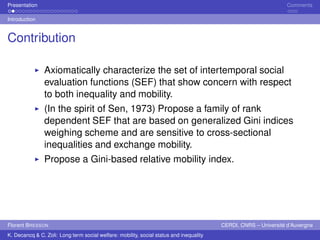
Ï Axiomatically characterize the set of intertemporal social 
evaluation functions (SEF) that show concern with respect 
to both inequality and mobility. 
Florent BRESSON CERDI, CNRS – Université d’Auvergne 
K. Decancq & C. Zoli: Long term social welfare: mobility, social status and inequality
Presentation Comments 
Introduction 
Contribution 
Ï Axiomatically characterize the set of intertemporal social 
evaluation functions (SEF) that show concern with respect 
to both inequality and mobility. 
Ï (In the spirit of Sen, 1973) Propose a family of rank 
dependent SEF that are based on generalized Gini indices 
weighing scheme and are sensitive to cross-sectional 
inequalities and exchange mobility. 
Florent BRESSON CERDI, CNRS – Université d’Auvergne 
K. Decancq & C. Zoli: Long term social welfare: mobility, social status and inequality
Presentation Comments 
Introduction 
Contribution 
Ï Axiomatically characterize the set of intertemporal social 
evaluation functions (SEF) that show concern with respect 
to both inequality and mobility. 
Ï (In the spirit of Sen, 1973) Propose a family of rank 
dependent SEF that are based on generalized Gini indices 
weighing scheme and are sensitive to cross-sectional 
inequalities and exchange mobility. 
Ï Propose a Gini-based relative mobility index. 
Florent BRESSON CERDI, CNRS – Université d’Auvergne 
K. Decancq & C. Zoli: Long term social welfare: mobility, social status and inequality
Presentation Comments 
Introduction 
Contribution 
Ï Axiomatically characterize the set of intertemporal social 
evaluation functions (SEF) that show concern with respect 
to both inequality and mobility. 
Ï (In the spirit of Sen, 1973) Propose a family of rank 
dependent SEF that are based on generalized Gini indices 
weighing scheme and are sensitive to cross-sectional 
inequalities and exchange mobility. 
Ï Propose a Gini-based relative mobility index. 
Ï Provide three decompositions 
Florent BRESSON CERDI, CNRS – Université d’Auvergne 
K. Decancq & C. Zoli: Long term social welfare: mobility, social status and inequality
Presentation Comments 
Introduction 
Contribution 
Ï Axiomatically characterize the set of intertemporal social 
evaluation functions (SEF) that show concern with respect 
to both inequality and mobility. 
Ï (In the spirit of Sen, 1973) Propose a family of rank 
dependent SEF that are based on generalized Gini indices 
weighing scheme and are sensitive to cross-sectional 
inequalities and exchange mobility. 
Ï Propose a Gini-based relative mobility index. 
Ï Provide three decompositions 
Florent BRESSON CERDI, CNRS – Université d’Auvergne 
K. Decancq & C. Zoli: Long term social welfare: mobility, social status and inequality
Presentation Comments 
Introduction 
Contribution 
Ï Axiomatically characterize the set of intertemporal social 
evaluation functions (SEF) that show concern with respect 
to both inequality and mobility. 
Ï (In the spirit of Sen, 1973) Propose a family of rank 
dependent SEF that are based on generalized Gini indices 
weighing scheme and are sensitive to cross-sectional 
inequalities and exchange mobility. 
Ï Propose a Gini-based relative mobility index. 
Ï Provide three decompositions (in fact two since the last is 
a special case). 
Florent BRESSON CERDI, CNRS – Université d’Auvergne 
K. Decancq & C. Zoli: Long term social welfare: mobility, social status and inequality
Presentation Comments 
Notations 
Concepts and notations 
Florent BRESSON CERDI, CNRS – Université d’Auvergne 
K. Decancq & C. Zoli: Long term social welfare: mobility, social status and inequality
Presentation Comments 
Notations 
Concepts and notations 
Ï N set of n individuals. 
Ï T = {1,2} set of periods. 
Ï xt 
i income of individual i at time t . 
Ï pt 
X 
(i ) : indicates position of i at time t in X. 
Florent BRESSON CERDI, CNRS – Université d’Auvergne 
K. Decancq & C. Zoli: Long term social welfare: mobility, social status and inequality
Presentation Comments 
Notations 
The multiperiod income profile 
Florent BRESSON CERDI, CNRS – Université d’Auvergne 
K. Decancq & C. Zoli: Long term social welfare: mobility, social status and inequality
Presentation Comments 
Notations 
The multiperiod income profile 
The whole joint distribution described by the multiperiod income 
profile: 
X = 
¡ 
X1;X2;PX 
¢ 
where: 
Ï X t is the instantaneous income distribution at time t . X t is 
a (strictly) ordered vector 
³ 
xt 
[1] 
, xt 
[2] 
, . . . , xt 
[n] 
´ 
with 
xt 
1 
< xt 
2 
< . . . < xt 
[n], 
Ï PX , the (exchange) mobility matrix, is an n ×n permutation 
matrix such that: 
PX (i1, i2) = 
( 
1 if ∃i ∈N s. t. p1 
X 
(i ) = i1 and p2 
X 
(i )= i2 
0 otherwise 
. 
Florent BRESSON CERDI, CNRS – Université d’Auvergne 
K. Decancq & C. Zoli: Long term social welfare: mobility, social status and inequality
Presentation Comments 
Notations 
The multiperiod income profile 
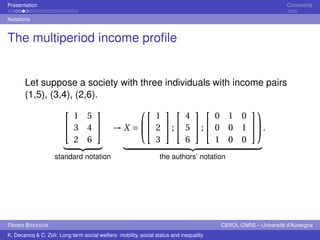
Let suppose a society with three individuals with income pairs 
(1,5), (3,4), (2,6). 
 
 
1 5 
3 4 
2 6 
 
 
| {z } 
standard notation 
→X = 
 
 
 
 
1 
2 
3 
 
; 
 
 
4 
5 
6 
 
; 
 
 
0 1 0 
0 0 1 
1 0 0 
 
 
 
 
| {z } 
the authors’ notation 
. 
Florent BRESSON CERDI, CNRS – Université d’Auvergne 
K. Decancq & C. Zoli: Long term social welfare: mobility, social status and inequality
Presentation Comments 
Notations 
Additional concepts and notations 
Florent BRESSON CERDI, CNRS – Université d’Auvergne 
K. Decancq & C. Zoli: Long term social welfare: mobility, social status and inequality
Presentation Comments 
Notations 
Additional concepts and notations 
Ï X the set of all income profiles for populations of size n 
and two time periods. 
Ï X(PX ) the set of all income profiles with mobility matrix PX . 
Ï X 
t 
is equal distribution at time t . 
Ï μ(X t ) is mean income at time t . 
Ï W :X →R is the social evaluation function. 
Florent BRESSON CERDI, CNRS – Université d’Auvergne 
K. Decancq & C. Zoli: Long term social welfare: mobility, social status and inequality
Presentation Comments 
The axiomatic framework 
M-IND 
Axiom 1. (Mobility preserving Independence (M-IND)) 
For all X,Y ,Z in X with PX = PY =PZ , 
W(X) ÊW(Y )⇔W(X +Z)ÊW(Y +Z). 
⇒ sequences of rank-preserving income increments preserve 
welfare orderings. 
Florent BRESSON CERDI, CNRS – Université d’Auvergne 
K. Decancq & C. Zoli: Long term social welfare: mobility, social status and inequality
Presentation Comments 
The axiomatic framework 
NORM 
Axiom 2. (Normalization (NORM)) 
For all X in X s.t. PX = I if X1→X 
1 
and X2→X 
2 
with 
X 
1 
= X 
2 
= μ·1n, then W(X)→¸·μ where ¸Ê 0. 
⇒ money metric evaluation. 
Florent BRESSON CERDI, CNRS – Université d’Auvergne 
K. Decancq & C. Zoli: Long term social welfare: mobility, social status and inequality
Presentation Comments 
The axiomatic framework 
MON 
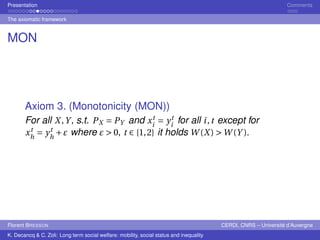
Axiom 3. (Monotonicity (MON)) 
For all X,Y , s.t. PX = PY and xt 
i 
= yt 
i for all i , t except for 
xt 
h 
= yt 
h 
+" where " > 0, t ∈ {1,2} it holds W(X) >W(Y ). 
Florent BRESSON CERDI, CNRS – Université d’Auvergne 
K. Decancq & C. Zoli: Long term social welfare: mobility, social status and inequality
Presentation Comments 
The axiomatic framework 
IME 
Axiom 4. (Irrelevance of Mobility for Equal distributions 
(IME)) 
t 
t 
For all X,Y in X, if X t →X 
and Y t →X 
for all t , then 
W(X)−W(Y )→0. 
Florent BRESSON CERDI, CNRS – Université d’Auvergne 
K. Decancq & C. Zoli: Long term social welfare: mobility, social status and inequality
Presentation Comments 
The axiomatic framework 
IMEG 
Axiom 5. (Irrelevance of Mobility for Equal Groups 
(IMEG)) 
For all X,Y ,Z in X, for all subgroups A and B with NA ∪NB = N, 
At At 
At 
if X →X 
and Y At →X 
for all t , then 
W(X A,ZB)−W(Y A,ZB)→0. 
Florent BRESSON CERDI, CNRS – Université d’Auvergne 
K. Decancq & C. Zoli: Long term social welfare: mobility, social status and inequality
Presentation Comments 
The axiomatic framework 
MIA 
Axiom 6. (Multiperiod Inequality Aversion (MIA)) 
For all X,Y in X with PX = PY , W(X) ÊW(Y ) if X can be 
obtained from Y by a sequence of multiperiod Pigou-Dalton 
transfers. 
Florent BRESSON CERDI, CNRS – Université d’Auvergne 
K. Decancq & C. Zoli: Long term social welfare: mobility, social status and inequality
Presentation Comments 
The axiomatic framework 
MPREF 
Axiom 7. (Mobility preference (MPREF)) 
For all X,Y in X with X t = Y t for all t ∈T , if Y can be obtained 
from X by a finite sequence of correlation increasing switches, 
then W(X) ÊW(Y ). 
⇒ Maximum mobility is achieved with complete rank reversal. 
Florent BRESSON CERDI, CNRS – Université d’Auvergne 
K. Decancq & C. Zoli: Long term social welfare: mobility, social status and inequality
Presentation Comments 
Results 
Main results 
Theorem 1 
For all X = 
¡ 
X1;X2;PX 
¢ 
in X, W satisfies M-IND if and only if 
there exists functions !1 
PX 
and !2 
PX 
and an increasing and 
continuous function VPX such that: 
W(X) =VPX 
" 
X 
i 
!1 
PX 
¡ 
p1 
X 
(i ),p2 
X 
¢ 
· x1 
(i ) 
i 
+ 
X 
i 
!2 
PX 
¡ 
p1 
X 
(i ),p2 
X 
¢ 
· x2 
(i ) 
i 
# 
. 
Florent BRESSON CERDI, CNRS – Université d’Auvergne 
K. Decancq & C. Zoli: Long term social welfare: mobility, social status and inequality
Presentation Comments 
Results 
Main results 
Theorem 2 
For all X = 
¡ 
X1;X2;PX 
¢ 
in X, W satisfies M-IND, MON, NORM 
and IME if and only if there exists °1,°2 >0 such that: 
W(X) = °1 · 
X 
i 
w1 
PX 
¡ 
p1 
X 
(i ),p2 
X 
¢ 
· x1 
(i ) 
i 
+°2 · 
X 
i 
w2 
PX 
¡ 
p1 
X 
(i ),p2 
X 
¢ 
· x2 
(i ) 
i 
, 
where: °1+°2 = ¸, 
X 
i 
w1 
PX 
¡ 
p1 
X 
(i ),p2 
X 
¢ 
= 
(i ) 
X 
i 
w2 
PX 
¡ 
p1 
X 
(i ),p2 
X 
¢ 
= 1, and 
(i ) 
wt 
PX 
¡ 
p1 
¢ 
>0 ∀i , t and PX . 
X (i ),p2 
X (i ) 
Florent BRESSON CERDI, CNRS – Université d’Auvergne 
K. Decancq & C. Zoli: Long term social welfare: mobility, social status and inequality
Presentation Comments 
Results 
Main results 
Theorem 3 (core result) 
For all X = 
¡ 
X1;X2;PX 
¢ 
in X, W satisfies M-IND, MON, NORM 
and IMEG if and only if there exists a °1,°2 > 0 such that: 
W(X) = °1 · 
X 
i 
£ 
®1 ¡ 
¢ 
+¯1 ¡ 
p1 
X (i ) 
¢¤ 
p2 
X (i ) 
· x1 
i 
+°2 · 
X 
i 
£ 
®2 ¡ 
p1 
X 
¢ 
+¯2 ¡ 
(i ) 
p2 
X 
¢¤ 
(i ) 
· x2 
i 
, 
where: °1 +°2 = ¸, 
X 
i 
®t ¡ 
p1 
X 
¢ 
+ 
(i ) 
X 
i 
¯t ¡ 
p2 
X 
¢ 
=1 ∀t , and 
(i ) 
®t ¡ 
¢ 
+¯t ¡ 
p1 
X (i ) 
¢ 
> 0 ∀i and t . 
p2 
X (i ) 
Florent BRESSON CERDI, CNRS – Université d’Auvergne 
K. Decancq & C. Zoli: Long term social welfare: mobility, social status and inequality
Presentation Comments 
Results 
Main results 
Theorem 4 
For all X = 
¡ 
X1;X2;PX 
¢ 
in X, W in Theorem 3 satisfies MIA and 
MPREF if and only if: 
Ï ®t 
¡ 
p1 
X 
(l ) 
¢ 
+¯t 
¡ 
p2 
X 
(l ) 
¢ 
Ê ®t 
¡ 
p1 
X 
(k) 
¢ 
+¯t 
¡ 
p2 
X 
(k) 
¢ 
∀t ∈T if p1 
X 
(l ) < 
p1 
X 
(k) and p2 
X 
(l ) < p2 
X 
(k), and 
Ï ®2(·) is non-increasing in p1 
X 
(i ) and ¯1(·) is non-increasing in 
p2 
X 
(i ). 
Florent BRESSON CERDI, CNRS – Université d’Auvergne 
K. Decancq & C. Zoli: Long term social welfare: mobility, social status and inequality
Presentation Comments 
Results 
Decompositions 
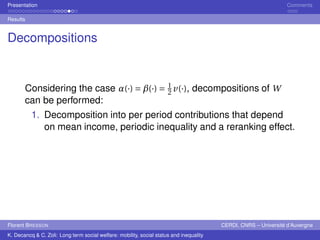
Considering the case ®(·) =¯(·) = 1 
2 v(·), decompositions of W 
can be performed: 
Florent BRESSON CERDI, CNRS – Université d’Auvergne 
K. Decancq & C. Zoli: Long term social welfare: mobility, social status and inequality
Presentation Comments 
Results 
Decompositions 
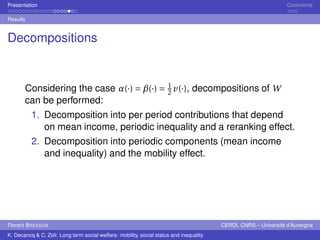
Considering the case ®(·) =¯(·) = 1 
2 v(·), decompositions of W 
can be performed: 
1. Decomposition into per period contributions that depend 
on mean income, periodic inequality and a reranking effect. 
Florent BRESSON CERDI, CNRS – Université d’Auvergne 
K. Decancq & C. Zoli: Long term social welfare: mobility, social status and inequality
Presentation Comments 
Results 
Decompositions 
Considering the case ®(·) =¯(·) = 1 
2 v(·), decompositions of W 
can be performed: 
1. Decomposition into per period contributions that depend 
on mean income, periodic inequality and a reranking effect. 
2. Decomposition into periodic components (mean income 
and inequality) and the mobility effect. 
Florent BRESSON CERDI, CNRS – Université d’Auvergne 
K. Decancq & C. Zoli: Long term social welfare: mobility, social status and inequality
Presentation Comments 
Results 
The specific case of the Gini weighing scheme 
Using the Gini inequality index weighing scheme one then 
obtains the relative Gini mobility index: 
M(X) = 
1 
2 
· 
P 
i 
£ 
p1 
X 
(i )−p2 
X 
¤ 
· 
(i ) 
¡ 
°2 
£ 
μ(X2)−x2 
i 
¤ 
−°1 
£ 
μ(X1)−x1 
i 
¤¢ 
°1 ·μ(X1) ·G(X1)+°2 ·μ(X2) ·G(X2) 
, 
with 0 ÉM É1. 
Florent BRESSON CERDI, CNRS – Université d’Auvergne 
K. Decancq & C. Zoli: Long term social welfare: mobility, social status and inequality
Presentation Comments 
Results 
The specific case of the Gini weighing scheme 
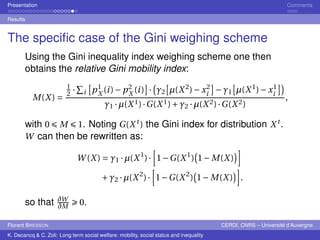
Using the Gini inequality index weighing scheme one then 
obtains the relative Gini mobility index: 
M(X) = 
1 
2 
· 
P 
i 
£ 
p1 
X 
(i )−p2 
X 
¤ 
· 
(i ) 
¡ 
°2 
£ 
μ(X2)−x2 
i 
¤ 
−°1 
£ 
μ(X1)−x1 
i 
¤¢ 
°1 ·μ(X1) ·G(X1)+°2 ·μ(X2) ·G(X2) 
, 
with 0 ÉM É1. Noting G(X t ) the Gini index for distribution X t . 
W can then be rewritten as: 
W(X) = °1 ·μ(X1) · 
h 
1−G(X1) 
¢i 
¡ 
1−M(X) 
+°2 ·μ(X2) · 
h 
1−G(X2) 
¢i 
¡ 
1−M(X) 
. 
so that @W 
@M 
Ê 0. 
Florent BRESSON CERDI, CNRS – Université d’Auvergne 
K. Decancq & C. Zoli: Long term social welfare: mobility, social status and inequality
Presentation Comments 
Conclusion 
Florent BRESSON CERDI, CNRS – Université d’Auvergne 
K. Decancq & C. Zoli: Long term social welfare: mobility, social status and inequality
Presentation Comments 
Conclusion 
Ï Show how basic properties, in particular M-IND and 
IME(G), characterize the set of intertemporal 
rank-dependant social evaluation functions that take both 
inequality and exchange mobility into account, 
Florent BRESSON CERDI, CNRS – Université d’Auvergne 
K. Decancq & C. Zoli: Long term social welfare: mobility, social status and inequality
Presentation Comments 
Conclusion 
Ï Show how basic properties, in particular M-IND and 
IME(G), characterize the set of intertemporal 
rank-dependant social evaluation functions that take both 
inequality and exchange mobility into account, 
Ï Propose a family of generalized Gini intertemporal social 
welfare functions, 
Florent BRESSON CERDI, CNRS – Université d’Auvergne 
K. Decancq & C. Zoli: Long term social welfare: mobility, social status and inequality
Presentation Comments 
Conclusion 
Ï Show how basic properties, in particular M-IND and 
IME(G), characterize the set of intertemporal 
rank-dependant social evaluation functions that take both 
inequality and exchange mobility into account, 
Ï Propose a family of generalized Gini intertemporal social 
welfare functions, 
Ï Introduce a (new?) mobility index. 
Florent BRESSON CERDI, CNRS – Université d’Auvergne 
K. Decancq & C. Zoli: Long term social welfare: mobility, social status and inequality
Presentation Comments 
(Minor) Comments 
Florent BRESSON CERDI, CNRS – Université d’Auvergne 
K. Decancq & C. Zoli: Long term social welfare: mobility, social status and inequality
Presentation Comments 
(Minor) Comments 
Ï Preliminary version ⇒ polishing is needed (references, 
unexplained notations,. . . ). 
Florent BRESSON CERDI, CNRS – Université d’Auvergne 
K. Decancq & C. Zoli: Long term social welfare: mobility, social status and inequality
Presentation Comments 
(Minor) Comments 
Ï Preliminary version ⇒ polishing is needed (references, 
unexplained notations,. . . ). 
Ï Little is said about M. 
Florent BRESSON CERDI, CNRS – Université d’Auvergne 
K. Decancq & C. Zoli: Long term social welfare: mobility, social status and inequality
Presentation Comments 
(Minor) Comments 
Ï Preliminary version ⇒ polishing is needed (references, 
unexplained notations,. . . ). 
Ï Little is said about M. 
Ï Definition of Multiperiod Pigou-Dalton transfer does not fit 
the interpretation that is given later (xt 
k 
+xt 
l 
= yt 
k 
+ yt 
l 
∀t ∈T ). 
Florent BRESSON CERDI, CNRS – Université d’Auvergne 
K. Decancq & C. Zoli: Long term social welfare: mobility, social status and inequality
Presentation Comments 
(Minor) Comments 
Ï Preliminary version ⇒ polishing is needed (references, 
unexplained notations,. . . ). 
Ï Little is said about M. 
Ï Definition of Multiperiod Pigou-Dalton transfer does not fit 
the interpretation that is given later (xt 
k 
+xt 
l 
= yt 
k 
+ yt 
l 
∀t ∈T ). 
Ï Distinction between direct and indirect effects of the 
mobility matrix on the weighing scheme in W (Theorem 1) 
is not clear. 
Florent BRESSON CERDI, CNRS – Université d’Auvergne 
K. Decancq & C. Zoli: Long term social welfare: mobility, social status and inequality
Presentation Comments 
(Minor) Comments 
Florent BRESSON CERDI, CNRS – Université d’Auvergne 
K. Decancq & C. Zoli: Long term social welfare: mobility, social status and inequality
Presentation Comments 
(Minor) Comments 
Ï Assume that there is no costs of intertemporal income 
variability or that costs are outweighted by gains related to 
reranking. 
Florent BRESSON CERDI, CNRS – Université d’Auvergne 
K. Decancq & C. Zoli: Long term social welfare: mobility, social status and inequality
Presentation Comments 
(Minor) Comments 
Ï Assume that there is no costs of intertemporal income 
variability or that costs are outweighted by gains related to 
reranking. 
Ï W not continuous. Marginal income increments in period t 
that change PX may result in non-marginal variations of W 
as they change the weight for the income at period t ′6= t . 
Florent BRESSON CERDI, CNRS – Université d’Auvergne 
K. Decancq & C. Zoli: Long term social welfare: mobility, social status and inequality
Presentation Comments 
(Minor) Comments 
Ï Assume that there is no costs of intertemporal income 
variability or that costs are outweighted by gains related to 
reranking. 
Ï W not continuous. Marginal income increments in period t 
that change PX may result in non-marginal variations of W 
as they change the weight for the income at period t ′6= t . 
Ï Extension to more than 2 periods. Perfect mobility with 
T > 2 periods? 
Florent BRESSON CERDI, CNRS – Université d’Auvergne 
K. Decancq & C. Zoli: Long term social welfare: mobility, social status and inequality
Presentation Comments 
(Minor) Comments 
Ï Assume that there is no costs of intertemporal income 
variability or that costs are outweighted by gains related to 
reranking. 
Ï W not continuous. Marginal income increments in period t 
that change PX may result in non-marginal variations of W 
as they change the weight for the income at period t ′6= t . 
Ï Extension to more than 2 periods. Perfect mobility with 
T > 2 periods? 
Ï Ex-ante or ex-post evaluation ? 
Florent BRESSON CERDI, CNRS – Université d’Auvergne 
K. Decancq & C. Zoli: Long term social welfare: mobility, social status and inequality
Presentation Comments 
That’s all folks! 
Florent BRESSON CERDI, CNRS – Université d’Auvergne 
K. Decancq & C. Zoli: Long term social welfare: mobility, social status and inequality

Session 8 a presentation decancq-zoli

  • 1.
    Presentation Comments K.Decancq & C. Zoli: Long term social welfare: mobility, social status and inequality Presentation and comments for the 33rd IARIW General Conference Florent BRESSON CERDI, CNRS – Université d’Auvergne August 29, 2014 Florent BRESSON CERDI, CNRS – Université d’Auvergne K. Decancq & C. Zoli: Long term social welfare: mobility, social status and inequality
  • 2.
    Presentation Comments Introduction Context Florent BRESSON CERDI, CNRS – Université d’Auvergne K. Decancq & C. Zoli: Long term social welfare: mobility, social status and inequality
  • 3.
    Presentation Comments Introduction Context Crisis has strengthen concerns about both rising inequalities and decreasing mobility (Stiglitz, 2012; Piketty, 2013; Krueger’s “Great Gatsby curve”). Florent BRESSON CERDI, CNRS – Université d’Auvergne K. Decancq & C. Zoli: Long term social welfare: mobility, social status and inequality
  • 4.
    Presentation Comments Introduction Context Crisis has strengthen concerns about both rising inequalities and decreasing mobility (Stiglitz, 2012; Piketty, 2013; Krueger’s “Great Gatsby curve”). Since Dalton (1920), many authors have investigated the normative foundations of social aversion to inequality (Atkinson, 1970; Kolm, 1976), and more recently the same efforts have been performed concerning intergenerational or intragenerational mobility (Atkinson, 1981; Dardanoni, 1993), so as to provide social indices based on well-behaved social welfare functions. Florent BRESSON CERDI, CNRS – Université d’Auvergne K. Decancq & C. Zoli: Long term social welfare: mobility, social status and inequality
  • 5.
    Presentation Comments Introduction Context Crisis has strengthen concerns about both rising inequalities and decreasing mobility (Stiglitz, 2012; Piketty, 2013; Krueger’s “Great Gatsby curve”). Since Dalton (1920), many authors have investigated the normative foundations of social aversion to inequality (Atkinson, 1970; Kolm, 1976), and more recently the same efforts have been performed concerning intergenerational or intragenerational mobility (Atkinson, 1981; Dardanoni, 1993), so as to provide social indices based on well-behaved social welfare functions. However, only few studies (Shorrocks, 1978; Kanbur & Stiglitz, 1986) have considered the desired properties for multiperiod social welfare functions that make it possible to take simultaneously inequality and mobility into account. Florent BRESSON CERDI, CNRS – Université d’Auvergne K. Decancq & C. Zoli: Long term social welfare: mobility, social status and inequality
  • 6.
    Presentation Comments Introduction Contribution Florent BRESSON CERDI, CNRS – Université d’Auvergne K. Decancq & C. Zoli: Long term social welfare: mobility, social status and inequality
  • 7.
    Presentation Comments Introduction Contribution Ï Axiomatically characterize the set of intertemporal social evaluation functions (SEF) that show concern with respect to both inequality and mobility. Florent BRESSON CERDI, CNRS – Université d’Auvergne K. Decancq & C. Zoli: Long term social welfare: mobility, social status and inequality
  • 8.
    Presentation Comments Introduction Contribution Ï Axiomatically characterize the set of intertemporal social evaluation functions (SEF) that show concern with respect to both inequality and mobility. Ï (In the spirit of Sen, 1973) Propose a family of rank dependent SEF that are based on generalized Gini indices weighing scheme and are sensitive to cross-sectional inequalities and exchange mobility. Florent BRESSON CERDI, CNRS – Université d’Auvergne K. Decancq & C. Zoli: Long term social welfare: mobility, social status and inequality
  • 9.
    Presentation Comments Introduction Contribution Ï Axiomatically characterize the set of intertemporal social evaluation functions (SEF) that show concern with respect to both inequality and mobility. Ï (In the spirit of Sen, 1973) Propose a family of rank dependent SEF that are based on generalized Gini indices weighing scheme and are sensitive to cross-sectional inequalities and exchange mobility. Ï Propose a Gini-based relative mobility index. Florent BRESSON CERDI, CNRS – Université d’Auvergne K. Decancq & C. Zoli: Long term social welfare: mobility, social status and inequality
  • 10.
    Presentation Comments Introduction Contribution Ï Axiomatically characterize the set of intertemporal social evaluation functions (SEF) that show concern with respect to both inequality and mobility. Ï (In the spirit of Sen, 1973) Propose a family of rank dependent SEF that are based on generalized Gini indices weighing scheme and are sensitive to cross-sectional inequalities and exchange mobility. Ï Propose a Gini-based relative mobility index. Ï Provide three decompositions Florent BRESSON CERDI, CNRS – Université d’Auvergne K. Decancq & C. Zoli: Long term social welfare: mobility, social status and inequality
  • 11.
    Presentation Comments Introduction Contribution Ï Axiomatically characterize the set of intertemporal social evaluation functions (SEF) that show concern with respect to both inequality and mobility. Ï (In the spirit of Sen, 1973) Propose a family of rank dependent SEF that are based on generalized Gini indices weighing scheme and are sensitive to cross-sectional inequalities and exchange mobility. Ï Propose a Gini-based relative mobility index. Ï Provide three decompositions Florent BRESSON CERDI, CNRS – Université d’Auvergne K. Decancq & C. Zoli: Long term social welfare: mobility, social status and inequality
  • 12.
    Presentation Comments Introduction Contribution Ï Axiomatically characterize the set of intertemporal social evaluation functions (SEF) that show concern with respect to both inequality and mobility. Ï (In the spirit of Sen, 1973) Propose a family of rank dependent SEF that are based on generalized Gini indices weighing scheme and are sensitive to cross-sectional inequalities and exchange mobility. Ï Propose a Gini-based relative mobility index. Ï Provide three decompositions (in fact two since the last is a special case). Florent BRESSON CERDI, CNRS – Université d’Auvergne K. Decancq & C. Zoli: Long term social welfare: mobility, social status and inequality
  • 13.
    Presentation Comments Notations Concepts and notations Florent BRESSON CERDI, CNRS – Université d’Auvergne K. Decancq & C. Zoli: Long term social welfare: mobility, social status and inequality
  • 14.
    Presentation Comments Notations Concepts and notations Ï N set of n individuals. Ï T = {1,2} set of periods. Ï xt i income of individual i at time t . Ï pt X (i ) : indicates position of i at time t in X. Florent BRESSON CERDI, CNRS – Université d’Auvergne K. Decancq & C. Zoli: Long term social welfare: mobility, social status and inequality
  • 15.
    Presentation Comments Notations The multiperiod income profile Florent BRESSON CERDI, CNRS – Université d’Auvergne K. Decancq & C. Zoli: Long term social welfare: mobility, social status and inequality
  • 16.
    Presentation Comments Notations The multiperiod income profile The whole joint distribution described by the multiperiod income profile: X = ¡ X1;X2;PX ¢ where: Ï X t is the instantaneous income distribution at time t . X t is a (strictly) ordered vector ³ xt [1] , xt [2] , . . . , xt [n] ´ with xt 1 < xt 2 < . . . < xt [n], Ï PX , the (exchange) mobility matrix, is an n ×n permutation matrix such that: PX (i1, i2) = ( 1 if ∃i ∈N s. t. p1 X (i ) = i1 and p2 X (i )= i2 0 otherwise . Florent BRESSON CERDI, CNRS – Université d’Auvergne K. Decancq & C. Zoli: Long term social welfare: mobility, social status and inequality
  • 17.
    Presentation Comments Notations The multiperiod income profile Let suppose a society with three individuals with income pairs (1,5), (3,4), (2,6).   1 5 3 4 2 6   | {z } standard notation →X =     1 2 3  ;   4 5 6  ;   0 1 0 0 0 1 1 0 0     | {z } the authors’ notation . Florent BRESSON CERDI, CNRS – Université d’Auvergne K. Decancq & C. Zoli: Long term social welfare: mobility, social status and inequality
  • 18.
    Presentation Comments Notations Additional concepts and notations Florent BRESSON CERDI, CNRS – Université d’Auvergne K. Decancq & C. Zoli: Long term social welfare: mobility, social status and inequality
  • 19.
    Presentation Comments Notations Additional concepts and notations Ï X the set of all income profiles for populations of size n and two time periods. Ï X(PX ) the set of all income profiles with mobility matrix PX . Ï X t is equal distribution at time t . Ï μ(X t ) is mean income at time t . Ï W :X →R is the social evaluation function. Florent BRESSON CERDI, CNRS – Université d’Auvergne K. Decancq & C. Zoli: Long term social welfare: mobility, social status and inequality
  • 20.
    Presentation Comments Theaxiomatic framework M-IND Axiom 1. (Mobility preserving Independence (M-IND)) For all X,Y ,Z in X with PX = PY =PZ , W(X) ÊW(Y )⇔W(X +Z)ÊW(Y +Z). ⇒ sequences of rank-preserving income increments preserve welfare orderings. Florent BRESSON CERDI, CNRS – Université d’Auvergne K. Decancq & C. Zoli: Long term social welfare: mobility, social status and inequality
  • 21.
    Presentation Comments Theaxiomatic framework NORM Axiom 2. (Normalization (NORM)) For all X in X s.t. PX = I if X1→X 1 and X2→X 2 with X 1 = X 2 = μ·1n, then W(X)→¸·μ where ¸Ê 0. ⇒ money metric evaluation. Florent BRESSON CERDI, CNRS – Université d’Auvergne K. Decancq & C. Zoli: Long term social welfare: mobility, social status and inequality
  • 22.
    Presentation Comments Theaxiomatic framework MON Axiom 3. (Monotonicity (MON)) For all X,Y , s.t. PX = PY and xt i = yt i for all i , t except for xt h = yt h +" where " > 0, t ∈ {1,2} it holds W(X) >W(Y ). Florent BRESSON CERDI, CNRS – Université d’Auvergne K. Decancq & C. Zoli: Long term social welfare: mobility, social status and inequality
  • 23.
    Presentation Comments Theaxiomatic framework IME Axiom 4. (Irrelevance of Mobility for Equal distributions (IME)) t t For all X,Y in X, if X t →X and Y t →X for all t , then W(X)−W(Y )→0. Florent BRESSON CERDI, CNRS – Université d’Auvergne K. Decancq & C. Zoli: Long term social welfare: mobility, social status and inequality
  • 24.
    Presentation Comments Theaxiomatic framework IMEG Axiom 5. (Irrelevance of Mobility for Equal Groups (IMEG)) For all X,Y ,Z in X, for all subgroups A and B with NA ∪NB = N, At At At if X →X and Y At →X for all t , then W(X A,ZB)−W(Y A,ZB)→0. Florent BRESSON CERDI, CNRS – Université d’Auvergne K. Decancq & C. Zoli: Long term social welfare: mobility, social status and inequality
  • 25.
    Presentation Comments Theaxiomatic framework MIA Axiom 6. (Multiperiod Inequality Aversion (MIA)) For all X,Y in X with PX = PY , W(X) ÊW(Y ) if X can be obtained from Y by a sequence of multiperiod Pigou-Dalton transfers. Florent BRESSON CERDI, CNRS – Université d’Auvergne K. Decancq & C. Zoli: Long term social welfare: mobility, social status and inequality
  • 26.
    Presentation Comments Theaxiomatic framework MPREF Axiom 7. (Mobility preference (MPREF)) For all X,Y in X with X t = Y t for all t ∈T , if Y can be obtained from X by a finite sequence of correlation increasing switches, then W(X) ÊW(Y ). ⇒ Maximum mobility is achieved with complete rank reversal. Florent BRESSON CERDI, CNRS – Université d’Auvergne K. Decancq & C. Zoli: Long term social welfare: mobility, social status and inequality
  • 27.
    Presentation Comments Results Main results Theorem 1 For all X = ¡ X1;X2;PX ¢ in X, W satisfies M-IND if and only if there exists functions !1 PX and !2 PX and an increasing and continuous function VPX such that: W(X) =VPX " X i !1 PX ¡ p1 X (i ),p2 X ¢ · x1 (i ) i + X i !2 PX ¡ p1 X (i ),p2 X ¢ · x2 (i ) i # . Florent BRESSON CERDI, CNRS – Université d’Auvergne K. Decancq & C. Zoli: Long term social welfare: mobility, social status and inequality
  • 28.
    Presentation Comments Results Main results Theorem 2 For all X = ¡ X1;X2;PX ¢ in X, W satisfies M-IND, MON, NORM and IME if and only if there exists °1,°2 >0 such that: W(X) = °1 · X i w1 PX ¡ p1 X (i ),p2 X ¢ · x1 (i ) i +°2 · X i w2 PX ¡ p1 X (i ),p2 X ¢ · x2 (i ) i , where: °1+°2 = ¸, X i w1 PX ¡ p1 X (i ),p2 X ¢ = (i ) X i w2 PX ¡ p1 X (i ),p2 X ¢ = 1, and (i ) wt PX ¡ p1 ¢ >0 ∀i , t and PX . X (i ),p2 X (i ) Florent BRESSON CERDI, CNRS – Université d’Auvergne K. Decancq & C. Zoli: Long term social welfare: mobility, social status and inequality
  • 29.
    Presentation Comments Results Main results Theorem 3 (core result) For all X = ¡ X1;X2;PX ¢ in X, W satisfies M-IND, MON, NORM and IMEG if and only if there exists a °1,°2 > 0 such that: W(X) = °1 · X i £ ®1 ¡ ¢ +¯1 ¡ p1 X (i ) ¢¤ p2 X (i ) · x1 i +°2 · X i £ ®2 ¡ p1 X ¢ +¯2 ¡ (i ) p2 X ¢¤ (i ) · x2 i , where: °1 +°2 = ¸, X i ®t ¡ p1 X ¢ + (i ) X i ¯t ¡ p2 X ¢ =1 ∀t , and (i ) ®t ¡ ¢ +¯t ¡ p1 X (i ) ¢ > 0 ∀i and t . p2 X (i ) Florent BRESSON CERDI, CNRS – Université d’Auvergne K. Decancq & C. Zoli: Long term social welfare: mobility, social status and inequality
  • 30.
    Presentation Comments Results Main results Theorem 4 For all X = ¡ X1;X2;PX ¢ in X, W in Theorem 3 satisfies MIA and MPREF if and only if: Ï ®t ¡ p1 X (l ) ¢ +¯t ¡ p2 X (l ) ¢ Ê ®t ¡ p1 X (k) ¢ +¯t ¡ p2 X (k) ¢ ∀t ∈T if p1 X (l ) < p1 X (k) and p2 X (l ) < p2 X (k), and Ï ®2(·) is non-increasing in p1 X (i ) and ¯1(·) is non-increasing in p2 X (i ). Florent BRESSON CERDI, CNRS – Université d’Auvergne K. Decancq & C. Zoli: Long term social welfare: mobility, social status and inequality
  • 31.
    Presentation Comments Results Decompositions Considering the case ®(·) =¯(·) = 1 2 v(·), decompositions of W can be performed: Florent BRESSON CERDI, CNRS – Université d’Auvergne K. Decancq & C. Zoli: Long term social welfare: mobility, social status and inequality
  • 32.
    Presentation Comments Results Decompositions Considering the case ®(·) =¯(·) = 1 2 v(·), decompositions of W can be performed: 1. Decomposition into per period contributions that depend on mean income, periodic inequality and a reranking effect. Florent BRESSON CERDI, CNRS – Université d’Auvergne K. Decancq & C. Zoli: Long term social welfare: mobility, social status and inequality
  • 33.
    Presentation Comments Results Decompositions Considering the case ®(·) =¯(·) = 1 2 v(·), decompositions of W can be performed: 1. Decomposition into per period contributions that depend on mean income, periodic inequality and a reranking effect. 2. Decomposition into periodic components (mean income and inequality) and the mobility effect. Florent BRESSON CERDI, CNRS – Université d’Auvergne K. Decancq & C. Zoli: Long term social welfare: mobility, social status and inequality
  • 34.
    Presentation Comments Results The specific case of the Gini weighing scheme Using the Gini inequality index weighing scheme one then obtains the relative Gini mobility index: M(X) = 1 2 · P i £ p1 X (i )−p2 X ¤ · (i ) ¡ °2 £ μ(X2)−x2 i ¤ −°1 £ μ(X1)−x1 i ¤¢ °1 ·μ(X1) ·G(X1)+°2 ·μ(X2) ·G(X2) , with 0 ÉM É1. Florent BRESSON CERDI, CNRS – Université d’Auvergne K. Decancq & C. Zoli: Long term social welfare: mobility, social status and inequality
  • 35.
    Presentation Comments Results The specific case of the Gini weighing scheme Using the Gini inequality index weighing scheme one then obtains the relative Gini mobility index: M(X) = 1 2 · P i £ p1 X (i )−p2 X ¤ · (i ) ¡ °2 £ μ(X2)−x2 i ¤ −°1 £ μ(X1)−x1 i ¤¢ °1 ·μ(X1) ·G(X1)+°2 ·μ(X2) ·G(X2) , with 0 ÉM É1. Noting G(X t ) the Gini index for distribution X t . W can then be rewritten as: W(X) = °1 ·μ(X1) · h 1−G(X1) ¢i ¡ 1−M(X) +°2 ·μ(X2) · h 1−G(X2) ¢i ¡ 1−M(X) . so that @W @M Ê 0. Florent BRESSON CERDI, CNRS – Université d’Auvergne K. Decancq & C. Zoli: Long term social welfare: mobility, social status and inequality
  • 36.
    Presentation Comments Conclusion Florent BRESSON CERDI, CNRS – Université d’Auvergne K. Decancq & C. Zoli: Long term social welfare: mobility, social status and inequality
  • 37.
    Presentation Comments Conclusion Ï Show how basic properties, in particular M-IND and IME(G), characterize the set of intertemporal rank-dependant social evaluation functions that take both inequality and exchange mobility into account, Florent BRESSON CERDI, CNRS – Université d’Auvergne K. Decancq & C. Zoli: Long term social welfare: mobility, social status and inequality
  • 38.
    Presentation Comments Conclusion Ï Show how basic properties, in particular M-IND and IME(G), characterize the set of intertemporal rank-dependant social evaluation functions that take both inequality and exchange mobility into account, Ï Propose a family of generalized Gini intertemporal social welfare functions, Florent BRESSON CERDI, CNRS – Université d’Auvergne K. Decancq & C. Zoli: Long term social welfare: mobility, social status and inequality
  • 39.
    Presentation Comments Conclusion Ï Show how basic properties, in particular M-IND and IME(G), characterize the set of intertemporal rank-dependant social evaluation functions that take both inequality and exchange mobility into account, Ï Propose a family of generalized Gini intertemporal social welfare functions, Ï Introduce a (new?) mobility index. Florent BRESSON CERDI, CNRS – Université d’Auvergne K. Decancq & C. Zoli: Long term social welfare: mobility, social status and inequality
  • 40.
    Presentation Comments (Minor)Comments Florent BRESSON CERDI, CNRS – Université d’Auvergne K. Decancq & C. Zoli: Long term social welfare: mobility, social status and inequality
  • 41.
    Presentation Comments (Minor)Comments Ï Preliminary version ⇒ polishing is needed (references, unexplained notations,. . . ). Florent BRESSON CERDI, CNRS – Université d’Auvergne K. Decancq & C. Zoli: Long term social welfare: mobility, social status and inequality
  • 42.
    Presentation Comments (Minor)Comments Ï Preliminary version ⇒ polishing is needed (references, unexplained notations,. . . ). Ï Little is said about M. Florent BRESSON CERDI, CNRS – Université d’Auvergne K. Decancq & C. Zoli: Long term social welfare: mobility, social status and inequality
  • 43.
    Presentation Comments (Minor)Comments Ï Preliminary version ⇒ polishing is needed (references, unexplained notations,. . . ). Ï Little is said about M. Ï Definition of Multiperiod Pigou-Dalton transfer does not fit the interpretation that is given later (xt k +xt l = yt k + yt l ∀t ∈T ). Florent BRESSON CERDI, CNRS – Université d’Auvergne K. Decancq & C. Zoli: Long term social welfare: mobility, social status and inequality
  • 44.
    Presentation Comments (Minor)Comments Ï Preliminary version ⇒ polishing is needed (references, unexplained notations,. . . ). Ï Little is said about M. Ï Definition of Multiperiod Pigou-Dalton transfer does not fit the interpretation that is given later (xt k +xt l = yt k + yt l ∀t ∈T ). Ï Distinction between direct and indirect effects of the mobility matrix on the weighing scheme in W (Theorem 1) is not clear. Florent BRESSON CERDI, CNRS – Université d’Auvergne K. Decancq & C. Zoli: Long term social welfare: mobility, social status and inequality
  • 45.
    Presentation Comments (Minor)Comments Florent BRESSON CERDI, CNRS – Université d’Auvergne K. Decancq & C. Zoli: Long term social welfare: mobility, social status and inequality
  • 46.
    Presentation Comments (Minor)Comments Ï Assume that there is no costs of intertemporal income variability or that costs are outweighted by gains related to reranking. Florent BRESSON CERDI, CNRS – Université d’Auvergne K. Decancq & C. Zoli: Long term social welfare: mobility, social status and inequality
  • 47.
    Presentation Comments (Minor)Comments Ï Assume that there is no costs of intertemporal income variability or that costs are outweighted by gains related to reranking. Ï W not continuous. Marginal income increments in period t that change PX may result in non-marginal variations of W as they change the weight for the income at period t ′6= t . Florent BRESSON CERDI, CNRS – Université d’Auvergne K. Decancq & C. Zoli: Long term social welfare: mobility, social status and inequality
  • 48.
    Presentation Comments (Minor)Comments Ï Assume that there is no costs of intertemporal income variability or that costs are outweighted by gains related to reranking. Ï W not continuous. Marginal income increments in period t that change PX may result in non-marginal variations of W as they change the weight for the income at period t ′6= t . Ï Extension to more than 2 periods. Perfect mobility with T > 2 periods? Florent BRESSON CERDI, CNRS – Université d’Auvergne K. Decancq & C. Zoli: Long term social welfare: mobility, social status and inequality
  • 49.
    Presentation Comments (Minor)Comments Ï Assume that there is no costs of intertemporal income variability or that costs are outweighted by gains related to reranking. Ï W not continuous. Marginal income increments in period t that change PX may result in non-marginal variations of W as they change the weight for the income at period t ′6= t . Ï Extension to more than 2 periods. Perfect mobility with T > 2 periods? Ï Ex-ante or ex-post evaluation ? Florent BRESSON CERDI, CNRS – Université d’Auvergne K. Decancq & C. Zoli: Long term social welfare: mobility, social status and inequality
  • 50.
    Presentation Comments That’sall folks! Florent BRESSON CERDI, CNRS – Université d’Auvergne K. Decancq & C. Zoli: Long term social welfare: mobility, social status and inequality