CLIL Essentials
    (Content and
     Language
Integrated Learning)


        Empowerment program
What is CLIL?
• An umbrella term covering a dozen of
  educational approaches (immersion, bilingual
  education, multilingual education, language
  showers, bains linguistiques...)

• A continuum of educational approaches devoted
  to two main components – language and content

• CLIL is referred to as dual-focused education as
  lessons have two main aims, one related to
  particular subject or topic and one linked to
  language. (The British Council page)

• Neither ‘translation’ of first language teaching into
  another language, nor ‘disguised’ systematic
  grammar.
Is it CLIL or not CLIL?
 • Bilingual teaching
 • Immersion
 • LSP/ESP (Language/English for
   Specific Purposes)
 • Academic language teaching
 • International Baccalaureate
 • …
CLIL-Classroom principles
• Language is used to learn as well as to
  communicate
• It is the subject matter which
  determines the language needed to
  learn
• Subject is taught in simple easily
  comprehensible ways, using diagrams,
  illustrations, graphs, highlighted terms
• Language – subject based vocabulary,
  texts and discussions. If needed, L1 can
  be used
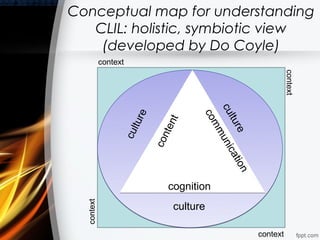
A successful CLIL lesson should
   combine elements of the following
               (the 4Cs):
• Content - Progression in knowledge, skills and
  understanding related to specific elements of a
  defined curriculum. (It should not repeat the
  content learnt in other lessons!)
• Communication – Using language to learn and
  learning to use language. Language does not
  follow the grammatical progression found in
  language-learning settings
• Cognition-Developing thinking skills which link
  concept formation (abstract and concrete),
  understanding and language
• Culture- understanding of otherness and self,
  deepened feelings of community and global
  citizenship
Conceptual map for understanding
   CLIL: holistic, symbiotic view
    (developed by Do Coyle)
            context


                                                                        context
                                             cu
                         e


                                         co

                                               ltu
                     tur


                                    t
                                t en


                                            m

                                                  r
                  cul


                                                e
                                             mu
                             con


                                                  nic
                                                      ati
                                                         on
                                 cognition
  context


                                   culture

                                                              context
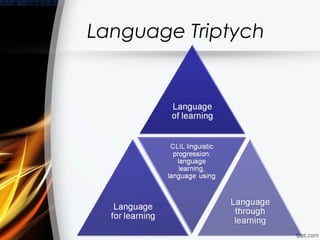
Language Triptych
Three interrelated types of
            language
• L of learning – content obligatory
  language related to the subject theme
  or topic
• L for learning – language needed to
  operate in foreign language
  environment (for pair/ group work,
  asking questions, debating, etc.)
• L through learning- new language that
  cannot be planned. This emerging
  language needs to be captured,
  recycled and developed so that it
  becomes a part of a learner’s repertoire
Lexical rather than
   grammatical approach
• Language that has real purpose and
  is dictated by the context of the
  subject
• Attention to collocations, semi-fixed
  expressions, set phrases and subject
  specific and academic vocabulary
• Chunks of language that can be
  picked up and used immediately
• There is no grading for language!
• Learners are not afraid to make
  mistakes
• Learner styles are taken into account
Benefits of CLIL
• The whole that is greater than the sum of the
  parts (synergy effect)
• Accelerates learning
• Is authentic
• Nurtures a feel good (fun!) and can do
  attitude
• Fires the brain up, fires the neurons,
  rejuvenates teaching
• Serves as a platform for ultimate students’
  interest in other languages and cultures
• Gives feelings of professional satisfaction and
   cooperation to teachers
• Parents are for it
• Beneficial for the school
Discouraging factors/
          limitations
• CLIL is complex
• There is no single model for CLIL – the
  context is to be taken into account
• Who is to teach CLIL (language or subject
  teachers), and how to combine both?
• New concepts are always difficult to accept
• Threat to the native language, if any? Do
  academic language and terminology
  develop?
• Insufficient understanding of content through
  the medium of foreign language
• CLIL methodology and assessment are not
  clear – teachers have to be supported
• Teacher overload, shortage of materials
Current ELT interest in
         CLIL
• CLIL programs are becoming
  common place in numerous
  countries in Europe (Austria,
  Finland, Spain (all subjects in
  Basque country), the
  Netherlands)

• Language teachers help subject
  teachers. The aim is to have
  subject teachers teaching CLIL
  by themselves.
Topics to be Covered

Water:
•   Pollution of the Baltic Sea
•   Stabilization of sand dunes
•   Rising sea levels
•   Seaside littering
•   Recession of beaches
•   Oil platforms in the Baltic Sea
•   Coastal erosion & coastal defenses
•   Saving flora & fauna of the Baltic Sea
•   Pollution of rivers
•   Surface water quality
•   Sunken ships at the coast of Denmark
What is Ecology to do with CLIL?


In CLIL, language learning is based on
  characteristics of ecology, i.e. it is
  holistic, interactive, dynamic, non-
  linear, complex, unpredictable, and
  situated in a certain context.
For this, the teacher needs
  creativity, initiative , and effort.


SO LET’S GO GREEN IN TEACHING!
List of References

•   Coyle, D., Hood, P. and D. Marsh 2010. CLIL Content and
    Language integrated Learning. CUP
•   Integruotas dalyko ir užsienio kalbos mokymas. Lietuvos
    Respublikos Švietimo ir mokslo ministerija, Vilnius, 2007
•   Ceruti, M. A. On Solid Ground. Matching Practice and Theory
    in a CLIL Perspective. Studies about Languages 16/2010
•   Järvinen, H. M. What is Ecology to do with CLIL? An
    Ecological Approach in CLIL. International CLIL Research
    Journal 2009
•   Lasagabaster D. and Sierra J. M. Language Attitudes in CLIL
    and Traditional ELF Classes. International CLIL Research
    Journal 1/2009
•   Janulienė A. On the Use of CLIL at Lithuanian Schools.
    Verbum 2010

Session 6

  • 1.
    CLIL Essentials (Content and Language Integrated Learning) Empowerment program
  • 2.
    What is CLIL? •An umbrella term covering a dozen of educational approaches (immersion, bilingual education, multilingual education, language showers, bains linguistiques...) • A continuum of educational approaches devoted to two main components – language and content • CLIL is referred to as dual-focused education as lessons have two main aims, one related to particular subject or topic and one linked to language. (The British Council page) • Neither ‘translation’ of first language teaching into another language, nor ‘disguised’ systematic grammar.
  • 3.
    Is it CLILor not CLIL? • Bilingual teaching • Immersion • LSP/ESP (Language/English for Specific Purposes) • Academic language teaching • International Baccalaureate • …
  • 4.
    CLIL-Classroom principles • Languageis used to learn as well as to communicate • It is the subject matter which determines the language needed to learn • Subject is taught in simple easily comprehensible ways, using diagrams, illustrations, graphs, highlighted terms • Language – subject based vocabulary, texts and discussions. If needed, L1 can be used
  • 5.
    A successful CLILlesson should combine elements of the following (the 4Cs): • Content - Progression in knowledge, skills and understanding related to specific elements of a defined curriculum. (It should not repeat the content learnt in other lessons!) • Communication – Using language to learn and learning to use language. Language does not follow the grammatical progression found in language-learning settings • Cognition-Developing thinking skills which link concept formation (abstract and concrete), understanding and language • Culture- understanding of otherness and self, deepened feelings of community and global citizenship
  • 6.
    Conceptual map forunderstanding CLIL: holistic, symbiotic view (developed by Do Coyle) context context cu e co ltu tur t t en m r cul e mu con nic ati on cognition context culture context
  • 7.
  • 8.
    Three interrelated typesof language • L of learning – content obligatory language related to the subject theme or topic • L for learning – language needed to operate in foreign language environment (for pair/ group work, asking questions, debating, etc.) • L through learning- new language that cannot be planned. This emerging language needs to be captured, recycled and developed so that it becomes a part of a learner’s repertoire
  • 9.
    Lexical rather than grammatical approach • Language that has real purpose and is dictated by the context of the subject • Attention to collocations, semi-fixed expressions, set phrases and subject specific and academic vocabulary • Chunks of language that can be picked up and used immediately • There is no grading for language! • Learners are not afraid to make mistakes • Learner styles are taken into account
  • 10.
    Benefits of CLIL •The whole that is greater than the sum of the parts (synergy effect) • Accelerates learning • Is authentic • Nurtures a feel good (fun!) and can do attitude • Fires the brain up, fires the neurons, rejuvenates teaching • Serves as a platform for ultimate students’ interest in other languages and cultures • Gives feelings of professional satisfaction and cooperation to teachers • Parents are for it • Beneficial for the school
  • 11.
    Discouraging factors/ limitations • CLIL is complex • There is no single model for CLIL – the context is to be taken into account • Who is to teach CLIL (language or subject teachers), and how to combine both? • New concepts are always difficult to accept • Threat to the native language, if any? Do academic language and terminology develop? • Insufficient understanding of content through the medium of foreign language • CLIL methodology and assessment are not clear – teachers have to be supported • Teacher overload, shortage of materials
  • 12.
    Current ELT interestin CLIL • CLIL programs are becoming common place in numerous countries in Europe (Austria, Finland, Spain (all subjects in Basque country), the Netherlands) • Language teachers help subject teachers. The aim is to have subject teachers teaching CLIL by themselves.
  • 13.
    Topics to beCovered Water: • Pollution of the Baltic Sea • Stabilization of sand dunes • Rising sea levels • Seaside littering • Recession of beaches • Oil platforms in the Baltic Sea • Coastal erosion & coastal defenses • Saving flora & fauna of the Baltic Sea • Pollution of rivers • Surface water quality • Sunken ships at the coast of Denmark
  • 14.
    What is Ecologyto do with CLIL? In CLIL, language learning is based on characteristics of ecology, i.e. it is holistic, interactive, dynamic, non- linear, complex, unpredictable, and situated in a certain context. For this, the teacher needs creativity, initiative , and effort. SO LET’S GO GREEN IN TEACHING!
  • 15.
    List of References • Coyle, D., Hood, P. and D. Marsh 2010. CLIL Content and Language integrated Learning. CUP • Integruotas dalyko ir užsienio kalbos mokymas. Lietuvos Respublikos Švietimo ir mokslo ministerija, Vilnius, 2007 • Ceruti, M. A. On Solid Ground. Matching Practice and Theory in a CLIL Perspective. Studies about Languages 16/2010 • Järvinen, H. M. What is Ecology to do with CLIL? An Ecological Approach in CLIL. International CLIL Research Journal 2009 • Lasagabaster D. and Sierra J. M. Language Attitudes in CLIL and Traditional ELF Classes. International CLIL Research Journal 1/2009 • Janulienė A. On the Use of CLIL at Lithuanian Schools. Verbum 2010