What is CLIL  (A brief theoretical overview) Dalia-Ona Pinkevi čienė Loreta Zavadskienė
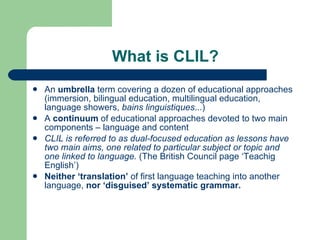
What is CLIL? An  umbrella  term covering a dozen of educational approaches (immersion, bilingual education, multilingual education, language showers,  bains linguistiques ...)  A  continuum  of educational approaches devoted to two main components – language and content CLIL is referred to as dual-focused education as lessons have two main aims, one related to particular subject or topic and one linked to language.  (The British Council page ‘Teachig English’) Neither ‘translation’  of first language teaching into another language,  nor ‘disguised’ systematic grammar.
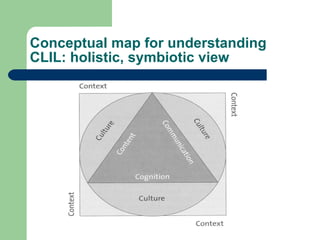
Conceptual map for understanding CLIL: holistic, symbiotic view
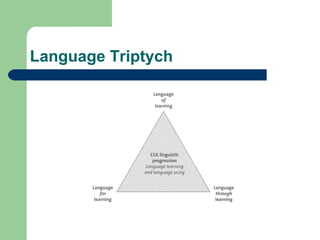
Language Triptych
Benefits of CLIL The whole that is  greater  than the sum of the parts Accelerates  learning Nurtures a  feel good ( fun!)   and  can do   attitude towards language learning in general Fires   the brain up , fires the neurons Rejuvenates  teaching (David Marsh) Serves as a  platform  for ultimate  students’  interest in other languages and cultures Gives  feelings of  professional  satisfaction  and  cooperation  to teachers
Discouraging factors CLIL is  complex There is  no single model  for CLIL – the context is to be taken into account Who is to teach CLIL  (language or subject teachers), and how to combine both? Threat  to the  native language Insufficient understanding  of  content  through the medium of foreign language CLIL methodology and assessment are not clear – teachers have to be  supported Teacher  overload
Current ELT interest in CLIL CLIL programs are becoming common place in numerous countries in Europe (Austria, Finland, Spain, the Netherlands) BUT NOT  SO MUCH  IN LITHUANIA!
What is Ecology to do with CLIL? In CLIL, l anguage learning is based on characteristics of ecology, i.e. it is  holistic, interactive, dynamic, non-linear, complex, unpredictable, and situated in a certain context.  For this, the teacher needs creativity, initiative , and effort. SO LET’S GO GREEN IN TEACHIN G!
List of References Coyle, D., Hood, P. and D. Marsh 2010.  CLIL  Content and Language integrated Learning.  CUP Integruotas dalyko ir užsienio kalbos mokymas.  Lietuvos Respublikos Švietimo ir mokslo ministerija, Vilnius,  2007 Ceruti, M. A. On Solid Ground. Matching Practice and Theory in a CLIL Perspective.  Studies about Languages  16/2010 J ä rvinen, H. M. What is Ecology to do with CLIL? An Ecological Approach in CLIL.  International CLIL Research Journal   2009 Lasagabaster D. and Sierra J. M. Language Attitudes in CLIL and Traditional ELF Classes.  International CLIL Research Journal   1/2009 Janulien ė A. On the Use of CLIL at Lithuanian Schools.  Verbum  2010

About CLIL

  • 1.
    What is CLIL (A brief theoretical overview) Dalia-Ona Pinkevi čienė Loreta Zavadskienė
  • 2.
    What is CLIL?An umbrella term covering a dozen of educational approaches (immersion, bilingual education, multilingual education, language showers, bains linguistiques ...) A continuum of educational approaches devoted to two main components – language and content CLIL is referred to as dual-focused education as lessons have two main aims, one related to particular subject or topic and one linked to language. (The British Council page ‘Teachig English’) Neither ‘translation’ of first language teaching into another language, nor ‘disguised’ systematic grammar.
  • 3.
    Conceptual map forunderstanding CLIL: holistic, symbiotic view
  • 4.
  • 5.
    Benefits of CLILThe whole that is greater than the sum of the parts Accelerates learning Nurtures a feel good ( fun!) and can do attitude towards language learning in general Fires the brain up , fires the neurons Rejuvenates teaching (David Marsh) Serves as a platform for ultimate students’ interest in other languages and cultures Gives feelings of professional satisfaction and cooperation to teachers
  • 6.
    Discouraging factors CLILis complex There is no single model for CLIL – the context is to be taken into account Who is to teach CLIL (language or subject teachers), and how to combine both? Threat to the native language Insufficient understanding of content through the medium of foreign language CLIL methodology and assessment are not clear – teachers have to be supported Teacher overload
  • 7.
    Current ELT interestin CLIL CLIL programs are becoming common place in numerous countries in Europe (Austria, Finland, Spain, the Netherlands) BUT NOT SO MUCH IN LITHUANIA!
  • 8.
    What is Ecologyto do with CLIL? In CLIL, l anguage learning is based on characteristics of ecology, i.e. it is holistic, interactive, dynamic, non-linear, complex, unpredictable, and situated in a certain context. For this, the teacher needs creativity, initiative , and effort. SO LET’S GO GREEN IN TEACHIN G!
  • 9.
    List of ReferencesCoyle, D., Hood, P. and D. Marsh 2010. CLIL Content and Language integrated Learning. CUP Integruotas dalyko ir užsienio kalbos mokymas. Lietuvos Respublikos Švietimo ir mokslo ministerija, Vilnius, 2007 Ceruti, M. A. On Solid Ground. Matching Practice and Theory in a CLIL Perspective. Studies about Languages 16/2010 J ä rvinen, H. M. What is Ecology to do with CLIL? An Ecological Approach in CLIL. International CLIL Research Journal 2009 Lasagabaster D. and Sierra J. M. Language Attitudes in CLIL and Traditional ELF Classes. International CLIL Research Journal 1/2009 Janulien ė A. On the Use of CLIL at Lithuanian Schools. Verbum 2010