CLIL Content   and   language   integrated   learning
What   is   CLIL ? It is a dual-focused educational approach in which an additional language is used for the learning and teaching of both content and language .
Where does  CLIL  come from? It was coined in 1994, but the first known  CLIL -type programme dates back some 5000 years to what is now Iraq. CLIL  seeks to support second-language learning while also favouring first-language development
The rise of  CLIL By the mid-90s globalization was placing greater linguistic demands on mainstream education. It has made the world interconnected. The world is becoming a mixed global village.
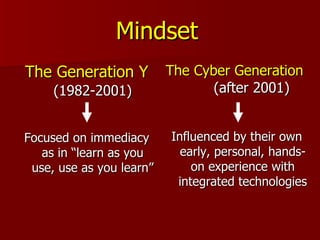
Mindset   The Generation Y   (1982-2001) Focused on immediacy as in “learn as you use, use as you learn” The Cyber Generation   (after 2001) Influenced by their own early, personal, hands-on experience with integrated technologies
CLIL  strategies A language that is not the student’s native language Content teachers Language teachers in  CLIL  programmes supporting content teachers
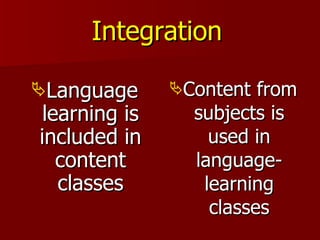
Integration   Language learning is included in content classes Content from subjects is used in language-learning classes
CLIL  content goals  are supported by  language goals In addition to a focus on content and language there is a third element The development of  learning skills
 
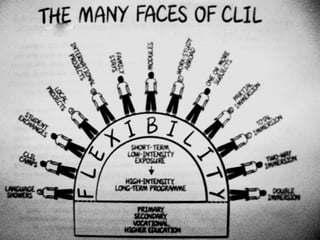
The many faces of  CLIL Language showers CLIL camps Student exchanges Local projects International projects Family stays Modules Work-study abroad One or more subjects Partial immersion Total immersion Two-way-immersion Double immersion
Language showers For students between 4-10 years old Between 30 minutes/1 hour of exposure per day Strategies:  games, songs, visual, realia and handling of objects and movements Teacher:  speaks in  CLIL  language Goals:   * be aware of the existence of different languages,  * be prepared for language learning Suggested activities: Routine activities (lunchtime, get dressed) Strategies:  repetition, miming, gesturing pointing, songs to teach new vocabulary
CLIL camps For students coming from one school Purpose-designed location  Length:  5 days Organization:   * students are sub-divided into teams, * there are rules (all participants must use the  CLIL  language), *  could be a system of tokens and fines Goals:   * experience success in living a second-language environment, * have fun and associate the  CLIL  language with an enjoyable experience, *  motivate students to continue second-language study, * inspire students to continue learning the  CLIL  language
CLIL camps Suggested activities for children from 9 years old:   * hiking and orienteering,  * a final talent show,  * student teaching Suggested activities for very young children: * a walkabout in the nature environment,  * planning and building birdhouses,  * doing competitive and non-competitive sports
International projects Need to lead to concrete accomplishments and enable students to connect with new ideas, sources and people Schools can either join existing projects or create a project of their own Goals:   * help students assume greater responsibility for their learning,  * motivate students,  * create opportunities for contact and communication with other speakers of the  CLIL  language, *  develop skills in communication, information and communication technologies, teamwork and problem solving,  * develop reasoning, enquiry, critical and creative thinking and evaluation skills
Suggested activities http://www.scienceacross.org/index.cfm?fuseaction=content.showhomepage&CFID=1219843&CFTOKEN=94713940 To choose a topic and develop it with the help of parents, members of the local community, etc.
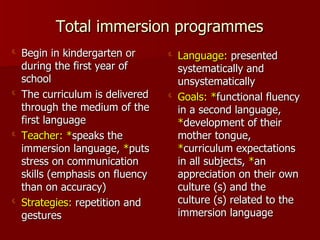
Total immersion programmes Begin in kindergarten or during the first year of school The curriculum is delivered through the medium of the first language Teacher:   * speaks the immersion language,  * puts stress on communication skills (emphasis on fluency than on accuracy) Strategies:  repetition and gestures Language:  presented systematically and unsystematically Goals:   * functional fluency in a second language,  * development of their mother tongue,  * curriculum expectations in all subjects,  * an appreciation on their own culture (s) and the culture (s) related to the immersion language
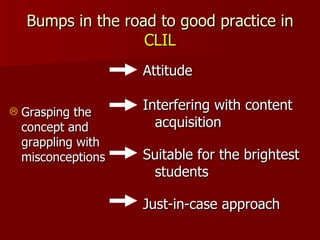
Bumps in the road to good practice in  CLIL Grasping the concept and grappling with misconceptions Attitude   Interfering with content acquisition Suitable for the brightest students Just-in-case approach
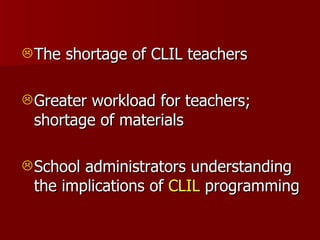
The shortage of CLIL teachers Greater workload for teachers; shortage of materials School administrators understanding the implications of  CLIL  programming

Clil

  • 1.
    CLIL Content and language integrated learning
  • 2.
    What is CLIL ? It is a dual-focused educational approach in which an additional language is used for the learning and teaching of both content and language .
  • 3.
    Where does CLIL come from? It was coined in 1994, but the first known CLIL -type programme dates back some 5000 years to what is now Iraq. CLIL seeks to support second-language learning while also favouring first-language development
  • 4.
    The rise of CLIL By the mid-90s globalization was placing greater linguistic demands on mainstream education. It has made the world interconnected. The world is becoming a mixed global village.
  • 5.
    Mindset The Generation Y (1982-2001) Focused on immediacy as in “learn as you use, use as you learn” The Cyber Generation (after 2001) Influenced by their own early, personal, hands-on experience with integrated technologies
  • 6.
    CLIL strategiesA language that is not the student’s native language Content teachers Language teachers in CLIL programmes supporting content teachers
  • 7.
    Integration Language learning is included in content classes Content from subjects is used in language-learning classes
  • 8.
    CLIL contentgoals are supported by language goals In addition to a focus on content and language there is a third element The development of learning skills
  • 9.
  • 10.
    The many facesof CLIL Language showers CLIL camps Student exchanges Local projects International projects Family stays Modules Work-study abroad One or more subjects Partial immersion Total immersion Two-way-immersion Double immersion
  • 11.
    Language showers Forstudents between 4-10 years old Between 30 minutes/1 hour of exposure per day Strategies: games, songs, visual, realia and handling of objects and movements Teacher: speaks in CLIL language Goals: * be aware of the existence of different languages, * be prepared for language learning Suggested activities: Routine activities (lunchtime, get dressed) Strategies: repetition, miming, gesturing pointing, songs to teach new vocabulary
  • 12.
    CLIL camps Forstudents coming from one school Purpose-designed location Length: 5 days Organization: * students are sub-divided into teams, * there are rules (all participants must use the CLIL language), * could be a system of tokens and fines Goals: * experience success in living a second-language environment, * have fun and associate the CLIL language with an enjoyable experience, * motivate students to continue second-language study, * inspire students to continue learning the CLIL language
  • 13.
    CLIL camps Suggestedactivities for children from 9 years old: * hiking and orienteering, * a final talent show, * student teaching Suggested activities for very young children: * a walkabout in the nature environment, * planning and building birdhouses, * doing competitive and non-competitive sports
  • 14.
    International projects Needto lead to concrete accomplishments and enable students to connect with new ideas, sources and people Schools can either join existing projects or create a project of their own Goals: * help students assume greater responsibility for their learning, * motivate students, * create opportunities for contact and communication with other speakers of the CLIL language, * develop skills in communication, information and communication technologies, teamwork and problem solving, * develop reasoning, enquiry, critical and creative thinking and evaluation skills
  • 15.
    Suggested activities http://www.scienceacross.org/index.cfm?fuseaction=content.showhomepage&CFID=1219843&CFTOKEN=94713940To choose a topic and develop it with the help of parents, members of the local community, etc.
  • 16.
    Total immersion programmesBegin in kindergarten or during the first year of school The curriculum is delivered through the medium of the first language Teacher: * speaks the immersion language, * puts stress on communication skills (emphasis on fluency than on accuracy) Strategies: repetition and gestures Language: presented systematically and unsystematically Goals: * functional fluency in a second language, * development of their mother tongue, * curriculum expectations in all subjects, * an appreciation on their own culture (s) and the culture (s) related to the immersion language
  • 17.
    Bumps in theroad to good practice in CLIL Grasping the concept and grappling with misconceptions Attitude Interfering with content acquisition Suitable for the brightest students Just-in-case approach
  • 18.
    The shortage ofCLIL teachers Greater workload for teachers; shortage of materials School administrators understanding the implications of CLIL programming