UNIT 1 INTRODUCTION TO LEARNING CURRICULUM CONCEPTS THROUGH THE MEDIUM OF ANOTHER LANGUAGE
AIMS OF THE SESSION Knowing what is CLIL. Kwowing its historical background. Understanding its rapid widespread around Europe and Spain.
CONTENTS OF THE SESSION Warm up activity Teacher’s speech on topic History Names Definition Key terms  Reasons / advantages Obstacles European Organisations The Valencian Project Debate on topic Implementation
WARM UP What makes CLIL so innovative? Is CLIL a hindrance for the mother tongue? What languages are usually taught? Is CLIL just for gifted students?
A BRIEF HISTORY (I) International schools Subjects taught in one of the world’s majority languages (French, English, German, Spanish) EU language policy Native language + two languages of the Union
A BRIEF HISTORY (II) 1990: Lingua Program 1993: Language Learning for European Citizenship. 1995: European White Paper on Education and Training. 1996: EuroCLIC Network, the term CLIL introduced, “Learning and Teaching Non-language Subjects through a Foreign Language”. 2001: availability of a comprehensive typology of European CLIL 2002: European Year of Languages. CLIL Compendium. 2004: Action Plan for the Promotion of Language Learning & Linguistic Diversity 2005: The Potential of Plurilingual Education symposium
MANY NAMES CLIP CBI CBLI CBLT EAC EAL EMI FLIP FLAME LAC TCTE TETC TCFL DFI BCT CLIL
DEFINITION Teaching subjects to students through a foreign language (David Marsh, 1994). All types of provision in which a second language is used to teach certain subjects in the curriculum other than the language lessons themselves (Eurydice Report, 2006).
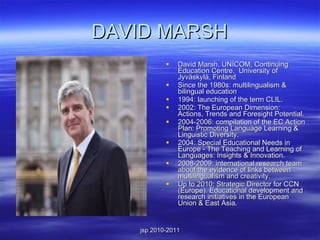
DAVID MARSH David Marsh, UNICOM, Continuing Education Centre,  University of Jyväskylä, Finland Since the 1980s: multilingualism & bilingual education 1994: launching of the term CLIL.  2002: The European Dimension: Actions, Trends and Foresight Potential.   2004-2006: compilation of the EC Action Plan: Promoting Language Learning & Linguistic Diversity.   2004: Special Educational Needs in Europe - The Teaching and Learning of Languages: Insights & Innovation. 2008-2009: international research team about the evidence of links between multilingualism and creativity.  Up to 2010: Strategic Director for CCN (Europe). Educational development and research initiatives in the European Union & East Asia.   
CLIL KEY TERMS (I) Additional Language Bilingual Environment  Certification  Discourse Type  Exposure  Low Medium High Foreign Language ICT  Immersion Method  Intercultural Knowledge & Understanding. Language Awareness  Language Shower  Learning Styles
CLIL KEY TERMS (II) Learning Strategies  Majority Language Minority Language  Monolingual Environment  Mother Tongue  Multilingual Environment  Native Speaker  Plurilingual Attitudes  School Profile  Second Language  Target Language  Trans-languaging
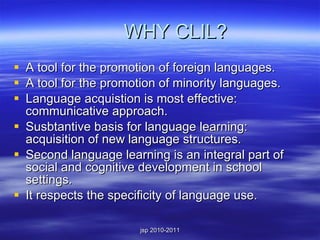
WHY CLIL? A tool for the promotion of foreign languages. A tool for the promotion of minority languages. Language acquistion is most effective: communicative approach. Susbtantive basis for language learning: acquisition of new language structures. Second language learning is an integral part of social and cognitive development in school settings. It respects the specificity of language use.
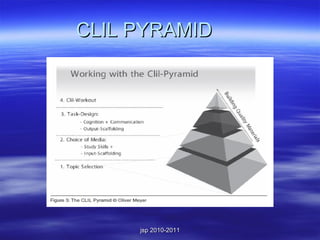
CLIL PYRAMID
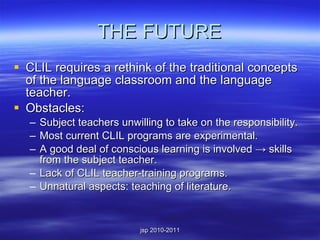
THE FUTURE CLIL requires a rethink of the traditional concepts of the language classroom and the language teacher. Obstacles: Subject teachers unwilling to take on the responsibility. Most current CLIL programs are experimental. A good deal of conscious learning is involved  -> skills from the subject teacher. Lack of CLIL teacher-training programs. Unnatural aspects: teaching of literature.
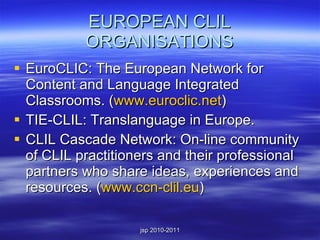
EUROPEAN CLIL ORGANISATIONS EuroCLIC: The European Network for Content and Language Integrated Classrooms. ( www.euroclic.net ) TIE-CLIL: Translanguage in Europe. CLIL Cascade Network: On-line community of CLIL practitioners and their professional partners who share ideas, experiences and resources. ( www.ccn-clil.eu )
PEBE  Valencian Community Plurilingual Project Primary 1st Decree: DOGV July 14th, 1998 ( 1 ) Primary current Decree: DOCV July 21st, 2007 ( 2 ) Preprimary 1st Decree: DOGV August 21st, 2008 Secondary current Decree: DOCV April 26th, 2010. ( 3 )
DEBATE ON TOPIC Would you like to start a multilingual programme in your school? How would you do it? What results could you expect?
HOW TO DO IT? School project accepted by School Board and Staff. The plurilingual program is based on a Bilingual Program (PIP or PEV) Subjects in foreign language: maximum 2. Foreign language = vehicular language. Communicative approach. LIL / CLIL. Two ways:  subject teacher using English as the language of instruction (teachers with “Capacitació”) Subject teacher without foreign language skills + English teacher (simultaneously) Two hours for coordinating non-language teachers with language teachers. Teachers involved in the project must prepare materials and share them with other teachers.
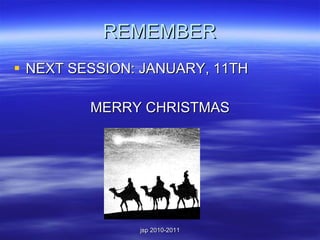
REMEMBER NEXT SESSION: JANUARY, 11TH MERRY CHRISTMAS

Unit 1 introduction to clil

  • 1.
    UNIT 1 INTRODUCTIONTO LEARNING CURRICULUM CONCEPTS THROUGH THE MEDIUM OF ANOTHER LANGUAGE
  • 2.
    AIMS OF THESESSION Knowing what is CLIL. Kwowing its historical background. Understanding its rapid widespread around Europe and Spain.
  • 3.
    CONTENTS OF THESESSION Warm up activity Teacher’s speech on topic History Names Definition Key terms Reasons / advantages Obstacles European Organisations The Valencian Project Debate on topic Implementation
  • 4.
    WARM UP Whatmakes CLIL so innovative? Is CLIL a hindrance for the mother tongue? What languages are usually taught? Is CLIL just for gifted students?
  • 5.
    A BRIEF HISTORY(I) International schools Subjects taught in one of the world’s majority languages (French, English, German, Spanish) EU language policy Native language + two languages of the Union
  • 6.
    A BRIEF HISTORY(II) 1990: Lingua Program 1993: Language Learning for European Citizenship. 1995: European White Paper on Education and Training. 1996: EuroCLIC Network, the term CLIL introduced, “Learning and Teaching Non-language Subjects through a Foreign Language”. 2001: availability of a comprehensive typology of European CLIL 2002: European Year of Languages. CLIL Compendium. 2004: Action Plan for the Promotion of Language Learning & Linguistic Diversity 2005: The Potential of Plurilingual Education symposium
  • 7.
    MANY NAMES CLIPCBI CBLI CBLT EAC EAL EMI FLIP FLAME LAC TCTE TETC TCFL DFI BCT CLIL
  • 8.
    DEFINITION Teaching subjectsto students through a foreign language (David Marsh, 1994). All types of provision in which a second language is used to teach certain subjects in the curriculum other than the language lessons themselves (Eurydice Report, 2006).
  • 9.
    DAVID MARSH DavidMarsh, UNICOM, Continuing Education Centre,  University of Jyväskylä, Finland Since the 1980s: multilingualism & bilingual education 1994: launching of the term CLIL. 2002: The European Dimension: Actions, Trends and Foresight Potential.  2004-2006: compilation of the EC Action Plan: Promoting Language Learning & Linguistic Diversity.   2004: Special Educational Needs in Europe - The Teaching and Learning of Languages: Insights & Innovation. 2008-2009: international research team about the evidence of links between multilingualism and creativity. Up to 2010: Strategic Director for CCN (Europe). Educational development and research initiatives in the European Union & East Asia.  
  • 10.
    CLIL KEY TERMS(I) Additional Language Bilingual Environment Certification Discourse Type Exposure Low Medium High Foreign Language ICT Immersion Method Intercultural Knowledge & Understanding. Language Awareness Language Shower Learning Styles
  • 11.
    CLIL KEY TERMS(II) Learning Strategies Majority Language Minority Language Monolingual Environment Mother Tongue Multilingual Environment Native Speaker Plurilingual Attitudes School Profile Second Language Target Language Trans-languaging
  • 12.
    WHY CLIL? Atool for the promotion of foreign languages. A tool for the promotion of minority languages. Language acquistion is most effective: communicative approach. Susbtantive basis for language learning: acquisition of new language structures. Second language learning is an integral part of social and cognitive development in school settings. It respects the specificity of language use.
  • 13.
  • 14.
    THE FUTURE CLILrequires a rethink of the traditional concepts of the language classroom and the language teacher. Obstacles: Subject teachers unwilling to take on the responsibility. Most current CLIL programs are experimental. A good deal of conscious learning is involved -> skills from the subject teacher. Lack of CLIL teacher-training programs. Unnatural aspects: teaching of literature.
  • 15.
    EUROPEAN CLIL ORGANISATIONSEuroCLIC: The European Network for Content and Language Integrated Classrooms. ( www.euroclic.net ) TIE-CLIL: Translanguage in Europe. CLIL Cascade Network: On-line community of CLIL practitioners and their professional partners who share ideas, experiences and resources. ( www.ccn-clil.eu )
  • 16.
    PEBE ValencianCommunity Plurilingual Project Primary 1st Decree: DOGV July 14th, 1998 ( 1 ) Primary current Decree: DOCV July 21st, 2007 ( 2 ) Preprimary 1st Decree: DOGV August 21st, 2008 Secondary current Decree: DOCV April 26th, 2010. ( 3 )
  • 17.
    DEBATE ON TOPICWould you like to start a multilingual programme in your school? How would you do it? What results could you expect?
  • 18.
    HOW TO DOIT? School project accepted by School Board and Staff. The plurilingual program is based on a Bilingual Program (PIP or PEV) Subjects in foreign language: maximum 2. Foreign language = vehicular language. Communicative approach. LIL / CLIL. Two ways: subject teacher using English as the language of instruction (teachers with “Capacitació”) Subject teacher without foreign language skills + English teacher (simultaneously) Two hours for coordinating non-language teachers with language teachers. Teachers involved in the project must prepare materials and share them with other teachers.
  • 19.
    REMEMBER NEXT SESSION:JANUARY, 11TH MERRY CHRISTMAS