


Sungwoo Kim
 Real world problem-driven 
 Solution-oriented 
 Interdisciplinarity/Multidisplinarity
“The term 'applied linguistics' refers to a broad range 
of activities which involve solving some language-related 
problem or addressing some language-related 
concern.” 
http://www.linguisticsociety.org/resource/applied-linguistics
“Applied Linguistics itself is an interdisciplinary field of 
inquiry that addresses a broad range of language-related 
issues in order to improve the lives of individuals and 
conditions in society. It draws on a wide range of 
theoretical, methodological, and educational approaches 
from various disciplines–from the humanities to the 
social, cognitive, medical, and natural sciences–as it 
develops its own knowledge-base about language, its 
users and uses, and their underlying social and material 
conditions.” (AAAL) 
http://www.aaal.org/content.asp?contentid=133
Applied Linguistics is an interdisciplinary field of 
research and practice dealing with practical problems 
of language and communication that can be identified, 
analysed or solved by applying available theories, 
methods and results of Linguistics or by developing 
new theoretical and methodological frameworks in 
Linguistics to work on these problems. Applied 
Linguistics differs from Linguistics in general mainly 
with respect to its explicit orientation towards 
practical, everyday problems related to language and 
communication. 
(http://www.aila.info/about.html)
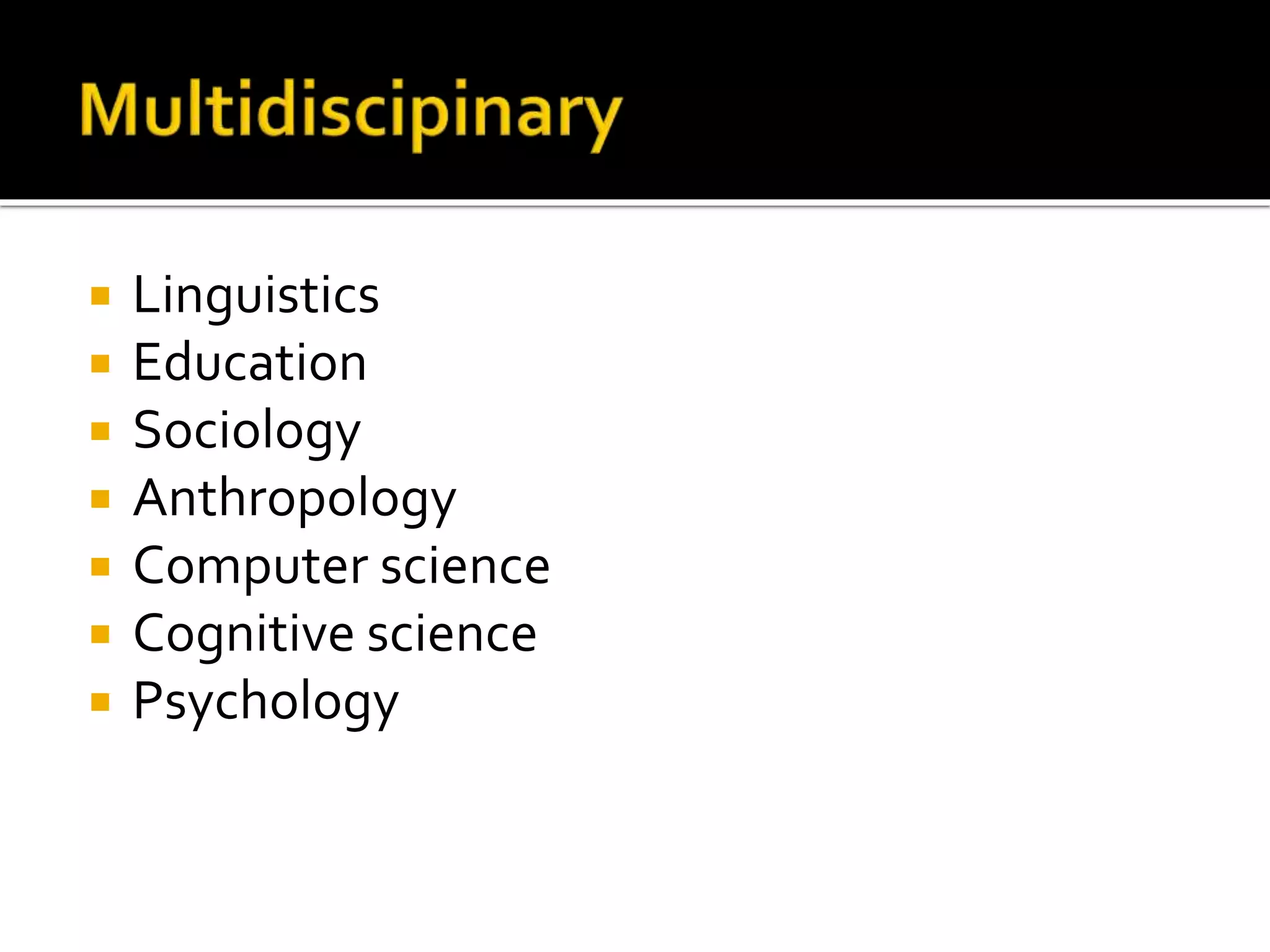
 Linguistics 
 Education 
 Sociology 
 Anthropology 
 Computer science 
 Cognitive science 
 Psychology
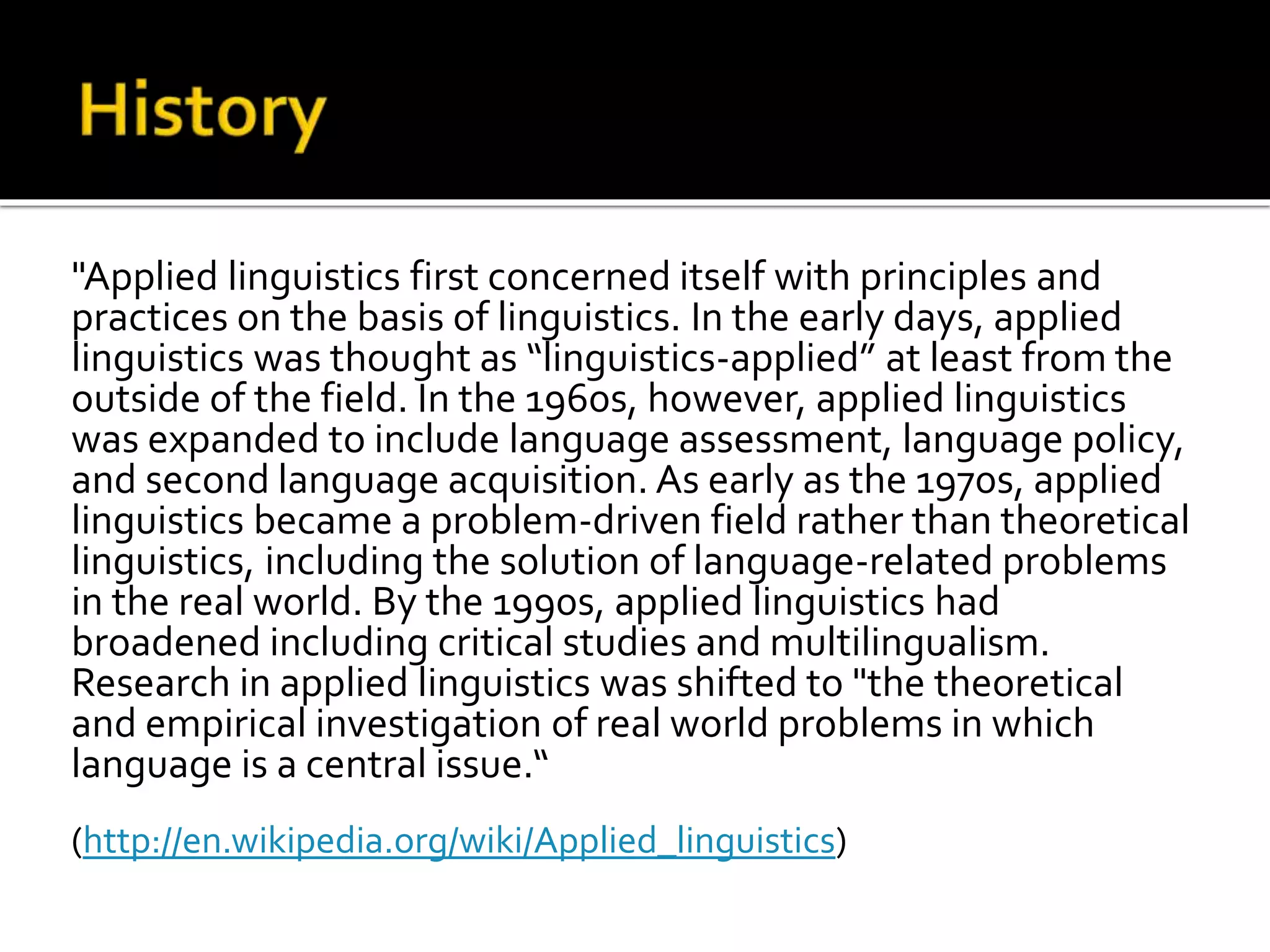
"Applied linguistics first concerned itself with principles and 
practices on the basis of linguistics. In the early days, applied 
linguistics was thought as “linguistics-applied” at least from the 
outside of the field. In the 1960s, however, applied linguistics 
was expanded to include language assessment, language policy, 
and second language acquisition. As early as the 1970s, applied 
linguistics became a problem-driven field rather than theoretical 
linguistics, including the solution of language-related problems 
in the real world. By the 1990s, applied linguistics had 
broadened including critical studies and multilingualism. 
Research in applied linguistics was shifted to "the theoretical 
and empirical investigation of real world problems in which 
language is a central issue.“ 
(http://en.wikipedia.org/wiki/Applied_linguistics)
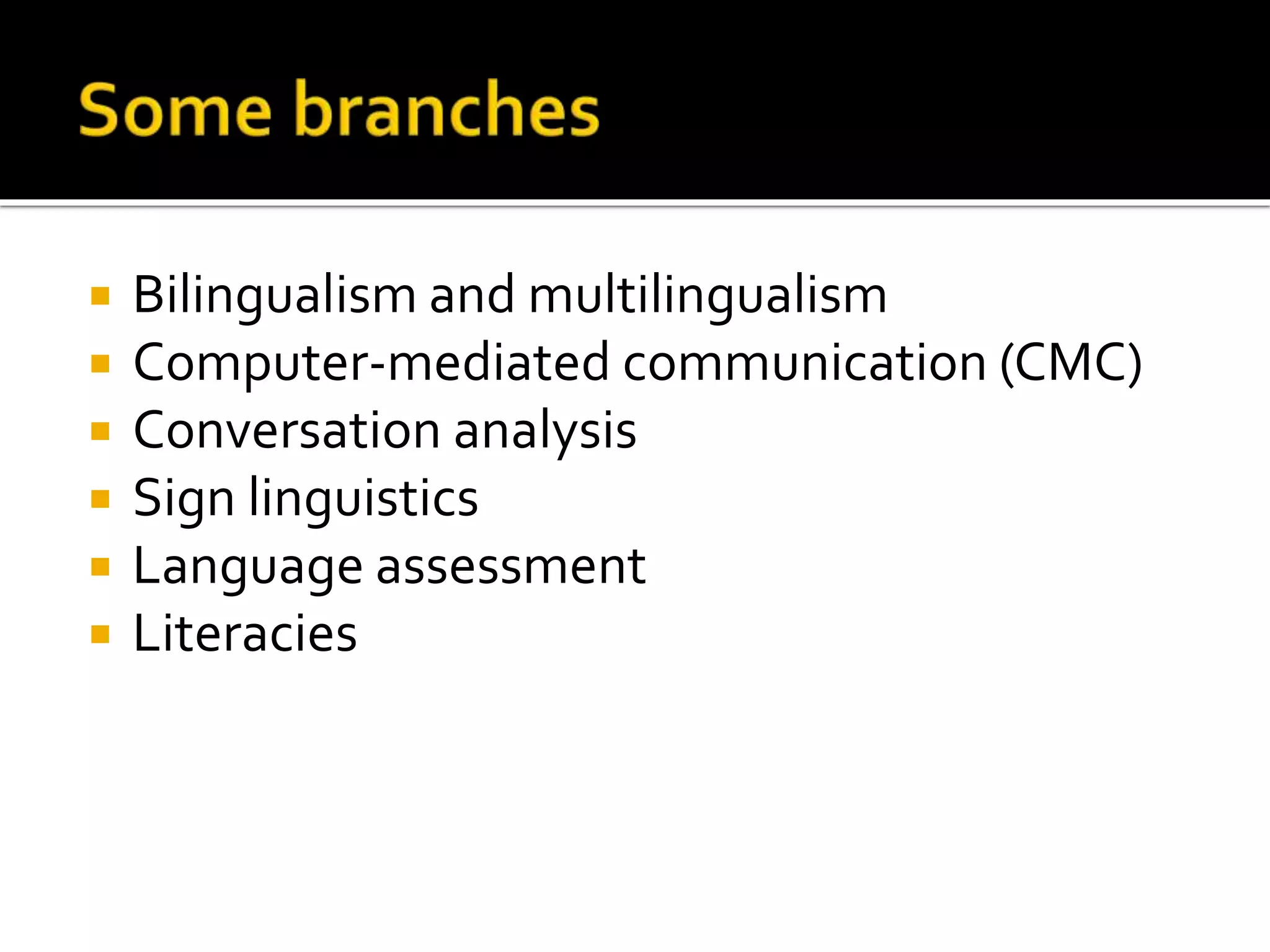
 Bilingualism and multilingualism 
 Computer-mediated communication (CMC) 
 Conversation analysis 
 Sign linguistics 
 Language assessment 
 Literacies
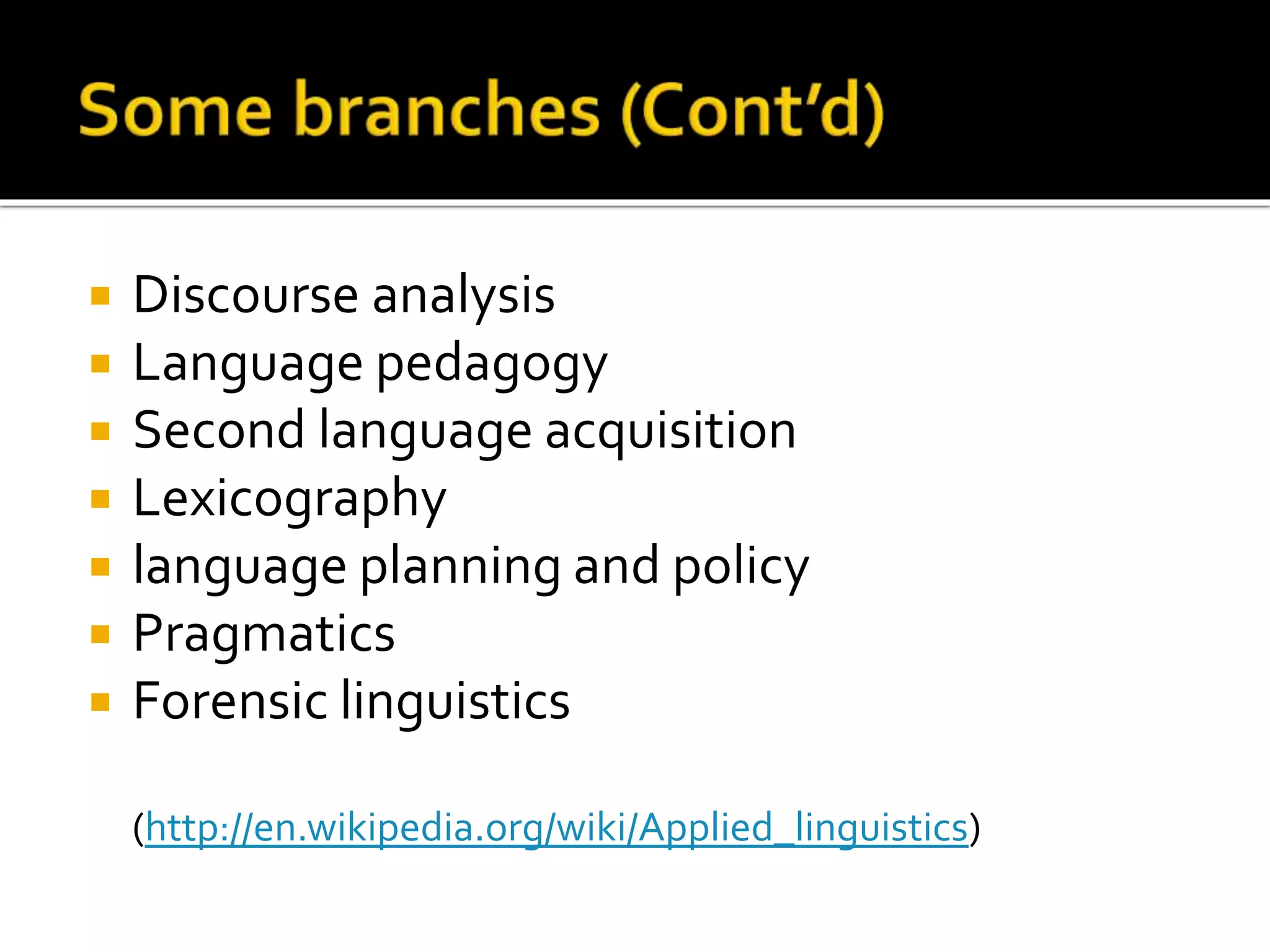
 Discourse analysis 
 Language pedagogy 
 Second language acquisition 
 Lexicography 
 language planning and policy 
 Pragmatics 
 Forensic linguistics 
(http://en.wikipedia.org/wiki/Applied_linguistics)
What Can You do With a Masters Degree in 
Applied Linguistics? 
 http://www.salisbury.edu/careerservices/Students/Graduate 
Majors/AppliedLinguistics.html
 What kind of language-related problems are there? 
 Why are they important? 
 What are some problems around you? 
 Can you think of language-related problems on 
campus?
 Search “language-related problems” or “language-related 
issues” in Google and review first two pages. 
 What problems are identified? 
 What kinds of problems interest you most? 
 How would you solve them?

A taste of applied linguistics

  • 1.
  • 2.
     Real worldproblem-driven  Solution-oriented  Interdisciplinarity/Multidisplinarity
  • 3.
    “The term 'appliedlinguistics' refers to a broad range of activities which involve solving some language-related problem or addressing some language-related concern.” http://www.linguisticsociety.org/resource/applied-linguistics
  • 4.
    “Applied Linguistics itselfis an interdisciplinary field of inquiry that addresses a broad range of language-related issues in order to improve the lives of individuals and conditions in society. It draws on a wide range of theoretical, methodological, and educational approaches from various disciplines–from the humanities to the social, cognitive, medical, and natural sciences–as it develops its own knowledge-base about language, its users and uses, and their underlying social and material conditions.” (AAAL) http://www.aaal.org/content.asp?contentid=133
  • 5.
    Applied Linguistics isan interdisciplinary field of research and practice dealing with practical problems of language and communication that can be identified, analysed or solved by applying available theories, methods and results of Linguistics or by developing new theoretical and methodological frameworks in Linguistics to work on these problems. Applied Linguistics differs from Linguistics in general mainly with respect to its explicit orientation towards practical, everyday problems related to language and communication. (http://www.aila.info/about.html)
  • 6.
     Linguistics Education  Sociology  Anthropology  Computer science  Cognitive science  Psychology
  • 7.
    "Applied linguistics firstconcerned itself with principles and practices on the basis of linguistics. In the early days, applied linguistics was thought as “linguistics-applied” at least from the outside of the field. In the 1960s, however, applied linguistics was expanded to include language assessment, language policy, and second language acquisition. As early as the 1970s, applied linguistics became a problem-driven field rather than theoretical linguistics, including the solution of language-related problems in the real world. By the 1990s, applied linguistics had broadened including critical studies and multilingualism. Research in applied linguistics was shifted to "the theoretical and empirical investigation of real world problems in which language is a central issue.“ (http://en.wikipedia.org/wiki/Applied_linguistics)
  • 8.
     Bilingualism andmultilingualism  Computer-mediated communication (CMC)  Conversation analysis  Sign linguistics  Language assessment  Literacies
  • 9.
     Discourse analysis  Language pedagogy  Second language acquisition  Lexicography  language planning and policy  Pragmatics  Forensic linguistics (http://en.wikipedia.org/wiki/Applied_linguistics)
  • 10.
    What Can Youdo With a Masters Degree in Applied Linguistics?  http://www.salisbury.edu/careerservices/Students/Graduate Majors/AppliedLinguistics.html
  • 11.
     What kindof language-related problems are there?  Why are they important?  What are some problems around you?  Can you think of language-related problems on campus?
  • 12.
     Search “language-relatedproblems” or “language-related issues” in Google and review first two pages.  What problems are identified?  What kinds of problems interest you most?  How would you solve them?