Unit 4
The Internal Assessment
Source: David, Fred R. & David, Forest R, 16th. Edition (©2017)
Strategic Management. Pearson Education Inc., USA
Learning Objectives
4.1 Describe the nature and role of an internal assessment in
formulating strategies.
4.2 Discuss the nature and role of management in formulating
strategies.
4.3 Discuss the nature and role of marketing in formulating
strategies.
4.4 Discuss the nature and role of finance and accounting in
formulating strategies.
4.5 Discuss management information systems (MIS) in terms of
formulating strategies.
4.6 Explain how to develop and use an Internal Factor
Evaluation (IFE) Matrix.
Source: David, Fred R. & David, Forest R, 16th. Edition (©2017)
Strategic Management. Pearson Education Inc., USA 2
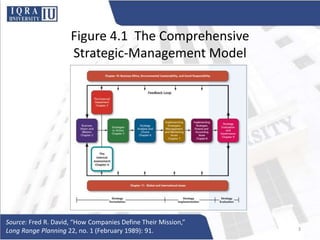
Figure 4.1 The Comprehensive
Strategic-Management Model
Source: Fred R. David, “How Companies Define Their Mission,”
Long Range Planning 22, no. 1 (February 1989): 91. 3
The Process of Performing an Internal Audit
• The internal audit
• Requires gathering, assimilating, and prioritizing
information about the firm's management, marketing,
finance, accounting, production/operations, research
and development (R and D), and management
information systems operations
• Provides more opportunity for participants to
understand how their jobs, departments, and
divisions fit into the whole firm
Source: David, Fred R. & David, Forest R, 16th. Edition (©2017)
Strategic Management. Pearson Education Inc., USA 4
The Resource-Based View (RBV)
• The Resource-Based View (RBV) Approach
• contends that internal resources are more important
for a firm than external factors in achieving and
sustaining competitive advantage
Source: David, Fred R. & David, Forest R, 16th. Edition (©2017)
Strategic Management. Pearson Education Inc., USA 5
The Resource-Based View (RBV)
• Proponents of the RBV contend that organizational
performance will primarily be determined by internal
resources. These resources can be grouped into
• tangible
• intangible
Source: David, Fred R. & David, Forest R, 16th. Edition (©2017)
Strategic Management. Pearson Education Inc., USA 6
The Resource-Based View (RBV)
• For a resource to be valuable, it must be either:
(1) rare,
(2) hard to imitate, or
(3) not easily substitutable.
• These three characteristics of resources are called
Empirical Indicators
• These enable a firm to implement strategies that improve
its efficiency and effectiveness and lead to a sustainable
competitive advantage.
Source: David, Fred R. & David, Forest R, 16th. Edition (©2017)
Strategic Management. Pearson Education Inc., USA 7
Key Internal Forces
• Distinctive competencies
• A firm’s strengths that cannot be easily matched or
imitated by competitors
• Building competitive advantages involves taking
advantage of distinctive competencies
Source: David, Fred R. & David, Forest R, 16th. Edition (©2017)
Strategic Management. Pearson Education Inc., USA 8
Management
• The functions of management consist of four basic
activities:
1. planning
2. organizing
3. motivating
4. controlling
Source: David, Fred R. & David, Forest R, 16th. Edition (©2017)
Strategic Management. Pearson Education Inc., USA 9
The Basic Functions of Management
• Planning: forecasting, establishing objectives, devising
strategies, and developing policies
• Organizing: organizational design, job specialization, job
descriptions, span of control, coordination, job design,
and job analysis
(Continued)
Source: David, Fred R. & David, Forest R, 16th. Edition (©2017)
Strategic Management. Pearson Education Inc., USA 10
The Basic Functions of Management
• Motivating: leadership, communication, work groups,
behavior modification, delegation of authority, job
enrichment, job satisfaction, needs fulfillment,
organizational change, employee morale, and managerial
morale
• Controlling: quality control, financial control, sales
control, inventory control, expense control, analysis of
variances, rewards, and sanctions
Source: David, Fred R. & David, Forest R, 16th. Edition (©2017)
Strategic Management. Pearson Education Inc., USA 11
Production/Operations
• Production/operations function
• consists of all those activities that transform inputs
into goods and services
• Production/operations management deals with inputs,
transformations, and outputs that vary across industries
and markets.
Source: David, Fred R. & David, Forest R, 16th. Edition (©2017)
Strategic Management. Pearson Education Inc., USA 12
Integrating Strategy and Culture
• Organizational culture significantly affects planning
activities.
• If strategies can capitalize on cultural strengths, such as a
strong work ethic or highly ethical beliefs, then
management often can swiftly and easily implement
changes.
Source: David, Fred R. & David, Forest R, 16th. Edition (©2017)
Strategic Management. Pearson Education Inc., USA 13
Organizational Culture
• Organizational culture is “a pattern of behavior that has
been developed by an organization as it learns to cope
with its problem of external adaptation and internal
integration and that has worked well enough to be
considered valid and to be taught to new members as the
correct way to perceive, think, and feel.”
Source: David, Fred R. & David, Forest R, 16th. Edition (©2017)
Strategic Management. Pearson Education Inc., USA 14
Table 4.4 Aspects of Organizational Culture
Dimension Low Degree Degree Degree High
1. Strong work ethic; arrive early and leave late 1 2 3 4 5
2. High ethical beliefs; clear code of business ethics followed 1 2 3 4 5
3. Formal dress; shirt and tie expected 1 2 3 4 5
4. Informal dress; many casual dress days 1 2 3 4 5
5. Socialize together outside of work 1 2 3 4 5
6. Do not question supervisor’s decision 1 2 3 4 5
7. Encourage whistle-blowing 1 2 3 4 5
8. Be health conscious; have a wellness program 1 2 3 4 5
9. Allow substantial “working from home” 1 2 3 4 5
10. Encourage creativity, innovation, and open-mindedness 1 2 3 4 5
11. Support women and minorities; no glass ceiling 1 2 3 4 5
12. Be highly socially responsible; be philanthropic 1 2 3 4 5
13. Have numerous meetings 1 2 3 4 5
14. Have a participative management style 1 2 3 4 5
15. Preserve the natural environment; have a sustainability program 1 2 3 4 5
Fifteen Example (Possible) Aspects of an Organization’s Culture
Source: David, Fred R. & David, Forest R, 16th. Edition (©2017)
Strategic Management. Pearson Education Inc., USA
Management Audit Checklist of Questions
1. Does the firm use strategic-management concepts?
2. Are company objectives and goals measurable and well
communicated?
3. Do managers at all hierarchical levels plan effectively?
4. Do managers delegate authority well?
5. Is the organization's structure appropriate?
6. Are job descriptions and job specifications clear?
7. Is employee morale high?
8. Are employee turnover and absenteeism low?
9. Are organizational reward and control mechanisms
effective?
Source: David, Fred R. & David, Forest R, 16th. Edition (©2017)
Strategic Management. Pearson Education Inc., USA 16
Marketing
Marketing
• the process of defining, anticipating, creating, and
fulfilling customers’ needs and wants.
Source: David, Fred R. & David, Forest R, 16th. Edition (©2017)
Strategic Management. Pearson Education Inc., USA 17
Five Basic Activities in Marketing
1. Marketing research and target market analysis
2. Product planning
3. Pricing products
4. Promoting products
5. Placing or distributing products
Source: David, Fred R. & David, Forest R, 16th. Edition (©2017)
Strategic Management. Pearson Education Inc., USA 18
Marketing Research and Target Market Analysis
• Marketing Research
• the systematic gathering, recording, and analyzing of
data about problems relating to the marketing of
goods and services
• can uncover critical strengths and weaknesses
• Target Market Analysis
• The examination and evaluation of consumer needs
and wants
Source: David, Fred R. & David, Forest R, 16th. Edition (©2017)
Strategic Management. Pearson Education Inc., USA 19
Product Planning
• Product Planning
• includes activities such as test marketing; product and
brand positioning; devising warranties; packaging;
determining product options, features, style, and
quality; deleting old products; and providing for
customer service.
• important when a company is pursuing product
development or diversification
Source: David, Fred R. & David, Forest R, 16th. Edition (©2017)
Strategic Management. Pearson Education Inc., USA 20
Pricing
• Pricing
• Refers to deciding the amount an individual must
exchange to receive a firm’s product offering.
• Pricing strategies are often based on costs, demand,
the competition, or on customers’ needs.
Source: David, Fred R. & David, Forest R, 16th. Edition (©2017)
Strategic Management. Pearson Education Inc., USA 21
Promotion
• Promotion
• Includes many marketing activities, such as
advertising, sales promotion, public relations,
personal selling, and direct marketing.
• Common promotional tools designed to inform
consumers about products include TV advertising,
magazine ads, billboards, websites, and public
relations, among others.
Source: David, Fred R. & David, Forest R, 16th. Edition (©2017)
Strategic Management. Pearson Education Inc., USA 22
Distribution
• Channels of Distribution
• This is a term that refers to various intermediaries
that take a product from a producer to an end
customer.
• These intermediaries have names such as
wholesalers, retailers, brokers, facilitators, agents,
vendors, or simply distributors.
Source: David, Fred R. & David, Forest R, 16th. Edition (©2017)
Strategic Management. Pearson Education Inc., USA 23
Marketing Audit Checklist of Questions
1. Are markets segmented effectively?
2. Is the organization positioned well among competitors?
3. Are present channels of distribution reliable and cost
effective?
4. Is the firm conducting and using market research
effectively?
5. Are product quality and customer service good?
6. Are the firm's products and services priced appropriately?
7. Does the firm have an effective promotional strategy?
8. Is the firm's Internet presence excellent as compared to
rivals?
Source: David, Fred R. & David, Forest R, 16th. Edition (©2017)
Strategic Management. Pearson Education Inc., USA 24
Finance/Accounting Functions
• The functions of finance/accounting comprise three
decisions:
1. The investment decision
2. The financing decision
3. The dividend decision
Source: David, Fred R. & David, Forest R, 16th. Edition (©2017)
Strategic Management. Pearson Education Inc., USA 25
Finance/Accounting Functions
• Investment Decision (Capital Budgeting)
• the allocation and reallocation of capital and
resources to projects, products, assets, and divisions
of an organization
• Financing Decision
• determines the best capital structure for the firm and
includes examining various methods by which the
firm can raise capital
(Continued)
Source: David, Fred R. & David, Forest R, 16th. Edition (©2017)
Strategic Management. Pearson Education Inc., USA 26
Finance/Accounting Functions
• Dividend Decisions
• concern issues such as the percentage of earnings
paid to stockholders, the stability of dividends paid
over time, and the repurchase or issuance of stock
• determine the amount of funds that are retained in a
firm compared to the amount paid out to
stockholders
Source: David, Fred R. & David, Forest R, 16th. Edition (©2017)
Strategic Management. Pearson Education Inc., USA 27
Finance/Accounting Functions
1. How has each ratio changed over time?
2. How does each ratio compare to industry norms?
3. How does each ratio compare with key competitors?
Source: David, Fred R. & David, Forest R, 16th. Edition (©2017)
Strategic Management. Pearson Education Inc., USA 28
Figure 4.2 Financial Ratio Trend Analysis
Source: David, Fred R. & David, Forest R, 16th. Edition (©2017)
Strategic Management. Pearson Education Inc., USA 29
Table 4.9 A Summary of Key Financial Ratios (1 of 4)
Ratio How Calculated What it measures
Liquidity Ratios
Current Ratio
extent to which a firm can meet its short-term
obligations
Quick Ratio
The extent to which a firm can meet its short-
term obligations without relying on the sale of
its inventories
Current assets
Current liabilities
Current assets minus inventory
Current liabilities
Leverage Ratios
Debt-to-Total-
Assets Ratio
The percentage of total funds provided by
creditors
Debt-to-Equity
Ratio
The percentage of total funds provided by
creditors versus by owners
Long-Term Debt-
to-Equity Ratio
The balance between debt and equity in a
firm’s long-term capital structure
Times-Interest-
Earned Ratio
the extent to which earnings can decline
without the firm becoming unable to meet its
annual interest costs
Total debt
Total assets
Total debt
Total stockholders' equity
Long-term debt
Total stockholders' equity
Profits before interest and taxes
Total interest charges
A Summary of Key Financial Ratios (2 of 4)
Ratio How Calculated What it measures
Activity Ratios
Inventory turnover
Whether a firm holds excessive stocks of
inventories and whether a firm is slowly
selling its inventories compared to the
industry average
Fixed Assets
turnover
Sales productivity and plant and equipment
utilization
Total Assets
turnover
Whether a firm is generating a sufficient
volume of business for the size of its asset
investment
Accounts
Receivable
turnover
The average length of time it takes a firm to
collect credit sales (in percentage terms)
Average Collection
Period
The average length of time it takes a firm to
collect on credit sales (in days)
Sales
Inventory of finished goods
Sales
Fixed assets
Sales
Total assets
Annual credit sales
Accounts receivable
Accounts receivable
Total credit sales/365 days
Source: David, Fred R. & David, Forest R, 16th. Edition (©2017)
Strategic Management. Pearson Education Inc., USA
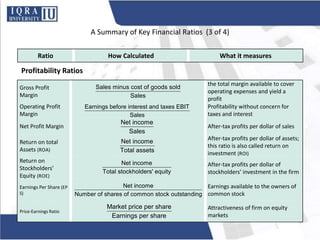
A Summary of Key Financial Ratios (3 of 4)
Ratio How Calculated What it measures
Profitability Ratios
Gross Profit
Margin
the total margin available to cover
operating expenses and yield a
profit
Operating Profit
Margin
Profitability without concern for
taxes and interest
Net Profit Margin After-tax profits per dollar of sales
Return on total
Assets (ROA)
After-tax profits per dollar of assets;
this ratio is also called return on
investment (ROI)
Return on
Stockholders’
Equity (ROE)
After-tax profits per dollar of
stockholders’ investment in the firm
Earnings Per Share (EP
S)
Earnings available to the owners of
common stock
Price-Earnings Ratio
Attractiveness of firm on equity
markets
Sales minus cost of goods sold
Sales
Earnings before interest and taxes EBIT
Sales
Net income
Sales
Net income
Total assets
Net income
Total stockholders' equity
Net income
Number of shares of common stock outstanding
Market price per share
Earnings per share
A Summary of Key Financial Ratios (4 of 4)
Ratio How Calculated What it measures
• Growth Ratios
Sales Annual percentage growth in total sales Firm’s growth rate in sales
Net Income Annual percentage growth in profits Firm’s growth rate in profits
Earnings Per Share Annual percentage growth in EPS Firm’s growth rate in EPS
Dividends Per
Share
Annual percentage growth in dividends per
share
Firm’s growth rate in dividends per share
Source: David, Fred R. & David, Forest R, 16th. Edition (©2017)
Strategic Management. Pearson Education Inc., USA
Finance/Accounting Audit Checklist
1. Where is the firm financially strong and weak as
indicated by financial ratio analyses?
2. Can the firm raise needed short-term capital?
3. Can the firm raise needed long-term capital through debt
or equity?
4. Does the firm have sufficient working capital?
5. Are capital budgeting procedures effective?
(Continued)
Source: David, Fred R. & David, Forest R, 16th. Edition (©2017)
Strategic Management. Pearson Education Inc., USA 34
Finance/Accounting Audit Checklist
6. Are dividend payout policies reasonable?
7. Does the firm have excellent relations with its investors
and stockholders?
8. Are the firm's financial managers experienced and well
trained?
9. Is the firm's debt situation excellent?
Source: David, Fred R. & David, Forest R, 16th. Edition (©2017)
Strategic Management. Pearson Education Inc., USA 35
Management Information Systems
• Management Information System
• Receives raw material from both external and internal
evaluation of an organization
• Improves the performance of an enterprise by
improving the quality of managerial decisions
• Collects, codes, stores, synthesizes, and presents
information in such a manner that it answers important
operating and strategic questions
Source: David, Fred R. & David, Forest R, 16th. Edition (©2017)
Strategic Management. Pearson Education Inc., USA 36
Business Analytics
• Business Analytics is a technique that involves using
software to mine huge volumes of data to help executives
make decisions.
• Also called predictive analytics, machine learning, or
data mining.
Source: David, Fred R. & David, Forest R, 16th. Edition (©2017)
Strategic Management. Pearson Education Inc., USA 37
The Internal Factor Evaluation (IFE) Matrix
1. List key internal factors as identified in the internal-audit
process.
2. Assign a weight that ranges from 0.0 (not important) to
1.0 (all-important) to each factor.
3. Assign a 1-to-4 rating to each factor to indicate whether
that factor represents a strength or weakness.
4. Multiply each factor's weight by its rating to determine a
weighted score for each variable.
5. Sum the weighted scores for each variable to determine
the total weighted score for the organization.
Source: David, Fred R. & David, Forest R, 16th. Edition (©2017)
Strategic Management. Pearson Education Inc., USA 38
Figure 4.3 How to Gain and
Sustain Competitive Advantages
Source: David, Fred R. & David, Forest R, 16th. Edition (©2017)
Strategic Management. Pearson Education Inc., USA 39
Session Ends
Disclaimer
The information provided in this module is derived from Pearson
Education Inc., USA, and other sources. All information is provided in
good faith for educational purposes only. Iqra University claims no
ownership of this information, and will not be liable for any claims
arising thereof, now or in the future.

Session 4 The Internal Assessment.pptx

  • 1.
    Unit 4 The InternalAssessment Source: David, Fred R. & David, Forest R, 16th. Edition (©2017) Strategic Management. Pearson Education Inc., USA
  • 2.
    Learning Objectives 4.1 Describethe nature and role of an internal assessment in formulating strategies. 4.2 Discuss the nature and role of management in formulating strategies. 4.3 Discuss the nature and role of marketing in formulating strategies. 4.4 Discuss the nature and role of finance and accounting in formulating strategies. 4.5 Discuss management information systems (MIS) in terms of formulating strategies. 4.6 Explain how to develop and use an Internal Factor Evaluation (IFE) Matrix. Source: David, Fred R. & David, Forest R, 16th. Edition (©2017) Strategic Management. Pearson Education Inc., USA 2
  • 3.
    Figure 4.1 TheComprehensive Strategic-Management Model Source: Fred R. David, “How Companies Define Their Mission,” Long Range Planning 22, no. 1 (February 1989): 91. 3
  • 4.
    The Process ofPerforming an Internal Audit • The internal audit • Requires gathering, assimilating, and prioritizing information about the firm's management, marketing, finance, accounting, production/operations, research and development (R and D), and management information systems operations • Provides more opportunity for participants to understand how their jobs, departments, and divisions fit into the whole firm Source: David, Fred R. & David, Forest R, 16th. Edition (©2017) Strategic Management. Pearson Education Inc., USA 4
  • 5.
    The Resource-Based View(RBV) • The Resource-Based View (RBV) Approach • contends that internal resources are more important for a firm than external factors in achieving and sustaining competitive advantage Source: David, Fred R. & David, Forest R, 16th. Edition (©2017) Strategic Management. Pearson Education Inc., USA 5
  • 6.
    The Resource-Based View(RBV) • Proponents of the RBV contend that organizational performance will primarily be determined by internal resources. These resources can be grouped into • tangible • intangible Source: David, Fred R. & David, Forest R, 16th. Edition (©2017) Strategic Management. Pearson Education Inc., USA 6
  • 7.
    The Resource-Based View(RBV) • For a resource to be valuable, it must be either: (1) rare, (2) hard to imitate, or (3) not easily substitutable. • These three characteristics of resources are called Empirical Indicators • These enable a firm to implement strategies that improve its efficiency and effectiveness and lead to a sustainable competitive advantage. Source: David, Fred R. & David, Forest R, 16th. Edition (©2017) Strategic Management. Pearson Education Inc., USA 7
  • 8.
    Key Internal Forces •Distinctive competencies • A firm’s strengths that cannot be easily matched or imitated by competitors • Building competitive advantages involves taking advantage of distinctive competencies Source: David, Fred R. & David, Forest R, 16th. Edition (©2017) Strategic Management. Pearson Education Inc., USA 8
  • 9.
    Management • The functionsof management consist of four basic activities: 1. planning 2. organizing 3. motivating 4. controlling Source: David, Fred R. & David, Forest R, 16th. Edition (©2017) Strategic Management. Pearson Education Inc., USA 9
  • 10.
    The Basic Functionsof Management • Planning: forecasting, establishing objectives, devising strategies, and developing policies • Organizing: organizational design, job specialization, job descriptions, span of control, coordination, job design, and job analysis (Continued) Source: David, Fred R. & David, Forest R, 16th. Edition (©2017) Strategic Management. Pearson Education Inc., USA 10
  • 11.
    The Basic Functionsof Management • Motivating: leadership, communication, work groups, behavior modification, delegation of authority, job enrichment, job satisfaction, needs fulfillment, organizational change, employee morale, and managerial morale • Controlling: quality control, financial control, sales control, inventory control, expense control, analysis of variances, rewards, and sanctions Source: David, Fred R. & David, Forest R, 16th. Edition (©2017) Strategic Management. Pearson Education Inc., USA 11
  • 12.
    Production/Operations • Production/operations function •consists of all those activities that transform inputs into goods and services • Production/operations management deals with inputs, transformations, and outputs that vary across industries and markets. Source: David, Fred R. & David, Forest R, 16th. Edition (©2017) Strategic Management. Pearson Education Inc., USA 12
  • 13.
    Integrating Strategy andCulture • Organizational culture significantly affects planning activities. • If strategies can capitalize on cultural strengths, such as a strong work ethic or highly ethical beliefs, then management often can swiftly and easily implement changes. Source: David, Fred R. & David, Forest R, 16th. Edition (©2017) Strategic Management. Pearson Education Inc., USA 13
  • 14.
    Organizational Culture • Organizationalculture is “a pattern of behavior that has been developed by an organization as it learns to cope with its problem of external adaptation and internal integration and that has worked well enough to be considered valid and to be taught to new members as the correct way to perceive, think, and feel.” Source: David, Fred R. & David, Forest R, 16th. Edition (©2017) Strategic Management. Pearson Education Inc., USA 14
  • 15.
    Table 4.4 Aspectsof Organizational Culture Dimension Low Degree Degree Degree High 1. Strong work ethic; arrive early and leave late 1 2 3 4 5 2. High ethical beliefs; clear code of business ethics followed 1 2 3 4 5 3. Formal dress; shirt and tie expected 1 2 3 4 5 4. Informal dress; many casual dress days 1 2 3 4 5 5. Socialize together outside of work 1 2 3 4 5 6. Do not question supervisor’s decision 1 2 3 4 5 7. Encourage whistle-blowing 1 2 3 4 5 8. Be health conscious; have a wellness program 1 2 3 4 5 9. Allow substantial “working from home” 1 2 3 4 5 10. Encourage creativity, innovation, and open-mindedness 1 2 3 4 5 11. Support women and minorities; no glass ceiling 1 2 3 4 5 12. Be highly socially responsible; be philanthropic 1 2 3 4 5 13. Have numerous meetings 1 2 3 4 5 14. Have a participative management style 1 2 3 4 5 15. Preserve the natural environment; have a sustainability program 1 2 3 4 5 Fifteen Example (Possible) Aspects of an Organization’s Culture Source: David, Fred R. & David, Forest R, 16th. Edition (©2017) Strategic Management. Pearson Education Inc., USA
  • 16.
    Management Audit Checklistof Questions 1. Does the firm use strategic-management concepts? 2. Are company objectives and goals measurable and well communicated? 3. Do managers at all hierarchical levels plan effectively? 4. Do managers delegate authority well? 5. Is the organization's structure appropriate? 6. Are job descriptions and job specifications clear? 7. Is employee morale high? 8. Are employee turnover and absenteeism low? 9. Are organizational reward and control mechanisms effective? Source: David, Fred R. & David, Forest R, 16th. Edition (©2017) Strategic Management. Pearson Education Inc., USA 16
  • 17.
    Marketing Marketing • the processof defining, anticipating, creating, and fulfilling customers’ needs and wants. Source: David, Fred R. & David, Forest R, 16th. Edition (©2017) Strategic Management. Pearson Education Inc., USA 17
  • 18.
    Five Basic Activitiesin Marketing 1. Marketing research and target market analysis 2. Product planning 3. Pricing products 4. Promoting products 5. Placing or distributing products Source: David, Fred R. & David, Forest R, 16th. Edition (©2017) Strategic Management. Pearson Education Inc., USA 18
  • 19.
    Marketing Research andTarget Market Analysis • Marketing Research • the systematic gathering, recording, and analyzing of data about problems relating to the marketing of goods and services • can uncover critical strengths and weaknesses • Target Market Analysis • The examination and evaluation of consumer needs and wants Source: David, Fred R. & David, Forest R, 16th. Edition (©2017) Strategic Management. Pearson Education Inc., USA 19
  • 20.
    Product Planning • ProductPlanning • includes activities such as test marketing; product and brand positioning; devising warranties; packaging; determining product options, features, style, and quality; deleting old products; and providing for customer service. • important when a company is pursuing product development or diversification Source: David, Fred R. & David, Forest R, 16th. Edition (©2017) Strategic Management. Pearson Education Inc., USA 20
  • 21.
    Pricing • Pricing • Refersto deciding the amount an individual must exchange to receive a firm’s product offering. • Pricing strategies are often based on costs, demand, the competition, or on customers’ needs. Source: David, Fred R. & David, Forest R, 16th. Edition (©2017) Strategic Management. Pearson Education Inc., USA 21
  • 22.
    Promotion • Promotion • Includesmany marketing activities, such as advertising, sales promotion, public relations, personal selling, and direct marketing. • Common promotional tools designed to inform consumers about products include TV advertising, magazine ads, billboards, websites, and public relations, among others. Source: David, Fred R. & David, Forest R, 16th. Edition (©2017) Strategic Management. Pearson Education Inc., USA 22
  • 23.
    Distribution • Channels ofDistribution • This is a term that refers to various intermediaries that take a product from a producer to an end customer. • These intermediaries have names such as wholesalers, retailers, brokers, facilitators, agents, vendors, or simply distributors. Source: David, Fred R. & David, Forest R, 16th. Edition (©2017) Strategic Management. Pearson Education Inc., USA 23
  • 24.
    Marketing Audit Checklistof Questions 1. Are markets segmented effectively? 2. Is the organization positioned well among competitors? 3. Are present channels of distribution reliable and cost effective? 4. Is the firm conducting and using market research effectively? 5. Are product quality and customer service good? 6. Are the firm's products and services priced appropriately? 7. Does the firm have an effective promotional strategy? 8. Is the firm's Internet presence excellent as compared to rivals? Source: David, Fred R. & David, Forest R, 16th. Edition (©2017) Strategic Management. Pearson Education Inc., USA 24
  • 25.
    Finance/Accounting Functions • Thefunctions of finance/accounting comprise three decisions: 1. The investment decision 2. The financing decision 3. The dividend decision Source: David, Fred R. & David, Forest R, 16th. Edition (©2017) Strategic Management. Pearson Education Inc., USA 25
  • 26.
    Finance/Accounting Functions • InvestmentDecision (Capital Budgeting) • the allocation and reallocation of capital and resources to projects, products, assets, and divisions of an organization • Financing Decision • determines the best capital structure for the firm and includes examining various methods by which the firm can raise capital (Continued) Source: David, Fred R. & David, Forest R, 16th. Edition (©2017) Strategic Management. Pearson Education Inc., USA 26
  • 27.
    Finance/Accounting Functions • DividendDecisions • concern issues such as the percentage of earnings paid to stockholders, the stability of dividends paid over time, and the repurchase or issuance of stock • determine the amount of funds that are retained in a firm compared to the amount paid out to stockholders Source: David, Fred R. & David, Forest R, 16th. Edition (©2017) Strategic Management. Pearson Education Inc., USA 27
  • 28.
    Finance/Accounting Functions 1. Howhas each ratio changed over time? 2. How does each ratio compare to industry norms? 3. How does each ratio compare with key competitors? Source: David, Fred R. & David, Forest R, 16th. Edition (©2017) Strategic Management. Pearson Education Inc., USA 28
  • 29.
    Figure 4.2 FinancialRatio Trend Analysis Source: David, Fred R. & David, Forest R, 16th. Edition (©2017) Strategic Management. Pearson Education Inc., USA 29
  • 30.
    Table 4.9 ASummary of Key Financial Ratios (1 of 4) Ratio How Calculated What it measures Liquidity Ratios Current Ratio extent to which a firm can meet its short-term obligations Quick Ratio The extent to which a firm can meet its short- term obligations without relying on the sale of its inventories Current assets Current liabilities Current assets minus inventory Current liabilities Leverage Ratios Debt-to-Total- Assets Ratio The percentage of total funds provided by creditors Debt-to-Equity Ratio The percentage of total funds provided by creditors versus by owners Long-Term Debt- to-Equity Ratio The balance between debt and equity in a firm’s long-term capital structure Times-Interest- Earned Ratio the extent to which earnings can decline without the firm becoming unable to meet its annual interest costs Total debt Total assets Total debt Total stockholders' equity Long-term debt Total stockholders' equity Profits before interest and taxes Total interest charges
  • 31.
    A Summary ofKey Financial Ratios (2 of 4) Ratio How Calculated What it measures Activity Ratios Inventory turnover Whether a firm holds excessive stocks of inventories and whether a firm is slowly selling its inventories compared to the industry average Fixed Assets turnover Sales productivity and plant and equipment utilization Total Assets turnover Whether a firm is generating a sufficient volume of business for the size of its asset investment Accounts Receivable turnover The average length of time it takes a firm to collect credit sales (in percentage terms) Average Collection Period The average length of time it takes a firm to collect on credit sales (in days) Sales Inventory of finished goods Sales Fixed assets Sales Total assets Annual credit sales Accounts receivable Accounts receivable Total credit sales/365 days Source: David, Fred R. & David, Forest R, 16th. Edition (©2017) Strategic Management. Pearson Education Inc., USA
  • 32.
    A Summary ofKey Financial Ratios (3 of 4) Ratio How Calculated What it measures Profitability Ratios Gross Profit Margin the total margin available to cover operating expenses and yield a profit Operating Profit Margin Profitability without concern for taxes and interest Net Profit Margin After-tax profits per dollar of sales Return on total Assets (ROA) After-tax profits per dollar of assets; this ratio is also called return on investment (ROI) Return on Stockholders’ Equity (ROE) After-tax profits per dollar of stockholders’ investment in the firm Earnings Per Share (EP S) Earnings available to the owners of common stock Price-Earnings Ratio Attractiveness of firm on equity markets Sales minus cost of goods sold Sales Earnings before interest and taxes EBIT Sales Net income Sales Net income Total assets Net income Total stockholders' equity Net income Number of shares of common stock outstanding Market price per share Earnings per share
  • 33.
    A Summary ofKey Financial Ratios (4 of 4) Ratio How Calculated What it measures • Growth Ratios Sales Annual percentage growth in total sales Firm’s growth rate in sales Net Income Annual percentage growth in profits Firm’s growth rate in profits Earnings Per Share Annual percentage growth in EPS Firm’s growth rate in EPS Dividends Per Share Annual percentage growth in dividends per share Firm’s growth rate in dividends per share Source: David, Fred R. & David, Forest R, 16th. Edition (©2017) Strategic Management. Pearson Education Inc., USA
  • 34.
    Finance/Accounting Audit Checklist 1.Where is the firm financially strong and weak as indicated by financial ratio analyses? 2. Can the firm raise needed short-term capital? 3. Can the firm raise needed long-term capital through debt or equity? 4. Does the firm have sufficient working capital? 5. Are capital budgeting procedures effective? (Continued) Source: David, Fred R. & David, Forest R, 16th. Edition (©2017) Strategic Management. Pearson Education Inc., USA 34
  • 35.
    Finance/Accounting Audit Checklist 6.Are dividend payout policies reasonable? 7. Does the firm have excellent relations with its investors and stockholders? 8. Are the firm's financial managers experienced and well trained? 9. Is the firm's debt situation excellent? Source: David, Fred R. & David, Forest R, 16th. Edition (©2017) Strategic Management. Pearson Education Inc., USA 35
  • 36.
    Management Information Systems •Management Information System • Receives raw material from both external and internal evaluation of an organization • Improves the performance of an enterprise by improving the quality of managerial decisions • Collects, codes, stores, synthesizes, and presents information in such a manner that it answers important operating and strategic questions Source: David, Fred R. & David, Forest R, 16th. Edition (©2017) Strategic Management. Pearson Education Inc., USA 36
  • 37.
    Business Analytics • BusinessAnalytics is a technique that involves using software to mine huge volumes of data to help executives make decisions. • Also called predictive analytics, machine learning, or data mining. Source: David, Fred R. & David, Forest R, 16th. Edition (©2017) Strategic Management. Pearson Education Inc., USA 37
  • 38.
    The Internal FactorEvaluation (IFE) Matrix 1. List key internal factors as identified in the internal-audit process. 2. Assign a weight that ranges from 0.0 (not important) to 1.0 (all-important) to each factor. 3. Assign a 1-to-4 rating to each factor to indicate whether that factor represents a strength or weakness. 4. Multiply each factor's weight by its rating to determine a weighted score for each variable. 5. Sum the weighted scores for each variable to determine the total weighted score for the organization. Source: David, Fred R. & David, Forest R, 16th. Edition (©2017) Strategic Management. Pearson Education Inc., USA 38
  • 39.
    Figure 4.3 Howto Gain and Sustain Competitive Advantages Source: David, Fred R. & David, Forest R, 16th. Edition (©2017) Strategic Management. Pearson Education Inc., USA 39
  • 40.
  • 41.
    Disclaimer The information providedin this module is derived from Pearson Education Inc., USA, and other sources. All information is provided in good faith for educational purposes only. Iqra University claims no ownership of this information, and will not be liable for any claims arising thereof, now or in the future.

Editor's Notes

  • #16 Table 4.4 provides some example (possible) aspects of an organization’s culture. Note that you might want to ask employees and managers to rate the degree that the dimension characterizes the firm.