Copyright © 2011 Pearson
Education, Inc. Ch 9 -1
Chapter 9
Strategy Review, Evaluation, and Control
Strategic Management:
Concepts & Cases
13th
Edition
Fred David
Copyright © 2011 Pearson
Education, Inc. Ch 9 -2
Copyright © 2011 Pearson
Education, Inc. Ch 9 -3
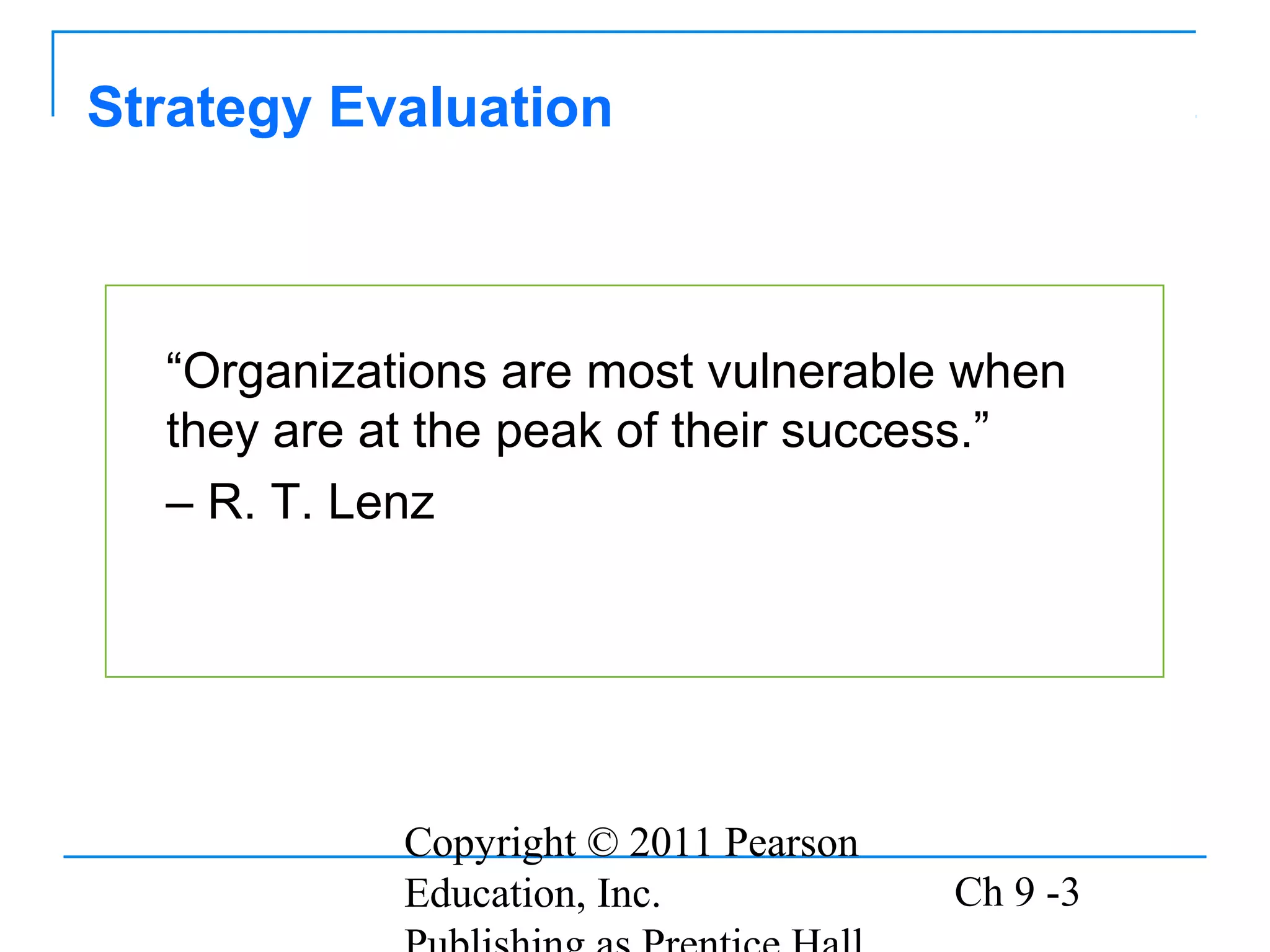
“Organizations are most vulnerable when
they are at the peak of their success.”
– R. T. Lenz
Strategy Evaluation
Copyright © 2011 Pearson
Education, Inc. Ch 9 -4
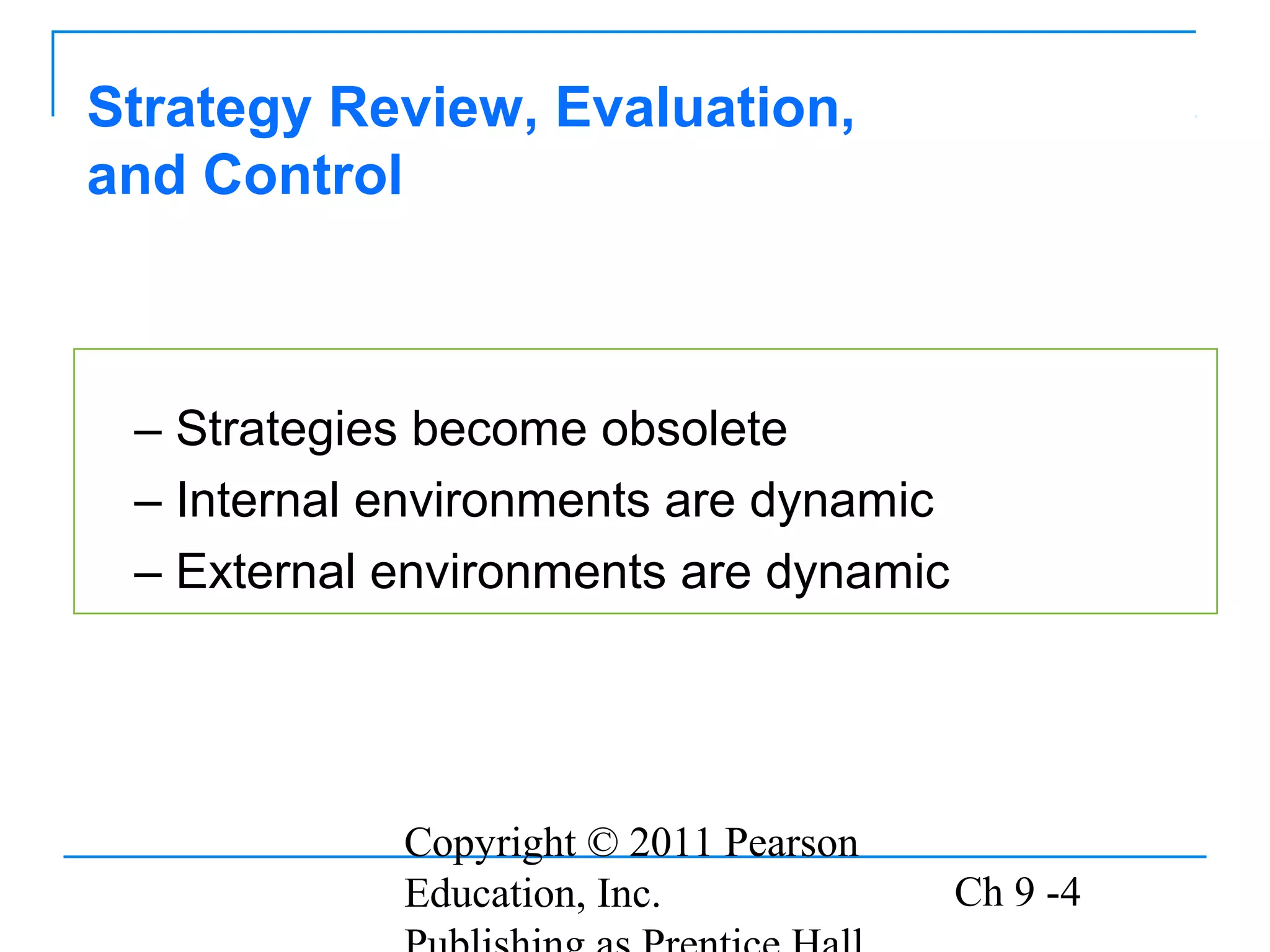
– Strategies become obsolete
– Internal environments are dynamic
– External environments are dynamic
Strategy Review, Evaluation,
and Control
Copyright © 2011 Pearson
Education, Inc. Ch 9 -5
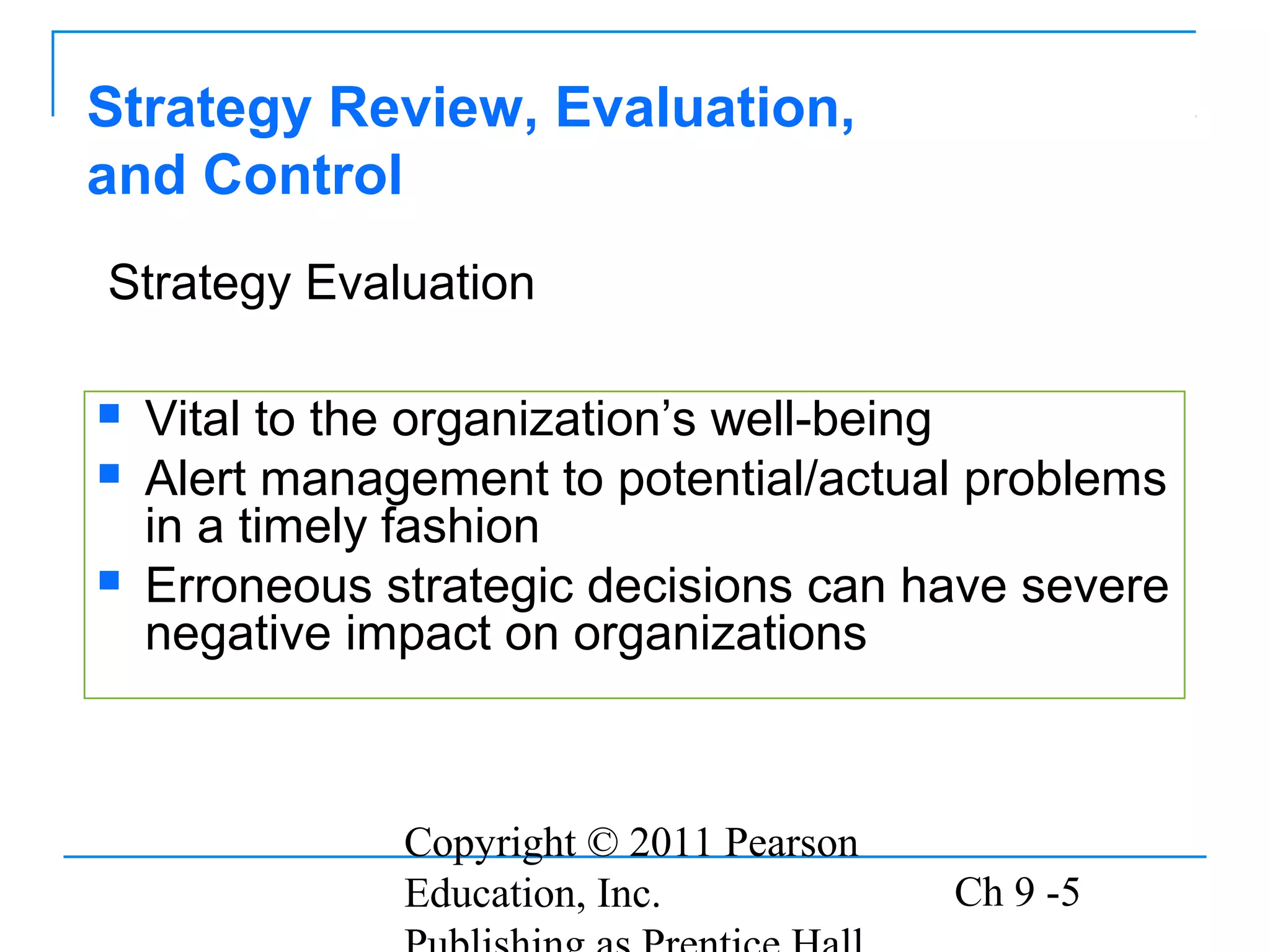
 Vital to the organization’s well-being
 Alert management to potential/actual problems
in a timely fashion
 Erroneous strategic decisions can have severe
negative impact on organizations
Strategy Review, Evaluation,
and Control
Strategy Evaluation
Copyright © 2011 Pearson
Education, Inc. Ch 9 -6
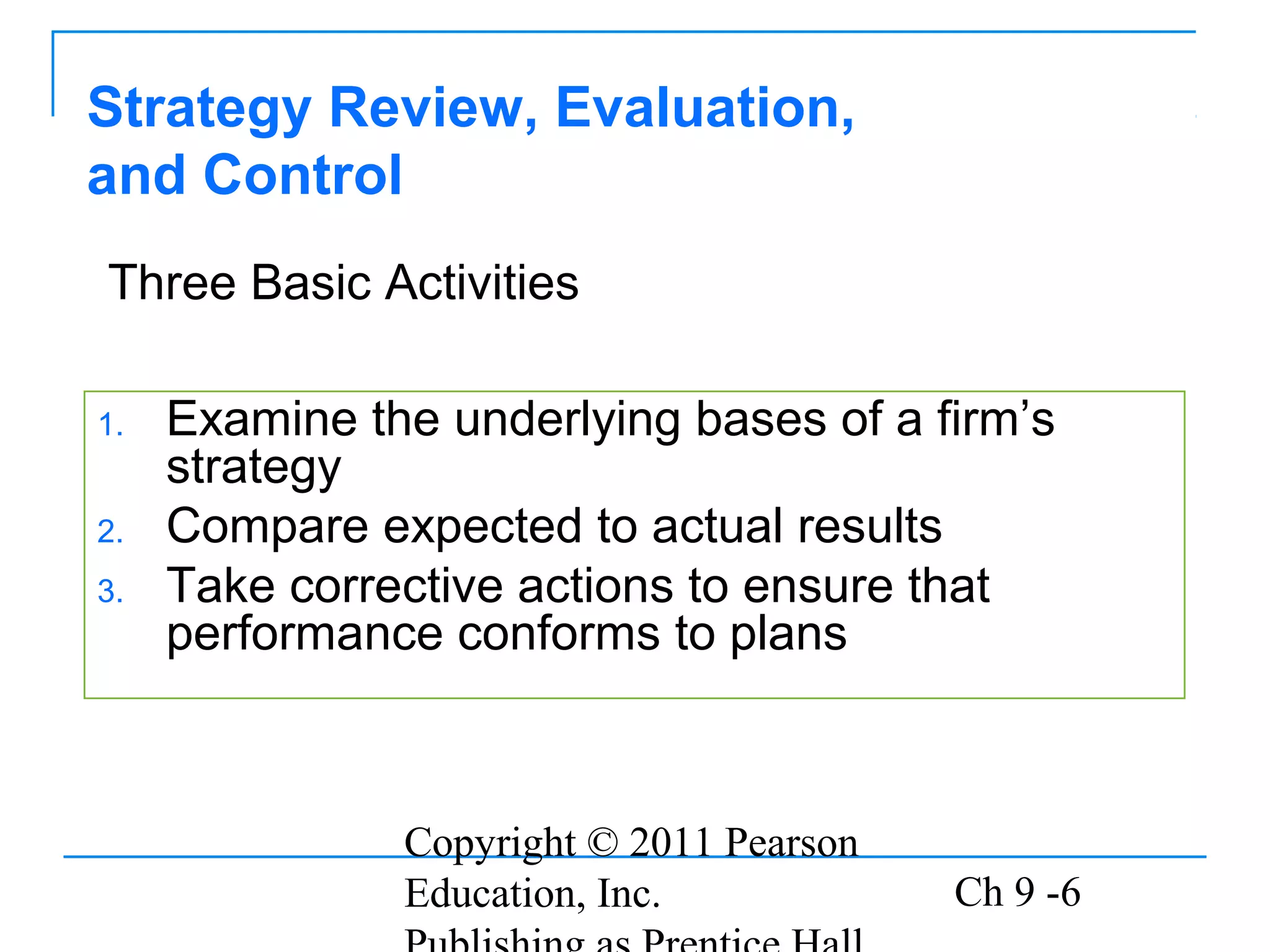
1. Examine the underlying bases of a firm’s
strategy
2. Compare expected to actual results
3. Take corrective actions to ensure that
performance conforms to plans
Strategy Review, Evaluation,
and Control
Three Basic Activities
Copyright © 2011 Pearson
Education, Inc. Ch 9 -7
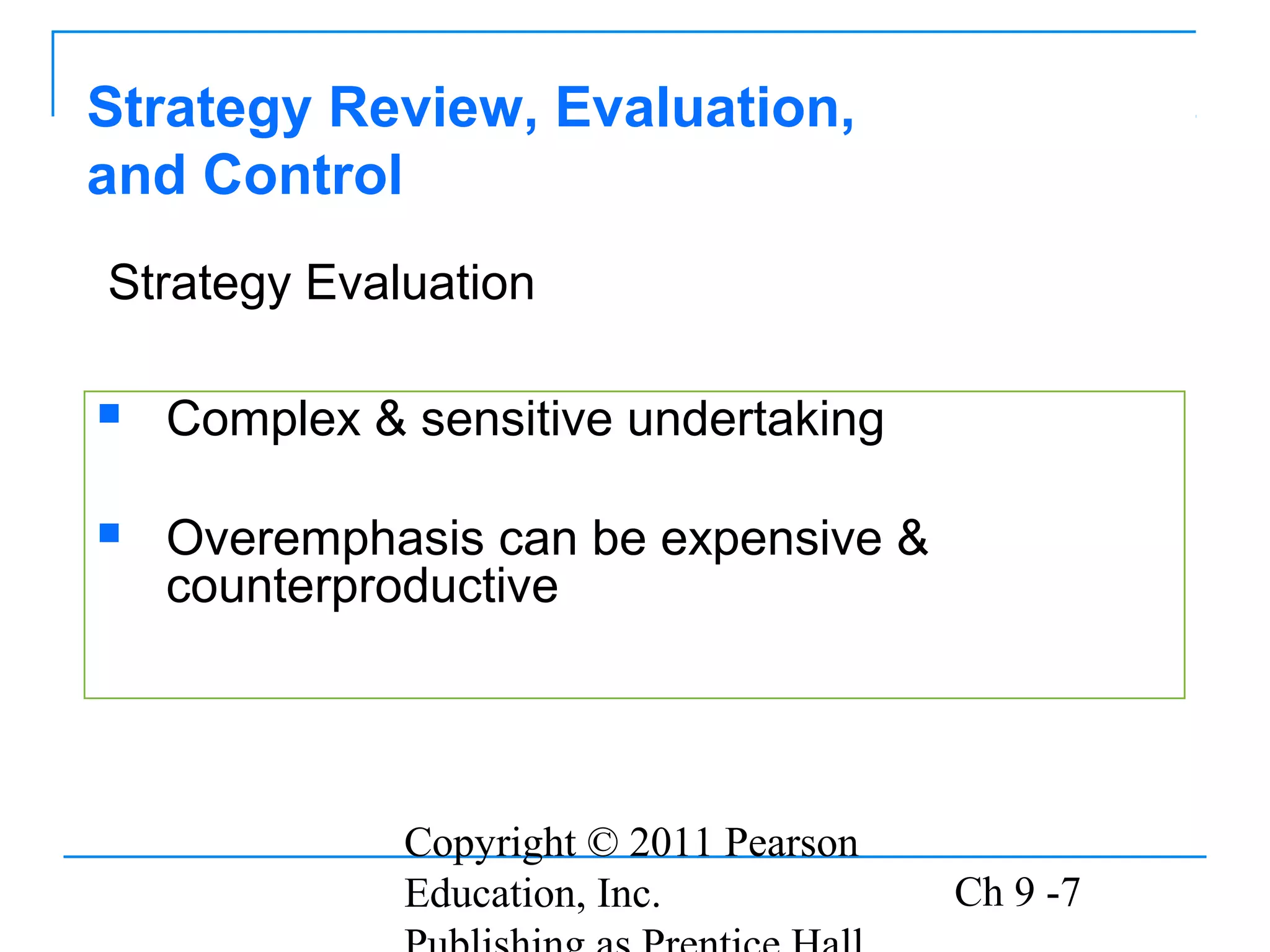
 Complex & sensitive undertaking
 Overemphasis can be expensive &
counterproductive
Strategy Review, Evaluation,
and Control
Strategy Evaluation
Copyright © 2011 Pearson
Education, Inc. Ch 9 -8
Strategy Review, Evaluation,
and Control
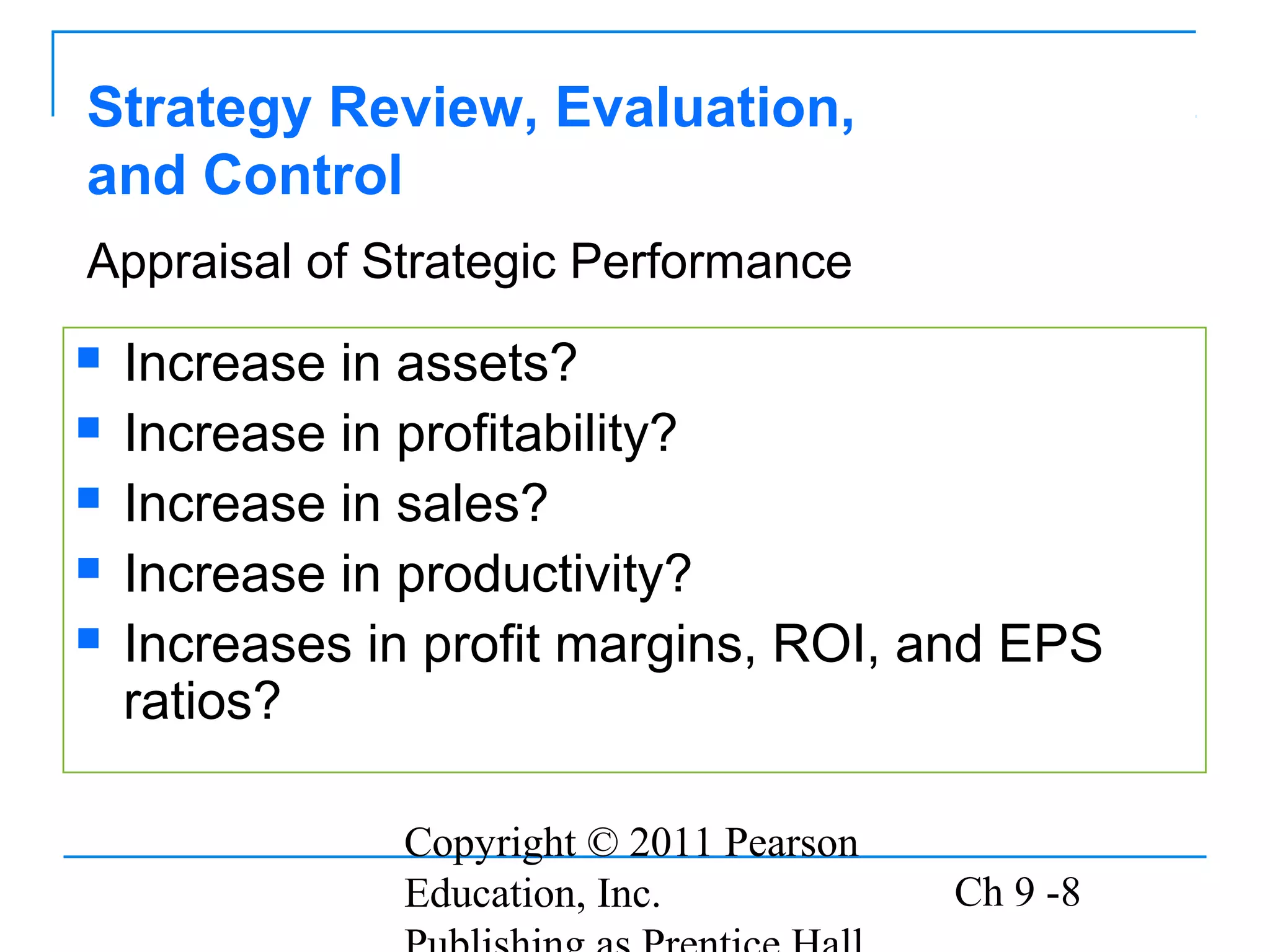
 Increase in assets?
 Increase in profitability?
 Increase in sales?
 Increase in productivity?
 Increases in profit margins, ROI, and EPS
ratios?
Appraisal of Strategic Performance
Copyright © 2011 Pearson
Education, Inc. Ch 9 -9
Strategy Review, Evaluation,
and Control
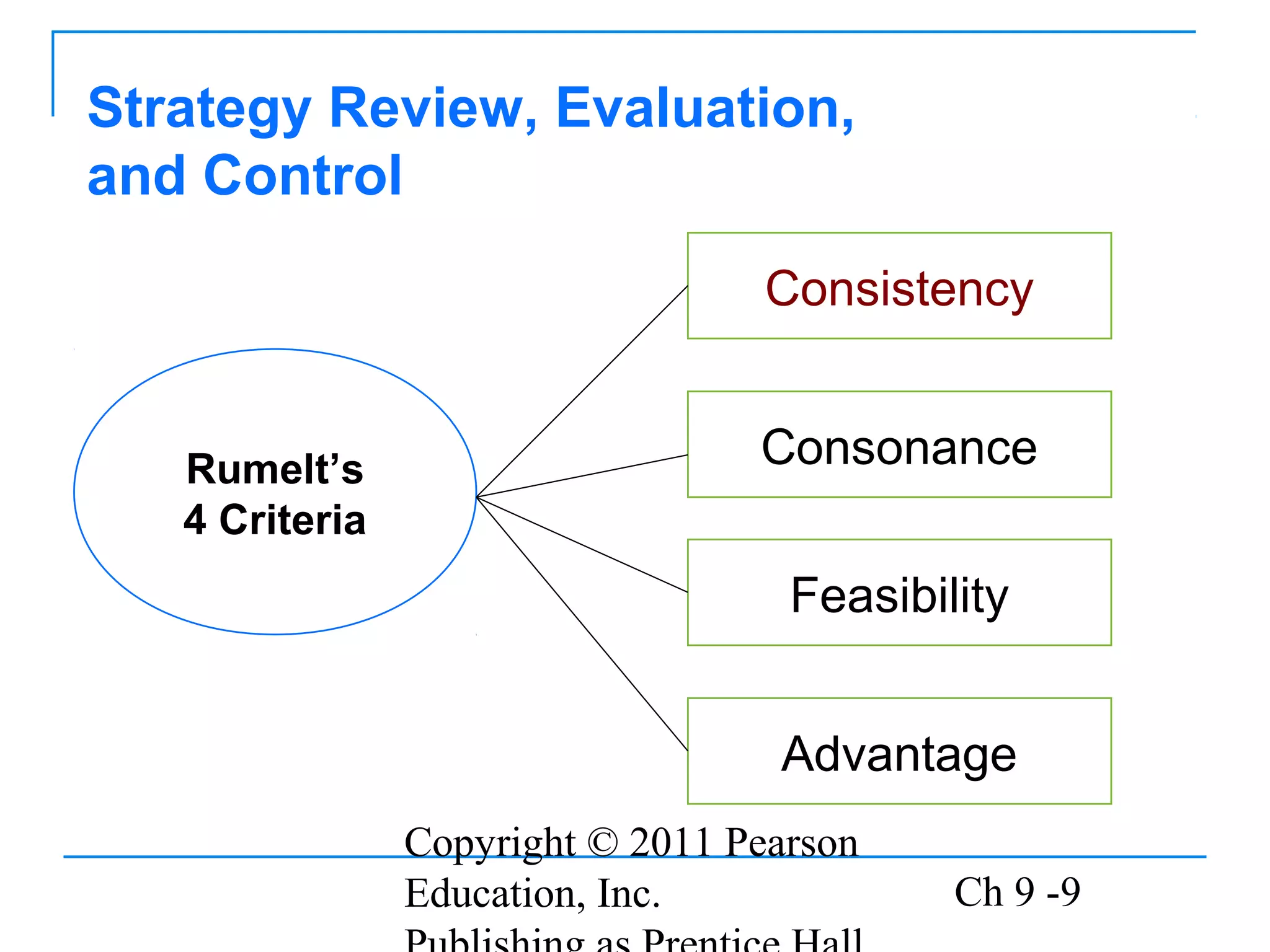
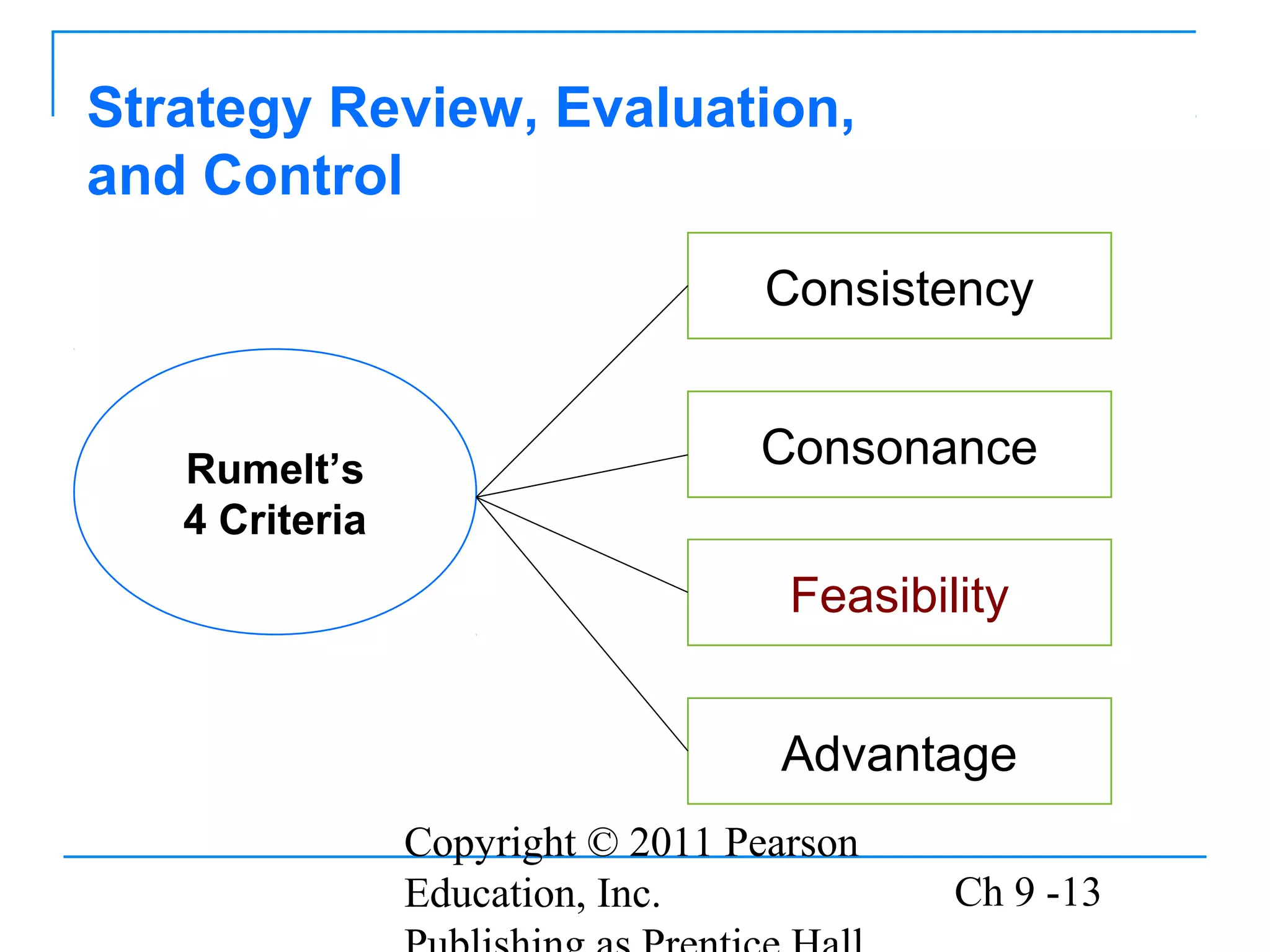
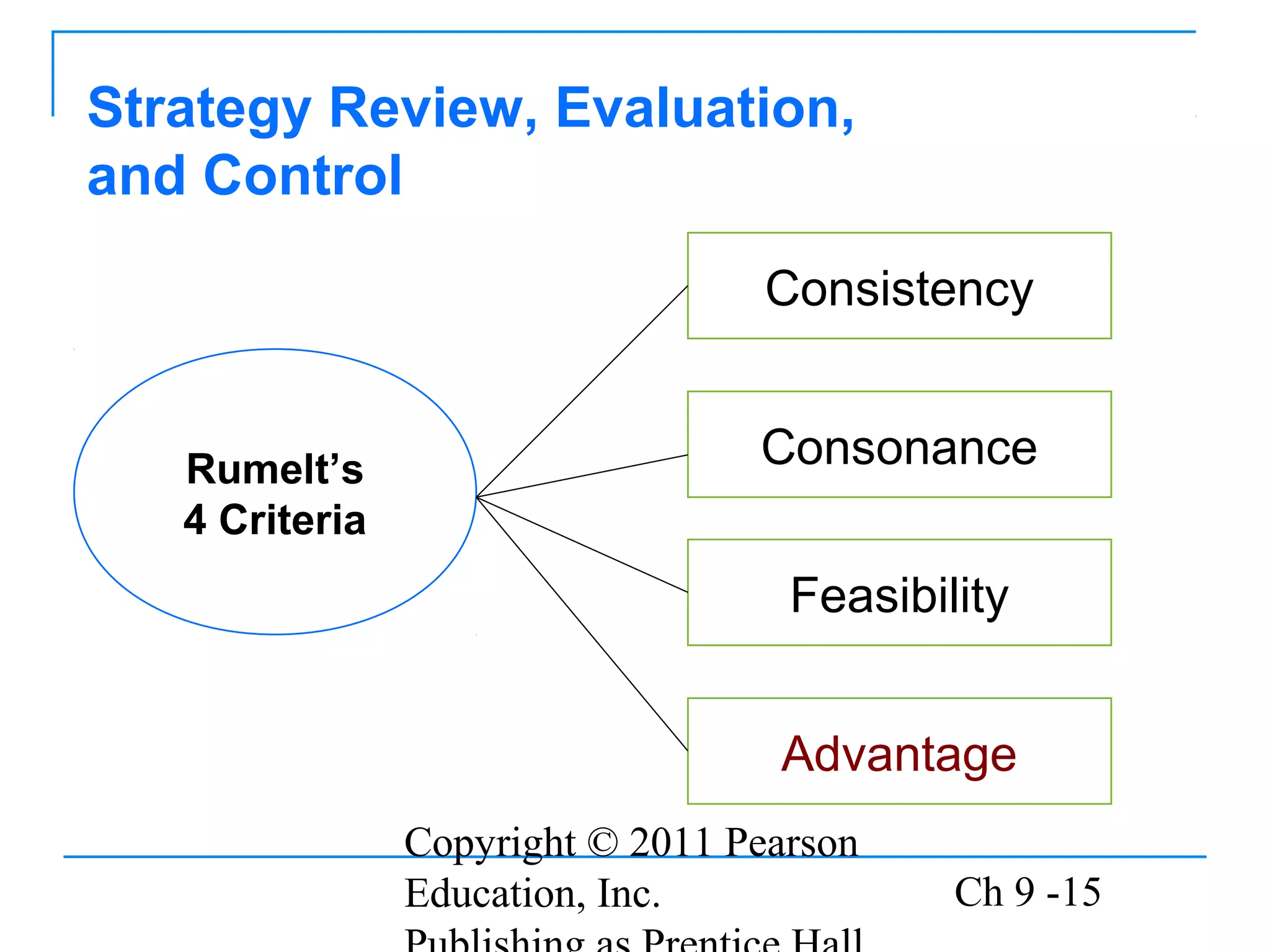
Consonance
Consistency
Feasibility
Advantage
Rumelt’s
4 Criteria
Copyright © 2011 Pearson
Education, Inc. Ch 9 -10
Strategy Review, Evaluation,
and Control
 Strategy should not present inconsistent
goals and policies
Consistency
Copyright © 2011 Pearson
Education, Inc. Ch 9 -11
Strategy Review, Evaluation,
and Control
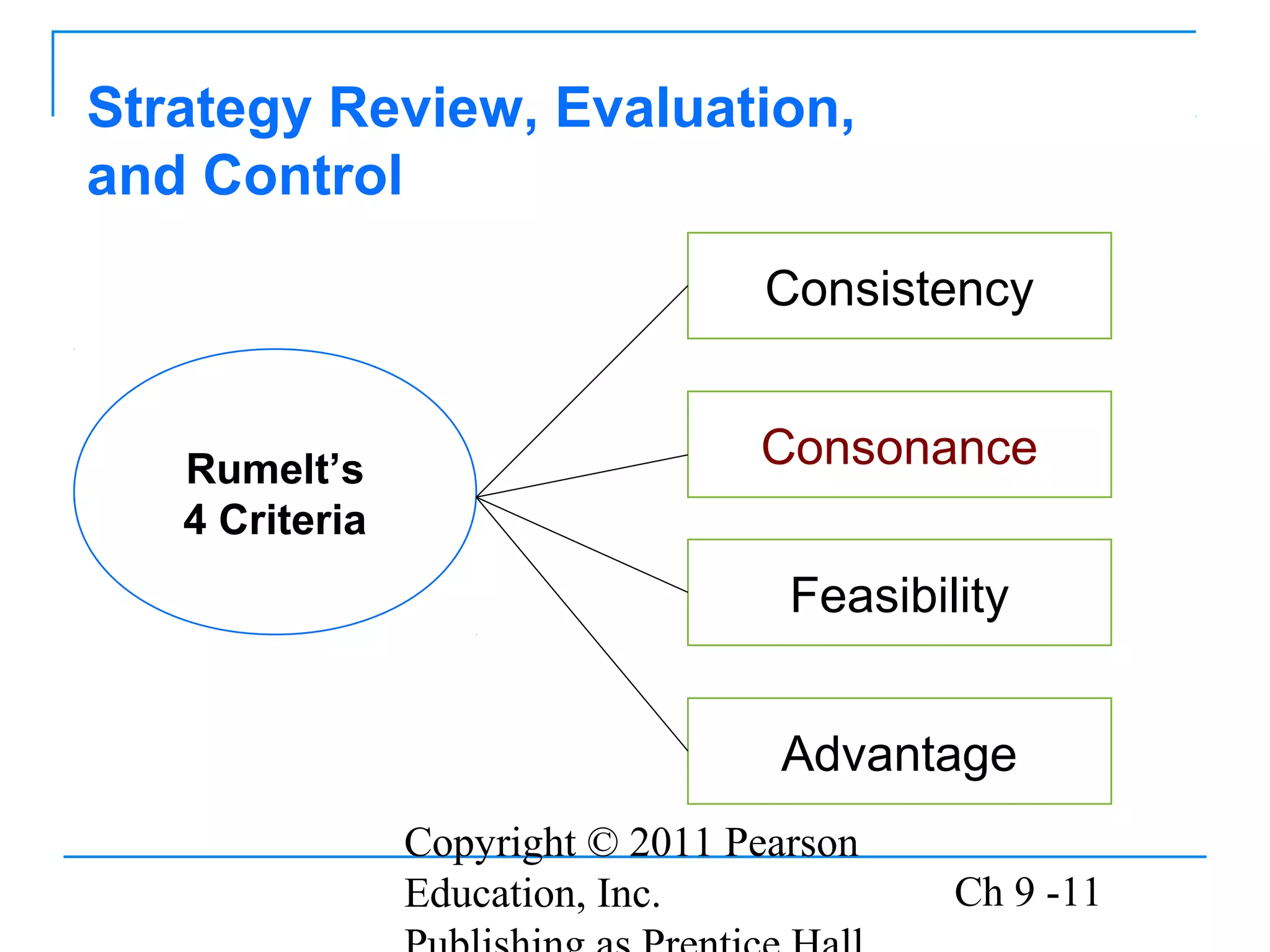
Consonance
Consistency
Feasibility
Advantage
Rumelt’s
4 Criteria
Copyright © 2011 Pearson
Education, Inc. Ch 9 -12
Strategy Review, Evaluation,
and Control
 Need for strategists to examine sets of
trends, as well as individual trends
Consonance
Copyright © 2011 Pearson
Education, Inc. Ch 9 -13
Strategy Review, Evaluation,
and Control
Consonance
Consistency
Feasibility
Advantage
Rumelt’s
4 Criteria
Copyright © 2011 Pearson
Education, Inc. Ch 9 -14
Strategy Review, Evaluation,
and Control
 Neither overtax resources nor create
unsolvable subproblems
Feasibility
Copyright © 2011 Pearson
Education, Inc. Ch 9 -15
Strategy Review, Evaluation,
and Control
Consonance
Consistency
Feasibility
Advantage
Rumelt’s
4 Criteria
Copyright © 2011 Pearson
Education, Inc. Ch 9 -16
Strategy Review,
Evaluation, and Control
 Creation or maintenance of competitive
advantage
Advantage
Copyright © 2011 Pearson
Education, Inc. Ch 9 -17
Strategy Review, Evaluation,
and Control
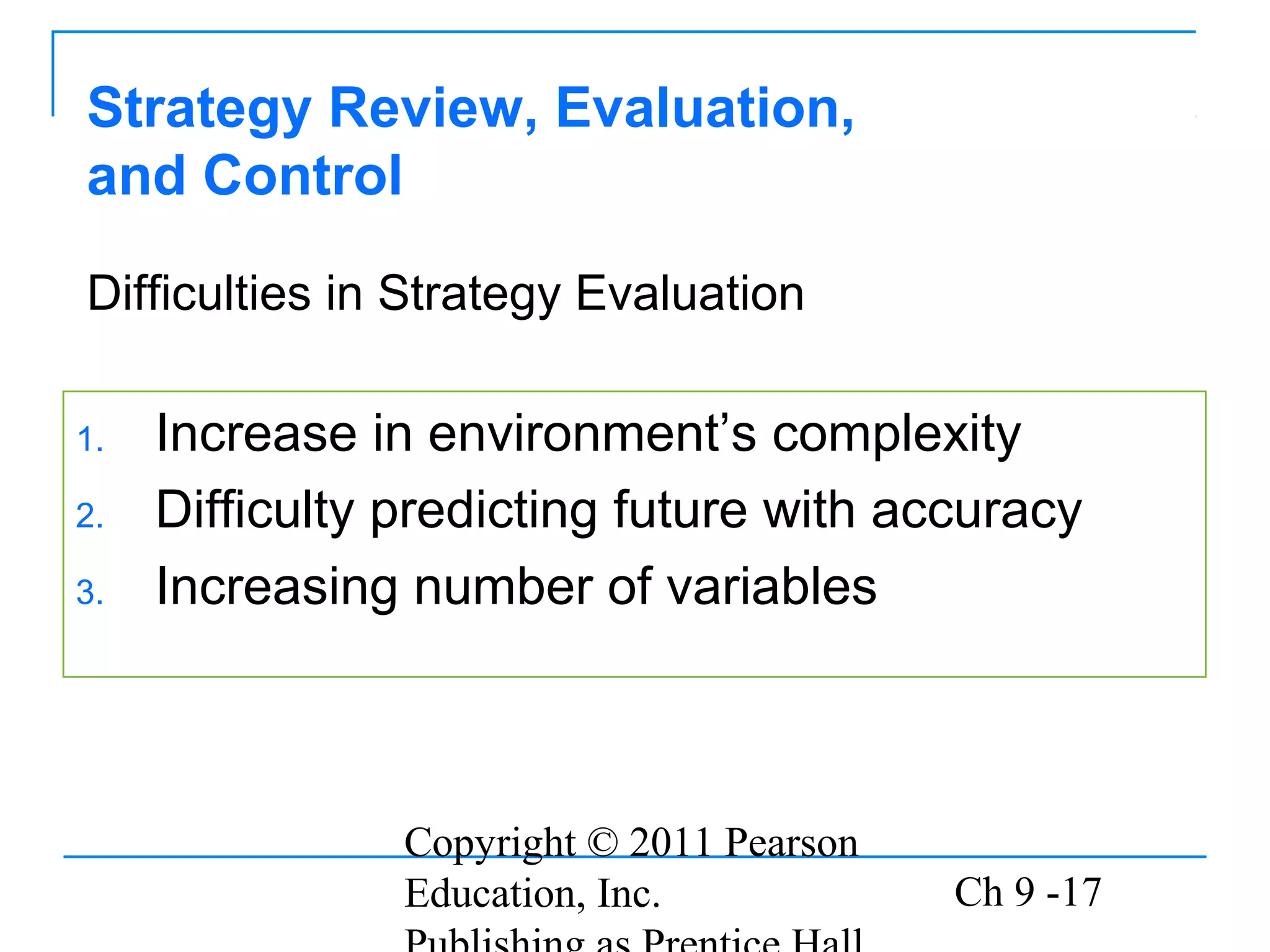
1. Increase in environment’s complexity
2. Difficulty predicting future with accuracy
3. Increasing number of variables
Difficulties in Strategy Evaluation
Copyright © 2011 Pearson
Education, Inc. Ch 9 -18
Strategy Review, Evaluation,
and Control
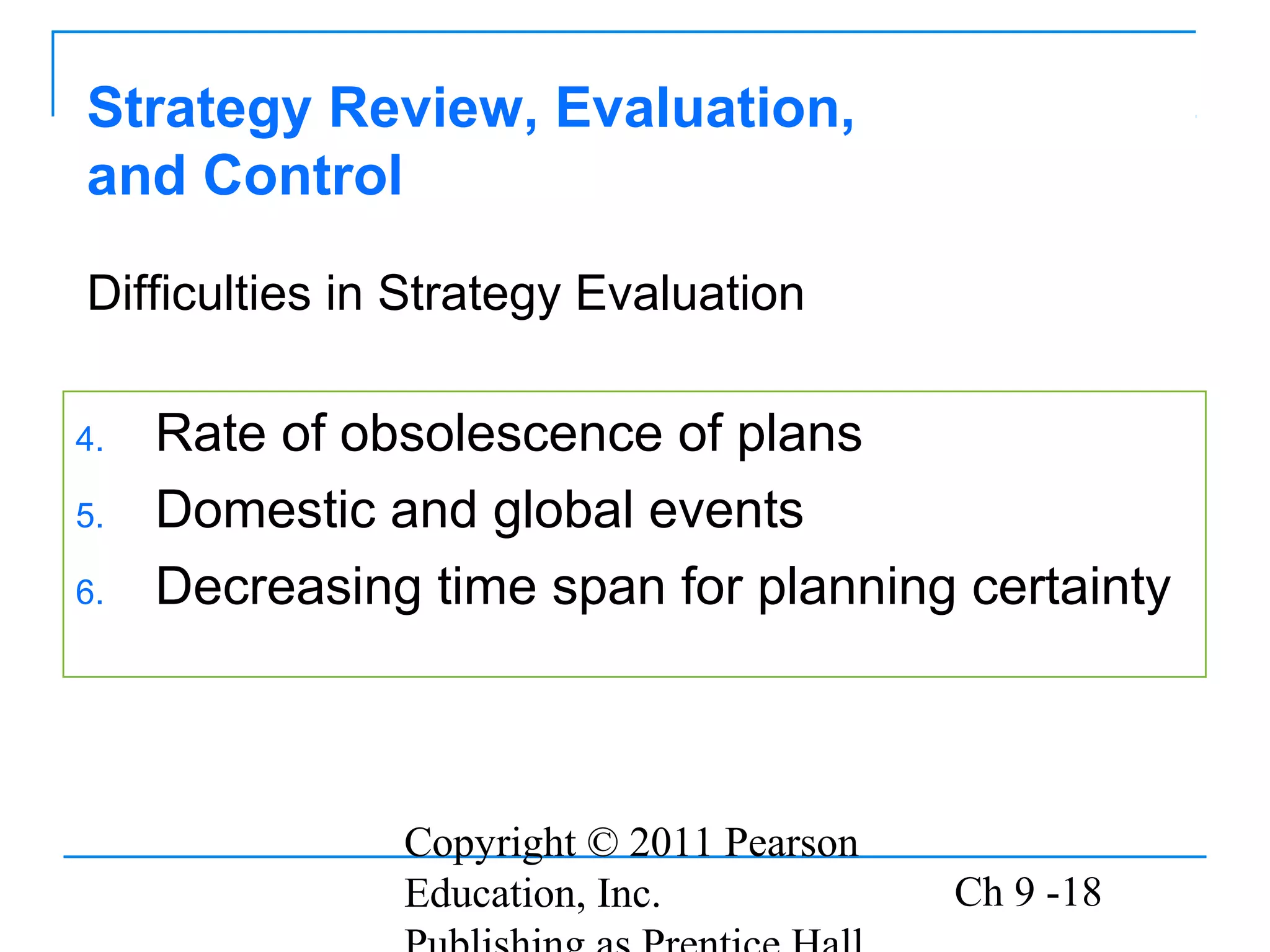
4. Rate of obsolescence of plans
5. Domestic and global events
6. Decreasing time span for planning certainty
Difficulties in Strategy Evaluation
Copyright © 2011 Pearson
Education, Inc. Ch 9 -19
Strategy Review, Evaluation,
and Control
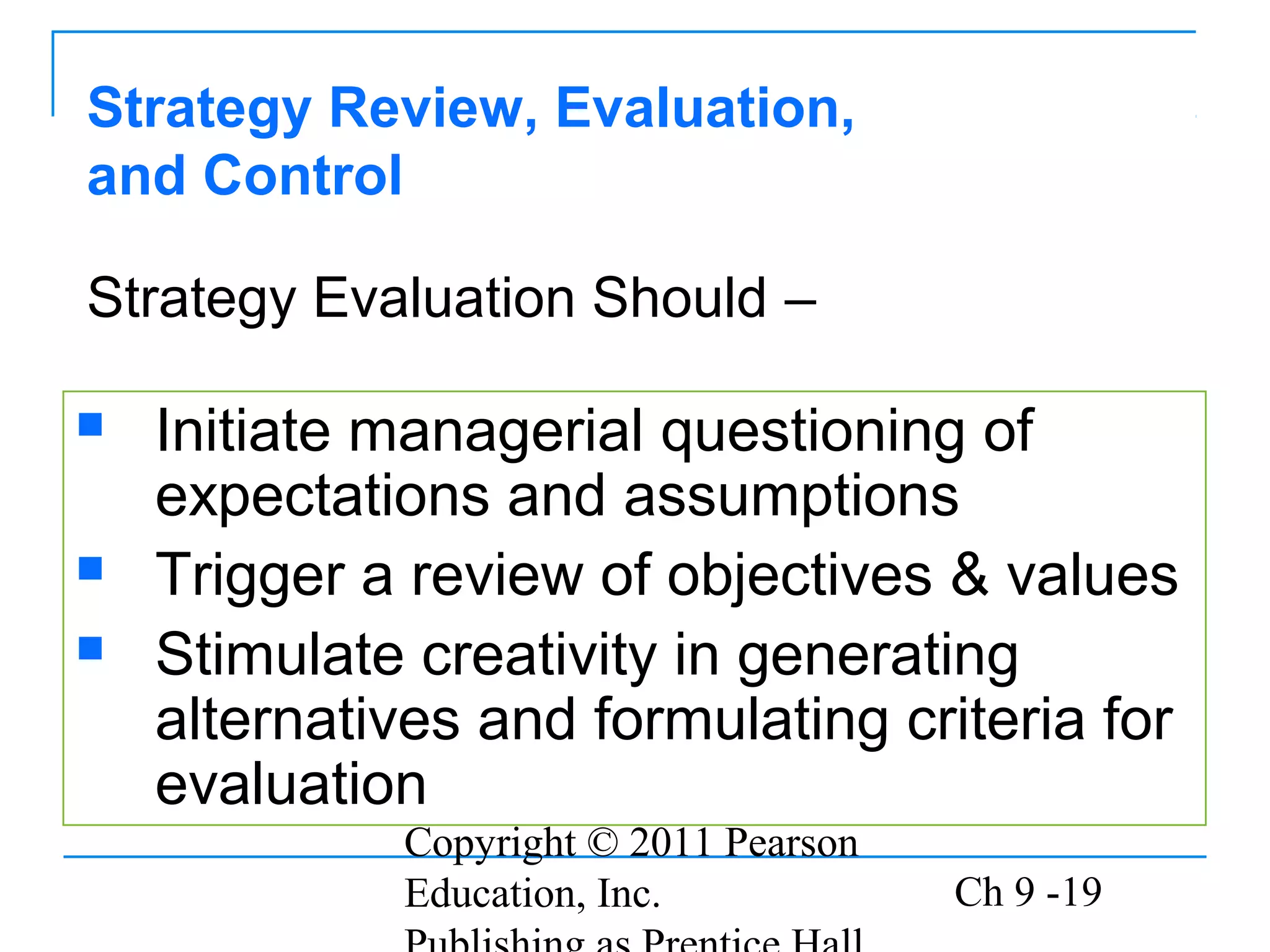
 Initiate managerial questioning of
expectations and assumptions
 Trigger a review of objectives & values
 Stimulate creativity in generating
alternatives and formulating criteria for
evaluation
Strategy Evaluation Should –
Copyright © 2011 Pearson
Education, Inc. Ch 9 -20
Strategy Review, Evaluation,
and Control
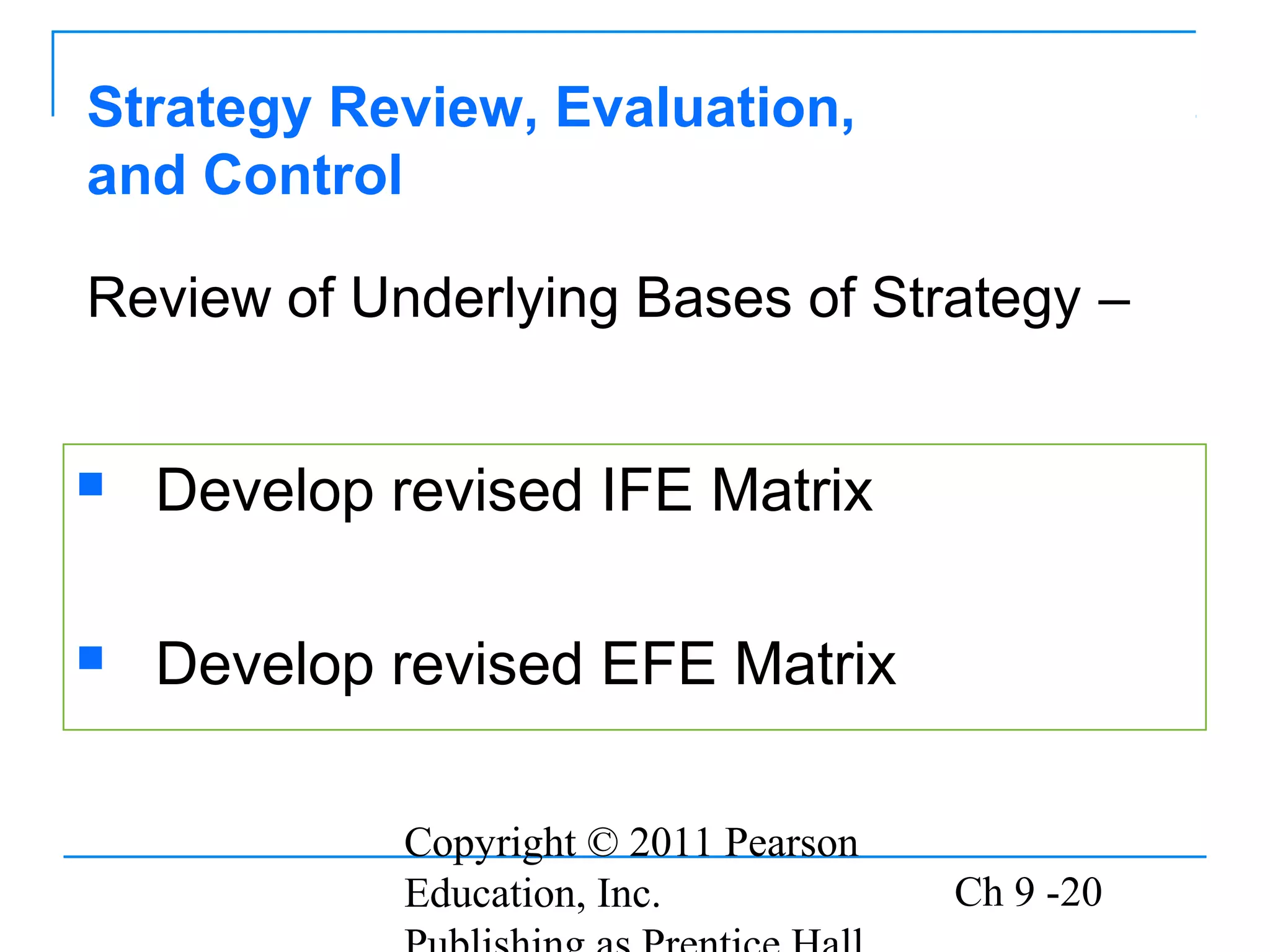
 Develop revised IFE Matrix
 Develop revised EFE Matrix
Review of Underlying Bases of Strategy –
Copyright © 2011 Pearson
Education, Inc. Ch 9 -21
Strategy Review, Evaluation,
and Control
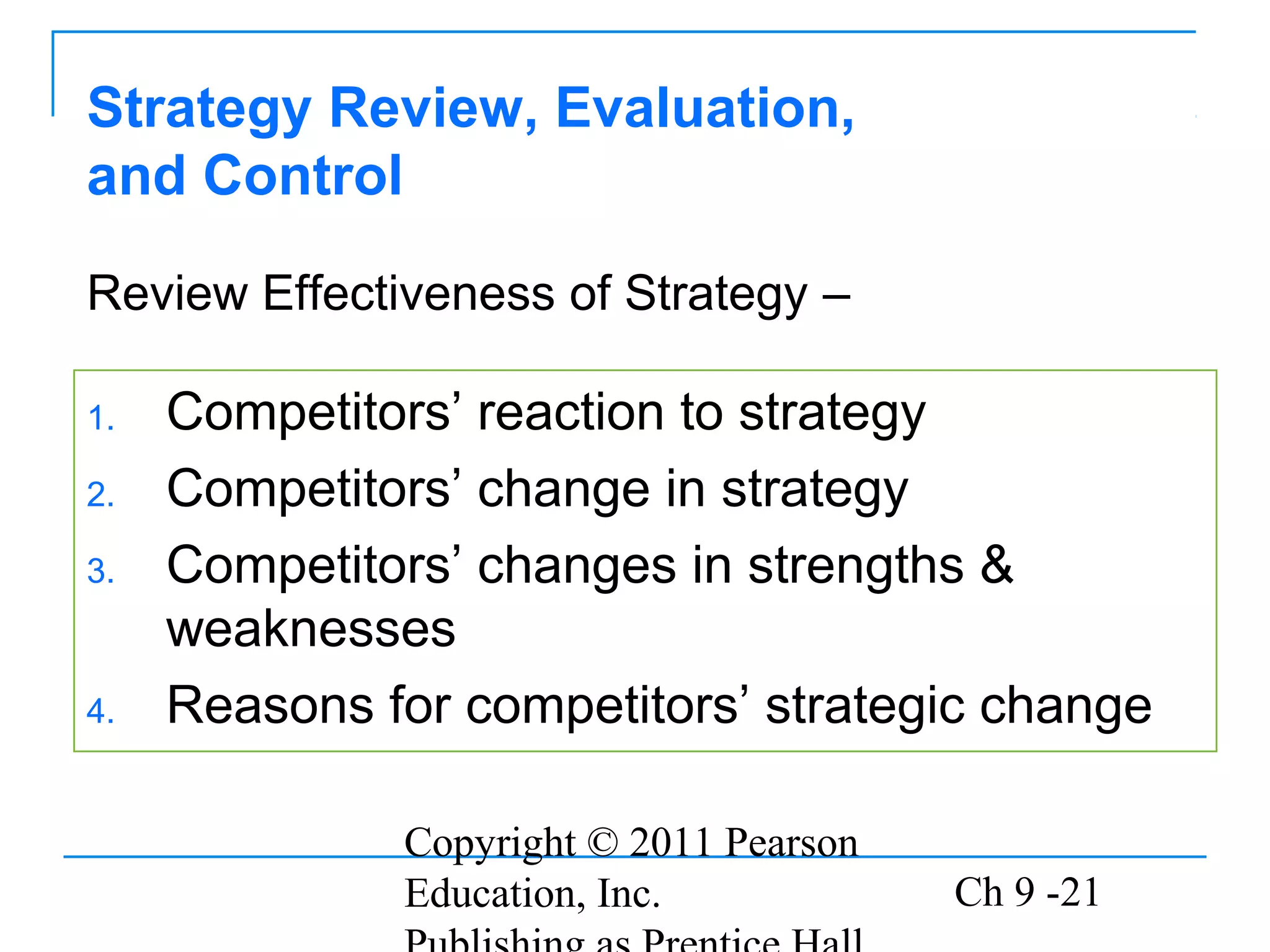
1. Competitors’ reaction to strategy
2. Competitors’ change in strategy
3. Competitors’ changes in strengths &
weaknesses
4. Reasons for competitors’ strategic change
Review Effectiveness of Strategy –
Copyright © 2011 Pearson
Education, Inc. Ch 9 -22
Strategy Review, Evaluation,
and Control
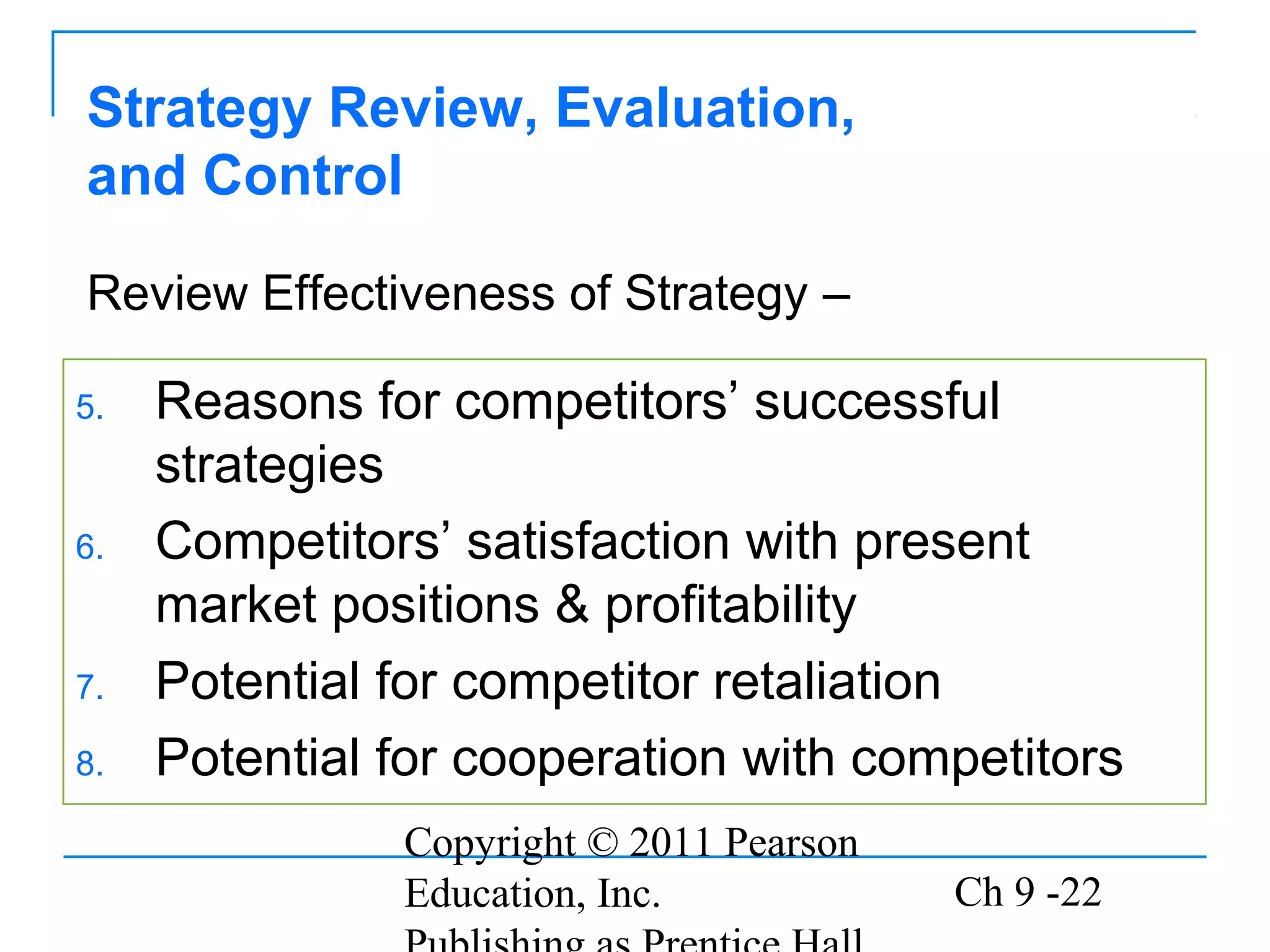
5. Reasons for competitors’ successful
strategies
6. Competitors’ satisfaction with present
market positions & profitability
7. Potential for competitor retaliation
8. Potential for cooperation with competitors
Review Effectiveness of Strategy –
Copyright © 2011 Pearson
Education, Inc. Ch 9 -23
Strategy Review, Evaluation,
and Control
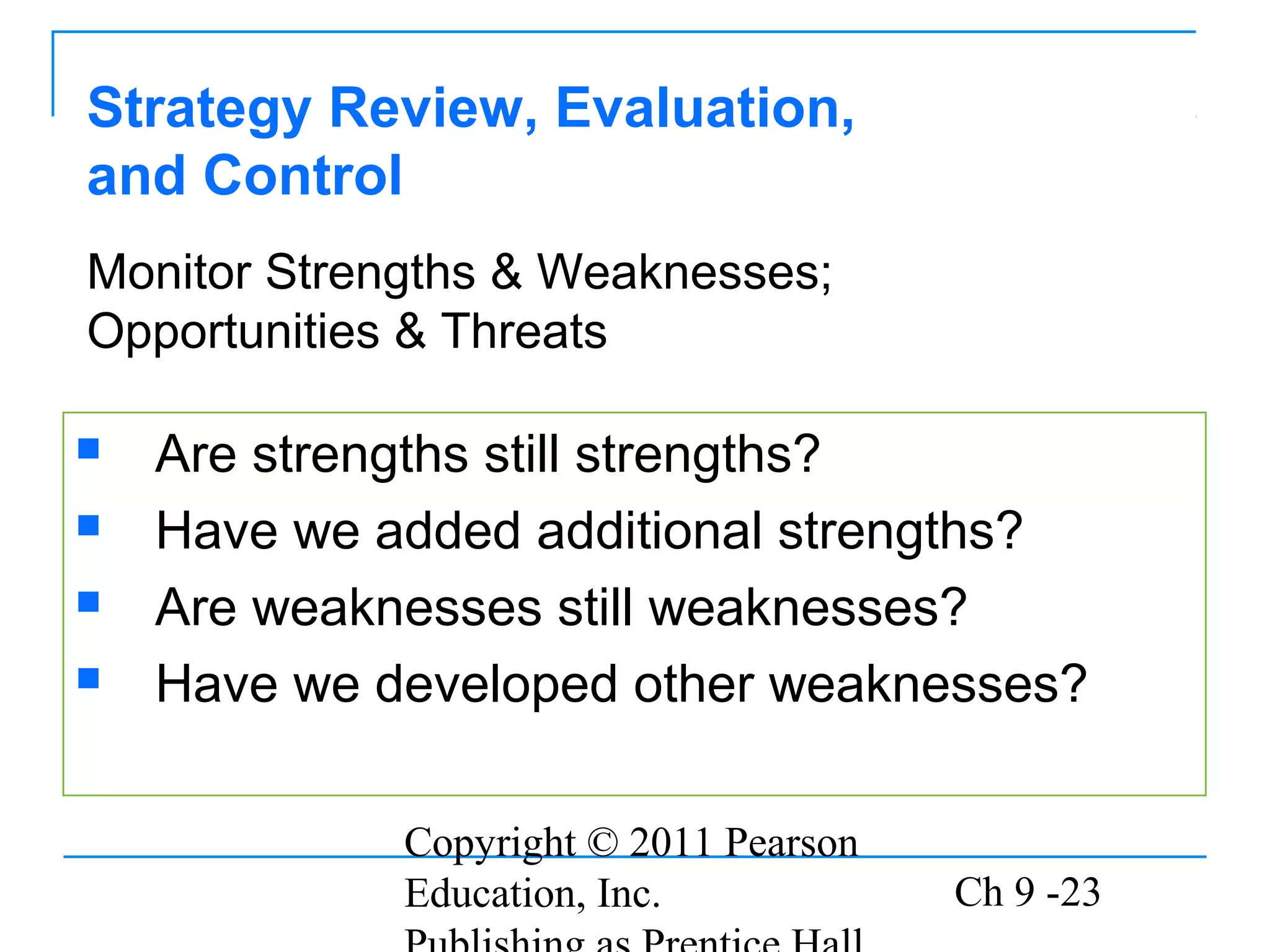
 Are strengths still strengths?
 Have we added additional strengths?
 Are weaknesses still weaknesses?
 Have we developed other weaknesses?
Monitor Strengths & Weaknesses;
Opportunities & Threats
Copyright © 2011 Pearson
Education, Inc. Ch 9 -24
Strategy Review,
Evaluation, and Control
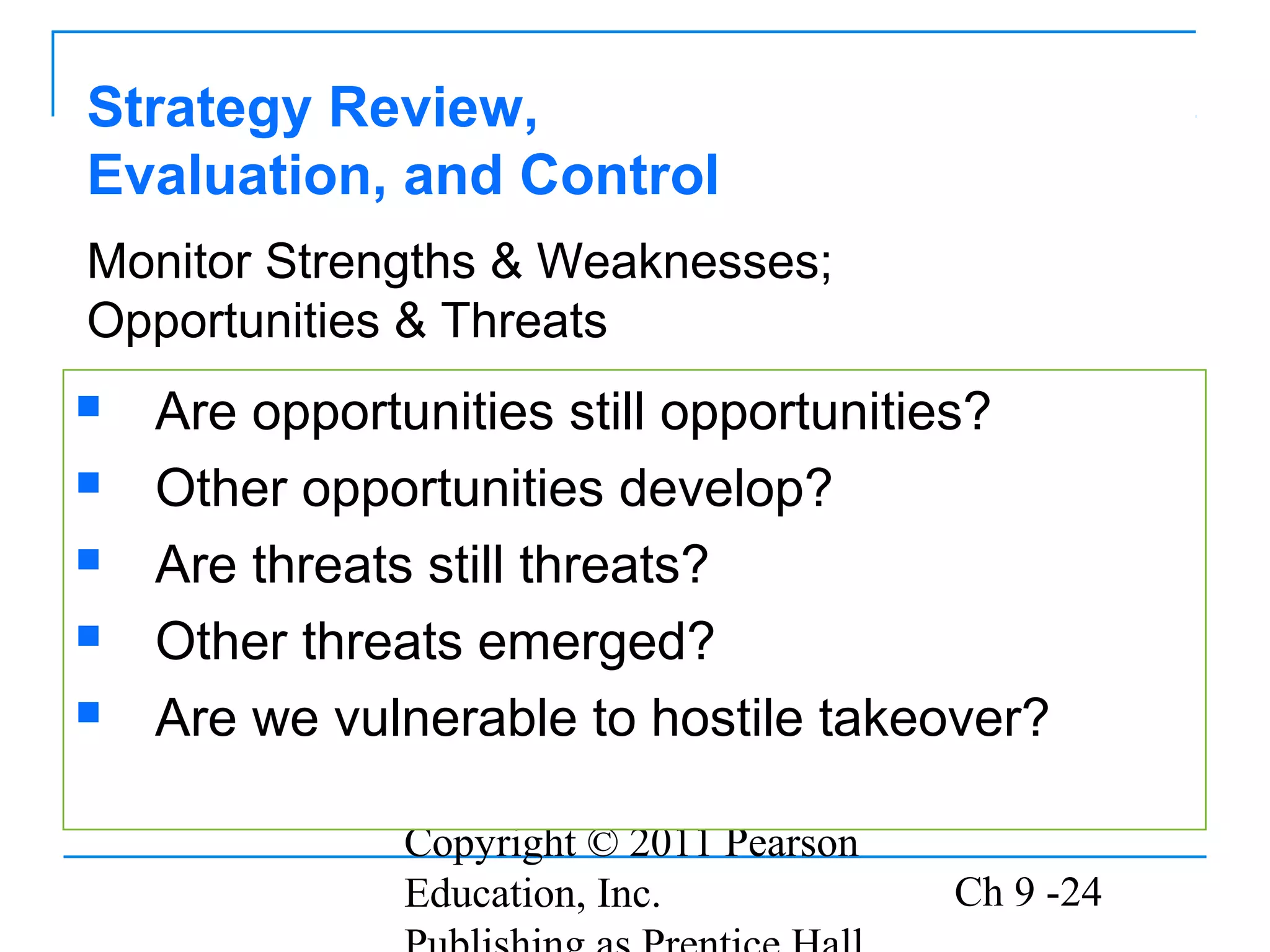
 Are opportunities still opportunities?
 Other opportunities develop?
 Are threats still threats?
 Other threats emerged?
 Are we vulnerable to hostile takeover?
Monitor Strengths & Weaknesses;
Opportunities & Threats
Copyright © 2011 Pearson
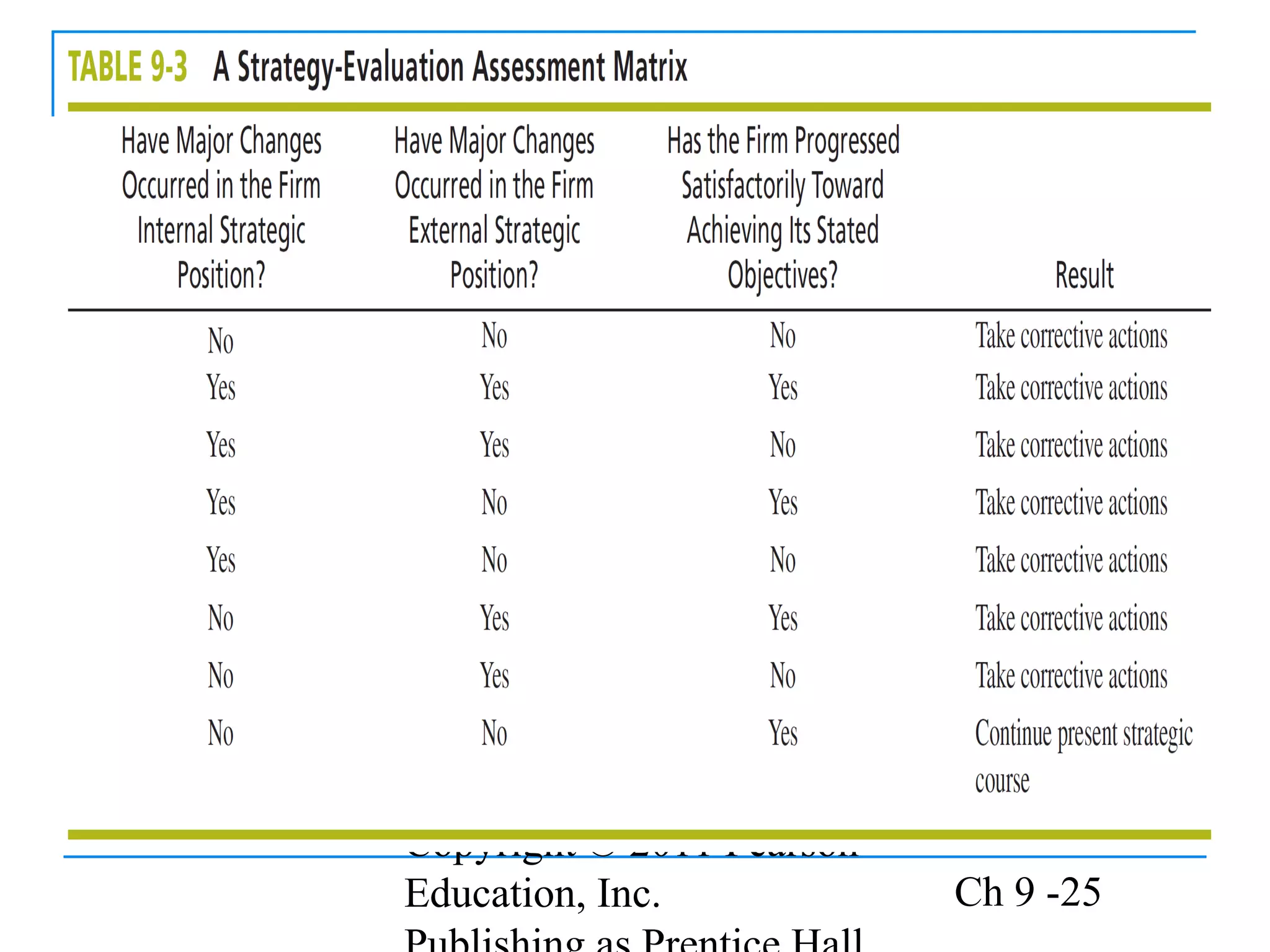
Education, Inc. Ch 9 -25
Copyright © 2011 Pearson
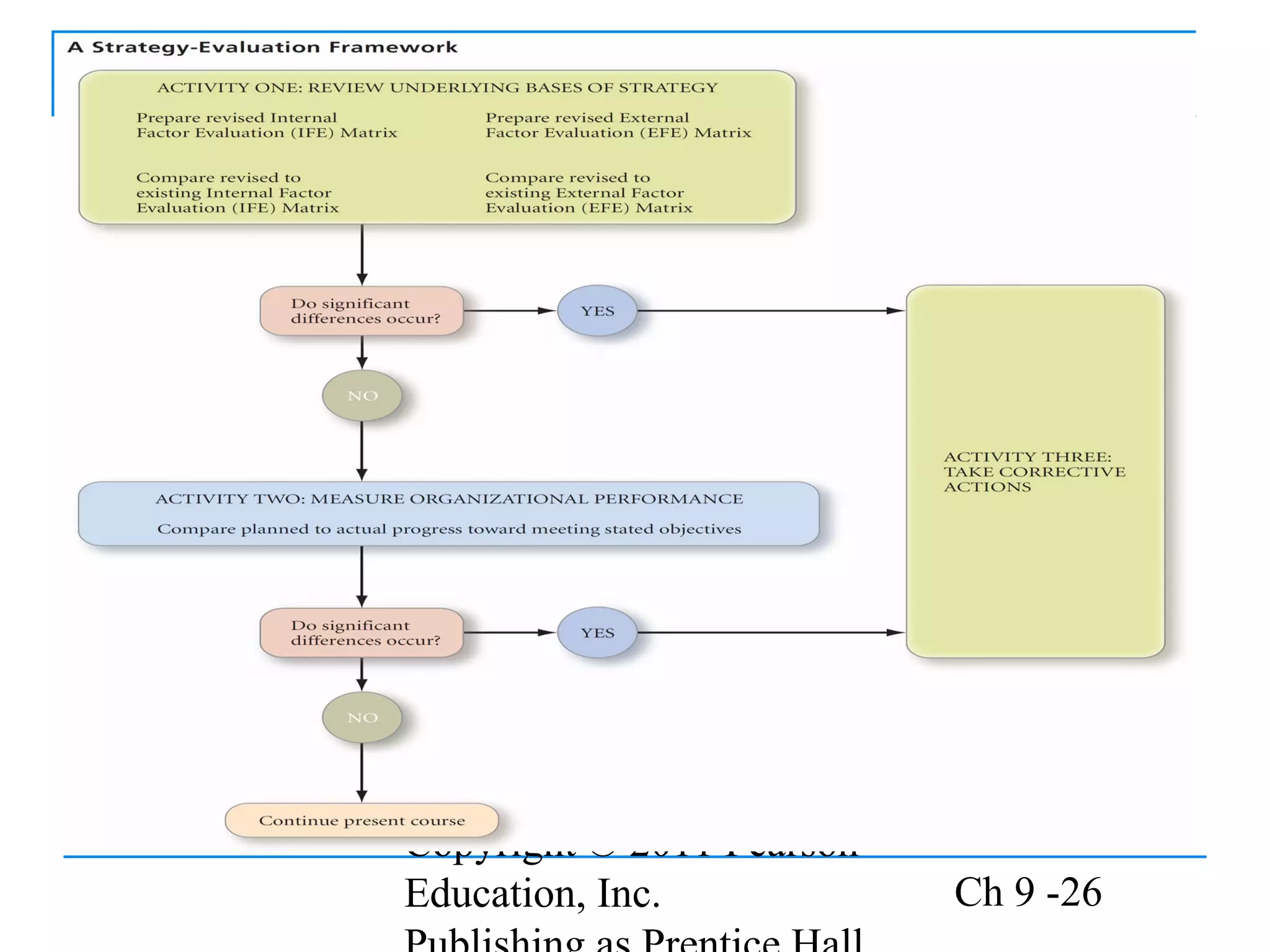
Education, Inc. Ch 9 -26
Copyright © 2011 Pearson
Education, Inc. Ch 9 -27
Strategy Review, Evaluation,
and Control
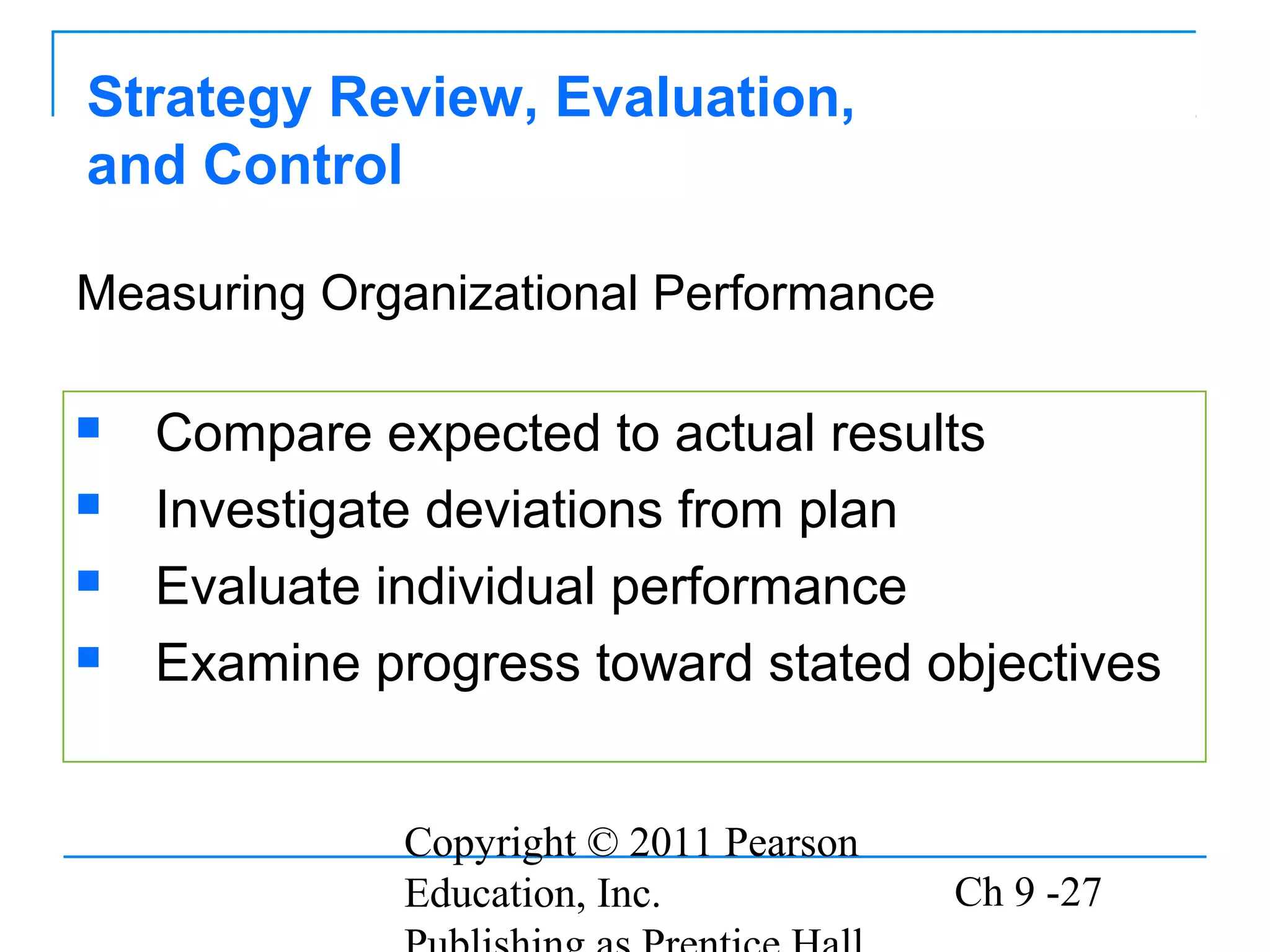
 Compare expected to actual results
 Investigate deviations from plan
 Evaluate individual performance
 Examine progress toward stated objectives
Measuring Organizational Performance
Copyright © 2011 Pearson
Education, Inc. Ch 9 -28
Strategy Review, Evaluation,
and Control
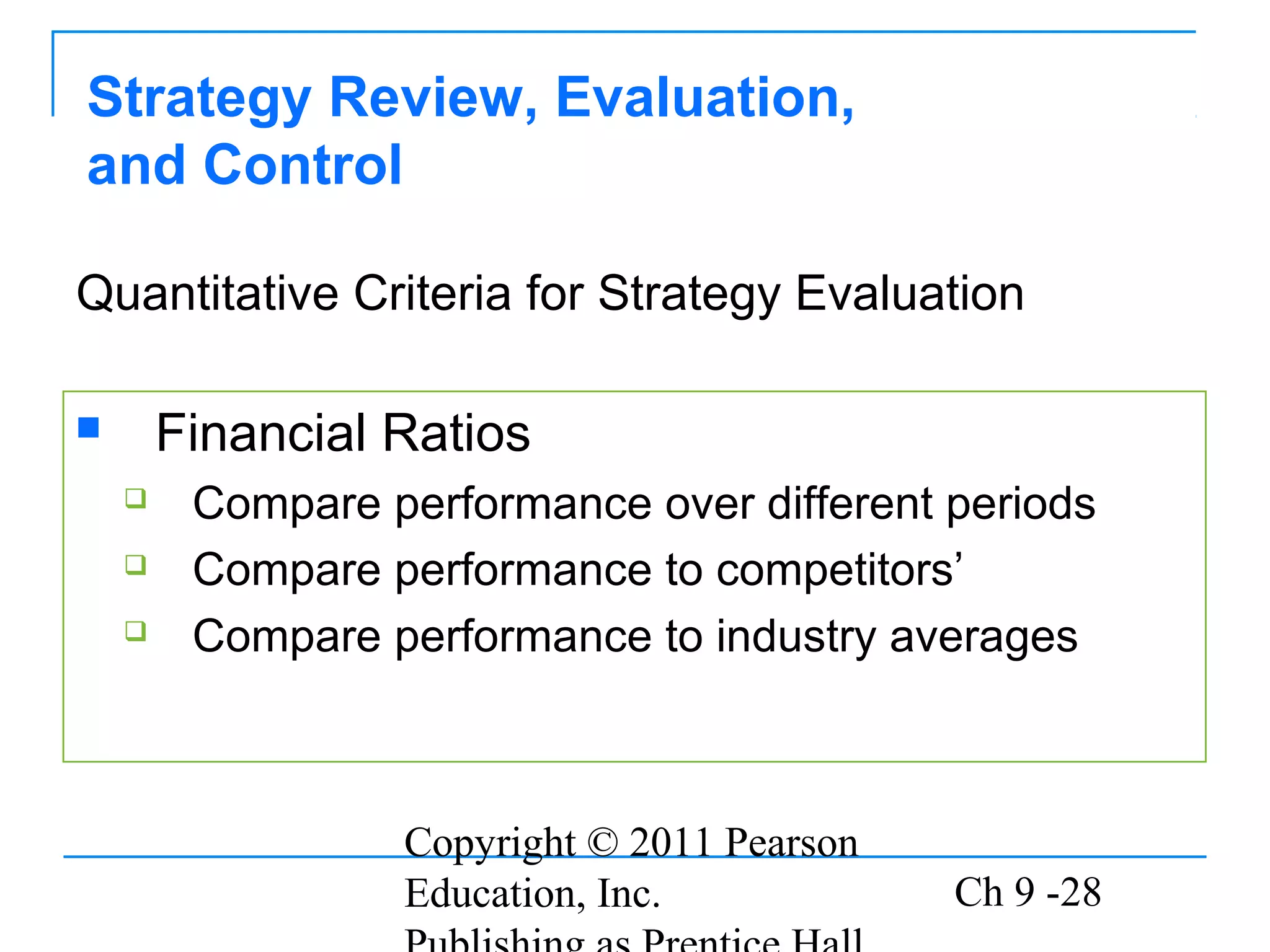
 Financial Ratios
 Compare performance over different periods
 Compare performance to competitors’
 Compare performance to industry averages
Quantitative Criteria for Strategy Evaluation
Copyright © 2011 Pearson
Education, Inc. Ch 9 -29
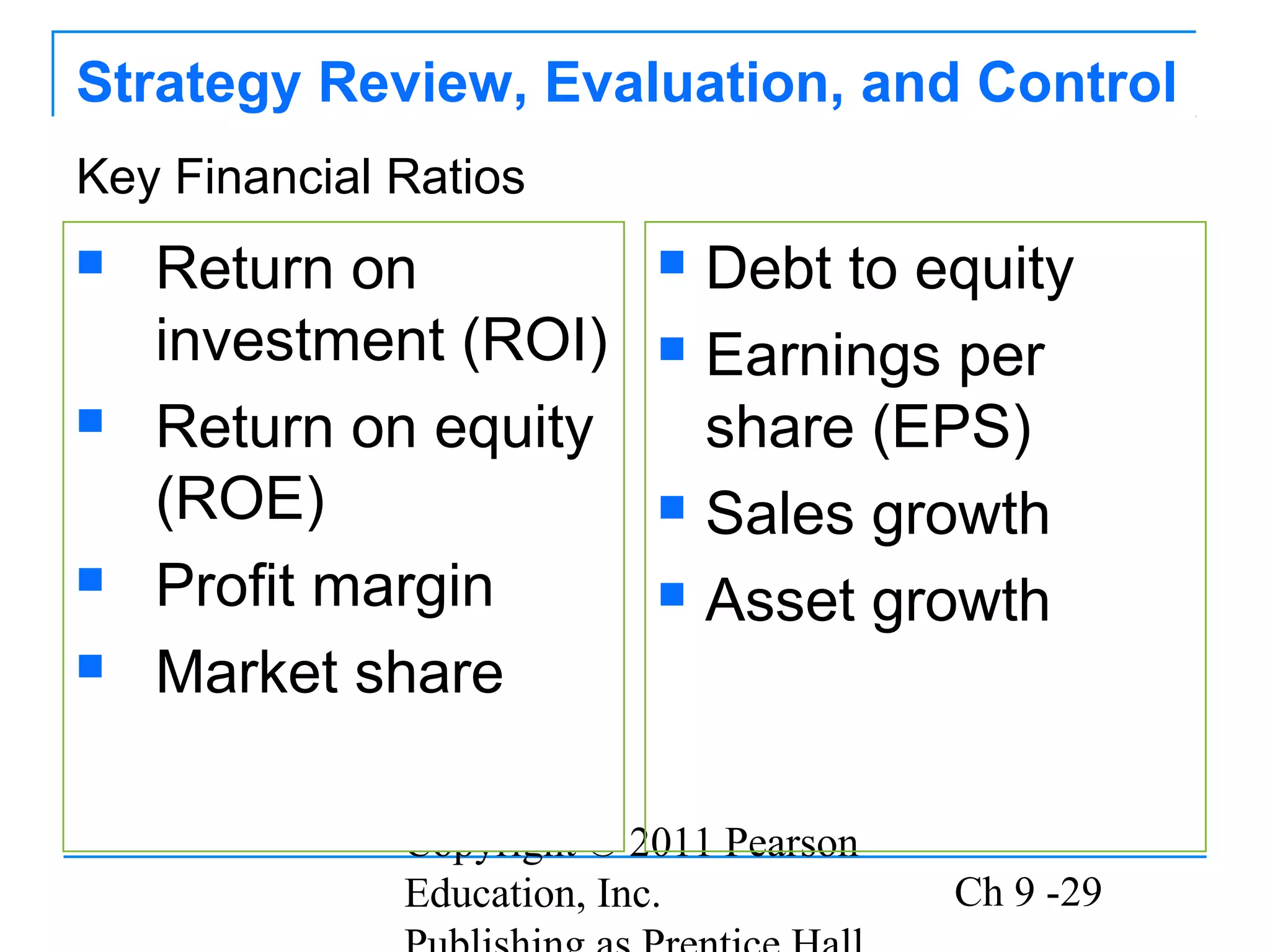
Strategy Review, Evaluation, and Control
 Return on
investment (ROI)
 Return on equity
(ROE)
 Profit margin
 Market share
 Debt to equity
 Earnings per
share (EPS)
 Sales growth
 Asset growth
Key Financial Ratios
Copyright © 2011 Pearson
Education, Inc. Ch 9 -30
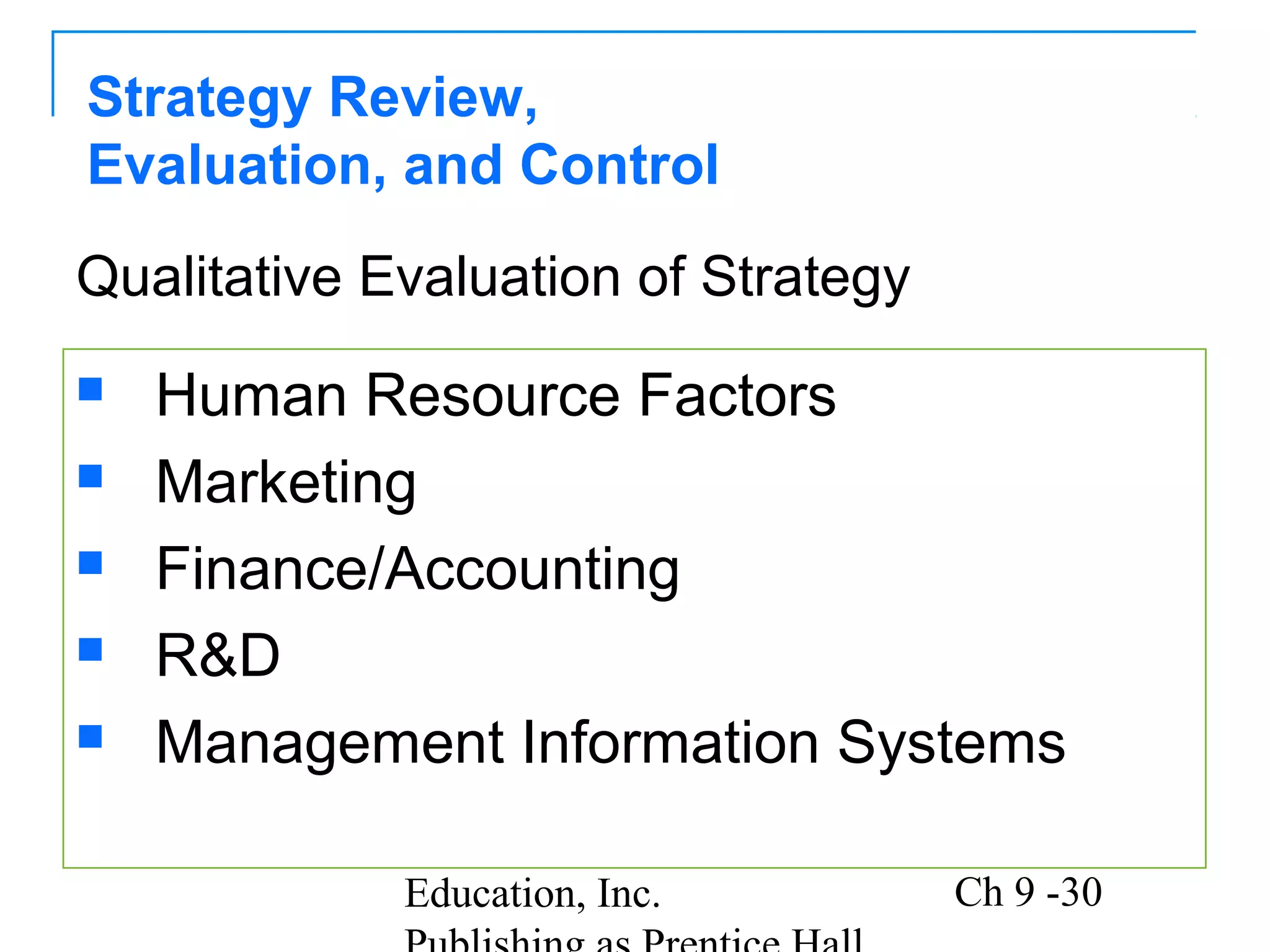
Strategy Review,
Evaluation, and Control
 Human Resource Factors
 Marketing
 Finance/Accounting
 R&D
 Management Information Systems
Qualitative Evaluation of Strategy
Copyright © 2011 Pearson
Education, Inc. Ch 9 -31
Copyright © 2011 Pearson
Education, Inc. Ch 9 -32
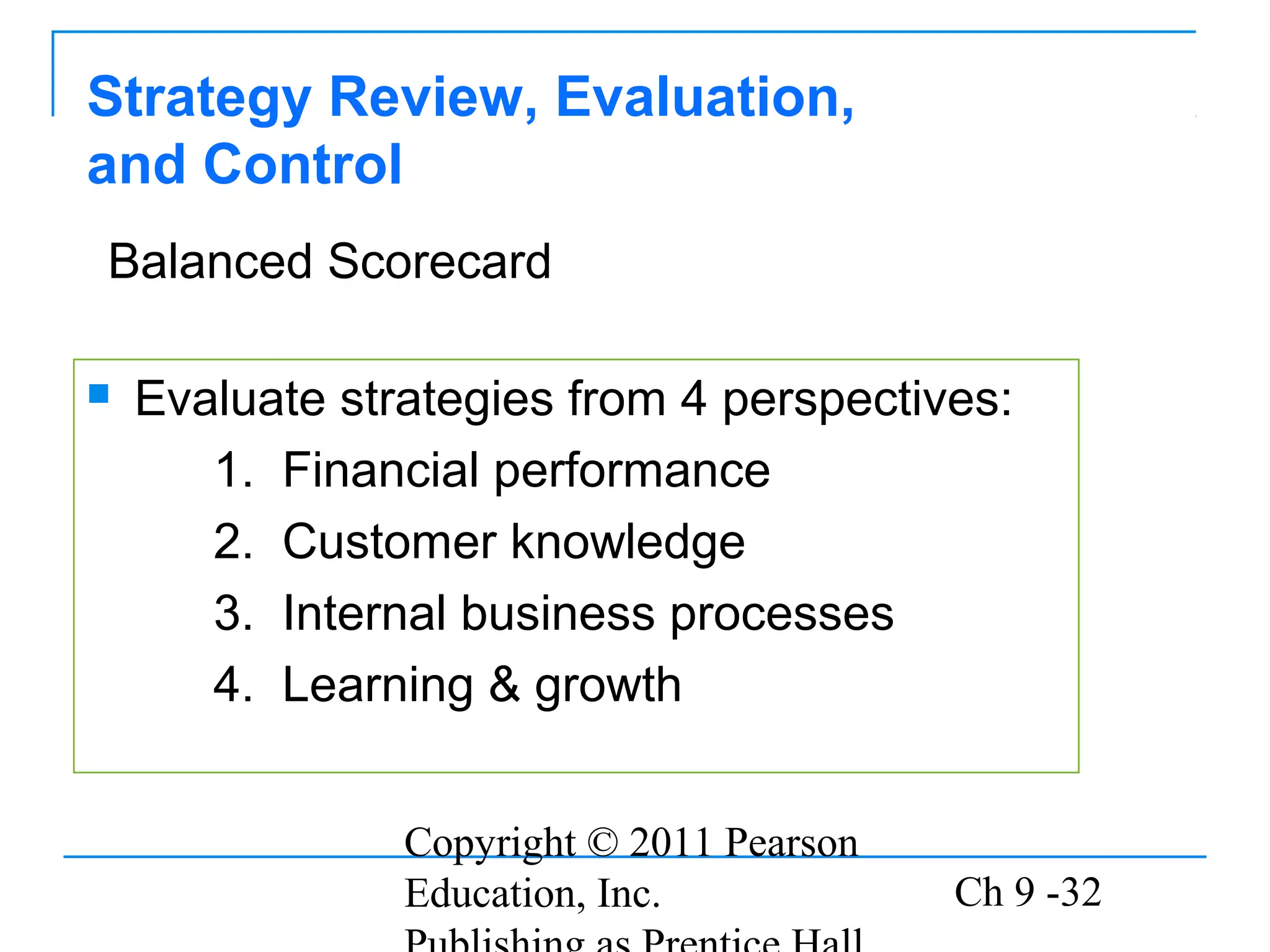
Strategy Review, Evaluation,
and Control
 Evaluate strategies from 4 perspectives:
1. Financial performance
2. Customer knowledge
3. Internal business processes
4. Learning & growth
Balanced Scorecard
Copyright © 2011 Pearson
Education, Inc. Ch 9 -33
Copyright © 2011 Pearson
Education, Inc. Ch 9 -34
Strategy Review, Evaluation,
and Control
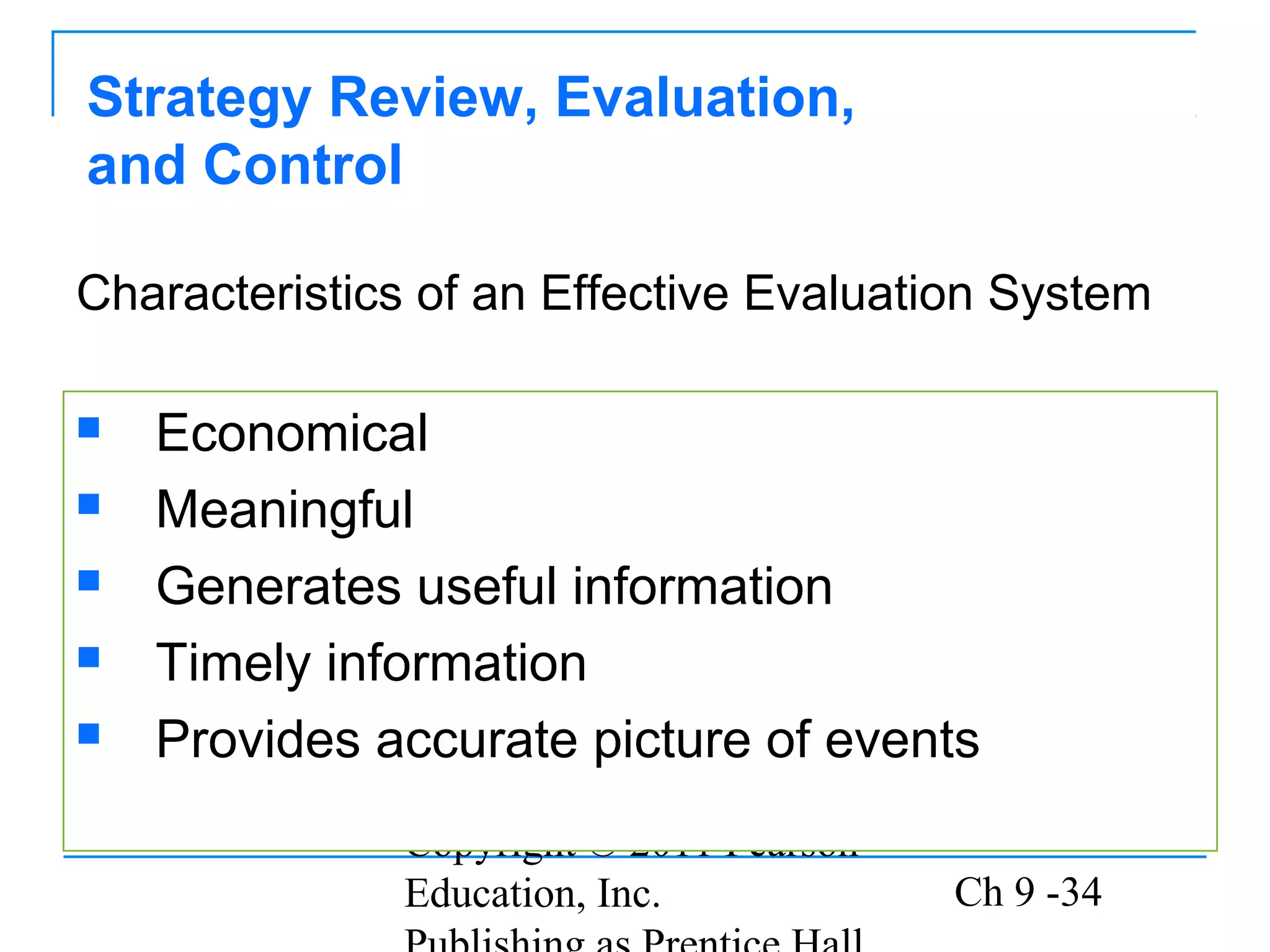
 Economical
 Meaningful
 Generates useful information
 Timely information
 Provides accurate picture of events
Characteristics of an Effective Evaluation System
Copyright © 2011 Pearson
Education, Inc. Ch 9 -35
Strategy Review, Evaluation,
and Control
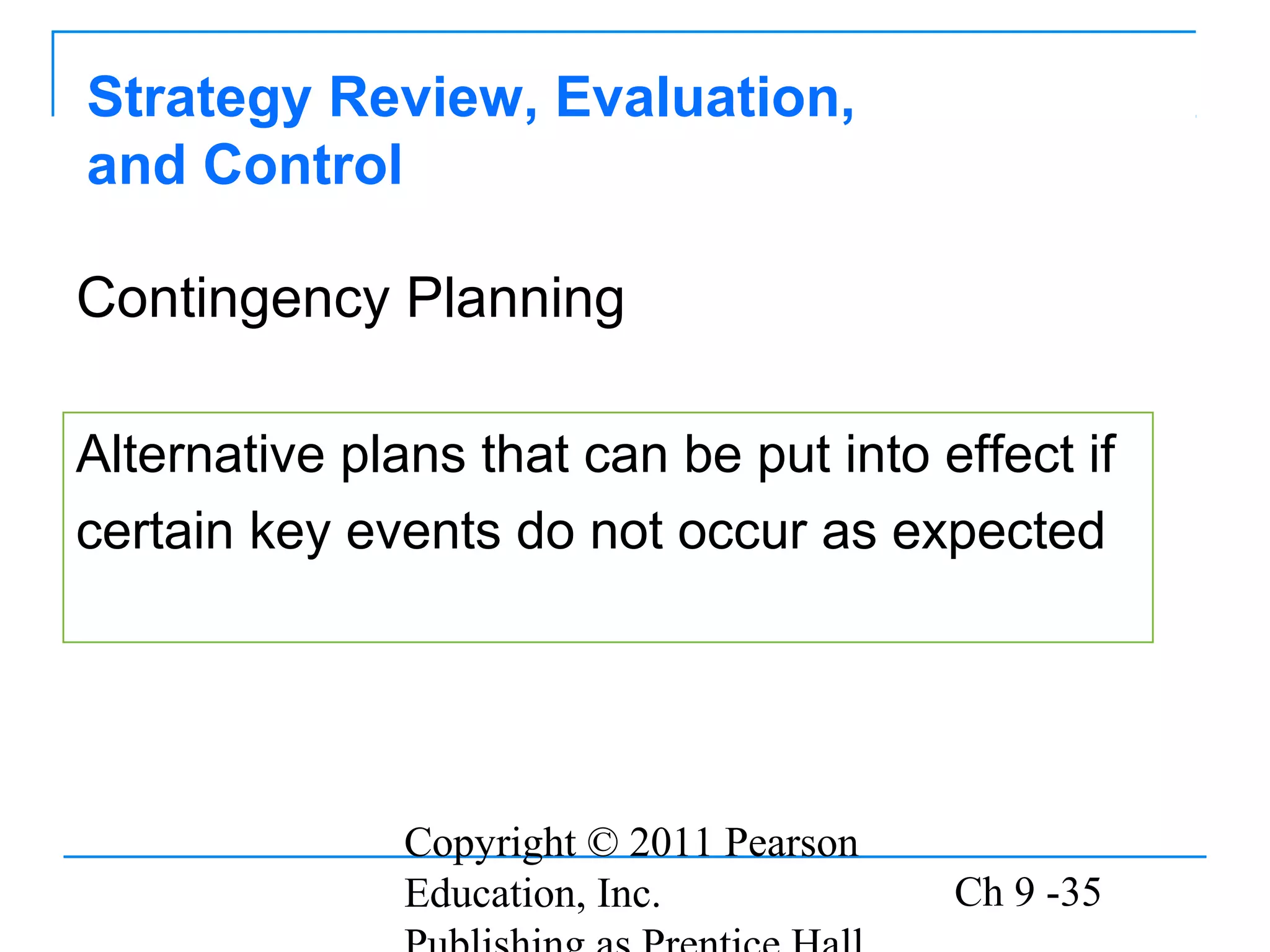
Alternative plans that can be put into effect if
certain key events do not occur as expected
Contingency Planning
Copyright © 2011 Pearson
Education, Inc. Ch 9 -36
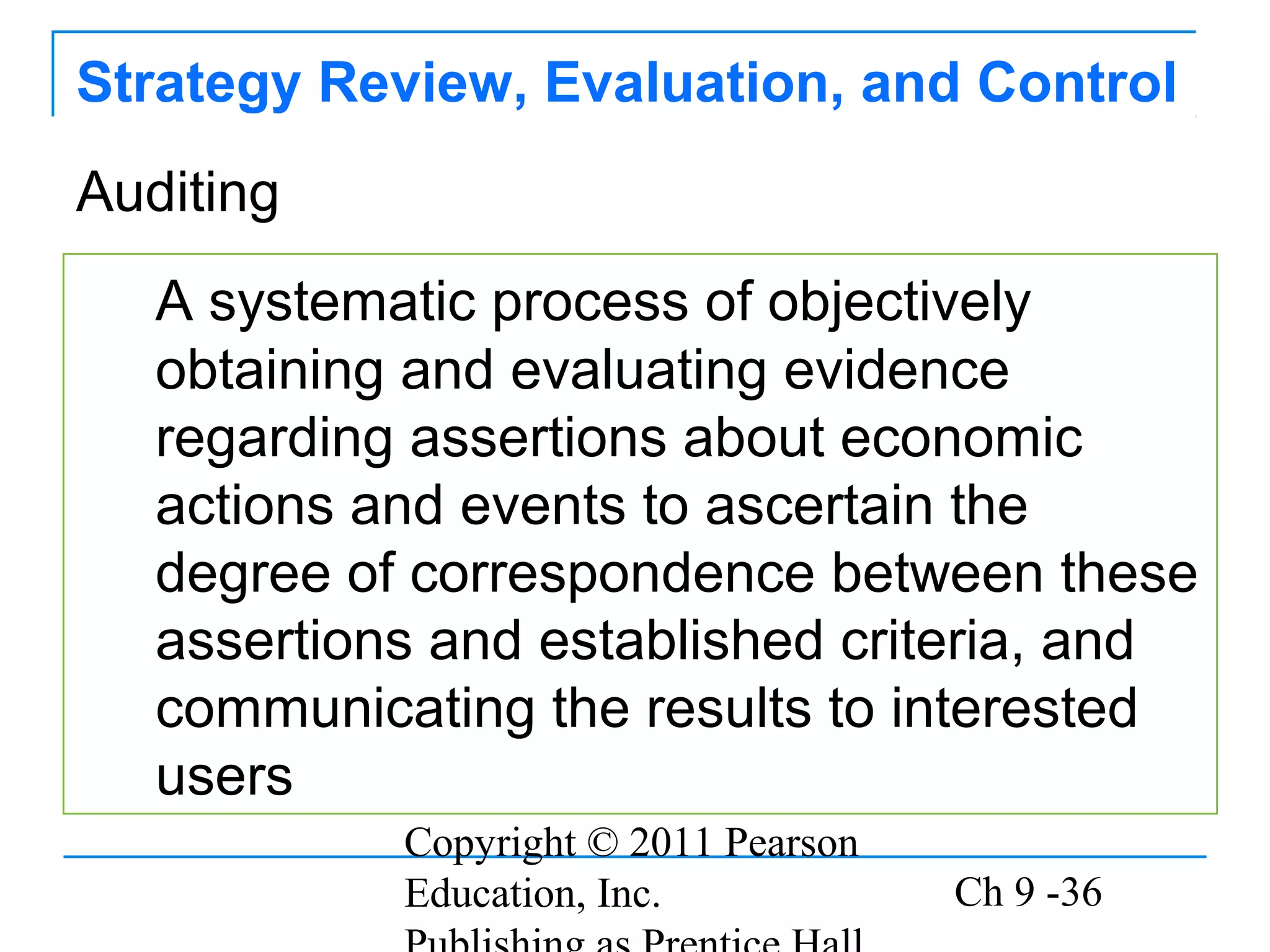
Strategy Review, Evaluation, and Control
A systematic process of objectively
obtaining and evaluating evidence
regarding assertions about economic
actions and events to ascertain the
degree of correspondence between these
assertions and established criteria, and
communicating the results to interested
users
Auditing
Copyright © 2011 Pearson
Education, Inc. Ch 9 -37
Strategy Review, Evaluation, and Control
 Should the process be more an “art” or a
“science”?
 Should strategies be visible or hidden from
stakeholders?
 Should process be more top-down or
bottom-up?
21st
Century Challenges in
Strategic Management
Copyright © 2011 Pearson
Education, Inc. Ch 9 -38
All rights reserved. No part of this publication may be reproduced, stored in a
retrieval system, or transmitted, in any form or by any means, electronic,
mechanical, photocopying, recording, or otherwise, without the prior written
permission of the publisher. Printed in the United States of America.

David sm13 ppt_09

  • 1.
    Copyright © 2011Pearson Education, Inc. Ch 9 -1 Chapter 9 Strategy Review, Evaluation, and Control Strategic Management: Concepts & Cases 13th Edition Fred David
  • 2.
    Copyright © 2011Pearson Education, Inc. Ch 9 -2
  • 3.
    Copyright © 2011Pearson Education, Inc. Ch 9 -3 “Organizations are most vulnerable when they are at the peak of their success.” – R. T. Lenz Strategy Evaluation
  • 4.
    Copyright © 2011Pearson Education, Inc. Ch 9 -4 – Strategies become obsolete – Internal environments are dynamic – External environments are dynamic Strategy Review, Evaluation, and Control
  • 5.
    Copyright © 2011Pearson Education, Inc. Ch 9 -5  Vital to the organization’s well-being  Alert management to potential/actual problems in a timely fashion  Erroneous strategic decisions can have severe negative impact on organizations Strategy Review, Evaluation, and Control Strategy Evaluation
  • 6.
    Copyright © 2011Pearson Education, Inc. Ch 9 -6 1. Examine the underlying bases of a firm’s strategy 2. Compare expected to actual results 3. Take corrective actions to ensure that performance conforms to plans Strategy Review, Evaluation, and Control Three Basic Activities
  • 7.
    Copyright © 2011Pearson Education, Inc. Ch 9 -7  Complex & sensitive undertaking  Overemphasis can be expensive & counterproductive Strategy Review, Evaluation, and Control Strategy Evaluation
  • 8.
    Copyright © 2011Pearson Education, Inc. Ch 9 -8 Strategy Review, Evaluation, and Control  Increase in assets?  Increase in profitability?  Increase in sales?  Increase in productivity?  Increases in profit margins, ROI, and EPS ratios? Appraisal of Strategic Performance
  • 9.
    Copyright © 2011Pearson Education, Inc. Ch 9 -9 Strategy Review, Evaluation, and Control Consonance Consistency Feasibility Advantage Rumelt’s 4 Criteria
  • 10.
    Copyright © 2011Pearson Education, Inc. Ch 9 -10 Strategy Review, Evaluation, and Control  Strategy should not present inconsistent goals and policies Consistency
  • 11.
    Copyright © 2011Pearson Education, Inc. Ch 9 -11 Strategy Review, Evaluation, and Control Consonance Consistency Feasibility Advantage Rumelt’s 4 Criteria
  • 12.
    Copyright © 2011Pearson Education, Inc. Ch 9 -12 Strategy Review, Evaluation, and Control  Need for strategists to examine sets of trends, as well as individual trends Consonance
  • 13.
    Copyright © 2011Pearson Education, Inc. Ch 9 -13 Strategy Review, Evaluation, and Control Consonance Consistency Feasibility Advantage Rumelt’s 4 Criteria
  • 14.
    Copyright © 2011Pearson Education, Inc. Ch 9 -14 Strategy Review, Evaluation, and Control  Neither overtax resources nor create unsolvable subproblems Feasibility
  • 15.
    Copyright © 2011Pearson Education, Inc. Ch 9 -15 Strategy Review, Evaluation, and Control Consonance Consistency Feasibility Advantage Rumelt’s 4 Criteria
  • 16.
    Copyright © 2011Pearson Education, Inc. Ch 9 -16 Strategy Review, Evaluation, and Control  Creation or maintenance of competitive advantage Advantage
  • 17.
    Copyright © 2011Pearson Education, Inc. Ch 9 -17 Strategy Review, Evaluation, and Control 1. Increase in environment’s complexity 2. Difficulty predicting future with accuracy 3. Increasing number of variables Difficulties in Strategy Evaluation
  • 18.
    Copyright © 2011Pearson Education, Inc. Ch 9 -18 Strategy Review, Evaluation, and Control 4. Rate of obsolescence of plans 5. Domestic and global events 6. Decreasing time span for planning certainty Difficulties in Strategy Evaluation
  • 19.
    Copyright © 2011Pearson Education, Inc. Ch 9 -19 Strategy Review, Evaluation, and Control  Initiate managerial questioning of expectations and assumptions  Trigger a review of objectives & values  Stimulate creativity in generating alternatives and formulating criteria for evaluation Strategy Evaluation Should –
  • 20.
    Copyright © 2011Pearson Education, Inc. Ch 9 -20 Strategy Review, Evaluation, and Control  Develop revised IFE Matrix  Develop revised EFE Matrix Review of Underlying Bases of Strategy –
  • 21.
    Copyright © 2011Pearson Education, Inc. Ch 9 -21 Strategy Review, Evaluation, and Control 1. Competitors’ reaction to strategy 2. Competitors’ change in strategy 3. Competitors’ changes in strengths & weaknesses 4. Reasons for competitors’ strategic change Review Effectiveness of Strategy –
  • 22.
    Copyright © 2011Pearson Education, Inc. Ch 9 -22 Strategy Review, Evaluation, and Control 5. Reasons for competitors’ successful strategies 6. Competitors’ satisfaction with present market positions & profitability 7. Potential for competitor retaliation 8. Potential for cooperation with competitors Review Effectiveness of Strategy –
  • 23.
    Copyright © 2011Pearson Education, Inc. Ch 9 -23 Strategy Review, Evaluation, and Control  Are strengths still strengths?  Have we added additional strengths?  Are weaknesses still weaknesses?  Have we developed other weaknesses? Monitor Strengths & Weaknesses; Opportunities & Threats
  • 24.
    Copyright © 2011Pearson Education, Inc. Ch 9 -24 Strategy Review, Evaluation, and Control  Are opportunities still opportunities?  Other opportunities develop?  Are threats still threats?  Other threats emerged?  Are we vulnerable to hostile takeover? Monitor Strengths & Weaknesses; Opportunities & Threats
  • 25.
    Copyright © 2011Pearson Education, Inc. Ch 9 -25
  • 26.
    Copyright © 2011Pearson Education, Inc. Ch 9 -26
  • 27.
    Copyright © 2011Pearson Education, Inc. Ch 9 -27 Strategy Review, Evaluation, and Control  Compare expected to actual results  Investigate deviations from plan  Evaluate individual performance  Examine progress toward stated objectives Measuring Organizational Performance
  • 28.
    Copyright © 2011Pearson Education, Inc. Ch 9 -28 Strategy Review, Evaluation, and Control  Financial Ratios  Compare performance over different periods  Compare performance to competitors’  Compare performance to industry averages Quantitative Criteria for Strategy Evaluation
  • 29.
    Copyright © 2011Pearson Education, Inc. Ch 9 -29 Strategy Review, Evaluation, and Control  Return on investment (ROI)  Return on equity (ROE)  Profit margin  Market share  Debt to equity  Earnings per share (EPS)  Sales growth  Asset growth Key Financial Ratios
  • 30.
    Copyright © 2011Pearson Education, Inc. Ch 9 -30 Strategy Review, Evaluation, and Control  Human Resource Factors  Marketing  Finance/Accounting  R&D  Management Information Systems Qualitative Evaluation of Strategy
  • 31.
    Copyright © 2011Pearson Education, Inc. Ch 9 -31
  • 32.
    Copyright © 2011Pearson Education, Inc. Ch 9 -32 Strategy Review, Evaluation, and Control  Evaluate strategies from 4 perspectives: 1. Financial performance 2. Customer knowledge 3. Internal business processes 4. Learning & growth Balanced Scorecard
  • 33.
    Copyright © 2011Pearson Education, Inc. Ch 9 -33
  • 34.
    Copyright © 2011Pearson Education, Inc. Ch 9 -34 Strategy Review, Evaluation, and Control  Economical  Meaningful  Generates useful information  Timely information  Provides accurate picture of events Characteristics of an Effective Evaluation System
  • 35.
    Copyright © 2011Pearson Education, Inc. Ch 9 -35 Strategy Review, Evaluation, and Control Alternative plans that can be put into effect if certain key events do not occur as expected Contingency Planning
  • 36.
    Copyright © 2011Pearson Education, Inc. Ch 9 -36 Strategy Review, Evaluation, and Control A systematic process of objectively obtaining and evaluating evidence regarding assertions about economic actions and events to ascertain the degree of correspondence between these assertions and established criteria, and communicating the results to interested users Auditing
  • 37.
    Copyright © 2011Pearson Education, Inc. Ch 9 -37 Strategy Review, Evaluation, and Control  Should the process be more an “art” or a “science”?  Should strategies be visible or hidden from stakeholders?  Should process be more top-down or bottom-up? 21st Century Challenges in Strategic Management
  • 38.
    Copyright © 2011Pearson Education, Inc. Ch 9 -38 All rights reserved. No part of this publication may be reproduced, stored in a retrieval system, or transmitted, in any form or by any means, electronic, mechanical, photocopying, recording, or otherwise, without the prior written permission of the publisher. Printed in the United States of America.

Editor's Notes

  • #4 <number>
  • #5 <number>
  • #6 <number>
  • #7 <number>
  • #8 <number>
  • #33 <number>