TThhee IInntteerrnnaall 
AAsssseessssmmeenntt 
Chapter Four
Chapter Objectives 
1. Describe how to perform an internal strategic-management 
audit. 
2. Discuss the Resource-Based View (RBV) in 
strategic management. 
3. Discuss key interrelationships among the functional 
areas of business. 
4. Identify the basic functions or activities that make 
up management, marketing, finance/accounting 
production/operations, research and development, 
and management information systems. 
Copyright ©2013 Pearson Education 4-2
Chapter Objectives 
5. Explain how to determine and prioritize a firm’s 
internal strengths and weaknesses. 
6. Explain the importance of financial ratio analysis. 
7. Discuss the nature and role of management 
information systems in strategic management. 
8. Develop an Internal Factor Evaluation (IFE) 
Matrix. 
9. Explain cost/benefit analysis value chain 
analysis, and benchmarking as strategic-management 
tools. 
Copyright ©2013 Pearson Education 4-3
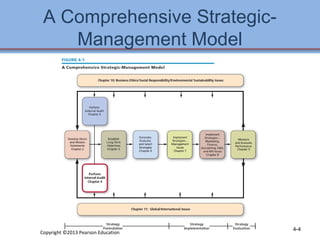
A Comprehensive Strategic- 
Management Model 
Copyright ©2013 Pearson Education 4-4
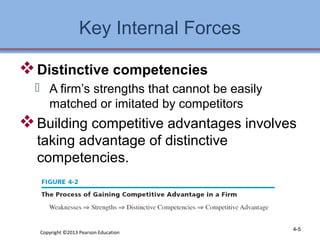
Key Internal Forces 
Distinctive competencies 
 A firm’s strengths that cannot be easily 
matched or imitated by competitors 
Building competitive advantages involves 
taking advantage of distinctive 
competencies. 
Copyright ©2013 Pearson Education 4-5
The Process of Performing an 
Internal Audit 
The internal audit 
 Requires gathering and assimilating 
information about the firm’s management, 
marketing, finance/accounting, 
production/operations, research and 
development (R&D), and management 
information systems operations 
 Provides more opportunity for participants to 
understand how their jobs, departments, and 
divisions fit into the whole organization 
Copyright ©2013 Pearson Education 4-6
The Resource-Based View (RBV) 
The Resource-Based View (RBV) 
approach 
 contends that internal resources are more 
important for a firm than external factors in 
achieving and sustaining competitive 
advantage 
Copyright ©2013 Pearson Education 4-7
The Resource-Based View (RBV) 
Proponents of the RBV contend that 
organizational performance will primarily 
be determined by internal resources that 
can be grouped into three all-encompassing 
categories: physical 
resources, human resources, and 
organizational resources 
Copyright ©2013 Pearson Education 4-8
The Resource-Based View (RBV) 
For a resource to be valuable, it must be 
either (1) rare, (2) hard to imitate, or (3) 
not easily substitutable 
These three characteristics of resources 
enable a firm to implement strategies that 
improve its efficiency and effectiveness 
and lead to a sustainable competitive 
advantage 
Copyright ©2013 Pearson Education 4-9
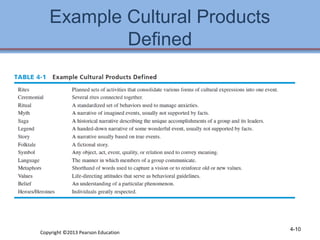
Example Cultural Products 
Defined 
Copyright ©2013 Pearson Education 4-10
Integrating Strategy and Culture 
Organizational culture significantly affects 
business decisions and thus must be 
evaluated during an internal strategic-management 
audit. 
If strategies can capitalize on cultural 
strengths, such as a strong work ethic or 
highly ethical beliefs, then management 
often can swiftly and easily implement 
changes. 
Copyright ©2013 Pearson Education 4-11
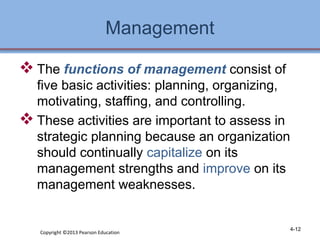
Management 
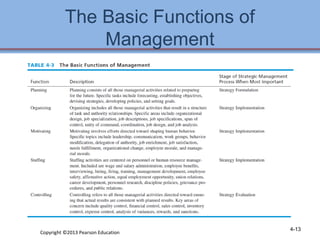
The functions of management consist of 
five basic activities: planning, organizing, 
motivating, staffing, and controlling. 
These activities are important to assess in 
strategic planning because an organization 
should continually capitalize on its 
management strengths and improve on its 
management weaknesses. 
Copyright ©2013 Pearson Education 4-12
The Basic Functions of 
Management 
Copyright ©2013 Pearson Education 4-13
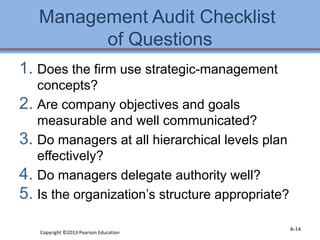
Management Audit Checklist 
of Questions 
1. Does the firm use strategic-management 
concepts? 
2. Are company objectives and goals 
measurable and well communicated? 
3. Do managers at all hierarchical levels plan 
effectively? 
4. Do managers delegate authority well? 
5. Is the organization’s structure appropriate? 
Copyright ©2013 Pearson Education 4-14
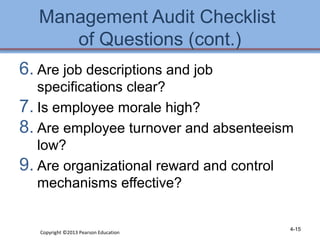
Management Audit Checklist 
of Questions (cont.) 
6. Are job descriptions and job 
specifications clear? 
7. Is employee morale high? 
8. Are employee turnover and absenteeism 
low? 
9. Are organizational reward and control 
mechanisms effective? 
Copyright ©2013 Pearson Education 4-15
Marketing 
Marketing 
 the process of defining, anticipating, creating, 
and fulfilling customers’ needs and wants for 
products and services 
Copyright ©2013 Pearson Education 4-16
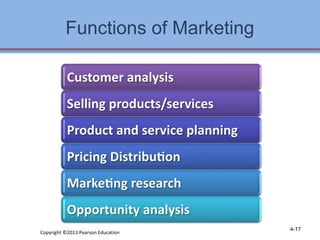
Functions of Marketing 
Copyright ©2013 Pearson Education 4-17
Marketing 
Customer analysis 
 the examination and evaluation of consumer 
needs, desires, and wants 
 involves administering customer surveys, 
analyzing consumer information, evaluating 
market positioning strategies, developing 
customer profiles, and determining optimal 
market segmentation strategies 
 essential in developing an effective mission 
statement 
Copyright ©2013 Pearson Education 4-18
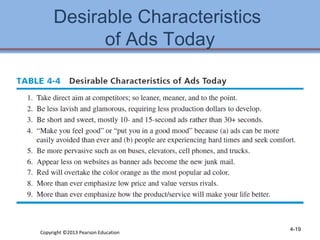
Desirable Characteristics 
of Ads Today 
Copyright ©2013 Pearson Education 4-19
Product and Service Planning 
Product and service planning 
 includes activities such as test marketing; 
product and brand positioning; devising 
warranties; packaging; determining product 
options, features, style, and quality; deleting 
old products; and providing for customer 
service 
 important when a company is pursuing 
product development or diversification 
Copyright ©2013 Pearson Education 4-20
Pricing 
Five major stakeholders affect pricing 
decisions: consumers, governments, 
suppliers, distributors, and competitors 
Sometimes an organization will pursue a 
forward integration strategy primarily to 
gain better control over prices charged to 
consumers 
Copyright ©2013 Pearson Education 4-21
Distribution 
Distribution 
 includes warehousing, distribution channels, 
distribution coverage, retail site locations, 
sales territories, inventory levels and 
location, transportation carriers, wholesaling, 
and retailing 
 especially important when a firm is striving to 
implement a market development or forward 
integration strategy 
Copyright ©2013 Pearson Education 4-22
Marketing Research 
Marketing research 
 the systematic gathering, recording, and 
analyzing of data about problems relating to 
the marketing of goods and services 
 can uncover critical strengths and 
weaknesses 
Copyright ©2013 Pearson Education 4-23
Cost/Benefit Analysis 
Three steps are required to perform a 
cost/benefit analysis: 
1.compute the total costs associated with a 
decision, 
2.estimate the total benefits from the 
decision, 
3.compare the total costs with the total 
benefits. 
Copyright ©2013 Pearson Education 4-24
Marketing Audit Checklist 
of Questions 
1. Are markets segmented effectively? 
2. Is the organization positioned well among 
competitors? 
3. Has the firm’s market share been increasing? 
4. Are present channels of distribution reliable and 
cost effective? 
5. Does the firm have an effective sales 
organization? 
6. Does the firm conduct market research? 
Copyright ©2013 Pearson Education 4-25
Marketing Audit Checklist 
of Questions 
7. Are product quality and customer service good? 
8. Are the firm’s products and services priced 
appropriately? 
9. Does the firm have an effective promotion, 
advertising, and publicity strategy? 
10. Are marketing, planning, and budgeting effective? 
11. Do the firm’s marketing managers have adequate 
experience and training? 
12. Is the firm’s Internet presence excellent as 
compared to rivals? 
Copyright ©2013 Pearson Education 4-26
Finance/Accounting Functions 
The functions of finance/accounting 
comprise three decisions: 
1.the investment decision 
2.the financing decision 
3.the dividend decision 
Copyright ©2013 Pearson Education 4-27
Finance/Accounting Functions 
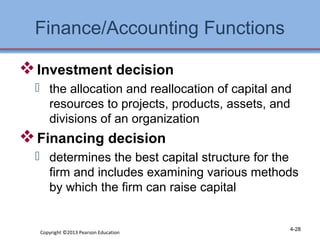
Investment decision 
 the allocation and reallocation of capital and 
resources to projects, products, assets, and 
divisions of an organization 
Financing decision 
 determines the best capital structure for the 
firm and includes examining various methods 
by which the firm can raise capital 
Copyright ©2013 Pearson Education 4-28
Finance/Accounting Functions 
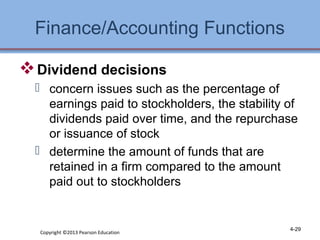
Dividend decisions 
 concern issues such as the percentage of 
earnings paid to stockholders, the stability of 
dividends paid over time, and the repurchase 
or issuance of stock 
 determine the amount of funds that are 
retained in a firm compared to the amount 
paid out to stockholders 
Copyright ©2013 Pearson Education 4-29
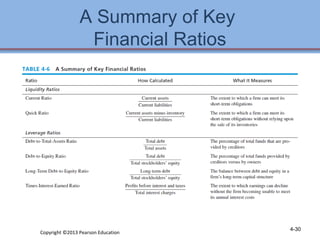
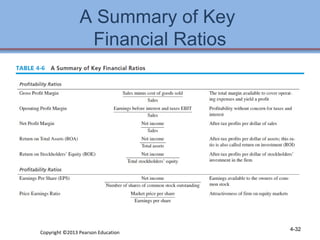
A Summary of Key 
Financial Ratios 
Copyright ©2013 Pearson Education 4-30
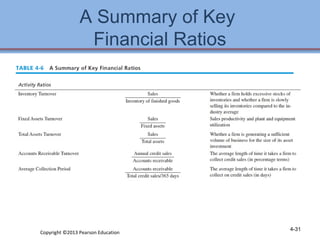
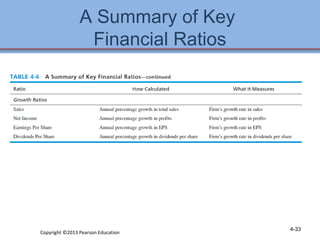
A Summary of Key 
Financial Ratios 
Copyright ©2013 Pearson Education 4-31
A Summary of Key 
Financial Ratios 
Copyright ©2013 Pearson Education 4-32
A Summary of Key 
Financial Ratios 
Copyright ©2013 Pearson Education 4-33
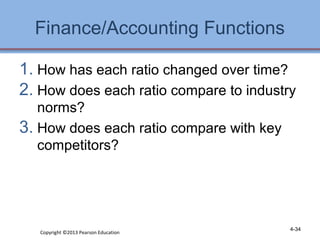
Finance/Accounting Functions 
1. How has each ratio changed over time? 
2. How does each ratio compare to industry 
norms? 
3. How does each ratio compare with key 
competitors? 
Copyright ©2013 Pearson Education 4-34
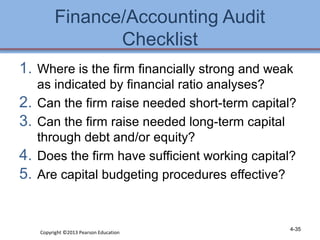
Finance/Accounting Audit 
Checklist 
1. Where is the firm financially strong and weak 
as indicated by financial ratio analyses? 
2. Can the firm raise needed short-term capital? 
3. Can the firm raise needed long-term capital 
through debt and/or equity? 
4. Does the firm have sufficient working capital? 
5. Are capital budgeting procedures effective? 
Copyright ©2013 Pearson Education 4-35
Finance/Accounting Audit 
Checklist 
7. Are dividend payout policies 
reasonable? 
8. Does the firm have good relations with 
its investors and stockholders? 
9. Are the firm’s financial managers 
experienced and well trained? 
10.Is the firm’s debt situation excellent? 
Copyright ©2013 Pearson Education 4-36
Production/Operations 
4-37 
Production/operations function 
 consists of all those activities that transforms 
inputs into goods and services 
Production/operations management 
deals with inputs, transformations, and 
outputs that vary across industries and 
markets. 
Copyright ©2013 Pearson Education
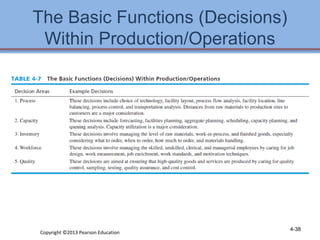
The Basic Functions (Decisions) 
Within Production/Operations 
Copyright ©2013 Pearson Education 4-38
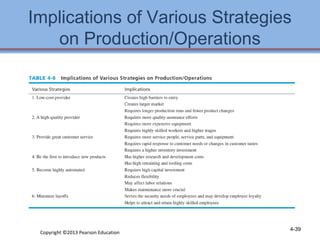
Implications of Various Strategies 
on Production/Operations 
Copyright ©2013 Pearson Education 4-39
Production/Operations 
Audit Checklist 
1. Are supplies of raw materials, parts, and 
subassemblies reliable and reasonable? 
2. Are facilities, equipment, machinery, and offices in 
good condition? 
3. Are inventory-control policies and procedures 
effective? 
4. Are quality-control policies and procedures effective? 
5. Are facilities, resources, and markets strategically 
located? 
6. Does the firm have technological competencies? 
Copyright ©2013 Pearson Education 4-40
Research and Development Audit 
1. Does the firm have R&D facilities? Are they adequate? 
2. If outside R&D firms are used, are they cost-effective? 
3. Are the organization’s R&D personnel well qualified? 
4. Are R&D resources allocated effectively? 
5. Are management information and computer systems 
adequate? 
6. Is communication between R&D and other 
organizational units effective? 
7. Are present products technologically competitive? 
Copyright ©2013 Pearson Education 4-41
Management Information 
Systems 
 A management information system’s purpose is 
to improve the performance of an enterprise by 
improving the quality of managerial decisions 
 An effective information system thus collects, 
codes, stores, synthesizes, and presents 
information in such a manner that it answers 
important operating and strategic questions 
Copyright ©2013 Pearson Education 4-42
Management Information 
Systems Audit 
1. Do all managers in the firm use the information 
system to make decisions? 
2. Is there a chief information officer or director of 
information systems position in the firm? 
3. Are data in the information system updated 
regularly? 
4. Do managers from all functional areas of the 
firm contribute input to the information system? 
5. Are there effective passwords for entry into the 
firm’s information system? 
Copyright ©2013 Pearson Education 4-43
Management Information 
Systems Audit 
6. Are strategists of the firm familiar with the 
information systems of rival firms? 
7. Is the information system user-friendly? 
8. Do all users of the information system understand 
the competitive advantages that information can 
provide firms? 
9. Are computer training workshops provided for 
users of the information system? 
10.Is the firm’s information system continually being 
improved in content- and user-friendliness? 
Copyright ©2013 Pearson Education 4-44
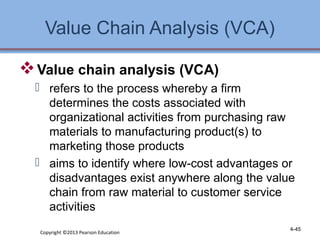
Value Chain Analysis (VCA) 
Value chain analysis (VCA) 
 refers to the process whereby a firm 
determines the costs associated with 
organizational activities from purchasing raw 
materials to manufacturing product(s) to 
marketing those products 
 aims to identify where low-cost advantages or 
disadvantages exist anywhere along the value 
chain from raw material to customer service 
activities 
Copyright ©2013 Pearson Education 4-45
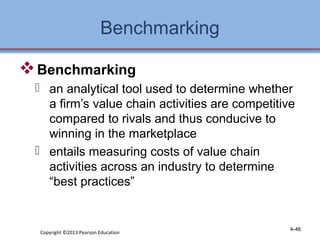
Benchmarking 
Benchmarking 
 an analytical tool used to determine whether 
a firm’s value chain activities are competitive 
compared to rivals and thus conducive to 
winning in the marketplace 
 entails measuring costs of value chain 
activities across an industry to determine 
“best practices” 
Copyright ©2013 Pearson Education 4-46
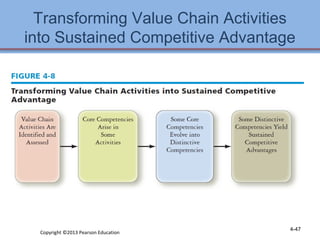
Transforming Value Chain Activities 
into Sustained Competitive Advantage 
Copyright ©2013 Pearson Education 4-47
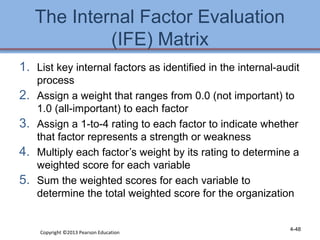
The Internal Factor Evaluation 
(IFE) Matrix 
1. List key internal factors as identified in the internal-audit 
process 
2. Assign a weight that ranges from 0.0 (not important) to 
1.0 (all-important) to each factor 
3. Assign a 1-to-4 rating to each factor to indicate whether 
that factor represents a strength or weakness 
4. Multiply each factor’s weight by its rating to determine a 
weighted score for each variable 
5. Sum the weighted scores for each variable to 
determine the total weighted score for the organization 
Copyright ©2013 Pearson Education 4-48
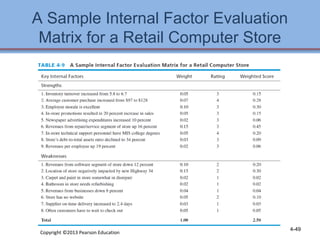
A Sample Internal Factor Evaluation 
Matrix for a Retail Computer Store 
Copyright ©2013 Pearson Education 4-49
Copyright ©2013 Pearson Education 4-50

David sm14 inppt04_ge

  • 1.
  • 2.
    Chapter Objectives 1.Describe how to perform an internal strategic-management audit. 2. Discuss the Resource-Based View (RBV) in strategic management. 3. Discuss key interrelationships among the functional areas of business. 4. Identify the basic functions or activities that make up management, marketing, finance/accounting production/operations, research and development, and management information systems. Copyright ©2013 Pearson Education 4-2
  • 3.
    Chapter Objectives 5.Explain how to determine and prioritize a firm’s internal strengths and weaknesses. 6. Explain the importance of financial ratio analysis. 7. Discuss the nature and role of management information systems in strategic management. 8. Develop an Internal Factor Evaluation (IFE) Matrix. 9. Explain cost/benefit analysis value chain analysis, and benchmarking as strategic-management tools. Copyright ©2013 Pearson Education 4-3
  • 4.
    A Comprehensive Strategic- Management Model Copyright ©2013 Pearson Education 4-4
  • 5.
    Key Internal Forces Distinctive competencies  A firm’s strengths that cannot be easily matched or imitated by competitors Building competitive advantages involves taking advantage of distinctive competencies. Copyright ©2013 Pearson Education 4-5
  • 6.
    The Process ofPerforming an Internal Audit The internal audit  Requires gathering and assimilating information about the firm’s management, marketing, finance/accounting, production/operations, research and development (R&D), and management information systems operations  Provides more opportunity for participants to understand how their jobs, departments, and divisions fit into the whole organization Copyright ©2013 Pearson Education 4-6
  • 7.
    The Resource-Based View(RBV) The Resource-Based View (RBV) approach  contends that internal resources are more important for a firm than external factors in achieving and sustaining competitive advantage Copyright ©2013 Pearson Education 4-7
  • 8.
    The Resource-Based View(RBV) Proponents of the RBV contend that organizational performance will primarily be determined by internal resources that can be grouped into three all-encompassing categories: physical resources, human resources, and organizational resources Copyright ©2013 Pearson Education 4-8
  • 9.
    The Resource-Based View(RBV) For a resource to be valuable, it must be either (1) rare, (2) hard to imitate, or (3) not easily substitutable These three characteristics of resources enable a firm to implement strategies that improve its efficiency and effectiveness and lead to a sustainable competitive advantage Copyright ©2013 Pearson Education 4-9
  • 10.
    Example Cultural Products Defined Copyright ©2013 Pearson Education 4-10
  • 11.
    Integrating Strategy andCulture Organizational culture significantly affects business decisions and thus must be evaluated during an internal strategic-management audit. If strategies can capitalize on cultural strengths, such as a strong work ethic or highly ethical beliefs, then management often can swiftly and easily implement changes. Copyright ©2013 Pearson Education 4-11
  • 12.
    Management The functionsof management consist of five basic activities: planning, organizing, motivating, staffing, and controlling. These activities are important to assess in strategic planning because an organization should continually capitalize on its management strengths and improve on its management weaknesses. Copyright ©2013 Pearson Education 4-12
  • 13.
    The Basic Functionsof Management Copyright ©2013 Pearson Education 4-13
  • 14.
    Management Audit Checklist of Questions 1. Does the firm use strategic-management concepts? 2. Are company objectives and goals measurable and well communicated? 3. Do managers at all hierarchical levels plan effectively? 4. Do managers delegate authority well? 5. Is the organization’s structure appropriate? Copyright ©2013 Pearson Education 4-14
  • 15.
    Management Audit Checklist of Questions (cont.) 6. Are job descriptions and job specifications clear? 7. Is employee morale high? 8. Are employee turnover and absenteeism low? 9. Are organizational reward and control mechanisms effective? Copyright ©2013 Pearson Education 4-15
  • 16.
    Marketing Marketing the process of defining, anticipating, creating, and fulfilling customers’ needs and wants for products and services Copyright ©2013 Pearson Education 4-16
  • 17.
    Functions of Marketing Copyright ©2013 Pearson Education 4-17
  • 18.
    Marketing Customer analysis  the examination and evaluation of consumer needs, desires, and wants  involves administering customer surveys, analyzing consumer information, evaluating market positioning strategies, developing customer profiles, and determining optimal market segmentation strategies  essential in developing an effective mission statement Copyright ©2013 Pearson Education 4-18
  • 19.
    Desirable Characteristics ofAds Today Copyright ©2013 Pearson Education 4-19
  • 20.
    Product and ServicePlanning Product and service planning  includes activities such as test marketing; product and brand positioning; devising warranties; packaging; determining product options, features, style, and quality; deleting old products; and providing for customer service  important when a company is pursuing product development or diversification Copyright ©2013 Pearson Education 4-20
  • 21.
    Pricing Five majorstakeholders affect pricing decisions: consumers, governments, suppliers, distributors, and competitors Sometimes an organization will pursue a forward integration strategy primarily to gain better control over prices charged to consumers Copyright ©2013 Pearson Education 4-21
  • 22.
    Distribution Distribution includes warehousing, distribution channels, distribution coverage, retail site locations, sales territories, inventory levels and location, transportation carriers, wholesaling, and retailing  especially important when a firm is striving to implement a market development or forward integration strategy Copyright ©2013 Pearson Education 4-22
  • 23.
    Marketing Research Marketingresearch  the systematic gathering, recording, and analyzing of data about problems relating to the marketing of goods and services  can uncover critical strengths and weaknesses Copyright ©2013 Pearson Education 4-23
  • 24.
    Cost/Benefit Analysis Threesteps are required to perform a cost/benefit analysis: 1.compute the total costs associated with a decision, 2.estimate the total benefits from the decision, 3.compare the total costs with the total benefits. Copyright ©2013 Pearson Education 4-24
  • 25.
    Marketing Audit Checklist of Questions 1. Are markets segmented effectively? 2. Is the organization positioned well among competitors? 3. Has the firm’s market share been increasing? 4. Are present channels of distribution reliable and cost effective? 5. Does the firm have an effective sales organization? 6. Does the firm conduct market research? Copyright ©2013 Pearson Education 4-25
  • 26.
    Marketing Audit Checklist of Questions 7. Are product quality and customer service good? 8. Are the firm’s products and services priced appropriately? 9. Does the firm have an effective promotion, advertising, and publicity strategy? 10. Are marketing, planning, and budgeting effective? 11. Do the firm’s marketing managers have adequate experience and training? 12. Is the firm’s Internet presence excellent as compared to rivals? Copyright ©2013 Pearson Education 4-26
  • 27.
    Finance/Accounting Functions Thefunctions of finance/accounting comprise three decisions: 1.the investment decision 2.the financing decision 3.the dividend decision Copyright ©2013 Pearson Education 4-27
  • 28.
    Finance/Accounting Functions Investmentdecision  the allocation and reallocation of capital and resources to projects, products, assets, and divisions of an organization Financing decision  determines the best capital structure for the firm and includes examining various methods by which the firm can raise capital Copyright ©2013 Pearson Education 4-28
  • 29.
    Finance/Accounting Functions Dividenddecisions  concern issues such as the percentage of earnings paid to stockholders, the stability of dividends paid over time, and the repurchase or issuance of stock  determine the amount of funds that are retained in a firm compared to the amount paid out to stockholders Copyright ©2013 Pearson Education 4-29
  • 30.
    A Summary ofKey Financial Ratios Copyright ©2013 Pearson Education 4-30
  • 31.
    A Summary ofKey Financial Ratios Copyright ©2013 Pearson Education 4-31
  • 32.
    A Summary ofKey Financial Ratios Copyright ©2013 Pearson Education 4-32
  • 33.
    A Summary ofKey Financial Ratios Copyright ©2013 Pearson Education 4-33
  • 34.
    Finance/Accounting Functions 1.How has each ratio changed over time? 2. How does each ratio compare to industry norms? 3. How does each ratio compare with key competitors? Copyright ©2013 Pearson Education 4-34
  • 35.
    Finance/Accounting Audit Checklist 1. Where is the firm financially strong and weak as indicated by financial ratio analyses? 2. Can the firm raise needed short-term capital? 3. Can the firm raise needed long-term capital through debt and/or equity? 4. Does the firm have sufficient working capital? 5. Are capital budgeting procedures effective? Copyright ©2013 Pearson Education 4-35
  • 36.
    Finance/Accounting Audit Checklist 7. Are dividend payout policies reasonable? 8. Does the firm have good relations with its investors and stockholders? 9. Are the firm’s financial managers experienced and well trained? 10.Is the firm’s debt situation excellent? Copyright ©2013 Pearson Education 4-36
  • 37.
    Production/Operations 4-37 Production/operationsfunction  consists of all those activities that transforms inputs into goods and services Production/operations management deals with inputs, transformations, and outputs that vary across industries and markets. Copyright ©2013 Pearson Education
  • 38.
    The Basic Functions(Decisions) Within Production/Operations Copyright ©2013 Pearson Education 4-38
  • 39.
    Implications of VariousStrategies on Production/Operations Copyright ©2013 Pearson Education 4-39
  • 40.
    Production/Operations Audit Checklist 1. Are supplies of raw materials, parts, and subassemblies reliable and reasonable? 2. Are facilities, equipment, machinery, and offices in good condition? 3. Are inventory-control policies and procedures effective? 4. Are quality-control policies and procedures effective? 5. Are facilities, resources, and markets strategically located? 6. Does the firm have technological competencies? Copyright ©2013 Pearson Education 4-40
  • 41.
    Research and DevelopmentAudit 1. Does the firm have R&D facilities? Are they adequate? 2. If outside R&D firms are used, are they cost-effective? 3. Are the organization’s R&D personnel well qualified? 4. Are R&D resources allocated effectively? 5. Are management information and computer systems adequate? 6. Is communication between R&D and other organizational units effective? 7. Are present products technologically competitive? Copyright ©2013 Pearson Education 4-41
  • 42.
    Management Information Systems  A management information system’s purpose is to improve the performance of an enterprise by improving the quality of managerial decisions  An effective information system thus collects, codes, stores, synthesizes, and presents information in such a manner that it answers important operating and strategic questions Copyright ©2013 Pearson Education 4-42
  • 43.
    Management Information SystemsAudit 1. Do all managers in the firm use the information system to make decisions? 2. Is there a chief information officer or director of information systems position in the firm? 3. Are data in the information system updated regularly? 4. Do managers from all functional areas of the firm contribute input to the information system? 5. Are there effective passwords for entry into the firm’s information system? Copyright ©2013 Pearson Education 4-43
  • 44.
    Management Information SystemsAudit 6. Are strategists of the firm familiar with the information systems of rival firms? 7. Is the information system user-friendly? 8. Do all users of the information system understand the competitive advantages that information can provide firms? 9. Are computer training workshops provided for users of the information system? 10.Is the firm’s information system continually being improved in content- and user-friendliness? Copyright ©2013 Pearson Education 4-44
  • 45.
    Value Chain Analysis(VCA) Value chain analysis (VCA)  refers to the process whereby a firm determines the costs associated with organizational activities from purchasing raw materials to manufacturing product(s) to marketing those products  aims to identify where low-cost advantages or disadvantages exist anywhere along the value chain from raw material to customer service activities Copyright ©2013 Pearson Education 4-45
  • 46.
    Benchmarking Benchmarking an analytical tool used to determine whether a firm’s value chain activities are competitive compared to rivals and thus conducive to winning in the marketplace  entails measuring costs of value chain activities across an industry to determine “best practices” Copyright ©2013 Pearson Education 4-46
  • 47.
    Transforming Value ChainActivities into Sustained Competitive Advantage Copyright ©2013 Pearson Education 4-47
  • 48.
    The Internal FactorEvaluation (IFE) Matrix 1. List key internal factors as identified in the internal-audit process 2. Assign a weight that ranges from 0.0 (not important) to 1.0 (all-important) to each factor 3. Assign a 1-to-4 rating to each factor to indicate whether that factor represents a strength or weakness 4. Multiply each factor’s weight by its rating to determine a weighted score for each variable 5. Sum the weighted scores for each variable to determine the total weighted score for the organization Copyright ©2013 Pearson Education 4-48
  • 49.
    A Sample InternalFactor Evaluation Matrix for a Retail Computer Store Copyright ©2013 Pearson Education 4-49
  • 50.

Editor's Notes

  • #9 Physical resources include all plant and equipment, location, technology, raw materials, machines; human resources include all employees, training, experience, intelligence, knowledge, skills, abilities; and organizational resources include firm structure, planning processes, information systems, patents, trademarks, copyrights, databases, and so on.