Topic 5: The Internal Audit
Learning Outcomes
1. Describe the nature and role of an internal assessment in formulating strategies.
2. Discuss why organizational culture is so important in formulating strategies.
3. Identify the basic functions (activities) that make up management and their
relevance in formulating strategies.
4. Identify the basic functions of marketing and their relevance in formulating
strategies.
5. Discuss the nature and role of finance/accounting in formulating strategies.
6. Discuss the nature and role of production/operations in formulating strategies.
7. Discuss the nature and role of research and development (R&D) in formulating
strategies.
8. Discuss the nature and role of management information systems (MIS) in
formulating strategies.
9. Explain value chain analysis and its relevance in formulating strategies.
10.Develop and use an Internal Factor Evaluation (IFE) Matrix.
Agenda
Checking of
Attendance
Discussion of the
Topic
Consultation Preview
Evaluative
Measures
05
01 02 03
04
Feedback
06
Strategic planning must include a detailed assessment of how the firm is doing in all
internal areas.
A complete internal assessment is vital to help a firm formulate, implement, and
evaluate strategies to enable it to gain and sustain competitive advantages.
Integrating Strategy and Culture
Organizational culture is “a pattern of behavior that has been developed by
an organization as it learns to cope with its problem of external adaptation
and internal integration, and that has worked well enough to be considered
valid and to be taught to new members as the correct way to perceive, think,
and feel.”
This definition emphasizes the importance of matching external with internal
factors in making strategic decisions.
Organizational culture captures the subtle, elusive, and largely unconscious
forces that shape a workplace. Remarkably resistant to change, culture can
represent a major strength or weakness for any firm. It can be an underlying
reason for strengths or weaknesses in any of the major business functions
Management
The functions of management consist of five basic activities:
planning, organizing, motivating, staffing, and controlling. An
overview of these activities is provided in Table 6-3 of the IM.
These activities must be examined in strategic planning because an
organization should continually capitalize on its strengths and
improve on its weaknesses in these five areas.
Management Audit Checklist of Questions
The following checklist of questions can help determine specific strengths and
weaknesses in the functional area of business. An answer of no to any question could
indicate a potential weakness, although the strategic significance and implications of
negative answers, of course, will vary by organization, industry, and severity of the
weakness. Positive or yes answers to the checklist questions suggest potential areas
of strength.
1. Does the firm use strategic-management concepts?
2. Are company objectives and goals measurable and well communicated?
3. Do managers at all hierarchical levels plan effectively?
4. Do managers delegate authority well?
5. Is the organization’s structure appropriate?
6. Are job descriptions and job specifications clear?
7. Is employee morale high?
8. Are employee turnover and absenteeism low?
9. Are organizational reward and control mechanisms effective?
Marketing
Marketing can be described as the process of defining, anticipating, creating,
and fulfilling customers’ needs and wants for products and services. There
are seven basic functions of marketing: (1) customer analysis, (2) selling
products and services, (3) product and service planning, (4) pricing, (5)
distribution, (6) marketing research, and (7) cost/benefit analysis
Understanding these functions helps strategists identify and evaluate
marketing strengths and weaknesses—a vital strategy-formulation activity
Marketing Audit Checklist of Questions
The following questions about marketing must be examined in strategic planning:
1. Are markets segmented effectively?
2. Is the organization positioned well among competitors?
3. Has the firm’s market share been increasing?
4. Are present channels of distribution reliable and cost effective?
5. Does the firm have an effective sales organization?
6. Does the firm conduct market research?
7. Are product quality and customer service good?
8. Are the firm’s products and services priced appropriately?
9. Does the firm have an effective promotion, advertising, and publicity strategy?
10. Are marketing, planning, and budgeting effective?
11. Do the firm’s marketing managers have adequate experience and training?
12. Is the firm’s Internet presence excellent as compared to rivals?
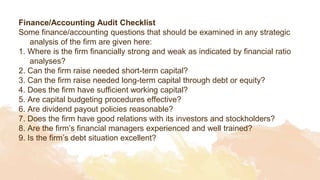
Finance/Accounting Audit Checklist
Some finance/accounting questions that should be examined in any strategic
analysis of the firm are given here:
1. Where is the firm financially strong and weak as indicated by financial ratio
analyses?
2. Can the firm raise needed short-term capital?
3. Can the firm raise needed long-term capital through debt or equity?
4. Does the firm have sufficient working capital?
5. Are capital budgeting procedures effective?
6. Are dividend payout policies reasonable?
7. Does the firm have good relations with its investors and stockholders?
8. Are the firm’s financial managers experienced and well trained?
9. Is the firm’s debt situation excellent?
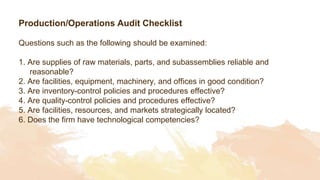
Production/Operations Audit Checklist
Questions such as the following should be examined:
1. Are supplies of raw materials, parts, and subassemblies reliable and
reasonable?
2. Are facilities, equipment, machinery, and offices in good condition?
3. Are inventory-control policies and procedures effective?
4. Are quality-control policies and procedures effective?
5. Are facilities, resources, and markets strategically located?
6. Does the firm have technological competencies?
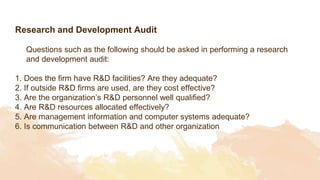
Research and Development Audit
Questions such as the following should be asked in performing a research
and development audit:
1. Does the firm have R&D facilities? Are they adequate?
2. If outside R&D firms are used, are they cost effective?
3. Are the organization’s R&D personnel well qualified?
4. Are R&D resources allocated effectively?
5. Are management information and computer systems adequate?
6. Is communication between R&D and other organization
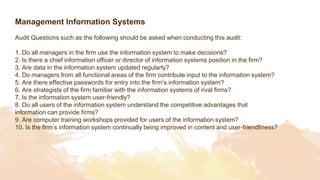
Management Information Systems
Audit Questions such as the following should be asked when conducting this audit:
1. Do all managers in the firm use the information system to make decisions?
2. Is there a chief information officer or director of information systems position in the firm?
3. Are data in the information system updated regularly?
4. Do managers from all functional areas of the firm contribute input to the information system?
5. Are there effective passwords for entry into the firm’s information system?
6. Are strategists of the firm familiar with the information systems of rival firms?
7. Is the information system user-friendly?
8. Do all users of the information system understand the competitive advantages that
information can provide firms?
9. Are computer training workshops provided for users of the information system?
10. Is the firm’s information system continually being improved in content and user-friendliness?
Value Chain Analysis
Value chain analysis (VCA) refers to the process whereby a firm
determines the costs associated with organizational activities from
purchasing raw materials to manufacturing product(s) to marketing those
products.
Value chain analysis aims to identify where low-cost advantages or
disadvantages exist anywhere along the value chain from raw material to
customer service activities.
Benchmarking
Benchmarking is an analytical tool used to determine whether a firm’s value
chain analysis is competitive compared to those of rivals and thus
conducive to winning in the marketplace.
Benchmarking entails measuring costs of value chain activities across an
industry to determine “best practices” among competing firms for the
purpose of duplicating or improving on those best practices.
Benchmarking enables a firm to take action to improve its competitiveness
by identifying (and improving on) value chain activities where rival firms
have comparative advantages in cost, service, reputation, or operation.
The Internal Factor Evaluation Matrix
A summary step in conducting an internal strategic-management audit is to construct
an Internal Factor Evaluation (IFE) Matrix.
This strategy-formulation tool summarizes and evaluates the major strengths and
weaknesses in the functional areas of a business, and it also provides a
basis for identifying and evaluating relationships among those areas. Intuitive
judgments are required in developing an IFE Matrix, so the appearance of a scientific
approach should not be interpreted to mean this is an all-powerful technique.
A thorough understanding of the factors included is more important than the actual
numbers. Similar to the EFE Matrix and the Competitive Profile Matrix (CPM)
Activity 5
Look for the application of IFE in the net. You can attach video, ppt or articles.

Topic 5 - The Internal Audit.pptx

  • 1.
    Topic 5: TheInternal Audit
  • 2.
    Learning Outcomes 1. Describethe nature and role of an internal assessment in formulating strategies. 2. Discuss why organizational culture is so important in formulating strategies. 3. Identify the basic functions (activities) that make up management and their relevance in formulating strategies. 4. Identify the basic functions of marketing and their relevance in formulating strategies. 5. Discuss the nature and role of finance/accounting in formulating strategies. 6. Discuss the nature and role of production/operations in formulating strategies. 7. Discuss the nature and role of research and development (R&D) in formulating strategies. 8. Discuss the nature and role of management information systems (MIS) in formulating strategies. 9. Explain value chain analysis and its relevance in formulating strategies. 10.Develop and use an Internal Factor Evaluation (IFE) Matrix.
  • 3.
    Agenda Checking of Attendance Discussion ofthe Topic Consultation Preview Evaluative Measures 05 01 02 03 04 Feedback 06
  • 4.
    Strategic planning mustinclude a detailed assessment of how the firm is doing in all internal areas. A complete internal assessment is vital to help a firm formulate, implement, and evaluate strategies to enable it to gain and sustain competitive advantages.
  • 5.
    Integrating Strategy andCulture Organizational culture is “a pattern of behavior that has been developed by an organization as it learns to cope with its problem of external adaptation and internal integration, and that has worked well enough to be considered valid and to be taught to new members as the correct way to perceive, think, and feel.” This definition emphasizes the importance of matching external with internal factors in making strategic decisions. Organizational culture captures the subtle, elusive, and largely unconscious forces that shape a workplace. Remarkably resistant to change, culture can represent a major strength or weakness for any firm. It can be an underlying reason for strengths or weaknesses in any of the major business functions
  • 6.
    Management The functions ofmanagement consist of five basic activities: planning, organizing, motivating, staffing, and controlling. An overview of these activities is provided in Table 6-3 of the IM. These activities must be examined in strategic planning because an organization should continually capitalize on its strengths and improve on its weaknesses in these five areas.
  • 7.
    Management Audit Checklistof Questions The following checklist of questions can help determine specific strengths and weaknesses in the functional area of business. An answer of no to any question could indicate a potential weakness, although the strategic significance and implications of negative answers, of course, will vary by organization, industry, and severity of the weakness. Positive or yes answers to the checklist questions suggest potential areas of strength. 1. Does the firm use strategic-management concepts? 2. Are company objectives and goals measurable and well communicated? 3. Do managers at all hierarchical levels plan effectively? 4. Do managers delegate authority well? 5. Is the organization’s structure appropriate? 6. Are job descriptions and job specifications clear? 7. Is employee morale high? 8. Are employee turnover and absenteeism low? 9. Are organizational reward and control mechanisms effective?
  • 8.
    Marketing Marketing can bedescribed as the process of defining, anticipating, creating, and fulfilling customers’ needs and wants for products and services. There are seven basic functions of marketing: (1) customer analysis, (2) selling products and services, (3) product and service planning, (4) pricing, (5) distribution, (6) marketing research, and (7) cost/benefit analysis Understanding these functions helps strategists identify and evaluate marketing strengths and weaknesses—a vital strategy-formulation activity
  • 9.
    Marketing Audit Checklistof Questions The following questions about marketing must be examined in strategic planning: 1. Are markets segmented effectively? 2. Is the organization positioned well among competitors? 3. Has the firm’s market share been increasing? 4. Are present channels of distribution reliable and cost effective? 5. Does the firm have an effective sales organization? 6. Does the firm conduct market research? 7. Are product quality and customer service good? 8. Are the firm’s products and services priced appropriately? 9. Does the firm have an effective promotion, advertising, and publicity strategy? 10. Are marketing, planning, and budgeting effective? 11. Do the firm’s marketing managers have adequate experience and training? 12. Is the firm’s Internet presence excellent as compared to rivals?
  • 10.
    Finance/Accounting Audit Checklist Somefinance/accounting questions that should be examined in any strategic analysis of the firm are given here: 1. Where is the firm financially strong and weak as indicated by financial ratio analyses? 2. Can the firm raise needed short-term capital? 3. Can the firm raise needed long-term capital through debt or equity? 4. Does the firm have sufficient working capital? 5. Are capital budgeting procedures effective? 6. Are dividend payout policies reasonable? 7. Does the firm have good relations with its investors and stockholders? 8. Are the firm’s financial managers experienced and well trained? 9. Is the firm’s debt situation excellent?
  • 11.
    Production/Operations Audit Checklist Questionssuch as the following should be examined: 1. Are supplies of raw materials, parts, and subassemblies reliable and reasonable? 2. Are facilities, equipment, machinery, and offices in good condition? 3. Are inventory-control policies and procedures effective? 4. Are quality-control policies and procedures effective? 5. Are facilities, resources, and markets strategically located? 6. Does the firm have technological competencies?
  • 12.
    Research and DevelopmentAudit Questions such as the following should be asked in performing a research and development audit: 1. Does the firm have R&D facilities? Are they adequate? 2. If outside R&D firms are used, are they cost effective? 3. Are the organization’s R&D personnel well qualified? 4. Are R&D resources allocated effectively? 5. Are management information and computer systems adequate? 6. Is communication between R&D and other organization
  • 13.
    Management Information Systems AuditQuestions such as the following should be asked when conducting this audit: 1. Do all managers in the firm use the information system to make decisions? 2. Is there a chief information officer or director of information systems position in the firm? 3. Are data in the information system updated regularly? 4. Do managers from all functional areas of the firm contribute input to the information system? 5. Are there effective passwords for entry into the firm’s information system? 6. Are strategists of the firm familiar with the information systems of rival firms? 7. Is the information system user-friendly? 8. Do all users of the information system understand the competitive advantages that information can provide firms? 9. Are computer training workshops provided for users of the information system? 10. Is the firm’s information system continually being improved in content and user-friendliness?
  • 14.
    Value Chain Analysis Valuechain analysis (VCA) refers to the process whereby a firm determines the costs associated with organizational activities from purchasing raw materials to manufacturing product(s) to marketing those products. Value chain analysis aims to identify where low-cost advantages or disadvantages exist anywhere along the value chain from raw material to customer service activities.
  • 15.
    Benchmarking Benchmarking is ananalytical tool used to determine whether a firm’s value chain analysis is competitive compared to those of rivals and thus conducive to winning in the marketplace. Benchmarking entails measuring costs of value chain activities across an industry to determine “best practices” among competing firms for the purpose of duplicating or improving on those best practices. Benchmarking enables a firm to take action to improve its competitiveness by identifying (and improving on) value chain activities where rival firms have comparative advantages in cost, service, reputation, or operation.
  • 16.
    The Internal FactorEvaluation Matrix A summary step in conducting an internal strategic-management audit is to construct an Internal Factor Evaluation (IFE) Matrix. This strategy-formulation tool summarizes and evaluates the major strengths and weaknesses in the functional areas of a business, and it also provides a basis for identifying and evaluating relationships among those areas. Intuitive judgments are required in developing an IFE Matrix, so the appearance of a scientific approach should not be interpreted to mean this is an all-powerful technique. A thorough understanding of the factors included is more important than the actual numbers. Similar to the EFE Matrix and the Competitive Profile Matrix (CPM)
  • 17.
    Activity 5 Look forthe application of IFE in the net. You can attach video, ppt or articles.