Copyright © 2011 Pearson
Education, Inc.
Publishing as Prentice Hall
Ch 10 -1
Chapter 10
Business Ethics/ Social Responsibility/
Environmental Sustainability
Strategic Management:
Concepts & Cases
13th
Edition
Fred David
Copyright © 2011 Pearson
Education, Inc.
Publishing as Prentice Hall
Ch 10 -2
Copyright © 2011 Pearson
Education, Inc.
Publishing as Prentice Hall
Ch 10 -3
Business Ethics
Social Responsibility
Environmental Sustainability
Copyright © 2011 Pearson
Education, Inc.
Publishing as Prentice Hall
Ch 10 -4
Business Ethics
 Principles of conduct within
organizations that guide decision
making and behavior
Copyright © 2011 Pearson
Education, Inc.
Publishing as Prentice Hall
Ch 10 -5
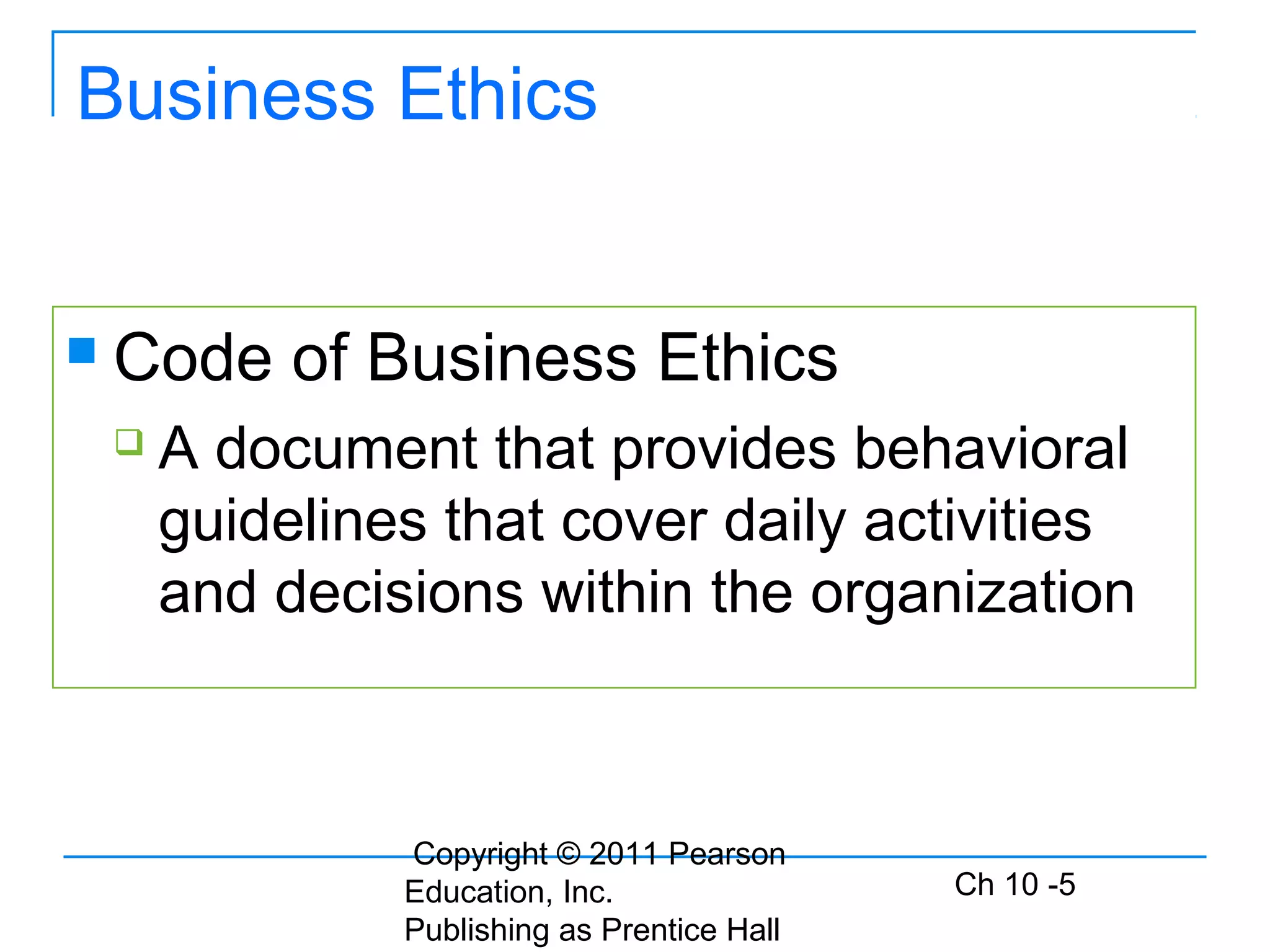
Business Ethics
 Code of Business Ethics
 A document that provides behavioral
guidelines that cover daily activities
and decisions within the organization
Copyright © 2011 Pearson
Education, Inc.
Publishing as Prentice Hall
Ch 10 -6
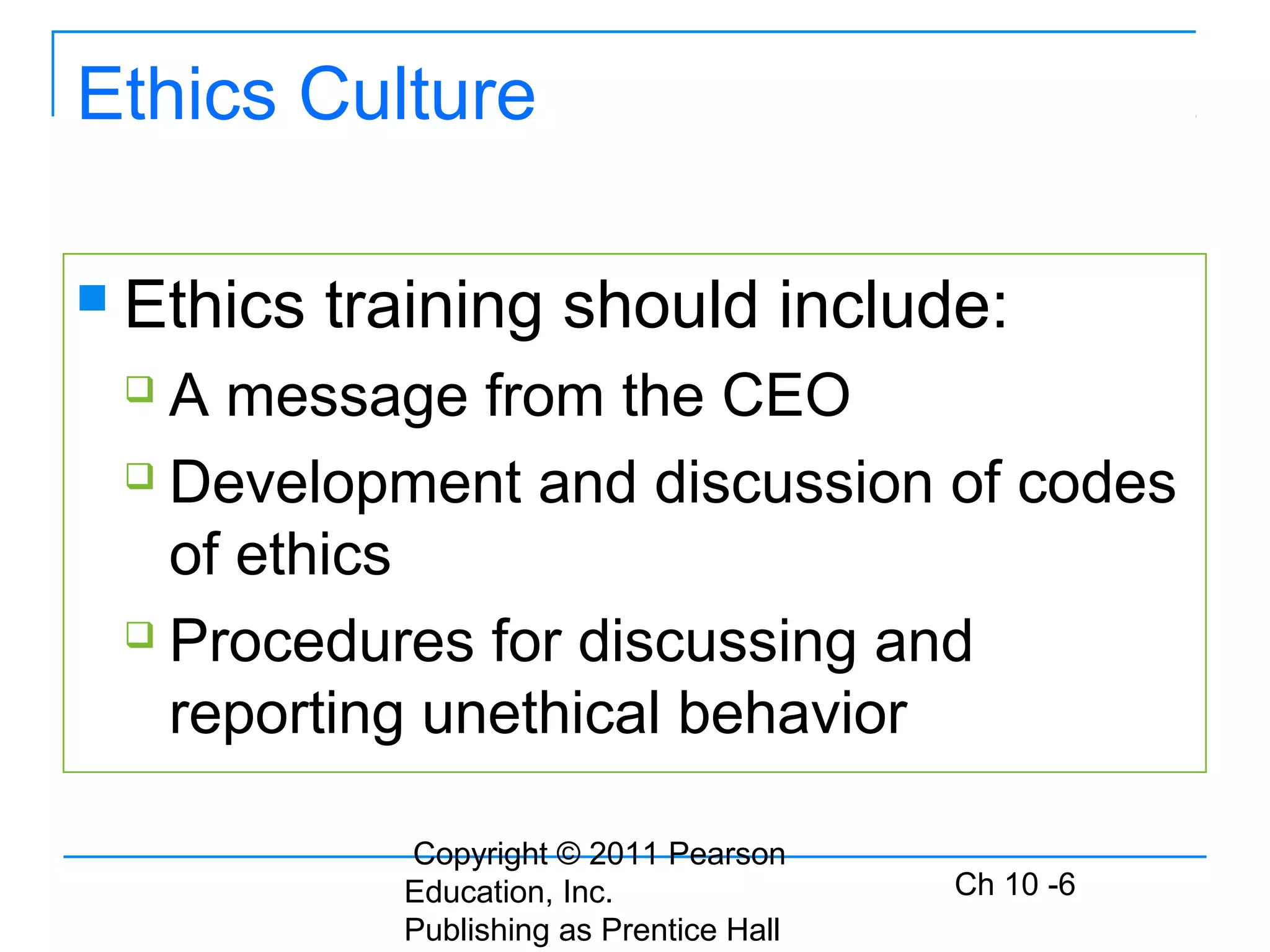
Ethics Culture
 Ethics training should include:
 A message from the CEO
 Development and discussion of codes
of ethics
 Procedures for discussing and
reporting unethical behavior
Copyright © 2011 Pearson
Education, Inc.
Publishing as Prentice Hall
Ch 10 -7
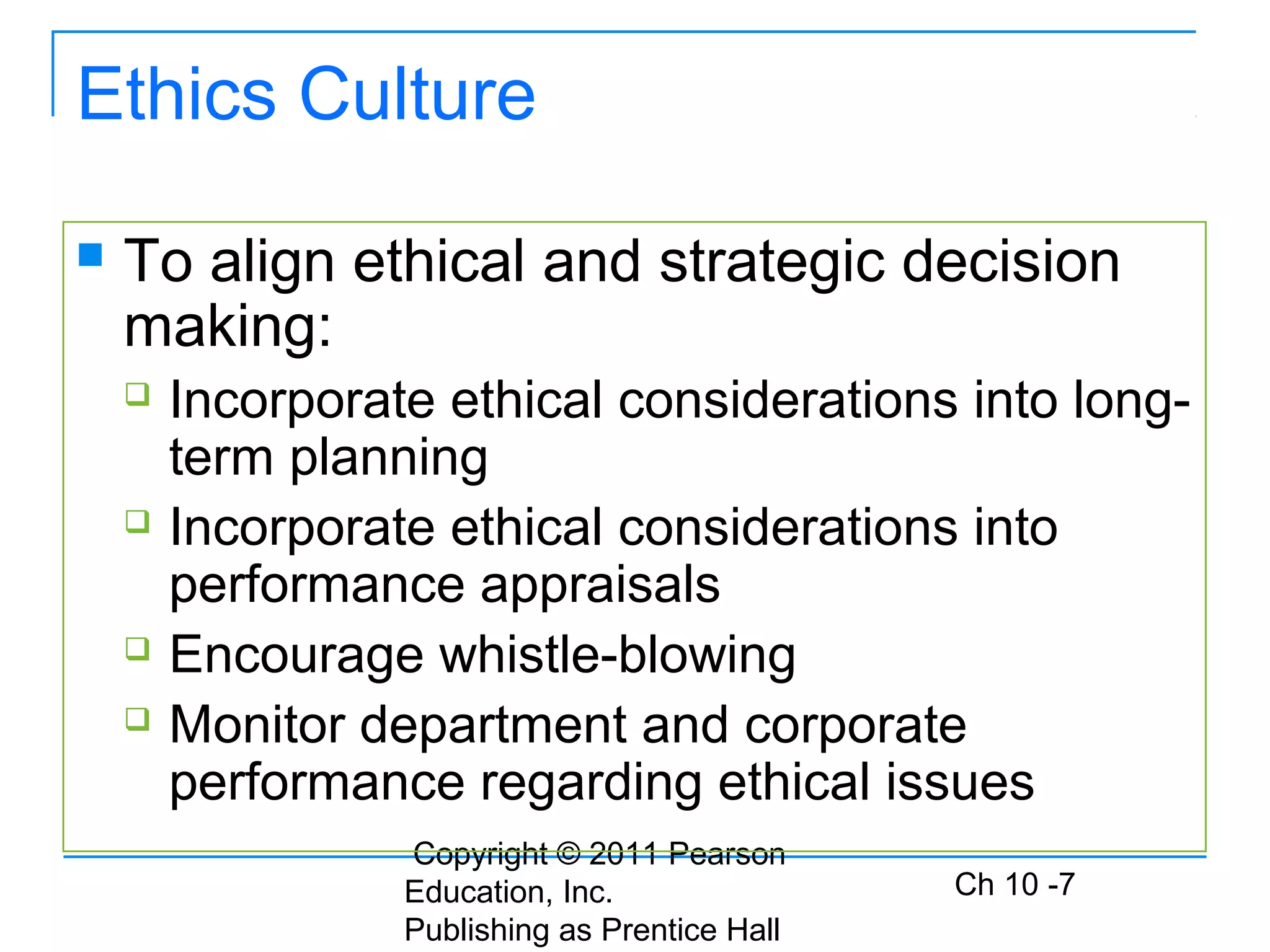
Ethics Culture
 To align ethical and strategic decision
making:
 Incorporate ethical considerations into long-
term planning
 Incorporate ethical considerations into
performance appraisals
 Encourage whistle-blowing
 Monitor department and corporate
performance regarding ethical issues
Copyright © 2011 Pearson
Education, Inc.
Publishing as Prentice Hall
Ch 10 -8
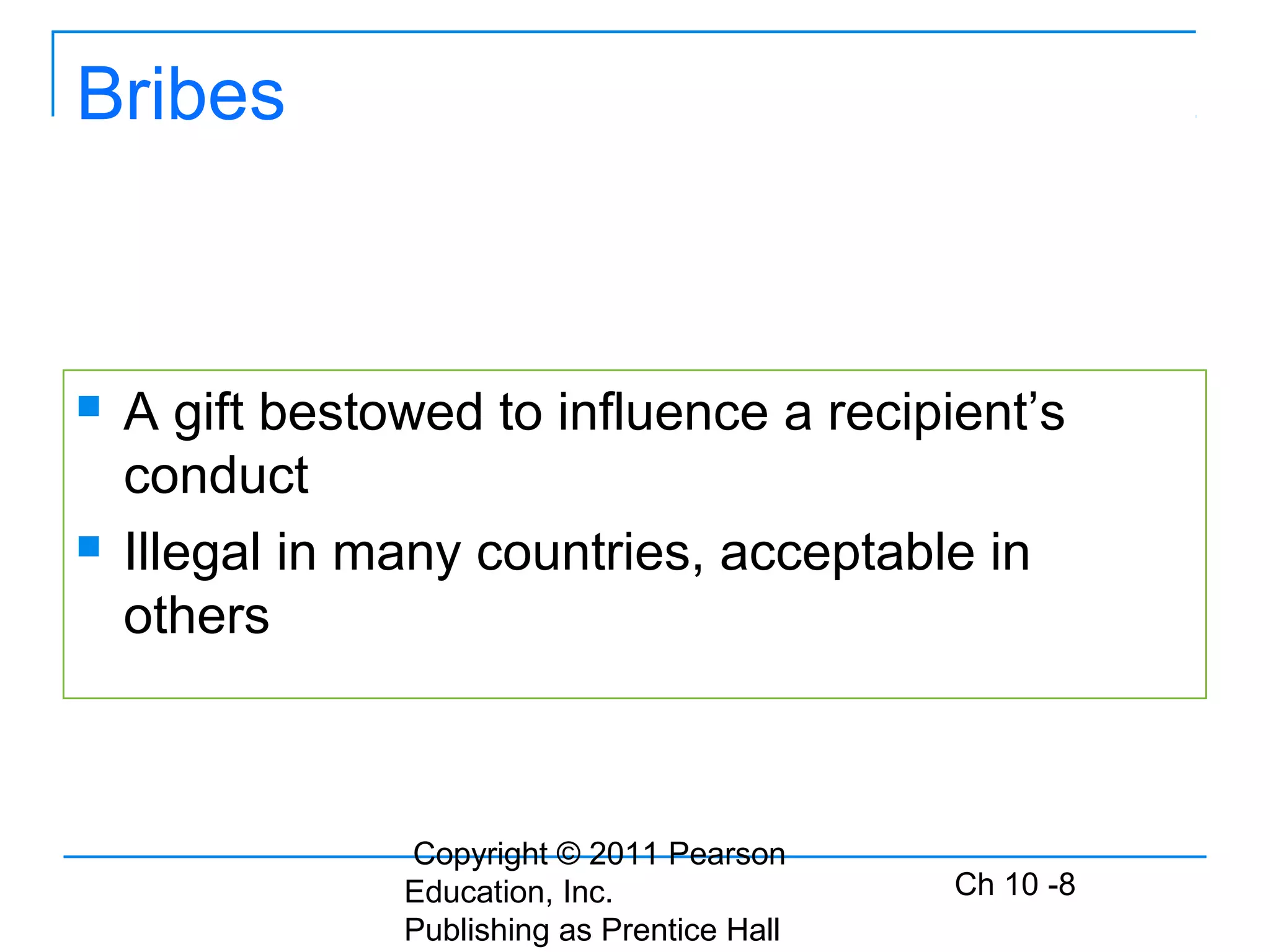
Bribes
 A gift bestowed to influence a recipient’s
conduct
 Illegal in many countries, acceptable in
others
Copyright © 2011 Pearson
Education, Inc.
Publishing as Prentice Hall
Ch 10 -9
Business Ethics
Social Responsibility
Environmental Sustainability
Copyright © 2011 Pearson
Education, Inc.
Publishing as Prentice Hall
Ch 10 -10
Social Responsibility
 Actions an organization takes beyond
what is legally required to protect or
enhance the well-being of living things
Copyright © 2011 Pearson
Education, Inc.
Publishing as Prentice Hall
Ch 10 -11
Social Policy
 Concerns what responsibilities the firm has to
its employees, consumers, environmentalists,
minorities, communities, shareholders, and
other groups
 Should be considered during each stage of
strategy formulation, implementation, and
evaluation
Copyright © 2011 Pearson
Education, Inc.
Publishing as Prentice Hall
Ch 10 -12
Social Policies on Retirement
 Worker shortages in countries around the
world are leading to changes in retirement
and immigration policies
Copyright © 2011 Pearson
Education, Inc.
Publishing as Prentice Hall
Ch 10 -13
Business Ethics
Social Responsibility
Environmental Sustainability
Copyright © 2011 Pearson
Education, Inc.
Publishing as Prentice Hall
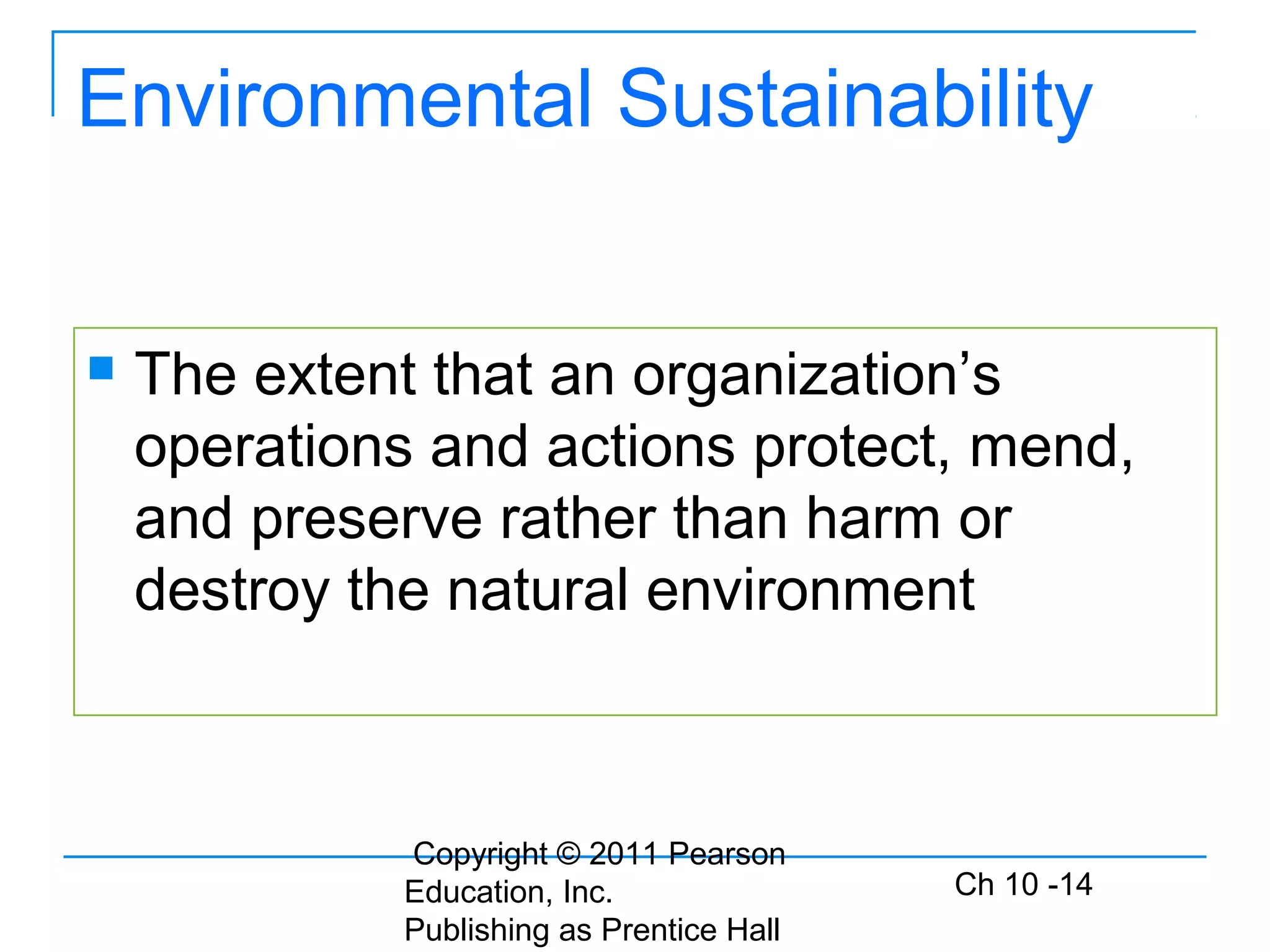
Ch 10 -14
Environmental Sustainability
 The extent that an organization’s
operations and actions protect, mend,
and preserve rather than harm or
destroy the natural environment
Copyright © 2011 Pearson
Education, Inc.
Publishing as Prentice Hall
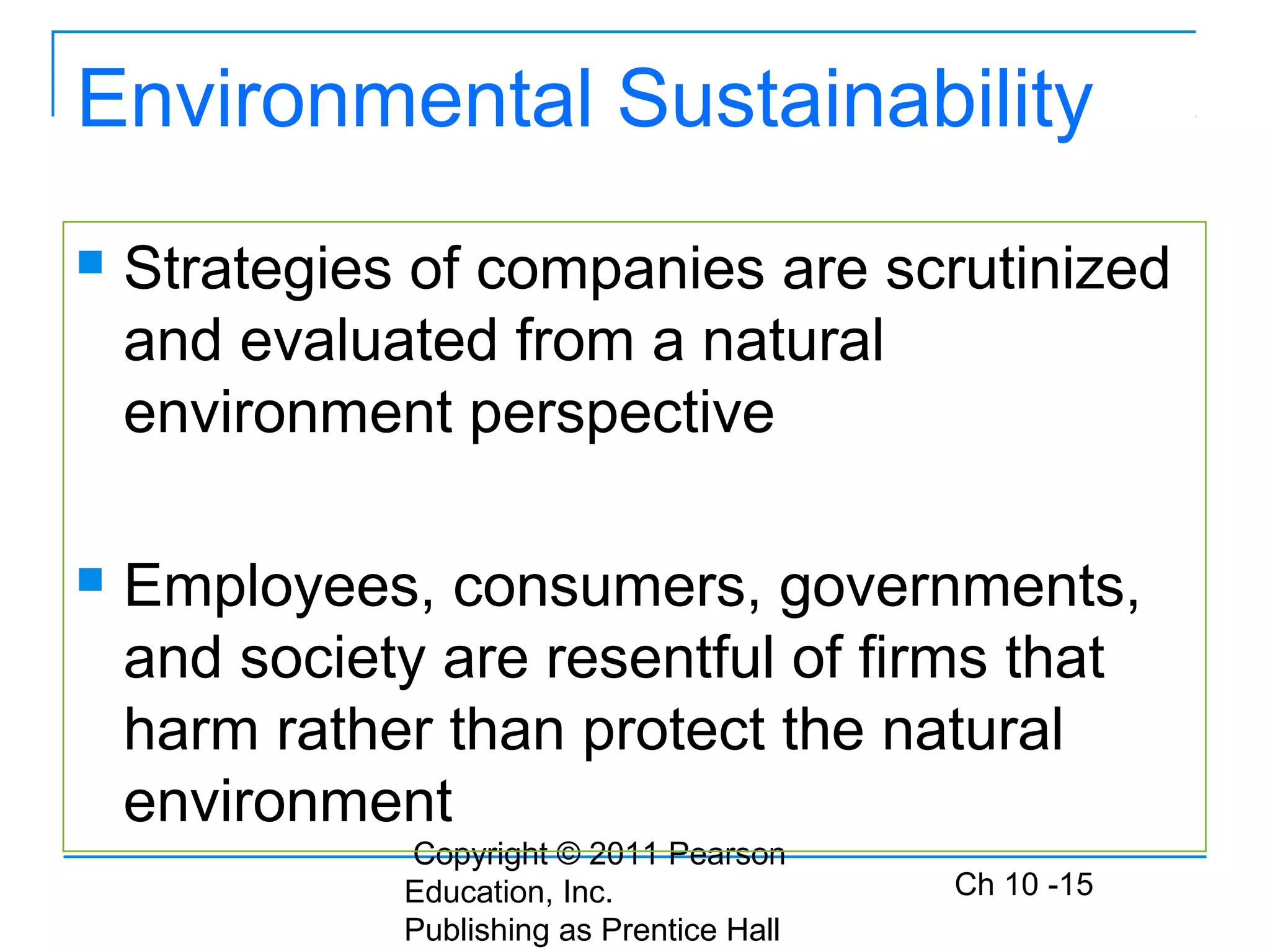
Ch 10 -15
Environmental Sustainability
 Strategies of companies are scrutinized
and evaluated from a natural
environment perspective
 Employees, consumers, governments,
and society are resentful of firms that
harm rather than protect the natural
environment
Copyright © 2011 Pearson
Education, Inc.
Publishing as Prentice Hall
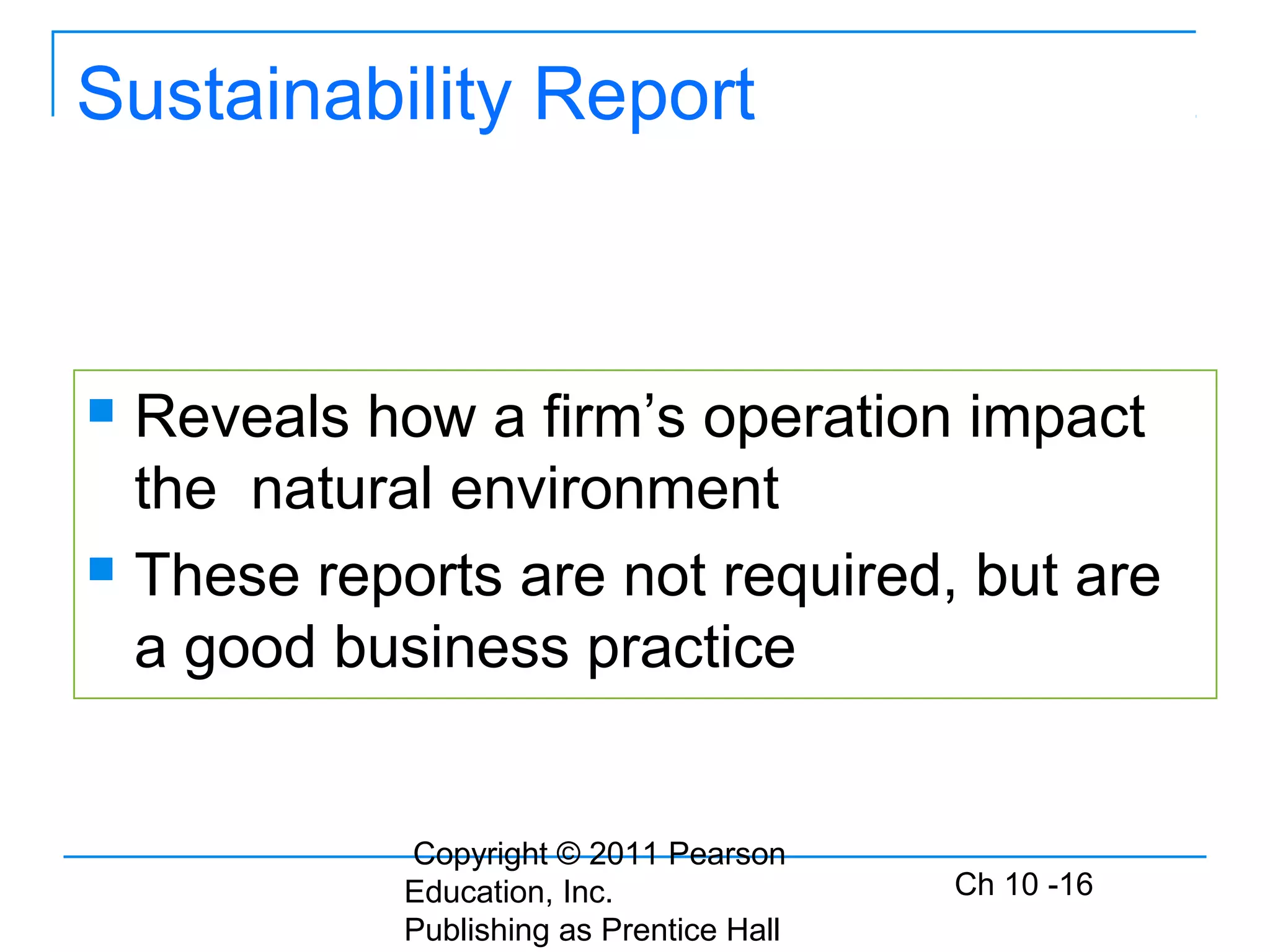
Ch 10 -16
Sustainability Report
 Reveals how a firm’s operation impact
the natural environment
 These reports are not required, but are
a good business practice
Copyright © 2011 Pearson
Education, Inc.
Publishing as Prentice Hall
Ch 10 -17
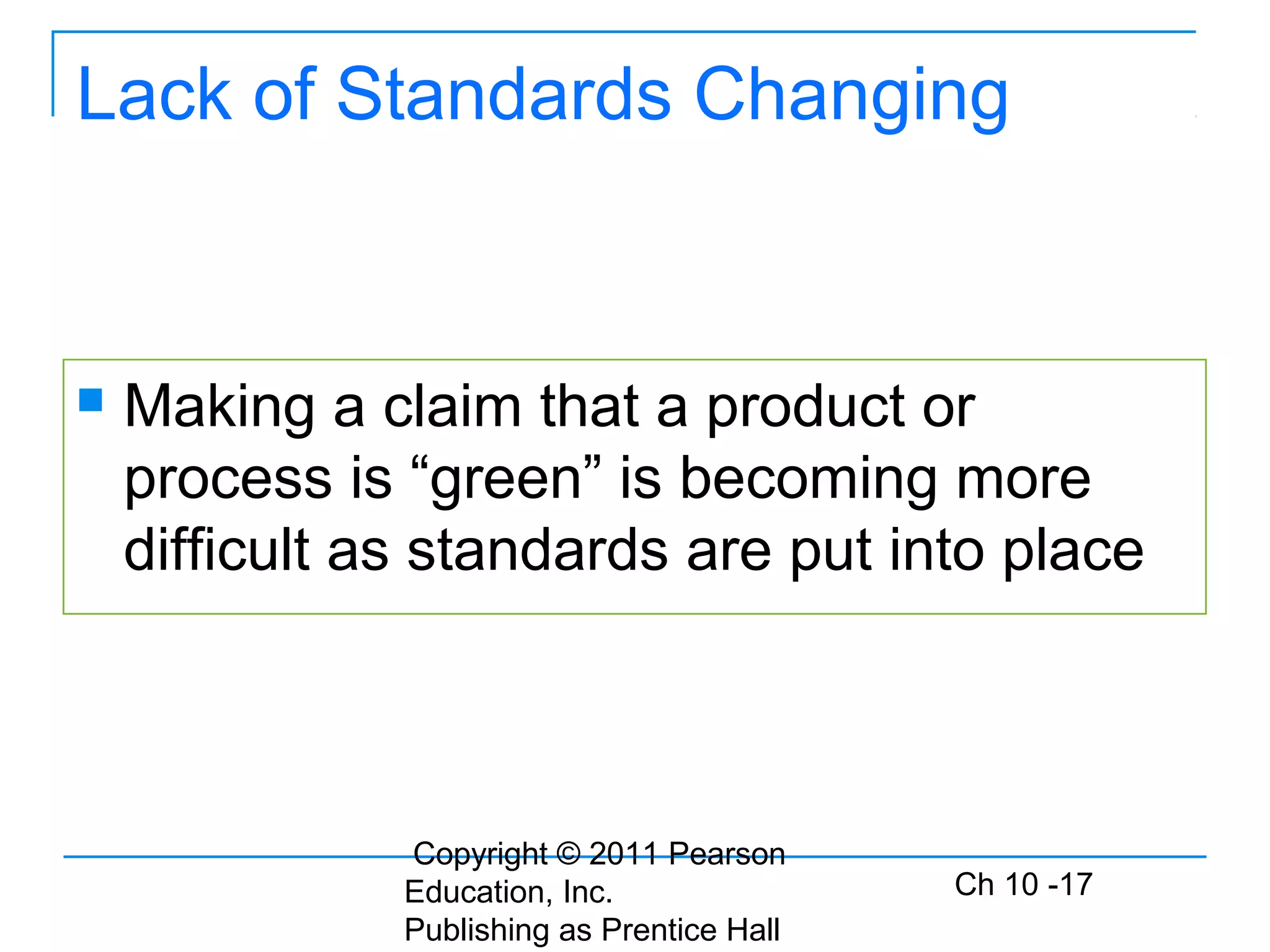
Lack of Standards Changing
 Making a claim that a product or
process is “green” is becoming more
difficult as standards are put into place
Copyright © 2011 Pearson
Education, Inc.
Publishing as Prentice Hall
Ch 10 -18
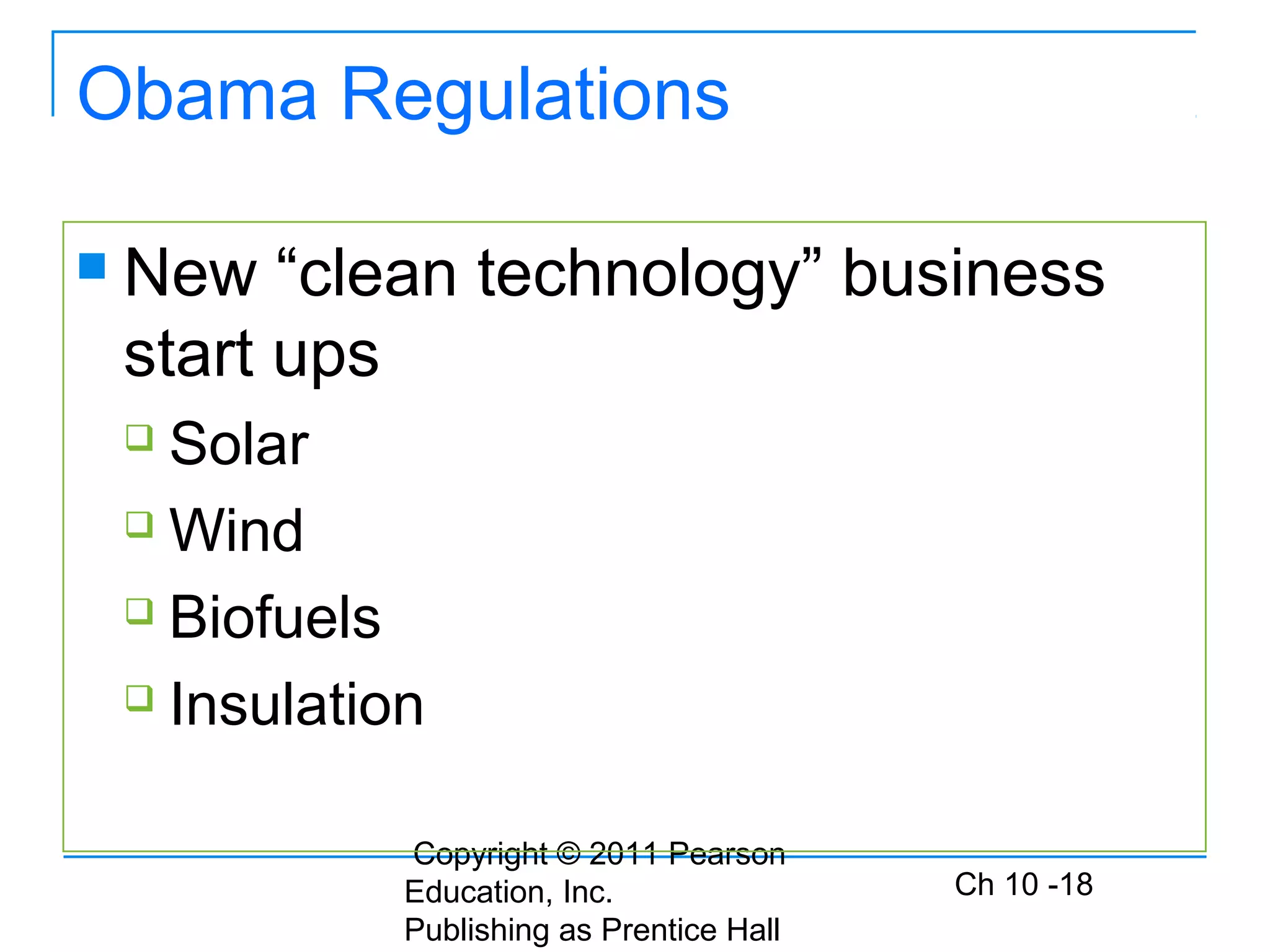
Obama Regulations
 New “clean technology” business
start ups
 Solar
 Wind
 Biofuels
 Insulation
Copyright © 2011 Pearson
Education, Inc.
Publishing as Prentice Hall
Ch 10 -19
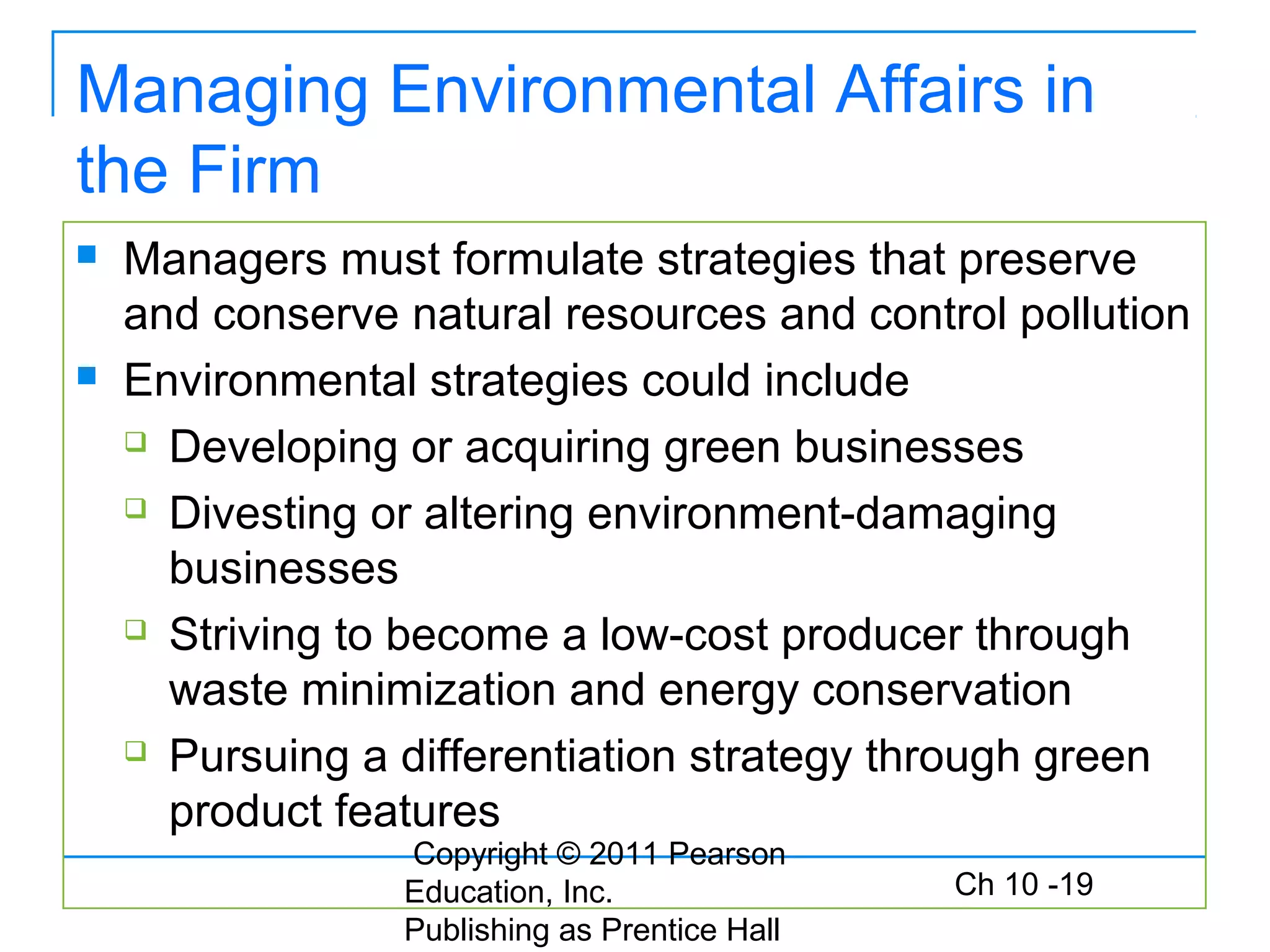
Managing Environmental Affairs in
the Firm
 Managers must formulate strategies that preserve
and conserve natural resources and control pollution
 Environmental strategies could include
 Developing or acquiring green businesses
 Divesting or altering environment-damaging
businesses
 Striving to become a low-cost producer through
waste minimization and energy conservation
 Pursuing a differentiation strategy through green
product features
Copyright © 2011 Pearson
Education, Inc.
Publishing as Prentice Hall
Ch 10 -20
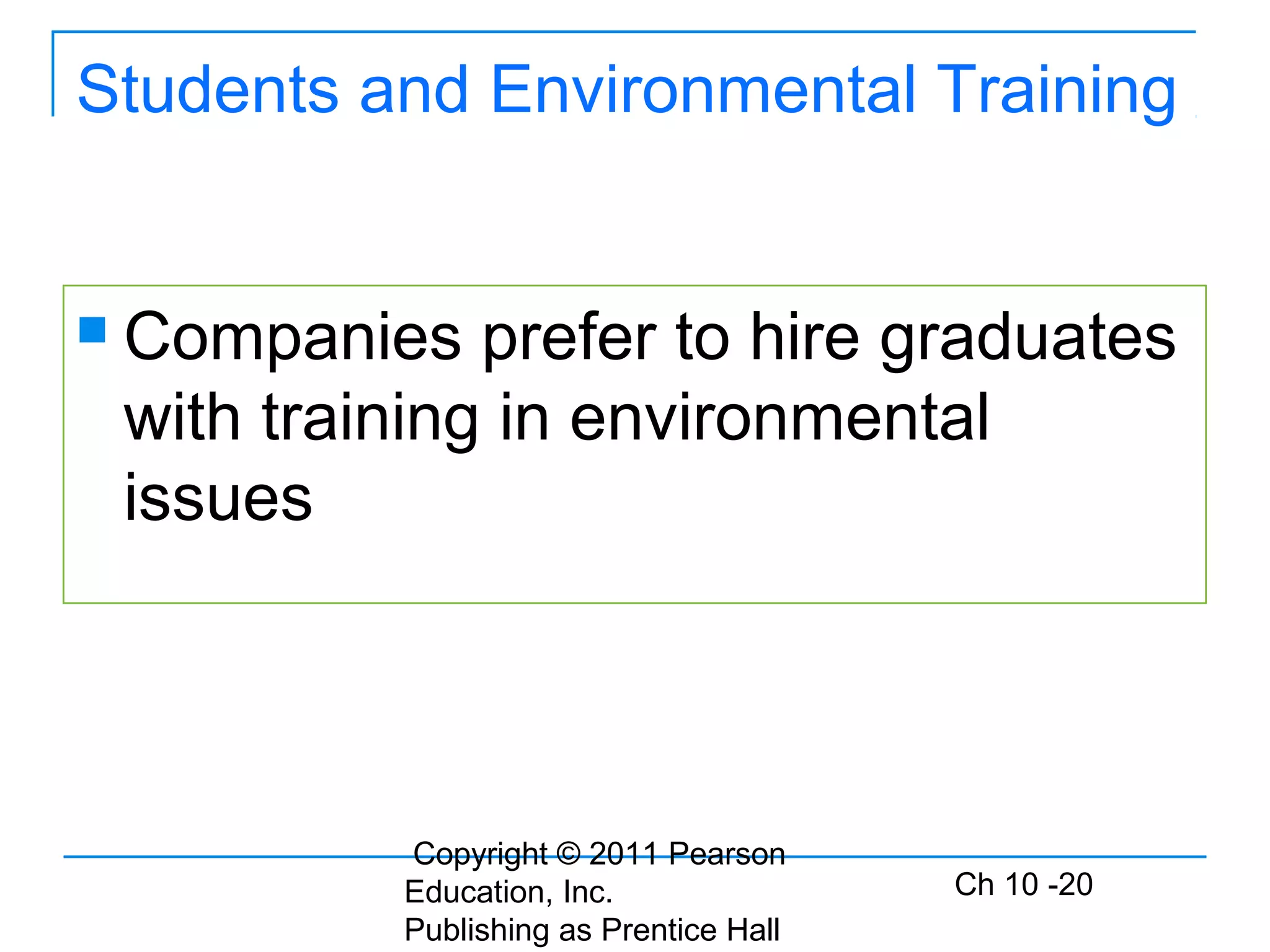
Students and Environmental Training
 Companies prefer to hire graduates
with training in environmental
issues
Copyright © 2011 Pearson
Education, Inc.
Publishing as Prentice Hall
Ch 10 -21
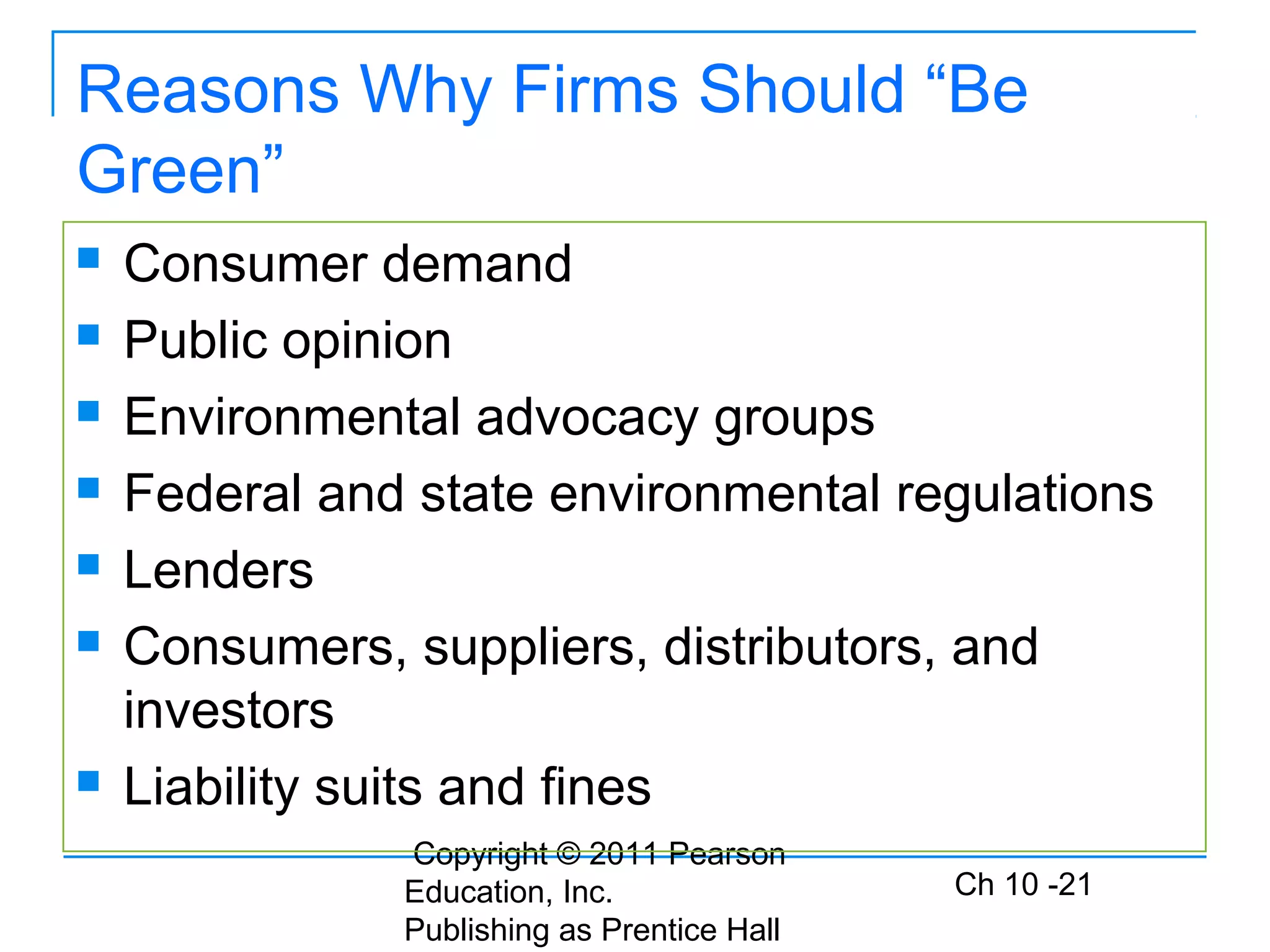
Reasons Why Firms Should “Be
Green”
 Consumer demand
 Public opinion
 Environmental advocacy groups
 Federal and state environmental regulations
 Lenders
 Consumers, suppliers, distributors, and
investors
 Liability suits and fines
Copyright © 2011 Pearson
Education, Inc.
Publishing as Prentice Hall
Ch 10 -22
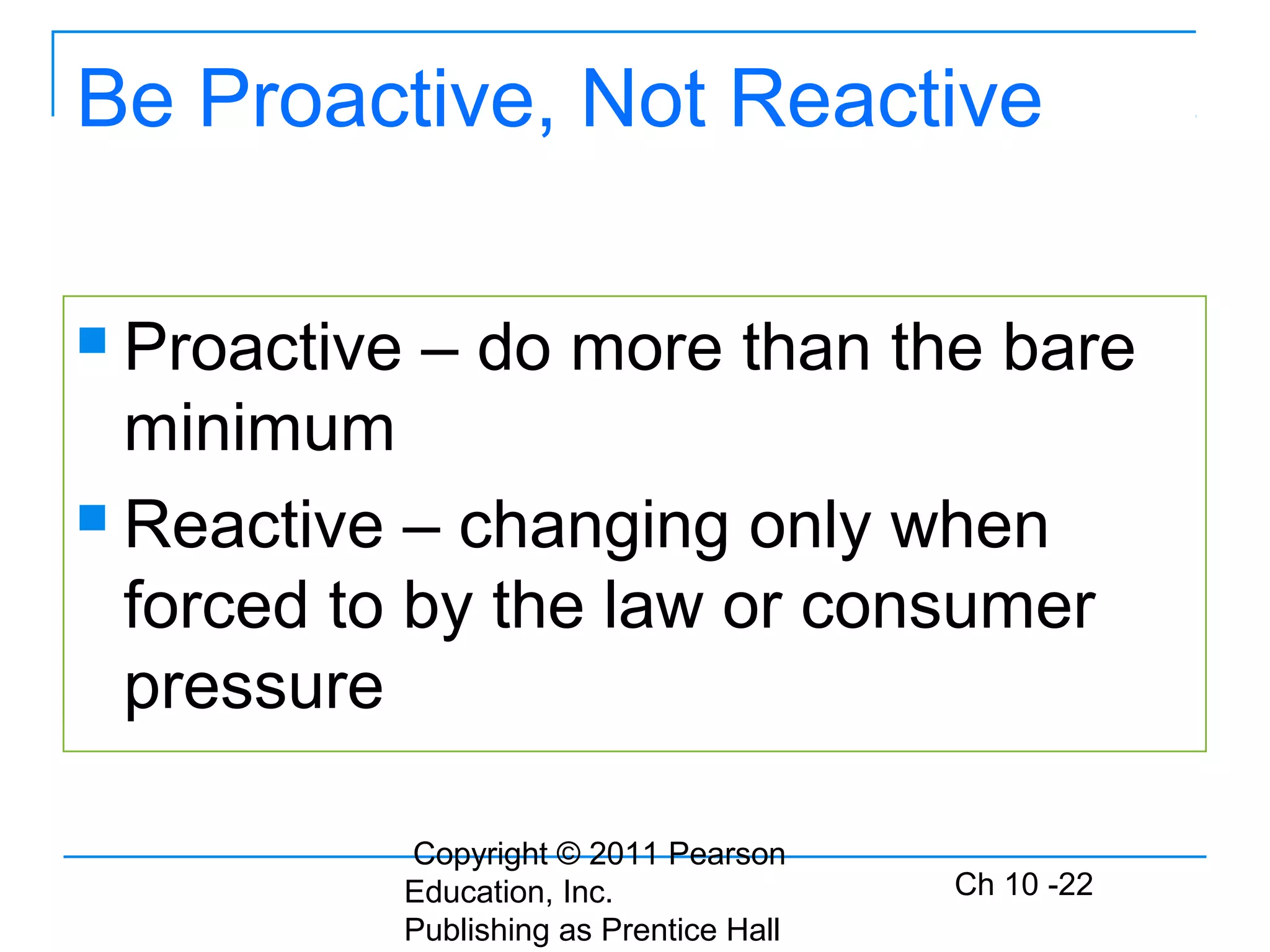
Be Proactive, Not Reactive
 Proactive – do more than the bare
minimum
 Reactive – changing only when
forced to by the law or consumer
pressure
Copyright © 2011 Pearson
Education, Inc.
Publishing as Prentice Hall
Ch 10 -23
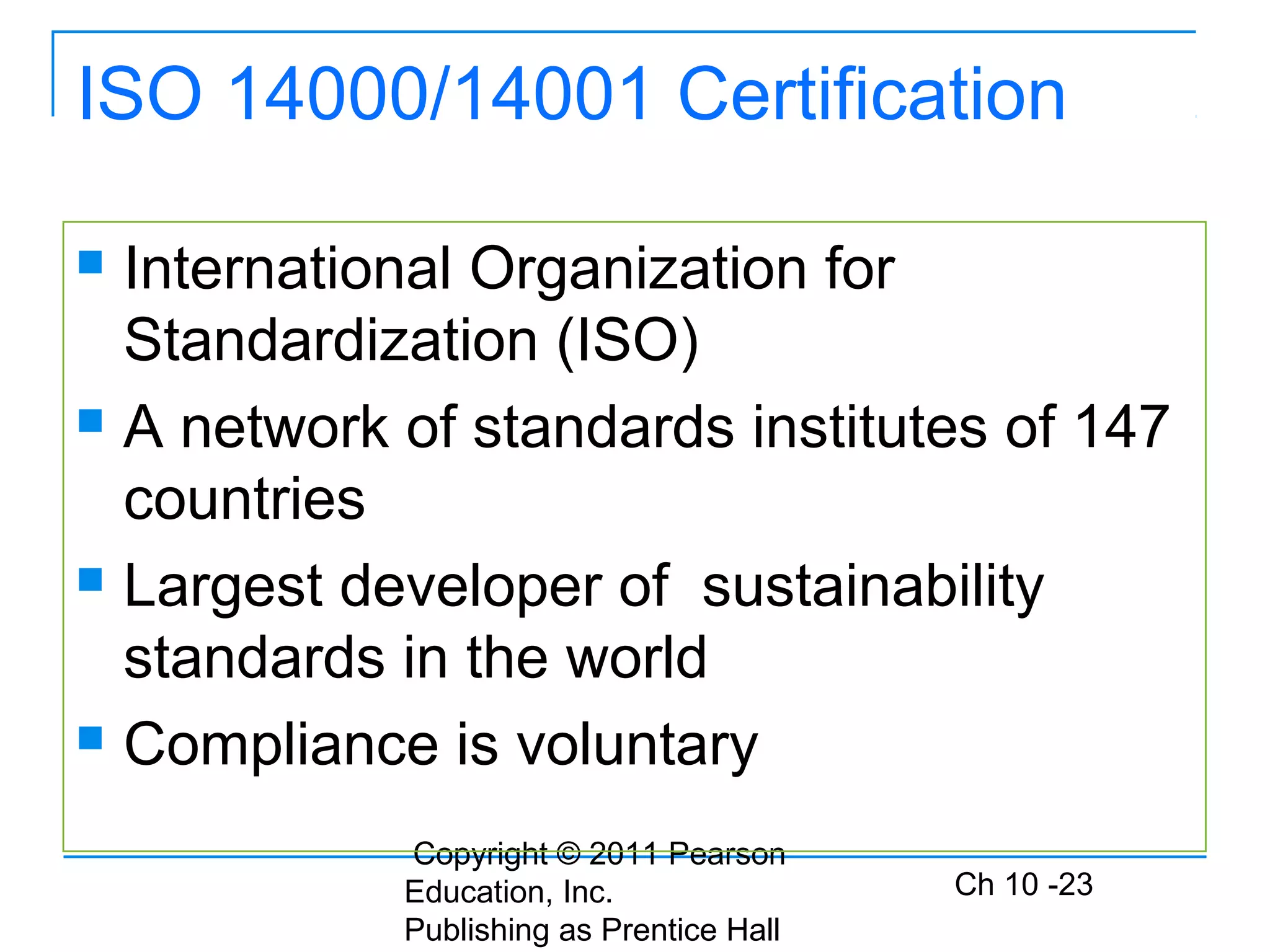
ISO 14000/14001 Certification
 International Organization for
Standardization (ISO)
 A network of standards institutes of 147
countries
 Largest developer of sustainability
standards in the world
 Compliance is voluntary
Copyright © 2011 Pearson
Education, Inc.
Publishing as Prentice Hall
Ch 10 -24
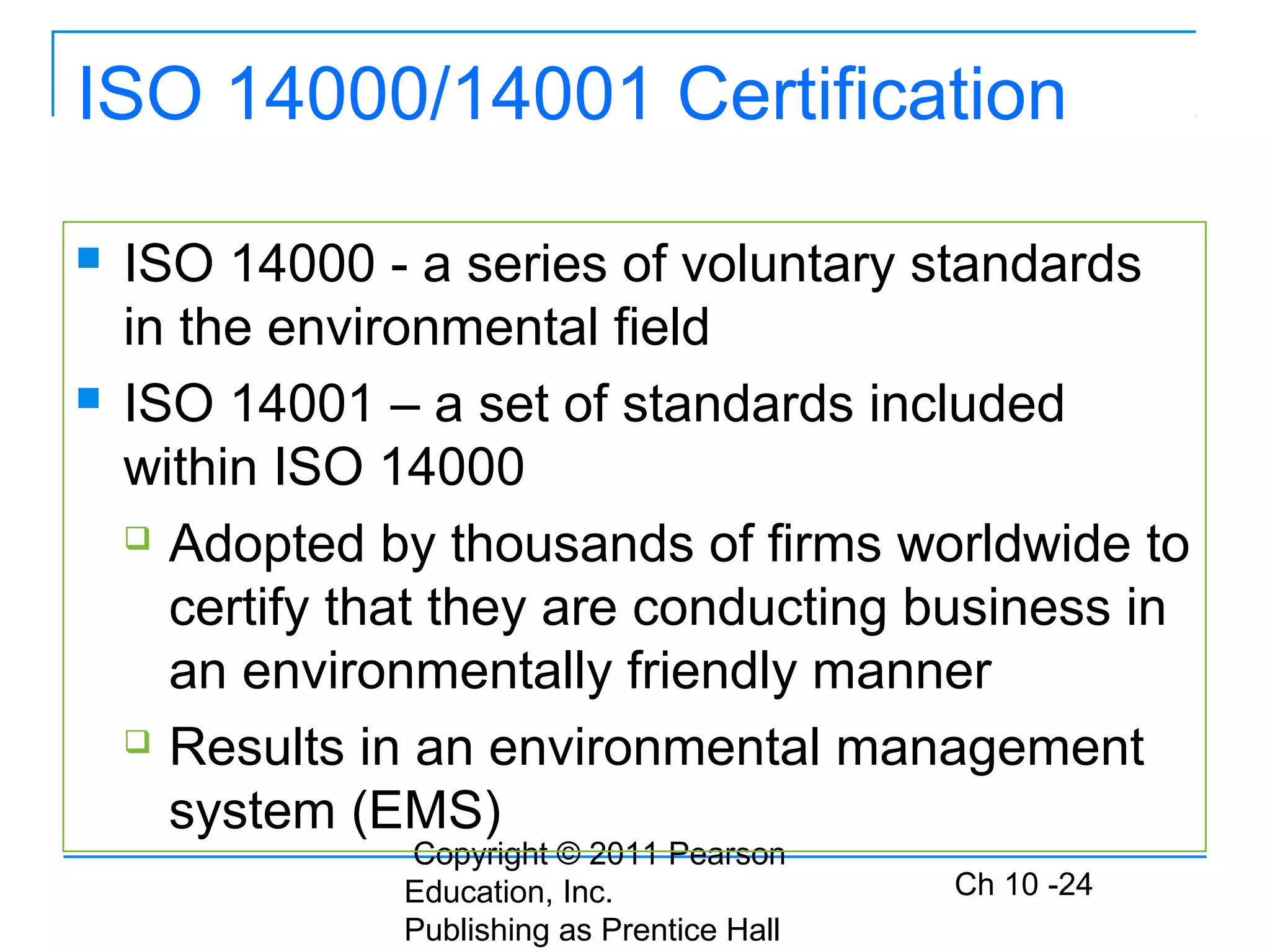
ISO 14000/14001 Certification
 ISO 14000 - a series of voluntary standards
in the environmental field
 ISO 14001 – a set of standards included
within ISO 14000
 Adopted by thousands of firms worldwide to
certify that they are conducting business in
an environmentally friendly manner
 Results in an environmental management
system (EMS)
Copyright © 2011 Pearson
Education, Inc.
Publishing as Prentice Hall
Ch 10 -25
Electric Car Networks
 Government funding for manufacturing
 Recharging stations being installed in many
cities
 Extensive research and development within
the auto industry
 Companies are replacing gasoline powered
vehicles with hybrid electric-natural gas
vehicles
Copyright © 2011 Pearson
Education, Inc.
Publishing as Prentice Hall
Ch 10 -26
March 2009 Copenhagen Meeting
 Scientists warned that global warming is
worse than expected
 Companies and governments encouraged to
vigorously implement strategies to cut
greenhouse gases
 Kyoto Protocal expires in 2012
 Results of March 2009 Copenhagen Meeting
are expected to replace the Kyoto Protocal
Copyright © 2011 Pearson
Education, Inc.
Publishing as Prentice Hall
Ch 10 -27
All rights reserved. No part of this publication may be reproduced, stored in a
retrieval system, or transmitted, in any form or by any means, electronic,
mechanical, photocopying, recording, or otherwise, without the prior written
permission of the publisher. Printed in the United States of America.

David sm13 ppt_10

  • 1.
    Copyright © 2011Pearson Education, Inc. Publishing as Prentice Hall Ch 10 -1 Chapter 10 Business Ethics/ Social Responsibility/ Environmental Sustainability Strategic Management: Concepts & Cases 13th Edition Fred David
  • 2.
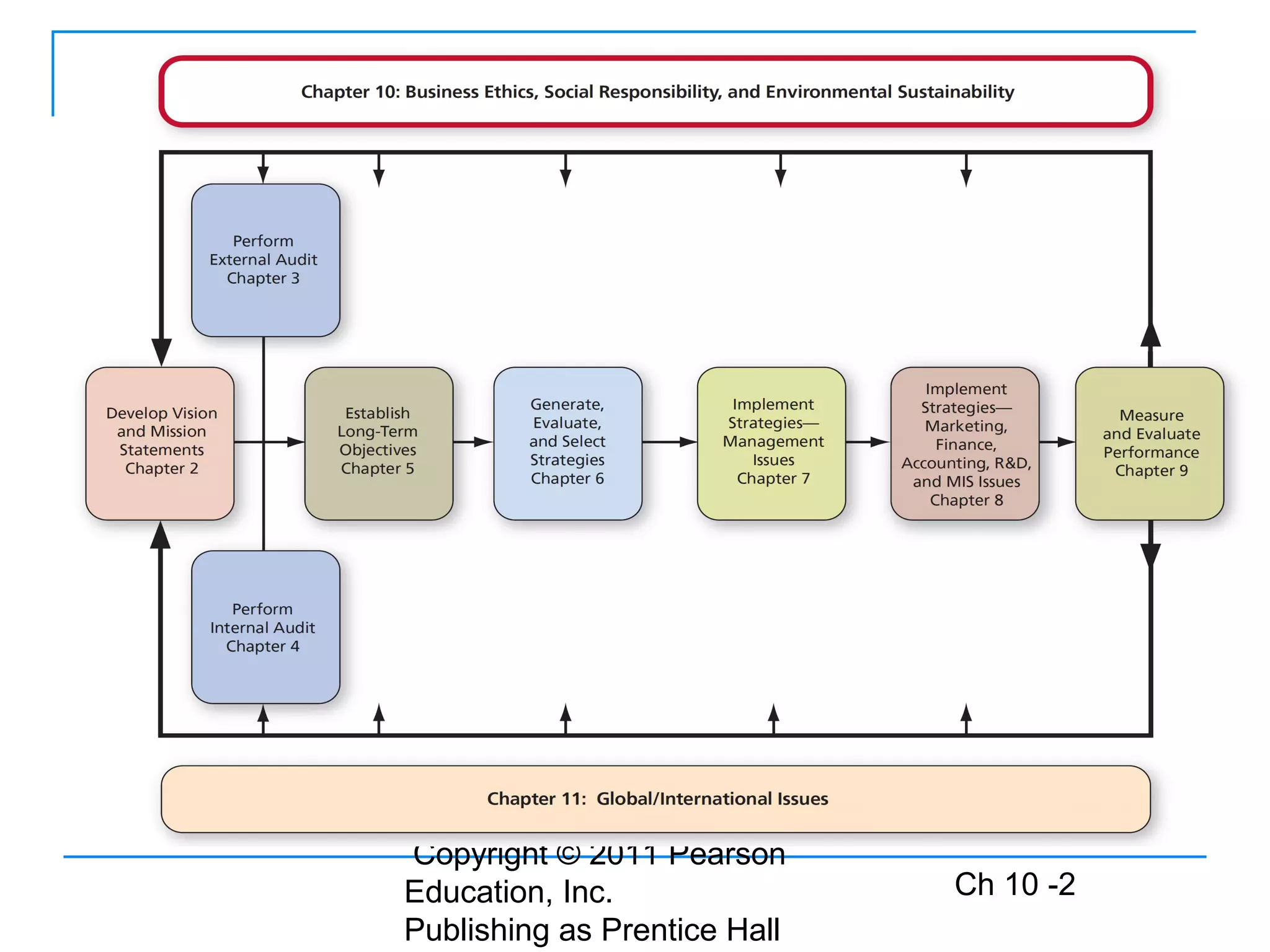
    Copyright © 2011Pearson Education, Inc. Publishing as Prentice Hall Ch 10 -2
  • 3.
    Copyright © 2011Pearson Education, Inc. Publishing as Prentice Hall Ch 10 -3 Business Ethics Social Responsibility Environmental Sustainability
  • 4.
    Copyright © 2011Pearson Education, Inc. Publishing as Prentice Hall Ch 10 -4 Business Ethics  Principles of conduct within organizations that guide decision making and behavior
  • 5.
    Copyright © 2011Pearson Education, Inc. Publishing as Prentice Hall Ch 10 -5 Business Ethics  Code of Business Ethics  A document that provides behavioral guidelines that cover daily activities and decisions within the organization
  • 6.
    Copyright © 2011Pearson Education, Inc. Publishing as Prentice Hall Ch 10 -6 Ethics Culture  Ethics training should include:  A message from the CEO  Development and discussion of codes of ethics  Procedures for discussing and reporting unethical behavior
  • 7.
    Copyright © 2011Pearson Education, Inc. Publishing as Prentice Hall Ch 10 -7 Ethics Culture  To align ethical and strategic decision making:  Incorporate ethical considerations into long- term planning  Incorporate ethical considerations into performance appraisals  Encourage whistle-blowing  Monitor department and corporate performance regarding ethical issues
  • 8.
    Copyright © 2011Pearson Education, Inc. Publishing as Prentice Hall Ch 10 -8 Bribes  A gift bestowed to influence a recipient’s conduct  Illegal in many countries, acceptable in others
  • 9.
    Copyright © 2011Pearson Education, Inc. Publishing as Prentice Hall Ch 10 -9 Business Ethics Social Responsibility Environmental Sustainability
  • 10.
    Copyright © 2011Pearson Education, Inc. Publishing as Prentice Hall Ch 10 -10 Social Responsibility  Actions an organization takes beyond what is legally required to protect or enhance the well-being of living things
  • 11.
    Copyright © 2011Pearson Education, Inc. Publishing as Prentice Hall Ch 10 -11 Social Policy  Concerns what responsibilities the firm has to its employees, consumers, environmentalists, minorities, communities, shareholders, and other groups  Should be considered during each stage of strategy formulation, implementation, and evaluation
  • 12.
    Copyright © 2011Pearson Education, Inc. Publishing as Prentice Hall Ch 10 -12 Social Policies on Retirement  Worker shortages in countries around the world are leading to changes in retirement and immigration policies
  • 13.
    Copyright © 2011Pearson Education, Inc. Publishing as Prentice Hall Ch 10 -13 Business Ethics Social Responsibility Environmental Sustainability
  • 14.
    Copyright © 2011Pearson Education, Inc. Publishing as Prentice Hall Ch 10 -14 Environmental Sustainability  The extent that an organization’s operations and actions protect, mend, and preserve rather than harm or destroy the natural environment
  • 15.
    Copyright © 2011Pearson Education, Inc. Publishing as Prentice Hall Ch 10 -15 Environmental Sustainability  Strategies of companies are scrutinized and evaluated from a natural environment perspective  Employees, consumers, governments, and society are resentful of firms that harm rather than protect the natural environment
  • 16.
    Copyright © 2011Pearson Education, Inc. Publishing as Prentice Hall Ch 10 -16 Sustainability Report  Reveals how a firm’s operation impact the natural environment  These reports are not required, but are a good business practice
  • 17.
    Copyright © 2011Pearson Education, Inc. Publishing as Prentice Hall Ch 10 -17 Lack of Standards Changing  Making a claim that a product or process is “green” is becoming more difficult as standards are put into place
  • 18.
    Copyright © 2011Pearson Education, Inc. Publishing as Prentice Hall Ch 10 -18 Obama Regulations  New “clean technology” business start ups  Solar  Wind  Biofuels  Insulation
  • 19.
    Copyright © 2011Pearson Education, Inc. Publishing as Prentice Hall Ch 10 -19 Managing Environmental Affairs in the Firm  Managers must formulate strategies that preserve and conserve natural resources and control pollution  Environmental strategies could include  Developing or acquiring green businesses  Divesting or altering environment-damaging businesses  Striving to become a low-cost producer through waste minimization and energy conservation  Pursuing a differentiation strategy through green product features
  • 20.
    Copyright © 2011Pearson Education, Inc. Publishing as Prentice Hall Ch 10 -20 Students and Environmental Training  Companies prefer to hire graduates with training in environmental issues
  • 21.
    Copyright © 2011Pearson Education, Inc. Publishing as Prentice Hall Ch 10 -21 Reasons Why Firms Should “Be Green”  Consumer demand  Public opinion  Environmental advocacy groups  Federal and state environmental regulations  Lenders  Consumers, suppliers, distributors, and investors  Liability suits and fines
  • 22.
    Copyright © 2011Pearson Education, Inc. Publishing as Prentice Hall Ch 10 -22 Be Proactive, Not Reactive  Proactive – do more than the bare minimum  Reactive – changing only when forced to by the law or consumer pressure
  • 23.
    Copyright © 2011Pearson Education, Inc. Publishing as Prentice Hall Ch 10 -23 ISO 14000/14001 Certification  International Organization for Standardization (ISO)  A network of standards institutes of 147 countries  Largest developer of sustainability standards in the world  Compliance is voluntary
  • 24.
    Copyright © 2011Pearson Education, Inc. Publishing as Prentice Hall Ch 10 -24 ISO 14000/14001 Certification  ISO 14000 - a series of voluntary standards in the environmental field  ISO 14001 – a set of standards included within ISO 14000  Adopted by thousands of firms worldwide to certify that they are conducting business in an environmentally friendly manner  Results in an environmental management system (EMS)
  • 25.
    Copyright © 2011Pearson Education, Inc. Publishing as Prentice Hall Ch 10 -25 Electric Car Networks  Government funding for manufacturing  Recharging stations being installed in many cities  Extensive research and development within the auto industry  Companies are replacing gasoline powered vehicles with hybrid electric-natural gas vehicles
  • 26.
    Copyright © 2011Pearson Education, Inc. Publishing as Prentice Hall Ch 10 -26 March 2009 Copenhagen Meeting  Scientists warned that global warming is worse than expected  Companies and governments encouraged to vigorously implement strategies to cut greenhouse gases  Kyoto Protocal expires in 2012  Results of March 2009 Copenhagen Meeting are expected to replace the Kyoto Protocal
  • 27.
    Copyright © 2011Pearson Education, Inc. Publishing as Prentice Hall Ch 10 -27 All rights reserved. No part of this publication may be reproduced, stored in a retrieval system, or transmitted, in any form or by any means, electronic, mechanical, photocopying, recording, or otherwise, without the prior written permission of the publisher. Printed in the United States of America.