PPT-36
Green Earth Movement
An E-Newsletter for the cause of Environment, Peace, Harmony and Justice
Remember - “you and I can decide the future”
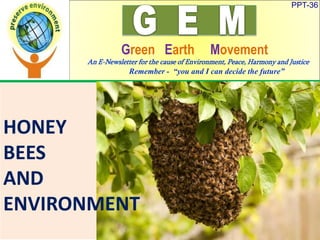
HONEY
BEES
AND
ENVIRONMENT
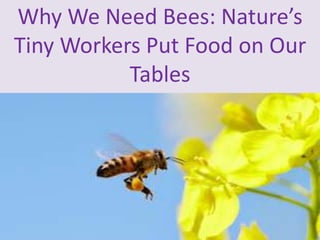
Why We Need Bees: Nature’s
Tiny Workers Put Food on Our
Tables
Many people think of bees simply as a
summertime nuisance. But these small and
hard-working insects actually make it
possible for many of your favorite foods to
reach your table.
From apples
to almonds to
the pumpkin
in our pumpkin
pies, we have
Bees to thank.
Bees are one of a
myriad of other
animals, including
birds, bats, beetles,
and butterflies,
called pollinators.
Pollinators transfer
pollen and seeds from one flower to
another, fertilizing the plant so it can grow
and produce food.
Some 250,000 species
of flowering plants
depend on bees for
pollination. Many of
these are crucial to
world agriculture. Bees
increase the yields of around 90 crops,
such as apples, blueberries and cucumbers
by up to 30%, so many fruits and
vegetables would become scarce and
prohibitively expensive.
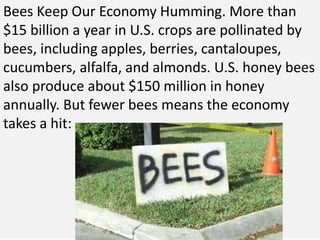
Bees Keep Our Economy Humming. More than
$15 billion a year in U.S. crops are pollinated by
bees, including apples, berries, cantaloupes,
cucumbers, alfalfa, and almonds. U.S. honey bees
also produce about $150 million in honey
annually. But fewer bees means the economy
takes a hit:
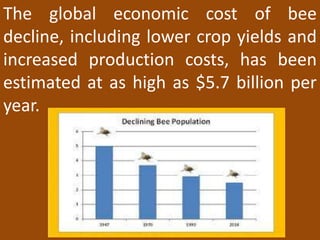
The global economic cost of bee
decline, including lower crop yields and
increased production costs, has been
estimated at as high as $5.7 billion per
year.
Keeping bee populations safe is
critical for keeping American tables
stocked with high-quality produce
and our
agriculture
sector
running
smoothly.
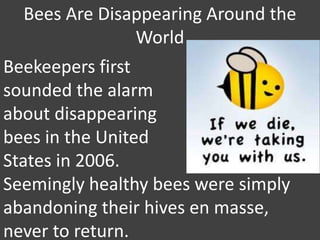
Bees Are Disappearing Around the
World
Beekeepers first
sounded the alarm
about disappearing
bees in the United
States in 2006.
Seemingly healthy bees were simply
abandoning their hives en masse,
never to return.
Now, a condition
known as Colony
Collapse Disorder
is causing bee
populations to
plummet, which
means these foods are also at risk. In the
United States alone, more than 25 percent
of the managed honey bee population has
disappeared since 1990.
Researchers are calling the mass
disappearance Colony Collapse Disorder,
and they estimate that nearly one-third of
all honey bee colonies in the United States
have vanished. The
number of hives in
the United States
is now at its lowest
point in the past
50 years.
What’s Causing
Colony Collapse
Disorder
Researchers
think this Colony
Collapse Disorder
may be caused by
a number of
interwoven factors:
1] Global warming, which has caused
flowers to bloom earlier or later than
usual. When pollinators come out of
hibernation, the flowers that provide
the food they need to start the season
have already bloomed.
2] Pesticide use on farms. Some toxic
pesticides meant
to kill pests can
harm the honey
bees needed for
pollination.
Many pesticides
banned by other
countries because they harm bees are still
available in the United States.
3] Habitat loss
brought about
by development,
abandoned farms,
growing crops
without leaving
habitat for wildlife,
and growing gardens with flowers that
are not friendly to pollinators.
4] Parasites such as harmful mites: The
deadly link between the worldwide
collapse of honeybee colonies and a
bloodsucking parasite has been revealed by
scientists. They
have discovered
that the mite has
massively and
permanently
increased the global prevalence of a fatal
bee virus.
How We Can Protect Bees
1] Policy makers
must take action
to protect the
bees and other
pollinators that
help keep fresh
food on our
table.
2] Farmers must be rewarded for practices
that help wild bee populations thrive, such as
leaving habitat for bees in
their surrounding fields,
alternating crops so bees
have food all year long, and
not using harmful pesticides.
Assistance should be provided
to farmers who plan to
support a wider variety of
pollinators beyond just bees.
3] Bee research by the U.S.
Department of Agriculture (USDA) and
the Environmental Protection Agency
(EPA) must be strengthened,
and must also
be broadened to
include research
on pollinators
besides honey
bees.
4] An Integrated Pest
Management (IPM) techniques
should be used to minimize
pesticide use and risk to bees.
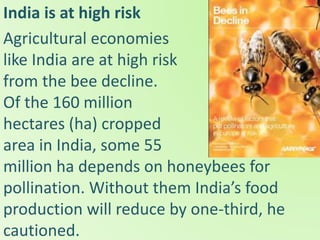
India is at high risk
Agricultural economies
like India are at high risk
from the bee decline.
Of the 160 million
hectares (ha) cropped
area in India, some 55
million ha depends on honeybees for
pollination. Without them India’s food
production will reduce by one-third, he
cautioned.
A warming climate and the loss of
natural areas to meet the demands
of tourism are driving Indian bee
colonies to the brink, imperilling an
essential food source.
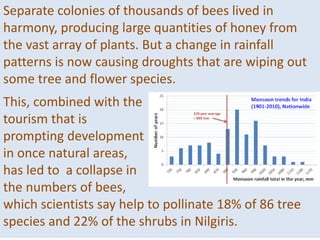
Separate colonies of thousands of bees lived in
harmony, producing large quantities of honey from
the vast array of plants. But a change in rainfall
patterns is now causing droughts that are wiping out
some tree and flower species.
This, combined with the
tourism that is
prompting development
in once natural areas,
has led to a collapse in
the numbers of bees,
which scientists say help to pollinate 18% of 86 tree
species and 22% of the shrubs in Nilgiris.
“Instead of visiting the natural flowers, the bees
are attracted more by the sugary rich residue in
the cups and use it as an alternative food
resource,” These cups are death traps for the
bees, which are trapped
in the sticky liquid and
cannot fly out to safety.
During his research, he
recorded the death of
nearly 170 bees a day
at a single beverage
shop.
Plantation of
flowering plants,
cutting down the
use of chemicals in
agriculture and
promoting organic
farming were some
of the measures suggested by the
experts to save honey bees from
extinction.
To conclude with a quote:
This educational PowerPoint Presentation (editable) is
prepared by GEM Team (courtesy: internet).
For other similar GEM PowerPoint Presentations on
various environmental issues see next slide.
These PPTs may be downloaded from our website
www.infantjesusjogeshwari.in
The GEM PPTs can be creatively used for various
groups like school/college students, NGOs,
government officials, Church groups, SCC groups,
housing society members and so on.
1. Twenty Simple Tips
2. Solar Energy
3. Junk Food
4. Plastic – a boon or bane?
5. Green Passion
6. Zero Garbage
7. Soft drink – A Health Hazard
8. Waste to energy
9. Rain Water Harvesting
10. Eco-friendly Religions
11. Happy Green Diwali
12. Climate Change
13. The future of Biodiversity
14. Genetically Modified Foods
15. Waste Water Treatment
16. Body, Organ, Tissue Donation
17. Organic Farming
18. Waste to cooking gas
19. Reduce, Reuse, Recycle
20. Protect Mangroves
21. Say NO to Bottled water
22. Save Lakes and Ponds
23. Forests are green lungs
24. Coal Mining and Ecology
25. Sin of Food Waste
26. Climate change and Poverty
27. Stop Water Pollution
28. Carbon Footprints
29. Parks and Open Spaces
30. Rising Sea Levels
31. Laudato Si – Pope’s Encyclical
32. Air Pollution
33. Life Style Changes
34. Water Pollution
35. Sand Mining
36. Bees and Environment
Also visit
www.infantjesusjogeshwari.in
Click RESOURCES section
for various resource materials including Quiz on
BIBLE, FAITH, LITURGY, CHURCH,
ENVIRONMENT etc.
ALSO JOKES, PUZZLES etc FOR CHILDREN
AND YOUTH
For Free GEM E-Newsletters visit –
www.infantjesusjogeshwari.in. Go to GEM
section,
click GEM E-NEWSLETTERS

Gem ppt-36-bees and environment

  • 1.
    PPT-36 Green Earth Movement AnE-Newsletter for the cause of Environment, Peace, Harmony and Justice Remember - “you and I can decide the future” HONEY BEES AND ENVIRONMENT
  • 2.
    Why We NeedBees: Nature’s Tiny Workers Put Food on Our Tables
  • 3.
    Many people thinkof bees simply as a summertime nuisance. But these small and hard-working insects actually make it possible for many of your favorite foods to reach your table. From apples to almonds to the pumpkin in our pumpkin pies, we have Bees to thank.
  • 4.
    Bees are oneof a myriad of other animals, including birds, bats, beetles, and butterflies, called pollinators. Pollinators transfer pollen and seeds from one flower to another, fertilizing the plant so it can grow and produce food.
  • 5.
    Some 250,000 species offlowering plants depend on bees for pollination. Many of these are crucial to world agriculture. Bees increase the yields of around 90 crops, such as apples, blueberries and cucumbers by up to 30%, so many fruits and vegetables would become scarce and prohibitively expensive.
  • 6.
    Bees Keep OurEconomy Humming. More than $15 billion a year in U.S. crops are pollinated by bees, including apples, berries, cantaloupes, cucumbers, alfalfa, and almonds. U.S. honey bees also produce about $150 million in honey annually. But fewer bees means the economy takes a hit:
  • 7.
    The global economiccost of bee decline, including lower crop yields and increased production costs, has been estimated at as high as $5.7 billion per year.
  • 8.
    Keeping bee populationssafe is critical for keeping American tables stocked with high-quality produce and our agriculture sector running smoothly.
  • 9.
    Bees Are DisappearingAround the World Beekeepers first sounded the alarm about disappearing bees in the United States in 2006. Seemingly healthy bees were simply abandoning their hives en masse, never to return.
  • 10.
    Now, a condition knownas Colony Collapse Disorder is causing bee populations to plummet, which means these foods are also at risk. In the United States alone, more than 25 percent of the managed honey bee population has disappeared since 1990.
  • 11.
    Researchers are callingthe mass disappearance Colony Collapse Disorder, and they estimate that nearly one-third of all honey bee colonies in the United States have vanished. The number of hives in the United States is now at its lowest point in the past 50 years.
  • 12.
    What’s Causing Colony Collapse Disorder Researchers thinkthis Colony Collapse Disorder may be caused by a number of interwoven factors:
  • 13.
    1] Global warming,which has caused flowers to bloom earlier or later than usual. When pollinators come out of hibernation, the flowers that provide the food they need to start the season have already bloomed.
  • 14.
    2] Pesticide useon farms. Some toxic pesticides meant to kill pests can harm the honey bees needed for pollination. Many pesticides banned by other countries because they harm bees are still available in the United States.
  • 15.
    3] Habitat loss broughtabout by development, abandoned farms, growing crops without leaving habitat for wildlife, and growing gardens with flowers that are not friendly to pollinators.
  • 16.
    4] Parasites suchas harmful mites: The deadly link between the worldwide collapse of honeybee colonies and a bloodsucking parasite has been revealed by scientists. They have discovered that the mite has massively and permanently increased the global prevalence of a fatal bee virus.
  • 17.
    How We CanProtect Bees 1] Policy makers must take action to protect the bees and other pollinators that help keep fresh food on our table.
  • 18.
    2] Farmers mustbe rewarded for practices that help wild bee populations thrive, such as leaving habitat for bees in their surrounding fields, alternating crops so bees have food all year long, and not using harmful pesticides. Assistance should be provided to farmers who plan to support a wider variety of pollinators beyond just bees.
  • 19.
    3] Bee researchby the U.S. Department of Agriculture (USDA) and the Environmental Protection Agency (EPA) must be strengthened, and must also be broadened to include research on pollinators besides honey bees.
  • 20.
    4] An IntegratedPest Management (IPM) techniques should be used to minimize pesticide use and risk to bees.
  • 21.
    India is athigh risk Agricultural economies like India are at high risk from the bee decline. Of the 160 million hectares (ha) cropped area in India, some 55 million ha depends on honeybees for pollination. Without them India’s food production will reduce by one-third, he cautioned.
  • 22.
    A warming climateand the loss of natural areas to meet the demands of tourism are driving Indian bee colonies to the brink, imperilling an essential food source.
  • 23.
    Separate colonies ofthousands of bees lived in harmony, producing large quantities of honey from the vast array of plants. But a change in rainfall patterns is now causing droughts that are wiping out some tree and flower species. This, combined with the tourism that is prompting development in once natural areas, has led to a collapse in the numbers of bees, which scientists say help to pollinate 18% of 86 tree species and 22% of the shrubs in Nilgiris.
  • 24.
    “Instead of visitingthe natural flowers, the bees are attracted more by the sugary rich residue in the cups and use it as an alternative food resource,” These cups are death traps for the bees, which are trapped in the sticky liquid and cannot fly out to safety. During his research, he recorded the death of nearly 170 bees a day at a single beverage shop.
  • 25.
    Plantation of flowering plants, cuttingdown the use of chemicals in agriculture and promoting organic farming were some of the measures suggested by the experts to save honey bees from extinction.
  • 26.
  • 27.
    This educational PowerPointPresentation (editable) is prepared by GEM Team (courtesy: internet). For other similar GEM PowerPoint Presentations on various environmental issues see next slide. These PPTs may be downloaded from our website www.infantjesusjogeshwari.in The GEM PPTs can be creatively used for various groups like school/college students, NGOs, government officials, Church groups, SCC groups, housing society members and so on.
  • 28.
    1. Twenty SimpleTips 2. Solar Energy 3. Junk Food 4. Plastic – a boon or bane? 5. Green Passion 6. Zero Garbage 7. Soft drink – A Health Hazard 8. Waste to energy 9. Rain Water Harvesting 10. Eco-friendly Religions 11. Happy Green Diwali 12. Climate Change 13. The future of Biodiversity 14. Genetically Modified Foods 15. Waste Water Treatment 16. Body, Organ, Tissue Donation 17. Organic Farming 18. Waste to cooking gas 19. Reduce, Reuse, Recycle 20. Protect Mangroves 21. Say NO to Bottled water 22. Save Lakes and Ponds 23. Forests are green lungs 24. Coal Mining and Ecology 25. Sin of Food Waste 26. Climate change and Poverty 27. Stop Water Pollution 28. Carbon Footprints 29. Parks and Open Spaces 30. Rising Sea Levels 31. Laudato Si – Pope’s Encyclical 32. Air Pollution 33. Life Style Changes 34. Water Pollution 35. Sand Mining 36. Bees and Environment
  • 29.
    Also visit www.infantjesusjogeshwari.in Click RESOURCESsection for various resource materials including Quiz on BIBLE, FAITH, LITURGY, CHURCH, ENVIRONMENT etc. ALSO JOKES, PUZZLES etc FOR CHILDREN AND YOUTH
  • 30.
    For Free GEME-Newsletters visit – www.infantjesusjogeshwari.in. Go to GEM section, click GEM E-NEWSLETTERS