The document discusses the role of science in sustainable development. It explains that science is critical to addressing complex global challenges like climate change, pollution, and poverty. Science provides the foundation for new solutions in areas like agriculture, energy, biotechnology, and infrastructure to promote more sustainable practices. However, science alone is not enough and widespread adoption requires contributions from policymakers, business leaders, and citizens to achieve sustainable development goals.
Sustainable development isthe idea that
human societies must live and meet their needs
without compromising the ability of future
generations to meet their own needs
Specifically it is a way of organising society so
that it can exist in the long term
2 7/2/2021 Add a footer
3.
3 7/2/2021 Adda footer
How did the idea of
sustainable
development get
relevant
4.
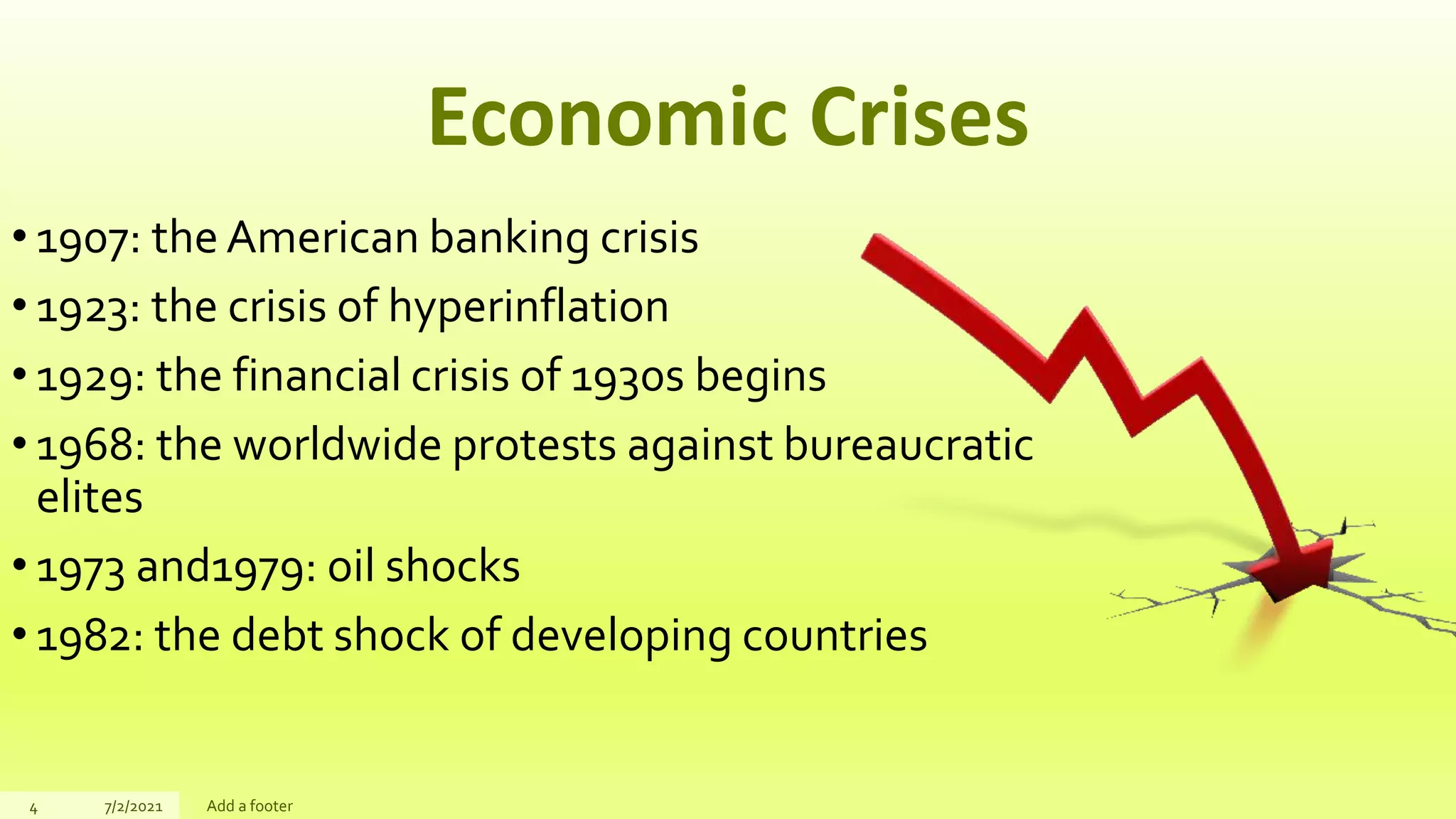
Economic Crises
• 1907:the American banking crisis
• 1923: the crisis of hyperinflation
• 1929: the financial crisis of 1930s begins
• 1968: the worldwide protests against bureaucratic
elites
• 1973 and1979: oil shocks
• 1982: the debt shock of developing countries
4 7/2/2021 Add a footer
5.
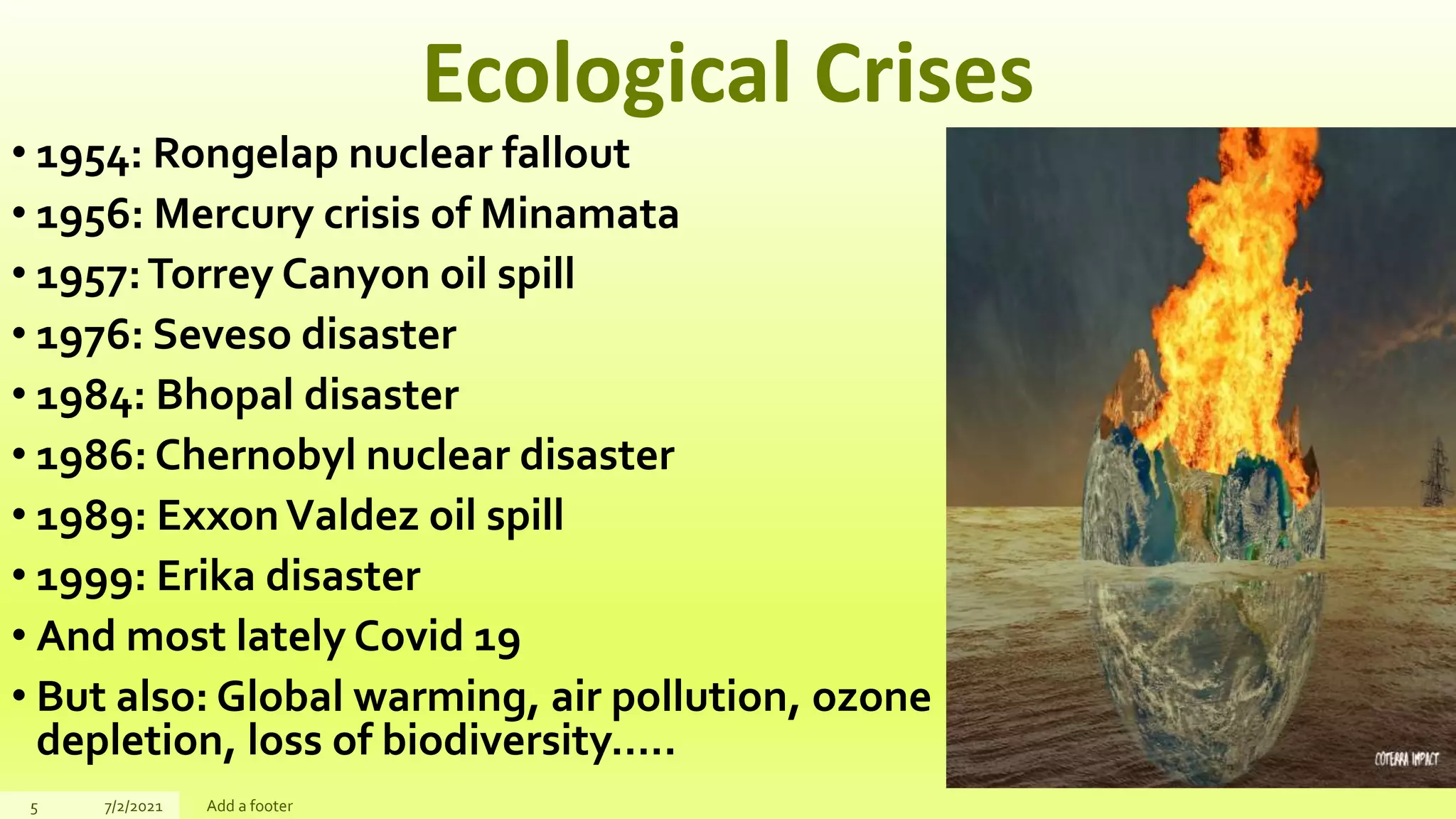
Ecological Crises
• 1954:Rongelap nuclear fallout
• 1956: Mercury crisis of Minamata
• 1957:Torrey Canyon oil spill
• 1976: Seveso disaster
• 1984: Bhopal disaster
• 1986: Chernobyl nuclear disaster
• 1989: ExxonValdez oil spill
• 1999: Erika disaster
• And most lately Covid 19
• But also: Global warming, air pollution, ozone
depletion, loss of biodiversity…..
5 7/2/2021 Add a footer
Limits to Growth
•1972, Meadows et al., commissioned by the Club of Rome, ran a computer
simulation that aimed to predict the consequences of what could happen in a
planet with limited resources
• The interactions between 5 different dimensions- world population growth,
industrialisation, pollution, food production and non renewable resource depletion-
were analysed, considering a scenario where these variables grew exponentially
and technology’s ability to increase resources was linear
• The strongest ending scenario was that an economic and social collapse would
happen by the end of 21st century if man imposes no limit to growth
7 7/2/2021 Add a footer
8.
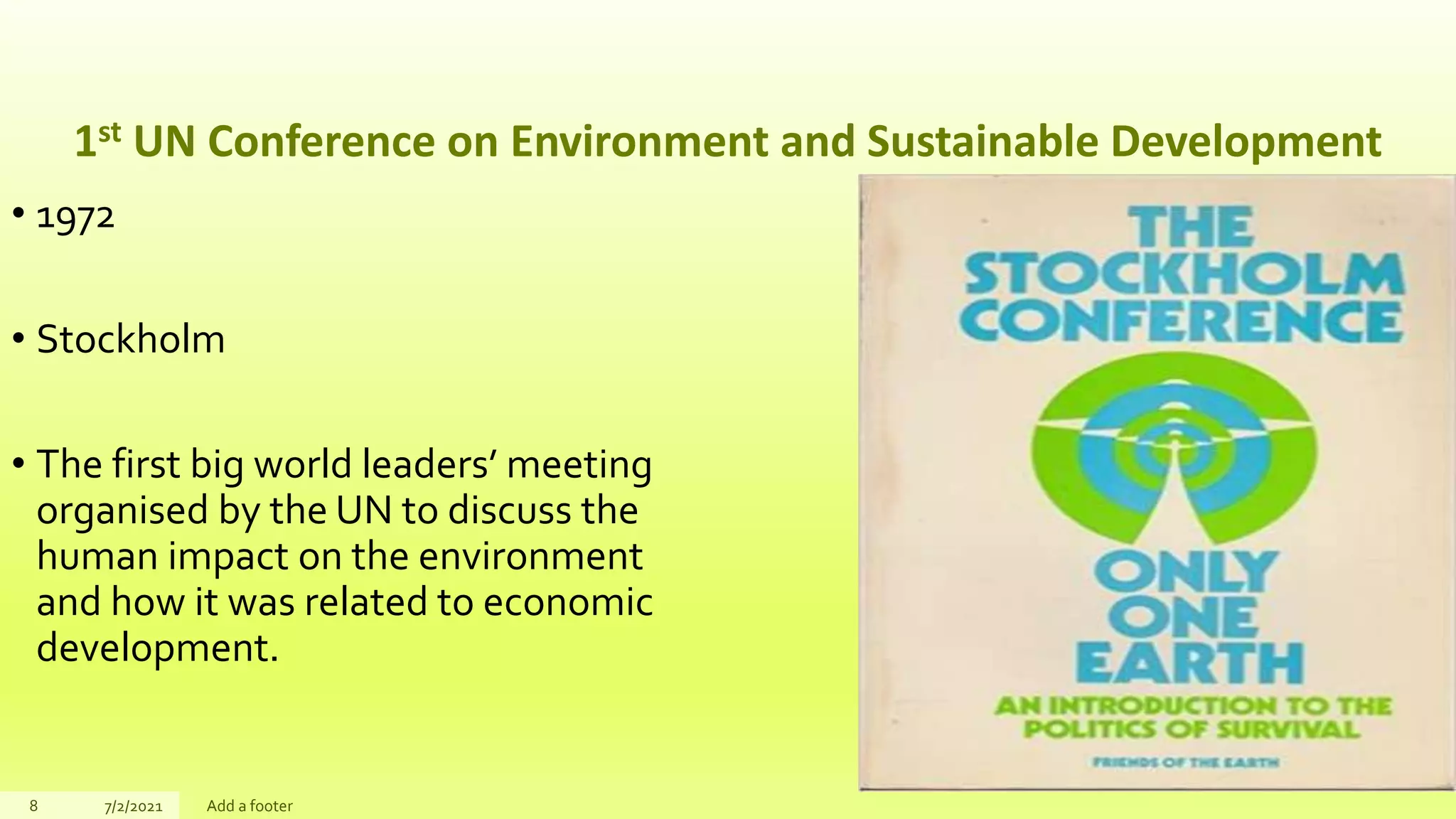
1st UN Conferenceon Environment and Sustainable Development
• 1972
• Stockholm
• The first big world leaders’ meeting
organised by the UN to discuss the
human impact on the environment
and how it was related to economic
development.
8 7/2/2021 Add a footer
9.
HDI and EcologicalFootprint
• HDI: Human Development Index
• Statistical tool that measures
countries economic and social
achievements
• It uses dimensions such as
health, education, financial
flows, mobility or human
security among others
• UN Development Programme
ranks countries based on HDI
report every year
• Ecological Footprint:
Maximum limit of
consumption per person
according to Earth’s
ecological capacity
• Living below it wouldn’t
compromise the future
generations, as the planet
would be able to
regenerate itself.
9 7/2/2021 Add a footer
10.
What these haveto do with sustainable development?
• Ideally humankind should get to a point where at least the
minimum HDI is achieved and live below maximum ecological
footprint per capita
• Living above minimum HDI would guarantee that human needs
are satisfied
• Living below the maximum ecological footprint per capita
would guarantee that resources would be preserved for future
generation
• But is this trend maintained?
10 7/2/2021 Add a footer
11.
Earth Overshoot Day
•The date when humanity’s demand for ecological
resources and services in a given year exceeds what
Earth can regenerate in that year
• The remainder of the year corresponds to global
overshoot
• Earth Overshoot Day is hosted and calculated by
Global Footprint Network, an international research
organisation that provides decision-makers with a
menu of tools to help the human economy operate
within Earth’s ecological limits
11 7/2/2021 Add a footer
Brundtland Report
• Alsoknown as Our Common Future
• In 1987
• Gave the most recognised and widely
accepted definition of sustainable
development
• Sustainable development is “the human
ability to ensure that the current
development meets the needs of the
present without compromising the
ability of future generations to meet
their own needs”
13 7/2/2021 Add a footer
14.
Climate Change andSustainable Development
• UN Development Programme and
theWorld Meteorological
Organisation created the
International Panel on Climate
Change(1988)
• Purpose is to develop and share the
knowledge about the impact of
human activities on climate change
• Also aims to explore the causes,
consequences, and ways of fighting
climate change
14 7/2/2021 Add a footer
15.
Triple Bottom Line
•Coined in 1994 by John Elkington, the founder of a sustainability consultancy
firm
• This expression means that companies should consider 3 different bottom
lines in their businesses
15 7/2/2021 Add a footer
16.
The Millennium EcosystemAssessment
•4 years long investigation that started in 2001 and was
requested by UN
•Over 1200 researchers gathered to assess the
consequences that ecosystems’ changes had on human
well-being
•Finding the scientific basis for action needed to improve
the conservation and sustainable use of ecosystems was a
goal
16 7/2/2021 Add a footer
17.
2030 Agenda forSustainable Development
• Adopted at the UN Sustainable
development Summit on 25
September 2015
• 15 year plan
• 17 goals were adopted by all UN
member states
• The Sustainable Development
Goals are a universal call to
action to end poverty, protect
the planet and improve the lives
and prospects of everyone,
everywhere
17 7/2/2021 Add a footer
34 7/2/2021 Adda footer
What is the role of
Science in Sustainable
Development ?
35.
35 7/2/2021 Adda footer
• Science is critical to tackle complex challenges for humanity such as
climate change, biodiversity loss, pollution and poverty reduction as
it lays foundation for new approaches and solutions
• Science and technology alone are obviously not the sole answers --
and will never be
• While complete solutions to urgent problems of health, agriculture,
food security, and clean water, for example, might not always be
available or practicable, development decisions made in the
absence or ignorance of the best S&T advice available will be highly
risky
• A sufficient base for science and technology for sustainable
development must be assembled from a variety of key activities
36.
Elements Where Scienceand Technology are Intimately Involved
•Building Capacity for Sustainable Development
•Investing inTraining the Next Generation
•Ensuring Access to Information
•Strengthening the Scientific Basis of Decision-Making
•Informing the Public
36 7/2/2021 Add a footer
37.
37 7/2/2021 Adda footer
Sustainable Agriculture
The term sustainable agriculture means an integrated system of plant
and animal production practices having a site-specific application that
will, over the long term:
•satisfy human food and fiber needs;
•enhance environmental quality and the natural resource base upon
which the agricultural economy depends;
•make the most efficient use of nonrenewable resources and on-farm
resources and integrate, where appropriate, natural biological cycles
and controls;
•sustain the economic viability of farm operations; and
•enhance the quality of life for farmers and society as a whole
38.
Sustainable Energy
• Sustainableenergy should be
widely encouraged as it does
not cause any harm to the
environment and is available
widely free of cost.
• All renewable energy sources
like
solar, wind, geothermal, hydrop
ower and ocean energy are
sustainable as they are stable
and available in plenty.
38 7/2/2021 Add a footer
39.
Biotechnology
• Biotechnology promisesto make
a significant contribution in
enabling the development of
better healthcare, enhanced food
security, and improved supplies of
portable water, more efficient
industrial development process
for transforming raw material,
support for sustainable
development methods of
afforestation and reforestation
and detoxication of hazardous
waste.
39 7/2/2021 Add a footer
40.
40 7/2/2021 Adda footer
•Biotechnology in Genetically Modified crops helps farmers to minimize yield loss from
pests and grow more food
•Allows important non-target insects like bees, butterflies, earthworms, and ladybugs to
flourish thus enhancing biodiversity
•Its uses also improve soil health and conserving tillage
•A drought resistant crop prevents the use of extensive irrigation and conserves our
water resource
•It also decreases the use of harmful fertilizers thereby helps to mitigate nutrient
pollution
•Production of biofuels
Pollution control by genetic engineering
41.
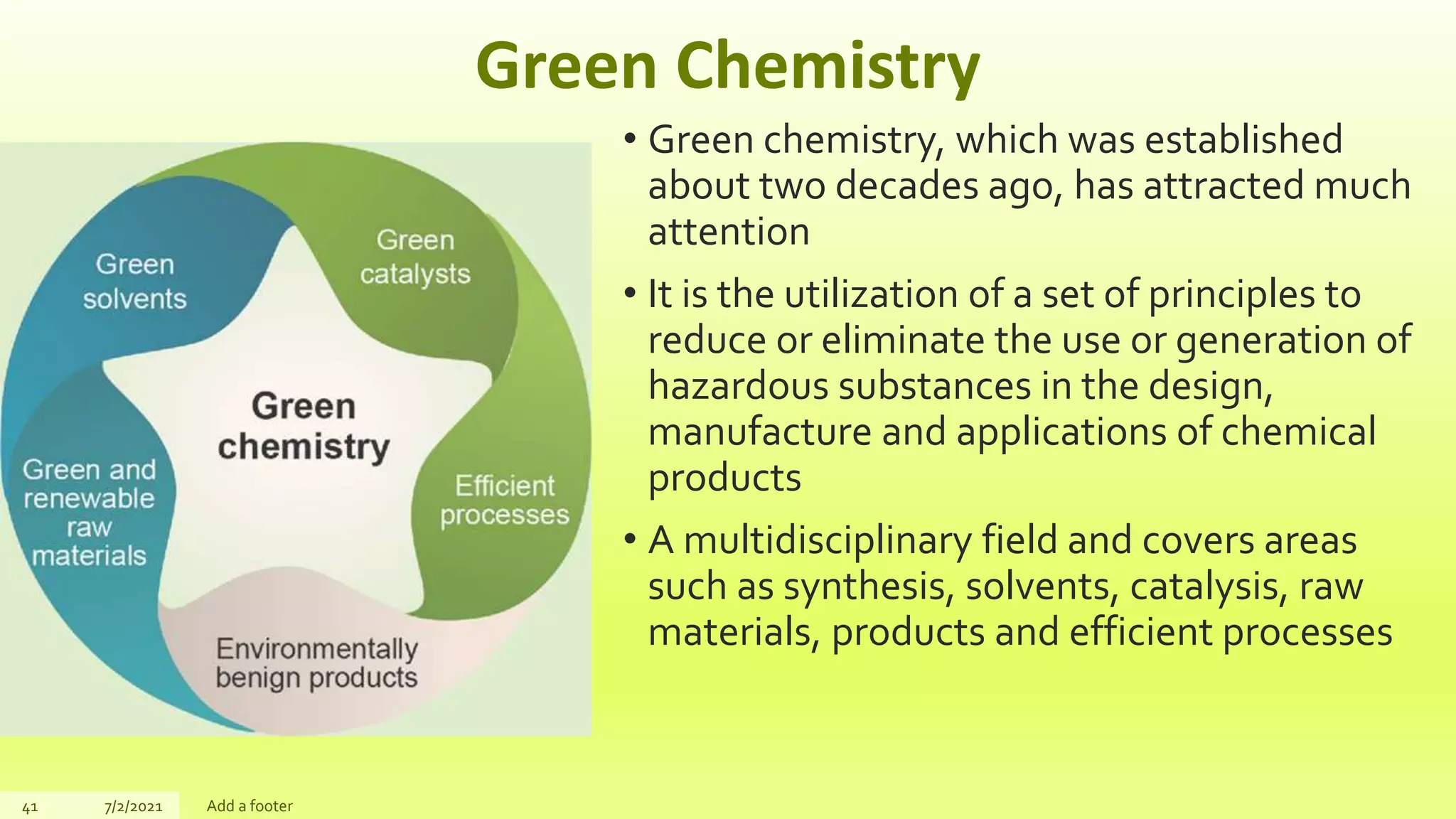
Green Chemistry
• Greenchemistry, which was established
about two decades ago, has attracted much
attention
• It is the utilization of a set of principles to
reduce or eliminate the use or generation of
hazardous substances in the design,
manufacture and applications of chemical
products
• A multidisciplinary field and covers areas
such as synthesis, solvents, catalysis, raw
materials, products and efficient processes
41 7/2/2021 Add a footer
42.
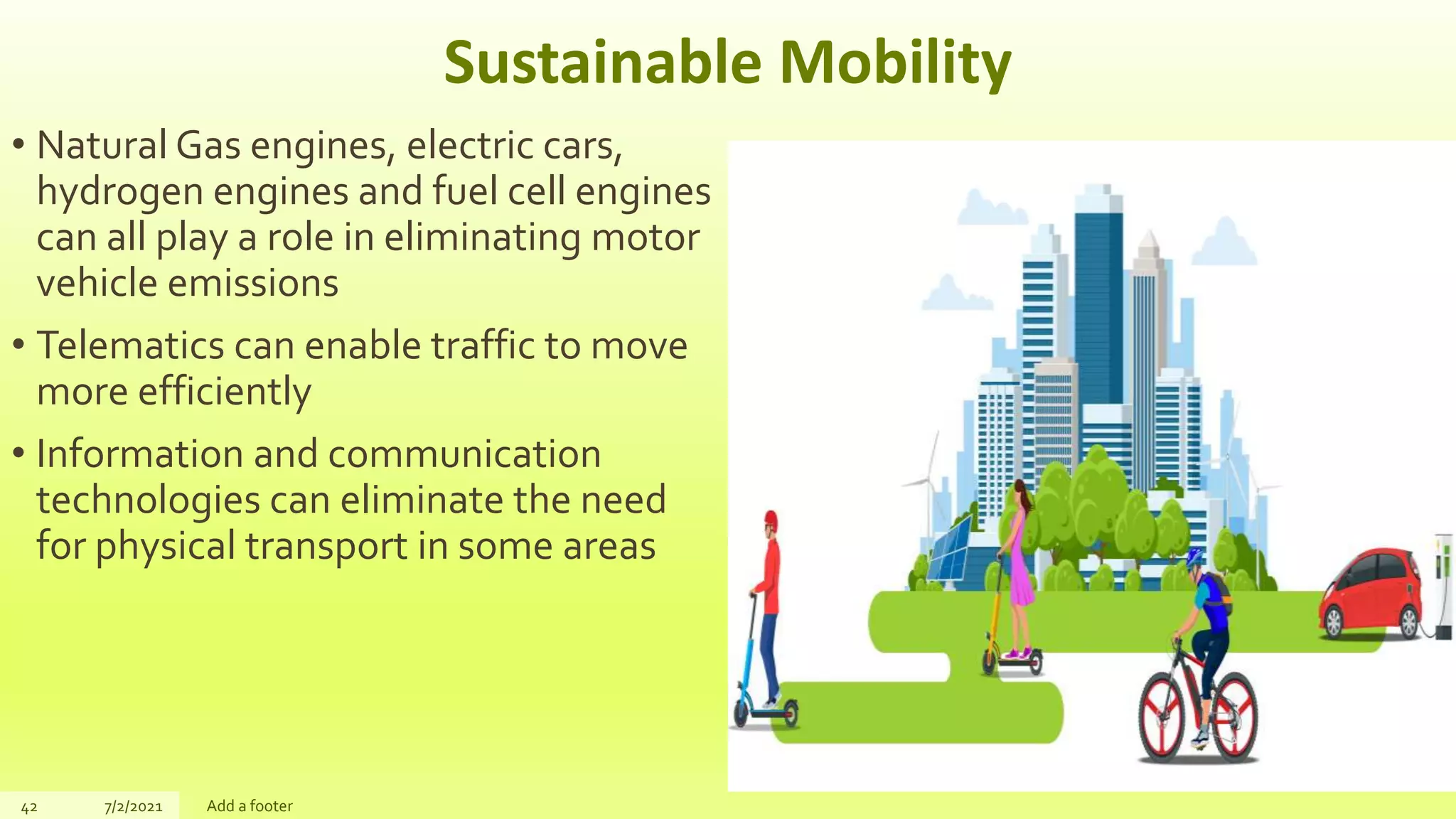
Sustainable Mobility
• NaturalGas engines, electric cars,
hydrogen engines and fuel cell engines
can all play a role in eliminating motor
vehicle emissions
• Telematics can enable traffic to move
more efficiently
• Information and communication
technologies can eliminate the need
for physical transport in some areas
42 7/2/2021 Add a footer
43.
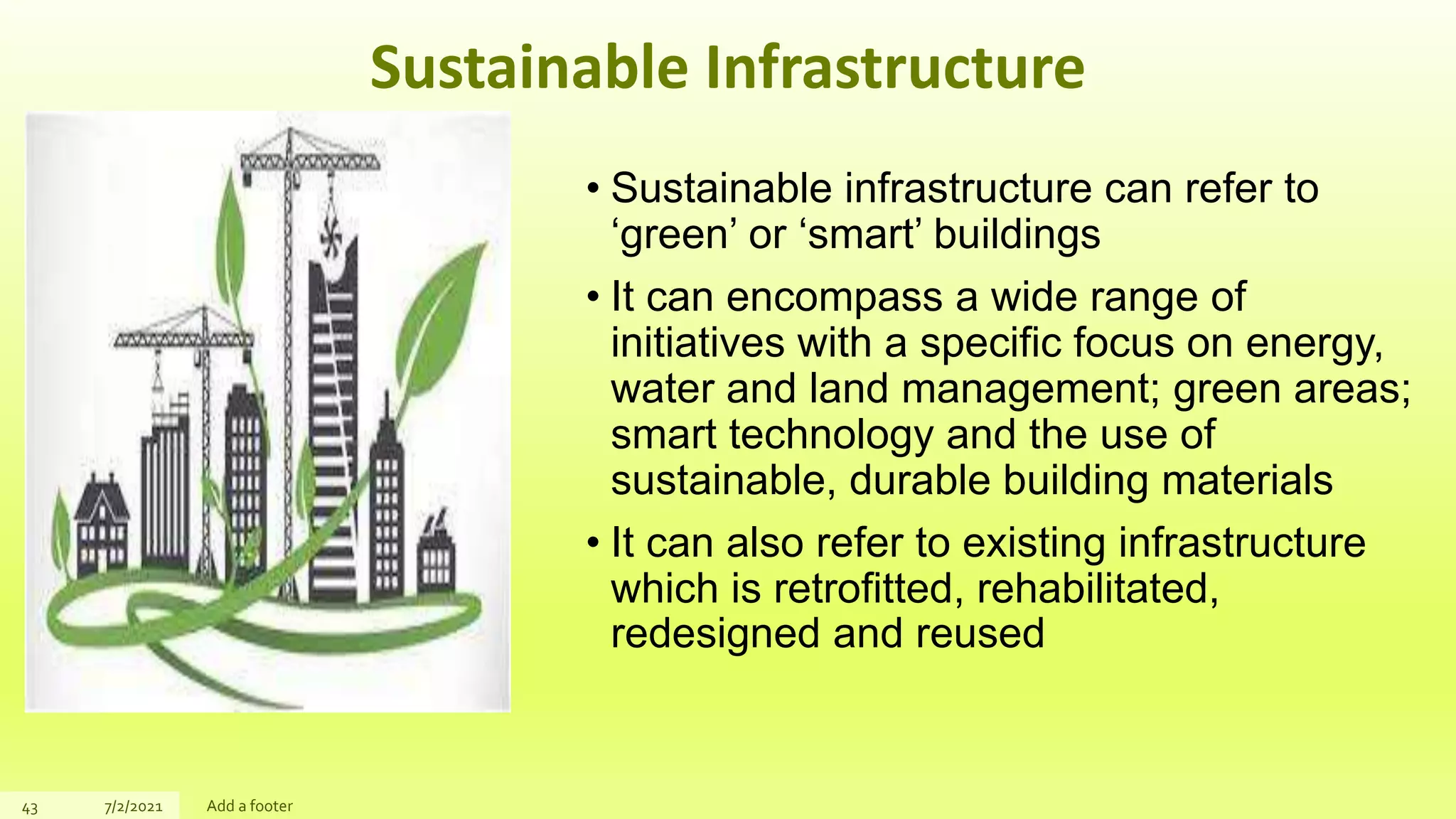
Sustainable Infrastructure
• Sustainableinfrastructure can refer to
‘green’ or ‘smart’ buildings
• It can encompass a wide range of
initiatives with a specific focus on energy,
water and land management; green areas;
smart technology and the use of
sustainable, durable building materials
• It can also refer to existing infrastructure
which is retrofitted, rehabilitated,
redesigned and reused
43 7/2/2021 Add a footer
45 7/2/2021 Adda footer
This means, apart from the policy makers,
leaders, scientists, ecologists, entrepreneurs, its
WE, the people who are the most important
factor in a sustainable development path
#2 What is the definition of sustainable development?
How has sustainability evolved and changed throughout the years and what are its important milestones?
What shapes sustainable development today?
What has science to do in sustainable development?
#3 The official definition was developed for the first time in the Brundtland Report in 1987
#4 Several ecological and social crises took place in the world and rose awareness that a more sustainable model.
#7 The Tragedy of Commons 1968
Written by ecologist and philosopher Garret Hardin
#8 After more than 4 decades these predictions seem to be right, isn’t it?
#9 Main goal: To find a common outlook and common principles to inspire and guide world’s population to preserve the human environment
#13 Every year the overshoot day comes earlier, why? Because our demand for ecological resources in a given year has been exceeding what the planet can regenerate in that same year
#19 Economic growth must be inclusive to provide sustainable jobs and promote equality
#20 The Sustainable Development Goals aim to end all forms of hunger and malnutrition by 2030, making sure all people – especially children and the more vulnerable – have access to sufficient and nutritious food all year round. This involves promoting sustainable agricultural practices: improving the livelihoods and capacities of small scale famers, allowing equal access to land, technology and markets. It also requires international cooperation to ensure investment in infrastructure and technology to improve agricultural productivity. Together with the other goals set out here, we can end hunger by 2030.
#21 The Sustainable Development Goals make a bold commitment to end the epidemics of AIDS, tuberculosis, malaria and other communicable diseases by 2030. The aim is to achieve universal health coverage, and provide access to safe and effective medicines and vaccines for all. Supporting research and development for vaccines is an essential part of this process as well as providing access to affordable medicines.
#24 Ensuring universal access to safe and affordable drinking water for all by 2030 requires we invest in adequate infrastructure, provide sanitation facilities and encourage hygiene at every level. Protecting and restoring water-related ecosystems such as forests, mountains, wetlands and rivers is essential if we are to mitigate water scarcity. More international cooperation is also needed to encourage water efficiency and support treatment technologies in developing countries.
#25 Ensuring universal access to affordable electricity by 2030 means investing in clean energy sources such as solar, wind and thermal. Adopting cost-effective standards for a wider range of technologies could also reduce the global electricity consumption by buildings and industry by 14 percent. This means avoiding roughly 1,300 mid-size power plants. Expanding infrastructure and upgrading technology to provide clean energy sources in all developing countries is a crucial goal that can both encourage growth and help the environment.
#27 Technological progress is also key to finding lasting solutions to both economic and environmental challenges, such as providing new jobs and promoting energy efficiency. Promoting sustainable industries, and investing in scientific research and innovation, are all important ways to facilitate sustainable development.
#29 Making cities safe and sustainable means ensuring access to safe and affordable housing, and upgrading slum settlements. It also involves investment in public transport, creating green public spaces, and improving urban planning and management in a way that is both participatory and inclusive.
#30 The efficient management of our shared natural resources, and the way we dispose of toxic waste and pollutants, are important targets to achieve this goal. Encouraging industries, businesses and consumers to recycle and reduce waste is equally important, as is supporting developing countries to move towards more sustainable patterns of consumption by 2030.
#31 Strengthening the resilience and adaptive capacity of more vulnerable regions, such as land locked countries and island states, must go hand in hand with efforts to raise awareness and integrate measures into national policies and strategies. It is still possible, with the political will and a wide array of technological measures, to limit the increase in global mean temperature to two degrees Celsius above pre-industrial levels. This requires urgent collective action.
#32 The Sustainable Development Goals create a framework to sustainably manage and protect marine and coastal ecosystems from land-based pollution, as well as address the impacts of ocean acidification. Enhancing conservation and the sustainable use of ocean-based resources through international law will also help mitigate some of the challenges facing our oceans.
#33 The Sustainable Development Goals aim to conserve and restore the use of terrestrial ecosystems such as forests, wetlands, drylands and mountains by 2020. Promoting the sustainable management of forests and halting deforestations is also vital to mitigating the impact of climate change. Urgent action must be taken to reduce the loss of natural habitats and biodiversity which are part of our common heritage.
#39 Sun will continue to provide sunlight till we all are here on earth, heat caused by the sun will continue to produce winds, the earth will continue to produce heat from inside and will not cool down anytime soon, movement of earth, sun and moon will not stop, and this will keep on producing tides. The process of evaporation will cause water to evaporate that will fall down in the form of rain or ice which will go through rivers or streams and merge in the oceans and can be used to produce energy through hydropower.