Equitable use of
resources for
sustainable
development
RAJESHWARI JAGADISH
BMSCCM*
Scarcity of resources is the burning
problem of modern technology. The
twenty-first century will see growing
human needs for resources since many
parts of the world are using natural
resources at a rate faster than the
natural processes can replenish it.
*There are several principles that each
of us can adopt to bring about
sustainable lifestyles.
*Reduction of the unsustainable and
unequal use of resources and control of
our population growth.
*Expand green grassland.
*The clean water of a lake that supports
so much life.
*Magnify power of the oceans.
INTRODUCTION
Standard of living refers to the consumption of
goods and services by an individual . It relates
directly to the economic development where as
the wellbeing or quality of life of a population
refers to a combination of attributes that provide
physical ,mental , spiritual and social wellbeing.
STANDARD OF
LIVING AND
QUALITIES OF
LIFE
SOME DEFNITIONS ARE:
*”Development that meets the needs of the
present without compromising the ability of
future generations to meet their own needs”.
*”Economic development that is conducted
without depletion of natural resources.”
SUSTAINABLE
DEVELOPMENT
MAIN FEATURES
OF SUSTAINABLE
DEVELOPMENT
 A desirable human condition : a society that
people want to sustain because it meets their
needs.
 A enduring ecosystem condition : an
ecosystem that maintains its capacity to
support human life and others.
 A balance between present and future
generations; and within the present
generation.
 INCLUDED:
*Sustainable growth.
*Sustainable consumption .
*Sustainability.
SUSTAINABLE GROWTH
For growth we need resources and the rate of depletion resources cannot be matched
with the regenerating capacity of earth , as it is finite , not growing and materially
closed . Therefore , sustainable growth is an impossible theorem .
SUSTAINABLE CONSUMPTION
Sustainable consumption is related to production and distribution , use and disposal
of products and services and provides the means to rethink our lifecycle . The aim is
to ensure that the basic needs of the entire global community are met , excess is
reduced and environmental damage is avoided .
SUSTAINABILITY
Sustainability is the action oriented variant of sustainable development . There are
some principles of sustainability which include the following-
*Protecting nature.
*Thinking long term.
*Recognizing limits.
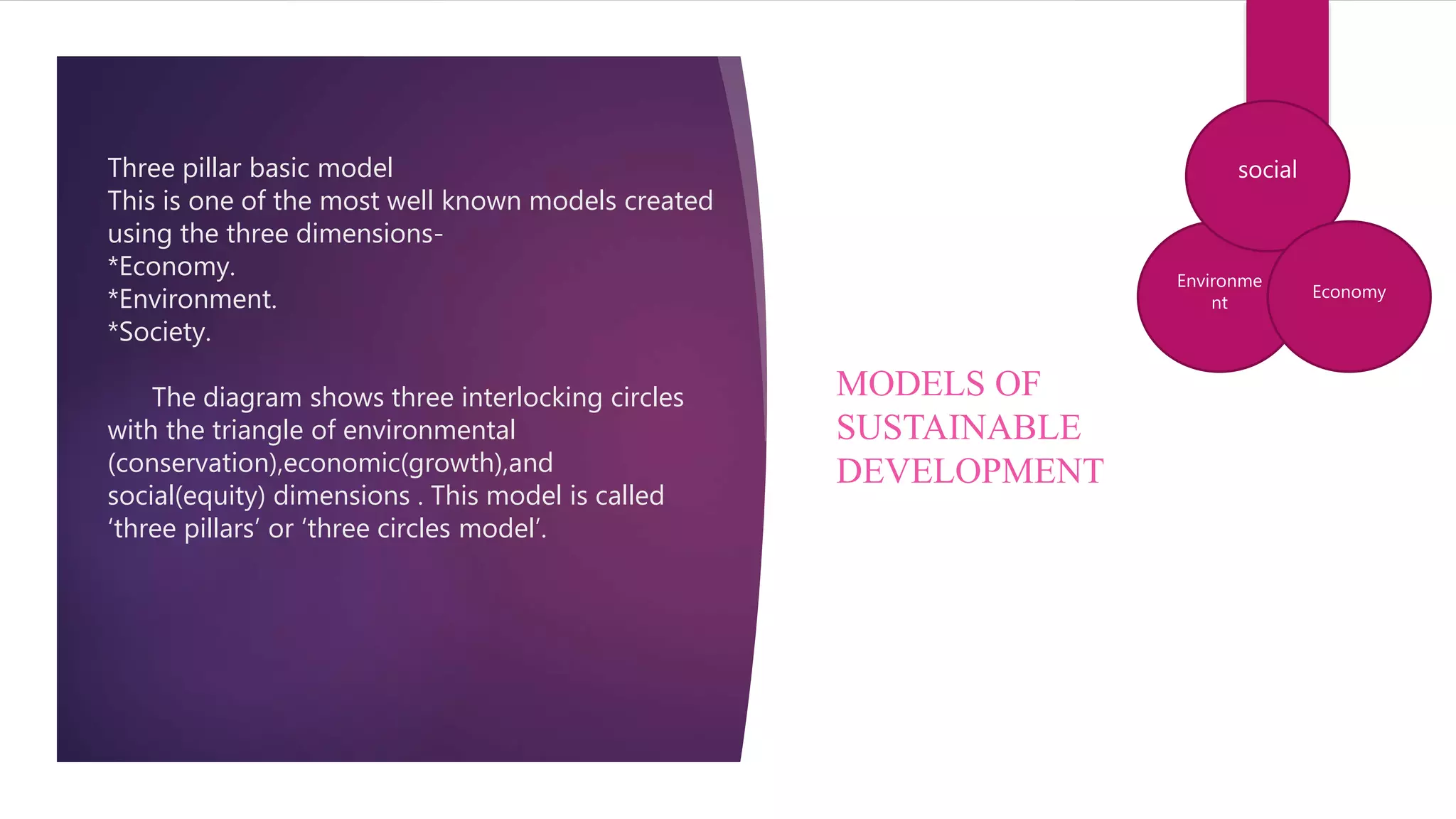
Three pillar basic model
This is one of the most well known models created
using the three dimensions-
*Economy.
*Environment.
*Society.
The diagram shows three interlocking circles
with the triangle of environmental
(conservation),economic(growth),and
social(equity) dimensions . This model is called
‘three pillars’ or ‘three circles model’.
MODELS OF
SUSTAINABLE
DEVELOPMENT
Environme
nt
social
Economy
THE
SUSTAINABILITY
MODEL
 It was designed in 1994 by the international
union for the conservation of nature , IUCN.
It illustrates the relationship between people and
ecosystem as one circle inside another , like the
yolk of an egg . This implies that people are
within the ecosystem , and that ultimately one is
entirely dependent upon the other . Just as an
egg is good only if both the white and yolk are
good , so a society is well and sustainable only if
both people and the ecosystem, are well.
Thus according to this model:
Sustainable development=human well being+
ecosystem well being.
This model was developed by the German
Wuppertal Institute and defines SD with the
help of four components- economy ,
environment , society , and institutions.
In this model the inter linkages such as
care , access , democracy ,and eco-efficiency
need to be looked at closely as they show the
relation between the dimensions which could
translate and influence policy . In each
dimension of the prism , there are imperatives
. Indicators are used to measure hoe far one
as actually come in comparison to the overall
vision of SD.
PRISM OF
SUSTAINABILITY
INDICATORS OF
SUSTAINABLE
DEVELOPMENT
 Gross National Happiness (GNH)
 Human Development Index (HDI)
 Ecological Footprint (EF)
 The Happy Index (HPI)
Gross National Happiness is an attempt to
define quality of life in a more holistic and
psychological terms than Gross National
Product .
Four pillars of GNH are:
< The promotion of equitable and
sustainable socio-economic development .
< Preservation and promotion of
cultural values .
< conservation of the natural
environment .
< Establishment of good governance .
GROSS NATIONAL
HAPPINESS(GNH)
Human Development
Index (HDI)
 The Human Development Index is the
measure of life expectancy , literacy ,
education , and standard of living for
countries world wide .
Three basic dimensions if human
development index are:
< A long and healthy life .
< Knowledge .
< A decent standard of living .
< Using appropriate technology .
<Reduce , Recycle and Reuse
approach .
< Promotion environmental awareness
approach .
< Resource utilization as per carrying capacity
.
< Improving quality of life including social ,
cultural and economic .
MEASURES OF
SUSTAINABLE
DEVELOPMENT
SOLAR PANELS , WIND
TURBINES , AND
GREEN ENERGY
 Instead of burning fossil fuels that will be
depleted within short generations , alternative
energy such as solar panels , wind turbines
and other green energy sources need to be
implemented to sustain and care for the
sources that remain .
 The definition of sustainable living means
today than when it was first considered
almost 200 years ago back , then it was to
improve man’s conditions , today it is to
maintain man’s functional society and protect
the environment .
For sustainable engineering solutions
lifestyle choices , we may consider the
sustainability of our lifestyles through sub
division into the following categories :
< energy including transport.
< Finite resource depletion and
waste management .
< Water .
HOW CAN WE ACHIEVE
SUSTAINABLE
LIFESTYLE
ENERGY INCLUDING
TRANSPORT
 The energy required to support our lifestyle
may be sub divided into the following
categories :
< Electricity for lighting and appliances .
< Transport .
< Embodied energy in products .
The quality of human life and quality of
ecosystem on earth are indicators of the
sustainable use of resources . There are
some clear indicators of sustainable
lifestyles in human life :
< Increased longevity .
< The long term conservation of
biodiversity .
< The careful long term use of
natural resources .
< The prevention of degradation
and pollution of the environment .
NEEDS FOR SUSTAINABLE
LIFESTYLES
NEED FOR
SUSTAINABLE
LIFESTYLES The quality of ecosystems have indicators that
are more difficult to assess :
< A stabilized population .
< The long term conservation of biodiversity .
< The careful long term use of natural
resources .
< The prevention of degradation and
pollution of the environment .
Some of the following tips to live a more
sustainable lifestyles are :
< Save energy .
< Eat less meat .
< Use reusable alternatives.
< Go paperless .
< Use renewable energy .
< Recycle and reuse .
< Grow your own produce .
< Donate unused items .
< Save water .
< Buy fair trade products .
< Drive less .
< Don’t waste food .
< Wear sustainable clothing .
< Use of eco-friendly cleaning
products .
HOW DO LIVE THE
SUSTAINABLE
LIFESTYLE ?
SUSTAINABLE
LIFESTYLE
 Instead of converting forest land to agriculture land ,
make use of existing land for multiple cropping .
 Increase in irrigation .
 Move towards no tillage agriculture .
 Not burning crop residues that emit (CO2).
 Use of paper and jute bags instead of non recyclable
plastic bags .
 Use of energy efficient appliances like CFL bulbs ,
pressure cooker .
 Use public transport system .
 Make green purchases .
Sustainable lifestyle describes that it
attempts to reduce an individual’s or
society’s use of earth’s natural resources
and one’s personal resources . From this
statement the natural conclusion is that
Sustainable lifestyle is at odds with
industrialization .
CONCLUSION
THANK YOU

Equitable use of resources for sustainable lifestyles

  • 1.
    Equitable use of resourcesfor sustainable development RAJESHWARI JAGADISH BMSCCM*
  • 2.
    Scarcity of resourcesis the burning problem of modern technology. The twenty-first century will see growing human needs for resources since many parts of the world are using natural resources at a rate faster than the natural processes can replenish it. *There are several principles that each of us can adopt to bring about sustainable lifestyles. *Reduction of the unsustainable and unequal use of resources and control of our population growth. *Expand green grassland. *The clean water of a lake that supports so much life. *Magnify power of the oceans. INTRODUCTION
  • 3.
    Standard of livingrefers to the consumption of goods and services by an individual . It relates directly to the economic development where as the wellbeing or quality of life of a population refers to a combination of attributes that provide physical ,mental , spiritual and social wellbeing. STANDARD OF LIVING AND QUALITIES OF LIFE
  • 4.
    SOME DEFNITIONS ARE: *”Developmentthat meets the needs of the present without compromising the ability of future generations to meet their own needs”. *”Economic development that is conducted without depletion of natural resources.” SUSTAINABLE DEVELOPMENT
  • 5.
    MAIN FEATURES OF SUSTAINABLE DEVELOPMENT A desirable human condition : a society that people want to sustain because it meets their needs.  A enduring ecosystem condition : an ecosystem that maintains its capacity to support human life and others.  A balance between present and future generations; and within the present generation.  INCLUDED: *Sustainable growth. *Sustainable consumption . *Sustainability.
  • 6.
    SUSTAINABLE GROWTH For growthwe need resources and the rate of depletion resources cannot be matched with the regenerating capacity of earth , as it is finite , not growing and materially closed . Therefore , sustainable growth is an impossible theorem .
  • 7.
    SUSTAINABLE CONSUMPTION Sustainable consumptionis related to production and distribution , use and disposal of products and services and provides the means to rethink our lifecycle . The aim is to ensure that the basic needs of the entire global community are met , excess is reduced and environmental damage is avoided .
  • 8.
    SUSTAINABILITY Sustainability is theaction oriented variant of sustainable development . There are some principles of sustainability which include the following- *Protecting nature. *Thinking long term. *Recognizing limits.
  • 9.
    Three pillar basicmodel This is one of the most well known models created using the three dimensions- *Economy. *Environment. *Society. The diagram shows three interlocking circles with the triangle of environmental (conservation),economic(growth),and social(equity) dimensions . This model is called ‘three pillars’ or ‘three circles model’. MODELS OF SUSTAINABLE DEVELOPMENT Environme nt social Economy
  • 10.
    THE SUSTAINABILITY MODEL  It wasdesigned in 1994 by the international union for the conservation of nature , IUCN. It illustrates the relationship between people and ecosystem as one circle inside another , like the yolk of an egg . This implies that people are within the ecosystem , and that ultimately one is entirely dependent upon the other . Just as an egg is good only if both the white and yolk are good , so a society is well and sustainable only if both people and the ecosystem, are well. Thus according to this model: Sustainable development=human well being+ ecosystem well being.
  • 11.
    This model wasdeveloped by the German Wuppertal Institute and defines SD with the help of four components- economy , environment , society , and institutions. In this model the inter linkages such as care , access , democracy ,and eco-efficiency need to be looked at closely as they show the relation between the dimensions which could translate and influence policy . In each dimension of the prism , there are imperatives . Indicators are used to measure hoe far one as actually come in comparison to the overall vision of SD. PRISM OF SUSTAINABILITY
  • 12.
    INDICATORS OF SUSTAINABLE DEVELOPMENT  GrossNational Happiness (GNH)  Human Development Index (HDI)  Ecological Footprint (EF)  The Happy Index (HPI)
  • 13.
    Gross National Happinessis an attempt to define quality of life in a more holistic and psychological terms than Gross National Product . Four pillars of GNH are: < The promotion of equitable and sustainable socio-economic development . < Preservation and promotion of cultural values . < conservation of the natural environment . < Establishment of good governance . GROSS NATIONAL HAPPINESS(GNH)
  • 14.
    Human Development Index (HDI) The Human Development Index is the measure of life expectancy , literacy , education , and standard of living for countries world wide . Three basic dimensions if human development index are: < A long and healthy life . < Knowledge . < A decent standard of living .
  • 15.
    < Using appropriatetechnology . <Reduce , Recycle and Reuse approach . < Promotion environmental awareness approach . < Resource utilization as per carrying capacity . < Improving quality of life including social , cultural and economic . MEASURES OF SUSTAINABLE DEVELOPMENT
  • 16.
    SOLAR PANELS ,WIND TURBINES , AND GREEN ENERGY  Instead of burning fossil fuels that will be depleted within short generations , alternative energy such as solar panels , wind turbines and other green energy sources need to be implemented to sustain and care for the sources that remain .  The definition of sustainable living means today than when it was first considered almost 200 years ago back , then it was to improve man’s conditions , today it is to maintain man’s functional society and protect the environment .
  • 17.
    For sustainable engineeringsolutions lifestyle choices , we may consider the sustainability of our lifestyles through sub division into the following categories : < energy including transport. < Finite resource depletion and waste management . < Water . HOW CAN WE ACHIEVE SUSTAINABLE LIFESTYLE
  • 18.
    ENERGY INCLUDING TRANSPORT  Theenergy required to support our lifestyle may be sub divided into the following categories : < Electricity for lighting and appliances . < Transport . < Embodied energy in products .
  • 19.
    The quality ofhuman life and quality of ecosystem on earth are indicators of the sustainable use of resources . There are some clear indicators of sustainable lifestyles in human life : < Increased longevity . < The long term conservation of biodiversity . < The careful long term use of natural resources . < The prevention of degradation and pollution of the environment . NEEDS FOR SUSTAINABLE LIFESTYLES
  • 20.
    NEED FOR SUSTAINABLE LIFESTYLES Thequality of ecosystems have indicators that are more difficult to assess : < A stabilized population . < The long term conservation of biodiversity . < The careful long term use of natural resources . < The prevention of degradation and pollution of the environment .
  • 21.
    Some of thefollowing tips to live a more sustainable lifestyles are : < Save energy . < Eat less meat . < Use reusable alternatives. < Go paperless . < Use renewable energy . < Recycle and reuse . < Grow your own produce . < Donate unused items . < Save water . < Buy fair trade products . < Drive less . < Don’t waste food . < Wear sustainable clothing . < Use of eco-friendly cleaning products . HOW DO LIVE THE SUSTAINABLE LIFESTYLE ?
  • 22.
    SUSTAINABLE LIFESTYLE  Instead ofconverting forest land to agriculture land , make use of existing land for multiple cropping .  Increase in irrigation .  Move towards no tillage agriculture .  Not burning crop residues that emit (CO2).  Use of paper and jute bags instead of non recyclable plastic bags .  Use of energy efficient appliances like CFL bulbs , pressure cooker .  Use public transport system .  Make green purchases .
  • 23.
    Sustainable lifestyle describesthat it attempts to reduce an individual’s or society’s use of earth’s natural resources and one’s personal resources . From this statement the natural conclusion is that Sustainable lifestyle is at odds with industrialization . CONCLUSION
  • 24.