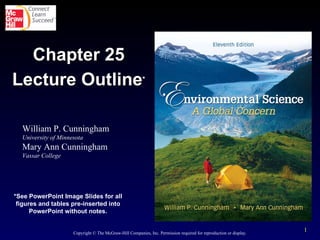
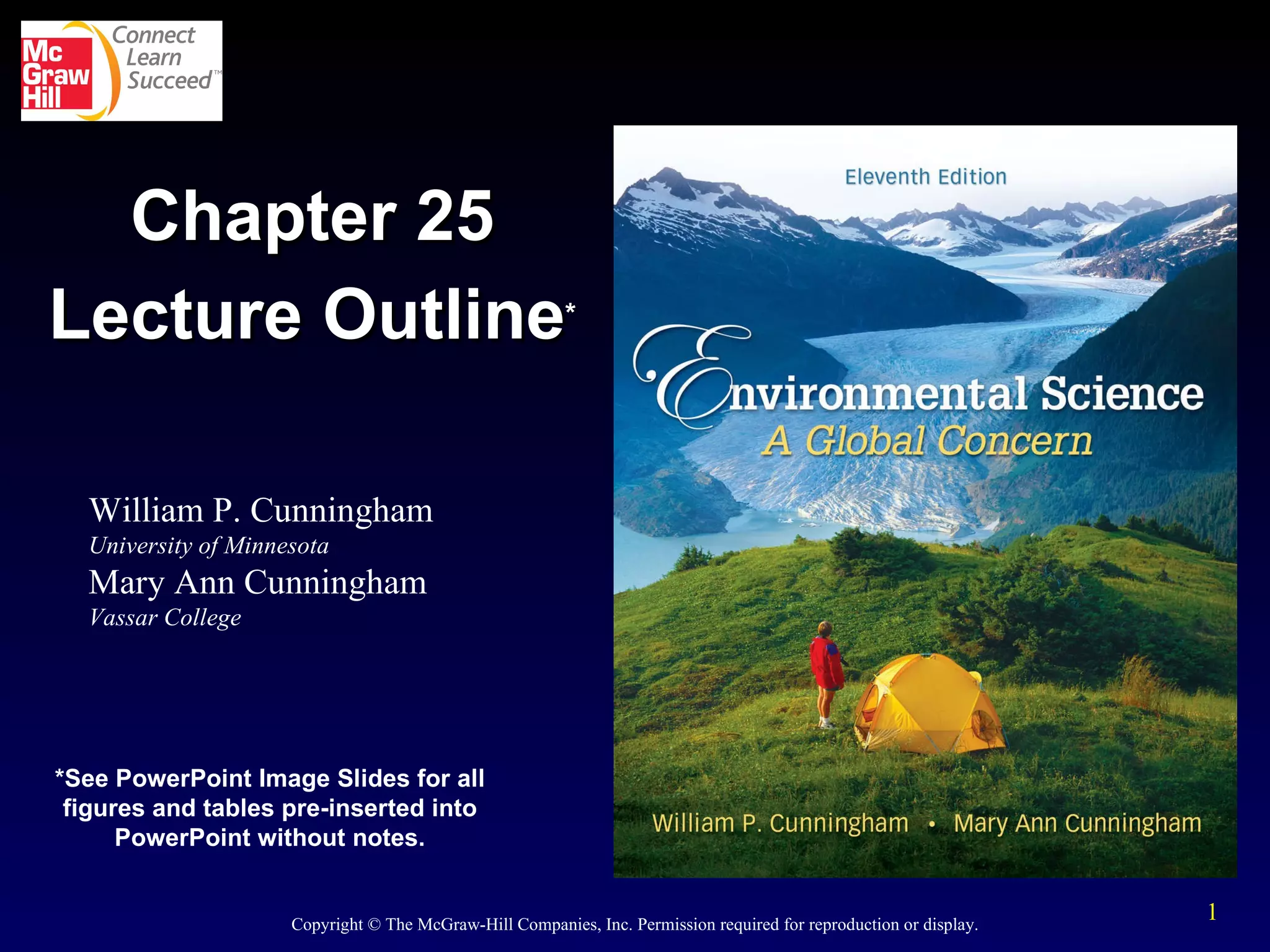
William P. Cunningham University of Minnesota Mary Ann Cunningham Vassar College Copyright © The McGraw-Hill Companies, Inc. Permission required for reproduction or display. *See PowerPoint Image Slides for all figures and tables pre-inserted into PowerPoint without notes. Chapter 25 Lecture Outline *
What Then Shall We Do?
Outline Environmental Education Environmental Careers How Much is Enough? Green Consumerism Working Together Mainline and Radical Environmental Groups Campus Greening Sustainability is a Global Challenge Millennium Assessment  What Then Shall We Do?
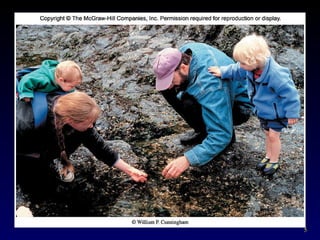
Environmental Education In 1990, Congress passed the  National Education Act  establishing two goals: Improve understanding among the general public of the natural and built environment and the relationships between humans and their environment Encourage post-secondary students to pursue careers related to the environment
 
Environmental Literacy William Reilly , former EPA administrator, called for  environmental literacy  in which every citizen is fluent in the principles of ecology and has a working knowledge of the environment. Foster a stewardship ethic
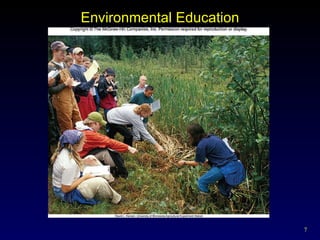
Environmental Education
Citizen Science Ordinary people join with established scientists to answer real scientific questions Community-based research was pioneered in the Netherlands in when they combined researchers with students and neighborhood groups to work on research projects The Audubon Society sponsors a annual Christmas Bird Count. Earthwatch International and American River Watch are also examples of enlisting the public in scientific research projects.
Environmental Careers Trained people in environmental professions, at every level from support staff to managers to educators are essential, and those roles will only increase in importance. World Wildlife Fund estimates 750,000 new jobs  in renewable energy in next 10 yrs Environmental law Environmental engineering Environmental education
Green Business Can resource conservation and environmental awareness be an advantage in business? Most large companies have an environmental department. Companies are beginning to design with pollution control and waste disposal in mind. Huge market for pollution control technology
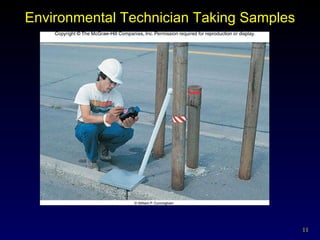
Environmental Technician Taking Samples
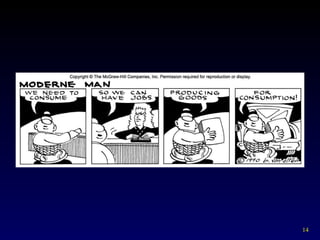
How Much Is Enough? Veblen in  Theory of the Leisure Class  coined the term  conspicuous consumption  to describe buying things we do not need in order to impress others. The average American now consumes twice as many goods and services as in 1950 An average house in the U.S. is now more than twice as big as 50 years ago, even though the typical family has half the number of people. We need the additional space to hold all the stuff we buy.
How Much Is Enough? Growing number of people find themselves stuck in a vicious cycle: Work frantically at a job they hate, to buy things they don’t need, so they can save time to work longer hours. Some, however, take a cue from Thoreau and are adopting more simple, less consumptive lifestyles.
 
We Can Reduce Our Environmental Impacts Even small steps can have significant environmental effects: Switching from a diet high in red meat to a vegetarian one can save as much energy as trading in a normal car for a hybrid. It takes only about 2 calories of fossil fuel to grow one calorie of energy in a fruit or vegetable. The ratio is as high as 80 to 1 for cattle grown in confined feeding operations.
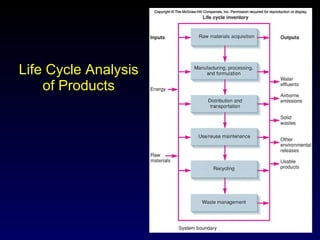
“Green Washing” Can Confuse Consumers Many terms used in advertising are vague and have little meaning: Nontoxic, biodegradable, recyclable, natural, organic, environmentally friendly Several national programs scientifically analyze the environmental impacts of products. Blue Angel label in Germany Green Seal program in the U.S. The most comprehensive product analysis is called  life cycle analysis , as it follows a product through its manufacture, use and disposal.
Life Cycle Analysis of Products
Limits of Green Consumerism Often, consumers are faced with complicated comparisons and choices. Paper or plastic grocery bags? Both have good and bad points, and represent trade-offs in energy use, pollution production, ability to recycle, etc. If you have both paper and plastic recycling, plastic is probably better because it is easier to recycle and produces less pollution. A better choice may be to take your own cloth bag.
Limits of Green Consumerism Focus on doing your best to recycle, buy green products, and be involved. Green consumerism generally can do little about larger issues of global equality, chronic poverty, and oppression in the Third World. There is a danger that an exclusive focus on our own small steps, such as recycling, may divert attention from greater environmental issues.
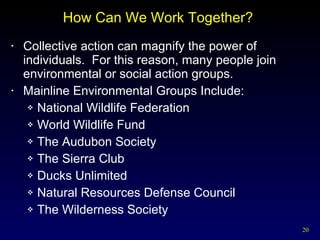
How Can We Work Together?  Collective action can magnify the power of individuals.  For this reason, many people join environmental or social action groups. Mainline Environmental Groups Include: National Wildlife Federation World Wildlife Fund The Audubon Society The Sierra Club Ducks Unlimited Natural Resources Defense Council The Wilderness Society
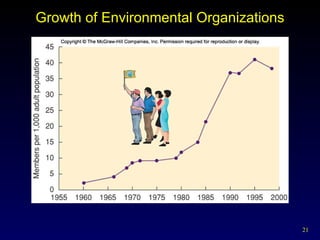
Growth of Environmental Organizations
Mainline Environmental Groups Mass membership, large professional staffs, and long history provide these groups a degree of respectability and influence not found in newer, smaller groups Mainline environmental organizations are often criticized by radical environmentalists for their tendency to compromise and cooperate with the establishment. These groups have local chapters, a good way for you to become involved
Mainline Environmental Groups Some groups have limited contact with members and focus instead on land acquisition, litigation and lobbying. Environmental Defense Fund Nature Conservancy National Resources Defense Council Wilderness Society
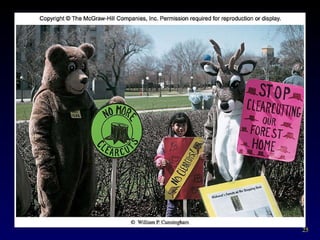
Radical Groups Capture Media Attention Direct Action   Groups Earth First! Sea Shepherd Greenpeace Often associated with  deep ecology  - profoundly biocentric worldview Use creative tactics such as street theater and civil disobedience How far should you go in disobeying rules to change public opinion?
 
Non-governmental Organizations (NGOs) Rapid rise in international NGOs Rio Summit in 1992 had 30,000 representatives of environmental groups attending Carry out public education and consciousness-raising using protest marches and civil disobedience Conservation International does debt for nature swaps
Campus Greening Student Environmental Action Coalition (SEAC) is largest group with some 5000 chapters. Is there a chapter on your campus? Another important student organizing group is the network of Public Interest Research Groups. You can learn to organize, use media to get your message out. “ Step it Up” campaign about global warming was done via internet. Electronic environmentalism allowed them to organize more than 800 events.
Schools Can Be Environmental Leaders Schools can do campus audits to study water and energy use, waste disposal, recycling, paper consumption, etc. New buildings should meet U.S. Green Building Council standards.  It does not cost any more to build in an environmentally friendly way. At Carnegie Mellon in Pittsburgh, a kiosk in the dorm shows daily energy use and there are green dorms with natural lighting, clean air and few allergens.
Colleges Showing Environmental Leadership Dartmouth, Harvard, Stanford and Williams rank at the top for green policies. Berea College in Kentucky got special commendation. Berea’s ecovillage has a student designed house that produces its own electricity and treats waste water in a living system. College has a full time sustainability coordinator
Your Campus Can Reduce Energy Usage Your campus can reduce energy use by purchasing fuel efficient vehicles using green building standards purchasing energy from renewable sources buying locally produced foods
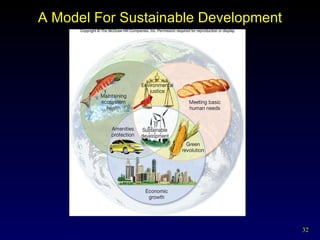
Sustainability is a Global Challenge Sustainable Development - use renewable resources in harmony with ecological systems Developing countries need access to more-efficient, less-polluting technologies Technology transfer and financial aid Poverty is at the core of many problems. The $350 billion/yr needed is small compared to the $1 trillion/yr spent on wars and military. Need to find compromise between no-growth and unlimited growth
A Model For Sustainable Development
Millennium Assessment Millennium Assessment done by the U.N. in 2000 All of us depend on ecosystems to provide conditions for decent life. We have made unprecedented demands on ecosystems to meet growing demands for food, water, fibers for clothing and energy. These changes improved humans but weakened nature’s ability to purify air and water, protect from disasters.
Millennium Assessment in 2000 Outstanding problems include the dire state of the world’s fish stocks, the vulnerability of people living in dry regions, and the growing threat of global warming and pollution. Human actions have taken the planet to the edge of a massive wave of extinctions. Loss of ecosystem services is a barrier to reducing poverty, hunger, and disease.
Millennium Assessment in 2000 Pressures on ecosystems will increase globally unless we change our actions. Conservation is more likely to succeed if local communities are given ownership. Today’s technology can reduce human impact, but it is unlikely to be deployed fully until we stop thinking of ecosystem services as free and limitless. Better protection of natural assets requires coordinated efforts of governments, business, and international institutions.

Chapt25 lecture

  • 1.
    William P. CunninghamUniversity of Minnesota Mary Ann Cunningham Vassar College Copyright © The McGraw-Hill Companies, Inc. Permission required for reproduction or display. *See PowerPoint Image Slides for all figures and tables pre-inserted into PowerPoint without notes. Chapter 25 Lecture Outline *
  • 2.
  • 3.
    Outline Environmental EducationEnvironmental Careers How Much is Enough? Green Consumerism Working Together Mainline and Radical Environmental Groups Campus Greening Sustainability is a Global Challenge Millennium Assessment What Then Shall We Do?
  • 4.
    Environmental Education In1990, Congress passed the National Education Act establishing two goals: Improve understanding among the general public of the natural and built environment and the relationships between humans and their environment Encourage post-secondary students to pursue careers related to the environment
  • 5.
  • 6.
    Environmental Literacy WilliamReilly , former EPA administrator, called for environmental literacy in which every citizen is fluent in the principles of ecology and has a working knowledge of the environment. Foster a stewardship ethic
  • 7.
  • 8.
    Citizen Science Ordinarypeople join with established scientists to answer real scientific questions Community-based research was pioneered in the Netherlands in when they combined researchers with students and neighborhood groups to work on research projects The Audubon Society sponsors a annual Christmas Bird Count. Earthwatch International and American River Watch are also examples of enlisting the public in scientific research projects.
  • 9.
    Environmental Careers Trainedpeople in environmental professions, at every level from support staff to managers to educators are essential, and those roles will only increase in importance. World Wildlife Fund estimates 750,000 new jobs in renewable energy in next 10 yrs Environmental law Environmental engineering Environmental education
  • 10.
    Green Business Canresource conservation and environmental awareness be an advantage in business? Most large companies have an environmental department. Companies are beginning to design with pollution control and waste disposal in mind. Huge market for pollution control technology
  • 11.
  • 12.
    How Much IsEnough? Veblen in Theory of the Leisure Class coined the term conspicuous consumption to describe buying things we do not need in order to impress others. The average American now consumes twice as many goods and services as in 1950 An average house in the U.S. is now more than twice as big as 50 years ago, even though the typical family has half the number of people. We need the additional space to hold all the stuff we buy.
  • 13.
    How Much IsEnough? Growing number of people find themselves stuck in a vicious cycle: Work frantically at a job they hate, to buy things they don’t need, so they can save time to work longer hours. Some, however, take a cue from Thoreau and are adopting more simple, less consumptive lifestyles.
  • 14.
  • 15.
    We Can ReduceOur Environmental Impacts Even small steps can have significant environmental effects: Switching from a diet high in red meat to a vegetarian one can save as much energy as trading in a normal car for a hybrid. It takes only about 2 calories of fossil fuel to grow one calorie of energy in a fruit or vegetable. The ratio is as high as 80 to 1 for cattle grown in confined feeding operations.
  • 16.
    “Green Washing” CanConfuse Consumers Many terms used in advertising are vague and have little meaning: Nontoxic, biodegradable, recyclable, natural, organic, environmentally friendly Several national programs scientifically analyze the environmental impacts of products. Blue Angel label in Germany Green Seal program in the U.S. The most comprehensive product analysis is called life cycle analysis , as it follows a product through its manufacture, use and disposal.
  • 17.
  • 18.
    Limits of GreenConsumerism Often, consumers are faced with complicated comparisons and choices. Paper or plastic grocery bags? Both have good and bad points, and represent trade-offs in energy use, pollution production, ability to recycle, etc. If you have both paper and plastic recycling, plastic is probably better because it is easier to recycle and produces less pollution. A better choice may be to take your own cloth bag.
  • 19.
    Limits of GreenConsumerism Focus on doing your best to recycle, buy green products, and be involved. Green consumerism generally can do little about larger issues of global equality, chronic poverty, and oppression in the Third World. There is a danger that an exclusive focus on our own small steps, such as recycling, may divert attention from greater environmental issues.
  • 20.
    How Can WeWork Together? Collective action can magnify the power of individuals. For this reason, many people join environmental or social action groups. Mainline Environmental Groups Include: National Wildlife Federation World Wildlife Fund The Audubon Society The Sierra Club Ducks Unlimited Natural Resources Defense Council The Wilderness Society
  • 21.
  • 22.
    Mainline Environmental GroupsMass membership, large professional staffs, and long history provide these groups a degree of respectability and influence not found in newer, smaller groups Mainline environmental organizations are often criticized by radical environmentalists for their tendency to compromise and cooperate with the establishment. These groups have local chapters, a good way for you to become involved
  • 23.
    Mainline Environmental GroupsSome groups have limited contact with members and focus instead on land acquisition, litigation and lobbying. Environmental Defense Fund Nature Conservancy National Resources Defense Council Wilderness Society
  • 24.
    Radical Groups CaptureMedia Attention Direct Action Groups Earth First! Sea Shepherd Greenpeace Often associated with deep ecology - profoundly biocentric worldview Use creative tactics such as street theater and civil disobedience How far should you go in disobeying rules to change public opinion?
  • 25.
  • 26.
    Non-governmental Organizations (NGOs)Rapid rise in international NGOs Rio Summit in 1992 had 30,000 representatives of environmental groups attending Carry out public education and consciousness-raising using protest marches and civil disobedience Conservation International does debt for nature swaps
  • 27.
    Campus Greening StudentEnvironmental Action Coalition (SEAC) is largest group with some 5000 chapters. Is there a chapter on your campus? Another important student organizing group is the network of Public Interest Research Groups. You can learn to organize, use media to get your message out. “ Step it Up” campaign about global warming was done via internet. Electronic environmentalism allowed them to organize more than 800 events.
  • 28.
    Schools Can BeEnvironmental Leaders Schools can do campus audits to study water and energy use, waste disposal, recycling, paper consumption, etc. New buildings should meet U.S. Green Building Council standards. It does not cost any more to build in an environmentally friendly way. At Carnegie Mellon in Pittsburgh, a kiosk in the dorm shows daily energy use and there are green dorms with natural lighting, clean air and few allergens.
  • 29.
    Colleges Showing EnvironmentalLeadership Dartmouth, Harvard, Stanford and Williams rank at the top for green policies. Berea College in Kentucky got special commendation. Berea’s ecovillage has a student designed house that produces its own electricity and treats waste water in a living system. College has a full time sustainability coordinator
  • 30.
    Your Campus CanReduce Energy Usage Your campus can reduce energy use by purchasing fuel efficient vehicles using green building standards purchasing energy from renewable sources buying locally produced foods
  • 31.
    Sustainability is aGlobal Challenge Sustainable Development - use renewable resources in harmony with ecological systems Developing countries need access to more-efficient, less-polluting technologies Technology transfer and financial aid Poverty is at the core of many problems. The $350 billion/yr needed is small compared to the $1 trillion/yr spent on wars and military. Need to find compromise between no-growth and unlimited growth
  • 32.
    A Model ForSustainable Development
  • 33.
    Millennium Assessment MillenniumAssessment done by the U.N. in 2000 All of us depend on ecosystems to provide conditions for decent life. We have made unprecedented demands on ecosystems to meet growing demands for food, water, fibers for clothing and energy. These changes improved humans but weakened nature’s ability to purify air and water, protect from disasters.
  • 34.
    Millennium Assessment in2000 Outstanding problems include the dire state of the world’s fish stocks, the vulnerability of people living in dry regions, and the growing threat of global warming and pollution. Human actions have taken the planet to the edge of a massive wave of extinctions. Loss of ecosystem services is a barrier to reducing poverty, hunger, and disease.
  • 35.
    Millennium Assessment in2000 Pressures on ecosystems will increase globally unless we change our actions. Conservation is more likely to succeed if local communities are given ownership. Today’s technology can reduce human impact, but it is unlikely to be deployed fully until we stop thinking of ecosystem services as free and limitless. Better protection of natural assets requires coordinated efforts of governments, business, and international institutions.