14-1
Service Delivery process:
14-2
Learning Outcomes:
• Examine the modes of service distribution in the modern
context
• Analyze the employee’s role in services delivery process of
organizations
• Evaluate the customer’s levels of participation in service
production and delivery using examples
• Ascertain the methods in managing customers as partial
employees to increase productivity in service delivery
process.
14-3
14-4
Service Distribution
Direct Delivery Of
Service.
Delivery of Service
through Intermediaries
14-5
Direct Delivery of Service
• Services are generally intangible &
experimental in nature.
• It allows the service principal (service
producer) to deliver the service directly to
the customer.
• Example-IBM Global Services.
14-6
Delivery of Service through
Intermediaries
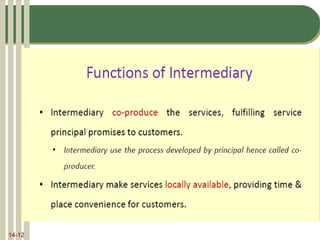
• Intermediaries often deliver services & perform
several imp. functions for service principals
(service producer).
• Services such as haircutting, dry cleaning, etc are
produced by the intermediaries (the franchisee)
using the process developed by the service
principal.
• The primary types of intermediaries
used in service delivery are
franchises, agents, brokers and
electronic channels.
14-7
Direct or Company–Owned
Channels
• In this services are distributed directly
from provider to the customer.
• Some of these are local services–doctors,
dry cleaners and hairstylists (their area of
distribution are limited).
• Others are national chains with multiple outlets
but are considered direct channels because the
provider owns all the outlets.
• Example- Starbucks, the popular chain of coffee
shops in United States.
14-8
Advantages
Advantages & Disadvantages
• The company has the complete control over the outlets and can
maintain consistency in service provision.
• Standards can be established & will be carried out as planned as
the company itself monitors & rewards proper execution of the
service.
• A final benefit of the company-owned channels is that the
company owns the customer relationship.
14-9
Advantages & Disadvantages
• The company must bear all the financial risk.
• When expanding, the firm must find all the capital.
• Partnering or joint venture is almost always
preferred to company-owned channels.
Disadvantages
14-10
Channel Flows
14-11
Options for Service Delivery
14-12
14-13
14-14
14-15
14-16
14-17
14-18
Channel as Partnership
Cooperation Collaboration
Relationship
Marketing
Coordination
14-19
Franchising
Franchising
Most common type of distribution
in services
Franchising is a relationship or partnering in
which the service provider– the franchiser-develops
& optimizes a service format that it licenses for
delivery by other parties- the franchisees
14-20
Agents And Brokers
• An Agent is an intermediary who acts on behalf of a
service principal (such as real estate agent) or a
customer and is authorized to make agreements between
the principal and the customer.
• A Broker is an intermediary who brings buyers and
sellers together while assisting in negotiation. Brokers
are paid by the party who hired them, rarely become
involved in financing or assuming risk and are not long-
term representatives of buyers or sellers.
• Examples- Real estate brokers,
Insurance brokers, Security brokers.
14-21
Electronic Channels
• Electronic channels are the only service
distributors that do not require direct human
interaction.
• Examples- Telephone, Television channels,
Internet and Web.
14-22
Benefits
• Consistent Delivery for standardized services.
• Low Cost.
• Customer Convenience.
• Wide distribution.
• Customer choice and ability to customize
• Quick Customer feedback
14-23
Challenges
• Price Competition.
• Changes in Consumer Behavior.
• Security Concerns.
• Refusal to deal.
• Exclusive Territory.
14-24
CUSTOMER
COMPANY
Service delivery
Gap 3: The
Service
Performance Gap
Customer-driven
service designs
and standards
Provider Gap 3
11-24
14-25
Key Factors Leading to Provider Gap 3
11-25
14-26
Employees’ Roles in Service
Delivery
• Service Culture
• The Critical Importance of Service
Employees
• Boundary-Spanning Roles
• Strategies for Delivering Service Quality
Through People
• Customer-Oriented Service Delivery
11-26
14-27
Service Culture
“A culture where an appreciation for good
service exists, and where giving good
service to internal as well as ultimate,
external customers, is considered a natural
way of life and one of the most important
norms by everyone in the organization.”
- Christian Grönroos
11-27
14-28
The Critical Importance of Service
Employees
• They are the service.
• They are the organization in the customer’s eyes.
• They are the brand.
• They are marketers.
• Their importance is evident in:
– the services marketing mix (people)
– the service-profit chain
– the services triangle
11-28
14-29
The Service Marketing Triangle
11-29
14-30
The Service Marketing Triangle
Internal Marketing
Interactive Marketing
External Marketing
Company
(Management)
Customers
Providers
“Enabling the
promise”
“Delivering the promise”
“Making the
promise”
Source: Adapted from Mary Jo Bitner, Christian Gronroos, and Philip Kotler 11-30
14-31
Aligning the Triangle
• Organizations that seek to provide
consistently high levels of service
excellence will continuously work to align
the three sides of the triangle.
• Aligning the sides of the triangle is an
ongoing process.
11-31
14-32
Services Marketing Triangle
Applications Exercise
• Focus on a service organization. In the context
you are focusing on, who occupies each of the
three points of the triangle?
• How is each type of marketing being carried out
currently?
• Are the three sides of the triangle well aligned?
• Are there specific challenges or barriers in any of
the three areas?
11-32
14-33
Making Promises
• Understanding customer needs
• Managing expectations
• Traditional marketing communications
• Sales and promotion
• Advertising
• Internet and web site communication
11-33
14-34
Keeping Promises
• Service delivery
– Reliability, responsiveness, empathy, assurance,
tangibles, recovery, flexibility
• Face-to-face, telephone & online
interactions
• The Customer Experience
• Customer interactions with sub-contractors
or business partners
• The “moment of truth”
11-34
14-35
Enabling Promises
• Hiring the right people
• Training and developing people to deliver
service
• Employee empowerment
• Support systems
• Appropriate technology and equipment
• Rewards and incentives
11-35
14-36
Ways to Use the
Services Marketing Triangle
• Overall Strategic
Assessment
– How is the service
organization doing on all
three sides of the triangle?
– Where are the
weaknesses?
– What are the strengths?
• Specific Service
Implementation
– What is being promoted
and by whom?
– How will it be delivered
and by whom?
– Are the supporting systems
in place to deliver the
promised service?
11-36
14-37
The Service Profit Chain
11-37
14-38
Boundary Spanners Interact with Both Internal
and External Constituents
11-38
14-39
Boundary-spanning Roles
• Boundary spanners:
– Provide a critical link between the external
customer environment and the internal
operations of the organization
– Serve a critical function in understanding,
filtering, interpreting information and resources
to and from the organization and its external
constituencies
– High stress!!!
11-39
14-40
Boundary-spanning Roles
• What are these jobs like?
– Emotional labor
• The labor that goes beyond the physical or mental
skills needed to deliver quality service.
• Often requires suppression of true feelings
– Many sources of potential conflict
• person/role
• organization/client
• interclient
– Quality/productivity tradeoffs
11-40
14-41
Strategies for Delivering Service Quality
through People
11-41
14-42
Strategies for Delivering Service
Quality through People
• Hire the right people
• Compete for the best people
• Hire for service competencies and service inclination
• Be the preferred employer
• Develop people to deliver service quality
• Train for technical and interactive skills
• Empower employees
• Promote teamwork
11-42
14-43
Benefits and Costs of Empowerment
• Benefits:
– Quicker responses to customer
needs during service delivery
– Quicker responses to
dissatisfied customers during
service recovery
– Employees feel better about
their jobs and themselves
– Employees tend to interact with
warmth/enthusiasm
– Empowered employees are a
great source of ideas
– Great word-of-mouth
advertising from customers
• Costs:
– Potentially greater dollar
investment in selection and
training
– Higher labor costs
– Potentially slower or
inconsistent service delivery
– May violate customers’
perceptions of fair play
– Employees may “give away the
store” or make bad decisions
11-43
14-44
Strategies for Delivering Service
Quality through People (continued)
• Provide needed support systems
• Measure internal service quality
• Provide supportive technology and equipment
• Develop service-oriented internal processes
• Retain the best people
• Include employees in the company’s vision
• Treat employees as customers
• Measure and reward strong service performers
11-44
14-45
Traditional Organizational Chart
Manager
Supervisor
Front-
line
Employe
e
Customers
Front-
line
Employe
e
Front-
line
Employe
e
Front-
line
Employe
e
Supervisor
Front-
line
Employe
e
Front-
line
Employe
e
Front-
line
Employe
e
Front-
line
Employe
e
11-45
14-46
Customer-Focused Organizational
Chart
11-46
14-47
Inverted Services Marketing
Triangle
11-47
14-48
CUSTOMERS’ ROLE IN
SERVICE DELIVERY
1. Service is all about experience.
2. In “ The future of competition” Venkat Ramaswamy says
active customer interaction creates a far higher value than a
static product offer. Its not just about putting customer at the
centre, but experience. Its about creating value together.
14-49
CUSTOMERS’ ROLE IN
SERVICE DELIVERY
3. Service delivery is all about customer driven approach, unlike the 4P’s
approach which is product driven focusing on 4A’s : Awareness,
Availability, Accessibility, Affordability
• Customers play a very vital role in successful delivery of service as
customers are often present in the place where service is produced
(Delivered)
• Customers alone can influence whether the delivered service is as per
customer defined specifications.
• Other customers who are present in the Service scape can also influence
the Service positively or negatively.
14-50
Customer Roles in Service Delivery
Productive Resources
Contributors to
Quality and
Satisfaction
Competitors
14-51
Customers as Productive
Resources
• “partial employees”
– contributing effort, time, or other resources
to the production process
• customer inputs can affect
organization’s productivity
• key issue:
– should customers’ roles be expanded?
reduced?
14-52
Customers as Contributors to Service
Quality and Satisfaction
• Customers can contribute to
– their own satisfaction with the service
• by performing their role effectively
• by working with the service provider
– the quality of the service they receive
• by asking questions
• by taking responsibility for their own satisfaction
• by complaining when there is a service failure
14-53
Customers as Competitors
• customers may “compete” with the service
provider
• “internal exchange” vs. “external exchange”
• internal/external decision often based on:
– expertise
– resources
– time
– economic rewards
– psychic rewards
– trust
– control
14-54
Levels Of Customer Participation
14-55
THE IMPORTANCE OF
CUSTOMERS IN SERVICE
DELIVERY
Low: Consumer Presence
Required during Service
Delivery
Products are standardized
Service is provided
regardless of any individual
purchase
Payment may be the
Only required customer
Input.
End Consumer Examples
Airline travel
Motel stay
Fast-food restaurant
Business–to Business
Customer Examples
Uniform cleaning service
Pest control
Interior greenery maintenance
service
Moderate: Consumer Input
Required for Service Creation
Client inputs customize a standard
service
Provision of service requires customer
Purchase
Customer inputs ( information materials)
Are necessary for an adequate outcome,
but the service firm provides the service
Haircut
Annual Physical exam
Full-service restaurant
Agency created advertising
Campaigning
Payroll service
Freight transportation
High: Customer Co creates the
Service Product
Active client participation guides the
customized service.
Service cannot be created apart from the
customer’s purchase and active
participation.
Customer inputs are mandatory
And cocreate the outcome.
Marriage Counseling
Personal training
Weight reduction program
Major illness or surgery
Management consulting
Executive Management seminar
Installation of computer network.
Level of Customer Participation:
14-56
LEVEL OF CUSTOMER
PARTICIPATION
• The level of participation of customers varies from Service to
Service.
• In “High level of participation.” Eg. B to B projects like
providing software solutions & consultancies.
• In “Moderate level of participation” customers inputs are
necessary to facilitate effective delivery of service.
14-57
LEVEL OF CUSTOMER
PARTICIPATION
• In entertainment service very “low level of participation” is
required. Service provider provides the Service & only the
customer’s presence is required to avail the service
• In many Service deliveries other customers also affect the
service delivery in a positive or negative way. This can
influence the customer’s perceptions of Service quality and
affect customer satisfaction.
14-58
HOW CUSTOMERS WIDEN GAP
3
• Lack of understanding of their roles
• Not being willing or able to perform their roles
• No rewards for “good performance”
• Interfering with other customers
• Incompatible market segments
14-59
STRATEGIES FOR ENHANCING
CUSTOMER PARTICIPATION
14-60
STRATEGIES FOR ENHANCING
CUSTOMER PARTICIPATION
 Define customers’ job
1. Helping oneself: through active participation,
customers may become productive resources.
2. Helping others: mentoring programs in university.
3. Promoting the company: recommendation
4. Individual differences: not every one want to
participate
14-61
STRATEGIES FOR ENHANCING
CUSTOMER PARTICIPATION
 Recruit, educate and reward customers
1. Recruit the right customers who are comfortable
with roles and communicate responsibilities.
2. Educate and train customers through socializing
org. values, abilities and skills, customer orientation
(universities), customer education (hospitals) and
customer information (McDonald's)
3. Reward customers for their contributions
4. Avoid negative outcomes of inappropriate customer
participation
14-62
STRATEGIES FOR ENHANCING
CUSTOMER PARTICIPATION
 Manage the customer mix
Compatibility management: a process of first attracting
homogeneous consumers to the service environment, then
actively managing both the physical environment and
customer to customer encounters in such a way as to
enhance satisfying encounters and minimizing
dissatisfying customers.
Strategies:
1. Homogeneous customers
2. Locational proximity
3. Codes of conduct ( dresses and smoking attitudes)
14-63
Customers as Partial Employees

Service delivery process.pdf process delivery

  • 1.
  • 2.
    14-2 Learning Outcomes: • Examinethe modes of service distribution in the modern context • Analyze the employee’s role in services delivery process of organizations • Evaluate the customer’s levels of participation in service production and delivery using examples • Ascertain the methods in managing customers as partial employees to increase productivity in service delivery process.
  • 3.
  • 4.
    14-4 Service Distribution Direct DeliveryOf Service. Delivery of Service through Intermediaries
  • 5.
    14-5 Direct Delivery ofService • Services are generally intangible & experimental in nature. • It allows the service principal (service producer) to deliver the service directly to the customer. • Example-IBM Global Services.
  • 6.
    14-6 Delivery of Servicethrough Intermediaries • Intermediaries often deliver services & perform several imp. functions for service principals (service producer). • Services such as haircutting, dry cleaning, etc are produced by the intermediaries (the franchisee) using the process developed by the service principal. • The primary types of intermediaries used in service delivery are franchises, agents, brokers and electronic channels.
  • 7.
    14-7 Direct or Company–Owned Channels •In this services are distributed directly from provider to the customer. • Some of these are local services–doctors, dry cleaners and hairstylists (their area of distribution are limited). • Others are national chains with multiple outlets but are considered direct channels because the provider owns all the outlets. • Example- Starbucks, the popular chain of coffee shops in United States.
  • 8.
    14-8 Advantages Advantages & Disadvantages •The company has the complete control over the outlets and can maintain consistency in service provision. • Standards can be established & will be carried out as planned as the company itself monitors & rewards proper execution of the service. • A final benefit of the company-owned channels is that the company owns the customer relationship.
  • 9.
    14-9 Advantages & Disadvantages •The company must bear all the financial risk. • When expanding, the firm must find all the capital. • Partnering or joint venture is almost always preferred to company-owned channels. Disadvantages
  • 10.
  • 11.
  • 12.
  • 13.
  • 14.
  • 15.
  • 16.
  • 17.
  • 18.
    14-18 Channel as Partnership CooperationCollaboration Relationship Marketing Coordination
  • 19.
    14-19 Franchising Franchising Most common typeof distribution in services Franchising is a relationship or partnering in which the service provider– the franchiser-develops & optimizes a service format that it licenses for delivery by other parties- the franchisees
  • 20.
    14-20 Agents And Brokers •An Agent is an intermediary who acts on behalf of a service principal (such as real estate agent) or a customer and is authorized to make agreements between the principal and the customer. • A Broker is an intermediary who brings buyers and sellers together while assisting in negotiation. Brokers are paid by the party who hired them, rarely become involved in financing or assuming risk and are not long- term representatives of buyers or sellers. • Examples- Real estate brokers, Insurance brokers, Security brokers.
  • 21.
    14-21 Electronic Channels • Electronicchannels are the only service distributors that do not require direct human interaction. • Examples- Telephone, Television channels, Internet and Web.
  • 22.
    14-22 Benefits • Consistent Deliveryfor standardized services. • Low Cost. • Customer Convenience. • Wide distribution. • Customer choice and ability to customize • Quick Customer feedback
  • 23.
    14-23 Challenges • Price Competition. •Changes in Consumer Behavior. • Security Concerns. • Refusal to deal. • Exclusive Territory.
  • 24.
    14-24 CUSTOMER COMPANY Service delivery Gap 3:The Service Performance Gap Customer-driven service designs and standards Provider Gap 3 11-24
  • 25.
    14-25 Key Factors Leadingto Provider Gap 3 11-25
  • 26.
    14-26 Employees’ Roles inService Delivery • Service Culture • The Critical Importance of Service Employees • Boundary-Spanning Roles • Strategies for Delivering Service Quality Through People • Customer-Oriented Service Delivery 11-26
  • 27.
    14-27 Service Culture “A culturewhere an appreciation for good service exists, and where giving good service to internal as well as ultimate, external customers, is considered a natural way of life and one of the most important norms by everyone in the organization.” - Christian Grönroos 11-27
  • 28.
    14-28 The Critical Importanceof Service Employees • They are the service. • They are the organization in the customer’s eyes. • They are the brand. • They are marketers. • Their importance is evident in: – the services marketing mix (people) – the service-profit chain – the services triangle 11-28
  • 29.
  • 30.
    14-30 The Service MarketingTriangle Internal Marketing Interactive Marketing External Marketing Company (Management) Customers Providers “Enabling the promise” “Delivering the promise” “Making the promise” Source: Adapted from Mary Jo Bitner, Christian Gronroos, and Philip Kotler 11-30
  • 31.
    14-31 Aligning the Triangle •Organizations that seek to provide consistently high levels of service excellence will continuously work to align the three sides of the triangle. • Aligning the sides of the triangle is an ongoing process. 11-31
  • 32.
    14-32 Services Marketing Triangle ApplicationsExercise • Focus on a service organization. In the context you are focusing on, who occupies each of the three points of the triangle? • How is each type of marketing being carried out currently? • Are the three sides of the triangle well aligned? • Are there specific challenges or barriers in any of the three areas? 11-32
  • 33.
    14-33 Making Promises • Understandingcustomer needs • Managing expectations • Traditional marketing communications • Sales and promotion • Advertising • Internet and web site communication 11-33
  • 34.
    14-34 Keeping Promises • Servicedelivery – Reliability, responsiveness, empathy, assurance, tangibles, recovery, flexibility • Face-to-face, telephone & online interactions • The Customer Experience • Customer interactions with sub-contractors or business partners • The “moment of truth” 11-34
  • 35.
    14-35 Enabling Promises • Hiringthe right people • Training and developing people to deliver service • Employee empowerment • Support systems • Appropriate technology and equipment • Rewards and incentives 11-35
  • 36.
    14-36 Ways to Usethe Services Marketing Triangle • Overall Strategic Assessment – How is the service organization doing on all three sides of the triangle? – Where are the weaknesses? – What are the strengths? • Specific Service Implementation – What is being promoted and by whom? – How will it be delivered and by whom? – Are the supporting systems in place to deliver the promised service? 11-36
  • 37.
  • 38.
    14-38 Boundary Spanners Interactwith Both Internal and External Constituents 11-38
  • 39.
    14-39 Boundary-spanning Roles • Boundaryspanners: – Provide a critical link between the external customer environment and the internal operations of the organization – Serve a critical function in understanding, filtering, interpreting information and resources to and from the organization and its external constituencies – High stress!!! 11-39
  • 40.
    14-40 Boundary-spanning Roles • Whatare these jobs like? – Emotional labor • The labor that goes beyond the physical or mental skills needed to deliver quality service. • Often requires suppression of true feelings – Many sources of potential conflict • person/role • organization/client • interclient – Quality/productivity tradeoffs 11-40
  • 41.
    14-41 Strategies for DeliveringService Quality through People 11-41
  • 42.
    14-42 Strategies for DeliveringService Quality through People • Hire the right people • Compete for the best people • Hire for service competencies and service inclination • Be the preferred employer • Develop people to deliver service quality • Train for technical and interactive skills • Empower employees • Promote teamwork 11-42
  • 43.
    14-43 Benefits and Costsof Empowerment • Benefits: – Quicker responses to customer needs during service delivery – Quicker responses to dissatisfied customers during service recovery – Employees feel better about their jobs and themselves – Employees tend to interact with warmth/enthusiasm – Empowered employees are a great source of ideas – Great word-of-mouth advertising from customers • Costs: – Potentially greater dollar investment in selection and training – Higher labor costs – Potentially slower or inconsistent service delivery – May violate customers’ perceptions of fair play – Employees may “give away the store” or make bad decisions 11-43
  • 44.
    14-44 Strategies for DeliveringService Quality through People (continued) • Provide needed support systems • Measure internal service quality • Provide supportive technology and equipment • Develop service-oriented internal processes • Retain the best people • Include employees in the company’s vision • Treat employees as customers • Measure and reward strong service performers 11-44
  • 45.
  • 46.
  • 47.
  • 48.
    14-48 CUSTOMERS’ ROLE IN SERVICEDELIVERY 1. Service is all about experience. 2. In “ The future of competition” Venkat Ramaswamy says active customer interaction creates a far higher value than a static product offer. Its not just about putting customer at the centre, but experience. Its about creating value together.
  • 49.
    14-49 CUSTOMERS’ ROLE IN SERVICEDELIVERY 3. Service delivery is all about customer driven approach, unlike the 4P’s approach which is product driven focusing on 4A’s : Awareness, Availability, Accessibility, Affordability • Customers play a very vital role in successful delivery of service as customers are often present in the place where service is produced (Delivered) • Customers alone can influence whether the delivered service is as per customer defined specifications. • Other customers who are present in the Service scape can also influence the Service positively or negatively.
  • 50.
    14-50 Customer Roles inService Delivery Productive Resources Contributors to Quality and Satisfaction Competitors
  • 51.
    14-51 Customers as Productive Resources •“partial employees” – contributing effort, time, or other resources to the production process • customer inputs can affect organization’s productivity • key issue: – should customers’ roles be expanded? reduced?
  • 52.
    14-52 Customers as Contributorsto Service Quality and Satisfaction • Customers can contribute to – their own satisfaction with the service • by performing their role effectively • by working with the service provider – the quality of the service they receive • by asking questions • by taking responsibility for their own satisfaction • by complaining when there is a service failure
  • 53.
    14-53 Customers as Competitors •customers may “compete” with the service provider • “internal exchange” vs. “external exchange” • internal/external decision often based on: – expertise – resources – time – economic rewards – psychic rewards – trust – control
  • 54.
  • 55.
    14-55 THE IMPORTANCE OF CUSTOMERSIN SERVICE DELIVERY Low: Consumer Presence Required during Service Delivery Products are standardized Service is provided regardless of any individual purchase Payment may be the Only required customer Input. End Consumer Examples Airline travel Motel stay Fast-food restaurant Business–to Business Customer Examples Uniform cleaning service Pest control Interior greenery maintenance service Moderate: Consumer Input Required for Service Creation Client inputs customize a standard service Provision of service requires customer Purchase Customer inputs ( information materials) Are necessary for an adequate outcome, but the service firm provides the service Haircut Annual Physical exam Full-service restaurant Agency created advertising Campaigning Payroll service Freight transportation High: Customer Co creates the Service Product Active client participation guides the customized service. Service cannot be created apart from the customer’s purchase and active participation. Customer inputs are mandatory And cocreate the outcome. Marriage Counseling Personal training Weight reduction program Major illness or surgery Management consulting Executive Management seminar Installation of computer network. Level of Customer Participation:
  • 56.
    14-56 LEVEL OF CUSTOMER PARTICIPATION •The level of participation of customers varies from Service to Service. • In “High level of participation.” Eg. B to B projects like providing software solutions & consultancies. • In “Moderate level of participation” customers inputs are necessary to facilitate effective delivery of service.
  • 57.
    14-57 LEVEL OF CUSTOMER PARTICIPATION •In entertainment service very “low level of participation” is required. Service provider provides the Service & only the customer’s presence is required to avail the service • In many Service deliveries other customers also affect the service delivery in a positive or negative way. This can influence the customer’s perceptions of Service quality and affect customer satisfaction.
  • 58.
    14-58 HOW CUSTOMERS WIDENGAP 3 • Lack of understanding of their roles • Not being willing or able to perform their roles • No rewards for “good performance” • Interfering with other customers • Incompatible market segments
  • 59.
  • 60.
    14-60 STRATEGIES FOR ENHANCING CUSTOMERPARTICIPATION  Define customers’ job 1. Helping oneself: through active participation, customers may become productive resources. 2. Helping others: mentoring programs in university. 3. Promoting the company: recommendation 4. Individual differences: not every one want to participate
  • 61.
    14-61 STRATEGIES FOR ENHANCING CUSTOMERPARTICIPATION  Recruit, educate and reward customers 1. Recruit the right customers who are comfortable with roles and communicate responsibilities. 2. Educate and train customers through socializing org. values, abilities and skills, customer orientation (universities), customer education (hospitals) and customer information (McDonald's) 3. Reward customers for their contributions 4. Avoid negative outcomes of inappropriate customer participation
  • 62.
    14-62 STRATEGIES FOR ENHANCING CUSTOMERPARTICIPATION  Manage the customer mix Compatibility management: a process of first attracting homogeneous consumers to the service environment, then actively managing both the physical environment and customer to customer encounters in such a way as to enhance satisfying encounters and minimizing dissatisfying customers. Strategies: 1. Homogeneous customers 2. Locational proximity 3. Codes of conduct ( dresses and smoking attitudes)
  • 63.